 夜雨聆风
夜雨聆风


This 700-Word "Rant" Reveals the Helpless Self-Rescue of the Service Industry After Long-Term Suppression
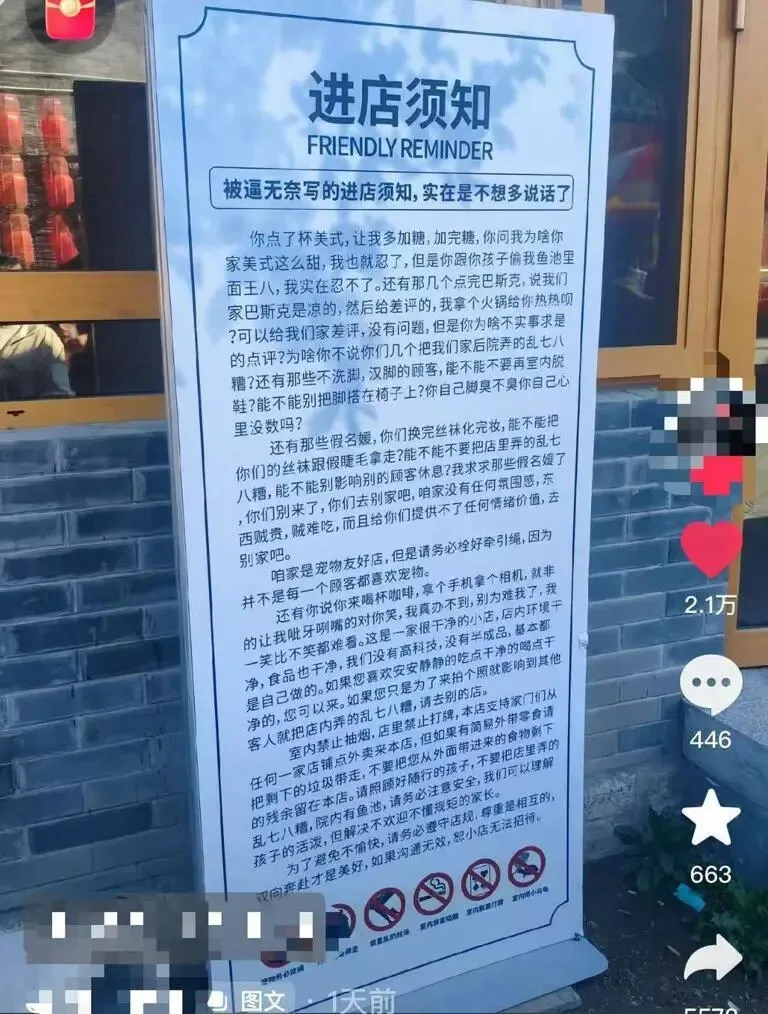
According to Jimu News, a café’s in-store rules in Qingzhou Ancient City, Weifang, have recently sparked heated online discussions. The 700-word notice includes standard prohibitions such as no indoor smoking and no card playing indoors, alongside unusual rules like “no discarding stockings randomly” and “no catching small turtles indoors.” These rules have piqued many netizens’ curiosity and earned widespread empathy for the shop owner.
Mr. Liu, the café owner, stated that every item listed is based on real incidents. For example, some customers smoked, played cards, took off their shoes and propped their feet on stools indoors; some poured tea water and sunflower seed shells into fish ponds; even some “pretentious socialites” changed stockings, put on makeup in the store, and left behind discarded stockings and false eyelashes without a second thought. Such rules have exposed the “uncivilized misbehavior” hidden behind the café’s warm appearance, a stark wake-up call to many.
Commentary: A Café Posts 700-Word In-Store Rules — Who Drove This “Rant”?
While the emotional value a café provides can be diverse, any act of creating such value must abide by social etiquette. It is clear that the shop owner has tried his best to accommodate and endure during operation to satisfy customers. Issuing this “manifesto-like” in-store notice is not due to a lack of tolerance, but because further suppression would likely harm his mental health. If that is the case, what is the point of running the shop? What is the point of tolerating uncivilized behavior?
Mr. Liu is far from the only business owner driven “crazy” by uncivilized customers. In daily life, behaviors such as occupying seats without ordering, making loud noises, scribbling on facilities, and letting pets sit on dining tables are common in catering establishments.
When such behaviors reach a breaking point, they severely damage the environment and image of the venue and ruin other customers’ dining experience. For a catering business run with passion and dreams, this persistent situation can be fatal. Under such circumstances, it is neither surprising nor excessive for operators to say no to uncivilized behavior and “draw a line” with customers lacking basic etiquette.
Therefore, this 700-word “rant” represents the helpless self-rescue of the service industry after enduring long-term repression. This form of self-rescue may be blunt, even “excessive” as some netizens put it, and may even backfire — Mr. Liu claimed he has been “severely criticized” by many customers, which is proof enough. Yet this act deserves understanding from more people.
Notably, the prevalence of uncivilized behavior in some areas stems from a distorted consumer mentality. For a long time, some consumers believe their arbitrary demands deserve no criticism, and it is the shop’s “uncooperativeness” that is to blame. It seems as if the service industry should unconditionally meet their every request, no matter how unreasonable. However, forcing the service industry to offer extra “tolerance” beyond its core business and bear the consequences is not what a civilized business ecosystem should look like.
Although issuing such strongly worded rules is a way to “select” customers — retaining polite and quality patrons while filtering out uncivilized ones — it is worth noting that the shop has actually left an opportunity for everyone. At its core, this move is a call for mutual respect and understanding between the business and all consumers.
Of course, achieving this expectation is no easy task, and it may even affect business due to criticism. Yet it is an unavoidable step forward.