 夜雨聆风
夜雨聆风
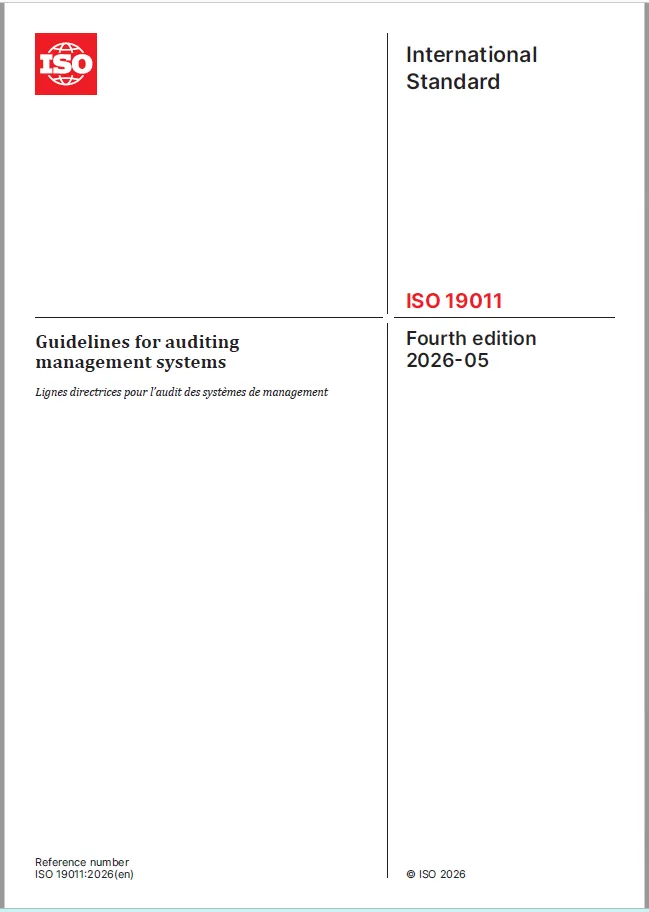
ISO 19011-2026【PDF原文+中文翻译版】
原文英文标题:Guidelines for auditing management systems
中文翻译标题:管理体系审核指南
Foreword
ISO (the International Organization for Standardization) is a worldwide federation of national standards bodies (ISO member bodies). The work of preparing International Standards is normally carried out through ISO technical committees. Each member body interested in a subject for which a technical committee has been established has the right to be represented on that committee. International organizations, governmental and non-governmental, in liaison with ISO, also take part in the work. ISO collaborates closely with the International Electrotechnical Commission (IEC) on all matters of electrotechnical standardization.
The procedures used to develop this document and those intended for its further maintenance are described in the ISO/IEC Directives, Part 1. In particular, the different approval criteria needed for the different types of ISO document should be noted. This document was drafted in accordance with the editorial rules of the ISO/IEC Directives, Part 2 (see www.iso.org/directives).
ISO draws attention to the possibility that the implementation of this document may involve the use of (a) patent(s). ISO takes no position concerning the evidence, validity or applicability of any claimed patent rights in respect thereof. As of the date of publication of this document, ISO had not received notice of (a) patent(s) which may be required to implement this document. However, implementers are cautioned that this may not represent the latest information, which may be obtained from the patent database available at www.iso.org/patents. ISO shall not be held responsible for identifying any or all such patent rights.
Any trade name used in this document is information given for the convenience of users and does not constitute an endorsement.
For an explanation of the voluntary nature of standards, the meaning of ISO specific terms and expressions related to conformity assessment, as well as information about ISO’s adherence to the World Trade Organization (WTO) principles in the Technical Barriers to Trade (TBT), see www.iso.org/iso/foreword.html.
This document was prepared by Project Committee ISO/PC 302, Guidelines for auditing management systems, in collaboration with the European Committee for Standardization (CEN) Technical Committee CEN/CLC/JTC 1, Criteria for conformity assessment bodies, in accordance with the Agreement on technical cooperation between ISO and CEN (Vienna Agreement).
This fourth edition cancels and replaces the third edition (ISO 19011:2018), which has been technically revised.
The main changes are as follows:
— expansion of guidance on remote auditing methods through the introduction of guidance contained in ISO/IEC TS 17012;
— expansion of Annex A to provide guidance on remote auditing methods and virtual locations.
Any feedback or questions on this document should be directed to the user’s national standards body. A complete listing of these bodies can be found at www.iso.org/members.html.
Introduction
Since the third edition of this document was published in 2018, several management system standards have been published in new fields. Most of them have a common structure, identical core requirements, and common terms and core definitions. As a result, there is a need to consider a broader approach to management system auditing, as well as to provide guidance that is more generic.
This document provides guidance which can be applied to audit against a range of audit criteria (separately or in combination) including, but not limited to:
— requirements specified in one or more management system standards;
— policies, processes and requirements specified by the organization or other relevant interested parties;
— statutory and regulatory requirements;
— one or more management system processes defined by the organization and/or other parties;
— management system plan(s) relating to the provision of specific results of a management system (e.g. quality plan, project plan).
This document provides guidance for all organizations regardless of their size and type, and audits of varying scopes. This includes those conducted by large audit teams, typically of larger organizations, and those by single auditors, whether in large or small organizations. This guidance should be adapted as appropriate to the scope and complexity of the audit programme.
This document concentrates on internal audits (first party) and audits conducted by organizations on their external providers and other external interested parties (second party). This document can also be useful for external audits conducted for purposes other than third-party management system certification. ISO/IEC 17021-1 provides requirements for auditing management systems for third-party certification; however, this document can provide useful additional guidance (see Table 1).
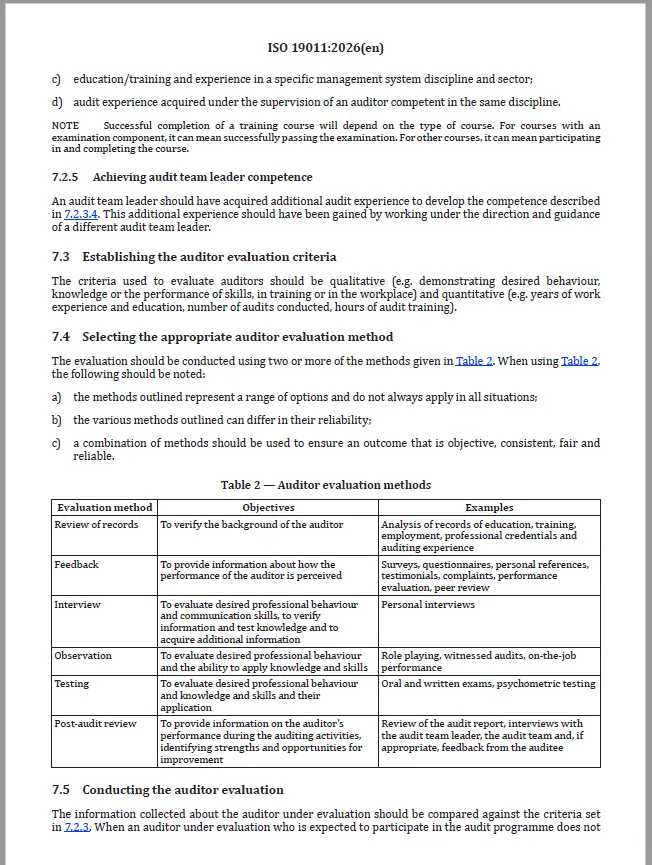
Table 1 — Different types of audits
First party Second party Third party
Internal audit External provider audit Certification audit or accreditation assessment
Audit by the external interested party of an organization Statutory, regulatory and similar audit
ISO/IEC TS 17012 addresses the growing need for remote auditing methods. Its aim is to provide guidance on implementing remote auditing methods effectively while supporting the general principles of auditing as outlined in this document.
To simplify the readability of this document, the singular form of “management system” is preferred, but the reader can adapt the implementation of the guidance to their own situation. This also applies to the use of “individual” and “individuals”, “auditor” and “auditors”.
This document is intended to apply to a broad range of potential users, including auditors, organizations implementing management systems and organizations needing to conduct management system audits for contractual or regulatory reasons. The guidance in this document can be applied to users in developing their own audit-related requirements.
The guidance in this document can also be used for the purpose of self-declaration and can be useful to organizations involved in the training, qualification and certification of persons participating in the audit programme.
The guidance in this document is intended to be flexible. As indicated at various points in the text, the use of this guidance can differ depending on the size and level of maturity of an organization’s management system. The nature and complexity of the organization to be audited, as well as the objectives and scope of the audits to be conducted, should also be considered.
This document adopts the combined audit approach when two or more management systems of different disciplines are audited together. Where these systems are integrated into a single management system, the principles and processes of auditing are the same as for a combined audit (sometimes known as an “integrated audit”).
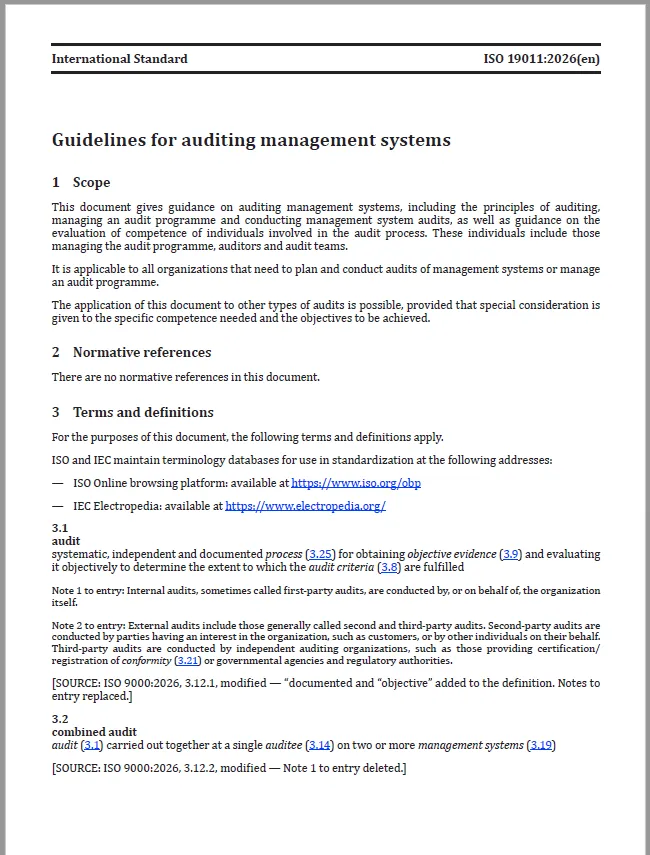
1 Scope
This document gives guidance on auditing management systems, including the principles of auditing, managing an audit programme and conducting management system audits, as well as guidance on the evaluation of competence of individuals involved in the audit process. These individuals include those managing the audit programme, auditors and audit teams.
It is applicable to all organizations that need to plan and conduct audits of management systems or manage an audit programme.
The application of this document to other types of audits is possible, provided that special consideration is given to the specific competence needed and the objectives to be achieved.
2 Normative references
There are no normative references in this document.
3 Terms and definitions
For the purposes of this document, the following terms and definitions apply.
ISO and IEC maintain terminology databases for use in standardization at the following addresses:
— ISO Online browsing platform: available at https://www.iso.org/obp
— IEC Electropedia: available at https://www.electropedia.org/
3.1
audit
systematic, independent and documented process (3.25) for obtaining objective evidence (3.9) and evaluating it objectively to determine the extent to which the audit criteria (3.8) are fulfilled
Note 1 to entry: Internal audits, sometimes called first-party audits, are conducted by, or on behalf of, the organization itself.
Note 2 to entry: External audits include those generally called second and third-party audits. Second-party audits are conducted by parties having an interest in the organization, such as customers, or by other individuals on their behalf. Third-party audits are conducted by independent auditing organizations, such as those providing certification/registration of conformity (3.21) or governmental agencies and regulatory authorities.
[SOURCE:ISO 9000:2026, 3.12.1, modified — “documented and “objective” added to the definition. Notes to entry replaced.]
3.2
combined audit
audit (3.1) carried out together at a single auditee (3.14) on two or more management systems (3.19)
[SOURCE:ISO 9000:2026, 3.12.2, modified — Note 1 to entry deleted.]
3.3
joint audit
audit (3.1) carried out at a single auditee (3.14) by two or more auditing organizations
[SOURCE:ISO 9000:2026, 3.12.3]
3.4
remote auditing method
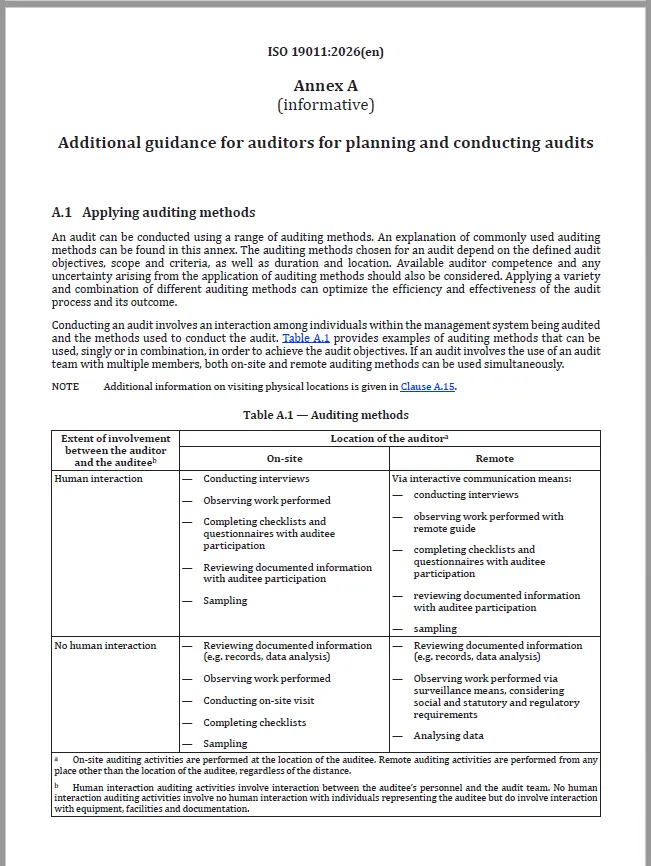
method used for conducting audit activities from any place other than the location of the auditee (3.14)
Note 1 to entry: Remote auditing methods can be used in combination with on-site methods to achieve a full and effective audit (3.1).
Note 2 to entry: Remote auditing methods can be used for virtual locations, i.e. where an organization performs work or provides a service using an online environment, enabling individuals to execute processes (3.25) irrespective of physical locations.
Note 3 to entry: Remote auditing methods can be used by the auditor (3.16) at one site of the auditee to audit another site.
[SOURCE:ISO/IEC TS 17012:2024, 3.1]
3.5
audit programme
arrangements for a set of one or more audits (3.1) planned for a specific time frame and directed towards a specific purpose
3.6
audit scope
extent and boundaries of an audit (3.1)
Note 1 to entry: The audit scope generally includes a description of the physical and virtual locations (see 3.4, Note 2 to entry), functions, organizational units, activities and processes (3.25), as well as the time period covered.
3.7
audit plan
description of the activities and arrangements for an audit (3.1)
3.8
audit criteria
set of requirements (3.24) used as a reference against which objective evidence (3.9) is compared
Note 1 to entry: If the audit criteria are legal (including statutory or regulatory) requirements, the words “compliance” or “non-compliance” are often used in an audit finding (3.11).
Note 2 to entry: Requirements may include policies, procedures, work instructions, legal requirements, contractual obligations, industry standards, etc.
3.9
objective evidence
data supporting the existence or verity of something
Note 1 to entry: Objective evidence can be obtained through observation, measurement, test or by other means.
[SOURCE:ISO 9000:2026, 3.8.6, modified — Note 2 to entry deleted.]
3.10
audit evidence
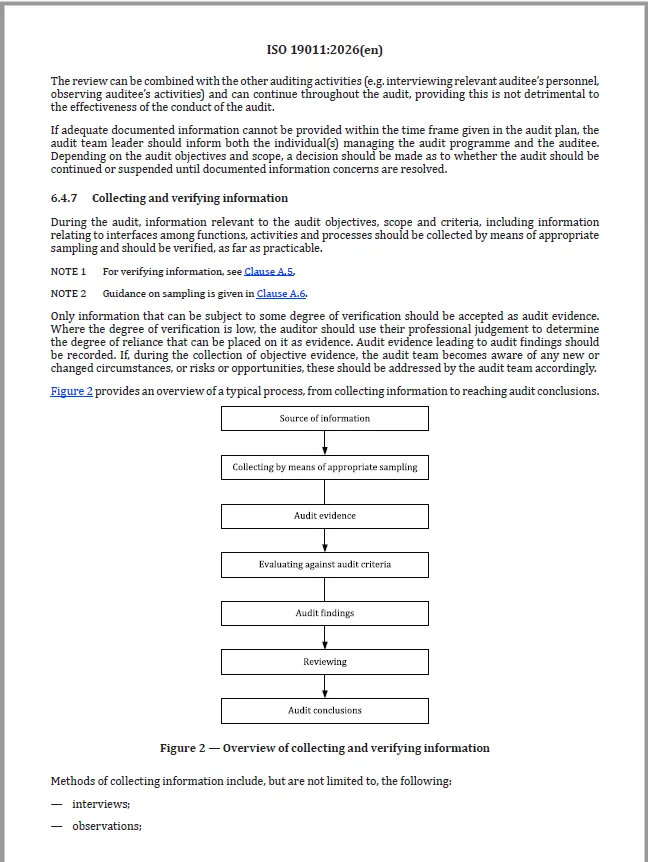
records, statements of fact or other information, which are relevant to the audit criteria (3.8) and verifiable
3.11
audit finding
results of the evaluation of the collected audit evidence (3.10) against audit criteria (3.8)
Note 1 to entry: Audit findings indicate conformity (3.21) or nonconformity (3.22).
Note 2 to entry: Audit findings can lead to the identification of risks (3.20), opportunities for improvement or recording good practices.
Note 3 to entry: If the audit criteria are selected from statutory requirements or regulatory requirements, the audit finding is termed “compliance” or “non-compliance”.
3.12
audit conclusion
result of an audit (3.1), after consideration of the audit objectives and all audit findings (3.11)
3.13
audit client
organization or person requesting an audit (3.1)
Note 1 to entry: In the case of internal audit, the audit client can also be the auditee (3.14) or the individual(s) managing the audit programme (3.5). Requests for external audit can come from sources such as regulatory authorities, contracting parties, or potential or existing customers.
[SOURCE:ISO 9000:2026, 3.12.4, modified — Note 1 to entry added.]
3.14
auditee
organization as a whole or parts thereof being audited
3.15
audit team
one or more persons conducting an audit (3.1), supported if needed by technical experts (3.17)
Note 1 to entry: One auditor (3.16) of the audit team is appointed as the audit team leader.
Note 2 to entry: The audit team can include auditors-in-training.
3.16
auditor
person who conducts an audit (3.1)
3.17
technical expert
<audit> person who provides specific knowledge or expertise to the audit team (3.15)
Note 1 to entry: Specific knowledge or expertise relates to the organization, the activity, process (3.25), product, service, discipline to be audited, language or culture.
Note 2 to entry: A technical expert to the audit team does not act as an auditor (3.16).
3.18
observer
individual who accompanies the audit team (3.15) but does not act as an auditor (3.16) nor a technical expert (3.17)
3.19
management system
set of interrelated or interacting elements of an organization to establish policies and objectives, as well as processes (3.25) to achieve those objectives
Note 1 to entry: A management system can address a single discipline or several disciplines, e.g. quality management, financial management or environmental management.
Note 2 to entry: The management system elements establish the organization’s structure, roles and responsibilities, planning, operation, policies, practices, rules, beliefs, objectives and processes to achieve those objectives.
Note 3 to entry: The scope of a management system can include the whole of the organization, specific and identified functions of the organization, specific and identified sections of the organization, or one or more functions across a group of organizations.
[SOURCE:ISO 9000:2026, 3.4.2, modified — Examples added to Note 1 to entry. Note 2 to entry expanded. Notes 3 and 4 to entry deleted.]
3.20
risk
effect of uncertainty
Note 1 to entry: An effect is a deviation from the expected — positive or negative.
Note 2 to entry: Uncertainty is the state, even partial, of deficiency of information related to, understanding or knowledge of, an event, its consequence, or likelihood.
Note 3 to entry: Risk is often characterized by reference to potential events and consequences, or a combination of these.
Note 4 to entry: Risk is often expressed in terms of a combination of the consequences of an event (including changes in circumstances) and the associated likelihood of occurrence.
[SOURCE:ISO 9000:2026, 3.7.2, modified — Note 5 to entry deleted.]
3.21
conformity
fulfilment of a requirement (3.24)
[SOURCE:ISO 9000:2026, 3.5.9, modified — Note 1 to entry deleted.]
3.22
nonconformity
non-fulfilment of a requirement (3.24)
[SOURCE:ISO 9000:2026, 3.5.13]
3.23
competence
ability to apply knowledge and skills to achieve intended results
[SOURCE:ISO 9000:2026, 3.10.6]
3.24
requirement
need or expectation that is stated, generally implied or obligatory
Note 1 to entry: “Generally implied” means that it is custom or common practice for the organization and interested parties that the need or expectation under consideration is implied.
Note 2 to entry: A specified requirement is one that is stated, e.g. in documented information.
[SOURCE:ISO 9000:2026, 3.5.1, modified — Notes 3, 4 and 5 to entry deleted.]
3.25
process
set of interrelated or interacting activities that use inputs to deliver an intended result
[SOURCE:ISO 9000:2026, 3.3.1, modified — “or transforms” deleted and “intended” added in the definition. Notes to entry deleted.]
3.26
performance
measurable result
Note 1 to entry: Performance can relate either to quantitative or qualitative findings.
Note 2 to entry: Performance can relate to managing activities, processes (3.25), products, services, systems or organizations.
3.27
effectiveness
extent to which planned activities are realized and planned results are achieved
请将您需要的标准号发来,针对标准文件购买进行报价,建议单位申购,扫码添加微信,登记单位信息后进行订购
宽天下标准翻译提供国外标准翻译中文和国家标准翻译英文服务,涵盖最新版本的标准:GB、ISO、CEN、GJB、MIL、IEC、UL、BS、NF、DIN、JIS、GMW、GOST、KS、ANSI、ASTM、ASME、AWS、IEEE、API、AS/NZS、SAE、CIE、CSA、CGA、AOAC、AASHTO、NFPA、ACI等等。

查标准、看标准、买标准、译标准
需要了解更多,请添加微信:fanyi800
欢迎访问:www.kuantianxia.com