2010 年 12 月大学英语六级阅读真题试卷
PartIV ReadingComprehension (Reading inDepth) (25 minutes)
SectionA
Directions: In this section, there is a short passage with 5 questions or incomplete statements.
Read the passage carefully. Then answer the questions or complete the statements in the fewest
possiblewords. Pleasewriteyour answers onAnswer Sheet 2.
Questions47to 51are basedon thefollowing passage.
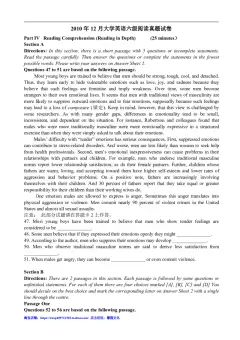
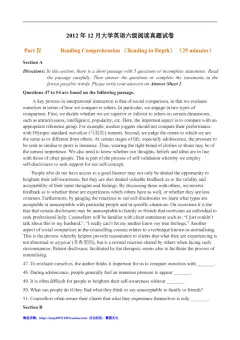
Most young boys are trained to believe that men should be strong, tough, cool, and detached.
Thus, they learn early to hide vulnerable emotions such as love, joy, and sadness because they
believe that such feelings are feminine and imply weakness. Over time, some men become
strangers to their own emotional lives. It seems that men with traditional views of masculinity are
more likely to suppress outward emotions and to fear emotions, supposedly because such feelings
may lead to a loss of composure (镇定). Keep in mind, however, that this view is challenged by
some researchers. As with many gender gaps, differences in emotionality tend to be small,
inconsistent, and dependent on the situation. For instance, Robertson and colleagues found that
males who were more traditionally masculine were more emotionally expressive in a structured
exercisethan when they were simply asked to talk about theiremotions.
Males’ difficulty with “tender” emotions has serious consequences. First, suppressed emotions
can contribute to stress-related disorders. And worse, men are less likely than women to seek help
from health professionals. Second, men’s emotional inexpressiveness can cause problems in their
relationships with partners and children. For example, men who endorse traditional masculine
norms report lower relationship satisfaction, as do their female partners. Further, children whose
fathers are warm, loving, and accepting toward them have higher self-esteem and lower rates of
aggression and behavior problems. On a positive note, fathers are increasingly involving
themselves with their children. And 30 percent of fathers report that they take equal or greater
responsibilityfortheir children than their working wives do.
One emotion males are allowed to express is anger. Sometimes this anger translates into
physical aggression or violence. Men commit nearly 90 percent of violent crimes in the United
Statesand almostall sexual assaults.
注意: 此部分试题请在答题卡2上作答。
47. Most young boys have been trained to believe that men who show tender feelings are
considered tobe ______________.
48. Somemen believe that iftheyexpressed their emotionsopenly they might ______________.
49. According to theauthor, men whosuppress theiremotionsmay develop ______________.
50. Men who observe traditional masculine norms are said to derive less satisfaction from
______________.
51. Whenmales get angry, they can become ______________oreven commit violence.
SectionB
Directions: There are 2 passages in this section. Each passage is followed by some questions or
unfinished statements. For each of them there are four choices marked [A], [B], [C] and [D] You
should decide on the best choice and mark the corresponding letter on Answer Sheet 2with a single
linethroughthecentre.
Passage One
Questions52to 56are basedon thefollowing passage.
淘宝店铺:https://shop499712503.taobao.com/ 店主旺旺:慧园文化In the early 20th century, few things were more appealing than the promise of scientific
knowledge. In a world struggling with rapid industrialization, science and technology seemed to
offer solutions to almost every problem. Newly created state colleges and universities devoted
themselves almost entirely to scientific, technological, and engineering fields. Many Americans
came to believe that scientific certainty could not only solve scientific problems, but also reform
politics, government, and business. Two world wars and a Great Depression rocked the confidence
of many people that scientific expertise alone could create a prosperous and ordered world. After
World War Ⅱ, the academic world turned with new enthusiasm to humanistic studies, which
seemed to many scholars the best way to ensure the survival of democracy. American scholars
fanned out across much of the world—with support from the Ford Foundation, the Fulbright
program, etc.—to promote the teaching of literature and the arts in an effort to make the case for
democratic freedoms.
In the America of our own time, the great educational challenge has become an effort to
strengthen the teaching of what is now known as the STEM disciplines (science, technology,
engineering, and math). There is considerable and justified concern that the United States is falling
behind much of the rest of the developed world in these essential disciplines. India, China, Japan,
and otherregions seem to beseizing technological leadership.
At the same time, perhaps inevitably, the humanities—while still popular in elite colleges and
universities—have experienced a significant decline. Humanistic disciplines are seriously
underfunded, not just by the government and the foundations but by academic institutions
themselves. Humanists are usually among the lowest-paid faculty members at most institutions and
are often lightly regarded because they do not generate grant income and because they provide no
obviouscredentials(资质)for mostnonacademiccareers.
Undoubtedly American education should train more scientists and engineers. Much of the
concern among politicians about the state of American universities today is focused on the absence
of “real world” education—which means preparation for professional and scientific careers. But the
idea that institutions or their students must decide between humanities and science is false. Our
society could not survive without scientific and technological knowledge. But we would be equally
impoverished (贫困的) without humanistic knowledge as well. Science and technology teach us
what wecan do.Humanisticthinkinghelps usunderstand what weshould do.
It is almost impossible to imagine our society without thinking of the extraordinary
achievements of scientists and engineers in building our complicated world. But try to imagine our
world as well without the remarkable works that have defined our culture and values. We have
always needed, and westillneed, both.
注意:此部分试题请在答题卡2上作答。
52. In theearly 20th century Americans believed science and technology could _______.
[A]solvevirtually all existing problems [C]help raisepeople’s livingstandards
[B] quicken thepace ofindustrialization [D] promotethenation’s social progress
53. Why did many American scholars become enthusiastic about humanistic studies after World
WarⅡ?
[A]They wanted toimprovetheir own status withinthe current education system.
[B] They believed thestabilityof asociety depended heavily onhumanisticstudies.
[C]They could get financial support from various foundations for humanisticstudies.
[D]They realized science and technology alone were noguarantee forabetter world.
54. Whyare American scholars worried about education today?
[A]The STEMsubjects are too challenging forstudents tolearn.
淘宝店铺:https://shop499712503.taobao.com/ 店主旺旺:慧园文化[B] SomeAsian countries have overtaken America inbasic sciences.
[C]America is lagging behindinthe STEM disciplines.
[D]There are not enough scholars inhumanisticstudies.
55. Whataccounts for thesignificant declinein humanisticstudies today?
[A]Insufficient funding. [C]Shortage ofdevoted faculty.
[B] Shrinkingenrollment. [D]Dim prospects forgraduates.
56. Whydoes theauthor attach so much importanceto humanisticstudies?
[A]They promotethedevelopment of science and technology.
[B] They help prepare students for theirprofessional careers.
[C]Humanisticthinkinghelps define ourculture and values.
[D]Humanisticthinking helps cultivatestudents’creativity.
Passage Two
Questions57to 61are basedon thefollowing passage.
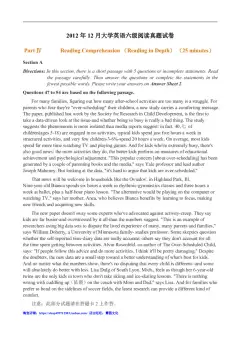
Will there ever be another Einstein? This is the undercurrent of conversation at Einstein
memorial meetings throughout the year. A new Einstein will emerge, scientists say. But it may take
along time.After all, more than 200years separated Einstein from his nearest rival, Isaac Newton.
Many physicists say the next Einstein hasn’t been born yet, or is a baby now. That’s because
the quest for a unified theory that would account for all the forces of nature has pushed current
mathematics to itslimits. New math mustbe created before theproblem can besolved.
But researchers say there are many other factors working against another Einstein emerging
anytime soon.
For one thing, physics is a much different field today. In Einstein’s day, there were only a few
thousand physicists worldwide, and the theoreticians who could intellectually rival Einstein
probably would fit intoa streetcarwith seats tospare.
Education is different, too. One crucial aspect of Einstein’s training that is overlooked is the
years of philosophy he read as a teenager—Kant, Schopenhauer and Spinoza, among others. It
taught him how to think independently and abstractly about space and time, and it wasn’t long
before hebecame aphilosopherhimself.
“The independence created by philosophical insight is—in my opinion—the mark of
distinction between a mere artisan (工匠) or specialist and a real seeker after truth,” Einstein wrote
in1944.
And he was an accomplished musician. The interplay between music and math is well known.
Einsteinwould furiously play his violinas away to thinkthrough aknotty physics problem.
Today, universities have produced millions of physicists. There aren’t many jobs in science
for them, so they go to Wall Street and Silicon Valley to apply their analytical skills to more
practical—and rewarding—efforts.
“Maybe there is an Einstein out there today,” said Columbia University physicist Brian Greene,
“but itwould be alotharder forhim to beheard.”
Especially considering what Einstein was proposing.
“The actual fabric of space and time curving? My God, what an idea!” Greene said at a recent
gathering at the Aspen Institute. “It takes a certain type of person who will bang his head against
thewall because you believe you’ll find thesolution.”
Perhaps the best examples are the five scientific papers Einstein wrote in his “miracle year” of
1905. These “thought experiments” were pages of calculations signed and submitted to the
prestigious journal Annalen der Physik bya virtual unknown. There were nofootnotes orcitations.
Whatmight happen tosuch asubmission today?
淘宝店铺:https://shop499712503.taobao.com/ 店主旺旺:慧园文化“Weall get papers likethose in themail,” Greene said.“Weput them inthejunk file.”
注意: 此部分试题请在答题卡2上作答。
57. Whatdoscientists seem toagree upon,judging from the firsttwo paragraphs?
[A]Einstein pushed mathematics almostto itslimits.
[B] It willtake another Einsteintobuild aunified theory.
[C]No physicistis likely to surpass Einstein in thenext200years.
[D]It will besometimebefore a new Einsteinemerges.
58. Whatwas critical to Einstein’s success?
[A]His talent as an accomplished musician.
[B] His independent and abstract thinking.
[C]His untiringeffort to fulfill his potential.
[D]His solid foundation in math theory.
59. Whatdoes theauthor tell usabout physiciststoday?
[A]They tendto neglect traininginanalytical skills.
[B] They are very good at solving practical problems.
[C]They attach great importance topublishing academicpapers.
[D]They often go into fields yielding greater financial benefits.
60. What does Brian Greene imply by saying “... it would be a lot harder for him to be heard”
(Lines 1-2, Para. 9)?
[A]Peoplehave to compete inorder toget their papers published.
[B] It ishard for ascientist to havehis papers published today.
[C]Papers likeEinstein’s would unlikely get published today.
[D]Nobody will read papers onapparently ridiculous theories.
61. Whenhe submitted his papers in 1905,Einstein_______.
[A]forgot tomake footnotes and citations
[B] was little known in academiccircles
[C]was known as ayoung genius in math calculations
[D]knew nothingabout theformat of academicpapers
淘宝店铺:https://shop499712503.taobao.com/ 店主旺旺:慧园文化