(cid:31)(cid:30)(cid:31)(cid:31)(cid:30)(cid:29)(cid:28)(cid:29)
(cid:28)(cid:27)(cid:26)(cid:31) (cid:25)(cid:24)(cid:23)(cid:30)(cid:27)(cid:26)(cid:25)(cid:31)(cid:22)(cid:21)(cid:20)(cid:29)(cid:19)(cid:26)(cid:24)(cid:25)(cid:24)(cid:26) (cid:18)(cid:17)(cid:16)(cid:15)(cid:31)(cid:31)(cid:30)(cid:29)(cid:28)(cid:27)G*)H)$I((2DJKL()MN%ODL2DPQR"*ODS$)T%*M)-2DU*%MMDVWN)$IXDY)4)-%OD
WDGQR"*ODS$)T%*M)-2DU*%MMD866Z
!"#$$%&’(#)*%+,%$-$& %&
[N)MD%O)-)"$DWD\*)-)$HD]*"KJD"RD!"#$%&’=DGQR"*ODS$)T%*M)-2DU*%MMDVWN)$IXDY)4)-%ODI$OD^)()$DU*%MMD8F.5
*+,-./0$12&3456%
"GQR"*O# )MDID*%H)M-%*%OD-*IO%4I*_D"RDGQR"*ODS$)T%*M)-2DU*%MM
789):;<=
>?@ A B
*+,-./0$12&3456ƒ/
D E FGH
WDGQR"*ODS$)T%*M)-2DU*%MMD8FF.
IJK LMN O P QJ
(cid:152)/W §%7¤ ):'“ *+,-./0$12&3456«fg./08F.5
R OST U V W X
GQR"*OD‹*+,-./0›fifl(cid:176)(cid:160)–
Y ZIJK ^_‘
*+,-./0$12&3456
/†‡3· (cid:181)¶/†‡3•¢‚„”» …‰(cid:190)\Au¿(cid:192)\A`´“ \A(cid:140)ˆ“ \Am˜
cde
¯(cid:134)“ ˘˙¨(cid:201)˚(cid:152)¢›¸(cid:204)“ m˜¨k˝·
fg./0 h i
lmn opq rst
!"#$%&’()
! " #
%’()
1’()
C ( )
) :
[\)]
abcd
j k
. / fg./0
u v wxyzw{.|/}
~ (cid:127) 0)#"1#)!2)()$31"4
(cid:128)(cid:129)(cid:130)(cid:131) 566(cid:132)789(cid:132)76:7
89(cid:130)(cid:131) 68;(cid:132)9<:;9<57=+9<:>8997
(cid:133) (cid:134) (cid:135)(cid:136)(cid:137)(cid:138)./(cid:139)(cid:140)(cid:141)(cid:142)3456
(cid:143) (cid:144) (cid:135)(cid:136)(cid:137)(cid:138)./(cid:139)(cid:140)(cid:141)(cid:142)3456
(cid:134) (cid:145) (cid:135)(cid:136)(cid:137)(cid:138)(cid:146)(cid:147)(cid:134)(cid:148)(cid:149)(cid:150)3456
(cid:151) (cid:152) >9>(cid:153)(cid:154)!.678(cid:153)(cid:154) .?.:
(cid:134) (cid:155) 73>;
/ (cid:156) 86.5(cid:157) :(cid:158)(cid:159) 8/
(cid:134) (cid:156) 868.(cid:157) :(cid:158)(cid:159) 9(cid:156)(cid:134)(cid:145)
(cid:160)¡¢| @ABCD7>9(cid:132)>(cid:132);55>(cid:132)855:(cid:132)<
£ ⁄ 7E:;¥
!"#$!%"&’
()*+, -./012 3456789:; <=> 5FF?989@..<8Eddie Hobo
Comic
strip
Welcome to the unit
Reading
Grammar
Integrated skills
Study skills
Task
Self-assessment
ProjectUnit Reading Grammar
Appendices: Irregular verbs (pp. 122–123) Notes (pp. 124–132) Grammar check (pp. 133–140)
srehto
htiw
gnola
gnitteG
1
eludoM
tnemniatretnE
2
eludoM
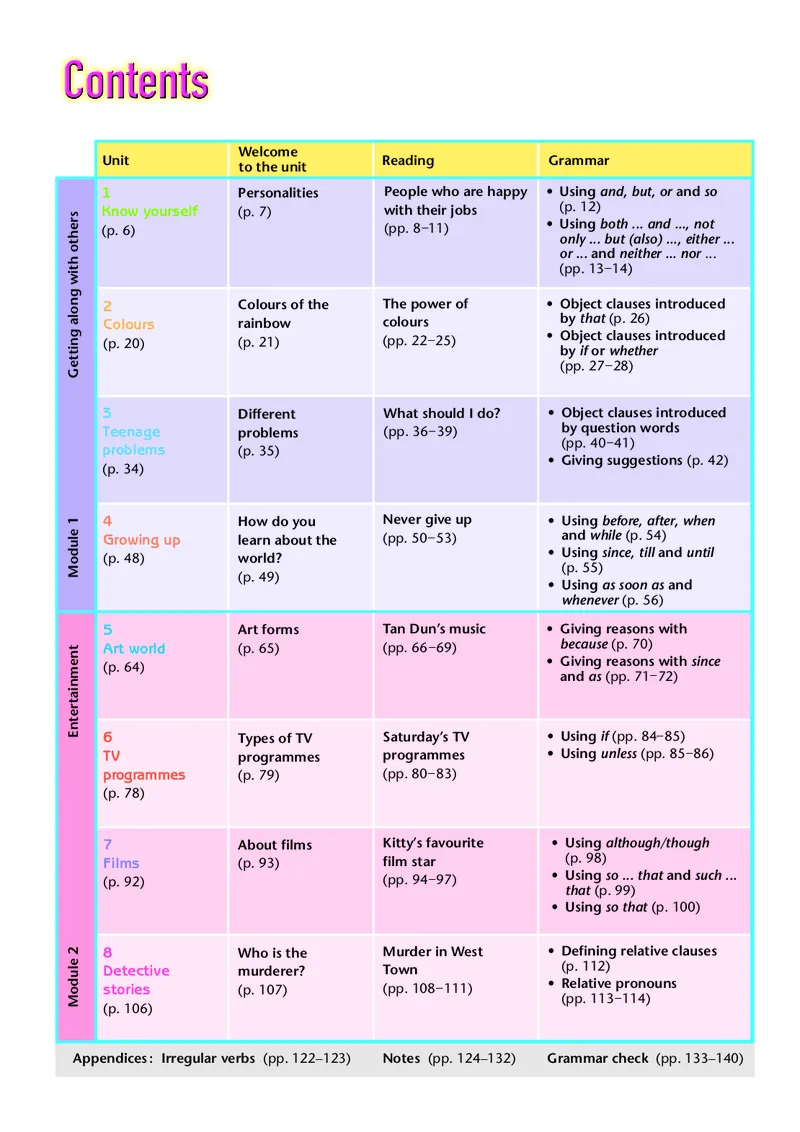
Welcome
to the unit
1 Personalities People who are happy • Using and, but, orand so
Know yourself (p. 7) with their jobs (p. 12)
(p. 6) (pp. 8—11) • Using both ... and ..., not
only ... but (also) ..., either ...
or ... and neither ... nor...
(pp. 13—14)
2 Colours of the The power of • Object clauses introduced
Colours rainbow colours by that(p. 26)
(p. 20) (p. 21) (pp. 22—25) • Object clauses introduced
by ifor whether
(pp. 27—28)
3 Different What should I do? • Object clauses introduced
Teenage problems (pp. 36—39) by question words
(pp. 40—41)
problems (p. 35)
• Giving suggestions(p. 42)
(p. 34)
4 How do you Never give up • Using before, after, when
Growing up learn about the (pp. 50—53) and while(p. 54)
• Using since, tilland until
(p. 48) world?
(p. 55)
(p. 49)
• Using as soon asand
whenever(p. 56)
5 Art forms Tan Dun’s music • Giving reasons with
Art world (p. 65) (pp. 66—69) because(p. 70)
• Giving reasons with since
(p. 64)
and as(pp. 71—72)
6 Types of TV Saturday’s TV • Using if(pp. 84—85)
TV programmes programmes • Using unless(pp. 85—86)
programmes (p. 79) (pp. 80—83)
(p. 78)
7 About films Kitty’s favourite • Using although/though
Films (p. 93) film star (p. 98)
(p. 92) (pp. 94—97) • Using so ... thatand such ...
that(p. 99)
• Using so that(p. 100)
8 Who is the Murder in West • Defining relative clauses
Detective murderer? Town (p. 112)
stories (p. 107) (pp. 108—111) • Relative pronouns
(pp. 113—114)
(p. 106)tcejorP
)121—021
.pp(
tnemniatretne
tuoba
telkoob
A
2 tcejorP
Wordlists (pp. 141–153) Proper nouns (pp. 154–155)
)36—26
.pp(
flesruoy
tuoba
retsop
A
1
tcejorP
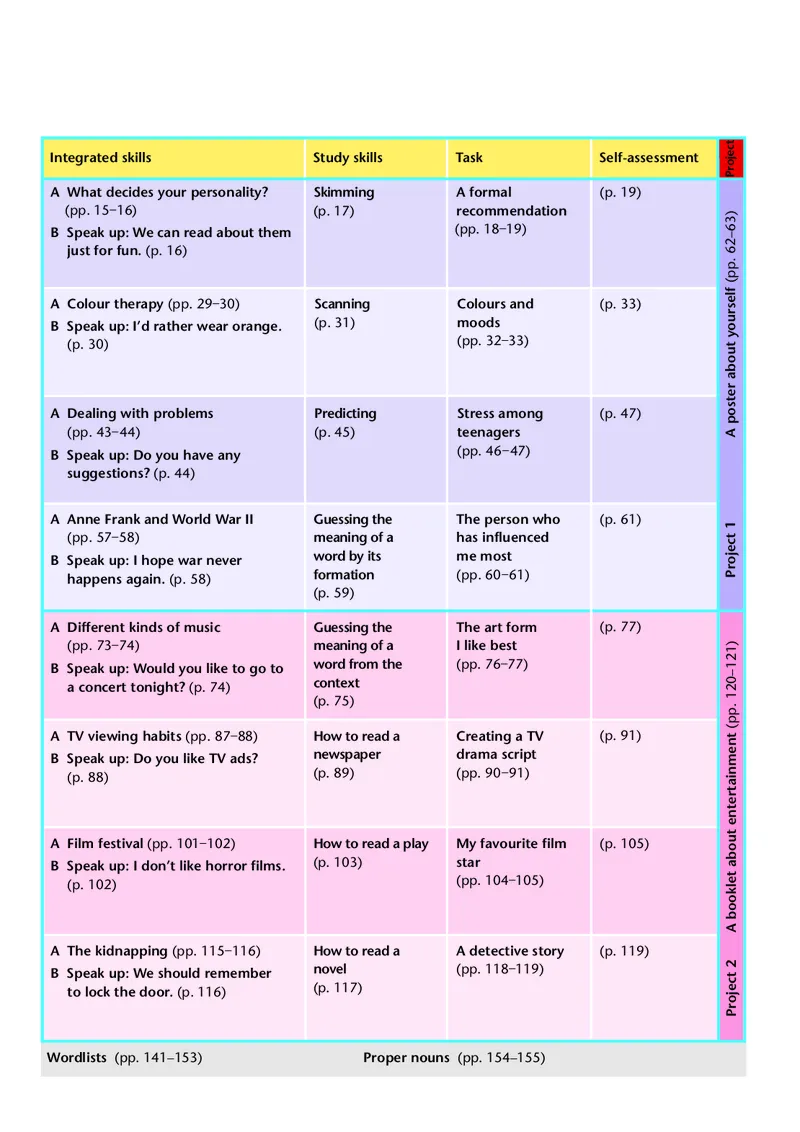
Integrated skills Study skills Task Self-assessment
A What decides your personality? Skimming A formal (p. 19)
(pp. 15—16) (p. 17) recommendation
B Speak up: We can read about them (pp. 18—19)
just for fun. (p. 16)
A Colour therapy (pp. 29—30) Scanning Colours and (p. 33)
B Speak up: I’d rather wear orange. (p. 31) moods
(p. 30) (pp. 32—33)
A Dealing with problems Predicting Stress among (p. 47)
(pp. 43—44) (p. 45) teenagers
B Speak up: Do you have any (pp. 46—47)
suggestions? (p. 44)
A Anne Frank and World War II Guessing the The person who (p. 61)
(pp. 57—58) meaning of a has influenced
B Speak up: I hope war never word by its me most
happens again. (p. 58) formation (pp. 60—61)
(p. 59)
A Different kinds of music Guessing the The art form (p. 77)
(pp. 73—74) meaning of a I like best
B Speak up: Would you like to go to word from the (pp. 76—77)
a concert tonight? (p. 74) context
(p. 75)
A TV viewing habits (pp. 87—88) How to read a Creating a TV (p. 91)
B Speak up: Do you like TV ads? newspaper drama script
(p. 88) (p. 89) (pp. 90—91)
A Film festival(pp. 101—102) How to read a play My favourite film (p. 105)
B Speak up: I don’t like horror films. (p. 103) star
(p. 102) (pp. 104—105)
A The kidnapping (pp. 115—116) How to read a A detective story (p. 119)
B Speak up: We should remember novel (pp. 118—119)
to lock the door. (p. 116) (p. 117)1 2 It says some people are generous.
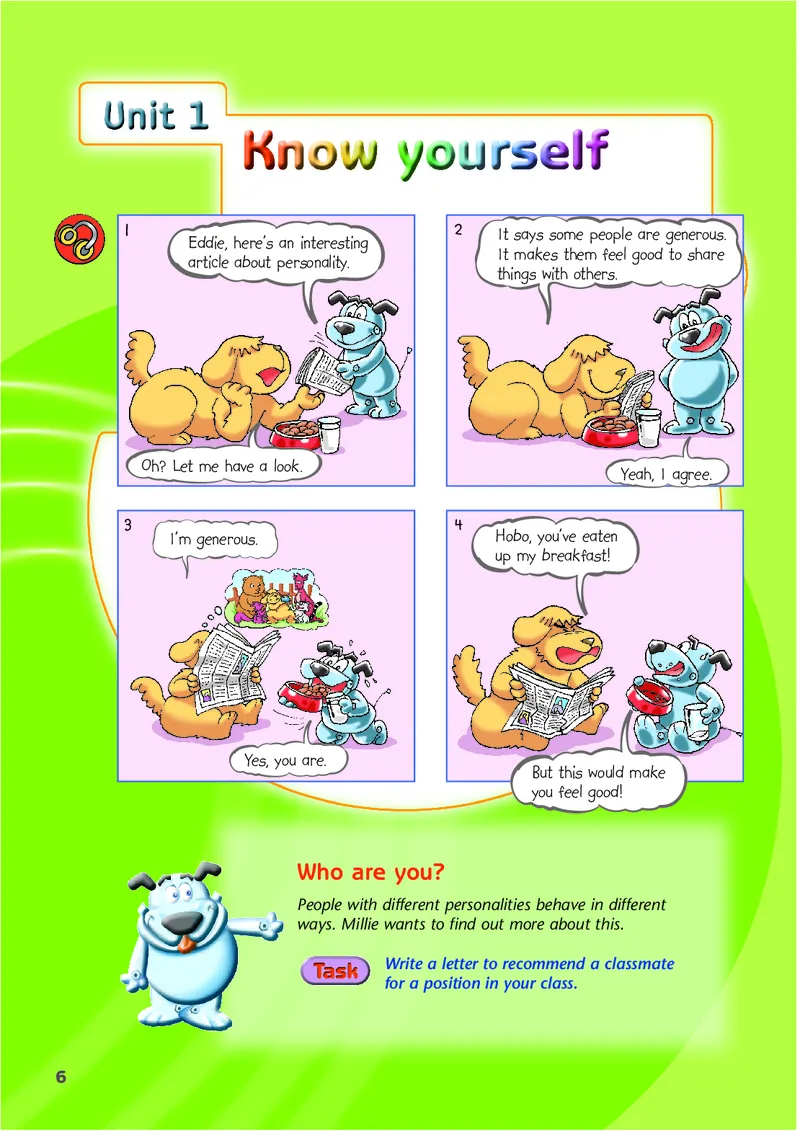
Eddie, here's an interesting
It makes them feel good to share
article about personality.
things with others.
Oh? Let me have a look.
Yeah, I agree.
3 4
I'm generous. Hobo, you’ve eaten
up my breakfast!
Yes, you are.
But this would make
you feel good!
Who are you?
People with different personalities behave in different
ways. Millie wants to find out more about this.
Write a letter to recommend a classmate
for a position in your class.
6Unit 1
Personalities
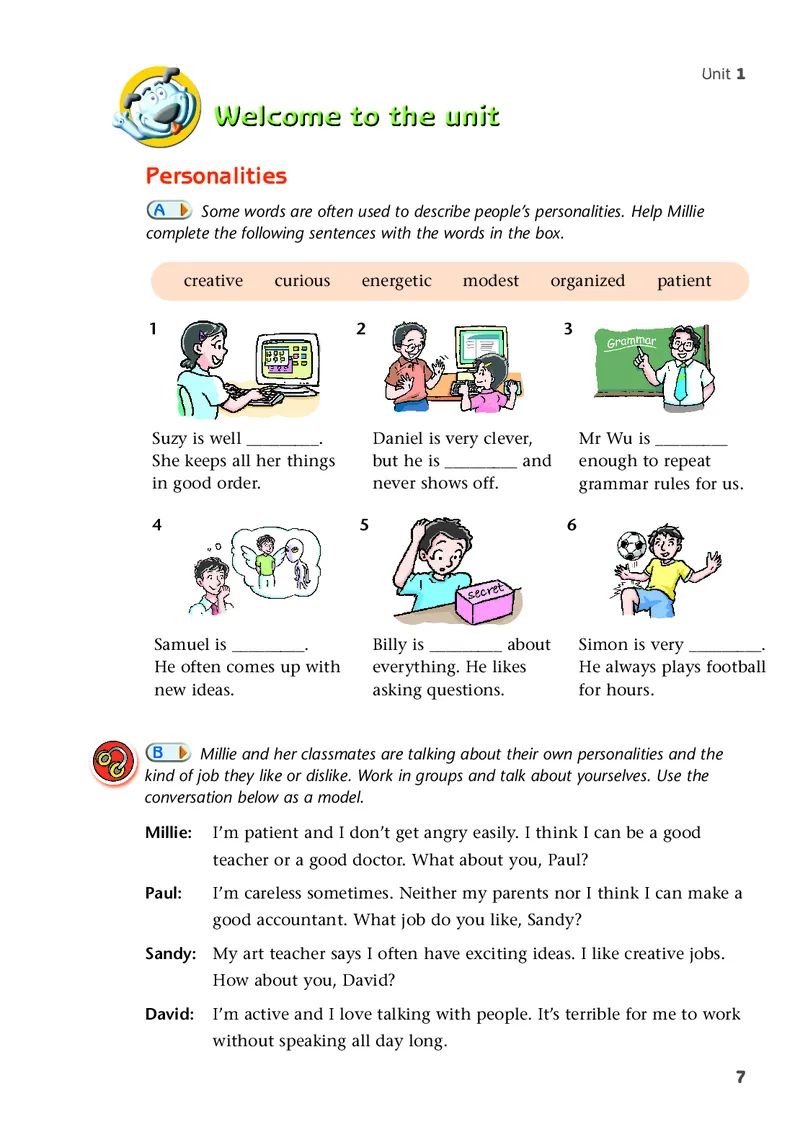
Some words are often used to describe people’s personalities. Help Millie
complete the following sentences with the words in the box.
creative curious energetic modest organized patient
1 2 3
Suzy is well _________. Daniel is very clever, Mr Wu is _________
She keeps all her things but he is _________ and enough to repeat
in good order. never shows off. grammar rules for us.
4 5 6
Samuel is _________. Billy is _________ about Simon is very _________.
He often comes up with everything. He likes He always plays football
new ideas. asking questions. for hours.
Millie and her classmates are talking about their own personalities and the
kind of job they like or dislike. Work in groups and talk about yourselves. Use the
conversation below as a model.
Millie: I’m patient and I don’t get angry easily. I think I can be a good
teacher or a good doctor. What about you, Paul?
Paul: I’m careless sometimes. Neither my parents nor I think I can make a
good accountant. What job do you like, Sandy?
Sandy: My art teacher says I often have exciting ideas. I like creative jobs.
How about you, David?
David: I’m active and I love talking with people. It’s terrible for me to work
without speaking all day long.
7Unit 1
A People who are happy with their jobs
Millie has read an article on Sunshine Daily. It introduces four people who
are outstanding in their fields in Sunshine Town. Here is the article.
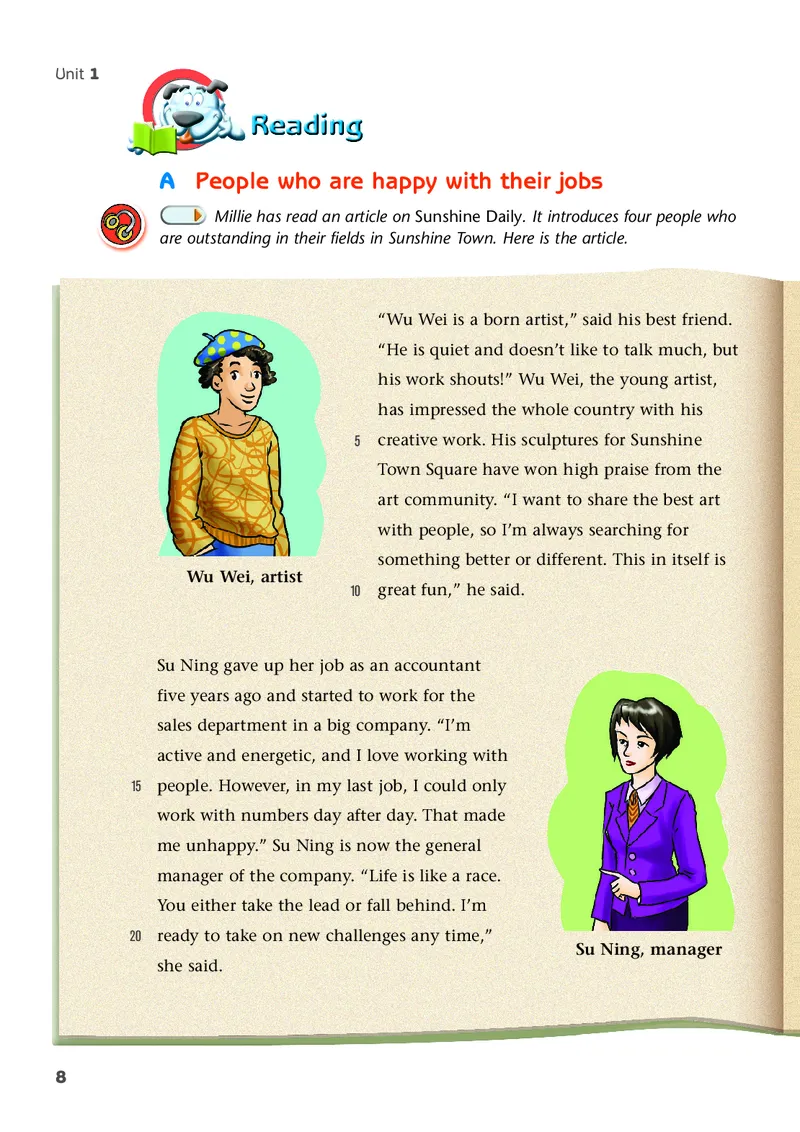
“Wu Wei is a born artist,” said his best friend.
“He is quiet and doesn’t like to talk much, but
his work shouts!” Wu Wei, the young artist,
has impressed the whole country with his
5 creative work. His sculptures for Sunshine
Town Square have won high praise from the
art community. “I want to share the best art
with people, so I’m always searching for
something better or different. This in itself is
Wu Wei, artist
10 great fun,” he said.
Su Ning gave up her job as an accountant
five years ago and started to work for the
sales department in a big company. “I’m
active and energetic, and I love working with
15 people. However, in my last job, I could only
work with numbers day after day. That made
me unhappy.” Su Ning is now the general
manager of the company. “Life is like a race.
You either take the lead or fall behind. I’m
20 ready to take on new challenges any time,”
Su Ning, manager
she said.
8Unit 1
Liu Hao is the chief engineer of the high-speed
railway connecting Sunshine Town to Tianjin.
“To us, a miss is as good as a mile. We can’t
25 afford to make any mistakes,” said Mr Liu. “All
of us know that it’s necessary to pay attention
to every detail.” “He’s serious and well
organized,” one of his team members said. “He
always works to high standards, but he’s
30 modest and easy to work with.”
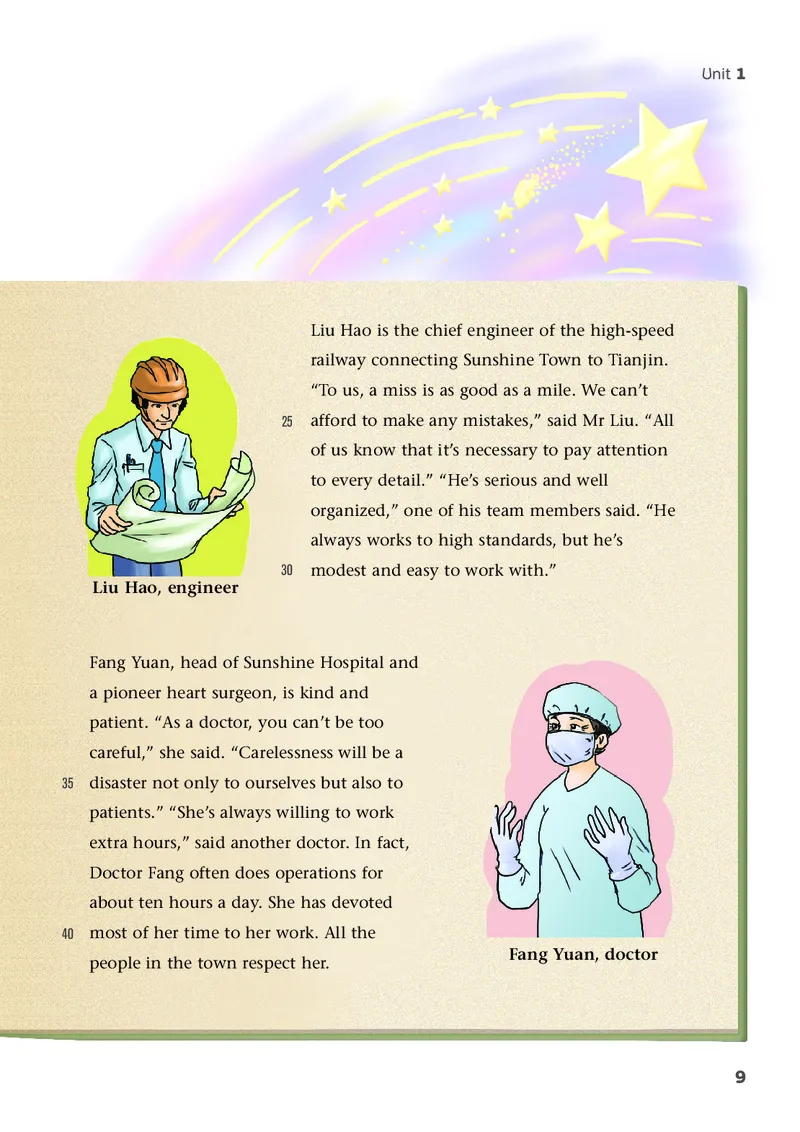
Liu Hao, engineer
Fang Yuan, head of Sunshine Hospital and
a pioneer heart surgeon, is kind and
patient. “As a doctor, you can’t be too
careful,” she said. “Carelessness will be a
35 disaster not only to ourselves but also to
patients.” “She’s always willing to work
extra hours,” said another doctor. In fact,
Doctor Fang often does operations for
about ten hours a day. She has devoted
40 most of her time to her work. All the
Fang Yuan, doctor
people in the town respect her.
9Unit 1
B Jobs and personalities
Millie wants to make sure that she knows the meanings of some words in
the newspaper article. Help her match the first parts on the left with the second
parts on the right to make complete explanations. Write the correct letters in the
blanks.
1 A creative person _________ a has lots of energy.
2 An active person _________ b does not talk much about his/her
abilities.
3 An energetic person _________ c can produce something new or a
work of art.
4 A modest person _________ d can plan his/her work well.
5 An organized person _________ e enjoys taking part in different
activities.
6 A patient person _________ f can wait without getting angry.
Millie wants to tell her classmates about the four people. Help her check the
sentences below. Write a T if a sentence is true or an F if it is false.
1 Wu Wei’s friend does not think that his work is very good. _________
2 Wu Wei’s sculptures are famous all over the country. _________
3 Su Ning was once happy with her job as an accountant. _________
4 Su Ning changed her job five years ago. _________
5 Liu Hao is the chief engineer of the new bridge. _________
6 Liu Hao’s team members find it difficult to work with him. _________
7 Fang Yuan thinks doctors should be very careful. _________
8 Fang Yuan spends most of her time on her work. _________
10Unit 1
Millie is summarizing the newspaper article. Help her find the words on
pages 8 and 9 to complete her notes below.
Job Personality
Quiet,does not like to (2)___________
(1)________ Creative—his work shouts
Enjoys searching for something better or (3)___________
Wu Wei
Active and (5)___________
(4)________ Loves working with (6)___________
Ready to take on (7)___________
Su Ning
Pays attention to every (9)___________
(8)________ Serious and well (10)___________
Always works to high (11)___________
Liu Hao
Kind and (13)___________
(12)________ Very (14)___________ at work
Willing to work (15)___________
Fang Yuan
C Your personalities
Write a short description of your personality. Then think about what job you
want to do in the future and see if your personality matches the job requirements.
Your personality
:
________________________________________________________________
What job do you want to do?
________________________________________________________________
Do you think your personality is suitable for the job?
________________________________________________________________
Work in pairs. Write a short description of your partner’s personality. Then
discuss with your partner whether or not you agree with each other.
Your partner’s personality:
________________________________________________________________
11Unit 1
A Using and, but, or and so
We use conjunctions like and, but, or and so to join ideas together.
We use and to join ideas that are similar.
I am active and energetic. I love working with people.
➜I am active and energetic, and I love working with people.
We use but to join ideas that are different.
He does not like to talk much. His work shouts!
➜He does not like to talk much, but his work shouts!
We use or to introduce another possibility.
I can be a good teacher. I can be a good doctor.
➜
I can be a good teacher or a good doctor.
In negative sentences, we use or to join two or more ideas.
He does not like singing. He does not like dancing.
➜
He does not like singing or dancing.
We use so to express the result of something.
I want to share the best art with people.
I am always searching for something better or different.
➜
I want to share the best art with people, so I am always searching for something
better or different.
Millie’s classmates
Millie wants to write about her classmates. Help her join her ideas with and,
but, or or so.
1 Kitty is kind. Sometimes she is impatient.
_____________________________________________________________________
2 Billy would not accept others’ advice. Billy would not think twice.
_____________________________________________________________________
3 Judy is gentle. Judy never gets angry with others.
_____________________________________________________________________
4 Suzy worries too much. She cannot sleep well sometimes.
_____________________________________________________________________
12Unit 1
B Using both ... and ..., not only ... but (also) ...,
either ... or ... and neither ... nor ...
We use conjunctions like both ... and ..., not only ... but (also) ..., either ...
or ..., and neither ... nor ... to connect the same part of two sentences to
avoid repetition.
both ... and ...
We use both ... and ... to emphasize that something is true not just of one
person, thing or situation, but of another too.
Kitty has known something about the four people. I have known something
about the four people.
➜Both Kitty and I have known something about the four people.
not only ... but (also) ...
We use not only ... but (also) ... to add another fact to something you have
mentioned.
Carelessness will be a disaster to ourselves. Carelessness will be a disaster to
patients.
➜
Carelessness will be a disaster not only to ourselves but (also) to patients.
either ... or ...
We use either ... or ... to mean one or the other, this or that, he or she, etc.
You take the lead. You fall behind.
➜
You either take the lead or fall behind.
neither ... nor ...
We use neither ... nor ... to mean not this one and not the other, not this
and not that, not he and not she, etc.
My parents do not think I can make a good accountant.
I do not think I can make a good accountant.
➜
Neither my parents nor I think I can make a good accountant.
When we use the conjunctions to connect two subjects, the verb form after
both ... and ... is always plural, but the verb form after not only ...
but (also) ..., either ... or ... and neither ... nor ... can be plural or singular,
depending on the subject closer to the verb.
Both Kitty and Simon are energetic.
Not only the students but (also) their teacher knows about the four people.
Either Simon or David is ready to take on new challenges.
Neither Millie nor her friends know about types of personality.
13Unit 1
Amy’s family and classmates
Amy is writing about what her family does at the weekend. Help her complete
the sentences with the correct conjunctions.
my dad my mum goes to work at the
1 _____________ _____________
weekend. We visit my grandparents on Saturdays.
my mum my grandma are good at cooking.
2 _____________ _____________
They cook lunch for us.
my mum my dad does the dishes after lunch.
3 _____________ _____________
I also help with it.
In the afternoon, my grandpa and my dad play chess
4 _____________
chat with each other.
_____________
My mum helps clean the rooms for my grandparents
5 _____________
does some shopping for them.
_____________
Amy and Suzy are talking about what jobs their classmates can do in the
future. Complete their conversation with the correct conjunctions and the correct
forms of the verbs in brackets.
Amy: I’ve learnt about jobs and personalities recently.
Suzy: Really? What jobs do you think our classmates can do in the future?
Amy: I think Millie would make an excellent teacher. She’s
(1)______________ willing to work with children ______________
patient with them.
Suzy: What about Simon?
Amy: He’s active and good at playing football. I think he can be
(2)______________ a PE teacher ______________ a football player.
Suzy: Do you think David and Lisa can be artists?
Amy: They’re very organized, but artists should be creative.
(3)______________ David’s ______________ Lisa’s personality
(4)______________ (be) suitable for being an artist, I’m afraid.
Suzy: Who can be a manager?
Amy: (5)______________ Billy ______________ Paul (6)______________ (be)
very confident and energetic. I think they can be managers.
Suzy: How can I learn about jobs and personalities?
Amy: You can read about them (7)______________ from some books
______________ on the Internet.
14Unit 1
A What decides your personality?
Millie has found an article about the Chinese animal signs and personalities.
Look at the words and the pictures below and help Millie complete part of her notes
in Part A2.
In the Chinese lunar calendar, there are 12 animal signs.
Each of them represents a lunar year. They appear in a
fixed order and the cycle repeats every 12 years.
Rat: smart Horse: lively
Ox: hard-working Sheep: gentle
Tiger: brave Monkey: clever
Rabbit: careful Rooster: practical
Dragon: powerful Dog: loyal
Snake: wise Pig: honest
Millie is listening to a radio programme about animal signs, star signs and
personalities. She is making some notes. Listen to the programme and help her
complete her notes.
CHINESE ANIMAL SIGNS
Animal signs: 12 in all, each representing a (1)______________
They are: Rat, Ox, Tiger, (2)______________, Dragon,
(3)______________, Horse, Sheep, (4)______________,
Rooster, (5)______________ and Pig
Some people believe that people born under the same
(6)______________ may have similar personalities.
WESTERN STAR SIGNS
Star signs: a cycle of (7)______________ star signs
Your star sign: depends on your (8)______________
Some people believe that your star sign may decide your
personality.
15Unit 1
Millie is writing about what she has learnt from the radio. Listen to the
programme again and help Millie complete the article.
Do you know what decides your personality?
In the Chinese lunar calendar,there are 12 animal signs.Some people believe that
people born under the same (1)______________may have similar personalities.For
example,they think that people born in the Year of the Rabbit are (2)______________,
while people born in the Year of the Dragon are very (3)______________.
In Western countries,a year is divided into a cycle of (4)______________star signs.
Your star sign depends on your (5)______________.Some people believe that your
(6)______________may decide your personality.
Do animal signs or star signs really tell anything about your personality? No,not
really.If you are interested in either animal signs or star signs,read about them just
for (7)______________.It is you who shape your life and your future.
B Speak up: We can read about them just for fun.
Millie and her neighbour Joe are talking about animal signs and personalities.
Work in pairs and give your own opinions. Use the conversation below as a model.
You may use the information in Part A1 to help you.
Millie: What’s your animal sign, Joe?
Joe: My animal sign is the Tiger. It is said that people born in the Year
of the Tiger are brave.
Millie: Mm, you’re brave in some ways.
Joe: Yes. What it says about me may be true, but for my cousin Julie,
that’s not the case. Her animal sign is the Sheep. It says that she’s
gentle, but in fact, she gets angry easily.
Millie: Yes, many people believe similar things. I think we can read about
these for fun, but we shouldn’t believe in them.
16Unit 1
Skimming
Skimming means reading the text quickly to get the main idea.
Skimming is often used when we read:
• newspapers (to quickly get the general news of the day).
• magazines (to find interesting articles we would like to read in more detail).
• business and travel guides (to quickly get information).
When skimming, read the title, the main headings, the first and last
paragraphs, and the first sentence of each paragraph. This will give you a
good idea of what the text is about.
Millie has found this article in a magazine. Skim the article below to find
the main idea. Use the following questions to help you.
1 What is the article about?
2 Is it true that some aspects of your personality are formed by nature?
3 What can change your personality?
How is your personality formed?
Personality includes your thoughts,feelings and behaviours which
make you different from other people. How is your personality
formed? Most people believe that it is formed by both nature and
the environment.
By nature
Some aspects of your personality are passed onto you by your
parents,for example,liveliness and impatience. That is why people
say “like father,like son”. Sometimes,these personalities do not
change and remain the same throughout your life.
By the environment
The environment,including your education,your experiences and
the people around you,can change your personality. For example,
you may become confident if you successfully complete a difficult
task through hard work. That is how your experience influences
your personality.
17Unit 1
A formal recommendation
Class 1, Grade 9 needs a new monitor. Millie and Simon want to recommend
David. They are making a spidergram to organize their ideas about him. Here is the
spidergram.
He is not afraid of making a He spends a lot of time helping
speech in front of many people. with our class projects.
Confident
Hard-working
He thinks he can do
He always does extra
anything if he tries his
work after class.
best.
Clever David Helpful
He always comes up He often helps other
with good ideas. students.
Organized
He never forgets the
things he needs to do.
He has learnt to use He will help us with
He has won several
the computer to get our lessons if we are
science competitions.
himself more organized. absent from school.
We are writing to recommend ... as our new monitor/....
He/She has many strong qualities for this position.
He/She always/often/never ....
... is very confident/clever/helpful/hard-working.
We think ... is the most suitable/right person to be ....
We hope that you agree with us.
18Unit 1
Help Millie and Simon complete their letter to Mr Wu. Use the information
from the spidergram on page 18.
Dear Mr Wu,
We are writing to recommend David as our new monitor. We think he has
many strong qualities for this position.
David is very confident. He thinks he (1) __________________________________.
He is not afraid of (2) ________________________________________________________.
We also think he is (3) ________________. He always does extra work after
class. He spends (4) _____________________________________________________________.
David is clever. He (5) _______________________________________________________________,
and he has won (6) ____________________________________________________.
David is (7)________________ and never (8) ____________________________________.
He has learnt to (9) ___________________________________________________________________.
He is also very(10) _________________. He often (11) _____________________.
For example, he will(12) __________________________________________________.
We think David is the most suitable person to be our monitor. We hope
that you agree with us.
Yours sincerely,
Millie Simon
Write a letter to your teacher to recommend a classmate for a position in
your class. Use Millie and Simon’s spidergram and their letter as a model.
I have learnt Details Result
1 about jobs and personalities.
2 to use the new words to
describe people.
3 to use conjunctions to
join ideas together.
4 when and how to skim
in reading.
Result: Perfect! Good! Not bad!
I need to spend more time on ___________________________________.
191 2
I think blue is better than
Which one do you
pink. Pink is a girl’s colour.
want to wear, Eddie?
OK. Try it on.
3 But there’s nothing wrong 4 And I’m not sure if blue
with pink, you know. looks good on you.
How do colours influence us?
The world would be a dull place without colours. The
Class 1, Grade 9 students are doing a project on colours—
what they represent and how they influence people.
Describe the relationship between people’s
moods and the colours they choose to wear.
20Unit 2
Colours of the rainbow
One day, Millie looked out of her window after a rain shower and saw a
rainbow. Write the names of the colours in the blanks.
blue green indigo orange red violet yellow
1 ________________
2 ________________
3 ________________
4 ________________
5 ________________
6 ________________
7 ________________
Amy’s cousin Shirley is talking with Amy about the rainbow. Work in pairs
and talk with your partner about colours. Use the conversation below as a model.
Shirley: Did you see a rainbow in the sky just now, Amy?
Amy: Yes, I did. Do you know how many colours there are in a rainbow?
Shirley: Sure. There are seven colours. They’re red, orange, yellow, green,
blue, indigo and violet.
Amy: Yes, that’s right. Which is your favourite colour?
Shirley: I like green best. What about you?
Amy: My favourite colour is orange.
21Unit 2
A The power of colours
Millie has found an article about the relationship between colours and
moods in a magazine. Here is the article. Find out what the different colours
represent and how they influence us.
Colours and moods
Some people believe that colours can influence our moods. You
may wonder whether it is true. In fact, colours can change our
moods and make us feel happy or sad, energetic or sleepy. This
article explains what colours can do and what characteristics
5 they represent.
Have you ever walked into a room and felt
relaxed? It could be because the walls were painted blue. Blue is a
calm colour. It brings peace to our mind and body. Blue can also
represent sadness, so you may say “I’m feeling blue” when you are
10 feeling sad. White is another calm colour. It is also the colour of
purity. Many women like to wear white on their wedding day.
22Unit 2
Some colours, such as orange and yellow, can
make you feel warm. People in cold areas prefer warm colours in
their homes to create a warm and comfortable feeling.
15 Orange represents joy. It can cheer you up when you are feeling
sad. Yellow is the colour of the sun, so it can remind you of a
warm sunny day. Yellow is also the colour of wisdom. Some
people prefer this colour when they hope for success.
When you feel tired or weak, you should
20 wear energetic colours like green. Green can give you energy, as
it is the colour of nature and represents new life. However, it is
also the colour of envy, so we may say someone is “green with
envy”.
If you require strength in either body or
25 mind, red may be of some help to you. Red is the colour of heat.
It represents power and strong feelings. Wearing red can also
make it easier to take action. This may help when you are having
difficulty making a decision.
23Unit 2
B What do the different colours represent?
Millie is not sure about the meanings of some words in the article. Help
her work out what the words mean. Circle the correct letters.
1 To influence someone means 5 At a wedding, a man and a woman
_______. _______.
a to give someone a present a get into trouble
b to make someone change b get married
c to ask someone for help c fight with each other
2 When you feel relaxed, you are 6 To cheer someone up means
_______. _______.
a calm and not nervous a to make someone calmer
b too tired to move b to make someone sadder
c happy and cheerful c to make someone happier
3 To prefer means _______. 7 To remind someone of something
a to hate something means to help someone _______.
b to talk about something a remember or think about
often something
c to like one thing more b forget something
than another c feel sure about something
4 To create means _______. 8 To require means _______.
a to grow a to repair
b to produce b to think
c to find c to need
Millie wants to remember what the different colours represent. Help her
match the colours on the left with what they represent on the right.
1 blue • • a wisdom
2 white • • b new life
3 orange • • c power
4 yellow • • d purity
5 green • • e joy
6 red • • f peace
24Unit 2
Millie is thinking about her friends. Help her decide which colour is suitable
for each of them. Use the information on pages 22 and 23 to help you.
1 2
The best colour for Lisa is Daniel likes the colour
. It is the colour because it
of and it can help him
represents power. down when he is angry.
3 4
Sandy should use the colour Paul’s colour should be
more. It can . He works
her up when hard and hopes for
she feels sad. .
5
Kitty likes spring. Her
favourite colour is
because it is
the colour of .
There is also a short questionnaire in the magazine. Fill in the questionnaire
with your own information to see if your favourite colour matches your characteristics.
My favourite colour is _______________.
It represents _____________________________________________________
________________________________________________________________.
I like it because ___________________________________________________
________________________________________________________________.
I am ____________________________________________________________
________________________________________________________________.
Does your favourite colour match your characteristics? Yes No
25Unit 2
A Object clauses introduced by that
An object clause functions as the object of a sentence. We use that to
introduce an object clause that is a statement.
An object clause can be put after verbs such as know, think, believe, hope
and mean.
Some people believe that colours can influence our moods.
She hopes that yellow can bring her success.
An object clause can also follow adjectives such as certain, sure and glad.
He is glad that the walls in his room are blue.
She is sure that yellow can bring her good luck.
In informal English we often drop that.
I think (that) blue is better than pink.
“I’m feeling blue” means (that) “I’m feeling sad”.
Do you think (that) your favourite colour matches your characteristics?
Talking about room colours
Sandy is chatting online with Millie about room colours. Try to add that to
each object clause.
Millie: Did you know there is a relationship between colours and
moods?
Sandy: Certainly. I think colours influence our everyday lives in
many ways.
Millie: How should we choose the colours for the rooms of a house?
Sandy: Most people think light colours are better than dark ones.
Millie: Yes. I notice light colours make rooms seem larger.
Sandy: Sure. I also know blue can make us feel relaxed.
Millie: Yes. My mum says blue is suitable for bedrooms. I also find
some people prefer orange for their dining rooms.
Sandy: True, but it depends on personal taste. Anyway, we should
choose the colour which makes us feel comfortable.
26Unit 2
B Object clauses introduced by if or whether
We use if or whether to introduce an object clause that expresses a yes/no
question. Such an object clause often follows verbs such as ask, see, wonder
and find out. The word order in the clause should be the same as that in a
statement.
You may wonder if/whether colours influence our moods.
Sandy asks if/whether orange can cheer her up.
Problems about shopping
The Class 1, Grade 9 students are shopping. Complete the sentences by
using if or whether to make object clauses.
1
Should I choose the red dress?
Kitty cannot decide _______________________
__________________________________________.
2
Do white clothes suit me?
Sandy does not know _____________________
__________________________________________.
3
Is the sports bag made of cotton?
Amy is asking _____________________________
__________________________________________.
4
Does the green T-shirt match my trousers?
Simon is not sure __________________________
__________________________________________.
5
Should I stay at home instead of going
shopping with my classmates?
Daniel often wonders _____________________
__________________________________________.
27Unit 2
How much do you know about colours?
Daniel wants to tell his online friend Tommy about colours. Help him
complete his email using that, if or whether.
Dear Tommy,
Have you ever noticed the colours around you? Colours are really
interesting. A report says (1) ___________ blue can help us feel relaxed
because it represents peace. You may wonder (2) ___________ it
represents anything else. Yes. Blue also means sadness. I do not know
(3) ___________ you like green. Some people think (4) ___________
green can give us energy, but it also represents envy. Did you know
(5) ___________ red represents good luck in China? It is often used for
celebrations!
Please tell me your favourite colour and (6) ___________ you know
anything else about colours. Write back soon.
Best wishes,
Daniel
Daniel has some questions about colours to ask his dad, but his dad has not
come home yet. Help him write a note for his dad.
1 Dad knows a lot about colours.
2 Is red just the colour of heat and power?
3 Was yellow once the colour of the rulers in ancient China?
4 Did the rulers in ancient Europe like to wear purple?
5 Do all the doctors in the world wear white uniforms?
I believe (1) ____________________________________________.
I wonder (2) ____________________________________________.
I want to know (3) _______________________________________.
I do not know (4) ________________________________________.
I am not certain (5) ______________________________________.
28Unit 2
A Colour therapy
Millie has found an advertisement for colour therapy by Mrs Rainbow. Read
the advertisement and help Millie complete part of her notes.
MMrrss RRaaiinnbbooww’’ss CCoolloouurr TThheerraappyy
Discover how the power of colours can change your
moods and improve your life! Watch The Teens Show
on STTV at 6 p.m., 30 September to learn more!
Therapy centre: 21/F, 810 South-east Road
Telephone number: 5557 8187
Price: ¥100 for half an hour
We promise that this therapy can help you change your moods,
or you will get your money back!
Mrs Rainbow’s ColourTherapy
Her therapy centre is on (1)_________________________________________.
It costs (2)______________ for 30 minutes.
If it does not work,you can (3)________________________________.
She has practised colour therapy since she left (4)______________.
Colour therapy comes from ancient India.
If you do not feel confident enough,use the colour (5)______________ more.
If you cannot sleep well,paint your bedroom (6)______________.
If you feel stressed,eat more (7)______________ vegetables.
If you feel tired,(8)______________ food can help cheer you up. But do not eat
too much of it,or you may get (9)______________ easily.
Millie is watching The Teens Show. Listen to the interview with Mrs Rainbow
carefully and help Millie complete her notes in Part A1.
29Unit 2
Suzy wants to learn something about Mrs Rainbow. Listen to Suzy’s questions
and help Millie answer them. Circle the correct letters.
1 a She works at a museum. 4 a He should wear green.
b She uses colours to change b He should use the colour
people’s moods. yellow more.
c She works for a fashion c He should think of a warm
magazine. sunny place.
2 a She colours their clothes. 5 a She tells people what colours
b She suggests different of food to eat.
clothes to different people. b She makes your clothes
c She suggests different change colour.
colours to different people. c She makes food for people.
3 a You will sleep better if you 6 a She will give you free clothes.
paint your bedroom blue. b You will get your money back.
b You should think of the sun. c She will give you free books.
c You should wear orange.
B Speak up: I’d rather wear orange.
Andy is talking with Millie about what to wear for a party. Work in pairs and
talk about your preferences. Use the conversation below as a model.
Andy: I’m going to a friend’s birthday party, Millie. Come and see if these
clothes look good on me.
Millie: Which shirt do you prefer, the red one or the
orange one?
Andy: I don’t like red. I’d rather wear orange.
Millie: You look smart in orange. Which
trousers do you like?
Andy: I prefer jeans.
Millie: Good. Jeans are comfortable and
they’ll match your shirt.
Andy: OK. Thanks, Millie.
30Unit 2
Scanning
Scanning means moving our eyes quickly over the text to look for specific
information such as names or numbers. We do not need to read every word.
Instead, we look for the key information that will answer our questions.
Scanning is often used when we read:
• some parts like “What’s on TV” in the newspaper.
• a bus/train timetable.
• a guidebook.
Millie is reading an English magazine article to find out why many boys and
girls dress in different colours. Scan the article to help Millie find the answers.
1 What did it mean if the sky was blue?
2 Why did women in the past like pink and red?
3 What power was blue once believed to have?
4 Where did girls come from according to a European story?
Blue for boys and pink for girls
In many places,baby boys are dressed in blue and baby girls in pink.
Why the difference?
Scientists now think this started many years ago. When most men
worked in the fields,the weather was very important to them. If the
sky was blue,it meant good weather. So when the men thought of
blue,they were very happy. In the past,women’s main job was to
look for food for their family. They liked pink and red because these
were the colours of healthy food,such as strawberries and apples.
People were also influenced by old stories. The colour blue was once
believed to have the power to drive evil spirits away,so people
dressed baby boys in blue in the hope that boys would be
protected. Baby girls were dressed in pink because,according to a
European story,girls were born inside pink roses.
31Unit 2
Colours and moods
Millie is doing her project on the relationship between people’s moods and
the colours they choose to wear. Help her complete part of her report using the
table she has prepared.
black power and trust
blue calm and sadness
green energy and nature
orange joy and warmth
red power and strength
white calm and peace
yellow wisdom and success
Colours and what they represent Millie
The woman in this picture is wearing a (1)_____________dress and a pair of
(2)_____________shoes.She is carrying a white handbag too.This is interesting
because red and white are very different colours.
Red represents (3)_____________and (4)_____________.Maybe she feels weak,
and that is why she is wearing red—she just wants to make herself look more
powerful.
White represents (5)_____________and (6)_____________.She may hope that
the colour white could help her calm down.
I think the woman must feel a little bit stressed,and she hopes these colours will
change that.Red and white are a good match,as the powerful (7)_____________
balances the calm (8)_____________.
32Unit 2
Your art teacher gave you two advertisements. She asked what you think
about them. You want to make some notes first.
Colour of T-shirt/skirt/hat/shoes: Colour of T-shirt/trousers/glasses/shoes:
________________________________ _________________________________
Represents: ______________________ Represents: _______________________
________________________________ _________________________________
Moods: __________________________ Moods: ___________________________
Reasons: ________________________ Reasons: _________________________
Is it a good fruit juice advertisement? Is it a good mobile phone advertisement?
Why or why not?___________________ Why or why not?____________________
________________________________ _________________________________
Now use your notes to write a report on the relationship between the colours
and the model’s moods in one of the advertisements. Use Millie’s table and report on
page 32 to help you.
I have learnt Details Result
1 about the power of colours.
2 to use the new words to talk
about colours and moods.
3 to use object clauses introduced
by tthhaatt, iiff and wwhheetthheerr.
4 when and how to scan in
reading.
Result: Perfect! Good! Not bad!
I need to spend more time on ___________________________________.
331 2
Hobo, I have
a problem. What’s wrong, I’m getting fat. Look
Eddie? at my stomach.
3 4
You eat too much. Why not eat
Good. I’ll finish the
less and exercise more?
food for you then.
Maybe you’re right.
What problems do you have?
Everybody has problems. Some students are asking for
advice on how to solve their problems.
Write an email to your friend about how
to deal with his or her problems.
34Unit 3
Different problems
Some students in Class 1, Grade 9 have problems. Look at the pictures.
What problems do they have? Complete the sentences with the words in the box.
friends homework marks noise parents sleep
1 2 3
I don’t get enough The TV is always on at
_________. I feel I don’t have enough time my home. The _________
tired in class. to do my _________. almost drives me mad.
4 5 6
I don’t have any close Sometimes I get low My _________ work
_________. Sometimes _________ in exams. all day. They don’t
I feel lonely. I feel sad. have time for me.
Millie is talking with her mum about teenage problems. Work in pairs and
talk about your problems. Use the conversation below as a model.
Millie: Mum, many of my classmates have problems.
Mum: Really? How about you? Do you have any problems?
Millie: Yes, I do. Sometimes I feel sleepy in class.
Mum: Oh dear. You don’t get enough sleep.
Millie: What should I do then?
Mum: Perhaps you should manage your time better and go to bed earlier.
Millie: OK. I’ll try.
35Unit 3
A What should I do?
Millie and Simon have some problems. They wrote to Mr Sigmund Friend, a
famous youth worker, and asked for some advice. Here are their letters.
D I k e I a I n a h m o o r a w f M t v M e e h n r i a o l h F l w i r l a e o i , v e t I a e n o s n d t f h d o , o h I s u o t a l m a d m y e d w u a ea p o G l r l r w a k a t e d e it v . e h T e 9 h r it y e s . n t d u I a d y s e o , n m a t. n e d I t i h I m a h v e a s e v f a e i n n p d o r o i c t b h h l o e a m ic rd e , a b t n o u d t s t t I a o d y d o o n i o t t .
5 10 a I I w I k w h I c n W a a a d o o k r r n r h w e d t e n a h t l a o t y h i m t s t s e h p i h i s n m a e o o n e v i f u m a x d e a l g t d i p a n i l d n o o n I g a n e r y d y t s g m o a . s o ? h p n y m o C a t l l a r t u i i o e f d n c e a h f t y i w i y n m t o i i i s u m s t e o h h o f e o t o f a h u f o r e l a t n l r m t m h h m I y o o y c b e m h o b h s o u i e o o b e l w m d m s b . i o h e I e e r w a s o s k v f u l o . t i e e g r k n m k e g e o v d o s n o o r t e l u i t l o i e b t m n y i t m s b w e ? . a e I h l H f l h e o o a t o r w h n p m e d e e r v y m t i o e t h r u i h , o s s e b i a c b . r ies.
from you
soon.
Best
wishes,
Millie
Wang
15
36Unit 3
Dear Mr Friend,
20 o p I M f l l a o y m y v n e i y n a g w p m a r f o e o t b c o i l s h t e b i m n S a g . i l m l . f o o H o n o t , w b a e a n v l d e l, r r I , e a m a m y d i l n i o n g v G e a r o b a f o d u f e o t o 9 f t o . b o I a t a l b l m a h l a l c , s r a a b n z e d y c , o a o m b f o e c u o t t u h r f e o s o e c , t a b u a s l e l.
25 o i w d s w f I u o h o h a r i r y m e l n l w n i h t p o v a o h e t o w y u s e r e a s r y t m s l a s l p a o n o h a l r w a t r o e n e y u d m t s l i f o d o n e o n t o e d s s t e v t e t t o r e b v o r e r e a p i p s c l l l w . o t a l t T p o i w y n w h r i g o o r t e it . y u h u n h r t a m I s m h b g i y o o d e e b u e . f t b r t I a i i i e e n f t f e n s t t h e d . o e e l T s r t a t h 6 r a i n e m o f g y u t p e r e b . h y . m r l e S e s . l s p o o b I c m m e d u h c s o e o e a t t o r n u i i l e m m . o s l W t a e e e x s s e u m . n a w o y I d n f e b t e d p e f e r a o l m s n i r e r t e a g v p a n e e k l n t a e t i d s y t
30 s t Is c im h it o e o b o l a w n d o i t r t k ? o a I s n w t d o a n m y d o y e u r h t h o o l b a w b t i e e I s c t . a o I n l p o a l o a c k y h f i f e o o v r o e w t a b a r a d b ll a ? t l o a S n h y c o o e u u r l b d e v t a I w l s u e p a e e b n n l e d m a l y e d s v s ice.
Best wishes,
Simon Luo
37Unit 3
B Helping the students out
Mr Friend wants to help Millie and Simon. He has made a list of keywords
in their letters. Match the words on the left with the meanings on the right. Write
the correct letters in the blanks.
1 choice (line 4) _________ a reason
2 stay up (line 5) _________ b be not sure if something is true
3 imagine (line 9) _________ c making sure that rules are obeyed
4 doubt (line 9) _________ d very useful or important
5 cause (line 19) _________ e the right to decide which thing you
want
6 strict (line 25) _________ f start to have a skill, ability, etc.
7 develop (line 26) _________ g go to bed later than usual
8 valuable (line 30) _________ h form a picture in your mind of
someone or something
Mr Friend wants to keep a record of each student. Look at the cards and
help him complete them. Put a tick (✓) if Millie or Simon has that problem and
a cross (✗) if he or she does not have that problem.
Millie Simon
Problems Problems
✗
Friendship _________ Friendship _________
✓
Lots of homework _________ Lots of homework _________
Low marks _________ Low marks _________
Not enough time Not enough time
for hobbies _________ for hobbies _________
Staying up late _________ Staying up late _________
Strict parents _________ Strict parents _________
Weight _________ Weight _________
38Unit 3
Mr Friend is replying to Millie’s and Simon’s letters. Help him complete the
sentences with the words in the box.
advice hobbies homework important playing spare
stay out stay up strict valuable volleyball worth
Dear Millie,
Thank you very much for your letter. I hope I can help you.
You said you often (1) ___________ late to finish all your homework. Plan
your day carefully. Make a list of all the (2) ___________ you have. Then work
out how much time you need to finish it all. This will give you an idea of how much
(3) ___________ time you have.
You also said that you do not have enough time for your (4) ___________.
What about choosing your hobby according to the time you have? For example, play
(5) ___________ if you have a lot of time, and listen to music if you only have
a short time.
I hope you think my advice is (6) ___________ taking.
Best wishes,
Sigmund Friend
Dear Simon,
Thank you for your letter. I hope I can offer you some useful (7) ___________.
It seems that you spend a lot of time (8) ___________ football. Of course, it
is very (9) ___________ to develop hobbies. However, it is not wise to spend
hours playing football after school.
I agree with your parents that it is better for you to go home earlier. Enjoy your
hobby, but do not forget about your schoolwork. Why not just play football for an
hour or two, and then go home? Your parents are not (10) ___________ with
you; they just do not want you to (11) ___________ so late.
I hope you think my answer is (12) ___________ to you.
Best wishes,
Sigmund Friend
39Unit 3
A Object clauses introduced by question words
We use a question word to introduce an object clause that expresses a
wh- question. The word order in the clause should be the same as that
in a statement.
I wonder what I should do.
Daniel does not know whom he should talk to.
Sometimes we forget when we should stop.
I do not understand why they are so strict with me.
I do not know how I should deal with the problem.
More problems and questions
The Class 1, Grade 9 students are talking about their problems. Help them
complete each object clause below with a correct question word.
1 2
I need silence when I’m I need someone to share
studying. I don’t know my worries with. I wonder
___________ I can find ___________ I should go
a quiet place. to for help.
3 4
I have tried my best, but My parents often come
I don’t understand home very late. Sometimes
___________ I still get I don’t know ___________
low marks. I will see them.
5 6
Sometimes I’m careless. I often have difficulty
I wonder ___________ expressing myself. Who
I can be more careful. can tell me ___________
I should do?
The word order in an object clause introduced by a question word should
be _______________ (different from, the same as) that in a wh- question.
40
PIT
Whomis an
object pronoun.
We can use
whoinstead of
whom.
Kitty Peter
Amy Sandy
Paul SuzyUnit 3
Daniel has some questions. Rewrite his questions by using object clauses
introduced by question words.
1 Why do I always feel tired in class?
2 How much sleep do we need every day?
3 Which method should I use to solve the problem?
4 Where can we buy a good dictionary?
5 How can I improve my English quickly?
6 Whom should we ask for help?
7 What would life be like without hobbies?
1 Can you explain _w_h_y_ _I_ a_l_w_a_y_s _f_e_e_l _ti_re_d_ _i_n _c_la_s_s_____________________________?
2 I wonder __________________________________________________________.
3 I am not sure __________________________________________________________________.
4 Can you tell me _________________________________________________________________?
5 I want to know _________________________________________________________________.
6 I do not know __________________________________________________________________.
7 I cannot imagine ______________________________________________________.
Millie wants to introduce Mr Friend to her classmates. Help Millie complete
her email with the correct question words.
Dear classmates,
Have you ever had any problems? Are you wondering (1)___________
you can ask for advice? If so, you can write to Mr Sigmund Friend.
You may wonder (2)___________ he is. He is a youth worker. Do you
know (3)___________ a youth worker does? Mr Friend says that youth
workers help young people solve their problems. They are doing a great
job. Some of my friends wrote to Mr Friend and asked (4)___________
they could deal with their problems. Soon they got his replies. Now they
know (5)___________ they should do.
Best wishes,
Millie
41Unit 3
B Giving suggestions
We give suggestions politely using structures such as Why not ..., Why
don’t you ..., What/How about ..., Let’s ... and Shall we ....
Why not eat less and exercise more?
Why don’t you let your parents know you need them?
What/How about choosing your hobby according to the time you have?
Let’s write a letter to Mr Sigmund Friend.
Shall we have a meeting about this?
A plan to relax
Millie feels tired these days. Amy and Sandy are trying to help her. Use the
correct structures to help the girls give suggestions.
Millie: I’m always feeling tired these days. There’s so much homework and
I’ve spent all my time on it.
Sandy: (1) ______________ do something fun?
Amy: I agree. (2) ______________ go to the cinema?
Sandy: Good idea. But I don’t know what films are on now.
Millie: I don’t want to see any films.
Amy: (3) ______________ going to the new museum? My dad told me that
it’s big and modern. I know where it is, but I’m not sure when it
closes.
Sandy: (4) ______________ go and see? It’s still early.
Millie: OK. But we may get home late. (5) ______________ tell our parents
first.
A suggestion using _______________, _______________, _______________
or _______________ ends with a question mark. A suggestion using
_______________ ends with a full stop.
42
PIT
We also use
perhapsto give
suggestions.
Perhapsyou
should manage
your time better.Unit 3
A Dealing with problems
Millie’s classmate Nora also has problems. She went to ask Mr Friend for
help. Listen to Nora’s information and put a tick (✓) in the correct boxes below.
Nora
a Grade 9 student
one of the top students
loves English, Maths and Chemistry
always gets high marks in exams
not very good at sports
has many friends
Mr Friend is talking to Nora about her problems. Listen to their conversation
and help Mr Friend complete his notes.
Name: Nora
First problem: not good at (1) ____________, cannot (2) ____________
and hates swimming
Advice: just try your best in (3) ____________ and enjoy the exercise
Second problem: only a few
(4)
____________, classmates laugh at her and
call her a bookworm
Advice: talk to your (5) ____________ when feeling sad and share
your problems with her
pay (6) ____________ attention to those classmates who
laugh at you
be (7) ____________ of your schoolwork
43Unit 3
Mr Friend is writing a report on Nora’s visit. Help him complete the report.
Use the information on page 43 to help you.
Nora
Nora is one of the (1) ___________________ in her class at Sunshine Middle School.
Her favourite subjects are(2) ___________________,(3) ___________________
and (4) ___________________.
Nora does well in exams, but she still has some problems. She is not very good at
sports. She cannot(5) ___________________and hates (6) ___________________.
Also, sometimes her classmates(7) ___________________her and call her a
bookworm. This makes her feel bad.
I told her what to do in PE class. She should just (8) ___________________and
(9) ___________________. I also told her to(10) ___________________the
classmates who laugh at her.
Now Nora seems much happier than before. She still finds sport difficult, but she can
talk to her best friend Betty when she feels sad and(11) ___________________with
her. She should be(12) ___________________her schoolwork.
B Speak up: Do you have any suggestions?
Everybody has problems that worry them. Work in pairs. Take turns to share
your problems and give suggestions. Use the conversation below as a model.
Daniel: I’ve made little progress in my English, Millie. I’m very worried.
Millie: Don’t worry, Daniel. It takes time.
Daniel: I see. Do you have any suggestions?
Millie: Perhaps you should go over what you’ve learnt as often as possible.
Daniel: That’s a good idea. What else?
Millie: How about reading English aloud every morning? Try to pronounce
all the words correctly. Learning their correct pronunciation will
help you remember them.
Daniel: Thank you, Millie.
Millie: Don’t mention it.
44Unit 3
Predicting
To predict is to guess what comes next. It helps us understand what kinds of
books or articles we are reading, and where we might find information.
When we read an article, we can often predict the content from the title. We
can also use the headings in an article to predict the main idea of each part.
Headings are the titles of the different parts. Often, they are in bold.
There is an article called “The trouble with teenagers”. Predict the points
that will be talked about in the article and tick (✓) the correct boxes.
1 making friends 5 how our body changes
2 life in Australia 6 worrying about tests
3 feeling lonely 7 study, study, study
4 schoolwork and hobbies 8 love or friendship
To get a general idea of a book or an article, we should ask some basic
questions. If we predict the answers that the questions might have, it will
help us find the answers more quickly and easily when we read in detail.
Millie is reading an article in Teenagers magazine. Match her questions with
your predicted answers. Write the correct letter in each blank.
1 What is it about? _______ a In a new school.
2 When did it happen? _______ b Because she moved to another
city.
3 Who is it about? _______ c She is shy and quiet, and she has
no new friends at school.
4 Where did it happen? _______ d Problems with the new school.
5 Why did it happen? _______ e A few weeks after the new term.
6 How did it happen? _______ f A girl called Zoe.
45
PIT
If a question
begins with
when, then the
answer will be
a time or date.
If a question
begins with
why, then the
answer will give
a reason, often
beginning with
because.Unit 3
Stress among teenagers
The Class 1, Grade 9 students are doing a quiz in Teenagers magazine.
They want to find out whether they know how to deal with problems. Go through
the quiz and circle the best answers.
1 If someone laughs at you, you should 4 If you worry about exams, you
_________. should _________.
a shout at him/her a give up
b hit him/her b watch TV to relax
c pay no attention to him/her c talk to your teacher(s)
2 If you do not have enough time to do 5 If you are feeling stressed, you
your homework, you should _______. should _________.
a choose to do only part of it a shout at people
b forget about your homework b keep quiet
c plan your time more carefully c share your problem with
somebody
3 When it is too noisy at home and you
6 The problem of stress gets worse
cannot do your work, you should
_________. when you _________.
a keep it to yourself
a tell your family
b relax and take a holiday
b get angry
c ask for friends’ help
c leave the house
Thank you for telling me about your problems.
You are unhappy with ....
Many students of our age have this problem.
What/How about ...?
You also worry about ....
You always feel sad/angry/stressed about ....
Why don’t you/not ...?
I hope you think my advice/suggestions is/are worth taking.
46Unit 3
Millie’s friend Raymond wrote to her about his problems. Millie is writing a
reply telling him how to deal with them. Help Millie complete her email.
Dear Raymond,
Introduction Thank you very much for telling me about your problems.
You are unhappy with your weight, but you do not know how to
change it. Many students of our age have this problem. (1) ____________
____________________________________________________________________.
Main body
You also worry about exams. Your parents care too much about your
marks after each exam, so you always feel stressed. (2) _______________
__________________________________________________________________?
Conclusion I hope you think my advice is worth taking.
Best wishes,
Millie
Suppose one of your friends wrote to you about his or her problems. Write a
reply telling him or her how to deal with the problems. Use Millie’s email as a model.
I have learnt Details Result
1 about Millie’s and Simon’s
problems.
2 to use the new words to talk
about teenage problems.
3 to use object clauses
introduced by question words.
how to give suggestions.
4 how to predict while reading.
Result: Perfect! Good! Not bad!
I need to spend more time on ___________________________________.
47Unit 4
1 2
What’s up? You’ve been
What’s on your
happy since I first met you.
mind, Eddie?
I’m worried. Growing I’m growing too big
up is hard! for my house now.
3 4
That won’t be easy, Hobo. Please
That’s all right. Build
help me. Don’t wake me up until
another one for yourself.
you finish building it.
The world around you
Life is a journey. There are moments that help you
learn and grow. The Class 1, Grade 9 students are
sharing what they have learnt.
Write an article about the person who
has influenced you most.
48Unit 4
How do you learn about the world?
Mr Wu is asking the Class 1, Grade 9 students to do a survey on how they
learn about the world. Tick (✓) three boxes that you think are the most important
ways you learn about the world.
a Parents and relatives
b Teachers
c Friends
d Travelling
e Books
f TV and films
g The Internet
Simon and Millie are talking about how they like to learn about the world.
Work in pairs and talk about your ideas. Use the conversation below as a model.
Simon: How do you learn about the world, Millie?
Millie: I like to learn about the world from books.
Simon: Why do you like to learn that way?
Millie: Books allow me to learn about people in different times and places,
and I can read them whenever I want to. What about you?
Simon: I like to learn about the world through the Internet.
Millie: Is that so?
Simon: Yes. It’s quick. As soon as you click the mouse, there’s a great deal of
information.
Millie: That’s true.
49Unit 4
A Never give up
David likes basketball. He is reading an article about Spud Webb, a
retired American NBA player. Here is the article.
The shortest player in the NBA
Spud Webb was born in Texas, the USA, in 1963. He was very
small—much smaller than the other kids at school. However, he
had a big dream—he wanted to play in the NBA.
While attending junior high, Spud tried out for the school team,
5 but he was refused at first because he was too small. He did not
lose heart. When he finally got the chance, he scored 20 points in
his first game. From then on, he was the star of the team.
In senior high, Spud often had to sit in the stands because of his
height. He practised even harder and got the coach to change
10 his mind. Spud went on to become leader of the team. In his
last year of senior high, he was named Player of the Year
in Texas.
However, no university would invite him
to play basketball simply because he was
15 only 170 cm tall. He decided to play at
50Unit 4
a junior college. There he led his team to the national
championship. This brought him to the attention of North
Carolina State University. As a result, he succeeded in
getting a scholarship.
20 Although he was a great player at university, the NBA was
not interested in him because all its players were more than
20 cm taller than he was. After he graduated, he was forced
to play in another basketball league. He remained there for
about a year before the NBA took notice of him. In 1985, he
25 joined the Atlanta Hawks and became the shortest player in
the NBA at that time. He had many great achievements,
but his proudest moment came in 1986—he won the Slam
Dunk Contest.
Through hard work, Spud Webb proved that size and body
30 type do not matter—you can do almost anything if you
never give up.
51Unit 4
B Spud Webb, the shortest NBA player
David has found some new words in the article. Help him match the words
on the left with the meanings on the right. Write the correct letters in the blanks.
1 stand (line 8) _______ a achieve something that you
have been trying to do
2 national (line 16) _______ b use facts to show that
something is true
3 succeed (line 18) _______ c a place where people stand or
sit to watch sports
4 scholarship (line 19) _______ d be important
5 prove (line 29) _______ e of a whole country
6 matter (line 30) _______ f money given to somebody so
that he or she can continue to
study
David wrote down some important information on Spud Webb’s
basketball career. Can you find it in the article on pages 50 and 51? Write the
correct letters in the blanks.
a Spud was named Player of the Year
b Spud got a scholarship from a university
c Spud scored 20 points in his first game
d Spud became an NBA player in 1985
e small Spud had a big dream
Paragraph 1 _________
Paragraph 2 _________
Paragraph 3 _________
Paragraph 4 _________
Paragraph 5 _________
52Unit 4
Simon wants to know more about Spud Webb. He is asking David some
questions. Complete their conversation with the information in the article.
Simon: When was Spud Webb born?
David: He was born in (1) ________________.
Simon: Was he very tall?
David: No. He was (2) ________________ than the
other kids at school.
Simon: When did he become an NBA player?
David: He (3) ________________ the Atlanta Hawks in 1985 and became the
(4) ________________ player in the NBA at that time.
Simon: What was his proudest moment?
David: He (5) ________________ the Slam Dunk Contest in 1986.
Simon: Great! Spud proved that size and body type really don’t
(6) ________________. We can do almost anything if we never
(7) ________________.
Simon is writing about Spud Webb. Help him find out how Spud did not give
up at different stages of his life.
1 In junior high, the coach refused to let him play at first because he
was too small, but he__________________________________________________
_________________________________________________________________________.
2 In senior high, he often had to sit in the stands because of his
height, but he _________________________________________________________
_________________________________________________________________________.
3 After he graduated from high school, no university would invite
him to play basketball because he was only 170 cm tall. He decided
_________________________________________________________________________
_________________________________________________________________________.
4 After he graduated from university, the NBA was not interested in
him because all its players were more than 20 cm taller than he was.
He remained __________________________________________________________
_________________________________________________________________________.
53Unit 4
A Using before, after, when and while
We use the conjunctions before, after, when and while to introduce time
clauses. They can be placed at the beginning or in the middle of sentences.
Before means earlier than a certain time.
Beforeand
aftercan also
He remained there for about a year before the NBA took notice of him.
be used as
prepositions of
After means later than a certain time.
time.
before9 a.m. After he graduated, he was forced to play in another basketball league.
afterlunch
When means at or during a certain time.
When he finally got the chance, he scored 20 points in his first game.
While means during a certain time.
While (he was) attending junior high, Spud tried out for the school team.
54
PIT
One of David’s days
David is writing in his diary about one of his days. Help him combine his
sentences using before, after, when or while.
1 I go jogging every morning. Then I have breakfast.
________________________________________________________
2 I practised playing basketball for hours. I felt tired out.
________________________________________________________
3 I met Peter. I was waiting at the bus stop.
________________________________________________________
4 I was watching TV. I received a call from my uncle.
________________________________________________________
5 I was ready to go to bed. My father came back from work.
________________________________________________________Unit 4
B Using since, till and until
Since, tilland We also use the conjunctions since, till and until to introduce time clauses.
untilcan also
be used as Since means from a certain time. The verb in the main clause is often used
prepositions of
time. in the present perfect tense.
since2006
You’ve been happy since I first met you.
till/untiltoday
Till and until both mean up to a certain time, but till is more informal than
until.
Spud remained in another basketball league for about a year till/until the NBA
took notice of him.
When we use verbs like go, leave, arrive, etc. in the main clauses, we should
use the structure not ... till/until.
Do not wake me up until you finish your work.
David loves basketball
Here are more sentences from David’s diary entry. Complete his sentences
with since, till or until.
1 I have been crazy about playing basketball _____________ I was
a little boy.
2 The weather has been awful this week. The rain did not stop
_____________ yesterday evening, so we could not practise
basketball for several days.
3 We played basketball in the playground this afternoon
_____________ it was getting dark.
4 It is the first time we have played basketball _____________
Monday. We enjoyed ourselves very much.
5 I waited for 20 minutes at the bus stop _____________ the bus
arrived.
6 It is Friday evening. I will not go to bed _____________ I finish
watching my favourite TV programme.
PIT
55Unit 4
C Using as soon as and whenever
The conjunctions as soon as and whenever can also introduce time clauses.
As soon as means when something happens, or a short time after something
has happened.
It began to rain as soon as I left the house.
We can use Whenever means at any time.
every time
to replace I can read books whenever I want to.
whenever.
David is writing about Yao Ming, his favourite basketball star. Help him
complete his article with the correct conjunctions you have learnt in this unit.
56
PIT
More about basketball
Simon is writing about David’s love for basketball. Help Simon complete his
sentences with as soon as or whenever.
1 David often goes to play basketball _____________ school is over.
2 He watches the NBA _____________ there is a game on TV.
3 _____________ he talks about basketball, he gets excited.
4 _____________ he learnt that the NBA players would come to China,
he tried his best to get a ticket.
Yao Ming was born in Shanghai in 1980. He got his first basketball
(1) _____________ he was only four years old, but he did not become
serious about basketball (2) _____________ he was 12. Yao joined the
Houston Rockets in 2002 and became the best Chinese player to
ever play in the NBA. (3) _____________ he went to the USA, he knew
little English, but he quickly learnt the language. The best moment
in his career was in 2004—he scored 41 points in a game against
the Atlanta Hawks.
When Yao Ming was living in the USA, he returned to China
(4) _____________ he was needed. He took part in the Olympics in
2004 and in 2008 as one of the Chinese athletes. (5) _____________
he ended his basketball career, Yao has done more charity work,
especially for poor Chinese teenagers.Unit 4
A Anne Frank and World War II
Millie is listening to a radio programme about a book and World War II.
Listen to the first part of the programme and help Millie fill in the missing words.
World War II broke out in Europe in 1939 and ended in 1945. Life
changed for everybody, including women and (1) ________________
because of the war. About (2) ________________ people lost their lives
during the war.
The Diary of a Young Girl was written by a girl named Anne Frank. It
was first published in (3) ________________ and has been translated into
(4) ________________ languages since then. The diary has been read by
people all over the world. It was a record of that time, and it has also
become a symbol of the victory of the human spirit.
Listen to the second part of the programme and help Millie complete the
timeline about Anne Frank.
Anne Frank
Jun.1929: born in (1)________________,a Jew
Jul.1942: they went into hiding in her father’s
(2)________________
Aug.1944: they were caught and sent to a Nazi camp
Jan.1945: her (3)________________ died
Mar.1945: Anne and her elder (4)________________ died of illness
1947: her (5)________________ had her diary published
57Unit 4
Millie wants to tell her classmates about the programme. Help her complete
the article with the information on page 57.
The Diary of a Young Girlwas written by a girl named Anne Frank.
Anne Frank was born in (1)_____________ in 1929.She was a Jew.Because the
German Nazis hated the (2)_____________ and wanted to kill them,her family
were forced to move to another country.In (3)_____________,they went into
hiding in a secret place in her father’s (4)_____________.During that difficult
time,Anne kept writing in her diary until they were discovered by the Nazis
in (5)_____________.They were caught and sent to a Nazi camp.Her
(6)_____________ died a few months later.She and her elder sister died of
(7)_____________ in 1945,before the war ended.
After the war,her father collected her diary and had it published in
(8)_____________.It has been translated into (9)_____________ languages
since then.Her diary was a record of that time.In her diary,Anne wrote down
her thoughts,her feelings,her hopes and her dreams for the future.
B Speak up: I hope war never happens again.
Millie and Simon are talking about World War II. Work in groups and discuss
what you know about it. Use the conversation below as a model.
Millie: Have you read any other stories about children in the war?
Simon: Yes. I’ve just finished the book I Am David, a story about a
12-year-old boy and his journey to Copenhagen after he got away
from a Nazi camp.
Millie: The book A Small Free Kiss in the Dark is also about a young
homeless boy and how he survived the war with his friends.
Simon: I admire these children for their courage. However, it’s a pity that
they couldn’t enjoy a happy life just as we do.
Millie: Yes. Although we live in peace, some children in other parts of the
world still live in fear of their lives. I hope war never happens again.
58Unit 4
Guessing the meaning of a word by its formation
When we read and come across new words, we can sometimes guess their
meanings by the way they are formed.
Sometimes a suffix changes a word’s part of speech, but the meaning
remains almost the same. Thus, if you know the meaning of the root word,
you can guess the meaning of the word, e.g. illness, achievement, energetic,
dangerous.
Sometimes a prefix or a suffix changes the meaning of a word, e.g. incorrect,
dislike, unlucky, homeless.
Sometimes two words come together to form a compound word, such as
blackboard. Some compounds have a hyphen (-), such as hard-working.
Millie has found out more about Anne Frank and her book. She underlined
some new words in a paragraph. Help her guess their meanings. Match the words
on the left with the meanings on the right. Write the correct letters in the blanks.
The Diary of a Young Girl became a best-seller as soon as it was
published. Soon it was read by people worldwide. It is not an imaginary
story but a true experience of a teenager in wartime. In this book, Anne,
a Jewish girl, describes her boredom with being away from the outside
world, her unhappiness with living in a small place all year, and her
fear of discovery and death.
1 best-seller _________ a related to the Jews
2 worldwide _________ b the feeling of not being happy
3 imaginary _________ c a period when there is a war
4 wartime _________ d from all parts of the world
5 Jewish _________ e the state of feeling bored
6 boredom _________ f which is imagined and not true
7 unhappiness _________ g a book which sells well
8 discovery _________ h the act of discovering somebody
or something
59Unit 4
The person who has influenced me most
Mr Wu is asking each of the Class 1, Grade 9 students to write about the
person who has influenced him or her most. He shows an article to them as a model.
Read the article with them.
My father is in his fifties. He has worked in a local factory for years.
You will not find anything unusual about him until you learn more.
My father has always been kind and helpful. He is ready to help
anyone. He gave our TV to a family who could not afford one; he cares
for the children who have lost their parents; whenever he has some
money left, he gives it to someone in need.
My father has donated blood many times since 1990. The blood he has
donated is enough to save over 70 lives. He has also donated blood
cells to people with blood cancer. To my surprise, he has decided to
donate his body for medical research after his death.
When I was a little girl, I could not understand why my father always
seemed to be kinder to others than to his own family. Now I realize
that he has a heart full of love.
... is the person who has influenced me most.
... is in his/her twenties/thirties/forties/....
You will not find anything unusual about him/her until ....
... has always been kind/helpful/....
To my surprise, ....
When I was a little girl/boy, I could not understand ....
Now I realize that ....
60Unit 4
You want to write about a person who has influenced you most. Prepare
some notes first. The questions below may help you.
1 Who has influenced you most in your life?
_________________________________________________________________
2 What does he/she look like?
_________________________________________________________________
3 What is special about him/her?
_________________________________________________________________
4 What has he/she done? Give one or two examples.
_________________________________________________________________
5 What do you think of him/her?
_________________________________________________________________
Write about the person who has influenced you most. Use the article on
page 60 as a model.
I have learnt Details Result
1 about a retired NBA player.
2 to use the new words to tell
a story about growing up.
3 to use the conjunctions to
introduce time clauses.
4 to guess the meaning of a
word by its formation.
Result: Perfect! Good! Not bad!
I need to spend more time on ___________________________________.
61Unit 4
A poster about yourself
Each student in Class 1, Grade 9 has made a poster about himself or herself.
They are using the posters to play the game “Who am I?” After the game,
they are going to put all the posters on the wall as a class display. Your class
wants to do the same thing.
A Planning and preparing
1 Work in pairs. Think about and discuss the things you can include in
your poster.
2 Work alone. Prepare a list of things that you are going to include in your
poster. If you need help, you can use the list below.
3 Make some notes next to each topic.
Things to be included
• my age
• the strong and weak points of my personality
• the job I want to do in the future
• my favourite colour and what it represents
• my favourite subjects
• my hobbies
• examples of my success
• my problems
• how I deal with my problems
• the person who has influenced me most
62Unit 4
B Making your poster
Drafting and checking
• Read through your notes carefully.
• Write your first draft.
• Read through your draft and check for mistakes.
Using pictures and photos
• Draw some pictures of your hobbies, favourite colour, etc. on the poster.
• You may also stick a few photos of yourself that show you have grown up.
Presenting
• Try to make your poster look interesting. Think about what colours to
use and the positions of the text and pictures/photos.
• Remember to make the text big enough so that others can read it easily.
C How well do you know each other?
When you have finished, hand in your poster to your teacher. Your teacher
will give each of you a poster to read aloud to the whole class in turn.
You will guess who made each poster. The first student to guess correctly
gets a point. The student who gets the highest score at the end of the game
is the winner.
Who am I?
631 2
What are you doing,
You love art?
Eddie?
I’m painting. You know
Yes. Art is something
I love art.
pleasant and ...
3 4
And what? Why do Because I’ve found something
you stop there? more pleasant than art.
Learning about art
Sunshine Middle School is having an art festival.
Students at the school will learn a lot about art.
Write your story about the art form
you like best.
64Unit 5
Art forms
The Class 1, Grade 9 students want to know more about art. Help them
write the correct names of the different art forms in the blanks.
dance drama film music painting photography
1 2 3
4 5 6
Millie and Daniel are talking about their favourite art forms. Work in pairs. Try
to find out what art form your partner likes. Use the conversation below as a model.
Millie: What art form do you like?
Daniel: I like music.
Millie: Really? What kind of music do you like best?
Daniel: I prefer pop music.
Millie: Who’s your favourite singer?
Daniel: I just love Michael Jackson!
Millie: Why do you love him?
Daniel: Because he was the King of Pop. His musical talent was amazing.
65Unit 5
A Tan Dun’s music
Sandy likes reading music magazines. She is reading an article about the
famous composer Tan Dun. Here is the article.
Music without
boundaries
Each time a medal was presented
to a winner at the Beijing 2008
Olympic Games, the award music
was played. The music was written
5 by Tan Dun, a world-famous composer.
Born in 1958 in central Hunan, China, Tan Dun grew up near
the Liuyang River. When he was very young, Tan showed an
interest in music. He loves the sounds of the rushing water
and the blowing wind because, to him, the best music comes
10 from nature. Since he had no musical instruments then, he
made music with common objects like stones and paper.
In 1978, Tan entered the Central Conservatory of Music in
Beijing. Eight years later, he went on to study in the USA.
There he got to know great musicians from around the world.
15 As a composer, perhaps he is best known for winning an
66Unit 5
Oscar for his music in the filmCrouching Tiger, Hidden Dragon.
As he likes the sounds of nature, Tan uses them a lot in his
music. His amazing piece of music Water does not use any
musical instruments. Instead, Tan makes over 50 sounds from
20 water by controlling the speed of water flow. “They’re the
sounds of nature, and they create different pictures in different
minds,” Tan said.
Tan has helped build a bridge between the East and the West.
He has successfully brought Chinese and Western music
25 together. The music for the Beijing Olympics uses traditional
Chinese music and the sounds of an ancient Chinese bell,
though it is in a Western style.
“My music is to dream without boundaries,” Tan once said.
In his works, the past and the present, common objects and
30 musical instruments, traditional Chinese music and modern
Western music all mix together to make a new type—music
without boundaries.
67Unit 5
B Tan Dun, the famous composer
Sandy wants to know the meanings of some new words in the article. Help her
match the words on the left with the meanings on the right. Write the correct letters in
the blanks.
1 present (line 1) _______ a a dividing line
2 composer (line 5) _______ b not special
3 central (line 6) _______ c make something work in the way
you want
4 common (line 11) _______ d a person who writes music
5 control (line 20) _______ e in the centre of an area
6 boundary (line 28) _______ f give something to someone,
especially at an important event
Sandy is making a profile card about Tan Dun. Help her fill in the card with the
information on pages 66 and 67.
Tan Dun
Year of birth: (1)__________________________
Place of birth: (2)__________________________
Interest(s): (3)__________________________
Job: (4)__________________________
Education: studied music at a university in (5)__________________
went on to study in (6)__________________
Best known for: winning an (7)__________________ for the music in a film
His music: uses (8)__________________________ a lot
builds a bridge (9)__________________________
68Unit 5
Sandy is talking with Daniel about Tan Dun. Complete their conversation
with the information on pages 66 and 67.
Daniel: Tan Dun is one of the greatest (1)________________ in the world.
Could you tell me more about him?
Sandy: Sure. He wrote the (2)________________ music for the Beijing 2008
Olympic Games.
Daniel: I know he loves the sounds of (3)________________. Have they
influenced his works?
Sandy: Yes. He uses them a lot in his music, and in one of his works, Water,
he doesn’t use any musical (4)________________.
Daniel: Really? How does he make music, then?
Sandy: He makes over 50 sounds from water by (5)________________ the
speed of water (6)________________.
Daniel: That’s really amazing!
Sandy: Yes. When he was young, he used to make music with
(7)________________ objects like stones and paper.
Daniel: Wow! His music for the Beijing Olympics must be very special!
Sandy: Yes. It uses (8)________________ Chinese music and an
(9)________________ Chinese bell, but it’s in a (10)________________
style.
What does Tan Dun mean by saying that “My music is to dream without
boundaries”? Give examples if necessary.
69Unit 5
We never use
the conjunction
soin sentences
with because.
70
PIT
A Giving reasons with because
We use because to introduce clauses of reason. Its tone is strong.
I like listening to music because it makes me feel relaxed.
I like painting because I like all the different colours.
He loves the sounds of the rushing water and the blowing wind because, to him,
the best music comes from nature.
We often use because to answer why questions.
Millie: Why do you love Michael Jackson?
Daniel: Because he was the King of Pop.
Questions about Tan Dun
Daniel has more questions about Tan Dun. He searched the Internet and
made some notes. Look at his notes and answer his questions. Use because to
introduce the reasons.
He has successfully brought Chinese and Western music together.
He is a world-famous composer.
He has created a new type of music—music without boundaries.
He thinks the best music comes from nature.
1 Why was Tan Dun chosen to write music for the Beijing Olympics?
_____________________________________________________________________
2 Why does Tan like the sounds of nature?
_____________________________________________________________________
3 Why is Tan able to build a bridge between the East and the West?
_____________________________________________________________________
4 Why do people think highly of Tan’s music?
_____________________________________________________________________Unit 5
B Giving reasons with since and as
Sinceand as
Since and as are also used to give reasons for something.
are used in
Usually the reasons are already known. Their tone is weaker the same way
than because. and have no
difference in
Since he had no musical instruments then, he made music with meaning.
common objects like stones and paper.
As he likes the sounds of nature, Tan uses them a lot in his music.
71
PIT
An art festival
There is going to be an art festival at Sunshine Middle School. Help Amy
make sentences with since or as.
1 Daniel decided to play the violin at the art festival.
He is good at it.
_D_a_n_ie_l_ d_e_c_i_d_ed_ _t_o_ p_l_a_y _t_h_e_ v_io_l_in_ _a_t _t_h_e _a_r_t _f_e_s_ti_va_l_________
_s_in_c_e_/_as_ _h_e_ _is_ g_o_o_d_ _a_t _it_. _____________________________
2 Kitty will dance at the song and dance show.
She has to practise hard these days.
_________________________________________________
_________________________________________________
3 Sandy will design the posters for the art festival.
She can draw very well.
_________________________________________________
_________________________________________________
4 Some students love painting and taking photos.
There will be a students’ art show.
_________________________________________________
_________________________________________________
5 The art festival is open to all students and parents.
Everybody is welcome.
_________________________________________________
_________________________________________________Unit 5
Sunshine Middle School gave all the students free tickets to an opera during
the art festival. Sandy is writing about it in her diary. Help her complete her diary
entry with because or since/as.
Our school gave us free tickets to an opera (1) ________________ it can
help us learn more about different art forms.
(2) ________________ Millie also planned to take the underground, we
went to the theatre together. When we arrived, Kitty had already been
there. Soon Simon and Daniel came.
(3) ________________ it was still early, we went to buy some drinks. “We’d
better be quick (4) ________________ the opera will begin in 20 minutes,”
Kitty suggested. We came back quickly. Then we waited for Amy outside
the theatre.
"The opera is going to start in a minute. Please come inside," the man at
the door said, but Amy did not appear. After a while, we saw Amy running
towards us. “I’m late (5) ________________ there was too much traffic,”
she said, out of breath. Then we hurried into the theatre.
(6) ________________ the opera had just started, we did not miss much.
The opera lasted for one and a half hours. We did not get bored at all
(7) ________________ it was really wonderful.
72Unit 5
A Different kinds of music
There will be a music show during the art festival. Listen to Mr Wu talking about
the concerts for the show. Complete the poster with the correct date and times.
Concerts at the art festival
We have all kinds of music this Saturday, (1) ________ November.
Folk
At the school hall 9 a.m.–(2) ________
Country music
In the playground 10:30 a.m.–noon
Jazz
At the school hall (3) ________–3 p.m.
Rock
In the playground 3:30 p.m.–(4) ________
Classical music
At Sunshine Theatre 7 p.m.–(5) ________
Come and enjoy a day of music!
Sandy and Daniel are talking about the music show. Listen to their conversation
and help Daniel match the music with its characteristics.
1 Folk a • about country life and cowboys
• uses guitars
2 Country music b • serious
• has a lasting value
3 Jazz c • uses drums a lot
• exciting
4 Rock d • first created by African Americans
• musicians make up the music while playing
5 Classical music e • in the traditional style
• has strong local colour
73Unit 5
Daniel is writing about the music show in his diary. Help him complete his
diary entry with the information on page 73.
Today we had a music show. My parents and I attended all the concerts.
We went to the folk concert at the (1) ________________ first. It began at
(2) ________________. Folk music has strong (3) ________________ colour. After
that, we went to the (4) ________________ concert in the playground. This kind
of music is about country life and cowboys. The sounds of (5) ________________
are pleasant.
Since the jazz concert began at (6) ________________ at the school hall, we had
lunch near our school. Jazz musicians are great because they make up the music
while
(7)
________________. The rock concert began at 3:30 p.m. in the
(8)
________________. It was exciting, but my parents thought it was too noisy
because of the
(9)
________________.
The classical music concert started at 7 p.m. at
(10)
________________. Classical
pieces, such as “Swan Lake”, are (11) ________________ and have a lasting
(12)
________________.
It is a great day because I have learnt about different kinds of music.
B Speak up: Would you like to go to a concert tonight?
Sandy is inviting her friend Janice to a concert. Work in pairs. Take turns to
invite your partner to a concert. Use the conversation below as a model.
Sandy: Would you like to go to a concert tonight, Janice?
Janice: Of course. What kind of concert is it?
Sandy: It’s a classical music concert.
Janice: Great! I love classical music. When does it start?
Sandy: At 7 p.m.
Janice: And where is it held?
Sandy: At Sunshine Theatre.
Janice: OK. Shall we meet at the gate of the theatre?
Sandy: All right. I’ll see you there at 6:50. Bye.
74Unit 5
Guessing the meaning of a word from the context
When we read, sometimes we can guess the meaning of a new word from
the context.
If a new word appears in a sentence, the sentence itself might give the
meaning of the word. When we look at the words before and after the new
word, it is possible to find its meaning.
The teacher’s question was a real riddle, a very difficult question to understand.
In the sentence above, “a very difficult question to understand” explains the
meaning of the word riddle.
Underline the meaning of the word in bold in each sentence.
1 The conductor, the person who sold and checked tickets on the bus, got
very angry and told him to get off.
2 She decided to study agriculture, the science of farming, at university.
3 When we talk about the curriculum, we refer to the students’ course of
study at school.
If the sentence does not define the word, first, try to determine the word’s
part of speech. Then look at the way other words are used in the sentence,
as this might give a clue to the meaning of the new word.
I sat on the green grass watching the white clouds sailing across the azure sky.
In the sentence above, azure is the colour of the sky—blue.
Read the sentences below. Guess the meaning of the words in bold.
1 I do not like pop music. I prefer blues instead. __a_ _k_in_d_ _o_f_ m__u_si_c__
2 Vehicles such as cars and buses are not allowed
on this road. ________________
3 I have few close friends, but many acquaintances
at school that I like to talk to. ________________
4 It was Sunday, so there were many pedestrians
walking along Orange Street. ________________
5 The fruit was no longer fresh. It was starting to
go rotten, and the whole house smelt bad. ________________
75Unit 5
The art form I like best
There is a questionnaire on the school’s website. Complete the questionnaire
and discuss the art form you like best with your classmates.
1 What art form do you like best? Put a tick (✓) in the box.
dance literature
drama music
film painting
photography
others: ______________________
2 Are you good at this art form?
________________________________________________________
3 What do you think of this art form?
________________________________________________________
4 When did you become interested in this art form?
________________________________________________________
5 Do you have any stories about this art form?
________________________________________________________
6 How important is this art form to you?
________________________________________________________
I have a real gift for ....
I became interested in ... when I was ....
I once did not like ... because ....
I forgot ... until ....
Since then, I have been crazy about ....
I enjoy myself ... every time ....
76Unit 5
Read Sandy’s story about how she became interested in painting.
All my teachers and classmates praised my designs for the art festival.
They think I have a real gift for painting. However, I once did not like art
lessons because I could not draw very well.
One day, I was playing with some paint as usual in Ms Luo’s art lesson. I
mixed the paint with water. As I took the brush away, I dropped some paint
onto the paper. Looking at the mark, I decided to blow it. The paint began
to run, so I blew harder. The paint ran in all directions and made a very
interesting picture! I forgot that I was in class until Ms Luo came by my
desk. “That’s a very good picture, Sandy,” said Ms Luo. She encouraged me
to keep trying and make more wonderful pictures.
I did make some wonderful pictures later. Since then, I have been crazy
about crayons and paints. I enjoy myself in the world of colours every time
I paint.
Write your story about the art form you like best. Use Sandy’s article as a
model. The questionnaire on page 76 may help you.
I have learnt Details Result
1 about Tan Dun and his music.
2 to use the new words to talk
about an art form.
3 to give reasons with bbeeccaauussee,
ssiinnccee and aass.
4 to guess the meaning of a
word from the context.
Result: Perfect! Good! Not bad!
I need to spend more time on ___________________________________.
771 2 No. If you’re as busy as I
Eddie, aren’t you getting bored
am, you won’t get bored.
with staying at home all day?
Busy? But you have
nothing to do!
3 4 After that, it’s dinner time.
You’re wrong! In the morning, I watch
A dog’s work is never done!
sports on TV. Then I have lunch. And
then, of course, I need a little sleep.
Your own TV programme
The Class 1, Grade 9 students enjoy watching TV.
They are creating their own TV drama scripts for a
competition.
Create your own TV drama script with
an interesting story.
78Unit 6
Types of TV programmes
Sandy is doing a quiz. Help her match the scenes below with the types of
TV programmes. Write the correct name under each picture.
cartoon chat show comedy
documentary drama series game show
1 2 3
4 5 6
Sandy and her friends are talking about their favourite TV programmes. Work
in groups. Talk about the types of TV programmes you like. Use the conversation
below as a model.
Sandy: What type of TV programmes do you like?
Millie: I like watching documentaries because I can learn a lot about
nature, history and real-life events from them.
Daniel: I prefer game shows. I hope one day I can take part in one of them,
answer all the questions and win a big prize!
Amy: I think chat shows are as wonderful as game shows. There are
always famous people on these shows talking about their lives.
Simon: I love cartoons so much. Tom and Jerry is my favourite, though
there’s not much dialogue in it.
79Unit 6
A Saturday’s TV programmes
Millie is reading a TV guide online. Here are the two web pages
she is reading.
TV guide
Sports World
Sunshine TV 10 a.m.–11:30 a.m.
A weekly round-up of what is happening in sport,
with up-to-date information. The programme
5 covers different sports,such as swimming,
basketball and football. If you are a football fan,
you will not want to miss this week’s programme.
It is all about football. There are a number of
interviews with famous players. A report on the
10 coming World Cup will also be included.
Beijing Music Awards
Sunshine TV 8 p.m.–10 p.m.
This year’s Beijing Music Awards will be covered
live this Saturday. Many Asian pop stars will
15 attend. About 300,000 fans have voted online for
their favourite songs,singers and music videos,
and the results will be announced during the
show. Then some questions will follow. Write
down your answers and send text messages to
20 1396 while watching the show. You could win two
free concert tickets.
80Unit 6
Murder in a Country House
Golden TV 7 p.m.–9:30 p.m.
Murder in a Country Houseis a horror film
25 directed by Cindy Clark,a new director. In the
MMuurrddeerr iinn
film,a wealthy doctor is found dead in his aa CCoouunnttrryy
HHoouussee
house. Who is the murderer? You will not find
out the answer until the very end. This
excellent film is full of horror and mysteries.
30 If you enjoy solving mysteries,you might
like this film. However,if you get scared easily,
do not watch it!
Tiger Watch
Golden TV 10:30 p.m.–11:30 p.m.
35 This one-hour documentary takes a close look
at the life of tigers in India. After you watch this
programme,you will realize how much danger
these tigers face. The situation will continue
unless humans stop hunting them for their fur
40 and bones. If you are an animal-lover,you may feel sad about it.
In the documentary,you can see scenes from India,one of the
few places where tigers still live in the wild. Tiger Watchwon an
award for its amazing photography.
81Unit 6
B About the TV guide
Millie does not understand some of the words on the web pages. Help her
work out their meanings. Circle the correct letters.
1 A round-up is _______. 5 If a TV programme is covered live,
a a short report on the most it is _______.
important information a sent out while the event is
b the act of bringing people happening
together b recorded first and sent out
c a TV guide later
c about life
2 An up-to-date report _______.
6 Announce means _______.
a is made today
a to tell the public about
b talks about future success
decisions, plans, etc.
c includes the latest information
b to appear on TV
3 If you are a fan of a singer, you c to say something in a low
_______. voice
a dislike him or her
7 Wealthy means _______.
b enjoy listening to his or her
a poor
songs very much
b having a lot of money
c work for him or her
c healthy
4 An event will be covered means
8 If you get scared, you _______.
it will be _______.
a cry for help
a held soon
b feel happy and interested
b shown on TV, in newspapers,
etc. c feel afraid or nervous
c hidden
Millie made some notes of Saturday’s TV programmes. Help her check them.
Write a T if a sentence is true or an F if it is false.
1 There is a report on the coming Olympics in Sports World. ________
2 About 30,000 fans have voted for the Beijing Music
Awards. ________
3 People can send text messages to 1396 to win a prize
while watching the awards show. ________
4 Murder in a Country House was directed by a new director. ________
5 Tiger Watch lasts for two hours. ________
6 Tiger Watch reminds people how much danger tigers face. ________
82Unit 6
Millie is thinking about the information in the TV guide. Help her find the
words on pages 80 and 81.
Sports World has a (1)___________ round-up of what is
happening in sport. There are also a number of (2) ___________
with famous football players. This year’s Beijing Music Awards will
be covered (3) ___________ on Saturday. Many (4) ___________
pop stars will attend. People could win free (5) ___________ tickets
if they send a text message to the show. Murder in a Country
House is a (6) ___________ film about a (7) ___________ doctor.
I want to watch it because I love solving (8) ___________. Tiger
Watchis about the life of tigers in (9) ___________. In the
programme, I can see (10) ___________ from the country as well.
Recommend the most suitable Saturday’s TV programmes to Millie and her
friends. Choose from the four programmes listed on pages 80 and 81 and write the
names in the blanks.
1 2
I love programmes I love watching music
about animals. I also videos. I also like sports,
like films with good especially football. I’ll be
stories. I don’t mind at home all morning. I
feeling scared, but I have to play football
have to go to bed at tonight. I’ll be home
10:30 p.m. after 10 p.m.
The best TV programme for Millie The best TV programme for Simon
is ____________________________. is ____________________________.
3 4
I like good films,
I love sports. I enjoy
especially horror films!
playing tennis and
I also like programmes
swimming. I also love
about animals. I’m going
music. I’ll go swimming
to watch a basketball
in the morning, but I’ll
game in the evening, and
be home after 2 p.m.
I’ll be home at 10 p.m.
The best TV programme for Amy The best TV programme for Andy
is ____________________________. is ____________________________.
83Unit 6
A Using if
We use if to talk about the result of a possible action. We make sentences
with if like this:
We put a If-clause Main clause
comma after
(simple present tense) (will/may/might/... + infinitive)
the if-clause
when it is the
If you are a football fan, you will not want to miss this week’s programme.
first part of a
sentence.
If you are an animal-lover, you may feel sad about it.
If you enjoy solving mysteries, you might like this film.
What will happen if ...?
Millie is thinking about herself, her friends and TV programmes. Help her
choose the correct forms of the verbs in brackets to complete the sentences.
1 If I (go, will go) to the Reading Club this afternoon,
I (do not have, may not have) any time to watch TV.
2 If Simon (gets, will get) home too late,
he (misses, will miss) his favourite cartoon.
3 If Amy (completes, will complete) all her homework quickly,
she (watches, will watch) the chat show.
4 If Daniel (takes, will take) part in the game show,
he (wins, might win) a prize.
5 If Sandy (finds, will find) a programme interesting,
she (introduces, will introduce) it to us.
We often use the simple __________ (future, present) tense in the
if-clause. We need a __________ (comma, full stop) after the if-clause
when it is the first part of a sentence.
84
PITUnit 6
Asking about animals
Millie watched a documentary about animals. Help Millie answer her father’s
questions with the help of the words in the box.
attack catch hunt live protect walk
Dad: What will a bear do if it’s in danger?
Millie: If a bear (1)________________, it (2)________________ people.
Dad: What will a polar bear do if it’s hungry?
Millie: If a polar bear (3)________________, it (4)________________ fish from
the water.
Dad: What will elephants do if they’re thirsty?
Millie: If elephants (5)________________, they (6)________________ until they
find a river.
Dad: What will tigers do if they live in the wild?
Millie: Tigers (7)________________ for their own food if they
We do (8)________________.
not use a
comma if Dad: What will tigers do if they have babies?
the main
Millie: Tigers (9)________________ as a family if they (10)________________.
clause
comes Dad: What will male wolves do if there’s danger?
first.
Millie: Male wolves (11)________________ their families if there
(12)________________.
B Using unless
We can use unless to say that something can only happen or be true in
a particular situation.
The situation will continue unless humans stop hunting them for their fur and
bones.
Sometimes we can use if ... not to replace unless.
The situation will continue unless humans stop hunting them for their fur and
bones.
➜
The situation will continue if humans do not stop hunting them for their fur and
bones.
Unless it rains tomorrow, we are going to play football in the park.
➜
If it does not rain tomorrow, we are going to play football in the park.
85
PITUnit 6
The unless-clause can come first or after the main clause.
Unless you try your best, you will not realize your dream.
You will be late unless you leave right now.
A trip to a film and TV studio
Sandy has prepared some tips for a school trip to a film and TV studio.
However, she tore the tips by accident. Help her put the tips back together. Match
the two parts of the sentences and write the correct letters in the blanks.
1 Unless the weather report says it is going to rain, ______
2 We will arrive at the studio around 9:30 a.m. ______
3 Unless you already know the studio very well, ______
4 You will buy your lunch at the restaurants in the studio ______
5 Unless you are tired, ______
6 You will have a chance to see how a TV programme is recorded ______
a unless you take your own food with you.
b you will not need to take the minibus in the studio.
c you will not have to take an umbrella with you.
d unless the traffic is very heavy.
e unless you have little interest in it.
f you will travel around it with a tour guide.
We use the simple _______________ (future, present) tense in the
unless-clause.
86Unit 6
A TV viewing habits
Millie wants to interview three students about their TV viewing habits.
She has written down what she knew about the students before the interviews.
Read the information below.
Name Grade What I know about him/her
• Art Club
Anita 7
• loves playing with her cat at home
• Football Team
Philip 8
• a very good football player
• Drama Club
Sam 9
• likes acting
Millie is interviewing the students. Listen carefully and help her complete
the notes below.
Anita
Likes programmes about: (1) _____________ Reason: (2) ______________
Dislikes programmes about: (3) _____________ Reason: (4) ______________
Favourite programme: (5) ___________________________________
Time spent watching TV every week: (6) ________________________________________
Philip
Likes programmes about: (7) _____________ Reason: (8) ______________
Dislikes programmes about: (9) _____________ Reason: (10)______________
Favourite programme: (11) ___________________________________
Time spent watching TV every week: (12) ________________________________________
Sam
Likes programmes about: (13) _____________ Reason: (14) ______________
Dislikes programmes about: (15) _____________ Reason: (16) ______________
Favourite programme: (17) ____________________________________
Time spent watching TV every week: (18) _________________________________________
87Unit 6
Millie is writing a draft report on the interviews. Help her complete it with
the information on page 87.
TTVV vviieewwiinngg hhaabbiittss
I have interviewed three students at my school about their TV viewing habits.
I found that they are different from each other.
Anita is a Grade (1) ______________ student. She is a member of the
(2) ______________. She is interested in programmes about (3) ______________.
Usually she spends about (4) ______________ every week watching TV. Her
favourite programme is (5) ______________. She does not like programmes about
(6) ______________. She thinks they are (7) ______________.
Philip is a Grade (8) ______________ student. He is a very good (9) ______________,
so he likes programmes about (10) ______________. He thinks they are very
(11) ______________. His favourite TV programme is (12) ______________. He spends
about (13) ______________ every week watching TV. He does not like programmes
about (14) ______________—he does not find them (15) ______________.
Sam is a Grade (16) ______________ student. He is a member of the
(17) ______________. He likes (18) ______________ programmes because he
thinks they are really (19) ______________. His favourite programme is
(20) ______________. He watches TV for about (21) ______________ every week.
He finds programmes about (22) ______________ boring.
B Speak up: Do you like TV ads?
Millie and Simon are giving their views on TV advertisements. Work in pairs
and tell your partner your point of view. Use the conversation below as a model.
Simon: Do you like TV ads, Millie?
Millie: Yes. They’re interesting.
Simon: Why do you think so?
Millie: I think some of them are really creative. How about you?
Simon: I hate them.
Millie: Why?
Simon: I think most of them are silly. Watching TV ads is just a waste of
time.
88Unit 6
How to read a newspaper
When you read a newspaper, you should skim the headlines first. They will
tell you the topic of each article.
Newspaper headlines use the present tense. Some words are left out to save
space, including a/an/the, do/does/did, the verb be and and/but/or.
Read the newspaper headlines below. Pay attention to the tense and the
words left out.
1 The Driver was killed, and eight were hurt in a bus crash
2 Heavy fog delays flights in Xinjiang
3 A Cat show was held in Shanghai
Newspaper articles
4 New artist sweeps American Music Awards
Most
5 Here are some Xi’an travel tips
important
Newspapers use a special style of writing. Usually the most
important information—the who, what, where, when and
Least
how—comes first in an article. The details come next, from
important
the most important details to the least important ones.
In newspaper
Thames Post
headlines, the
1 Who was Susan Hunter?
present tense
Popular poet passes away
is used for
__________________________
immediate past
Susan Hunter, a poet whose poems
informationto
2 What happened to her?
draw the were loved by millions, died of cancer
readers in. on Tuesday in London. She was 73. __________________________
Ms Hunter wrote hundreds of poems. 3 Where did she die?
They were mostly about home, family
__________________________
and life in the countryside. People
around the country grew up listening 4 When did she die?
to her poems on the radio, and her
__________________________
books have always been popular. She
5 How did she die?
was also famous for helping other
young poets get their start, and she __________________________
taught writing at universities.
89
PIT
Read the article below. Then answer the questions.Unit 6
Creating a TV drama script
Millie is writing a TV drama script for a competition. Read through the first
half of her outline.
Background
• The twins, Justin and Luke, were at home.
• Their friend Sarah lived in Hill Building.
• The twins received a message from Sarah, who was asking for help.
• There were some burglars in Hill Building.
Story
• Justin and Luke called the police at once. Then they ran there quickly.
• The twins saw three men in police uniforms coming out of the building with
guns in their hands.
• The twins were pushed into a minibus.
• They tried to use a knife to open the back door of the minibus.
➜
Millie is writing the first half of the story. Help her complete it.
One day, the twins, Justin and Luke, were (1) ________________. They received a
message. It was from their friend Sarah. She was asking for (2) ________________.
There were some (3) ________________ in Hill Building!
Justin and Luke called the (4) ________________ at once. Then they
(5) ________________ to Hill Building quickly. When they arrived there, they saw
three men in (6) ________________ coming out of the building with
(7) ________________ in their hands. “They aren’t policemen. They’re the burglars,”
the twins thought. They ran towards the three men and tried to stop them from
leaving, but they were pushed into a (8) ________________.
Justin and Luketried to open the back door of the minibus with a (9) ________________.
90Unit 6
You are also interested in creating your own TV drama script. Write an
outline of your story first. Use the outline in Part A as a model. You may also
continue Millie’s story in Part B.
Tips for creating an interesting story
• Catch your readers’ attention in the first paragraph.
• Make your readers see what your characters are like by their
appearance, actions, speeches and thoughts.
• Write meaningful dialogues.
• Choose two or more scenes for your story.
• Describe what happens, what the characters do and where the
turning points are.
• Create a conflict to make your story interesting.
I have learnt Details Result
1 about a TV guide.
2 to use the new words to talk
about TV programmes.
3 to use iiff and uunnlleessss to talk
about the result of a possible
action.
4 how to read a newspaper.
Result: Perfect! Good! Not bad!
I need to spend more time on ___________________________________.
911 2
Why?
You’re very lucky, Hobo.
Because I’m your friend. Do you
know who I am? Tomorrow’s TV
superstar!
3 4 Well, I’m so good that I should
be in Hollywood instead.
You? A TV superstar? In
your dreams, Eddie.
Your favourite film star
The Class 1, Grade 9 students love watching films.
Each of them is writing an article about their
favourite film star.
Write an article about your favourite
film star.
92Unit 7
About films
Sandy has found some pictures of different types of films. Do you know what
types of films they are? Help her write the correct name under each picture.
action film cartoon horror film
romantic film science fiction film western
1 2 3
__________________ __________________ __________________
4 5 6
__________________ __________________ __________________
Sandy and Kitty are members of the school drama club. They are talking
about entering the film industry. Work in pairs and exchange your ideas. Use the
conversation below as a model.
Kitty: Who do you think would be suitable for entering the film industry?
Sandy: I think Millie would be suitable.
Kitty: Why do you think so?
Sandy: Millie is such a good storyteller that she can write exciting scripts.
Kitty: Yes, I think so too. What would you
like to do in the film industry, Sandy?
Sandy: Though I like acting, I’d rather be a
director.
93Unit 7
A Kitty’s favourite film star
Kitty’s favourite film star is Audrey Hepburn. She has found an article
about this international superstar in a magazine. Here is the article.
Hollywood’s all-time best
–Audrey Hepburn
A
udrey Hepburn is one of
Hollywood’s all-time
greatest actresses. When she
died in 1993, the world felt very sad
5 about the loss of a great beauty, a great actress and a great
humanitarian.
Hepburn was born in Belgium on 4 May 1929. As a child, she
loved dancing and dreamt of becoming a successful ballet
dancer. After World War II, she moved to London with her
10 mother. She worked as a model before becoming an actress.
In 1951, while acting in France, Hepburn met the French
writer Colette. Hepburn’s beauty and charm caught the writer’s
attention. Colette insisted that Hepburn was the perfect girl for
the lead role in Gigi, a play based upon her novel, although
15 Hepburn had never played any major roles before. That event
marked the beginning of her successful career.
94Unit 7
Two years later, Hepburn was chosen to play the lead role of a
young princess in the Hollywood film Roman Holiday. It was
a big success and Hepburn soon became world-famous. She won
20 the Oscar for Best Actress for her role in this film that year.
During her lifetime, Hepburn had four more Oscar nominations.
In 1989, Hepburn made her final appearance in the film Always
and played the role of an angel.
Hepburn’s achievements went beyond the film industry. She
25 began to work for UNICEF in the 1950s. Hepburn spent her last
few years working closely with UNICEF so that she could help
poor children in different parts of the world. She won many
awards because of her efforts in this area.
In 1991, Hepburn discovered that she had cancer. On 20
30 January 1993, she passed away peacefully in her sleep.
95Unit 7
B About Audrey Hepburn
Kitty does not know the meanings of some words in the article. Help her
work out their meanings. Circle the correct letters.
1 If someone is a humanitarian, he 4 If someone plays the lead role
or she ______. in a film or a play, he or she is
a loves animals ______.
b protects the environment a the director
c cares a lot about people b the main character
c the leader of a group
2 Someone of great charm ______.
a has lots of money 5 If someone gets an Oscar
b has an attractive quality nomination, he or she ______.
c wears beautiful clothes a will have the chance to win
an Oscar
3 If someone insists on something,
b will travel around the world
he or she ______.
c should be a singer
a speaks loudly
b cannot make a decision 6 If someone passed away, he or she
c is sure to say that something ______.
is true a went away
b died
c went past
Kitty wants to make sure that she knows about Audrey Hepburn. Look at
the magazine headlines. Help Kitty put them in the correct order. Write the
numbers 1–6 in the boxes.
a Hepburn met Colette in France
b Hepburn had four more Oscar nominations
c Roman Holidaywas a big success
d Hepburn won the Oscar for Best Actress
e Always––Audrey Hepburn’s last appearance in a film
f Hepburn played the lead role in the play Gigi
96Unit 7
Kitty is reading an article about Audrey Hepburn’s career. She carelessly
dropped some ink onto the paper. Help her fill in the missing words.
actress angel attention career
insisted lifetime Oscar role
Audrey Hepburn was one of Hollywood’s greatest actresses. She worked as
a model before she became an (1) . Her successful
(2) lasted for about 40 years. In 1951,while acting in France,
she met Colette,a famous French writer. Hepburn’s beauty and charm caught
the writer’s(3) . She (4) that Hepburn was
the right person for the lead (5) in the play Gigi.Two years
later,Hepburn was chosen to play the lead role in Roman Holiday,and won the
(6) for Best Actress that year. During her (7) ,
Hepburn had four more Oscar nominations. She made her final appearance
in the film Alwaysin 1989 and played the role of an(8) .
Sandy wants to know something about Audrey Hepburn. She is asking Kitty
some questions. Help Kitty answer Sandy’s questions.
1 Sandy: Why is Audrey Hepburn one of Hollywood’s all-time best?
Kitty: ____________________________________________________________
2 Sandy: What was Hepburn’s dream when she was a child?
Kitty: ____________________________________________________________
3 Sandy: How did Hepburn become world-famous?
Kitty: ____________________________________________________________
4 Sandy: What did Hepburn do beyond the film industry?
Kitty: ____________________________________________________________
97Unit 7
A Using although/though
We use although/though to contrast two clauses. Although is more formal
We should
never use than though.
the
conjunction Colette insisted that Hepburn was the perfect girl for the lead role in the play,
butin
although Hepburn had never played any major roles before.
sentences
with
Although he was a great player at university, the NBA was not interested in him.
although/
though.
Though I like acting, I’d rather be a director.
The music for the Beijing Olympics uses traditional Chinese music and the
sounds of an ancient Chinese bell, though it is in a Western style.
Going to the cinema
Mr Wu went to see My Fair Lady last Friday. However, he did not enjoy
himself. Read the sentences below and find out why. Join the two parts of each
sentence with although/though.
1 I left early to avoid the rush hour/there was a lot of traffic in the streets
___________________________________________________________________
2 I could not find a space to park my car/the cinema had a big car park
___________________________________________________________________
3 I finally got a ticket/my seat was in the last row in the corner
___________________________________________________________________
4 people kept coming in/the film had already been on for 15 minutes
___________________________________________________________________
5 I felt very hot/I only had a T-shirt on
___________________________________________________________________
6 some people were talking loudly/they were told to keep quiet
___________________________________________________________________
We can use although/though at the _______________ (beginning, end) or
in the _______________ (middle, end) of a sentence to introduce a clause.
98
PITUnit 7
B Using so ... that and such ... that
We use so ... that or such ... that to emphasize the qualities or characteristics
of somebody or something and show the result of it.
We use an adjective or an adverb between so and that.
I am so good that I should be in Hollywood instead.
The actress worked so hard that she did not have a day off last year.
We use a noun phrase between such and that.
Millie is such a good storyteller that she could write exciting scripts.
It was such an exciting script that she read it through without stopping.
Talking about Audrey Hepburn
Shirley does not know who Audrey Hepburn was. Amy is telling her something
about Hepburn. Help Amy join her sentences with so ... that and such ... that.
1 Hepburn was very beautiful. Many people were amazed by her beauty.
2 Hepburn was a kind lady. She spent her last few years working
with UNICEF to help poor children all over the world.
3 Hepburn acted very well. Some people mistook her for a real princess.
4 Hepburn was a great actress. She’ll always be remembered.
1 ____________________________________________________________________
2 ____________________________________________________________________
3 ____________________________________________________________________
4 ____________________________________________________________________
We use an _____________ or an _____________ between so and that.
We use a _____________ between such and that.
99Unit 7
C Using so that
We use so that to talk about the purpose of doing something. We usually
We can also
use can, will, could or may after so that.
use in order
thatinstead
Hepburn spent her last few years working closely with UNICEF so that she could
of so thatto
talk about help poor children in different parts of the world.
the purpose
of doing
something. Talking about Chinese action films
Simon is talking with Neil, his friend in the UK, about Chinese action films
on the phone. Help Neil answer Simon’s questions. Put the words in brackets in
the correct order and join the two parts of each sentence with so that.
1 Simon: Are you interested in Chinese action films?
Neil: Of course. ________________________________________________
__________________________________________________________
(I have bought/more about Chinese kung fu/a lot of DVDs/
I can learn)
2 Simon: Are you going to introduce Chinese kung fu to your friends in
the UK?
Neil: Sure! _____________________________________________________
__________________________________________________________
(what Chinese kung fu is all about/I will lend them my DVDs/
they will learn)
3 Simon: Has anybody taught you Chinese kung fu?
Neil: Yes. ______________________________________________________
__________________________________________________________
(I could improve/my skills/I attended/a course on Chinese
kung fu)
4 Simon: Who’s your favourite actor in Chinese action films?
Neil: Jackie Chan! ______________________________________________
__________________________________________________________
(I can see him/in my room/whenever I want/I have many
pictures of him)
We use _______________ (so ... that, so that) to talk about the
purpose of doing something. We use _______________ (so ... that,
so that) to talk about the result of something.
100
PITUnit 7
A Film festival
There is a film festival in Sunshine Town. Sandy wants to write about some
of the films. Help her complete part of her notes according to the guide below.
Film Festival Cinema Guide
Olympic Cinema Sunshine Cinema ABC Cinema
Olympic Road Sunshine Road Forest Road
Now showing Tales of Old Now showing The World of Now showing Love Ship
Beijing Dinosaurs Not suitable for children
Suitable for all ages Suitable for all ages Ticket price:=Y 60
Ticket price:=Y 40 Ticket price:=Y 40 (=Y 30 on Tuesdays and before
6 p.m. on Fridays)
Tales of Old Beijing
Type of film: a (1)__________________ documentary that shows you
what Beijing was like (2)__________________ ago
Cinema: (3)___________________ on (4)__________________
Story: a family that(5)____________________
The World of Dinosaurs
Type of film: a (6)___________________ film about (7)__________________
Cinema: (8)______________________on (9)____________________
Story: (10)____________________ is chosen to be the
(11)____________________ of the dinosaur family
Love Ship
Type of film: a (12) __________________ film
Cinema: (13)_____________________ on(14)__________________
Story: a woman falls in love with a man when she travels
(15)____________________, but when they start to
(16)____________________ together, something terrible
happens
Sandy is calling the festival hotline to find out more about the films. Listen to
the information carefully and help Sandy complete the rest of her notes in Part A1.
101Unit 7
Sandy is writing the report now. Help her complete it. Use the information
in Part A1 on page 101 to help you.
What is on at the local cinemas?
Here is some information about thefilms showing at the local cinemas.
Tales ofOld Beijing is now showing at(1)________________ Cinema on
(2)________________. It is a(3)________________ which is suitable for
(4)________________. It tells the story of a family that
(5) ________________________________.
Sunshine Cinema on(6) ________________ is now showing a film called
The World of Dinosaurs. It is a (7)________________ film, which brings
(8) ________________ alive on screen. A (9) ________________ is chosen
to be the (10) ________________ of the dinosaur family. This film is
suitable for (11) ________________.
Love Ship is showing at(12)________________ on (13) ________________.
It is a (14) ________________ film that is not suitable for
(15)________________. It is about a woman who falls in love with a man
when she travels (16)________________, but something terrible
happens when they start to (17)________________ together. The ticket
price is(18)________________, but there is a special offer on
(19)________________ and before(20)________________ on Fridays.
B Speak up: I don’t like horror films.
Sandy and Daniel are talking about different kinds of films. Work in pairs.
Talk about films with your partner. Use the conversation below as a model.
Sandy: Daniel, this Saturday’s talk on films has been cancelled. Shall we go
to the cinema instead?
Daniel: Good idea. What’s your favourite kind of film, Sandy?
Sandy: I like romantic films. They usually have beautiful stories. What
about you?
Daniel: I like action films. They’re really exciting. What do you think about
horror films?
Sandy: I don’t like horror films. They’re terrible.
Daniel: Neither do I. They seem to be full of mysteries, but in fact, they’re
quite stupid.
102Unit 7
How to read a play
A play has several parts not found in other kinds of literature. This is how
an excerpt of a play looks:
Most plays have three to five acts.
Act 1
Each act is divided into “scenes”. Scene 1
The setting shows when and where each scene happens. ⎧ Living room in Algernon’s flat. The sound of a
⎨
⎩ piano is heard in the next room.
The characters in a scene will be introduced first. ⎧ [Lane is arranging afternoon tea on the table, and after
⎨
⎩ the music has stopped, Algernon enters.]
Wordsin brackets tell what the characters are doing,
⎧ Algernon: Did you hear what I was playing, Lane?
and how the characters are acting or speaking.
⎪
⎪ Lane: I didn’t think it polite to listen, sir.
⎪
⎨
This is what the characters are ⎪ Algernon: I’m sorry for that. I don’t play well—
⎪
saying to each other. anyone can play well—but I play with
⎪
⎩ wonderful feelings.
Read this excerpt of a play. Then answer the questions on the right.
Act 2
Scene 1
Garden behind a house. Grey stone steps go
1 Where does this scene
up to the house. The garden, full of roses.
take place?
Time of year, July. Chairs, and a table covered
with books, are set under a large tree. _____________________
[Miss Prism is seated at the table. Cecily is at the 2 Which month is it?
back watering flowers.]
_____________________
Miss Prism: [Calling.] Cecily, Cecily! Your
3 What is Miss Prism
studies wait for you. Your
sitting under?
German grammar book is on
the table. Please open it at page _____________________
15. We will repeat yesterday’s
4 What is Cecily doing?
lesson.
_____________________
Cecily: [Coming over very slowly.] But I
don’t like German. It isn’t at all 5 Why does Miss Prism
an enjoyable language. I know call Cecily?
perfectly well that I look quite
_____________________
plain after my German lesson.
103Unit 7
My favourite film star
A website about films is inviting people to write about their favourite film
stars. Daniel wants to write about Jackie Chan. Read the fact file about him.
You can find
Jackie Chan
information
Personal details
about your
Date of birth: 7 April 1954
favourite film
star in Place of birth: Hong Kong
newspapers Talents: actor, Chinese kung fu superstar
or on the
Internet.
Acting career
• spent ten years at the China Drama Academy
• worked as a stuntman after he graduated
• Drunken Master(1978): a big success in Asia
• Rumble in the Bronx(1995): a great success in Hollywood
• other famous films: the Police Story series (1985, 1988, 1992 and 1996)
the Rush Hourseries (1998, 2001 and 2007)
the Shanghai Noon series (2000, 2003)
theNew Police Story series (2004, 2013)
• has acted in nearly 100 films and has won many awards
What is special about his films
They join humour and exciting action together.
Charity work
He set up the Jackie Chan Charitable Foundation in 1988. He has spent
many years doing charity work. He has helped people not only in China,
but in over 30 countries all over the world, including the USA, Australia,
Japan, Russia and South Africa.
Daniel is writing an article about Jackie Chan. Help him complete it. Use the
information in Part A to help you.
My favourite film star is (1) ______________. He is famous all over the
world.
Jackie Chan was born on (2) ______________ in (3) ______________. He
spent ten years at the (4) _____________________________. After he
graduated, he worked as (5) ______________. Later he became an actor.
In 1978 the film Drunken Mastersoon made Jackie Chan famous in
104
PITUnit 7
(6) ______________. His other successful films include the
(7) ______________ series in the 1980s and 1990s. Later he went to
Hollywood. In 1995 his film Rumble in the Bronxwas a great success
in (8) ______________. Then the (9) ______________ series and the
Shanghai Noonseries made him even more popular. So far he has acted
in nearly (10) ______________ and has won many awards. His films are
special because they successfully join (11) ______________ and exciting
action together.
Jackie Chan is a Chinese kung fu superstar, but his achievements are
far more than that. He set up the (12) _____________________________
in 1988. He has spent many years doing (13) ______________. He has
helped people not only in China, but in over (14) ______________ all over
the world, including the USA, Australia, Japan, Russia and South Africa.
Jackie Chan is considered by many people as a superstar, not only for
his success in action films but also for his efforts in charity work.
You also want to write an article about your favourite film star. Use Daniel’s
fact file and his article as a model.
I have learnt Details Result
1 about Audrey Hepburn, a
film star.
2 to use the new words to talk
about a film star.
3 to use aalltthhoouugghh//tthhoouugghh,
ssoo//ssuucchh ...... tthhaatt and ssoo tthhaatt
to introduce a clause.
4 how to read a play.
Result: Perfect! Good! Not bad!
I need to spend more time on ___________________________________.
1051 2
Why are you dressed What's a detective?
like that, Eddie?
A detective is someone who looks
I’m a detective. for clues to something important.
3 4
Wow! How cool! What
No. This is much more serious.
happened? A murder?
My food has gone missing.
A detective story
Detective stories are very exciting. Sunshine Middle
School is holding a writing competition. Millie wants
to write a detective story for it.
Write a detective story for a writing
competition in your school.
106Unit 8
Who is the murderer?
The Class 1, Grade 9 students are playing a game. They have to find out
who the murderer is. Read the police’s report and the notes on the suspects.
Police’s report
Last Saturday night at 8 p.m., a young man was murdered.
The murder happened in Sun Town.
We have four suspects. We have made notes on all of them.
SSuussppeecctt 11:: James Brown SSuussppeecctt 22:: J s i h m o m pk y e W ep h e i r te
Job:
doctor
Job:
Sun Town
A L L p a iv p s e t e s a S i r n a a : t n u c r e d : ay: t i w M n a o ll S o r k a o u n n i n n d g T T o o s i w n l w im n n a hospital L L A P i a v p e e s r p s t s e o S i a n n r a : a a t l u i n t r c y d e : a : y: i t n h a e l N l l p a e f n w u d l C s it t y rong
Personality:
serious
SSuussppeecctt 44:: Frank Johnson
SSuussppeecctt 33:: Emily Smith Job: office worker
Job: cook Lives in: Sky Town
Lives in: Star Town Last Saturday: at home alone
Last Saturday: working at a restaurant Appearance: of medium height and
in Sun Town untidy
Appearance: small and fat Personality: nervous
Personality: quiet
Daniel and Sandy are talking about the murder in Sun Town. Work in pairs
and discuss who you think is most likely to be the murderer. Use the conversation
below as a model.
Daniel: They all say that they’re not guilty. Who do you think is not telling
the truth?
Sandy: I guess Jimmy White is lying. He might be the murderer because he
lives in Sun Town.
Daniel: I don’t think so. Jimmy is helpful, and he was in another place
when the murder happened. Perhaps Frank Johnson killed the
young man.
Sandy: Who’s Frank Johnson?
Daniel: He’s an office worker of medium height. He looks untidy and
nervous.
107Unit 8
A Murder in West Town
Last night, there was a murder in West Town. The Class 1, Grade 9 students
are reading about it in the newspaper. Here is the article.
25-year-old Computer Engineer Murdered
Early today, the body of a 25-year-old man was found in West
Town. The police have confirmed that the victim was a computer
engineer. He was last seen leaving his office in East Town at about
7 p.m. yesterday. He said he was going to visit his parents.
5 The police believe that the murder took place between 9 p.m. last
night and 1 a.m. this morning. They are still working at the scene
of the crime to find out whether the victim was killed somewhere
else and then brought to West Town, or killed at the place where
he was found.
10 “We’re asking anyone who saw anything unusual near Corn Street
last night to contact us,” said Detective Lu, West Town’s chief
detective. “The victim was wounded with a knife and bled to death
as a result. We’re now checking the scene for more clues which will
help solve the case.”
108Unit 8
15 The police are also wondering if the victim had any enemies. He
was single. He had many friends and a well-paid job. However,
according to the record, he was guilty of computer crimes in the
past.
“He was charged with breaking into several computer systems
20 over the last year,” said Detective Lu. “We’re not sure whether
this made him any enemies. We suppose that the victim knew
his murderer.”
So far, the only suspect is a short thin man who was seen
running down Corn Street at 10 p.m. last night. A witness
25 reported that he was breathing heavily and had blood on his
shirt. However, the suspect could prove that he was somewhere
else at the time of the crime and insisted that he was not guilty.
The victim’s parents have offered a reward of ¥50,000 for any
information that leads to the arrest of the murderer. Anyone who
30 can provide useful information should contact the police.
109Unit 8
B About the murder
There are some words in the article that most of the Class 1, Grade 9
students do not know. Help them complete the sentences below. Circle the correct
letters.
1 If you are wounded, you might 3 Someone who is guilty _______.
_______. a is a witness
a have been hurt by a knife or b has done something against
a gun the law
b have done something wrong c has been hurt or killed
c have seen a crime
4 When people suppose, they
2 If you have an enemy, he or she _______.
might _______. a help or encourage somebody
a care about you b are sure of something
b fight for you c think or believe something is
c hate you or speak and act possible
against you
Millie wants to know how well Amy knows the case. Here are Amy’s answers
to Millie’s questions. Write a T if a sentence is true or an F if it is false.
1 The victim’s body was found in West Town. _________
2 The victim sold computers. _________
3 The victim worked in East Town. _________
4 It is possible that the victim was killed somewhere else. _________
5 The police know that the victim had some enemies. _________
6 The police have one suspect so far. _________
7 The suspect is a short fat man. _________
8 The police have arrested the murderer. _________
9 The victim’s parents are offering a reward for useful _________
information.
110Unit 8
Millie is talking with her classmates about the murder. Complete their
conversation with the words in the box.
according to bled crimes guilty prove
suppose suspect unusual witnesses wounded
Millie: What do you think about the murder case? The victim was
(1) ________________with a knife and, as a result, (2) ________________to
death.
Sandy: It’s very sad because he was so young.
Daniel: Yes, I agree. However, (3) ________________ the record, the victim was
once charged with computer (4) ________________.
Millie: Yes. The police (5) ________________ that might have something to do
with the murder. They’re asking the (6) ________________ or anyone
who saw anything (7) ________________to contact them.
Sandy: They have a (8) ________________, but the man
can (9) ________________ that he was
somewhere else at the time of the crime.
He insisted that he wasn’t (10) ________________.
Millie wrote about the case in her diary, but she made 11 mistakes because
she was sleepy. Help her underline the mistakes and write the correct words above
them.
29 December
Early this morning,a young man’s body was found in East Town.He was
murdered.The victim was a policeman who worked in West Town.He was
last seen leaving his home at about 7 p.m.last night.He said he was going to
visit his friend.
The murder took place between 7 p.m.and 1 a.m.The victim was killed with a
gun.The police are looking for scenes that will help them find the murderer.
A suspect saw a man walking down Corn Street with blood on his trousers.
However,the man said that he could prove he was somewhere else at the time
of the crime.
111Unit 8
A Defining relative clauses
We use adjectives to describe someone or something.
a short thin man useful information
But when we need a sentence to describe someone or something, we use a
If we take the
defining relative relative clause.
clause out of a
sentence, the A detective is someone who looks for clues to something important.
sentence will
not make
A defining relative clause describes the noun before it. We cannot take it out
much sense.
of a sentence because it contains important information. We can use who,
A detective is
someone. (✗) which or that in defining relative clauses.
We are asking anyone who saw anything unusual near Corn Street last night
to contact us.
We are now checking the scene for more clues which will help solve the case.
The victim’s parents have offered a reward of ¥50,000 for any information that
leads to the arrest of the murderer.
More about the murder
Millie is writing down some sentences about the murder case. Help her
decide whether they contain defining relative clauses. Underline the defining
relative clauses.
1 The young man mentioned that he was going to visit his parents after work.
2 The elderly couple were very sad to hear that their only son was murdered.
3 The police are now checking the scene for fingerprints and other clues that may
help solve the case.
4 There was probably more than one person who had something to do with the
murder.
5 A man who had blood on his shirt was seen running down Corn Street.
6 People hope that the police will catch the murderer soon.
112
PITUnit 8
PIT
B Relative pronouns
Who, which and that can be used as relative pronouns. We use them to
refer to people and/or things.
Relative pronoun People Things
That and which
refer to things.
who ✓
Thatis more
usual than which.
which ✓
that ✓ ✓
We use relative pronouns to introduce relative clauses. The relative clause
comes after the noun it refers to.
(cid:2)
So far, the only suspect is a short thin man who was seen running down Corn
Street at 10 p.m. last night.
(cid:2)
Anyone who can provide useful information should contact the police.
(cid:2)
We are now checking the scene for more clues which will help solve the case.
About detective stories
Simon and his friends are playing a game. Each person has to say something
about detective stories. Use who, which or that to help them complete their
sentences.
Simon: Edgar Allan Poe was the man (1) ___________ first wrote detective
stories in English.
Millie: Japanese writers have written some great stories (2) ___________
require readers to check every tiny detail for possible clues to the
criminal cases.
Daniel: Sherlock Holmes is a character (3) ___________ was created by Arthur
Conan Doyle as a master at solving crimes.
Suzy: Conan is a detective (4) ___________ appears in a cartoon series
popular among teenagers all over the world.
Kitty: Agatha Christie was a female writer (5) ___________ is considered
the queen of crime novels.
113Unit 8
Solving the crimes
A reporter is interviewing a police officer on TV about the murder in West
Town. Millie is taking notes. Help her complete the sentences using relative clauses.
A young man was murdered yesterday. He was single.
1
2 A knife was found in a rubbish bin near Corn Street. It was covered in blood.
3 We need information. It’ll help solve the case.
4 Here’s the drawing of the person. He might
be the murderer of the young man.
1 A young man___________________was murdered yesterday.
2 A knife ___________________was found in a rubbish bin near Corn Street.
3 We need information_______________________________.
4 Here is the drawing of the person_______________________________.
A few days later, Millie is telling her dad about the murder. Complete their
conversation with who, which or that and the expressions in the box.
is not allowed by the law his boss had committed
killed the young man was seen running down the street
Dad: Has there been any progress in the West Town murder case, Millie?
Millie: Yes. The person (1) __________________________ was his boss!
Dad: Really? Why did he do it?
Millie: The boss did something (2) __________________________. The victim
wanted to report the crime (3) __________________________ to the
police.
Dad: How terrible! What about the man (4) __________________________?
Millie: Well, it turned out that he had nothing to do with this case. He works
in a meat market and the blood on his shirt was from killing hens
and ducks. He was in a hurry to catch a bus!
114Unit 8
A The kidnapping
A child has been kidnapped. A police officer has made some notes. Read his
notes and help his assistant complete part of the suspects’ profiles.
Crime: kidnapping
Victim: Guan Fei—son of Guan Dawei, a man of great wealth
Details: four-year-old boy, about 1.1 metres tall, with short black hair,
wearing a red T-shirt, a brown jacket and blue trousers
Last seen: at 7 p.m. at his home
Crime happened: between 7 p.m. and 8 p.m. on 28 December
Suspects: • Wang Gang—six months in prison
• Fan Yiming—no criminal record
Suspect 1 Suspect 2
Name: Wang Gang Name: Fan Yiming
Job: (1) Job: (7)
Known Guan Dawei for Known Guan Dawei for
(8)
(2)
Does he know Guan Fei? Does she know Guan Fei?
(9)
(3)
Criminal record? (4) Criminal record? (10)
Did he go to Mr
Guan’shouse
Did she go to Mr Guan’s house
on 28 December? on 28 December?
(11)
(5)
Between 7 p.m. and 8 p.m. on 28 Between 7 p.m. and 8 p.m. on 28
December, he (6) December, she (12)
Listen to the police officer’s interviews with the two suspects. Then help his
assistant complete their profiles in Part A1.
115Unit 8
The police officer’s assistant is writing a report on the kidnapping case.
Help him complete it. Use the information in Part A1 on page 115 to help you.
REPORT ON THE KIDNAPPING CASE
Sometime between (1) ______________ and (2) ______________ on 28
December, Guan Dawei’s (3) _____________, Guan Fei, was kidnapped. The
victim is (4) ______________ old and about (5) ______________ tall. He was
wearing a (6) ______________ T-shirt, a brown (7) ______________ and blue
(8) ______________.
One suspect is (9) ______________. He was once (10) ______________ for six
months. He is a (11) ______________ and has known Guan Dawei for
(12) ______________. However, he (13) ______________ know the boy who was
kidnapped. He went to Mr Guan’s house on the morning of 28 December, but
in the evening he was at (14) _______________.
The other suspect is (15) ______________. She has no (16) ______________.
She is a (17) ______________ and has known Guan Dawei for almost
(18) ______________. She (19) ______________ the boy who was kidnapped.
She went to Mr Guan’s house on 28 December and left the house at about
(20) ______________.
B Speak up: We should remember to lock the door.
Mr Wu is asking the Class 1, Grade 9 students to think of some safety
tips against crime. Work in groups. Use the conversation below as a model.
Mr Wu: Can you think of any safety tips to protect yourselves against
crime?
Daniel: Yes. We should remember to lock the door when we leave home.
Millie: And we’d better shut all the windows too.
Simon: We shouldn’t carry a lot of money with us.
Sandy: We’d better not go out alone at night either. It can be dangerous.
Peter: I agree. I think we need to guard against any possible danger
around us.
116Unit 8
How to read a novel
When you read a novel, you often read quickly to get the general idea. You
do not need to understand each word.
Read the following excerpt from A Study in Scarlet by Arthur Conan
Doyle. Then answer the questions below.
“Come along, Doctor,” he (Holmes) said, “we shall go and look him
up. I’ll tell you one thing which may help you in the case,” he
continued, turning to the two detectives. “There has been murder
done, and the murderer was a man. He was more than six feet tall,
was in the prime of life, had small feet for his height ....”
Lestrade and Gregson glanced at each other with an incredulous
smile.
“If this man was murdered, how was it done?” asked the former.
“Poison,” said Sherlock Holmes curtly, and strode off. “One other
thing, Lestrade,” he added, turning round at the door, “‘Rache’, is
the German for ‘revenge’; so don’t lose your time looking for Miss
Rachel.”
Questions:
1 Who was the murderer, a man or a woman?
2 What was the murderer like?
3 How was the murder done?
4 What is the meaning of “Rache” in German?
There are some new words in the excerpt above, and some sentences with
more difficult words are left out. However, you can still answer the four
questions that help you get the general idea of the story.
Do you want to know what happened in the story? If you have time, find
the novel and read it quickly. Then tell your classmates about it.
117Unit 8
A detective story
Millie has entered the school writing competition. She has drawn some
pictures to help her plan her story. Help her label the pictures. Write the correct
letters in the boxes.
1 2 3 4
a A witness saw someone running into Bruce’s building.
b Bruce planned to take the necklace to the police station the next day.
c One day, Bruce found a gold necklace outside his door.
d Bruce was charged with theft.
Millie has written the first part of the story, but she missed out a few
words. Help her complete the sentences.
Bruce and the theft
Bruce gets along with all of his neighbours except the man who lives next door.
The man never speaks to anyone,and no one knows what he does for a living.
One day,when Bruce came home from work,he found a (1)________________
outside his (2)______________.Bruce wondered where it came from.
Bruce thought that perhaps someone had dropped the necklace.He planned to take
it to the (3) ______________the next day.Just then,a (4) _______________came
to Bruce’s home and saw the necklace in his hand.Bruce was very surprised when
he was charged with (5) _______________.The policeman told him that some
valuable jewellery had been stolen.A (6) _______________ said that she had seen
someone run from the jewellery shop into (7) _______________right after the
theft.
Bruce was not guilty,but how could he prove it?
118Unit 8
You also want to enter a writing competition at school. You have drawn some
pictures. Now write your own detective story using the pictures below, or write an
ending to Millie’s story in Part B on page 118.
1 2 3
We’d better call the police. He was murdered. Start I don’t know. I’ve never
looking for clues. seen him before.
4 5 6
I’ll have to check
We didn’t see or hear anything. You’re under arrest for
these for fingerprints.
We were having a party. murder.
Remember to include these points in your story.
• A description of the crime
• Any objects or clues found at the scene of the crime
• A description of the suspect
• How the detective finds the criminal
I have learnt Details Result
1 a story about a murder.
2 to use the new words to talk
about a detective story.
3 to use defining relative clauses.
4 how to read a novel.
Result: Perfect! Good! Not bad!
I need to spend more time on ___________________________________.
119A booklet about entertainment
Sometimes you need to take a break from schoolwork. What are the most popular
types of entertainment in your city? Make a booklet about the different types of
music, books, films and TV programmes that people enjoy.
A Planning and preparing
1 Work in groups of four. Talk about your favourite music, books, films and TV
programmes. Write down their titles.
2 Think about the different types of music, books, films and TV programmes.
Draw tables with headings like these:
Music Books Films TV programmes
• Pop • Drama • Action • Game show
• Jazz • Mystery • Comedy • Chat show
• Rock • Romance • Horror • Cartoon
• Folk • Science fiction • Romance • Documentary
3 Do a survey to find out what types of entertainment are the most popular in
your city. Interview your family and friends. Each member of the group
should interview at least four people. Use the questions below or think of
some questions of your own.
Music Do you often buy CDs or download music?
How often do you go to concerts?
What types of music do you like best?
Who is your favourite composer/singer?
Books How often do you buy books?
Do you like reading e-books?
What types of books do you like to read?
Who is your favourite writer?
Films How often do you go to the cinema?
Do you watch films on the Internet?
What types of films do you enjoy most?
Who is your favourite film actor/actress?
TV How many hours of TV do you watch every week?
When do you usually watch TV?
What types of TV programmes do you usually watch?
What is your favourite TV channel?
120B Putting the information together
Drafting and checking
• Plan how you are going to present the information.
p On the first page of your booklet, write “Types of entertainment” as the
title. Then list “Music”, “Books”, “Films” and “TV” below.
p On the second page of your booklet, write the heading “Music”. The third
page is “Books”. The fourth page is “Films”, and the fifth page is “TV”. On
each page, add the related table and survey questions from Part A and list
some of the answers to your questions in the survey.
p Think about why some things are popular and some are not. Write down
some reasons for people’s likes and dislikes. Do people of different ages
like to listen to/read/watch different things? Why?
p You can include more than one page for one type of entertainment.
Rearrange the pages if necessary.
• Write your first draft.
• Check for spelling and other mistakes.
Presenting
• Design the cover of your booklet. Write “Entertainment in ...” on it.
• Put an attractive picture on the cover of your booklet.
• Find some pictures to decorate the inside of your booklet. You can use old
photos or pictures from magazines. You can also get some pictures from the
Internet or draw your own pictures.
• Use bright colours for your booklet.
121122
sbrev
ralugerrI
Irregular verbs
Base form Simple past Past participle Base form Simple past Past participle
be was/were been feel felt felt
bear bore born fight fought fought
beat beat beaten find found found
become became become fly flew flown
begin began begun forget forgot forgotten
blow blew blown get got got
break broke broken give gave given
bring brought brought go went gone
build built built grow grew grown
burn burnt burnt hang hung hung
burned burned have had had
buy bought bought hear heard heard
catch caught caught hide hid hidden
choose chose chosen hit hit hit
come came come hold held held
cost cost cost hurt hurt hurt
cut cut cut keep kept kept
deal dealt dealt know knew known
dig dug dug lay laid laid
do did done lead led led
draw drew drawn learn learnt learnt
dream dreamt dreamt learned learned
dreamed dreamed leave left left
drink drank drunk lend lent lent
drive drove driven let let let
eat ate eaten lie lay lain
fall fell fallen light lit lit
feed fed fed lighted lighted123
Irregular
verbs
Base form Simple past Past participle Base form Simple past Past participle
lose lost lost sleep slept slept
make made made smell smelt smelt
mean meant meant smelled smelled
meet met met speak spoke spoken
mistake mistook mistaken speed speeded speeded
pay paid paid sped sped
put put put spell spelt spelt
read /ri(cid:2)d/ read /red/ read /red/ spelled spelled
ride rode ridden spend spent spent
ring rang rung spread spread spread
rise rose risen stand stood stood
run ran run steal stole stolen
say said said stick stuck stuck
see saw seen swim swam swum
sell sold sold take took taken
send sent sent teach taught taught
set set set tell told told
shake shook shaken think thought thought
shine shone shone throw threw thrown
show showed shown understand understood understood
showed showed wake woke woken
shut shut shut wear wore worn
sing sang sung win won won
sit sat sat write wrote writtenUnit 1
1 He’s quiet and doesn’t like to talk much, but his work shouts! (page 8, lines 2–3)
his work shouts
2 Life is like a race. You either take the lead or fall behind. (page 8, lines 18–19 )
take the lead fall behind
3 To us, a miss is as good as a mile. We can’t afford to make any mistakes.
(page 9, lines 24–25)
a miss is as good as a mile
4 As a doctor, you can’t be too careful. (page 9, lines 33–34)
cannot ... too ...
You cannot praise the film too much.
A kid can never have too many toys.
I can’t agree more.
5 In the Chinese lunar calendar, there are 12 animal signs. (page 15, Part A1)
6 Each of them represents a lunar year. They appear in a fixed order and the cycle repeats
every 12 years. (page 15, Part A1)
12
every
The buses go every 20 minutes. 20
7 It is you who shape your life and your future. (page 16, Part A3)
It is who/that
8 It is said that people born in the Year of the Tiger are brave. (page 16, Part B)
It is said that ... born in the Year of the
Tiger people
124
setoN
Notes9 He never forgets the things he needs to do. (page 18, Part A)
he needs to do the things
10 We think he has many strong qualities for this position. (page 19, Part B)
strong
High jump was never my strong point.
Unit 2
1 But there’s nothing wrong with pink, you know. (page 20, Picture 3)
there is something/nothing wrong with something /
There is something wrong with my new bike.
2 And I’m not sure if blue looks good on you. (page 20, Picture 4)
something looks good on somebody
somebody looks good in something
Red looks good on Kitty.
Kitty looks good in red.
3 In fact, colours can change our moods and make us feel happy or sad, energetic or
sleepy. (page 22, lines 2–3)
4 This article explains what colours can do and what characteristics they represent.
(page 22, lines 3–5)
what colours can do what characteristics they represent explains
5 Yellow is the colour of the sun, so it can remind you of a warm sunny day.
(page 23, lines 16–17)
6 Wearing red can also make it easier to take action. (page 23, lines 26–27)
wearing red -ing it to take
action easier
7 This may help when you are having difficulty making a decision. (page 23, lines 27–28)
have difficulty (in) doing something
I have great difficulty (in) learning dancing.
125
Notes126
setoN
8 We promise that this therapy can help you change your moods, or you will get your
money back! (page 29, Part A1)
or
Work hard, or you will fail the exam.
9 Red and white are a good match, as ... (page 32, Part A)
match match
Your red tie matches your white shirt well.
and and
Bread and butter is my favourite breakfast.
Unit 3
1 The TV is always on at my home. (page 35, Part A)
on
Hurry up. The film has been on for ten minutes.
2 I have a lot of homework every day, and I have no choice but to do it. (page 36, line 4)
choice have no choice but to ...
The little girl had no choice but to ask for her mother’s help.
3 I often doubt whether it is worth spending so much time on homework.
(page 36, lines 9–10)
doubt if/whether that
We doubt if/whether David told us the truth.
We never doubt that David is honest.
be worth (doing) something -ing
The Summer Palace is worth a visit.
4 I dream of a long holiday so that I could have more time for my hobbies. (page 36, line 11)
dream of/about (doing) something
She dreamt of entering one of the top universities in the world.
5 What about choosing your hobby according to the time you have? (page 39, Part B3)
you have time127
Notes
6 I need someone to share my worries with. (page 40, Part A1)
to share my worries with someone
with
time place way
The mall is a good place to meet friends and have fun.
7 Many students of our age have this problem. (page 47, Part B)
of ... age
She needs more friends of her own age.
Unit 4
1 Hobo: What’s on your mind, Eddie?
Eddie: I’m worried. Growing up is hard! (page 48, Picture 1)
on one’s mind
Don’t bother him. He’s got a lot on his mind.
growing up
2 Spud Webb was born in Texas, the USA, in 1963. (page 50, line 1)
1963
Spud Webb Anthony Jerome Webb NBA
Spud
3 He was very small—much smaller than the other kids at school. (page 50, lines 1–2)
much far a lot a little still even
Shanghai is much bigger than my hometown.
He practised even harder and got the coach to change his mind.
4 As a result, he succeeded in getting a scholarship. (page 51, lines 18–19)
succeed succeed in doing something
5 In 1985, he joined the Atlanta Hawks and became the shortest player in the NBA at
that time. (page 51, lines 24–26)
1985 NBA
1985 NBA NBA
1.60 Bogues6 Through hard work, Spud Webb proved that size and body type do not matter—you
can do almost anything if you never give up. (page 51, lines 29–31)
matter
The job matters more to him than anything else.
7 It was a record of that time, and it has also become a symbol of the victory of the
human spirit. (page 57, Part A1)
8 had her diary published (page 57, Part A2)
have something done /
I had my hair cut last Saturday.
9 My father is in his fifties. (page 60, Part A)
s in one’s +
in one’s twenties/thirties/forties / /
s in the +
in the seventies/eighties/nineties / /
10 To my surprise, he has decided to donate his body for medical research after his death.
(page 60, Part A)
Unit 5
1 Each time a medal was presented to a winner at the Beijing 2008 Olympic Games, the
award music was played. (page 66, lines 1–4)
2008
2 Born in 1958 in central Hunan, China, Tan Dun grew up near the Liuyang River.
(page 66, lines 6–7)
1958
born in 1958 in central Hunan, China
1958 1986
1988 1997
73
44 2008
3 He loves the sounds of the rushing water and the blowing wind because, to him, the
best music comes from nature. (page 66, lines 8–10)
128
setoN4 Since he had no musical instruments then, he made music with common objects like
stones and paper. (page 66, lines 10–11)
5 As a composer, perhaps he is best known for winning an Oscar for his music in the
film Crouching Tiger, Hidden Dragon. (pages 66–67, lines 15–16)
as
She used to work as a teacher.
6 As he likes the sounds of nature, Tan uses them a lot in his music.
(page 67, lines 17–18)
as as since
because
7 My music is to dream without boundaries. (page 67, line 28)
to dream without boundaries
8 The opera lasted for one and a half hours. (page 72, Part B2)
last
for
9 Looking at the mark, I decided to blow it. (page 77, Part B)
looking at the mark
10 I did make some wonderful pictures later. (page 77, Part B)
did do
She does speak English very well.
Unit 6
1 A weekly round-up of what is happening in sport, with up-to-date information.
(page 80, lines 3–4)
(Here is) a weekly round-up of ...
2 The programme covers different sports, such as swimming, basketball and football.
(page 80, lines 4–6)
sport
129
Notes130
setoN
3 There are a number of interviews with famous players. A report on the coming World
Cup will also be included. (page 80, lines 8–10)
a number of some the
number of
A number of young people are very interested in fashion.
The number of the Asian tiger is getting smaller and smaller.
4 This year’s Beijing Music Awards will be covered live this Saturday.
(page 80, lines 13–14)
live /laIv/
The basketball game is broadcast live.
5 Murder in a Country House is a horror film directed by Cindy Clark, a new director.
(page 81, lines 24–25)
directed by ... film
Please take good care of the books borrowed from the library.
6 This one-hour documentary takes a close look at the life of tigers in India.
(page 81, lines 35–36)
7 In the documentary, you can see scenes from India, one of the few places where tigers
still live in the wild. (page 81, lines 41–42)
where tigers still live in the wild places
8 The twins saw three men in police uniforms coming out of the building with guns in
their hands. (page 90, Part A)
with guns in their hands with + +
Unit 7
1 Well, I’m so good that I should be in Hollywood instead. (page 92, Picture 4)
Hollywood
2 Hepburn’s beauty and charm caught the writer’s attention. (page 94, lines 12–13)
catch one’s attention3 Colette insisted that Hepburn was the perfect girl for the lead role in Gigi, a play based
upon her novel, although Hepburn had never played any major roles before.
(page 94, lines 13–15)
4 Hepburn’s achievements went beyond the film industry. (page 95, line 24)
go beyond
As a nurse, her work goes beyond taking care of the patients.
5 On 20 January 1993, she passed away peacefully in her sleep. (page 95, lines 29–30)
1993 1 20
pass away
Her grandpa passed away at the age of 80.
6 Here is some information about the films showing at the local cinemas.
(page 102, Part A3)
showing at the local cinemas films show
Tales of Old Beijingis now showing at Olympic Cinema.
Sunshine Cinema is now showing a film called TheWorld of Dinosaurs.
7 Daniel, this Saturday’s talk on films has been cancelled. (page 102, Part B)
has been cancelled
8 Sandy: I don’t like horror films. They’re terrible.
Daniel: Neither do I. (page 102, Part B)
neither
neither nor
9 Lane is arranging afternoon tea on the table, and after the music has stopped,
Algernon enters. (page 103, Study skills)
(Oscar Wilde 1854–1900)
The Importance of Being Earnest
131
NotesUnit 8
1 He’s an office worker of medium height. (page 107, Part B)
of medium height of medium
build/size /
2 He was last seen leaving his office in East Town at about 7 p.m. yesterday.
(page 108, lines 3–4)
see somebody doing see
3 The police believe that the murder took place between 9 p.m. last night and 1 a.m. this
morning. (page 108, lines 5–6)
police people
4 We’re now checking the scene for more clues which will help solve the case.
(page 108, lines 13–14)
5 “He was charged with breaking into several computer systems over the last year,” said
Detective Lu. (page 109, lines 19–20)
charge somebody with ...
The police charged him with theft.
6 We’re not sure whether this made him any enemies. We suppose that the victim knew
his murderer. (page 109, lines 20–22)
7 The victim’s parents have offered a reward of ¥50,000 for any information that leads to
the arrest of the murderer. (page 109, lines 28–29)
8 Sherlock Holmes is a character ... was created by Arthur Conan Doyle as a master at
solving crimes. (page 113, Part B1)
Arthur Conan Doyle, 1859–1930
9 23
29 Study skills
9 Bruce gets along with all of his neighbours except the man who lives next door.
(page 118, Part B)
get along/on (with somebody)
He has never really got on with his flatmates.
132
setoNUnit 1
and but or so
and but or so
Our English teacher is kind andhelpful.
The boy is not very tall buthe runs very fast.
Do you often go home on foot orby bicycle?
She was ill, soshe did not go to school.
• and
Mike likes playing football andsinging songs.
• but
My uncle bought me a watch, butI did not like it.
• or
Which do you like better, juice orcoffee?
or and
I cannot speak Japanese orFrench.
• so
It began to rain, sowe went home.
so because
The dog was hungry, so we gave it something to eat. (✓)
Because the dog was hungry, so we gave it something to eat.
(✗)
both ... and ... not only ... but (also) ...
either ... or ... neither ... nor ...
both ... and ... not only ... but (also) ... either ... or ... neither ... nor ...
• both ... and ...
BothNew York andLondon have traffic problems.
He can bothswim andskate.
both ... and ...
Both she and I aregood at English.
• not only ... but (also) ... also
Not onlyMr Lin but (also)his son joined the charity walk.
They speak English not onlyin class but (also)at home.
,
not only ... but (also) ...
133
Grammar
check
Grammar checkNot only the students but (also) Mr Li haslunch at school.
• either ... or ...
When the girl is happy, she eithersings ordances.
either ... or ...
Either you or I amgoing there tomorrow.
• neither ... nor ...
It is neithertoo cold nortoo dry in winter here.
neither ... nor ...
Neither Dad nor Mum isat home today.
Unit 2
that
He thinks that he can go swimming tomorrow.
I am glad that you can come for dinner.
know think believe hope mean
certain sure glad
• that
I hear that you have passed the exam.
• that
I do not believe (that) he has never been to the USA.
if whether
if whether
I want to know if/whether he is our new teacher.
• if whether if
Tom wonders if/whether his grandpa will come next week.
• + + +
“Did Mary clean the classroom yesterday?” Mr Hu is asking.
Mr Hu is asking if/whetherMary cleaned the classroom yesterday.
•
She wonders, “Can Ikeep that book for one more week?”
She wonders if/whether shecan keep that book for one more week.
“Can youhelp me?” she asks.
She asks if/whetherIcan help her.
134
kcehc
rammarG135
Grammar
check
Unit 3
We do not know whosepencil this is.
Nobody knows whenthe train will arrive.
what who whom whose which when
where how why
•
Can you tell us whatthey are doing?
what
•
She wants to know why that little boy is crying.
• who whom who
whom
I do not know whois playing the piano next door.
Can you guess whom/whomy father is talking with?
whom who whom
•
I am not sure if/whether the bag is big enough.
Can you tell me which bus I should take?
Why not ... Why don’t you ... What/How about ... Let’s ... Shall we ...
Why notask your teacher for help?
Why don’t youlisten to music to relax yourself?
What/How aboutwatching a film this weekend?
Let’sgo to a restaurant for a change.
Shall wemeet at the school gate?
perhaps
Perhapsyou can park over there.
• Why not ...? Why don’t you ...?
Why notdonate your pocket money to charity?
Why don’t youdonate your pocket money to charity?
• What/How about ...?
What/How abouthaving a cup of coffee?
• Let’s ....
Let’slisten to the teacher.• Shall we ...?
Shall wego swimming tomorrow?
Unit 4
before after when while
Whenthe weather is good, my grandpa likes going fishing. ,
The sun came out afterthe storm stopped.
before after when while
• before
Close the windows beforeyou leave the room, please.
• after
I went to school afterI finished my breakfast.
• when
The days get longer whenspring comes.
when
• while
Whilemy sister was sweeping the floor, I was washing the dishes.
while
while
Whilethe boys were playing football, it rained.
when while be
be when/while + -ing
When (she is) in trouble, she always asks for my help.
While (I am) travelling, I like to buy some souvenirs.
since till until
since till until
Mr Brown has been in Beijing sinceyou left.
I worked till/untilhe came back.
• since
They have been friends sincethey were at primary school.
since
• till until till until
Walk till/untilyou see a white house.
not ... till/until
I did notgo to bed till/untilI finished my homework.
136
kcehc
rammarG137
Grammar
check
as soon as whenever
as soon as whenever
As soon asI arrive in Canada, I will call you.
Wheneverhe met us, he smiled at us.
• as soon as
We began to work as soon aswe got there.
He will visit you as soon ashe gets there .
• whenever
He likes listening to music wheneverhe has time.
whenever every time
Unit 5
because
I did not go to school yesterday becauseI was ill.
Becauseit was raining, we had to stay at home.
• because why
—Why didn’t he go with us today?
—Becausehe was too tired.
• because so
✓
Because my bike was broken, I went to school by bus yesterday. ( )
✗
Because my bike was broken, so I went to school by bus yesterday. ( )
since as
since as
Sinceyou are free, you’d better tidy your bedroom.
Asyou were not there, I left a message. ,
because since as
• since
Sinceit is late, I shall go home right now.
• as since
Asit is raining, you’d better take a taxi.
Unit 6
if
• ifIfit does not rain tomorrow, we will go hiking.
You will get good gradesifyou study hard.
if
• if
Ifyou ask him, he will help you.
They are going to have a picnic ifthey are free next Saturday.
• if
Ifit is fine tomorrow, we can go and fly the kite.
Don’t miss the programme ifyou like music.
if
unless
unless
Unlesshe studies hard, he will never pass the exam.
We will not get there on time unlesswe leave earlier.
• unless if ... not
You will be late unlessyou leave at once.
= Ifyou do notleave at once, you will be late.
unless if ... not
✓
I will be angry if I am not invited to the party. ( )
✗
I will be angry unless I am invited to the party. ( )
• unless
Unlessit rains, the game will be played.
• if unless
He cannot see clearly unlesshe wears glasses.
Don’t touch the machine unlessthe teacher allows you to.
Unit 7
although though
I will try it, althoughI may fail. ,
Thoughhe did not have much money, he was still happy.
although though
though although though
138
kcehc
rammarG139
Grammar
check
• although though
Although/Thoughit was only eight o’clock, there were few people in the streets.
• although though but yet
✓
Although/Though you are a little younger than me, yet you are much taller. ( )
✗
Although/Though you are a little younger than me, but you are much taller. ( )
so ... that such ... that
The boy is soyoung thathe cannot go to school.
It is suchnice weather thatI would like to go to the beach.
• so ... that so
He studied sohard thathe made great progress.
• such ... that so ... that such
Mike is suchan honest man thatwe all believe him.
so that
Say it louder so thateveryone can hear you.
I am going to take an early busso thatI will get there in time
• so that so that in order that
We will come at eight so thatthe meeting can begin early.
= We will come at eight in order thatthe meeting can begin early.
• can may will could might would should
I got up early so that I could catch the first bus.
Unit 8
He is the man who I saw yesterday.
Football is a game which is liked by most boys.
Give me the book that you read just now.
who which that140
kcehc
rammarG
• who
Yesterday I helped an old man wholost his way.
Mr Lin is just the man whoI want to interview.
• which
This is the fridge whichhe bought yesterday.
The building whichstands near my school is a supermarket.
• that who which
Mary likes music thatis quiet and gentle.
The coat (that) I tried on this morning is quite nice.
Now we have ten classes which learnFrench.
The man who livesnext door to us is very strange.141
Wordlist
Wordlist (by unit)
(Project)
Oxford Advanced Learner’s Dictionary (7th Edition) /I/ /W/ /IR/ /WR/
/i/ /u/ /iR/ /uR/
Unit 1
attention/R3tenSn/ n. (9)
pay attention to (9)
eat up (6)
standard /3stCndRd/n. (9)
creative /kri3eItIv/adj. (7)
pioneer /4paIR3nIR(r)/n. (9)
curious /3kjWRriRs/adj. (7)
surgeon/3sF(cid:2)JRn/n. (9)
energetic /4enR3JetIk/adj. (7)
carelessness/3keRlRsnRs/n. (9)
modest /3mBdIst/adj. (7)
organized/3O(cid:2)GRnaIzd/adj. also organised extra /3ekstrR/adj. (9)
devote/dI3vRWt/vt. (9)
(7)
order/3O(cid:2)dR(r)/n. (7) respect /rI3spekt/vt. (9)
suitable /3su(cid:2)tRbl; 3sju(cid:2)tRbl/adj.
keep ... in order (7)
(11)
show off (7)
partner/3pA(cid:2)tnR(r)/n. (11)
grammar/3GrCmR(r)/n. (7)
impatient /Im3peISnt/adj. (12)
come up with (7)
neither /3naIQR(r); 3ni(cid:2)QR(r)/conj. think twice (about sth) (12)
do the dishes (14)
(7)
nor /nO(cid:2)(r)/conj. (7) lunar /3lu(cid:2)nR(r)/adj. (15)
calendar /3kClIndR(r)/n. (15)
neither ... nor ... (7)
animal sign n. (15)
accountant/R3kaWntRnt/n. (7)
born/bO(cid:2)n/adj. (8) represent /4reprI3zent/vt. (15)
appear/R3pIR(r)/ vi. (15)
impress /Im3pres/vt. (8)
fixed/fIkst/ adj. (15)
sculpture/3skVlpTR(r)/n. (8)
cycle /3saIkl/n. (15)
praise/preIz/n. (8)
sales department/dI3pA(cid:2)tmRnt/n. (8) powerful /3paWRfl/adj. (15)
lively /3laIvli/adj. (15)
general/3JenrRl/adj. (8)
practical/3prCktIkl/adj. (15)
race /reIs/n. (8)
loyal/3lOIRl/adj. (15)
either ... or ... (8)
lead/li(cid:2)d/ n. (8) in all (15)
star sign n. (15)
take the lead (8)
divide /dI3vaId/vt.&vi. (16)
fall behind (8)
divide ... into ... (16)
challenge/3TClInJ/n. (8)
chief/Ti(cid:2)f/adj. (9) shape/SeIp/vt. (16)
speech/spi(cid:2)T/ n. (18)
high-speedadj. (9)
absent /3CbsRnt/adj. (18)
connect/kR3nekt/vt. (9)
monitor /3mBnItR(r)/n. (19)
connect to/with (9)
position/pR3zISn/n. (19)
miss/mIs/ n. (9)
agree with sb (19)
as good as (9)142
tsildroW
Unit 2 practise /3prCktIs/vt. (29)
stressed /strest/adj. (29)
indigo /3IndIGRW/n. (21)
suggest /sR3Jest/vt. (30)
violet /3vaIRlRt/n. (21)
would rather (= ’d rather) (30)
rainbow /3reInbRW/n. (21)
trust/trVst/n. (32)
mood /mu(cid:2)d/n. (22)
calm /kA(cid:2)m/ n. (32)
influence /3InflWRns/vt. (22)
warmth /wO(cid:2)mP/n. (32)
whether /3weQR(r)/conj. (22)
handbag /3hCndbCG/n. (32)
characteristic /4kCrRktR3rIstIk/n. (22)
match/mCT/n. (32)
calm /kA(cid:2)m/ adj. (22)
balance /3bClRns/ vt. (32)
relaxed /rI3lCkst/adj. (22)
peace /pi(cid:2)s/n. (22) Unit 3
sadness /3sCdnRs/n. (22)
purity /3pjWRrRti/n. (22) teenage /3ti(cid:2)neIJ/adj. (34)
wedding /3wedIN/n. (22) mark/mA(cid:2)k/ n. (35)
prefer /prI3fF(cid:2)(r)/ vt. (23) mad /mCd/adj. (35)
create/kri3eIt/ vt. (23) drive sb mad (35)
feeling /3fi(cid:2)lIN/ n. (23) exam/IG3zCm/ n. = examination (35)
cheer up (23) perhaps/pR3hCps/ adv. (35)
remind /rI3maInd/vt. (23) deal/di(cid:2)l/ vi. (36)
wisdom /3wIzdRm/n. (23) deal with (36)
as/Cz; Rz/conj. (23) choice /TOIs/n. (36)
envy /3envi/n. (23) but /bVt/conj. & prep. (36)
green with envy (23) stay up (36)
require /rI3kwaIR(r)/vt. (23) awake /R3weIk/adj. (36)
strength /streNP/n. (23) hardly/3hA(cid:2)dli/ adv. (36)
heat /hi(cid:2)t/n. (23) imagine/I3mCJIn/ vt. & vi. (36)
difficulty/3dIfIkRlti/n. (23) doubt /daWt/ vt. (36)
have difficulty (in) doing sth (23) worth/wF(cid:2)P/ adj. (36)
decision /dI3sIZn/n. (23) be worth doing sth (36)
relationship /rI3leISnSIp/n. (26) suggestion/sR3JesTRn/ n. (36)
certainly/3sF(cid:2)tnli/ adv. (26) cause/kO(cid:2)z/ n. (37)
everyday /3evrideI/adj. (26) strict/strIkt/ adj. (37)
personal /3pF(cid:2)sRnl/adj. (26) be strict with sb (37)
suit /su(cid:2)t; sju(cid:2)t/vt. (27) stay out (37)
celebration /4selI3breISn/n. (28) schoolwork/3sku(cid:2)lwF(cid:2)k/n. (37)
ancient /3eInʃRnt/adj. (28) valuable/3vCljuRbl/ adj. (37)
therapy /3PerRpi/n. (29) friendship/3frendSIp/ n. (38)
discover /dI3skVvR(r)/vt. (29) list/lIst/ n. (39)
teens /ti(cid:2)nz/n.[ ] 13 19 (29) work out (39)
promise/3prBmIs/ vt.&vi. (29) according to/R3kO(cid:2)dIN tR/ prep. (39)
or /O(cid:2)(r)/conj. (29) whom/hu(cid:2)m/ pron. (40)
work /wF(cid:2)k/vi. (29) silence/3saIlRns/n. (40)143
Wordlist
worry/3wVri/n. (40)
championship/3TCmpiRnSIp/n. (51)
method /3mePRd/ n. (41) succeed/sRk3si(cid:2)d/vi. (51)
solve/sBlv/vt. (41)
succeed in doing sth (51)
dictionary/3dIkSRnri/ n. (41)
scholarship/3skBlRSIp/n. (51)
youth/ju(cid:2)P/ worker n. (41) although /O(cid:2)l3QRW/conj. (51)
reply/rI3plaI/ n. (41)
graduate/3GrCJueIt/vi. (51)
chemistry/3kemIstri/n. (43) force/fO(cid:2)s/ vt. (51)
laugh at (43) league/li(cid:2)G/n. (51)
bookworm/3bWkwF(cid:2)m/n. (43)
remain/rI3meIn/ vi. (51)
progress/3prRWGres/n. (44)
take notice of (51)
worried /3wVrid/adj. (44) achievement/R3Ti(cid:2)vmRnt/n. (51)
go over (44) prove/pru(cid:2)v/vt. (51)
aloud/R3laWd/adv. (44)
matter/3mCtR(r)/vi. (51)
pronounce/prR3naWns/vt. (44)
career/kR3rIR(r)/n. (56)
correctly/kR3rektli/adv. (44)
against/R3Genst; R3GeInst/prep.
pronunciation/prR4nVnsi3eISn/n. (44)
(56)
mention/3menSn/ vt. (44)
break out (57)
don’t mention it (44) record/3rekO(cid:2)d/ n. (57)
stress/stres/n. (46)
symbol/3sImbl/ n. (57)
be of sb’s age (47)
victory/3vIktRri/n. (57)
spirit/3spIrIt/n. (57)
Unit 4
Jew/Ju(cid:2)/n. (57)
on one’s mind (48) go into hiding/3haIdIN/ (57)
time/taIm/ n. (49) Nazi/3nA(cid:2)tsi/adj. (57)
whenever/wen3evR(r)/ conj. (49) die of/from (57)
through/Pru(cid:2)/ prep. (49) German/3JF(cid:2)mRn/adj. (58)
as soon as (49) Nazi/3nA(cid:2)tsi/n. (58)
deal/di(cid:2)l/ n. (49) thought/PO(cid:2)t/n. (58)
a great deal (of) (49) survive/sR3vaIv/vt. & vi. (58)
junior high /4Ju(cid:2)niR(r) 3haI/n.< > (50) admire/Rd3maIR(r)/vt. (58)
try out for sth (50) courage/3kVrIJ/n. (58)
lose heart (50) in fear of one’s life (58)
score/skO(cid:2)(r)/ vt. & vi. (50) unusual/Vn3ju(cid:2)ZuRl; Vn3ju(cid:2)ZRl/adj. (60)
senior /3si(cid:2)niR(r)/high n.< > (50) cell/sel/n. (60)
stand/stCnd/n. (50) cancer/3kCnsR(r)/n. (60)
change one’s mind (50) surprise/sR3praIz/n. (60)
leader/3li(cid:2)dR(r)/ n. (50) to one’s surprise (60)
name/neIm/ vt. (50) research/rI3sF(cid:2)T/ n. (60)
university/4ju(cid:2)nI3vF(cid:2)sRti/ n. (50) death /deP/n. (60)
simply/3sImpli/adv. (50)
Unit 5
junior college n.< > (51)
national/3nCSnRl/adj. (51)
pleasant /3pleznt/adj. (64)144
tsildroW
drama /3drA(cid:2)mR/n. (65) American/R3merIkRn/n. (73)
African Americann. (73)
photography/fR3tBGrRfi/n. (65)
art form/fO(cid:2)m/n. (65) make up (73)
local colour n. (73)
pop/pBp/n. = pop music (65)
musical/3mju(cid:2)zIkl/adj. (65) tonight/tR3naIt/adv. (74)
literature /3lItrRtSR(r)/n. (76)
talent/3tClRnt/n. (65)
praise/preIz/vt. (77)
boundary/3baWndri/n. (66)
gift/GIft/n. (77)
medal /3medl/n. (66)
have a gift for (77)
present/prI3zent/vt. (66)
mark/mA(cid:2)k/n. (77)
winner/3wInR(r)/n. (66)
encourage/In3kVrIJ/vt. (77)
composer/kRm3pRWzR(r)/n. (66)
central/3sentrRl/ adj. (66)
Unit 6
instrument/3InstrRmRnt/n.
done/dVn/adj. (78)
(66)
chat show n. (79)
common/3kBmRn/ adj.
comedy/3kBmRdi/n. (79)
(66)
documentary/4dBkju3mentri/n. (79)
object/3BbJIkt/n. (66)
drama seriesn. (79)
stone/stRWn/n. (66)
game show n. (79)
musician/mju3zISn/n. (66)
real-life adj. (79)
be known/famous for (66)
dialogue/3daIRlBG/n. (79)
control/kRn3trRWl/vt. (67)
round-up/3raWnd Vp/n.
flow/flRW/n. (67)
(80)
successfully/sRk3sesfRli/adv. (67)
up-to-date adj. (80)
traditional/trR3dISRnl/adj. (67)
fan /fCn/n. (80) bell/bel/n. (67)
a number of (80)
though/QRW/conj. (67)
coming/3kVmIN/adj. (80)
dividing line/laIn/n. (68)
cover/3kVvR(r)/vt. (80)
highly/3haIli/adv. (70)
live/laIv/adv. (80)
breath/breP/n. (72)
Asian/3eISn; 3eIZn/adj. (80)
out of breath (72)
last/lA(cid:2)st/ vi. (72) vote/vRWt/vi. (80)
music video n. = MV (80)
concert/3kBnsRt/ n. (73)
announce/R3naWns/vt. (80)
folk/fRWk/n. = folk music (73)
text/tekst/message n. (80)
country music n. (73)
murder/3mF(cid:2)dR(r)/n. (81)
jazz/JCz/n. (73)
murderer/3mF(cid:2)dRrR(r)/n. (81)
rock/rBk/n. = rock music (73)
horror/3hBrR(r)/n. (81)
country/3kVntri/n. (73)
direct/dR3rekt; dI3rekt; daI3rekt/
cowboy/3kaWbOI/n. (73)
guitar/GI3tA(cid:2)(r)/n. (73) vt. (81)
lasting/3lA(cid:2)stIN/adj. (73) director/dR3rektR(r); dI3rektR(r); daI3rektR(r)/
value/3vClju(cid:2)/ n. (73) n. (81)
wealthy /3welPi/adj. (81)
drum/drVm/n. (73)
mystery/3mIstri/n. (81)
African/3CfrIkRn/adj. (73)might/maIt/modalv. (81) lead/li(cid:2)d/ n. (94)
scared/skeRd/adj. (81) role/rRWl/ n. (94)
unless/Rn3les/conj. (81) base/beIs/vt. (94)
animal-lovern. (81) major/3meIJR(r)/adj. (94)
scene/si(cid:2)n/n. (81) mark/mA(cid:2)k/vt. (94)
latest /3leItIst/ adj. (82) play the role of (95)
record/rI3kO(cid:2)d/ vt. (82) princess/4prIn3ses; 3prInses/n. (95)
attack /R3tCk/ vt. & vi. (85) lifetime/3laIftaIm/n. (95)
polar /3pRWlR/ bear n. (85) nomination/4nBmI3neISn/n. (95)
male /meIl/adj. (85) final/3faInl/ adj. (95)
studio/3stju(cid:2)diRW/n. (86) appearance/R3pIRrRns/n. (95)
minibus/3mInibVs/n. (86) angel/3eInJl/n. (95)
view/vju(cid:2)/vt. (88) beyond/bI3jBnd/prep. (95)
silly /3sIli/adj. (88) effort/3efRt/ n. (95)
waste /weIst/n. (88) pass away (95)
twin/twIn/n. (90) peacefully/3pi(cid:2)sfRli/adv. (95)
burglar/3bF(cid:2)GlR(r)/n. (90) attractive/R3trCktIv/adj. (96)
gun/GVn/n. (90) rush hour n. (98)
park/pA(cid:2)k/vt. & vi. (98)
Unit 7
car park n. (98)
superstar/3su(cid:2)pRstA(cid:2)(r); 3sju(cid:2)pRstA(cid:2)(r)/n. row/rRW/n. (98)
(92) amazed/R3meIzd/adj. (99)
in your dreams (92) mistake/mI3steIk/vt. (99)
so ... that (92) mistake ... for ... (99)
action film n. (93) kung fu/4kVN 3fu(cid:2)/n. (100)
romantic/rRW3mCntIk/adj. (93) DVD/4di(cid:2)vi(cid:2)3di(cid:2)/abbr.(= digital videodisc)
science fiction/3fIkSn/n. (100)
(93) actor/3CktR(r)/n. (100)
western/3westRn/n. (93) tale /teIl/n. (101)
industry/3IndRstri/n. (93) dinosaur/3daInRsO(cid:2)(r)/n. (101)
such... that (93) fall in love with sb (101)
storyteller/3stO(cid:2)ritelR(r)/n. (93) special offer n. (102)
script/skrIpt/n. (93) cancel/3kCnsl/vt. (102)
all-time adj. (94) neither/3naIQR(r); 3ni(cid:2)QR(r)/adv. (102)
actress/3CktrRs/n. (94) stupid/3stju(cid:2)pId/adj. (102)
loss/lBs/n. (94) stuntman/3stVntmCn/n. (104)
humanitarian/hju(cid:2)4mCnI3teRriRn/n. consider/kRn3sIdR(r)/vt. (105)
(94)
Unit 8
ballet/3bCleI/n. (94)
dancer/3dA(cid:2)nsR(r)/n. (94)
detective/dI3tektIv/n. (106)
charm/TA(cid:2)m/n. (94)
clue/klu(cid:2)/n. (106)
catch one’s attention (94)
missing/3mIsIN/ adj. (106)
insist/In3sIst/vt. & vi. (94)
145
Wordlist146
tsildroW
murder/3mF(cid:2)dR(r)/vt. (107) couple/3kVpl/ n. (112)
fingerprint/3fINGRprInt/n. (112)
suspect/3sVspekt/n. (107)
medium/3mi(cid:2)diRm/adj. (107) probably /3prBbRbli/adv. (112)
criminal/3krImInl/adj. (113)
untidy/Vn3taIdi/adj. (107)
female/3fi(cid:2)meIl/adj. (113)
guilty/3GIlti/adj. (107)
truth/tru(cid:2)P/n. (107) boss/bBs/n. (114)
commit/kR3mIt/vt. (114)
guess /Ges/vt. (107)
turn out (114)
lie/laI/vi. (107)
confirm/kRn3fF(cid:2)m/vt. (108) have nothing to do with (114)
hurry/3hVri/n. (114)
victim/3vIktIm/n. (108)
in a hurry (114)
crime/kraIm/n. (108)
kidnapping/3kIdnCpIN/n. (115)
somewhere/3sVmweR(r)/adv. (108)
wealth/welP/n. (115)
contact/3kBntCkt/vt. (108)
wound/wu(cid:2)nd/vt. (108) prison/3prIzn/n. (115)
bleed/bli(cid:2)d/vi. (108) in prison (115)
kidnap/3kIdnCp/vt. (116)
enemy/3enRmi/n. (109)
safety/3seIfti/n. (116)
single/3sINGl/ adj. (109)
lock/lBk/vt. (116)
well-paid adj. (109)
charge/TA(cid:2)J/vt. (109) shut/SVt/vt. (116)
guard/GA(cid:2)d/ vt. (116)
break into (109)
guard against sth (116)
system/3sIstRm/n. (109)
necklace/3neklRs/n. (118)
suppose/sR3pRWz/vt. (109)
theft/Peft/n. (118)
only/3RWnli/adj. (109)
get along/on with (118)
witness/3wItnRs/n. (109)
report/rI3pO(cid:2)t/vt. (109) jewellery/3Ju(cid:2)Rlri/n.< >[ ] (118)
breathe/bri(cid:2)Q/vi. &vt. (109) = < >jewelry
steal/sti(cid:2)l/vt. (118)
heavily/3hevIli/adv. (109)
reward/rI3wO(cid:2)d/n. (109)
arrest/R3rest/n. (109)
vt. & vi. (110)Wordlist (in alphabetical order)
(Project)
Oxford Advanced Learner’s Dictionary (7th Edition) /I/ /W/ /IR/ /WR/
/i/ /u/ /iR/ /uR/
A
attractive/R3trCktIv/adj. (96)
awake /R3weIk/adj. (36)
a number of (80)
absent /3CbsRnt/adj. (18)
B
according to/R3kO(cid:2)dIN tR/ prep. (39)
accountant/R3kaWntRnt/n. (7) balance /3bClRns/ vt. (32)
achievement/R3Ti(cid:2)vmRnt/n. (51) ballet/3bCleI/n. (94)
action film n. (93) base/beIs/vt. (94)
actor/3CktR(r)/n. (100) be known/famous for (66)
actress/3CktrRs/n. (94) be of sb’s age (47)
admire/Rd3maIR(r)/vt. (58) bell/bel/n. (67)
African/3CfrIkRn/adj. (73) beyond/bI3jBnd/prep. (95)
African Americann. (73) bleed/bli(cid:2)d/vi. (108)
against/R3Genst; R3GeInst/prep. bookworm/3bWkwF(cid:2)m/n. (43)
(56) born/bO(cid:2)n/adj. (8)
agree with sb (19)
boss/bBs/n. (114)
all-time adj. (94)
boundary/3baWndri/n. (66)
aloud/R3laWd/adv. (44)
break into (109)
although /O(cid:2)l3QRW/conj. (51)
break out (57)
amazed/R3meIzd/adj. (99)
breath/breP/n. (72)
American/R3merIkRn/n. (73)
out of breath (72)
ancient/3eInSRnt/ adj. (28)
breathe/bri(cid:2)Q/vi. &vt. (109)
angel/3eInJl/n. (95)
burglar/3bF(cid:2)GlR(r)/n. (90)
animal-lovern. (81)
but /bVt/conj. & prep. (36)
animal sign n. (15)
announce/R3naWns/vt. (80)
C
appear/R3pIR(r)/ vi. (15)
appearance/R3pIRrRns/n. (95) calendar /3kClIndR(r)/n. (15)
arrest/R3rest/n. (109) calm /kA(cid:2)m/ adj. (22)
vt. & vi. (110) n. (32)
art form/fO(cid:2)m/n. (65) cancel/3kCnsl/vt. (102)
as/Cz; Rz/conj. (23) cancer/3kCnsR(r)/n. (60)
as good as (9) car park n. (98)
as soon as (49) career/kR3rIR(r)/n. (56)
Asian/3eISn; 3eIZn/adj. (80) carelessness/3keRlRsnRs/n. (9)
attack /R3tCk/ vt. & vi. (85) catch one’s attention (94)
attention/R3tenSn/ n. (9) cause/kO(cid:2)z/ n. (37)
pay attention to (9) celebration /4selI3breISn/n. (28)
147
WordlistD
cell/sel/n. (60)
central/3sentrRl/ adj. (66)
dancer/3dA(cid:2)nsR(r)/n. (94)
certainly/3sF(cid:2)tnli/ adv. (26)
deal/di(cid:2)l/ n. (49)
challenge/3TClInJ/n. (8)
a great deal (of) (49)
championship/3TCmpiRnSIp/n. (51)
deal/di(cid:2)l/ vi. (36)
change one’s mind (50)
deal with (36)
characteristic /4kCrRktR3rIstIk/n. (22)
death /deP/n. (60)
charge/TA(cid:2)J/vt. (109)
decision /dI3sIZn/n. (23)
charm/TA(cid:2)m/n. (94)
detective/dI3tektIv/n. (106)
chat show n. (79)
devote/dI3vRWt/vt. (9)
cheer up (23)
dialogue/3daIRlBG/n. (79)
chemistry/3kemIstri/n. (43)
dictionary/3dIkSRnri/ n. (41)
chief/Ti(cid:2)f/adj. (9)
die of/from (57)
choice /TOIs/n. (36)
difficulty/3dIfIkRlti/n. (23)
clue/klu(cid:2)/n. (106)
have difficulty (in) doing sth (23)
come up with (7)
dinosaur/3daInRsO(cid:2)(r)/n. (101)
comedy/3kBmRdi/n. (79)
direct/dR3rekt; dI3rekt; daI3rekt/
coming/3kVmIN/adj. (80)
vt. (81)
commit/kR3mIt/vt. (114)
director/dR3rektR(r); dI3rektR(r); daI3rektR(r)/
common/3kBmRn/ adj.
n. (81)
(66)
discover /dI3skVvR(r)/vt. (29)
composer/kRm3pRWzR(r)/n. (66)
divide /dI3vaId/vt.&vi. (16)
concert/3kBnsRt/ n. (73)
divide ... into ... (16)
confirm/kRn3fF(cid:2)m/vt. (108)
dividing line/laIn/n. (68)
connect/kR3nekt/vt. (9)
do the dishes (14)
connect to/with (9)
documentary/4dBkju3mentri/n. (79)
consider/kRn3sIdR(r)/vt. (105)
done/dVn/adj. (78)
contact/3kBntCkt/vt. (108)
doubt /daWt/ vt. (36)
control/kRn3trRWl/vt. (67)
drama /3drA(cid:2)mR/n. (65)
correctly/kR3rektli/adv. (44)
drama seriesn. (79)
country/3kVntri/n. (73)
drum/drVm/n. (73)
country music n. (73)
DVD/4di(cid:2)vi(cid:2)3di(cid:2)/abbr.(= digital videodisc)
couple/3kVpl/ n. (112)
(100)
courage/3kVrIJ/n. (58)
cover/3kVvR(r)/vt. (80) E
cowboy/3kaWbOI/n. (73)
eat up (6)
create/kri3eIt/ vt. (23)
effort/3efRt/ n. (95)
creative /kri3eItIv/adj. (7)
either ... or ... (8)
crime/kraIm/n. (108)
encourage/In3kVrIJ/vt. (77)
criminal/3krImInl/adj. (113)
enemy/3enRmi/n. (109)
curious /3kjWRriRs/adj. (7)
energetic /4enR3JetIk/adj. (7)
cycle /3saIkl/n. (15)
148
tsildroW149
Wordlist
heat /hi(cid:2)t/n. (23)
envy /3envi/n. (23)
heavily/3hevIli/adv. (109)
green with envy (23)
highly/3haIli/adv. (70)
everyday /3evrideI/adj. (26)
high-speedadj. (9)
exam/IG3zCm/ n. = examination (35)
horror/3hBrR(r)/n. (81)
extra /3ekstrR/adj. (9)
humanitarian/hju(cid:2)4mCnI3teRriRn/n.
F (94)
hurry/3hVri/n. (114)
fall behind (8)
in a hurry (114)
fall in love with sb (101)
fan /fCn/n. (80) I
feeling /3fi(cid:2)lIN/ n. (23)
female/3fi(cid:2)meIl/adj. (113) imagine/I3mCJIn/ vt. & vi. (36)
impatient /Im3peISnt/adj. (12)
final/3faInl/ adj. (95)
impress /Im3pres/vt. (8)
fingerprint/3fINGRprInt/n. (112)
in all (15)
fixed/fIkst/ adj. (15)
in fear of one’s life (58)
flow/flRW/n. (67)
in your dreams (92)
folk/fRWk/n. = folk music (73)
force/fO(cid:2)s/ vt. (51) indigo /3IndIGRW/n. (21)
industry/3IndRstri/n. (93)
friendship/3frendSIp/ n. (38)
influence /3InflWRns/vt. (22)
G insist/In3sIst/vt. & vi. (94)
instrument/3InstrRmRnt/n.
game show n. (79)
(66)
general/3JenrRl/adj. (8)
German/3JF(cid:2)mRn/adj. (58) J
get along/on with (118)
jazz/JCz/n. (73)
gift/GIft/n. (77)
Jew/Ju(cid:2)/n. (57)
have a gift for (77)
jewellery/3Ju(cid:2)Rlri/n.< >[ ] (118)
go into hiding/3haIdIN/ (57)
= < >jewelry
go over (44)
junior high /4Ju(cid:2)niR(r) 3haI/n.< > (50)
graduate/3GrCJueIt/vi. (51)
junior college n.< > (51)
grammar/3GrCmR(r)/n. (7)
guard/GA(cid:2)d/ vt. (116)
K
guard against sth (116)
guess /Ges/vt. (107) kidnap/3kIdnCp/vt. (116)
guilty/3GIlti/adj. (107) kidnapping/3kIdnCpIN/n. (115)
guitar/GI3tA(cid:2)(r)/n. (73) kung fu/4kVN 3fu(cid:2)/n. (100)
gun/GVn/n. (90)
L
H
last/lA(cid:2)st/ vi. (72)
handbag /3hCndbCG/n. (32) lasting/3lA(cid:2)stIN/adj. (73)
hardly/3hA(cid:2)dli/ adv. (36) latest /3leItIst/ adj. (82)
have nothing to do with (114) laugh at (43)150
tsildroW
lead /li(cid:2)d/n. (8) mood /mu(cid:2)d/n. (22)
take the lead (8) murder/3mF(cid:2)dR(r)/n. (81)
n. (94)
vt. (107)
leader/3li(cid:2)dR(r)/ n. (50) murderer/3mF(cid:2)dRrR(r)/n. (81)
league/li(cid:2)G/n. (51)
music video n. = MV (80)
lie/laI/vi. (107) musical/3mju(cid:2)zIkl/adj. (65)
lifetime/3laIftaIm/n. (95)
musician/mju3zISn/n. (66)
list/lIst/ n. (39)
mystery/3mIstri/n. (81)
literature /3lItrRtSR(r)/n. (76)
live/laIv/adv. (80) N
lively /3laIvli/adj. (15)
name/neIm/ vt. (50)
local colour n. (73)
national/3nCSnRl/adj. (51)
lock/lBk/vt. (116)
Nazi/3nA(cid:2)tsi/adj. (57)
lose heart (50)
n. (58)
loss/lBs/n. (94)
necklace/3neklRs/n. (118)
loyal/3lOIRl/adj. (15)
neither /3naIQR(r); 3ni(cid:2)QR(r)/
lunar /3lu(cid:2)nR(r)/adj. (15)
conj. (7)
M adv. (102)
neither ... nor ... (7)
mad /mCd/adj. (35)
nomination/4nBmI3neISn/n. (95)
drive sb mad (35) nor /nO(cid:2)(r)/conj. (7)
major/3meIJR(r)/adj. (94)
make up (73) O
male /meIl/adj. (85)
object/3BbJIkt/n. (66) mark/mA(cid:2)k/ n. (35)
on one’s mind (48)
n. (77)
only/3RWnli/adj. (109)
vt. (94)
order/3O(cid:2)dR(r)/n. (7)
match/mCT/n. (32)
keep ... in order (7)
matter/3mCtR(r)/vi. (51)
or /O(cid:2)(r)/conj. (29)
medal /3medl/n. (66)
organized/3O(cid:2)GRnaIzd/adj. also organised
medium/3mi(cid:2)diRm/adj. (107)
(7)
mention/3menSn/ vt. (44)
don’t mention it (44)
P
method /3mePRd/ n. (41)
might/maIt/modalv. (81) park/pA(cid:2)k/vt. & vi. (98)
minibus/3mInibVs/n. (86) partner/3pA(cid:2)tnR(r)/n. (11)
miss/mIs/ n. (9) pass away (95)
missing/3mIsIN/ adj. (106) peace /pi(cid:2)s/n. (22)
mistake/mI3steIk/vt. (99) peacefully/3pi(cid:2)sfRli/adv. (95)
mistake ... for ... (99) perhaps/pR3hCps/ adv. (35)
modest /3mBdIst/adj. (7) personal /3pF(cid:2)sRnl/adj. (26)
monitor /3mBnItR(r)/n. (19) photography/fR3tBGrRfi/n. (65)pioneer /4paIR3nIR(r)/n. (9) role/rRWl/ n. (94)
play the role of (95) romantic/rRW3mCntIk/adj. (93)
pleasant /3pleznt/adj. (64) round-up/3raWnd Vp/n.
polar /3pRWlR/bear n. (85) (80)
pop/pBp/n. = pop music (65) row/rRW/n. (98)
position/pR3zISn/n. (19) rush hour n. (98)
powerful /3paWRfl/adj. (15)
S
practical/3prCktIkl/adj. (15)
practise /3prCktIs/vt. (29)
sadness /3sCdnRs/n. (22)
praise/preIz/n. (8)
safety/3seIfti/n. (116)
vt. (77)
sales department/dI3pA(cid:2)tmRnt/n. (8)
prefer /prI3fF(cid:2)(r)/ vt. (23)
scared/skeRd/adj. (81)
present/prI3zent/vt. (66)
scene/si(cid:2)n/n. (81)
princess/4prIn3ses; 3prInses/n. (95)
scholarship/3skBlRSIp/n. (51)
prison/3prIzn/n. (115)
schoolwork/3sku(cid:2)lwF(cid:2)k/n. (37)
in prison (115)
science fiction/3fIkSn/n.
probably /3prBbRbli/adv. (112)
(93)
progress/3prRWGres/n. (44)
score/skO(cid:2)(r)/ vt. & vi. (50)
promise/3prBmIs/ vt.&vi. (29)
script/skrIpt/n. (93)
pronounce/prR3naWns/vt. (44)
sculpture/3skVlpTR(r)/n. (8)
pronunciation/prR4nVnsi3eISn/n. (44)
senior /3si(cid:2)niR(r)/high n.< > (50)
prove/pru(cid:2)v/vt. (51)
shape/SeIp/vt. (16)
purity /3pjWRrRti/n. (22)
show off (7)
shut/SVt/vt. (116)
R
silence/3saIlRns/n. (40)
race /reIs/n. (8) silly /3sIli/adj. (88)
rainbow /3reInbRW/n. (21) simply/3sImpli/adv. (50)
real-life adj. (79) single/3sINGl/ adj. (109)
record/3rekO(cid:2)d/ n. (57) so ... that (92)
/rI3kO(cid:2)d/ vt. (82) solve/sBlv/vt. (41)
relaxed /rI3lCkst/adj. (22) somewhere/3sVmweR(r)/adv. (108)
relationship /rI3leISnSIp/n. (26) special offer n. (102)
remain/rI3meIn/ vi. (51) speech/spi(cid:2)T/ n. (18)
remind /rI3maInd/vt. (23) spirit/3spIrIt/n. (57)
reply/rI3plaI/ n. (41) stand/stCnd/n. (50)
report/rI3pO(cid:2)t/vt. (109) standard /3stCndRd/n. (9)
represent /4reprI3zent/vt. (15) star sign n. (15)
require /rI3kwaIR(r)/vt. (23) stay out (37)
research/rI3sF(cid:2)T/ n. (60) stay up (36)
respect /rI3spekt/vt. (9) steal/sti(cid:2)l/vt. (118)
reward/rI3wO(cid:2)d/n. (109) storyteller/3stO(cid:2)ritelR(r)/n. (93)
rock/rBk/n. = rock music (73) stone/stRWn/n. (66)
151
Wordlist152
tsildroW
tonight/tR3naIt/adv. (74)
strength /streNP/n. (23)
traditional/trR3dISRnl/adj. (67)
stress/stres/n. (46)
trust/trVst/n. (32)
stressed /strest/adj. (29)
truth/tru(cid:2)P/n. (107)
strict/strIkt/ adj. (37)
try out for sth (50)
be strict with sb (37)
studio/3stju(cid:2)diRW/n. (86) turn out (114)
twin/twIn/n. (90)
stuntman/3stVntmCn/n. (104)
stupid/3stju(cid:2)pId/adj. (102)
U
succeed/sRk3si(cid:2)d/vi. (51)
succeed in doing sth (51) university/4ju(cid:2)nI3vF(cid:2)sRti/ n. (50)
successfully/sRk3sesfRli/adv. (67) unless/Rn3les/conj. (81)
such ... that (93) untidy/Vn3taIdi/adj. (107)
suggest /sR3Jest/vt. (30) unusual/Vn3ju(cid:2)ZuRl; Vn3ju(cid:2)ZRl/adj. (60)
suggestion/sR3JesTRn/ n. (36) up-to-date adj. (80)
suit /su(cid:2)t; sju(cid:2)t/vt. (27)
suitable /3su(cid:2)tRbl; 3sju(cid:2)tRbl/adj. V
(11)
valuable/3vCljuRbl/ adj. (37)
superstar/3su(cid:2)pRstA(cid:2)(r); 3sju(cid:2)pRstA(cid:2)(r)/n.
value/3vClju(cid:2)/ n. (73)
(92)
victim/3vIktIm/n. (108)
suppose/sR3pRWz/vt. (109)
victory/3vIktRri/n. (57)
surgeon/3sF(cid:2)JRn/n. (9)
view/vju(cid:2)/vt. (88)
surprise/sR3praIz/n. (60)
violet /3vaIRlRt/n. (21)
to one’s surprise (60)
vote/vRWt/vi. (80)
survive/sR3vaIv/vt. & vi. (58)
suspect/3sVspekt/n. (107)
W
symbol/3sImbl/ n. (57)
system/3sIstRm/n. (109) warmth /wO(cid:2)mP/n. (32)
waste /weIst/n. (88)
T wealth/welP/n. (115)
wealthy /3welPi/adj. (81)
take notice of (51)
wedding /3wedIN/n. (22)
tale /teIl/n. (101)
well-paid adj. (109)
talent/3tClRnt/n. (65)
western/3westRn/n. (93)
teenage /3ti(cid:2)neIJ/adj. (34)
whenever/wen3evR(r)/ conj. (49)
teens /ti(cid:2)nz/n.[ ] 13 19 (29)
whether /3weQR(r)/conj. (22)
text/tekst/ messagen. (80)
whom/hu(cid:2)m/ pron. (40)
theft/Peft/n. (118)
winner/3wInR(r)/n. (66)
therapy /3PerRpi/n. (29)
wisdom /3wIzdRm/n. (23)
think twice (about sth) (12)
witness/3wItnRs/n. (109)
though/QRW/conj. (67)
work /wF(cid:2)k/vi. (29)
thought/PO(cid:2)t/n. (58)
work out (39)
through/Pru(cid:2)/ prep. (49)
worried /3wVrid/adj. (44)
time/taIm/ n. (49)
worry/3wVri/n. (40)153
Wordlist
worth/wF(cid:2)P/ adj. (36)
be worth doing sth (36)
would rather (= ’d rather) (30)
wound/wu(cid:2)nd/vt. (108)
Y
youth/ju(cid:2)P/worker n. (41)154
snuon
reporP
Proper nouns
Samuel/3sCmjWRl/ (7)
Billy /3bIli/ (7)
Paul /pO(cid:2)l/ (7)
Joe /JRW/ (16)
Julie/3Ju(cid:2)li/ (16)
Sigmund Friend/3sIGmRnd frend/ (36)
Zoe/3zRWi/ (45)
Raymond/3reImRnd/ (47)
Spud Webb /3spVd web/ (50)
Anne Frank /3Cn frCNk/ (57)
Michael Jackson /3maIkRl 3JCksn/ (65)
Janice/3JCnIs/ (74)
Cindy Clark/3sIndi klA(cid:2)k/ (81)
Anita /R3ni(cid:2)tR/ (87)
Philip/3fIlIp/ (87)
Sam/sCm/ (87)
Susan Hunter /3su(cid:2)zRn 3hVntR(r)/ (89)
Justin /3JVstIn/ (90)
Luke /lu(cid:2)k/ (90)
Sarah /3seRrR/ (90)
Audrey Hepburn/3O(cid:2)dri 3hepbF(cid:2)n/ (94)
Colette/kRW3let/ (94)
Jackie Chan /3JCki TCn/ (100)
Algernon/3ClJRnRn/ (103)
Lane /leIn/ (103)
Prism /3prIzRm/ (103)
Cecily /3sesIli/ (103)
James Brown/JeImz braWn/ (107)
Jimmy White/3JImi waIt/ (107)
Emily Smith/3emIli smIP/ (107)
Frank Johnson/frCNk 3JBnsn/ (107)
Edgar Allan Poe/3edGR 3ClRn pRW/ (113)
Sherlock Holmes/3SF(cid:2)lBk hRWmz/ (113)
Arthur Conan Doyle/3A(cid:2)PR(r) 3kRWnRn dOIl/ (113)
Conan /3kRWnRn/ (113)
Agatha Christie/3CGRPR 3krIsti/ (113)
Lestrade /3lestreId/ (117)155
Proper
nouns
Gregson /3GreGsn/ (117)
Bruce /bru(cid:2)s/ (118)
Rat /rCt/ (15)
Ox /Bks/ (15)
Dragon /3drCGRn/ (15)
Rooster /3ru(cid:2)stR(r)/ (15)
NBA (50)
(= National Basketball Association)
Texas/3teksRs/ (50)
North Carolina/kCrR3laInR/State University (51)
Atlanta/Rt3lCntR/Hawks/hO(cid:2)ks/ (51)
Slam Dunk /3slCm dVNk/ Contest/3kBntest/ NBA (51)
Houston/3hju(cid:2)stRn/Rockets/3rBkIts/ (56)
The Diary of a Young Girl (57)
I Am David (58)
A Small Free Kiss in the Dark
(58)
Central Conservatory/kRn3sF(cid:2)vRtri/of Music (66)
Oscar/3BskR(r)/ (67)
Crouching/3kraWTIN/Tiger, Hidden/3hIdn/Dragon (67)
Tom and Jerry (79)
Hollywood/3hBliwWd/ (92)
Belgium/3belJRm/ (94)
Gigi/3JIJi/ (94)
Roman Holiday (95)
Always (95)
China Drama Academy/R3kCdRmi/ (104)
Drunken/3drVNkRn/ Master (104)
Rumble/3rVmbl/ in the Bronx/brBNks/ (104)
Police Story (104)
Rush Hour (104)
Shanghai Noon (104)
New Police Story (104)
Jackie Chan Charitable Foundation (104)
/3TCrRtRbl faWn3deISn/
South Africa (104)(cid:31)(cid:30)(cid:31)(cid:31)(cid:30)(cid:29)(cid:28)(cid:29)
(cid:28)(cid:27)(cid:26)(cid:31) (cid:25)(cid:24)(cid:23)(cid:30)(cid:27)(cid:26)(cid:25)(cid:31)(cid:22)(cid:21)(cid:20)(cid:29)(cid:19)(cid:26)(cid:24)(cid:25)(cid:24)(cid:26) (cid:18)(cid:17)(cid:16)(cid:15)(cid:31)(cid:31)(cid:30)(cid:29)(cid:28)(cid:27)