Unit 9 Have you ever been to a museum?
(第一课时)
Section A (1a-2d)
组别: 姓名:
教学目标
1.掌握p65—p66的单词
2. 描述某人曾经去过哪些有趣的地方和谈论过去的经历。
教学重难点
进一步掌握用现在完成时谈论过去的经历
学 习 过 程
一、预习与交流
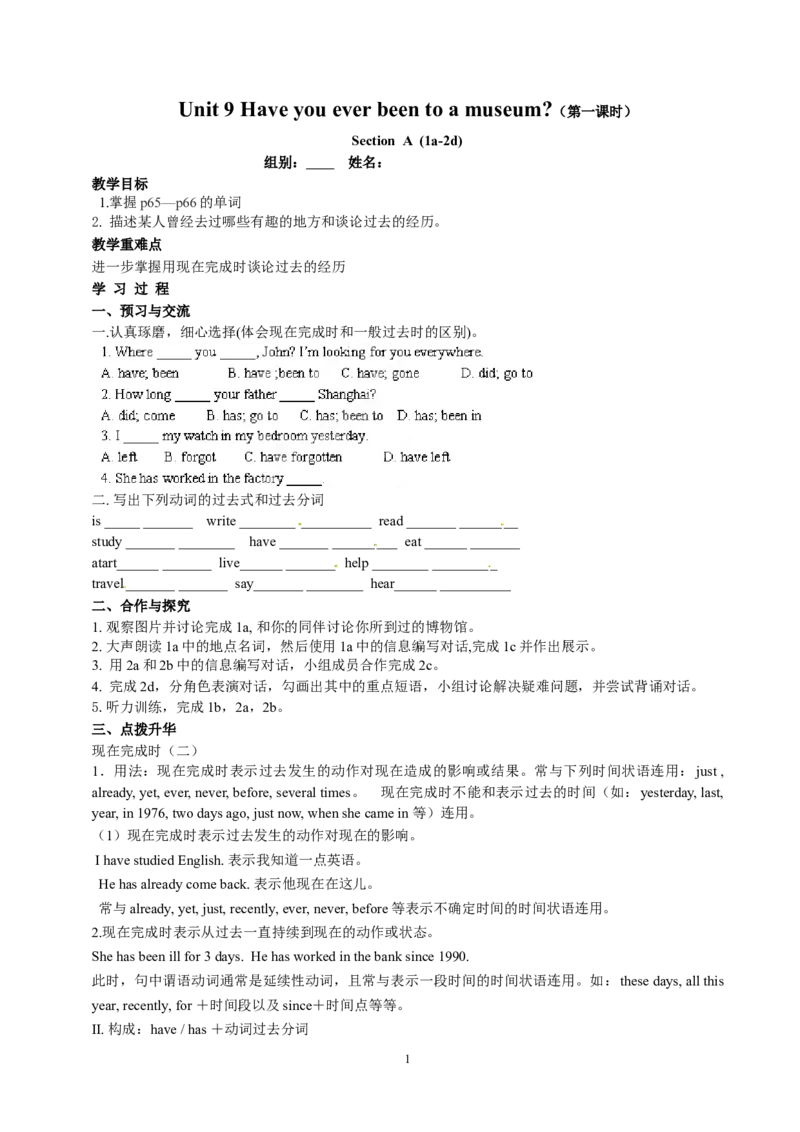
一.认真琢磨,细心选择(体会现在完成时和一般过去时的区别)。
二. 写出下列动词的过去式和过去分词
is _____ _______ write ________ __________ read _______ ________
study _______ ________ have _______ _________ eat ______ _______
atart______ _______ live______ _______ help ________ _________
travel_______ _______ say_______ ________ hear______ __________
二、合作与探究
1. 观察图片并讨论完成1a, 和你的同伴讨论你所到过的博物馆。
2. 大声朗读1a中的地点名词,然后使用1a中的信息编写对话,完成1c并作出展示。
3. 用2a和2b中的信息编写对话,小组成员合作完成2c。
4. 完成2d,分角色表演对话,勾画出其中的重点短语,小组讨论解决疑难问题,并尝试背诵对话。
5.听力训练,完成1b,2a,2b。
三、点拨升华
现在完成时(二)
1.用法:现在完成时表示过去发生的动作对现在造成的影响或结果。常与下列时间状语连用:just ,
already, yet, ever, never, before, several times。 现在完成时不能和表示过去的时间(如:yesterday, last,
year, in 1976, two days ago, just now, when she came in 等)连用。
(1)现在完成时表示过去发生的动作对现在的影响。
I have studied English. 表示我知道一点英语。
He has already come back. 表示他现在在这儿。
常与already, yet, just, recently, ever, never, before等表示不确定时间的时间状语连用。
2.现在完成时表示从过去一直持续到现在的动作或状态。
She has been ill for 3 days. He has worked in the bank since 1990.
此时,句中谓语动词通常是延续性动词,且常与表示一段时间的时间状语连用。如:these days, all this
year, recently, for +时间段以及since+时间点等等。
II. 构成:have / has +动词过去分词
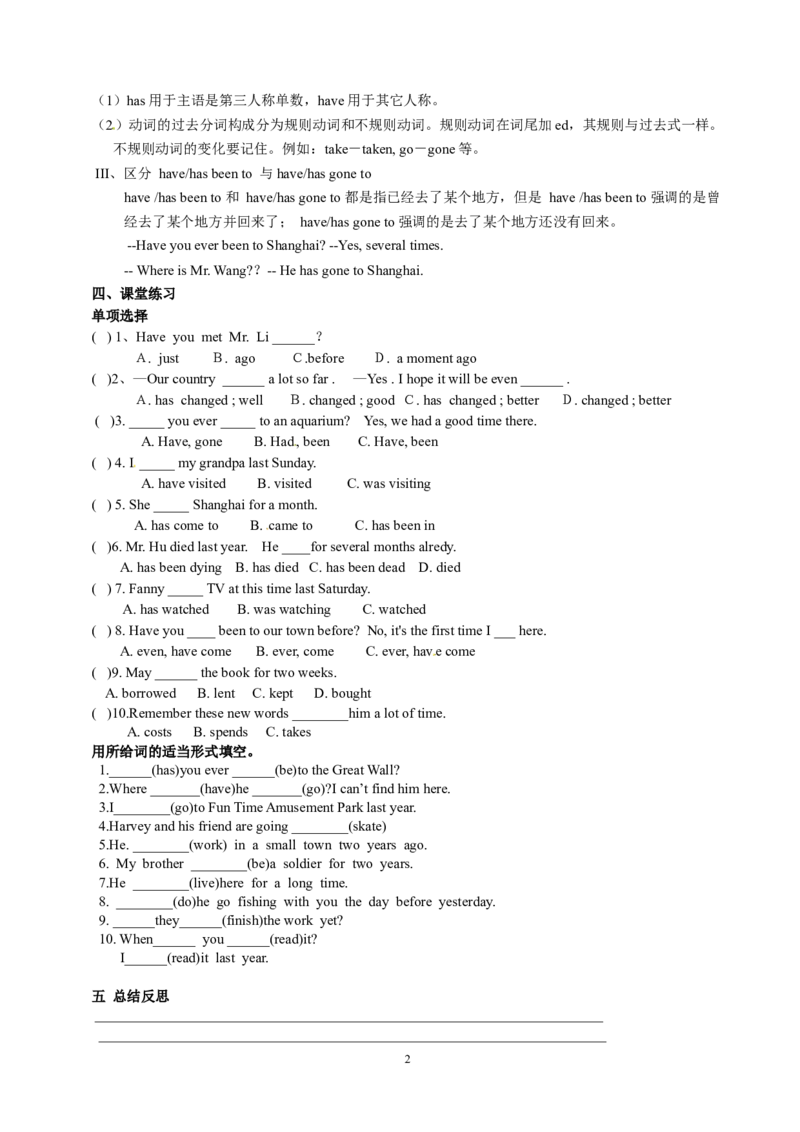
1(1)has用于主语是第三人称单数,have用于其它人称。
(2)动词的过去分词构成分为规则动词和不规则动词。规则动词在词尾加ed,其规则与过去式一样。
不规则动词的变化要记住。例如:take-taken, go-gone等。
III、区分 have/has been to 与have/has gone to
have /has been to 和 have/has gone to 都是指已经去了某个地方,但是 have /has been to 强调的是曾
经去了某个地方并回来了; have/has gone to强调的是去了某个地方还没有回来。
--Have you ever been to Shanghai? --Yes, several times.
-- Where is Mr. Wang??-- He has gone to Shanghai.
四、课堂练习
单项选择
( ) 1、Have you met Mr. Li ______?
A. just B. ago C.before D. a moment ago
( )2、—Our country ______ a lot so far . —Yes . I hope it will be even ______ .
A. has changed ; well B. changed ; good C. has changed ; better D. changed ; better
( )3. _____ you ever _____ to an aquarium? Yes, we had a good time there.
A. Have, gone B. Had, been C. Have, been
( ) 4. I _____ my grandpa last Sunday.
A. have visited B. visited C. was visiting
( ) 5. She _____ Shanghai for a month.
A. has come to B. came to C. has been in
( )6. Mr. Hu died last year. He ____for several months alredy.
A. has been dying B. has died C. has been dead D. died
( ) 7. Fanny _____ TV at this time last Saturday.
A. has watched B. was watching C. watched
( ) 8. Have you ____ been to our town before? No, it's the first time I ___ here.
A. even, have come B. ever, come C. ever, have come
( )9. May ______ the book for two weeks.
A. borrowed B. lent C. kept D. bought
( )10.Remember these new words ________him a lot of time.
A. costs B. spends C. takes
用所给词的适当形式填空。
1.______(has)you ever ______(be)to the Great Wall?
2.Where _______(have)he _______(go)?I can’t find him here.
3.I________(go)to Fun Time Amusement Park last year.
4.Harvey and his friend are going ________(skate)
5.He. ________(work) in a small town two years ago.
6. My brother ________(be)a soldier for two years.
7.He ________(live)here for a long time.
8. ________(do)he go fishing with you the day before yesterday.
9. ______they______(finish)the work yet?
10. When______ you ______(read)it?
I______(read)it last year.
五 总结反思
________________________________________________________________________
________________________________________________________________________
2Unit 9 Have you ever been to a museum?
(第二课时)
Section A 3a- 4c
组别: 姓名:
教学目标
1. 学习P67—68的生词:
2. 能够掌握本课出现的重点短语和句子。
3. 了解国外的风情和文化。
教学重难点
一般过去时,现在完成进行时和现在完成时的区别。
学 习 过 程
一、预习与交流
1.英汉互译。
1、___________以如此迅猛的方式 2、___________各种各样的
3、___________ 马桶的发展 4、___________社会团体
5、___________茶艺表演 6、_____________________用漂亮的茶具沏一杯完美的茶
7、___________ 一个品茶的好地方 8、___________ 相信
9、____________________国际马桶博物馆 10、___________在未来
2..小组成员互读单词和词组。
二、合作与探究
1. 带着问题阅读3a,然后回答相关问题。
2. 再读文章,勾画出其中的重点短语。
3. 独立完成 3b,3c,并在小组中作展示。
4. 小组成员大声朗读Grammar Focus。
5. 独立完成4a,并且核对答案,然后大声朗读这部分的句子。
6. 小组合作完成4b,4c的练习。
7. 试着背诵记忆Grammar Focus,4a部分的内容。
三、点拨升华
一、 延续性动词和瞬间动词
英语动词根据词义可分为两种,一种是延续性的,一种是终止性的,终止性动词(也可称为非延续性动
词,瞬间动词,或点动词),如begin,start,die,buy,leave, come等,表示动作的发生与结束于一瞬间完成,不能再
延续,所以它的现在完成时不能和表示延续的时间状语连用,即不能与表示一段时间的状语,for+时间段,
since+时间点/从句连用,也不能用在how long引导的特殊疑问句中.
eg. I've left Shanghai for three days.(×)
I've been away from Shanghai for three days.( √ ).
I left Shanghai three days ago. ( √ )
It is /has been three days since I left Shanghai.( √ )
常见终止性动词有:leave, go, come, arrive, begin, buy, borrow, die, join, become等.
四、课堂练习
单项选择。
( )1.My mother often encourages me________English as much as possible.
A. speak B. speaks C.speaking D.to speak
( )2.—Do you often ___ your penfriend? --Not very often.
A. hear from B. hear about C. hear of D. hear
( )3.Neither of the two boys______from the USA.
A.come B. don’t come C.comes D.doesn’t come
( )4.Have you ever seen him____?
A. ago B.two days ago C.before D.just now
( )5.His brother ______ for three months.
3A. has joined the army B.has been in the army
C. has become a soldier D.joined the army
( )6.Did you go there by ____bike?
A. a; a B./; a C.the; the D.a; the
( )7.There has never been such a beautiful village ____in the world.
A. anywhere B. everywhere C. somewhere D. nowhere
( )8.-What kind of house would you like ?
-I’d like ____with a garden in front of____.
A. it; one B. one; one C one; it D. it ; it
( )7.She has never been to the city , ____she?
A. doesn’t B. hasn’t C. has D.haven’t
( )8. –It’s Father’s Day, ____ ?
-Yes,Let’s buy a gift for Dad..
A. isn’t it B. dosen’t it C isn’t he D.doesn’t he
( )9.Juile’s father____to London last month.He____there three times.
A. went; had gone B. has gone; has been C went; has been D. has been; had gone
( ) 10. I don’t like those two coats because ________ of them fits me.
A. either B. neither C. none D. all
( ) 11. ––I really want to go to the . How about you?
–– So do I. We can swim in it.
A. water park B. aquarium C. zoo D. space museum
( ) 12. ____ is fun to learn another language.
A. That B. This C. It D. What
( )13. ––I hear your teacher ________ to Japan once. ––Yes, he _______ there last year.
A. goes; went B. has been; has been C. went; went D. has been; went
( ) 14. –– _______ have you been studying English? –– Since last year.
A. How far B. How soon C. How long D. How often
( ) 15. The Smiths have lived here with us ________ 1999.
A. for B. since C. before D. in
( ) 16. –– I have never been to Disneyland. How about you? –– .
A. Me, too B. So do I C. Me, neither D. Yes, I have
( )17. When my mother came back home last night, I was still _________.
A. wake B. woke C. waking D. awake
( ) 18. ––Tina, we are going to take a holiday in Europe. ––_________.
A. It’s wonderful B. With pleasure C. That’s OK D. Have a good time
所给词的适当形式填空
1. Have you ever _______________(study) with more than three friends?
2. Has Tom ever ______________(travel) to China?
3. Have you ever_________(say) something you didn’t want to say?
4. I have never _____________(argue) with my parents.
5. I ____________(go) to the space museum last year.
6. Harvey____________(have) a great time at the Water World.
五 总结反思
________________________________________________________________________
________________________________________________________________________
4Unit 9 Have you ever been to a museum?
(第三课时)
Section B 1a—2e
组别: 姓名:
教学目标
1.学习P69—71的生词和短语。
2. 学会谈论过去发生的事情。
3.掌握阅读技巧。
教学重难点
现在完成时的构成和用法
学 习 过 程
一、预习与交流
(一).复习Unit9 Section A Grammar Focus 中的句子,看看你能背写下了吗?
1、__________东南亚 2、__________夜间动物园 3、__________四分之三
4、__________一个讲英语的国家 5、__________做某事很困难
6、__________在白天 7、__________好几次 8、__________现在;目前
9、____________________一个有特别的主题的游乐园 10、__________在公园里到处走
11、__________ 听说 12、__________兜风 13、__________另一个省
14、__________鸟巢 15、__________鼓励某人做某事 16、__________数以千计的
二、合作与探究
1. 小组讨论完成1a中的任务。
2. 听力训练,听录音完成1b;1c,并大声朗读1b;1c部分的内容。
3. 小组合作完成1d
4. 小组交流2a,阅读2b的短文完成2c,2d的任务。
5. 交流完成2c;2d;2e并作展示。
三、点拨升华
一、 even的用法
even 意为“甚至”可用于形容词比较级前,表示加强程度,可修饰形容词比较级的词还有:a bit,a
little,much,a lot,still,even等
二、 wonder的用法 意为“想知道,对…感到怀疑”
1.wonder+特殊疑问句 “想知道,好奇”
2.wonder+whether/if从句“想知道是否…”
3.wonder+that从句 “诧异,惊奇”
三、 辨析with、by、in “用”
1、with,多指使用某种工具或用身体的某个部位或器官来完成某项活动。
如:He cut it open with a knife.
2、by,指采用某种方法、手段,by doing sth
如:I learn English by asking the teacher for help.
3、In,指使用某种语言、采用某种途径或选用某种材料等
如:Can you sing this song in English?
(二)一般过去时,现在完成进行时和现在完成时的区别
一般过去时只表示_______________,和___________不发生联系。现在完成时是用_____________
5说明现在的情况。
He lived in Beijing in 2000. 只说明他2000年住在北京,他目前住在哪里并不清楚。
He has lived in Beijing since 2000. 说明他自从2000年就住在北京,他目前还住在北京。
现在完成时和现在完成进行时都可以表示“从过去开始一直持续到现在”这一概念,有时两者可以
互相代用,但前者多用于口语。在含义上如着重表示动作的结果时,多用_______________ 时;如着重
表 示 动 作 一 直 在 进 行 , 即 动 作 的 延 续 性 或 者 动 作 仍 然 继 续 下 去 时 , 则 多 用
____________________________时。
四、课堂练习
用所给动词的正确时态填空
1. I __________(finish)today’s homework already. What about you?
2. He ____________ just ____________(decide) to join the swimming club.
3. _______you ____________(see) Jack recently? ——No , I haven’ t.
4. How long ____________ you ____________(be) in class today?
5. How many English words ____________ they ____________(learn)?
6. He ___________ ever ___________ (be) to the History Museum several times.
7. — _____________ you ever ___________ (be) to the zoo?
—Yes. I ____ (go) there last summer. I __ (see) many kinds of animals there.
8. —Where is Mr. Wang?
—He _________ (go) to the library. He wants to borrow some library books.
二、单项选择。
1. How long have you been _____English?
A.study B. studied C. studying D.studyed
2. He called me up when I ______a shower this morning.
A.have B. had C. have had D.was having
3.I think Ann _____a supper star in only 2 years?
A.is B. is going to C. is being D.has been
4.Have you ever ______to travel around?
A. take a train B. took train
C.by a train D. by trains
5. The kids from mountains districts _______never_______computer games before.They’re so excited.
A. have;played B.did;play C.are; playing D.do ;play
6.When I was fifteen years old,I got _____all kinds of stamps.
A. to collect B.to collecting C. collect D.to
7、I want to tell Mike about the thing.but he just ______it.
A. wasn’t interested B.wasn’t interested in C. didn’t interest D.interested
五 总结反思
________________________________________________________________________
________________________________________________________________________
6Unit 9 Have you ever been to a museum?
(第四课时)
Section B 3a—self check
组别: 姓名:
教学目标
1.掌握本单元中的重点词汇,短语,并灵活运用。
2. 阅读与写作技能
教学重难点
写作训练:写一篇文章号召人们保护动物
学 习 过 程
一、预习与交流
1.归纳课文中的短语
1._______ _ 在夜晚2._______ _ 在一个更加自然的环境中3._______ _ 一年到头
4._______ _ 离……远5._______ _ 在黑暗中6._______ _ 在过去
7._______ _ 去过某地8._______ _ 科学博物馆9._______ _ 历史博物馆
10._______ _ 游乐园11._______ _ 去不同的地方12._______ _ 去滑冰
13._______ _ 坐地铁14._______ _ 一个过周六下午的好方法
15._______ _ 所有的古老的电影摄影机 16._______ _ .解有关。。。。的情况
17._______ _ 在周末18._______ _ 在大山里露营 19._______ _ 搭帐篷
20._______ _ 以如此迅猛的方式 21._______ _ 各种各样的 22._______ _ 厕所的发展
23._______ _ 社会团体 24._______ _ 茶艺表演
25._______ _ 用漂亮的茶具沏一杯完美的茶
26._______ _ 一个品茶的好地方27._______ _ 数以千计的28._______ _ 国际厕所博物馆
29._______ _ 兵马俑30._______ _ 东南亚31._______ _ 夜间动物园
32._______ _ 四分之三33._______ _ 一个讲英语的国家34._______ _ 做某事很困难
35._______ _ 在白天36._______ _ 好几次37._______ _ 现在;目前
38.an amusement park with a special theme_______ _ 一个有特别的主题的游乐园
39._______ _ 在公园里到处走40._____ _ 听说 41.._______ _ 兜风
42._______ _ 另一个省 43._______ _ 鸟巢44._______ _ .鼓励某人做某事
二、合作与探究
1.独立完成Section B 3a,3b并在小组内进行交流。
2.独立完成Self Check1.2,3部分并在小组内进行交流。
3.小组内总结本单元的主要知识点,看谁做的最好。
三.点拨与升华
一、 分数表达法
分子为基数词,分母为序数词,当分子大于1时,分母要加-s。
如:one third 三分之一 three thirds 五分之三
二、 辨析maybe与may be
maybe adv. “也许,可能”,常位于句首,做状语。如:Maybe he is at home。也许他在家。
may be “大概是,可能是”,由情态动词may加动词原形be构成。如:He may be at home。
三、 have problem (in) doing sth. 意为“做某事有问题或有困难”。
如:You won’t have any problem in finding answers.你将轻而易举地找到答案。
类似的结构有:have trouble (in)doing sth/ have difficulty (in) doing sth.
四、thousand的用法
7如果thousand 前面有数字,就用:数字+thousand。thousand 不管是几千都不加s。
thousands of:成千上万的。前面不加明确的数字。
如:three thousand students 三千名学生 thousands of students
类似的词:hundred、million等
四、课堂练习
单项选择。
)1.—Have you ever _________to a water park?
—No,I haven’t.
A. gone B. been C. visited D.go
( )2. —I enjoy ice skating.
—________________________.
A. I do so. B. So I do. C. So do I. D. neither so I
( )3. —I have__________been to U.S.A.
—Neither has Jim.
A. never B. ever C. already D.yet
( )4.My teacher is_______years old.
A. 30 more than B. more than 30 C. more 30 than D.less than 30
( )5. You can rent a bike if you want to get some ___________.
A.exercise B. exercises C. exrecise D. exercised
( )6.I’ve never ____________other countries.
A. traveled B. traveled to C. traveled D. will travel
( )7.There were many times visitors ________photos of the buildingd in Hongcun.
A.take B.taking C. took D.are talking
( )8.—How long_______in Shanghai?
--Since the end of last year.
A.did she live B. does she live C.has she lived D.will she live
( )9.--_______has Judy run the marathon? --Three times.
A. How far B. How soon C. How many times D. How long
( )10、What ______job did he do?
A. others B. the other C. another D. other
假如你是阳光旅行社的一名导游。请你为郴州或嘉禾写一则旅游广告。说说人们应该来这旅游的理由。不
少于60字。
————————————————————————————————————————————
————————————————————————————————————————————
————————————————————————————————————————————
_____________________________________________________________________________
_____________________________________________________________________________
_____________________________________________________________________________
五 总结反思
________________________________________________________________________
_____________________________________________________________________________
89