八年级英语(下)学生自主学习导学案
Class________ Team__________ Name________ NO.____
单元课 Period
科目 English 课题 内容 SectionA(2a-2d)
时 2 [来源:Z§xx§k.Com]
课型 新课 设计人 雷元霞 审核人 郭茹 授课时间 ___________ 总课时No.
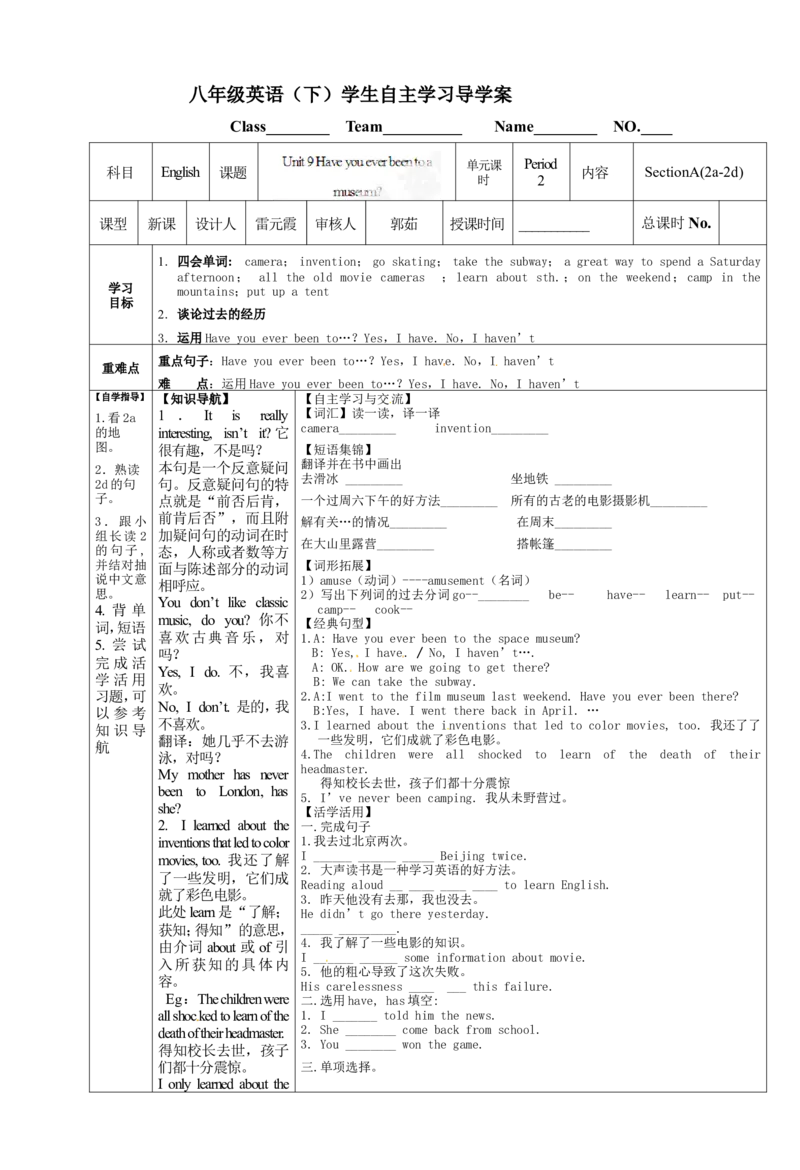
1. 四会单词: camera; invention; go skating; take the subway; a great way to spend a Saturday
afternoon; all the old movie cameras ;learn about sth.;on the weekend;camp in the
学习 mountains;put up a tent
目标
2. 谈论过去的经历
3. 运用Have you ever been to…?Yes,I have. No,I haven’t
重点句子:Have you ever been to…?Yes,I have. No,I haven’t
重难点
难 点:运用Have you ever been to…?Yes,I have. No,I haven’t
【自学指导】 【知识导航】 【自主学习与交流】
1 . It is really 【词汇】读一读,译一译
1.看2a
camera_________ invention_________
的地 interesting, isn’t it? 它
图。 很有趣,不是吗? 【短语集锦】
本句是一个反意疑问 翻译并在书中画出
2.熟读
去滑冰 _________ 坐地铁 _________
2d的句 句。反意疑问句的特
子。 点就是“前否后肯, 一个过周六下午的好方法_________ 所有的古老的电影摄影机_________
前肯后否”,而且附
3.跟小 解有关…的情况_________ 在周末_________
组长读 2 加疑问句的动词在时
在大山里露营_________ 搭帐篷_________
的句子, 态,人称或者数等方
并结对抽 面与陈述部分的动词 【词形拓展】
说中文意 1)amuse(动词)----amusement(名词)
相呼应。
思。 2)写出下列词的过去分词go--________ be-- have-- learn-- put--
You don’t like classic
4. 背 单 camp-- cook--
music, do you? 你不
词,短语 【经典句型】
喜欢古典音乐,对 1.A: Have you ever been to the space museum?
5. 尝 试
吗? B: Yes, I have. / No, I haven’t….
完 成 活
A: OK. How are we going to get there?
Yes, I do. 不,我喜
学 活 用 B: We can take the subway.
欢。
习题,可 2.A:I went to the film museum last weekend. Have you ever been there?
No, I don’t. 是的,我
以 参 考 B:Yes, I have. I went there back in April. …
不喜欢。 3.I learned about the inventions that led to color movies, too. 我还了了
知 识 导
翻译:她几乎不去游 一些发明,它们成就了彩色电影。
航
泳,对吗? 4.The children were all shocked to learn of the death of their
headmaster.
My mother has never
得知校长去世,孩子们都十分震惊
been to London, has
5. I’ve never been camping. 我从未野营过。
she?
【活学活用】
2. I learned about the 一.完成句子
inventions that led to color 1.我去过北京两次。
I ______ ______ _____ Beijing twice.
movies, too. 我还了解
2. 大声读书是一种学习英语的好方法。
了一些发明,它们成
Reading aloud __ ____ ____ ____ to learn English.
就了彩色电影。
3. 昨天他没有去那,我也没去。
此处learn是“了解; He didn’t go there yesterday.
获知;得知”的意思, _____ _________.
由介词 about 或 of 引 4. 我了解了一些电影的知识。
I ______ ______ some information about movie.
入所获知的具体内
5. 他的粗心导致了这次失败。
容。
His carelessness ____ ___ this failure.
Eg:The children were 二.选用have, has填空:
all shocked to learn of the 1. I _______ told him the news.
death of their headmaster. 2. She ________ come back from school.
3. You ________ won the game.
得知校长去世,孩子
们都十分震惊。 三.单项选择。
I only learned about theaccident later. 我只是后
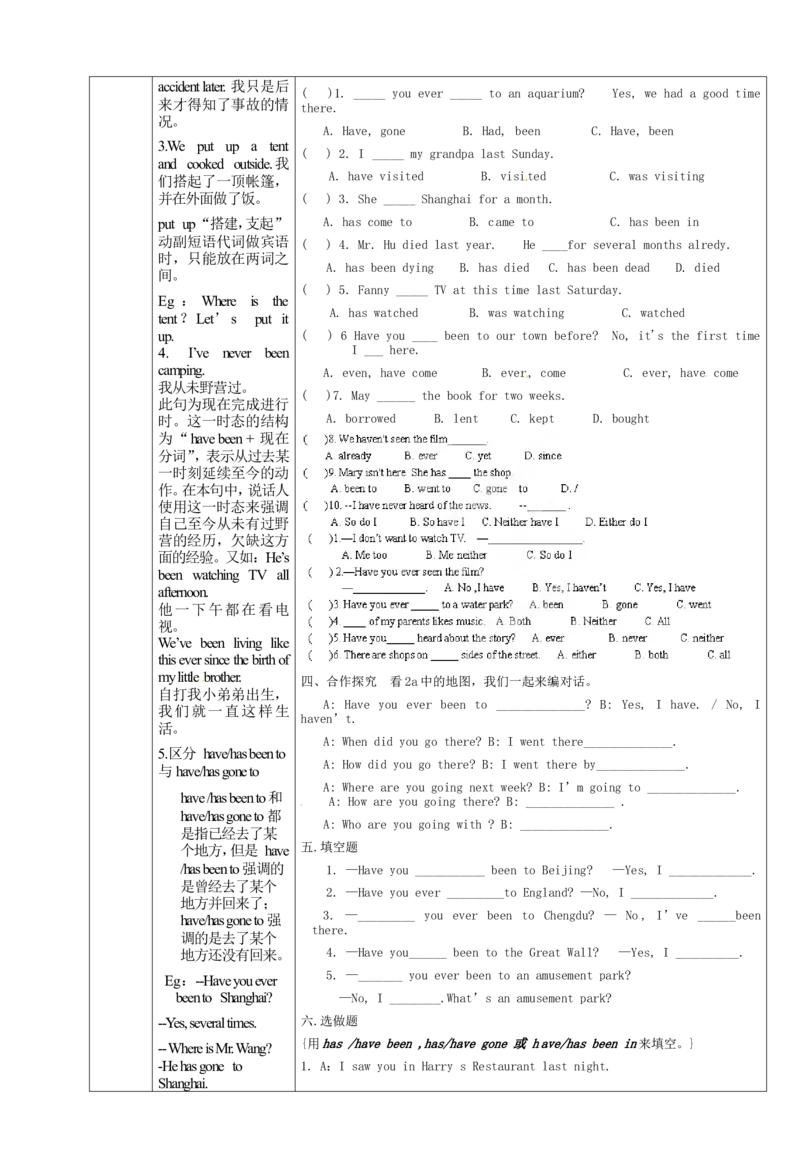
( )1. _____ you ever _____ to an aquarium? Yes, we had a good time
来才得知了事故的情
there.
况。
A. Have, gone B. Had, been C. Have, been
3.We put up a tent
( ) 2. I _____ my grandpa last Sunday.
and cooked outside.我
A. have visited B. visited C. was visiting
们搭起了一顶帐篷,
并在外面做了饭。 ( ) 3. She _____ Shanghai for a month.
put up“搭建,支起” A. has come to B. came to C. has been in
动副短语代词做宾语
( ) 4. Mr. Hu died last year. He ____for several months alredy.
时,只能放在两词之
A. has been dying B. has died C. has been dead D. died
间。
( ) 5. Fanny _____ TV at this time last Saturday.
Eg : Where is the [来源:学+科+网Z+X+X+K]
A. has watched B. was watching C. watched
tent?Let’s put it
up. ( ) 6 Have you ____ been to our town before? No, it's the first time
4. I’ve never been I ___ here.
camping. A. even, have come B. ever, come C. ever, have come
我从未野营过。
( )7. May ______ the book for two weeks.
此句为现在完成进行
时。这一时态的结构 A. borrowed B. lent C. kept D. bought
为“have been + 现在
分词”,表示从过去某
一时刻延续至今的动
作。在本句中,说话人
使用这一时态来强调
自己至今从未有过野
营的经历,欠缺这方
面的经验。又如:He’s
been watching TV all
afternoon.
他一下午都在看电
视。
We’ve been living like
this ever since the birth of
学|科|网Z|X|X|K] [来源:
my little brother.
四、合作探究 看2a中的地图,我们一起来编对话。
自打我小弟弟出生,
A: Have you ever been to ______________? B: Yes, I have. / No, I
我们就一直这样生
haven’t.
活。
A: When did you go there? B: I went there______________.
5.区分 have/has been to
A: How did you go there? B: I went there by______________.
与have/has gone to
A: Where are you going next week? B: I’m going to ______________.
have /has been to 和
A: How are you going there? B: ______________ .
have/has gone to 都
A: Who are you going with ? B: ______________.
是指已经去了某
个地方,但是 have 五.填空题
/has been to 强调的 1. —Have you ___________ been to Beijing? —Yes, I _____________.
是曾经去了某个
2. —Have you ever _________to England? —No, I _____________.
地方并回来了;
3. —_________ you ever been to Chengdu? — No, I’ve ______been
have/has gone to强
there.
调的是去了某个 [来源:学科网ZXXK]
地方还没有回来。 4. —Have you______ been to the Great Wall? —Yes, I __________.
5. —_______ you ever been to an amusement park?
Eg:--Have you ever
been to Shanghai? —No, I ________.What’s an amusement park?
--Yes, several times. 六.选做题
{用has /have been ,has/have gone 或 have/has been in来填空。}
-- Where is Mr. Wang?
-He has gone to 1. A:I saw you in Harry s Restaurant last night.
Shanghai.B:No, it wasn’t me. I ____ never _____ there.
2. A:Sally and Tim are on holiday, aren’t they? Where have they _____?
B:To Florida, again.
A:How many times have they _____ there?
B:This is their third visit.
3. A: How long have your parents that school?
B: Since they came to this city.
4. A:Where’s Tony? B:He’s got a headache so he _____________ to b
ed.
5. A:(on the phone)Can I speak to Mary, please?
B:She’s out, I’m afraid. She __________ to the cinema this evening.
6. She _____________ Shanghai for two days, and she will be back in two
weeks.
7. A:Can I have an apple, please?
B:We haven’t got any. I ______not _____ to the shops today.
[来源:学科网]
······Have been to/have gone to/have been in······
①have been to 表示“曾经去过某地”,说话时已不在去过的地方,常
与ever,never,just等连用。后可接次数,如once,twice,three times等,表
示“去过某地几次”。
②have gone to 意为“去了某地”,表示到了某地或正在去某地的途
中,总之说话时该人不在现场,一般不用第一,二人称作主语。
③have been in 表示“在某地待多长时间”,常与表示一段时间的状
语连用。
Time is money,but money is not time.. 时间就是金钱,但金钱不是时间