责任编辑:钱 锋
王金洲
王 希
封面设计:武 斌
王 琦
丽 子
绿色印刷产品
义务教育教科书(五·四学制) 英语 八年级 上册
定价:7.19元
价格批准文号:鲁发改价格核(2021)607005
举报电话:12345YIWU JIAOYU JIAOKESHU (WU·SI XUEZHI)
YINGYU
BA NIANJI SHANG CE
义务教育教科书(五·四学制)
英语
八年级 上册
人民教育出版社
圣智学习出版公司 编著
山东教育出版社
*
山东出版传媒股份有限公司
山东教育出版社出版
(济南市市中区二环南路 2066 号 4 区 1 号)
山东新华书店集团有限公司发行
青岛新华印刷有限公司印装
*
开本:787 毫米×1092 毫米 1/16
印张:7.5 字数:120 千
定价:7.19 元(上光)
ISBN 978-7-5328-8342-4
2014 年 7 月第 1 版 2019 年 7 月第 2 版 2021 年 7 月第 8 次印刷
著作权所有·请勿擅用本书制作各类出版物·违者必究
山东出版传媒股份有限公司教材中心售后服务电话:(0531)82098188致同学
亲爱的同学:
你好!欢迎学习我们精心为你编写的这套英语教材,希望它能成为你初中阶段
英语学习的好帮手。
作为中学生的你,一定希望进一步提高你的英语运用能力——能阅读英语读
物,能看懂英语电影,能用英语跟外国人交流⋯⋯那么你需要怎样做呢?让我们给
你一些建议吧。
● 首先要有信心,相信自己一定能学好英语。其次还要有热情,积极参与语言
实践。教材中设计了各种各样的练习活动,目的就是帮助你培养英语表达能力。只
要你带着热情去练习、去实践,你就会感受到成功的喜悦。
● 要养成良好的英语学习习惯,多听、多说、多读、多写。听的时候除了捕
捉信息,还要善于模仿。如果语音语调不正确,就不能有效地表达思想和情感。要
大胆地说,不要怕犯错误。要养成爱读英文的习惯,因为阅读是获取信息的主要渠
道。写能够巩固和强化你的语言知识,所以你还要重视写。
● 你是否发现,英语是有规律可循的?语音与拼法之间是有联系的。看到新单
词时,如果知道哪些字母发什么音,你就会比较容易地读出这个单词。并且,听到
某个单词的发音你就能比较容易地拼写出这个单词。所以,学英语一定要善于发现
规律。教材中的拼读规则练习你可不要忽视啊。
● 词汇学习非常重要,没有词汇的积累就无法进行言语表达。学单词时,要知
道它的意义,观察它的拼写,看它由哪些字母组成,试着按规则拼读出来,更重要
的是要看它是怎样使用的。
● 学习语法规则能帮助你说出和写出正确的句子。除了听老师讲解和看课本附
录中的语法说明外,你还要尝试自己归纳语法规则。但是,只知道语法规则是远远
不够的,只有在听说读写中练习运用这些规则,才能真正掌握语法。
● 学习语言离不开学习文化。从教材中你可以看到,不同国家的人们有着不同
的生活方式和行为习惯,有着不同的文化成就和遗产。了解中外文化知识会开阔你
的视野,会提高你跟外国人交际的能力。
● 英语学习不仅仅限于课堂,也不仅仅限于教材。如果你能把电视、报刊、图
书、互联网都当做英语学习的渠道,你的英语世界将是多么丰富多彩啊!
● 学习英语是一项艰辛的劳动,是与无数困难作斗争的过程,这好比攀登险
峰,无坦途可循,失败和挫折常与成功伴行。这就要求你具有良好的心理素质,善
于自我调控、改善学法、自我激励、磨练意志、树立信心。这样,你一定会成功!
祝你在英语学习中不断取得进步!
编 者Contents
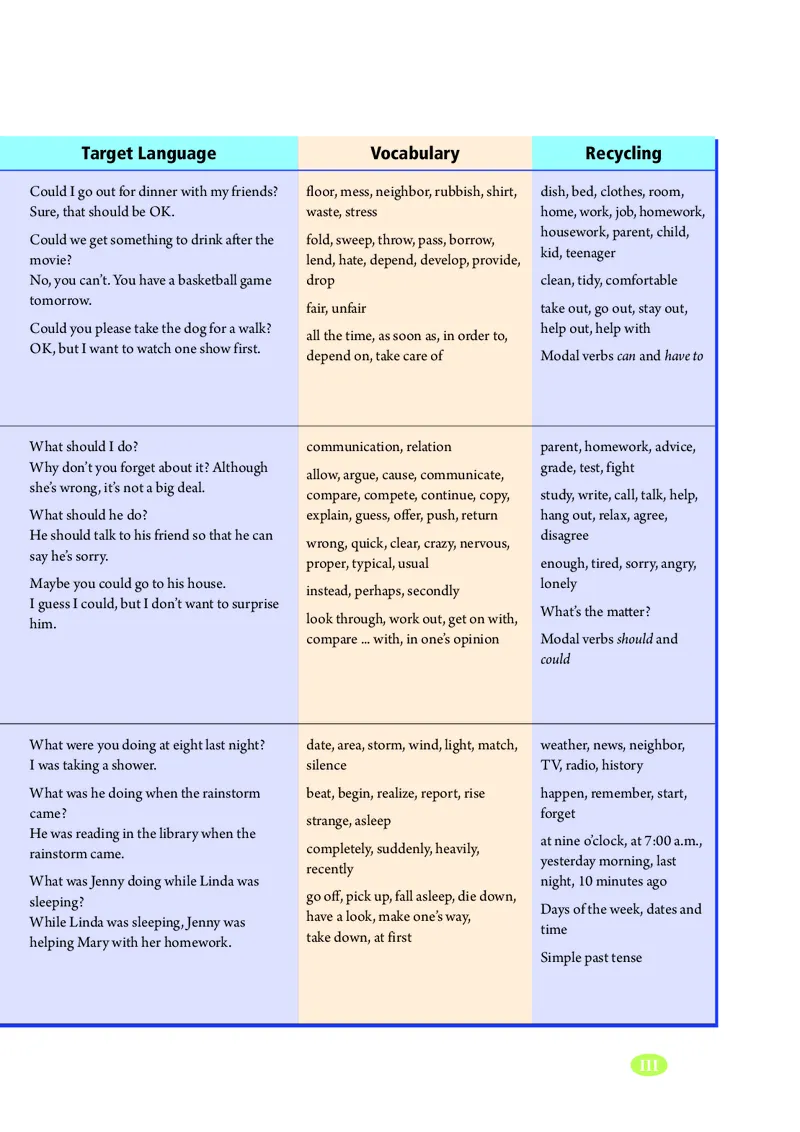
Units Topics Functions Structures Target Language Vocabulary Recycling
Chores and Make polite requests Could for polite requests Could I go out for dinner with my friends? floor, mess, neighbor, rubbish, shirt, dish, bed, clothes, room,
➊
permission Sure, that should be OK. waste, stress home, work, job, homework,
Ask for permission Could for permission
Could you housework, parent, child,
Could we get something to drink after the fold, sweep, throw, pass, borrow,
please clean kid, teenager
movie? lend, hate, depend, develop, provide,
your room? No, you can’t. You have a basketball game drop clean, tidy, comfortable
tomorrow.
Page 1 fair, unfair take out, go out, stay out,
Could you please take the dog for a walk? help out, help with
all the time, as soon as, in order to,
OK, but I want to watch one show first.
depend on, take care of Modal verbs can and have to
Interpersonal Talk about problems Why don’t you …? What should I do? communication, relation parent, homework, advice,
➋
communication Why don’t you forget about it? Although grade, test, fight
Give advice Conjunctions until, so that and allow, argue, cause, communicate,
Why don’t you she’s wrong, it’s not a big deal.
although compare, compete, continue, copy, study, write, call, talk, help,
talk to your
What should he do? explain, guess, offer, push, return hang out, relax, agree,
parents? He should talk to his friend so that he can disagree
wrong, quick, clear, crazy, nervous,
say he’s sorry.
Page 9 proper, typical, usual enough, tired, sorry, angry,
Maybe you could go to his house. lonely
instead, perhaps, secondly
I guess I could, but I don’t want to surprise
What’s the matter?
look through, work out, get on with,
him.
compare ... with, in one’s opinion Modal verbs should and
could
Unforgettable events Talk about past events Conjunctions when and while What were you doing at eight last night? date, area, storm, wind, light, match, weather, news, neighbor,
➌
I was taking a shower. silence TV, radio, history
Tell a story Questions and statements with the
What were you
past progressive tense What was he doing when the rainstorm beat, begin, realize, report, rise happen, remember, start,
doing when
came? forget
strange, asleep
the rainstorm He was reading in the library when the
at nine o’clock, at 7:00 a.m.,
came? rainstorm came. completely, suddenly, heavily,
yesterday morning, last
recently
What was Jenny doing while Linda was night, 10 minutes ago
Page 17
go off, pick up, fall asleep, die down,
sleeping?
Days of the week, dates and
have a look, make one’s way,
While Linda was sleeping, Jenny was
time
take down, at first
helping Mary with her homework.
Simple past tense
IIUnits Topics Functions Structures Target Language Vocabulary Recycling
Chores and Make polite requests Could for polite requests Could I go out for dinner with my friends? floor, mess, neighbor, rubbish, shirt, dish, bed, clothes, room,
➊
permission Sure, that should be OK. waste, stress home, work, job, homework,
Ask for permission Could for permission
Could you housework, parent, child,
Could we get something to drink after the fold, sweep, throw, pass, borrow,
please clean kid, teenager
movie? lend, hate, depend, develop, provide,
your room? No, you can’t. You have a basketball game drop clean, tidy, comfortable
tomorrow.
Page 1 fair, unfair take out, go out, stay out,
Could you please take the dog for a walk? help out, help with
all the time, as soon as, in order to,
OK, but I want to watch one show first.
depend on, take care of Modal verbs can and have to
Interpersonal Talk about problems Why don’t you …? What should I do? communication, relation parent, homework, advice,
➋
communication Why don’t you forget about it? Although grade, test, fight
Give advice Conjunctions until, so that and allow, argue, cause, communicate,
Why don’t you she’s wrong, it’s not a big deal.
although compare, compete, continue, copy, study, write, call, talk, help,
talk to your
What should he do? explain, guess, offer, push, return hang out, relax, agree,
parents? He should talk to his friend so that he can disagree
wrong, quick, clear, crazy, nervous,
say he’s sorry.
Page 9 proper, typical, usual enough, tired, sorry, angry,
Maybe you could go to his house. lonely
instead, perhaps, secondly
I guess I could, but I don’t want to surprise
What’s the matter?
look through, work out, get on with,
him.
compare ... with, in one’s opinion Modal verbs should and
could
Unforgettable events Talk about past events Conjunctions when and while What were you doing at eight last night? date, area, storm, wind, light, match, weather, news, neighbor,
➌
I was taking a shower. silence TV, radio, history
Tell a story Questions and statements with the
What were you
past progressive tense What was he doing when the rainstorm beat, begin, realize, report, rise happen, remember, start,
doing when
came? forget
strange, asleep
the rainstorm He was reading in the library when the
at nine o’clock, at 7:00 a.m.,
came? rainstorm came. completely, suddenly, heavily,
yesterday morning, last
recently
What was Jenny doing while Linda was night, 10 minutes ago
Page 17
go off, pick up, fall asleep, die down,
sleeping?
Days of the week, dates and
have a look, make one’s way,
While Linda was sleeping, Jenny was
time
take down, at first
helping Mary with her homework.
Simple past tense
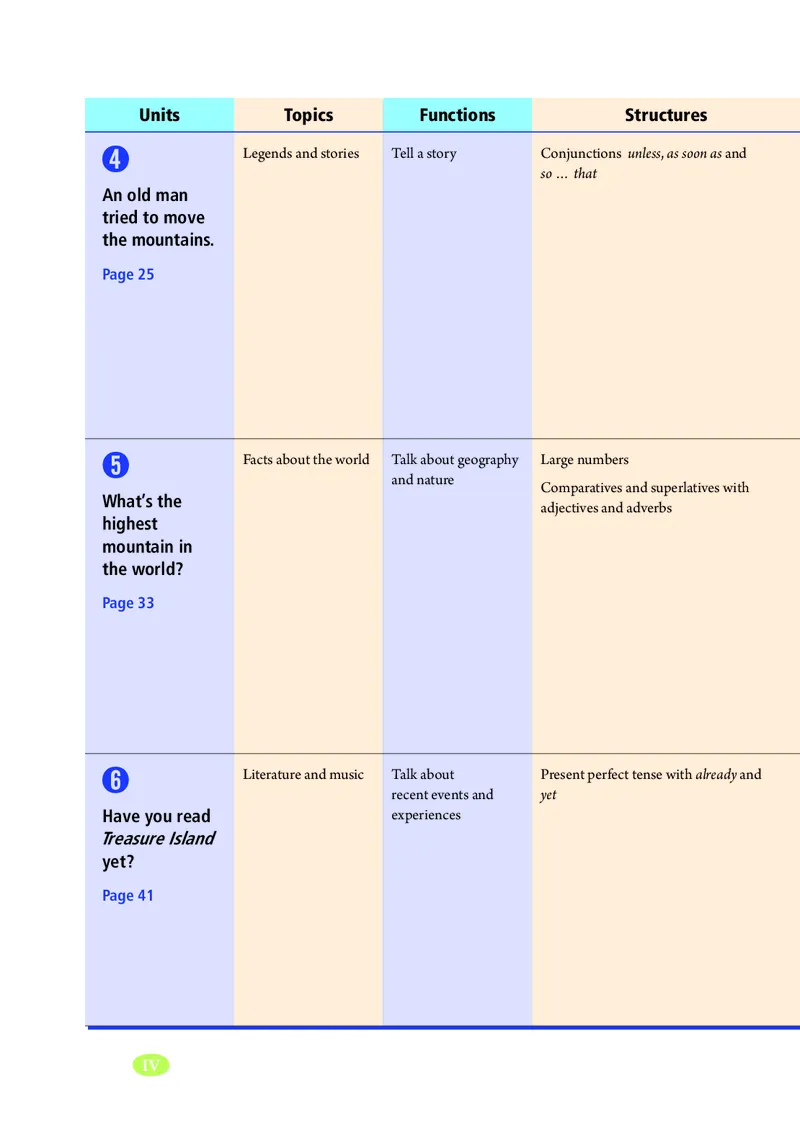
IIIUnits Topics Functions Structures Target Language Vocabulary Recycling
Legends and stories Tell a story Conjunctions unless, as soon as and How does the story begin? god, couple, husband, wife, object, story, mountain, fight,
➍
so … that Once upon a time, there was a very old gold, silk, stick, stone, tail, voice, problem, opinion, side
An old man man ... ground
interesting, different,
tried to move
What happened next? remind, fit, hide, lead, marry, shine, famous, favorite
the mountains. As soon as the man finished talking, Yu smile, cheat
Simple present tense
Gong said that his family could continue to
Page 25 brave, stupid, silly, weak, Western, Simple past tense
move the mountains after he died.
magic
Why was Yu Gong trying to move the Past progressive tense
once upon a time, turn ... into,
mountains?
fall in love, get married, a little bit,
Because they were so big that it took a long
instead of
time to walk to the other side.
Facts about the world Talk about geography Large numbers What’s the highest mountain in the world? nature, desert, ocean, square, mountain, kilometer, size,
➎
and nature Qomolangma. meter, bamboo, adult, illness, force, world, lake, river, sea,
Comparatives and superlatives with
What’s the population, condition, government, panda, elephant, country,
adjectives and adverbs How high is Qomolangma?
highest research, protection, achievement, scientist, fact
It’s 8,844.43 meters high. It’s higher than
mountain in any other mountain. excitement high, long, big, famous,
the world? achieve, include, protect, succeed, popular, strong
Did you know that China is one of the
weigh
Page 33 oldest countries in the world? Making comparisons
Yes, I did. It’s much older than the US. deep, wide, wild, thick, huge, ancient,
endangered
feel free, take in, walk into, fall over,
or so, as far as I know, in the face of,
at birth, up to
Literature and music Talk about Present perfect tense with already and Have you read Little Women yet? page, fiction, pop, fan, million, book, writer, library, music,
➏
recent events and yet Yes, I have. / No, I haven’t. record, line, success, beauty, song, singer, musician, CD
Have you read experiences technology, treasure, island, ship,
Has Tina read Treasure Island yet? read, finish, listen, feel
Treasure Island sand, land, mark, gun, tool
Yes, she has. She thinks it’s fantastic.
fantastic, interesting, boring,
yet? introduce, belong
Have you decided which book to write favorite, famous, popular,
Page 41 about yet? forever, abroad successful
Yes, I have. I’ve already finished reading it.
full of, hurry up, ever since, Simple present tense
It was really good.
one another
Simple past tense
Simple future tense
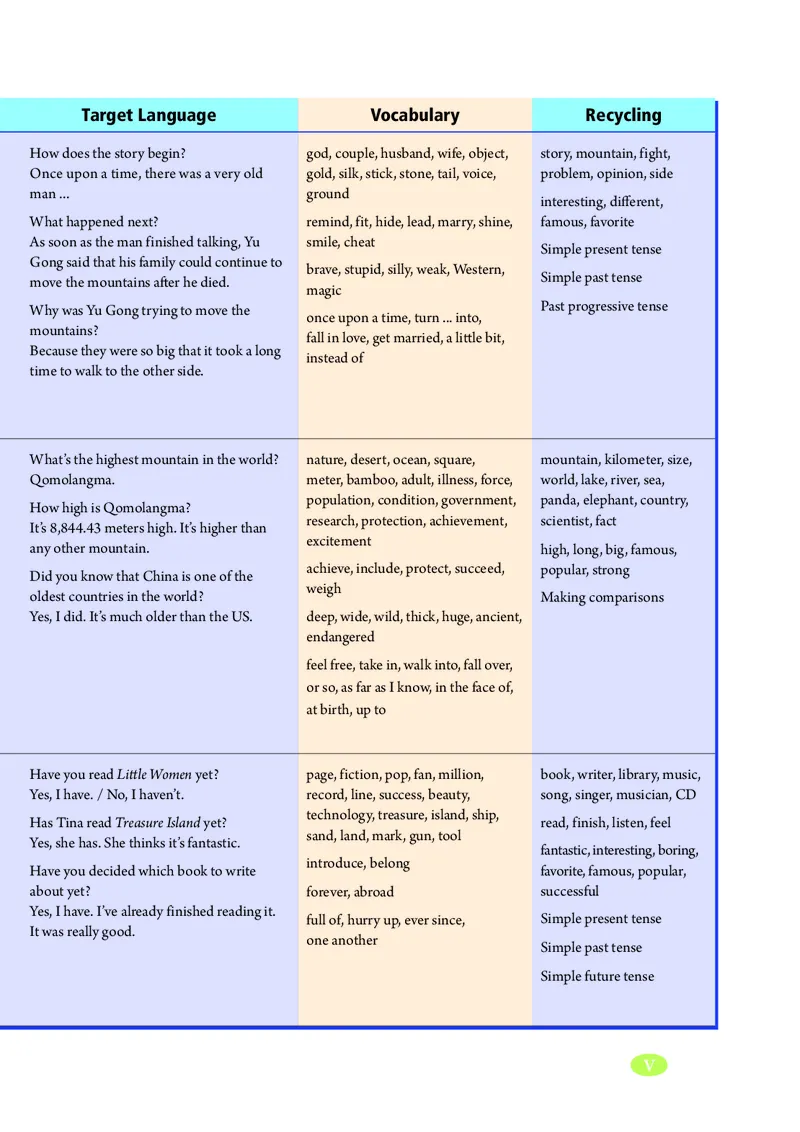
IVUnits Topics Functions Structures Target Language Vocabulary Recycling
Legends and stories Tell a story Conjunctions unless, as soon as and How does the story begin? god, couple, husband, wife, object, story, mountain, fight,
➍
so … that Once upon a time, there was a very old gold, silk, stick, stone, tail, voice, problem, opinion, side
An old man man ... ground
interesting, different,
tried to move
What happened next? remind, fit, hide, lead, marry, shine, famous, favorite
the mountains. As soon as the man finished talking, Yu smile, cheat
Simple present tense
Gong said that his family could continue to
Page 25 brave, stupid, silly, weak, Western, Simple past tense
move the mountains after he died.
magic
Why was Yu Gong trying to move the Past progressive tense
once upon a time, turn ... into,
mountains?
fall in love, get married, a little bit,
Because they were so big that it took a long
instead of
time to walk to the other side.
Facts about the world Talk about geography Large numbers What’s the highest mountain in the world? nature, desert, ocean, square, mountain, kilometer, size,
➎
and nature Qomolangma. meter, bamboo, adult, illness, force, world, lake, river, sea,
Comparatives and superlatives with
What’s the population, condition, government, panda, elephant, country,
adjectives and adverbs How high is Qomolangma?
highest research, protection, achievement, scientist, fact
It’s 8,844.43 meters high. It’s higher than
mountain in any other mountain. excitement high, long, big, famous,
the world? achieve, include, protect, succeed, popular, strong
Did you know that China is one of the
weigh
Page 33 oldest countries in the world? Making comparisons
Yes, I did. It’s much older than the US. deep, wide, wild, thick, huge, ancient,
endangered
feel free, take in, walk into, fall over,
or so, as far as I know, in the face of,
at birth, up to
Literature and music Talk about Present perfect tense with already and Have you read Little Women yet? page, fiction, pop, fan, million, book, writer, library, music,
➏
recent events and yet Yes, I have. / No, I haven’t. record, line, success, beauty, song, singer, musician, CD
Have you read experiences technology, treasure, island, ship,
Has Tina read Treasure Island yet? read, finish, listen, feel
Treasure Island sand, land, mark, gun, tool
Yes, she has. She thinks it’s fantastic.
fantastic, interesting, boring,
yet? introduce, belong
Have you decided which book to write favorite, famous, popular,
Page 41 about yet? forever, abroad successful
Yes, I have. I’ve already finished reading it.
full of, hurry up, ever since, Simple present tense
It was really good.
one another
Simple past tense
Simple future tense
VUnits Topics Functions Structures Target Language Vocabulary Recycling
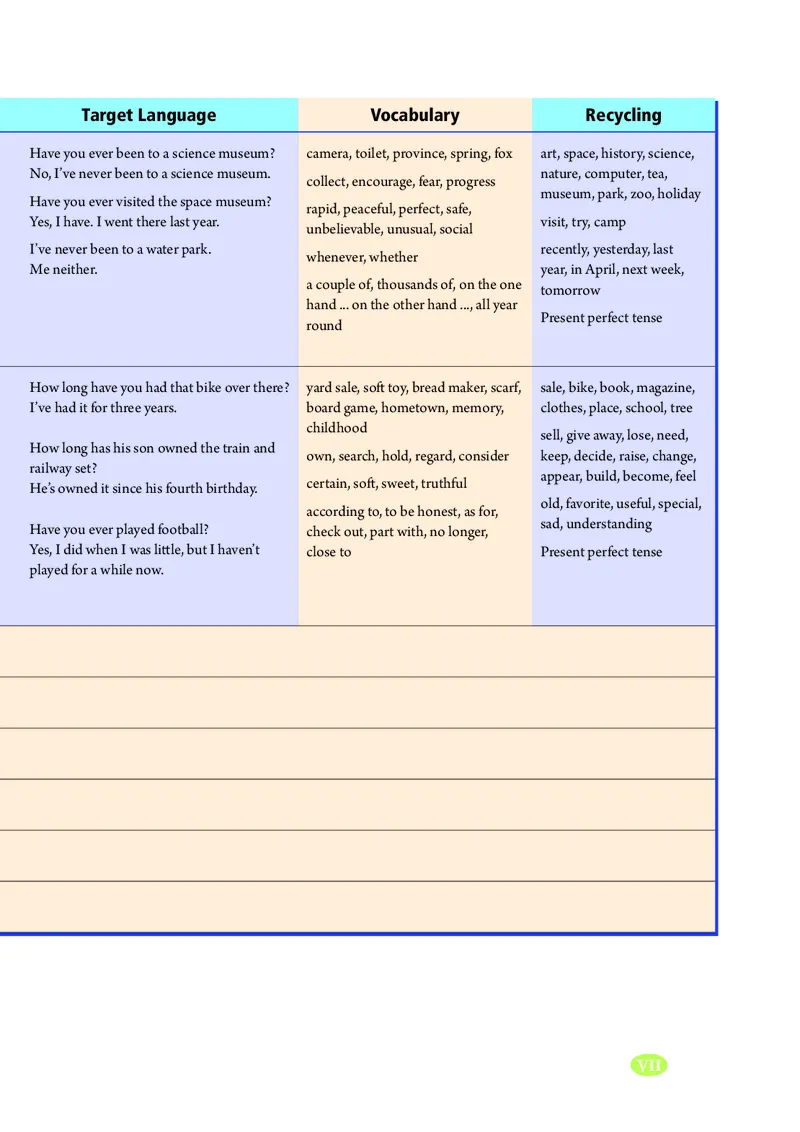
Fun places Talk about past Present perfect tense with been, ever Have you ever been to a science museum? camera, toilet, province, spring, fox art, space, history, science,
➐
experiences and never No, I’ve never been to a science museum. nature, computer, tea,
collect, encourage, fear, progress
Have you ever museum, park, zoo, holiday
Have you ever visited the space museum?
rapid, peaceful, perfect, safe,
been to a
Yes, I have. I went there last year. visit, try, camp
unbelievable, unusual, social
museum?
I’ve never been to a water park. recently, yesterday, last
whenever, whether
Page 49 Me neither. year, in April, next week,
a couple of, thousands of, on the one
tomorrow
hand ... on the other hand ..., all year
Present perfect tense
round
Living environment Talk about Present perfect tense with since and for How long have you had that bike over there? yard sale, soft toy, bread maker, scarf, sale, bike, book, magazine,
➑
possessions and I’ve had it for three years. board game, hometown, memory, clothes, place, school, tree
I’ve had this things around you childhood
sell, give away, lose, need,
bike for three How long has his son owned the train and
own, search, hold, regard, consider keep, decide, raise, change,
years. railway set? appear, build, become, feel
certain, soft, sweet, truthful
He’s owned it since his fourth birthday.
Page 57 according to, to be honest, as for, old, favorite, useful, special,
sad, understanding
Have you ever played football? check out, part with, no longer,
Yes, I did when I was little, but I haven’t close to Present perfect tense
played for a while now.
Page 65 Notes on the Text
Page 77 Tapescripts
Page 85 Grammar
Page 90 Words and Expressions in Each Unit
Page 99 Vocabulary Index
Page 107 Irregular Verbs
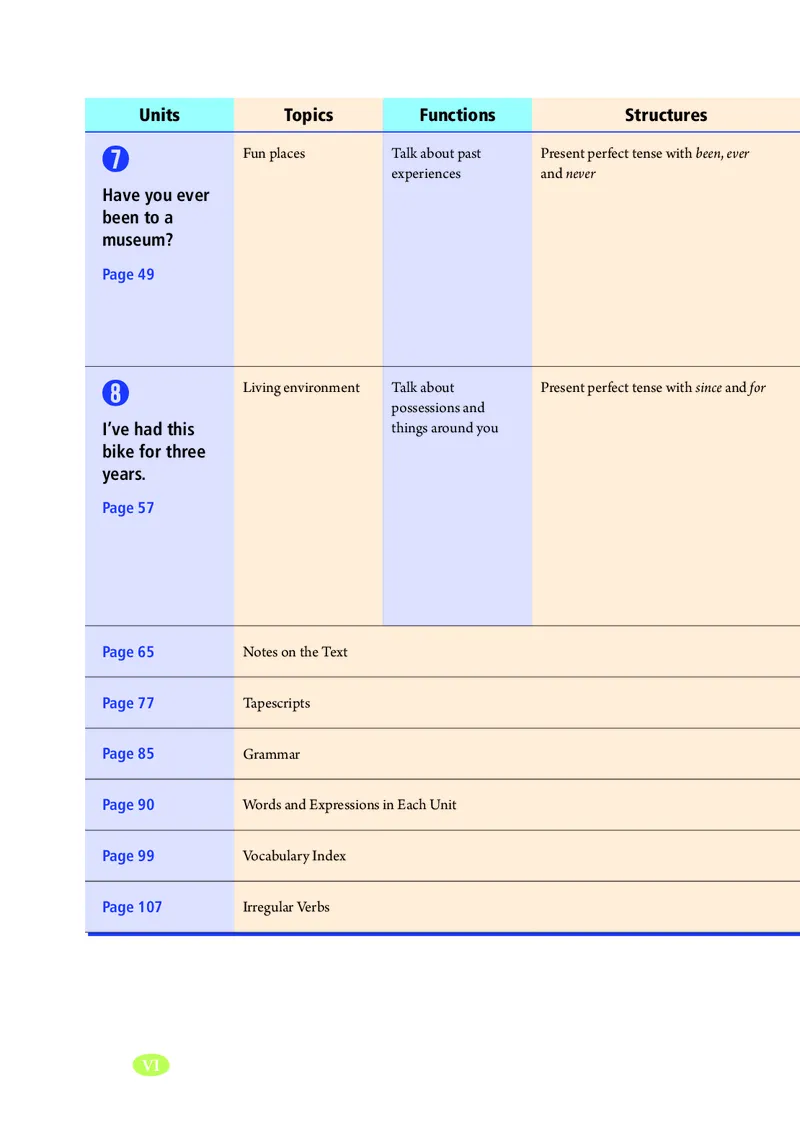
VIUnits Topics Functions Structures Target Language Vocabulary Recycling
Fun places Talk about past Present perfect tense with been, ever Have you ever been to a science museum? camera, toilet, province, spring, fox art, space, history, science,
➐
experiences and never No, I’ve never been to a science museum. nature, computer, tea,
collect, encourage, fear, progress
Have you ever museum, park, zoo, holiday
Have you ever visited the space museum?
rapid, peaceful, perfect, safe,
been to a
Yes, I have. I went there last year. visit, try, camp
unbelievable, unusual, social
museum?
I’ve never been to a water park. recently, yesterday, last
whenever, whether
Page 49 Me neither. year, in April, next week,
a couple of, thousands of, on the one
tomorrow
hand ... on the other hand ..., all year
Present perfect tense
round
Living environment Talk about Present perfect tense with since and for How long have you had that bike over there? yard sale, soft toy, bread maker, scarf, sale, bike, book, magazine,
➑
possessions and I’ve had it for three years. board game, hometown, memory, clothes, place, school, tree
I’ve had this things around you childhood
sell, give away, lose, need,
bike for three How long has his son owned the train and
own, search, hold, regard, consider keep, decide, raise, change,
years. railway set? appear, build, become, feel
certain, soft, sweet, truthful
He’s owned it since his fourth birthday.
Page 57 according to, to be honest, as for, old, favorite, useful, special,
sad, understanding
Have you ever played football? check out, part with, no longer,
Yes, I did when I was little, but I haven’t close to Present perfect tense
played for a while now.
Page 65 Notes on the Text
Page 77 Tapescripts
Page 85 Grammar
Page 90 Words and Expressions in Each Unit
Page 99 Vocabulary Index
Page 107 Irregular Verbs
VIIU 1
NIT
Section
A Could you please clean your room?
Language Goals:
Make polite
requests;
Ask for
Sure,
Mom.
permission
Peter, could you please
take out the rubbish?
1a Do you do these chores at home? Discuss them with your partner.
1. do the dishes 2. take out the rubbish 3. fold your clothes
4. sweep the floor 5. make your bed 6. clean the living room
1b Listen. Who will do these chores? Check (4) Peter’s mother or Peter.
Chores Peter’s mother Peter
do the dishes
sweep the floor
take out the rubbish
make the bed
fold the clothes
clean the living room
A: Could you please sweep the floor?
1c Make conversations about the B: Yes, sure. Can you do the dishes?
chores in 1a. A: Well, could you please do them?
I’m going to clean the living room.
B: No problem.
1UNIT 1
2a Listen. Peter asks his father if he can do
four things. What does his father say?
Check (4) yes or no.
Peter wants to ... Peter’s father says ... His father’s reasons
go out for dinner. 4 yes no I have to do some work.
go to the movies. yes no You have to clean your room.
stay out late. yes no I need to eat breakfast.
get a ride. yes no You have a basketball game.
2b Listen again. Why does Peter’s father say “no”? Draw lines to the reasons
in the chart in 2a.
2c Make conversations between Peter and his father.
A: Could I use your computer?
B: Sorry. I’m going to work on it now.
A: Well, could I watch TV?
B: Yes, you can, but first you have to clean your room.
2d Role-play the conversation.
Sister: Tony, could you please help out with a few things?
Brother: Could I at least finish watching this show?
Sister: No. I think two hours of TV is enough for you!
Brother: Fine. What do you want me to do?
Sister: Could you take out the rubbish, fold the clothes and do the dishes?
Brother: So much?
Sister: Yes, because Mom will be back
from shopping any minute now.
And she won’t be happy if she sees
this mess.
Brother: But the house is already pretty
clean and tidy!
Sister: Yes, well, it’s clean, but it’s not
“mother clean”!
2Could you please clean your room? UNIT 1
3a Read the story and answer the questions.
1. Why was Nancy’s mom angry with Her?
2. Did they solve the problem? How?
Last month, our dog welcomed me
when I came home from school. He
wanted a walk, but I was too tired.
I threw down my bag and went to the
living room. The minute I sat down in
front of the TV, my mom came over.
“Could you please take the dog for a
walk?” she asked.
“Could I watch one show first?” I asked.
“No!” she replied angrily. “You watch TV all the time and never help out
around the house! I can’t work all day and do housework all evening.”
“Well, I work all day at school, too! I’m just as tired as you are!” I shouted
back.
My mom did not say anything and walked away. For one week, she did not
do any housework and neither did I. Finally, I could not find a clean dish or
a clean shirt.
The next day, my mom came home from work to find the house clean and
tidy.
“What happened?” she asked in surprise.
“I’m so sorry, Mom. I finally understand that we need to share the housework
to have a clean and comfortable home,” I replied.
3b Read the sentences below. Underline the sentences from the reading
that mean the same thing.
1. Neither of us did any housework for a week.
2. My mom came over as soon as I sat down in front of the TV.
3. You’re tired, but I’m tired, too.
3c Decide whether the underlined words in the sentences are verbs or nouns.
Then write another sentence using the underlined word in the other form.
1. Could you take the dog for a walk? (noun) → I walked home from school. (verb)
2. Could I watch one show first?
3. I can’t work all day.
4. You watch TV all the time.
5. “What happened?” she asked in surprise.
3UNIT 1
Grammar
Focus
Could I go out for dinner with my friends? Sure, that should be OK.
Could we get something to drink after the movie? No, you can’t. You have a
basketball game tomorrow.
Could you please take the dog for a walk? OK, but I want to watch one
show first.
Could you please take out the rubbish? Yes, sure.
4a Write R for requests and P for permissions. Then match each one with
the correct response.
1. Could I hang out with my friends a. Yes, here you are.
after the movie? b. Hmm. How much do you need?
c. Yes, sure. No problem. I finished reading
2. Could you please pass me the salt?
it last night.
3. Could I borrow that book?
d. Yes, but don’t come back too late.
4. Could you help me do the dishes?
e. No, I can’t. I cut my finger and I’m trying
5. Could you lend me some money?
not to get it wet.
4b Fill in the blanks in the conversation.
A: I hate to chores.
B: Well, I hate some chores too, but I like other chores.
A: Really? Great! I ask you to me with some chores then?
B: What do you need help with?
A: you please my clothes for me?
B: I don’t want to do that! It’s boring!
A: OK. Then you do the dishes for me?
B: Sure, no problem. But we go to the movies after that?
A: Sure. I’ll finish my homework while you help me with the dishes. Then we
can go to the movies.
4c Make a list of things your group needs to do To-do list Name
for a camping trip. Then discuss who will do bring a tent Liu Chang
them and complete the chart.
A: Could you please bring a tent,
Liu Chang?
B: Sure. And could you please ...?
C: Sorry, I can’t. I have to ...
4Could you please clean your room? UNIT 1
1a What do teenagers ask their
Section
parents’ permission for? What
do parents ask their teenagers
B
to do? Write parents or teenagers
next to each phrase.
4 1. buy some drinks and snacks teenagers 5. go to the store
2. borrow some money 6. use your CD player
3. clean your room 7. take out the rubbish
4. invite my friends to a party 8. make your bed
1b Use the phrases in 1a to make conversations.
Parent: Could you clean your Child: Could I invite my friends to a party?
room? Parent: No, you can’t have a party. You have
Child: Yes, I can. a test on Monday.
1c Listen to a conversation between Sandy and her mom. Check (4) the
things in 1a that you hear.
1d Listen again. Fill in the chart.
What are they going to do?
Sandy’s mom
Sandy invite her friends,
Sandy and Dave
1e You are having a party. Ask your partner for help with these things:
go to the store buy drinks and snacks do the dishes
clean the living room take out the rubbish
A: Could you please take out the rubbish?
B: Yes, sure.
5UNIT 1
2a Discuss the questions with your partner.
1. What do you often do to help your parents at home?
2. Do you think kids should help out with chores at home?
2b The Sunday Mail magazine invited parents to write about whether they
think young people should do chores at home. Skim the following letters.
Which one agrees and which one disagrees?
Skimming
Dear Sir, This means looking quickly
I do not understand why some parents make their through a piece of writing to
kids help with housework and chores at home. Kids find the main idea without
these days already have enough stress from school.
reading every word. It is still
They do not have time to study and do housework,
a good idea to read the first
too. Housework is a waste of their time. Could we
sentence in each paragraph a
just let them do their job as students? They should
little more carefully.
spend their time on schoolwork in order to get good
grades and get into a good university. Also, when
they get older, they will have to do housework so there is
no need for them to do it now. It is the parents’ job
to provide a clean and comfortable environment
at home for their children. And anyway, I think
doing chores is not so difficult. I do not mind doing
them.
Ms. Miller
Dear Sir,
I think it is important for children to learn how to do chores and help their
parents with housework. It is not enough to just get good grades at school.
Children these days depend on their parents too much. They are always asking,
“Could you get this for me?” or “Could you help me with that?” Doing chores
helps to develop children’s independence and teaches them how to look after
themselves. It also helps them to understand the idea of fairness. Since they
live in one house with their parents, they should know that everyone should
do their part in keeping it clean and tidy. Our neighbor’s son got into a good
college but during his first year, he had no idea how to take care of himself.
As a result, he often fell ill and his grades dropped. The earlier kids learn to be
independent, the better it is for their future.
Mr. Smith
6Could you please clean your room? UNIT 1
2c According to Ms. Miller and Mr. Smith, what are the pros and cons
about kids doing chores?
Pros Cons
Doing chores helps to develop Housework is a waste of children’s
children’s independence. time.
2d Write one sentence with each phrase from the letters.
1. a waste of time
2. there is no need for ... to
3. do not mind
4. spend time on
5. in order to
6. it is not enough to
7. the earlier … the better
2e Discuss the questions with a partner.
1. Which letter do you agree with? Why?
2. What would you say to the person who wrote
the letter you don’t agree with?
3a Do you think children should do some chores at home? Why or why
not? Discuss this with a partner and take notes.
Children should do chores Children should not do
because … chores because …
7UNIT 1
3b Write a letter to the Sunday Mail and express your opinion.
Dear Sir or Madam,
I think / believe that .
I agree / disagree that .
I think it is fair / unfair for children to .
I think children should / should not
because .
For example, they should / should not
because .
Yours truly,
Self Check
1 Make a list of chores using these verbs.
1. do
2. clean
3. make
4. fold
5. sweep
6. take out
2 Are these polite requests or permissions? Write the numbers in
the correct places in the chart.
1. Could you please do your homework?
Requests Permissions
2. Could I watch TV?
3. Could you take out the rubbish first?
4. Could I use your computer?
5. Could I leave now?
6. Could you come back before nine?
3 Use the questions in activity 2 to write a conversation.
A:
B:
...
8U 2
NIT
Section
A Why don’t you talk to your parents?
Language Goals:
Talk about
problems;
Give advice
1a Look at these problems. Do you think they are serious or not? Write
them in the appropriate box.
1. I have to study too much so I don’t get enough sleep.
2. I have too much homework so I don’t have any free time to do things I like.
3. My parents don’t allow me to hang out with my friends.
4. I have too many after-school classes.
5. I got into a fight with my best friend.
Serious Not serious
1b Listen and circle the problems you hear in 1a.
A: What’s wrong?
1c Look at the problems B: I’m really tired because I studied until midnight
in 1a and make last night.
conversations. A: Why don’t you go to sleep earlier this evening?
9UNIT 2
2a Listen. Peter’s friend is giving him advice. Fill in the blanks with could
or should.
Advice
1. You write him a letter. ( )
2. You call him up. ( )
3. You talk to him so that you can say you’re sorry. ( )
4. You go to his house. ( )
5. You take him to the ball game. ( )
2b Listen again. Why doesn’t Peter like his friend’s advice? Write the
letters [a e] next to the advice in 2a.
Why Peter doesn’t like the advice
a. It’s not easy.
b. I don’t want to wait that long.
c. I don’t want to surprise him.
d. I’m not good at writing letters.
e. I don’t want to talk about it on the phone.
2c Role-play a conversation between Peter and his
friend.
A: What’s the matter, Peter?
B: I had a fight with my best friend. What should I do?
A: Well, you should call him so that you can say
you’re sorry.
2d Role-play the conversation.
Dave: You look sad, Kim. What’s wrong?
Kim: Well, I found my sister looking through my things yesterday. She took
some of my new magazines and CDs.
Dave: Hmm … that’s not very nice. Did she give them back to you?
Kim: Yes, but I’m still angry with her. What should I do?
Dave: Well, I guess you could tell her to say sorry. But why don’t you forget
about it so that you can be friends again? Although she’s wrong, it’s not a
big deal.
Kim: You’re right. Thanks for your advice.
Dave: No problem. Hope things work out.
10Why don’t you talk to your parents? UNIT 2
3a Look at this letter to a magazine and the reply from Robert Hunt, a
school counselor. Complete the chart.
Dear Mr. Hunt,
My problem is that I can’t get on with my family. Relations between my parents have
become difficult. They fight a lot, and I really don’t like it. It’s the only communication
they have. I don’t know if I should say anything to them about this. When they
argue, it’s like a big, black cloud hanging over our home. Also, my elder brother is not
very nice to me. He always refuses to let me watch my favorite TV show. Instead he
watches whatever he wants until late at night. I don’t
think this is fair. At home I always feel lonely and
nervous. Is that normal? What can I do?
Sad and Thirteen
Dear Sad and Thirteen,
It’s not easy being your age, and it’s normal to
have these feelings. Why don’t you talk about these
feelings with your family? If your parents are having problems, you should offer
to help. Maybe you could do more jobs around the house so that they have more
time for proper communication. Secondly, why don’t you sit down and communicate
with your brother? You should explain that you don’t mind him watching TV all
the time. However, he should let you watch your favorite show. I hope things will be
better for you soon.
Problems Advice
Robert Hunt
3b Do you agree or disagree with Mr. Hunt’s advice? Why?
I agree / disagree with his advice because …
3c Which words or phrases in the letters have the same or similar meanings
as the following? Write a sentence using each word or phrase.
make sth. clear — explain Can you explain to me how to do this math problem?
talk —
not allow —
worried —
get along with —
11UNIT 2
Grammar
Focus
You look tired. What’s the I studied until midnight last night so I didn’t get
matter? enough sleep.
Why don’t you forget about it? Although she’s wrong,
What should I do?
it’s not a big deal.
He should talk to his friend so that he can say he’s
What should he do?
sorry.
Maybe you could go to his
I guess I could, but I don’t want to surprise him.
house.
4a Fill in the blanks with although, so that or until.
1. A: What’s wrong?
B: My sister borrows my clothes without asking. What should I do?
A: Well, you could tell her that this makes you angry she’ll ask
you next time.
2. A: I don’t have any friends at my new school. What should I do?
B: you don’t have any now, you will soon make some.
3. A: I’m worried about my school grades. What’s your advice?
B: You shouldn’t wait the last minute to study for a test.
4. A: Mike is my best friend, but he always copies my homework. What should
I do?
B: he’s your best friend, you should still tell him that copying
others’ homework is wrong.
4b Write one piece of advice for each problem. Then compare your advice
with your partner’s and decide whether the advice is good or bad.
1. I’m very shy. Advice:
2. My sister and I fight all the time. Advice:
3. My sister spends all evening on the phone. Advice:
4. My cousin borrows my things without returning them. Advice:
5. My parents won’t let me have a pet. Advice:
4c Choose one of the problems and
ask your classmates for advice. Problems
Decide which classmate has the
You left your homework at home.
best advice.
Your best friend is more popular than you.
A: My best friend is more popular than me. You are afraid of speaking in front of people.
I want to be like him. What should I do? Your best friend does not trust you any more.
B: You could try to be friendlier. Your parents always argue.
C: You should just be yourself.
12Why don’t you talk to your parents? UNIT 2
1a What activities do you like to do to help lower your
Section
stress? Order them [1–8] with 1 being the most
favorite thing you do to lower stress.
B
play sports
hang out with friends
talk to parents or other family members
spend time alone
play computer games
read books
watch movies
other:
1b Tell your partner about your answers in 1a.
1c Listen and check (4) the problems Wei Ming talks about.
My parents give me a lot of pressure about school.
I don’t get enough sleep.
I don’t have enough free time.
I had a fight with my parents.
I have to compete with my classmates at school.
1d Listen again. What advice does Alice give to Wei Ming? Fill in the blanks.
1. Although you may be with your parents, you should talk
to them. Ask them why they give you so much .
2. Life shouldn’t just be about . Free time activities like
and hanging out with friends are important, too.
3. You shouldn’t with your classmates to get better grades.
You should all be each other to improve.
1e What is your advice for Wei Ming? Tell your partner and say why.
A: I think Wei Ming should …
B: Why?
A: Because …
13UNIT 2
2a Check (4) the after-school activities you and your classmates usually do.
do homework use the Internet
have after-school lessons hang out with friends
watch movies play sports or exercise
2b Read the article and answer the questions.
1. What is the common problem for Chinese and American families?
2. Who gives their opinions about the problem?
Guessing the Meaning
When reading something
Maybe You Should Learn to Relax!
for the first time, do not
These days, Chinese children are sometimes busier on worry about words you
weekends than weekdays because they have to take so do not know. Use the
context to help you guess
many after-school classes. Many of them are learning
the meaning.
exam skills so that they can get into a good high school
and later a good university. Others are practicing sports
so that they can compete and win. However, this doesn’t only happen in China.
The Taylors are a typical American family. Life for Cathy Taylor’s three children is
very busy. “On most days after school,” Cathy says, “I take one of my two boys to
basketball practice and my daughter to football training. Then I have to take my
other son to piano lessons. Maybe I could cut out a few of their activities, but I
believe these activities are important for my children’s future. I really want them to
be successful.” However, the tired children don’t get home until after 7:00 p.m. They
have a quick dinner, and then it’s time for homework.
Linda Miller, a mother of three, knows all about such
stress. “In some families, competition starts very young
and continues until the kids get older,” she says. “Mothers
send their small kids to all kinds of classes. And they are
always comparing them with other children. It’s crazy. I
don’t think that’s fair. Why don’t they just let their kids be
kids? People shouldn’t push their kids so hard.”
Doctors say too much pressure is not good for a child’s
development. Dr. Alice Green says all these activities can
cause a lot of stress for children.“Kids should have time to
relax and think for themselves, too. Although it’s normal to
want successful children, it’s even more important to have happy children.”
14Why don’t you talk to your parents? UNIT 2
2c Look at the words in bold in the article. Can you guess their meanings?
Try to match them with the meanings below.
1. Keeps on happening
2. Physical exercise and practice of skills
3. Worries about things at home, school or work
4. Usual or common
5. Try to be the best or the first to finish something
6. Getting better or bigger
7. Looking for differences and similarities between things
2d Read the article again and answer the questions.
1. Does Cathy Taylor think it’s important for kids to join after-school
activities?
2. Does Linda Miller agree with Cathy? What’s her opinion?
3. Does Dr. Green agree with Cathy or Linda? What does she say?
2e Discuss the questions with your partner.
1. What do you think of after-school activities?
2. What should you do to relax?
3a A magazine interviewed some parents about after-school classes for
children. Read the opinions below and make notes on your own opinions.
Why should children take
Your opinions
after-school classes?
1. “After-school classes can help kids Agree:
get into a good university.”
2. “I want my child to be a successful
person.” Disagree:
3. “It’s good for children to start
learning from a young age.”
15UNIT 2
3b Write a letter to the magazine to express your opinions on after-school
classes for children. Use the following expressions to help you.
Try to write two paragraphs.
First, say if you agree or disagree. Then, explain why.
Dear …, In my opinion, it is important for
children / parents to …
I don’t really agree with … because …
I believe it is better if children / parents
Although some parents are right
… so that …
about …, I think children should …
Perhaps children / parents should /
could …
If children …, they will …
Self Check
1 Fill in the blanks using until, so that or although.
1. You should eat more now you won’t be hungry later.
2. you may not like to do chores, you should help your parents
around the house.
3. You could save more money you can buy a gift for your
friend’s birthday.
4. Kids shouldn’t play computer games late at night. They
should rest early.
5. many people like to eat junk food, they should really eat
more fruit and vegetables they can be healthy.
2 For each problem, choose the advice you agree with more.
Then write one more advice.
1. My best friend and I had a fight, and now she won’t speak to me.
A. You should keep trying to talk to her until she talks to you.
B. Why don’t you wait a few more days before talking to her?
My advice:
2. My friend wants me to go to a party on the weekend, but I want to study
for my exams next week.
A. Why don’t you just go to the party? It’ll help you to relax.
B. You should study for the exams because they’re more important than a
party.
My advice:
3. My brother watches television while I’m trying to study.
A. Why don’t you tell him to do something quiet when you’re studying?
B. You could tell him to turn down the TV.
My advice:
16U 3
NIT
Section
A What were you doing when the
rainstorm came?
Language Goals: c
a
Talk about past
events;
Tell a story
What were people
doing yesterday at the time
of the rainstorm?
d
b
1a Where were the people at the time of the rainstorm? Match the statements
with the people in the picture.
1. I was in the library. 3. I was on the street.
2. I was in my house. 4. I was at the bus stop.
1b Listen to the TV report and circle the correct responses.
a. doing my homework / studying
b. playing basketball / reading
c. going to work / waiting for the bus
d. walking home / shopping
A: What was the girl doing at
1c Talk about what the people in 1a were
the time of the rainstorm?
doing at the time of the rainstorm.
B: She was …
17UNIT 3
2a Listen and number the pictures [1–5].
I so busy My alarm didn’t go off so I I took a hot shower and
for the up late. some warm
umbrella that I didn’t see food.
a car coming.
I for I to
the bus when it began the bus stop but I still
to rain heavily. missed the bus.
2b Listen again. Fill in the blanks in the sentences in 2a.
2c Use the information in 2a to retell the story in a conversation between
the boy and a TV reporter.
TV reporter: Tell us what happened yesterday morning.
Boy: ...
TV reporter: So, when the rainstorm suddenly came, what were you doing?
Boy: ...
2d Role-play the conversation.
Mary: What were you doing last night, Linda? I called at seven and you didn’t
pick up.
Linda: Oh, I was in the kitchen helping my mom.
Mary: I see. I called again at eight and you didn’t answer then either.
Linda: What was I doing at eight? Oh, I know. When you called, I was taking a
shower.
Mary: But then I called again at nine.
Linda: Oh, I was sleeping at that time.
Mary: So early? That’s strange.
Linda: Yeah, I was tired. Why did you call so many times?
Mary: I needed help with my homework. So while you were sleeping, I called
Jenny and she helped me.
18What were you doing when the rainstorm came? UNIT 3
3a Read the passage and answer the
1. What was the weather like
questions.
before the heavy rain started?
2. What was the neighborhood
The Storm Brought People like after the storm?
Closer Together
Ben could hear strong winds outside his home in Alabama. Black clouds were
making the sky very dark. With no light outside, it felt like midnight. The news on
TV reported that a heavy rainstorm was in the area.
Everyone in the neighborhood was busy. Ben’s dad was putting pieces of wood
over the windows while his mom was making sure the flashlights and radio were
working. She also put some candles and matches on the table.
Ben was helping his mom make dinner when the rain began to beat heavily against
the windows. After dinner, they tried to play a card game, but it was hard to have
fun with a serious storm happening outside.
Ben could not sleep at first. He finally fell asleep when the wind was dying down at
around 3:00 a.m. When he woke up, the sun was
rising. He went outside with his family and found the
neighborhood in a mess. Fallen trees, broken windows
and rubbish were everywhere. They joined the
neighbors to help clean up the neighborhood together.
Although the storm broke many things apart, it
brought families and neighbors closer together.
3b Complete the sentences using information from the passage.
1. When the news on TV was reported, strong winds
outside.
2. While Ben’s mom was making sure the radio was working, his dad
.
3. Ben when the heavy rain finally started.
4. When Ben at 3:00 a.m., the wind
.
3c Discuss the questions with a partner.
“Although the storm broke many things apart, it brought families and
neighbors closer together.” What other things can bring people closer
together? How can we help each other in times of difficulty?
19UNIT 3
Grammar
Focus
What were you doing at eight I was taking a shower.
last night?
What was she doing at the time She was doing her homework.
of the rainstorm?
What was he doing when the He was reading in the library when the
rainstorm came? rainstorm came.
What was Ben doing when it began When it began to rain, Ben was helping his
to rain heavily? mom make dinner.
What was Jenny doing while Linda While Linda was sleeping, Jenny was
was sleeping? helping Mary with her homework.
4a Look at the table and write sentences with both while and when.
John Mary
take photos buy a drink
play the piano leave the house
clean his room turn on the radio
shop take the car to the car wash
While John was taking photos, Mary bought a drink.
John was taking photos when Mary bought a drink.
4b Fill in the blanks with was, were, when or while.
At 7:00 a.m., I woke up. I making my breakfast, my brother
listening to the radio. I was eating, the radio news talked about
a car accident near our home. My brother and I went out right away to have a
look. we got to the place of the accident, the car in bad shape
from hitting a tree. But luckily, the driver fine. The roads icy
because of the heavy snow from the
A: What were you doing at nine
night before.
o’clock last Sunday morning?
B: I was sleeping. How about you?
4c What were you doing at these times
A: I was doing my homework.
last Sunday? Fill in the chart. Then
B: You’re kidding!
ask your partner.
You Your partner
9:00 a.m.
11:30 a.m.
4:00 p.m.
9:00 p.m.
20What were you doing when the rainstorm came? UNIT 3
1a Think of a time when you were late for or couldn’t
Section
go to an event. What was the event? What was the
reason why you were late or couldn’t go? Tell your
B
partner the story.
1b Listen and write short answers to the questions.
1. What event happened at the school yesterday?
2. Who missed the event?
3. Which team won at the event?
1c Listen again. Number the events [1–6] in the order they happened.
Kate saw a dog by the side of the road.
Kate got to the bus stop.
Kate called the Animal Helpline.
1 Kate left the house.
Kate waited for someone to walk by.
Kate realized her bag was still at home.
1d Talk about why Kate missed the school basketball competition. Student A
begins a sentence with while or when. Student B completes the sentence.
A: When the school basketball competition started …
B: When the school basketball competition started, Kate was still
making her way to school.
21UNIT 3
2a Look at the pictures and title in the passage. What do you think the
passage is about?
2b Read the passage and answer the questions.
1. What are the two events in the passage?
2. When did they happen?
Reading the Title and First Sentences
The title can be helpful for you to
understand a text. It is also a good idea to
Do You Remember read the first sentence of each paragraph
What You Were Doing? before you read the whole text.
People often remember what they were doing when they heard the news of
important events in history. In America, for example, many people remember
what they were doing on April 4, 1968. This was an important event in
American history. On this day, Dr. Martin Luther King was killed. Although
some people may not remember who killed him, they remember what they
were doing when they heard the news.
Robert Allen is now over 50, but he was a school pupil
at that time. “I was at home with my parents,” Robert
remembers. “We were eating dinner in the kitchen when
we heard the news on the radio. The news reporter said,
‘Dr. King died just 10 minutes ago. ’ My parents were
completely shocked! My parents did not talk after that,
and we finished the rest of our dinner in silence.”
More recently, most Americans remember what they were doing when the
World Trade Center in New York was taken down by terrorists. Even the date
— September 11, 2001 — has meaning to most Americans.
This was a day Kate Smith will never forget. She
remembers working in her office near the two
towers. “My friend shouted that a plane just hit the
World Trade Center! I didn’t believe him at first,
but then I looked out the window and realized that
it was true. I was so scared that I could hardly think
clearly after that.”
22What were you doing when the rainstorm came? UNIT 3
2c Read the passage again. Are the following statements true (T) or false
(F), or is the information not given (NG)?
1. Everyone in America remembers who killed Dr. King.
2. Robert Allen was eating lunch when Dr. King was killed.
3. Robert’s parents were shocked to hear the news.
4. Kate Smith was watching a movie when a plane hit the World
Trade Center.
5. Kate didn’t think her friend was telling the truth about the event.
2d Underline sentences from the passage with similar meanings to the
ones below.
1. Not everyone will remember who killed him, but they can remember what
they were doing when they heard that he got killed.
2. No one said anything for the rest of dinner.
3. September 11, 2001— the date alone means something to most people in
the US.
4. I had trouble thinking clearly after that because I was very afraid.
2e How much do you remember about the events in the passage? Test your
partner.
A: When did Dr. Martin Luther King die?
B: He died on ...
3a Make notes about an event you remember well.
What was the event?
When did it happen?
Where did it happen?
What were you doing?
What were your friends doing?
Why was it important?
Why do you remember this event?
23UNIT 3
3b Write a short article about the important event in 3a. Try to write three
paragraphs.
An important event that I remember well
First, write about the event was . It happened
(when and where it in / on at / in
happened). .
Next, write about what you When I heard the news of this event /
and some of your friends When this event happened, I was
were doing when this event . My
happened. friends were .
Then, write about why this This event is very important to me because
event was important. . / I remember
this event well because
.
Self Check
1 Fill in the blanks with when or while.
1. I was walking home from school, I saw a strange light in the sky.
But I pointed it out to my friend, it went away.
2. I told my older brother about the strange light in the sky, he just
laughed and didn’t believe me.
3. my brother was laughing, the television news reported that
other people had seen the light as well.
2 Fill in the blanks with the correct forms of the words in brackets.
When I (be) in the sixth grade, I (join) a piano
competition. I (practice) for four hours every day and my piano
teacher (come) three times a week to (help)
me. Then the big day finally (arrive). I (be) so
nervous when they (call) my name. I (go) up
and (start) to play. While I (play), everyone
(sit) still and listened. I played the song without any mistakes. Then
I (wait) for them to call out the winner. When I
(hear) my name, my heart (beat) so quickly I thought I would
stop breathing. I couldn’t believe it. I (win)! It (be)
the happiest day of my life!
24U 4
NIT
Section
A An old man tried to move the
mountains.
Language Goal: a b
Tell a story
c
d
1a Match the story titles with the pictures [a–d].
Journey to the West Yu Gong Moves a Mountain
Hou Yi Shoots the Suns Nu Wa Repairs the Sky
1b Listen and check (4) the facts you hear. Which story are Anna and
Wang Ming talking about?
The two mountains were very high and big.
A very old man tried to move the mountains.
A man told Yu Gong that he could never do it.
1c Discuss the questions
1. How does the story begin?
with your partner.
2. What happened next?
3. Where would they put all the earth and
stone from the mountains?
25UNIT 4
2a Listen and number the pictures [1–4] in order to tell the story.
2b Listen again and circle the words you hear.
1. A man saw Yu Gong and his (children / family) when they were working on
moving the mountains.
2. He told Yu Gong he could never do it because he was old and (poor / weak).
3. As soon as the man finished (talking / speaking), Yu Gong said that his family
could continue to move the mountains after he died.
4. Finally, a god was so moved by Yu Gong that he sent (two / three) gods to take
the mountains away.
5. This story reminds us that you can never (know / see) what’s possible unless
you try to make it happen.
2c Look at the pictures in 2a and tell the story in your own words.
2d Role-play the conversation.
Teacher: So what do you think about the story of Yu Gong?
Wang Ming: I think it’s really interesting. Yu Gong found a good way to solve his problem.
Claudia: Really? I think it’s a little bit silly. It doesn’t seem very possible to
move a mountain.
Wang Ming: But the story is trying to show us that anything is possible if you
work hard! Yu Gong kept trying and didn’t give up.
Claudia: Well, I still don’t agree with you. I think we should try to find other
ways to solve a problem.
Wang Ming: But what could Yu Gong do instead of moving the mountains?
Claudia: Well, there are many other ways. For example, he could build a road.
That’s better and faster than moving a mountain!
Teacher: You have different opinions about the story, and neither of you are
wrong. There are many sides to a story and many ways to understand it.
26An old man tried to move the mountains. UNIT 4
3a Read the passage and answer the questions.
1. Which book is talked about?
2. Who is the main character?
In November 1979, pupils in England were able
3. What is he like?
to watch a new TV program called Monkey. Most
of them were hearing this story for the first time. However, this story is not
new to Chinese children. The Monkey King or Sun Wukong is the main
character in the traditional Chinese book Journey to the West.
The Monkey King is not just any normal monkey.
In fact, he sometimes does not even look like a
monkey! This is because he can make 72 changes
to his shape and size, turning himself into different
animals and objects. But unless he can hide his
tail, he cannot turn himself into a person. To
fight bad people, the Monkey King uses a magic
stick. Sometimes he can make the stick so small that he can keep it in his ear. At
other times, he is able to make it big and long.
The Monkey King has excited the children of China for many years. And as
soon as the TV program came out more than 30 years ago, Western children
became interested in reading this story because the clever Monkey King keeps
fighting to help the weak and never gives up.
3b Read the passage again and complete the chart about the Monkey King.
What he can do What he cannot do
3c Complete the sentences below with phrases from the passage.
1. Journey to the West is a Chinese book. It tells one of the most popular
stories in China.
2. When the English TV program Monkey in 1979, Western children
this wonderful story.
3. The Monkey King can to his body. He is able to different
animals and objects.
4. The Monkey King make his magic stick small or large.
27UNIT 4
Grammar
Focus
How does the story begin? Once upon a time, there was a very old man ...
As soon as the man finished talking, Yu Gong
What happened next? said that his family could continue to move the
mountains after he died.
Why was Yu Gong trying to move Because they were so big that it took a long
the mountains? time to walk to the other side.
Who is the Monkey King? He is the main character in Journey to the West.
He cannot turn himself into a person unless he
What can’t the Monkey King do?
can hide his tail.
4a Fill in the blanks with unless, as soon as or so … that.
1. her father died, the stepsisters made her do all the chores.
2. She was busy she had no time to make a dress for the party.
3. The mice knew that they helped her make a dress, she would not be
able to go to the party.
4. the prince saw her, he fell in love with her.
5. The prince knew that the girl’s foot could fit the shoe, it was not the
right girl.
6. The new couple were happy they couldn’t stop smiling
when they got married.
4b Fill in the blanks with the correct forms of the verbs in brackets.
The Monkey King is the main character from the famous Chinese story
Journey to the West. He is wonderful because he (help) weak people.
The Monkey King (have) a magic stick. He (use) it to fight
bad people. He can (make) the stick big or small. He can sometimes
make the stick so small that he can put it in his ear. As soon as he (see)
bad people, he thinks of ways to fight them. He can (turn) himself
into different animals and objects. But unless he can hide his tail, he cannot
make himself a human. Children all over the world (love) the
Monkey King!
4c Tell your partner about your favorite My favorite story is ...
story.
It is interesting because …
28An old man tried to move the mountains. UNIT 4
1a Match the words with the letters in the pictures in 1c.
Section
gold emperor
B
silk underwear
1b Listen and number the pictures [1–5] in 1c.
1c Listen again and fill in the blanks.
When the emperor
at himself, he only
his underwear.
a
Nobody wanted to sound
stupid. But suddenly, a
young boy ,
“Look! The emperor isn’t
any clothes!”
The emperor had to them
silk and gold, but they
b everything for themselves. They were
trying to cheat the emperor.
c
This story is about an
emperor who loved
.
d
Two came to the city to
make special clothes for the emperor.
Once upon a time, there
was an emperor …
1d Use the pictures in 1c to tell the story.
29UNIT 4
2a A fairy tale is an old, traditional story. Do you
know what these fairy tales are about? Sleeping Beauty
Cinderella
2b Read the first paragraph of Hansel and Gretel.
Little Red Riding Hood
Think about how the fairy tale will continue.
Then read the rest of the story.
Finding Out The Text Type
Hansel and Gretel Before you read, decide
Hansel and Gretel lived near a forest with their what kind of text it is. Is
father and stepmother. One year, the weather was it a letter, a play, a short
story or something else?
so dry that no food would grow. The wife told her
husband that unless he left the children to die in the
forest, the whole family would die. Gretel heard this, and Hansel made a plan to save
himself and his sister.
SCENE ONE:
Gretel: Did you hear our stepmother planning to kill us?
Hansel: Don’t worry! I have a plan to save us.
Gretel: How can you save us?
Hansel: Be quiet! I’m going outside to get something in the moonlight.
Now, go to sleep.
SCENE TWO:
Wife: Get up, lazy children!
Husband: Yes, dears. You must come with me to the forest to get wood.
Wife: Here’s some bread. Don’t eat it until you get to the forest.
SCENE THREE:
Gretel: Hansel, what are you doing?
Hansel: I’m dropping white stones along the way. Unless I do, we’ll be lost.
Tonight, when the moon is shining bright, we’ll be able to see the stones.
SCENE FOUR:
Wife: You bad children! What a long time you slept in the forest!
Husband: We thought you were never coming back.
Wife: Now, go to bed. As soon as you wake up, you must go to the forest with
your father.
Hansel: What, again? I want to go out to look at the moon.
Wife: No. You can’t go out now.
30An old man tried to move the mountains. UNIT 4
SCENE FIVE:
Gretel: What can we do? You have no more stones.
Hansel: I’ll drop pieces of bread. As soon as the moon rises, we can follow them
instead.
SCENE SIX:
Gretel: I can’t see any bread on the ground. Maybe it was the birds.
Hansel: Never mind! Just keep walking. Unless we do, we won’t find our way out.
SCENE SEVEN:
Gretel: Hansel, we’re really lost!
Hansel: Listen! That bird’s song is so beautiful that we
should follow it.
Gretel: Look! It’s leading us to that wonderful house
made of bread, cake and candy.
Hansel: Let’s eat part of the house!
(Then they hear an old woman’s voice from inside the house.)
Voice: Who is that? Who is brave enough to eat my house?
2c Match each description below with the correct scene.
A. The children get lost.
B. The children wake up.
C. The children cannot find the pieces of bread.
D. Gretel learns about Hansel’s plan.
E. The children surprise the parents.
F. Hansel has to change his plan.
G. The children learn that something bad is going to happen.
2d Read the play again and answer the questions.
1. Why does the wife tell her husband to leave the children in the forest?
2. What does Hansel go out to get?
3. Why does he do this in the moonlight?
4. How do Hansel and Gretel find their way home?
5. Why do Hansel and Gretel get lost the second time?
2e Act out the play in groups of four.
31UNIT 4
3a Write some key words from each scene. Then discuss your answers with
your partner.
Scene 1: plan, kill, save, ... Scene 5:
Scene 2: Scene 6:
Scene 3: Scene 7:
Scene 4:
3b Complete the summary of the play.
Gretel heard that their planned to her and her brother.
But Hansel had a plan to himself and his sister. He went to get some
white before he went to bed that night. The next day, the wife sent
the children to the . Hansel the stones as they walked.
Later that night, they could see the stones because of the shining .
The stones showed them the way home. Hansel wanted to get more stones,
but his stepmother did not let him go out. The next morning, the wife sent the
children to the forest again. Hansel had no stones, so he dropped of
. But the ate them, so Hansel and Gretel were in
the forest. They walked until they saw a made of food. Hansel
wanted to the house, but then they heard the voice of an old
coming from the house.
Self Check
1 Use your own ideas to complete the sentences.
1. We will be late unless … 4. Bill opened his book as soon as …
2. You won’t be successful unless … 5. The movie was so touching that …
3. As soon as I got to the bus stop … 6. The boy was so excited that …
2 Fill in the blanks with the correct forms of the words in brackets.
Once upon a time, there (be) an emperor. He (love) buying and looking
at clothes. One day, two brothers (come) to the city. They (tell) the
emperor that they could make beautiful clothes for him, but he must (give) them silk
and gold. The brothers (be) bad people. They (keep) all the silk and gold
for themselves. They told the emperor the clothes they made (be) special because
only clever people could (see) them. When the emperor (put) on the
clothes, all he could see was his underwear. But he didn’t want people to (think) he was
stupid, so he (say) the clothes were beautiful. Then he (walk) around the
city in his new clothes until one boy (shout), “The emperor isn’t wearing any clothes!”
32U 5
NIT
An old man tried to move the mountains. UNIT 4
Section
A What’s the highest mountain
in the world?
Language Goal:
Talk about
geography
and nature
Qomolangma the Nile
the Caspian Sea the Sahara
1a Match the facts you know.
Qomolangma about 9,600,000 square kilometers in size
The Sahara 1,025 meters deep
The Caspian Sea 6,671 kilometers long
The Nile 8,844.43 meters high
1b Listen and complete the sentences.
1. Qomolangma is than any other mountain in the world.
2. The Sahara is desert in the world.
3. The Caspian Sea is of all the salt lakes.
4. The Nile is river in the world.
1c Use the information in 1b to make
A: What is the highest
conversations.
mountain in the world?
B: Qomolangma.
33UNIT 5
2a Listen and number the facts [1–4] in the order you hear them.
6,300 5,000 5,464 300
The Yangtze River is about kilometers long and
the Yellow River is kilometers long.
China has the biggest population in the world. It’s a lot bigger
than the population of the US.
China is over years old. It has a much longer
history than the US. The US is not even years old.
China is almost as big as the US, but it is the biggest country in
Asia.
2b Listen again and fill in the blanks in 2a with the numbers in the box.
2c Make conversations using the information in 2a.
A: Did you know that China is one of the oldest
countries in the world?
B: Yes, I did. It’s much older than my country.
2d Role-play the conversation.
Guide: Feel free to ask me anything on today’s Great Wall tour.
Tourist 1: How long is the wall?
Guide: Ah, the most popular question! If we’re only talking about the parts
from the Ming Dynasty, it’s about 8,850 kilometers long. This makes
it the longest wall in the world.
Tourist 2: Wow, that’s amazing! Why did the ancient emperors build the wall?
Guide: The main reason was to protect their part of the country. As you
can see, it’s quite tall and wide. As far as I know, there are no other
man-made objects as big as this.
Tourist 3: Is Badaling part of the Ming Great Wall?
Guide: Yes, it’s the most famous part.
34What’s the highest mountain in the world? UNIT 5
3a Read the article and match each
paragraph with the main ideas.
Paragraph 1 Spirit of climbers
Paragraph 2 Achievements of climbers
Qomolangma — the Most
Paragraph 3 Facts and dangers
Dangerous Mountain in the World?
One of the world’s most dangerous sports is mountain climbing, and one of the most
popular places for this is the Himalayas. The Himalayas run along the southwestern
part of China. Of all the mountains, Qomolangma rises the highest and is the most
famous. It is 8,844.43 metres high and so is very dangerous to climb. Thick clouds
cover the top and snow can fall very hard. Even more serious difficulties include
freezing weather conditions and heavy storms. It is also very hard to take in air as you
get near the top.
The first people to reach the top were Tenzing Norgay and
Edmund Hillary on May 29, 1953. The first Chinese team
did so in 1960, while the first woman to succeed was Junko
Tabei from Japan in 1975.
Why do so many climbers risk their lives? One of the main
reasons is that people want to challenge themselves in the
face of difficulties. The spirit of these climbers shows us
that we should never give up trying to achieve our dreams.
It also shows that humans can sometimes be stronger than
the forces of nature.
3b Read the article again and complete the chart.
Paragraph 1 Paragraph 2 Paragraphs 1 & 3
List four dangers for climbers List three achievements List four comparisons
thick clouds 1953 – Tenzing Norgay and Edmund most dangerous sport
Hillary were the first to reach the top
3c Answer the questions using information from the article.
1. Where are the Himalayas?
2. How high is Qomolangma?
3. Why do so many people try to climb this mountain even though it is dangerous?
4. What does the spirit of the climbers tell us?
35UNIT 5
Grammar
Focus
What’s the highest mountain in the Qomolangma.
world?
How high is Qomolangma? It’s 8,844.43 meters high. It’s higher
than any other mountain.
Which is the deepest salt lake in the The Caspian Sea is the deepest of all the salt
world? lakes.
Did you know that China is one of Yes, I did. It’s much older than the US.
the oldest countries in the world?
4a Fill in the blanks with the correct forms of the words in the box.
1. The Amazon River is one of the rivers in the world.
big
It’s a little than the Yangtze River.
much
2. Qomolangma is 8,844.43 meters . It’s one of the
popular
most places for serious mountain climbers.
long
3. No ocean in the world is as as the Pacific Ocean.
old
high 4. Although Japan is than Canada, it is
smaller.
4b Write two comparisons about two topics. Write true facts.
e.g. Two rivers: the Yangtze River and the Amazon River
The Yangtze River is almost as long as the Amazon River.
The Amazon is longer than the Yangtze, but the Yangtze is the longest
river in China.
Two cities: and
1.
2.
Two animals: and
1.
2.
4c Write five questions
1. What is the highest building in our city?
using comparisons.
2.
Then ask your partner 3.
your questions. 4.
5.
36What’s the highest mountain in the world? UNIT 5
1a Compare facts about these two animals. Use the
Section
language in the box to help you make sentences.
B
Elephant Panda
- is 350 cm tall - is 150 cm tall
- weighs 5,000 kilos (standing on two legs)
- eats 150 kilos of food a day - weighs 100 kilos
- eats 10 kilos of food a day
Example sentence:
This elephant weighs many times more than this panda.
(200 cm taller / shorter, weigh much more / less, eat much more / less,
eat many times more)
1b Listen and check (4) the numbers you hear.
100 16 20 50
4
120 0.1 0.2 150
1c Listen again and complete the sentences.
1. At birth, a baby panda is about to kilos.
2. At birth, a baby panda is about cm long.
3. A baby panda is not black. It is and it has no .
4. A panda can live up to to years.
1d Take turns telling your classmates about pandas.
A: A baby panda cannot see.
B: An adult panda weighs many times more than a
baby panda.
37UNIT 5
2a Talk about pandas in your class. Use these words to help you.
big bamboo zoo popular cute black and white
Sichuan famous endangered beautiful forest protect
2b Scan the article to find out what these numbers mean:
10, 12, 300, 2,000.
Scanning
It is 8:30 a.m. at the Chengdu Research Base. Panda This means moving your eyes
keepers are preparing milk for the baby pandas’ quickly down the page to find
breakfast. At 9:00 a.m., they find that most of the specific information.
babies are already awake and hungry. When the
babies see the keepers, they run over to them with excitement and some of the
young pandas even walk into their friends and fall over!
Lin Wei, one of the panda keepers, says, “They’re so cute and lovely. I take care of
them like they’re my own babies. I wash, feed and play with them every day. They’re
very special to me.” In fact, many people around the world love these black and white
animals. Pandas have become so popular that they are now a symbol of China.
Scientists say there are now fewer than 2,000 pandas living in the forests. Another
300 or so live in zoos or research centers in China and other countries. Pandas do
not have many babies, maybe only one every two years. The babies often die from
illnesses and do not live very long. Adult pandas spend more than 12 hours a day
eating about 10 kilos of bamboo. Many years ago, there were a lot more bamboo
forests and pandas in China, but then humans started to cut down these forests.
As the forests get smaller and other human activities cause more problems, pandas
cannot find enough to eat and they are having fewer babies.
An education program in Chengdu teaches children
about pandas and other endangered wild animals.
They send people to schools to tell children about the
importance of saving these animals. And the Chinese
government is trying hard to help save the pandas.
Scientists are doing research to better understand the
habits of pandas. We all hope that in the future there will be a lot more pandas.
2c Scan the article again and write short answers to the questions.
1. What is Lin Wei’s job?
2. What do the baby pandas have for breakfast?
3. Why are pandas endangered?
4. What does the education program in Chengdu do?
5. Why are scientists doing research?
38What’s the highest mountain in the world? UNIT 5
2d Complete the sentences using words from the passage.
1. The panda at the Chengdu Research Base are awake early in
the morning to breakfast for the baby pandas.
2. In , pandas have become so that they are now a
symbol of China.
3. Adult pandas do not have babies very , and some of the
babies only live for a short time because of .
4. A special program in Chengdu teaches about why pandas are
.
5. The Chinese government is helping to the pandas. Scientists
also want to better the habits of pandas.
2e What other ways do you think children can help to save the pandas?
3a Read the following words and phrases about whales. Put them in the
correct place in the chart.
✿ Humans catch whales for meat, fat ✿ Live in the sea
and oil ✿ Some kinds have teeth
✿ Eat small fish and other sea life ✿ Learn more about whales
✿ Jump high out of the water ✿ Stop putting rubbish into the sea
✿ Rules on whale protection ✿ Sing songs
✿ Huge ✿ Whale parts sold to make things
✿ Water pollution like candles and soap
What do they look like?
Where do they live?
What do they eat?
What can they do?
Why do some of them have
to be protected?
How can we protect them?
39UNIT 5
3b Write a paragraph about whales and why they need to be protected.
Use the information in 3a. Then make a poster.
Whales are … They live in … They eat … They can …
One interesting fact is …. Another interesting fact is …
Some kinds of whales are in danger because …
We should protect whales from …
I think people should / shouldn’t …
Self Check
1 Complete the chart.
Adjectives Comparatives Superlatives
high
dangerous
long
popular
2 Match verbs and objects. Then add one more object to each list.
Verbs Objects
1. reach a. my life, my money, ...
2. achieve b. the top of a mountain, the library, ...
3. risk c. my dream, success, ...
3 Circle the correct word and / or fill in the blank with the
correct form of the word in brackets for each sentence.
1. An elephant weighs ( few / many ) times more than a dog.
2. An adult panda can eat ( much / a little ) more than a cat.
3. Canada is a ( little / lot ) less (crowded) than China.
4. A tiger is ( much / a little ) (strong) than a man.
40U 6
NIT
What’s the highest mountain in the world? UNIT 5
Section
A Have you read
Treasure Island yet?
Language Goal:
Talk about
recent events and
experiences
1a Have you heard of these books? Check (4) the ones you know.
Alice in Wonderland Little Women
Treasure Island Oliver Twist
Robinson Crusoe Tom Sawyer
1b Listen and complete the chart.
Book title Name Have they read it? What do they think of it?
Nick
Judy
Sandy
Alan
Kate
Harry
A: Have you read Little Women yet?
B: No, I haven’t. Have you?
1c Practice the conversation. Then talk A: Yes, I’ve already read it.
about the other books in 1a. B: What’s it like?
A: It’s fantastic.
41UNIT 6
2a Listen. Who has read these books? Circle the names.
1. Treasure Island Mark / Tina
2. Oliver Twist Mark / Tina
3. Robinson Crusoe Mark / Tina
4. Tom Sawyer Mark / Tina
2b Listen again and write T for true and F for false.
1. Oliver Twist is about a boy who goes out to sea and finds an
island full of treasures.
2. Robinson Crusoe is a classic.
3. Tina thinks that Treasure Island is a fantastic book.
4. Tom Sawyer is about a boy who lives in the United Kingdom.
2c Use the information in 2a and 2b to talk about the books.
A: Has Tina read Treasure Island?
B: Yes, she has. She thinks it’s fantastic.
A: What’s it about?
B: It’s about …
2d Role-play the conversation.
Amy: Steve, have you decided yet which book to write about for English
class?
Steve: Yes, Little Women. I’ve already finished reading it!
Amy: Wow, you’re fast! What’s it about?
Steve: It’s about four sisters growing up. It was really good, so I couldn’t put it
down. Which book did you choose?
Amy: I chose Treasure Island, but I haven’t finished reading it yet. I’m only on
page 25.
Steve: Have you at least read the back of the book to see what it’s about?
Amy: Yes, I have. It looks interesting.
Steve: You should hurry up. The book report is due in two weeks.
Amy: Yes, I know. I’ll read quickly.
42Have you read Treasure Island yet? UNIT 6
3a Read the passage based on Robinson Crusoe.
Then answer the questions.
1. What does Robinson Crusoe wait for?
2. Why does Robinson Crusoe call the
man Friday?
When I first arrived on this island, I had nothing.
But I’ve found the ship and made a small boat. I’ve brought back many things I can use —
food and drink, tools, knives and guns. Although I have lost everything, I have not lost my
life. So I will not give up and I will wait for another ship. I have already cut down trees and
built a house. I go out with my gun almost every day to kill animals and birds for food. I’m
even learning to grow fruit and vegetables.
A few weeks ago, I found the marks of another man’s feet on
the sand. Who else is on my island? How long have they been
here? Not long after that, I saw some cannibals trying to kill
two men from a broken ship. One of them died but the other ran
towards my house. I helped him kill the cannibals. This man now
lives with me and helps me. I named him Friday because that
was the day I met him. He is smart and I have already taught
him some English.
3b Read the passage again. Find words that have these meanings.
1. You can use these to shoot things:
2. Something you use to travel in the sea:
3. A piece of land in the middle of the sea:
4. You can use these to cut things:
5. Signs left behind by someone or something:
3c Correct the sentences.
1. Robinson Crusoe arrived on the island with enough food and drink.
2. Friday made a small boat.
3. Robinson had some food and tools when he first arrived on the island.
4. Robinson used the ship to build his house.
5. Friday saw some marks of another man’s feet on the beach.
6. Robinson tried to kill the two men.
43UNIT 6
Grammar
Focus
Have you read Little Women yet? Yes, I have. / No, I haven’t.
Has Tina read Treasure Island yet? Yes, she has. She thinks it’s fantastic.
Have you decided which book to Yes, I have. I’ve already finished reading
write about yet? it. It was really good.
4a Use the words in brackets to complete the conversations.
1. A: Would you like something to drink?
B: No, thanks. I’ve just drunk some tea . (just / drink some tea)
2. A: I heard you lost your key. ? (find)
B: No, not yet.
3. A: Do you know when Tom is leaving?
B: . (already / leave)
A: When ? (leave)
B: This morning.
4. A: Is your sister going to the movies with us tonight?
B: No. . (already / see the film)
5. A: What do your parents think about our plan?
B: I . (not / tell them / yet)
4b Fill in the blanks with the correct forms of the words in brackets.
Sally (love) reading. In the morning, she reads the newspaper
and in the evening she reads books. She already
(read) more than 100 different books! Her favorite kind of books is science
fiction. She is interested in science and technology and loves to imagine what
the world (be) like in 50 years. She (finish) reading
a book about robots last week and (write) a book report about it
next week for her French class. Every time she is in the library, Sally looks at the
many books she (not read) yet and she can’t wait to read them!
A: What books have you already read?
B: I’ve already read Tom Sawyer and Harry Potter.
4c Complete the chart with
A: What do you think of them?
information about you
B: Well, I think Harry Potter was exciting, but Tom
and a friend.
Sawyer was a bit boring.
You Your friend Comments
Books I have already read
Movies I have already seen
Songs I have already heard
44Have you read Treasure Island yet? UNIT 6
1a Who is your favorite singer or musician? Tell your
Section
partner why you like him or her.
B
1b Listen to a conversation between Alex and Dave. Write A for Alex or D
for Dave next to each opinion.
The Toms must be popular.
The Toms play pop music.
The Toms’ music sounds
more like rock.
Listening to The Toms is a
good way to wake up.
1c Listen again and take notes.
Band name
Country
Number of people in the band
Kind of music
Why Alex and Dave like to listen Alex:
to this band Dave:
1d Ask your friends and parents what kind of music they listen to and why.
How does the music make them feel?
What kind Why do they How does it
of music? listen to it? make them feel?
Friend 1
Friend 2
Parents
45UNIT 6
2a Discuss the questions with a partner.
1. Do you have a favorite singer or band?
2. Do you have a favorite song?
3. What facts do you know about your favorite singer, band or song?
2b Read the passage and complete the fact sheet on page 47.
Summarizing
A Country Music Song
Changed Her Life Forever While reading, make notes or underline the
main ideas in the text. After reading, write
When Sarah was a teenager, a short summary in your own words. This
she used to fight over almost can help you better understand the text.
everything with her family. But
five years ago, while she was studying abroad in England, she heard a song full
of feelings about returning home on the radio. It made Sarah think about her
family and friends back in the US. She came to realize how much she actually
missed all of them. Ever since then, she has been a fan of American country
music.
Country is a traditional kind of music from the southern states of America.
Nashville, Tennessee is the home of country music. Many songs these days
are just about modern life in the US, such as the importance of money and
success, but not about belonging to a group. However, country music brings
us back to the “good old days” when people were kind to each other and
trusted one another. It reminds us that the best things in life are free ––
laughter, friends, family, and the beauty of nature and the countryside.
Sarah hasn’t been to Nashville yet, but it is her
dream to go there one day. She has already read a
lot about the place and done some research on it.
She knows that there is a Country Music Hall of
Fame Museum in Nashville. There are also always
a lot of great country music concerts with famous
musicians and singers, like Garth Brooks. Sarah
has already listened to most of his songs. “Garth is
one of the most successful musicians in American
history. He’s sold more than 120 million records. I
hope to see him sing live one day!”
46Have you read Treasure Island yet? UNIT 6
Country Music Fact Sheet
Where it is from:
What kind of music it is:
A famous country music place in Nashville:
A famous country music singer:
The number of records he has sold:
2c Read the passage again and underline the main ideas. Then use the
underlined text to write short answers to the questions below.
Second paragraph
What is country music?
First paragraph
What is country music about?
Who is Sarah?
Where is she from?
Third paragraph
What does she like?
What is Sarah’s dream?
Who is Garth Brooks?
2d Use the notes you made in 2c to write a short summary of the passage.
Write no more than 100 words.
2e Close your book. What facts can you remember about country music?
Tell a partner. What other facts would you like to know about country
music? Make a list of questions.
3a Think of a singer or writer you know well. Make a list of facts about
him / her. Think of the following:
1. Who is the singer / writer?
2. When did the singer / writer first become famous?
3. How and why did he / she first become famous?
4. What famous songs / books has he / she recorded / written? When?
5. How many CDs / books has he / she sold?
6. How did you find out about him / her?
7. Is he / she still popular today?
8. Have you introduced this singer / writer to others?
9. How do you feel about his / her music / books?
10. Have you ever played / sung his / her songs yourself?
47UNIT 6
3b Write an article about the singer or writer. Here are some words and
phrases you can use.
the first line in the song / book the book / song was written / recorded by
enjoyed success in successful song / CD / book
I listen to this song / read this book when …
The song / book makes me feel …
Self Check
1 Fill in the blanks with the correct words in the box.
1. What do you think this dress? Do you think it looks good on me?
down
2. The little boy was so hungry that he didn’t put his spoon at all.
of
He just kept on eating.
about
3. She grew in a small town, although she lives in a big city now.
back
4. For homework, our teacher told us to write our summer vacation.
up
5. At the end of the day, the bus brought us to our school.
2 Fill in the blanks with the correct forms of the words in brackets.
1. I (join) the book club last month and I (read)
five books already.
2. I only (start) taking French classes last week and I
(learn) 50 French words already.
3. Tony (buy) a pop music CD yesterday but he
(listen) to it yet.
4. They (listen) to many songs by The Beatles, but they cannot
(sing) any of them.
5. She (see) the newspaper on the table this morning, but she
(have) any time to read it yet.
3 Make a list of the things you have done and the ones you haven’t
done yet this week. Then ask two other students.
You
(student’s name) (student’s name)
science homework,
Things I have done
Things I haven’t done
48U 7
NIT
Have you read Treasure Island yet? UNIT 6
Section
A Have you ever been
to a museum?
Language Goal:
Talk about
past experiences
Have you ever been to a science museum?
Yes, I have. I went to the National
Science Museum last year. Have you
ever been to a history museum?
No, I haven’t.
Me neither.
Let’s go to one
tomorrow.
1a Which of these places would you like to visit? Rank them from 1 (most)
to 6 (least).
space museum history museum art museum
water park zoo amusement park
1b Listen. Have these students ever been to these places? Check (4) the boxes.
Science History Art Nature Space
museum museum museum museum museum
Claudia
Sarah 4
A: Let’s go somewhere different today.
1c Ask and answer questions B: OK. Where do you want to go?
about the places in 1b. A: Have you ever been to the space museum?
B: No, I haven’t. How about you?
A: …
49UNIT 7
2a Look at the map of the R P I A V R E K R
town. Listen and circle T
E
E
the places you hear. T R
R
S
GREEN STREET
E
T
N
E
C
AMU
P
S
A
E
R
M
K
ENT
2b Listen again and circle T for true or F for false.
Conversation 1 Conversation 2 Conversation 3
1. Tina went to the space 1. Linda has been to the 1. Frank had a great time
museum last year. T / F amusement park. T / F at the water park. T / F
2. John has never been to 2. Linda went to the amusement 2. Frank’s friend has never
the space museum. park yesterday. T / F been to the water park.
T / F 3. Linda is going to the T / F
3. They are going to take amusement park again by 3. Frank and his friend are
the subway. T / F bike. T / F going skating. T / F
2c Look at the map in 2a and make conversations about the places.
A: Have you ever been to the space museum?
B: Yes, I have. How about you?
A: No, I haven’t.
B: Oh, it’s fantastic. Let’s go tomorrow.
A: OK. How are we going to get there?
B: We can take the subway.
2d Role-play the conversation.
Anna: I went to the film museum last weekend. Have you ever been there?
Jill: Yes, I have. I went there back in April.
Anna: It’s really interesting, isn’t it? It’s a great way to spend a Saturday
afternoon.
Jill: Yes, I love all the old movie cameras there. I learned about the
inventions that led to color movies, too.
Anna: So, what did you do on the weekend?
Jill: I camped in the mountains with some friends. We put up a tent and
cooked outside.
Anna: That sounds fun. I’ve never been camping.
Jill: You should try it!
50Have you ever been to a museum? UNIT 7
3a Three students talk about the most 1. Which three museums do the
interesting museums they have students talk about?
ever been to. Read the magazine 2. What do you think is the most
article and answer the questions.
interesting thing about each
museum?
Ken: The most
interesting museum I’ve ever been to is the American
Computer Museum. They have information about different
computers and who invented them. The old computers were
much bigger. It’s unbelievable that technology has progressed
in such a rapid way! I’ve also learned that there was a special computer. It could play
chess even better than humans. I wonder how much more computers will be able to
do in the future.
Amy: I’ve recently been to a very unusual museum
in India, the International Museum of Toilets. I just
couldn’t believe my eyes when I saw so many different
kinds of toilets there. The museum teaches people about
the history and development of toilets. It also encourages
governments and social groups to think about ways to
improve toilets in the future.
Linlin: Last year I went to the Hangzhou National
Tea Museum. It’s a relaxing and peaceful place near
a lake. The tea art performances show how to make
a perfect cup of tea with beautiful tea sets. Watching
the tea preparation is just as enjoyable as drinking
the tea itself. I’ve finally realized why my grandpa
loves drinking tea and collecting tea sets.
3b Read the article again and answer the following questions.
1. What does Ken say about the American Computer Museum?
2. What can we learn at the International Museum of Toilets?
3. Why is the Hangzhou National Tea Museum a nice place to enjoy tea?
3c Which of the underlined
make (something) better quiet
words in the passage have
become better made
the following meanings?
uncommon quick
51UNIT 7
Grammar
Focus
Have you ever been to a science Yes, I’ve been to a science museum. /
museum? No, I’ve never been to a science museum.
Have you ever visited the space Yes, I have. I went there last year. /
museum? No, I haven’t.
I’ve been to the art museum Me, too. And I’ve also visited the nature
many times. museum.
I’ve never been to a water park. Me neither.
4a Put the correct forms of the verbs in the blanks.
1. A: Do you want (come) to the space museum?
B: No, I’ve already (be) there three times.
2. A: Have you (see) the robots at the science museum?
B: Yes, I (go) there last weekend.
3. A: Let’s (spend) the day at the zoo.
B: Well, I’ve already (be) there a couple of times, but I’m
happy (go) again.
4. A: How about (go) to the art museum? There are some special
German paintings there right now.
B: Sure. When do you want (go)?
5. A: Have you ever (visit) the history museum?
B: No, I’ve never (be) there.
4b Fill in the blanks with the correct forms of the verbs in brackets.
Most of us (see) Mickey Mouse, Donald Duck and other famous
Disney characters in cartoons before. But have you ever (be) to
Disneyland? Disneyland (be) an amusement park with a special
theme — Disney characters and movies. There (be) many exciting
rides, lovely restaurants and fantastic gift shops there. You can also
(see) the Disney characters walking around the park. And have you ever
(hear) of a Disney Cruise? This (be) a boat ride
with a Disney theme. You can (take) a ride on the boat for several
days and eat and sleep on it. On the boat, you can (shop) and have
Disney parties before you (arrive) at the Disney island.
4c Answer the survey questions and then ask your partner.
Have you ever … You Your partner
been to another province in China?
lost something important?
52Have you ever been to a museum? UNIT 7
1a Match the pictures with the names.
Section
a c
B
the Terracotta
Army
the Great Wall
the Bird’s Nest
the Palace Museum
b d
1b Listen to a student interviewing a foreign student. Check (4) the
questions you hear.
Have you visited the Palace Museum?
Have you been to the Great Wall?
Have you been to the Bird’s Nest?
Have you seen the Terracotta Army?
Have you tried Chinese food?
1c Listen again and take notes.
Name:
Country:
How long in China:
Places visited:
Food:
Have you visited …?
1d What places have you been to?
Have you been to …?
Ask your partner.
Have you seen …?
Have you tried …?
53UNIT 7
2a What do you know or want to know about Singapore? Discuss it with
your group.
2b Read the article. How many reasons can you find for visiting Singapore?
Making Notes
Singapore — A Place You Will After reading, write down
Never Forget! three or more things you have
learned. We always remember
Have you ever been to Singapore? For
things better if we take time
thousands of tourists from China, this small
to reflect.
island in Southeast Asia is a wonderful and
safe place to take a holiday. On the one hand, more than three quarters of the
population are Chinese, so you can simply speak Putonghua a lot of the time.
On the other hand, Singapore is an English-speaking country, so it’s also a good
place to practice your English!
Have you ever tried Chinese food outside of China? Maybe you fear that you
won’t be able to find anything good to eat when you travel. In Singapore,
however, you’ll find a lot of food from China; you won’t have any problem
getting rice, noodles or dumplings. Singapore is also an excellent place to
try new food. Whether you like Indian food, Western food or Japanese food,
you’ll find it all in Singapore!
Most large cities have zoos, but have you ever been to a zoo at night? Singapore
has a Night Safari. It might seem strange to go to a zoo when it’s dark.
However, if you go to see lions, tigers or foxes during the daytime, they’ll
probably be asleep! A lot of animals only wake up
at night, so this is the best time to watch them. At
the Night Safari, you can watch these animals in a
more natural environment than in a normal zoo.
One great thing about Singapore is that the
temperature is almost the same all year round.
This is because the island is so close to the
equator. So you can choose to go whenever
you like — spring, summer, autumn or winter.
And, of course, it’s not too far from China!
54Have you ever been to a museum? UNIT 7
2c The statements below are false. Use information from the article to
correct them.
1. Most people in Singapore only speak English.
2. It is not easy to get many different kinds of good food in Singapore.
3. It is better to see lions and tigers during the daytime because they will
probably be awake.
4. It is best to visit Singapore in the autumn.
2d Fill in the conversation about Singapore using the information from
the article.
A: I’m going to Singapore next week. you ever there before?
B: Yes, I’ve to Singapore many times. It’s my favorite country to visit in
Asia.
A: What languages do people there?
B: Mostly Chinese and .
A: What about the food? Is it good?
B: It’s excellent! you ever tried Indian food? Indian food is really good in
Singapore.
A: I see. Have you heard of the Night Safari? Someone told me to go
there.
B: Yes! I been to the Night Safari. It was really exciting to the
animals in the dark.
A: And is it always in Singapore?
B: All round! It’s always summer there!
2e Make notes about Singapore. Write down anything that you remember.
Do not look at the article.
3a Make a list of facts
Size and location:
about your hometown
Population:
or a place you have
Weather:
been to. Think about
History:
these topics.
Places to visit:
Things to eat:
55UNIT 7
3b Write an article to advertise your
Have you ever tried / seen / been …?
hometown or a place you have
been to. If you …, you will / can …
You should …
One great thing about … is …
Self Check
1 Think about the things below and write an answer for each one.
1. One thing that you have collected before:
2. One invention that you have found to be very useful:
3. One unbelievable or unusual thing that you’ve seen or heard recently:
4. One way that you’ve used to encourage a friend in the past:
5. One peaceful and quiet place that you’ve been to recently:
2 Complete the conversation.
A: Hey, John. are you doing this weekend?
B: Not much, Mark. I don’t really have any plans yet.
A: you ever been to the space museum?
B: , I have. I there last month.
A: Oh, how it?
B: It was great. I been there many times.
A: I see. I never there.
B: Well, let’s go this weekend then. I don’t going again. I think there’s
something new there. I not see it last time.
A: Perfect!
3 Complete the chart.
Have you ever been to a / an … How many times? What did you see / do there?
home for old people?
farm?
amusement park?
56U 8
NIT
Have you ever been to a museum? UNIT 7
Section
A I’ve had this bike for
three years.
Language Goal:
How long
Talk about have you had that I’ve had it for
bike over there? three years! I learned
possessions how to ride a bike
on it.
and things
around you
1a Look at the things at the yard sale. Do you have any of these things at
home? How long have you had them?
1b Listen and check (4) the facts you hear.
Jeff ’s family is having a yard sale.
Amy thinks it’s hard to sell her old things.
Jeff has had his bike for more than 10 years.
Amy wants to keep her old things because they bring back sweet memories.
You can also give old things away to people in need.
A: This is a really old book.
1c Practice the
B: Yes, I’ve had it for seven years. I’ve read it three times.
conversation. Then
A: Why are you selling it?
make conversations
B: Because I don’t read it anymore.
about other things
A: How much is it?
in the picture above.
B: You can have it for 75 cents.
57UNIT 8
2a Listen and check (4) the things Amy’s family are
giving away and circle the things they are keeping.
book magazine toy bear toy lion toy tiger
bread maker sweater dress hat scarf
2b Listen again and fill in the blanks.
1. Amy has had her favorite for three years.
2. Amy has had the toy since she was a .
3. Amy’s mom has had the old bread maker for more than
years.
4. Amy can give away the and because they
do not fit her anymore.
2c Student A is Amy’s mom. Student B is Amy. Make conversations.
A: Amy, can we give away these soft toys?
B: Mom, I want to keep the bear.
A: Why? It’s so old.
B: Because I’ve had it since I was a baby.
2d Role-play the conversation.
Linda: Welcome to the Sunshine Home for Children. I’m Linda.
Amy: Hi, I’m Amy. I have some things for the kids. I’ve had this magazine for a
couple of months. The stories inside may be a bit old, but they’re still
interesting.
Linda: Great! Many children here love reading.
Amy: And check out these soft toys and board games for younger kids. I’ve had
them since I was a child. There’s also a sweater and a dress.
Linda: Perfect! We always need toys and clothes.
Amy: One last thing is a bread maker. My mom’s had it for a long time but it still
works.
Linda: Thanks so much!
58I’ve had this bike for three years. UNIT 8
3a Read the article written by a father for a newspaper. What is his family
going to sell at the yard sale?
My children are growing up fast. My daughter is 16 and my
boy is already in junior high school. As they get bigger, our
house seems to get smaller. So we want to sell some of our
things in a yard sale and give the money to a children’s home.
We have already cleared out a lot of things from our bedrooms.
We have decided to each sell five things that we no longer
use. My son was quite sad at first. Although he has not
played with his old toys for a long time, he still wanted to
keep them. For example, he has owned a train and railway set since his fourth
birthday, and he played with it almost every week until he was about seven. And
he did not want to lose his toy monkey, either. He slept next to the monkey every
night when he was a child. My daughter was more
understanding, although she also felt sad to part with
certain toys.
As for me, I did not want to give up my football shirts,
but, to be honest, I have not played for a while now. I
am getting older, too!
3b Read the article again and answer the questions.
1. Why did they decide to have a yard sale?
2. What do they want to do with the money from the sale?
3. Why does the son want to keep his train and railway set?
4. How can the old toys be useful again?
5. Have you ever thought about having a yard sale to sell your things?
What would you do with the money you raise?
3c Find the words or phrases in the article which can be replaced with the
ones below and write them next to the words.
lose — part with kids —
truthful — many —
some time — even though —
quickly — older —
59UNIT 8
Grammar
Focus
How long have you had that bike I’ve had it for three years.
over there?
How long has his son owned the He’s owned it since his fourth birthday.
train and railway set?
Have you ever played football? Yes, I did when I was little, but I haven’t
played for a while now.
4a Rewrite the sentences using for or since.
1. Jim is in Japan. He arrived there three days ago.
Jim has been in Japan for three days.
2. They are very hungry. Their last meal was ten hours ago.
3. I have a camera. I bought it in 2009.
4. I know Anna. I first met her three years ago.
5. Linda is ill. She became ill on Monday.
4b Fill in the blanks with the correct forms of the verbs in brackets.
1. I (never be) to the water park before. I want to
(go) next month before the weather gets too cold.
2. They (never own) any pets, but they (always
want) to have a dog.
3. We (have) a piano since last November. We
(buy) it from the Li family when they moved to the US last year.
4. Cathy and Amy (not be) back to their hometown for two
years. They (miss) their hometown a lot and hope to visit the
place next year.
5. This museum (be) here for over 20 years. It
(be) one of the oldest buildings in this small town.
4c Fill in the questions and ask two students. Then complete the chart.
1. Do you have a(n) ? How long have you had it?
2. Do you own a(n) ? How long have you owned it?
Things How long
favorite book for two years
Tony
basketball since he was 10 years old
Student 1
Student 2
60I’ve had this bike for three years. UNIT 8
1a Check (4) the places or things you can find in your
Section
town or city.
B a museum a primary school a bridge
a zoo a park a hill
a library a river
1b Listen and answer the questions.
1. Does Martin like Jenny’s hometown?
2. Does Jenny still live in her hometown?
3. What is behind the science museum? What do people do there on weekends?
1c Listen again and fill in the chart about the places in Jenny’s hometown.
Place New or old? How long has it been there?
town library
science museum
restaurant down the street
1d Talk about your town / city with a partner.
A: My city is lovely.
B: What are some of the special places there?
A: Well, there’s a concert hall there. It’s been
around for at least 20 years.
61UNIT 8
2a Answer the questions before you read. Then read the passage to find
out if your answers are the same as in the passage.
1. Why do millions of Chinese leave the countryside every year?
2. How often do you think these people visit their hometowns?
3. What new buildings does the government usually build in towns and villages?
Using Previous Knowledge
Hometown Feelings
We can often guess what a
Some people still live in their hometown. However,
text is about by using what
we already know. Answering others may only see it once or twice a year. Nowadays,
questions before we read can
millions of Chinese leave the countryside to search for
also help us do this.
work in the cities. Among these is Zhong Wei, a 46-year-
old husband and father. He has lived in Wenzhou for the last 13 years. With a hard
job in a crayon factory, he doesn’t find much time to visit his hometown. “I used
to return home at least once a year, but I haven’t been back for almost three years
now. It’s a shame, but I just don’t have the time,” he says.
Many people like Zhong Wei regard with great interest how their hometowns have
changed. Perhaps large hospitals and new roads have appeared. In many places, the
government has also built new schools and sent teachers from the cities to help.
“I noticed that’s true of my hometown,” adds
Zhong Wei. “Children have learned to read and
count at my old primary school since the mid-20th
century. But now the buildings are really old. I hear
they’re going to build a new school there.” Zhong
Wei thinks such developments are good, and he
also knows that his hometown cannot always stay
the same.
According to Zhong Wei, however, some things
will never change. “In my hometown, there was a big old tree opposite the
school. It is still there and has become quite a symbol of the place. Most of the
children in my time liked to play together under that big tree, especially during
the summer holidays. It was such a happy childhood. Our hometown has left
many soft and sweet memories in our hearts.”
62I’ve had this bike for three years. UNIT 8
2b Find expressions in the passage that have the same meanings as these
words and phrases.
1. look for 5. go back
2. consider 6. changes
3. across from 7. area
4. in one’s opinion
2c Complete the summary with words from the passage. You may need to
change the forms of the words.
Many Chinese people these days leave their to work in the
. They usually to their hometowns one or two
times a . Zhong Wei hasn’t been back in close to three years.
He has been working in a factory in Wenzhou for the past
13 years.
People like him are in how their hometowns are changing.
New buildings are often built by the . Zhong Wei thinks these
changes are because things need to change in order to become
better. But he also thinks some things change, and his
hometown is still the place that holds all his childhood .
2d Think of changes that are happening in your town or city today. Which
changes are generally good? Which changes could be seen as bad?
3a Think about your favorite thing from childhood
which you still have. For example, it can be a toy
or a book. Then take notes using the questions.
1. How long have you had it?
2. How did you get it? Did someone give it to you? Who?
3. Why do you like it so much? Why is it special?
4. Can you say anything more about it?
63UNIT 8
3b Write three paragraphs about your favorite thing. Use your notes in 3a
to help you.
In the first paragraph, My favorite thing from childhood is .
introduce your favorite I’ve had it for / since .
thing. gave it to me.
In the second paragraph, I like so much because .
talk about why it is It’s special to me because . I think
special. .
In the third paragraph, has given me many memories.
write about a story or I remember when .
memories.
Self Check
1 Complete the sentences using for or since.
1. I haven’t been to a museum
2. I haven’t written a letter
3. I haven’t ridden a bike
4. I haven’t seen a movie
5. I haven’t played computer games
2 Complete the conversation.
A: Hey Eric, you enjoyed your time in Beijing so far?
B: Yes, it been great! Everyone is so friendly.
A: How long you been in China now?
B: Oh, I here about two years now.
A: Wow, that means you haven’t back to the US for two years?
B: No, I been back twice moving to China.
you been to the US before, Li Juan?
A: Yes, I went there once when I 10 years old, but I
not been back then.
64Notes on the Text
Notes on the Text
Unit 1 Could you please clean your room?
1. Tony, could you please help out with a few things? 托尼,你能帮忙做几件事吗?
help out ( with something)是一个动词短语,表示在某人繁忙或遇到困难时“给
予帮助”。再如本单元中这句话:
You watch TV all the time and never help out around the house! 你老是看电视,从
不帮忙干家务。
另外,在help和out之间还可加入具体的“人”。例如:
Can you help me out? 你能帮我一把吗?
They helped( us) out with the clean-up. 他们帮助我们做大扫除。
2. ... because Mom will be back from shopping any minute now. ⋯⋯因为妈妈随时
都会买完东西回来。
any minute now是一种常见的口语表达法,相当于“随时;马上;在任何时刻”的
意思,表示事情有可能在极短的时间内发生或眼下就要发生。在这一结构中,minute还
可用second, moment, time等词替换。例如:
The guests are arriving any time now but we’re still not ready. 客人们即刻就到,但
我们还没有准备好。
We’re expecting them any moment now. 我们期待他们随时到来。
3. “What happened?” she asked in surprise. 她惊讶地问道:“发生什么事了?”
此句中介词短语in surprise表示状态,意思是“吃惊地;惊讶地”。再如:
She looked at me in great surprise and asked after a long while, “Didn’t you just
leave for Australia this morming?” 她极其惊讶地看着我,好长一会儿才问道:“你不是今
早才离开去澳大利亚了吗?”
4. It is the parents’ job to provide a clean and comfortable environment at home
for their children. 在家中给他们的孩子提供一个干净、舒适的环境是家长们的事情。
此处代词it仅为形式上的主语,真正的主语是to provide…for their children。我们
也可将It is one’s job( duty, ...) to do something. 视为一个固定的句型,表示“做某事
是某人的工作(职责等)”。又如:
It’s every teacher’s job to explain things clearly to the students. 把东西给学生讲明白
是每一位老师应做的事情。
65Notes on the Text
5. And anyway, I think doing chores is not so difficult. 反正我觉得干点家务也不太
难。
anyway是一个副词,若位于句首,其后往往会有逗号将其与句子的其他内容隔开。
anyway在此句中的作用是追加评论,相当于汉语的“反正;仍然;依然”。又如:
Sam didn’t get the job, but he’s not unhappy because it didn’t pay well anyway. 萨姆
没有得到那份工作,但他并没有闷闷不乐,反正薪酬也不算高。
anyway还可用来表示“不管怎样;无论如何”之意。例如:
It’s just a cold. But anyway, you should still see the doctor. 这只不过是感冒,但不
管怎样,你还是应该看看医生。
6. The earlier kids learn to be independent, the better it is for their future. 孩子们
越早学会独立,对他们的未来就越好。
“the+比较级+⋯⋯,the+比较级+⋯⋯”是英语中一个常用的句型结构,表示“越
⋯⋯,就越⋯⋯”。又如:
The more he explained,the better we understood. 他解释得越多,我们就理解得
越透彻。
Many people believe that the more a person reads, the wiser he will become. 很多
人相信一个人书读得越多就会变得越聪明。
Unit 2 Why don’t you talk to your parents?
1. Although she’s wrong, it’s not a big deal. 尽管她做得不对,但也没什么了不起的。
big deal是英语中的一个固定搭配,表示“重要的事情或状况”,多用于非正式交流。
作否定用法时,常说It’s not a big deal. 或It’s no big deal. 表示说话人并不认为某事有什
么了不起。例如:
There’s a soccer game on TV this evening but I don’t have to watch it. It’s no big
deal. 今天晚上电视上有一场足球赛,但我不一定要看。没什么大不了的。
big deal也经常用于肯定和疑问结构中。例如:
It’s a big deal, David, bigger than you know. 这事挺重要的,戴维,比你所知道的要
重要。
What’s the big deal? It’s only a birthday, not the end of the world. 有什么了不起
的?这不过是个生日,又不是世界末日。
2. Hope things work out. 希望事情会好起来。
这是一种常见的表达法,表示某些不如人意的事情会随时间的推移逐渐有所改观。
句中work out为短语动词,表示“解决(问题);改善(状况)”之意。又如:
Don’t worry. Things will work out. 别担心,事情会慢慢解决的。
66Notes on the Text
Do you want to stay with us to see how things work out? 你想和我们待在一起,看
看事情如何得以解决吗?
3. They fight a lot, and I really don’t like it. 他们经常争吵,我真的不喜欢这样。
此处fight为“吵架;(激烈的)争吵”之意。又如:
Although they just got married, they’re fighting almost every day. 虽然他们刚结婚,
但几乎天天吵架。
fight另有“打架”之意,应注意结合语境进行区分。例如:
My little brothers are always fighting. 我的小弟弟们老是打架。
As kids, we always fought for toys in the kindergarten, but now we’re pretty good
friends. 儿时我们在幼儿园里总是打架争抢玩具,可如今我们是相当好的朋友。
4. Sad and Thirteen伤心13
这是一个利用普通词汇组合而成的“名字”,将人物的心情和年龄组合在一起,意思
是“一个伤心的13岁孩子”。作为人名,可译作“伤心13”。
5. Maybe I could cut out a few of their activities, but ... 或许我可以减掉他们几个活
动,但⋯⋯
此处cut out是一个短语动词,表示“删除;剪下”或“停止;戒除”等。再如:
Don’t cut your parents out of your lives. 不要把父母从你的生活中赶出去。
If you cut out the drinking, you’d feel much healthier. 如果你戒掉酒,就会觉得身
体好很多。
6. People shouldn’t push their kids so hard. 人们不该对自己的孩子逼得太紧。
动词push的基本意思是“推;推动”。例如:
Don’t push this door; you have to pull it open. 别推这扇门,你得把它拉开才行。
但是在本单元中,push表示“使(某人)努力;鞭策;督促”,其后宾语可以是别
人或自己。例如:
The math teacher really pushes his students. That’s why they don’t like him that
much. 那位数学老师确实对学生们鞭策过多了,这就是他们不那么喜欢他的原因。
Lucy should push herself a little harder. 露西应该鞭策自己再加把劲儿了。
Unit 3 What were you doing when the rainstorm came?
1. With no light outside, it felt like midnight. 外面没有光亮,感觉就像半夜一样。
此句中介词with表示一种伴随的状况,同时还包含着某种因果关系,表示“因某种
状况的存在而导致⋯⋯”,因此可译作“由于;因为”等。例如:
With my parents away, I’m the king of the house. 我爸妈不在,我可是家中的
“王”了!
67Notes on the Text
I can’t work with all that noise going on. 由于那噪音响着,我无法工作。
2. Ben’s dad ... while his mom was making sure the flashlights and radio were
working. 本的爸爸⋯⋯,同时他妈妈在确认手电筒和收音机都能正常使用。
1) 此句中的连词while的意思是“当⋯⋯的时候;和⋯⋯同时”,while还可以表示
“而;然而;但(是)”之意,用来说明或强调两种事情或情形的不同。例如:
Tom is active and outgoing while his sister Rosa is shy and quiet. 汤姆活跃外向,
而他的妹妹罗莎却羞怯腼腆。
2) make sure的意思是“确认;查明;核实;确保;设法保证”,其后可接句子,或
接介词of及宾语,用来引入需要确认的内容。例如:
Could you make sure what time he’s arriving? I would like to go and meet him at
the airport. 你确认一下他几点到达好吗?我想去机场接他。
Make sure you turn off the TV before you leave the house. 在你离开屋子前确认关
闭了电视。
3) 此句中的work表示机器、器官等的“运作;运转”,这是动词work的一种基本
用法。再如:
My watch is waterproof—that means it would work fine even if it’s in water. 我的手
表是防水的——这就是说即便在水里它也会正常运转。
My brain isn’t working well now. 这会儿我的脑子不好使。
3. On this day, Dr. Martin Luther King was killed. 这一天,马丁·路德·金博士遇
害了。
1) 马丁·路德·金(Martin Luther King, Jr., 1929~1968)是世界知名的美国民
权运动领袖。在20世纪50~60年代,他为改善美国黑人的社会权利及地位做了大量的工
作。作为黑人领袖,他赢得了美国各阶层人民的尊重和爱戴,为世界所关注,1964年荣
获“诺贝尔和平奖”。
2) was killed的意思是“被杀害”,表达的是被动关系。语法上将这种语言现象称作
“被动语态”,我们将在以后正式学习这一语法项目。
4. ... most Americans remember what they were doing when the World Trade
Center in New York was taken down by terrorists. ⋯⋯绝大多数美国人都记得纽
约世贸中心被恐怖分子摧毁时他们在做什么。
1) 纽约世贸中心
世界贸易中心( World Trade Center)简称“世贸中心”,是一个由两座并立的塔
式摩天楼(被称作“双子塔”)、四座办公楼和一座旅馆组成的建筑群,主体于1973年建
成使用,曾以世界最高的双子塔闻名于世,是美国纽约的地标之一。2001年9月11日,
世贸中心被恐怖分子用所劫持的民航班机撞击摧毁,这就是举世震惊的“9·11事件”。
68Notes on the Text
2) 此句中was taken down也是被动语态,意思是“被摧毁”。其中take down表示
将建筑物或高的物体“拆掉;拆除;拆卸”,此处根据上下文可翻译成“摧毁;毁掉”。
又如:
They’re talking about how to take that wall down. 他们在讨论如何拆除那堵墙。
5. She remembers working in her office near the two towers. 她记得当时(自己)
正在距两座塔楼不远的办公室工作。
1) towers在句子中指的是世贸中心的双子塔。
2) remember( someone) doing something是一种固定搭配,表示“记得(某人)
曾经做过某事”,其中remember可表示“记得;回忆起;想起;记住”等意思。例如:
I don’t remember seeing him anywhere. 我不记得在什么地方见过他。
He remembered meeting her at a party once. 他回想起曾在一次聚会上见过她。
I remember my father bringing home a large Christmas tree. 我记得父亲带回家一
个很大的圣诞树。
Unit 4 An old man tried to move the mountains.
1. But what could Yu Gong do instead of moving the mountains? 但是不把山移开,
愚公还能做什么呢?
instead of是一个介词短语,表示“代替(某人或某物);而不是(某人或某物)”的
意思。再如:
Would you pass me the sugar instead of salt? 你能把糖递给我吗?不要递给我盐。
Instead of being annoyed, he seemed quite pleased. 他没有生气,反而看起来还挺
高兴。
2. Once upon a time, there was a very old man... 很久以前,有一位老翁⋯⋯
once upon a time的意思是“从前;很久以前”,是英文故事、童话开头常见的一种
叙述方式,另一个类似的说法是long( , long) ago或a long time ago。又如:
Once upon a time there was a mountain. And in the mountain, there was ... 从前有
座山,山里有⋯⋯
Long, long ago, a bird gave a monkey a gift. 很久很久以前,小鸟送给猴子一件礼物。
3. But unless he can hide his tail, he cannot turn himself into a person. 但是如果他
不能把尾巴藏起来,他就不能把自己变成人。
unless的意思是“如果不;若非;除非”,它引导的是一个条件状语从句,相当于
if ... not。因此,上面的句子可以改写为:But if he cannot hide his tail, he cannot turn
himself into a person.
再如本单元中的这三个句子:
69Notes on the Text
The wife told her husband that unless he left the children to die in the forest, the
whole family would die. 妻子告诉丈夫,如果他不把孩子们扔到森林里让他们自生自灭,
整个家庭就会灭亡。
Unless I do, we’ll be lost. 如果我不这样做,我们会迷路的。
Unless we do, we won’t find our way out. 我们如果不这么做,就找不到出去的路。
4. One year, the weather was so dry that no food would grow. 有一年,天气太干旱
了,以至于粮食颗粒不长。
so ... that ... 是一个常见的句式结构,即:副词so+形容词或副词+that引导的句子,
表示“如此⋯⋯以至于⋯⋯”。又如本单元中的这个句子:That bird’s song is so beautiful
that we should follow it. 那只鸟的歌声是如此美妙,我们应当跟着它走。
有时这个句式中的that可以省略,如:
Everything happened so quickly I didn’t have time to think. 一切发生得是那么快,
我连思考的时间都没有。
5. We thought you were never coming back. 我们以为你们再也不回来了。
We thought ... 表示人们过去的某种想法、判断等,可以译作“我们原想⋯⋯;我们
本以为⋯⋯”。又如:
I thought he would come, but he didn’t.我原想他会来的,但他却没有。
6. As soon as you wake up, you must go to the forest with your father. 你们一醒来
就必须和爸爸去森林里。
as soon as表示“一⋯⋯就⋯⋯”,再如本单元中这个句子:As soon as the moon
rises, we can follow them instead.月亮一升起来,我们就可以顺着它们(面包屑)走了。
7. It’s leading us to that wonderful house made of bread, cake and candy. 它在把我
们引向那座由面包、蛋糕和糖果做成的美妙房屋。
此句中made of bread,cake and candy作定语,修饰名词house,形容词wonderful
也是house的定语。在英语中,大部分形容词作定语修饰名词时应前置,短语或句子作定
语修饰名词时则后置。又如:
the young people in the room屋子里的年轻人
Unit 5 What’s the highest mountain in the world?
1. Feel free to ask me anything on today’s Great Wall tour. 在今天的长城游中,大
家尽管问我任何问题,不要拘束。
feel free是英语口语中一个常用表达。若有人让你feel free to do something,就是让
你无需拘束,只管按照自己的意愿去做某事。例如:
A: Can I use your bathroom? 我可以用一下你的卫生间吗?
70Notes on the Text
B: Yes, feel free. 可以,请随意。
2. As far as I know, there are no man-made objects as big as this. 据我所知,再没有
像它这样大的人造物体了。
as far as I know是一个固定的表达方式,还可以说so far as I know,意思是“据我
所知”。例如:
As far as I know, Jack’s got twin sisters. 就我所知,杰克有一对孪生姐妹。
They’re not coming today, so far as I know. 他们今天不来了——就我所知是这样的。
3. the Ming Great Wall 明长城
“明长城”是指明朝时期为了防御北方游牧民族的骚扰,历时一百多年在北部地区
修筑的军事防御工程。这段长城东起辽宁虎山,西至甘肃嘉峪关,从东向西横贯多个省、
直辖市、自治区,全长约8850千米,是现存历代长城遗迹中最完整、最坚固的。
4. Even more serious difficulties include freezing weather conditions and heavy
storms. 更加严峻的困难包括极冷的天气状况和巨大的风暴。
1) difficulty既可作可数名词也可作不可数名词,在此用作可数名词。作可数名词
时,difficulty通常用作复数,表示具体概念,即:各种各样的“困难;难题;难事”。例
如:
People learning a new language may face some difficutties. 人们学习一门新的语言
时可能会遇到一些困难。
If you have any difficulties, you can call me for help. 如果你遇到任何困难,给我打
电话求助好了。
作不可数名词时,difficulty可译作“困难;艰难;辛苦;费劲”。例如:
He had great difficulty in finding a new job. 他找新的工作费了很大劲。
We found the house without difficulty. 我们轻而易举地找到了那座房子。
2) include表示“包括;包含”,是一个及物动词。例如:
Does your price of the bike include this light? 你们的车价包含这盏车灯吗?
5. The spirit of these climbers shows us that we should never give up trying to
achieve our dreams. 这些登山者的精神向我们表明:我们决不应该放弃实现自己梦
想的尝试。
1) give up doing something的意思是“放弃做某事;半途而废”。再如:
He gave up learning a third language after he got the job. 他找到工作之后就放弃了
对第三门语言的学习。
2) achieve our dreams相当于make our dreams come true,其中动词achieve表示
“(通过努力)实现;取得;获取;达到(梦想、成绩、成功、目的)”等。例如:
He achieved great success in a short time. 他用很短的时间取得了极大的成功。
71Notes on the Text
Lin Tao achieved very good exam results. 林涛考试取得了很好的成绩。
6. ... they run over to them with excitement and some of the young pandas even
walk into their friends and fall over! ⋯⋯它们兴奋地跑向饲养员,其中一些年幼的
熊猫甚至撞上自己的伙伴而跌倒!
此句中run over, walk into和fall over均为短语动词。
1) run over的意思是“跑上前去;跑过去”,其中over用作副词,表示“从⋯⋯的
一边到另一边;穿越”。例如:
She ran over to say hello, but I didn’t recognize her. 她跑过来打招呼,但我没有认
出她来。
2) walk into表示“(走路时意外地)撞上”。例如:
As he was thinking too deeply and not paying attention to where he was going, he
walked straight into a tree. 由于他陷入沉思,没有注意看路,径直撞到了一棵树上。
3) fall over表示“摔倒;跌跤;倒下”。例如:
Don’t run too fast, or you might fall over. 别跑得太快,要不你会摔跤的。
Many trees fell over after the storm. 暴风雨后许多树木都倒了。
fall over something则表示“被某物绊倒”。例如:
Tommy fell over the dog and broke his front teeth. 汤米被那只狗绊了一跤,磕断了
门牙。
7. Scientists say there are now fewer than 2,000 pandas living in the forests. 科学
家们说:如今生活在森林里的熊猫不足2000只。
此句中living in the forests是一个现在分词短语,用作定语,修饰名词pandas。
又如:
the girls singing under the tree 树底下唱歌的姑娘们
the women washing clothes by the river 河边洗衣服的妇女们
Unit 6 Have you read Treasure Island yet?
1. Have you at least read the back of the book to see what it’s about? 至少你已经读
过书的背面,了解了它的大致内容了吧?
此句中的动词see表示“(通过查看、打听等)弄清、了解;查看、发现(信息或事
实)”。作这种用法时,see常接how,what,when等引导的宾语从句。例如:
He agreed to go with me to see what was wrong. 他同意跟我去了解一下毛病出在哪里。
First of all, we need to take some time to see how it works. 首先,我们需要花些时
间了解一下它是如何运作的。
2. The book report is due in two weeks. 读书报告两周后必须交。
72Notes on the Text
此处due为形容词,意思是“预定;预期;预计”,后边引出预期的时间、地点等,
还常常构成短语be due( to do something)或be due( for something)。例如:
Our plane is due at Shanghai Hongqiao International Airport at 12:30. 我们的飞机
预计于12:30降落在上海虹桥国际机场。
Rose is due to start school in January. 罗丝一月份就要开始上学了。
You are due for a medical examination next month. 你的身体检查预定在下个月
(必须完成)。
3. The Toms must be popular. 汤姆乐队一定很受欢迎。
1) 此处the Toms是一个虚构的音乐团队的名称,可能是由若干个名叫Tom的男
子所组成(或起主要作用)的乐队。英语中“the+姓或名的复数形式”这一结构可用
来表示某一群体,如表示某一姓氏的家庭,或同名的某几个人所组成的小群体。如:the
Greens(格林一家,相当于the Green family),the Jacks(杰克小组;杰克社团;杰克
帮)等。
2) 此句中情态动词must的意思是“一定;准是”,而非“必须”。作这一用法时,
must表示推测,暗含很大的可能性。又如:
They must be there by now. 他们现在准到那儿了。
情态动词表示推测的用法将在九年级正式学习。
4. the “good old days”过去的好时光
英语中the good old days是一个习惯用语,指一个人人生中或历史上的一段比现在
更好的幸福时光,可译作“过去的好日子”。例如:
I wish my grandma would stop talking about the good old days. 我真希望我奶奶能
停止唠叨那过去的好时光。
In the good old days, going to a movie only cost 5 cents. 在当初的好日子里,去看
一场电影只要5分钱就够了。
5. I hope to see him sing live one day! 我希望有一天看到他现场演唱!
1) see someone do something是一个常见的结构,表示“看见某人做某事”。英
语中有一些表示感知的动词,如see(看)、watch(观看)、feel(感觉)、hear(听到)、
listen to(听)、smell(嗅)等用于主动态时,后面可以接名词(或代词)+不带to的不定
式(或 -ing形式)。又如:
I watched them get on the bus one by one, and then we waved goodbye to each
other. 我看着他们一个个上了公共汽车,然后我们相互挥手道别。
2) live可用作动词、形容词或副词,且用作不同词性时发音有所不同。作动词时,
live读作/lIv/,表示“居住;生存;过⋯⋯生活”等含义。作形容词和副词时,live读作
/laIv/。在上面的句子中,live为副词,意思是“在现场直播;在现场表演”。又如:
73Notes on the Text
Lang Lang is playing live in our city tonight. 朗朗今晚在我们城市举办现场演奏。
Unit 7 Have you ever been to a museum?
1. I learned about the inventions that led to color movies, too. 我还了解了一些发
明,它们成就了彩色电影。
此处learn是“了解;获知;得知”的意思,由介词about或of引入所获知的具体内
容。例如:
The children were all shocked to learn of the death of their headmaster. 得知校长去
世,孩子们都十分震惊。
I only learned about the accident later.我只是后来才得知了事故的情况。
2. I’ve never been camping. 我从未野营过。
此句为现在完成进行时(*初中阶段不要求掌握)。这一时态的结构为“have been+
现在分词”,表示从过去某一时刻一直延续至今的动作。在本句中,说话人使用这一时态
来强调自己至今从未有过野营的经历,欠缺这方面的经验。又如:
He’s been watching TV all afternoon. 他一下午都在看电视。
We’ve been living like this ever since the birth of my little brother. 自打我小弟弟出
生,我们就一直这样生活。
3. I wonder how much more computers will be able to do in the future. 不知道将
来电脑还能够做些什么事情呢。
1) wonder表示“(对某事)感到疑惑;想要知道;想弄明白;琢磨”,后面常接由
what,how,who或if / whether(是否)引导的宾语从句。例如:
I wonder how they’re getting on. 我想知道他们现在过得怎样。
I just wonder if they’ve arrived safely. 我就想知道他们是否安全抵达了。
2) 此句从句部分的原始结构是:How much more will computers be able to do in
the future? 由于充当了宾语从句,疑问结构被改成了陈述结构how much more comput-
ers will be able to do in the future。
4. the International Museum of Toilets国际马桶博物馆
这是位于印度新德里的一个主题式展览馆,收藏、陈列的马桶装置十分丰富,从古
至今,应有尽有,简直就是一部厕所的发展史。参观者可从不同角度去认识厕所的演变
史。同时,博物馆里还收藏了许多名人用过的厕所及相关物品的复制品,旨在开拓人们
视野,迸行社会文明教育,推广环保宣传和研究。
5. Watching the tea preparation is just as enjoyable as drinking the tea itself. 看沏
茶的过程和饮茶本身一样令人愉快。
-able是一个典型的形容词后缀,可加在动词之后,表示“可⋯⋯的;能够⋯⋯的”。
74Notes on the Text
此处enjoyable(能使人快乐的;令人愉快的)便是一例,再如:drinkable(可饮用的),
washable(可洗的),readable(可读的),usable(可用的;可使用的)等等。
6. Singapore has a Night Safari. 新加坡有一个夜间野生动物园。
safari指在丛林及原野上的“野生动物观赏或狩猎之旅”。a safari park是指一种可供
驾车游览的“野生动物园”。
Unit 8 I’ve had this bike for three years.
1. yard sale 庭院旧货出售
这是国外的一种风俗,也是一种独特的售货方式。人们利用周末,将家中搁置不用
的物件放在自家庭院中廉价出售,因而被称作yard sale,也可译作“庭院拍卖会”。
庭院售卖的物品种类繁多,应有尽有,大到家具、电器,小到玩具、衣物和鞋帽。
这些物品虽多数为二手家什,但也有全新的物品,且价钱合理公道,甚至还可讨价还价。
正是这种低廉、公道的价格及买家淘宝和碰大运的心理,使得yard sale广受欢迎,逐渐
演变成一种独特的文化现象。
2. Because I don’t read it anymore. 因为我不再看它了。
副词anymore亦可写作any more,常用于否定句的末尾,意思是“再也(不);
(不)再”。not ... anymore相当于not ... any longer。例如:
You can have it, for I don’t need it anymore. 你可以把它拿走,因为我不再需要它了。
The doctor told me not to play computer games anymore. 大夫叫我别再玩电脑游
戏了。
3. Because I’ve had it since l was a baby. 因为我还是个婴儿的时候就拥有它了。
since(自从⋯⋯)常常引导短语或从句,用于现在完成时的句子中。since引出从句
时,从句中一般使用过去时。再如:
I’ve had these soft toys since I was a child. 我还是个孩子的时候就有这些毛绒玩具了。
Since that unfortunate accident last week, I haven’t been sleeping at all well. 自从上
周发生了那次不幸的事故之后,我一直睡得很不好。
4. I’ve had this magazine for a couple of months. 这本杂志我买了几个月了。
1) a couple of有两种意思:其一,表示具体的数量“两个”,指两个相同的人或物
体;其二,表示数量不定的“少数几个”,作这种虚指的用法时,具体意思往往视上下文
和具体的语境而决定。例如:
You have to wait for a couple of hours for the clothes to dry completely. 你得等上一
两个小时让这些衣服完全干燥。
Look! There are a couple of boys waiting for you at the door. 瞧!门口有两三个男
孩正在等你。
75Notes on the Text
2) 介词for也常用在现在完成时的句子中,后面引出表示时间的词或短语,说明某
种情况已经持续了一段时间。再如:
Jeff has had his bike for more than 10 years. 杰夫已经拥有他的自行车超过10年了。
5. We have decided to each sell five things that we no longer use. 我们决定每人出
售五件不再使用的物品。
1) 此句中we no longer use是由that引导的定语从句,修饰前面的名词five things。
2) 句中no longer的意思是“不再;不复”,有时可用not ... any longer或not ...
anymore替换。再如:
He no longer lives here(. =He doesn’t live here anymore / any longer.)他不再住
这儿了。
3) each在句中对we进行限定,表示“(两个或两个以上的人或物中)各自;每
个”。再如:
My sister and I each have an English-Chinese dictionary. 我和姐姐各有一本英汉
词典。
6. ... but, to be honest, I have not played for a while now. ⋯⋯但是,说实在的,现
在我已经有一段时间没玩了。
to be honest是英语口语中一个常用表达,表示“说实话;老实说”。英语中类似的
表达还有:to be frank,意思是“坦率地说”。例如:
To be honest, I don’t like him very much. 老实说,我不太喜欢他。
To be perfectly frank, I think that’s a crazy idea. 坦白相告,我认为那是个荒唐
的主意。
7. It’s a shame, but I just don’t have the time … 实在是遗憾,但我就是没有时间⋯⋯
It’s a shame.是一种常见的口语表达,表示一种不如人愿的情形(an unhappy
situation),相当于汉语中“真遗憾;多可惜啊”的意思。It’s a shame ... 之后还可接
不定式或由that引导的从句。例如:
A: I didn’t have enough money to buy the guitar I wanted. 我没有足够的钱,买不
了我想要的吉他。
B: It’s a shame! 真是遗憾呀!
It’s a shame to cover this beautiful table with a tablecloth. 把这张漂亮的桌子用桌布
盖起来真是可惜。
It’s a shame that you have to leave so soon. 真遗憾你这么快就要走了。
shame还可表示“(因做错事而感到的)羞愧;惭愧”。例如:
His face burned with shame. 他的脸因羞愧而发烫。
76Tapescripts
Tapescripts
Unit 1 Could you please clean your Dad: I can’t, Peter. I have to do some work now.
room? Peter: Oh, OK. No problem. I’ll call Alan.
Section A, 1b Maybe his dad can give me a ride.
Mom: Peter, we need to clean the house. Your Section B, 1c, 1d
grandma is coming over at seven. Sandy: Could I invite my friends to a party on
Peter: Sure, but I need to do my homework Saturday, Mom?
first. Mom: Of course! That sounds like fun.
Mom: OK. Then after you finish your Sandy: Yeah. Um ... could I borrow some
homework, let’s clean up the kitchen. I money?
can do the dishes and sweep the floor. Mom: What for?
Could you please take out the rubbish? Sandy: I need to buy some drinks and snacks.
Peter: Sure, Mom. Could I go to the store?
Mom: Good. And could you please make your Mom: Well, I’m going tomorrow, and I can
bed and fold your clothes? buy some drinks and snacks for you.
Peter: All right. Sandy: Oh, good. Thanks, Mom.
Mom: And let’s see ... I have to clean the living Mom: You’re welcome. Oh, could you clean
room before your grandma arrives. your room?
Section A, 2a, 2b Sandy: I cleaned it last week.
Peter: Hey, Dad? Mom: You need to clean it again for your
Dad: Yes? party.
Peter: Could I go out for dinner with my Sandy: OK. At the party, could I use your CD
friends tonight? player?
Dad: Sure, that should be OK. Mom: Yes, if you’re careful with it.
Peter: Could I go to the movies after that? Sandy: Don’t worry, Mom!
My friends said the new action movie is Mom: Now, there are a few other things I
really good. want you to do before the party. Could
Dad: I guess so. But don’t stay out late. you please move the big chairs to the
Peter: Could I stay out until eleven? We might bedroom and clean the living room?
get something to drink after the movie. Sandy: Sure. Dave is coming early on
Dad: No, you can’t. You have a basketball Saturday, so he can help me.
game tomorrow, remember? You need
to have a good rest. Unit 2 Why don’t you talk to your parents?
Peter: Oh, yeah. Well, could you give me a ride Section A, 1b
to town now? If I take the bus, I’ll be Girl 1: You look really tired. What’s the
late. matter?
77Tapescripts
Girl 2: I studied until midnight last night so I Section B, 1c, 1d
didn’t get enough sleep. Wei Ming: Alice, help me! My parents are
Girl 1: Why don’t you go to sleep earlier giving me too much pressure about
tonight? You can start studying earlier. school!
Girl 2: But I have two after-school classes Alice: Hey, Wei Ming. Although you may
today. So I can only start studying after be unhappy with your parents, you
dinner. should talk to them. Ask them why
Girl 1: Maybe you should tell your parents they give you so much pressure.
that you can’t do so many things. Wei Ming: It’s because they want me to get
Girl 2: I did, but they think it’s important that good grades.
I take more after-school classes. Alice: But life shouldn’t just be about
Girl 1: Well, they probably want you to get grades. Free time activities like
into a good senior high school. sports and hanging out with friends
Girl 2: Yes, I guess that’s the reason. are important, too.
Girl 1: You should talk to them again. Explain Wei Ming: I totally agree. I need more free
to them that you need to get enough time to do activities I enjoy. This
sleep to stay healthy. can help me relax and be healthier.
Girl 2: That’s a good idea. OK, I’ll try to talk to Alice: Yes, you won’t get good grades if
them again. you’re stressed out all the time.
Section A, 2a, 2b Wei Ming: I also keep worrying about getting
Boy 1: Hey, Peter, what’s wrong? better grades than my classmates.
Boy 2: I had a fight with my best friend. What Alice: Oh, you shouldn’t compete with
should I do? your classmates to get better
Boy 1: Well, you could write him a letter. grades. You should all be helping
Boy 2: I don’t think so, although it’s a good each other to improve.
idea. I’m just not very good at writing Wei Ming: You’re right. Thanks for all the
letters. good advice, Alice.
Boy 1: Maybe you should call him up.
Boy 2: No, I don’t want to talk about it on the Unit 3 What were you doing when the
phone. rainstorm came?
Boy 1: But you really should talk to him so that Section A, 1b
you can say you’re sorry. [in the studio]
Boy 2: Yes, I know I should, but it’s not easy. Reporter: The weather is beautiful today! But
Boy 1: Maybe you could go to his house. yesterday’s rainstorm was the
Boy 2: I guess I could, but I don’t want to heaviest one so far this year. So,
surprise him. what were people doing yesterday
Boy 1: Hey, I know. You could take him to the at the time of the rainstorm?
ball game. [outside the studio, on the street]
Boy 2: But the ball game is next week. I don’t Girl: I was at home doing my homework.
want to wait until then to talk to him. But I could hear the heavy rain
against my bedroom window.
78Tapescripts
Boy: I was reading at the library after but you didn’t answer.
school. I’m so glad I didn’t decide to Kate: Sorry, John. I left my phone at
play basketball! home.
Woman: I was waiting for the bus after work. John: What were you doing at the time
Then the rain suddenly started and I of the competition?
got all wet. Kate: Well, I left my house late and
Man: I was walking home from the when the competition started, I
supermarket. Luckily, I had an was still making my way to school.
umbrella, but I still got wet! John: Then what happened?
[back in the studio] Kate: When I got to the bus stop, I
Reporter: Looks like many people were caught realized that my bag was still at
in the rain yesterday. Many took home!
hours to get home ... John: But why didn’t you just go home
Section A, 2a, 2b to get your bag?
Boy: Yesterday was a terrible day. My Kate: I did, but while I was running
alarm didn’t go off so I woke up back home, I saw a dog by the side
late. It was seven thirty when I woke of the road and it was hurt.
up, and I needed to be at school John: Oh, so I’m sure you helped the
by eight! I ran to the bus stop ... but, dog. I know how much you love
I still missed the bus. It was eight animals.
thirty when I got to school. My Kate: Yes, I wanted to call the Animal
teacher was angry and I felt bad all Helpline, but I didn’t have my
day. At four thirty, it was time to go phone so I had to wait for
home. I was waiting for the bus someone to walk by. Then I used
when ... all of a sudden ... it began his phone to call the helpline.
to rain heavily. It was like ... a really John: OK. No wonder you didn’t make
crazy rainstorm! I thought I had it to the competition.
an umbrella in my schoolbag, so I Kate: Yes, I’m so sorry I wasn’t there to
kept trying to look for it. I was so cheer you on, but I’m happy that
busy looking for the umbrella that your team won!
I didn’t see a car coming. And it
got water all over me! I was waiting Unit 4 An old man tried to move the
like that ... completely wet ... for mountains.
maybe almost an hour. Finally, the Section A, 1b
bus came and brought me home. I Wang Ming: Hi, Anna. In my Chinese class
took a hot shower and ate some warm today, we read a famous story
food. It felt so good to be home! called Yu Gong Moves a Mountain.
Section B, 1b, 1c Anna: Oh, how does the story begin?
John: Hey, Kate, why weren’t you at the Wang Ming: Well, once upon a time, there was
school basketball competition a very old man. There were two
yesterday? I called you so many times, mountains near his house. They
79Tapescripts
were so high and big that it took a Section B, 1b, 1c
long time to walk to the other side. Mei Ling: Tom, can you tell me a story from
Anna: So what happened next? Europe?
Wang Ming: Well, the old man told his family Tom: Well, I know one. It’s called The
that they should all help him to Emperor’s New Clothes. This story
move the mountains. is about an emperor who loved
Anna: Mm, but an old man probably clothes. He loved buying and
couldn’t even move a small tree. looking at his beautiful clothes.
Wang Ming: Yes, that’s what his wife said, too. Mei Ling: So what happened?
Anna: And where would they put all the Tom: Two brothers came to the city
earth and stone from the mountains? to make special clothes for the
Wang Ming: Yu Gong said that they put it into emperor. But the emperor had to
the sea because it’s big enough to give them silk and gold.
hold everything. So they all Mei Ling: Were the clothes nice?
started digging the next day. Tom: Well, the brothers kept everything
Section A, 2a, 2b for themselves and told the
Wang Ming: Let me tell you the rest of the emperor that people couldn’t
story about Yu Gong. Yu Gong see the clothes unless they were
and his family began to move clever.
some of the earth and stone to Mei Ling: Oh, so they were really trying to
the sea. One day, a man saw Yu cheat the emperor!
Gong and his children when they Tom: Yes, you are right. when the
were working on moving the emperor looked at himself, he
mountains. He told Yu Gong that only saw his underwear. But he
he could never do it because he didn’t want people to think he was
was old and weak. As soon as the stupid, so he said his new clothes
man finished talking, Yu Gong were very beautiful.
said that his family could continue Mei Ling: Did he wear the new clothes?
to move the mountains after he Tom: Yes, he did. He walked through
died. His family would live and the city wearing his new clothes.
grow, but the mountains could Nobody wanted to sound stupid,
not get bigger. So Yu Gong and his so everyone said his new clothes
family kept on digging day after were wonderful. But suddenly, a
day and year after year. Finally, a young boy shouted, “Look! The
god was so moved by Yu Gong emperor isn’t wearing any clothes!”
that he sent two gods to take Mei Ling: What a funny story!
the mountains away. This story
reminds us that you can never Unit 5 What’s the highest mountain in
know what’s possible unless you the world?
try to make it happen. Section A, 1b
Teacher: Yesterday, we learned some
80Tapescripts
important geographical facts. I hope Mike: But China is about the same size as
you all still remember them. I’m the US, right?
going to test you now by asking a few Girl: Yes, and it’s the biggest country in
questions. First, what’s the highest Asia. We also have some famous
mountain in the world? rivers. The Yangtze River is the
Boy 1: Qomolangma! It’s higher than any longest river in Asia. It’s about 6, 300
other mountain in the world. kilometers long.
Teacher: That’s right. And who can tell me what Mike: Wow! I didn’t know that. I thought
the Sahara is? the Yellow River was longer.
Girl 1: The Sahara is the biggest desert in the Boy: No, the Yellow River is 5, 464
world. kilometers long. But both rivers are
Teacher: Very good. And which is the deepest very important to China.
salt lake in the world? Section B, 1b, 1c
Girl 2: The Caspian Sea is the deepest of all Teacher: Do you have any questions about
the salt lakes. baby pandas?
Teacher: You’re all so smart! Now, for the last Boy 1: Are they much smaller than an adult
question, which is the longest river in panda?
the world? Teacher: Yes. When they’re born, they only
Boy 2: I know! The Nile is the longest river weigh about 0.1 to 0.2 kilos.
in the world. Boy 1: Wow, that’s small! I know an adult
Boy 1: And the Amazon is the second longest panda weighs many times more than a
river in the world. baby.
Teacher: It seems that you know the answers to Teacher: That’s right. And the adult pandas
all my questions. Good job! weigh around 100 kilos.
Section A, 2a, 2b Boy 2: What about the size of a baby panda?
Mike: Hi, I’m Mike. I’m from the United How small is it?
States. Teacher: At birth, it’s only around 15 cm long,
Boy: Welcome to our class, Mike. We’re but an adult panda is around 150 cm
happy to meet you. long.
Mike: Can you tell me a bit more about Girl 1: Is a baby panda also black and white?
China? Teacher: No, you would never guess! A baby
Girl: Sure! Did you know that China is one panda is pink and it cannot see. It also
of the oldest countries in the world? doesn’t have any teeth.
It’s over 5, 000 years old. Girl 1: How long can pandas live?
Mike: Yes, I did. It’s much older than my Teacher: They can live up to 20 to 30 years.
_
country in fact, the United States is
one of the youngest countries in the Unit 6 Have you read Treasure Island yet?
world. It’s not even 300 years old. Section A, 1b
Boy: And China has the biggest population, Conversation 1
too. It’s a lot bigger than the population Nick: Hey, Judy, how was English class?
of the United States. Judy: Hey, Nick. It was a good class today. I
81Tapescripts
enjoyed it. exciting things happen to him.
Nick: What’s your class reading right now? Mark: Sounds interesting. I’ll have to read it.
Judy: We’re reading a book called Treasure Section B, 1b, 1c
Island. Dave: What are you listening to, Alex? The
Nick: How is it? I haven’t read it yet. song sounds really good.
Judy: It’s really exciting. Alex: Hey, Dave! I’m listening to a band
Conversation 2 called “The Toms”. Have you heard of
Alan: Sandy, have you finished the reader yet? them yet?
Sandy: What reader, Alan? Dave: No, I haven’t. Are they a new band?
Alan: Robinson Crusoe. Ms. Butler told us to Alex: Yes, they only started singing earlier
finish it this week, remember? this year. But they’ve already made
Sandy: Oh, no! I’ve not read it yet. two CDs.
Alan: Well, I just finished reading it last night. Dave: Wow, they must be really popular.
Sandy: How is it? Is it boring? Where are they from?
Alan: No, I love it. It’s wonderful. Alex: They’re from California, in the United
Conversation 3 States. There are five people in the
Kate: Have you read Little Women yet, Harry? band and they’re all teenage boys.
Harry: No, I haven’t. Have you, Kate? Dave: I guess what they’re playing is pop
Kate: Yes. I’ve already read it. music, right?
Harry: What’s it like? Alex: Yes, but it sounds more like rock. I
Kate: It’s fantastic. like their music because it’s loud and
Harry: Can I borrow it from you? full of energy. I feel excited when I
Kate: Sure. listen to it.
Section A, 2a, 2b Dave: Me, too. I think if I listen to their
Tina: Hi, Mark. music every morning, it will wake me
Mark: Hey there, Tina. What’s up? up and make me happy for the rest of
Tina: I’m reading this fantastic book. the day!
Mark: What is it? Alex: Do you want to borrow my CD then?
Tina: Treasure Island. Have you read it yet? Dave: Sure, thanks! That’d be great!
Mark: No, I haven’t. What’s it about?
Tina: It’s about this boy who goes out to sea Unit 7 Have you ever been to a museum?
and finds an island full of treasures. Section A, 1b
What are you reading right now? Sarah: I’m bored, Claudia. Let’s do something
Mark: I’ve just finished Oliver Twist and interesting.
Robinson Crusoe. Claudia: Have you ever been to a science
Tina: Oh, yeah. I’ve already read both of museum?
them. They’re classics. We had to study Sarah: Yes, I have. I went to the National
Robinson Crusoe last term. Science Museum last year. Have you
Mark: So what are you studying this term? ever been to a history museum?
Tina: Tom Sawyer. It’s a story about a boy Claudia: No, I haven’t.
who lives in the United States. Many Sarah: Me neither. Let’s go to one tomorrow.
82Tapescripts
Claudia: Well, that sounds good, but I’m not Conversation 3
interested in history. Tom: Have you ever been to the water park,
Sarah: Really? I didn’t know that. Well, how Frank?
about the art museum? Have you Frank: No, I’ve never been there.
been to the art museum? Tom: Neither have I. Let’s go there together!
Claudia: I’ve been to the art museum many Frank: I’d really love to go, but I don’t have
times. any money.
Sarah: Me, too. But I’d like to go again. Tom: Well, let’s go skating instead. There’s a
Hmm, let’s see ... how about the nature great new place for skating in River Park
museum? I’ve been there a few times. on Center Street.
Claudia: So have I. I went there on our last Frank: That’s a great idea. Could I borrow
school trip. your bike? I want to go home to get my
Sarah: I know. Let’s go to the space museum. skates.
I’ve never been there. Section B, 1b, 1c
Claudia: That’s a great idea. I went there last Boy 1: So, Peter, how long have you been in
year, but I’d like to go there again. China?
Section A, 2a, 2b Boy 2: I’ve been here for two weeks, but I’m
Conversation 1 going back to Australia tomorrow.
John: Hey, have you ever visited the space Boy 1: Have you traveled much?
museum, Tina? Boy 2: Yes, I have. I’ve seen many interesting
Tina: Yes, I went there last year. Have you things.
ever been there, John? Boy 1: Have you visited the Palace Museum?
John: No, I haven’t. Boy 2: Yes, I have. I went there last week. It
Tina: Well, I’d really like to go there again. was wonderful. There were so many
John: Great. What bus do we take to get to beautiful treasures.
the museum? Boy 1: And have you been to the Great Wall?
Tina: We can take the subway. The station is Boy 2: Oh, yes. I loved it, but there were too
near the museum. many people. I’ve also been to the Bird’s
Conversation 2 Nest.
Kim: Hi, Linda. Have you ever been to the Boy 1: Wow, great! Did you go anywhere
amusement park? outside Beijing?
Linda: Yes, I have, but a long time ago. I Boy 2: Yes. I went to see the Terracotta Army
remember it was really fun. There in Xi’an. It was fantastic.
were so many exciting things to do Boy 1: OK. Have you tried Chinese food?
there. Boy 2: Oh, yes. I love Chinese food.
Kim: Do you want to go again next week? Boy 1: Do you have a favorite dish?
Linda: Sure. I think that would be a great idea. Boy 2: I love Beijing Duck. It’s so delicious.
Kim: Do you think we can ride our bikes Boy 1: Thank you for your time and have a safe
there? trip home.
Linda: Of course! It’s not very far away. It’s Boy 2: Thank you.
just on Green Street, behind the zoo.
83Tapescripts
Unit 8 I’ve had this bike for three years. years. Aunt Taylor bought a new one
Section A, 1b for me last week.
Amy: You have some great things at this yard Amy: That’s great. We can still have homemade
sale, Jeff. bread. And I can give away this sweater
Jeff: Thanks, Amy. Our family has collected and dress, too. They don’t fit me
so many things over the years, but we anymore. But I want to keep the hat
don’t use them anymore. and scarf for ice skating.
Amy: But isn’t it hard to sell some of your Mom: Great. You can take these things to the
things? There are many things I’ve had children’s home tomorrow then.
since I was a child. I don’t think I could Section B, 1b, 1c
sell them. Martin: Hey, Jenny, your hometown is really
Jeff: Yes, it’s hard to say goodbye to certain beautiful.
things. Jenny: Yes, I’ve been away for the past few
Amy: By the way, how long have you had that years, but I still love this town. Even
bike over there? though it’s old, it’s full of interesting
Jeff: I’ve had it for three years! I learned how places to see and things to do.
to ride a bike on it. Martin: Wow, look at that building! I’ve never
Amy: Old things really bring back sweet seen anything like it!
memories. But it’s true that we may Jenny: Yes, that’s one of the oldest buildings
never use some of these things again. in this town. It’s been around for
Jeff: Yes, like old toys or books you’ve hundreds of years. It’s now the town
already read. You can sell those, or library.
you can also give them away to kids or Martin: What about the building next to it?
people who need them. Jenny: Oh, that’s the new science museum.
Amy: Oh! How much is this book? It’s only been here since last August.
Jeff: You can have it for 75 cents. There’s a really big park behind the
Section A, 2a, 2b museum. Many families go there on
Mom: Let’s look through this box of old things weekends to let the kids run around
and decide what to give away. and climb the hills.
Amy: I think I want to keep this book. I’ve Martin: Nice. Can we check it out?
had it for three years. Even though Jenny: Sure. But first, let’s have lunch at this
I’ve already read it twice, it’s still my restaurant down the street. It’s been
favorite book. But we can give away the around for as long as I can remember.
magazine. It serves the best food in town.
Mom: What about these soft toys?
Amy: I want to keep the bear because I’ve
had it since I was a baby. It has special
meaning to me because Grandma gave
it to me. I’ll give away the lion and tiger.
Mom: OK. And this old bread maker of mine
can go, too. I’ve had it for more than 10
84Grammar
Grammar
I. 动词( Verbs)(V)
1. 情态动词( Modal Verbs)( II)
情态动词可以用来表示“提议”、“建议”或“请求”等。
情态动词 should 作“应该;应当;可以”讲,用以表达职责和义务、提出劝告,而
且表述的是自己的主观看法。其后接动词原形。例如:
I think you should lie down and rest. 我觉得你应该躺下休息。
You should call him so that you can say you’re sorry. 你应当给他打电话,向他说声
对不起。
should 的否定式是should not/shouldn’t,意思是“不应当;不该”。例如:
You shouldn’t take such risks. 你不该冒这么大风险。
情态动词could用于有礼貌地向对方提出要求或请求。例如:
A: Could you please take the dog for a walk? 能请你出去遛遛狗吗?
B: OK, but I want to watch one show first. 可以,但我想先看个节目。
再如:Could we get something to drink after the movie? 我们看完电影后可以喝点
什么吗?
could也用于提出建议,比can语气更为婉转。例如:
Maybe you could do more jobs around the house so that they have more time for
proper communication. 也许你可以在家里多做点事,让他们多些时间好好地沟通。
2. 过去进行时( Past Progressive Tense)
过去进行时由“was/were + 动词-ing”构成,表示在过去某一时刻或某一段时间正在
进行的动作。这一特定的过去时间除有上下文暗示以外,一般用时间状语来表示。例如:
A: What were you doing at eight last night? 昨晚八点你在干什么?
B: I was taking a shower. 我(当时)在淋浴。
A: What was he doing when the rainstorm came? 暴风雨来的时候他在干什么?
B: He was reading in the library when the rainstorm came. 暴风雨来的时候他在图书
馆看书。
A: What was Jenny doing while Linda was sleeping? 琳达在睡觉的时候,珍妮在
做什么?
B: While Linda was sleeping, Jenny was helping Mary with her homwork. 琳达在
85Grammar
睡觉的时候,珍妮在帮助玛丽做作业。
下面以动词work 为例,将过去进行时的肯定式、否定式和疑问式以及简略答语列表
如下:
肯 定 式 否 定 式
I/He/She/It was working. I/He/She/It was not working.
We/You/They were working. We/You/They were not working.
疑 问 式 和 简 略 回 答
Was I working? Were you working? Was he/she/it working?
Yes, you were. Yes, I was. Yes, he/she/it was.
No, you were not. No, I was not. No, he/she/it was not.
Yes, you/we/they were.
Were we/you/they working?
No, you/we/they were not.
注:
1) was not 常缩略为wasn’t //;were not 常缩略为weren’t /(r)/。
2) 一般过去时与过去进行时用法的比较:一般过去时表示在过去某个时间发生过的
动作或存在的状态,而过去进行时则表示在过去某一时刻或某一段时间正在进行的动作。
例如:
David wrote a letter to his friend last night.
大卫昨晚给他的朋友写了封信。(信写完了。)
David was writing a letter to his friend last night.
大卫昨晚一直在给他的朋友写信。(信不一定写完。)
3. 现在完成时( Present Perfect Tense)
1) 现在完成时的构成
现在完成时由“助动词have( has) + 过去分词”构成。下面以动词finish 为例,将现
在完成时的肯定式、否定式和疑问式以及简略答语列表如下:
肯 定 式 否 定 式
I/You have finished. I/You have not finished.
He/She/It has finished. He/She/It has not finished.
We/You/They have finished. We/You/They have not finished.
疑 问 式 和 简 略 回 答
Have I/you finished? Yes, you/I have. No, you/I have not.
Has he/she/it finished? Yes, he/she/it has. No, he/she/it has not.
Have we/you/they finished? Yes, you/we/they have. No, you/we/they have not.
注:have not 常简略为 haven’t /v/, has not 常简略为 hasn’t //。
86Grammar
2) 现在完成时的用法
用 法 例 句
表示过去发生或已经完成的动作 — Have you had your lunch yet?
对现在造成的影响或结果。 — Yes, I have. I’ve just had it. ( 现在我不饿了。)
— Have you read Little Women yet?
— No, I haven’t. ( 我对该书不了解。)
某些动词的现在完成时可表示过 I haven’t seen her these days.
去某一时间开始并一直持续到现 I’ve known Bob for three years.
在(包括“现在”在内)的动作 I’ve been at this school for over two years.
或状态,可以和表示延续的时间 They have lived here since 1996.
状语连用。表示持续动作或状态 How long have you worked in this library?
的动词多是延续性动词。 She has taught us since I came to this school.
现在完成时可以和already, never, I have already taught him some English.
ever, just, before, yet等连用。 John has never been to the space museum.
Have you ever been to a zoo at night?
My boy has just started junior high school.
I’ve never been to the water park before.
Have you decided which book to write about yet?
have( has) been和have( has) Where has he been?他刚才到哪儿去了?
gone的区别: (他已经回来了。)
have( has) been表示“曾经到过 Where has he gone?他到哪儿去了?
某地”,have( has) gone表示“已 (他不在这里。)
经去某地了”。 She has been to Shanghai.她去过上海。
(她已不在上海了。)
She has gone to Shanghai.她到上海去了。
(她可能已在去上海的路上,或已到上海,总之,现在
不在这里。)
注:非延续性动词在否定结构中可用现在完成时表示持续的动作或状态。例如:
I haven’t bought anything for two months.
3) 现在完成时和一般过去时的区别
现在完成时表示过去发生的某一动作对现在造成的影响或结果, 强调的是现在的情
况,所以它不能和表示过去的时间状语连用,例如:yesterday, last night, three weeks ago,
in 1990 等。而一般过去时只表示过去的动作或状态,和现在不发生联系,它可以和上述
表示过去的时间状语连用。例如:
I have seen the film. 我看过这部电影。(我了解这部电影的内容。)
87Grammar
I saw the film last week. 我上星期看了这部电影。(只说明上星期看了这部电影,不涉
及现在的情况。)
He has lived here since 1992. 1992 年以来他一直住在这里。(他现在还住在这里。)
He lived here in 1992. 1992 年他住在这里。(不涉及现在他是否还住在这里。)
II. 连词( Conjunctions)
用来连接词与词、短语与短语,以及句子与句子的虚词叫做连词。连词在句中不能单
独作句子成分,一般不重读。连词按其性质可分为两类:并列连词和从属连词。
1. 并列连词( Coordinate Conjunctions)
并列连词是指用以连接并列的单词、短语、从句或句子的连词。常见的并列连词有:
and,but,for,or,so,both ... and ...,not only ... but also ...,then 等。例如:
Becky and her father often watch NBA games.
Are you going to have a picnic on Saturday or on Sunday?
He got up very early this morning, but still he’s late for school.
2. 从属连词( Subordinate Conjunctions)
从属连词是指用以引导从句的连词。常见的从属连词有:when,while,as,after,
before,until,if,because,though,than,as soon as 等。例如:
Adam always finishes his homework before he plays football.
She can’t go to school because she is ill today.
注:在同一个句子中, though 与but、because 与so 不可同时使用。例如:
(×) Though she was ill, but she was listening to the report carefully.( 要么删去but;
要么删去though)
(×) Because her parents died, so she had to make a living by herself.( 要么删去
because; 要么删去so)
III. 状语从句( Adverbial Clause)
在复合句中,用作状语的从句叫做状语从句。状语从句根据它表达的意思可分为时
间、原因、条件、比较、结果、目的和让步等类型。
类 型 引导连词 例 句
As he explored the town, he took a lot of pictures.
由when,before,
As soon as he arrived in France, he called me.
after,as,while,as
He has been in Shanghai since he was born.
时间 soon as,since,not ...
Don’t come in until you are called.
until,whenever等连
Whenever I’m feeling down, my friends will cheer me up.
词引导。
While I was watching TV, the bell rang.
88Grammar
类 型 引导连词 例 句
I didn’t go surfing because it was too cold.
由because,as,since
原因 As the car was expensive, we didn’t buy it.
等连词引导。
Since he was busy, he didn’t come.
由if,unless等连词引 If you travel in India, you can use English everywhere.
条件
导。 I won’t pass the exam unless I work hard.
由as( so) ... as,than The Yangtze River is almost as long as the Amazon River.
比较
等引导。 John swims better than Jim( does).
结果 由so ... that引导。 He was so weak that he couldn’t walk on.
We’ll sit near the front so we can hear the speaker better.
目的 由so,so that等引导。
You should talk to him so that you can say you’re sorry.
Although the traffic was heavy, we got to the railway
由although,even
让步 station on time.
though等引导。
Even though he is 80, he still looks strong and healthy.
注:在时间状语从句和条件状语从句中通常用一般现在时表示一般将来时。 例如:
If you go to the party, you’ll have a great time!如果你去参加聚会,你会玩得很愉快的!
Unless we talk to someone, we’ll certainly feel worse.除非我们找人聊一聊,不然我们
肯定会感觉更糟。
89Words and Expressions in Each Unit
Words and Expressions in Each Unit
(注:在本词表中,重点词汇用黑体标出。
在英式发音和美式发音有区别时,英式发音在前,美式发音在后。)
Unit 1 in order to 目的是;为了 p.6
rubbish /rbS/ n. 垃圾;废弃物 p.1 provide /prvad/ v. 提供;供应 p.6
take out the rubbish 倒垃圾 p.1 anyway /eniwe/ adv. 而且;加之 p.6
fold /fld/ v. 折叠;对折 p.1 depend /dpend/ v. 依靠;信赖 p.6
sweep /swip/ v. (swept /swept/) depend on 依靠;信赖 p.6
扫;打扫 p.1 develop /dvelp/ v. 发展;壮大 p.6
floor /flO(r)/ n. 地板 p.1 independence /ndpendns/ n. 独立 p.6
mess /mes/ n. 杂乱;不整洁 p.2 fairness /fens/, /ferns/
throw /r/ v. (threw /ru/) n. 公正性;合理性 p.6
扔;掷 p.3 since /sns/ conj. 因为;既然
all the time 频繁;反复 p.3 prep., conj. & adv. 从⋯⋯以后;
neither /na/, /ni(r)/ adv. 也不 自⋯⋯以来 p.6
pron. 两者都不 p.3 neighbor /neb(r)/(=neighbour)
shirt /S(r)t/ n. 衬衫 p.3 n.邻居 p.6
as soon as 一⋯⋯就⋯⋯ p.3 take care of 照顾;处理 p.6
pass /pAs/, /ps/ ill /l/ adj. 有病;不舒服 p.6
v. 给;递;走过;通过 p.4 drop /drp/, /drAp/ v. 落下;掉下 p.6
borrow /br/, /bAr/ independent /ndpendnt/
v. 借;借用 p.4 adj. 独立的;自主的 p.6
lend /lend/ v. (lent /lent/)借给;借出 p.4 fair /fe/, /fer/ adj. 合理的;公正的 p.8
finger /fNg(r)/ n. 手指 p.4 unfair /nfe/, /nfer/
hate /het/ v. 厌恶;讨厌 p.4 adj. 不合理的;不公正的 p.8
chore /tSO(r)/
n. 杂务;乏味无聊的工作 p.4 Sandy /sndi/ 桑迪(女名) p.5
while /wal/ conj. 与⋯⋯同时;
当⋯⋯的时候;而;然而 p.4 Unit 2
snack /snk/ n. 点心;小吃;快餐 p.5 allow /la/ v. 允许;准许 p.9
stress /stres/ n. 精神压力;心理负担 p.6 wrong /rN/, /rON/
waste /west/ n. 浪费;垃圾 adj. 有毛病;错误的 p.9
v. 浪费;滥用 p.6 What’s wrong? 哪儿不舒服? p.9
90Words and Expressions in Each Unit
midnight /mdnat/ n. 午夜;子夜 p.9 anymore /enimO(r)/
look through 快速查看;浏览 p.10 adv. (常用于否定句和疑问句末)
guess /ges/ v. 猜测;估计 p.10 再也(不);(不)再 p.13
deal /dil/ n. 协议;交易 p.10 member /memb(r)/ n. 成员;分子 p.13
big deal 重要的事 p.10 pressure /preS(r)/ n. 压力 p.13
work out 成功地发展;解决 p.10 compete /kmpit/ v. 竞争;对抗 p.13
get on with 和睦相处;关系良好 p.11 opinion /pnjn/
relation /rleSn/ n. 意见;想法;看法 p.14
n. 关系;联系;交往 p.11 skill /skl/ n. 技艺;技巧 p.14
communication /kmjunkeSn/ typical /tpkl/ adj. 典型的 p.14
n. 交流;沟通 p.11 football /ftbOl/ n.( 美式)橄榄球;
argue /A(r)gju/ v. 争吵;争论 p.11 足球 p.14
cloud /klad/ n. 云;云朵 p.11 cut out 删除;删去 p.14
elder /eld(r)/ adj. 年纪较长的 p.11 quick /kwk/ adj. 快的;迅速的;
instead /nsted/ 时间短暂的 p.14
adv. 代替;反而;却 p.11 continue /kntnju/
whatever /wtev/, /wAtevr/ v. 持续;继续存在 p.14
pron. 任何;每一 p.11 compare /kmpe/, /kmper/
nervous /n(r)vs/ v. 比较 p.14
adj. 焦虑的;担忧的 p.11 compare ... with 比较;对比 p.14
offer /f/, /Afr/ crazy /krezi/
v. 主动提出;自愿给予 p.11 adj. 不理智的;疯狂的 p.14
proper /prp/, /prApr/ push /pS/ v. 鞭策;督促;推动 p.14
adj. 正确的;恰当的 p.11 development /dvelpmnt/
secondly /sekndli/ n. 发展;发育;成长 p.14
adv. 第二;其次 p.11 cause /kOz/ v. 造成;引起 p.14
communicate /kmjunket/ usual /juul/ adj. 通常的;寻常的 p.15
v. 交流;沟通 p.11 in one’s opinion 依⋯⋯看 p.16
explain /ksplen/ v. 解释;说明 p.11 perhaps /p(r)hps/
clear /kl/, /klr/ adv. 可能;大概;也许 p.16
adj. 清楚易懂的;晴朗的 p.11
copy /kpi/, /kApi/ v. 抄袭;模仿; Cathy /ki/ 凯茜(女名) p.14
复制;复印 p.12 Taylor /tel(r)/ 泰勒(姓) p.14
return /rt(r)n/
v. 归还;回来;返回 p.12
91Words and Expressions in Each Unit
Unit 3 make one’s way 前往;费力地前进 p.21
rainstorm /renstO(r)m/ n. 暴风雨 p.17 passage /psd/ n. 章节;段落 p.22
alarm /lA(r)m/ n. 闹钟 p.18 pupil /pjupl/ n. 学生 p.22
go off ( 闹钟)发出响声 p.18 completely /kmplitli/
begin /bgn/ v. (began /bgn/) adv.彻底地;完全地 p.22
开始 p.18 shocked /Skt/, /Skt/
heavily /hevli/ adj. 惊愕的;受震惊的 p.22
adv. 在很大程度上;大量地 p.18 silence /salns/
suddenly /sdnli/ adv. 突然;忽然 p.18 n. 沉默;缄默;无声 p.22
pick up (=pick up the phone) in silence 沉默;无声 p.22
接电话 p.18 recently /risntli/ adv.不久前;最近 p.22
strange /strend/ take down 拆除;往下拽;记录 p.22
adj. 奇特的;奇怪的 p.18 terrorist /terrst/
storm /stO(r)m/ n. 暴风雨 p.19 n. 恐怖主义者;恐怖分子 p.22
wind /wnd/ n. 风 p.19 date /det/ n. 日期;日子 p.22
light /lat/ n. 光;光线;光亮 p.19 tower /ta(r)/ n. 塔;塔楼 p.22
report /rpO(r)t/ v. & n.报道;公布 p.19 at first 首先;最初 p.22
area /eri/, /eri/ n. 地域;地区 p.19 truth /tru/ n. 实情;事实 p.23
wood /wd/ n. 木;木头 p.19
window /wnd/ n. 窗;窗户 p.19 Allen /ln/ 艾伦(姓) p.22
flashlight /flSlat/ n. 手电筒;火炬 p.19 Martin /mA(r)tn/ Luther
match /mtS/ n. 火柴 p.19 /lu(r)/ King /kN/
beat /bit/ v. 敲打;打败 p.19 马丁·路德·金 p.22
against /genst/ prep. 倚;碰;撞 p.19
asleep /slip/ adj. 睡着 p.19 Alabama /lbAm/
fall asleep 进入梦乡;睡着 p.19 阿拉巴马州(美国) p.19
die down 逐渐变弱;逐渐消失 p.19 Animal Helpline /helplan/
rise /raz/ v. & n. 升起;增加;提高 p.19 动物保护热线 p.21
fallen /fOln/ adj. 倒下的;落下的 p.19 World Trade /tred/ Center
apart /pA(r)t/ adv. 分离;分开 p.19 世贸大楼(美国纽约) p.22
have a look 看一看 p.20
icy /asi/ adj. 覆盖着冰的;冰冷的 p.20 Unit 4
kid /kd/ v. 开玩笑;欺骗 p.20 shoot /Sut/ v. (shot /St/, /SAt/)
realize /rlaz/, /rilaz/ 射击;发射 p.25
v. 理解;领会;认识到 p.21 stone /stn/ n. 石头 p.25
92Words and Expressions in Each Unit
weak /wik/ adj. 虚弱的;无力的 p.26 underwear /ndwe/,
god /gd/, /gAd/ n. 神;上帝(God) p.26 /ndrwer/ n. 内衣 p.29
remind /rmand/ v. 提醒;使想起 p.26 nobody /nbdi/ pron. 没有人
bit /bt/ n. 一点;小块 p.26 n. 小人物 p.29
a little bit 有点儿;稍微 p.26 stupid /stjupd/, /stupd/
silly /sli/ adj. 愚蠢的;不明事理的 p.26 adj. 愚蠢的 p.29
instead of 代替;反而 p.26 cheat /tSit/ v. 欺骗;蒙骗
turn ... into 变成 p.27 n. 骗子 p.29
object /bdkt/, /Abdkt/ stepmother /stepm(r)/ n. 继母 p.30
n. 物体;物品 p.27 wife /waf/ n. 妻子;太太 p.30
hide /had/ v. 隐藏;隐蔽 p.27 husband /hzbnd/ n. 丈夫 p.30
tail /tel/ n. 尾巴 p.27 whole /hl/ adj. 全部的;整体的 p.30
magic /mdk/ scene /sin/
adj. 有魔力的;有神奇力量的 p.27 n.( 戏剧或歌剧的)场;场景 p.30
stick /stk/ n. 棍;条 p.27 moonlight /munlat/ n. 月光 p.30
excite /ksat/ v. 使激动;使兴奋 p.27 shine /San/ v. (shone /Sn/)
Western /west(r)n/ 发光;照耀 p.30
adj. 西方国家的;(尤指)欧美的; bright /brat/ adv. 光亮地;明亮地
西方的(w可以小写) p.27 adj. 明亮的;光线充足的 p.30
once upon /pn/, /pAn/ a time ground /grand/ n. 地;地面 p.31
从前 p.28 lead /lid/ v. (led /led/)带路;领路 p.31
stepsister /stepsst(r)/ n. 继姐(妹) p.28 voice /vOs/ n. 声音 p.31
prince /prns/ n. 王子 p.28 brave /brev/ adj. 勇敢的;无畏的 p.31
fall in love 爱上;喜欢上 p.28
fit /ft/ v. 适合;合身 p.28 Claudia /klOdi/, /kladi/
couple /kpl/ n(. 尤指)夫妻;两人; 克劳迪娅(女名) p.22
两件事物 p.28
smile /smal/ v. & n. 笑;微笑 p.28 Journey to the West 《 西游记》 p.27
marry /mri/ v. 结婚 p.28 the Monkey King /kN/ 美猴王 p.29
get married 结婚 p.28 Sleeping Beauty /bjuti/《 睡美人》 p.30
gold /gld/ n. 金子;金币 Cinderella /sndrel/《 灰姑娘》 p.30
adj. 金色的 p.29 Little Red Riding Hood /hd/
emperor /empr(r)/ n. 皇帝 p.29 《小红帽》 p.30
silk /slk/ n. 丝绸;丝织物 p.29 Hansel /hnsl/ and Gretel /gretl/
《韩塞尔与葛雷特》(《糖果屋》) p.30
93Words and Expressions in Each Unit
Unit 5 challenge /tSlnd/
square /skwe/, /skwer/ v. & n. 挑战;考验 p.35
n. 平方;正方形 p.33 in the face of 面对(问题、困难等) p.35
meter /mit(r)/ (=metre) achieve /tSiv/ v. 达到;完成;成功 p.35
n. 米;公尺 p.33 force /fO(r)s/ n.力;力量 p.35
deep /dip/ adj. 深的;纵深的 p.33 nature /netS(r)/ n. 自然界;大自然 p.35
desert /dez(r)t/ n. 沙漠 p.33 even though (=even if) 即使;虽然 p.35
population /ppjuleSn/, ocean /Sn/ n. 大海;海洋 p.36
/pApjuleSn/ n. 人口;人口数量 p.34 the Pacific /psfk/ Ocean 太平洋 p.36
Asia /e/, /eS/ n.亚洲 p.34 cm (=centimeter / centimetre)
feel free( 可以)随便(做某事) p.34 /sentmit(r)/ 厘米 p.37
tour /t/, /tr/ n. & v. 旅行;旅游 p.34 weigh /we/ v.重量是⋯⋯;
tourist /trst/, /trst/ 称⋯⋯的重量 p.37
n.旅行者;观光者 p.34 birth /b(r)/ n. 出生;诞生 p.37
wall /wOl/ n. 墙 p.34 at birth 出生时 p.37
amazing /mezN/ adj. 令人大为 up to 到达(某数量、程度等);
惊 奇的;令人惊喜(或惊叹)的 p.34 至多有;不多于 p.37
ancient /enSnt/ adult /dlt/, /dlt/
adj. 古代的;古老的 p.34 adj. 成年的;成人的
protect /prtekt/ v. 保护;防护 p.34 n. 成 人;成年动物 p.37
wide /wad/ adj. 宽的;宽阔的 p.34 bamboo /bmbu/ n.竹子 p.38
as far as I know 就我所知 p.34 endangered /ndend(r)d/
man-made /mnmed/ adj. 濒危的 p.38
adj. 人造的 p.34 research /rs(r)tS/
achievement /tSivmnt/ n. & v. 研究;调查(用作名词时,
n. 成就;成绩 p.35 重音可放在第一个音节) p.38
southwestern /sawest(r)n/ keeper /kip(r)/ n. 饲养员;保管人 p.38
adj. 西南的;西南方向的 p.35 awake /wek/ adj. 醒着 p.38
thick /k/ adj. 厚的;浓的 p.35 excitement /ksatmnt/
include /nklud/ v. 包括;包含 p.35 n. 激动;兴奋 p.38
freezing /frizN/ adj. 极冷的; walk into 走路时撞着 p.38
冰冻的 p.35 fall over 绊倒 p.38
condition /kndSn/ n. 条件;状况 p.35 or so 大约 p.38
take in 吸入;吞入(体内) p.35 illness /lns/ n. 疾病;病 p.38
succeed /sksid/ v. 实现目标;成功 p.35 wild /wald/ adj. 野生的 p.38
94Words and Expressions in Each Unit
government /gv(r)nmnt/ full of 满是⋯⋯的;(有)大量的;
n. 政府;内阁 p.38 (有)丰富的 p.42
whale /wel/ n.鲸 p.39 classic /klsk/ n. 经典作品;名著 p.42
oil /Ol/ n.油;食用油;石油 p.39 page /ped/ n(. 书刊或纸张的)页,
protection /prtekSn/ n. 保护;保卫 p.39 面,张 p.42
huge /hjud/ adj. 巨大的;极多的 p.39 hurry /hri/ v. 匆忙;赶快 p.42
hurry up 赶快;急忙(做某事) p.42
Tenzing /tenzN/ Norgay /nrge/ due /dju/, /du/ adj.预期;预定 p.42
丹增·诺尔盖 p.35 ship /Sp/ n. 船 p.43
Edmund /edmnd/ Hillary /hlri/ tool /tul/ n. 工具 p.43
埃德蒙·希拉里 p.35 gun /gn/ n. 枪;炮 p.43
Junko /duNk/ Tabei /tAbe/ mark /mA(r)k/ n. 迹象;记号;分数
田部井淳子 p.35 v. 做记号;打分 p.43
sand /snd/ n.沙滩;沙 p.43
Qomolangma /tSmlANm/ cannibal /knbl/ n.食人肉者 p.43
珠穆朗玛峰 p.33 towards /twOdz/, /tOrdz/
the Nile /nal/ 尼罗河 p.33 prep. 朝;向;对着 p.43
the Caspian /kspin/ Sea 里海 p.33 land /lnd/ n.陆地;大地 p.43
the Sahara /shAr/ 撒哈拉沙漠 p.33 fiction /fkSn/ n.小说 p.44
the Yangtze /jNts/ River 长江 p.34 science fiction 科幻小说(或影片等) p.44
the Yellow River 黄河 p.34 technology /teknldi/,
the Ming Dynasty /dnsti/, /teknAldi/ n.科技;工艺 p.44
/dansti/ 明朝 p.34 French /frentS/ n. 法语 p.44
the Ming Great Wall 明长城 p.34 pop /pp/, /pAp/
the Himalayas /hmlez/ n. 流行音乐;流行乐曲 p.45
喜马拉雅山脉 p.35 rock /rk/, /rAk/ n. 摇滚乐 p.45
the Amazon /mzn/, band /bnd/ n.乐队 p.45
/mzAn/ River 亚马孙河 p.36 country music( 也作country)
Chengdu Research Base /bes/ 乡村音乐 p.45
成都研究基地 p.38 forever /frev(r)/ adv. 永远 p.46
abroad /brOd/
Unit 6 adv. 在国外;到国外 p.46
treasure /tre(r)/ n.珠宝;财富 p.41 actually /ktSuli/
island /alnd/ n.岛 p.41 adv. 真实地;事实上 p.46
95Words and Expressions in Each Unit
ever since 自从 p.46 Tom Sawyer /sOj(r)/
fan /fn/ n. 迷;狂热爱好者 p.46 《汤姆·索亚历险记》 p.41
southern /s(r)n/ adj.南方的 p.46 Harry Potter /pt(r)/,/pAtr/
modern /mdn/, /mAdrn/ 《 哈里·波特》 p.44
adj. 现代的;当代的 p.46
success /skses/ n.成功 p.46 Nashville /nSvl/
belong /blN/, /blON/ 纳什维尔(美国田纳西州府) p.46
v. 属于;归属 p.46 Tennessee /tensi/
one another 互相 p.46 田纳西州(美国) p.46
laughter /lAft/, /lft(r)/ Country Music Hall of Fame/fem/
n. 笑;笑声 p.46 Museum 乡村音乐名人堂博物馆 p.46
beauty /bjuti/ n. 美;美丽 p.46
million /mljn/ num. 一百万 p.46 Unit 7
record amusement /mjuzmnt/
/rekOd/, /rekrd/n. 唱片;记录 n. 娱乐;游戏 p.49
/rkO(r)d/ v. 录制;录(音) p.46 amusement park 游乐场 p.49
introduce /ntrdjus/, somewhere /smwe/, /smwer/
/ntrdus/ v. 介绍;引见 p.47 adv. 在某处;到某处 p.49
line /lan/ n. 行;排 p.48 camera /kmr/
n. 照相机;摄影机;摄像机 p.50
Alex /leks/ 亚历克斯(男名) p.45 invention /nvenSn/
Garth /gA(r)/ Brooks /brks/ n. 发明;发明物 p.50
加思·布鲁克斯 p.46 invent /nvent/ v. 发明;创造 p.50
The Beatles /bitlz/ unbelievable /nblivbl/
披头士乐队(英国) p.48 adj. 难以置信的;不真实的 p.51
progress /prgres/, /prAgres/
Treasure Island《 金银岛》 p.41 v. & n. 进步;进展 p.51
Alice in Wonderland /wnd(r)lnd/ rapid /rpd/ adj. 迅速的;快速的 p.51
《爱丽丝梦游仙境》 p.41 unusual /njuul/
Little Women《 小妇人》 p.41 adj. 特别的;不寻常的 p.51
Oliver /lv(r)/, /Alv(r)/ Twist /twst/ toilet /tOlt/ n.坐便器;厕所 p.51
《雾都孤儿》 p.41 encourage /nkrd/, /nkrd/
Robinson Crusoe /krus/ v. 鼓励 p.51
《鲁滨逊漂流记》 p.41 social /sSl/ adj. 社会的 p.51
96Words and Expressions in Each Unit
peaceful /pisfl/ adj. 和平的;安宁的 p.51 fox /fks/, /fAks/ n. 狐狸 p.54
tea art 茶艺 p.51 all year round 全年 p.54
performance /p(r)fO(r)mns/ equator /kwet(r)/ n.赤道 p.54
n. 表演;演出 p.51 whenever /wenev(r)/ conj.
perfect /p(r)fkt/ adj. 完美的; 在任何⋯⋯时候;无论何时 p.54
完全的 p.51 spring /sprN/ n.春天 p.54
tea set 茶具 p.51 mostly /mstli/ adv. 主要地;
itself /tself/ pron. 通常 p.55
(it的反身代词)它自己 p.51 location /lkeSn/ n. 地点;位置 p.55
collect /klekt/ v. 收集;采集 p.51
a couple of 两个;一对;几个 p.52 National /nSnl/ Science Museum
German /d(r)mn/ 国家科学博物馆 p.49
adj. 德国的;德语的;德国人的 International /nt(r)nSnl/
n. 德语;德国人 p.52 Museum of Toilets 国际厕所
theme /im/ n.主题 p.52 博物馆 p.51
ride /rad/ n. 供乘骑的游乐设施; Hangzhou National Tea Museum
短途旅程 p.52 杭州国家茶博物馆 p.51
province /prvns/, /prAvns/ Donald /dnld/, /dAnld/Duck
n. 省份 p.52 唐老鸭 p.52
thousand /aznd/ num. 一千 p.54 Disneyland /dznilnd/
thousands of 数以千计的; 迪斯尼乐园 p.52
许许多多的 p.54 Disney Cruise /kruz/ 迪斯尼巡游 p.52
on the one hand ... on the other hand ... the Terracotta /terkt/,
一方面⋯⋯另一方面⋯⋯ p.54 /terkAt/ Army 兵马俑 p.53
safe /sef/ adj.安全的;无危险的 p.54 the Bird’s Nest /nest/ 鸟巢 p.53
simply /smpli/ adv. 仅仅;只; Singapore /sNpO(r)/, /sNpO(r)/
不过 p.54 新加坡 p.54
fear /f/, /fr/ v. & n. 害怕;惧怕 p.54 Southeast Asia 东南亚 p.54
whether /we(r)/ conj. 不管⋯⋯ Night Safari /sfAri/ 夜间动物园 p.54
(还是);或者⋯⋯(或者);是否 p.54
Indian /ndin/ adj.印度的 Unit 8
n.印度人 p.54 yard /jA(r)d/ n. 院子 p.57
Japanese /dpniz/ yard sale 庭院拍卖会 p.57
adj. 日本的;日本人的;日语的 sweet /swit/ adj. 甜蜜的;甜的;
n. 日本人;日语 p.54 含糖的 p.57
97Words and Expressions in Each Unit
memory /memri/ n. 记忆;回忆 p.57 to be honest 说实在的 p.59
cent /sent/ n. 分;分币 p.57 while /wal/ n. 一段时间;一会儿 p.59
toy /tO/ n. 玩具 p.58 truthful /trufl/ adj. 诚实的;
bear /be/, /ber/ n. 熊 p.58 真实的 p.59
maker /mek(r)/ n. 生产者; hometown /hmtan/ n. 家乡;
制订者 p.58 故乡 p.60
bread maker 面包机 p.58 nowadays /nadez/
scarf /skA(r)f/ n. 围巾;披巾; adv. 现今;现在;目前 p.62
头巾 p.58 search /s(r)tS/ v. & n. 搜索;搜查 p.62
soft /sft/, /sOft/ adj. 软的;柔软的 p.58 among /mN/ prep.
soft toy 软体玩具;布绒玩具 p.58 在(其)中;⋯⋯之一 p.62
check /tSek/ v. & n. 检查;审查 p.58 crayon /kren/ n. 彩色铅笔
check out 察看;观察 p.58 (或粉笔、蜡笔) p.62
board /bO(r)d/ n. 板;木板 p.58 shame /Sem/ n. 羞耻;羞愧;惭愧 p.62
board game 棋类游戏 p.58 regard /rgA(r)d/ v. 将⋯⋯认为;
junior /duni(r)/ 把⋯⋯视为;看待 p.62
adj. 地位(或职位、级别)低下的 p.59 count /kant/ v. 数数 p.62
junior high school 初级中学 p.59 century /sentSri/ n. 百年;世纪 p.62
clear /kl/, /klr/ v. 清理;清除 p.59 according /kO(r)dN/ to
clear out 清理;丢掉 p.59 依据;按照 p.62
bedroom /bedrum/ n. 卧室 p.59 opposite /pzt/, /Apzt/
no longer 不再;不复 p.59 prep. 与⋯⋯相对;在⋯⋯对面
own /n/ v. 拥有;有 p.59 adj. 对面的;另一边的 p.62
railway /relwe/ n. 铁路;铁道 p.59 especially /speSli/ adv. 尤其;
part /pA(r)t/ v. 离开;分开 p.59 特别;格外 p.62
part with 放弃、交出(尤指不舍得 childhood /tSaldhd/
的东西) p.59 n. 童年;幼年 p.63
certain /s(r)tn/ consider /knsd(r)/ v. 注视;
adj. 某种;某事;某人 p.59 仔细考虑 p.63
as for 至于;关于 p.59 close to 几乎;接近 p.63
honest /nst/, /Anst/ hold /hld/ v. (held /held/, held)
adj. 诚实的;老实的 p.59 拥有;抓住 p.63
98Vocabulary Index
Vocabulary Index
(注:在本词表中,重点词汇用黑体标出。
在英式发音和美式发音有区别时,英式发音在前,美式发音在后。)
A anymore /enimO(r)/
a couple of 两个;一对;几个 p.52 adv. (常用于否定句和疑问句末)
a little bit 有点儿;稍微 p.26 再也(不);(不)再 p.13
abroad /brOd/ anyway /eniwe/ adv. 而且;加之 p.6
adv. 在国外;到国外 p.46 apart /pA(r)t/ adv. 分离;分开 p.19
according /kO(r)dN/ to area /eri/, /eri/ n. 地域;地区 p.19
依据;按照 p.62 argue /A(r)gju/ v. 争吵;争论 p.11
achieve /tSiv/ v. 达到;完成; as far as I know 就我所知 p.34
成功 p.35 as for 至于;关于 p.59
achievement /tSivmnt/ as soon as 一⋯⋯就⋯⋯ p.3
n.成就;成绩 p.35 Asia /e/, /eS/ n.亚洲 p.34
actually /ktSuli/ asleep /slip/ adj. 睡着 p.19
adv. 真实地;事实上 p.46 at birth 出生时 p.37
adult /dlt/, /dlt/ at first 首先;最初 p.22
adj. 成年的;成人的 awake /wek/ adj. 醒着 p.38
n. 成 人;成年动物 p.37
against /genst/ prep. 倚;碰;撞 p.19 B
alarm /lA(r)m/ n. 闹钟 p.18 bamboo /bmbu/ n.竹子 p.38
all the time 频繁;反复 p.3 band /bnd/ n.乐队 p.45
all year round 全年 p.54 bear /be/, /ber/ n. 熊 p.58
allow /la/ v. 允许;准许 p.9 beat /bit/ v. 敲打;打败 p.19
amazing /mezN/ adj. 令人大为 beauty /bjuti/ n. 美;美丽 p.46
惊 奇的;令人惊喜(或惊叹)的 p.34 bedroom /bedrum/ n. 卧室 p.59
among /mN/ prep. 在(其)中; begin /bgn/ v. (began /bgn/)
⋯⋯之一 p.62 开始 p.18
amusement /mjuzmnt/ belong /blN/, /blON/
n. 娱乐;游戏 p.49 v. 属于;归属 p.46
amusement park 游乐场 p.49 big deal 重要的事 p.10
ancient /enSnt/ birth /b(r)/ n. 出生;诞生 p.37
adj. 古代的;古老的 p.34 bit /bt/ n. 一点;小块 p.26
99Vocabulary Index
board /bO(r)d/ n. 板;木板 p.58 cloud /klad/ n. 云;云朵 p.11
board game 棋类游戏 p.58 cm (=centimeter / centimetre)
borrow /br/, /bAr/ /sentmit(r)/ 厘米 p.37
v. 借;借用 p.4 collect /klekt/ v. 收集;采集 p.51
brave /brev/ adj. 勇敢的;无畏的 p.31 communicate /kmjunket/
bread maker 面包机 p.58 v. 交流;沟通 p.11
bright /brat/ adv. 光亮地;明亮地 communication /kmjunkeSn/
adj. 明亮的;光线充足的 p.30 n. 交流;沟通 p.11
compare /kmpe/, /kmper/
C v. 比较 p.14
camera /kmr/ compare ... with 比较;对比 p.14
n. 照相机;摄影机;摄像机 p.50 compete /kmpit/ v. 竞争;对抗 p.13
cannibal /knbl/ n.食人肉者 p.43 completely /kmplitli/
cause /kOz/ v. 造成;引起 p.14 adv. 彻底地;完全地 p.22
cent /sent/ n. 分;分币 p.57 condition /kndSn/
century /sentSri/ n. 百年;世纪 p.62 n. 条件;状况 p.35
certain /s(r)tn/ consider /knsd(r)/ v. 注视;
adj. 某种;某事;某人 p.59 仔细考虑 p.63
challenge /tSlnd/ continue /kntnju/
v. & n. 挑战;考验 p.35 v. 持续;继续存在 p.14
cheat /tSit/ copy /kpi/, /kApi/ v. 抄袭;模仿;
v. 欺骗;蒙骗 复制;复印 p.12
n. 骗子 p.29 count /kant/ v. 数数 p.62
check /tSek/ v. & n. 检查;审查 p.58 country music( 也作country)
check out 察看;观察 p.58 乡村音乐 p.45
childhood /tSaldhd/ couple /kpl/ n(. 尤指)夫妻;两人;
n. 童年;幼年 p.63 两件事物 p.28
chore /tSO(r)/ crayon /kren/ n. 彩色铅笔
n. 杂务;乏味无聊的工作 p.4 (或粉笔、蜡笔) p.62
classic /klsk/ n. 经典作品;名著 p.42 crazy /krezi/
clear /kl/, /klr/ adj. 不理智的;疯狂的 p.14
adj. 清楚易懂的;晴朗的 p.11 cut out 删除;删去 p.14
clear /kl/, /klr/ v. 清理;清除 p.59
clear out 清理;丢掉 p.59 D
close to 几乎;接近 p.63 date /det/ n. 日期;日子 p.22
100Vocabulary Index
deal /dil/ n. 协议;交易 p.10 fall over 绊倒 p.38
deep /dip/ adj. 深的;纵深的 p.33 fallen /fOln/ adj. 倒下的;落下的 p.19
depend /dpend/ v. 依靠;信赖 p.6 fan /fn/ n.迷;狂热爱好者 p.46
depend on 依靠;信赖 p.6 fear /f/, /fr/ v. & n. 害怕;惧怕 p.54
desert /dez(r)t/ n. 沙漠 p.33 feel free( 可以)随便(做某事) p.34
develop /dvelp/ v. 发展;壮大 p.6 fiction /fkSn/ n.小说 p.44
development /dvelpmnt/ finger /fNg(r)/ n. 手指 p.4
n. 发展;发育;成长 p.14 fit /ft/ v. 适合;合身 p.28
die down 逐渐变弱;逐渐消失 p.19 flashlight /flSlat/ n. 手电筒;火炬 p.19
drop /drp/, /drAp/ v. 落下;掉下 p.6 floor /flO(r)/ n. 地板 p.1
due /dju/, /du/ adj.预期;预定 p.42 fold /fld/ v. 折叠;对折 p.1
football /ftbOl/
E n.( 美式)橄榄球;足球 p.14
elder /eld(r)/ adj. 年纪较长的 p.11 force /fO(r)s/ n.力;力量 p.35
emperor /empr(r)/ n. 皇帝 p.29 forever /frev(r)/ adv. 永远 p.46
encourage /nkrd/, fox /fks/, /fAks/ n. 狐狸 p.54
/nkrd/ v. 鼓励 p.51 freezing /frizN/
endangered /ndend(r)d/ adj. 极冷的;冰冻的 p.35
adj. 濒危的 p.38 French /frentS/ n. 法语 p.44
equator /kwet(r)/ n.赤道 p.54 full of 满是⋯⋯的;(有)大量的;
especially /speSli/ adv. 尤其; (有)丰富的 p.42
特别;格外 p.62
even though (=even if) 即使;虽然 p.35 G
ever since 自从 p.46 German /d(r)mn/
excite /ksat/ v. 使激动;使兴奋 p.27 adj. 德国的;德语的;德国人的
excitement /ksatmnt/ n. 德语;德国人 p.52
n. 激动;兴奋 p.38 get married 结婚 p.28
explain /ksplen/ v. 解释;说明 p.11 get on with 和睦相处;关系良好 p.11
go off ( 闹钟)发出响声 p.18
F god /gd/, /gAd/ n. 神;上帝(God) p.26
fair /fe/, /fer/ adj. 合理的;公正的 p.8 gold /gld/
fairness /fens/, /ferns/ n. 金子;金币
n. 公正性;合理性 p.6 adj. 金色的 p.29
fall asleep 进入梦乡;睡着 p.19 government /gv(r)nmnt/
fall in love 爱上;喜欢上 p.28 n. 政府;内阁 p.38
101Vocabulary Index
ground /grand/ n. 地;地面 p.31 instead /nsted/
guess /ges/ v. 猜测;估计 p.10 adv. 代替;反而;却 p.11
gun /gn/ n.枪;炮 p.43 instead of 代替;反而 p.26
introduce /ntrdjus/,
H /ntrdus/ v. 介绍;引见 p.47
hate /het/ v. 厌恶;讨厌 p.4 invent /nvent/ v. 发明;创造 p.50
have a look 看一看 p.20 invention /nvenSn/ n. 发明;
heavily /hevli/ 发明物 p.50
adv. 在很大程度上;大量地 p.18 island /alnd/ n.岛 p.41
hide /had/ v. 隐藏;隐蔽 p.27 itself /tself/ pron.
hold /hld/ v. (held /held/, held) (it的反身代词)它自己 p.51
拥有;抓住 p.63
hometown /hmtan/ J
n. 家乡;故乡 p.60 Japanese /dpniz/
honest /nst/, /Anst/ adj. 日本的;日本人的;日语的
adj. 诚实的;老实的 p.59 n. 日本人;日语 p.54
huge /hjud/ adj. 巨大的;极多的 p.39 junior /duni(r)/
hurry /hri/ v.匆忙;赶快 p.42 adj. 地位(或职位、级别)低下的 p.59
hurry up 赶快;急忙(做某事) p.42 junior high school 初级中学 p.59
husband /hzbnd/ n. 丈夫 p.30
K
I keeper /kip(r)/ n. 饲养员;保管人 p.38
icy /asi/ adj. 覆盖着冰的;冰冷的 p.20 kid /kd/ v. 开玩笑;欺骗 p.20
ill /l/ adj. 有病;不舒服 p.6
illness /lns/ n. 疾病;病 p.38 L
in one’s opinion 依⋯⋯看 p.16 land /lnd/ n.陆地;大地 p.43
in order to 目的是;为了 p.6 laughter /lAft/, /lft(r)/
in silence 沉默;无声 p.22 n. 笑;笑声 p.46
in the face of 面对(问题、困难等) p.35 lead /lid/ v. (led /led/)带路;领路 p.31
include /nklud/ v. 包括;包含 p.35 lend /lend/ v. (lent /lent/)
independence /ndpendns/ n. 独立 p.6 借给;借出 p.4
independent /ndpendnt/ light /lat/ n. 光;光线;光亮 p.19
adj. 独立的;自主的 p.6 line /lan/ n. 行;排 p.48
Indian /ndin/ adj. 印度的 location /lkeSn/ n. 地点;位置 p.55
n.印度人 p.54 look through 快速查看;浏览 p.10
102Vocabulary Index
M nowadays /nadez/
magic /mdk/ adv. 现今;现在;目前 p.62
adj. 有魔力的;有神奇力量的 p.27
make one’s way 前往;费力地前进 p.21 O
maker /mek(r)/ n. 生产者; object /bdkt/, /Abdkt/
制订者 p.58 n. 物体;物品 p.27
man-made /mnmed/ ocean /Sn/ n. 大海;海洋 p.36
adj. 人造的 p.34 offer /f/, /Afr/
mark /mA(r)k/ n. 迹象;记号;分数 v. 主动提出;自愿给予 p.11
v. 做记号;打分 p.43 oil /Ol/ n.油;食用油;石油 p.39
marry /mri/ v. 结婚 p.28 on the one hand ... on the other hand ...
match /mtS/ n. 火柴 p.19 一方面⋯⋯另一方面⋯⋯ p.54
member /memb(r)/ n. 成员;分子 p.13 once upon /pn/,
memory /memri/ n. 记忆;回忆 p.57 /pAn/ a time 从前 p.25
mess /mes/ n. 杂乱;不整洁 p.2 one another 互相 p.46
meter /mit(r)/ (=metre) opinion /pnjn/
n. 米;公尺 p.33 n. 意见;想法;看法 p.14
midnight /mdnat/ n. 午夜;子夜 p.9 opposite /pzt/, /Apzt/
million /mljn/ num. 一百万 p.46 prep. 与⋯⋯相对;在⋯⋯对面
modern /mdn/, /mAdrn/ adj. 对面的;另一边的 p.62
adj. 现代的;当代的 p.46 or so 大约 p.38
moonlight /munlat/ n. 月光 p.30 own /n/ v. 拥有;有 p.59
mostly /mstli/ adv. 主要地;通常 p.55
P
N page /ped/ n(. 书刊或纸张的)
nature /netS(r)/ n. 自然界;大自然 p.35 页,面,张 p.42
neighbor /neb(r)/(=neighbour) part /pA(r)t/ v. 离开;分开 p.59
n.邻居 p.6 part with 放弃、交出(尤指不舍得
neither /na/, /ni(r)/ adv. 也不 的东西) p.59
pron. 两者都不 p.3 pass /pAs/, /ps/
nervous /n(r)vs/ v. 给;递;走过;通过 p.4
adj. 焦虑的;担忧的 p.11 passage /psd/ n. 章节;段落 p.22
no longer 不再;不复 p.59 peaceful /pisfl/ adj. 和平的;安宁的 p.52
nobody /nbdi/ pron. 没有人 perfect /p(r)fkt/ adj. 完美的;
n. 小人物 p.29 完全的 p.52
103Vocabulary Index
performance /p(r)fO(r)mns/ v. 理解;领会;认识到 p.21
n. 表演;演出 p.52 recently /risntli/
perhaps /p(r)hps/ adv. 不久前;最近 p.22
adv. 可能;大概;也许 p.16 record
pick up (=pick up the phone) /rekOd/, /rekrd/n. 唱片;记录
接电话 p.18 /rkO(r)d/ v. 录制;录(音) p.46
pop /pp/, /pAp/ regard /rgA(r)d/ v. 将⋯⋯认为;
n. 流行音乐;流行乐曲 p.45 把⋯⋯视为;看待 p.62
population /ppjuleSn/, relation /rleSn/
/pApjuleSn/ n. 人口; n. 关系;联系;交往 p.11
人口数量 p.34 remind /rmand/ v. 提醒;使想起 p.26
pressure /preS(r)/ n. 压力 p.13 report /rpO(r)t/ v. & n.报道;公布 p.19
prince /prns/ n. 王子 p.28 research /rs(r)tS/
progress /prgres/, /prAgres/ n. & v. 研究;调查(用作名词时,
v. & n. 进步;进展 p.51 重音可放在第一个音节) p.38
proper /prp/, /prApr/ return /rt(r)n/
adj. 正确的;恰当的 p.11 v. 归还;回来;返回 p.12
protect /prtekt/ v. 保护;防护 p.34 ride /rad/ n. 供乘骑的游乐设施;
protection /prtekSn/ n. 保护;保卫 p.39 短途旅程 p.52
provide /prvad/ v. 提供;供应 p.6 rise /raz/ v. & n. 升起;增加;提高 p.19
province /prvns/, /prAvns/ rock /rk/, /rAk/ n. 摇滚乐 p.45
n. 省份 p.52 rubbish /rbS/ n. 垃圾;废弃物 p.1
pupil /pjupl/ n. 学生 p.22
push /pS/ v. 鞭策;督促;推动 p.14 S
safe /sef/ adj.安全的;无危险的 p.54
Q sand /snd/ n.沙滩;沙 p.43
quick /kwk/ adj. 快的;迅速的; scarf /skA(r)f/ n. 围巾;披巾;头巾 p.58
时间短暂的 p.14 scene /sin/
n.( 戏剧或歌剧的)场;场景 p.30
R science fiction 科幻小说(或影片等) p.44
railway /relwe/ n. 铁路;铁道 p.59 search /s(r)tS/ v. & n. 搜索;搜查 p.62
rainstorm /renstO(r)m/ secondly /sekndli/ adv. 第二;其次 p.11
n. 暴风雨 p.18 shame /Sem/ n. 羞耻;羞愧;惭愧 p.62
rapid /rpd/ adj. 迅速的;快速的 p.51 shine /San/ v. (shone /Sn/)
realize /rlaz/, /rilaz/ 发光;照耀 p.30
104Vocabulary Index
ship /Sp/ n.船 p.43 strange /strend/
shirt /S(r)t/ n. 衬衫 p.3 adj. 奇特的;奇怪的 p.18
shocked /Skt/, /Skt/ stress /stres/ n. 精神压力;心理负担 p.6
adj. 惊愕的;受震惊的 p.22 stupid /stjupd/, /stupd/
shoot /Sut/ v. (shot /St/, /SAt/) adj. 愚蠢的 p.29
射击;发射 p.25 succeed /sksid/ v. 实现目标;成功 p.35
silence /salns/ success /skses/ n.成功 p.46
n. 沉默;缄默;无声 p.22 suddenly /sdnli/ adv. 突然;忽然 p.18
silk /slk/ n. 丝绸;丝织物 p.29 sweep /swip/ v. (swept /swept/)
silly /sli/ adj. 愚蠢的;不明事理的 p.26 扫;打扫 p.1
simply /smpli/ adv. 仅仅;只; sweet /swit/ adj. 甜蜜的;甜的;
不过 p.54 含糖的 p.57
since /sns/ conj. 因为;既然
prep., conj. & adv. 从⋯⋯以后; T
自⋯⋯以来 p.6 tail /tel/ n. 尾巴 p.27
skill /skl/ n. 技艺;技巧 p.14 take care of 照顾;处理 p.6
smile /smal/ v. & n. 笑;微笑 p.28 take down 拆除;往下拽;记录 p.22
snack /snk/ n. 点心;小吃;快餐 p.5 take in 吸入;吞入(体内) p.35
social /sSl/ adj. 社会的 p.51 take out the rubbish 倒垃圾 p.1
soft /sft/, /sOft/ tea art 茶艺 p.51
adj. 软的;柔软的 p.58 tea set 茶具 p.51
soft toy 软体玩具;布绒玩具 p.58 technology /teknldi/,
somewhere /smwe/, /smwer/ /teknAldi/ n.科技;工艺 p.44
adv. 在某处;到某处 p.49 terrorist /terrst/
southern /s(r)n/ adj.南方的 p.46 n. 恐怖主义者;恐怖分子 p.22
southwestern /sawest(r)n/ the Pacific /psfk/ Ocean 太平洋 p.36
adj. 西南的;西南方向的 p.35 theme /im/ n.主题 p.52
spring /sprN/ n.春天 p.54 thick /k/ adj. 厚的;浓的 p.35
square /skwe/, /skwer/ thousand /aznd/ num. 一千 p.54
n. 平方;正方形 p.33 thousands of 数以千计的;
stepmother /stepm(r)/ n. 继母 p.30 许许多多的 p.54
stepsister /stepsst(r)/ n. 继姐(妹) p.28 throw /r/ v. (threw /ru/)
stick /stk/ n. 棍;条 p.27 扔;掷 p.3
stone /stn/ n. 石头 p.25 to be honest 说实在的 p.59
storm /stO(r)m/ n. 暴风雨 p.19 toilet /tOlt/ n.坐便器;厕所 p.51
105Vocabulary Index
tool /tul/ n.工具 p.43 weigh /we/ v.重量是⋯⋯;
tour /t/, /tr/ n. & v. 旅行;旅游 p.34 称⋯⋯的重量 p.37
tourist /trst/, /trst/ Western /west(r)n/
n. 旅行者;观光者 p.34 adj. 西方国家的;(尤指)欧美的;
towards /twOdz/, /tOrdz/ 西方的(w可以小写) p.27
prep. 朝;向;对着 p.43 whale /wel/ n.鲸 p.29
tower /ta(r)/ n. 塔;塔楼 p.22 What’s wrong? 哪儿不舒服? p.9
toy /tO/ n. 玩具 p.58 whatever /wtev/, /wAtevr/
treasure /tre(r)/ n.珠宝;财富 p.41 pron. 任何;每一 p.11
truth /tru/ n. 实情;事实 p.23 whenever /wenev(r)/ conj.
truthful /trufl/ adj. 在任何⋯⋯时候;无论何时 p.54
诚实的;真实的 p.59 whether /we(r)/ conj. 不管⋯⋯
turn ... into 变成 p.27 (还是);或者⋯⋯(或者);是否 p.54
typical /tpkl/ adj. 典型的 p.14 while /wal/ conj. 与⋯⋯同时;
当⋯⋯的时候;而;然而 p.4
U while /wal/ n. 一段时间;一会儿 p.59
unbelievable /nblivbl/ whole /hl/ adj. 全部的;整体的 p.30
adj. 难以置信的;不真实的 p.51 wide /wad/ adj. 宽的;宽阔的 p.34
underwear /ndwe/, wife /waf/ n. 妻子;太太 p.30
/ndrwer/ n. 内衣 p.32 wild /wald/ adj. 野生的 p.38
unusual /njuul/ wind /wnd/ n. 风 p.19
adj. 特别的;不寻常的 p.51 window /wnd/ n. 窗;窗户 p.19
up to 到达(某数量、程度等); wood /wd/ n. 木;木头 p.19
至多有;不多于 p.37 work out 成功地发展;解决 p.10
usual /juul/ adj. 通常的; wrong /rN/, /rON/
寻常的 p.15 adj. 有毛病;错误的 p.9
V
voice /vOs/ n. 声音 p.31 Y
yard /jA(r)d/ n. 院子 p.57
W yard sale 庭院拍卖会 p.57
walk into 走路时撞着 p.38
wall /wOl/ n.墙 p.34
waste /west/ n. 浪费;垃圾
v. 浪费;滥用 p.6
weak /wik/ adj. 虚弱的;无力的 p.26
106Irregular Verbs
Irregular Verbs
Verb Past tense Past participle Verb Past tense Past participle
be (am, feel felt felt
was, were been
is, are) fight fought fought
bear bore born find found found
beat beat beaten fly flew flown
become became become forget forgot forgotten
begin began begun get got got / gotten
blow blew blown give gave given
break broke broken go went gone
bring brought brought grow grew grown
build built built hang
hung hung
(悬挂)
burnt /
burn burnt / burned
burned
have
had had
(has)
buy bought bought
catch caught caught hear heard heard
choose chose chosen hide hid hidden
come came come hit hit hit
cost cost cost hold held held
cut cut cut hurt hurt hurt
dig dug dug keep kept kept
do(does) did done know knew known
draw drew drawn lay laid laid
lead led led
dreamt /
dream dreamt/dreamed
dreamed learnt /
learn learnt / learned
learned
drink drank drunk
drive drove driven leave left left
eat ate eaten lend lent lent
fall fell fallen let let let
feed fed fed lie (躺) lay lain
107Irregular Verbs
Verb Past tense Past participle Verb Past tense Past participle
light lit / lighted lit / lighted sleep slept slept
lose lost lost smelt /
smell smelt / smelled
make made made smelled
mean meant meant speak spoke spoken
meet met met sped /
speed sped / speeded
mistake mistook mistaken speeded
pay paid paid spelt /
spell spelt / spelled
put put put spelled
read spend spent spent
read /red/ read /red/
/rid/ spread spread spread
ride rode ridden stand stood stood
ring rang rung steal stole stolen
rise rose risen stick stuck stuck
run ran run swim swam swum
say said said take took taken
see saw seen teach taught taught
sell sold sold tell told told
send sent sent think thought thought
set set set throw threw thrown
shake shook shaken under-
understood understood
shine shone shone stand
show showed shown wake woke woken
shut shut shut wear wore worn
sing sang sung win won won
sit sat sat write wrote written
108出 版 说 明
为了更好地满足五四学制实验区义务教育教学的需要,2003年山东省教
育厅决定以全国中小学教材审定委员会初审通过的义务教育课程标准实验教科
书为基础,委托山东教育出版社等单位改编、出版一套五四学制的义务教育课
程标准实验教科书。该套实验教科书经全国中小学教材审定委员会初审通过后
供山东省的烟台、威海、淄博、莱芜等五四学制实验区选用,受到了广大师生
的欢迎和肯定。
2011年7月,教育部启动了义务教育课程标准实验教科书的修订送审工
作,为了做好五四学制实验教科书的修订送审工作,山东出版集团与人民教育
出版社签署了合作协议。五四学制教科书的修订、编写依据教育部制定的义务
教育课程标准(2011年版),以人教版六三学制教科书为基础,吸取了五四学
制实验区多年来在教学实践中探索、积累的丰硕成果。
义务教育教科书(五四学制)《英语》(6〜9年级)是在刘道义、郑旺
全、David Nunan主编的人教版六三学制《英语(新目标)》(7〜9年级)的基
础上改编而成的,参加此次改编的人员有刘道义、吴欣、刘倩、高钧、宋纯
杰、曹凤华、肖宁、周飞宇、林常青、常晶晶、岳建梅,由刘道义任主编、刘
倩任副主编。本套教科书经教育部审定通过,供五四学制地区选用。
本书的改编、出版得到了山东省教育厅、山东出版集团、山东省教学研
究室、烟台市教育科学研究院、威海市教育教学研究中心、淄博市教研室、莱
芜市教研室以及泰安、青岛、济宁等教研单位,特别是人民教育出版社的领导
和学科专家的大力帮助和支持,在此表示由衷的感谢。
欢迎广大师生在使用过程中提出修改意见和建议,以利于教科书的不断
改进和完善。
山东教育出版社