高2026届十月阶段性检测
英 语
注意事项:
1. 答题前,考生务必将自己的姓名、准考证号填写在答题卡上。
2. 回答选择题时,选出每小题答案后,用铅笔把答题卡上对应题目的答案标号涂黑。如需改
动,用橡皮擦干净后,再选涂其它答案标号。回答非选择题时,将答案写在答题卡上,写在本试卷
上无效。
3. 考试结束后,只将答题卡交回。
第一部分 听力(共两节,满分30分)
做题时,先将答案标在试卷上。录音内容结束后,你将有两分钟的时间将试卷上的答案转涂
到答题卡上。
第一节(共5小题;每小题1.5分,满分7.5分)
听下面5段对话。每段对话后有一个小题,从题中所给的A、B、C三个选项中选出最佳选项,
并标在试卷的相应位置。听完每段对话后,你都有10秒钟的时间来回答有关小题和阅读下一小题。
每段对话仅读一遍。
1.Why does the woman look happy?
A.The weather will be fine soon.
B.She got a good grade in an exam.
C.She just went on a wonderful hike.
2.What was the woman’s phone bill last month?
A.80 yuan. B.100 yuan. C.120 yuan.
3.What is the man’s attitude towards applying new technology to farming?
A.Doubtful. B.Supportive. C.Ambiguous.
4.Where does the conversation take place?
A.In the car. B.On the phone. C.In the police office.
5.What are the speakers talking about?
A.How to stay focused. B.How to keep a dog. C.How to improve the mood.
第二节(共15小题;每小题1.5分,满分22.5分)
听下面5段对话或独白。每段对话或独白后有几个小题,从题中所给的A、B、C三个选项中
选出最佳选项,并标在试卷的相应位置。听每段对话或独白前,你将有时间阅读各个小题,每小题
5秒钟;听完后,各小题将给出5秒钟的作答时间。每段对话或独白读两遍。
听第6段材料,回答第6至7题。
6.What are the main focuses of the marketing mix according to the woman?
A.Product and price. B.Product and place. C.Promotion and place.
7.What does the woman suggest doing in the end?
A.Hiring professional employees.
B.Offering time-limited discounts online.
C.Reducing the number of physical stores.
英语试题 第1页(共10页)第二部分 阅读理解(共两节,满分50分)
第一节(共15小题;每小题2.5分,满分37.5分)
阅读下列短文,从每题所给的A、B、C和D四个选项中选出最佳选项。
A
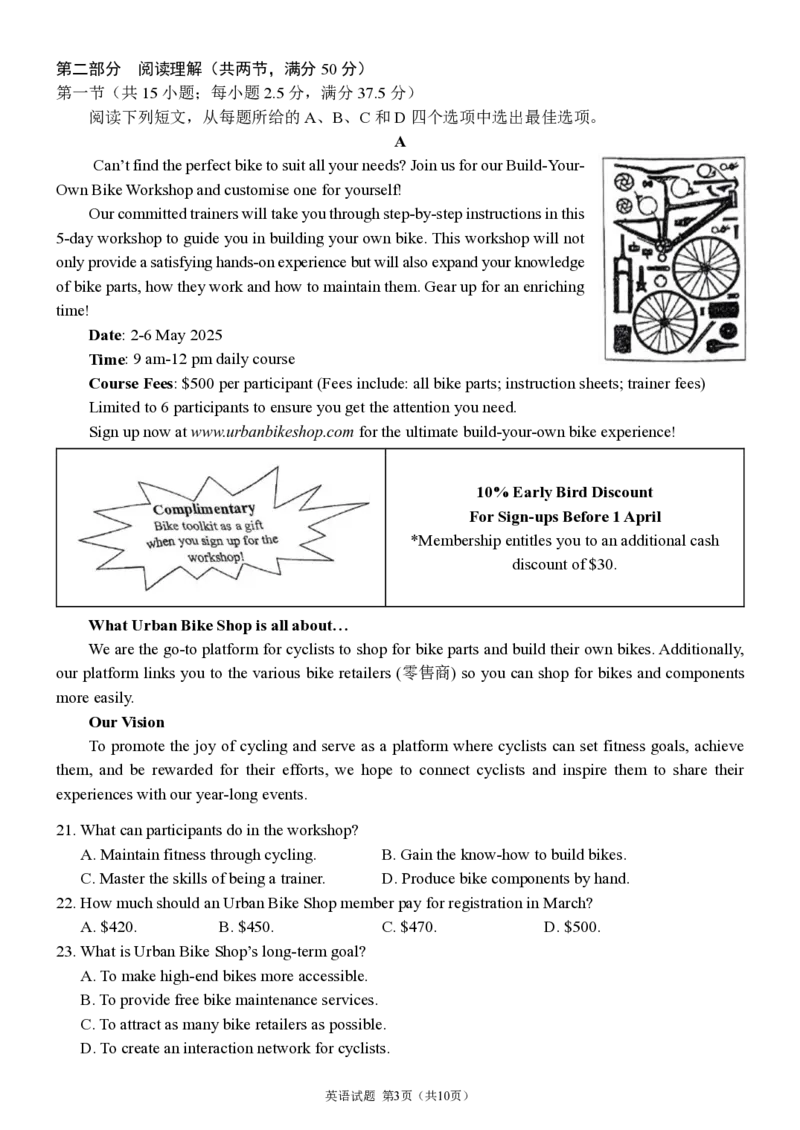
Can’t find the perfect bike to suit all your needs? Join us for our Build-Your-
Own Bike Workshop and customise one for yourself!
Our committed trainers will take you through step-by-step instructions in this
5-day workshop to guide you in building your own bike. This workshop will not
only provide a satisfying hands-on experience but will also expand your knowledge
of bike parts, how they work and how to maintain them. Gear up for an enriching
time!
Date: 2-6 May 2025
Time: 9 am-12 pm daily course
Course Fees: $500 per participant (Fees include: all bike parts; instruction sheets; trainer fees)
Limited to 6 participants to ensure you get the attention you need.
Sign up now at www.urbanbikeshop.com for the ultimate build-your-own bike experience!
10% Early Bird Discount
For Sign-ups Before 1 April
*Membership entitles you to an additional cash
discount of $30.
What Urban Bike Shop is all about…
We are the go-to platform for cyclists to shop for bike parts and build their own bikes. Additionally,
our platform links you to the various bike retailers (零售商) so you can shop for bikes and components
more easily.
Our Vision
To promote the joy of cycling and serve as a platform where cyclists can set fitness goals, achieve
them, and be rewarded for their efforts, we hope to connect cyclists and inspire them to share their
experiences with our year-long events.
21.What can participants do in the workshop?
A.Maintain fitness through cycling. B.Gain the know-how to build bikes.
C.Master the skills of being a trainer. D.Produce bike components by hand.
22.How much should an Urban Bike Shop member pay for registration in March?
A.$420. B.$450. C.$470. D.$500.
23.What is Urban Bike Shop’s long-term goal?
A.To make high-end bikes more accessible.
B.To provide free bike maintenance services.
C.To attract as many bike retailers as possible.
D.To create an interaction network for cyclists.
英语试题 第3页(共10页)B
In the mid-20th century, maps of the world showed continents surrounded by vast, featureless oceans.
Beneath the waves, the ocean floor was largely unknown. That all changed thanks to the work of Marie
Tharp, a pioneering cartographer and geologist.
In the 1940s, few women were accepted in science. Tharp, however, was determined to make her
mark. She partnered with oceanographer Bruce Heezen, who collected sonar data from ships that crossed
the Atlantic Ocean. The data was just a string of numbers and graphs – without someone to translate it into
a visual format, it was difficult to interpret. That was where Tharp came in. She began plotting thousands
of data points, a painstaking process that required a mix of mathematical skill and artistic intuition.
In the process of her mapping, Tharp discovered the central valley of the Mid-Atlantic Ridge, a place
where the ocean floor was pulling apart. This was exactly the kind of evidence that could support the
controversial theory of continental drift, which was largely dismissed by the scientific community at the
time.
Convincing the scientific community would prove difficult, since many geologists had long believed
that the ocean floor was flat and featureless. Tharp and Heezen turned to art to create visual representations
of the ocean floor. This produced stunning maps that brought Tharp’s findings to life in a way that no
scientific paper could. The beauty of these maps captured the imaginations of scientists and the public alike.
Tharp’s maps, and the evidence they provided, became a cornerstone of the modern understanding of
geology. Her work proved that the ocean floor was not static but a dynamic, changing landscape.
For many years, Tharp’s contributions were overshadowed by her male colleagues – it was Bruce
Heezen’s name that often appeared on scientific papers. Tharp worked behind the scenes, receiving little
recognition for her groundbreaking work.
Today, satellite and sonar technology enable us to map the ocean floor with incredible precision, but
none of this would have been possible without Tharp’s pioneering efforts.
24.What underlying reason motivated Tharp’s commitment to science?
A. A request from Heezen. B.A need to store sonar data.
C.A belief in continental drift. D. A desire to establish herself.
25.Why was Tharp’s discovery of the central valley significant?
A.It backed a then-dismissed theory.
B.It showed sonar data was unreliable.
C.It confirmed the ocean floor was flat.
D.It questioned a once-popular technology.
26.How did Tharp and Heezen make Tharp’s findings widely accepted?
A.By giving public lectures. B.By visualising data points.
C.By consulting geology experts. D.By publishing scientific papers.
27.How was Tharp’s work treated by her contemporaries?
A.It was credited to others. B.It was viewed as accidental.
C.It was finally acknowledged. D.It was ignored as lacking in evidence.
英语试题 第4页(共10页)C
Albert Einstein’s 1915 masterpiece The Foundation of the General Theory of Relativity is the first and
still the best introduction to the subject, but it probably wouldn’t be publishable in a scientific journal today.
Why not? After all, it undoubtedly would pass the tests of correctness and significance. And while it’s
believed that the paper was incomprehensible to its first readers, in fact many papers in theoretical physics
are much more difficult. As the physicist Richard Feynman wrote, “There was a time when the newspapers
said that only 1.2 men understood the theory of relativity, which is not true. After reading the paper, a lot
of people understood the theory of relativity in some way or other, certainly more than 1.2.”
No, the problem is its style. It starts with a leisurely philosophical discussion of space and time and
then continues with an explanation of known mathematics. Those two sections, which would be considered
extraneous today, take up half the paper. Worse, there are zero citations of previous scientists’ work, nor
are there any graphs. Those features might make a paper not even get past the first editors.
A similar process of professionalisation has transformed other parts of the scientific landscape.
Requests for research time at major laboratories are more strictly structured. And anything involving work
with human objects, or putting instruments in space, involves piles of paperwork.
We see it also in the Regeneron Science Talent Search, the Nobel Prize of high school science
competitions. In the early decades of its history, the winning projects were usually the sort of clever but
naive, amateurish efforts one might expect of talented beginners working on their own. Today, polished
work coming out of internships at established laboratories is the norm.
These professionalising tendencies are a natural consequence of the explosive growth of modern
science. Standardisation and system make it easier to manage the rapid flow of papers, applications and
people. But there are serious downsides. A lot of unproductive effort goes into jumping through bureaucratic
hoops (繁文缛节).
Of course, Einstein would have found his way to meeting modern standards and publishing his results.
Its scientific core wouldn’t have changed, but the paper might not be the same taste to read.
28.According to Richard Feynman, which statement about Einstein’s 1915 paper is true?
A.It attracted few professionals. B.It turned out to be comprehensible.
C.It needed further improvement. D.It was a classic in theoretical physics.
29.What does the underlined word “extraneous” in Paragraph 3 mean?
A.Unrealistic. B.Imprecise. C.Unattractive. D.Irrelevant.
30.According to the author, what is affected as modern science develops?
A.The selection of young talents. B.The evaluation of laboratories.
C.The principle of scientific research. D.The application of research findings.
31.Which would be the best title for this passage?
A.How to write quality papers? B.Will science be professionalised?
C.Could Einstein get published today? D.How will modern science make advances?
英语试题 第5页(共10页)D
With self-driving cars gaining popularity in today’s automobile landscape, the issue of legal liability
(法律责任) in the case of an accident has become more relevant.
Research in human-vehicle interaction has shown even systems designed to automate driving are far
from being error-proof. Besides, recent evidence points to drivers’ limited understanding of what these
systems can and cannot do as a contributing factor to system misuse. A recent study tackles the issue of
over-trusting drivers and the resulting system misuse from a legal viewpoint. It looks at what the manufacturers
of self-driving cars should legally do to ensure that drivers understand how to use the vehicles appropriately.
One solution suggested in the study involves requiring buyers to sign end-user license agreements
(EULAs), similar to the terms and conditions that require agreement when using new software products.
But this is far from ideal. The agreement may not provide enough information to the driver, leading to
confusion about the nature of the requests for agreement and their implications. Further, most end users
don’t read EULAs. A 2017 study shows 91 percent of people agree to them without reading. Among young
people, 97 percent agree without reviewing the terms.
The issue is that, unlike using a smartphone app, operating a car has intrinsic and serious safety risks,
whether the driver is human or software. And human drivers need to consent (准许) to take responsibility
for the outcomes of the software and hardware.
“Warning fatigue” and distracted driving are also causes for concern. For example, a driver, annoyed
after receiving continuous warnings, could decide to just ignore the message. Or, if the message is
presented while the vehicle is in motion, it could represent a distraction. Given these limitations and
concerns, even if this mode of obtaining consent is to move forward, it likely won’t fully protect automakers
from their legal liability, should the system malfunction or an accident occur.
Driver training for self-driving vehicles can help ensure that drivers fully understand system
capabilities and limitations. This needs to occur beyond the vehicle purchase. Recent evidence shows even
relying on the information provided by the seller is not going to answer many questions. All of this
considered, the road forward for self-driving cars is not going to be a smooth ride after all.
32.What can we learn from recent studies in human-vehicle interaction?
A. Automatic driving systems are not immune to errors.
B.Driverless vehicles may be misused by some people.
C.Self-driving car makers aren’t aware of the legal matters.
D.Drivers have limited knowledge of the automatic systems.
33.What is the problem with requiring buyers to sign EULAs?
A.Drivers aren’t willing to take responsibility.
B.End users find the terms complex to interpret.
C.The information provided may cause confusion.
D.Most users sign them without reading the terms.
34.What would drivers do when they suffer from “warning fatigue”?
A.Be distracted easily by the message. B.Rest a while to avoid fatigue driving.
C.Waste no time keeping the car moving. D.Take no action despite repeated warnings.
英语试题 第6页(共10页)35.Which would be the best title for the passage?
A.How Can We Reduce Self-Driving Risks?
B.Who’s to Blame if a Self-Driving Car Crashes?
C. Are Self-Driving Systems Truly Safe and Legal?
D.Where Will the Human-Vehicle Interaction Lead?
第二节(共5小题;每小题2.5分,满分12.5分)
阅读下面短文,从短文后的选项中选出可以填入空白处的最佳选项。选项中有两项多余选项。
Every animal sleeps, but the reason for this has remained foggy. When lab rats are not allowed to
sleep, they die within a month. 36
One idea is that sleep helps us strengthen new memories. 37 We know that, while awake,
fresh memories are recorded by reinforcing connections between brain cells, but the memory processes
that take place while we sleep have been unclear.
Support is growing for a theory that sleep evolved so that connections between neurons (神经元) in
the brain can be weakened overnight, making room for fresh memories to form the next day. 38
Now we have the most direct evidence yet that he is right. 39 The synapses in the mice taken
at the end of a period of sleep were 18 per cent smaller than those taken before sleep, showing that the
connections between neurons weaken while sleeping.
If Tononi’s theory is right, it would explain why, when we miss a night’s, we find it harder the next
day to concentrate and learn new information – our brains may have smaller room for new experiences.
Their research also suggests how we may build lasting memories over time even though the synapses
become thinner. The team discovered that some synapses seem to be protected and stayed the same size.
40 “You keep what matters,” Tononi says.
A.We should also try to sleep well the night before.
B.It’s as if the brain is preserving its most important memories.
C.Similarly, when people go for a few days without sleeping, they get sick.
D.The processes take place to stop our brains becoming loaded with memories.
E.That’s why students do better in tests if they get a chance to sleep after learning.
F.“Sleep is the price we pay for learning,” says Giulio Tononi, who developed the idea.
G.Tononi’s team measured the size of these connections, or synapses, in the brains of 12 mice.
第三部分 英语知识运用(共两节,满分30 分)
第一节(共15 小题;每小题 1 分,满分15 分)
阅读下面短文,从每题所给的A、B、C、D四个选项中选出可以填入空白处的最佳选项。
Roger Bannister, born in Harrow, England, early revealed a remarkable talent for running. University
education was beyond the 41 of his working-class parents, but he was 42 to secure a place
at one of England’ s prestigious universities and embark on a career in 43 .
英语试题 第7页(共10页)Luckily, owing to his academic 44 , Bannister was awarded a scholarship by Oxford University,
where his exceptional speed on the track soon earned him the attention and 45 from the sports media.
Surprisingly, he 46 to compete in the 1948 Olympics in London, preferring to focus on his 47 and
his medical studies. By 1951, Bannister had claimed the British championship in the mile and felt 48 to
pursue Olympic success. Unfortunately, a last-minute change in the schedule 49 him to compete
without adequate recovery between events, leaving him to finish fourth in the 1500-meter race at the 1952
Olympics. To break the four-minute mile barrier, Bannister, while undertaking full-time medical studies,
dedicated 45 minutes each day 50 to training. On May 6, 1954, at Oxford, his sheer perseverance
ultimately 51 . At the age of 25, Bannister made history, crossing the finish line in 3:59.4. When the
announcer read out the time: “3…”, the rest was 52 by the deafening roar of the crowd. In the
following famous “Mile of the Century” race, Bannister 53 Australian runner John Landy with a
time of 3:58.8 to Landy’ s 3:59.6, both under four minutes. In 1955, Bannister’s autobiography, The First
Four Minutes, came out.
Bannister’s 54 to academic medicine proved equally distinguished, yet the spirit and legacy of
the four-minute mile remain profoundly 55 , resonating not only with people of our era, but to
generations before and after.
41.A. hope B.control C.sight D.reach
42.A. excited B.determined C.satisfied D.surprised
43.A. sport B.biology C.writing D.medicine
44.A. passion B.distinction C.courage D.subject
45.A. support B.admission C.recognition D.explosion
46.A. declined B.planned C.decided D.promised
47.A. family B.training C.profession D.competition
48.A. eager B.proud C.prepared D.nervous
49.A. forced B.allowed C.tempted D.encouraged
50.A. undoubtedly B.consciously C.attentively D.exclusively
51.A. paid back B.took off C.turned out D.paid off
52.A. favoured B.attracted C.drowned D.confirmed
53.A. challenged B.outpaced C.overlooked D.failed
54.A. access B.attitude C.contribution D.approach
55.A. beneficial B.considerate C.acceptable D.inspirational
第二节(共10小题;每小题1.5分,满分15分)
阅读下面短文,在空白处填入1个适当的单词或括号内单词的正确形式。
In the heart of the Gobi Desert, 56. ________ the sands whisper tales of ancient times, lies an
unexpected feast captured in stone – perhaps 57. ________ (indicate) of the world’s oldest barbecue party.
On the mural bricks 58. ________ (find) within the Wei and Jin tombs, the barbecue culture emerges as a
common and captivating theme.
英语试题 第8页(共10页)“Each brick tells its own little story, showing scenes like slaughtering cattle and sheep or making meat
skewers, like 59. ________ lively comic book,” says Lu Xiaoling, a researcher at the Wei and Jin Tombs
Research Institute. For decades, Lu 60. ________ (work) and conducted research at the tombs in Xincheng
town, located at the junction of Jiuquan and Jiayuguan. More than 3,000 tombs have been discovered here,
61. ________ (range) from the Han (206 BC-AD 220) and Tang (618-907) dynasties, with most dating
back to the Wei and Jin periods. Of all the excavated tombs, Tomb No. 6 – excavated in 1972 – stands out
62.________ having the most richly detailed and best-preserved mural bricks, as well as the most complete
depiction of a barbecue scene.
This indicates that, at the time, especially in the Hexi Corridor (a vital passageway on the ancient Silk
Road), roasted meat 63. ________ (be) already very popular. It was a delicacy used to entertain guests and
was highly favoured,” she says. The tomb occupant used mural bricks 64. ________ (document) his life,
hoping to continue enjoying these experiences after death. This reflects the perspective on life and death
at the time, where people viewed death as a 65. ________ (continue) of life, explains Lu.
第四部分 写作(共两节,满分40分)
第一节(满分15分)
你是高三学生李华,近期你向X大学申请了两门线上选修课,分别为“英语文学入门”与
“探索演讲的艺术”今日收到了该大学Admission Office的电子邮件,内容如下:
Dear Li Hua,
Thank you for your interest in our online elective courses. We are delighted that you have applied
for both Getting Started with English Literature and Exploring the Art of Public Speaking. Due to limited
course availability, each student is allowed to enrol in one elective course per term. Please select your
preferred course from the two and explain your choice.
Additionally, taking an elective course requires time and may influence your current high school
studies. Please kindly include in your reply how you will deal with the situation.
Thank you once again for your interest in our programmes. We look forward to supporting your
academic journey!
Admission Office
X University
请根据该邮件中所提要求,写一封回复邮件。注意:
1. 写作词数为80个左右;
2. 请按照如下格式在答题卡的相应位置作答。
Dear Sir/Madam,
Yours,
Li Hua
英语试题 第9页(共10页)第二节(满分25分)
阅读下面材料,根据其内容和所给段落开头语续写两段,使之构成一篇完整的短文。
Here are a few things you need to know about my dad. First, he was a slightly impatient kind of guy.
If he wanted something done, he wanted it done NOW, if not sooner. Second, you need to know that Dad
was an early riser. Every single day. No exceptions. No excuses. Work or no work. Holidays or vacation
days, there was my father, up and ready to go. Oh, and you should know that Mom was a night owl, up
late watching a late movie or a wrestling match.
One more thing about my dad. He was colour-blind. That usually doesn’t matter. And he was a fairly
conservative kind of person. For instance, he bought our new home out in the country and objected
immediately to the stucco (灰泥) being a pale peach colour. Way too “flashy” for Dad. He hired a painter
to cover up all that peach with a nice, not-flashy grey. Dad was fond of grey anyway.
And so, we arrived at the Saturday morning when Dad sprang out of bed as bright-eyed as ever, felt
restless, and looked around for something that needed doing. Mom was sound asleep, as usual. My brother
and I slept in a bit. There was nobody around to keep an eye on Dad and whatever he decided to do next.
So, Dad decided that the porch (门廊) on our newly grey house needed a fresh coat of paint. He
headed off to the hardware store to get paint and painting supplies. He did not tell any of us. Nor did he
invite any of us along.
We’ve never been sure what happened at the hardware store. Did he ask for advice? Did he study
colour samples? Did another shopper help him choose? Who knows? But we’re all pretty sure that Dad
had no clue what colour he was painting the wooden porch. My brother and I woke up, wondered where
Dad was, and went looking for him.
注意:
1. 续写词数应为150左右;
2. 请按如下格式在答题卡的相应位置作答。
We froze in our tracks when we stepped outside.
Looking at the bright pink porch, we three exchanged looks, unsure how to tell him the truth.
英语试题 第10页(共10页)