绝密★启用前
2026 (1 )
年普通高等学校招生全国统一考试 月
英语
注意事项:微信公众号:馥香诗意
1.答卷前,考生务必将自己的姓名、准考证号填写在答题卡上。
2.回答选择题时,选出每小题答案后,用铅笔把答题卡上对应题目的答案标号涂黑。如需改动,用橡
皮擦干净后,再选涂其他答案标号。回答非选择题时,将答案写在答题卡上。写在本试卷上无效。
3.考试结束后,将本试卷和答题卡一并交回。
第一部分 听力(共两节,满分30 分)
做题时,先将答案标在试卷上。录音内容结束后,你将有两分钟的时间将试卷上的答案转涂到
答题卡上。
第一节(共5小题;每小题1.5 分,满分7.5 分)
听下面5 段录音。每段录音后有一个小题,从题中所给的A、B、C三个选项中选出最佳选项。
听完每段录音后,你都有10 秒钟的时间来回答有关小题和阅读下一小题。每段录音播放两遍。
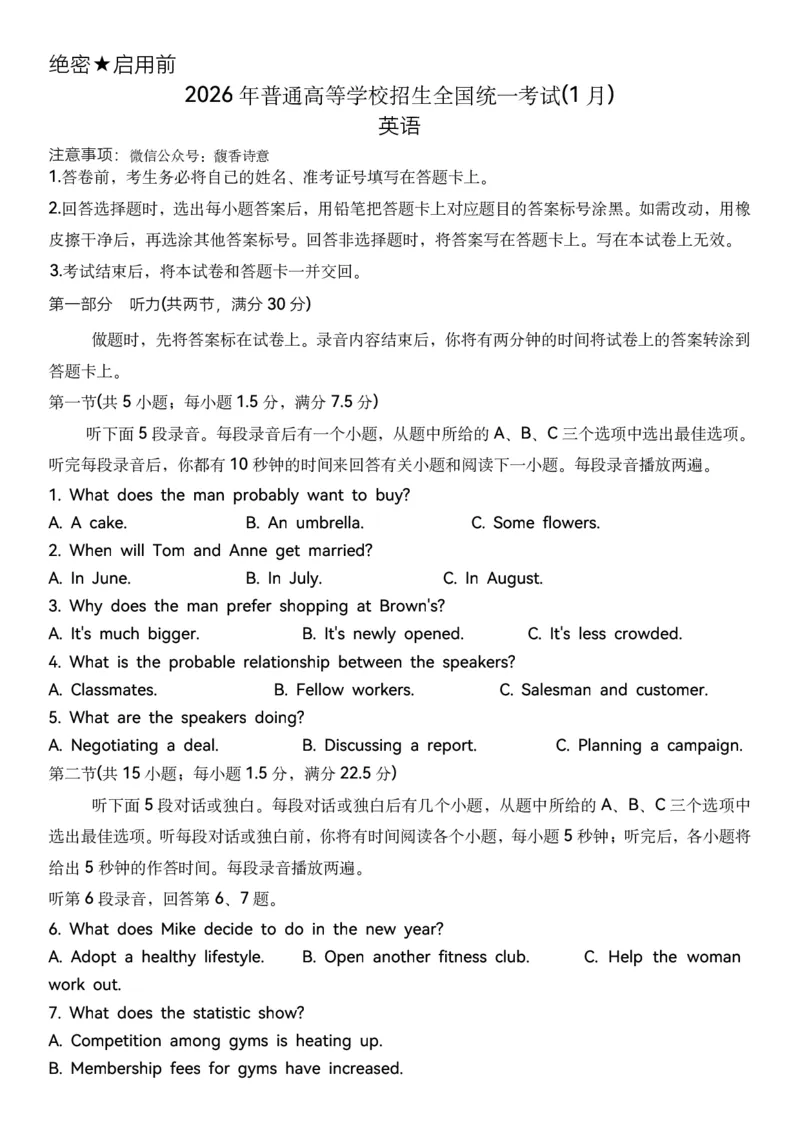
1. What does the man probably want to buy?
A. A cake. B. An umbrella. C. Some flowers.
2. When will Tom and Anne get married?
A. In June. B. In July. C. In August.
3. Why does the man prefer shopping at Brown's?
A. It's much bigger. B. It's newly opened. C. It's less crowded.
4. What is the probable relationship between the speakers?
A. Classmates. B. Fellow workers. C. Salesman and customer.
5. What are the speakers doing?
A. Negotiating a deal. B. Discussing a report. C. Planning a campaign.
第二节(共15 小题;每小题1.5 分,满分22.5 分)
听下面 5 段对话或独白。每段对话或独白后有几个小题,从题中所给的 A、B、C 三个选项中
选出最佳选项。听每段对话或独白前,你将有时间阅读各个小题,每小题5 秒钟;听完后,各小题将
给出5 秒钟的作答时间。每段录音播放两遍。
听第6 段录音,回答第6、7题。
6. What does Mike decide to do in the new year?
A. Adopt a healthy lifestyle. B. Open another fitness club. C. Help the woman
work out.
7. What does the statistic show?
A. Competition among gyms is heating up.
B. Membership fees for gyms have increased.C. Some gym- goers' enthusiasm is short-lived.
听第7 段录音,回答第8 至10 题。
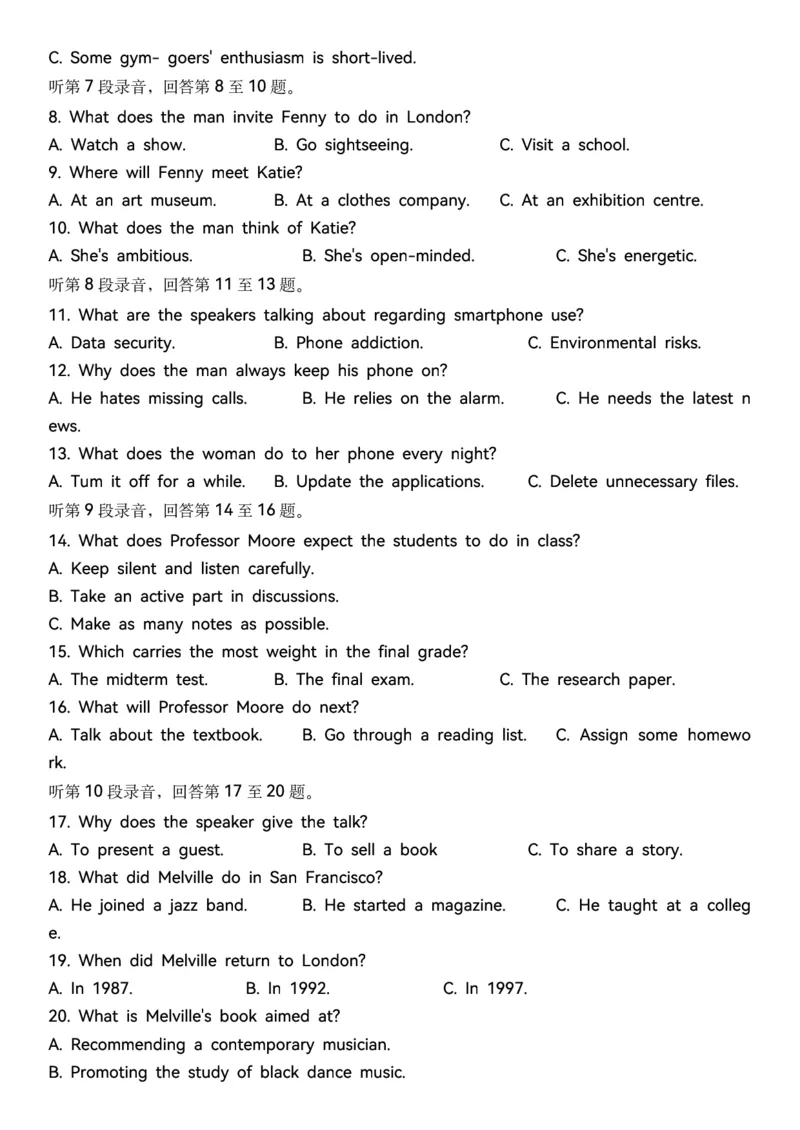
8. What does the man invite Fenny to do in London?
A. Watch a show. B. Go sightseeing. C. Visit a school.
9. Where will Fenny meet Katie?
A. At an art museum. B. At a clothes company. C. At an exhibition centre.
10. What does the man think of Katie?
A. She's ambitious. B. She's open-minded. C. She's energetic.
听第8 段录音,回答第11至13 题。
11. What are the speakers talking about regarding smartphone use?
A. Data security. B. Phone addiction. C. Environmental risks.
12. Why does the man always keep his phone on?
A. He hates missing calls. B. He relies on the alarm. C. He needs the latest n
ews.
13. What does the woman do to her phone every night?
A. Tum it off for a while. B. Update the applications. C. Delete unnecessary files.
听第9 段录音,回答第14至16 题。
14. What does Professor Moore expect the students to do in class?
A. Keep silent and listen carefully.
B. Take an active part in discussions.
C. Make as many notes as possible.
15. Which carries the most weight in the final grade?
A. The midterm test. B. The final exam. C. The research paper.
16. What will Professor Moore do next?
A. Talk about the textbook. B. Go through a reading list. C. Assign some homewo
rk.
听第10 段录音,回答第17 至20 题。
17. Why does the speaker give the talk?
A. To present a guest. B. To sell a book C. To share a story.
18. What did Melville do in San Francisco?
A. He joined a jazz band. B. He started a magazine. C. He taught at a colleg
e.
19. When did Melville return to London?
A. In 1987. B. In 1992. C. In 1997.
20. What is Melville's book aimed at?
A. Recommending a contemporary musician.
B. Promoting the study of black dance music.C. Drawing public attention to music education.参考答案:
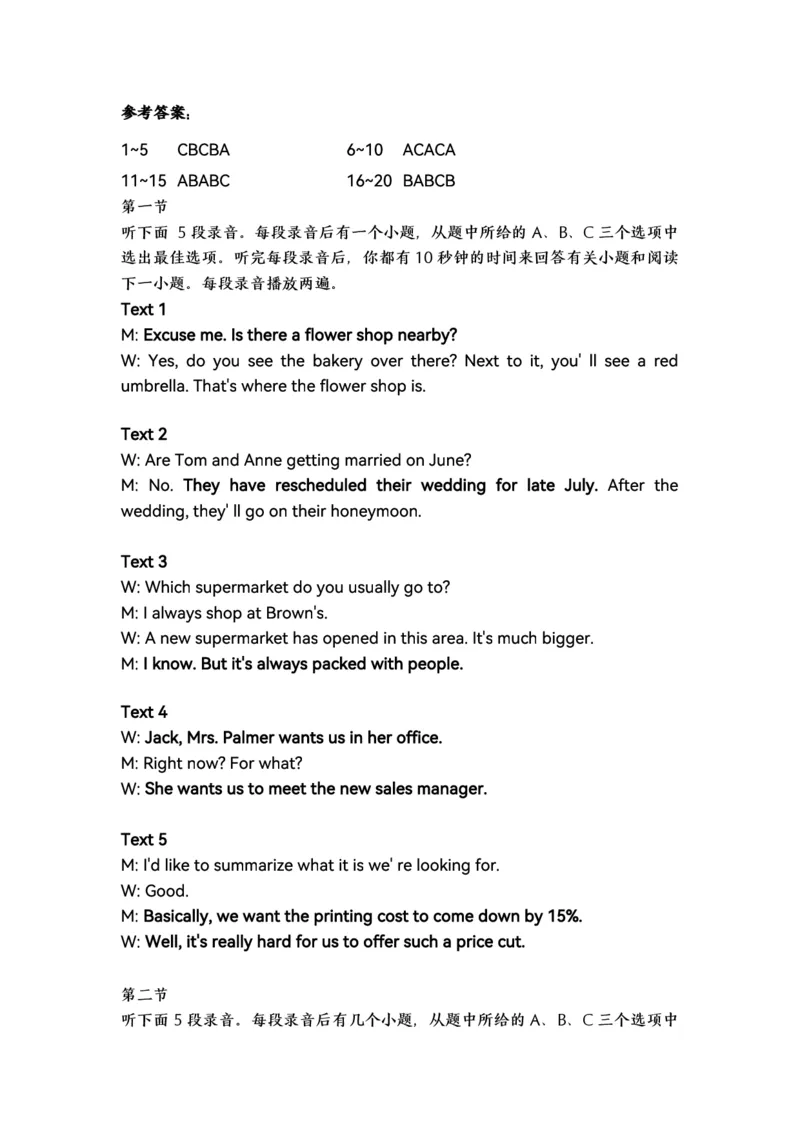
1~5 CBCBA 6~10 ACACA
11~15 ABABC 16~20 BABCB
第一节
听下面 5段录音。每段录音后有一个小题,从题中所给的A、B、C三个选项中
选出最佳选项。听完每段录音后,你都有 10秒钟的时间来回答有关小题和阅读
下一小题。每段录音播放两遍。
Text 1
M: Excuse me. Is there a flower shop nearby?
W: Yes, do you see the bakery over there? Next to it, you' ll see a red
umbrella. That's where the flower shop is.
Text 2
W: Are Tom and Anne getting married on June?
M: No. They have rescheduled their wedding for late July. After the
wedding, they' ll go on their honeymoon.
Text 3
W: Which supermarket do you usually go to?
M: I always shop at Brown's.
W: A new supermarket has opened in this area. It's much bigger.
M: I know. But it's always packed with people.
Text 4
W: Jack, Mrs. Palmer wants us in her office.
M: Right now? For what?
W: She wants us to meet the new sales manager.
Text 5
M: I'd like to summarize what it is we' re looking for.
W: Good.
M: Basically, we want the printing cost to come down by 15%.
W: Well, it's really hard for us to offer such a price cut.
第二节
听下面5 段录音。每段录音后有几个小题,从题中所给的A、B、C 三个选项中选出最佳选项。听每段录音前,你将有时间阅读各个小题,每小题5秒钟;听完
后,每小题都有5 秒钟的作答时间。每段录音播放两遍。
Text 6
W: Happy New Year, Mike
M: Happy New Year
W: Have you made any resolutions?
M: I'd like to eat less and exercise more this year. Three hamburgers a day
is probably not a good idea.
W: Yeah, many people hope to be healthier in the new year. You always see
a lot of people start joining gyms. I heard some kind of statistic that gyms
are always 50% more crowded in the month of January. And then usually
by February, it's back to normal.
M: It's so true. It's always difficult to keep up the workout routine.
Text 7
M: Fenny, if you' re up in London tomorrow, I' ve got two tickets for the
American Ballet Theatre Would you like to come?
W: Thanks, but I' ll be busy tomorrow.
M: No problem. Maybe another time. Do you have plans?
W: Yes, I' ll meet Katie at the Olympia Exhibition Centre. Remember her?
We went to the same art school. Some of her designs are going to be
exhibited there. She is hoping one of the big clothes companies might buy
them.
M: Setting her sights high, isn't she?
W: Yeah, she is aiming high. But she has what it takes to get there.
Text 8
W: People are increasingly concerned about online security. And many
experts are now offering advice on how to use smartphones safely.
M: What advice?
W: Let me ask you first: How long have you kept your phone on so far?
M: For over a year now. It's not that I'm addicted to it, or have important
calls, but I need the alarm to wake me up every morning.
W: Yeah, but that's where the risk is. According to experts, we should
switch our phones off and on once a day as a security measure. It helps
close the applications running in the background and stop data collectionprocesses we' re not aware of.
M: Sounds reasonable. Do we switch the phone off and switch it back on
immediately?
W: Well, better wait for a few minutes.
M: When do you usually do that?
W: I do it every night before going to bed.
Text 9
W: Welcome to History of the English Language. Since the class is quite
small, I plan to run this course as a discussion.I hope everyone will be fully
engaged and volunteer to share your knowledge and opinions. Iwon't take
attendance,but since part of your grade depends on participation, I
encourage you to come to class.
M: Professor Moore?
W: Yes?
M: Could you tell us more about the assessment of the course?
W: Certainly. In addition to your participation in class, which accounts for
10%, there will be a midterm test,20%; a final exam, 30%; and a research
paper, 40%. Any questions?
M: Do we have any reading assignments?
W: Yes, I believe you' ve all got your textbook. You have to finish reading
assigned chapters before each class. Apart from that, there's a list of books
you' re required to read. Now let's have a close look at it.
Text 10
W: Hello, everybody. Thanks for your consistent support for our weekly
meeting. New Books Sharing. Today, we' ve invited Dr. Caspar Melville, a
lecturer from the University of London. Dr. Melville started out as a music
journalist for a black music magazine called Blues and Soul. In 1992, he
moved to San Francisco, and founded a jazz magazine named On the One
with some friends. They did a really good job, though there was not a lot of
money in it. In 1997,he moved back to London and started teaching, and
made the decision to find another way to write about music. He grew up in
London. He feels that the music in London clubs has formed him, but
unfortunately, it has been seriously undervalued by the academic world.In black music studies, jazz has received great attention, but dance music
has been largely ignored. His book, It's a London Thing, is meant to change
that situation. So let's welcome Dr. Melville to share with us his ideas in the
book.