语法选择解题技巧
考点分布
“语法选择”的主要考点分布:冠词、名词的单复数、动词时态和语态、形容词和副词的比较等级、代
词、连词、介词、非谓语动词、同根词、定语从句、状语从句和宾语从句等。
一、语法选择常考语法点
1.考冠词:
a/an : 第一次提到;泛指; 单词读音第一个音为元音时(an),辅音时(a);固搭;
the : 第二次提到;特指; 固定搭配; play the +西洋乐器, the +序数词; /(不填):固定搭
配;play + 球类
2.考数词:
① seven-year-old; two-meter-long; (数词做形容词用法)
② five hundred/thousand/million/billion (具体数值后面不需要+s)
hundreds of / thousands of/millions of /billions of (表示概数时用of 结构)
3.考名词:
① 主谓一致(名词单复数与后面的动词的形式(三单,原形)保持一致)
② 可数名词与不可数名词的区别,修饰语等 two cups of coffee/tea
4.考代词:
① many + n 复数 much + 不可数名词
② a number of + n复数 a great amount of / a great deal of + 不可数名词
③ little/a little/few/a few 否定意义:little + 不可数名词 few + 可数名词复数
肯定意义: a little + 不可数名词 a few + 可数名词复数
④ Other/another/the other/others/the others
1)other + 名词复数 another + 名词单数(表三者或者三者以上 另一个)
2)others 后面不能加名词 others = other + 名词复数
3)one…. The other…. 一个…. 另一个…..(两者之间)
some…. Others…. 一些….. 另一些……
4)other (无范围)与 the other (有范围)
others (无范围)与 the others (有范围)
⑤ 不定代词something、everything、anything、nothing + 形容词
⑥ 人称代词 1)主语用主格
2)动词/介词后用宾格;
1
学科网(北京)股份有限公司3)空格后有名词,用形容词性物主代词,没有名词则用名词性物主代词; 名词性物主代词= 形容词性
物主代词 + 具体的名词
4)反身代词常考 enjoy oneself / help yourself / dress oneself / teach oneself;
5. 考形容词/副词
① -ed是修饰人,-ing是修饰事物
② 形容词修饰名词,副词(一般以ly 结尾)修饰动词,副词修饰形容词
③ 出现than, 用比较级
④ 出现 as…. as 结构,用形容词/副词原级
⑤ one of + adj最高级+ n 复数
6.考介词
① 时间介词
at: 用于具体时刻、节日前,例如:at 8:00,at Christmas. 固定搭配:at noon, at night
in: 用于世纪、年、季节、月份等不具体的时间前,例如:in 2011
固定搭配:in the morning/afternoon/evening
on: 用于具体的某一天,或具体的早上、下午、晚上; 星期。
on the afternoon of May 5th on a cold day, on Monday/ Tuesday …
for/since: 后面+一段时间,现在完成时的标志
② 其它介词
with:与...一起,和...;带着...,有...的;以(手段、材料),用(工具)
without: 没有。
by + 交通工具
③ 介词+ doing after/before doing; in doing ; for doing …
7.考连词
but/however:表示转折关系;(but后无逗号; however, 后须有逗号)
so/therefore/thus:表示因果关系;
or:或者、否则之意。
and:表示并列关系;
though/although:表示虽然……但是,不能与but连用。
all:表示全部都,用于三者以上;
none: 表示没有人,用于三者或三者以上(侧重指人,表否定)
both...and:表示两者都;
either...or:表示两者之一(选择);
neither...nor:表示两者中没有一个;
2
学科网(北京)股份有限公司either: 用于句末,表示两者的否定
too: 用于句末,表示两者的肯定
also: 用于句中,表示也
8.考动词:
一看:有无时态标志; 单复数标志;
二看:空格前有无情态动词(情态动词+do)、介词 (介词+Ving)
三看:并列结构;有无 and/or (如有则观察and/or前或后的动词形式,答案选项的形式要与其保持一
致)
四看:固定搭配,如make/let sb do sth , see sb do/doing sth 等
9.考被动语态
被动语态: be (is/are/am/was/were) + done(过去分词)
含有情态动词的被动语态: should/must/can/could/may/might……be done
10. 考定语从句:
跟在名词/代词后面,修饰名词/代词 修饰人:who 修饰物:which
11. 考宾语从句:
跟在谓语后面 三要素:
① 引导词
② 时态 当主句为一般现在时时,从句可以为任何时态; 当主句为一般过去时时,从句必须用过去时
态; 当从句为表示客观事实,真理时,不管主句是什么时态,从句都用一般现在时;
③ 语序:陈序语序
12. 考词性
-tion 一般为名词后缀 separation, selection,
-ness 一般为名词后缀 calmness
-ly 一般为副词后缀 luckily, fortunately,
-ful 一般为形容词后缀 careful,
-ing/-ed 一般为形容词后缀 -ing形容的是物; -ed形容的是人
13. 固定搭配
pick up 捡起
wait for 等待
deal with 处理
think of 思考
look ahead向前看,预测未来 look out小心
look on冷眼旁观 look up仰望;查阅;拜访
3
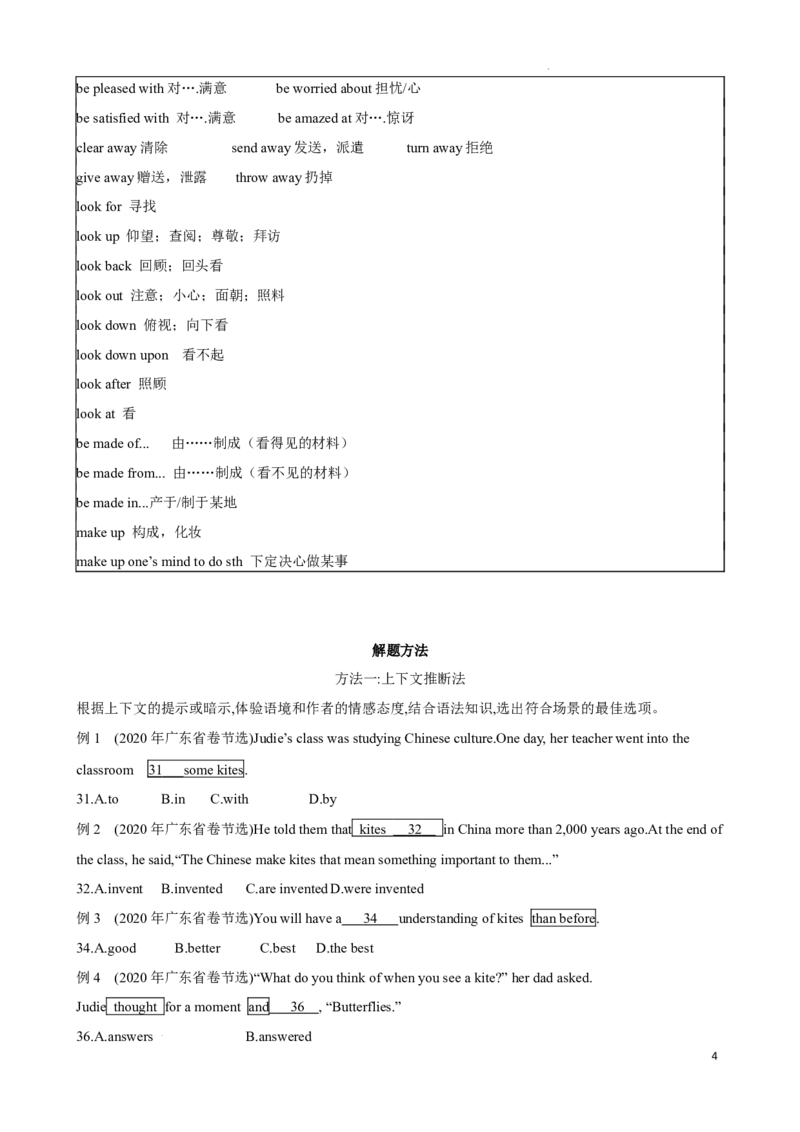
学科网(北京)股份有限公司be pleased with对….满意 be worried about担忧/心
be satisfied with 对….满意 be amazed at对….惊讶
clear away清除 send away发送,派遣 turn away拒绝
give away赠送,泄露 throw away扔掉
look for 寻找
look up 仰望;查阅;尊敬;拜访
look back 回顾;回头看
look out 注意;小心;面朝;照料
look down 俯视;向下看
look down upon 看不起
look after 照顾
look at 看
be made of... 由……制成(看得见的材料)
be made from... 由……制成(看不见的材料)
be made in...产于/制于某地
make up 构成,化妆
make up one’s mind to do sth 下定决心做某事
解题方法
方法一:上下文推断法
根据上下文的提示或暗示,体验语境和作者的情感态度,结合语法知识,选出符合场景的最佳选项。
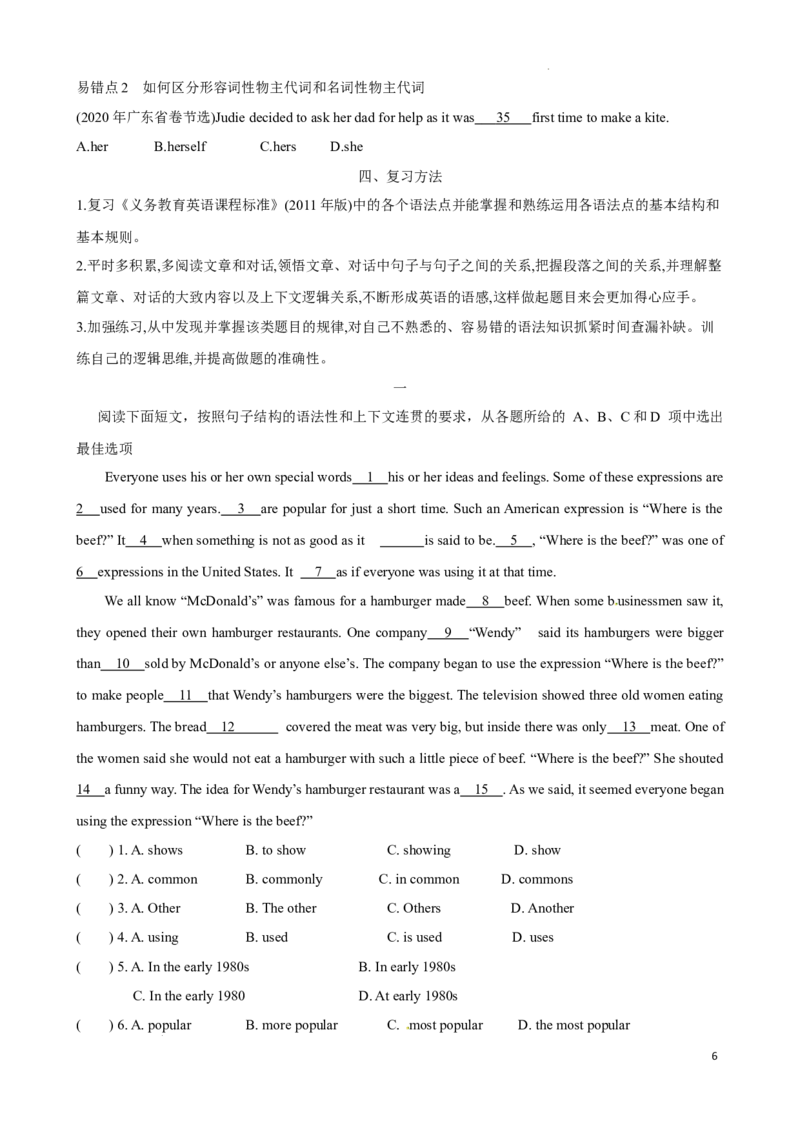
例1 (2020年广东省卷节选)Judie’s class was studying Chinese culture.One day, her teacher went into the
classroom 31 some kites.
31.A.to B.in C.with D.by
例2 (2020年广东省卷节选)He told them that kites 3 2 in China more than 2,000 years ago.At the end of
the class, he said,“The Chinese make kites that mean something important to them...”
32.A.invent B.invented C.are inventedD.were invented
例3 (2020年广东省卷节选)You will have a 34 understanding of kites than before.
34.A.good B.better C.best D.the best
例4 (2020年广东省卷节选)“What do you think of when you see a kite?” her dad asked.
Judie thought for a moment and 36 , “Butterflies.”
36.A.answers B.answered
4
学科网(北京)股份有限公司C.will answer D.has answered
例5 (2020年广东省卷节选)Judie’s dad agreed that it would be a good idea to make a butterfly kite.They made
a cross with some wood sticks, 3 7 then Judie painted a butterfly on a piece of white paper.Next they stuck
the paper on the cross. Finally they tied a long tail to the bottom.
37.A.and B.but C.or D.so
例6 (2020年广东省卷节选)Judie’s dad agreed that it would be a good idea to make a butterfly kite…Next
they stuck the paper on the cross.Finally they tied a long tail to the bottom.
The next morning, they took 38 kite to the park and tested it.
38.A.a B.an C.the D.\
例7 (2020年广东省卷节选)“Judie, can you tell me 40 you like butterflies?” asked her dad.
Judie replied, “To me, butterflies mean beauty and freedom!”
40.A.why B.which C.what D.when
方法二:句子成分分析法
分析句子的各个成分,结合语法知识,补充句子所缺的成分。语法选择中常考的句子成分:谓语(表示做动作
的词)、宾语(动作的承受者)、定语(修饰性质的词)、状语(时间、地点、原因、结果、目的、条件等)。
例1 (2020年广东省卷节选)Judie decided to ask her dad for help as it was 35 first time to make a kite.
“What do you think of when you see a kite?” her dad asked.
35.A.her B.herself C.hers D.she
例2 (2020年广州卷节选)The children hold their books close as they say good-bye and run home 12
.David and his donkeys head back, over and around the hills, and into the sunset.
12.A.cheer B.cheerful C.cheerfully D.more cheerful
方法三:固定搭配
结合上下文并利用动词短语、介词短语、常用句型的固定搭配来直接选择答案。
例1 (2020年广东省卷节选)At the end of the class, he said, “The Chinese make kites that mean something
important to them.I expect each of you 33 a kite that means something important to you…
33.A.make B.to make C.making D.made
例2 (2020年广东省卷节选)“Wow!” she cried proudly.
“ 3 9 high my butterfly flies!”
39.A.What B.What a C.What an D.How
易错点1 如何判断形容词或副词的比较等级
(2020年广东省卷节选)You will have a 34 understanding of kites than before.
A.good B.better C.best D.the best
5
学科网(北京)股份有限公司易错点2 如何区分形容词性物主代词和名词性物主代词
(2020年广东省卷节选)Judie decided to ask her dad for help as it was 35 first time to make a kite.
A.her B.herself C.hers D.she
四、复习方法
1.复习《义务教育英语课程标准》(2011年版)中的各个语法点并能掌握和熟练运用各语法点的基本结构和
基本规则。
2.平时多积累,多阅读文章和对话,领悟文章、对话中句子与句子之间的关系,把握段落之间的关系,并理解整
篇文章、对话的大致内容以及上下文逻辑关系,不断形成英语的语感,这样做起题目来会更加得心应手。
3.加强练习,从中发现并掌握该类题目的规律,对自己不熟悉的、容易错的语法知识抓紧时间查漏补缺。训
练自己的逻辑思维,并提高做题的准确性。
一
阅读下面短文,按照句子结构的语法性和上下文连贯的要求,从各题所给的 A、B、C和D 项中选出
最佳选项
Everyone uses his or her own special words 1 his or her ideas and feelings. Some of these expressions are
2 used for many years. 3 are popular for just a short time. Such an American expression is “Where is the
beef?” It 4 when something is not as good as it is said to be. 5 , “Where is the beef?” was one of
6 expressions in the United States. It 7 as if everyone was using it at that time.
We all know “McDonald’s” was famous for a hamburger made 8 beef. When some businessmen saw it,
they opened their own hamburger restaurants. One company 9 “Wendy” said its hamburgers were bigger
than 10 sold by McDonald’s or anyone else’s. The company began to use the expression “Where is the beef?”
to make people 11 that Wendy’s hamburgers were the biggest. The television showed three old women eating
hamburgers. The bread 12 covered the meat was very big, but inside there was only 13 meat. One of
the women said she would not eat a hamburger with such a little piece of beef. “Where is the beef?” She shouted
14 a funny way. The idea for Wendy’s hamburger restaurant was a 15 . As we said, it seemed everyone began
using the expression “Where is the beef?”
( ) 1. A. shows B. to show C. showing D. show
( ) 2. A. common B. commonly C. in common D. commons
( ) 3. A. Other B. The other C. Others D. Another
( ) 4. A. using B. used C. is used D. uses
( ) 5. A. In the early 1980s B. In early 1980s
C. In the early 1980 D. At early 1980s
( ) 6. A. popular B. more popular C. most popular D. the most popular
6
学科网(北京)股份有限公司( ) 7. A. seemed B. seems C. is seemed D. seem
( ) 8. A. of B. from C. by D. in
( ) 9. A. calls B. calling C. called D. call
( ) 10. A. this B. that C. these D. those
( ) 11. A. know B. knows C. knowing D. knew
( ) 12. A. who B. whose C. which D. what
( ) 13. A. a few B. much C. a lot of D. a bit of
( ) 14. A. with B. at C. in D. by
( ) 15. A. succeed B. success C. successful D. successfully
二
语法选择
阅读下面短文,掌握其大意,然后从1-15 小题所给的A、B、C 和D 项中选出一个最佳选项
Many, many years ago most people did not have beautiful books. Some families did not have books at all.
The people ____1_____ did have books had only a few.Instead of ____2_____ books, people told stories. They
would remember things ____3_____happened to them and would retell these tales to friends.Some stories you
read in books today ____4_____ to children many years ago by their fathers and mothers. ____5_____ those girls
and boys grew up, they, in turn, told their children the same tales.Sometimes the stories changed as one man told
____6_____. That is why today there are different beginnings and different endings to the same folk tales. You
____7_____ different names for all kinds of characters in the different versions(版本) of the tales. In this way the
stories almost seem ____8_____ different ones and not your favorite tales at all. Some people _____9____
stories. They would suppose ____10_____ things which had happened could not really have happened. Such
people became ____11_____ as storytellers.
In many of the tales, animals did the talking. In others, good men came to help bad men.Strange, exciting
things ____12_____. The different ideas made interesting stories.Some of the early tales, ___13______ them
Mother Goose verses were told in rhyme. Thepoems were learned by boys and girls at home and at school.
What Mother Goose rhymes do you know and remember? Do you think there was_____14____ a Mother
Goose? Mother Goose stories and rhymes are ____15_____ good ones that we read and enjoy them today, years
after they were first told.
1. A. which B. whom C. who D. when
2. A. read B. to read C. reads D. reading
3. A. who B. that C. what D. where
4. A. tell B. told C. was told D. were told
7
学科网(北京)股份有限公司5. A. When B. Though C. While D. Which
6. A. other B. another C. the other D. the others
7. A. even find B. even found C. will even find D. would even find
8. A. is B. are C. will be D. to be
9. A. made in B. made up C. made of D. made from
10. A. that B. what C. when D. where
11. A. know B. knew C. known D. to know
12. A. happen B. happened C. are happened D. were happened
13. A. in B. of C. among D. between
14. A. real B. really C. to be real D. to be really
15. A. such B. so C. such a D. so many
三
语法选择
阅读下面短文,按照句子结构的语法性和上下文连贯的要求,从1~15各题所给的A、B、C和D项
中选出最佳选项,并在答题卡上将该项涂黑。
The tradition of birthday parties started a long time ago. There are some traditions 1 you can find
almost anywhere, anytime, such 2 sending birthday cards, 3 out the candles on a birthday
cake and singing the ‘Happy Birthday’ song. Others are only 4 for certain ages and in certain
countries.
In China, 5 a child’s second birthday, family members put many things on the floor around
the child. According to Chinese tradition, the first thing that the child picks up 6 you what
profession the child will choose later in 7 .
For Japanese children, 8 third, fifth and seventh birthdays are 9 important. At this
age, there is a special celebration Shichi-Go-San (seven, five, three in Japanese) when children go to the temple
wearing a new kimono (和服). The priest (僧侣) gives them special sweets, and the parents usually organize a
party for their friends in their home.
In Argentina, Mexico and several 10 Latin American countries, girls have a special birthday
celebration 11 they reach the age of fifteen. After a special ceremony (仪式), the girls dance a waltz
with their father and other boys.
Eighteen is the traditional ‘coming of age’—the age when (in many countries) you have the right to vote
(选举), join the army and (in Britain) drink alcohol 12 buy a house.
In many English-speaking countries, a 13 birthday cake often has a key on top, or the cake
8
学科网(北京)股份有限公司itself is sometimes in the shape of a key. The key means that the young person 14 now 15
to leave and enter the family home at any time they want to!
1. A. where B. what C. that D. when
2. A. for B. like C. so D. as
3. A. blow B. blowing C. to blow D.blown
4. A. find B. finds C. found D. finding
5. A. on B. in C. at D. to
6. A. telling B. told C. will tell D. tells
7. A. life B. lives C.living D.live
8. A. a B. an C. the D. /
9. A. especial B.especially C. more especial D. most especial
10. A. the other B. another C. others D. other[来源:Z&xx&k.Com]
11. A. when B.before C. since D. because
12. A. and B. but C. or D. so
13. A. twenty-one B. twenty-first C. twentieth-one D. twentieth-first
14. A. has B. was C. have D. is
15. A. old enough B. young enough C. enough old D. enough young
四
语法选择
阅读下面短文,按照句子结构的语法行和上下文连贯的要求,从1-15各题所给的A、 B、 C和D项
中选出最佳选项,并在答题卡上将该项涂黑。
The back door of the ambulance was suddenly shut. The driver ran to the front, jumped into his seat and
____1____ the engine. Inside were the worried parents, Mr. and Mrs. Green. The mother was holding ____2____
baby daughter, Ellen. The little girl had ____3____ food stuck in her throat and ____4____ hardly breathe.
The driver, Mr. White, turned ____5____ his siren (警笛) and flashing light, and started speeding towards
the ____6____ hospital. The cars ahead of him pulled out of the way as he drove through the busy traffic. From
the back of the ambulance, the parents were shouting ____7____ him to hurry, since Ellen had almost stopped
breathing. Mr. White knew he had no time to lose, ____8____ he drove straight past the traffic lights.
Coming towards him from his right was a taxi. The driver ____9____ was listening to his radio did not hear
the ambulance. The lights were green, and he drove straight on into the path of the ambulance.
Mr. White tried ____10____ his ambulance, but it was too late. It hit ____11____ taxi. Everyone was
9
学科网(北京)股份有限公司shaken, ____12____ no one was hurt. Mr. White looked back to see ____13____ little Ellen was.
“Look!” cried Mrs. Green. “She ____14____ again.”
“It must have been the crash,” said her husband ____15____. “It knocked the food out of her throat. The
accident turned out to be a blessing.”
1. A. start B. started C. has started D. starts
2. A. their B. theirs C. they D. them
3. A. any B. no C. some D. each
4. A. would B. might C. should D. could
5. A. on B. off C. out D. into
6. A. near B. nearly C. nearer D. nearest
7. A. with B. by C. at D. for
8. A. because B. although C. so D. after
9. A. which B. why C. while D. who
10. A. stop B. to stop C. stops D. stopped
11. A. the B. a C. an D. /
12. A. and B. or C. but D. before
13. A. where B. how C. when D. what
14. A. is breathing B. breathed C. was breathing D. will breathe
15. A. happy B. happily C. unhappy D. happiness
五
语法选择
阅读下面短文,按照句子结构的语法性和上下文连贯的要求,从 1~15 各题所给的 A、B、 C 和 D 项
中选出最佳选项并在答题卡上将该项涂黑.
I had never noticed her.She was not the kind of girl who could draw attention.She was not tall(1)
looked ordinary.In class,she liked sitting at the back,reading or writing notes.One day I asked her(2)
aloud the text.When I heard her standard (标准)American English,I looked at her with new eyes.And I
remembered her name﹣Kelly.Later on,the National College Speech Competition would be held.One
student in our school(3) to attend.I thought it over and filled in her name.Kelly practised(4)
for the competition.However,I was a little worried (5) she was always too quiet.Could she
really(6) well in the competition?
(7) the night of the competition,I sat in the front row of the hall very early.I told her to
take it easy.Her face turned red and she said nothing.(8) seemed that she was really nervous.I
10
学科网(北京)股份有限公司felt upset,but I just patted her on(9) shoulder and let her go to draw lots (抽签).As a result,
she drew No.9while No.8was a boy who was very good at giving speeches.
Sure enough,No.8was very(10) .The whole audience made a warm applause.
While they(11) about his speech with excitement,Kelly appeared on the stage.I with no
courage to look at her.It was her(12) time to go up the stage,so I couldn't be angry with her for
any small mistakes.But at that moment,I found (13) I was so afraid of her failure(失败).
The strong spotlight and large hall made(14) so small that nobody seemed to notice she had
been on the stage.I felt hopeless.
But the moment that surprised me came.I clearly heard a voice,a very loud voice,"Now,please focus
on me."
Three times in all,louder and louder.
The whole audience fell silent.
I could hardly believe that loud voice came from the girl,who was usually soft﹣voiced and didn't catch
attention at all.She gave a perfect speech.
I think I will never forget this touching lesson(15) my student taught me﹣never underestimate
(低估)the power of the silent people.
1.A.or B.but C.as well D.and
2.A.read B.reading C.to read D.to reading
3.A.allow B.allowed C.was allowed D.allows
4.A.hard B.hardly C.harder D.hardest
5.A.though B.because C.when D.if
6.A.did B.be done C.do D.doing
7.A.In B.At C.By D.on
8.A.That B.This C.It's D.It
9.A.an B.a C.不填 D.the
10.A.success B.successful C.succeed D.successfully
11.A.talked B.would talk C.as well D.were talking
12.A.one B.the one C.first D.the first
13.A.when B.that C.why D.what
14.A.she B.her C.herself D.hers
15.A.which B.whose C.what D.who.
六
语法选择
阅读下面短文,按照句子结构的语法性和上下文连贯的要求,从1~15各题所给的A、B、C和D项
11
学科网(北京)股份有限公司中选出最佳选项,并在答题卡上将该项涂黑。
Xian Xinghai was a very famous musician in China. He wrote one of the greatest pieces of music of the 20th
century. In his short life he wrote 1 300 songs and an opera.
Xian was bom in Panyu, Guangdong, China in 1905. Because his father died before he was born, Xian
moved from place to place with 2 mother. He began learning to play 3 violin
when he was 20 years old. In the beginning, his violin was 4 cheap and badly made that he
5 not play it well. His friends laughed at him. Xian did not stop 6 and soon showed
his talent. In 1934, he was one of the first Chinese students 7 studied in a special music school
in Paris. Before he_____8_____, Xian became the schools best student_____9_____won several prizes for his
talents.
In 1935, he returned to China and helped fight against the Japanese army. Later, he came to Yan'an
10 music at a college. 11 there were no pianos in Yan'an at that time Xian still wrote
11 of his most important music there, including The Yellow River, his most famous work.
In May 1940, Xian _____13_____to the Soviet Union by the Chinese Communist Party to write music for
movies. In the Soviet Union, life was very_____14_____. Xian got sick and later died of a lung illness
_____15_____October 30, 1945, aged only 40. Xian's music, however, lives on in the people's hearts.
1. A. near B. nearly C. nearby D. nearer
2. A. he B. him C. his D. he’s
3. A. a B. an C. the D. this
4. A. so B. such C. very D. much
5. A. need B. may C. should D. could
6. A. practice B. practicing C. to practice D. practised
7. A. what B. which C. whom D. who
8. A. leave B. leaves C. left D. was leaving
9. A. and B. but C. as D. or
10. A. teach B. taught C. teaching D. to teach
11. A. If B. Although C. When D. Because
12. A. any B. little C. few D. some
13. A. sent B. was sent C. has sent D. was sending
14. A. hard B. harder C. hardest D. the hardest
15. A. at B. in C. on D. by
12
学科网(北京)股份有限公司