







文档内容
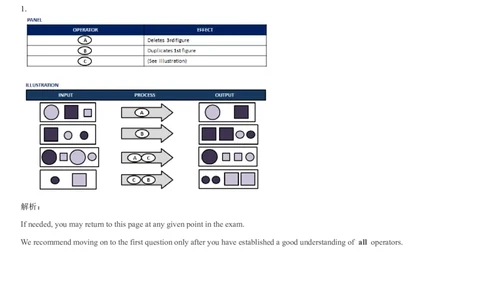
1.
解析:
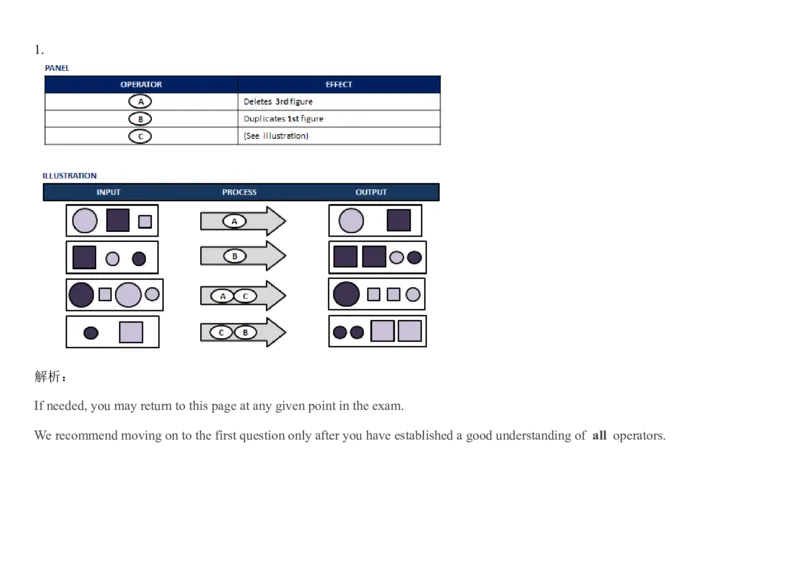
If needed, you may return to this page at any given point in the exam.
We recommend moving on to the first question only after you have established a good understanding of all operators.2.
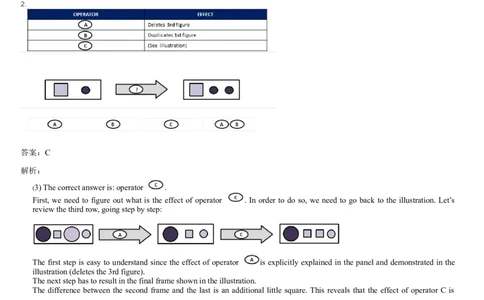
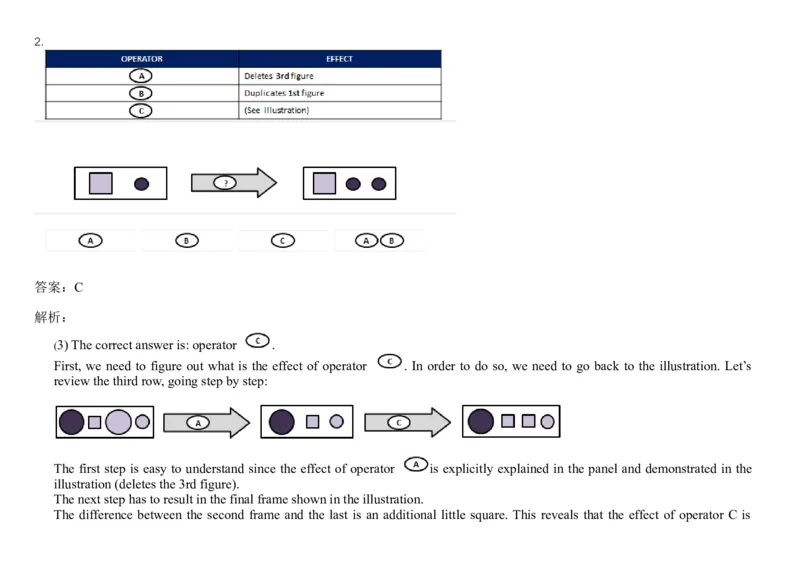
答案:C
解析:
(3) The correct answer is: operator .
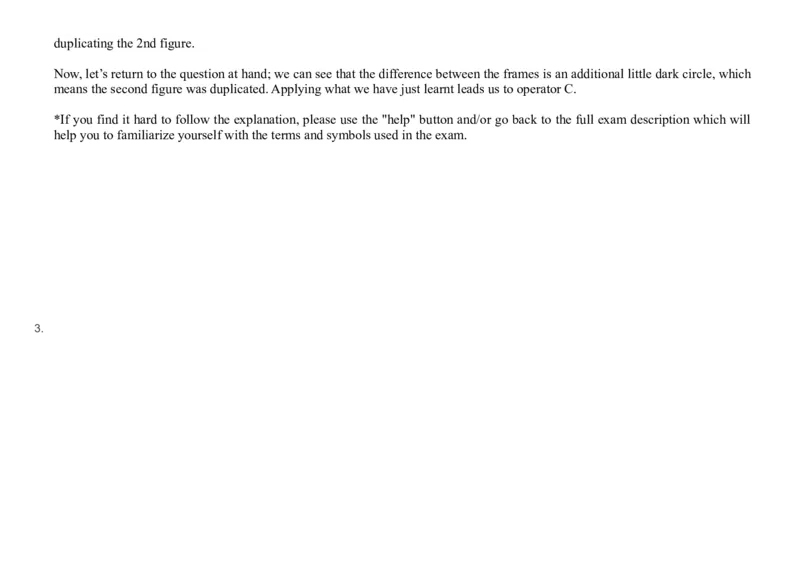
First, we need to figure out what is the effect of operator . In order to do so, we need to go back to the illustration. Let’s
review the third row, going step by step:
The first step is easy to understand since the effect of operator is explicitly explained in the panel and demonstrated in the
illustration (deletes the 3rd figure).
The next step has to result in the final frame shown in the illustration.
The difference between the second frame and the last is an additional little square. This reveals that the effect of operator C isduplicating the 2nd figure.
Now, let’s return to the question at hand; we can see that the difference between the frames is an additional little dark circle, which
means the second figure was duplicated. Applying what we have just learnt leads us to operator C.
*If you find it hard to follow the explanation, please use the "help" button and/or go back to the full exam description which will
help you to familiarize yourself with the terms and symbols used in the exam.
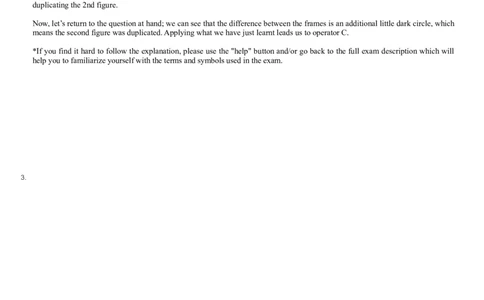
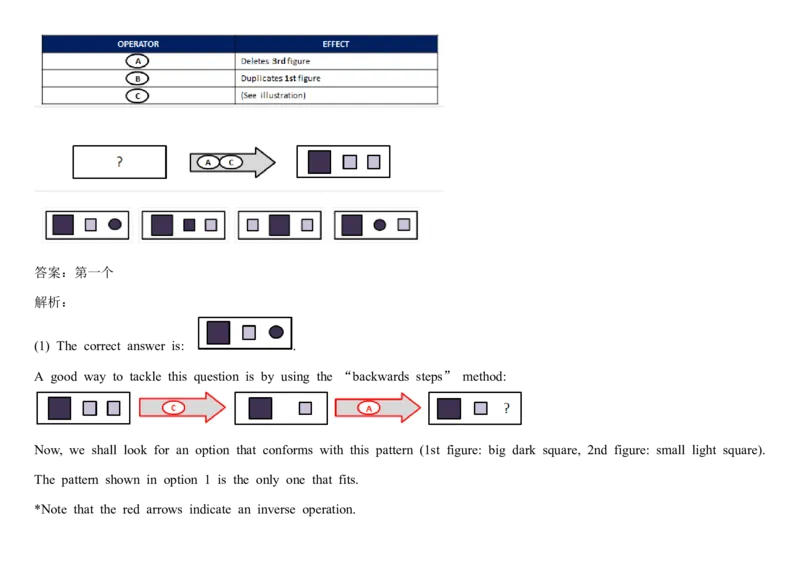
3.答案:第一个
解析:
(1) The correct answer is: .
A good way to tackle this question is by using the “backwards steps” method:
Now, we shall look for an option that conforms with this pattern (1st figure: big dark square, 2nd figure: small light square).
The pattern shown in option 1 is the only one that fits.
*Note that the red arrows indicate an inverse operation.4.
答案:第二个
解析:
(2) The correct answer is: "Only ."
In this type of question we will need to check both of the combinations in order to decide what is the correct answer.
The first combination :The second combination :
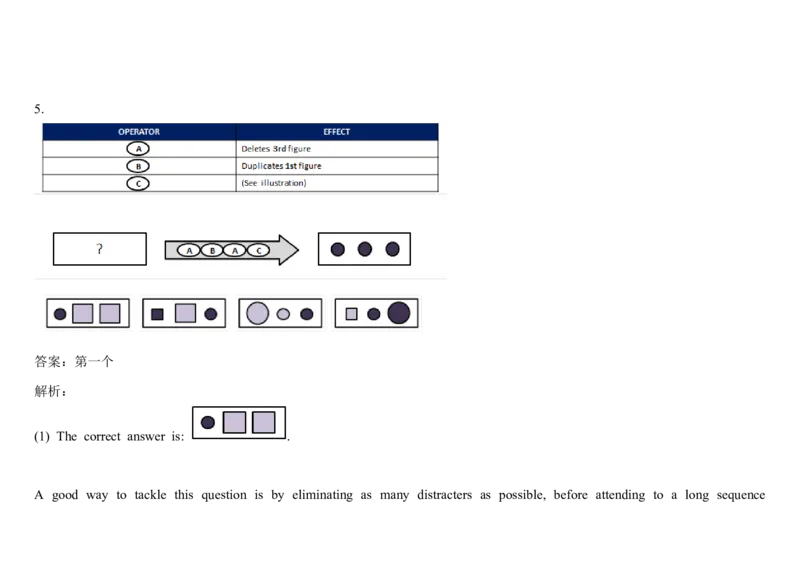
Only the second combination, C B, leads to the required frame.5.
答案:第一个
解析:
(1) The correct answer is: .
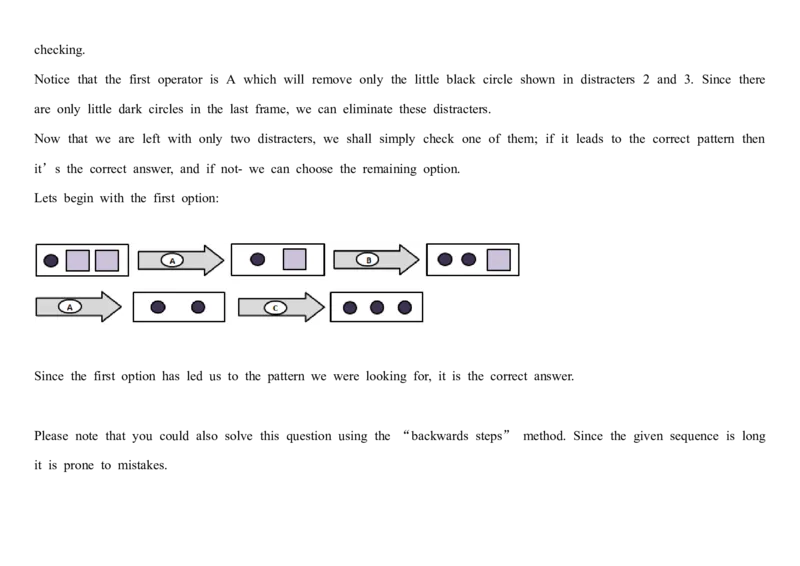
A good way to tackle this question is by eliminating as many distracters as possible, before attending to a long sequencechecking.
Notice that the first operator is A which will remove only the little black circle shown in distracters 2 and 3. Since there
are only little dark circles in the last frame, we can eliminate these distracters.
Now that we are left with only two distracters, we shall simply check one of them; if it leads to the correct pattern then
it’s the correct answer, and if not- we can choose the remaining option.
Lets begin with the first option:
Since the first option has led us to the pattern we were looking for, it is the correct answer.
Please note that you could also solve this question using the “backwards steps” method. Since the given sequence is long
it is prone to mistakes.6.
解析:
If needed, you may return to this page at any given point in the exam.We recommend moving on to the first question only after you have established a good understanding of all operators.
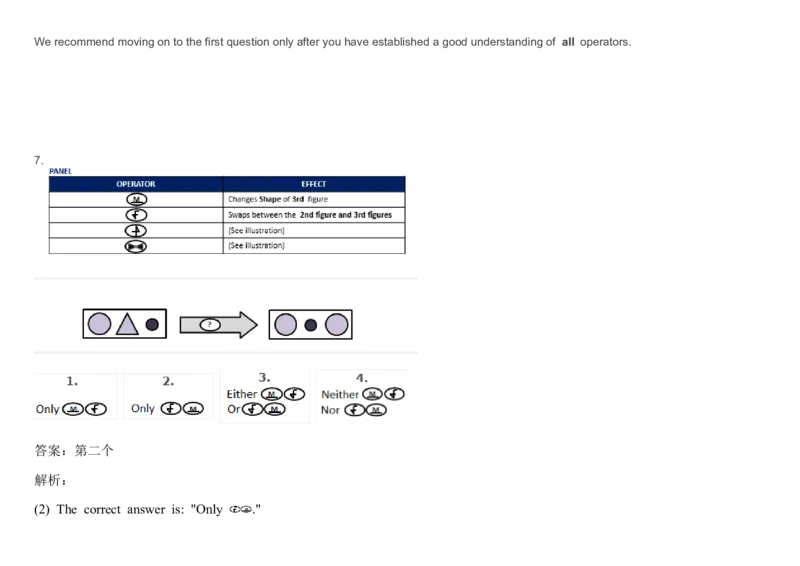
7.
答案:第二个
解析:
(2) The correct answer is: "Only ."The first step in diagrammatic reasoning questions is to make sure you understand the effect of all operators, regardless of
the question at hand.
In order to do so, we need to go back to the illustration and figure out the effect of operators and .
Let’s review the third row, going step by step:
The first step is easy to understand since the effect of operator is explicitly explained and demonstrated.
The next step has to result in the final frame shown in the illustration.
The difference between the second frame and the last reveals that the effect of operator is changing the shading of the
2nd figure.
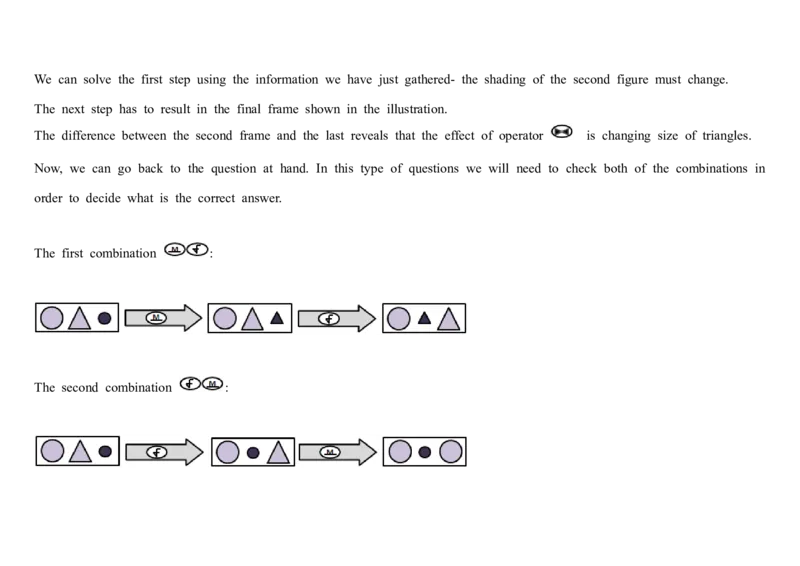
Now, let’s review the fourth row, going step by step:We can solve the first step using the information we have just gathered- the shading of the second figure must change.
The next step has to result in the final frame shown in the illustration.
The difference between the second frame and the last reveals that the effect of operator is changing size of triangles.
Now, we can go back to the question at hand. In this type of questions we will need to check both of the combinations in
order to decide what is the correct answer.
The first combination :
The second combination :As you can see, only the second combination lead to the required frame.
8.答案:第四个
解析:
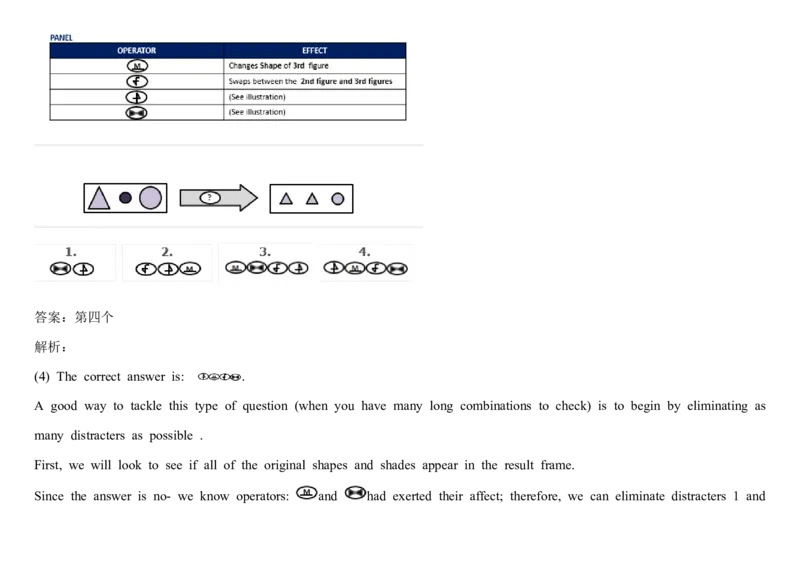
(4) The correct answer is: .
A good way to tackle this type of question (when you have many long combinations to check) is to begin by eliminating as
many distracters as possible .
First, we will look to see if all of the original shapes and shades appear in the result frame.
Since the answer is no- we know operators: and had exerted their affect; therefore, we can eliminate distracters 1 and2. Now that we are left with only two possible distracters (that differ in the order of operations) it is suffice to check only
one of them; if it leads to the correct pattern then it’s the correct answer, and if not- we can choose the remaining option.
Lets begin with distracter 3:
We did not receive the pattern we were looking for . Thus, we can deduce the correct answer is the one shown in option 4.
In the real exam, at this point you should choose option 4 and move on to the next question. However, for learning
purposes we shall continue to demonstrate the correct answer:
9.答案:第四个
解析:
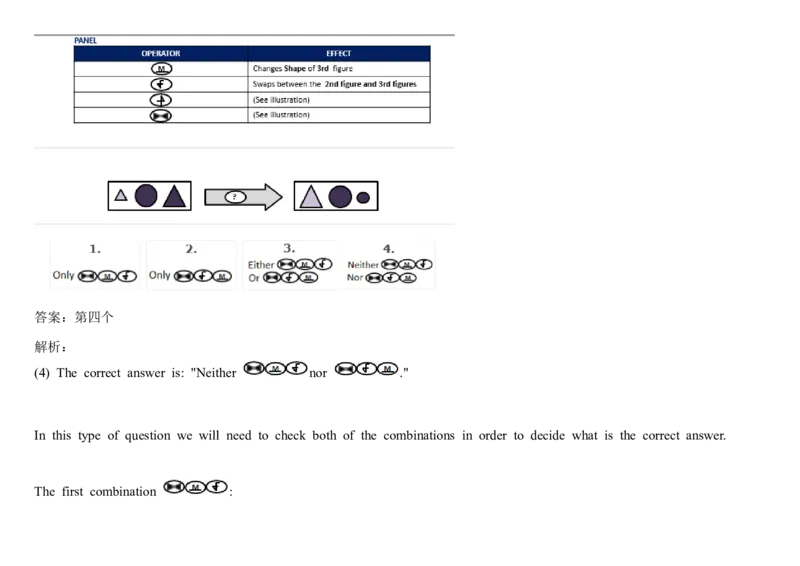
(4) The correct answer is: "Neither nor ."
In this type of question we will need to check both of the combinations in order to decide what is the correct answer.
The first combination :The second combination :
As you can see, neither combination leads to the required frame.
Please note that the first operator in both of the combinations was identical whereas the following two were the same but in
a different order. In this exam the order of operations plays a crucial role.10.
答案:第三个
解析:
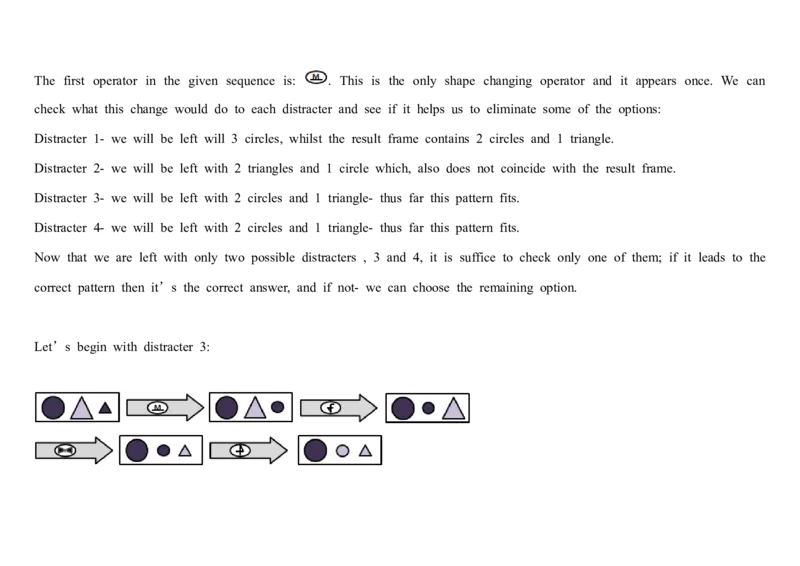
(3) The correct answer is:
A good way to tackle this question is by using an elimination process.The first operator in the given sequence is: . This is the only shape changing operator and it appears once. We can
check what this change would do to each distracter and see if it helps us to eliminate some of the options:
Distracter 1- we will be left will 3 circles, whilst the result frame contains 2 circles and 1 triangle.
Distracter 2- we will be left with 2 triangles and 1 circle which, also does not coincide with the result frame.
Distracter 3- we will be left with 2 circles and 1 triangle- thus far this pattern fits.
Distracter 4- we will be left with 2 circles and 1 triangle- thus far this pattern fits.
Now that we are left with only two possible distracters , 3 and 4, it is suffice to check only one of them; if it leads to the
correct pattern then it’s the correct answer, and if not- we can choose the remaining option.
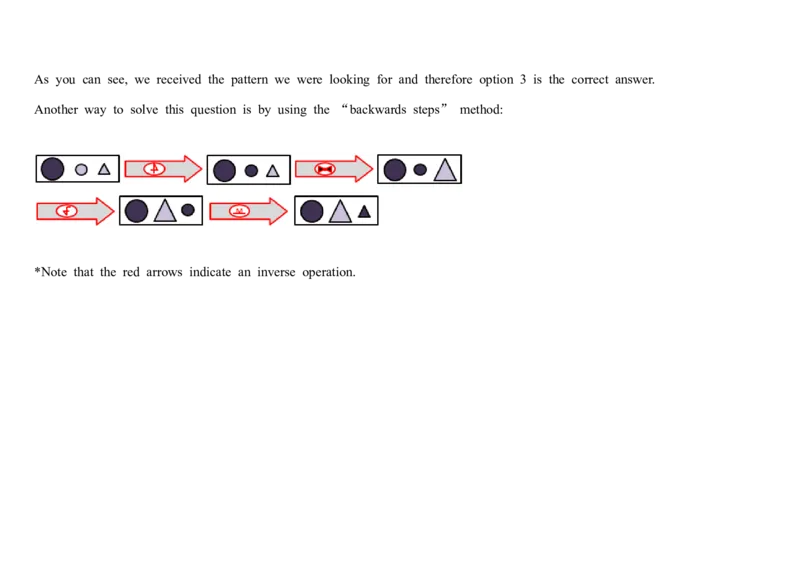
Let’s begin with distracter 3:As you can see, we received the pattern we were looking for and therefore option 3 is the correct answer.
Another way to solve this question is by using the “backwards steps” method:
*Note that the red arrows indicate an inverse operation.