1、
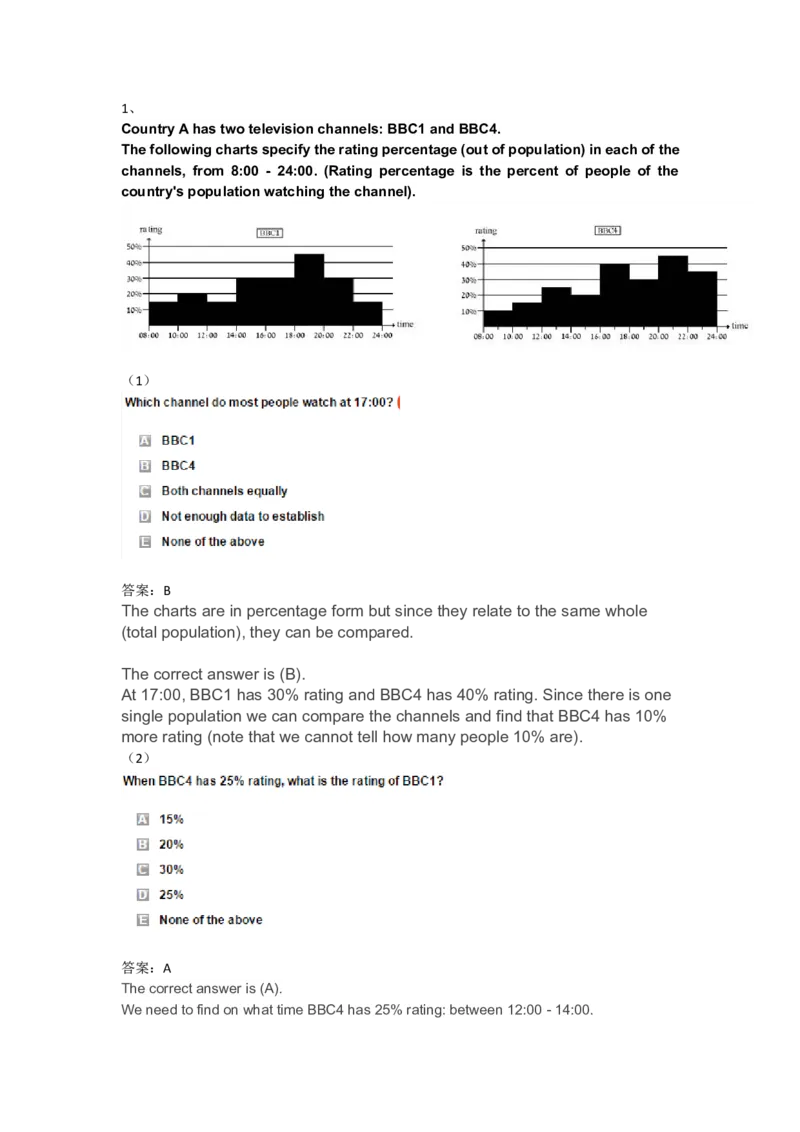
Country A has two television channels: BBC1 and BBC4.
The following charts specify the rating percentage (out of population) in each of the
channels, from 8:00 - 24:00. (Rating percentage is the percent of people of the
country's population watching the channel).
(1)
答案:B
The charts are in percentage form but since they relate to the same whole
(total population), they can be compared.
The correct answer is (B).
At 17:00, BBC1 has 30% rating and BBC4 has 40% rating. Since there is one
single population we can compare the channels and find that BBC4 has 10%
more rating (note that we cannot tell how many people 10% are).
(2)
答案:A
The correct answer is (A).
We need to find on what time BBC4 has 25% rating: between 12:00 - 14:00.On those hours BBC1 has 15% rating.
(3)
答案:C
The correct answer is (C).
We'll place 100 as the number of population in Limbo so that we can find the number of
people watching at a certain time (that number will be equal to the percentage).
Answer (A): at 9:00 BBC1 has 15 viewers, and at 11:00 BBC1 has 20 viewers, which are
5 viewers more. Those 5 are a third of the viewers at 9:00 (15 viewers).
Answer (B): at 13:00 BBC1 has 15 viewers, and at 15:00 BBC1 has 30 viewers, which are
15 viewers more. Those 15 make a 100% of theviewers at 13:00 (15 viewers).
Answer (C): at 17:00 BBC1 has 30 viewers, and at 19:00 BBC1 has 45 viewers, which are
15 viewers more. Those 15 make 50% of the viewers at 17:00 (30 viewers). This is the
correct answer.
Answer (D): at 19:00 BBC1 has 45 viewers, and at 21:00 BBC1 has 30 viewers which are
actually less viewers.
(4)
答案:B
The correct answer is (B).
At 9:00 BBC4 has 10% rating. At 11:00 BBC1 has 20% rating (twice as many). Therefore,
If BBC4 has 450 thousand viewers (at 9:00), BBC1 has 900 thousand viewers at 11:00
(twice as many).
2、
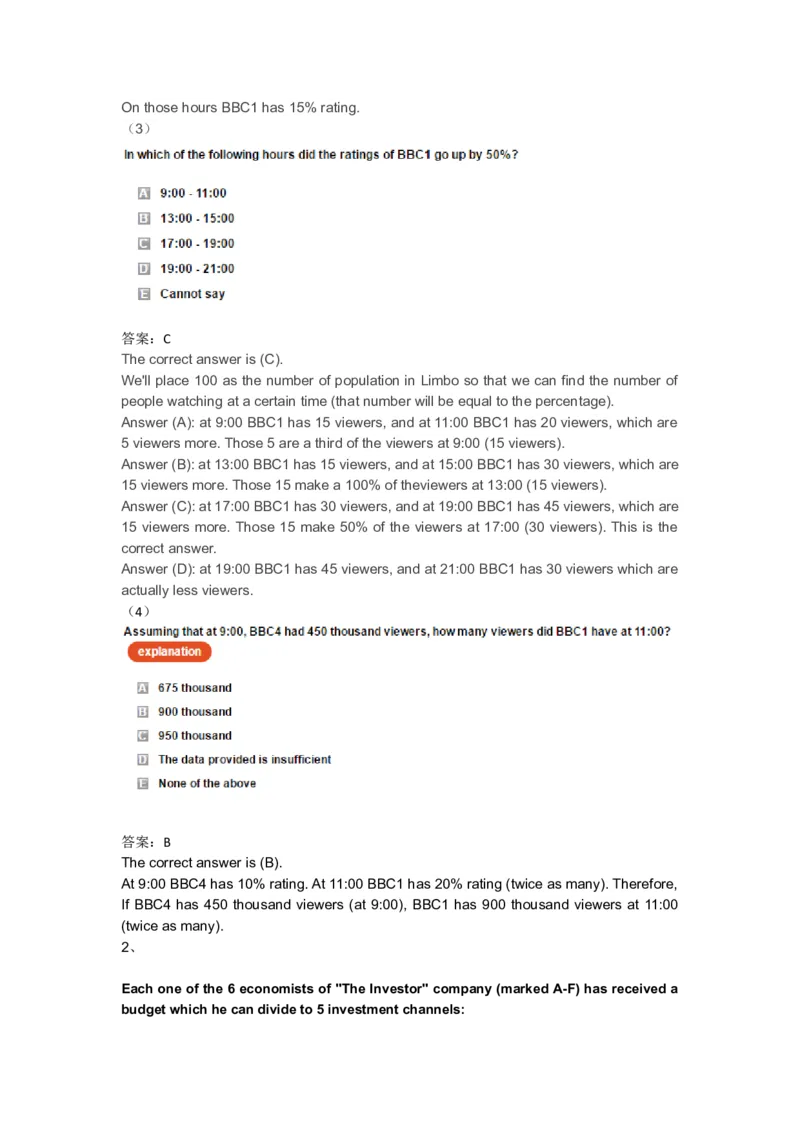
Each one of the 6 economists of "The Investor" company (marked A-F) has received a
budget which he can divide to 5 investment channels:The graph below describes how each of the economists has chosen to divide his
budget.
Economist A's budget is X.
The budget of economist C and economist F is 2X each.
(1)
答案:D
Economist A invested 30% of his budget (X) in bonds: (30/100)*X = 30X/100.
Economist C invested 10% of his budget (2X) in bonds: (10/100)*2X= 20X/100.
Economist F invested 20% of his budget (2X) in bonds: (20/100)*2X = 40X/100.
Altogether they have invested 0.9X in bonds.
(30X/100+20X/100+40X/100=0.9X)
3、答案:E
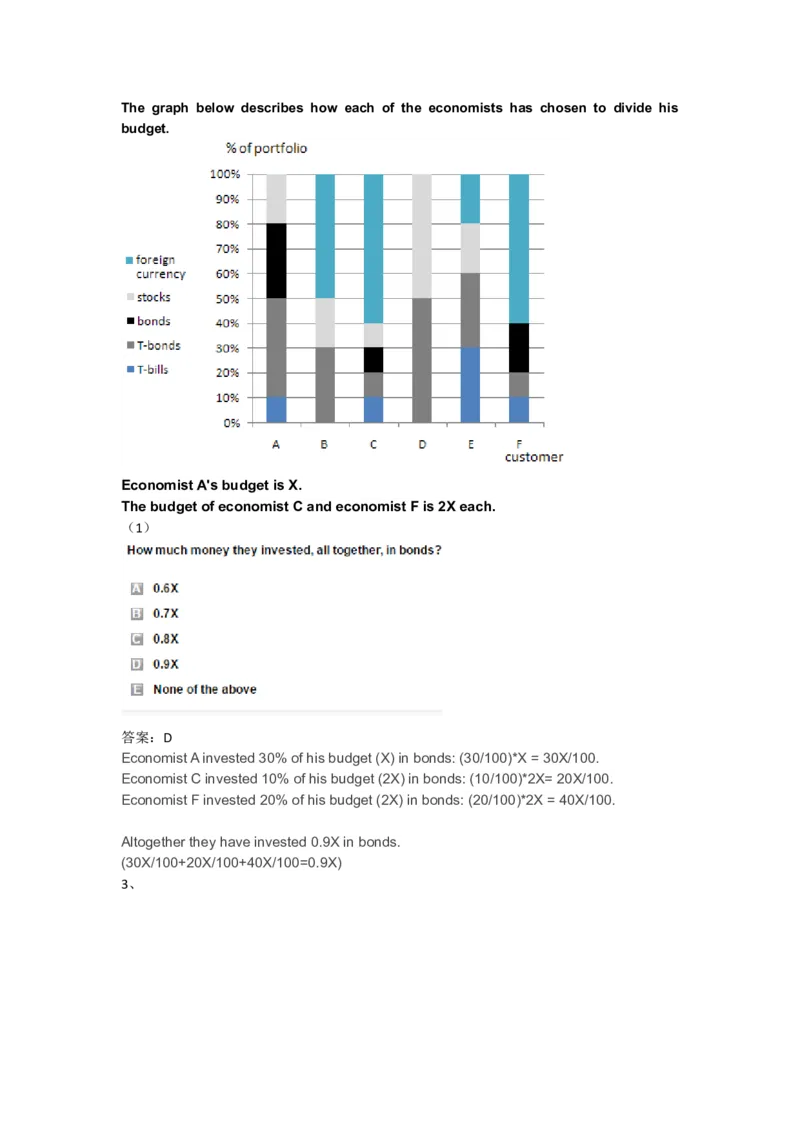
Number of robberies in year 1: 0.9 million.
Rounded to the nearest million = 1 million = 0.001 billion.
4、
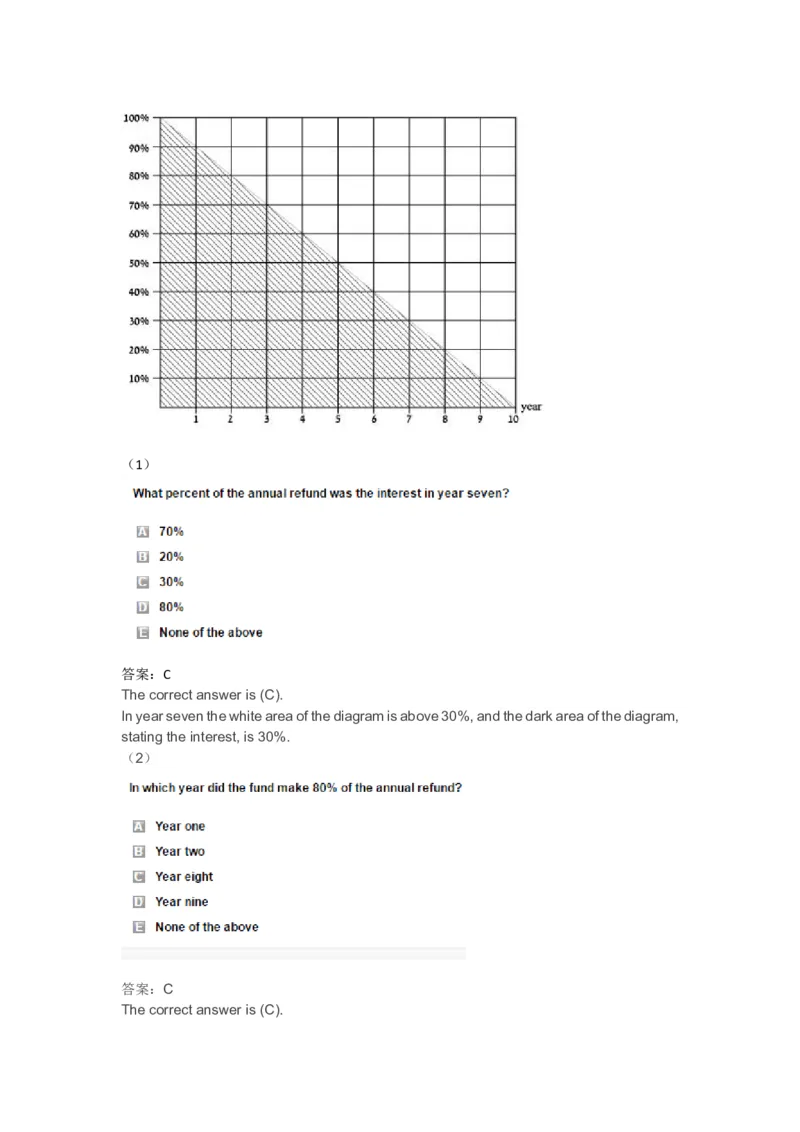
The following diagram describes the mortgage refunds in "D" BANK.
The mortgage is being refunded in 10 equal annual refunds, and each one of them is
made up of interest and fund. The dark part of the diagram describes the interest's
percentage out of the refund, whereas the white part describes the fund's percentage.(1)
答案:C
The correct answer is (C).
In year seven the white area of the diagram is above 30%, and the dark area of the diagram,
stating the interest, is 30%.
(2)
答案:C
The correct answer is (C).We're looking for a year in which the fund (the white area) intakes 80% thus the interest
(the dark area) takes up 20%. That year is year eight.
(3)
答案:C
The correct answer is (C).
The first year that had more fund than interest return is the year where the fund took up
more than 50% and the interest less than 50%. In year five the fund and the interest made
50% each and so starting year six there was more fund than interest return.
(4)
答案:D
The correct answer is (D).
We'll calculate each year separately:
First year: the interest is 90% of the refund (which is 10,000 GBP)
(90/100)*10,000=9,000
Second year: the interest is 80% of the refund (which is 10,000 GBP)
(80/100)*10,000=8,000
Third year: the interest is 70% of the refund (which is 10,000 GBP)
(70/100)*10,000=7,000
The interest David payed thus far is 24,000 GBP (9,000+8,000+7,000)
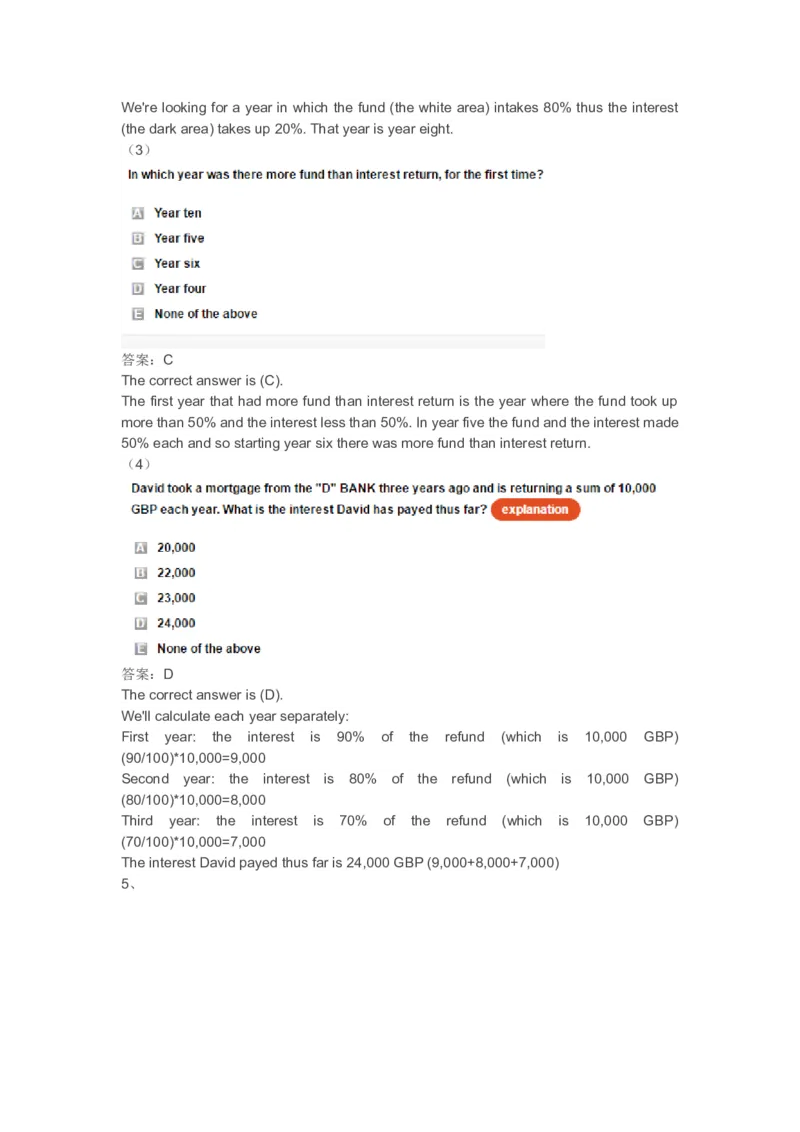
5、*The ratio of men:women in both countries is 48%:52% respectively.
(1)
答案:C
The answer can be easily discovered without any calculations. Nepal has fewer people
than Thailand. If there is a similar percentage, Nepal will naturally have a lower number of
people that correspond to that percentage.
Since Nepal has less than half the population that Thailand does, and in 1995 had a similar
percentage of literate females which was the lowest of any given time frame, Nepal will
have the lowest number that year.
Note: Always pay attention to the asterisks! In this question, the asterisk provides us with
the ratio of men to women. Without this piece of information, the answer would be Cannot
say.
6、
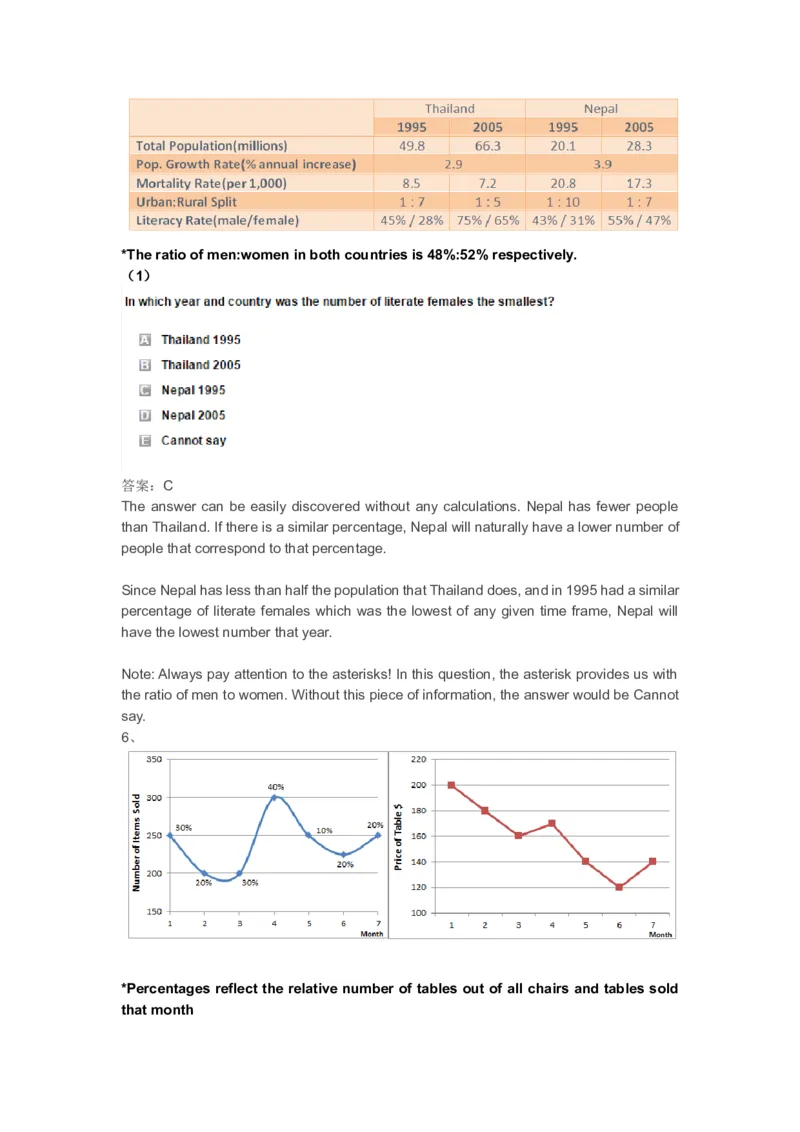
*Percentages reflect the relative number of tables out of all chairs and tables sold
that month(1)
答案:D
This is a question that can be answered by estimation. Look for low numbers - both in
terms of percentage and in in terms of total sales. This would immediately rule out some
answer choices.
Choosing the long way, the number of tables sold is dependent on the number of all furniture
sold, and the percentage of the tables from all furniture. A calculation for each month
shows:
Month 1: 0.3*250 = 75
Month 2: 0.2*200 = 40
Month 3: 0.3*200 = 60
Month 5: 0.1*250 = 25
Month 6: 0.2*225 = 45
Therefore, the lowest number of tables was sold in month 5.
(2)答案:C
The total number of tables sold in month 2 is: 0.2*200 = 40.
The price of one table was $180 in month 2, and $140 in month 5. Since the same amount
is bought and sold at each transaction, we can just find the differences between the prices
and multiply it by the number of tables.
(180-140)*40 = $1,600.
7、
Mental Performance Differences Between Age Groups
(n= # of people surveyed, M=mean, SD=standard deviation)
*Success rate = (average score/maximal score)
(1)答案:C
Success rate = (average score/maximal score).
The table specifies the maximal score for the vocabulary test: 33
The success rate of young people: 15.7/33 = 0.4757 --> 47.57%
The success rate of older people: 23.2/33 = 0.7030 --> 70.3%
The absolute difference between the two age groups: 70.3% - 47.57% = 22.73%
Note: as the question requires calculating the absolute difference between two rates, it
may also be regarded as a percentage points question.
The term 'percentage points' refers to the absolute difference between two percentage
values.
(2)
答案:A
The weighted average success rate can be found by giving each experiment group a new
average score which is proportional to the size of the two groups combined.
Number of young people in experiments 1 and 2 combined: 20+15=35.
Success rate = average score/maximal test score
Group 1:Proportinal size: 20/35.
Average success rate: 99.5/130=0.765=76.5%
Group 2:
Proportional size: 15/35
Average success rate: 94.2/130=0.725=72.5%
Weighting:
[(15/35)*72.5] + [(20/35)*76.5] ~75
8、
*gha= global hectare.
(1)
答案:B
We need to calculate how many global hectares are occupied by USA and Japan, and thencompare between them on a percentage change basis.
USA: (300 mil) x (8 gha/person)=2,400 global hectares
Japan: (125 mil)x(5 gha/person)=625 global hectares
% change = (Difference/Original)x100% = [(2400 - 625)/625]x100% = [(2400/625)-
(625/625)]x100% = [(2,400/625)-1]x100% = 284%
(2)
答案:B
This question is not just about adding up all the ecological footprint values and then dividing
that of Japan by the calculated sum. We must bring into consideration the population of
each country:
Gha = Ecological Footprint x Population
South Africa: 50x2.5 = 125
France: 60x5 = 300
Romania: 25x2.5 = 62.5
Germany: 75x3 = 225
Japan: 125x5 = 625
USA: 300x8 = 2400
Total gha: 125+300+62.5+225+625+2400 = 3737.5.
Japan: 625
Japan’s ratio: 625/3737.5 = 0.167
The correct answer is approximately 17%.
(3)答案:A
First we need to calculate the total gha output for each country.
South Africa: 50 * 2.5 = 125
France: 60 * 5 = 300
Romania: 25 * 2.5 = 62.5
Germany: 75 * 3 = 225
Japan: 125 * 5 = 625
USA: 300 * 8 = 2400
(Note that since all population numbers are in millions, the millions can be cancelled out to
simplify the calculations.)
In order to calculate the weighted average, we must find the total population so that we
can find the percentage of the total population represented by each country. The total
population (in millions) is: 50 + 60 + 25 + 75 + 125 + 300 = 635. Therefore, the fraction of
the total population represented by each country is as follows.
South Africa: 50 / 635 = 10/127
France: 60 / 635 = 12/127
Romania: 25 / 635 = 5/127
Germany: 75 / 635 = 15/127
Japan: 125 / 635 = 25/127
USA: 300 / 635 = 60/127
The weighted global average equals the sum of each country's total gha output multiplied
by the country's fraction of the total population. Therefore, the weighted global average
equals: (125 * 10/127) + (300 * 12/127) + (62.5 * 5/127) + (225 * 15/127) + (625 * 25/127)
+ (2400 * 60/127) = 168162.5/127 = 1324.114.
Since Romania's total gha output is only 62.5, which is less than the weighted global
average, Romania will not pay any fine.
A faster method: While we can calculate the weighted average of all countries, it's betterto examine the data first. A fine will be incurred if the value for a country is above the
weighted average. Romania has the lowest value, alongside South Africa, and therefore at
the lowest risk for a fine. Given the fact that there is more than two different values in a
calculation of an average, the lowest value will always be below average.
Secondly, the USA has roughly twice the total population of the other countries combined,
while also having the highest gha value. This will affect the weighted average and increase
it even higher, as the USA's relative weight to other countries is substantial.
An educated guess would be that Romania would incur no fine.
9、
Prices for specific advertising products (in GBP)
1. BrandMad offers 10% discount on any purchase above £1000.
2. HIP offers 20 free match boxes for each 1000 lighters.
3. Big-time offers 15% discounts on annual contracts.
(1)
答案:B
Since we are dealing with equal time periods, there is no need to take into calculation the number of months! Simply
look for the price difference and the fact that Big-time offers 15% percent off for annual campaigns [(1920*0.85)-
1310]/1310 =0.2458 = 24.58%.
A quicker way to calculate percentages is:
(1920*0.85/1310)-1 = 0.2458=24.58%
(2)答案:B
Note that the price of 500 pens is £550, the price of 1000 match boxes is £700, and the price of 50 shirts is £1127.
Also note that according to the question, we need to calculate the purchase of 2 units of 500 pens, 2 units of 1000 matchboxes and 6 units
We are looking for the change in prices before and after a 10% increase. Intuitively we deduce the present total price
from the future one to arrive at the difference. However, in order to speed up the calculations, we may choose to do
something a little different. We can calculate the total sum before the increase:
(6*1127) + (2*700) + (2*550) = 9262.
The difference between this sum and the future sum is an increase of 0.1 in prices. Thus we can calculate the
difference:
9262 X 0.1 = 926.2
Last but not least, we mustn't forget the 10% discount on purchases over 1000 pounds. Since the purchase prior to
the 10% increase was greater than 1000 pounds, we can assume that the future purchase, following the increase,
will also be entitled to a 10% discount. Thus we can simply calculate 0.9 out of the difference we have previously
calculated:
926.2*0.9= £833.58