




文档内容
1.
解析:
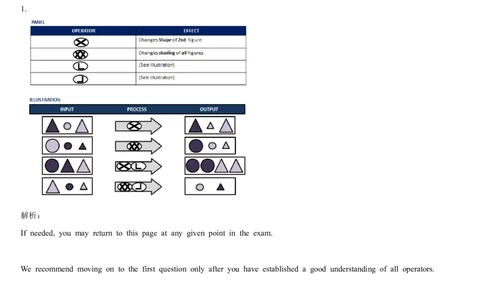
If needed, you may return to this page at any given point in the exam.
We recommend moving on to the first question only after you have established a good understanding of all operators.2.
答案:第二个
解析:
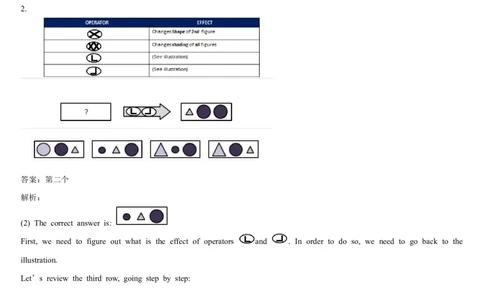
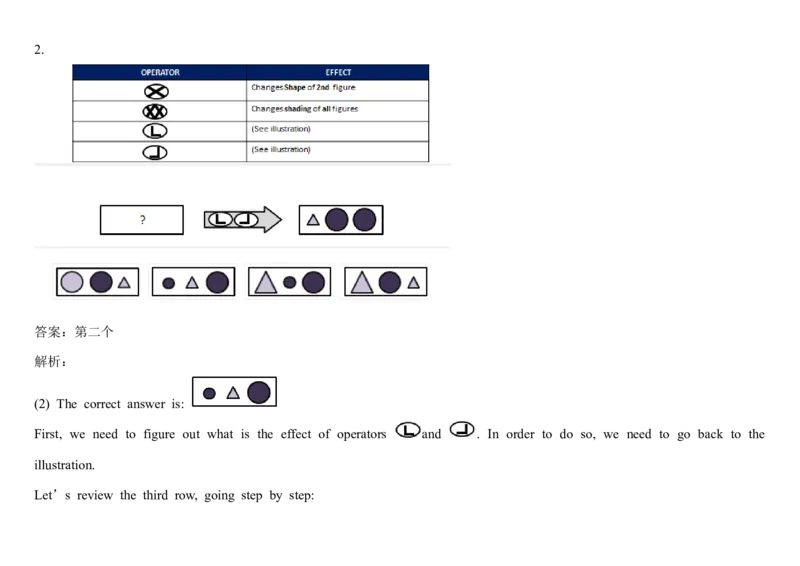
(2) The correct answer is:
First, we need to figure out what is the effect of operators and . In order to do so, we need to go back to the
illustration.
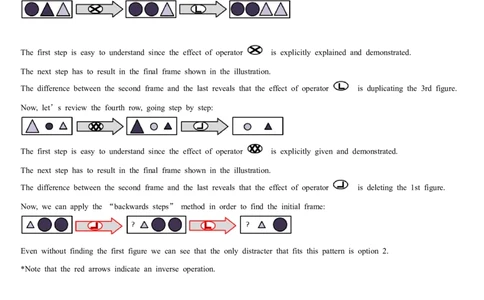
Let’s review the third row, going step by step:The first step is easy to understand since the effect of operator is explicitly explained and demonstrated.
The next step has to result in the final frame shown in the illustration.
The difference between the second frame and the last reveals that the effect of operator is duplicating the 3rd figure.
Now, let’s review the fourth row, going step by step:
The first step is easy to understand since the effect of operator is explicitly given and demonstrated.
The next step has to result in the final frame shown in the illustration.
The difference between the second frame and the last reveals that the effect of operator is deleting the 1st figure.
Now, we can apply the “backwards steps” method in order to find the initial frame:
Even without finding the first figure we can see that the only distracter that fits this pattern is option 2.
*Note that the red arrows indicate an inverse operation.3.
答案:
解析:
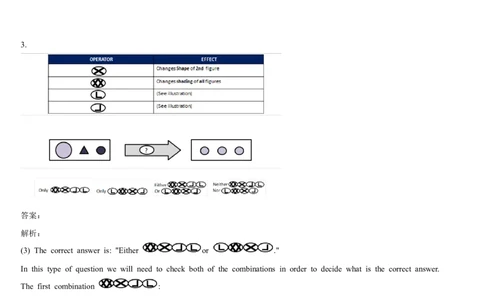
(3) The correct answer is: "Either or ."
In this type of question we will need to check both of the combinations in order to decide what is the correct answer.
The first combination :The second combination :
As you can see, both of the combinations lead to the required frame.4.
答案:第四个
解析:
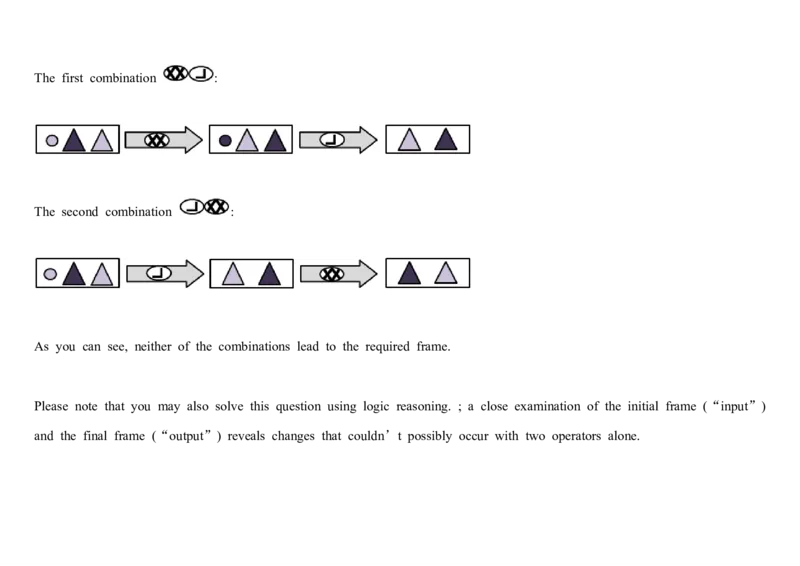
(4) The correct answer is: "Neither nor ."
In this type of question we will need to check both of the combinations in order to decide what is the correct answer.The first combination :
The second combination :
As you can see, neither of the combinations lead to the required frame.
Please note that you may also solve this question using logic reasoning. ; a close examination of the initial frame (“input”)
and the final frame (“output”) reveals changes that couldn’t possibly occur with two operators alone.5.
答案:第一个
解析:
(1) The correct answer is .This is a straight forward question where you simply have to follow the given sequence:
The correct answer is option 1.
6.解析:
If needed, you may return to this page at any given point in the exam.
We recommend moving on to the first question only after you have established a good understanding of all operators.
7.答案:第三个
解析:
(3) The correct answer is: "Either or ."
First, we need to figure out what the effect of operators and are.
In order to do so, we need to go back to the illustration.
Let’s review the third row, going step by step:The first step is easy to understand since the effect of operator is explicitly explained and demonstrated.
The next step has to result in the final frame shown in the illustration.
The difference between the second frame and the last suggests that the effect of operator is either shading swap
between the 2nd and 3rd figures, or a change in shadings of all small figures.
Now, let’s review the fourth row, going step by step:
The only way to we can achieve the final frame is if the effect of operator is to change the shading of small figures
and the effect of operator is to reverse the order of the figures.
Now that we understand the effects of the operators we can address the question at hand.
In this type of questions we will need to check both of the combinations in order to decide what is the correct answer.The first combination :
Please note that since there are no squares in the initial frame, the first operator has no effect on the pattern.
The second combination :
As you can see, both combinations lead to the required frame.
8.答案:第三个
解析:
(3) The correct answer is: .
A good way to tackle this type of question (when you have many long combinations to check) is to begin by eliminating as
many distracters as possible .
First, we will examine whether all of the original shapes and sizes appear in the result frame.Since the answer is no- we can deduce that operators: and are at play; therefore, we can eliminate distracter 2.
The big light circle remains the first figure which means operator is not part of the sequence we are looking for; hence,
we can also eliminate distracter 1.
Notice that even though different figures are now light/dark, the total number of light/dark figures has remained the same .
In order for this to happen a change in shadings (using operator ) had to occur before the small square became big.
According to this, we are looking for a combination that includes the following operators:
, and .
And that the appears prior to the .
The only distracter that coincides with this logic is option 3.
Another way to solve this question is by checking each distracter until you find the right combination. Since the time limit
in this exam is fairly tight we recommend eliminating as many distracters as possible before applying a one-by-one checking
method.9.
答案:第一个
解析:
(1) The correct answer is: "Only ."
In this type of question we will need to check both of the combinations in order to decide what is the correct answer.
The first combination :The second combination :
As you can see, only the first combination leads to the required frame.
10.答案:第二个
解析:
(2) The correct answer is: .A good way to tackle this question is by using an elimination process.
Operator is the only shape changing operator and it appears only once. Since it is situated last, we recover the
previous frame by “undoing” the operation (using the “backwards steps” method) and see if it helps us to eliminate
some of the options.
As you can see, the initial pattern has to contain 2 circles and 1 square.
This information helps us to eliminate distracter 3.
Operator is the only size changing operator and it appears only once. Thus, the small square at the one –before- last
frame has had to begin as a big square in the initial frame.
This information helps us to eliminate distracter 1.Now that we are left with only two possible distracters , 2 and 4, it suffices to check only one of them; if it leads to the
correct pattern then it’s the correct answer, and if not- we can choose the remaining option.
Let’s begin with distracter 2:
As you can see, we received the pattern we were looking for and therefore option 2 is the correct answer.
Another approach to this question is the “backwards steps” method:*Note that the red arrows indicate an inverse operation.