Talent Q
Elements
Psychometric Review
August 2017OVERVIEW OF TECHNICAL MANUALS FOR THE NEW
KORN FERRY ASSESSMENT SOLUTION
The Korn Ferry Assessment Solution (KFAS) offers a new and innovative process for assessing
talent. Deployed on a technology platform that enables client self-service, the KFAS shifts the
focus away from specific assessment products to solutions suitable for applications across
the talent life cycle. Whether a need pertains to talent acquisition or talent management,
the participant will experience a single, seamless assessment process. This process has three
elements: a success profile, an assessment experience, and results reporting tailored to a
variety of talent acquisition and talent management uses.
The success profile provides a research-based definition of “what good looks like” in a given
role. Specifically, the success profile outlines the unique combination of capabilities, including
competencies, traits, drivers, and cognitive abilities, that are associated with success in the role.
These components are used to inform both the assessment experience and results reporting,
which differ according to the solution, for both talent acquisition and talent management.
Whereas the KFAS is new, the assessment components are carried over from legacy
Korn Ferry assessment products. The science, research, and psychometric-based information
that are the foundation of these robust assessments remain relevant. Therefore, while we work
to consolidate and refine technical manuals for the KFAS, we can use the existing technical
manuals for KF4D Enterprise, Dimensions-KFLA, Aspects, and Elements as a bridge.
CONTINUES ON NEXT PAGE
ii © Korn Ferry 2017. All rights reserved.CONTINUED FROM PREVIOUS PAGE
This technical manual provides background research and psychometric-based information
regarding some of the assessments used in the KFAS. The following table summarizes
the solutions available for talent acquisition offerings and where to find the relevant
psychometric-based information in the technical manual. We would like to remind you that,
in the talent acquisition context and absent a client-specific validation study, the assessment
should always be used with other information (e.g., from interviews and résumés) to guide
talent decisions.
The Korn Ferry Assessment Solution: Talent Acquisition
SOLUTION/NEED
GRADUATE I GRADUATE II
(for entry (for entry first- MANAGERIAL/
ENTRY LEVEL professionals) line leadership) PROFESSIONAL LEADERSHIP
Types of roles Frontline Graduate/campus Graduate/campus Sales Any level of
in solution leadership
Apprenticeships Apprenticeships Apprenticeships Engineering
offering
Across all
Operational Across all Across all Accounting
industries
industries industries
Customer service Technical
Across all
Across all Across all
Hospitality IT geographies
geographies geographies
Retail Finance
Non-managerial Marketing
Design
Assessment Competencies Competencies Competencies Competencies Competencies
objects
Cognitive ability: Cognitive ability: Cognitive ability: Cognitive ability: Cognitive ability:
available
• Numerical • Numerical • Numerical • Numerical • Numerical
• Verbal • Verbal • Verbal • Verbal • Verbal
• Checking • Logical • Logical • Logical • Logical
Drivers Drivers Drivers
Traits Traits Traits
Technical Dimensions-KFLA Dimensions-KFLA KF4D Enterprise KF4D Enterprise KF4D
manuals to for competencies for competencies for competencies, for competencies, Enterprise for
reference traits, drivers traits, drivers competencies,
Aspects for Elements for
traits, drivers
cognitive ability cognitive ability Elements for Elements for
cognitive ability cognitive ability Elements for
cognitive ability
The KFAS may also be used for a variety of talent management applications such as
high potential identification, leadership development/succession, leadership selection, and
professional development. The self-assessment components within these solutions include
competencies, traits, and drivers, which may be used for diverse reporting needs, including
learning agility and risk factors results. Technical information for these components is
covered in the KF4D Enterprise technical manual. Multi-rater assessments may also be a part
of talent management solutions.
iii © Korn Ferry 2017. All rights reserved.FOREWORD
This Psychometric Review provides information relating to the development and use of
Elements (Numerical, Verbal and Logical).
The information included focuses on the initial and ongoing development of the assessments,
the background and rationale for their development, and their psychometric properties (for
example, reliability, validity and group differences).
You will see how the assessments were developed and how they are unique to Korn Ferry. You
will also learn more about the underlying models and their associated norm groups.
1 © Korn Ferry 2017. All rights reserved.CONTENTS
OVERVIEW OF TECHNICAL MANUALS FOR THE NEW KORN FERRY ASSESSMENT
SOLUTION ii
SECTION 1
Background to Elements 3
SECTION 2
Rationale for Elements 6
SECTION 3
Developing Elements 10
SECTION 4
Elements and other ability tests 12
SECTION 5
Norms for Elements 13
SECTION 6
Reporting 14
SECTION 7
Reliability 15
SECTION 8
Validity 18
SECTION 9
Relationships between Elements and biographical data 25
SECTION 10
Completion times 29
SECTION 11
Relationships between Elements and Dimensions 30
SECTION 12
Language availability and cultural differences 31
SECTION 13
Summary 32
SECTION 14
Glossary 34
SECTION 15
References 36
2 © Korn Ferry 2017. All rights reserved.SECTION 1
BACKGROUND TO ELEMENTS
Elements is an innovative range of online adaptive ability tests measuring numerical,
verbal and logical reasoning ability.
Elements adapts to the candidate’s performance in real time affording a concise but rigorous assessment
experience. Elements was developed by a team under the supervision of Roger Holdsworth. Roger was
the main author of many other ability tests, namely SHL’s test of Verbal and Numerical Critical Reasoning
(1987 onwards), which are used across many countries and industries. The first version of Elements was
developed in 2007 and, following initial trials, the tests were revised later that year.
In the early years of psychometrics, beginning in the 1910s with work on IQ at Stanford University and the
subsequent development of the American Army Alpha, the primary focus was on assessing abilities. As
these methods developed and in particular with the application of factor analysis in the 1930s, interest
in measuring a broader range of outcomes developed, with the widespread use of psychological testing
and assessment centres deployed to support mobilisation during the Second World War.
Following this, the use of psychometrics to assess abilities has expanded considerably and has been
intensively employed in high-volume assessment situations in particular in large organisations, for
example, to support graduate recruitment.
Our approach to ability testing is firmly grounded in psychometric theory, and the Elements tests are
designed to provide standardised, reliable, valid and fair quantitative measurement of abilities. Guilford’s
work in the 1960s has shaped ability testing generally and underpins our approach. His model proposed
a non-hierarchical approach with specific abilities in particular areas such as verbal, numerical or
mechanical reasoning. The model of specific abilities has been further expanded by Sternberg’s triarchic
model of intelligence (1985) and Gardner (1983) in his model of Multiple Intelligences. Subsequent meta-
analytical validation of ability tests has demonstrated their efficacy in predicting job performance from
frontline roles through to senior management positions (Schmidt and Hunter, 2004).
Elements tests how well a candidate can perform when they are trying their hardest (rather than
measuring typical performance). The assessments also operate similarly to other cognitive ability tests
in that they are norm-referenced, so results gain practical meaning and utility once they have been
compared with an appropriate norm group (e.g. managerial and professional roles).
3 © Korn Ferry 2017. All rights reserved.However, Elements is significantly different from most other ability tests in that all three tests are
adaptive. Many ability tests were originally designed to be paper-based, with everyone being presented
with the same set of questions which progressively increase in difficulty. Candidates would be given a set
amount of time, usually about 30 minutes, to complete the tests. The number of questions the candidate
gets right within the overall time limit then determines their raw score.
With the advent of the internet, it is now possible to take a more intelligent, efficient approach to test
development known as adaptive testing. Within an adaptive test there is a large bank of questions (e.g.
300 or more) of varying levels of difficulty. The candidate starts the test with a question of medium
difficulty. If they answer this question correctly, they are presented with one of a selection of harder
questions. Alternatively, if they get a question wrong, the candidate is presented with a slightly easier
question. This continues until they have completed a set number of questions and the combination of the
right and wrong answers, along with respective difficulty levels of the questions, determines their final
score.
The adaptive testing approach provides a number of significant advantages over traditional testing:
■ Secure: The adaptive nature of the test means that individuals get questions which are unique to their
level of ability, and which are randomly selected from a large bank of possible questions. This reduces
the chance of questions and correct answers ‘leaking out’ and being published on the internet. The
questions are randomised, which further reduces the chance that any two candidates will receive the
same test. Verification tests are available for all candidates, which are short follow-up assessments
completed under controlled conditions. The verification tests commence at the level an individual
attained in the main test, and provide feedback concerning the similarity in scores between the two
testing sessions. All of these features greatly improve the security of the test and the confidence
clients can have in the results.
■ Fast: Because candidates are quickly taken to questions appropriate to their level of ability, the testing
process can be completed much more quickly (e.g. half the time) compared with traditional tests, with
no compromise on scientific rigour.
■ One test system: A much greater spread of questions (e.g. suitable for frontline roles all the way up
to senior management) can be included in one testing system, removing the requirement for different
tests for different roles. This also means that the tests are fair, with no assumptions being made
regarding an individual’s education or work experience.
All three Elements tests (verbal, numerical and logical) are adaptive. They take a maximum of only 16
minutes per test to complete, half the time of equivalent traditional tests. A candidate’s score is then
compared with different groups (e.g. senior managers, graduate, frontline candidates) to assess how well,
relatively, a candidate has done on the assessment
4 © Korn Ferry 2017. All rights reserved.Average completion
Elements test Ability measured
time (approx.)
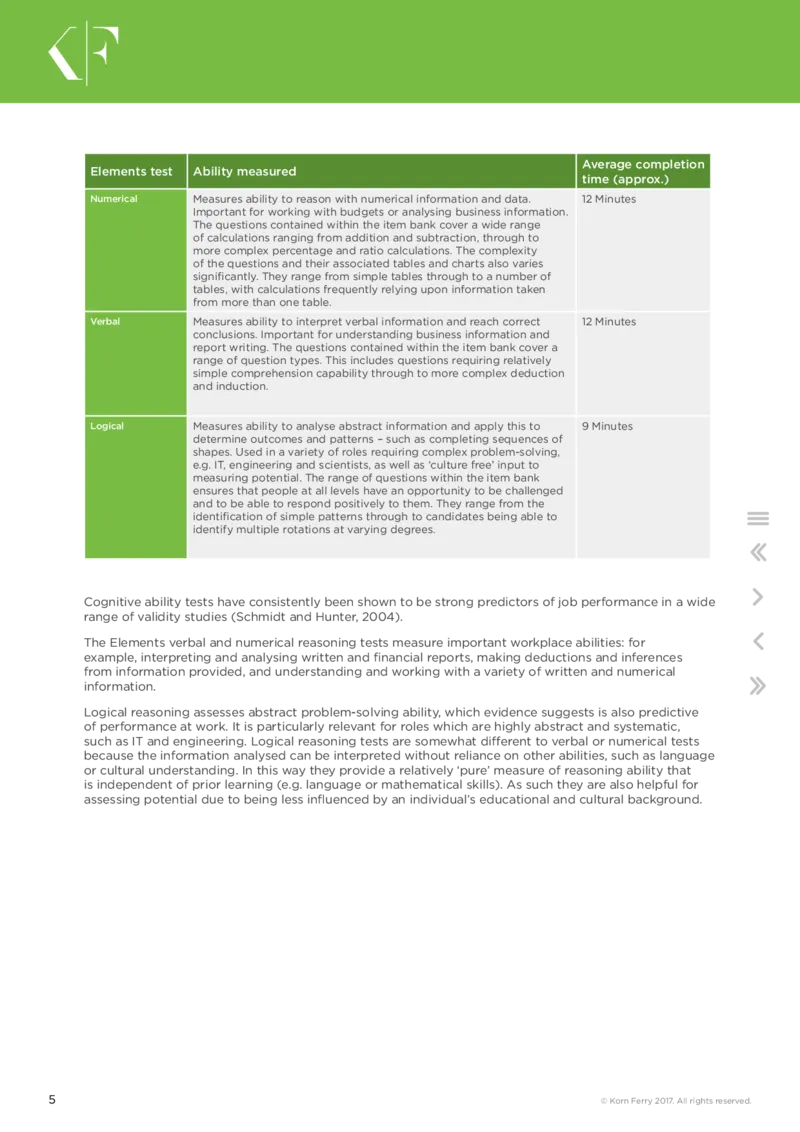
Numerical Measures ability to reason with numerical information and data. 12 Minutes
Important for working with budgets or analysing business information.
The questions contained within the item bank cover a wide range
of calculations ranging from addition and subtraction, through to
more complex percentage and ratio calculations. The complexity
of the questions and their associated tables and charts also varies
significantly. They range from simple tables through to a number of
tables, with calculations frequently relying upon information taken
from more than one table.
Verbal Measures ability to interpret verbal information and reach correct 12 Minutes
conclusions. Important for understanding business information and
report writing. The questions contained within the item bank cover a
range of question types. This includes questions requiring relatively
simple comprehension capability through to more complex deduction
and induction.
Logical Measures ability to analyse abstract information and apply this to 9 Minutes
determine outcomes and patterns – such as completing sequences of
shapes. Used in a variety of roles requiring complex problem-solving,
e.g. IT, engineering and scientists, as well as ‘culture free’ input to
measuring potential. The range of questions within the item bank
ensures that people at all levels have an opportunity to be challenged
and to be able to respond positively to them. They range from the
identification of simple patterns through to candidates being able to
identify multiple rotations at varying degrees.
Cognitive ability tests have consistently been shown to be strong predictors of job performance in a wide
range of validity studies (Schmidt and Hunter, 2004).
The Elements verbal and numerical reasoning tests measure important workplace abilities: for
example, interpreting and analysing written and financial reports, making deductions and inferences
from information provided, and understanding and working with a variety of written and numerical
information.
Logical reasoning assesses abstract problem-solving ability, which evidence suggests is also predictive
of performance at work. It is particularly relevant for roles which are highly abstract and systematic,
such as IT and engineering. Logical reasoning tests are somewhat different to verbal or numerical tests
because the information analysed can be interpreted without reliance on other abilities, such as language
or cultural understanding. In this way they provide a relatively ‘pure’ measure of reasoning ability that
is independent of prior learning (e.g. language or mathematical skills). As such they are also helpful for
assessing potential due to being less influenced by an individual’s educational and cultural background.
5 © Korn Ferry 2017. All rights reserved.SECTION 2
RATIONALE FOR ELEMENTS
Elements is an online ability testing system which measures verbal, numerical and
logical reasoning abilities.
It is also designed to be used across sectors, functions and, in particular, organisational levels. The design
of the system draws on existing theories relating to ability testing, including classical test theory and item
response theory. In developing the Elements tests, four key goals were kept in mind:
■ To develop a reliable and quick testing system for abilities using adaptive testing.
■ To ensure the system is secure, minimising opportunities for cheating.
■ To provide one testing system applicable across role levels, from frontline or customer service roles up
to senior management – this is advantageous as it allows candidates to demonstrate their full ability
(rather than applying a ceiling to the level of question difficulty that can be reached by pre-judging
which version of a test to administer).
■ To ensure the system is both reliable and valid.
■ In the contemporary era of online assessment, employers are typically looking to balance the need
for robust assessment with the desire for rapid and scaleable assessment of candidates. The latter
is particularly an issue given the costs of attracting as well as selecting candidates. Additionally,
employers look to ensure testing supports the employer brand, particularly given that with the growth
of online testing, candidates are often completing assessments remotely. In this context, expecting
candidates to sit lengthy tests is increasingly unrealistic and risks acting as a deterrent to applicants.
UNDERSTANDING THE STRATIFIED
ADAPTIVE NATURE OF ELEMENTS
The development of Elements was focused very strongly on the need to balance robustness with speed
to deliver a practical and effective solution.
■ In terms of test design, adaptive tests such as Elements are significantly different from conventional
approaches to testing. In conventional tests, all candidates are presented with the same questions,
normally in an ascending order of difficulty. In adaptive tests, the questions presented to a candidate
depend on how the candidate scored on previous questions. Each time a candidate gets a question
right within the time available, they are moved on to a more difficult one. If they get a question wrong,
or fail to answer, they move to an easier question.
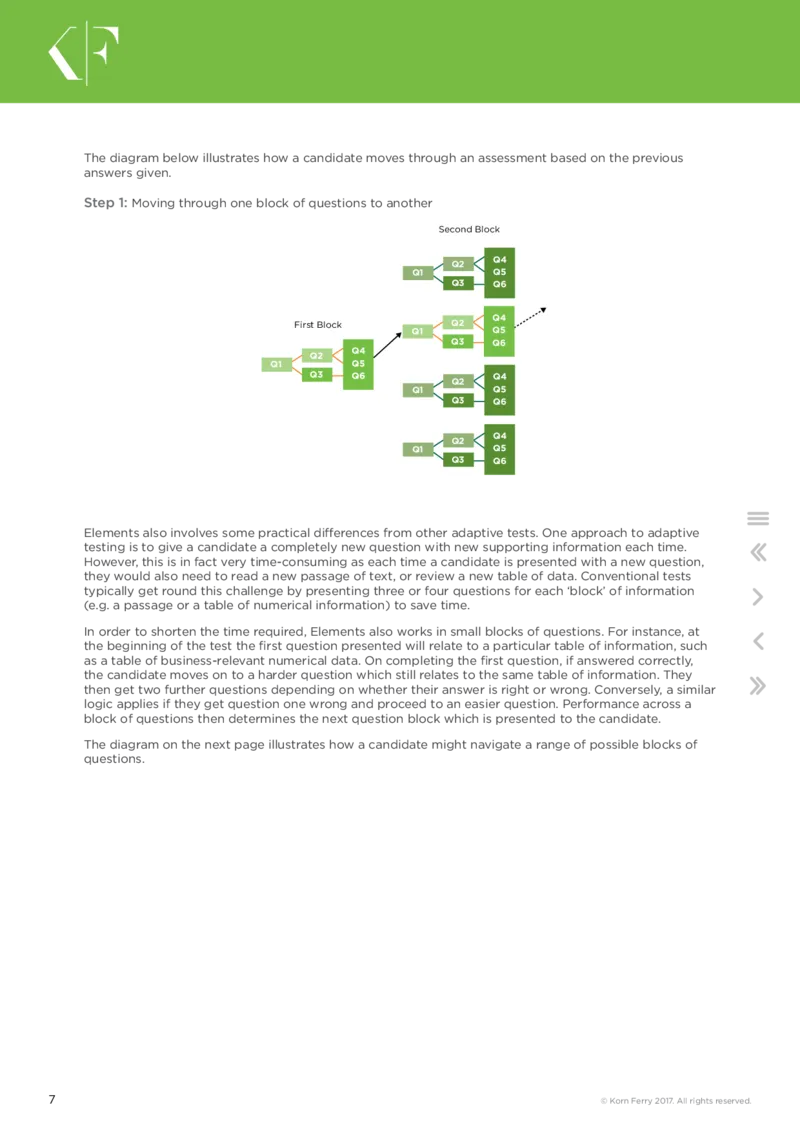
6 © Korn Ferry 2017. All rights reserved.The diagram below illustrates how a candidate moves through an assessment based on the previous
answers given.
Step 1: Moving through one block of questions to another
Second Block
Q4
Q2
Q1 Q5
Q3 Q6
Q4
First Block Q2
Q1 Q5
Q3 Q6
Q4
Q2
Q1 Q5
Q3 Q6 Q4
Q2
Q1 Q5
Q3 Q6
Q4
Q2
Q1 Q5
Q3 Q6
Elements also involves some practical differences from other adaptive tests. One approach to adaptive
testing is to give a candidate a completely new question with new supporting information each time.
However, this is in fact very time-consuming as each time a candidate is presented with a new question,
they would also need to read a new passage of text, or review a new table of data. Conventional tests
typically get round this challenge by presenting three or four questions for each ‘block’ of information
(e.g. a passage or a table of numerical information) to save time.
In order to shorten the time required, Elements also works in small blocks of questions. For instance, at
the beginning of the test the first question presented will relate to a particular table of information, such
as a table of business-relevant numerical data. On completing the first question, if answered correctly,
the candidate moves on to a harder question which still relates to the same table of information. They
then get two further questions depending on whether their answer is right or wrong. Conversely, a similar
logic applies if they get question one wrong and proceed to an easier question. Performance across a
block of questions then determines the next question block which is presented to the candidate.
The diagram on the next page illustrates how a candidate might navigate a range of possible blocks of
questions.
7 © Korn Ferry 2017. All rights reserved.Step 2: Moving through a complete test
Q2 Q4
Q1 Q5
Q3 Q6
Q2 Q4
Q1 Q5
Q3 Q6 Q2 Q4
Q1 Q5
Q2 Q4 Q3 Q6
Q1 Q5
Q3 Q6 Q2 Q4
Q1 Q5
Q1 Q2 Q Q 4 5 Q2 Q4 Q3 Q6 Q1 Q Q 2 3 Q Q Q 4 5 6
Q3 Q6 Q1 Q5
Q3 Q6
Q1 Q2 Q Q 4 5 Q2 Q4
Q1 Q2 Q Q 4 5 Q2 Q4 Q3 Q6 Q1 Q3 Q Q 5 6
Q3 Q6 Q1 Q5
Q3 Q6
Q1 Q Q 2 3 Q Q Q 4 5 6 Q1 Q2 Q Q 4 5 Q2 Q4 Q1 Q Q 2 3 Q Q Q 4 5 6
Q3 Q6 Q1 Q5
Q3 Q6
Q2 Q4
Q1 Q5
Q1 Q2 Q4 Q3 Q6
Q1 Q5
Q3 Q6
Q2 Q4
Q1 Q2 Q Q 4 5 Q1 Q3 Q Q 5 6
Q3 Q6
Q2 Q4
Q1 Q5
Q3 Q6
Within each block (where a candidate will complete three of the six available questions), the questions
have item ‘difficulty levels’ which are used to determine the score attained so far in the test.
SCORING ELEMENTS
A candidate’s score on any passage or table is the sum of the difficulty levels of all questions that
they got right, or zero if they got none right. In terms of how the tests work, getting a question wrong
includes being timed out.
‘Difficulty level’ is the reverse of the percentage of candidates who got the question right in the trial
versions of Elements: if 75% of candidates got a question right, that question’s difficulty level is 0.25
(25%). For any passage or table there are eight possible scores.
The aggregate score so far (based on difficulty levels of questions answered correctly) then determines
the choice of the next block of questions from those within the Elements question database. This process
continues to the end of the test.
The addition of time limitations on individual questions and a large number of response options per
question means that these aspects are contained and controlled, allowing this approach to deliver
reliable and valid measurement across a bank of questions with a wide span of difficulty levels.Item
response theory approaches to adaptive testing include multiple parameters for assessing question
discrimination, one of which relates to the probability of guessing. Candidates guessing answers within
ability testing can have an effect on results and negatively influence reliability. Elements has therefore
been designed to try to minimise this impact. Specifically, a large number of response options have
been incorporated for each question so that the probability of candidates guessing correctly is much
lower than in other tests. This is very helpful in minimising this problem and containing its impact on test
effectiveness.
8 © Korn Ferry 2017. All rights reserved.A candidate’s final score is the sum of the difficulty levels of all questions correctly answered. The more
questions a candidate answers correctly, the higher the difficulty level of further questions, and thus the
greater opportunity they have to achieve a very high total score.
All the questions are based on a passage of text (Elements Verbal) or on a table of statistical data
(Elements Numerical). Each passage and each table has six possible questions, but any candidate is
only presented with three of these. This also applies in principle to Elements Logical. Elements can be
described as ‘stratified adaptive’ tests. In technical terms, this is an adapted or stratified version of a
one-parameter IRT (item response theory) scoring approach known as Rasch scaling. Candidates move
adaptively (according to whether they answer the question correctly, as explained above) from question
to question within a passage or table, until they have been presented with three questions from that
passage or table. They are then moved to another table or passage, according to their cumulative score
at the time.
Based on our statistics, we can use the final score to determine a candidate’s percentile score in
comparison with any given norm group. This can be our total database; high- potential norm; university
graduates, managers and professionals; non-graduates such as customer service and administrative
roles; or any group we are able to define. Because Korn Ferry Assessment Systems record all details of
a candidate’s responses, and also their replies to background data questions, we can calculate many
different norm statistics post hoc. As such we can create specific norm groups relevant to a particular
population based on a client need.
For any candidate, it is also possible to conduct a seven-minute verification test. This is often used where
candidates complete the main test unsupervised and remotely, e.g. from home. A verification test can be
used to complete a short follow-up assessment on candidates who are brought forward to the next stage
(such as an assessment centre) under controlled conditions on the client’s premises. The verification
tests will commence at the level an individual attained in the main test, and provide feedback concerning
the similarity in scores between the two testing sessions. For many clients, simply the possibility of
conducting verification is very helpful as the risk of discovery strongly deters candidates who may be
tempted to cheat, even if only a random sample of candidates actually undergo verification testing.
SPEED OF TESTING
Elements provides some key advantages in terms of ease of completion and test duration. Because the
tests operate in blocks of three questions, it is not necessary for individuals to familiarise themselves with
new background information for every question, enabling them to progress more quickly. Additionally,
due to the use of adaptive testing, it is possible to test candidates reliably within a maximum of 16
minutes on each test, around half the time of traditional tests.
RANDOMISATION
As well as the adaptive nature of Elements, the tests are randomised with a wide selection of questions
available for the system to choose from at each level of difficulty.
For instance, there are three different starter blocks for each test as well as a wide range of subsequent
options available. This has significant benefits in terms of reducing the opportunity for cheating because
there are so many different questions. It would be futile for candidates to share screenshots of their
tests as every candidate is presented with a different selection of questions. This in combination with the
verification testing approach outlined earlier ensures the tests are highly secure and significantly curtails
the possibility of cheating by some candidates, even in the context of remote testing.
APPLICABILITY ACROSS DIFFERENT ROLE LEVELS
A final key benefit of the system is that due to the wide range of questions within each test, there is no
need to decide which level of test to administer in advance as is the case with classical tests.
Rather, a candidate can simply start to complete Elements Numerical, for example, and the system will
home in on the candidate’s ability level. This means the system is applicable across role levels, and the
administrator can simply choose which norm group to compare the results with after a candidate has
been tested.
9 © Korn Ferry 2017. All rights reserved.SECTION 3
DEVELOPING ELEMENTS
The Elements tests were developed using a number of guiding principles
and methods.
As previously mentioned, the idea was to create a testing system that would minimise opportunities for
cheating and remove the need for a library of tests, instead enabling test users to have a one size fits
all solution for everyone ranging from supervisors upwards. The final assessment also had to be cutting
edge, innovative and relevant in the workplace.
The development of the Elements item banks came as the result of a number of inputs:
■ A review of the existing validation literature to confirm which three areas of ability to focus on.
■ A review of materials used across a variety of different workplaces to ensure that the final design was
relevant and appropriate for the likely candidate groups.
■ A consideration of advances in technology and psychometrics that could be harnessed, adapted and
applied in the test system.
This phase of work resulted in a specification for the test system including the adaptive nature of the
tests, the required psychometrics and also a detailed specification of exactly how many items at varying
levels of difficulty and content type would be needed for each category of test. It also included an
overview of the required number of answer options for each type of item.
After the inception of the initial design, item writing was shared amongst the development team. Items
were then peer reviewed with a number of criteria in mind, namely:
■ Appropriate level of difficulty
■ Work relevance
■ Face relevance
■ How up to date they were
■ Reading level (using accessible vocabulary)
■ Free from ambiguity in passages/tables/items/answer options
■ Checking the scoring key
10 © Korn Ferry 2017. All rights reserved.Key international stakeholders were also asked to review the items for ease of translation, ensuring that
there were no terms that would be difficult to translate and that the scenarios and content used could
be applied across (or at least adapted to suit) a variety of cultures. This obviously led to a number of
rewrites prior to the start of the first trial. Of course, as each test type involves different abilities, the
checks were adapted to suit. For example, anyone reviewing the Elements Logical test was asked to
find the correct answer and document the rules they applied to get to it. This was then compared to the
original author’s documented rules about the item as a means of checking for ambiguity. Similarly, the
Elements Verbal and Elements Numerical items were initially reviewed without a scoring key to check for
any ambiguity amongst the answer options. A wider review was then carried out of the entire bank of
items to ensure that there was a clear spread of difficulty and content.
The trial versions of the tests were fixed (i.e. non-adaptive) versions and each one consisted of 30 items.
Each version was created with overlapping common items so that each item could be evaluated and
calibrated appropriately. This design was optimal for the purposes of constructing the item banks. Trials
were conducted on a combination of university students and employees from sponsoring organisations
across a variety of sectors and industries, ultimately totalling in the region of 2,000 people.
Once trial data was obtained, the items were screened for acceptance into the item banks using a set of
criteria:
■ Item discrimination parameters were reviewed with items exhibiting low item-total correlation being
rejected.
■ Item difficulty parameters were reviewed with items exhibiting extreme values being rejected.
■ Item distractors were also reviewed with item distractors exhibiting irregularities being rejected.
Items that did not meet the criteria set were excluded from the item bank. The final item bank
incorporated a wide spread of item difficulties from 0.1 to 0.9 with the majority always falling into the
0.2 to 0.7 range. The group differences were in line with expectations and a more complete analysis
of differences is provided in the ‘Relationship between Elements and biographical data’ section. The
resulting banks of items were subjected to a final peer review for content and context coverage. The final
banks of items were then configured to create the adaptive randomised tests.
11 © Korn Ferry 2017. All rights reserved.SECTION 4
ELEMENTS AND OTHER
ABILITY TESTS
Elements offers a number of advantages over and above other ability tests.
One of the main differences is that Elements is designed for use across all job levels and all industry
sectors and that it uses stratified adaptive testing. Results are available as soon as the candidate has
completed the test and are provided to the client in an easy-to- understand report.
Elements can only be completed online. Far from being a disadvantage, this has several benefits.
Firstly, it means that we collect every piece of data, rather than having to rely on people sending data
to us. We know exactly how each candidate has responded to each individual question, how long they
took to respond, and even how many times they changed their mind. We are able to make very small
amendments to questions imperceptibly, instead of having to print new editions. It also enables us to use
the stratified adaptive testing approach.
12 © Korn Ferry 2017. All rights reserved.SECTION 5
NORMS FOR ELEMENTS
Since any revisions (since 2007) to the content of Elements have been very minor, we
are able to take all completions since mid-2008 as the basis for our norm group.
The most recent version of the norms (2012) covers more than 145,000 completions of Elements
Verbal and almost 110,000 Elements Numerical completions. As Elements Logical was released later,
the database for this is smaller but still exceeds 40,000. The data used within the norms includes a
variety of project types including those completing Elements in a recruitment, selection, development
and restructure context, along with a series of research studies. Whilst it is recognised that this is an
‘opportunity sample’, the data used offers a wide representation from a variety of sectors, functions, age
groups and of course a balance of gender.
■ The following norm groups are available:
■ Professional, graduate and managerial (comprises people on our database who meet this
description*)
■ Customer service, administrative and similar (non-graduate – comprises people on our database who
do not have a university degree*)
■ High Potential (predominantly candidates from the Finance sector with above average scores on
Elements)
■ Composite
*These descriptions are intended to be of practical use, although we recognise that some managers and
professionals may not have university degrees, and some people in customer service, administrative and
similar roles may have degrees. Obviously, people should normally be compared with other applicants for
the same type of job rather than with those who have the same educational level.
The sample size for the norm groups can be seen below:
Norm group Verbal Numerical Logical
Professional, graduate and managerial
94,388 83,754 29,921
Customer service, administrative and similar
26,659 24,502 11,977
HiPo
2744 2805 430
Composite 145,916 108,256 41,898
A further breakdown of each group is provided in the Norms and Reliability Supplement (which can be
downloaded from the Korn Ferry Learning Centre).
13 © Korn Ferry 2017. All rights reserved.SECTION 6
REPORTING
There are two main reports available: one for candidates and the other for the HR
professional, psychologist or hiring manager.
The Elements scores are also included in the role match profile. A set of sample reports is available to
download from the Talent Q website (www.talentqgroup.com).
14 © Korn Ferry 2017. All rights reserved.SECTION 7
RELIABILITY
Reliability can be measured in a number of ways, either by looking at the consistency
of a test over a period of time (test-retest reliability or parallel form) or by looking at
the ‘internal consistency reliability’.
The internal consistency can be measured in a number of ways, the simplest being the split-half reliability
(Spearman-Brown split-half method). This adds up the score on the items for half of the test (e.g. all
the ‘even’ numbered items) and correlates this with the score on the items for the other half of the test
(e.g. all the ‘odd’ numbered items). However, a more sophisticated approach is generally preferred by
psychometricians and is usually measured by using Cronbach’s alpha coefficient.
To measure the internal consistency of a test, statisticians have developed complex equations which in
practice identify the average level of correlation for all the possible ‘split-half’ combinations that could
be made. As with other reliability coefficients, the alpha should typically be 0.7 or higher for any given
assessment or scale within an assessment.
TEST-RETEST RELIABILITY
With regard to the test-retest reliability of Elements, a series of projects and research studies have
allowed us to collect data on a large number of people who have completed at least one of the Elements
tests twice. For all tests the majority of the participants were aged under 40 and most were qualified to
degree level or above. The male/female split was similar for Numerical and Logical (roughly 70:30) but
for Verbal it was closer to equal proportions of males and females.
The table below provides the correlations between the first and second attempts, the size of each of the
groups and the average time (in days) between the two attempts.
Verbal Numerical Logical
Correlation
0.73 0.72 0.76
Sample size
114 437 409
Average time between tests
90 153 92
15 © Korn Ferry 2017. All rights reserved.The industry accepted standards for reliability is 0.7, therefore all three tests are displaying good
test-retest reliability. However, although these figures are perfectly acceptable there are important
considerations in terms of why they may in fact be an underestimation of true reliability:
■ As test takers in this research did not see the exact same test at the first and second testing session,
the test-retest reliability coefficient can be seen as a conservative estimate since item sampling adds
an extra degree of error beyond variation in a test taker’s performance.
■ The text books refer to ‘coefficient of stability’ when the same test is given at a later time, say three
months later, and ‘coefficient of equivalence’ when a parallel version is given at approximately the
same time as the initial version. Because Elements tests are adaptive, the candidate has virtually no
chance of being given the same version on the second testing occasion, so the reported correlations
are actually coefficients of both stability and equivalence, which represents a much stricter test of
their reliability.
■ Further, in most published studies, the tests have been given under standardised, supervised
conditions, whereas in this case testing was unsupervised and carried out remotely. It could well be
that on one or other of the occasions, the candidate was distracted in some way. So, despite our best
intentions, we cannot be sure that the same conditions applied to both occasions.
INTERNAL RELIABILITY: CLASSICAL TEST THEORY AND ITEM
RESPONSE THEORY
As adaptive tests such as Elements provide each test taker with a different set of questions, methods
traditionally used to measure reliability are not appropriate. However, it was possible to consider the
internal reliability of the fixed trial versions of the tests as one measure of reliability using Cronbach’s
alpha (Cronbach, 1951). Using the trial versions, the alpha coefficient for each test was as follows:
Internal consistency reliability
Elements Verbal
0.83
Elements Numerical
0.88
Elements Logical
0.78
Obviously, test takers in this research were experiencing a wider breadth of questions than they actually
see in the adaptive Elements tests so the figures above are regarded as a low estimate of the reliability of
the shorter, adaptive versions.
The reliability of the adaptive version of the tests can be measured using a different measure of internal
consistency known as ‘marginal reliability’. This is based on item response theory (IRT) and offers a
better measure of precision (Green, Bock, Humphreys, Linn and Reckase, 1984).alpha (Cronbach, 1951).
Using the trial versions, the alpha coefficient for each test was as follows:
16 © Korn Ferry 2017. All rights reserved.In IRT, the reliability of a test varies along the range of the ability continuum. Marginal reliability is
effectively the average reliability over the ability continuum. The values for marginal reliability range
from 0 to 1 and their interpretation is analogous to Cronbach’s alpha. Marginal reliability provides a single
value that summarises a scale’s overall precision (Thissen and Wainer, 2001)
The marginal reliability of each Elements test was estimated using IRT calibration (n=1000). The results
are presented below. The results show that Elements ability tests are highly reliable.
Internal consistency reliability
Elements Verbal 0.85
Elements Numerical 0.0.81
Elements Logical 0.82
It is worth noting that the reliability coefficients are equivalent to much longer non-adaptive ability tests
used in employment settings.
17 © Korn Ferry 2017. All rights reserved.SECTION 8
VALIDITY
The validity of a test can be measured in a number of different ways, namely face
validity, construct validity and criterion validity.
FACE VALIDITY
Elements was developed by experts in the field of psychometrics with the intention that the questions
would be as face valid as possible to the person completing the test. All questions are designed to be
relevant to today’s working environments, such that test takers will ‘buy into’ the subject matter used
rather than being put off by outdated or irrelevant content.
CONSTRUCT VALIDITY
Construct validity is a more theoretical but nevertheless important aspect of validity. A ‘construct’ in
psychology is a term meaning a particular psychological characteristic, for instance numerical reasoning
ability, or an aspect of personality (e.g. extraversion), values, motivation or performance. Construct
validity is concerned with whether a test is measuring the construct it claims to measure. There are two
ways of assessing construct validity:
■ Convergent validity: if the test can be shown to correlate significantly with other tests measuring
similar constructs, then it may be claimed to have convergent validity.
■ Discriminant validity: if the test can be shown to not correlate significantly with other tests which are
intended to measure different constructs, then discriminant or ‘divergent’ validity can be claimed.
As psychologists believe there is a concept known as general intelligence (or ‘g’), it is safe to assume that
an ability test with good construct validity is likely to correlate with other tests (to some degree) due to
this underlying factor of ‘g’.
The correlation observed between Elements Verbal and Numerical is 0.44 (based on a sample of more
than 30,000 people who had completed both tests in their current versions). The correlation between
Elements Verbal and Logical is 0.32 and the correlation between Elements Numerical and Logical is 0.46
(based on a sample of more than 15,000 people who had completed both tests in their current versions).
This shows that there is a similar degree of overlap between the three ability assessments, but that
verbal, numerical and logical reasoning are nevertheless separate attributes, worthy of being assessed
separately.
18 © Korn Ferry 2017. All rights reserved.Research comparing Elements with another similar series of tests also provides evidence of construct
validity. 85 participants were asked to complete Elements and SHL Verify Verbal, Numerical and Inductive
tests. Using the entire sample, the correlations* were as follows:
Verbal
0.85
Numerical
0.81
Logical/Inductive
0.82
*The correlation coefficients were adjusted for the reliability of the tests.
Clearly, the numerical tests show the highest correlation, with the verbal tests slightly lower. Whilst
there are going to be clear expected overlaps between the SHL and our Elements verbal tests, there are
differences which will inevitably impact the size of the correlation between them. For example, the SHL
tests offer candidates a choice of ‘True, False or Cannot Say’, whereas the Elements tests offer a series
of possible responses and the candidate has to choose which is/are correct. Therefore, having a slightly
lower correlation is in line with expectations.
Whilst we would also expect a correlation between the Elements Logical test and the SHL inductive
test it is no surprise that they demonstrate the lowest correlation. Whilst the underlying constructs
being measured are similar, there are differences in the tests. For example, Elements Logical offers more
response options to choose from, candidates have more cells to choose between and interpret and also
the underlying pattern that candidates need to uncover in the Elements test apply in a multidimensional
manner (horizontal and vertical, not just horizontal).
Further evidence of construct validity can be sought by looking at the correlation between ability tests
and related personality scales. Elements Verbal has significant positive correlations with Dimensions
scales Conceptual and Flexible. Elements Numerical has significant positive correlations with Dimensions
scale Analytical. Elements Logical has significant positive correlations with Dimensions scales Analytical
(highest) and Flexible.
All of these results support the construct validity of Elements further.
CRITERION (EMPIRICAL) VALIDITY
Criterion validity looks at the relationship between the ability test and performance on the job. So far, we
have collected nine studies of the empirical validity of Elements.
19 © Korn Ferry 2017. All rights reserved.STUDY 1:
Telecoms company 1
Using the trial versions of Elements, against a ‘hard’ criterion of sales performance among 60 sales
representatives in a telecoms company, there was a highly significant correlation with Elements
Numerical (0.34). Sales representatives who performed better on Elements had higher sales
performance figures. Since other factors than ability obviously influence performance in any job, a
correlation of 0.40 is about the limit that a single test might be expected to reach.
STUDY 2:
Telecoms company 2
The sample consisted of 149 people in sales roles in a telecoms company in Asia. There were two
main performance criteria for these people (although not everyone had all data). ‘Sales order
value’ was available for 90 (of the 149) subjects, ‘revenue’ for 124. Some 14 subjects had neither
performance value, 79 of them had both. Both criteria were expressed as percentages of target or
budget.
All participants completed the tests in UK English. However, for a number of participants, English
was not their first language. To remove the impact of language proficiency on the results, the data
set was split into two groups: those who spoke English as their first language and those who did
not.
For those people whose first language was not English, no significant relationships were found
between the Verbal or Numerical tests and their performance criteria, suggesting that the
completion language had affected results.
However, very clear and positive relationships were available for the validation group subjects who
did claim English as their first language. We always recommend that people should only complete
assessments in a language in which they are totally fluent, therefore the English-speaking subset is
the only legitimate group to analyse.
Elements and performance
Sale order value Revenue
Number in sub-group
47 60
Elements Verbal
0.66 0.05
Elements Numerical
0.97 0.33
The correlations for Elements Verbal and Numerical with the sales order value criterion are
exceptionally high. These results should be treated with caution and may not be fully replicated in
a study with another sample. However, they are very clearly indicative of the value of such tests in
predicting sales performance.
Against the revenue criterion, the result for Elements Numerical is exactly at the level to be
expected (from the collected body of all validity studies) for a relevant aptitude test when
correlated with a legitimate performance criterion. It is worth repeating here that both
performance criteria are objective measures so the results can hardly be spurious.
20 © Korn Ferry 2017. All rights reserved.Summary
■ The study confirms the value that Elements can have in identifying successful performers in
sales roles.
■ The study was very useful as we were able to examine the relationships between tests and
objective (and highly tangible) criteria of performance.
■ The above results held good for the subjects whose first language was English – but not for
others, almost certainly because the latter group’s proficiency in English was a confounding
variable which masked the participants’ true abilities.
STUDY 3:
Recruitment company
The sample for this study was 36 recruitment consultants based in Ireland. The group was a
mixture of temporary/permanent/contract consultants across a mix of specialisms.
All participants completed Elements Verbal, Logical and Numerical and were each assigned a
ranking based on their total profit within a fixed period.
This is of course a particularly small sample for a validation study and, as the performance criterion
was a ranking, non-parametric correlations were used (Spearman’s rho) resulting in smaller
correlation coefficients than one would usually see using parametric methods. However, taking this
into account we can see that it still provides an indication of the relationship between the Elements
tests and the performance criterion (profit). The correlations are presented below:
Profit
Elements Verbal
0.11
Elements Numerical
0.27
Elements Logical
0.08
*None of the correlations reached significance at the 0.05 level but this comes as no surprise with
such a small sample.
The data indicates that the Elements Numerical test goes some way towards predicting success in
the recruitment consultant role. Whilst a higher correlation would give more credibility to this, we
have to acknowledge this is a small group and therefore regard the finding with some caution. As
highlighted above, numerical reasoning is only one part of the job so we would not expect to see a
high correlation; however this is a promising start.
21 © Korn Ferry 2017. All rights reserved.STUDY 4:
Online publishing company
The sample consisted of 58 people working across a variety of professional roles in an online
publishing company. They all completed Elements Verbal, Numerical and Logical and were
assigned to one of three performance categories, from high to low. This categorisation was based
on their annual performance review results combined with a rating from the organisation’s CEO.
Elements Logical demonstrated a significant correlation with the performance measure (0.30,
p<.05). This suggests that there is a relationship between someone’s ability to analyse and reason
with abstract information, and performance in a variety of roles.
STUDY 5:
Industry standards body
The sample consisted of 94 people working as client managers for the organisation. A number
of performance measures were provided but the key one that stood out was the breadth of the
employee’s capability, as shown by a measure of the number of areas or ‘products’ in which
an employee is trained to assess others. Whilst they completed all three ability tests, it was
performance on Elements Verbal that correlated most highly with this measure of performance
(0.23, p<.05).
This suggests that the higher someone’s verbal reasoning the more likely they will be to acquire
multiple qualifications. A likely explanation here is that this illustrates a greater ability to learn
based on higher levels of verbal cognitive ability.
STUDY 6:
Retail & Brewery company
The sample for this study was 34 employees who completed Elements Numerical and Elements
Verbal as part of a wider development programme. Within the same programme they also took
part in a 360-degree review project where their managers, peers and direct reports rated them on
key organisational competencies (which were combined with the employees’ own self-ratings).
The key competencies that showed clear relationships with Elements Verbal and Elements
Numerical were those relating to Persuading, Convincing and Influencing Others along with
Thinking Commercially. Elements Verbal also correlated significantly with the ability to Deliver
More for Customers and finally Elements Numerical with Delivering Results. An overall rating was
created (based on the average of all competency ratings) and this showed moderate correlations
with both Elements tests.
The results are presented in the table on the next page.
22 © Korn Ferry 2017. All rights reserved.Verbal Numerical
Persuading, convincing and influencing others
0.37 0.36
Thinking commercially
0.35 0.35
Deliver more for customers
0.36
Delivering results
0.34
Average 360 rating
0.22 (n.s.) 0.27(n.s.)
Unless stated, all correlations are significant at p<.05
This study suggests that Elements Verbal and Elements Numerical can go some way towards
predicting overall performance (as measured by a 360-degree review process) and can also
be linked with Persuading, Convincing and Influencing Others and Thinking Commercially too.
Persuading, Convincing and Influencing Others in this project is measured by items that have an
element of persuading using well-reasoned arguments, which explains why there are relatively
strong correlations with verbal and numerical reasoning. Further, Thinking Commercially is
measured by items that look at someone’s capacity for dealing with complexity, and considering
the pros and cons of proposals. Again, it therefore comes as no surprise to see a significant
correlation with verbal and numerical reasoning.
There is less clear evidence to explain the relationship between verbal reasoning and Deliver More
for Customers or between numerical reasoning and Delivering Results.
No firm conclusions can be drawn from this study as the sample size is too small. However, the
results go some way towards providing extra validation evidence for Elements.
STUDY 7:
Automotive manufacturing and retail company -sales roles
The sample for this study was 94 employees who completed Elements Numerical and Elements
Verbal. The performance measure for the project was sales profit over a four month period. The
role was a sales-based one working in car showrooms. The sales people’s scores
on the Elements Verbal test correlated significantly with sales profit at 0.38. This suggests that the
higher someone’s verbal reasoning the more success they have in relation to overall
sales profit.
23 © Korn Ferry 2017. All rights reserved.STUDY 8:
Internet bank
Data was collected on 38 employees who were taking part in a high potential scheme for an
international bank. All 38 were assigned a rating on their overall performance by their manager and
they were also required to complete all three Elements tests (data was only available for 35 people
on Elements Logical). None of the tests correlated significantly with the performance rating, which
comes as no surprise with such a small sample. The test approaching significance was Elements
Numerical, which correlated with the manager’s rating at 0.35. More data is needed before any firm
conclusions can be drawn.
STUDY 9:
Care & Social Care company
Within this study there were 102 operational managers working for a care organisation dedicated
to helping people with disabilities to retain autonomy and independence. The participants were
all given an annual performance review and from that a performance measure was provided
that reflected their overall performance. Of the three tests, the one demonstrating the highest
correlation was Elements Numerical which correlated at 0.3 (p<.001). This suggests that the better
performing operational managers are those with the highest numerical reasoning capability.
24 © Korn Ferry 2017. All rights reserved.SECTION 9
RELATIONSHIPS
BETWEEN ELEMENTS AND
BIOGRAPHICAL DATA
This part of the review for Elements Verbal is based on data from a sample of more
than 32,000 people who completed Elements Verbal and for whom biodata was
available. For Elements Numerical the sample was in the region of 30,000. Finally,
the Logical sample was in the region of 15,000. As not everyone provided all biodata
information, the sample sizes are smaller in some areas.
It should always be remembered that the remarks made in this part of the review relate to the samples
concerned and may not be generalisable to other samples.
STATISTICAL NOTE
The respondents’ Elements scores have been compared with age, gender, education, function and ethnic
origin. Some biodata variables lend themselves to correlations, others to differences between means.
With such a large sample size, any correlation above 0.03 is flagged as statistically significant; therefore
it is probably more sensible to consider correlations above 0.1 as the minimum for psychological
significance. As regards significant differences between means, this would strictly depend on the
sizes of the sub- samples involved; but we have taken 0.25 of a standard deviation (SD) as the critical
value. Differences between 0.25 and 0.40 of a SD will be called significant, anything above 0.40 highly
significant.
25 © Korn Ferry 2017. All rights reserved.AGE
It is generally expected that reasoning ability (when measured by tests with time limits) will fall off
gradually with increased age. This is less likely to be the case with tests such as Elements Verbal and
Numerical because they are based on contemporary business-related subject matter.
To comply with UK guidance on collection of biographical data, we ask people to indicate in which age
band they are, rather than exact age in years or date of birth. The table below presents the numbers
falling into each age category; as can be seen there is a wide range of ages. The test correlating highest
with age was Logical (–0.30), followed by Verbal (–0.12) and lastly Numerical (–0.10). Since all of these
correlations are negative, these findings are consistent with industry expectations suggesting that
reasoning ability decreases with age. Whilst this relationship is strongest for logical reasoning ability, all
of these correlations are quite small, indicating that whilst people appear to do less well on ability tests
as they get older, this relationship is not particularly strong.
Age group distribution
Numerical
Verbal
Logical
12000
10000
8000
6000
4000
2000
0
Age group
26 © Korn Ferry 2017. All rights reserved.
elpoep
fo
rebmuN
<=20 21 to 25 26 to 30 31 to 35 36 to 40 41 to 50 51 to 60 >60
EDUCATION
The mean difference between graduates and non-graduates is in the region of 0.07 of a standard
deviation for Elements Numerical and 0.18 of a standard deviation for Verbal.
This is a little less than one would expect and we need more data to explore these findings further.
Interestingly the non-graduate group performed better on Elements Logical than the graduate group,
with the mean difference being 0.15 of a standard deviation. This emphasises the fact that logical ability
is less dependent on academic learning than verbal and numerical ability, meaning it may have less
adverse impact than other ability tests.Function
The number of respondents from the various functions for each ability test are as follows:
Function distribution
Numerical
Verbal
Logical
5,000
4,500
4,000
3,500
3,000
2,500
2,000
1,500
1,000
500
0
Function
27 © Korn Ferry 2017. All rights reserved.
elpoep
fo
rebmuN
A d m /e i n l e is c t t r r a ic ti a v l e C us s t o er m vi e c r es S al e Fi n a nc e G e n m er a a n l a g e m e nt H R I T L e g al M arketi n g O p erati o
ns
Pr o d ucti o
n
The highest scoring functions on Elements Verbal were legal, general management and marketing; the
lowest were administrative/clerical and customer services. However, none of these differences were
statistically significant.
The highest scoring function by far on Elements Numerical was finance; the lowest was
administrative/clerical.
The highest scoring function on Elements Logical was IT, although this difference was not statistically
significant. No group scored significantly lower on Elements Logical.
ETHNIC ORIGIN
In this research we had data on ethnic origin for 9,198 people who had completed Elements Verbal in
their own language. Data was available for 7,449 people who had completed Elements Numerical in their
own language.These figures are presented below as percentage of overall completions below. The data reported on
for Elements Logical includes all completions as this test is by design not language dependent. In this
instance we had data on 6,750 people.
Elements Verbal Elements Numerical Elements Logical
5% 4% 3%
10% 10% 14%
7% 9%
16%
78% 77% 67%
White Chinese Indian sub continent African and Afro Caribbean
Of people taking the Verbal test in their own language, those who said their ethnic group was ‘White’
made up 77%. In the Numerical test, this percentage was also 77%. Across the Logical test completers,
the white group made up 67%. As a result, the other ethnic groups were somewhat smaller across all
three tests, a factor we should consider in interpreting any statistics.
Some non-white ethnic groups are generally reported as performing less well than whites at tests
of verbal and numerical reasoning, and many reasons have been put forward for this. If we find such
differences, this does not necessarily mean that the tests are unfair. As far as this review goes, our data
set is too small to give us a reliable answer to such questions.
The Chinese sample scored somewhat better than the other groups on the Numerical test, with the
African and Caribbean group scoring somewhat less well.
The white sample scored better on Elements Verbal than the other groups, with the African and
Caribbean group and the Indian sub-continent group scoring less well.
On Elements Logical, the Chinese group scored better than the other ethnic groups and the African and
Caribbean group scored less well.
Generally speaking, in studies of ethnic differences on psychometric tests, it is often observed that the
African and Caribbean groups perform less well than the white groups, whilst the east Asian groups
frequently outperform whites. The west Asian groups only slightly underperform compared with the
white groups generally speaking. As a profession we are seeking explanation for why these differences
exist, but it is particularly difficult to tease out factors of educational background (or opportunity), social
factors (socio- economic group, parental support, etc) and other cultural differences (level of aspiration,
or fear of making mistakes, amongst many others).
In summary, we can say preliminarily that Elements ability tests produce similar patterns of differences
between ethnic groups as have been found with other similar assessments. Any significant differences
observed are between 0.25–0.5 of a standard deviation and therefore compare favourably to other ability
tests.
ADDRESSING GROUP DIFFERENCES
Whilst the group differences outlined within this review are typically under half a standard deviation and
therefore unlikely to have much of an impact on selection rates for the various groups, it is still important
that users monitor results to ensure fairness.
With large volumes of use this can be carried out by looking at the actual scores of different groups.
However, with smaller volumes this will involve making sure that the tests used continue to relate to the
role and reviewing other validation studies where you are unable to conduct your own.
28 © Korn Ferry 2017. All rights reserved.SECTION 10
COMPLETION TIMES
In Elements, there is a time limit for each question rather than for the test as a whole.
The purpose of such a design is to constrain test takers to operate at a similar level of
speed when answering the questions. This enables us to obtain purer and comparable
estimates of individual ability.
The maximum time available (full time limit for all questions) is 16 minutes and 15 seconds for Verbal, and
16 minutes for Numerical. The average time taken is 11 minutes 37 seconds for Verbal, and 12 minutes 4
seconds for Numerical. Thus an average of 23 minutes 41 seconds for both tests together – which is less
than half the time required for conventional tests of the same type.
The maximum time available for Elements Logical is 15 minutes. The average time taken in the sample of
completions we have so far is 8 minutes 41 seconds.
29 © Korn Ferry 2017. All rights reserved.SECTION 11
RELATIONSHIPS BETWEEN
ELEMENTS AND DIMENSIONS
Correlations between Elements and Dimensions were as follows for a sample that had
completed Dimensions and one or more of the Elements tests:
Trait Verbal Numerical Logical
Communicative -0.03 -0.03 0.00
Influential 0.05 0.05 0.09
Socially Confident 0.05 -0.01 0.10
Supportive -0.02 -0.06 0.07
Consultative 0.02 -0.06 0.02
Analytical 0.12 0.22 0.24
Conceptual 0.15 0.14 0.12
Creative 0.03 0.02 0.06
Methodical 0.02 0.03 0.02
Conscientious -0.06 -0.05 -0.07
Relaxed 0.05 0.04 0.11
Resilient 0.02 0.03 0.12
Flexible 0.17 0.08 0.19
Decisive and Action-oriented 0.03 0.04 0.13
Achievement-oriented -0.04 0.03 0.02
This analysis was conducted on samples in the region of 10,000 (Logical) to 15,000 (Verbal and
Numerical) people. As a result, all correlations could theoretically be classed as significant. We had
previously hypothesised a positive correlation between Elements Numerical and Analytical, and between
Elements Verbal and Conceptual, which are indeed two of the largest correlations for each of these two
tests.
The findings support these hypotheses, therefore suggesting that those with a preference for being
Analytical are also likely to show strong numerical ability. Similarly, those who have a preference for
being Conceptual also demonstrate high verbal ability. Logical ability was also found to be positively
correlated with Analytical. This supports the idea that people are likely to have a preference for aspects
of work in which they also have an ability, although the direction of this relationship may be unknown.
Other notable correlations were seen between being Flexible and having high verbal and logical ability
which can likely be explained by the orientation towards learning new things and variety that are often
related to problem solving capability.
30 © Korn Ferry 2017. All rights reserved.SECTION 12
LANGUAGE AVAILABILITY
AND CULTURAL
DIFFERENCES
A common question about psychometric assessments is whether they really translate
to other languages and cultures.
Modern tests of verbal and numerical reasoning tend to be very up to date and job-
relevant, being based on real or near-real situations. These will sometimes fail to
translate literally; we have therefore adopted the following process:
■ All assessments are originally developed with the intention that they will need to be translated and
adapted to different languages and cultures.
■ Translation is carried out by people with the target language as mother tongue, who are also fluent in
English.
■ The translation team includes occupational psychologists with up-to-date business experience in the
target culture.
■ Data continues to be collected until we have enough to create a local norm.
■ Local norms are at first ‘modelled’ using a combination of local data and wider, international groups.
When sufficient data is available, this data becomes the local norm basis.
■ We carry out extensive cross-language and cross-cultural validation studies.
■ We study cultural differences within same-language populations.
A wide programme of translation is currently under way. A list of available languages can be seen on the
Talent Q website: www.talentqgroup.com
31 © Korn Ferry 2017. All rights reserved.SECTION 13
SUMMARY
Talent Q has been founded on the basis of knowledge and insight gained from
specialist occupational psychologists and practitioners.
This section provides some general conclusions surrounding Elements, plus an
overview of the link with our online personality assessment, Dimensions. Dimensions
measures 15 key personality traits and is often used alongside Elements.
The findings of this review illustrate the psychometric rigour of Elements and demonstrate its capability
to assess candidates in a way which is fair and objective. In doing so, HR professionals and consultants
can be reassured that by using Elements (and other Korn Ferry assessments), they are providing a
reliable, fair and objective measure of ability (or personality in the case of Dimensions) which can be
applied to recruitment and development decisions throughout the talent lifecycle.
We are committed to ongoing development and analysis. This review will be updated periodically to
reflect international expansion in the use of Elements. We are always keen to talk to clients who would
like to get involved in this process with us. Please contact your account manager for more information.
Specifically, this review has demonstrated the following:
THE RATIONALE AND DESIGN INTENTIONS UNDERLYING THE
CONSTRUCTION OF ELEMENTS
This section of the review focuses on the need to create an adaptive system which would in turn create
a fast, randomised suite of ability tests. The adaptive nature of Elements has many benefits, which have
been discussed in detail in this review. For example, it offers the advantage of being able to measure
people across all role levels with a single assessment.
ELEMENTS NORM GROUPS
Due to the adaptive nature of Elements, a range of norm groups for different roles and levels within an
organisation is not needed. Instead, we offer three norm groups which cover most eventualities and can
be tailored in exceptional circumstances
32 © Korn Ferry 2017. All rights reserved.RELIABILITY AND VALIDITY OF ELEMENTS
The sound reliability of Elements has been demonstrated through a plethora of research to establish
it as a robust and stable measure of ability. Research has included a test-retest reliability study, split-
half reliability analysis and internal consistency analysis. In addition, the validity of Elements has been
indicated through the face validity of question content as well as several validation studies.
ELEMENTS AND BIOGRAPHICAL DATA
We have reviewed all Elements completions and looked at this in relation to biographical data provided
by candidates. In doing so, it has been established that group differences are minimal when using
Elements Verbal, Numerical and Logical ability tests. However, we maintain that client data should be
regularly reviewed and cut-offs set accordingly to avoid any unnecessary adverse impact.
ELEMENTS AND DIMENSIONS
Finally, the review explored the relationship between Elements and Dimensions. As expected, a
relationship was found between Elements Numerical and the Analytical scale in Dimensions, and between
Elements Verbal and the Conceptual scale in Dimensions. These findings are intuitive and in line with
expectations, in that we would expect to see people who have a preference for being analytical also
having an ability in numerical reasoning. Similarly, those with high verbal reasoning ability are also likely
to have a preference for being conceptual.
33 © Korn Ferry 2017. All rights reserved.SECTION 14
GLOSSARY
Correlation
■ A statistical way of assessing the strength of relationship between two variables (e.g. analytical
reasoning scores on a test and job performance).
Reliability
■ Refers to how accurate a test is. There are a number of different types of reliability, as described
below.
Test-retest reliability
■ This form of reliability assesses the extent to which an individual’s score is likely to be similar if the
test is taken at different points in time, e.g. a few weeks or months later.
Internal consistency reliability
■ Understanding reliability in terms of internal consistency looks inside the test to assess whether the
questions, or ‘items’, which make up the test are all measuring the same thing.
■ Split-half reliability: The simplest way of assessing internal consistency is known as split-half reliability.
This adds up the score on the items for half of the test (e.g. all the ‘even’ numbered items) and
correlates this with the score on the items for the other half of the test (e.g. all the ‘odd’ numbered
items).
■ Cronbach’s alpha: This still leaves the issue of how well related the different halves actually are,
compared with other combinations. As a result, statisticians have developed more complex equations
for assessing internal consistency, which in practice identify the average level or correlation for all
possible ‘split-half’ combinations that could be made. One of the best known of these is Cronbach’s
alpha.
Validity
■ Refers to the extent to which a test can be deemed to be effective in determining what we want to
be able to predict, for instance future performance in a job. There are a number of types of validity, as
described below.
Construct validity
■ Concerned with whether a test is measuring the ‘construct’ it claims to measure. There are two ways
of assessing construct validity:
■ Convergent validity: If the test can be shown to correlate significantly with other tests designed to
measure the same or similar constructs, it may be claimed to have convergent validity.
■ Discriminant validity: If the test can be shown to not correlate significantly with other tests which are
intended to measure different constructs, discriminant or ‘divergent’ validity can be claimed.
Face validity
■ Related to whether people looking at the test, using their own judgement and experiences, think it
does what it is supposed to do.
34 © Korn Ferry 2017. All rights reserved.Criterion validity
■ Tells us whether the results of a test predict something which is practically useful, such as subsequent
performance in a role.
Content validity
■ Looks at the validity of a test’s content, such as the questions and scenarios used. This requires that
the questions in a test can be seen to directly relate to the behaviour or aspect of performance they
are intended to measure.
Computer adaptive testing (CAT)
■ CAT refers to a form of computer-based testing in which the difficulty level adapts depending on the
candidate’s ability level.
Item response theory (IRT)
■ IRT is a method employed in the design, analysis and scoring of assessments which draws on the
application of mathematical models to testing data. IRT focuses on the question (or ‘item’) rather than
the test level focus of classical test theory, by modelling the response of a candidate of a given ability
to each item in the test.
Classical test theory (CTT)
■ CTT is a method employed in the design, analysis and scoring of assessments. The essential idea
behind CTT is that an observed assessment score is the sum of a ‘true’ score plus measurement error.
The most important formula that lies at the core of classical test theory is defined as follows:
X = T + E, where
X = the total score/observed score obtained
T = the true score and
E = the error component
Rasch scaling
■ This is a method of analysing assessment data to measure ability; it can also be used to measure
attitudes and personality traits. It is theoretically similar to IRT, but uses a specific property that
provides a criterion for successful measurement.
Standard deviation
■ Refers to the amount of variation or ‘dispersion’ there is from the average (mean).
35 © Korn Ferry 2017. All rights reserved.SECTION 15
REFERENCES
Cronbach, L.J. (1951) Coefficient alpha and the internal structure of tests. Psychometrika, 16(3), 297–334.
Gardner, H. (1983) Frames of mind: The theory of multiple intelligences. New York: Basic Books.
Green, B., Bock, R., Humphreys. L., Linn, R. and Reckase, M. (1984) Technical guidelines for assessing
computerized adaptive tests. Journal of Educational Measurement, 21, 347–360.
Schmidt, F. and Hunter, J. (2004) General mental ability in the world of work: Occupational attainment
and job performance. Journal of Personality and Social Psychology. 86(1), 162–173.
Sternberg, R.J. (1985) Beyond IQ: A Triarchic Theory of Intelligence. Cambridge: Cambridge University
Press.
Thissen, D. and Wainer, H. (eds.) (2001). Test scoring. Mahwah, New Jersey: Lawrence Erlbaum.
36 © Korn Ferry 2017. All rights reserved.ABOUT KORN FERRY
Korn Ferry is the preeminent global people and
organizational advisory firm. We help leaders,
organizations, and societies succeed by releasing
thefull power and potential of people.
Through our Executive Search, Hay Group, and
Futurestep divisions, our nearly 7,000 colleagues
deliver services in the following areas:
Strategy Execution and Organization Design
Talent Strategy and Work Design
Rewards and Benefits
Assessment and Succession
Executive Search and Recruitment
Leadership Development
See how we help your organization rise UP
at kornferry.com
Contact us:
http://infokf.kornferry.com/-PRO-contact-us.html
©Korn Ferry 2016. All rights reserved.
37 © Korn Ferry 2017. All rights reserved.
7102
VON
STNEMELE
GHFK
104-QT