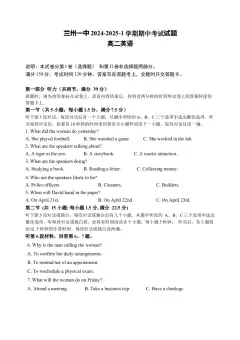
2024 年兰州一中第一学期期中考试
英语试卷
注意事项:
1.答题前,考生务必用黑色碳素笔将自己的姓名、准考证号、考场号、座位号
在答题卡上填写清楚。
2.每小题选出答案后,用2B铅笔把答题卡上对应题目的答案标号涂黑。如需改
动,用橡皮擦干净后,再选涂其他答案标号。在试题卷上作答无效。
3.考试结束后,请将本试卷和答题卡一并交回。满分150分,考试用时120分钟。
(本试卷满分150分,考试时间120分钟)
第一部分 听力 (共两节,每题1.5分,满分30分)
第一节(共5小题;每小题1.5分,满分7.5分)
听下面5段对话。每段对话后有一个小题,从题中所给的A、B、C三个选项中选出
最佳选项,并标在试卷的相应位置。听完每段对话后,你都有 10秒钟的时间来回答有关小
题和阅读下一小题。每段对话仅读一遍。
1. What will James do tomorrow?
A. Watch a TV program. B. Give a talk. C. Write a report.
2. What can we say about the woman?
A. She's generous. B. She's curious. C. She's helpful.
3. When does the train leave?
A. At 6:30. B. At 8:30. C. At 10.30.
4. How does the woman go to work?
A. By car. B. On foot. C. By bike.
5. What is the probable relationship between the speakers?
A. Classmates. B. Teacher and student. C. Doctor and patient.
第二节 (共15小题;每小题1.5分,满分22.5分)
听下面5段对话或独白。每段对话或独白后有几个小题,从题中所给的A、B、C三个选项
中选出最佳选项。听每段对话或独白前,你将有时间阅读各个小题,每小题 5秒钟;听完
后,各小题将给出5秒钟的作答时间。每段对话或独白读两遍。
听第6段材料,回答6至7题。
6. What does the woman regret?
A. Giving up her research. B. Dropping out of college. C. Changing her major.
7. What is the woman interested in studying now?
A. Ecology. B. Education. C. Chemistry.
听第7段材料,回答第8至9题。
8. What is the man?
A. A hotel manager. B. A tour guide. C. A taxi driver.
9. What is the man doing for the woman?A. Looking for some local foods.
B. Showing her around the seaside.
C. Offering information about a hotel.
听第8段材料,回答第10至12题。
10. Where does the conversation probably take place?
A. In an office. B. At home. C. At a restaurant.
11. What will the speakers do tomorrow evening?
A. Go to a concert. B. Visit a friend. C. Work extra hours.
12. Who is Alice going to call?
A. Mike. B. Joan. C. Catherine.
听第9段材料,回答第13至16题。
13. Why does the woman meet the man?
A. To look at an apartment. B. To deliver some furniture. C. To have a meal together.
14. What does the woman like about the carpet?
A. Its color. B. Its design. C. Its quality.
15. What does the man say about the kitchen?
A. It's a good size. B. It's newly painted. C. It's adequately equipped.
16. What will the woman probably do next?
A. Go downtown. B. Talk with her friend. C. Make payment.
听第 10 段材料,回答第17至20题。
17. Who is the speaker probably talking to?
A. Movie fans. B. News reporters. C. College students.
18. When did the speaker take English classes?
A. Before he left his hometown.
B. After he came to America.
C. When he was 15 years old.
19. How does the speaker feel about his teacher?
A. He's proud. B. He's sympathetic. C. He's grateful.
20. What does the speaker mainly talk about?
A. How education shaped his life.
B. How his language skills improved.
C. How he managed his business well.
第二部分 阅读 (共两节,满分50分)
第一节 (共15小题;每小题2.5分,满分37.5分)
阅读下列短文,从每题所给的A、B、C和D四个选项中,选出最佳选项。
A
Icehouse and ice ticket
As early as Pre-Qin Dynasty, people used natural ice to keep food fresh and make cold
drinks.The Zhou royal court had a specialized department called “ice administration”. They
collected natural ice blocks each December to store in the icehouse. During the Qing Dynasty, “ice
tickets” were used and they were available only to officials and the rich.
Ice container
The most commonly used cooling tool is called “Jian”, which is a big container filled with
ice. It was made of clay in early Chinese history, and was later made of copper (铜). The “Jian”
can be seen as an ancient refrigerator, which can be used to make cold drinks.
Hiding food in the well
During the Qin and Han dynasties, for common people, the most common way to cool off is
by using their wells. Some families put a pot in the well as a cold closet, or put food in a basket
and lowered the basket into the well with a rope.
Herbal drinks
During the Qing Dynasty, taking Chinese herbal medicine was popular in Beijing. In hot
summer, some people preferred to drink ice water, some boiled perilla leaves, and liquorice as
summer soup to keep off the heat. Ancient people also loved to make lotus seed soup in summer
for the benefit of strengthening the body.
21. What does “Jian” have the same function as?
A. Container. B. Clay. C. Refrigerator. D. Copper.
22. Which of the following is unavailable to common people?
A. Ice container. B. Ice tickets. C. Hiding food in the well. D. Herbal drinks.
23. What’s the common purpose of the above four ways?
A. To strengthen the body. B. To keep food fresh.
C. To make cold drinks. D. To escape the summer heat.
B
As a child, Liu Wenwen didn’t like the suona, a “loud” traditional Chinese musical
instrument, also an ancestral treasure of her family that was to become her career.
Liu says she felt ashamed. In the 1990s, people admired things that were modern and
international. The suona was considered out of date. Her father’s family has performed with the
suona for seven generations, while the tradition on her mother’s side of the family can be traced
back to the early Qing Dynasty. Despite her unwillingness, she followed her parents to play the
suona as early as 3 years old. Besides it, Liu has also learned traditional Chinese vocal music anddancing—skills that have improved her oral muscles and sense of rhyme, helping equip her to be a
professional musician.
It wasn’t until 2008 that she first found suona music beautiful. That was when she entered the
Shanghai Conservatory of Music to learn the instrument more systematically from Liu Ying, a
professor and top player. “The music played by the professor is just amazing, and different from
what I had heard before,” she says.
She loves exchanging ideas about suona playing techniques with her students. “It’s wonderful
to see the younger generation carrying on this cultural tradition.” Liu Wenwen said she is pleased
to see the suona regain popularity among young people, sometimes combined with jazz, opera and
other art forms. This has stopped its decline in the 1990s. Her name, when mentioned on China’s
social media platforms, often is followed by a video of her live performance at a concert in
Sydney, Australia. Westerners were amazed by the loud, unfamiliar instrument and its colorful
music. “I felt my hard work had paid off. I trained for over 20 years, probably just to win cheers
and applause for traditional Chinese music on the international stage”.
24. What urged Liu Wenwen to learn to play the suona?
A. Family tradition. B. Personal interest.
C. Her professor. D. Her ambition.
25. Apart from daily training, what did Liu do to be a professional musician?
A. Follow her parents to play the suona.
B. Learn music history at an early age.
C. Play the suona with her parents on the stage.
D. Better her oral muscles and sense of rhyme.
26. How did Liu first find suona music beautiful?
A. By learning from the famous professor Liu.
B. By visiting Shanghai Conservatory of Music.
C. By performing the suona music in Sydney.
D. By hearing her family playing the suona.
27. What can we learn from Liu’s last words in the last paragraph?
A. She learned the value of her performance.
B. She earned a fortune after 20 years’ training.
C. She worked hard and became an international professor.D. She surprised many westerners with a video of her performance.
C
The COVID-19 pandemic has been a frequent topic of conversation for most of us over the
past year. As we dreamt of indoor dining, vacations, and hugging our friends again, my friend
Ana texted that her mother, living in Brazil, had been infected by the coronavirus. I won’t go into
details here, but the disruption to life in Brazil have been especially upsetting considering their
social and cultural norms(规范).
Ana is Brazilian, and I’m from the US. While living in New York City, we became fast friends
despite the few awkward cultural differences I learned to deal with. She was comfortable with
intimacy; I preferred to keep my distance. She liked the company of many; I liked the friendship
of few. It was awkward for me to lean in for a quick hug, only to be embraced then kissed on the
cheeks. To this day, I’m not an excellent cheek kisser, but I try. She is one of many people over the
years who have educated me, in a way, about delighting in cultural difference.
I called Ana to check on her mother and I was primarily curious about how social and cultural
norms have been affected. It’s difficult, said Ana, because the necessary health regulations are
opposite to “what we believe and everything we know about living in a community and
displaying feelings of love”, but she hasn’t given up hope. I asked if the shifts made during the
pandemic will change cultural norms. “Absolutely not,” said Ana. This is who Brazilians are in
nature and change doesn’t happen overnight. They spend a lot of time and energy investing in
relationships, and the deeply rooted social conventions won’t change quickly.
Over the years, Ana has shared many stories that emphasize the differences in our upbringing.
I delight in our differences, even if kissing on the cheek makes me uncomfortable. We find our
commonalities, like talking with our hands, being expressive, and valuing community. And we
learn from our differences. COVID disrupted many things, but through all of this, Ana said, we
must constantly be adjusting, understanding, and doing what’s best for our communities and the
people we love.
28. Which of the following words can best replace the underlined word in Paragraph 1?
A. Adjustment. B. Disturbance.
C. Commitment. D. Preference.
29. What can we learn about Ann from Paragraph 2?
A. She is good at educating other people.
B. She prefers to stay alone in her own comfort zone.
C. She enjoys the close contact with others.
D. It took a long time for her to make friends with me.
30. Why doesn’t Ana think the pandemic will change social and cultural norms?
A. Because the Brazilians are born to be sociable.
B. Because the social conventions are easy to change.
C. Because the health regulations consist with her beliefs.
D. Because Brazilians rarely value investment in relationships.
31. What would be the best title for the passage?
A. My Attitude towards Friendship
B. Social and Cultural norms in the Pandemic
C. The Influence of COVID-19 on Life
D. My Acceptance of Cultural Differences
DThere are many sources of debate on a long Toad trip, including route selection, the choice of
snacks, and, probably most importantly, what to Play on the radio. Finding a way for all parties to
listen to their own audio without the need for headphones has been a goal of car makers for
decades, and scientists may have finally managed it.
A team from the University of Le Mans in France carefully positioned microphones, speakers
and filters(过滤器)to create personalised sound zones (PSZs) inside a car, and the small
regions are where sound from a set of speakers can be heard clearly. Outside these, it can not be
heard.
One barrier which scientists have previously been unable to overcome was the impact of
moving one’s seat. They were able to form a PSZ, but unable to move it to follow a person if they
moved the seat forwards or backwards.
The French team created a new algorithm(算法) specifically to tackle this issue, which
handles the sound waves to create “bright” and “dark” zones in the car. “Loudspeakers are
placed in the headrests, and specific filters for each transducer(换能器) are calculated to
reproduce a sound signal that maintains good quality in the zone under consideration and is
strongly weakened in other zones.” said Dr Lucas Vindrola, the author of the study. “The key to
the technique working properly is having sufficient microphones placed around the car to detect
how many people are in the car and where they are sitting. The price to pay is to have control
microphones in the passenger section, so that the algorithm can work.”
However, the technique is not yet ready to be commercially rolled out as a luxurious optional
extra just yet, as it currently works only for a limited range of frequencies.
32. What was once a challenge for scientists?
A. PSZs could hardly be formed.
B. The sound of moving a seat is loud,
C. They couldn’t create movable PSZs.
D. The seats couldn’t be moved back and forth.
33. What is Paragraph 4 mainly about?
A. How the impact of moving one’s seat was addressed.
B. Why enough microphones are placed around the car.
C. When the algorithm can work well for all passengers.
D. Where “bright” and “dark” zones are created in the car.
34. What can we infer about the new technique?
A. It currently works without limitation.
B. It has been put into use commercially.
C. It can function well with enough microphones.
D. It is costly to detect the position of microphones.
35. What is the main purpose of the passage?
A. To launch a new debate. B. To tackle an old problem.
C. To advertise an algorithm. D. To introduce a new technology.
第二节(共5小题;每小题2.5分,满分12.5分)
阅读下面短文,从短文后的选项中选出可以填入空白处的最佳选项。选项中有两项为多
余选项。
It’s a long debated topic: Which is more effective, group studying or studying alone?
We’ve all experienced getting together with classmates to study for an upcoming exam andspending the entire time talking or joking around. 3 6 So if you are the one who can be
so distracting, it’s strongly recommended that you should study alone. The following are some
benefits of studying alone.
1. Minimum distractions
When you lock yourself away in your room, there tend to be less distractions than when you
are studying in a group. 37 There are literally no distractions, unless you’re the one
who feels the need to clean everything when you study.
2. Personal study environment
3 8 You may require classical music, a comfortable room, and a cup of tea while you
study. Someone else may require complete silence, and no snacks at all. Studying alone allows
you to set the perfect study environment so you get the most out of studying. 39 Some
students learn best with flashcards, while others learn best when they reread chapters. Find your
learning style, and you can get better results.
3. Personalized learning content
40 Only when you study alone, you’re able to focus on exactly those topics. It’s
easy to look over the material you’re already familiar with. The hard part of studying is to learn
what you don’t understand.
A. You can learn whatever you like.
B. Nobody is moving around or talking near you.
C. That is what you can achieve in group studying.
D. Everyone is different, which means everyone learns differently.
E. There may be some topics in class that you really need to work on.
F. You leave the group without accomplishing anything to get you ready for your exam.
G. Studying alone also allows you to use the study strategies that are the most effective for your
learning style.
第三部分 语言运用(共两节,满分30分)
第一节(共15小题;每小题1分,满分15分)
阅读下面短文,从每题所给的A、B、C、D四个选项中选出可以填入空白处的最佳选
项。
Because people dine out often, there are lots of restaurants in Italy. Most of them are
Italian, of course. 41 , today the European country also has many ethnic (民族风味
的)restaurants. Al Borgo Antico in Legnano, a town on the outskirts(城郊)of Milan, is
42 . It offers traditional Italian food, but its owners are 43 . In 1989, co-owner Francesco
Wu moved with his 44 from China to Italy. His parents opened a Chinese 45 near Milan.
“When you move to a different country, you have to 46 ,” Wu told me during a recent
interview. At the beginning, the business was 47 for the brothers. They had to 48
prejudices and the people who said that no one would eat Italian cuisine made by Chinese chefs.
“It was 49 when people came in and saw our Chinese 50 and left,” Wu said.
The brothers 51 it despite all of the doubts, “ 52 , the restaurant became one of the best-
known in the area,” Wu said, smiling.
In 2012, eight years after opening his restaurant, Wu 53 a business organization
for Chinese immigrants (移民). “We 54 that something like this was missing, and
that it could be 5 5 for both the Italian and Chinese community. Wu said.
41. A. However B. Therefore C. Instead D. Otherwise
42. A. cheap B. unique C. convenient D. comfortable43. A. Japanese B. German C. French D. Chinese
44. A. friends B. neighbors C. family D. team
45. A. restaurant B. firm C. school D. store
46. A. fight B. adapt C. try D. stand
47. A. profitable B. tough C. boring D. pleasant
48. A. miss B. affect C. ignore D. criticize
49. A. depressing B. surprising C. amusing D. confusing
50. A. faces B. menus C. waiters D. decorations
51. A. offered B. closed C. refused D. made
52. A. Suddenly B. Actually C. Hopefully D. Eventually
53. A. founded B. heard of C. joined D. depended on
54. A. predicted B. realized C. regretted D. reported
55. A. enough B. demanding C. useful D. available
第二节 (共10小题;每小题1.5分,满分15分)
阅读下面短文,在空白处填入1个适当的单词或括号内单词的正确形式。
Deep in a rainforest in Hainan province, Zhang Chenliang picks up a daddy longlegs(长腿蜘
蛛) and 56._________ (present) it to the camera, explaining its features and living habits for the
benefit of viewers on a short video platform.
57._______ 34-year-old is an influential vlogger with expertise in animals, insects and
plants, and boasts some 22 million 58.___________(follower). His humorous expression and
distinctive accent have helped 59._________(he) carve out a career as one of the most influential
Chinesecreators of popular science content.
Born and 60.________(raise) in Beijing, Zhang has had a deep love of nature since he was a
child. He loved going to his grandmother's home in the countryside, where the fields
61._________ (be) bursting with vegetables and reeds( 芦 苇 ). They were also a
62._________(nature) habitat for insects, which have always interested him.
After watching one of his videos, one young woman was inspired to conduct a field trip
63.______ her own, and afterwards, applied 64._______(study) at the Chinese Academy of
Sciences hoping to become a biologist.
"That makes me feel that my work is worthwhile, and that 65._______ I've been doing is
having a positive impact on young people," Zhang said.
第四部分写作(共两节、满分40分)
第一节(满分15分)
为迎接一年一度的重阳节,学校英文报举办了以“关爱老人”为主题的征文比赛。请写一
篇英语短文参赛,包括以下要点:
1. 重阳节的意义2. 如何关爱老人3. 期望与呼吁
注意:1. 写作字数应为80左右。 2.请按如下格式在答题卡的相应位置作答。
Love the elderly
_______________________________________________________________________________
_______________________________________________________________________________
_______________________________________________________________________________
_______________________________________________________________________________
_______________________________________________________________________________
第二节(满分25分)
阅读下面材料,根据其内容和所给段落开头语续写两段,使之构成一篇完整的短文。
When school was over, the day was fading and it started to drizzle(毛毛雨). I stood at the
school gate, with a loaded backpack on my shoulders. It was Friday again: a weekend of joy with
unlimited sleeping hours and dinner courses specially made to my taste, a weekend at home. I
waved goodbye to my friends as they jumped into their fathers’ warm and comfortable cars.
Curiously, this gave rise to a disturbing feeling in me. It was not exactly what they called jealousy,
but somethinglike dismay(沮丧). I knew all I could expect was an old bike Mom would ride along on,
with the badly-oiled chain creaking(嘎吱作响) against the wheel to announce her arrival.
Every Friday when Mom came to pick me up for the weekend, it was a moment full of great
expectation and great unease. I always felt my face burning as we rode our way in and out of the
numerous cars and saw my friends’ faces sticking out of the car windows. It was like stepping into
a ballroom with beautifully dressed ladies and finding yourself in a smelly T-shirt.
To tell you the truth, Mom is quite a headache once in a while. She just looks a homely
middle-aged housewife. Being a practitioner of DIY, she knits most of my sweaters, chiefly in old
styles. Whenever caught by some curious classmates asking what brand my sweaters are, I’d force
a smile and reply in a half joking manner: homemade.
I couldn’t remember when I started to find her such an embarrassment. As a little boy, I relied
on her so much. She had been working at home, cooking in the kitchen, knitting by the lamp or
riding across town to buy me a book I badly needed. It had always been much fun riding with
mom. But just now there seemed to be something standing between us, something that made her
so strange to me and me to her.
注意:1. 续写词数应为150左右;2. 请按如下格式在答题卡的相应位置作答。
Today she showed up in a raincoat.
_______________________________________________________________________________
_______________________________________________________________________________
_______________________________________________________________________________
_______________________________________________________________________________
_______________________________________________________________________________
_____________________________________________________________
Mom tried to cover me with the back of the raincoat again as a storm set in.
_______________________________________________________________________________
_______________________________________________________________________________英语学科答案
第一部分听力
1—5 BCCBA 6—10 BABCC
11—15 ABAAC 16—20 BCBCA
阅读理解
A篇21. C 22.B 23. D
B篇【答案】24. A 25. D 26. A 27. A
C篇: BCAD D篇; CACD
第二节 七选五
36-40 FBDGE
第三部分 英语知识运用
第一节:完形填空
41-55 ABDCA BBCAA DDABC
语法填空:“无穷小亮”科普太有趣了!网友:重燃了我当科学家的梦想
Keys: 56. presents 谓语动词,客观描述常态,用一般现在时
57. The 冠词,特指
58. followers变名词复数,“粉丝,追随者”
59. him 代词宾格
60. raised 非谓语动词,表被动, “被抚养”
61. were be动词,过去时态
62. natural 词形变换,变形容词,修饰名词habitat
63. of/on介词, of her own “属于她自己的”, on one’s own “独自的”
64. to study 非谓语动词,apply to do sth “申请做某事”
65. what 连词,主语从句
应用文写作素材
重阳节的意义:
1. The Double Ninth Festival(重阳节
2. 农历的九月初九为重阳节。
It is celebrated on the ninth day of the ninth lunar month.
3. 重阳节是中国传统节日之一,用来推行一种敬老的活动。
It is one of our Chinese traditional festivals, on which activities are held to respect or to
arouse the awareness of caring for the elderly.
4. 九月初九“九九”谐音是“久久”,有长久之意。
Double Ninth in Chinese means long life (longevity).
如何关爱老人:
1. 由于当代人口老龄化的问题,关爱老人成为更重要的议题。
With the ageing of population in modern society, it is more important than ever that the
older should be taken good care of.
2. 对个人来说。我们应当时常陪伴在老人身边,或者常通电话,常回家看看。
For individuals, we should keep our parents or grandparents company on a regular basis,
call them or go back to see them as frequently as possible.
3. 社会应当为孤寡老人建立更多的敬老院,让他们在安全和温暖中享受退休后的生活。
As a society, more nursing homes should be built to make sure that majority of old
people and be safe and enjoy their retirement.4. 尊重身边的老人,无论你们关系是否亲密。
Learn to respect the elderly, no matter how close you are.
呼吁:
1. 通过大家共同的努力,提高老人的幸福指数。
By working together, we can improve the level of happiness for the older.
参考范文
The Double Ninth Festival is celebrated on the ninth day of the ninth lunar month, on
which activities are held to respect or to arouse the awareness of caring for the elderly.
(定语从句)
With the ageing of population in modern society, it is more important than ever that the
older should be taken good care of. (形式主语,主语从句) For individuals, we should
keep our parents or grandparents company on a regular basis. For a society, more nursing
homes should be built to make sure that majority of old people can enjoy their
retirement.
Hopefully, by working together, we can improve the level of happiness for the older since
it is what they deserve(原因状语从句+表语从句) after a lifelong hard working.
读后续写
【答案】 Today she showed up in a raincoat. Seeing her standing in the heavy rain
with all the body wet, I finally could not control myself and shouted at her, “Why do
you look so flustered? I don’t need you to take me home. I feel ashamed to have a
mother like you!” Suddenly, Mom was shocked and silent. Maybe, she had never thought
that I would have that feeling of her appearance and our home condition. She said
nothing and just covered the raincoat on me. I pushed it away wildly.
Mom tried to cover me with the back of the raincoat again as a storm set in. With
a smile, she said, “Dear son, I’m trying my best to earn our living, and I’m sure
that if we work harder, we will get whatever we want in the future.” Hearing her
words, I felt embarrassed. I thought of the time when she knitted in the deep night and
cooked for me in the early morning. Yes, she had always been doing whatever she could
to make me live well. But I was still unsatisfied. I had known that if I wanted to get
what others had, I should spare no efforts to study hard and get it by myself.