2014年全国统一高考英语试卷(新课标Ⅰ)
第二部分 阅读理解(共两节,满分60分)
第一节 (共15小题;每小题3分,满分45分)
阅读下列短文,从每题所给的四个选项(A、B、C、和D)中,选出最佳选
项,并在答题卡上将该项涂黑。
A
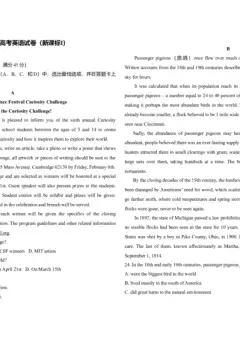
The Cambridge Science Festival Curiosity Challenge
Dare to Take the Curiosity Challenge!
The Cambridge Science Festival (CSF) is pleased to inform you of the sixth
annual Curiosity Challenge. The challenge invites, even dares school students
between the ages of 5 and 14 to create artwork or a piece of writing that shows their
curiosity and how it inspires them to explore their world.
Students are being dared to draw a picture, write an article, take a photo or write
a poem that shows what they are curious about. To enter the challenge, all artwork or
pieces of writing should be sent to the Cambridge Science Festival, MIT Museum,
265 Mass Avenue. Cambridge 02139 by Friday, February 8th.
Students who enter the Curiosity Challenge and are selected as winners will be
honored at a special ceremony during the CSF on Sunday, April 21st. Guest speaker
will also present prizes to the students. Winning entries will be published in a book.
Student entries will be exhibit and prizes will be given. Families of those who take
part will be included in the celebration and brunch will be served.
Between March 10th and March 15th, each winner will be given the specifics of
the closing ceremony and the Curiosity Challenge celebration. The program
guidelines and other related information are available at:
http://cambridgesciencefestival.org.
21. Who can take part in the Curiosity Challenge?
A. School students B. Cambridge locals C. CSF winners D. MIT artists
22. When will the prize-giving ceremony be held?
A. On February 8th B. On March 10th C. On April 21st D. On March 15th23. What type of writing is this text?
A. An exhibition guide. B. An art show review.
C. An announcement. D. An official report.
B
Passenger pigeons ( 旅 鸽 ) once flew over much of the United States in
unbelievable numbers. Written accounts from the 18th and 19th centuries described
flocks(群)so large that they darkened the sky for hours.
It was calculated that when its population reach its highest point, there were
more than 3 billion passenger pigeons – a number equal to 24 to 40 percent of the
total bird population in the United States, making it perhaps the most abundant birds
in the world. Even as late as 1870 when their numbers had already become smaller, a
flock believed to be 1 mile wide and 320 miles (about 515 kilometers) long was seen
near Cincinnati.
Sadly, the abundance of passenger pigeons may have been their undoing. Where
the birds were abundant, people believed there was an ever-lasting supply and killed
them by the thousands. Commercial hunters attracted them to small clearings with
grain, waited until pigeons had settled to feed, then threw large nets over them, taking
hundreds at a time. The birds were shipped to large cities and sold in restaurants.
By the closing decades of the 19th century, the hardwood forests where passenger
pigeons nested had been damaged by Americans’ need for wood, which scattered(驱
散)the flocks and forced the birds to go farther north, where cold temperatures and
spring storms contributed to their decline. Soon the great flocks were gone, never to
be seen again.
In 1897, the state of Michigan passed a law prohibiting the killing of passenger
pigeons, but by then, no sizable flocks had been seen in the state for 10 years. The last
confirmed wild pigeon in the United States was shot by a boy in Pike County, Ohio, in
1900. For a time, a few birds survived under human care. The last of them, known
affectionately as Martha, died at the Cincinnati Zoological Garden in September 1,
1914.24. In the 18th and early 19th centuries, passenger pigeons .
A. were the biggest bird in the world
B. lived mainly in the south of America
C. did great harm to the natural environment
D. were the largest bird population in the US
25. The underlined word “undoing” probably refers to the pigeons’ .
A. escape B. ruin C. liberation D. evolution
26. What was the main reason for people to kill passenger pigeons?
A. To seek pleasure B. To save other birds
C. To make money D. To protect crops
27. What can we infer about the law passed in Michigan?
A. It was ignored by the public B. It was declared too late
C. It was unfair D. It was strict
C
A typical lion tamer(驯兽师)in people’s mind is an entertainer holding a whip
(鞭)and a chair. The whip gets all of the attention, but it’s mostly for show. In
reality, it’s the chair that does the important work. When a lion tamer holds a chair in
front of the lion’s face, the lion tries to focus on all four legs of the chair at the same
time. With its focus divided, the lion becomes confused and is unsure about what to
do next. When faced with so many options, the lion chooses to freeze and wait instead
of attacking the man holding the chair.
How often do you find yourself in the same position as the lion? How often do you
have something you want to achieve ( e.g. lose weight, start a business, travel
more)--- only to end up confused by all of the options in front of you and never
make progress?
This upsets me to no end because while all the experts are busy debating about
which option is best, the people who want to improve their lives are left confused by
all of the conflicting information. The end result is that we feel like we can’t focus or
that we’re focused on the wrong things, and so we take less action, make lessprogress, and stay the same when we could be improving.
It doesn’t have to be that way. Anytime you find the world waving a chair in your
face, remember this: All you need to do is focus on one thing. You just need to get
started. Starting before you feel ready is one of the habits of successful people. If you
have somewhere you want to go, something you want to accomplish, someone you
want to become … take immediate action. If you’re clear about where you want to go,
the rest of the world will either help you get there or get out of the way.
28. Why does the lion tamer use a chair?
A. To show off his skills. B. To trick the lion.
C. To get ready for a fight. D. To entertain the audience.
29. In what sense are people similar to a lion facing a chair?
A. They feel puzzled over choices. B. They hold on to the wrong things.
C. They find it hard to make changed. D. They have to do something for show.
30. What is the author’s attitude towards the experts mentioned in Paragraph 3?
A. Tolerant B. Doubtful C. Respectful D. Supportive
31. When the world is “waving a chair in your face”, you’re advised to .
A. wait for a better chance B. break your old habits
C. make a quick decision D. ask for clear guidance
D
As more and more people speak the global languages of English, Chinese,
Spanish, and Arabic, other languages are rapidly disappearing. In fact, half of the
6,000-7,000 languages spoken around the world today will likely die out by the next
century, according to the United Nations Educational, Scientific, and Cultural
Organization (UNESCO).
In an effort to prevent language loss, scholars from a number of organizations---
UNESCO and National Geographic among them---have for many years been
documenting dying languages and the cultures they reflect.
Mark Turin, a scientist at the Macmillan Center, Yale University, who specializes
in the languages and oral traditions of the Himalayas, is following in that tradition.His recently published book, A Grammar of Thangmi with an Ethnolinguistic
Introduction to the Speakers and Their Culture, grows out of his experience living,
looking and raising a family in a village in Nepal.
Documenting the Tangmi language and culture is just a starting point for Turin,
who seeks to include other languages and oral traditions across the Himalayans
reaches of India, Nepal, Bhutan, and China. But he is not content to simply record
these voices before they disappear without record.
At the University of Cambridge Turin discovered a wealth of important
materials---including photographs, films, tap recordings, and field notes---which had
remained unstudied and were badly in need of care and protection.
Now, through the two organizations that he has founded---the Digital Himalaya
Project and the World Oral Literature Project---Turin has started a campaign to make
such documents, found in libraries and stores around the world, available not just to
scholars but to the youngers.
Generations of communities from whom the materials were originally collected.
Thanks to digital technology and the widely available Internet. Turin notes, the
endangered languages can be saved and reconnected with speech communities.
32. Many scholars are making efforts to .
A. promote global language B. rescue disappearing languages
C. search for language communities D. set up language research organizations
33. What does “that tradition” in Paragraph 3 refer to?
A. Having full records of the languages.
B. Writing books on language teaching.
C. Telling stories about language users.
D. Living with the native speakers.
34. What is Turin’s book based on?
A. The cultural studies in India.
B. The documents available at Yale.
C. His language research in Bhutan.
D. His personal experience in Nepal.35. Which of the following best describes Turin’s work?
A. Write, sell and donate. B. Record, repair and reward.
C. Design, experiment and report. D. Collect, protect and reconnect.
第二节 (共5小题,每小题3分,满分15分)
根据短文内容,从短文后的选项中选出能填入空白处的最佳选项,选项中
有两项为多余选项。
The jobs of the future have not yet been invented. 36 By helping them
develop classic skills that will serve them well no matter what the future holds.
1. Curiosity
Your children need to be deeply curious. 37 Ask kids, “What ingredients(配
料)can we add to make these pancakes even better next time?” and then try them
out. Did those ingredients make the pancakes better? What could we try next time?
2. Creativity
True creativity is the ability to take something existing and create something new
from it. 38 There are a dozen different things you can do with them. Experimenting
with materials to create something new can go a long way in helping them develop
their creativity.
3. Personal skills
Understanding how others feel can be a challenge for kids. We know what’s
going on inside our own head, but what about others? Being able to read people helps
kid from misreading a situation and jumping to false conclusions. 39 “Why do you
think she’s crying?” “Can you tell how that man is feeling by looking at his face?” “If
someone were to do that to you, how would you feel?”
4. Self Expression
40 There are many ways to express thoughts and ideas---music, acting,
drawing, building, photography. You may find that your child is attracted by one more
than another.
A. Encourage kids to cook with you.
B. And we can’t forget science education.C. We can give kids chances to think about materials in new ways.
D. We can do this in real life or ask questions about characters in stories.
E. Gardening is another great activity for helping kids develop this skill.
F. So how can we help our kids prepare for jobs that don’t yet exist?
G. Being able to communicate ideas in a meaningful way is a valuable skill.
第三部分 英语知识运用(共两节,满分55分)
第一节 完形填空(共20 小题;每小题两分,满分40分)
阅读下面短文,从短文后各题所给的四个选项(A,B,C,D)中,选出可
以填入空白处的最佳选项,并在答题卡上将该项涂黑。
As a general rule, all forms of activity lead to boredom when they are performed
on a routine(常规)basis. As a matter of fact, we can see this 41 at work in
people of all 42 . For example, on Christmas morning, children are excited about
43 with their new toys. But their 44 soon wears off and by January those 45 toys
can be found put away in the basement. The world is full of 46 stamp albums and
unfinished models, each standing as a monument to someone’s 47 interest. When
parents bring home a pet, their child 48 bathes it and brushes its fur. Within a short
time, however, the 49 of caring for the animal is handed over to the parents.
Adolescents enter high school with great 50 but are soon looking forward to 51
. The same is true of the young adults going to college. And then, how many 52 ,
who now complain(抱怨)about the long drives to work, 53 drove for hour
at a time when they first 54 their driver’s licenses (执照)? Before people
retire, they usually 55 to do a lot of 56 things, which they never had 57
to do while working. But 58 after retirement, the golfing, the fishing, the reading
and all of the other pastimes become as boring as the jobs they 59 . And, like the
child in January, they go searching for new 60 .
41. A. habit B. principle C. way D. power
42. A. parties B. races C. countries D. ages
43. A. working B. living C. playing D. going
44. A. confidence B. interest C. anxiety D. sorrow45. A. same B. extra C. funny D. expensive
46. A. well-organized B. colorfully-printed C. half-filled D. newly-collected
47. A. broad B. passing C. different D. main
48. A. silently B. impatiently C. worriedly D. gladly
49. A. promise B. burden C. right D. game
50. A. courage B. calmness C. confusion D. excitement
51. A. graduation B. independence C. responsibility D. success
52. A. children B. students C. adults D. retirees
53. A. carefully B. eagerly C. nervously D. bravely
54. A. required B. obtained C. noticed D. discovered
55. A. need B. learn C. plan D. start
56. A. great B. strange C. difficult D. correct
57. A. time B. money C. skills D. knowledge
58. A. only B. well C. even D. soon
59. A. lost B. chose C. quit D. left
60. A. pets B. toys C. friends D. colleagues.
第二节(共10小题:每小题1.5分,满分15分)
阅读下面材料,在空白处填入适当的内容(不多于3个单词)或括号内单
词的正确形式。
Are you facing a situation that looks impossible to fix?
In 1969, the pollution was terrible along the Cuyahoga River near Cleveland,
Ohio. It 61 (be)unimaginable that it could ever be cleaned up. The river was
so polluted that it 62 (actual)caught fire and burned. Now, years later, this
river is one of 63 most outstanding examples of environmental cleanup.
But the river wasn’t changed in a few days 64 even a few months. It took
years of work 65 (reduce) the industrial pollution and clean the water. Finally,
that hard work paid off and now the water in the river is 66 (clean)than ever.
Maybe you are facing an impossible situation. Maybe you have a habit 67 is
driving your family crazy. Possibly you drink too much or don’t know how to controlyour credit card use. When you face such an impossible situation, don’t you want a
quick fix and something to change immediately?
While there are 68 (amaze) stories of instant transformation, for most of us
the 69 (change) are gradual and require a lot of effort and work, like cleaning
up a polluted river. Just be 70 (patience).
第四部分 写作(共两节,满分35分)
第一节 短文改错(共10小题;每小题1分,满分10分)
假定英语课上老师要求同桌之间交换修改作文,请你修改你同桌写的以下
作文。文中共有10处错误,每句中最多有两处,每处仅涉及一个单词的增加、
删除或修改。
增加:在缺词处加一个漏字符号(^),并在其下面写出该加的词。
删除:把多余的词用斜线(\)划掉。
注意:1. 每处错误及其修改均仅限一词;
2. 只允许修改10处,多者(从第11处起)不计分。
Nearly five years before, and with the help by our father, my sister and I planted
some cherry tomatoes(圣女果)in our back garden. Since then --- for all these year
--- we had been allowing tomatoes to self-seed where they please. As result, the plants
are growing somewhere. The fruits are small in size, but juicy and taste. There are so
much that we often share them with our neighbors. Although we allow tomato plants
to grow in the same place year after year, but we have never had any disease or insect
attack problems. We are growing wonderfully tomatoes at no cost!
第二节 书面表达(满分25分)
假定你是李华,计划暑假期间去英国学习英语,为期六周.下面的广告引
起了你的注意,请给该校写封信,询问有关情况(箭头所指内容)注意:
1. 词数100左右;
2. 可以适当增加细节,以使行文连贯;
3. 参考词汇:住宿—accommodation.