北京市大兴区 2022—2023 学年九年级上学期期中英语试卷
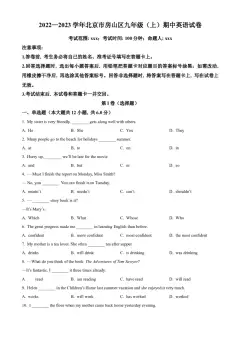
Ⅰ、单项选择
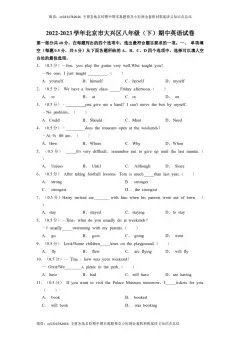
1. As a good teacher, Mrs. Green is always happy to answer ________ questions.
A. we B. us C. our D. ours
2. Chinese people always admire the full moon_________the Mid-Autumn night.
A. in B. at C. on D. for
3. —________ you look up the new words in a dictionary?
—Yes, of course. It’s an easy way to know the meanings of them.
A. May B. Need C. Can D. Must
4. Amy used to be really short, but she looks much ________ than before.
A. tall B. taller C. tallest D. the tallest
5. —________ do you improve your pronunciation, Jane?
—By listening to a tape and repeating out aloud.
A. How B. What C. Why D. When
6. Jack went to an international kite festival and he ________ many different kinds of kites there.
.
A will see B. sees C. has seen D. saw
7. —Where is your little brother, Larry?
—Look! He ________ up for the Halloween there.
A. dresses B. will dress C. dressed D. is dressing
8. If he keeps absent from class, he ________ the examinations this term.
A. will fail B. failed C. is failing D. has failed
9. Alice and Judy came into the concert while the musician ________ the piano on the stage.
A. played B. was playing C. will play D. has played
10. The teenagers ________ a lot of social work since they became volunteers two years ago.
A. will do B. did C. are doing D. have done
11. On our farm, the tea leaves ________ by hand when they are ready.
A. pick B. picked C. are picked D. were picked
12. —Do you know ________ every day, Susan?
—Yes. At 7:00 p.m.
A. why the bookstore closes B. when does the bookstore close
C. when the bookstore closes D. why does the bookstore close
Ⅱ、完形填空Never Give Up
My foot still didn’t heal(愈合) from an earlier injury(伤) before our school sports meeting. I even
____13____ whether I should take part in the meeting. But finally I was standing at the starting line, ready for the
3000-meter run. “Ready…set…” the gun popped(砰) and we all rushed off. A few minutes later, when I saw the
other ____14____ running ahead(在前面) of me, I felt very ashamed(惭愧) as I fell farther and farther behind.
“Hooray!” shouted the crowd. It was the loudest cheer I heard in the race. The first-place runner was two laps(圈)
ahead of me when she ____15____ the finishing line.” Maybe I should drop out.” I thought as I moved on along
the track. However, I made up my mind to keep running. For the last two laps in the race, I ran in ____16____ and
decided not to take part in the race next year. “It won’t be worth(值得的) even if my foot has healed.” I thought.
When I got to the finishing line, I heard another cheer, ____17____ than the one I heard earlier. I turned
around and saw the boys preparing for their race. I thought they must be cheering for the boys.
I was leaving ____18____ when several girls came up to me. “Wow, you’ve got courage(勇气)!” one of them
told me. “Courage? I’ve just lost the race!” I thought. “All of us were ____19____ for you. Did you hear us?” said
one girl. After hearing these words, I suddenly regained(重新获得) hope. I realized strength and courage weren’t
always measured(衡量) in medals and victories, but in the difficulties we ____20____. The strongest people were
not always the people who won, but the people who didn’t give up when they failed.
13. A. regretted B. wondered C. doubted D. decided
14. A. teachers B. girls C. boys D. guards
15. A. jumped B. pulled C. left D. crossed
16. A. fear B. order C. pain D. surprise
17. A. louder B. shorter C. lower D. higher
18. A. silently B. proudly C. safely D. nervously
19. A. waiting B. cheering C. looking D. preparing
20. A. expected B. noticed C. avoided D. challenged
Ⅲ、阅读理解
A
Advice from Liu Yang’s Pals
,
Hi my name is Liu Yang from China. I have trouble in learning English. I need to improve my English
learning. Could you please give me some advice? Thank you.
Hello, I’m from Australia. I know just how you’re feeling now. Why don’t you join an English-speaking club?
You can have conversations with your friends about your life. It’s a good way to improve your speaking and enjoy
yourself!
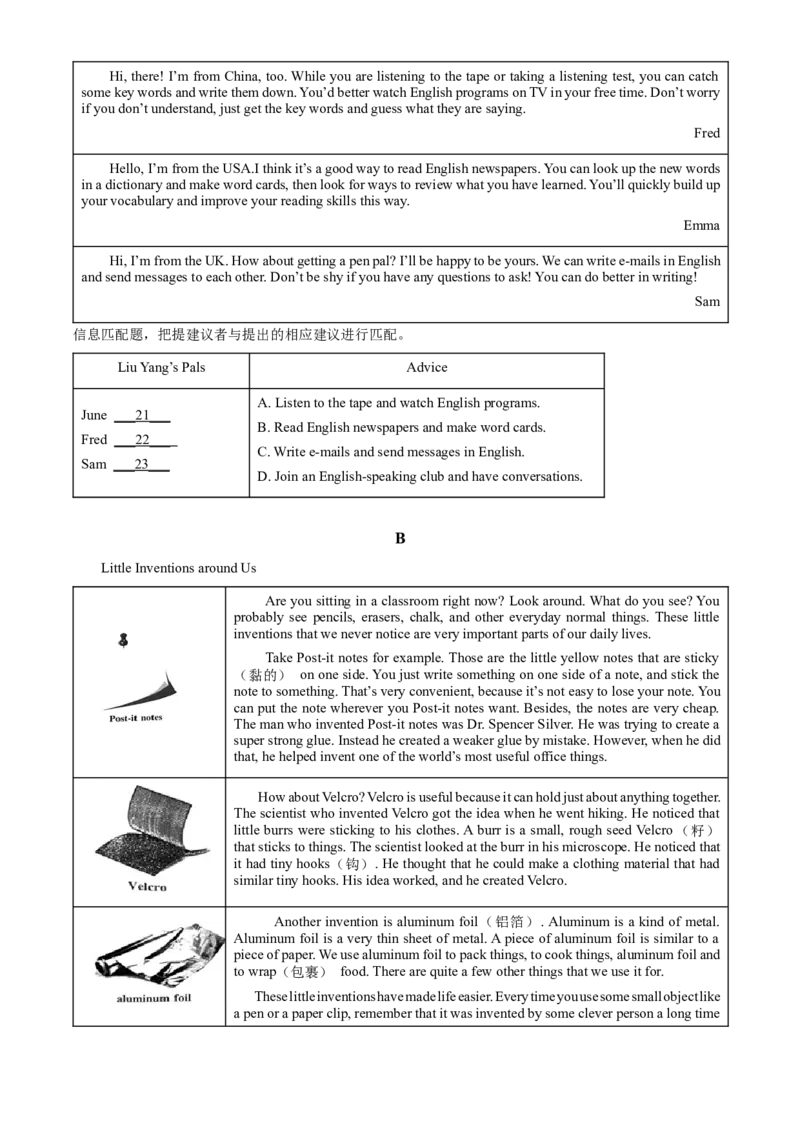
JuneHi, there! I’m from China, too. While you are listening to the tape or taking a listening test, you can catch
some key words and write them down. You’d better watch English programs on TV in your free time. Don’t worry
if you don’t understand, just get the key words and guess what they are saying.
Fred
Hello, I’m from the USA.I think it’s a good way to read English newspapers. You can look up the new words
in a dictionary and make word cards, then look for ways to review what you have learned. You’ll quickly build up
your vocabulary and improve your reading skills this way.
Emma
Hi, I’m from the UK. How about getting a pen pal? I’ll be happy to be yours. We can write e-mails in English
and send messages to each other. Don’t be shy if you have any questions to ask! You can do better in writing!
Sam
信息匹配题,把提建议者与提出的相应建议进行匹配。
Liu Yang’s Pals Advice
A. Listen to the tape and watch English programs.
June ___21___
B. Read English newspapers and make word cards.
Fred ___22___
C. Write e-mails and send messages in English.
Sam ___23___
D. Join an English-speaking club and have conversations.
B
Little Inventions around Us
Are you sitting in a classroom right now? Look around. What do you see? You
probably see pencils, erasers, chalk, and other everyday normal things. These little
inventions that we never notice are very important parts of our daily lives.
Take Post-it notes for example. Those are the little yellow notes that are sticky
(黏的) on one side. You just write something on one side of a note, and stick the
note to something. That’s very convenient, because it’s not easy to lose your note. You
can put the note wherever you Post-it notes want. Besides, the notes are very cheap.
The man who invented Post-it notes was Dr. Spencer Silver. He was trying to create a
super strong glue. Instead he created a weaker glue by mistake. However, when he did
that, he helped invent one of the world’s most useful office things.
How about Velcro? Velcro is useful because it can hold just about anything together.
The scientist who invented Velcro got the idea when he went hiking. He noticed that
little burrs were sticking to his clothes. A burr is a small, rough seed Velcro(籽)
that sticks to things. The scientist looked at the burr in his microscope. He noticed that
it had tiny hooks(钩). He thought that he could make a clothing material that had
similar tiny hooks. His idea worked, and he created Velcro.
Another invention is aluminum foil(铝箔). Aluminum is a kind of metal.
Aluminum foil is a very thin sheet of metal. A piece of aluminum foil is similar to a
piece of paper. We use aluminum foil to pack things, to cook things, aluminum foil and
to wrap(包裹) food. There are quite a few other things that we use it for.
These little inventions have made life easier. Every time you use some small object like
a pen or a paper clip, remember that it was invented by some clever person a long timeago.
24. From the inventions in the passage, Velcro can be used for ________.
A. creating super strong glue B. wrapping cooked food
.
C posting notes on the board D. sticking things together
25. What does the writer think of the inventions?
A. They have changed our cooking styles. B. They play important parts in our lives.
C. They are all invented by accident. D. They are made of the same materials.
26. What can we know from the passage?
A. Aluminum foil can also be used to cook things.
B. Spenser Silver created a stronger glue by mistake.
C. It’s not easy to find Post-it notes in the classroom.
D. The scientist got the idea of Velcro from a zipper.
C
Spreading Happiness
Jessica Martin and Asherah Weiss are art teachers in a school. They thought their students might have the
magic words that could bring calm to people in difficult times, so they created a project called “Pep Toc” with their
students. The project had two parts—one was setting up a hotline, and the other was making encouraging posters.
The two teachers had the same basic question for all the students: “What could you say to help or encourage
someone else?”
Students working on the hotline thought of what they would like to say. Then Ms. Martin recorded each one,
and divided the recordings into different parts of the telephone hotline. When people call the hotline, they can hear
happy voices of children of different ages sharing positive(积极的) messages. For example, pressing l brings
ideas for people who are “feeling mad or nervous”. Helpful suggestions include: “listen to music” or “go and get a
cookie”. Pressing 2 results in “words of encouragement and life advice”. This includes messages like: “The world
is a better place with you in it.”and “You are okay!” By pressing 3, you can hear a group of children saying
together: “You can do it! Keep trying, don’t give up!”
Other students made encouraging posters and hung them up around the town. Many posters had strips(条)
of paper. When people passed by, they could tear off(撕掉) the strips and take with them. For example, one
poster said “If you are mad, think of positive thoughts.” and had strips reminding people to “Be happy.”
Ms. Martin thought the project would only attract interest from people near the school. But in its first six
weeks, the hotline got 5 million calls from around the world. It has become very popular with stressed adults,patients in hospitals, and others who just want to hear the happy voices of children. For Martin and Weiss, the
project shows students that small acts can have a big influence. “If you have an idea, just try to do it and see what
happens,” Weiss says. Students now know that they have amazing power. They’re already thinking about new
messages to record for the Pep Toc Hotline.
27. Jessica Martin and Asherah Weiss created the project in order to ________ .
A. encourage their students to take part in art competitions
B. ask their students to work hard to achieve their dreams
C. expect their students to bring pleasure to people in trouble
D. help their students to get good scores on their art exams
28. What is Paragraph 2 mainly about?
A. What could be received from the posters. B. How they worked on their hotline properly.
C. Where people read the posters more easily. D. When the hotline could be telephoned.
29. What does the writer tell us in the last paragraph?
A. The project has made great influence on the people around the world.
B. The posters didn’t attract interest from the people near the school.
C. The hotline hasn’t become popular with the people in the town.
D. The students felt stressed about the development of their project.
D
Polite Speech
Different countries and cultures have their own rules of polite speech. When learning a language, it is important to
learn rules of polite speech of the culture in which that language is spoken.
In spoken English, indirect questions are generally considered more formal (正式的) and polite than direct
questions. Indirect questions are questions with extra (额外的) words and phrases to make your questions softer and
less demanding (强求的). Try using some of these phrases to create indirect questions, “Do you know…”, “Can/Could
you tell me…”. When “Where is the bus stop? “ becomes “Do you know where the bus stop is?”, it sounds much
more polite.
It is said that it is easy to recognize (辨别) an impolite question when you’re the person being asked the question,
but not so easy when you’re the one asking the question. What makes a question impolite? Most people would
consider a question impolite if it’s asking them for information that they don’t really want to disclose to others. For
example, in many cultures, it is not polite to ask questions about money. “How much money do you get every month?”
is not good. When unsure, it is best to remember that, if you are meeting someone for the first time, or you don’t
know a person very well yet, keep on the topics like sports, music, hobbies, or other general ones. Avoid topics whichcan be more personal to someone, such as money, family, age, health, politics, religion (宗教) .
In the English language, “magic words” are very important in polite speech. “Please” is sometimes referred to
as the “magic word”. When eating out in a restaurant, you’d better say “Check the bill, please.” instead of “Bring me
the bill, waiter!” Another magic word (or phrase) is “thank you”. When using English to ask for things or information,
it is therefore important to use the magic words “please” and “thank you”.
,
Polite speech is always welcomed so why not use it? Even if you haven’t used these polite words and
phrases all your life, it’s never too late to start. Practice holding polite conversations with family and close friends
until you’re comfortable. and it feels natural. Gradually, speaking politely will become second nature (天性) to you
though it might seem so difficult to speak politely. Try to speak politely in different situations. This will help you
communicate better with other people.
30. If we want to make our questions more polite, we should ________ .
A. speak louder to make everyone hear the questions clearly
B. make a good choice of proper places to ask the questions
C. ask questions directly with pleasant expressions on faces
D. add extra words to the questions to make them sound softer
31. The word “disclose” in Paragraph 3 probably means “________”.
A. look up B. make known C. pay attention D. keep away
32. Which of the following is TRUE according to the passage?
A. It’s not easy for the listeners to find out the impolite questions.
B. Some “magic words” play an important role in our polite speech.
C. Personal topics have to be talked about when we meet a stranger.
D. It isn’t necessary to practice polite conversations with our family.
33. What’s the writer’s main purpose in writing this passage?
A. To discuss the advantages of the polite speech.
B. To teach us to use language in different situations.
C. To encourage us to use polite speech in our life.
D. To help us deal with the shyness when we speak.
E
The Value of Labor
Can you cook? If so, what are your special dishes?
For middle and primary school students, being able to cook will become a must in the near future. They will
also need to learn how to plant vegetables, repair home electric products, raise animals at home according to the newcurriculum standard(课程标准)for labor(劳动)education.
Starting from this autumn term, students in primary and middle schools need to take courses on labor skills at
least once a week. The labor courses have three types of labor tasks. The first type is everyday chores. It includes
cleaning, organizing, cooking, and using or repairing home electric products. The second type is productive labor. It
includes making traditional handicrafts(手工艺), and using new technologies such as 3D printing and laser(激
光)cutting. The third type is service work. It includes volunteer work in the communities.
The new curriculum also calls for the build of a labor week every school year. Schools should arrange(安
排)a week of off-campus activities. The labor education must be strengthened(加强)to help students develop an
interest in labor and form a strong social responsibility(责任).
Recently, internet users have discussed the changes online. Many welcome such courses and say it is necessary to
teach young students basic life skills. Some have regretted not learning such skills during their own school days.
,
Liu Fang a mother of 6-year-old twins in Beijing, is a strong supporter of labor education. For the past
year, she has trained her daughters to do house chores and make simple dishes for the family.
“The main idea is to let them share responsibilities as family members and become independent as early as they
can.” said Liu, “Through doing housework, their hand-eye coordination(协调), time management and organization
skills can be trained and it’s also good to help them relax. My twins have fun in doing chores and are more
independent.”
阅读短文,回答以下各小题。
34. How often do the students need to take labor courses in a term?
_____________________________________________
35. What does the third type of labor courses include?
_____________________________________________
36. What is labor education trying to help students do?
_____________________________________________
37. What do you think of having labor courses? Why?
_____________________________________________
Ⅳ、书面表达
38. 假定你是李华,你的英国笔友Chris对中国传统手工艺术很感兴趣,他给你发来邮件,想请你介绍
一种传统手工艺品。请你用英语回复一封邮件,描述你最喜欢的艺术形式及与其相关的文化习俗,如剪纸
(papercutting)、泥塑(clay art)、孔明灯(sky lantern)等。
提示词语:be made of, design, shape, symbol, wish
提示问题:●What is your favorite traditional Chinese art form?
●How are the artworks usually made?
●What do you know about its culture and custom?
Dear Chris,
I’m glad to know that you’re interested in traditional Chinese art forms.
________________________________________________________________________________________
____________________________________________________________________________________________
____________________________________________________________________________________________
____________________________________________________________________________________________
____________________________________________________________________________________________
_____________________
I hope the above is helpful. Please feel free to ask for more information.
Yours,
Li Hua
39. 某英文网站正在开展以“自主学习(autonomous learning)”为主题的征文活动,假定你是李华,
请用英语写一篇短文投稿,谈谈你在自主学习方面有哪些具体做法,取得了什么效果。
提示词语:plan, prepare, review, read, progress
提示问题:
●How do you learn by autonomous learning?
●What have you achieved?
It’s very important for us to learn by autonomous learning in our life.
____________________________________________________________________________________________
____________________________________________________________________________________________
____________________________________________________________________________________________
____________________________________________________________________________________________
____________________________________________________________________________________________
__________