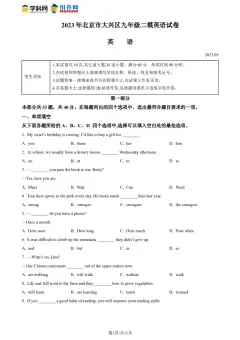
北京市大兴区 2022—2023 学年九年级上学期期中英语试卷
Ⅰ、单项选择
1. As a good teacher, Mrs. Green is always happy to answer ________ questions.
A. we B. us C. our D. ours
【答案】C
【解析】
【详解】句意:作为一个好老师,格林夫人总是乐于回答我们的问题。
考查代词辨析。we我们,人称代词主格;us我们,人称代词宾格;our我们的,形容词性物主代词;ours
我们的,名词性物主代词。设空处修饰后面的名词复数“questions”。因此应用形容词性物主代词。 故选
C。
2. Chinese people always admire the full moon_________the Mid-Autumn night.
A. in B. at C. on D. for
【答案】C
【解析】
【详解】句意:在中秋节夜晚中国人总是赏月。
根据考查介词。in+年/月,表示在某年或某月;at+钟点,表示在几点钟;on+具体日期,表示在具体的某
一天;表示在某一天的上午、下午或晚上,用介词on。for+时间段,表示长达多长时间。此处接the Mid-
Autumn night.,表示在中秋节的晚上,用介词on。故选C。
.
3 —________ you look up the new words in a dictionary?
—Yes, of course. It’s an easy way to know the meanings of them.
A. May B. Need C. Can D. Must
【答案】C
【解析】
【详解】句意:——你可以在字典里查生词吗?——是的, 当然。这是了解它们的意思的一个简单的方法。
考查情态动词can的用法。May可以;Need需要;Can能;Must必须。根据“Yes, of course. It’s an easy
way to know the meanings of them.”可知,可以在字典里查生词吗,这是了解它们的意思的一个简单的方法。
因此应用情态动词can来表示“可以”。故选C。
4. Amy used to be really short, but she looks much ________ than before.
A. tall B. taller C. tallest D. the tallest
【答案】B
【解析】
【详解】句意: 艾米过去很矮, 但她现在看起来比以前高多了。考查形容词比较级。tall,是形容词,意为“高的”;根据“than”,可知这里使用形容词比较级。 故选B。
5. —________ do you improve your pronunciation, Jane?
—By listening to a tape and repeating out aloud.
A. How B. What C. Why D. When
【答案】A
【解析】
【详解】句意:——简,你是怎样提高你的发音的?——通过听磁带并大声地重复。
考查疑问词辨析。how如何;what什么;why为什么;when什么时候。根据答语“By listening to a tape and
repeating out aloud.”可知,要问“你如何提高你的发音的”,要填“如何”, 故选A。
6. Jack went to an international kite festival and he ________ many different kinds of kites there.
A. will see B. sees C. has seen D. saw
【答案】D
【解析】
【详解】句意:杰克去参加一个国际风筝节,他在那里看到了许多不同种类的风筝。
考查一般过去时。根据“Jack went to an international kite festival”可知,时态是一般过去时,故选D。
7. —Where is your little brother, Larry?
—Look! He ________ up for the Halloween there.
A. dresses B. will dress C. dressed D. is dressing
【答案】D
【解析】
的
【详解】句意:——你 小弟弟在哪里,拉里? ——看!他正在那里为万圣节打扮。
考查现在进行时。dresses动词第三人称单数形式,在一般现在时中主语为第三人称单数时使用;will dress
一般将来时;dressed一般过去时;is dressing现在进行时。由“Look!”可知本句时态是现在进行时,动词
结构为“be+doing”。 故选D。
8. If he keeps absent from class, he ________ the examinations this term.
A. will fail B. failed C. is failing D. has failed
【答案】A
【解析】
【详解】句意: 如果他一直缺课,他这学期的考试就会不及格。
考查动词时态。fail是动词。意为“失败”;根据“If he keeps absent from class”可知if引导条件状语从句用一
般现在时,主语应该使用一般将来时“will+动词原形”。 故选A。
9. Alice and Judy came into the concert while the musician ________ the piano on the stage.A. played B. was playing C. will play D. has played
【答案】B
【解析】
【详解】句意:当音乐家在舞台上弹钢琴时,爱丽丝和朱迪走进了音乐会。
考查时态。根据“Alice and Judy came into the concert while the musician...the piano on the stage”可知当她们
进来时,音乐家正在弹钢琴,用过去进行时was/were doing。故选B。
10. The teenagers ________ a lot of social work since they became volunteers two years ago.
A. will do B. did C. are doing D. have done
【答案】D
【解析】
【详解】句意:自从两年前成为志愿者以来,这些青少年做了很多社会工作。
考查现在完成时态。根据句中的“since”可知,其后跟一般过去时,主句用现在完成时,所以空白处填
“have done”。 故选D。
11. On our farm, the tea leaves ________ by hand when they are ready.
A. pick B. picked C. are picked D. were picked
【答案】C
【解析】
【详解】句意:在我们的农场,茶叶成熟时都是手工采摘的。
考查一般现在时的被动语态。主语“the tea leaves”是动作“pick”的承受者,时态是一般现在时,所以用一
般现在时的被动语态。故选C。
12. —Do you know ________ every day, Susan?
—Yes. At 7:00 p.m.
A. why the bookstore closes B. when does the bookstore close
C. when the bookstore closes D. why does the bookstore close
【答案】C
【解析】
【详解】句意:——苏珊,你知道书店每天什么时候关门吗?——知道。晚上7点。
考查宾语从句。宾语从句用陈述语序,排除BD;根据“At 7:00 p.m.”可知,询问的是书店关门的时候,
应用when引导宾语从句。故选C。
Ⅱ、完形填空
Never Give Up
My foot still didn’t heal(愈合) from an earlier injury(伤) before our school sports meeting. I even
____13____ whether I should take part in the meeting. But finally I was standing at the starting line, ready for the3000-meter run. “Ready…set…” the gun popped(砰) and we all rushed off. A few minutes later, when I saw the
other ____14____ running ahead(在前面) of me, I felt very ashamed(惭愧) as I fell farther and farther behind.
“Hooray!” shouted the crowd. It was the loudest cheer I heard in the race. The first-place runner was two laps(圈)
ahead of me when she ____15____ the finishing line.” Maybe I should drop out.” I thought as I moved on along
the track. However, I made up my mind to keep running. For the last two laps in the race, I ran in ____16____ and
decided not to take part in the race next year. “It won’t be worth(值得的) even if my foot has healed.” I thought.
When I got to the finishing line, I heard another cheer, ____17____ than the one I heard earlier. I turned
around and saw the boys preparing for their race. I thought they must be cheering for the boys.
I was leaving ____18____ when several girls came up to me. “Wow, you’ve got courage(勇气)!” one of them
told me. “Courage? I’ve just lost the race!” I thought. “All of us were ____19____ for you. Did you hear us?” said
one girl. After hearing these words, I suddenly regained(重新获得) hope. I realized strength and courage weren’t
always measured(衡量) in medals and victories, but in the difficulties we ____20____. The strongest people were
not always the people who won, but the people who didn’t give up when they failed.
13. A. regretted B. wondered C. doubted D. decided
14. A. teachers B. girls C. boys D. guards
15. A. jumped B. pulled C. left D. crossed
16. A. fear B. order C. pain D. surprise
17. A. louder B. shorter C. lower D. higher
18. A. silently B. proudly C. safely D. nervously
19. A. waiting B. cheering C. looking D. preparing
20. A. expected B. noticed C. avoided D. challenged
【答案】13. C 14. B 15. D 16. C 17. A 18. A 19. B 20. D
【解析】
【导语】本文是一篇记叙文,讲述了作者带伤参加运动会的3000米跑步, 虽然输了比赛, 但却得到了其
他人的喝彩与尊重。
【13题详解】
句意:我甚至怀疑我是否应该参加运动会。
regretted后悔;wondered想要知道;doubted怀疑;decided决定。根据上文“My foot still didn’t heal(愈合)
from an earlier injury(伤) before our school sports meeting.我们学校运动会之前, 我的脚还没有从先前的伤
势中恢复过来。”可知作者怀疑自己应不应该参加运动会。故选C。
【14题详解】
句意:几分钟后,当我看到其他女孩跑在我前面时,我感到很羞愧,因为我越来越落后。teachers教师;girls女孩;boys男孩;guards警卫。根据下文“The first-place runner was two laps(圈) ahead of
me when she... the finishing line.第一名选手在到达终点线时领先我两圈。”可知, 第一名是女孩,因此应该
是其他女孩都跑在作者的前面。故选B。
【15题详解】
句意:当第一名跑者越过终点线时,她领先我两圈。
jumped跳;pulled拉;left离开;crossed穿过。根据“the finishing line”可知应该是第一名选手穿过终点线时
领先作者两圈。故选D。
【16题详解】
句意:在比赛的最后两圈,我在疼痛中跑步,决定明年不参加比赛。
fear恐惧;order命令;pain痛苦;surprise惊讶。根据上文“My foot still didn’t heal(愈合) from an earlier
injury(伤) before our school sports meeting.在我们学校运动会之前,我的脚还没有从先前的伤势中恢复过
来。”可知作者忍着疼痛跑步。故选C。
【17题详解】
句意:当我到达终点时,我听到了另一声更响亮的欢呼声,比我之前听到的更响亮。
louder更大声的;shorter更短的;lower更低的;higher更高的。根据“ All of us were...for you. Did you hear
us?”语境可知作者应该听到了比早些时候还要大声的欢呼声。故选A。
【18题详解】
句意:我正要默默地离开时,几个女孩向我走来。
silently默默地;proudly骄傲地;safely安全地;nervously紧张地。根据下文“I’ve just lost the race!我刚刚
输了比赛”可知作者应该是要默默地离开。故选A。
【19题详解】
句意:我们都在为你欢呼。你听到了吗?
waiting等待;cheering欢呼;looking看着;preparing准备。根据下文“After hearing these words, I suddenly
regained(重新获得) hope. 听到这些话后,我突然重新获得了希望。”可知女孩们应该是为作者欢呼。故选
B。
【20题详解】
句意:我意识到力量和勇气并不总是以奖牌和胜利来衡量,而是以我们挑战的困难来衡量。
expected期待;noticed注意;avoided避免;challenged挑战。根据上文内容和“but in the difficulties we”可知
我们挑战的困难能体现出我们的力量和勇气。故选D。
Ⅲ、阅读理解
A
Advice from Liu Yang’s PalsHi, my name is Liu Yang from China. I have trouble in learning English. I need to improve my English learning.
Could you please give me some advice? Thank you.
Hello, I’m from Australia. I know just how you’re feeling now. Why don’t you join an English-speaking club?
You can have conversations with your friends about your life. It’s a good way to improve your speaking and enjoy
yourself!
June
Hi, there! I’m from China, too. While you are listening to the tape or taking a listening test, you can catch
some key words and write them down. You’d better watch English programs on TV in your free time. Don’t worry
if you don’t understand, just get the key words and guess what they are saying.
Fred
Hello, I’m from the USA.I think it’s a good way to read English newspapers. You can look up the new words
in a dictionary and make word cards, then look for ways to review what you have learned. You’ll quickly build up
your vocabulary and improve your reading skills this way.
Emma
,
Hi I’m from the UK. How about getting a pen pal? I’ll be happy to be yours. We can write e-mails in
English and send messages to each other. Don’t be shy if you have any questions to ask! You can do better in
writing!
Sam
信息匹配题,把提建议者与提出的相应建议进行匹配。
Liu Yang’s Pals Advice
A. Listen to the tape and watch English programs.
June ___21___
B. Read English newspapers and make word cards.
Fred ___22___
C. Write e-mails and send messages in English.
Sam ___23___
D. Join an English-speaking club and have conversations.
【答案】21. D 22. A
23. C
【解析】
【导语】本文讲了一些关于学习英语方面的建议。
【21题详解】
根据“Why don’t you join an English-speaking club? You can have conversations with your friends about your
life. It’s a good way to improve your speaking and enjoy yourself! June”可知June建议加入一个英语俱乐部并进
行对话。故选D。
【22题详解】
根据“While you are listening to the tape or taking a listening test, you can catch some key words and write them
down. You’d better watch English programs on TV in your free time. Don’t worry if you don’t understand, just getthe key words and guess what they are saying. Fred”可知Fred建议听磁带,看英语节目。故选A。
【23题详解】
根据“How about getting a pen pal? I’ll be happy to be yours. We can write e-mails in English and send messages
to each other. Don’t be shy if you have any questions to ask! You can do better in writing! Sam”可知Sam建议用
英语写电子邮件和发送信息。故选C。
B
Little Inventions around Us
Are you sitting in a classroom right now? Look around. What do you see? You
probably see pencils, erasers, chalk, and other everyday normal things. These little
inventions that we never notice are very important parts of our daily lives.
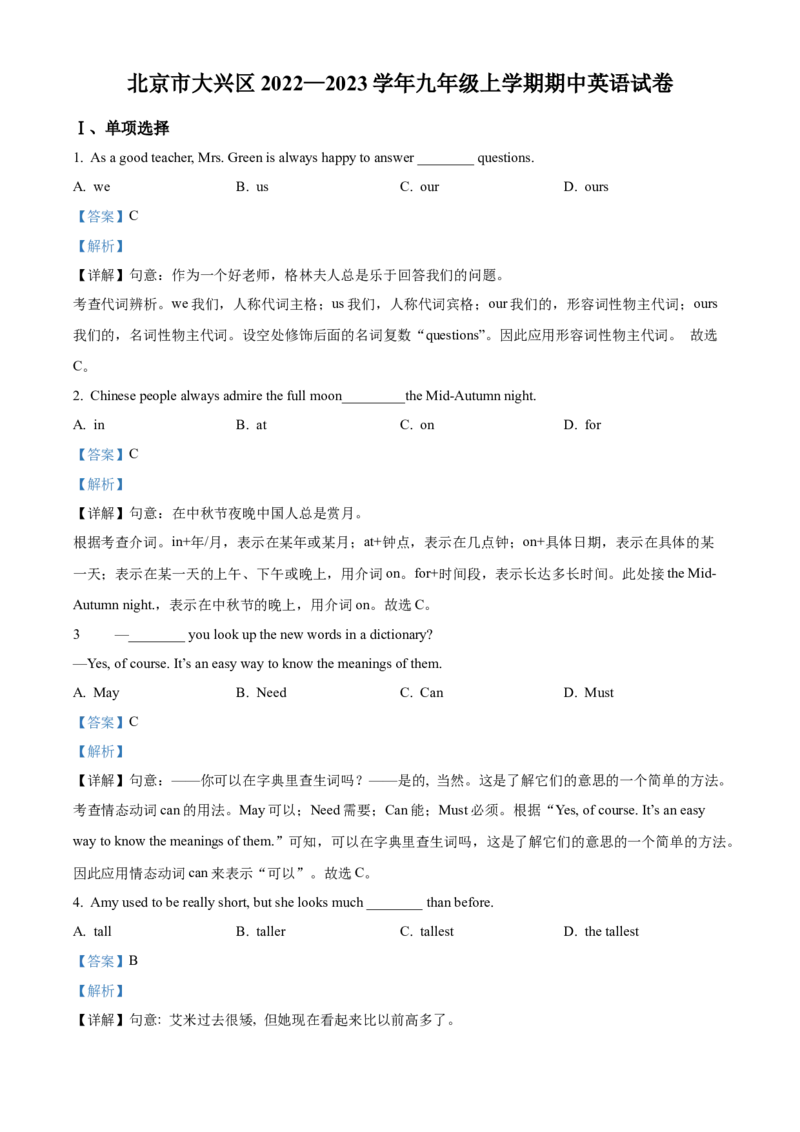
Take Post-it notes for example. Those are the little yellow notes that are sticky
(黏的) on one side. You just write something on one side of a note, and stick the
note to something. That’s very convenient, because it’s not easy to lose your note. You
can put the note wherever you Post-it notes want. Besides, the notes are very cheap.
The man who invented Post-it notes was Dr. Spencer Silver. He was trying to create a
super strong glue. Instead he created a weaker glue by mistake. However, when he did
that, he helped invent one of the world’s most useful office things.
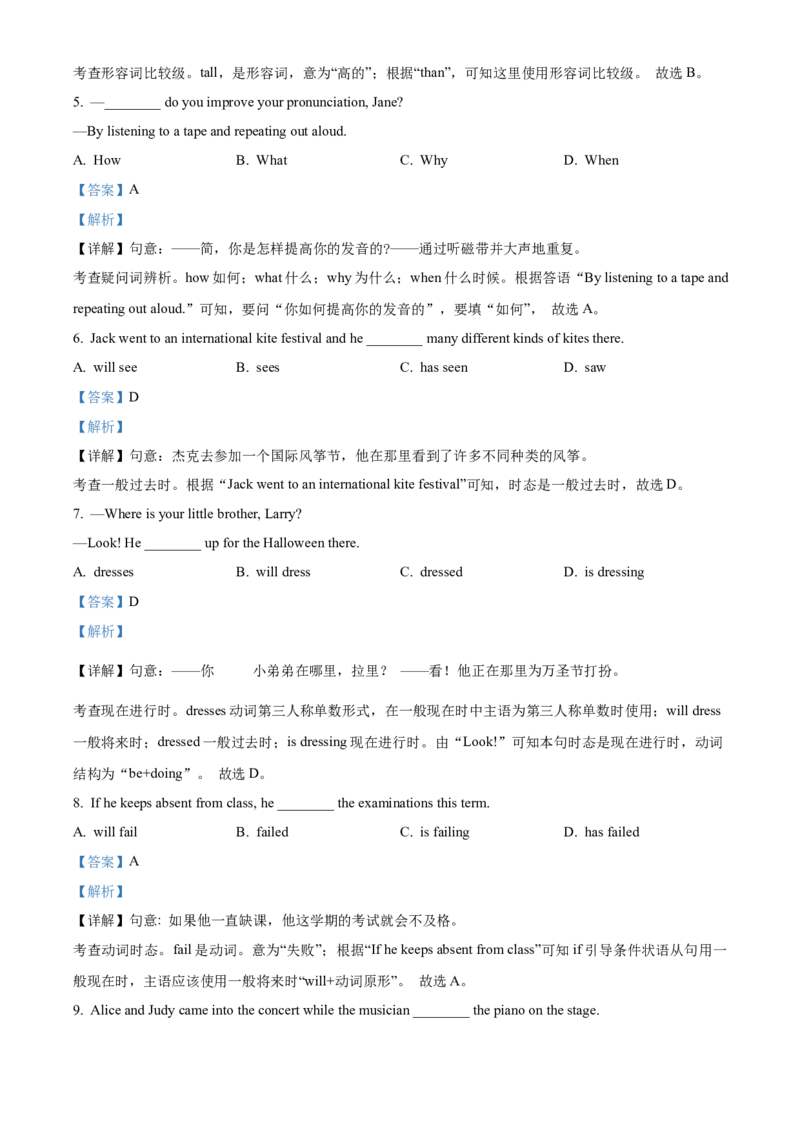
How about Velcro? Velcro is useful because it can hold just about anything together.
The scientist who invented Velcro got the idea when he went hiking. He noticed that
little burrs were sticking to his clothes. A burr is a small, rough seed Velcro(籽)
that sticks to things. The scientist looked at the burr in his microscope. He noticed that
it had tiny hooks(钩). He thought that he could make a clothing material that had
similar tiny hooks. His idea worked, and he created Velcro.
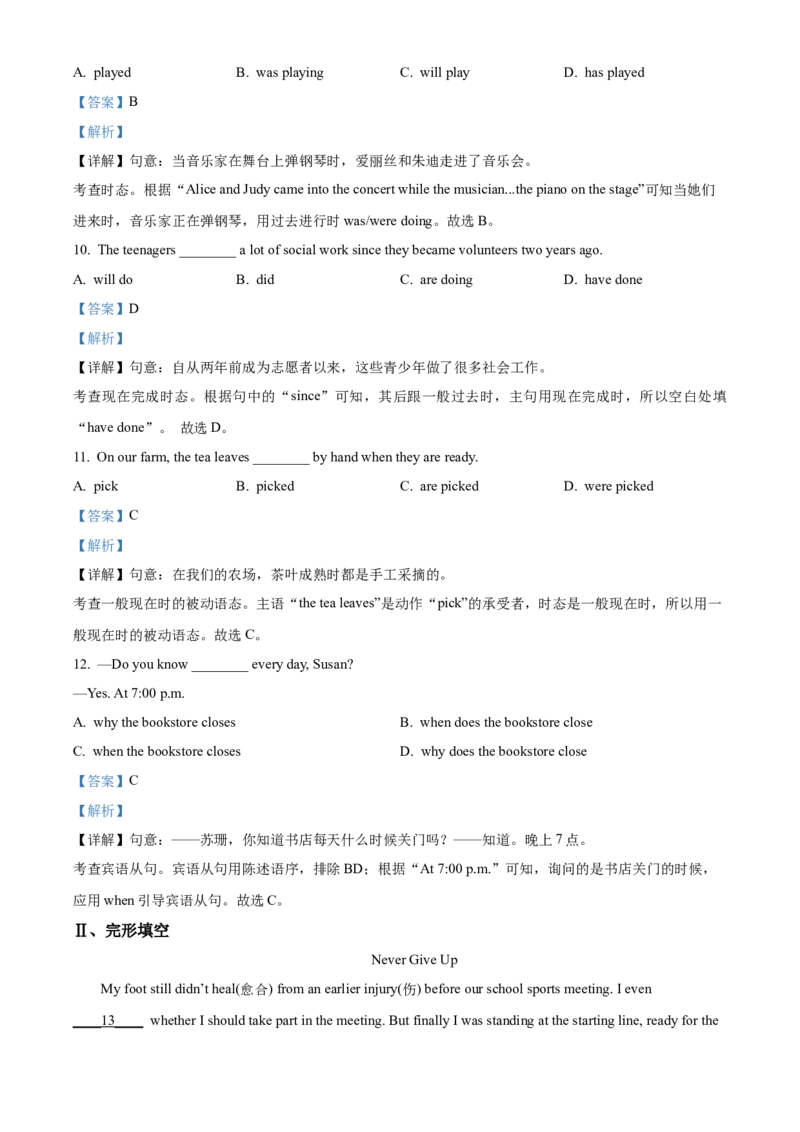
Another invention is aluminum foil(铝箔). Aluminum is a kind of metal.
Aluminum foil is a very thin sheet of metal. A piece of aluminum foil is similar to a
piece of paper. We use aluminum foil to pack things, to cook things, aluminum foil and
to wrap(包裹) food. There are quite a few other things that we use it for.
These little inventions have made life easier. Every time you use some small object like
a pen or a paper clip, remember that it was invented by some clever person a long time
ago.
24. From the inventions in the passage, Velcro can be used for ________.
A. creating super strong glue B. wrapping cooked food
C. posting notes on the board D. sticking things together
25. What does the writer think of the inventions?
A. They have changed our cooking styles. B. They play important parts in our lives.
C. They are all invented by accident. D. They are made of the same materials.
26. What can we know from the passage?
A. Aluminum foil can also be used to cook things.
B. Spenser Silver created a stronger glue by mistake.C. It’s not easy to find Post-it notes in the classroom.
D. The scientist got the idea of Velcro from a zipper.
【答案】24. D 25. B 26. A
【解析】
【导语】本文介绍了生活中一些很有用的小发明。
【24题详解】
细节理解题。根据原文“Velcro is useful because it can hold just about anything together.”可知,魔术贴可以把
任何东西粘在一起。故选D。
【25题详解】
细节理解题。根据原文“These little inventions have made life easier.”可知,它们在我们的生活中扮演着重要
的角色。故选B。
【26题详解】
细节理解题。根据原文“We use aluminum foil to pack things, to cook things, aluminum foil and to wrap(包
裹) food.”可知,铝箔也可以用来做饭。故选A。
C
Spreading Happiness
Jessica Martin and Asherah Weiss are art teachers in a school. They thought their students might have the
magic words that could bring calm to people in difficult times, so they created a project called “Pep Toc” with their
students. The project had two parts—one was setting up a hotline, and the other was making encouraging posters.
The two teachers had the same basic question for all the students: “What could you say to help or encourage
someone else?”
Students working on the hotline thought of what they would like to say. Then Ms. Martin recorded each one,
and divided the recordings into different parts of the telephone hotline. When people call the hotline, they can hear
happy voices of children of different ages sharing positive(积极的) messages. For example, pressing l brings
ideas for people who are “feeling mad or nervous”. Helpful suggestions include: “listen to music” or “go and get a
cookie”. Pressing 2 results in “words of encouragement and life advice”. This includes messages like: “The world
is a better place with you in it.”and “You are okay!” By pressing 3, you can hear a group of children saying
together: “You can do it! Keep trying, don’t give up!”
Other students made encouraging posters and hung them up around the town. Many posters had strips(条)
of paper. When people passed by, they could tear off(撕掉) the strips and take with them. For example, one
poster said “If you are mad, think of positive thoughts.” and had strips reminding people to “Be happy.”
Ms. Martin thought the project would only attract interest from people near the school. But in its first sixweeks, the hotline got 5 million calls from around the world. It has become very popular with stressed adults,
patients in hospitals, and others who just want to hear the happy voices of children. For Martin and Weiss, the
project shows students that small acts can have a big influence. “If you have an idea, just try to do it and see what
happens,” Weiss says. Students now know that they have amazing power. They’re already thinking about new
messages to record for the Pep Toc Hotline.
27. Jessica Martin and Asherah Weiss created the project in order to ________ .
A. encourage their students to take part in art competitions
B. ask their students to work hard to achieve their dreams
C. expect their students to bring pleasure to people in trouble
D. help their students to get good scores on their art exams
28. What is Paragraph 2 mainly about?
A. What could be received from the posters. B. How they worked on their hotline properly.
C. Where people read the posters more easily. D. When the hotline could be telephoned.
29. What does the writer tell us in the last paragraph?
A. The project has made great influence on the people around the world.
B. The posters didn’t attract interest from the people near the school.
C. The hotline hasn’t become popular with the people in the town.
D. The students felt stressed about the development of their project.
【答案】27. C 28. B 29. A
【解析】
【导语】本文介绍了Jessica Martin和Asherah Weiss是一所学校的美术老师。他们和他们的学生创建了一
个名为“Pep Toc”的项目,期望他们的学生能给处于困境中的人们带来快乐。
【27题详解】
细节理解题。根据“They thought their students might have the magic words that could bring calm to people in
difficult times, so they created a project called “Pep Toc” with their students.”(他们认为他们的学生可能有神奇
的语言,可以在困难时期给人们带来平静,所以他们和他们的学生创建了一个名为“Pep Toc”的项目)可
知期望他们的学生能给处于困境中的人们带来快乐。故选C。
【28题详解】
段落大意题。根据“Students working on the hotline thought of what they would like to say. Then Ms. Martin
recorded each one, and divided the recordings into different parts of the telephone hotline. When people call the
hotline, they can hear happy voices of children of different ages sharing positive(积极的) messages. ”(在热线
上工作的学生想到了他们想说的话。然后Martin女士把每一个录音都录了下来,并把录音分成了热线电话的不同部分。当人们拨打热线时, 他们可以听到不同年龄的孩子们分享积极信息的快乐声音。)可知这
段讲述了他们如何正确地运作热线。故选B。
【29题详解】
推理判断题。根据“But in its first six weeks, the hotline got 5 million calls from around the world. It has become
very popular with stressed adults, patients in hospitals, and others who just want to hear the happy voices of
children”(但在开通的前六周,这条热线接到了来自世界各地的500万个电话。它在压力大的成年人、医
院里的病人和其他只想听到孩子快乐声音的人中间非常受欢迎。)可知这个项目对全世界的人们产生了巨
大的影响。故选A。
D
Polite Speech
Different countries and cultures have their own rules of polite speech. When learning a language, it is important to
learn rules of polite speech of the culture in which that language is spoken.
In spoken English, indirect questions are generally considered more formal (正式的) and polite than direct
questions. Indirect questions are questions with extra (额外的) words and phrases to make your questions softer and
less demanding (强求的). Try using some of these phrases to create indirect questions, “Do you know…”, “Can/Could
you tell me…”. When “Where is the bus stop? “ becomes “Do you know where the bus stop is?”, it sounds much
more polite.
It is said that it is easy to recognize (辨别) an impolite question when you’re the person being asked the question,
but not so easy when you’re the one asking the question. What makes a question impolite? Most people would
consider a question impolite if it’s asking them for information that they don’t really want to disclose to others. For
example, in many cultures, it is not polite to ask questions about money. “How much money do you get every month?”
is not good. When unsure, it is best to remember that, if you are meeting someone for the first time, or you don’t
know a person very well yet, keep on the topics like sports, music, hobbies, or other general ones. Avoid topics which
can be more personal to someone, such as money, family, age, health, politics, religion (宗教) .
In the English language, “magic words” are very important in polite speech. “Please” is sometimes referred to
as the “magic word”. When eating out in a restaurant, you’d better say “Check the bill, please.” instead of “Bring me
the bill, waiter!” Another magic word (or phrase) is “thank you”. When using English to ask for things or information,
it is therefore important to use the magic words “please” and “thank you”.
Polite speech is always welcomed, so why not use it? Even if you haven’t used these polite words and phrases
all your life, it’s never too late to start. Practice holding polite conversations with family and close friends until you’re
comfortable. and it feels natural. Gradually, speaking politely will become second nature (天性) to you though itmight seem so difficult to speak politely. Try to speak politely in different situations. This will help you communicate
better with other people.
,
30. If we want to make our questions more polite we should ________ .
A. speak louder to make everyone hear the questions clearly
B. make a good choice of proper places to ask the questions
C. ask questions directly with pleasant expressions on faces
D. add extra words to the questions to make them sound softer
31. The word “disclose” in Paragraph 3 probably means “________”.
A. look up B. make known C. pay attention D. keep away
32. Which of the following is TRUE according to the passage?
A. It’s not easy for the listeners to find out the impolite questions.
B. Some “magic words” play an important role in our polite speech.
C. Personal topics have to be talked about when we meet a stranger.
D. It isn’t necessary to practice polite conversations with our family.
33. What’s the writer’s main purpose in writing this passage?
A. To discuss the advantages of the polite speech.
B. To teach us to use language in different situations.
C. To encourage us to use polite speech in our life.
D. To help us deal with the shyness when we speak.
【答案】30. D 31. B 32. B 33. B
【解析】
【导语】本文作者在这篇文章中鼓励我们在生活中使用礼貌用语。
【30题详解】
细节理解题。根据“In spoken English, indirect questions are generally considered more formal (正式的)
and polite than direct questions. Indirect questions are questions with extra(额外的) words and phrases to make
your questions softer and less demanding(强求的).”可知,在问题中添加额外的单词,使它们听起来更柔和,
这样我们的问题会更礼貌。故选D。
【
31题详解】
词义猜测题。根据“Most people would consider a question impolite if it’s asking them for information that they
don’t really want to disclose to others.”可知,disclose意思是“透露”,即make known“使被知道”。故选
B。
【32题详解】推理判断题。根据“When using English to ask for things or information, it is therefore important to use the
magic words ‘please’ and ‘thank you’.”可知,选项B“一些‘神奇的词汇’在我们的礼貌用语中起着重要的作
用”描述正确。故选B。
【33题详解】
主旨大意题。根据“Try to speak politely in different situations.This will help you communicate better with other
people.”可知,作者在这篇文章中鼓励我们在生活中使用礼貌用语。故选B。
E
The Value of Labor
Can you cook? If so, what are your special dishes?
For middle and primary school students, being able to cook will become a must in the near future. They will
also need to learn how to plant vegetables, repair home electric products, raise animals at home according to the new
curriculum standard(课程标准)for labor(劳动)education.
Starting from this autumn term, students in primary and middle schools need to take courses on labor skills at
least once a week. The labor courses have three types of labor tasks. The first type is everyday chores. It includes
cleaning, organizing, cooking, and using or repairing home electric products. The second type is productive labor. It
includes making traditional handicrafts(手工艺), and using new technologies such as 3D printing and laser(激
光)cutting. The third type is service work. It includes volunteer work in the communities.
The new curriculum also calls for the build of a labor week every school year. Schools should arrange(安
排)a week of off-campus activities. The labor education must be strengthened(加强)to help students develop an
interest in labor and form a strong social responsibility(责任).
Recently, internet users have discussed the changes online. Many welcome such courses and say it is necessary to
teach young students basic life skills. Some have regretted not learning such skills during their own school days.
Liu Fang, a mother of 6-year-old twins in Beijing, is a strong supporter of labor education. For the past year, she
has trained her daughters to do house chores and make simple dishes for the family.
“The main idea is to let them share responsibilities as family members and become independent as early as they
can.” said Liu, “Through doing housework, their hand-eye coordination(协调), time management and organization
skills can be trained and it’s also good to help them relax. My twins have fun in doing chores and are more
independent.”
阅读短文,回答以下各小题。
34. How often do the students need to take labor courses in a term?
_____________________________________________
35. What does the third type of labor courses include?_____________________________________________
36. What is labor education trying to help students do?
_____________________________________________
37. What do you think of having labor courses? Why?
_____________________________________________
【答案】34. At least once a week.
35. Volunteer work in the communities.
36. Labor education trying to help students develop an interest in labor and form a strong social responsibility.
37. I think having labor courses is helpful. Because having labor courses can let me share responsibilities as family
members and become independent as early as I can.
【解析】
【导语】本文是一篇记叙文。文章主要讲述了对于中小学生来说,在不久的将来,会做饭将成为必需品。
根据新的劳动教育课程标准,他们还需要学习如何种植蔬菜、修理家用电器、在家饲养动物。
【34题详解】
根据“Starting from this autumn term, students in primary and middle schools need to take courses on labor skills
at least once a week”可知,从今年秋季学期开始,中小学生每周至少要上一次劳动技能课程。故填At least
once a week.
【35题详解】
根据“The third type is service work. It includes volunteer work in the communities”可知,第三种是服务性工作。
它包括在社区的志愿工作。故填Volunteer work in the communities.
【36题详解】
根据“The labor education must be strengthened(加强)to help students develop an interest in labor and form a
strong social responsibility(责任)”可知,加强劳动教育,培养学生对劳动的兴趣,形成强烈的社会责任
感,由此可知,劳动教育试图帮助学生培养对劳动的兴趣,并形成强烈的社会责任感。故填Labor
education trying to help students develop an interest in labor and form a strong social responsibility.
【37题详解】
通读全文可知,我认为开设劳动课程很有帮助。因为参加劳动课程可以让我为家庭成员分担责任,尽早独
立。故填I think having labor courses is helpful. Because having labor courses can let me share responsibilities as
family members and become independent as early as I can.(此题答案不唯一,合理即可)
Ⅳ、书面表达
38. 假定你是李华,你的英国笔友Chris对中国传统手工艺术很感兴趣,他给你发来邮件,想请你介绍
一种传统手工艺品。请你用英语回复一封邮件,描述你最喜欢的艺术形式及与其相关的文化习俗,如剪纸(papercutting)、泥塑(clay art)、孔明灯(sky lantern)等。
提示词语:be made of, design, shape, symbol, wish
提示问题:
●What is your favorite traditional Chinese art form?
●How are the artworks usually made?
●What do you know about its culture and custom?
Dear Chris,
I’m glad to know that you’re interested in traditional Chinese art forms.
________________________________________________________________________________________
____________________________________________________________________________________________
____________________________________________________________________________________________
____________________________________________________________________________________________
____________________________________________________________________________________________
_____________________
I hope the above is helpful. Please feel free to ask for more information.
Yours,
Li Hua
【答案】例文:
Dear Chris,
I’m glad to know that you’re interested in traditional Chinese art forms. There are different kinds of art forms
in China. You can find beauty in them. Now let me introduce paper cutting to you.
As we all know that paper cutting is one of the most popular traditional art forms in China. It has the history of
over 1500 years. It is not only interesting but also beautiful. It is easy for us to make paper cutting. You only need a
pair of scissors and some paper. We can use them to cut out different shapes we like, such as animals, flowers and
so on. What’s more, I like it because it represents good luck and best wishes for the future. People use them to
decorate their houses. It’s also used to celebrate the festival. How interesting paper cutting is!
I hope the above is helpful. Please feel free to ask for more information.
Yours,
Li Hua
【解析】
【详解】[总体分析]
①题材:本文是一篇应用文,为电子邮件;②时态:时态为“一般现在时”;
③提示:写作要点已给出,考生应注意不要遗漏,适当增加细节完整表述内容。
[写作步骤]
第一步,介绍自己感兴趣的一种艺术形式;
第二步,介绍剪纸的历史,用处以及意义。
[亮点词汇]
①not only…but also 不但……而且……
②cut out 切断,剪出
③such as 例如
④be used to do sth 被用来做某事
[高分句型]
①There are different kinds of art forms in China.(there be句型)
②As we all know that paper cutting is one of the most popular traditional art forms in China.(“one of the+形容词
最高级+复数名词”的结构)
39. 某英文网站正在开展以“自主学习(autonomous learning)”为主题的征文活动,假定你是李华,
请用英语写一篇短文投稿,谈谈你在自主学习方面有哪些具体做法,取得了什么效果。
提示词语:plan, prepare, review, read, progress
提示问题:
●How do you learn by autonomous learning?
●What have you achieved?
It’s very important for us to learn by autonomous learning in our life.
____________________________________________________________________________________________
____________________________________________________________________________________________
____________________________________________________________________________________________
____________________________________________________________________________________________
____________________________________________________________________________________________
__________
【答案】例文
It’s very important for us to learn by autonomous learning in our life. Autonomous learning is a kind of
learning mode, a kind of ability for learners to manage themselves. It is also a way for teenagers to face the world
and future.
When I studied by myself, I planned my study by making a to-do list. I managed time so that I can make fulluse of it. I also made good preparation before every class. After school, I reviewed what I had learned before doing
homework. I downloaded some useful apps in order to get more learning resources. The learning tools can help me
improve my study. In my spare time, I like reading in the city library.
I get many benefits from autonomous learning. I have improved my learning ability a lot. I have become more
confident. Besides, I have become more interested in learning.
【解析】
【详解】[总体分析]
①题材:本文是一篇说明文,属于材料作文写作;
②时态:时态为“一般过去时”、“一般现在时”和“现在完成时”;
③提示:文章开头以及要点已经给出,按照提示的要点逐点阐述,可以适当增加细节,并突出写作重点。
[写作步骤]
第一步,承接短文开头,引出话题,说明自主学习的重要性;
第二步,结合具体事例说明你在自主学习方面有哪些具体的做法,可适当增加细节;
第三步,说明自主学习带来的收获并书写结语。
[亮点词汇]
①a way to do sth做某事的一种方法
②make full use of充分利用
③in order to do sth为了做某事
④get benefits from从……中获益
[高分句型]
①When I studied by myself, I planned my study by showing the learning goals.(when引导时间状语从句)
②I managed time so that I can make full use of it.(so that引导目的状语从句)