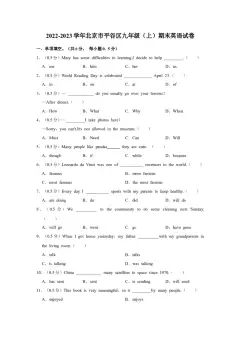
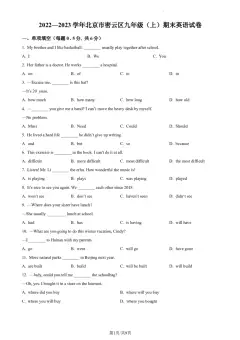
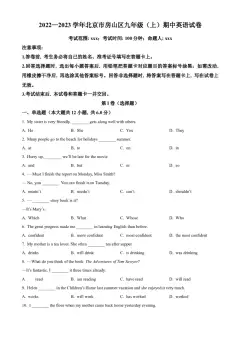
2022-2023 学年北京市平谷区九年级(上)期末英语试卷
一、单项填空。(共6分, 每小题0. 5分)
1. Mary has some difficulties in learning. I decide to help ________.
A. me B. him C. her D. us
.
2 World Reading Day is celebrated ________ April 23.
A. in B. on C. at D. of
3. —________ do you usually go over your lessons?
—After dinner.
A. How B. What C. Why D. When
4. —_________ I take photos here?
—Sorry, you can’t. It’s not allowed in the museum.
A. Must B. Need C. Can D. Will
5. Many people like pandas they are cute.
A. though B. if C. while D. because
6. Leonardo da Vinci was one of ________ inventors in the world.
A. famous B. more famous C. most famous D. the most famous
7. Every day I __________ sports with my parents to keep healthy.
A. am doing B. do C. did D. will do
8. We ________ to the community to do some cleaning next Sunday.
A. will go B. went C. go D. have gone
9. When I got home yesterday, my father ________ with my grandparents in the living room.
A. talk B. talks C. is talking D. was talking
10. China ________ many satellites to space since 1970.
A. has sent B. sent C. is sending D. will send
11. This book is very meaningful, so it ________ by many people.
A. enjoyed B. enjoys C. was enjoyed D. is enjoyed
12. --- Judy, could you tell me_______the schoolbag?
--- Oh, yes. I bought it in a store on the Internet.
.
A where did you buy B. where will you buy
C. where you bought D. where you will buy
二、完形填空。
Ever since my Dad died, my life has changed. My Mom is always really busy at her work, and she doesn’t
第1页/共8页
学科网(北京)股份有限公司spend much time with me anymore. I have to go to a daycare every day after school.
One day, at dinner time, I asked Mom if we could go to the ___13___ together. “Can we please go to the fair
this Sunday?” I begged.
“Lilly, you know I have to work that day,” Mom told me.
She ___14___ a plate in front of me and kissed my head. It was a delicious piece of cherry pie, which was
my favourite. Then I looked into my Mom’s brown eyes and asked her, “Can’t you take this Sunday off?” Mom
___15___ down next to me and put her hand on my shoulder.
“Sorry, Lilly! I have to go to work that day. “
Tears streamed down my face as I yelled, “You never have time for me!” Then I ran into my room and
slammed the door. I ___16___ on my bed for a long time.
When I got out of my bed and went to the kitchen table where Mom left me a plate of pancakes, I ___17___
found a note under the plate. I grabbed it and read it.It said that Mom was really sorry that she couldn’t take me to
the fair.
After Mom came back home that day, she put me down on the couch and had a ___18___ with me. She said,
“Lilly! I go to work so much not because I like it, but because I have to make money that can pay for food and
clothes. It was much ___19___ when your Dad was not around. But now I’ve decided to take weekends off, and
tomorrow I’m taking you to the fair.”
“Really?” I smiled.
“Really.” Mom ___20___ as she held me close and rocked me back and forth. Then she tapped me on my
nose and said, “I love you, Lilly.” I laughed, “I love you too, Mom... And you are the best Mom forever!”
.
13 A. zoo B. park C. fair D. gym
14. A. kept B. placed C. washed D. covered
15. A. sat B. went C. fell D. wrote
16. A. glued B. calmed C. cried D. slept
17. A. luckily B. carefully C. quietly D. suddenly
18. A. rest B. talk C. walk D. meal
19. A. safer B. harder C. easier D. busier
20. A. nodded B. argued C. shouted D. cried
三、阅读下列短文, 根据短文内容, 从短文后各题所给的A、B、C、D四个选项中, 选择最
佳选项。(共26分, 每小题6分)
A
第2页/共8页
学科网(北京)股份有限公司McKenna is in third grade. She likes going to the beach and learning about the world. The followings are her
favourite things that she shared with her classmates. Please match the following sentences with her favourite things.
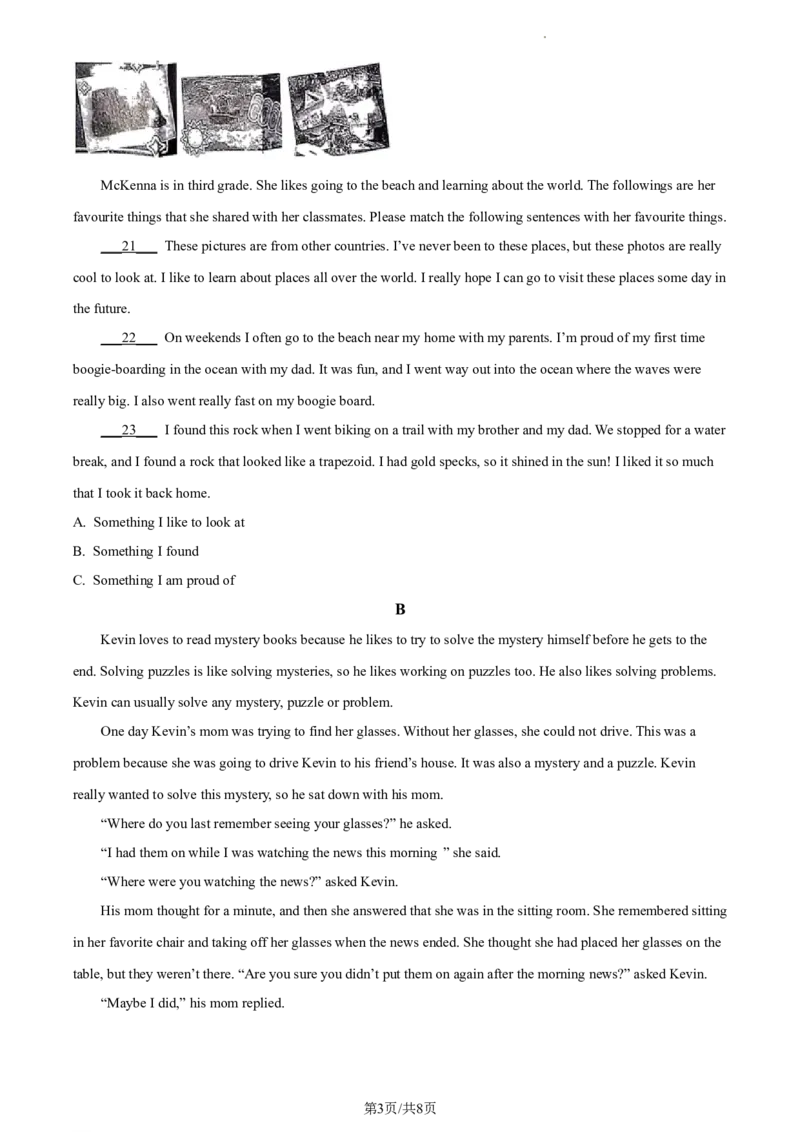
___21___ These pictures are from other countries. I’ve never been to these places, but these photos are really
cool to look at. I like to learn about places all over the world. I really hope I can go to visit these places some day in
the future.
___22___ On weekends I often go to the beach near my home with my parents. I’m proud of my first time
boogie-boarding in the ocean with my dad. It was fun, and I went way out into the ocean where the waves were
really big. I also went really fast on my boogie board.
___23___ I found this rock when I went biking on a trail with my brother and my dad. We stopped for a water
break, and I found a rock that looked like a trapezoid. I had gold specks, so it shined in the sun! I liked it so much
that I took it back home.
A. Something I like to look at
B. Something I found
C. Something I am proud of
B
Kevin loves to read mystery books because he likes to try to solve the mystery himself before he gets to the
end. Solving puzzles is like solving mysteries, so he likes working on puzzles too. He also likes solving problems.
Kevin can usually solve any mystery, puzzle or problem.
One day Kevin’s mom was trying to find her glasses. Without her glasses, she could not drive. This was a
problem because she was going to drive Kevin to his friend’s house. It was also a mystery and a puzzle. Kevin
really wanted to solve this mystery, so he sat down with his mom.
“Where do you last remember seeing your glasses?” he asked.
,
“I had them on while I was watching the news this morning ” she said.
“Where were you watching the news?” asked Kevin.
His mom thought for a minute, and then she answered that she was in the sitting room. She remembered sitting
in her favorite chair and taking off her glasses when the news ended. She thought she had placed her glasses on the
table, but they weren’t there. “Are you sure you didn’t put them on again after the morning news?” asked Kevin.
“Maybe I did,” his mom replied.
第3页/共8页
学科网(北京)股份有限公司“Let’s walk through your day, Mom,” said Kevin. Kevin had his mom describe everything she remembered
doing during the day so far. She mentioned watching the news, making breakfast, folding laundry, working in her
home office and then gardening. It was after gardening that she started looking for her glasses. After hearing about
his mom’s day, Kevin retraced her path through the house and yard. He looked under the cushion (垫子) of her
favorite chair, in the kitchen, in the laundry basket, in her office and around the garden. He didn’t find her glasses.
Kevin didn’t want to give up, so he looked in each place again and he looked even harder. When he went
around the kitchen again, he opened the cabinets(橱柜)instead of just looking on the counters. Kevin solved the
mystery, the puzzle and the problem. He found his mom’s glasses in the drawer with the silverware. “Thank you,
Kevin,” said his mom, “I wouldn’t be able to see anything without you.”
24. What was Kevin’s mom trying to find?
A. Her glasses. B. Her books. C. Her chairs. D. Her keys.
25. Where did Kevin find them for her mom?
A. On the table. B. In the yard. C. In the drawer. D. On the Internet.
26. How did Kevin help her mom find them?
A. By reading mystery books. B. By following her day’s path.
C. By looking for it in his house with his friends. D. By walking around his house with his mom.
C
When it comes to internet safety for kids, one important aspect that must be addressed is social media sites.
Social media sites such as Facebook can be a great way for kids to interact with each other. But it’s also important
for parents to be aware of(意识到)the negative effects and dangers of being on such sites.
Here are some tips to keep in mind about how to keep kids safe on social media sites. Think of the Internet as a
Big, Open Space. You wouldn’t drop your child off at a big public place like a mall for the day and expect everyone
he meets to treat him with kindness and protect his best interests, would you? That is a good analogy(类比)for
What happens when a child goes online unsupervised. Be sure to keep a close eye on exactly who your child is
talking to and when.
Be aware of the possibility for bullying(欺负). While it is probably the case that many children online will
have pleasant interactions with friends and peers, for the most part, the truth is that bullying—both online and off—is
a reality among children. When you have more opportunity for social interaction, you have more opportunity for
rejection or bullying by peers. Keep an eye out for signs that your child may be the one who is bullied, and educate
yourself about bullying in school.
Know about something called facebook depression(抑郁症). Researchers say looking at Instagram or
Facebook posts of happy events in others’ lives can make some kids with poor self-esteem(自尊)feel even worse.
第4页/共8页
学科网(北京)股份有限公司That makes a certain amount of sense when you consider the fact that people tend to post happy news and photos of
themselves at parties on social media sites. Be sure to explain to your child that what he sees on social media sites is
definitely not what a person’s everyday real life is. People are not likely to post news about failures or mistakes or
times when they are not feeling good about themselves. Images of shiny, happy people on such sites tell only a small
pair of the much bigger story.
27. What can we learn from the passage?
A. Social media sites are very good for kids.
B. Happy events in others’ lives can influence some kids with poor self-esteem.
C. Kids have more opportunities for bullying by peers at school.
D. Happy photos posted on social media sites are people’s real life.
28. The word “unsupervised” in Paragraph 2 probably mean “________”.
A. not to be with B. not under watch and direct
C. not looked for D. not thought and learned
29. Which of the following would be the best title for the passage?
A. Learning about Social Media B. Talking about Social Media
C. Helping Your Kid with Social Media D. Keeping Your Kid Safe on Social Media
C
Just like a detective following clues that lead to the perpetrator (罪犯) of a crime, you as a reader must use
context (语境) clues within a text passage to tell the meaning of unfamiliar vocabulary.Context clues are simply
hints (提示) or additional information the author provides that can help you understand the meaning of a difficult
word or phrase.These clues can be found in the same sentence as the vocabulary word or elsewhere in the passage,
so be on the lookout whenever a new term presents itself.
With reading comprehension (理解) being as important to all aspects of life as it is today, it’s no wonder that
language skills such as vocabulary are emphasized (强调). You will most definitely meet vocabulary questions in
the reading parts of tests, and you’re going to have to use some skills to get you through.
Understanding how various types of context clues work can help you to understand difficult vocabulary
words, even those brand new to you.There may be some words you can’t completely understand in a text, but you
shouldn’t let that discourage you.Inside the passage, where all the interesting clues of vocabulary lie, you can figure
challenging words out.
Context clues are also helpful when you’re trying to work out the main idea of a passage or struggling to make
inferences (推断) about meaning because unknown words can help connect the dots in useful ways.
Every author writes differently, so a number of different types of context clues can be found in reading
第5页/共8页
学科网(北京)股份有限公司passages.Some authors offer very little explanation for difficult words, throwing difficult vocabulary into their
writing wherever they can with little or no help, other authors carefully create their passages to make sure readers
follow every step of the way, and most are somewhere in the middle.No matter what degree of help you’re given,
context clues are your friend.
Generally, context clues can be grouped into four types:
•Definitions (定义) or restatements
•Synonyms (同义词)
•Antonyms or opposites
•Examples or explanations
After examining the context of a passage for clues, you should have at least a vague (模糊的) idea of what an
unknown vocabulary word means.Use your estimate (估计) to come up with synonyms for the new word, then try
these out in the sentence to see if it still makes sense. If not, keep searching for hints until you’ve found something
that works.
30. According to the passage, context clues are ________.
A. the skills of guessing new words
B. the meanings of unfamiliar vocabulary words
C. additional information that explains the meanings of unknown words
D. the hints that help you understand the meaning of a difficult passage
31. What are Paragraph 3 and Paragraph 4 mainly about?
A. What context clues mean. B. Where context clues come from.
C. How we benefit from context clues. D. Why we are discouraged by context clues.
32. What can we learn from the passage?
A. Reading is more important than language skills.
B. You will never meet vocabulary questions in the reading tests.
C. Different types of context clues can be found because of different writing styles.
D. Context clues are only used for working out unfamiliar words.
33. What is the writer’s main purpose in writing the passage?
A. To tell the importance of reading comprehension.
B. To help us know the context clues and use them to solve vocabulary problems.
C. To compare different ways to find out context clues in a text passage.
D. To discuss the meanings of unfamiliar vocabulary words.
阅读短文,根据短文内容回答问题。
第6页/共8页
学科网(北京)股份有限公司The Spring Festival is the most important festival for the Chinese people. Many customs accompany Spring
Festival. Some are still followed today, but others have weakened.
Before the New Year comes, Chinese people completely clean the indoors and outdoors of their homes as well
as their clothes, bedclothes and all their utensils (用具). Then people begin decorating their cleaned rooms. All the
door panels will be pasted (粘贴) with Spring Festival couplets, highlighting Chinese calligraphy(书法) with black
characters on red paper. The content varies from house owners’ wishes for a bright future to good luck for the New
Year. Also, pictures of the god of doors and wealth will be posted on front door to ward off evil (邪恶) spirits and
welcome peace.
The Chinese character “fu” (meaning blessing or happiness) is a must. The character put on paper can be
pasted normally or upside down, for in Chinese the “reveled fu” is homophonic(谐音)with “fu comes”, both being
pronounced as ‘‘fudaole’’. What’s more, two big red lanterns can be raised on both sides of the front door. Red
paper-cuttings can be seen on window glass and brightly colored New Year paintings with auspicious (吉利的)
meanings may be put on the wall.
People attach great importance to Spring Festival Eve. At that time, all family members eat dinner together.
The meal is more luxurious than usual. Dishes such as chicken, fish and bean curd cannot be excluded (把……排
除在外), for in Chinese, their pronunciations, respectively “ji”, a “yu” and a “doufu”, mean auspiciousness,
abundance and richness. After the dinner, the whole family will sit together, chatting and watching TV. In recent
years, the Spring Festival party broadcast on China Central Television Station (CCTV) is important entertainment
for the Chinese both at home and abroad. According to custom, each family will slay up to see the New Year in.
Burning fireworks was once the most typical custom on the Spring Festival. People thought the spluttering
sound could help drive away evil spirits. However, such an activity was completely or partially forbidden in big
cities once the government took security, noise and pollution factors into consideration. As a replacement, some
buy tapes with firecracker sounds to listen to, some break little balloons to get the sound too, while others buy
firecracker handicrafts to hang in the living room.
34. When do people usually clean and decorate their houses?
__________________________________________
35. Where do people usually put red paper-cuttings?
__________________________________________
.
36 What do people usually do after dinner on Spring Festival Eve?
第7页/共8页
学科网(北京)股份有限公司__________________________________________
37. What do you think is the most important for the Spring Festival? Why?
__________________________________________
五、文段表达。(共10分)
38. 假如你是李华,你们学校正在组织观看“天宫课堂”太空授课活动。你们班交换生Peter给你发邮件
询问相关事情。请用英语回复一封邮件,告诉他观看的时间和地点,以及需要做什么准备。
要求:根据中文和英文提示,完成一篇不少于50词的文段写作。文中已给出内容不计入总词数。所给提示
词语仅供选用。请不要写出你的校名和姓名。
提示词语:lab, online, notebook, questions
提示问题:●When and where will you watch the class?
● What do you advise Peter to prepare for it?
Dear Peter,
How is it going?
Our school will organize us to watch the Tiangong Class.
____________________________________________________________________________________________
____________________________________________________________________________________________
____________________________________________________________________________________________
____________________________________________________________________________________________
____________________________________________________________________________________________
_____________________________
If there is anything that I can do, please let me know.
Yours,
Li Hua
第8页/共8页
学科网(北京)股份有限公司