文档文本内容
英语(基础卷02)
六年级英语下学期期中素养测评(译林版三起)
参考解析
听力部分
一、听句子, 选出你所听到的单词。(录音听两遍) (每小题1分,共5分)
A C A A B
1.Lily never drinks cola.
2.You should put your things in order.
3.There were many mice in the house long long ago.
4.We must follow the rules of the game.
5.Mike went to bed late last night .He feels sleepy today.
二、听句子,用数字1-5给下列图片排序。(录音听两遍) (每小题1分,共5分)
2 5 3 4 1
1.My bedroom is clean and tidy.
2.The red light means you must stop.
3.They are reading books quietly.
4.Mike likes drinking water.
5.There are a few apples on the table.
三、听录音,选择合适的答语。(录音听两遍) (每小题2分,共10分)
C C A B A
1. How can you help me?
2.When does Lily get up every day?
3. Where's the bus stop?
4. What do you have for breakfast?
5. Can we run fast on the busy road?
四、听短文, 选择正确答案。(录音听两遍) (每空2分,共10分)
C B A B C
In 1923, people in America first used a traffic light. It was a little different from today’s trafficlight. It had two parts. One said “Go” and the other said “Stop”. When people saw “Go”,they could
cross the road. In 1951, people first walked on a zebra crossing in England. A zebra crossing is white
and black. The drivers can see it easily. People walk on a zebra crossing when they cross the road.
This can keep them safe from cars.
笔试部分
五、根据首字母提示补全单词,完成句子。 (每小题1分,共5分)
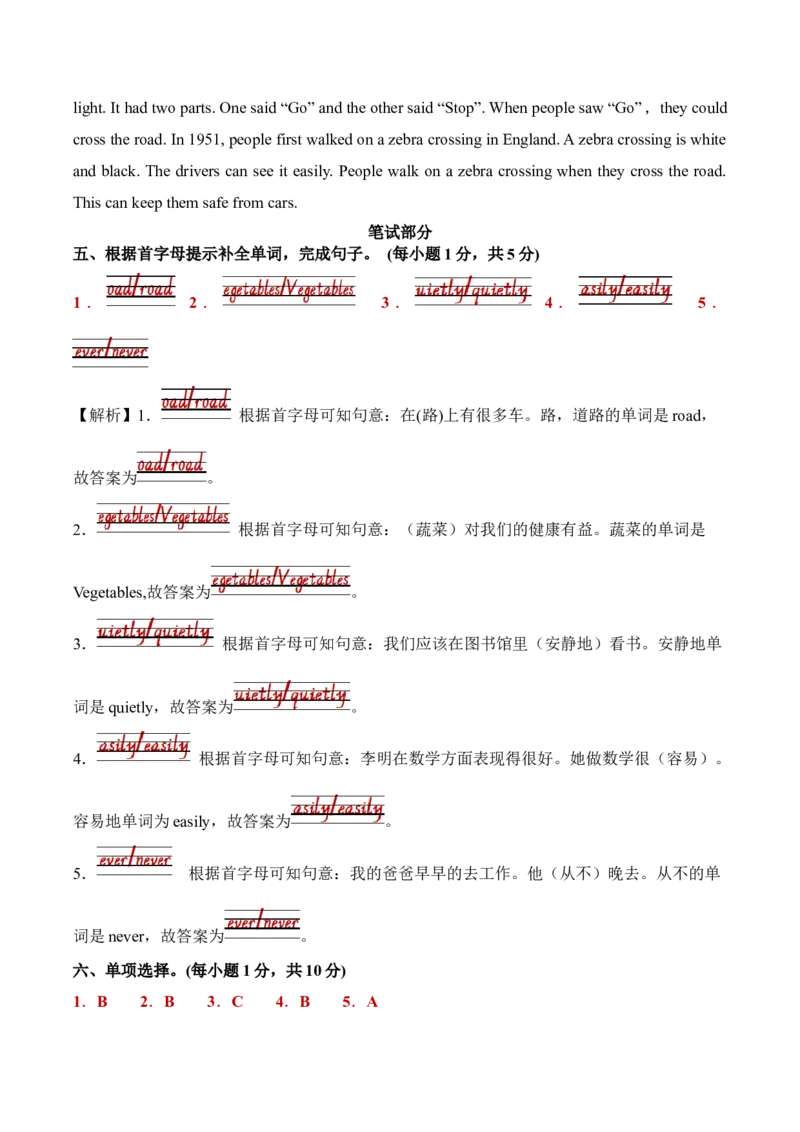
1 . 2 . 3 . 4 . 5 .
【解析】1. 根据首字母可知句意:在(路)上有很多车。路,道路的单词是road,
故答案为 。
2. 根据首字母可知句意:(蔬菜)对我们的健康有益。蔬菜的单词是
Vegetables,故答案为 。
3. 根据首字母可知句意:我们应该在图书馆里(安静地)看书。安静地单
词是quietly,故答案为 。
4. 根据首字母可知句意:李明在数学方面表现得很好。她做数学很(容易)。
容易地单词为easily,故答案为 。
5. 根据首字母可知句意:我的爸爸早早的去工作。他(从不)晚去。从不的单
词是never,故答案为 。
六、单项选择。(每小题1分,共10分)
1.B 2.B 3.C 4.B 5.A6.C 7.A 8.B 9.A 10.B
1.B
【解析】根据Six years ago 可知时态是一般过去时,动词要用过去式,故选B。
2.B
【解析】根据答语“You can take the bus.” 可知在询问出行方式,要用How 提问,故选B。
3.C
【解析】由答语中的did 可知时态为一般过去时,问答句时态须保持一致,故选C。
4.B
【解析】water 是不可数名词,A 选项修饰可数名词,C 选项用于否定句和一般疑问句中,
故选B。
5.A
【解析】由“My grandpa is 85 years old.” 可推测走得速度慢,walk 为动词,用副词修饰,故
选A。
6.C
【解析】on time 意为“准时”,根据句意“你应该……吃午饭。”,可知故选C。
7.A
【解析】用do 提问就要用do 回答,再结合情景可知是肯定回答,故选A。
8.B
【解析】句意“当你打碎瓶子时你应该当心玻璃。”,A 选项意为“寻找”,C 选项意为
“照顾”,和句意不符,故选B。
9.A
【解析】根据句子中的“She is the first to school.”可以推断,姐姐早上起得很早,故选A。
10.B
【解析】一空前是some,其后接可数名词复数,故一空为tomatoes;二空处的tomato 修饰
soup,不需变形,故选B。
七、用所给单词的正确形式填空。(每小题2分,共10分)
1.excited;excitedly 2.flies 3.teeth 4.cities 5.shouldn't
【解析】
1.excited;excitedly 第一个空:形容词 excited(兴奋的),修饰主语“the boy”,跟在系
动词 was后。第二个空:副词 excitedly(兴奋地),修饰动词 laughed。需将形容词 excited变为副词形式。故答案为excited;excitedly。
2.flies 主语Mike是第三人称单数,一般现在时,动词 fly需加 -s,变为 flies。故答案为
flies。
3.teeth tooth(牙齿)的复数形式为不规则变化teeth。故答案为teeth。
4.cities city(城市)的复数形式为 cities(以辅音字母 + y结尾,变y 为i 再加-es)。故
答案为cities。
5.shouldn't 根据句意“但我们不应害怕它”,需用should的否定形式 shouldn’t。故答案为
shouldn't。
八、根据中文提示, 补全句子。(每小题1分,共5分)
1.played;happily 2.Swimming is good for 3.felt hungry
4.only ate a little 5.not safe
1.played;happily
【解析】句子描述的是过去的事件,因此动词用过去式 played, 开心地对应副词happily,修
饰动词played。故答案为played;happily。
2.Swimming is good for
【解析】动名词 Swimming 作主语,表示一项活动。 “对……有益” 固定搭配为 is good
for。故答案为Swimming is good for。
3.felt hungry
【解析】感到饿译为felt hungry,felt 是过去式(时间状语 this morning 表示过去)。 故答
案为felt hungry。
4.only ate a little
【解析】原句中的 “只吃了一点”需用过去式 ate,a little 修饰不可数名词 rice,表示少量。
因此答案为 only ate a little。
5.not safe
【解析】“不安全的” 译为not safe,表示否定。故答案为not safe。
九、按要求完成下列各题。(每小题2分,共10分)
1.How ;catch 2.never;late 3.Does;have any 4.is crossing;road safely 5.
doesn’t;have
1.How ;catch【解析】画线部分为“with a large net”(用一张大网),表示方式,需用疑问词How提问。
原句时态为一般过去时,疑问句需用助动词 did,动词恢复原形 catch。故答案为
How;catch。
2.never;late
【解析】always go early(总是很早去)与never go late(从不迟到)逻辑上等价,需用 never
和 late 转换。never置于动词前,late 作副词修饰动作。 故答案为never;late。
3.Does;have any
【解析】 一般疑问句需用助动词 Does(主语为第三人称单数),动词恢复原形 have。肯定
句中的some在疑问句中需改为any。 故答案为Does; have any。
4.is crossing;road safely
【解析】将两句话合并时,需用副词 safely 修饰动词 crossing,表示“安全地过马路”。故
答案为is crossing;road safely。
5.doesn’t;have
【解析】否定句需用助动词 doesn’t(第三人称单数),动词恢复原形 have。故答案为
doesn’t;have。
十、选择合适的选项,补全对话。(每空2分,共10分)
1.D 2.E 3.A 4.C 5.B
1.D
【解析】
Mike的回答是肯定的一般疑问句,因此问题应为Yes/No问句。
选项D "Do you have a healthy diet?"(你有健康的饮食吗?)符合语境,因为后续对话围绕饮
食展开。故选D。
2.E
【解析】根据下一句“I often have an egg and a glass of milk. ”回答内容明确提到早餐的具体
食物,因此问题应询问早餐内容。选项E "What do you have for breakfast?"(你早餐吃什么?)
直接对应回答。故选E。
3.A
【解析】根据下一句“I often have some rice, vegetables, and meat for lunch and dinner. ”回答
提到午餐和晚餐的饮食,因此问题应转向这两餐。选项 A"What about lunch and dinner?"(那
午餐和晚餐呢?)自然引出后续内容。故答案为A。4.C
【解析】回答中的"Yes, I do."需对应一个关于喜好的问题,且提到冰淇淋对牙齿不好。
选项C"Do you like eating ice cream?"(你喜欢吃冰淇淋吗?)符合逻辑。 故选C。
5.B
【解析】回答需体现“虽然喜欢冰淇淋,但控制摄入量”。 选项 B "But I eat a little at a
time."(但我一次只吃一点。)通过转折词"But"衔接,说明节制,符合语境 ,故选B。
十一、阅读短文, 根据短文内容选择最佳答案。(每小题2分,共10分)
1.B 2.A 3.C 4.C 5.A
【导语】短文介绍了不同国家的交通处罚。
【解析】
1.B 根据前文提到的“traffic penalties(交通处罚)” 可知应该是违反交通规则,故选
B。
2.A 根据“ In Indonesia, if the driver breaks the traffic rules, he will get a fine(罚款)first.
Then he must cut his hair.” 可知在印度尼西亚违反交通规则会剪头发,故选A。
3.C 根据“In Colombia, if the driver breaks the traffic rules, he has to see lots of
movies about traffic accidents(事故).” 可知在哥伦比亚违反交通规则后会看关于交通事故
的影片,故选C。
4.C 根据“In the USA, the driver will be a nurse if he breaks the traffic rules. He has
to look after the wounded in the hospital.” 可知美国司机违反交通规则后会作为护士在医
院照顾伤员,故选C。
5.A 根据“Anyway, wherever we go(无论去哪里), we need to follow the local traffic
rules.” 可知作者是想让我们遵守交通规则,故选A。
十二、书面表达。(10分)
例文:
Being a good student
To be a good student, we should do a lot of things. We should go to bed and get up
early. We should put our things in order. We should listen to the teachers at school. We
should have a healthy diet. We should eat some rice, some meat, some fish, some
vegetables and some fruit every day. We should follow the traffic rules. We should study
hard to make our dreams come true.