文档文本内容
英语(提高卷02)
六年级英语下学期期中素养测评(译林版三起)
参考解析
听力部分
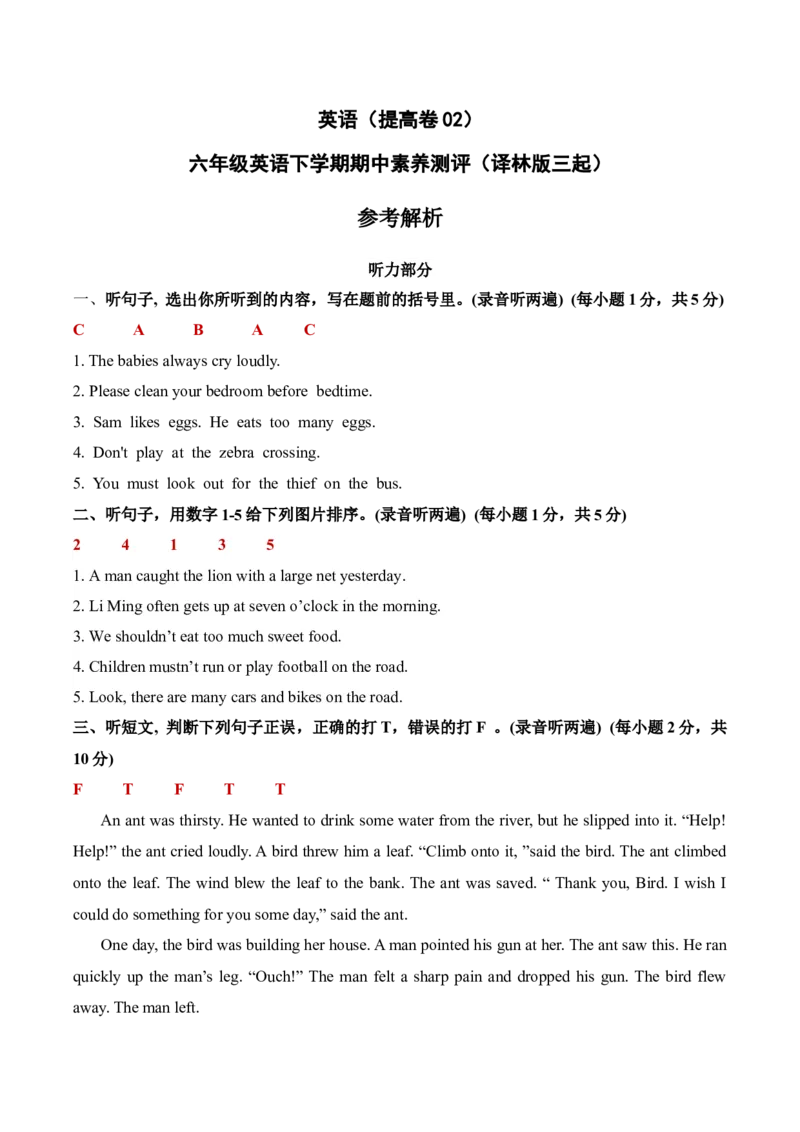
一、听句子, 选出你所听到的内容,写在题前的括号里。(录音听两遍) (每小题1分,共5分)
C A B A C
1. The babies always cry loudly.
2. Please clean your bedroom before bedtime.
3. Sam likes eggs. He eats too many eggs.
4. Don't play at the zebra crossing.
5. You must look out for the thief on the bus.
二、听句子,用数字1-5给下列图片排序。(录音听两遍) (每小题1分,共5分)
2 4 1 3 5
1. A man caught the lion with a large net yesterday.
2. Li Ming often gets up at seven o’clock in the morning.
3. We shouldn’t eat too much sweet food.
4. Children mustn’t run or play football on the road.
5. Look, there are many cars and bikes on the road.
三、听短文, 判断下列句子正误,正确的打T,错误的打F 。(录音听两遍) (每小题2分,共
10分)
F T F T T
An ant was thirsty. He wanted to drink some water from the river, but he slipped into it. “Help!
Help!” the ant cried loudly. A bird threw him a leaf. “Climb onto it, ”said the bird. The ant climbed
onto the leaf. The wind blew the leaf to the bank. The ant was saved. “ Thank you, Bird. I wish I
could do something for you some day,” said the ant.
One day, the bird was building her house. A man pointed his gun at her. The ant saw this. He ran
quickly up the man’s leg. “Ouch!” The man felt a sharp pain and dropped his gun. The bird flew
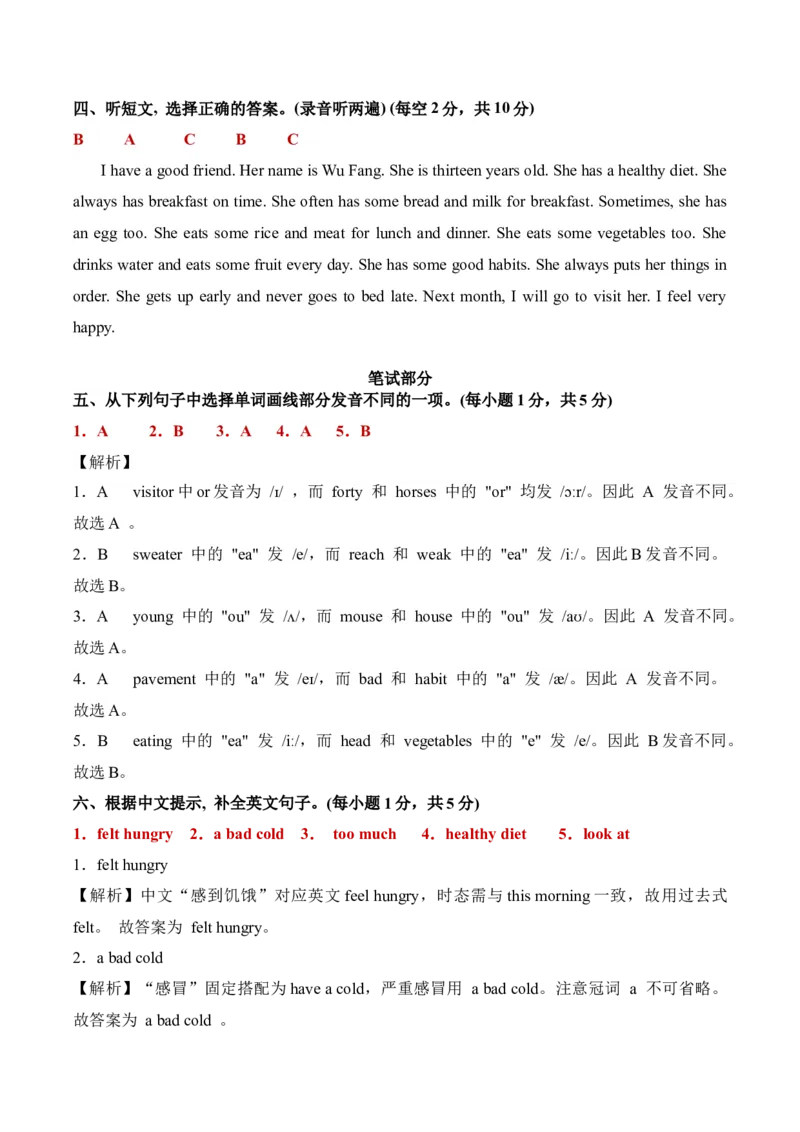
away. The man left.四、听短文, 选择正确的答案。(录音听两遍) (每空2分,共10分)
B A C B C
I have a good friend. Her name is Wu Fang. She is thirteen years old. She has a healthy diet. She
always has breakfast on time. She often has some bread and milk for breakfast. Sometimes, she has
an egg too. She eats some rice and meat for lunch and dinner. She eats some vegetables too. She
drinks water and eats some fruit every day. She has some good habits. She always puts her things in
order. She gets up early and never goes to bed late. Next month, I will go to visit her. I feel very
happy.
笔试部分
五、从下列句子中选择单词画线部分发音不同的一项。(每小题1分,共5分)
1.A 2.B 3.A 4.A 5.B
【解析】
1.A visitor中or发音为 /ɪ/ ,而 forty 和 horses 中的 "or" 均发 /ɔːr/。因此 A 发音不同。
故选A 。
2.B sweater 中的 "ea" 发 /e/,而 reach 和 weak 中的 "ea" 发 /iː/。因此B发音不同。
故选B。
3.A young 中的 "ou" 发 /ʌ/,而 mouse 和 house 中的 "ou" 发 /aʊ/。因此 A 发音不同。
故选A。
4.A pavement 中的 "a" 发 /eɪ/,而 bad 和 habit 中的 "a" 发 /æ/。因此 A 发音不同。
故选A。
5.B eating 中的 "ea" 发 /iː/,而 head 和 vegetables 中的 "e" 发 /e/。因此 B发音不同。
故选B。
六、根据中文提示, 补全英文句子。(每小题1分,共5分)
1.felt hungry 2.a bad cold 3. too much 4.healthy diet 5.look at
1.felt hungry
【解析】中文“感到饥饿”对应英文 feel hungry,时态需与this morning一致,故用过去式
felt。 故答案为 felt hungry。
2.a bad cold
【解析】“感冒”固定搭配为have a cold,严重感冒用 a bad cold。注意冠词 a 不可省略。
故答案为 a bad cold 。3.too much
【解析】“太多”修饰不可数名词(meat)时用too much,故答案为too much。
4.healthy diet
【解析】“饮食”对应diet,作可数名词,需加冠词 a,形容词healthy 修饰名词,表示“健
康的”。
5.look at
【解析】“看” 强调动作时用look at,故答案为look at。
七、单项选择。(每小题1分,共10分)
1.A 2.C 3.A 4.C 5.A
6.C 7.C 8.B 9.C 10.A
1.A
【解析】in a healthy diet 是固定短语,意为“在健康的饮食中”,故选A。
2.C
【解析】由any 可知该句是否定句,traffic lights 是复数,be 动词要用are,又根据“three
years ago”可知是一般过去时,故选C。
3.A
【解析】there be 句型遵循就近原则。选项中的vegetables 是复数,fruit 是单数,故选A。
4.C
【解析】be 后加形容词,故一空为sad,二空前的smile 是动词,其后要用副词修饰,故选
C。
5.A
【解析】look for 是“寻找”的意思,由now 可知本句为现在进行时,故选A。
6.C
【解析】It 是第三人称单数,其后动词用第三人称单数形式,故第一空填means;再结合前
句“Look at the green man.” 和生活常识可知绿灯可以走,故选C。
7.C
【解析】此处不定式表目的。keep后面加形容词,故选C。
8.B
【解析】结合生活实际可知在英国,人们在道路的左侧行驶,on the ... side of... 是固定短语,
意为“在……的……边”,故选B。9.C
【解析】run 是动词,其后要用副词修饰,fast形副同形,like doing sth. 是固定结构,意为
“喜欢做某事”,故选C。
10.A
【解析】当想得到对方肯定回答时,在一般疑问句中要用some 表示“一些”,juice 是不可
数名词,要用too much,故选A。
八、用所给单词的正确形式填空。(每小题2分,共10分)
1.Whose;Helen’s 2.drinks 3.easy;easily 4.are crossing;slowly 5.sadly;angry
1.Whose;Helen’s
【解析】根据句意可知此句在询问书的归属,是Helen 的书,在英语中,用来询问所有权或
归属关系的词是Whose,故填Whose; Helen’s。
2.drinks
【解析】drink作名词意为饮料,是可数名词,any 后面加可数名词复数,故填drinks。
3.easy;easily
【解析】第一空形容词作表语,故填easy;第二空需要用副词修饰动词do,故填easily。
4.are crossing;slowly
【解析】Look 表示本句时态为现在进行时,谓语要用 be doing 结构,故一空为 are
crossing;cross 是动词,其后要用副词修饰,故二空填slowly,故填are crossing;slowly。
5.sadly;angry
【解析】cried 是动词,其后用副词修饰,故一空填sadly,look 是感官动词,其后一般接形
容词,故二空填angry,故填 sadly;angry。
九、按要求完成下面各题。(每小题2分,共10分)
1.ate;last 2.doesn’t do 3.went;by bus 4.What must;not do 5.Can you;safely
1.ate;last
【解析】原句为一般现在时,改写时需用一般过去时,动词 "eats" 变为 "ate",时间状语
"every week" 改为 "last week"。故答案为ate;last。
2.doesn’t do
【解析】原句谓语为“does”(助动词),否定形式需在助动词后加“not”,即“does not 缩
写为 "doesn’t”。实义动词 "do" 需保持原形。故答案为doesn’t do。
3.went; by bus【解析】原句意为“乘公交去学校”,"take the bus" 可替换为 "go by bus",动词 "took" 对
应过去式 "went"。故答案为went; by bus。
4.What must;not do
【解析】画线部分为“play football”,提问动作用“What...do”。结构为“What must you not
do on the road?”,需注意助动词“must”与主语“you”的顺序。故答案为What must;not do 。
5.Can you; safely
【解析】将情态动词“can”提前至句首,主语 "you" 紧随其后,构成一般疑问句“Can you
cross the busy road safely?”,副词“safely”位置不变。故答案为Can you; safely 。
十、从方框中选择合适的句子完成对话。(每小题2分,共10分)
1.B 2.A 3.C 4.D 5.E
【解析】
1.B 电话对话中,确认身份后需自报姓名,因此选项 B“This is Bobby speaking”符合语境。
故选B。
2.A Bobby总述有坏习惯后,需说明其中一个具体影响,因此选项 A“I feel sleepy in class,
so I can’t do well at school.”(熬夜导致上课困倦,成绩差)此处先点明坏习惯的后果,为后续
详细列举铺垫。故选A。
3.C Bobby 列举其他坏习惯,选项 C“And I also like drinking cola and eating junk food.”
(补充不健康饮食习惯)上下文均为具体坏习惯,需用“also”连接同类内容。故选C。
4.D 提到在马路玩球后,需说明家庭关系影响,选项 D“ Mum is always angry with me.”
坏习惯导致家庭矛盾,逻辑连贯。故选D。
5.E Alice鼓励Bobby行动,选项E“If you really want to change, I think you can make it.”
呼应谚语“行动胜于言辞”,强调付诸实践的重要性。
十一、阅读短文,判断句子正(T)误(F)。
1.F 2.T 3.T 4.F 5.T
【导语】短文写了食物金字塔里各层的食物。
【解析】
1.F 由“At the bottom(底部), we can see bread,rice and noodles. They are the staple food
(主食).” 可知,面包、米饭和面条是主食。故填F。
2.T 由“ We can see the fruit and vegetables. We should have them every day because they
give us a lot of vitamins.” 可知, 水果和蔬菜能给我们大量的维生素。故填T。3.T 由“The third floor is meat,fish,milk and eggs. They can make us strong.” 可知,肉类、
鱼、牛奶和蛋能让我们强壮。故填T。
4.F 由“Having too many sweets is not good for our teeth.” 可知, 吃太多糖果对我们的牙齿
不好。故填F。
5.T 由短文内容可知, 主食和第二层的水果和蔬菜是非常重要的。故填T。
十二、书面表达。(10分)
例文:
Road safety is very important. There are many rules when we cross the road. I’d like to tell
you about them. You must cross a road or a street on the zebra crossing. You must look out for
cars. You must look left, then right and then left again. When you see the green man, you can
go. You should walk quickly. You mustn’t ride a bike or play on the zebra crossing.
Follow the rules and stay safe on the road.