Starter Unit 1 Good morning!
(1a-2e)
1.语言能力:掌握英语字母A至H的发音、顺序和书写规范。
2.文化意识:了解缩略词HB、CD、BBC的含义。
Teaching
3.思维品质:尝试在听力中通过听辨男女声、观察图片或调动背景知识分辨男
Aims
名及女名。
4.学习能力:有意识地运用知识迁移策略问候他人或对他人的问候做出应答。
Teaching 能够问候他人或对他人的问候做出应答。
Difficulties
Teaching
multimedia courseware or other realia that the T needs for
Aids
teaching
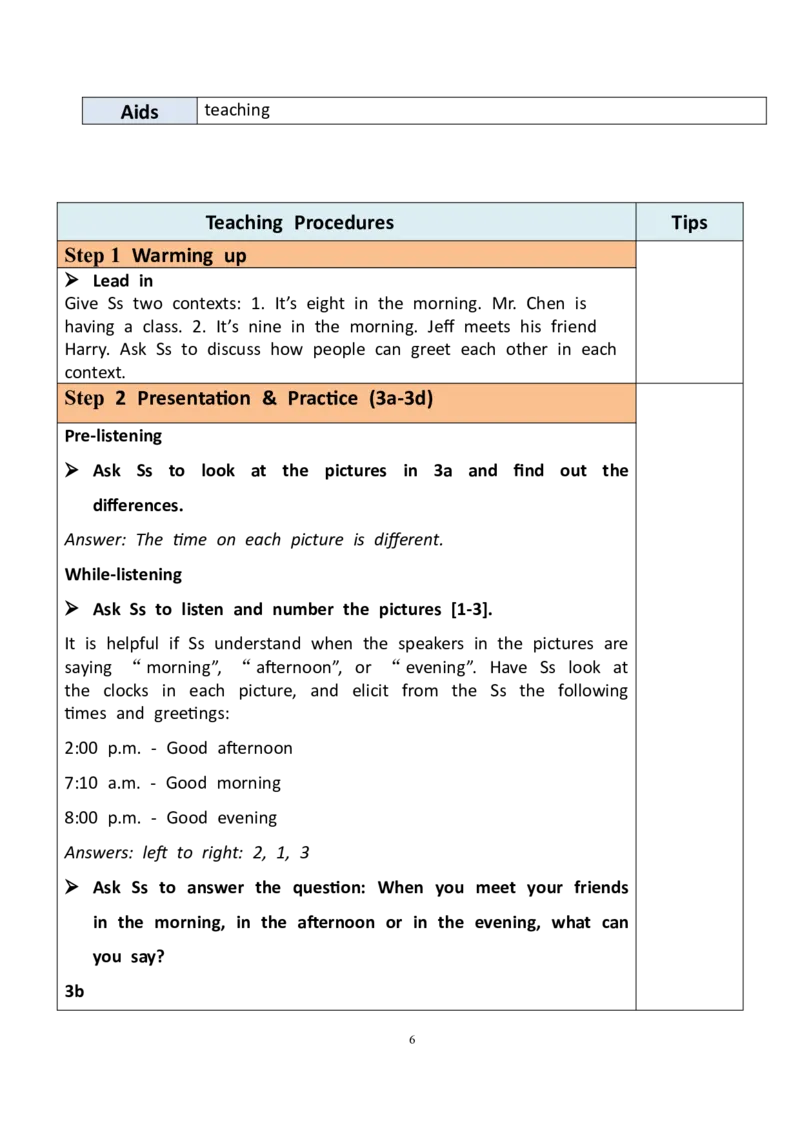
Teaching Procedures Tips
Step 1 Warming up
Sing a good morning song and let Ss ready for the class.
Step 1: Play the video of good morning song to Ss.
Step 2: Ask all the Ss to stand up, then let each S to find three
or four partners and stand in a circle.
Step 3: T plays the video again and ask Ss to sing the song with
the video. T and Ss can also add some gestures to make the song
more interesting.
Step 2 Presentation & Practice (1a-1c)
Pre-listening
Show the picture of activity 1a to Ss. T simply introduces the
picture, then ask Ss to count how many Ss are in the picture.
(Tip: T can count with Ss together if Ss have difficulty in counting
numbers.)
1a
1 T asks Ss to write down the names of the students in the
picture.
(Tip: Ask Ss to pay attention that all the names are start with the
upper case letters.)
Answers:
Boy’s names: Bob, Dale, Eric, Frank
Girl’s names: Alice, Cindy, Grace, Helen
Show the portraits of the eight students who have appeared
in the picture of activity 1a to Ss. Ask them to say each
character’s name.
Optional choice:
After completing 1a, ask Ss to list all the English first names that
they know. Write the names on the board. You can then ask Ss to
say whether the names are male or female. You can also ask Ss
to say whether they think these names are real names, nick
names or shortened names.
While-listening
1b
Let Ss listen to the recording, then repeat.
In 1b, T may want to correct mistakes as a class. In this way, T
listens as the class repeats new language in chorus and identifies
common or serious errors. (T doesn’t identify which Ss made
errors.) T then discusses the errors with the class and models the
correct way of speaking, or plays the recording again. Ss are then
given the opportunity to repeat the new language.
Post-listening
1c
Ask Ss to practice the conversations in the picture.
To make this activity more interesting, T can try to create a fun
“hello”chain to help Ss practice greeting one another.
2Ask all Ss to stand; then nominate one S to start the chain. The
nominated S, S1, turns to the S his/her left, S2, and greets
him/her using one of the phrases in 1a and S2’s real name. When
S2 responds, S1 sits down. Then, S2 turns to S3 on his/her left
and the chain continues.
(Tip: T can make this activity more challenging by splitting the
class into equally sized teams and having each team race to
complete the “hello” chain—the team with all Ss seated first is
the winner.)
Let’s practice!
Ask all the Ss to move around in the classroom and greet their
classmates freely.
Step 3 Language points learning (1a-1c)
Good morning!是人们早晨或上午见面时的问候语,其答语通常还是
Good morning! 问候他人时,称呼语通常放在问候语后,而且用逗号
隔开。
good是形容词,在句中作定语修饰名词,或者用在连系动词(be动
词是连系动词的一种)后面作表语。
Hi!/Hello!用于熟人之间非正式场合下的问候,可单独使用,也可加称
呼使用。hi和hello可互换,但hi比hello更随意、亲切一些。
Step 4 Presentation & Practice (2a-2e)
Pre-listening
Ask Ss to look at the picture on PPT P16 and put the names
in alphabetical order.
Show Ss the picture on P17 and let them to find the hidden
letters.
While-listening
2a
Ask Ss to listen to the recording and repeat the letters.
(Tip: T can encourage Ss to point at each letter as they say it.
This ensures Ss are associating the written form of the letter with
the sound they are hearing or saying.)
2b
Ask Ss to listen and number the letters they hear.
Before doing 2b, have Ss work in pairs, taking turns to point at
any letter from 2a with the partner saying the letter.
Answers:
3Top row (left to right): 8, 1, 5, 7
Bottom row: 4, 2, 3, 6
Let’s practice!
Ask Ss to read the letter appeared on P20 quickly, then say the
letter before and after it.
2c
Ask Ss to practice writing the letters.
Before writing each letter, T can point to each of the writing lines
and elicit from Ss where to begin writing. Ss must also learn the
correct stroke order for each letter so that they can later
developing cursive writing. T can help Ss remember the correct
stroke order by chanting verbal instructions for each stroke.
When modeling how to write “A”. T: 1. down, 2. down, 3. across
When modeling how to write “a”: T: 1. circle round, down and
tick
2d
Ask Ss to write the missing big letter or small letter for each
pair.
Have Ss work in pairs. Ask one S to turn their back to their
partner. The other S then uses their index finger to write a letter
on their partners’ back. The S feels the stroke order and guesses
which letter it might be. Ss take turns to write and guess.
As an alternative, T can ask Ss to close their eyes and hold out
their hands with palms face up. Their partners use their idex
fingers to write letters on the palms of the hands. The Ss feel the
stroke order and guess which letters they might be.
Answers:
Top row (left to right): g, A, c, F
Bottom row (left to right): h, D, b, E
2e
Ask Ss to work in pairs or groups and talk about what the
abbreviations mean.
Answers:
HB: Hard Black
CD: Compact Disc
BBC: British Broadcasting Corporation
Step 5 Language points learning (2a-2e)
字母Aa-Hh 书写格式
1) 大写字母均占上两格。
42) 小写字母a, c, e占中格;b, d, h占上两格;g占下两格;f占三格。
3) 大写字母一笔写完的有C, G;两笔写完的有B, D;三笔写完的有A,
E, F, H。
4) 小写字母一笔写完的有a, b, c, e, g, h;两笔写完的有d, f。
5) 在8个字母中,Aa和Ee是元音字母,其余是辅音字母。
缩略词
HB(铅笔芯)硬黑;CD光盘,激光唱片;BBC英国广播公司
这三个词是缩略词。英语中有一些名称由几个词组成,但为了使用
方便,将每个单词的第一个字母大写,放在一起表示这个名称。
拓展:CBA (China Basketball Association) 中国篮球协会
APEC (Asia-Pacific Economic Corporation) 亚太经合组织
UK (United Kingdom) 英国
Step 6 Summary & Homework
Summary
Ask Ss to do the exercises from PPT P26-28.
Homework:
Write the letters A-H from memory.
Do the exercises in students’ book.
Teaching
Reflection
Starter Unit 1 Good morning!
(3a-4d)
1.语言能力:能够区分元音字母A和E在重读开、闭音节中的不同发音。
2.文化意识:识读常见的英语人名,了解日常问候用语的多种表达方式,初步
Teaching
认识字母在生活中的重要性。
Aims
3.思维品质:尝试在听力中抓住关键词:英语人名及打招呼的时段。
4.学习能力:有意识地运用知识迁移策略问候他人或对他人的问候做出应答。
Teaching 能够问候他人或对他人的问候做出应答。
Difficulties
Teaching
multimedia courseware or other realia that the T needs for
5Aids teaching
Teaching Procedures Tips
Step 1 Warming up
Lead in
Give Ss two contexts: 1. It’s eight in the morning. Mr. Chen is
having a class. 2. It’s nine in the morning. Jeff meets his friend
Harry. Ask Ss to discuss how people can greet each other in each
context.
Step 2 Presentation & Practice (3a-3d)
Pre-listening
Ask Ss to look at the pictures in 3a and find out the
differences.
Answer: The time on each picture is different.
While-listening
Ask Ss to listen and number the pictures [1-3].
It is helpful if Ss understand when the speakers in the pictures are
saying “morning”, “afternoon”, or “evening”. Have Ss look at
the clocks in each picture, and elicit from the Ss the following
times and greetings:
2:00 p.m. - Good afternoon
7:10 a.m. - Good morning
8:00 p.m. - Good evening
Answers: left to right: 2, 1, 3
Ask Ss to answer the question: When you meet your friends
in the morning, in the afternoon or in the evening, what can
you say?
3b
6 Ask Ss to practice the conversations in 3a with their partner.
To make role-plays more realistic, try to have Ss think about who
is speaking, and why, when and where they are speaking. Help set
the scene by asking: Who is speaking? Why are they speaking?
When is this? Where is this?
Possible answers:
Pic 1: Dale and Helen are greeting each other. They have just
arrived at school. It is morning. They are outside the school.
Pic 2: Frank and Eric are greeting each other. They are about to
play basketball. It is afternoon. They are at the basketball court.
Pic 3: Alice and Bob are greeting each other. They are going to
study together. It is evening. They are at Bob’s home.
Play a video of greeting song to Ss. Ask Ss to listen first,
then chant with the music.
3c
Ask Ss to listen to the conversation and practice with their
partner.
To make 3c more challenging for Ss, ask them to listen with closed
books and answer some questions that the T writes on the board:
1. Who is speaking?
2. When is it?
Answers: 1. Dale and Cindy. 2. It is afternoon.
3d
Ask each S to choose an English name for himself/herself and
greet each other.
(Tip: Ss can be encouraged to choose English names that sounds
similar to their Chinese names.)
Step 3 Language points learning (3a-3d)
Good afternoon!是人们下午见面时的问候语,其答语通常还是Good
afternoon! 问候他人时,称呼语通常放在问候语后,而且用逗号隔
7开。
Good evening!是人们晚上见面时的问候语,其答语通常还是Good
evening! 问候他人时,称呼语通常放在问候语后,而且用逗号隔
开。
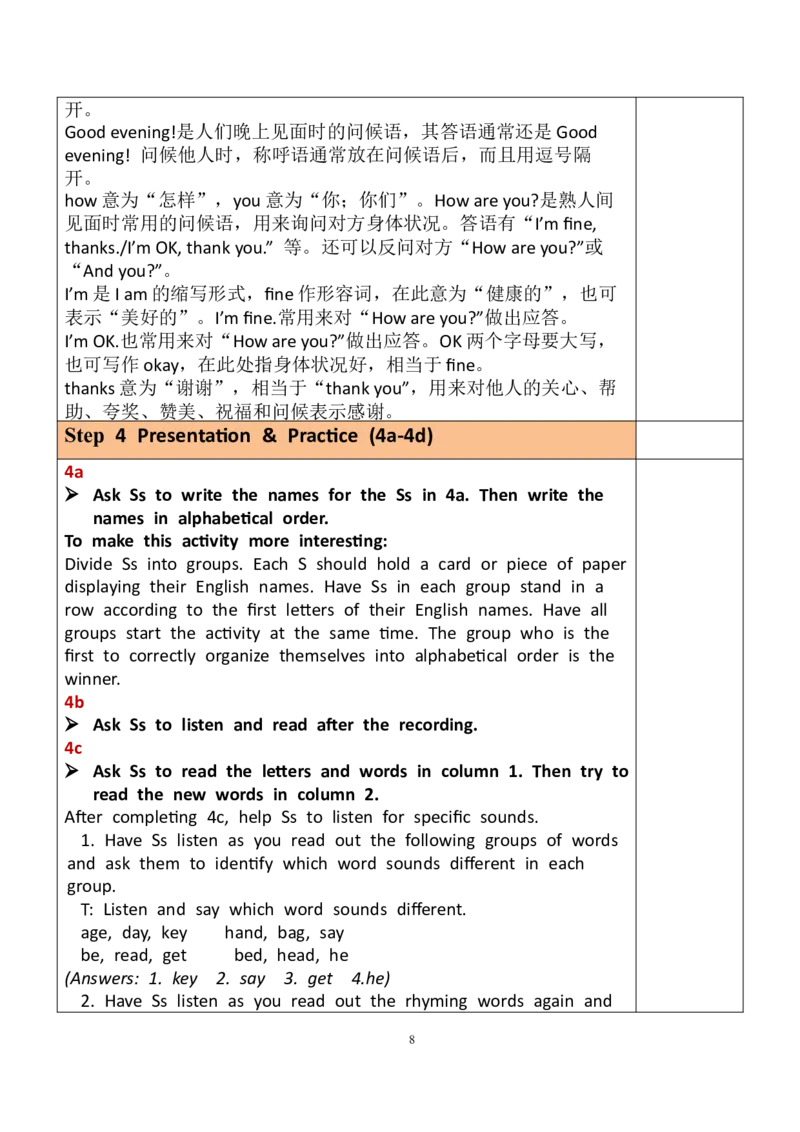
how意为“怎样”,you意为“你;你们”。How are you?是熟人间
见面时常用的问候语,用来询问对方身体状况。答语有“I’m fine,
thanks./I’m OK, thank you.” 等。还可以反问对方“How are you?”或
“And you?”。
I’m是I am的缩写形式,fine作形容词,在此意为“健康的”,也可
表示“美好的”。I’m fine.常用来对“How are you?”做出应答。
I’m OK.也常用来对“How are you?”做出应答。OK两个字母要大写,
也可写作okay,在此处指身体状况好,相当于fine。
thanks意为“谢谢”,相当于“thank you”,用来对他人的关心、帮
助、夸奖、赞美、祝福和问候表示感谢。
Step 4 Presentation & Practice (4a-4d)
4a
Ask Ss to write the names for the Ss in 4a. Then write the
names in alphabetical order.
To make this activity more interesting:
Divide Ss into groups. Each S should hold a card or piece of paper
displaying their English names. Have Ss in each group stand in a
row according to the first letters of their English names. Have all
groups start the activity at the same time. The group who is the
first to correctly organize themselves into alphabetical order is the
winner.
4b
Ask Ss to listen and read after the recording.
4c
Ask Ss to read the letters and words in column 1. Then try to
read the new words in column 2.
After completing 4c, help Ss to listen for specific sounds.
1. Have Ss listen as you read out the following groups of words
and ask them to identify which word sounds different in each
group.
T: Listen and say which word sounds different.
age, day, key hand, bag, say
be, read, get bed, head, he
(Answers: 1. key 2. say 3. get 4.he)
2. Have Ss listen as you read out the rhyming words again and
8ask them to identify the sound that is the same. To make this
easier, you can give Ss options.
T: Listen again. What sound is the same?
age, day Is it /eɪ/ or /æ/?
hand, bag Is it /eɪ/ or /æ/?
be, read Is it /i:/ or /e/?
bed, head Is it /i:/ or /e/?
(Answers: 1. /eɪ/ 2. /æ/ 3. /i:/ 4. /e/)
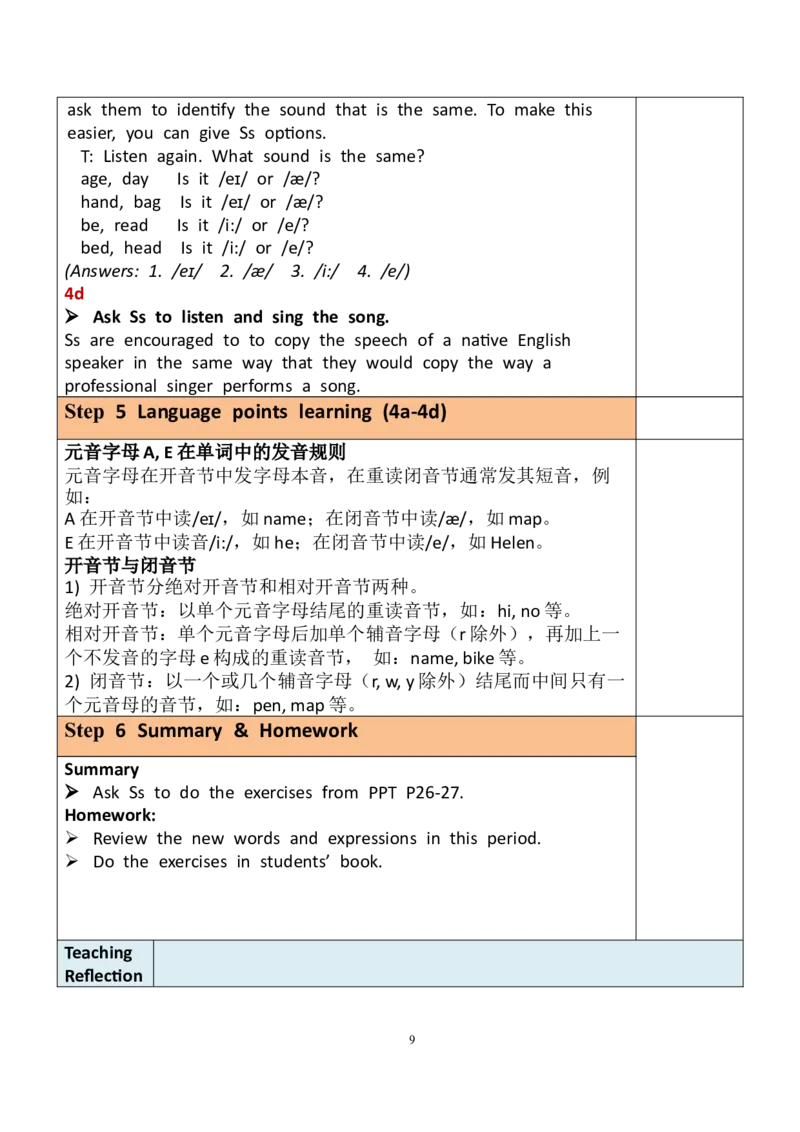
4d
Ask Ss to listen and sing the song.
Ss are encouraged to to copy the speech of a native English
speaker in the same way that they would copy the way a
professional singer performs a song.
Step 5 Language points learning (4a-4d)
元音字母A, E在单词中的发音规则
元音字母在开音节中发字母本音,在重读闭音节通常发其短音,例
如:
A在开音节中读/eɪ/,如name;在闭音节中读/æ/,如map。
E在开音节中读音/i:/,如he;在闭音节中读/e/,如Helen。
开音节与闭音节
1) 开音节分绝对开音节和相对开音节两种。
绝对开音节:以单个元音字母结尾的重读音节,如:hi, no等。
相对开音节:单个元音字母后加单个辅音字母(r除外),再加上一
个不发音的字母e构成的重读音节, 如:name, bike等。
2) 闭音节:以一个或几个辅音字母(r, w, y除外)结尾而中间只有一
个元音母的音节,如:pen, map等。
Step 6 Summary & Homework
Summary
Ask Ss to do the exercises from PPT P26-27.
Homework:
Review the new words and expressions in this period.
Do the exercises in students’ book.
Teaching
Reflection
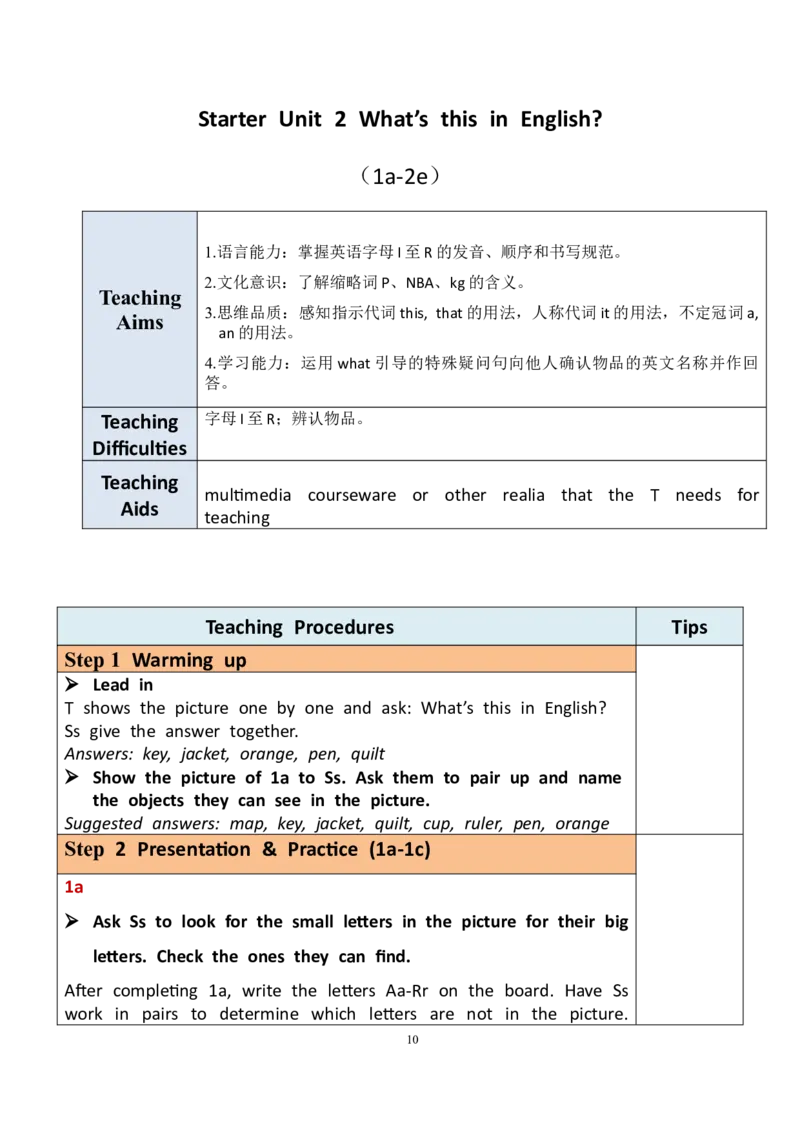
9Starter Unit 2 What’s this in English?
(1a-2e)
1.语言能力:掌握英语字母I至R的发音、顺序和书写规范。
2.文化意识:了解缩略词P、NBA、kg的含义。
Teaching
3.思维品质:感知指示代词this, that的用法,人称代词it的用法,不定冠词a,
Aims
an的用法。
4.学习能力:运用what引导的特殊疑问句向他人确认物品的英文名称并作回
答。
Teaching 字母I至R;辨认物品。
Difficulties
Teaching
multimedia courseware or other realia that the T needs for
Aids
teaching
Teaching Procedures Tips
Step 1 Warming up
Lead in
T shows the picture one by one and ask: What’s this in English?
Ss give the answer together.
Answers: key, jacket, orange, pen, quilt
Show the picture of 1a to Ss. Ask them to pair up and name
the objects they can see in the picture.
Suggested answers: map, key, jacket, quilt, cup, ruler, pen, orange
Step 2 Presentation & Practice (1a-1c)
1a
Ask Ss to look for the small letters in the picture for their big
letters. Check the ones they can find.
After completing 1a, write the letters Aa-Rr on the board. Have Ss
work in pairs to determine which letters are not in the picture.
10Look at the speech bubbles and the item labels to determine
which letters are missing.
Answers: The missing letters are b, d, f
While-listening
1b
Ask Ss to listen to the recording and repeat each sentence.
Help Ss use full sentence answers. Start from one-word answers
and add words. E.g.
T: Pen. Gesture for Ss to repeat.
T: A pen. Gesture for Ss to repeat.
T: It’s a pen. Gesture for Ss to repeat.
Show Ss picture on PPT P9 one by one and ask: What’s this /
that in English? Ss should answer the question using a
complete sentence: It’s a / an ...
Post-listening
1c
T can use the items in the classroom to model 1c. Point at
some objects and ask and answer questions about them.
T: What’s this? Gesture for Ss to repeat.
T: It’s a pen. Gestures for Ss to repeat.
Follow up by writing the names of the objects on the board and
having Ss identify whether the words contain any of the letters Ii-
Rr.
Step 3 Presentation & Practice (2a-2e)
Pre-listening
Show PPT P12 to Ss, ask them the find the hidden letters Ii-
Rr.
While-listening
2a
Ask Ss to listen and repeat the letters Ii-Rr.
11Before Ss do 2a, have them review the big and small letters Aa-
Hh. Ask half of the Ss to write one big letter from A-H on a piece
of paper. Then ask Ss to stand up and walk around to find their
matching big/small letter partners. Have Ss stand next to their
partners. Finally, give Ss a few minutes to form groups according
to their letters.
2b
Ask Ss to listen and number the letters they hear.
After doing 2b, T can ask Ss to close their books. T writes letters
Ii-Rr on the board, then point at each letter randomly and have Ss
say the name of the letter. To make this more challenging, T
should point to different letters more quickly.
Answers: Top row (left to right): 4, 7, 9, 3, 1
Bottom row (left to right): 6, 8, 10, 2, 5
Show PPT P15, ask Ss to draw a line from “Ii” to
“Rr”(finally to “I i”) using their point fingers.
2c
Ask Ss to look and copy the letters Ii-Rr.
After completion of 2c, have Ss compete to write all of the letters
Ii-Rr as quickly as possible. Have Ss start the same time. When a
S finished, the S should raise his/her hand. The first S to finish
with legible writing is the winner.
2d
Let Ss to write the missing big or small letter for each pair.
After Ss have written the letters in 2d, have them number the
letter from 1 to 10.
Answers: To row (left to right): m, K, p, R, j
Bottom row (left to right): q, L, o, N, i
2c
Have Ss guess the meaning of the abbreviations in 2c.
Answers: P: Parking (You see this on a road sign in a place near
where you would park your car.)
NBA: National Basketball Association (You see this on the clothing
or on the advertisements for some American basketball teams.)
Kg: kilogram (You see this on food packages. It shows the weight.)
Step 4 Language points learning
What’s this in English? 这个用英语怎么说?
1) what 什么,What’s 是 What is 的缩写形式;
2) this 这个,常指离说话人较近的人或事物;
123) in English 用英语;
4) 该问句的答语为:It’s a / an …
What’s that in English? 那个用英语怎么说?
1) that 那个,常指离说话人较远的人或事物;
2) 该问句的答语为:It’s a / an …
在It’s an orange.这句话中,it 是第三人称单数形式,常代替上文中
的单数可数名词或不可数名词,也可代指this或 that,it’s 是 it is
的缩写形式。a / an(用于单数可数名词前, 表示未曾提到的)一
(人、事、物),a, an都是不定冠词,a用于以辅音音素开头的单
词前;an用于以元音音素开头的单词前。
Step 5 Summary & Homework
Summary
Ask Ss to do the exercises from PPT P23-25.
Homework:
Write the letters I-R from memory.
Do the exercises in students’ book.
Teaching
Reflection
Starter Unit 2 What’s this in English?
(3a-4d)
1.语言能力:能够区分元音字母I和O在重读开、闭音节中的不同发音。
2.文化意识:识读常见的生活用品,向他人分享或确认物品的英文名称,激发
Teaching
对周围事物的好奇心。
Aims
3.思维品质:能通过对图片的观察获取信息,并正确拼写单词。
4.学习能力:有意识地运用知识迁移策略向他人求助某个单词的拼写方法。
Teaching 拼写单词。
Difficulties
Teaching
multimedia courseware or other realia that the T needs for
13Aids teaching
Teaching Procedures Tips
Step 1 Warming up
Revision
Show PPT P5, ask Ss to match each big letter with its small letter.
Lead in
Pair up, ask Ss to guess what is behind the shadow. They are
expected to use the structure: —What’s this / that in English? —
It’s a / an ...
Answers: pen, orange, key, cup (a cup of tea / coffee)
Step 2 Presentation & Practice (3a-3d)
While-listening
3a
Try 3a as a “Listen, draw and label” task.
Have Ss close their textbooks. Play the recording, pausing after
each item so Ss can quickly draw the item. After the recording is
finished, have Ss label their pictures (orange, key, map, etc.). To
make the activity easier, write a list of possible labels on the
board for Ss to choose from and copy. Check answers as a class.
Answers: Top row (left to right): 5, 2, 7, 1
Bottom row (left to right): 4, 6, 3, 8
3b
Ask Ss to listen and complete the words under the pictures in
3a.
Have Ss try to spell the words first and then listen to check their
answers. In this way, Ss have more time to think about the words.
T can also instruct Ss to listen for specific sounds in the words
based on what they have written.
Answers: Top row (left to right): a ruler, a map, a jacket, a key
14Bottom row (left to right): a quilt, an orange, a pen, a cup
3c
Ask Ss to listen to the conversation, then practice with their
partner.
Explain to Ss that there are many ways to ask someone how to
spell a word. Write the following on the board:
Spell it, please.
How do you spell that?
How do you spell “cup”?
How is it spelled?
What’s the spelling?
After completing 3c, have Ss practice the conversation again using
these phrases.
3d
Ask Ss to listen to the conversation and number the words
they hear.
Before doing 3d, have Ss close their textbooks and listen for
important words. Tell Ss to write the four words / things being
discussed — one word / thing in each conversation.
Answers: 1, 4, 2, 3
3e
Ask Ss to talk about things in the picture following the
example. Or have Ss practice the conversation using things in
their classroom. Encourage Ss to use “ this” and “ that”
correctly.
Let Ss know when to use “this” and “that”. Explain that we use
“this” to talk about something we are holding or that is very
close to us. We use “that” to talk about something that we have
to point to, which is very far from us.
15Step 3 Language points learning (3a-3d)
在Spell it, please!这句话中,spell 作动词,意为“用字母拼;拼
写” 。
please是感叹词,意为“请”,常用于祈使句,表示客气地请求或吩
咐,使语气更委婉。拼写单词时,一般用大写字母,各个字母之间
用连字符“-”连接。
祈使句
本句是一个祈使句。英语中用来表示请求、劝告或命令的句子叫祈
使句。祈使句通常省略主语you, 以动词原形开头,其否定形式是在
动词原形前加don't。
Step 4 Presentation & Practice (4a-4d)
4a
Ask Ss to fill in the missing letter.
After Ss have completed 4a, have Ss create their own lists of
letters (Aa-Rr) with 10 missing letters. Have Ss exchange the lists
with their partners and place the lists face down (so they cannot
be read). Then have Ss flip their lists over at the same time and
compete with their partners to complete the lists. The S who
correctly finishes writing the missing letters first wins.
Answers: Top row (left to right): A, D, F, G, J, N, P, Q
Bottom row (left to right):c, e, g, k, m, n, q, r
4b
Ask Ss to number the words in alphabetical order [1-15].
T may want to give Ss additional practice by having them compete
to place the five words in each row in alphabetical order and the
three words in each column in alphabetical order. Then T can ask
Ss to place in order the words in all rows and columns.
Answers: Top row (left to right):9, 1, 11, 10, 12
Middle row (left to right): 4, 8, 7, 3, 2
Bottom row (left to right): 13, 6, 14, 5, 15
Read and answer
Ask Ss to read the letters together, or ask Ss take turns to read
each letter to their partner. T can walk around in the classroom to
correct Ss’ pronunciation.
4c
Ask Ss to listen to the recording and repeat the letters and
the words.
4c can be completed as a dictation exercise in which Ss listen and
then organize words by writing them in the correct place in a
16chart. Draw the chart on the board and have Ss copy it:
A
E
I
O
Choose and say one word at a time from the far right column of
4c. Have Ss associate each word with the correct letter sound and
write it in the chart. Give Ss enough time between each word to
fill in the chart. After all of the words have been spoken, have Ss
open their textbooks to 4c to check their answers.
4d
Ask Ss to read the letters and words in column 1 and column
2.
4d can be completed as a class activity in which Ss listen to a
string of words / sounds and choose a matching word from a
selection written on the board:
can, go, leg, milk, dog, he, nice, name
With textbooks closed, ask Ss to listen as the T reads out the list
of words in one row of column 1 of the chart in 4d.
T: A, H, J, K, Dale, Grace ...
Elicit from Ss the matching word from the board. Repeat with the
other rows of column 1 of the chart in 4d.
Step 5 Language points learning (4a-4d)
元音字母I和O在单词中的发音规则
1) 字母I在开音节中发/aɪ/的音;在闭音节中发/ɪ/的音。
2) 字母O在开音节中发/əʊ/的音;在闭音节中发/ɒ/的音。
Step 6 Summary & Homework
Summary
Ask Ss to do the exercises from PPT P24-26.
Homework:
Review the new words and expressions in this period.
Do the exercises in students’ book.
Teaching
Reflection
17Starter Unit 3 What color is it?
(1a-2e)
1.语言能力:掌握英语字母S至Z的发音、顺序和书写规范。
Teaching 2.文化意识:了解缩略词S/M/L、UFO、CCTV的含义。
Aims 3.思维品质:初步尝试在听力中抓关键信息并做笔记。
4.学习能力:有意识地运用知识迁移策略使用What引导的特殊疑问句询问物品
的颜色并作回答。
Teaching 字母S至Z;辨认颜色。
Difficulties
Teaching
multimedia courseware or other realia that the T needs for
Aids
teaching
Teaching Procedures Tips
Step 1 Warming up
Lead in
Ask Ss to say the different colors in English.
Match: What new colors can we get?
Ask Ss to think about: What color can we get if we mix red and
white / red and blue / black and white together?
red + white = pink, red + blue =purple, black + white = gray
Show Ss the Olympic rings and ask them to say the color of
each ring.
left to right: blue, yellow, black, green, red
Step 2 Presentation & Practice (1a-1c)
Pre-listening
Show the picture of 1a to Ss, ask them to say the letters
they see.
181a
Ask Ss to look at the picture and write the letter for each
color.
T can check Ss’ comprehension of the colors by playing a quick
game. T asks Ss to find something in the picture that is a certain
color. Ss then list one or more things in the picture which are
that color.
While-listening
1b
Instead of having Ss listen and then repeat in 1b, T can
introduce to speech shadowing. Just as someone’s shadow
follows closely behind them, in speech shadowing Ss try to
shadow what the speaker is saying almost at the same time as
it is being said. As such, Ss do not wait for the speaker to
finish a sentence before repeating.
Show PPT P12-P13, ask Ss to say the color of each item.
Post-listening
Ask Ss to make their own conversation following the example.
To complete the conversation, elicit from Ss some items in your
classroom and their colors. Remind Ss to choose a single countable
item and to use the word “a” or “an” before the item as
appropriate.
Step 3 Language points learning (1a-1c)
询问颜色:What color +be+主语(被询问的物品)?
1) 句子的主语是单数时,be动词用is, 其答语为“It's+颜色.”。
2) 句子的主语是复数时,be动词用are, 其答语为“They're+颜色.”。
Step 4 Presentation & Practice (2a-2e)
Pre-listening
Show PP P17, ask Ss to find the hidden letters (S-Z).
19While-listening
2a
Ask Ss to listen and repeat the letters.
Before Ss do activity 2a, have Ss review the letters A-R. With
textbooks closed, elicit from Ss the letters A-R and write them on
the board. Then have Ss stand and work in pairs to say A-R as
quickly as possible. To make this more challenging, each S in a
pair takes turns saying one of the letters. Start all Ss at the same
time and ask them to sit when they have finished.
2b
Have Ss take turns saying the letters while their partners write
down the order in which the letters are said.
Answers: Top row (left to right): 2, 8, 4, 6
Bottom row (left to right): 5, 7, 3, 1
Show PPT P20, ask Ss to say the letter they see quickly
together.
2c
Let Ss learn to write the letters.
After completion of 2c, T can dictate the letters and have Ss try
to write them. In order to vary the level of difficulty of the
activity, T can choose to say the letters quickly or slowly and
should change the order in which the letters are said.
2d
Ask Ss to write the missing big letter or small letter for each
pair.
After completion of 2d, T can dictate big and small letters and
give Ss time to write. T: 1. big W, 2. small s ...
To make this more challenging, T can introduce the terms “capital
letter” or “upper case” for big letters and “lower case” for small
letters.
Answers: Top row (left to right): w, T, s, X
Bottom row (left to right): u, Z, y, V
2e
Ask Ss to guess the meaning of each abbreviation.
Answers: S / M / L: small / medium / large (You see these on
clothing labels.)
UFO: unidentified flying object
CCTV: China Central Television (You see this on television. It shows
which channel / station you are watching.)
Give more abbreviations to Ss and let them guess the
20meanings.
BBC: British Broadcasting Corporation
NBA: National Basketball Association
UN: United Nations IQ: intelligence quotient
ID: identity card RMB: Renminbi
UFO: unidentified flying object
VIP: very important person EQ: Emotional Quotient
IT: information technology WTO: World Trade Organization
CCTV: China Central Television
Step 5 Language points learning (2a-2e)
字母Ss-Zz
1) 大写字母占上两格。
2) 小写字母s, u, v, w, x, z占中格;t占上两格;y占下两格。
3) 大写字母一笔写完的有S, V, W, Z;两笔写完的有T, U, X, Y。
4) 小写字母一笔写完的有s, u, v, w, y, z;两笔写完的有t, x。
5) 在这8个字母中,Uu是元音字母,其余是辅音字母。
Step 6 Summary & Homework
Summary
Ask Ss to do the exercises from PPT P27-30.
Homework:
Write the letters S-Z from memory.
Do the exercises in students’ book.
Teaching
Reflection
Starter Unit 3 What color is it?
(3a-4d)
1.语言能力:能够区分元音字母U在重读开、闭音节中的不同发音。
Teaching
2.文化意识:识读常见物品的颜色,简单交流分享物品的颜色,初步感知事物
Aims
的外部特征。
213.思维品质:尝试根据五个元音字母在重读开、闭音节中的发音规律拼读和识
记单词。
4.学习能力:有意识地运用知识迁移策略使用What引导的特殊疑问句询问物品
的颜色并作回答。
Teaching 掌握A、E、I、O、U五个元音字母的发音方法。
Difficulties
Teaching
multimedia courseware or other realia that the T needs for
Aids
teaching
Teaching Procedures Tips
Step 1 Warming up
Revision
Let Ss review the colors. Tell them that they can use the following
structures:
— What's this / this letter? — It's ...
— What color is it? — It's ...
Step 2 Presentation & Practice (3a-3d)
While-listening
3a
Ask Ss to listen and color the things.
After completion of 3a, have Ss focus on real objects as well as
the pictures in the book. Bring a cup, a key and a ruler to class
and show Ss each object, one at a time. Elicit from Ss the name
of each object ad its color. Also have Ss repeat the activity using
their own objects such as rulers, keys and cups.
3b
Have Ss try to write the words first and then listen to check
the answers. In this way, Ss have more time to think about
the spelling of the words and T can instruct Ss to listen for
specific sounds in the words to confirm that their spelling of
22the words is correct.
Answers: 1. The key is yellow. 2. The ruler is blue. 3. The cup is
red.
Show Ss the listening material, ask them to role-play the
conversation with their partner.
3c
Ask Ss to listen and complete the chart.
Before doing 3c, have Ss predict what they will hear in the
recording. Ask Ss to guess what they will hear and write down
three things and their colors in the chart. After completion of 3c,
have Ss say whether any of their predictions were correct.
Answers:
3d
Ask Ss to make conversations using the things in 3a-3c.
After completing 3d, have Ss create conversations using real objects
(things in the classroom). As a class, brainstorm or elicit a list of
classroom objects and their colors. Write the objects and colors on
the board. Have Ss use the conversation in 3d to help them
discuss the things that are now listed on the board.
Show pictures on PPT P11, ask Ss to describe the colors. T
can make this as a competition.
Step 3 Language points learning (3a-3d)
定冠词the
the是定冠词,通常放在名词前,特指说话双方都知道的或上文提到
23过的人或事物。the在元音音素前读/ðɪ/;在辅音音素前读/ ðə /。the
常有以下几个用法:
1) 特指某个或某些特定的人或物;
2) 指上文提到过的人或事物;
3) 指谈话双方都知道的人或物;
4) 指世界上独一无二的事物;
5) 用在表示姓氏的复数名词前,表示“……夫妇”或 “……一家
人”。
6) 用在序数词、形容词或副词最高级前;
7) 和某些形容词连用,表示一类人;
8) 用在专有名词前。
Step 4 Presentation & Practice (4a-4d)
4a
Ask Ss to write the small letter next to each big letter. Then,
number the letters A-Z and make them in order.
Answers: Top row (left to right): q, w, e, r, t, y, u, i, o, p
Middle row (left to right): a, s, d, f, g, h, j, k, l
Bottom row (left to right): z, x, c, v, b, n, m
4b
Ask Ss to listen and sing the alphabet song. Tell Ss that letter
“Z” is pronounced differently in American English (“zee”) and
British English (“zed”).
4c
Ss can be encouraged to do peer-monitoring of their
pronunciation.
Have Ss work in pairs. First play the recording, which features
native speakers, and then have one S in each pair repeat. The
partner will then say how close his / her pronunciation is to the
recording. Have Ss regularly work with different partners to allow
them to hear variations in pronunciation. By doing this activity, T
can also raise Ss’ awareness of common pronunciation errors.
4d
Ask Ss to listen and repeat the chant.
T may want to make this activity more interesting by varying the
chant. E.g. T can have Ss compete to say the chant as slowly as
possible, as quickly as possible, as clearly as possible, as softly as
possible or as loudly as possible.
Step 5 Language points learning (4a-4d)
2426个英文字母
1) 英文字母共有26个,A, E, I, O, U是5个元音字母,其余21个是辅
音字母。
2) 26个字母的书写规则
①每个字母都应稍向右倾斜约5°,斜度要一致。
②大写字母都应一样高, 占上面两格。
③小写字母a, c, e, m, n, o, r, s, u, v, w, x, z 占中间格, 上下抵线, 但
都不出格。
④小写字母b, d, h, k, l 的上端顶第一线,占上两格。
⑤小写字母 i 和 j 的点、f 和 t的上端都在第一格,f 和 t的第二
笔紧贴在第二线下。
⑥小写字母a, d, h, i, k, l, m, n, t 和u, 它们的书写中都有一个上挑的
小圆钩,不能写成锐角。
在now you see这个表达中,now作副词,意思是“现在;目前”
强调现在的事实或所处的状态。see在此处意为“理解、明白”。see
还可意为“看见”,强调看的结果。
在I can say my ABC.这句话中,can是情态动词, 意思是“能;
会”,情态动词没有人称和数的变化,后要加动词原形。can常用来
说明某人有能力做某事,其否定形式是在can后面加not, 即can’t
或cannot。
say 是及物动词, 意为“说;讲”, 强调说的内容。say sth. to
sb.“对某人说某事”。
Step 6 Summary & Homework
Summary
Ask Ss to do the exercises from PPT P26-28.
Homework:
Review the new words and expressions in this period.
Do the exercises in students’ book.
Teaching
Reflection
Unit 1 My name’s Gina.
Section A (1a-2d)
251.语言能力:听懂有关自我介绍和简单问候他人的短对话,读懂Linda, Helen
互相打招呼的对话。
Teaching 2.文化意识:了解西方初次见面的礼节,学会自我介绍与问候他人,培养与他
Aims 人交往的能力。
3.思维品质:初步学习在听力和阅读的过程中把握具体的信息。
4.学习能力:有意识地运用知识迁移策略介绍自己的名字并简单问候他人。
Teaching
介绍自己的名字,简单问候他人。
Difficulties
Teaching
multimedia courseware or other realia that the T needs for
Aids
teaching
Teaching Procedures Tips
Step 1 Revision & Lead in
Show Ss teaching goals in this class.
T: Morning everyone. Today we are going to learn to use pronouns to
introduce
different things or people.
Show Ss pictures and ask them to make conversations using the
target
sentence patterns and words on P5.
Step 1: Show Ss pictures of a cup, a jacket, a map, an orange, a ruler, and a
key.
And ask them using the sentence pattern: What’s this? / What is that?
Ss answer the questions with the sentence pattern: It’ s …
(There may be some grammar mistakes in their answers like: This is
a … or That is a … T must correct them in time.)
Step 2: Show the new words and expressions and ask them to read after
the tape.
(While Ss are reading, T must correct their pronunciation to make sure
they can read correctly.)
Step 3: ask Ss to watch a video about a hello song.
(Encourage Ss to sing after the song because the lyrics and melody are easy for
26them.)
Step 2 Presentation & Practice
Before-listening Ask Ss to see the picture and finish
听力环节进行
different tasks. 之前,让学生
先看图片,用
Step 1: Ask Ss to observe the picture and share their opinions. The T can use the
英 语 猜 测 内
following prompts: Here are many students. They meet in their new school. What are they
容,不但帮助
doing now? What can you see in the picture?
学生复习已经
(Encourage Ss to talk about their ideas in groups and then share in class. They can
学过的句型,
share one by one in groups or they can ask one S member to share. T must 激发学生思考
新 单 词 和 句
encourage them because they just enter middle school and they need more oral
型,从心理上
practice which can give them encouragement and confidence.)
降低了学生面
1a 对听力时的难
度。
Step 2: Ask Ss to write English words for the things in the picture in 1a.
(Ask Ss to say and spell the words one by one to make sure they understand the
听力部分对于
meaning of each picture and can spell the words correctly.)
学生来说可能
Answers: map cup book ruler clock schoolbag basketball 成为障碍。通
过观看视频帮
Step 3: Ask Ss to underline the names in the pictures.
助学生具体的
(Ask Ss to read the names one by one to make sure they can read the names
了解听力材料
correctly.) 的信息,再通
过跟读听力材
1b&1c While-listening&Post-listening
料,加深学生
Step 1: Play the recording and ask Ss to listen and number the conversations 对 材 料 的 理
[1-3] 解,同时让学
生两两对话更
in 1b.
加充分的练习
T: We have talked about so many things and students in the new school. Now 了听力能力。
let’s listen and number the conversations [1-3] in 1b.
(Tip: After Ss share their answers, T show Ss a video about 1b to help Ss
understand the listening scripts more.)
Answers: 2 1 3
Step 2: Ask Ss to practice the conversations in 1b with their partners and
then
show in class.
(To make this task easier, T can show Ss the sample conversation on P14
first, and then ask them to make a similar conversation with their partner. If
the class is strong, T can ask Ss to start the conversation directly.)
2a
Ask Ss to see the picture and make a dialogue in 2a. (Ss make a dialogue freely and share in
groups.)
Then play the recording and ask Ss to listen to the conversations and number the
pictures [1-4] in 2a. The T can check answers as a class.
Answers: Top row: 3,2
Bottom row: 1,4
2b
Ask Ss to listen to 2b and circle the names in the picture.
(T ask Ss to share the answers randomly to make sure they understand the
27dialogues. )
Answers: Eric, Alice, Bob, Mike, Jack, Mary, Ms. Miller
2c
Ask Ss to make conversations according to the pictures on PPT 25.
Before Ss practice, they must read the phrases and sentence patterns in 2c twice or three
times to make sure they have mastered them well. Since they have practiced so many times before
this part, so T needn’t spend much time on this part. But T should make Ss clear about these
pronouns : my, your, his, her, their.
Step 3 Presentation & Reading
2d 2d的对话部分
对知识点进行
The T can ask Ss to read the conversation silently first and
了再一次总结
explain the sentences that Ss can’t understand.Then the T can 和练习,让学
focus Ss’ attention on the target structure appeared in the
生在真实情境
中感知语言的
conversation and other key word groups. Ss can be asked to 运用。
make sentences using the key structure and phrases.Then the T
can make Ss read the conversation in chorus to check their
pronunciation and intonation. At last the T can invite some Ss to
role-play the conversation as open pairs.
Step 4 Language Points
1. What’s one’s name? 用来询问他人姓名,表示“某人叫什么名字?”
回答这个问句有三种形式:
① My / His / Her / Its name’s …
② I’m / He’s / She’s / It’s …
③ 直接回答出名字。
2. I’m Ms. Brown.
3. Nice to meet you. 初次相识问候语
nice 作形容词,多用来形容天气或景色“宜人”以及人的感受“愉快”。
初次认识某人,常对他说“Nice to meet you.”, 意为“见到你很高兴。”
它的应答语通常为“Nice to meet you, too.”,意为“见到你也很高兴。”
4.his pron. 他的
his是形容词性物主代词“他的”,后面要加名词,其对应的人称代词主格是he。
5. and conj. 那么,于是;和; 又;而
and作连词,此处意为“那么,于是”,在本句中起到引起话题的作用。
6.her pron. 她的
her是形容词性物主代词“她的”,后面要加名词,其对应的人称代词主格是she。
7.she pron. 她
she是代词, 用来指代女性,意为“她”。其对应词he用来指代男性, 意为“他”。
“she”和“he”为人称代词的主格形式,通常在句中作主语, 此时谓语动词应用单数形式。
8. —Is he Jack? —No, he isn’t.
28Is he …? 他是······吗?
答语通常为:Yes, he is./No, he isn’t.
如果询问的对象是女性, 要用 “Is she …?”。
答语通常为:Yes, she is./No, she isn’t.
Step 5 Exercises & Homework Exercises的任
务是对本节课
重点知识点的
Exercises
总结与回顾,
Ask Ss to do the exercises on PPT P32-P34. 如果学生水平
较高,老师也
T ask Ss to make a summary about what we have learned today.
可以根据学生
Homework 情况适当增加
1. Read the conversation in 2d. 练习量。
2. Do the exercises in students’ book.
In this period, the key and difficult part is to help Ss to introduce things with proper
pronouns: my, your, his, her, their, especially the last three words. Actually some weak
Teaching Ss still can’t master their meaning so well. So more practice and exercise must be done
Reflection to help them understand adjectival possessive pronouns. Guessing before listening can
remind Ss of the words they have learned, which is also a good way for Ss to think
about their new knowledge.
Unit 1 My name’s Gina.
Section A (GF-3c)
1.语言能力:能够正确使用be动词的一般现在时用法、what引导的特殊疑问
句询问对方姓名以及正确使用my,your, his, her等形容词性物主代词。
Teaching 2.文化意识:了解西方初次见面的礼节,学会自我介绍与介绍他人,培养与他
Aims
人交往的能力。
3.思维品质:能根据对话内容或所给条件进行改编或创编。
4.学习能力:有意识地运用知识迁移策略介绍自己的名字和他人的名字。
Teaching
my,your, his, her等形容词性物主代词的用法;be动词的一般现在时的用法。
Difficulties
Teaching
multimedia courseware or other realia that the T needs for teaching
Aids
29Teaching Procedures Tips
Step 1 Warm-up
Show Ss teaching goals in this class.
学生在回答问
T: Morning everyone. Today we are going to learn to use the personal pronouns
题时,教师务
必用不同的评
and possessive pronouns to introduce things.
价性语言鼓励
Show Ss pictures on PPT P5-P8 and ask them to answer questions. 学生,无论他
的回答是否让
(If Ss can’t answer the questions correctly, T must give them guidance, and make a summary
你满意
about the sentence patterns. At the same time T must give students positive comments to
encourage.)
Ask Ss to introduce their friends to their deskmate.
通过看图
T: Now it’s your turn now. It’s time for you to introduce your friends to your deskmate. You 猜词,帮助学
can use the sentence patterns on PPT: What’s his name? S: He is … / His name is … What’s 生正确使用句
her name? S: She is … / Her name is … Is he / she …? S: Yes, he/she is. / No, he / she isn’t. 型。
Step 2 Grammar learning
Ask Ss to read the contents on grammar focus part, and make a
summary.
本部分的语法
(T can show the questions on the blackboard like: What are the personal pronouns? 是重难点,老
Ask them to talk about the questions in groups or find out the answers in their 师应该多引导
学生自主探索
workbook such as《学练优》. After that T can ask Ss to make a summary according
或小组合作探
to the following table. 索这些语法,
从而记得更牢
人称代词主格
固。
形容词性物主代词
通过思维导图
让学生更容易
理解和记忆这
Ask Ss to summarize the differences of the two. 些语法之间的
不同。
Show Ss grammar focus part and ask Ss to answer the questions.
Q1: sentence pattern about asking for others’ names.
Q2: sentence pattern about introduce yourselves.
Q3: introduce others
(This part is easy for Ss to make a summary. And T must show the summary on PPT
after Ss share.)
T introduce other difficult language points to Ss.
30be动词的用法
Be动词不可缩写的情况
Step 3 Presentation & Practice
3a
通过习题让学
Ask Ss to do the task in 3a and invite some Ss to read the
生对知识点的
conversations to check answers. 用法有更加清
晰的认识。
Answers: —What’s your name? —I’m Cindy.
—What’s his name? —He’s Bob.
—Are you Mike? —Yes, I am.
3b
Ask Ss to fill in the blanks in 3b. Then Ss can check answers with
这个小组互动
partners. At last the T can choose some Ss to role-play the dialogue to 很有效的调动
make sure they get the correct answers. 了学生积极性
帮助他们练习
If possible, the T can ask Ss why they choose the answer. If Ss have
句型,同时培
problems, the T should explain the related knowledge clearly. 养他们的瞬间
记忆能力。
Answers: What’s name’s are No I’m Bob Nice meet
3c Group work
T can ask Ss to introduce their group members to the class.
(Ss can introduce the students in their rows or their group members. T correct their grammar
mistakes while Ss are sharing. After Ss share, T ask how many students they remember. Ss
who can remember the most names can get a star.)
Step 4 Summary & Homework 通过习题让学
生对知识点的
用法有更加清
Summary
晰的认识。
Ask Ss to do the exercises on PPT P23-P26.
T ask Ss to make a summary about language points they learned today.
31Homework
1. Preview the new words and phrases in Section B(1a-1e).
2. Do the exercises in students’ book.
Personal pronouns and possessive pronouns are difficult points in U1, especially for Ss
Teaching who have weak sense of English. Dictation must be done in the next class to make sure
Reflection students can memorize all the pronouns and use them correctly. The class procedure is
simple, and T must pay more attention to their mistakes in exercise.
Unit 1 My name’s Gina.
Section B (1a-1f)
1.语言能力:听懂有关电话号码的相关信息。
2.文化意识:让学生学会询问他人的电话号码,学会交朋友,了解朋友们的信
Teaching
息。
Aims
3.思维品质:学会询问他人的电话号码。
4.学习能力:有意识地运用知识迁移策略介绍自己的电话号码并询问他人的号
码。
Teaching 通过练习进行询问电话号码等相关信息。
Difficulties
Teaching
multimedia courseware or other realia that the T needs for
Aids
teaching
Teaching Procedures Tips
Step 1 Lead in
Show Ss teaching goals.
T: Morning everyone. Today we are going to talk about how to ask for and give phone
numbers.
Ask Ss to see pictures on PPT P5-P10 and answer questions. Q&A 的部
(While T show Ss pictures, they can ask two questions: Q1: What’s this? or What are they? 分通过情景吸
Q2: How many … are there? Before Ss answer the two questions, T can remind them to 引学生兴趣并
answer the questions with complete sentences.) 帮助学生快速
T ask Ss to answer questions by showing pictures. 进入主题。学
T: This is Mrs. White. She is a farmer. She is busy today. She has so many things on the farm. 生看图回答问
题快速帮助学
32Now let’s help her to count the things. 生进入知识讲
( Ss count numbers from P13-P14. They can just tell with numbers. But it’s better for T to 解。
encourage them to answer with complete sentences: There are eight eggs.)
Ask Ss to find out the numbers on P15.
(Before this part, T can ask Ss to write down the numbers 0-9 on their exercise book to help
Ss spell the words correctly. T must make a summary about their common mistakes. Then Ss
can find out the numbers and share in class.)
Ss sing a song about numbers.
通 过 设 置 情
景,让学生在
真实的场景中
运用数字。学
生通过用完整
句 子 回 答 问
题,实现了从
单词到句子的
练习。
Step 2 Presentation & Practice
由于这个听力
1a 内 容 比 较 简
单,学生可先
Ask Ss to listen to 1a and repeat after the tape. T should pay attention to
完 成 听 力 部
Ss’ 分,再通过自
pronunciation and intonation.Then ask Ss to read a series of telephone 读听力材料理
解文本。
numbers .
在处理文本的
(First Ss can practice by themselves and then they can read in class. When Ss are 过程中,可以
适 当 拓 展 延
practicing, T should walk around and give guidance. This part may be a little
伸,为后面的
difficult for Ss, so more time should be given.)
知识点讲解做
铺垫。
1b & 1c
Play the recording and ask Ss to listen to the conversation and write the
telephone number in 1b. Then the T can check answers as a class.
Answers: 2786926
Then ask Ss work in pairs to make conversations using the sentence
patterns in 1c.
1d
Play the recording again and ask Ss to do the match task in 1d. T
can choose some Ss to share answers in class.
Answers: c d b a
1e
Ask Ss to listen again and complete the phone numbers in 1d. Ss can check
answers in pairs by making the conversations like this :
S1: What’s Tom’s telephone number?
S2:It’s 278-7928
33Answers: 60 49 28 24
(After Ss listen to each dialogue, ask them to read the listening scripts by
themselves. T highlight the key sentence patterns: What is your telephone
number? My telephone number is … to make sure Ss pay more attention. Also T
can tell Ss the forms about how to write a name, both Chinese and English.)
Ask Ss to ask and answer their telephone numbers with their partners.
(T give an example first. Ss must use the right sentence patterns. While T can give
Ss more extension like: What is his / her / your mother’s telephone number? )
Step 3 Language Points
这个环节的小
1. 基数词
组讨论,激发
英语中的数词可以分为两大类:基数词和序数词。表示数目多少的词为基数 学生自主学习
词,如zero, one, five等;表示事物先后顺序的词为序数词,如first(第一), 的能力,帮助
他们快速适应
second(第二)等。其中,基数词可以表示数目、年龄、编号、号码等。
七年级的学习
2. What’s one’s telephone number? 生活。
该句型用来询问某人的电话号码, 意为“某人的电话号码是多少?”。答语用
“It’s + 电话号码. ”或“One’s telephone / phone number is + 电话号码.”,也可
直接回答电话号码。
3. 中文姓名的英语书写方式
此处Li Xin是一个中文姓名。 中文姓名的英语写法,一般用汉语拼音拼写。姓
和名分开写,姓在前,名字在后。姓和名字的第一个字母都要大写。
(Ss can find out the usage by finding out the details in the listening scripts.)
Step 4 Exercises & Homework 通过习题让学
生对知识点的
用法有更加清
Exercises
晰的认识。
Step1: Ask Ss to do the exercises on PPT P30-P32.
Step2: T ask Ss to make a summary about language points they learned today.
Homework
1. Preview the passage in Section B 2b.
2. Do the exercises in students’ book.
The design of activities before listening(Activities1a and 1b) is very
important. The purpose is to activate the memory in students' brain, recall
Teaching
the learned words, phrases and sentence patterns, and pave the way for
Reflection
listening activities. At the same time, students' response process is also to
learn and consolidate language knowledge in application.
Unit 1 My name’s Gina.
34Section B (2a-2c)
1.语言能力:了解中英文名字间的差异,能辨认英文姓氏与名字。
2.文化意识:帮助学生比较中英文姓名的不同之处,通过了解中英文名字的区
别,培养和提高学生对中外文化差异的敏感性和鉴别能力,加深对本国文化
Teaching
的理解和认识,培养学生的世界观意识,以及初步的跨文化交际能力。
Aims
3.思维品质:能读懂介绍个人信息的语篇内容,并初步掌握如何在阅读过程中
把握具体信息的能力。
4.学习能力:通过阅读关于介绍个人信息的语篇内容,帮助学生懂得保护个人
隐私的重要性。
Teaching 了解中英文名字间的差异,能辨认英文姓氏与名字。
Difficulties
Teaching
multimedia courseware or other realia that the T needs for teaching
Aids
Teaching Procedures Tips
Step 1 Lead in
Ask Ss to see the pictures on P5-P8and say their names .
(If Ss don’t know some of the names, T can should tell them first. T use the
此部分作为引
入环节,图片
picture on P5 Yang Liwei as an example to explain full name, last name, and first
中的人物被学
name so that Ss can tell the full name, last name, and first name of the next three
生熟知,贴近
pictures. T can also use the photos of teachers or students in class to make the
生活,激发学
class vivid. If T are sure Ss can understand name, last name, and first name, he or 生的兴趣。
she can tell what is family name and what is given name.)
Step 2 Presentation & Reading
2a
T ask Ss to read the list of names and write F for first name and L for last name in 2a. 该环节教会学
(Before answering, T lead Ss to read the names to make sure they can read correctly. When Ss 生 阅 读 策 略
are answering questions, it’s better for them to use the complete pronunciation instead of
skim。虽然文
章比较简单,
letter F or L.)
但从七年级伊
Answers:
始,还是要培
351-5 FLLFF 6-10 FLLLF 养学生的阅读
2b 思维。
Ask Ss to skim the messages and match them with the pictures.
(T tell Ss what skim is: to read fast and find the key words. This passage is very
short, so Ss can finish it very quickly.)
Answers: BCA
(T can also teach Ss how to find the key words or sentences to make a
summary. If Ss can’t summarize correctly, T should lead Ss to find out the key
sentences or phrases and then Ss can learn to summarize well.) 该环节教会学
2b Ask Ss to scan and circle the first names and underline the last names.
生 阅 读 策 略
scan。
(Ss can also listen to the tape and circle the first names and underline the last
让学生学会找
names. While Ss are answering questions, T remember to correct their 文本细节。让
学生对重点的
pronunciation. T show the answers of each question. If time is enough, Ss can tell
句型有更清晰
the full name, last name, and first name of each name.)
的 了 解 和 掌
Answers: 握。
在文本内容比
2c
较简单的情况
Ask Ss to read the article in groups and match the names with the telephone 下,第三遍阅
numbers in 2c. T can check answers by asking Ss to read the full 读可以省略,
直接做相应的
sentence like this :
练习题提高课
Eric Brown’s phone number is 357-5689. 堂效率。
Answers:
Ask Ss to read the article and find three pairs of friends in the name list.
(One S can read for others, and other students find out three pairs of friends and
write them down.)
Answers:
Step 3 Language Points
1. first name / last name
361) first 第一;last 最后的; 末尾的 本部分
language points
2) first name 名字;last name 姓
环节中的每个
3) first name 相当于 given name;last name 相当于 family name,full name 意为 知识点的意思
可先让学生思
“全名”。
考,教师提
2. My friend is Gina Smith.
问,然后教师
1) friend作名词,常用短语:make friends (with...) (和······)交朋友。 再进行总结和
补充。然后通
2) friendly 是 friend 的形容词形式,意为“友好的”。be friendly to 意为
过习题让学生
“对······友好”。 对其用法有更
加清晰的认识.
Step 4 Exercises & Homework 通过习题让学
生对知识点的
用法有更加清
Exercises
晰的认识。
Step1: Ask Ss to do the exercises on PPT P18-P19.
Step2: T ask Ss to make a summary about what they learned today.
Homework
1. Read and recite the new words and phrases.
2. Do the exercises in students’ book.
Teaching skills and design are important in this class, because the teacher should
try to engage more Ss in the class and make Ss understand the reading and
master some reading skills. Ss can’t tell family name and last name clearly, so
Teaching
exercise about the names can be given more. The teacher can use English to explain
Reflection
phrases Ss learned,which is a good way to develop Ss’ thinking ability in an English
way. The content is easy, so more time has been left. We can add a dictation at the end of
the class to check Ss’ understanding.
Unit 1 My name’s Gina.
Section B (3a-Self Check)
1.语言能力:复习数字并能正确叙述别人的电话号码,别人的姓氏及名字。
Teaching
2.文化意识:了解西方初次见面的礼节,学会自我介绍与问候他人,培养与他
Aims
人交往的能力。
3.思维品质:能对所获取的信息进行初步的整理和总结。
374.学习能力:有意识地运用知识迁移策略制作学生卡并介绍自己的相关信息。
Teaching Ss are able to use the phrases and sentence structures they learned to make an ID card.
Difficulties
Teaching
multimedia courseware or other realia that the T needs for teaching
Aids
Teaching Procedures Tips
Step 1 Lead in
Free Talk
T ask Ss to two questions to start the class.
Q1: Do you have a school ID card?
Q2: What information does it have on the card?
(T can show pictures of some ID cards, or show each group a picture of an ID card, and ask 引入环节的身
份证信息收集
them to observe and answer what information they can find in an ID card. Ss can answer
questions group by group. One group share one piece of information to make the class
极大地吸引了
学生的兴趣,
active and vivid at first.)
如果是真实的
Lead in
教师或学生校
Ask Ss to look at the ID card and answer the questions. 园卡信息可能
Q1: What’s his telephone number? 更好。
Q2: What’s his family name?
Q3: What’s his given name?
(T make sure Ss can answer the questions with complete sentences and keep it on to make it
into a habit. T can choose Ss to answer the question, or ask Ss to answer in a line or a row.)
Step 2 Presentation & Writing
3a
T ask Ss to use the information on the ID card to complete the sentences in 3a. 在写作前,让
(This part is very easy for Ss, so T don’t need to spend so much time on it. After sharing the 学生通过练习
对于所学知识
answers, T can tell Ss the form of how to write down a phone number: 3XXX-4XXXX-4XXXX)
进 行 充 分 回
Answers: Alice Green 951-3397
顾,通过 oral
Ask Ss to fill in blanks and do Q&A with their deskmates.
的形式锻炼了
Q1: What’s her telephone number?
speaking
Q2: What’s her first name? ability.
Q3: What’s her last name?
(When Ss are practicing Q&A in pairs, T can walk around and give guidance,
especially to some weak Ss. The adjective pronouns may be a problem for them.
If we give more guidance, they will learn better.)
3b
T ask Ss to design their own ID card and write an essay to introduce
themselves.
38老师给出写作
范文,帮助学
生梳理常见的
错误句型,让
学生在后期纠
错的过程中明
(This part seems easy, but it really needs Ss to have a comprehensive ability, such as
确知道自己的
art skills, English abilities etc. T can give Ss some advice or steps to finish this task. 错误所在。让
学生对优秀作
Step1: fill in the blanks. Step2: draw a picture of yourselves. Step3: write a short
文有直观的认
passage about yourselves, including the information in the Id card, and they can
识。
also add more information if they like, such as their favorite color, family
members etc. Before writing T also needs to give Ss some detailed guidance to
cultivate Ss’ writing habit.)
Ask Ss to share their ID card with their partners.
(When sharing, T ask Ss to pay attention to three details : Capitalized first letter,
correct grammar, good handwriting. T can also ask Ss to share some good sentences
or give some comments. T can also show Ss a sample to explain the full-mark
writing. )
Step 3 Self Check
The part of Self Check is to provide a comprehensive review of
key vocabulary and functions presented in the unit. The T can
ask Ss to do these exercises as homework after class.
Answers
1:
2: 1.C 2.A 3.E 4.D 5.B
Step 4 Language Points
391. middle adj. 中间的 n. 中间
(1) middle作形容词, 意为“中间的; 中等的”, 常置于名词前作定语, 如middle school
“中学”。
(2) middle可作名词, 意为“中间”, 常构成短语:
in the middle (of sth.) “在(······的)中央”。
Homework
1. Remember the words, expressions and sentences in this unit.
2. Preview Unit 2 Section A (1a-1c).
There are some problems in this writing class. First, when Ss were in correcting
writing in groups, they had so many questions. I couldn’t answer their questions at the
Teaching same time and the class management was not so easy to do. For G7 students, their
Reflection learning habits are not formed very well, so more guidance in writing must be given.
The best part today was that I gave Ss rubrics and sentence patterns ahead so some B-
level can write grammatically correct sentences.
Unit 2 This is my sister.
Section A(1a-2d)
1.语言能力:学会介绍家庭成员。
2.文化意识:了解家庭成员的称谓,学会书面或口头向他人介绍家庭成员,促
进家庭意识的养成。
Teaching
Aims
3.思维品质:初步学习在听力和阅读的过程中将图片与人物描述相结合进行有
效记忆。
4.学习能力:有意识地运用知识迁移策略介绍朋友和家庭成员。
Teaching
学会介绍他人。
Difficulties
Teaching
A tape recorder ; CAI or multimedia courseware
Aids
Teaching Procedures Tips
Step 1 Lead in
40 The T can play a video about introducing the family and lead in
the topic and guide Ss to talk about their own family.The T can
use the following prompts:
How many people are there in your family?
Who are they?
How many people are there in these pictures?
Then the T can show some pictures and pre-teach some words
of family members. And then the T can show another family
photo and elicit these words from Ss.
Step 2 Presentation & Practice
Before Ss do activity 1a, the T may want to guide them to look
at the topic picture and try reading the dialog in the picture.
1a
The activity is to set the scene and test Ss’ knowledge and
increase their vocabulary. The T can do the activity 1a as a class
or have Ss do this alone or in pairs first before doing the
activity as a class.
Answers:
1. a 2.c 3.b 4.h 5.f 6.e 7.i 8.d 9.g
Then the T can present a family tree to Ss to help Ss to
understand the family relations.
1b
The activity is to help Ss recognize the target language in
natural
speech. During 1b, ask Ss to listen for the words in 1a. In order
to make this activity more challenging, ask Ss to study the
words for one minute, close their books and then listen to the
recording.
Answers:
circled:parents, sister, brothers, grandparents
1b
Then the T can play the recording for the second time and ask Ss
to complete the tape script. Then check the answers as a class
and ask Ss to read after the tape. The T should pay attention to
Ss’ pronunciation and intonation.
1c
This activity is to help Ss use the target language in natural
speech. This is Near. That is Far.
41The T should help Ss to differentiate when to use“this/ these"
and“that/those”.Explain that we use "this/these" to talk about
things/people near to us. We use“that/those" to talk about
things/people far from us.
Demonstrate “this” by standing next to a S and introducing
him/her. T:This is my student.
Demonstrate“these" by standing between two Ss and
introducing them. T: These are my students.
Demonstrate “that” by pointing to a S at the back of the
classroom and introducing him/her. T: That is my student.
Demonstrate “those” by pointing to several Ss at the back of
the classroom an
introducing them. T:Those are my students.
Have Ss practice introducing classmates who are near to and far
from them.
2a
The activity is to help Ss recognize the target language in
natural
speech. Before listening , the T can ask Ss to read the words in
the box and say out their Chinese meanings. Then play the
recording for the first time and make Ss to finish the task in
2a. Then check answers as a class.
Answers:
circled:parents, mother, father, sister, grandparents, brother
2b
The activity is to give Ss practice in listening for specific items
in conversations. The T can ask Ss to listen for the family
role(e.g. father or mother). Tell Ss that in conversation, the
person’s name is said immediately afterward. For example, the
word “Tom” is said immediately after the word “father”, so Ss
hear “my father, Tom”.
Then the T can play the recording and Ss finish the task in 2b.
At last the T can check answers by inviting some students to
share answers in class.
Answers:
1. d 2.c 3.a 4. b 5.e 6.f
The T can also ask Ss to answer the following questions to
improve their listening skills:
What is Cindy’s mother’s name?
What is her father’s name?
42Is Mary her sister?
Who is Linda?
After listening , the T can present the listening material to the
students in need to help them get the specific information about
the conversation.
2c
This activity is to give Ss the opportunity to use the target
language in a controlled manner. Remind Ss that they are asking
questions about family members out of curiosity. They are not
asking questions as a T in an examination. Therefore, their tone
should be polite and not demanding.
Step 3 Presentation & Reading
2d
The T can ask Ss to read the conversation silently first and
explain the sentences that Ss can’t understand.Then the T can
focus Ss’ attention on the target structure appeared in the
conversation and other key word groups. Ss can be asked to
make sentences using the key structure and phrases.Then the T
can make Ss read the conversation in chorus to check their
pronunciation and intonation. At last the T can invite some Ss
to role-play the conversation as open pairs.
Step 4 Language points
介绍他人的句型
1) This is ... 意为“这是······”,用来介绍离说话人较近的第三方。
2) 介绍离说话人较远的第三方时, 可以用“That is ... ”意为“那
是······” 。 “That is”可以缩写成“That’s”。
3) 被介绍的人不止一个时,可以使用句型“These/Those are ...”。
【拓展延伸】
在打电话用语中,“This is ...”表示“我是······”,用于介绍自己。
特别提醒:
“That is”可以缩写成“That’s”,但是 This is, These are 和 Those are 均
不能缩写。
family 作主语时,如果指整个家庭,谓语动词用单数形式;如果指
43家庭中的成员,谓语动词用复数形式。
1) those是指示代词“那些”,用来指代较远的人或物,其单数形式
为that。
2) these 是指示代词“这些”,用来指代较近的人或物,其单数形
式为this。
who为疑问代词,常用在句首引导特殊疑问句,对人进行提问。
Who引导的特殊疑问句:Who + be动词 + 主语?
主语是单数时,be动词用is;主语是复数时,be动词用are。
1) Is this ...? 意为“这是······吗?”;Is that ...? 意为“那是······
吗?”。
2) 上述两个一般疑问句,常用“Yes, it is./No, it isn't.”进行回答。
1) Are these ...? 意为“这(些)是······吗?”;Are those ...? 意为
“那(些)是······吗?”。
2) 上述两个一般疑问句,常用“Yes, they are./No, they aren't.”进
行回答。
Step 5 Summary & Homework
Summary The T can encourage Ss to summarize the key points
of this class to help Ss consolidate the knowledge.
Homework:
Read and recite the conversation in 2d.
Do the exercises in students’ book.
This is the first period of the unit.During this period, teachers interact
with students through high-density questions according to the topic
picture, which is helpful for students to learn new vocabulary, and
also help students review the language content they have learned.
Teaching Teachers' questions can play a good demonstration role for students
Reflection in pronunciation, intonation, expression and sentence making. At the
same time, they can quickly activate the relevant schemata in
students' brain and enter the state of language learning. Therefore,
teachers should make effective use of the topic picture and
improve their questioning skills.
44Unit 2 This is my sister.
Section A(Grammar Focus-3c)
1.语言能力:学会运用指示代词this, that, these, those介绍人物关系,并学会
用who引导的特殊疑问句询问第三方是谁。
2.文化意识:了解家庭成员的称谓,学会书面或口头向他人介绍家庭成员,促
Teaching 进家庭意识的养成。
Aims
3.思维品质:能根据所给内容或所给条件进行改编或创编。
4.学习能力:有意识地运用指示代词和人称代词介绍他人。
Teaching
运用指示代词和人称代词介绍他人。
Difficulties
Teaching
CAI or multimedia courseware
Aids
Teaching Procedures Tips
Step 1 Lead in
The T can tell Ss to bring their family photos to school and
make them introduce their family members in the photos in
pairs. The T can make a sample first:
This is my family photo.
This is my father.
This is my mother.
That is my sister.
Look! It’s me.
Those are my grandparents.
And I have a dog. Its name is Pipi.
Step 2 Grammar learning
Grammar Focus
The T can ask Ss to read the sentences in the chart and pay
attention to their pronunciation and intonation. Then guide
45them to distinguish how to introduce people and identify
people. Draw their attention to the usage of the target
language.
At last the T can summarize the usage of the target
grammar structure from several aspects.
Step 3 Presentation & Practice
3a
1. Ask Ss to fill in the blanks in 3a. Then Ss can check
answers with partners. At last the T can choose some Ss to
role-play the dialogue to make sure they get the correct
answers.
If possible, the T can ask Ss why they choose the answer. If
Ss have problems, the T should explain the related knowledge
clearly.
Answers:
A: That i s my family. That’s my mother.
B: Who ’ s /Who is he?
A: He ’ s / He is my father.
B: Who’s she?
A: She’s m y sister.
B: And who are/who ’ re they?
A: They ’ re(They are) my grandparents.
3b
1. Ask Ss to look at the picture in 3b and try to figure out
the relations of the people in the picture. Ss can write the
family role beside each member.
2. Ask Ss to make sentences individually using the words in
the three boxes to introduce these people in the picture.
Then Ss can check their answers by making conversations in
pairs.The T can make assessments and pay attention to the
subject-verb
agreement in Ss’ sentences. At last, the T can also choose
some Ss to read their sentences in class.
Sample answers:
Are these/those your...?
Is this/that...?
This is my brother/sister/father/mother.
These are my parents.
46That is my brother/grandmother/grandfather.
Those are my grandparents.
...
3c
The activity is to give Ss the opportunity to use the target
language correctly. The T can ask Ss to work in groups of
four. Then Ss in each group take turns to ask and answer
questions according to the family photos they bring to class.
The the T can invite one or two group to present all the
process of the group task. The other Ss must listen carefully
and take notes of the information about the people in those
pictures. At last, the T can choose some Ss to answer some
questions about what they hear.
Step 4 Summary & Homework
Summary The T can encourage Ss to summarize the key The
points of this class to help Ss consolidate the knowledge. homework
Homework: can vary
Preview the new words and phrases in Section B(1a-1e). with the
Do the exercises in students’ book. specific
conditions.
The common mistake students make in learning this unit is to use
this and that when introducing two or more people at the same time.
Teaching
Teachers can remind students with examples, and ask students to read
Reflection
and practice more to cultivate their sense of language, so as to avoid
similar mistakes.
Unit 2 This is my sister.
Section B(1a-1d)
1.语言能力:掌握单词 son, daughter, cousin, grandpa, grandma, mom, dad,
uncle,aunt等,通过家谱图了解家族成员的关系并用英语单词介绍家庭成员。
Teaching
2.文化意识:了解中英家庭构成差异,增强家族意识,传承传统家风。
Aims
3.思维品质:能根据所给内容或所给条件进行改编或创编。
4.学习能力:了解家族成员的关系并使用目标语言介绍家庭成员。
47Teaching
了解家族成员的关系并使用目标语言介绍家庭成员。
Difficulties
Teaching
A tape recorder; CAI or multimedia courseware
Aids
Teaching Procedures Tips
Step 1 Lead in
The T can play a video about introducing family members to
help Ss review the target language they have learned and more
involved in the following activities.
Then the T can encourage Ss to describe a family tree. During
the process, the T can also pre-teach some new words and
expressions. Ss are encouraged to practice using these target
language.
Step 2 Presentation & Practice
1a
This activity is to help Ss use the target language to complete
a family tree. Have Ss learn the different terms that are
commonly used for each family member. Write on the board:
Grandfather/Grandpa
Grandmother/Grandma
Mother/Mom
Father/Dad
Explain that “grandpa,grandma, mom, dad” are less formal.
Ss do the in 1a individually and the T can check answers in
class. The T can ask Ss to read these words in chorus to check
their pronunciation.
Answers:
mom, aunt, son, sister, cousin
1b
The activity is to give Ss practice recognizing the target
language.
The T can use Answer Poll to check Ss’ answers:
Find out how many Ss obtained the correct answers in an
48activity by taking a poll. List the possible answers on the board
(but do not tell Ss the correct answers). Then ask Ss to raise
their hands for each item they checked. In this way, you can
count how many Ss checked each item. Finally, tell Ss the
correct answers. How many were correct?How many were
wrong?
Answers:
aunt; uncle; cousin; friends; grandpa, grandma.
1c
This activity is to provide guided listening and speaking practice
with the target language. The T can guide Ss to use picture
clues. Before listening , the T can ask Ss to look at the
pictures in 1c and discuss the following questions:
How many people are in the pictures?
Who are they?
Where are they?
What are they doing?
...
In this way, Ss are better prepared to answer listening
comprehension questions.
Answers: picture 1
1d
The activity is to provide Ss with speaking practice using the
target language. Ask Ss to draw their families and friends.
Then Ss work in pairs to introduce the people in their
pictures. The T can observe and offer help to Ss in need. Ss
should pay attention to the accuracy of Ss’ speaking.
Step 3 Language points
aunt 指父母那一辈除母亲之外的所有女性长辈,相当于
汉语中的“姑母;姨母;伯母;婶母;舅母”。前面有不
定冠词修饰时,应用 an。注意:a+读音以辅音音素开头的
词;an+读音以元音音素开头的词。
uncle 指父母那一辈除父亲之外的所有男性长辈,相当于
汉语中的“舅父;叔父;伯父;姑父;姨父”。前面有不
定冠词修饰时,应用 an。
49 aunt 与 uncle 与人名连用的时候, 书写与汉语习惯相反,
要将称呼写在人名前, 且首字母要大写。
cousin 是名词, 意为“堂兄(弟、姊、妹);表兄(弟、
姊、妹)”,表示与自己同辈的男性亲属或女性亲属,其
复数形式为 cousins。
Step 4 Summary & Homework
The
Summary The T can encourage Ss to summarize the key points homewor
of this class to help Ss consolidate the knowledge. k can
Homework: vary with
Preview the passage in Section B 2b. the
Do the exercises in students’ book. specific
conditions
.
The design of activities before listening(Activities1a and 1b) is very
important. The purpose is to activate the memory in students' brain, recall
Teaching
the learned words, phrases and sentence patterns, and pave the way for
Reflection
listening activities. At the same time, students' response process is also to
learn and consolidate language knowledge in application.
Unit 2 This is my sister.
Section B(2a-2c)
1.语言能力:能够读懂介绍家庭成员的文章,并分辨出英文名字及家庭成员之
间的关系。
2.文化意识:了解家庭成员的称谓,学会书面或口头向他人介绍家庭成员,促
Teaching
进家庭意识的养成。
Aims
3.思维品质:能提取、整理、概括语篇的关键信息、主要内容。
4.学习能力:能整理、归纳所学内容,把握重点和难点。
Teaching
50Difficulties 阅读文章,找出文章的关键信息。
Teaching
A tape recorder ,CAI or multimedia courseware
Aids
Teaching Procedures Tips
Step 1 Lead in
The T can present the family pictures appearing in this unit and
elicit the people’s names from Ss . Ss can be encouraged to say
out more names in this unit. The T can also encourage Ss to
review what the differences between Chinese names and English
names.
Step 2 Presentation & Reading
2a
The activity is to provide writing practice with the target
language. Before Ss look for the answers in the unit, ask them
to try to do the activity from memory first. Ss often read
material or listen to conversations, but they do not necessarily
try to remember what they have heard or read.
Answers:
Male: Tom Bob Jack Paul Jiang Tao Alan
Eric John Bill Dale
Female: Cindy Li Lan Jenny Linda Mary Sally
Kate Jane Jiang Shan Helen Lin Fang
2b
The activity is to provide reading practice with the target
Language. Before reading, the T can ask Ss to observe the two
pictures and answer the following questions:
How many people can you see in the first picture?
How many people can you see in the second picture?
What else can you see in the second picture?
Then the T can ask Ss to read the passage quickly and do the
task
in 2a individually . The T can check answers by asking the
following questions:
What’s her grandfather’s/grandmother’s/father’s/mother’s/sister’s/
51cousin’s name?
What are her brothers’ names?
Does the dog have a name?
Answers:
Jenny Alan Mary Bob Eric Cindy Helen Coco
2c
The activity is to provide Ss with reading comprehension practice
using the target language. The T can ask Ss to read the passage
carefully and complete the sentences individually. Then ask some
Ss to share their answers by reading the full sentences. At last
the T can explain the key language points to Ss and play the
recording of the passage. Ss can read after the recording and the
T can pay attention to their pronunciation and intonation.
Answers:
1. Jenny 2. parents 3.brothers 4.sister 5.cousin 6.Coco
Teaching Tip:
Guess Encourage Ss to guess the correct answer to a question
before scanning a reading passage to find the answer. One way to
do this is to ask Ss to cover the reading passage with a piece of
paper and to try and quickly guess the answers to the
questions.After they have done this,they can either check their
answers with a partner or immediately scan the reading passage
for the correct answers.
2c
To make the task more challenging, the T can ask Ss to
paraphrase
the passage using the third person like this:
Alan and Mary are Jenny’s_____. Bob and Eric are Jenny’s
_______. Cindy is Jenny’s _____. Helen is Jenny’s_______. Helen
is Jenny’s _______. Jenny’s dog is ______.
Step 3 Language points learning
Here are two nice photos of my family. 本句是以here开头的倒 The
装句,用来引起注意或加强语气,其正常语序为“Two nice language
photos of my family are here.”。在倒装句中, 谓语动词的单复 points are
数形式取决于后面名词(短语)的数。 for
特别提醒:以here开头的句子中, 如果句子的主语是人称代 reference
词, only.
则不用完全倒装。
52 photo为可数名词, 其复数形式为photos。
take photos/a photo (of…)意为“(给……)拍照”。
a photo of …意为“一张……的照片”。
of作介词,表示所属关系,其后接名词、代词或名词性物主代词,
常用于构成名词所有格。
介词短语in the first photo在本句中作表语。介词短语可在句中作
表语,和be动词一起构成系表结构。first在此作序数词,意为
“第一”,序数词前通常要加定冠词the。
Step 4 Summary & Homework The
homework
Summary The T can encourage Ss to summarize the key points
can be
of this class to help Ss consolidate the knowledge.
varied
Homework:
with the
Read and recite the passage in 2b.
specific
Do the exercises in students’ book.
conditions.
In the process of English teaching, teachers should try their best to
encourage students to participate in the discussion and do not overemphasize
Teaching
the correct answers. This can not only broaden students' thinking space, help
Reflection
the development of creative thinking ability, but also help students master
the language in use.
Unit 2 This is my sister.
Section B(3a-Self Check)
1.语言能力:以书面形式描述照片或图片上的家庭成员组成。
2.文化意识:了解家庭成员的称谓,学会书面或口头向他人介绍家庭成员,促
进家庭意识的养成。
Teaching
3.思维品质:能根据所给内容或所给条件进行改编或创编。
Aims
4.学习能力:有意识地运用知识迁移策略根据照片,写一篇介绍全家福的短
文。
根据照片,写一篇介绍全家福的短文。
Teaching
53Difficulties
Teaching
CAI or multimedia courseware
Aids
Teaching Procedures Tips
Step 1 Lead in
The T can present a family photo and ask Ss to introduce the
family. The T can write the sentence patterns Ss may use to
help them. During the process, the T can also check if Ss
master the target language and pay attention to the accuracy
of Ss’ speaking.
Step 2 Presentation & Writing
3a
This activity is to provide reading and writing practice with the
target language.At first, the T should guide Ss to understand
the requirement of activity 3a. Then ask Ss to read aloud the
words in the box. Ss can complete the passage individually and
then the T can invite some Ss to read the passage to check
their answers. Then Ss can work in pairs and get information
about Paul’s family to draw it.
Teaching Tip:
Ss may feel anxious about drawing pictures in class if they feel
they are not good artists. Remind Ss that they need only do
quick sketches in class. Giving a time limit for drawing tasks
can actually be helpful too, as it removes the opportunity to
think too much about the picture or add too much detail.
Answers:
family, parents, brothers, Cindy.
3b
The activity is to let Ss use the target language to write
about
themselves. Peer tutoring can be very effective and enable
both Ss to learn more.In this activity, one S is telling
another S about his or her family. After the S has described
the family photo, he or she can ask his or her partner
54questions to find out how much the partner understood:
Who is this?
What’s his name?
Suggested Answer:
Hi. I am L i Ping. Here is a photo of my family.
Thes e ar e m y parents . Thos e ar e m y grandparents . The y
ar e m y mothe r ’ s parents . Who i s tha t girl ? Sh e i s m y
cousin.
He r nam e i s Liu Me i. And who i s thi s boy ? Can you guess ?
Yes , i t i s me .
Step 3 Self Check
The part of Self Check is to provide a comprehensive review of
key vocabulary and functions presented in the unit.
Teaching Tip:
Encourage Ss to teach and learn from their peers. This includes
helping others with things such as spelling, pronunciation and
word choice. In the case of a writing activity , it can be very
helpful to have Ss check each other’s work for errors before
turning it in to the T or presenting it in front of the class.
Answers:
1. Male: father, dad, grandfather, grandpa, uncle,brother, son,
Both:parents, grandparents,cousin
Female: mother, mom, grandmother, grandma, aunt, sister,
daughter
2.
Bill: Here’s a photo of my family.
Dale: Who ’ s /Who is he?
Bill: He ’ s/He is my uncle.
Dale: Who ’ s /Who is this girl?
Bill: She ’ s/She is my cousin.
Dale: Are these/they your parents?
Bill: Yes, they are. And these are my grandparents.
Step 4 Summary & Homework
55 Summary The T can encourage Ss to summarize the key
points of this class to help Ss consolidate the knowledge. The
Homework: homework
Preview Unit 3 Section A (1A-1C). can be
Do the exercises in students’ book. varied with
the specific
conditions.
In the last period of the unit, the students should use the new items
they have learned to practice writing. The T can make full use of
Teaching
the sample to help students.After writing, the teacher can ask the
Reflection
students to correct and polish the passage they write together, which
will help to foster their spirit of cooperation.
Unit 3 Is this your pencil?
Section A (1a-2d)
1.语言能力:学会并使用有关教室物品的基本词汇。
2.文化意识:通过“识别物品的所属”的学习,让学生们学会爱惜自己的学习
Teaching 物品,养成照看好自己的物品的好习惯,发现不属于自己的物品,应及时归
还物品的主人。
Aims
3.思维品质:通过抓关键词完成听力和阅读任务。
4.学习能力:有意识地运用知识迁移策略询问以及辨认物品所有者。
Teaching
询问以及辨认物品所有者。
Difficulties
Teaching
multimedia courseware or other realia that the T needs for
Aids
teaching
Teaching Procedures Tips
Step 1 Lead in
Show Ss teaching goals in this class.
通过Q&A 的
T: Morning everyone. Today we are going to learn to use the possessive pronouns to identify
形式引入主
ownership.
题,进入单词
56 Show Ss pictures and ask them to answer the questions on PPT P5-P6. 学习,教师课
Q1: What things are there in your schoolbag? 上对重点或易
Q2: What things are there in your pencil box? 错单词用拼读
(T show Ss a picture of a schoolbag, and use some instructive languages like: 或音标的形式
进行纠音或拼
Open your schoolbag, and see what is in your schoolbag. or let’s open your pencil
写帮助学生更
box and see what is in your pencil box. Wow, books, a pencil-box, a dictionary. 快速的掌握。
And ask them to read these words after T. If necessary, T can show Ss the
syllables to help Ss to pronounce the difficult words like eraser and dictionary.)
T Show Ss a desk and ask them to tell the school things on the desk.
(T set a situation: This is Tom’s desk. There are many school things on it. What
are they? After Ss say the names of the school things, T lead Ss to read the words
and ask them to read together or individually to check if they can read correctly.
While Ss are reading, T must correct their pronunciation to make sure they can
read correctly. )
Ask Ss to see and say quickly.
(T can choose four or five Ss to have a PK. The quickest one can get a star. T
show pictures one by one and ask Ss to say the word quickly. Tell Ss to say it as
quickly as possible.)
Step 2 Presentation & Practice
Ask Ss to observe the picture in 1a and say the school things in the
picture. 在听力环
T: Look! There are many school things in this picture. What can you see? 节开始之前,
(Encourage B level Ss to answer easy questions to build their confidence. They 将单词融入情
景进行对话练
can share one by one in groups or they can ask one S member to share. T must
习,帮助学生
encourage them to share, because they just enter middle school and they need 复习单词,降
more oral practice to give themselves encouragement and confidence.) 低了听力部分
的难度。
1a
Ask Ss to match the words with the things in the picture in 1a.
(Ask Ss to share the words one by one to make sure they can say the school things
correctly and can spell the words correctly.)
Answers: e g b h c f a d
听力环节过后
Ask Ss to ask and answer questions in pairs.
进行本单元重
(Remind Ss to use the sentence patterns:
点知识点讲解
1. —What’s this/that? —It’s … 帮助学生提前
了解重难点,
2. —Is it yours? —Yes, it is mine. /No, it's his/hers.
降低后期学习
3. —What’s these/those? —They're … 难度。
4. —Are they yours? —Yes, they are mine./No, they are his/hers.
T must correct their grammar mistakes when Ss share their conversation in class. )
1b & 1c
Ask Ss to listen and number the conversations [1-3] in 1b. 再通过跟读听
力材料,在材
T: We have talk about so many school things you use at school. Now let’s listen and number
料中理解名词
the conversations [1-3] in 1b.
性物主代词的
(After checking the answers as a class,T can invite some Ss to role-play these 意思,加深学
conversations in class.)
57Answers: 3 2 1 生对语法的理
Ask Ss to make their own conversations with their partners using the 解。同时让学
生两两对话更
school things and then show in class.
加充分的练习
(The sentence patterns in 1b are too short and easy. To make it more real and vivid, T can add 了听力能力。
more sentences to set a real situation and ask Ss to make the conversation in pairs. Or ask Ss
to make a similar conversation with their partner. If the class is strong, T can ask Ss
to start the conversation directly.)
2a
Ask Ss to see the pictures of school things and write their English
names on the blackboard. T can check if Ss have remembered these
target words.
Then play the recording and ask Ss to check (√) the things they hear.
Answers: pencil, eraser, ruler, books, pencil box
2b & 2c
Ask Ss to listen again and complete the conversation with the words in the box in 2b.
(T can check answers by having Ss to role-play the conversation.)
Ask Ss to read the listening scripts so that they can have a better understanding of
the conversation. The T should explain some difficult sentences or phrases that Ss
can’t understand clearly.
Answers: pencil, eraser, ruler, books, pencil box
At last, Ss can be encouraged to make their own conversations using the school
things around them.
Step 3 Presentation & Reading
2d 2d的对话部分
The T can ask Ss to read the conversation silently first and explain the sentences
对知识点进行
that Ss can’t understand.Then the T can focus Ss’ attention on the target structure
了再一次总结
和练习,让学
appeared in the conversation and other key word groups. Ss can be asked to make
生在真实情境
sentences using the key structure and phrases.Then the T can make Ss read the
中感知语言的
conversation in chorus to check their pronunciation and intonation. At last the T can
运用。
invite some Ss to role-play the conversation as open pairs.
Step 4 Language points
1.含be动词的一般疑问句
(1)结构:Be动词(am/is/are)+主语+其他?
(2)肯否回答:Yes, 主语+be动词(am/is/are).
No, 主语+be动词(am/is/are)+not.
(3)一般疑问句主语是this, that, these, those,回答时用it指代this/that;用they指代
these/those。
2. 名词性物主代词
583. Excuse me, Grace.
(1) excuse me用于礼貌地引起他人注意,尤其是问路、问姓名等。
(2) 对打断别人等失礼行为表示歉意。
(3) 用于婉转地表示不赞成对方的观点。
4. me pron.(I 的宾格)我
me是I的宾格形式, 用在动词或介词后面作宾语。
5 . What about this dictionary?
. “What about ...?” 等同于 “How about ...?”,是口语中常用的句型, 常用于以下情
景:
1) 向对方提出建议或请求;
2) 征求对方的看法或意见;
3) 用以将注意力转向另一人或物。
6. about prep.关于 adv.大约
(1)about在此处作介词,意为“关于”,后常接名词、代词或动词-ing形式作宾语。
(2)about还可作副词,意为“大约” 。
7. Thank you for your help, Anna.
thank you for … 意为“为······感谢你”,等于Thanks for …,都是表达感谢的方式。for是介
词,后加名词、代词或动词-ing 形式,表示感谢的内容或原因,即 thank you for sth. 或
thank you for doing sth.
Step 5 Exercises & Homework Exercises的任
务是对本节课
重点知识点的
Exercises
总结与回顾,
Ask Ss to do the exercises on PPT P33-P35. 如果学生水平
较高,老师也
T ask Ss to make a summary about what we have learned today.
可以根据学生
Homework 情况适当增加
练习量。
1. Recite the conversation in 2d.
2. Do the exercises in students’ book.
In this period, the key and difficult part is to help Ss to use the possessive pronouns
well and can tell what these pronouns refer to in a passage. The most difficult thing is to
Teaching help them transform adjective pronouns (my, your, his, her, their…) + n. into the
Reflection possessive pronouns (mine, yours, hers, theirs …). Actually some weak Ss still can’t
master their meaning so well. So more practice and exercise must be done to help them
understand possessive pronouns.
Unit 3 Is this your pencil?
59Section A (Grammar Focus-3c)
1.语言能力:正确使用mine, yours,his,hers等名词性物主代词;正确使用一般
疑问句确认物主关系并作简略回答。
2.文化意识:通过“识别物品的所属”的学习,让学生们学会爱惜自己的学习
Teaching
物品,养成照看好自己的物品的好习惯,发现不属于自己的物品,应及时归
Aims 还物品的主人。
3.思维品质:能根据语篇内容或所给条件进行改编或创编。
4.学习能力:能在学习过程中积极思考,主动探究,发现并尝试使用多种策略
解决语言学习中的问题,积极进行拓展性运用。
正确使用mine, yours,his,hers等名词性物主代词;正确使用一般疑问句确认物
Teaching
主
Difficulties
关系并作简略回答。
Teaching
multimedia courseware or other realia that the T needs for teaching
Aids
Teaching Procedures Tips
Step 1 Warm-up
Show Ss teaching goals in this class.
T: Morning everyone. Today we are going to learn to use the possessive pronouns to identify 开 头 的 chant
ownership. 不仅复习了所
学知识,而且
T ask Ss to chant together.
极大吸引了学
(T should chant for Ss as a sample. We can ask Ss to clap the hands or pat the 生对课堂的兴
趣。
desk to make a rhythm.)
Show Ss pictures on P6-P9 and ask them to answer questions on PPT.
(If Ss can’t answer the questions correctly, T must give them guidance and ask
them to say the sentence again. T can also make a summary about the sentence 通过选数
patterns. At the same time T must give students positive comments to encourage 字看图说词,
them.) 复习上节课所
T ask Ss to play a number game about words and phrases. 学 单 词 或 短
语。
T: Let’s play a game together. You can choose one number you like, and translate. Now let’s
see who is the fastest.
(T ask Ss to use a complete sentence to answer the question: What’s this? It’s a …)
T ask Ss to play a number game about sentences.
T: There is another game for you. You can choose one number you like, and translate the
sentence. Now let’s see who can say it well. 游戏环节
大大提高了课
60(T should correct Ss if they have wrong answers, and ask the student to say the correct sentence 堂趣味性。
again.)
Step 2 Grammar learning
本部分的语法
Ask Ss to read the contents on grammar focus part and make a 是重难点,老
师应该多引导
summary about how to use the target language.
学生自主探索
(T can show the questions on the blackboard like: What is the form of a question 或小组合作探
sentence? What be verb can we use in a question sentence? What do these the 索这些语法,
从而记得更牢
possessive pronouns refer to? Ask them to talk about the questions in groups and
固。
have a try to make some conclusion.)
含be的一般疑问句
通过表格让学
生更好的体察
形物代和名物
代的区别。
物主代词的比较和分类
Step 3 Presentation & Practice
3a
Ask Ss to observe the two pictures in 3a and tell the differences
between them. Then have Ss fill in the blanks and T can invite some
Ss to share their answers.If possible, the T can ask why they choose
the answer.If Ss have problems, the T should explain the related
knowledge clearly.
Answers: Questions: this, these, that, those
这个全班互动
Answers: isn’t, they, is, aren’t 很有效的调
动了学生积
极性并帮助
3b 他们练习句
Ask Ss to fill in the blanks in 3b. Then Ss can check answers with 型。
61partners. At last the T can choose some Ss to role-play the dialogue to
make sure they get the correct answers.
Answers: it is hers it isn’t hers they are his they aren’t they are
3c Mingle
T can collect some things from Ss before class and put these things
into a box. Then each S take one thing in class and try to find out
the owner. T show sentence patterns on the blackboard to help Ss ask and
answer fluently. T should walk around to give guidance in case some students
can’t understand the instruction.
Step 4 Exercises & Homework
Ask Ss to do the exercises on PPT P27-P29.
Guide Ss to make a summary about language points they learned today.
Homework
1. Preview the new words and phrases in Section B(1a-1e).
2. Do the exercises in students’ book.
This lesson extends from the first lesson to the use of plural forms of nouns to
practice the use of general questions and nominal possessive pronouns. Students
Teaching can practice through a large number of listening, speaking, reading and writing
Reflection activities, and can also consolidate through grammar explanation and deepening
practice. The teaching activities arranged in this class can enable students to
practice and master key knowledge.
Unit 3 Is this your pencil?
Section B (1a-1e)
1.语言能力:能听懂失物招领处有关物品丢失的语句。
2.文化意识:通过“识别物品的所属”的学习,让学生们学会爱惜自己的学习
Teaching
物品,养成照看好自己的物品的好习惯,发现不属于自己的物品,应及时归
Aims 还物品的主人。
3.思维品质:能提取、整理、概括语篇的关键信息、主要内容。
4.学习能力:能在学习活动中积极与他人合作,共同完成学习任务。
Teaching
用合适的句型谈论物品的所属。
62Difficulties
Teaching
multimedia courseware or other realia that the T needs for teaching
Aids
Teaching Procedures Tips
Step 1 Lead in
Revision
T can help Ss review what they have learned by having them do the exercises on
P5-P6. T can highlight the difficult points that Ss often make mistakes in. 复习环节让学
生写在练习本
Lead in
上效果比口头
T pre-teach the new words by using the corresponding pictures so that Ss can
回答效果好。
master these words quickly. T can have Ss read after him/her.
( T can ask Ss the questions: Do you know these things? Then ask Ss to say the things one by
one in a line or a row . But it’s better for T to encourage them to answer with complete 通 过 设 置 情
sentences: It’s a/an ... ) 景,让学生在
Ask Ss to say the things in English as quickly as possible on P9 to practice Ss’ fast 真实的场景中
memory. 说单词。学生
通过用完整句
子回答问题,
实现了从单词
到 句 子 的 练
习。
Step 2 Presentation & Practice
1a
This activity is to help Ss recognize the target vocabulary in a
different context. In order to make Ss more aware of the contents of a
picture, give Ss 60 seconds to study the picture. Then have Ss close
their books and draw the picture from memory. Ss then compare their
drawings with a classmate’s. In regard to the picture in this activity,
the T might challenge Ss by asking them to draw the picture with the
objects and letters.
Answers: 1.e, 2.b, 3.h, 4.a, 5.i, 6.g, 7.c , 8.d, 9.f
1b
Ask Ss to answer questions about the things in the picture in 1a.
(First T show an example to tell students how to make a conversation. Then T
give students some time to practice in pairs and ask two or three pairsto share
in class. T highlight the key sentence patterns: How do you spell it? W-A-T-C-
H. and tell a similar sentence: Can you spell it? Spell it, please. T ask students
63to pay more attention to the punctuation in the sentence: Spell it, please.)
Optional Approach: Mystery Object Spelling
After reviewing the conversation in 1b as a class, try this fun activity. Tell Ss
they will play a game using the conversation in 1b and their own belongings.
Have Ss work in pairs. Have one S close their eyes. The other S will place a
belonging(e.g.a watch or ruler) in the hands of their partner and will ask, “What's
this?” Keeping their eyes shut,the S will try to guess what the thing is that they
are holding. They will guess and say,“It's a watch.”When they guess correctly,they
can open their eyes and spell the word,“W-A-T-C-H!”
1c
The activity is to provide guided listening and writing practice with the target
language. Before Ss listen,have them try to identify the contents of the related
picture without referring to the list of words. In the picture in this activity, have Ss
cover the box containing the words and try to name the items from a to i.Then
have them do the listening activity. T can check answers as a class.
Answers:
circled: b.watch, a. ID card, d.pen, e. baseball
1d
Play the recording again and have Ss do the task in 1d. Then the T can
check
answers by asking Ss to say a full sentence with the answer like this:
Linda lost her watch and ID card.
Answers:
Linda: watch, ID card,
Mike: pen, baseball
(After Ss finish the listening tasks, T can ask them to read the listening scripts by
themselves. T highlight the key sentence patterns: : I lost my watch this morning.
Here you are. All right. to make sure Ss pay more attention. Also T can translate the
key sentences for Ss if necessary.)
1e
Teaching tip: Standing and Sitting Role-plays
Once Ss are in pairs, you can use this procedure to help assign roles.
Ask one S in each pair to stand. Assign roles to Ss who are standing.
Then assign roles to Ss who are sitting. When Ss switch roles, they can
also switch their standing or sitting position. This helps the T to monitor
how quickly or slowly different Ss are completing the task.
While Ss are speaking, T can observe and offer help to Ss in need. Ss
should pay attention to the accuracy of Ss’ speaking.
64Step 3 Language points
1. watch 可数名词,复数:watches。
拓展:
英语中以s, x, sh, ch结尾的名词,在变复数时末尾加-es。
bus—buses 公共汽车 box—boxes 盒子
dish—dishes 盘;碟 match—matches 比赛
watch clock (钟表)
指钟表、挂钟、闹钟等,常用来掌握时
手表、怀表或秒表 间,多带有闹钟的功能,以提醒人们注
意时间
2.How do you spell it? 你怎么拼写它?
这是一个特殊疑问句,用来询问拼写方法。注意:回答拼写单词时每个字母都
要大写,而且字母与字母之间用连字符连接。
英语中常用代词代替已知的名词,而不重复该词。本句中it代替需要拼写的单
词。
同义句型:
Can you spell it, please?请你把它拼写出来,好吗?
Spell it, please. 请把它拼写出来。
Do you know how to spell it?你知道它如何拼写吗?
Step 4 Exercises & Homework
Exercises
Step1: Ask Ss to do the exercises on PPT P23-P26. 通过习题让学
Step2: T ask Ss to make a summary about language points they learned today. 生对知识点的
Homework 用法有更加清
晰的认识。
1. Preview the passage in Section B 2b.
2. Do the exercises in students’ book.
Teachers should create context and input language so that students have more
opportunities to get enough listening training. Students should learn to use what
Teaching
they have learned to write new dialogues and output languages. Students learn to
Reflection
confirm the ownership of objects in English, and practice general questions and
their answers repeatedly
Unit 3 Is this your pencil?
Section B (2a-2c)
Teaching
651.语言能力:读懂有关失物招领的通知。
2.文化意识:了解失物招领的小常识,培养爱惜个人财物以及拾金不昧的品
德。
Aims
3.思维品质:能提取、整理、概括语篇的关键信息、主要内容。
4.学习能力:能整理、归纳所学内容,把握重点和难点。
Teaching
How to express opinions using the target language.
Difficulties
Teaching
multimedia courseware or other realia that the T needs for teaching
Aids
Teaching Procedures Tips
Step 1 Lead in
Ask Ss to see the things the little piggy lost and say their
English names. The T can also encourage Ss to spell these
words. 引 入 环 节 通
过,卡通人物
T: The little piggy lost many things. Can you talk about them and spell the words?
小猪的故事,
Encourage Ss have a free talk. The T can use the following
极大地吸引了
prompts: 学生对课堂的
兴趣。
What should the little piggy do?
Do you often lose things like little piggy?
What do you lose easily?
Step 2 Presentation & Reading
2a
The activity is to provide writing practice with the target
vocabulary.
Teaching tip:Introducing Activities Through Acting
In order to really help Ss understand what they should do for an activity,
introduce the activity by acting it out in front of Ss without revealing to
Ss that you are acting. For example, as an introduction to activity 2a, the
T could walk around the classroom and pretend to be looking for
something that he/she has lost(e.g. watch),asking Ss where the missing
watch is.
Then the T can ask Ss to look through the notices on the
board in the next activity.
T: The notices are about the things students lost and found. Let’s have a look. How many
notices can you see?
66(Ss can easily find out that there are four notices in the pictures so we don't need to spend
much time on this part. It’s just a lead in before reading.)
2b
Ask Ss to read the notices quickly on the board and circle the
lost
things.
(T tell Ss what skim is: to read fast and find the key words. This passage is very
short, so Ss can finish the task very quickly. At the same time T ask Ss to
guess the meaning of lost and found. What does lost mean in Chinese and
what does found mean in Chinese?)
Answers: watch, computer game, keys, ID card
2c
The activity is to provide Ss with reading comprehension
practice using the target language.
Teaching Tip: Scanning for Clues
Teach Ss to look for key words and phrases to answer questions related to a reading
activity. For example,before Ss scan the passage to identify the lost and found items,
elicit from Ss key words that will help them to place the items in the correct
category. Point out to Ss that two of the notices are clearly labeled “Found” and
“Lost.” The questions “Is it yours?” and “Is this your
_?”would be placed in a “Found” notice.“I lost my...” would be placed in a
"Lost" notice.
Answers: Lost:ID card
Found:watch,keys,computer game
Ask Ss to read the notices carefully again and answer the following
questions. The T can invite some Ss to share their answers.
Q1: Where is the computer game?
Q2: What’s John’s phone number?
Q3: Who lost a school ID card?
At last the T can explain the key language points to Ss and
play the recording of the passage. Ss can read after the
recording and the T can pay attention to their pronunciation
and intonation.
Step 3 Language Points
1. library作可数名词,其复数形式为libraries,in the library意为“在图书馆”。
2. ask作动词,在此处意为“请求;要求”,ask ... for ... 意为“请求······给
予······”。ask作动词,还可意为“询问”,其反义词为answer(回答)。
3. lost是动词lose的过去式,意为“遗失;丢失”。其反义词为find(找到; 发
现
Lost可表示“寻物启事”,Found可表示“失物招领”,Lost and Found 表示
“失物招领处”。
67lost还可作形容词,意为“丢失的;失去的”。
4. must是情态动词, 其后接动词原形,没有人称和时态的变化。
must的否定形式为mustn’t,表示禁止,意为“不可以”。
5.call sb. 给某人打电话
call sb. at+电话号码 拨打······号码找某人
6. e-mail v. 给······发电子邮件 n. 电子邮件 复数名词:e-mails
Step 4 Homework
Exercises
Step1: Ask Ss to do the exercises on PPT P21-P22.
Step2: T ask Ss to make a summary about what they learned today.
Homework
1. Read and recite the new words and phrases.
2. Do the exercises in students’ book.
The class is so smooth and efficient that T can finish the class on time. T should pay
more attention to the usage of the language points and let students make enough
Teaching sentences to master them. Therefore, Ss can master these language points and
Reflection understand the passage clearly. But some B level students cannot use the language
points well. The T can pay more attention to them and try to help them by
giving them more exercises.
Unit 3 Is this your pencil?
Section B (3a-Self Check)
1.语言能力:写一则寻物启事或失物招领启事。
2.文化意识:了解失物招领的小常识,培养爱惜个人财物以及拾金不昧的品
Teaching
德。
Aims
3.思维品质:能提取、整理、概括语篇的关键信息、主要内容。
4.学习能力:有意识地运用真实的信息完成一份寻物启事。
Teaching 写一则寻物启事或失物招领启事。
Difficulties
Teaching
multimedia courseware or other realia that the T needs for teaching
Aids
68Teaching Procedures Tips
Step 1 lead in
The T can guide Ss to make conversations using the target language. The
T can use the following prompts:
There are many things in the lost and found office. Let's see what these things are. Who do
they belong to? T shows the sentence pattern and the pictures first and invites the Ss to
answer the questions in pairs. Then invite more groups of students to make conversation.
Step 2 Presentation
3a
This activity is to provide reading and writing practice with the target
language. The T can ask Ss to read the words in the box and finish the
在写作前,让
task individually. Then the T can invite some Ss to read and translate
学生通过练习
the two notices to check answers.
Answers: Lost ,name, call ; Found, yours, 284-5486 对于所学知识
3b 进 行 充 分 回
The activity is to let Ss use the target language to write about 顾。
themselves.
Teaching Tip: Try it without the textbook.
Ss often become too dependent on the textbook. Therefore, after Ss
understand what they should do in an activity, ask them to close their
textbooks and try to do the activity. After Ss have done as much as they
can without the support of the textbooks , have them open their
textbooks and study the content. Then have Ss close their textbooks again
and continue the activity. The goal is for Ss to study how to write lost
notices and then write lost notices without copying from their textbooks.
Sample writing:
Lost:
I lost my pen this morning.
It’s black. Call me at 857-932.
My name is Tony.
Thank you very much!
Found:
I found a blue bag this morning on the playground.
Is it yours? Call me at 236-039.
69Betty
Step 3 Self Check
The part of Self Check is to provide a comprehensive review of key
vocabulary and functions presented in the unit.
Teaching Tip:Create a test
One way to make sure that Ss understand the material is to have them
make a test. This can be done as a group. Elicit test questions from Ss
and write the questions on the board. Then have Ss take the test
independently, or elicit the answers from Ss and write the answers on the
board.
Answers:
1. pen , ruler , pencil , pencil box , schoolbag , eraser,.. .
2. I ,me, my, mine
you, you, your, yours
she,her,her,hers
he, him, his, his
3. 1.A: Is that your schoolbag?
B: No, it isn’t.
2. A: Are those your baseballs?
B:Yes, they are.
3. A: Is this your key?
B: Yes, it is.
4. A:Are those your pencils?
B:No, they aren’t.
Step 4 Exercise & Homework
Exercises
Step1: T ask Ss to do the exercises on PPT P15-P19.
Step2: T ask Ss to make a summary about what they learned today.
Homework
701. Remember the words, expressions and sentences in this unit.
2. Preview Unit 4 Section A (1a-1c).
In the last period of the unit, the students should use the new items
they have learned to practice writing. The T can make full use of
Teaching
the sample to help students.After writing, the teacher can ask the
Reflection
students to correct and polish the passage they write together, which
will help to foster their spirit of cooperation.
Unit 4 Where’s my schoolbag?
Section A (1a-2d)
1.语言能力:正确使用一般疑问句询问物品的位置以及使用on,in,under描述物
品所在位置。
Teaching 2.文化意识:养成整洁、规范、有条理的良好生活习惯。
Aims
3.思维品质:通过抓关键词完成听力和阅读任务。
4.学习能力:有意识地运用知识迁移策略询问物品所在位置。
Teaching 正确使用一般疑问句询问物品的位置以及使用on,in,under描述物品所在位置。
Difficulties
Teaching multimedia courseware or other realia that the T needs for
Aids teaching
Teaching Procedures Tips
Step 1 Warm up
Show Ss the teaching goal of this class.
71T: Morning everyone. Today we are going to learn to talk about where
things are.
Lead in
Show Ss pictures and ask them to talk about things in the house
on PPT P5-P10.
(Students can brainstorm the things they know in their bedroom,
or living room. After that, T can show Ss pictures and ask them to
say the words in English. T can ask questions like: What is this in
English? where is the cat? T asks Ss to answer questions with the
sentence pattern: It’s … T explains to Ss the meaning of on, in, and
under.)
Step 2 Presentation & Practice (1a-1c)
Pre-listening
Ask Ss to see the picture and finish different tasks.
Ask Ss to observe the picture and say the things in the picture.
T: Look! There are many things in this picture. What can you see?
(This part is about words, so T can encourage B level Ss to answer easy
questions to build their confidence. )
1a
Ask Ss to match the words with the things in the picture in
1a.
(Ask Ss to share the words one by one to make sure they can say the
school things correctly and can spell the words correctly.)
Answers: b e h g d a f c
Ask Ss to see pictures and answer questions one by one.
(Ask Ss to use the sentence pattern: —Where is …? —It’s on/in/under…
T must correct Ss grammar mistakes when they share their conversation
in class. T can make a summary about the sentence pattern: —Where is
…? T should also give examples about the sentence pattern: Where are …
They are …)
Language points:
72 Get Ss to look at the picture of 1a again and ask them
to answer the questions:
Where’s my computer game?
Where are my books?
Where’s my pencil box?
While-listening
1b
Ask Ss to listen and number the things [1-4] in 1b.
T: We have talked about so many school things. Now let’s listen and
number the things [1-4] in 1b.
Answers: 1. books 2. pencil box 3. computer game 4. keys
Step 2: Ask Ss to listen again and complete the conversation
on P18.
(When all the Ss have finished the exercise, T can ask them to
read the conversation together. Then, T can show Ss the video of
this conversation.)
Post-listening
1c & Pair work
Ask Ss to practice the conversation in 1a with their partners.
Tell Ss that they can make their own conversations using the
words in the box in 1c.
Native speakers do not always speak in complete sentences. This is
especially true when they are responding to questions. Therefore, T
may wish to have Ss practice the short answers to questions in
addition to the long responses (e.g. under the table).
Step 3 Language points learning (1a-1c)
在Where are my books? 这句话中
(1)Where 引导的特殊疑问句,询问“某人或某物在哪里”。
(2)结构:Where + be + 主语(人或物)?
(be 动词要与主语保持一致)
73(3)答句:主语 + be + 表示地点的介词短语。
(其主语一般用人称代词代替,避免重复)
in意为“在......里”,常指某人或某物在某范围空间里。
on 意为“在......上面”,指一个物体在另一个物体的上面,两个物
体相互接触。其反义词为 under“在......下”。
Step 4 Presentation & Practice (2a-2d)
Pre-listening
Show Ss the pictures on P24, let Ss to tell the English names
of the six things.
2a
Ask Ss to listen to 2a and number the things [1-6].
Answers: 1. computer game 2. books 3. pencil box 4. schoolbag
5. ruler 6. keys
2b
Ask Ss to listen again and number them in the picture [1-6].
T can have Ss write down the key words and phrases in the
recording that reveal the location of an object. Elicit these from Ss
and write them on the board: in the bookcase, on the chair,
under the sofa, under the table, under the chair, on the table.
Answers: 1. computer game, in the bookcase 2. books, on the
chair 3. pencil box, under the sofa 4. schoolbag, under the table
5. ruler, under the chair 6. keys, on the table
Ask Ss to listen again and answer the questions.
Q1. What’s the girl’s name in the conversation?
Q2. Is the boy’s computer game on the table?
Q3. Are the boy’s books in the bookcase?
Answers: 1. Helen. 2. No, it isn’t. 3. No, they aren’t.
Ask Ss to read the listening scripts.
(After Ss finish reading, T can ask Ss to underline the Wh-question and
their answer: —Where is …? —It’s on/in/under… and the
interrogative sentence and its answer: — Is my computer game on
the table? — No, it isn’t. It’s in the bookcase. Explain the usage of
these two sentence patterns. Then ask Ss to ask and answer questions
with the two sentence patterns in pairs. )
2c
Remind Ss that they can say things in more than one way. It
can be useful to use word subtraction drills to show Ss the
acceptable variations in answering.
For example:
74T: Are the keys on the sofa? (Gesture for Ss to repeat.)
T: No, they aren’t. They are on the table. (Gesture for Ss to
repeat.)
T: No, they aren’t. (Gesture for Ss to repeat.)
T: No. (Gesture for Ss to repeat.)
2d
T asks to role-play a conversation between Mom and Jack.
T: Now let’s role-play a conversation between Mom and Jack. Let’s read
the conversation first. Group 1&2 will be Mom and Group 3&4 will be
Jack. Here we go.
(After reading together, T asks Ss to choose one partner on their own and
role-play. One or two pairs of Ss volunteer to share.)
Step 4 Language points learning (2a-2d)
1) come 是不及物动词,其反义词为 go,意为“去”。come 常与介
词 to 搭配使用, 后面跟地点名词,表示“来到某地”。当 come 后
跟here,home等地点副词时,其后不带介词to。
2) come on 在此处表示催促, 意为“快点儿”。英语中还可以用
“Hurry up!”表示催促。
3. I think it’s in your grandparents’ room. (教材P20 2d)
1) think v. 认为; 想;思考
2) 常用短语有:think about “认为、思考” think of “想起、认为……
(怎么样)”
Step 5 Exercises & Homework
Exercises
Ask Ss to do the exercises on PPT P37-P39.
T asks Ss to make a summary about what we have learned today.
(Some students may make mistakes on PPT P38, so teachers must correct
them.)
Homework
Read the conversation in 2d.
Do the exercises in students’ book.
Teaching The most difficult part in this period is to help students understand the
Reflection differences between the two sentences patterns: 1. —Where is/are …? —
75It’s/ They’re on/in/under… 2. — Is my computer game on the table?
— No, it isn’t. It’s in the bookcase. Another sentence pattern is
important too: I think it's in your grandparents’ room. But I didn’t talk
about the differences between s’ and ’s.
Unit 4 Where’s my schoolbag?
Section A (Grammar Focus-3c)
1.语言能力:正确使用where引导的特殊疑问句询问物品的位置以及正确使用
介词on, in, under描述物品所在位置。
Teaching
2.文化意识:养成整洁、规范、有条理的良好生活习惯。
Aims
3.思维品质:能根据语篇内容或所给条件进行改编或创编。
4.学习能力:能在学习过程中积极与他人合作,共同完成学习任务。
Teaching 正确使用where引导的特殊疑问句、一般疑问句询问物品的位置。
Difficulties
Teaching multimedia courseware or other realia that the T needs for
Aids teaching
Teaching Procedures Tips
Step 1 Warm-up
Show Ss teaching goal in this class.
T: Morning everyone. Today we are going to learn to use prepositions of
place and where questions.
T ask Ss to look at the pictures and answer question: Where is the
ball?
(T asks students to use the sentence pattern: It is ... to answer the
question. T can explain the three words: on/ in/ under by showing the
pictures and ask the Ss to tell the meaning of the three words one by
one.)
76 Show Ss pictures on PPT P6-P9 and ask them to answer questions on
PPT.
(If Ss can’t answer the questions correctly, T must give them guidance,
and ask them to say the sentence again. T can also make a summary
about the sentence patterns: 1. Where’s the… ? It’s in / on / under /… 2.
Where are the… ? They’re in / on / under… In order to encourage Ss, T
must give them positive comments.)
Step 2 Presentation
Ask Ss to read the contents on grammar focus part, then T
makes a summary.
(T can show the questions on the blackboard like: When do we use What
is …? When do we use What are …? Ask them to talk about the
questions in groups. After that T can ask Ss to make a summary according
to the grammar in their book. T can give Ss more examples to help Ss
understand the grammar.)
Grammar points
where questions.
prepositions of place
77Optional choice: T can give Ss some extra exercises so as
to make sure that Ss can understand the grammar points.
Step 3 Practice
3a
Ask Ss to look at the pictures and complete the
conversations.
Answers: 1. are, on, table 2. book, Is, under 3. are, Are,
schoolbag
3b
Ask Ss to ask and answer questions about the things in 3b.
Suggested answers:
1. A: Where are the books? B: They’re on the sofa.
2. A: Where is the computer game? B: It’s on the bookcase.
3. A: Where are the pencils? B: They’re in the pencil box.
3c
Ask Ss to work in pairs. One S should look at the picture
on page 19, the other S should look at the picture on page
21. Ask each pair of Ss to ask and answer questions to find
the differences.
Remind Ss that they can ask where something located using pairs pf
questions. Point out a “wh” question is often combined with a
“yes-no” question.
Answers:
1. The books are on the bed, not on the sofa.
2. The schoolbag is on the table, not under the table.
3. They keys are under the sofa, not on the table.
4. The pencil box is on the table, not in the schoolbag.
78Step 4 Exercises & Homework
Exercises
Ask Ss to do the exercises on PPT P26-P28.
T asks Ss to make a summary about language points they learned
today.
Homework
Preview the new words and phrases in Section B(1a-1e).
Do the exercises in students’ book.
Since we have talked about this part in the last period so this class is very
easy for students. A lot of time has been left. I give students enough
Teaching
Reflection examples to practice the grammar points, so they can understand them
clearly.
Unit 4 Where’s my schoolbag?
Section B (1a-1e)
1.语言能力:听懂有关房间物品位置的语篇。
Teaching
2.文化意识:养成整洁、规范、有条理的良好生活习惯。
Aims
3.思维品质:通过抓关键词完成听力任务。
4.学习能力:通过记录关键词的方法,获取听力中的关键信息。
Teaching 让学生回答房间物品的位置。
Difficulties
Teaching multimedia courseware or other realia that the T needs for
Aids teaching
Teaching Procedures Tips
Step 1 Warm up
Show Ss teaching goals.
T: Morning everyone. Today we are going to ask and answer the location
of things around the house.
79Review
Ask Ss to answer questions on PPT P5-P6.
(It’s better for B level Ss to answer the questions, so T can know what
problems they have. Before Ss answer the two questions, T reminds
them to answer the questions with complete sentences.)
Lead in
T asks Ss to say the things on PPT P7-P8 in English. T needs to
remind Ss that they need to use the sentence pattern given
on P7.
Step 2 Presentation & Practice
1a
Get Ss to look at the picture in 1a. Ask them to tell
their partners what they can see in the picture, then match
the word with the things in the picture.
Answers: 1. a 2. f 3. d 4. e 5. b 6.c
Still work in pairs, ask Ss take turns to tell each
other where the things (in 1 the picture in 1a) are.
1b
Ask Ss to look at the picture in 1a and write down all the
things they remember in 1b.
T: Well you have three minutes to look at the things in 1a, and then
memorize them as many as you can. Now let's see who is the memory
master.
Answers:
(After the Ss finish writing, T may want to ask Ss to exchange their
answers with each other. Ask then to modify each other’s answer
according to the answers given on PPT. Ss who write the most words will
be the champion.)
T shows the pictures on P12, then ask Ss to say the thing
as fast as he can.
(Tip: This activity is the similar to the previous one, so T can choose
which activity to use.)
While-listening
801c
Ask Ss to listen and circle the things Tom wants from his
room.
T: Tom is at school. He wants some things from his room. He is having a
conversation with his mother on the phone. What does he want? Where are
they? Let’s listen to the tape and circle the things Tom wants from his
room.
Answers: circled : English books, ruler, notebook, tape
1d
Ask Ss to listen again and write down where Tom’s
things are.
Answers:
The English books are under the video.
The ruler is on the bed.
Th notebook is under the model plane in the bookcase.
The tape is in the tape player.
T may want Ss to complete the conversation on P16
and P17, then check their answers by listening the recording
again.
(After Ss listen to the conversation and finish the task, T can ask them
to read the listening scripts. T highlights the key sentence patterns: 1.
Could you bring some things to school for me? 2. Meet you at one at
your school. T can also ask Ss to underline the collocation: bring… to
…, and translate the key sentences for Ss if necessary. T tell Ss the
spelling of two fallible words: radio, tape. )
Post-listening
1e
Ask Ss to ask and answer questions about the things in
Tom’s room in pairs.
(One S is A and one S is B. Make conversations about the things in Tom’s
room in 1d. Then switch the roles. T gives samples on P19.)
Step 3 Language points learning
81radio n. 收音机;无线电广播。
radio station 无线电台 listen to the radio 听广播
on the radio 在广播中 radio program广播节目
Step 4 Exercises & Homework
Exercises
Ask Ss to do the exercises on PPT P21-P23.
T ask Ss to make a summary about language points they learned
today.
Homework
Preview the passage in Section B 2b.
Do the exercises in students’ book.
The game memory master makes the class interesting and vivid. The effect
of writing the words on paper is better than oral expression. T can dictate
Teaching
Reflection the key sentences to help students to memorize better at the end of the
class.
Unit 4 Where’s my schoolbag?
Section B (2a-2c)
1.语言能力:读懂关于房间物品位置的语篇,了解Kate,Gina的生活习惯。
Teaching
2.文化意识:养成整洁、规范、有条理的良好生活习惯。
Aims
3.思维品质:能提取、整理、概括稍长语篇的关键信息以及主要内容。
4.学习能力:在阅读中运用略读、扫读策略,把握大意,理解关键信息。
Teaching 读懂关于房间物品位置的语篇,了解Kate,Gina的生活习惯。
Difficulties
Teaching multimedia courseware or other realia that the T needs for
Aids teaching
Teaching Procedures Tips
82Step 1 Warm up
Look and say
T asks Ss to see the pictures and tell their names on PPT P5.
(T shows the pictures one by one and asks students the question: What
is this in English? or What is that in English? Ss answer the question
using the sentence pattern: It is a … If Ss cannot say the words correctly,
T must correct them and ask them to say the words again.)
T shows Ss the picture on PPT P6 and ask Ss to try to
memorize as many things as they can. Then write down all the
things they can remember.
(First, T shows Ss the picture on P6 and asks them to remember the
things in the picture as many as they can. Second, T shows Ss the
pictures again and ask Ss to remember the locations of these things.
Then T asks them to fill in the blanks on P7. When students are writing
down the things, T can walk around and check Ss’ pronunciations of
these words.)
Lead in
T asks Ss to see the pictures on PPT P9 & P10 and say the
items in English.
(T shows the pictures one by one and ask students the question: What is
this in English? or What is that in English? Ss answer the question with
the sentence pattern: It is a … If Ss cannot say the words correctly, T
must correct them and ask them to say the words again.)
Step2: T ask Ss to see the pictures and say the words on PPT P10-P11.
T: Let’s play a game together. I will show you some pictures and you can
say it in English. If you can say the words, just stand up and say it out.
Free talk
Let Ss to work in groups of four. Ask them to answer the
questions and share their answers with their team members.
1. Is your room tidy or not?
2. What things are there in your room?
3. Do you clean your room by yourself?
Step 2 Presentation & Practice
Pre-reading
2a
T ask Ss to write the words they know for the things in the
picture.
83Have Ss study the picture for three minutes and then recreate the
picture with their textbooks closed using only words and a diagram.
Ss shouldn’t draw anything in detail. E.g. Ss write the word
“books”, “keys” and “bookcase” where each thing would be in
the actual picture in the textbook. Give Ss time to do the activity
and have them compare their diagrams with partners before opening
their textbooks to check if their diagrams with partners before
opening their textbooks to check if their diagrams match the picture.
Answers will vary.
T ask Ss to look at the picture and answer the questions.
(Ss can discuss the ten questions in groups and then share in class. The
group who raises their hands first and can answer the questions all
correctly will be the winner. If there are mistakes in that groups’
answers, other groups can make correction.)
While-reading
2b
Ask Ss to look at the picture in 2b and make predictions:
1. Who are the two girls?
2. What’s the relationship (关系) between them?
3. What will the passage talk about?
(T tells Ss what predict is: to have a guess. Any answer is OK here. Ss can
tell the reason why they guess so.)
First Reading
2b
Ask Ss to skim the passage and answer the questions.
Q1: Is Kate tidy?
Q2: Is Gina tidy?
(T tells Ss what skim is: to read fast and find the key words. T can give
Ss help when necessary.)
Second Reading
Ask Ss to scan the passage and answer the questions.
Q1: Where are Kate’s keys?
Q2: Are Kate’s books and tapes in the bookcase?
Q3: Is Kate’s clock in her schoolbag?
Q4: Where is Gina’s white model plane?
Q5: Where are Gina’s book?
Third Reading
T asks Ss to retell the passage.
84(T can write some key words on the board to remind Ss of the
passage. Instead of grammar, T may want to focus more on contents
and logic when doing a retelling activity. )
Post-reading
Ask Ss to fill in the blanks about the passage on PPT P23.
(This part is a summary for Ss, and T can also check Ss’ understanding
about the passage.)
Step 3 Language points learning
【易混辨析】并列连词 but, and 与 or
our pron.我们的; our 是形容词性物主代词,其后一定要接名词。
everywhere adv. 处处; 到处; 各个地方; everywhere是副词, 由“every(每个)
+where(在哪里)”构成,相当于 here and there,其前不能使用in, at, to之类的
介词。
Step 4 Exercises & Homework
Exercises
Ask Ss to do the exercises on PPT P30-P32.
T asks Ss to make a summary about what they have learned
today.
Homework
Read and recite the new words and phrases.
Do the exercises in students’ book.
I used various reading strategies, such as skim, scan, retell, etc. to help Ss
Teaching quickly understand the text. I paid much attention to the usage of the
Reflection language points and let students make enough sentences to master the
language points, so Ss can master the language points and understand the
85passage clearly. However some B level students cannot use the language
points well, so T needs to pay more attention to them.
Unit 4 Where’s my schoolbag?
Section B (3a-Self Check)
1.语言能力:写出房间里物品的位置,尝试在句中使用and。
2.文化意识:养成整洁、规范、有条理的良好生活习惯。
Teaching
3.思维品质:能根据不同信息进行独立思考,能根据语篇内容或所给条件进行
Aims
改编或创编。
4.学习能力:有意识地运用知识迁移策略介绍房间里物品的位置。
Teaching 学会描述房间里物品的位置。
Difficulties
Teaching multimedia courseware or other realia that the T needs for
Aids teaching
Teaching Procedures Tips
Step 1 Warm up
Warming up
Show Ss pictures and questions from PPT P5-P7, ask Ss to
look at the pictures and answer the questions together.
Lead in
Get Ss to work in pairs. First, show the pictures on PPT P8
one by one; then let them to say the things in English; next,
ask Ss take turns to say if they have these things. (T can ask
them to use the sentence pattern This is a ... And I have one.
or This is a / an ... But I don't have one.
Step 2 Presentation& Practice
3a
T asks Ss to complete the chart in 3a.
86After completing 3a, have Ss try this activity. First, have Ss copy
the chart in 3a. Then have Ss walk around in the room asking and
answering questions with their classmates. Encourage Ss to write
down one classmate’s name next to each thing in the list and the
location of the thing. When Ss have completed the chart, they can
sit down. Finish the activity by discussing who has or does not
have each item. Write a conversation on the board for support if
necessary:
A: Do you have a dictionary?
B: Yes / No .
A: Where is it?
B: It’s on my desk .
3b
T asks Ss to write sentences about where the things are in their
rooms.
T can remind Ss that Two sentences can be joined together using
the conjunction “and”. Highlight for Ss that we use “is” when
we are talking about one thing but we use “are” when we are
talking about two or more things.
Answers: 3. My pens are in my pencil box and my pencil box is in my
schoolbag.
4. My tapes are in the bookcase and my jacket is on the bed.
5. My baseball is on the desk and my keys are in my schoolbag.
Optional Choice:
Ask each S to write a short passage to introduce his / her
room. Then, ask each of them to find a partner and take
turns to read the passage to his / her partner.
(Writing seems easy, but it really needs a comprehensive ability. T can
give Ss an outline. Ss can write according to the outline. Before writing T
also need to give Ss some detailed guidance to cultivate Ss’ writing habit.)
87Self Check
Exercise 1
Ask Ss write things in their rooms.
Answers will vary.
Exercise 2
Ask Ss to write about the things in the classroom with
in, on, under.
Answers will vary.
Step 3 Exercise & Homework
Exercises
T asks Ss to do the exercises on PPT P16-P18.
T asks Ss to make a summary about what they learned today.
Homework
Remember the words, expressions and sentences in this unit.
Preview Unit 5 Section A (1a-1c).
The writing in this class is difficult, the problems are as follows: Ss can not
use the connection words: and & but. Group leaders are encouraged to set
Teaching
Reflection good examples to other and to be good helpers. For G7 students, their
learning habits are not formed, so more guidance in writing must be given.
Unit 5 Do you have a soccer ball ?
Section A (1a-2d)
1.语言能力:能够谈论在体育运动情景中,正确使用相关词汇,询问物品所属
Teaching 关系,能够通过观察图片和圈划题干中的关键词,能够对听力内容进行预测
和预判,提高听力理解能力以及策略运用能力,能够在学生去运动的场景中
Aims
询问运动所需的器材并学会寻求帮助。
2.文化意识:通过谈论生活中的体育运动,了解健康的生活方式,拥有积极乐
88观的人生态度。
3.思维品质:能够在听说中准确获取并表达体育用品的所属关系,并通过对关
键信息的理解、分析、推测、评价等,提升学生发现问题、分析问题和解决
问题的能力,对事物做出正确的价值判断。
4.学习能力:通过谈论体育运动,激发学生的学习兴趣,通过听说看等技能策
略的感悟、体验和学习,形成良好的学习习惯,提高学习效率,通过小组合
作, 共同完成学习任务。
Teaching
谈论物品所属关系。
Difficulties
Teaching
multimedia courseware or other realia that the T needs for
Aids
teaching
Teaching Procedures Tips
Step 1 Lead in
Show Ss teaching goals in this class. 通过头脑风暴
T: Morning everyone. Today we are going to learn to talk about ownership. 的形式,可以
更好地激发学
Pre-teach the new words 生对已知单词
的总结和回
Show Ss pictures of sports things and elicit the target words from Ss. Ask Ss to read
忆,并且让他
after the tape. Then Ss can try to remember these words and pronunciation. And 们快速融入课
have a memory challenge by asking Ss to say the English names of these sports 堂。
things as quickly as possible.
Step 2 Presentation & Practice
1a
Have Ss observe the picture and find the sports things in the picture.
The T can also ask the strong Ss to describe the location of these
things using the prepositional phrases they have learned in Unit4.
Answers:
1. a 2. f 3. c 4. e 5. f 6. b
1b
听力环节结束
Play the recording and ask Ss to do the task in 1b. Then the T can
后的句型练习
check answers as a class. 帮助学生更好
Answers: 的掌握。
Circled: ping-pong ball, ping-pong bat
After listening, the T can present the listening script and the video to
89Ss in need and ask them read after the tape to practice the 在听力材料中
总结句型,让
pronunciation and intonation.
学生在情境中
1c 理解,更易于
The T can ask Ss to answer and answer questions in pairs with the sentence 掌握。
pattern: —Do you have…? —Yes, I do. / No, I don’t. Ss may make mistakes
like: Yes, I like. /No, I don’t like. T must correct their grammar mistakes.
Group work
Ask Ss to do a survey about sports things Ss have in their groups and then
choose a S from each group to make a report in class. The T can give
the following scaffolding to Ss:
In my group,I have a… ... has a… ... has a …and... ...
That’s all. Thank you.
Teaching Tip:Review and Recycle Across Units
It is important to include opportunities for review of language learned in
earlier units. The texts and activities in the Student Book reintroduce key
vocabulary items and language structures from unit to unit. However, the T
can further remind Ss of things that have been previously learned.For example,
in Unit 3,Ss learned the names of many things, including “pencil”, “pen”,
“book”, “eraser”,“ruler",“pencil box”,“schoolbag”, and “dictionary".
In Unit 4, Ss reviewed these things in the context of location. In Unit 5, Ss
can review these things again using the structure“Do you have
a_____________?”For pairs of Ss that finish 1c quickly,have them continue to
practice using the things from Units 3 and 4.
2a
Before listening , the T can have Ss play a turntable game to review
the new words and phrases they learned in the last class so that more
Ss can be more involved in class. Then have Ss observe the four
pictures in 2a.
Play the recording and ask Ss to do the task in 2a. The T can check
the answers as a class.
Answers: 3 4 1 2
2b
The T can have Ss say the balls’ English names and write them beside
the pictures. Then ask Ss to listen again and match the pictures in 2a with
the balls. The T can check answers by asking some Ss to share.
Answers: 3 2 1 4
Teaching Tip:Has and Doesn’t have
Once you have completed 2b, challenge Ss to listen again and write “has”
or “doesn’t have” to complete the sentences you write on the board:
Paul______a soccer ball.
Mike______a basketball.
Jane ______ a tennis ball.
Dale ______ a volleyball.
Answers: 1.doesn’t have 2.has 3.doesn’t have 4.has
90 2c
The activity is to give Ss the opportunity to use the target language in a controlled
manner.
Teaching Tip: Stress Important Words
Teach Ss to stress the important words in a sentence.For example,in 2c,the words
“Jane”and“tennis ball” would be stressed in the model question because they
convey meaning.The word “no" would be the important word in the model answer
because it also conveys meaning. Ss can be taught that the other words (e.g. does,
have, a, she, doesn't) are often spoken faster than the stressed words and with less
emphasis. Nevertheless, all words in a sentence should be spoken clearly and with
the correct pronunciation.
Step 3 Presentation & Reading
2d 2d的对话部分
对重点句型的
The T can ask Ss to read the conversation silently first and explain the
翻译和造句让
sentences that Ss can’t understand. Then the T can focus Ss’ attention on the
学生在真实情
target structure appeared in the conversation and other key word groups. Ss
境中感知语言
can be asked to make sentences using the key structure and phrases.Then the T
的运用。
can make Ss read the conversation in chorus to check their pronunciation and
intonation. At last the T can invite some Ss to role-play the conversation as open
pairs.
Step 4 Language points
1. ping-pong作不可数名词,指“乒乓球运动”,表示“乒乓球运动中的球” 要
用ping-pong ball。此外, table tennis也表示“乒乓球运动”。
2. bat n. 球棒;球拍 bat作名词, 还有“蝙蝠”的意思。
3. have作及物动词,意为“有”,其第三人称单数形式是has。
表示“拥有”, 强调所属关系, 意为“某人有
have 某物”。
there be 强调存在关系, 意为“某地有某人/ 某
物”。
4. Let's... 咱们……吧。该句型常用于提出建议或请求对方与自己一起做某事,
Let's后接动词原形。
肯定回答:OK./All right./That sounds good./Good idea./...
否定回答:Sorry, I... 对不起,我……
Step 5 Exercises & Homework
Exercises
Ask Ss to do the exercises on P41-P43.
Have Ss make a summary about what we have learned today.
(Some students may make mistakes on P43, so teachers must correct
them and guide them how to answer the question.)
Homework
1. Read the conversation in 2d.
2. Do the exercises in students’ book.
91
I spent too much time on the words in this period so we don't have enough
time to learn the conversation in 2d. I should delete some word activities
Teaching
to save more time for 2d. Some students didn’t master the sentence
Reflection
patterns: 1.be late for…2. let sb. do. More dictation about the sentence
patterns should be done.
Unit 5 Do you have a soccer ball?
Section A (Grammar Focus-3c)
1.语言能力:正确使用have的一般现在时询问并描述物品的所属关系。
2.文化意识:通过谈论生活中的体育运动,拓展到奥运会和残奥会,了解残奥
Teaching
会背后的精神品质,从而激发学生更积极参与体育,深刻了解少年强,则国
Aims 强的内涵,增强家国情怀。
3.思维品质:能根据语篇内容或所给条件进行改编或创编。
4.学习能力:能在学习过程中积极与他人合作,共同完成学习任务。
Teaching 正确使用have的一般现在时询问并描述物品的所属关系。
Difficulties
Teaching multimedia courseware or other realia that the T needs for
Aids teaching
Teaching Procedures Tips
Step 1 Warm-up
Show Ss teaching goals in this class.
T: Morning everyone. Today we are going to learn to use have to talk about ownership.
T ask Ss to see the pictures and answer question: What does Mr.
Clark have in his hat?
(T asks students to use the sentence pattern: He has a/an ... to answer the question. If Ss
say he have… T must correct their grammar mistakes.)
Show Ss pictures on P6-P9 and ask them to answer questions on
92PPT.
(If Ss can’t answer the questions correctly, T must give them guidance, and ask them to say the
sentence again. T can also make a summary about the sentence patterns:1. --Do you have a
soccer ball? --Yes, I do. 2. --Do they have a tennis ball? --Yes, they do. 3. --Does your
brother have a basketball? --Yes, he does. At the same time T must give students positive
comments to encourage.)
Step 2 Grammar learning
Grammar Focus 动词第三人称
The T can ask Ss to read the sentences in the chart and pay 单数是初中的
难点,老师应
attention to their pronunciation and intonation. Then guide
该通过多造句
them to distinguish when to use have/do and has/does. Draw 和对话,使学
生 理 解 更 牢
their attention to the usage of the target language.
固。
At last the T can summarize the usage of the target
grammar structure from several aspects.
Step 3 Presentation & Practice
3a
Ask Ss to read these words in the box in 3a and translate them. Then
Ss do the task in 3a and the T can invite some Ss to share their
answers.
Answers:
do: I they you we
does:he she it Eric
3b
Step 1:Ask students to find out the subject of the sentence first, and then fill
in do or
does.
Step 2:Teachers can encourage students to raise their hands and ask questions
they don't understand, and let other students help solve these problems. In
this part, Ss can consolidate let's... sentence pattern again.
Step 3:Ask the whole class to read the three groups of dialogues aloud, and
the teacher will correct the pronunciation mistakes.
Step 4:Let students practice dialogue with their partners in roles.
Step 5:Ask several groups of students to role-play the dialogue as open pairs.
Answers:
1. Do do 2. Does doesn’t does does 3.Do do
93 3c
This activity is a game that challenges students' memory. Teachers should try to make
the activity interesting for Ss and let them review and consolidate grammar
knowledge in the game.
Step 1:The teacher first asks the students to say the English names of various objects
in the room as much as possible. For example:
T:look at the picture This is Bob's room. What can you see in his room?
S1:A volleyball.
S2:A soccer ball.
S3:...
Step 2: Let Ss work in pairs. Let student B look at the picture for one minute, then
close the book and answer student A's question. According to the content of the
picture, the two Ss use the verb have to ask and answer, and practice the general
question sentence guided by the auxiliary verb does:
A:Does Bob have a soccer ball?
B:Yes,he does./ No he doesn't.
After student A asks about several items, they exchange roles and practice again.
Depending on the basis of students, students can expand the scope of questions to
other items in the room.
To further challenge Ss when doing task 2c, ask them to ask and answer questions
about the location of things, too. Remind Ss as necessary of the prepositional
phrases using "on", "in" and "under." Tell Ss they can ask and answer questions
about other belongings, not just sports equipment. Direct Ss' attention to an
example on the board:
A: Does he have a pen?
B: Yes, he does.
A: Where is it?
B: It's on the table.
Step 4 Language Points
1.great adj. 美妙的;伟大的
great 独立成句,常用于口语中,表示说话人的喜悦之情,通常意为“太好
了”。
2.play v.参加(比赛或运动); 玩耍
1) play在此处是及物动词,后接表示球类运动的名词时,play 与球类运动名词
之间不加冠词。
2) play 作动词还可意为 “玩耍”,play with sb./sth.表示“和某人一起
玩/玩……”。
3) play作动词,还可意为“演奏;弹奏” ,后接表示乐器的名词时,乐器名词
前要加定冠词the。
3. sound v.听起来好像
sound在此处作连系动词, 也是感观动词, 后常接形容词作表语。
常见的感官动词:
94Step 5 Exercises & Homework
Exercises
Ask Ss to do the exercises on P30-P32.
Ask Ss to make a summary about language points they learned today.
Homework
1. Preview the new words and phrases in Section B(1a-1d).
2. Do the exercises in students’ book.
I didn’t do well in explaining the grammar part. Well, the third singular form of verbs
Teaching
was a little complicated, so the students didn't fully understand it, especially the B-level
Reflection
Ss. So I need to help them understand it through practice in the next class.
Unit 5 Do you have a soccer ball?
Section B (1a-1d)
1.语言能力:使用形容词对事物发表基本看法。
2.文化意识:通过谈论生活中的体育运动,拓展到奥运会和残奥会,了解残奥
会背后的精神品质,从而激发学生更积极参与体育,深刻了解少年强,则国
Teaching
强的内涵,增强家国情怀。
Aims
3.思维品质:通过抓关键词完成听力任务。
4.学习能力:通过谈论体育运动,激发学生的学习兴趣,通过听说看等技能策
略的感悟、体验和学习,形成良好的学习习惯,提高学习效率,通过小组合
作, 共同完成学习任务。
Teaching 使用形容词对事物发表基本看法。
Difficulties
Teaching multimedia courseware or other realia that the T needs for teaching
Aids
Teaching Procedures Tips
Step 1 Lead in
Make Ss chant the following paragraph and elicit the rules of the target
language from them:
I have, you have, they have.
She has, he has, Mary has.
95Do I ,do you ,do they?
Does she ,does he ,does Mary?
I don’t ,you don’t ,they don’t.
She doesn’t, he doesn’t, Mary doesn’t.
Then ask Ss to finish the exercises on P6-P7 so that the T can check Ss’
understanding of the target language.
(These exercises are easy so the T can invite some weak Ss to answer in order to help
build these Ss’ confidence and encourage them to be more engaged in class. )
The T can use the following questions to lead in the topic of this class:
What do you usually do in your free time?
What do you think of these activities?(你认为这些活动怎么样?)
Then the T can elicit some description words from Ss and pre-teach
some adjectives. Ss can learn to use these words to express their
opinions to the mentioned activities.
(T can use different emojis to show the meanings of the adjectives an lead them to read these
words. After that, Ss can read the words together to check their pronunciation .)
Step 2 Presentation & Practice
1a
Before Ss do the task, the T should make sure they can read the
words in the box and understand their meanings. Then ask Ss to
observe the picture in 1a and do the task. Check answers as a class.
The T can also elicit more examples from Ss of activities that they
think are fun, interesting, boring , difficult and relaxing.
Answers: 1. c 2.e 3. a 4. d 5. b
1b
Teaching Tip: Say it differently
Make Ss aware that words can be said in different ways. For example,
they can be said at different speeds and stressed differently, and even with
different feelings or facial expressions. Before Ss listen, have them practice
saying each of the words in the box in different ways in an attempt to
prepare them for what they will hear in the actual recording. First, model
the words being spoken in different ways. Then have Ss practice.
Answers: 1.interesting 2.boring 3.fun 4.difficult
1c
Teaching Tip: Eliciting Ss’ Ideas First.
In 1c, it may be a good idea to elicit Ss’ ideas first before listening to
the recording a second time. On the board, write the following:
play computer games:
play volleyball:
Watch TV:
Play basketball:
96Elicit from Ss how they feel about doing each of these activities and write
their answers on the board. Try to get Ss to contribute more words those in
the recording.
Answers: Top to bottom: interesting, difficult, boring , fun
1d
The activity is to provide speaking practice with the target language.
Teaching Tip: Erase Parts of a Conversation
A more challenging alternative to ld involves helping Ss memorize and
role-play a longer conversation.
First,write a longer conversation on the board:
Student A:Jenny, student B:Tony
A:Let's play computer games!
B:That sounds interesting, but l don't have a computer.
A:well, do you have a volleyball?
B:Yes.
A:Then let's play volleyball.
B:On,volleyball is so difficult...
A:OK,Let's watch TV.
B:That sounds boring. Hmm...Let's play soccer! Do you have a soccer
ball?
A: No,I don't.
B:Oh. well, do you have a basketball?
A:Yes,I do.Let's play basketball!
B:That sounds fun!
Then, assign roles and have Ss practice the conversation.
Next, erase one or two words from each line of the conversation and have
Ss practice the conversation again.
As Ss continue to practice, gradually erase more and more of the
conversation.
Finally, erase the entire conversation, as Ss continue to practice.
Step 3 Language points
1. interesting adj. 有趣的
interesting作形容词,由“interest(v.使感兴趣)+-ing(后缀)”构成。
interesting的发音以元音音素开头,前用不定冠词时应该用an。
【拓展延伸】-ing结尾的形容词通常用来描述事物本身的特征; -ed结尾的形容
词通常用来描述人的感受。
interesting(有趣的) — interested (感兴趣的)
boring(没趣的;令人厌倦的) — bored (感到厌倦的)
relaxing(轻松的;令人放松的) — relaxed(放松的)
97exciting(令人兴奋的) — excited(兴奋的)
2. 1) fun作形容词,意为“有趣的,使人快乐的”。
2) fun还可以作不可数名词,意为“乐趣;快乐”。for fun意为“闹着玩地; 为
了好玩” ;have fun意为“玩得开心;过得愉快”,相当于have a good
time,enjoy oneself。
3. 1) watch作动词,常指观看电视节目、比赛、戏剧、表演等。第三人称单数
形式为watches。
2) watch还可以作名词,意为“手表”。
【易混辨析】watch, look与see
Step 4 Exercises & Homework
Exercises
Step1: Ask Ss to do the exercises on P29-P31.
Step2: Ask Ss to make a summary about language points they learned today.
Homework
1. Preview the passage in Section B 2b.
2. Do the exercises in students’ book.
The spelling and pronunciation of several descriptive adjectives involved in this
class are not easy. Teachers can combine the phonetic characteristics of words
Teaching
and pictures to teach. For longer words, teachers should pay attention to
Reflection
infiltrating phonetic teaching, and teach students to consciously memorize and
spell words according to syllables, so as to reduce the difficulty of learning.
Unit 5 Do you have a soccer ball?
Section B (2a-2c)
1.语言能力:能够读懂有关体育用品收藏的小短文,并能按照阅读任务完成相
关信息。
Teaching
2.文化意识:通过谈论生活中的体育运动,了解健康的休闲方式,拥有积极乐
Aims
观的人生态度。
3.思维品质:能提取、整理、概括稍长语篇的关键信息以及主要内容。
4.学习能力:提高学生的阅读能力,学会对事物发表看法。
98Teaching
能够读懂有关体育用品收藏的小短文,培养学生提取关键信息的阅读能力。
Difficulties
Teaching
multimedia courseware or other realia that the T needs for teaching
Aids
Teaching Procedures Tips
Step 1 Lead in
Ask Ss to brainstorm as many sports things as possible.
(T can ask students the question: what sports things do you know? Ss can say the sports
things one by one, and T can write them on the blackboard. If Ss cannot say the words
correctly, T must correct Ss’ pronunciation.)
Then guide Ss to have a free talk. The T can use the following prompts:
Do you know other sports things?
Do you like these sports?
Do you have these sports things?
What do you think of them?
Step 2 Presentation & Reading
2a
The activity is to provide writing practice with the target language as a
warm-up for the reading.
Teaching Tip:List Bingo!
Have Ss complete 2a and then play a quick game of bingo. The T reads out sentences
about having or not having items of sports equipment (i.e. “I have a baseball. I don’t
have a volleyball.”) Ss must listen and mark the sports items in the correct “Things I
have” or “Things I don’t have” columns of their lists. Once a S marks all six items on
their list, they shout “Bingo”. Then the S confirms that he/she has marked only the
correct items by reading out the six sentences (i.e. I have a baseball. I don’t have a
volleyball) The S who first shouts “Bingo” after correctly marking the sports equipment
in his/her list is the winner.
Predicting
The T can explain to Ss what predicting is . Then have Ss look at the title and
pictures in 2b, try to predict the main idea of the passage. Then choose the right
answer. Ss can check their own answers after they finish the reading.
2b Skimming
The T can tell Ss what skimming is: Look through the passage without reading every
word. Focus on the beginning and the ending. Then ask Ss to do the match task on
P11 to figure out who has a soccer ball.
Answer: Gina Smith
Scanning
99Ask Ss to read the passage carefully and do different tasks.
Task1(Para.1): ①Read the passage about Frank Brown. Choose T or F.
②Read the passage about Frank Brown. Fill in the chart.
Task2(Para.2):①Read the passage about Gina Smith. Fill in the blanks.
Task3(Para.3):①Read the passage about Wang Wei. Choose T or F.
②Read the passage about Wang Wei. Fill in the blanks
(T tells Ss what scanning is: to read carefully and find the details. Ss read para by para and do
the tasks. After Ss read the passage together, T should correct their pronunciation, and lead them
to read the words the sentences where they have problems again to make sure they can read
correctly. T asks Ss to answer the questions after each paragraph. They can share the answers one
by one or in a row or in a line. It's better for T to correct their pronunciation of the words or
grammar mistakes when Ss answer questions.)
Retelling
Ask Ss to retell the passage.
(T can use a mind map and give some clues to help them retell. For example, Frank
has ... Gina likes… but she doesn’t …)
At last the T can explain the key language points to Ss and play the
recording of the passage. Ss can read after the recording and the T can
pay attention to their pronunciation and intonation.
2c
The activity is to provide Ss with reading comprehension practice using
the target language.Ask Ss to cover the passage and finish 2c from
memory. The T can check answers as a class.
Answers: 1.2.3.4.5.6.
After Ss have completed 2c, have them change the sentence to yes/no
questions. Elicit the questions from Ss and write the questions on the
board. As a class, ask and answer the questions about Frank, Gina and
then Wang Wei. For example:
1.Does Frank play ping-pong with his classmates after class? No, he doesn’t.
2.Does Frank have soccer balls, basketballs, volleyballs and baseballs? No, he
doesn’t.
3.Does Frank’s brother have a soccer ball? Yes, he does.
4.Does Frank only enjoy watching sports on TV? No, he doesn’t.
5.Does Frank say soccer is easy? No, he doesn’t.
6.Do Frank and his brother go to the same school ?Yes, they do.
Step 3 Language Points
1. but是并列连词,意为“但是”,用来连接两个并列成分,表示转折关系。
2. do/does代替句中动词的用法:在并列句中,当前一分句的谓语动词为实义动词,且后一
分句中作谓语的实义动词与前一分句中的相同时,可省略与前一分句中相同的成分,用助
动词do或does代替。
3. same adj. 相同的 作形容词通常与定冠词the连用,位于单数名词前作定语。常构成短
语:the same... as... 意为“与……相同的……”
【拓展延伸】same的反义词为different(不同的),后接名词时用复数形式。常构成短
语:be different from... 意为“与……不同”。
1004. love v. & n. 爱; 喜爱
1) love在句中作动词,意为“爱; 喜爱”,近义词为like,但love感情色彩比like更强烈。
其后接名词、代词、动词-ing或动词不定式作宾语。
2) love还可用作名词,意为“爱; 喜爱”。
5. with prep. 和……在一起;带有; 使用
1) 介词“和……在一起”
2) 介词“带有”
3) 介词“使用”
6. sport在此用作可数名词,当它作定语修饰名词时,常用其复数形式。
sports meeting 运动会 sports club 体育俱乐部
play sports和do sports都表示“做运动; 参加体育运动”。
Step 4 Exercises & Homework
Exercises
Step1: Ask Ss to do the exercises on PPT P36-P38.
Step2: Ask Ss to make a summary about what they learned today.
Homework
1. Read and recite the new words and phrases.
2. Do the exercises in students’ book.
I used various forms of reading strategies, such as skim, scan, retell, etc. to help students
quickly understand the text. There are too many tasks in scanning part. I can delete some
to create more time for the following parts. The exercises at the end of the class are not
Teaching
necessary because it is a reading class and we don't have enough time to finish that part.
Reflection
I paid much attention to the usage of the language points and let students make enough
sentences to master the language points, so Ss can master the language points and
understand the passage clearly.
Unit 5 Do you have a soccer ball?
Section B (3a-Self Check)
1.语言能力:复习使用动词have对物品的所属进行询问和回答,以掌握行为动
词一般现在时一般疑问句的结构。
Teaching 2.文化意识:通过谈论生活中的体育运动,了解健康的休闲方式,拥有积极乐
观的人生态度。
Aims
3.思维品质:能根据语篇内容或所给条件进行改编或创编。
4.学习能力:有意识地运用知识迁移策略谈论物品所属关系,并尝试在句中使
用but。
Teaching
谈论物品所属关系,并尝试在句中使用but。
101Difficulties
Teaching
multimedia courseware or other realia that the T needs for teaching
Aids
Teaching Procedures Tips
Step 1 lead in
The T can ask Ss to share their sports collection. The T can use a sample like this:
I like sports. I have a small sports collection.
I have a baseball. I have a tennis racket.
I have a ping-pong ball. But I don’t have
a volleyball. I play sports every day.
Then the T can present the following sentence patterns and encourage Ss to talk
about their families or friends’ using these patterns.
He/She has …
But he/she doesn’t have …
He/She doesn’t have …
He/She plays sports every day.
He/She doesn’t play sports,
He/She only watches them on TV.
Step 2 Presentation
3a
This activity is to provide reading and writing practice with the target
language.
Teaching Tip: Scan the text for vocabulary items
Whenever Ss are asked to create material using vocabulary, encourage Ss
to look through the textbook and review the vocabulary items they have
studied. Ss can also be encouraged to review notebooks in which they
have been listing vocabulary. Ss must be taught the importance of
reviewing and using repeatedly the vocabulary items that they are
learning.
3b
The activity is to let Ss use the target language to communicate about
themselves.
Optional approach:Oral Interview
In 3b, Ss can be asked to interview their partners instead of having them fill in the
questionnaire in the textbook. Have one S ask the questions with an open textbook
And the other S answer the question with a closed textbook. Then have Ss reverse
roles.
3c
The activity is to let Ss use the target language to write about
themselves and others. After Ss finish writing, the T can ask them to
102correct each other’s writing in pairs. The T should remind Ss to check if
they use and / but correctly.
Sample writing:
I don ’ t have a baseball, but I have a soccer ball.
Tom has a baseball, but he doesn ’ t have a basebal l bat.
I have a volleyball, but I don ’ t have a basketball.
Tom doesn ’ t have a ping-pong ball, but he has a ping-pong bat.
Step 3 Self Check
The part of Self Check is to provide a comprehensive review of key
vocabulary and functions presented in the unit.
The T can ask Ss to finish the tasks and check answers as a class. Or
have them do the tasks as homework.
Answers:
1. Answers will vary.
2. 1.Does your mom have a baseball bat
2.Yes, I do.
3.Does your father have a soccer ball
4.Does your sister have a tennis ball
Step 4 Exercise & Homework
Exercises
Ask Ss to do the exercises on PPT P16-P18.
Ask Ss to make a summary about what they learned today.
Homework
1. Remember the words, expressions and sentences in this unit.
2. Preview Unit 5 Section A (1a-1c).
In the last period of the unit, the students should use the new items
they have learned to practice writing. The T can make full use of
Teaching
the sample to help students.After writing, the teacher can ask the
Reflection
students to correct and polish the passage they write together, which
will help to foster their spirit of cooperation.
Unit 6 Do you like bananas?
Section A (1a-2d)
Teaching
1031.语言能力:通过多种任务活动,能熟练地运用所学语言谈论喜好与厌恶。
2.文化意识:了解中西方饮食的习惯,认识不同饮食文化,尊重文化的多样性
和差异性,提倡合理健康的饮食,树立健康饮食观念。
Aims
3.思维品质:能提取、整理、概括稍长语篇的关键信息、主要内容。
4.学习能力:让学生在句型操练、游戏、小组活动等过程中掌握语言知识并运
用到现实生活中去。
Teaching 熟练地运用所学语言谈论喜好与厌恶。
Difficulties
Teaching multimedia courseware or other realia that the T needs for
Aids teaching
Teaching Procedures Tips
Step 1 Warm up
Show Ss teaching goals in this class.
T: Morning everyone. Today we are going to learn to talk about likes and
dislikes.
Warming up & Lead in
Show Ss pictures and ask them to talk about the things on PPT
P5-P9.
T: This is a fruit and vegetable house. What’s in the house?
(Students can brainstorm the fruit and vegetables they know. T writes
them down on the blackboard. After that, teacher can show students
pictures and ask them to say the words in English. T can ask questions
like: What is this in English? and What are these in English? T can
teach Ss countable nouns and uncountable nouns. T needs to correct Ss’
grammar mistakes.)
Step 2 Presentation & Practice (1a-1c)
Pre-listening
1a
Ask Ss to match the words with the things in the picture.
(This part is about words, so T can encourage B level Ss to answer easy
questions to build their confidence. Ask Ss to read the words one by one
to make sure they can pronounce the words correctly. )
104Answers: 1. a, 2. i, 3. f, 4. h, 5. b, 6. g, 7. c, 8. j, 9. e, 10. a
Ask Ss to read the dialogue in the picture together.
While-listening
1b
Ask Ss to listen and number the conversations [1-3] in 1b.
T: Some people are buying something in the shop. What are they going to
buy? Now let’s listen and number the conversations [1-3] in 1b.
(Tip: After Ss shared their answers, Ss can read the scripts or watch a
video to get more familiar with the sentence patterns: Do you like … ?
Yes, I do / No, I don’t. )
Answers: 1 2 3
1c
In 1c, have Ss act out the scene, imitating the setting and
location of the speakers. Arrange the desks in your classroom
to resemble cafeteria tables and a food counter. Have some Ss
stand in line where the imaginary food counter would be.
Have other Ss sit at their desks where the imaginary cafeteria
tables would be. Encourage Ss to act out the conversations on
location!
Step 3 Language points learning (1a-1c)
可数名词与不可数名词的用法:
可数名词是能直接以数目进行计算的 名词,如 banana, hamburger,
tomato, orange, strawberry, pear。可数名词有复数形式。
不可数名词是不能直接以数目进行计算
的名词,如milk,bread。不可数名词一般没有复数形式。
tomato是可数名词,其复数形式是在词尾加-es,即tomatoes。
以-o 结尾的需加-es 构成复数的可数名词:英雄(hero)爱吃西红柿
(tomato)和土豆(potato)。
strawberry是可数名词,其复数形式把y变i,加-es, 即strawberries。
以辅音字母+y结尾的可数名词变复数,要变y为i再加-es;
以元音字母+y结尾的可数名词变复数,直接在词尾加-s。
ice-cream 由“ice(n.冰)+cream(n.奶油)”构成,既可作可数名词,
也可作不可数名词。 作可数名词时,意为“一份冰激凌”,如果用
不定冠词修饰,需要用an。
salad作名词, 是音译词。泛指沙拉这种食物时,是不可数名词;特
指沙拉作为一份食物时,是可数名词。
milk 作不可数名词,可以借助量词来表达它的数量。a glass of milk
是“一杯牛奶”,two glasses of milk是“两杯牛奶”。
bread是不可数名词,不可直接与不定冠词 a或具体的数词连用。 如
105果需要表达面包的数量,则用piece / slice(片)来修饰。
Step 4 Presentation & Practice (2a-2d)
Pre-listening
Show Ss the pictures on PPT P24 and P25 one by one, and
ask them to answer the questions. Remind Ss to pay attention
to the singular forms and plural forms.
While-listening
2a
Ask Ss to listen and circle the food you hear.
As a way to activate vocabulary and to help Ss know what to
listen for, dictate a list of target words before the listening activity.
In this dictation task, Ss have their books closed. T reads out a list
of words. Depending on Ss’ abilities and the complexity of the
words, Ss can be instructed to either 1) listen and repeat, 2) listen
and draw a picture to represent each word, or 3) listen and write
down the words.
Answers: circled: hamburgers, tomatoes, ice-cream
2b
Ask Ss to listen again and fill in the blanks.
After completion of 2b, have Ss draw their own three-frame comic
strips about healthy kinds of food. Have Ss work in small groups
to draw their comic strops. When Ss have finished, have one or
two groups hold up and present their comic strips to the class. If
possible, display the comic strips on the walls of your classroom
until Ss have completed Unit 6.
Answers: 1. hamburgers 2. tomatoes, tomatoes 3. ice-cream, ice-
cream
Play the recording for another time and ask Ss to answer the
questions.
1. Does the boy like hamburgers?
2. Does the girl like hamburgers?
3. Does the boy like tomatoes?
4. Does the boy like ice-cream?
(The task is easy for Ss. After that, Ss can read by themselves to
understand the listening scripts more. Or Ss can just read the listening
scripts together.)
2c
Ask Ss to work in pairs to ask and answer questions.
Have Ss create paper props by drawing different kinds of food.
106Encourage Ss to write the name of food on the back of each
picture. Later you can display their pictures in an imaginary
cafeteria counter. Ts should keep these props as they may come in
useful in future units or activities.
Ask Ss to do a survey in groups.
(Ss ask their classmates weather they like the things in the table. And
do a report in class with the samples: I like ... and ..., but I don’t like ...
or ... xxx likes ..., but xxx doesn’t like ... xxx likes ... and ..., but xxx doesn’t
like ... or ... ...)
2d
T asks to role-play a conversation between Jack, Tom and Bill.
T: Now let’s role-play a conversation between Jack and Tom and Bill. Let’s
read the conversation first. Group 1&2 will be Jack, Group 3&4 will be
Tom, and I will be Bill. Here we go.
(After reading together, T asks Ss to role-play in groups of three. The
group leaders can arrange roles for the group members or they can
choose the character they like. One or two groups of Ss will be invited
to share.)
T explains the language points in 2d.
Step 4 Language points learning (2a-2d)
1) “How about ... ?”用于提出请求或建议,也可用于征求对方的意见
或看法,相当于“What about ... ?”。其中about是介词,后接名词、
代词或v-ing形式。
2) 常用于提建议的句型还有:
Let’s... 我们……吧。
Why not...? 为什么不……呢?
Why don’t you...? 你为什么不……呢?
Would you like...? 你想……吗?
right作形容词在句中作表语或定语。其反义词为wrong“错误的”。
【拓展延伸】:
1) right 作形容词,还可意为“右边的”。其对应词为 left “左边
的”。
2) right 还可作名词, 意为“右边;右方”。on the right 意为“在右
边”。
3) right还可作副词, 意为“恰好;正好”。
next week 意为“下周”,英语中的 next, last 后跟表示时间的词语
107构成时间状语,如:next day 第二天 last month 上个月 next
month 下个月 last week 上周 next year 明年 last
year 去年
think about 表示“思考;考虑”, think 为不及物动词, 常与介词
about连用。
Let’s have…意为“让我们吃……”
1) 在英语中“have + 表示一日三餐”的名词,意为“用餐”。
have breakfast / lunch / supper 吃早饭/午饭/晚饭
have dinner 吃晚饭
2)“have + 表示食品、饮料等的名词”意为“吃;喝” (=eat,
drink ) 。 如 : have (some) bread 吃 面 包 have eggs
(for breakfast) (早餐)吃鸡蛋 have (a cup of ) tea 喝(一杯)
茶
Step 5 Exercises & Homework Exercises的任
务是对本节课
重点句型的总
Exercises
结与回顾,如
Ask Ss to do the exercises on PPT P43-P44. 果学生水平较
高,老师也可
T asks Ss to make a summary about what we have learned today.
以根据学生情
Homework 况适当增加练
Read the conversation in 2d. 习量。
Do the exercises in students’ book.
The usage of un. and cn. are the key points in this period, however, I
didn't tell the language points form the overall perspective in the class. So,
Teaching
Ss can not understand the grammar in a logical way, they just memorize the
Reflection
specific words. The language points in 2d part should be dictated in the next
class because Ss often have problems in these sentences.
Unit 6 Do you like bananas?
Section A (Grammar Focus-3c)
1.语言能力:能够区分食物名词中的可数名词、不可数名词以及既可以作可数
Teaching
也可以作不可数的名词。
Aims
2.文化意识:了解中西方饮食的习惯,认识不同饮食文化,尊重文化的多样性
和差异性,养成良好饮食习惯,树立健康饮食观念。
1083.思维品质:能够正确运用可数名词复数形式的变化规律来表达食物类名词。
4.学习能力:有意识地运用知识迁移策略正确使用 like各个人称的肯定句、否
定句以及一般疑问句谈论对食物的喜好。
能够区分食物名词中的可数名词、不可数名词以及既可以作可数也可以作不
Teaching
可数的名词。
Difficulties
Teaching multimedia courseware or other realia that the T needs for
Aids teaching
Teaching Procedures Tips
Step 1 Warm up
Show Ss teaching goals of this class.
T: Morning everyone. Today we are going to learn countable nouns and
uncountable nouns.
Revision
T asks Ss to see the pictures, then complete the sentences on
P5 & P6 and answer the questions on P7 & P8.
(T gives the sentence pattern: I like … / I don’t like …
They like … / They don’t like … / Do you like … Ss can say He likes
… / He doesn’t like… / Yes, he does. / No, he doesn’t. If Ss say He
don’t like … T must correct their grammar mistakes.)
Step 2 Presentation & Grammar
Ask Ss to read the contents on grammar focus part, then T
makes a summary.
(T can show the questions on the blackboard like: 1.When do we use like
…? 2.When do we use likes…? 3.When do we use do …? 4.When do we
use does …? 5.Which words are countable nouns? 6.Which words are
uncountable nouns? 7.What are the ways of changing a singular word into
a plural form? 8.Are they other irregular forms? Give them examples.
Ask them to talk about the questions in groups. After that T can ask Ss to
make a summary according to the grammar points in their books. T can
give Ss more examples to help Ss understand the grammar.)
109Grammar points
动词like的一般现在时的用法
肯定句:主语+like(s)+其他.
否定句:主语+ don’t/ doesn’t like +其他.
一般疑问句及其回答:Do(es)+主语+like+其他?
肯定回答:Yes,主语+do(es). 否定回答:No, 主语+don’t/
doesn’t.
可数名词与不可数名词
名词是指人或事物的名称。根据所表示事物的性质,名词可分为可
数名词和不可数名词。可数名词有复数形式,不可数名词一般没有
复数形式。
可数名词
(1)定义:可以计数的名词。
(2)可数名词前可以用 a , an 限定, 表“一个”。
(3)可数名词前可以用 one, two, three 等数词限定。
(4)可数名词有复数形式。
可数名词的复数形式构成
110可数名词复数形式的不规则变化
不可数名词
(1)定义:不能计数的名词。
(2)不可数名词前不可以用 a , an 限定。
(3)不可数名词前不可以用 one, two , three限定。
(4)不可数名词没有复数形式。
常见的不可数名词
粉末/颗粒类,如:flour(面粉),rice(米饭)
液体、气体等,如:water(水),air(空气)
语言、学科等,如:English(英语),Chinese(汉语)
肉类,如:beef(牛肉),pork(猪肉)
油脂类,如:oil(油),butter(黄油)
一些抽象名词,如:knowledge(知识),friendship(友谊)
111既可数又不可数名词
Ask Ss to summarize the grammar part.
(T can ask students to divide all the nouns in this unit into two categories,
countable nouns and uncountable nouns to make sure students master
well. Ss may confuse the third singular form of verbs with the plural
nouns, so T needs to help them to distinguish. When T is talking
about language points, more examples should be given to help Ss
understand grammar in real situation. T can give Ss some exercise to help
them understand the grammar well.)
Step 3 Practice
3a
Ask Ss to underline the correct words in the brackets.
Answers: 1. don’t 2. likes, doesn’t 3. likes, doesn’t 4. like, like
5. like, don’t
(T encourages Ss to give reasons of why they underline that word.
Then, T reminds Ss to pay attention to the conjunction “but” and
tell them the usage of “but”.)
Pair work
Get Ss to work in pairs. Ask each pair to introduce
someone they are familiar with to their partners. Remind
them to use the sentence structure: ... like / likes ..., but ...
don’t / doesn’t like ...
3b
Ask Ss to number the sentences in the box of 3b with
number [1-4]. Then use them to make a conversation. T can
show Ss a sample conversation on PPT P23.
112Answers:left to right: 3, 2, 1, 4
3c
Dive Ss into several groups. Ask Ss to do a survey in
their groups about what food they like and what food they don’t
like.
(Give Ss two minutes to ask their group members and fill in the chart first.
Then Ss ask Ss to share like this: Zhang Wei likes … but he doesn’t
like…)
Optional choice: Interview
Ask Ss to interview at least three students about the food they like
and dislike, and make a report.
Step 4 Exercises & Homework
Exercises
Ask Ss to do the exercises from PPT P26-P28.
T ask Ss to make a summary about language points they learned
today.
Homework
Preview the new words and phrases in Section B(1a-1d).
Do the exercises in students’ book.
The content is too full that I didn’t finish the tasks all. Well, the un. and
cn. are a little complicated, so the students couldn’t remember all of
Teaching
Reflection them, especially the B-level Ss, so I need to help them understand it through
exercise in the following classes.
Unit 6 Do you like bananas?
Section B (1a-1e)
1.语言能力:能够听懂Tom, Sally对食物喜好的对话。
Teaching 2.文化意识:了解中西方饮食的习惯,认识不同饮食文化,尊重文化的多样性
和差异性,养成良好饮食习惯,树立健康饮食观念。
Aims
3.思维品质:能提取、整理、概括稍长语篇的关键信息、主要内容。
4.学习能力:有意识地运用知识迁移策略谈论别人对食物的喜好。
Teaching 谈论别人对食物的喜好。
113Difficulties
Teaching multimedia courseware or other realia that the T needs for
Aids teaching
Teaching Procedures Tips
Step 1 Warm up
Show Ss teaching goals.
T: Morning everyone. Today we are going to express what others like and
dislike.
Let’s chant!
Ask Ss to chant together.
(T chant first and then ask Ss to chant after T.)
Ask Ss to look at the pictures on PPT P6-P7, then write down
the words.
(Give Ss three minutes to write the words on their exercise books and
then ask students to share the answers. When students are writing, T
must walk around to see what their problems are. This part is very easy
for Ss, so T can also ask Ss to answer directly. While Ss are answering, T
must correct the spelling mistakes like strawberry, vegetable etc.)
Lead in
T uses P8 to teach Ss three words: breakfast, lunch and dinner.
Pair work
Ask each S to find a partner. Ask each pair to read the
conversation one by one and then take turns to answer the
questions.
Step 2 Presentation & Practice
1a
Have Ss use word elimination to help them identify
the things in 1a. First, have Ss match the pictures with the
words they already know. Tell Ss to look at the words that
are remaining. It should be easier to guess which picture
matches each of the remaining words.
Have Ss categorize new words: this will make new
words easier to remember, recall and use correctly. Categorize
114the words in 1a by meal and then brainstorm some more
words for each category.
Answers: Breakfast: (eggs, apple, banana) porridge ...
Lunch: (hamburger, orange, carrots) dumplings ...
Dinner: (Chicken, rice, salad, ice-cream) noodles ...
Optional choice: Free Talk
Because Ss have already had the similar activity, so T
can choose to pick a few Ss to answer the questions quickly.
1b
Ask Ss to add more words to the lists.
T: We have talked about so many things for breakfast, lunch and supper.
Do you know other food? How many other words can you add to the lists?
You have two minutes to write them down in the table.
Answers will vary.
Ask Ss to talk about which fruit or vegetables they
like with their partners.
1c
Ask Ss to circle the food they hear in 1a.
Have Ss guess which words and in which order the words will
appear in a upcoming recording. Tell Ss to write down the numbers
of the words that they think they will hear them. Once Ss have
written their numbers, have them listen. Find out if any of the Ss
guessed correctly.
Answers: circled: 10. carrot 2. salad 7. banana 1. orange 4.
apple 5. ice-cream
1d
Ask Ss to listen again. Fill in the chart.
It may help Ss if T plays the recording sentence by sentence. Stop
the recording after each sentence and ask questions about the
meaning of the sentence. If Ss cannot understand a sentence, T may
choose to write the sentence on the board and explain it in more
detail.
Answers: Tom likes: carrots, vegetables (including salad)
Tom doesn’t like: apples
Sally likes: salad, fruit (including bananas, oranges, apples), ice-
115cream
Sally doesn’t like: vegetables (except for salad)
Ask Ss to listen for the third time and complete the
conversation.
Answers: carrots, vegetables, How about, great, But, fruit, bananas,
really, Ice-cream
(After Ss listen to the conversation and finish the task, T asks them to
read the listening scripts by themselves.)
Post-listening
1e
Ask Ss to answer questions about what Sally and Tom like
and don’t like.
Ask Ss to do a survey in groups about what their group
members like and don’t like.
( T encourages Ss to use the following sentences to ask and answer
questions: What do you like for breakfast / lunch / dinner? For breakfast /
lunch / dinner, I like ________, but I don’t like __________. Then Ss
collect the ideas of all the group members and share together. When Ss are
sharing, the sentence patterns are as follows: In my group, for breakfast,
Sally likes … but she doesn’t like…)
Step 3 Exercises & Homework
Exercises
Ask Ss to do the exercises on PPT P22-P24.
T asks Ss to make a summary about language points they learned
today.
Homework
Preview the passage in Section B 2b.
Do the exercises in students’ book.
Through various activities, students have a full practice of the sentence
patterns: What do you like for breakfast / lunch / dinner? For breakfast /
Teaching
Reflection lunch / dinner, I like ________, but I don’t like __________. The survey
makes the class interesting and vivid for students.
Unit 6 Do you like bananas?
116Section B (2a-2c)
1.语言能力:能够读懂杂志文章,了解Cindy的饮食习惯。
Teaching 2.文化意识:了解中西方饮食的习惯,认识不同饮食文化,尊重文化的多样性
和差异性,养成良好饮食习惯,树立健康饮食观念。
Aims
3.思维品质:能提取、整理、概括稍长语篇的关键信息、主要内容。
4.学习能力:有意识地运用知识迁移策略谈论别人对食物的喜好。
Teaching 读懂杂志文章,了解Cindy的饮食习惯。
Difficulties
Teaching multimedia courseware or other realia that the T needs for
Aids teaching
Teaching Procedures Tips
Step 1 Warm up
Review
T asks Ss to brainstorm different fruit and vegetables.
(T asks students the question: What fruit and vegetables do you know?
What other food do you know? Ss can share the fruit and vegetables one
by one, and T writes them on the blackboard. If Ss cannot say the words
correctly, T must correct them and ask them to say the words again. They
can start with fruit first.)
Free Talk
T asks Ss to look at the pictures on P8, then have a free talk
about the following questions.
1. Do you think they are healthy or unhealthy food?
2. Do you usually eat them?
3. What do you think of your eating habits?
(T encourages Ss to share their ideas with the sentences like: I think
hamburgers are not healthy. I don’t often eat them. I like … for lunch. T
asks two or three Ss to share their ideas.)
Step 2 Presentation & Practice
Pre-reading
2a
117 Ask Ss to tick the food which they think are healthy.
After completion of 2a, have Ss work in small groups to conduct a
survey. Have each group record the responses of its members.
Each group should then summarize and tell the class the responses
of its members.
Answers will vary.
Brainstorm
Ask Ss to write more healthy food and unhealthy food.
Answers will vary.
While-reading
First Reading
Reading Tip 1: Predicting
T asks Ss to look at the title and pictures in 2b, try to predict: What's the
article about?
(T tells Ss what predict is: to have a guess. Any answer is OK here. Ss can
tell the reason why they guess so.)
Second Reading
Reading Tip 2: scanning
Ask Ss to scan the passage and complete the thinking map.
Reading Tip 3: Scanning
Ask Ss to judge which sentence is right and which sentence is
wrong according to the passage.
Answers: 1. F 2. F 3. T 4. T 5. T
Third Reading
Reading Tip 4: Retelling
T asks Ss to retell the passage.
(T can use the table above and give some clues to help Ss retell. T can
118say the first words of the sentences or use transitional words or questions
to remind them of the next sentence if students forget. There will be some
grammatical mistakes when they are retelling, so teachers must use some
transitional words to connect the sentences together, or to correct their
pronunciations.)
2b
Ask Ss to read the magazine article and circle the
food words.
T ask Ss to write down the food that Cindy likes for meals
and David likes for meals.
T: Just now you have circled all the words about food. What does
Cindy like for breakfast, lunch and dinner? What does David like for
breakfast, lunch and dinner? Now write B for breakfast, L for lunch and D
for dinner after the words.
Let each S take out a piece of paper. Show Ss PPT
P18 and ask them to write down the Chinese translation for
each phrase.
2c
Ask Ss to write down five sentences about Cindy’s
eating habits.
While Ss are completing 2c, walk around the room and look at the
sentence of different Ss. Choose sentences in which there are
common errors, and write these sentences on the board. Then have
Ss work in pairs to find the errors and suggest corrections. Elicit
from Ss how to correct the sentences, and make the corrections on
the board.
Answers will vary.
119Post-reading
Optional choice: Divide Ss into groups of four. Ask
them to discuss what they like to eat for each meal. T can
encourage Ss to say more about their preferences, e.g. I like ...
but I don’t like ..., I always / never have ... for ... (T can write
these sentences on the board if necessary).
Step 3 Language points learning
在Sports star eats well.这句话中,well作副词,修饰动词eat。
healthy的常用短语有:stay / keep healthy 保持健康 healthy food 健
康食品
【拓展延伸】
health n. 健康unhealthy adj. 不健康的healthily adv. 健康地
want的用法:
(1)want to do sth. 想要做某事
(2)want sth. 想要某物
(3)want sb. to do sth. 想要某人做某事
ask 的用法:
ask sb. about sth. 就某事询问某人
ask for 寻求;要求ask to do sth. 要求做某事ask sb. to do sth. 要求某
人做某事
Step 4 Exercises & Homework
Exercises
Ask Ss to do the exercises on PPT P25-P27.
T asks Ss to make a summary about what they learned today.
Homework
Read and recite the new words and phrases.
Do the exercises in students’ book.
I used various forms of reading strategies, such as skim, scan, retell, etc. to
help students quickly understand the passage. I paid a lot of attention to
Teaching
the usage of the language points and let students make enough sentences to
Reflection
master the language points, so Ss can master the language points and
understand the passage clearly.
120Unit 6 Do you like bananas?
Section B (3a-Self Check)
1.语言能力:学会用英语表达一日三餐的饮食喜好。
2.文化意识:了解中西方饮食的习惯,认识不同饮食文化,尊重文化的多样性
Teaching
和差异性,养成良好饮食习惯,树立健康饮食观念。
Aims
3.思维品质:掌握饮食习惯写作的框架结构。
4.学习能力:有意识地运用知识迁移策略写一篇文章,分别介绍自己和同伴喜
欢吃什么,不喜欢吃什么。
Teaching 学会用英语表达一日三餐的饮食喜好。
Difficulties
Teaching multimedia courseware or other realia that the T needs for
Aids teaching
Teaching Procedures Tips
Step 1 Warm up
Look and write
T asks Ss to look at the pictures on PPT P5-P7 and fill in the
blanks.
(This task is very easy for Ss, so T don’t need to spend much on this part.)
Answers: 1. bananas and strawberries 2. ice-cream and
hamburgers 3. tomatoes and oranges
Step 2 Presentation & Practice
3a
T asks Ss to complete the survey about their eating habits. 在写作前的调
查对于所学知
Encourage Ss during any question and answer or survey activity to
识进行充分回
reply only on what they hear ( i.e. have them close their 顾。
textbooks and do not give them prompts on the board). Give Ss
language to help them ask for repetition if they have misheard or
not understood something (i.e. Please say that again. / Please
speak more slowly.)
Answers will vary.
1213b
T asks Ss to write about what they and their partner like and don't
like for breakfast, lunch and dinner according to the survey in 3a.
After completion of 3b, have Ss stand and present their completed
passages about what they and their partners like to eat for
breakfast, lunch and dinner.
Encourage Ss to speak as fluently and naturally as possible. For
those Ss who are listening, ask some questions about what they
have just heard to ensure they are paying attention.
T must give each S who presents a passage one thing to work on.
This should be one aspect of their presentation that can be
improved. Focusing on only one error at a time will not make Ss
feel like they have dne badly and yet it will give them one thing
really work on improving.
Answers will vary.
Self Check
Exercise 1
Ask Ss to write the plural forms of the words in the box on
the left, then put them into the correct columns.
Answers 1:
Exercise 2
First, ask Ss to choose a topic (i.e. the food / sports / colors
they like or dislike), then let them write five sentences for
that topic.
Answers will vary.
Exercise 3
Tell Ss that they need to think about the food / sports /
colors their parents like and write five sentences.
Answers will vary.
(T can encourage Ss to correct each other’s sentences first, then
pick some Ss to read their answers to the whole class. )
Step 3 Exercise & Homework
122 T asks Ss to do the exercises on PPT P14-P16. 时
T asks Ss to make a summary about what they have learned
today.
Homework
Remember the words, expressions and sentences in this unit.
Preview Unit 5 Section A (1a-1c).
In this lesson, Ss practiced to write their (and their parents’) likes
and dislikes about food, sports or colors. They practiced the sentence
structure I like … for… a lot and they also learned to use the
Teaching
Reflection conjunctions to make their passages more fluently. Most of the Ss
could finish the tasks of this lesson and they did pretty well. In all,
I think this class is efficient.
Unit 7 How much are these socks?
Section A (1a-2e)
1.语言能力:能够通过听力训练感知和初步运用How much...? 引导的问句以及回答
来谈论物品的价格和物品的颜色特征;
Teaching
2.文化意识:表达购物需求,帮助学生养成礼貌购物、合理购物的习惯。
Aims 3.思维品质:通过本节课的学习培养学生相互之间的合作和竞争意识,能够形成自主学
习、有效交际和运用英语思维的能力。
4.学习能力:学生能听懂含有本课重点词汇和目标语言的听力材料,能够了解并掌握一
些基本的听力技巧。如听前预测的技巧和有目的地获取有效信息的技巧,能灵活运用目
标语言对物品价格进行讨论,然后与同伴进行交流。
Teaching 运用How much...? 引导的问句以及回答来谈论物品的价格和物品的颜色特征
Difficulties
Teaching multimedia courseware or other realia that the T needs for
Aids teaching
123Teaching Procedures Tips
Step 1 Lead in
Show Ss teaching goals in this class.
T: Morning everyone. Today we are going to learn to ask about prices and talk
about clothing.
Ask Ss to brainstorm different clothes they know. Pre-teach the target words.
T: This Saturday I am going shopping in the mall with my mom. What clothes are there in
the mall? Do you know?
通过头脑风暴
(Students can brainstorm different clothes they know in English or Chinese. The T
的形式,可以
writes them down on the blackboard. After that the T can show students pictures and
更好地激发学
ask them to say the words in English. T can ask questions like: What is this in English?
生对已知单词
and What are these in English? T can correct Ss’ pronunciation. Then ask Ss to read together 的总结和回
to make sure Ss can read correctly.) 忆,并且让他
们快速融入课
The T can also play a game with Ss using the vocabulary about 堂
clothing:
Have Ss stand and tell them if you say something about that they are
wearing, ,they can be seated. Start off by saying a piece of clothing that
only one or a few Ss are wearing, e.g. red shoes, black trousers, purple
sweater. Continue the game until all Ss are seated.
Step 2 Presentation & Practice
1a
Ask Ss to observe the picture in 1a and match the words with the things in the
picture. 在听力力环节
T: Let’s come into another clothes store. What clothes can you see in it? What are the people
开始之前的单
词练习充分,
doing? Now let’s come to 1a. Match the words with the things in the picture.
减少学生的听
(This part is about words, so T can encourage B level Ss to answer easy questions
力障碍。
to build their confidence. Ask Ss to read the words one by one to make sure
they can say can spell the words correctly . B level Ss can be given more
oral practice and attention in this part.)
Answers: 1.i 2.d 3.a 4.c 5.f 6.g 7.j 8.b 9.h 10.e
Then ask Ss to read the dialogues about prices.
(Ss read the dialogues and T explain the sentence patterns:
—How much is this T-shirt? —It’s seven dollars.
—How much are these socks? —They’re two dollars.
Then ask Ss to do Q&A on P15. When Ss are practicing, T can walk around to
offer help to Ss in need. Encourage Ss to speak as much as possible.)
1b
Before doing 1b, have Ss predict the words they think they will hear.
Ss should be able to predict that they will probably hear some of the
words from 1a. Then play the recording and have Ss check their
answers. Elicit how many people guessed correctly.
124Answers:
Circled: hat, shorts, sweater
1c
The T can ask Ss to read the sample conversation in 1c and draw their
attention to the target sentence patterns. Then Ss can work in pairs to
make conversations. The T can remind Ss that it is perfectly
acceptable to say a price only. For example:
A:How much is this T-shirt?
B:Seven dollars.
2a
Before Ss do the task in 2a, the T can guide Ss to review the
vocabulary about
color. Ask Ss to describe the rainbow on P27 to check their
pronunciation. Then pre-teach the four adjectives :big small short long.
The T show Ss how to describe thing using these adjectives and colors.
Explain to Ss that adjectives must be said in a certain order. (冠词+大
小/长短+颜色+中心名词
). Ask Ss to chant the examples.
2b
To get ready for the listening activity in 2b, the T may have Ss look at
the pictures first. Ask Ss to describe the pictures using the color words
and big,small, long, short. Note that long and short cannot be used with
certain nouns, e.g. shoes,hats,bag. Also, the Ss’ interpretation of the
colors might vary. For example, some Ss might say a piece of clothing is
gray, while the others think it’s black, brown or tan.
Answers: the big purple hat the brown sweater the red shorts
the green T-shirt the long blue and yellow socks the black
trousers
2c
Teaching Tip: Listen for "How Much"
Ask Ss when they hear a price given in a conversation.Tell Ss that the
price is usually given right after someone asks a question. Elicit from Ss
that the question is “How much...?”and that the question could take the
form of“How much is it?”or“How much are they?” Advise Ss to
listen carefully for the price after they hear this question.
Answers: the big purple hat $5.00 the brown sweater $8.00
the red shorts $6.00 the green T-shirt $7.00
the long blue and yellow socks$2.00 the black trousers$9.00
2d
The activity is to give Ss the opportunity to use the target
language in a controlled manner.
125Teaching Tip: Point to Pictures
Have Ss point to pictures of the clothing in 2b as they are asking and
answering questions. Explain to Ss that in real-world conversations people
make their meaning more clear through visual aids including pointing at
things they are talking about or gesturing as they speak. Therefore, Ss can
make themselves better understood to native English speakers through their
physical gestures as well as their words.
Step 3 Presentation & Reading
2e
The activity is to give Ss the opportunity to use the target language in a
controlled manner.
Teaching Tip: A Pair Of...
In 2e, the speakers use the word “pair" when referring to shoes and socks. Draw
a chart on the board and elicit some ideas about items of clothing that come in
pairs.
A/one pair of socks shoes
Two pairs of trousers shorts
Ss have not yet learned the words for other clothing items,but they may be able to
add: glasses,gloves,etc.
You may want to explain to Ss that the phrase “a pair of” isn't necessary if the
item is being used in the plural. You may also want to explain that some items (e.g.
trousers and shorts) are always plural. Give Ss the following examples to study.
×I need sock.
√I need a sock.(Just one sock).
√I need socks./I need a pair of socks.
The T can ask Ss to read the conversation silently first and explain the
sentences that Ss can’t understand. Then the T can focus Ss’ attention on the
target structure appeared in the conversation and other key word groups. Ss
can be asked to make sentences using the key structure and phrases.Then the
T can make Ss read the conversation in chorus to check their pronunciation
and intonation. At last the T can invite some Ss to role-play the conversation
as open pairs.
Step 4 Language points
1. “ How much is/are...?” 是 询 问 物 品 价 格 的 句 型 , 其 答 语 通 常 为
“It’s/They’re+价格”,也可直接说出价格。much可作形容词或代词,用来
指代或修饰不可数名词。
2. short作“短的”讲时,其反义词是long(长的);short作“矮的”讲时,其
反义词是tall(高的)
3. 介词“for” 表示目的,译为“为……;去做……”; need…for…表示“需
要……去做……”。
Step 5 Exercises & Homework
Exercises
126 Ask Ss to do the exercises on PPT P48-P50.
Ask Ss to make a summary about what we have learned today.
Homework
1. Read the conversation in 2e.
2. Do the exercises in students’ book.
The classroom procedures were too complex, and some repetitive activities can be
Teaching
deleted to make the classroom more efficient. The sentences in 2e part should be dictated
Reflection
in the next class because these sentences are often used in writing part.
Unit 7 How much are these socks?
Section A (Grammar Focus-3c)
1.语言能力:熟练掌握询问价格的 How much…? 句型并进行回答。以及指示代
词this/that/these/those与定冠词the的区别。
Teaching 2.文化意识:表达购物需求,帮助学生养成礼貌购物、合理购物的习惯。
Aims
3.思维品质:通过本节课的学习培养学生相互之间的合作和竞争意识,能够形成自主学
习、有效交际和运用英语思维的能力。
4.学习能力:有意识地运用知识迁移策略询问物品的价格,并进行回答。
Teaching
正确使用询问价格的How much...句型,以及指示代词this/that/these/those与定冠
Difficulties
词the的区别。
Teaching
multimedia courseware or other realia that the T needs for teaching
Aids
Teaching Procedures Tips
Step 1 Revision
T asks Ss to see the pictures on PPT P5-P8 and fill in the blanks so that Ss can have a
better review of what they have learned.
T asks Ss to have a free talk with their partners about clothes.
(T can give a sample first, and Ss can have a free talk according to the sample. —What's
this? / What are these?
127—This is a shirt. / These are shoes.
—How do you spell it?
—S-H-I-R-T.
—How much is it? / How much are they?
—It's 10 dollars. / They are 10 dollars.)
Step 2 Grammar learning
Grammar Focus
The T can ask Ss to read the sentences in the chart and pay
attention to their pronunciation and intonation. Then guide
them to distinguish when to use how much is and how much
are. Draw their attention to the usage of the target language.
At last the T can summarize the usage of the target
grammar structure from several aspects.
Step 3 Presentation & Practice
3a
Ask Ss to read these words in the three boxes in 3a and translate them.
Then
Ss do the task in 3a and the T can invite some Ss to share their
answers.
Sample Answers:
How much is ... the this that yellow purple T-shirt sweater
brown white hat
green blue red skirt jacket bag
How much are ... the those these black trousers shorts
socks shoes
3b
Ask Ss to look at the pictures and write the questions and answers.
(When Ss share answers, T should ask them to explain the reasons. Ss read the
conversations and T explain the language points. After students share the
answers, T can ask Ss to make a conversation in class.)
Answers:
1. It's five dollars. 2. It's ten dollars. 3. It's six dollars.
4. How much are the socks? 5. How much is the sweater?
6. How much is the skirt?
3c
The activity is to provide speaking practice with the target language.
Teaching Tip: Remember the Price
128After completion of 3b, have Ss look at their books for one minute
and try to memorize the prices of the six items of clothing. After one
minute, have Ss close their books and stand. They must then answer
the T’s question about the price of one item before they can sit down,
e.g.
T: How much is the black hat?
S:It’s $5.
Step 4 Exercises & Homework
Exercises
Ask Ss to do the exercises on PPT P27-P30.
Ask Ss to make a summary about language points they learned today.
Homework
1. Preview the new words and phrases in Section B(1a-1e).
2. Do the exercises in students’ book.
When explaining the sentence pattern what's the price of… this sentence pattern was
not fully emphasized, so students made many mistakes when doing exercises. The
Teaching
grammar of this class is relatively simple. But I explained too much, which is a waste of
Reflection
time. Students should be allowed to do more exercises. Ss can master the usage though
practice.
Unit 7 How much are these socks?
Section B (1a-1e)
1.语言能力:掌握数字“10-31”的英文表达。
2.文化意识:表达购物需求,帮助学生养成礼貌购物、合理购物的习惯。
Teaching
3.思维品质:通过本节课的学习培养学生相互之间的合作和竞争意识,能够形成自主学
Aims
习、有效交际和运用英语思维的能力。
4.学习能力:有意识地运用知识迁移策略询问物品的价格,并进行回答。
Teaching
灵活运用所学数字10-31流利地询问价格。
Difficulties
Teaching
multimedia courseware or other realia that the T needs for teaching
Aids
129Teaching Procedures Tips
Step 1 Lead in
Review
Step1: Show Ss teaching goals.
T: Morning everyone. Today we are going to count the numbers over 10 and find out the rules.
Step2: Ask Ss to do Q&A on P5-P7.
(T asks Ss to guess the price of the things given on PPT, and Ss only have three chances. When
they answer the questions, the sentence patterns must be used: It’s…dollars. Do they …? Does he/
she…? Yes …do/ does. No …do/ does. )
Lead in
Step1: The T can present the target numbers on P8-P11 and teach Ss how to read them
in English.
Step2: T asks Ss to observe and find the rules.
( Ss can count numbers line by line, from 1 to 50. T can ask Ss to read the words on PPT P8-P11.
Then ask Ss to find out the rules. Then T asks Ss to write the numbers down according to the rules
in their exercise books: 1-12 13-19 20-23 30,40,50,60,70,80,90 to make sure Ss can write
correctly.)
Step3: T asks Ss to make a summary about numbers.
英语数词不难记,找出规律就容易。
零至十二词不同,一个一个单独记,
后面加teen变十几,thirteen , fifteen辨仔细,
eighteen 只有一个t,两个音节念清晰。
二十至九十后加ty,twenty不同重点记,
forty去掉字母u,thirty, fifty更出奇,
十位数后个位数,表示数值几十几,
按序排列不费力,连字符号莫丢弃。
Step 2 Presentation
1a
Step1: T asks Ss to listen and repeat. The T can also have them chant these
numbers.
Step2: T asks Ss to have a Group competition.
(Ss count and spell numbers from 10 to 31 in groups. The group who can finish first
can get a star.)
1b
The activity is to give Ss practice in guessing word meaning.
Teaching Tip: Board Writing Relay
Have Ss compete to write the words for the numbers 1-31 on the board.
Divide Ss into small groups of four to six. Invite two groups to the front of
the class and have them compete against each other. The group that first
finishes writing the numbers 1 to 31 on the board is the winner. However,each
group has only one pen/stick of chalk. Ss must take turns to write each of the
numbers before passing the pen/stick of chalk to another member of their
group. The winning group gets to pick which two groups will compete next. If
130both groups finish at the same time, the T will declare the group with the
neatest handwriting the winner.
Answers: row 2 should be row 4
row 4 should be row 2
1c
The activity is to provide guided listening practice with the target
language.
Teaching Tip:Recalling Tips
Encourage Ss to recall useful tips they may have been taught in the
past.For 1c, ask Ss if they can remember which words they are likely to hear
before they hear a price.Elicit the answer:How much?
Answers: fifteen(15),eleven(11),twenty (20),sixteen(16)
(After listening, T can ask Ss to answer the following questions according to the
picture in 1d to practice the target structure.
How much are the black shoes?
How much is the blue sweater?
How much are these trousers?
How much is the T-shirt?
How much is the green sweater? )
1d
The activity is to provide listening practice with the target language.
Teaching Tip:Shopping for Fun
In the US,clothes shopping is often considered a fun activity.Many young
people will tell you that they like to go to the mall in their free time.What
they often mean is that they like to browse in stores,perhaps trying on
interesting outfits.
These young people don't always buy something when they go to a store.They
might not have any money.
If you go shopping without planning to buy something,you can say you are
"just browsing" or "window-shopping".
Answers: Circled:blue sweater,socks,T-shirt,trousers,green sweater
Checked:trousers
1e
The activity is to provide speaking practice with the target language.
Teaching Tip:Take a Test
For 1e,have Ss test each other. Have Ss close their textbooks and take out
a piece of paper. Ask for the price of each item in the picture in 1d.Tell Ss
that they can write down the prices but not the questions. Have Ss compare
131answers. Then have Ss open their textbooks and repeat the questions.
Step 3 Language points
Language points:
基数词的用法
数词是表示数量或顺序的词, 可分为基数词和序数词两种。 表示数目多少的
词叫基数词, 如one, two, three等。 基数词可指代或修饰可数名词。
1) 表示数量,置于名词前。
2) 表示编号,置于名词后。名词和基数词首字母通常大写。
3) 表示号码。
4) 表示年龄。
5) 表示时间。
6) 表示计算。
Step 4 Exercises & Homework
Exercises
Step1: Ask Ss to do the exercises on PPT P27-P29.
Step2: Ask Ss to make a summary about language points they learned today.
Homework
1. Preview the passage in Section B 2b.
2. Do the exercises in students’ book.
I designed many activities to help students to master the numbers from one to one
Teaching hundred and they can say them well but some of the students don't know how to write
Reflection the numbers from one to thirty-nine, so students must write down the words at the end of
the class to make sure they can spell well.
Unit 7 How much are these socks?
Section B (2a-2c)
2.语言能力:能够读懂关于服装店的广告。
2.文化意识:表达购物需求,帮助学生养成礼貌购物、合理购物的习惯。
Teaching
Aims 3.思维品质:能提取、整理、概括稍长语篇的关键信息、主要内容。
4.学习能力:能整理、归纳所学内容,把握重点和难点。
Teaching
能够读懂关于服装店的广告。
Difficulties
132Teaching
multimedia courseware or other realia that the T needs for teaching
Aids
Teaching Procedures Tips
Step 1 Warm up
Review
Step1: T asks Ss to see the pictures and say the price on PPT P5-P6.
(T shows pictures one by one and ask students the question: How much is an egg? How much are
the socks? How much is the pencil box? How much is the pen? How much is the hat? Ss should
answer the question with the sentence patterns like: They are … It is … If Ss cannot say the words
correctly, T must correct them .) Quick eyes 环
Step2: T asks Ss to do Q&A in pairs. 节提高了学生
(Ss ask and answer questions with the sentence patterns: 对 课 堂 的 兴
A:How much is/are...? 趣,并高效帮
B:It's/They're _______ dollars.) 助学生复习了
Step3: T asks Ss to say the numbers as fast as they can so that they can have a good review
数字。
of the numbers they have learned.
(If Ss see the number, just stand up to say it out.)
Step 2 While-reading
2a
The activity is to provide practice with the target language as a warm-up for the
reading.
Teaching Tip:What's the price?
Have Ss work in pairs to match the clothes and prices in 2a.Then conduct a survey
about how much they think each item costs in their town.It may be easier to do
this in Chinese yuan rather than dollars.The T can then introduce the exchange rate
between the US dollar and the Chinese yuan,so that Ss can compare the prices they
matched in 2a and the prices of the clothes in their town.
2b
The activity is to provide reading practice with the target language.
Step 1: T askS Ss to look at the title and the picture and answer the following
questions.
Q1: What can you see in the picture?
Q2: Where are the clothes?
Q3: What’s the store’s name?
Q4: Predict the prices of these clothes.
Step 2: Have Ss work in pairs.Have one S cover the picture and look only at the
textbook passage while the other S covers the textbook passage and looks only at the
picture.While one S reads the passage,the other S tries to fill in the price tags.Then have
Ss change roles.
Answers : green sweaters:$15 yellow sweaters:$12
black trousers (for boys):$22 shorts (for boys):$16
purple skirts (for girls):$20 jackets:$30
133black shoes:$28 socks:$2 for three pairs
Step 3: Have Ss read the ad again and answer the questions.
Q1. Can we buy blue sweaters in Mr. Cool's Clothes Store?
Q2. Which is cheaper, purple skirts or black shoes?
Q3. How much are six pairs of socks?
(T tells Ss what scan is: to read carefully and find the details. Ss read para by para, and do the
tasks. After Ss read the passage together, T should correct their pronunciation, and lead them to
read the words the sentences where they have problems again to make sure they can read
correctly. T asks Ss to answer the questions after each paragraph. They can share the answers one
by one or in a row or in a line. It's better for T to correct their pronunciation of the words or
grammar mistakes when Ss answer questions.)
2c
The activity is to provide reading and writing practice with the target language.
Teaching Tip: Helpful Words
For weaker Ss who may have difficulties with this activity,provide them with the set of
words to choose from.You can write the words on a piece of paper and give it only to
those Ss who need extra help. In doing so,you still allow stronger Ss to try the activity
on their own.
For 2c,the words are:
much,take,skirt,shorts,dollars,skirts,can,shoes,twenty,only,sixteen,shoes
Answers: can,skirt,skirts,much,twenty/20,take,shoes,only,dollars, sixteen/16, shoes, shorts
Then the T can ask Ss to chant the conversation to check their pronunciation and
intonation. Then invite some open pairs to role-play in class.
Step 3 Language Points
1. Mr. Cool’s Clothes Store 酷先生服装店(教材P41 2b)
在英语中, 服装店等专有名词(人名、地名、店名等)的每个单词的首字母均
要大写。 例如:No. 6 Middle School 第六中学; Huaxing Clothes Store 华兴服
装店
2. Come and buy your clothes at our great sale! (教材P41 2b)
句式剖析: 本句是一个祈使句,表示建议。其中and连接两个动词come和
buy,表示动作的一先一后。祈使句通常省略主语you,以动词原形开头。buy是
及物动词, 反义词是sell(卖),常见用法有:buy sb. sth. = buy sth. for sb. 给某人
买某物 buy sth. from... 从……买某物
1) sale是动词sell的名词形式。
2) on sale 折价销售; 减价出售;for sale 待售
3) at a/one's great sale相当于on sale,其中at表示“以……(价格)”。
3.We sell all our clothes at very good prices. (教材P41 2b)
price作名词, 常用于以下结构:
1) at... prices/at a... price 以……的价格
2) the price of... ……的价格表示价格高低用high(高的) 和 low(低的);
表示物品贵或便宜用expensive(昂贵的)和 cheap(便宜的)。
4. For girls, we have skirts in purple for only $20! (教材P41 2b)
1341) for girls中的for做介词, 在此处表示对象,意为“对……来说”。
2) 句中的介词in在此处用于表示物品的颜色。
3) for only $20 中的介词for用在此处表示价格, 意为“以……金额”。
Step 4 Exercises & Homework
Exercises
Step1: Ask Ss to do the exercises on PPT P28-P30.
Step2: Ask Ss to make a summary about what they learned today.
Homework
1. Read and recite the new words and phrases.
2. Do the exercises in students’ book.
I didn't make full use of the sentences in this passage because students only make
conversations using some simple sentences and what we learned before. Some
Teaching
sentences aren't practiced in the conversation part like: We have skirt in purple for only
Reflection
twenty yuan. We sell all our clothes at very good prices. And students didn't master the
key sentences well so the class is not so effective.
Unit 7 How much are these socks?
Section B (3a-Self Check)
1.语言能力:能够以书面形式写一则有关服装店的广告,描述衣物以及价格等
信息。
Teaching
2.文化意识:表达购物需求,帮助学生养成礼貌购物、合理购物的习惯。
Aims 3.思维品质:学习多元化、多角度地描述服装店物品的价格。
4.学习能力:根据图片以及所给句型结构写一则服装店的广告,注意写清楚物
品的价格。
Teaching
能够用所学的句子写一则广告。
Difficulties
Teaching
multimedia courseware or other realia that the T needs for teaching
Aids
Teaching Procedures Tips
Step 1 Lead in
135 T asks Ss to look at the things in the picture and say several sentences using the target 引 入 环 节 的
see&say 对 重
language.
点句型进行了
(T asks Ss to see the picture and make sentences with the sentence patterns: we have … for …
针对性复习,
yuan. … is/ are only … yuan. Ss may make many mistakes here, so T must correct them and ask 直击要点。
them to say these sentences again.)
Step 2 Presentation
3a
The activity is to provide reading and writing practice with the target
language.
Teaching Tip:Line by Line Correction
After completing 3a, encourage Ss to read and make corrections to their
writing. Explain that it is important to read each line carefully, correcting any
errors that they find.
Try correcting a passage(containing a repeated common error) as a
class.Encourage Ss to look at each line and decide if it is correct√ or incorrect
×.If it is incorrect, have them correct it.
×Do you like sweater? Do you like sweaters?
×We have sweater for only 21 yuan. We have sweaters for only 21
yuan.
×How much are our trouser? How much are our trousers?
√ Only 20 yuan.
×And red skirt are 25 yuan.→And red skirts are 25 yuan.
Answers will vary.sample answers:
sweaters,sweaters,21,trousers,20,skirts,25
3b
The activity is to let Ss use the target language to express their own
ideas.
Teaching Tip:Ad Plan
Before completion of 3b,have Ss work in small groups to create an
advertising
plan.Have Ss complete a chart shown on the board:
Store Name:__________________
Where is the store?
What clothes are in the store?
How much are the clothes?
Who shops there?
Then have the groups of Ss present their plans as well as their
advertisements to the class.
Answers will vary. Sample Writing:
Sale at Little Bear's Store
Come and buy your clothes at Little Bear's Store! We’re having a big sale!
Do you like hats,shorts and socks? We have these in all colors,and they're
all on sale! Do you need T-shirts, shoes or skirts? We have red T-shirts,black
or white shoes,and brown skirts on sale. We have all the clothes you need
.Come to our store now.
136Step 3 Self Check
The part of Self Check is to provide a comprehensive review of key
vocabulary and functions presented in the unit.
Teaching Tip:Do You Have...?
Before doing Activity 1,have Ss stand back to back with a partner. Tell Ss
not to look at their partners. Tell Ss that they should take turns asking yes-no
questions about their partners' clothing.
A:Do you have white socks?
B:Yes,I do./No,I don't.
Give Ss a specific time limit to do the activity before switching partners.
Answers :
1.Answers will vary
2.G,E,B,H,I,F,D,A,C
Step 4 Exercise & Homework
Exercise
Ask Ss to do the exercises on PPT P13-P15.
Ask Ss to make a summary about what they learned today.
(T can give Ss 3 minutes to ask them to finish them all first, and then check answers. When Ss are
doing exercise, T can walk around to see what their problems are. T can also randomly ask Ss to
answer questions. When analyzing the exercise, T can emphasis the right forms of their problems.)
Homework
1. Remember the words, expressions and sentences in this unit.
2. Preview Unit 8 Section A (1a-1c).
Students even the group leaders have many problems when they are sharing their
writings, because they are still confused about the sentences: We have … for …
Teaching
(money); … is/are … (money); … at very good prices; … at our great sale. So I need to
Reflection
ask them to hand in their writings and I check and correct their mistakes one more time
to see where their problems are.
Unit 8 When is your birthday?
Section A (1a-2e)
Teaching
1.语言能力:能够掌握日期的询问与表达方式;能通过谈论自己、同学以及父
Aims
母家人的生日,理解生日更多的含义。
1372.文化意识:通过互相询问生日的日期,可以增进同学之间的了解和友情并学
会
在英语交流中注意他人的情感。
3.思维品质:通过本节课的学习培养学生相互之间的合作和竞争意识,能够形成自主学
习、有效交际和运用英语思维的能力。
4.学习能力:能在学习活动中积极与他人合作,共同完成学习任务。
Teaching 掌握日期的询问与表达方式。
Difficulties
Teaching multimedia courseware or other realia that the T needs for
Aids teaching
Teaching Procedures Tips
Step 1 Warm up
Show Ss teaching goals.
T: Morning everyone. Today we are going to learn to talk about likes and
dislikes.
Let’s sing a song
Let Ss sing a song about months with the video together. Ask them
to try to remember as many words as possible to express months.
Read and write
Show Ss pictures and ask them to say the months.
(T shows pictures and ask Ss the questions: What is the first year of the
month? What is the second year of the month? Students say the months.
T can correct Ss’ pronunciations. Then T leads Ss to read the words and
uses syllables to spell the words. Ss can practice by themselves and try to
write them down on the exercise books.)
Let’s chant!
Ask the whole class to say the 12 months in English one by one
together.
Step 2 Presentation & Practice (1a-1c)
Pre-listening
1a
Ask Ss to listen and repeat the months.
Ss listen and repeat after the tape. Then ask Ss to fill in the blanks on PPT
P12.
138(Tip: If Ss are already familiar with the months of the year, have
them try and chant the months in reverse order. To make this more
challenging, you can have Ss compete to see who can say it
fastest.)
Ask Ss to have a Memory challenge.
T: Now, I’m going to click an apple at random and you need to
say the month you see in English as quickly as possible. Here we
go.
Step3: Ask Ss to do Q&A on PPT P15-P16.
(Tip: Before Ss do Q&A, T can use Chinese to explain the meaning of
ordinal numbers: first, second, third…When Ss share the answers, they
must spell the words on the board. T can correct their pronunciations
and spell mistakes.)
While-listening
1b
Ask Ss to listen and number the conversations [1-3].
Answers: 1. 1 2. 2 3. 3
As an alternative listening exercise, encourage Ss to
answer the questions on PPT P17 by taking notes. Explain to
Ss that when they take notes they should write down the
information that related to the questions.
Answers: 1. Her birthday is on May 2nd.
2. Her birthday is on January 5th.
3. His birthday is on June 3rd.
Post-listening
1c
T asks Ss to practice the conversations in 1b with their
partners.
T plays the recording of 1b. When listening to a recording, pause
after each line or short sentence clause and have Ss repeat.
Encourage Ss imitate the speed, pronunciation, intonation, volume
and word stress. To make this more interesting, have Ss vote on
which of their classmates sounds the most similar to the speaker
in the recording.
Ask Ss to make an interview about the date of their classmates’
birthdays and make a report.
T: Now here is a task for you. Move from your seat and interview five
139students the dates of their birthdays. Then do a report for your partner.
Now let’s see who is the best reporter.
(Ss are encouraged to use the sentences: When is your birthday? My
birthday is on ... When Ss are interviewing, T walk around and give
help.)
Step 3 Language points learning (1a-1c)
1) month为可数名词,其复数形式为months。
2) 常见短语:this / last / next month 这 /上 / 下个月
表示月份的名词都是专有名词,首字母必须大写。
“When is one's birthday?”为询问某人生日的句型,其答语通常为
“One's birthday is on+日期.”或“It's on+日期.”。
when 为疑问副词,引导特殊疑问句,用来询问时间。常用介词 in /
on / at等构成的介词短语进行回答。
Step 4 Presentation & Reading (2a-2e)
Ask Ss to learn the ordinal numbers on PPT P26-P27.
(Ss observe the ordinal numbers on P26-P27 and find out the rules. T
shows the rules to Ss and explain the rules.)
Ask Ss to see the cardinal numbers and say the corresponding
ordinal numbers.
(When Ss see the numbers on the picture, they can stand up and say
them out.)
140 Ask Ss to read the dates on PPT P30.
(T can ask Ss to read in a line or a row. When Ss are reading, T can
correct their pronunciation mistakes and remind Ss to pay attention
to.)
While-listening
2a
Ask Ss to listen and repeat.
Encourage Ss to notice that ordinal numbers usually end as follows:
1st, 21st, 31st — end in “st”
2nd, 22nd — end in “nd”
3rd, 23rd — end in “rd”
All other numbers end in “th”.
2b
Ask Ss to listen and circle the numbers they hear in 2a.
Answers: 1. 4th 2. 5th 3. 17th 4. 22nd
Ask Ss to put the dates they hear in order.
Answers: 1. 2 2. 4 3. 3 4. 1
(After Ss finish the task, T can lead Ss to read the dates again.)
2c
Ask Ss to listen again and match the names, months and dates.
Answers:
(After Ss finish the task, they can read the listening scripts together.)
2d
Ask Ss to do Q&A in pairs according to 2c.
T: Well, it’s your turn now. Talk about the children’s birthdays in 2c. Then
ask your partner about the birthdays in his or her family.
(T shows the sample conversation on the blackboard. When is your
father's birthday?
His /Her birthday is on ______________.
Group work
Ask Ss to do a survey in groups to talk about the birthdays of their
group members’ family members.
(Ss use the sentence patterns to ask and answer, then fill the chart. They
must use complete sentences to share answers, T must correct their
mistakes.)
2e
Ask Ss to read the conversation and answer the questions.
1411. How old is Alan?
2. How old is Bill?
3. When is Alan’s birthday party?
(The questions are very easy, so Ss share their answers one by one.)
Ask Ss to make their own conversations in pairs according to 2e.
Step 5 Language points learning (2a-2e)
名词的所有格
表示所属关系,即表示某物是“谁的”。名词所有格常见的结构有
两种:
’s 所有格
(1)表示有生命的人或动物的名词所有格, 单数名词和不以 s 结尾的
复数名词一般在词尾加“ ’s”。
如: Kate’s cat 凯特的猫 Children’s Day 儿童节
(2) 名词后加 “ ’s” 表示所有, 意为“......的”。如: This is Tom’s
book. 这是汤姆的书。以s结尾的复数名词只在词尾加“ ’ ”。
如:the students’ book 学生用书the boys’ books 男孩们的书
(3) 如果表示两(几)个人共同拥有,在最后一个名词的词尾加“’s”
如: Eric and Cindy’s father 艾瑞克和辛迪的父亲(两个人的父亲是同
一个人)
(4) 如果表示两(几)个人各自拥有, 则须在每个名词后都加上“’s”
如:Jane’s and Helen’s rooms 珍的房间和海伦的房间(两人各自拥有
一个房间)
of 所有格
(1)无生命事物名词的所属关系,一般常用 “of + 名词”来表示,
即 of 所有格。如:a photo of my family 一张全家福 the name of
the tree 这棵树的名字
(2) of 所有格与 ’s 所有格有时可以互换,不过要注意它们物主的
位置不同。如: 狗的名字是甜甜。The name of the dog is Tiantian.
(of 结构, 物主the dog在后)
The dog’s name is Tiantian. (’s 结构, 物主the dog在前)
介词on, in, at表示时间的用法
142how old 意为“多大年纪;几岁”,常用于询问年龄。回答时可以直
接用基数词表示,也可以用“基数词 + year(s) old”表示。
What’s ... age?”和“How old is / are ...?”意思相同,可互换。如:
What’s your age? = How old are you? 你多大了?
Step 6 Exercises & Homework
Exercises
Ask Ss to do the exercises on PPT P49-P51.
T ask Ss to make a summary about what we have learned today.
(Some students may make mistakes on PPT P50, so teachers must correct
them and guide them how to answer the question.)
Homework
Read the conversation in 2e.
Do the exercises in students’ book.
There are too many language points in this period so I didn't finish them
all at the end of the class. I will spend more time on language points in
Teaching
the next class. Students were confused about the ordinal words and the rules
Reflection
of the ordinal words. A review and dictation of these ordinary words should
be done at the beginning of the next class.
Unit 8 When is your birthday?
Section A (Grammar Focus-3c)
1.语言能力:掌握序数词的构成方式,重点记忆部分特殊的序数词的书写;
总结归纳 when 引导的特殊疑问句对生日的询问和应答来学习日期的表达
法。
能够询问或确认他人的年龄及生日日期。
Teaching
2.文化意识:通过互相询问生日的日期,可以增进同学之间的了解和友情,并
Aims
学会在英语交流中注意他人的情感。
3.思维品质:能根据对话推测人物的心理、行为动机等,推断信息之间简单的
逻辑关系。
4.学习能力:能在学习过程中积极思考,主动探究,发现并尝试使用多种策略
解决语言学习中的问题,积极进行拓展性运用。
Teaching 掌握序数词的构成方式,重点记忆部分特殊的序数词的书写。
Difficulties
143Teaching multimedia courseware or other realia that the T needs for
Aids teaching
Teaching Procedures Tips
Step 1 Warm-up
Show Ss teaching goals.
T: Morning everyone. Today we are going to learn the prepositions in /
on / at and the ordinal numbers.
Show Ss PPT P5-P6. Ask Ss to say the months in English and
then try to spell the words.
(Ask B-level students to read and spell. If Ss can’t answer correctly, T
must correct their grammar mistakes.)
Show Ss PPT P7-P8. Let Ss look at the chart on the left, then
write down new conversations following the example.
Free Talk
T can make this activity as a competition. There are seven festivals
on PPT P9. For each festival, T can ask Ss to stand up and speak
the date out aloud. The S who stands up first and say the date in
English correctly will be the winner.
(These festivals are known by everyone, so they don’t need to talk with
the partners. If Ss can’t answer correctly, T must correct their mistakes.)
Step 2 Grammar
Grammar Focus
Ask Ss to read the contents on grammar focus part, and
make a summary.
(T can show the questions on the blackboard like: 1. How do we ask for a
person’s birthday? 2.How do we say a date? Ask them to talk about the
questions in groups. After that T can ask Ss to make a summary according
to the grammar in their books. T can give Ss more examples to help Ss
understand the grammar.)
Grammar
1. 询问他人生日日期:When is _____ birthday?
1442. “名词+’s”所有格
“名词+’s”所有格主要用于有生命的名词的所有关系。
1) 单数名词后加“ ’s ”(以-s结尾的人名后加“ ’ ”或“ ’s
”)。
2) 以-s结尾的复数名词只加“ ’ ”,不以-s结尾的复数名词通常
加“ ’s ”。
3) 表示几个人共有,仅在最后一个人的名字后加“’s”;表示各自
所有时,应在各个名字后加“’s”。
of 所有格
1) of 所有格多用于表示无生命事物的名词的所有关系。
a map of China 一幅中国地图
2) of 所有格也可用于表示人和其他有生命的名词的所有关系。
the name of her cat 她的猫的名字
3) ’s所有格和of 所有格有时可以互相转换。
the girl’s new dress = the new dress of the girl 这个女孩的新连衣裙
3. 序数词
表示人或事物先后顺序的数词叫序数词。序数词大多数是由基数词
变化而来的,序数词往往与定冠词the连用。
序数词的构成
1) 1-3的序数词first / second / third与基数词差别很大,应逐一记忆。
2) 4-19的序数词是在相应基数词后加上后缀-th。注意fifth,eighth,
ninth,twelfth的特殊性。
3) 整十的序数词,通常是把相应的整十的基数词词尾的y变成ie,
再加-th。
4) 表示“第几十几”,只需把个位数的基数词变为序数词,十位数
不变。
5) 序数词的缩写形式是在阿拉伯数字后直接加上序数词的最后两个
字母。
145巧记妙学:基变序,有规律,多数词尾加-th。一二三,特殊记,词
尾字母t, d, d。
八去t,九去e,f 来把 ve替,然后再加-th。遇到整十需注意,变 y
为ie,然后再加-th。若是遇到几十几,只变个位数字就可以;中间
连字符“-”,千万别忘记。
序数词的用法
1) 序数词前一般要加定冠词the。
2) 序数词常用来修饰名词,但当名词前有形容词性物主代词等限定
词时,序数词前不用定冠词。
3) 表示分数时,分子用基数词,写在前面;分母用序数词,写在后
面。当分子大于1的时候,表示分母的序数词要+s。
4) 序数词前有时也可加不定冠词a / an,这时表示的不再是具体范围
内的“第几”,而是表示在原有基础上的“又一个,另一个”。
Step 3 Practice
3a
Ask Ss to match the questions and answers.
Answers: 1.b 2.d 3.e 4.c 5.a
(This part is very easy, T just need to ask Ss to answer one by one in a
row or a line.)
Ask Ss to practice the conversation in 3a.
T: Suppose you are a reporter and you have a chance to interview your
partner, and your partner needs to answer your questions. Practice the
conversations in 3a.
(Ss can practice first and make their own conversations later. Then they
can share in class. )
3b
Ask Ss to complete the conversation and practice it with
their partners.
(When Ss share their answers, T should ask them to explain the reasons.
Ss read the conversations and T explains the language points. After
students shared their answers, T asks Ss to make a conversation in class.)
Answers: 1. old 2. I’m 3. when 4. birthday 5. on 6. in
3c
Ask Ss to find out their group members’ birthdays and ages
and line up from the youngest to the oldest.
146 Ask Ss to finish the task in 3c and fill in the chart.
(Ss are suggested to use the sentence patterns: A: How old are you, Li
Hai? B: I'm thirteen years old. A: When is your birthday? B: It's on
February 20th.
Give Ss two minutes to ask and make a summary first. Then ask Ss to
share like this: In my group, … is the oldest. … is the second oldest. … is
the youngest.)
Step 4 Exercises & Homework
Exercises
Ask Ss to do the exercises on PPT P27-P30.
T ask Ss to make a summary about language points they learned
today.
Homework
Preview the new words and phrases in Section B (1a-1d).
Do the exercises in students’ book.
Ss have enough training for the sentence patterns: When is … birthday? It’s
on… However, most Ss are still not so clear about the expressions of
Teaching
Reflection dates. More exercises should be done to help them master the expressions
of dates.
Unit 8 When is your birthday?
Section B (1a-1d)
1.语言能力:掌握一些常见的学校活动的表达方式,并能熟练询问其日期。能
听懂有关学校组织活动话题的听力材料,并能获得相关信息。
2.文化意识:通过互相询问课内外活动的安排日程,不仅可以增进同学之间的
Teaching
了解和友情,而且还能学会合理地安排自己的作息时间,养成有规律地生
Aims
活、学习的好习惯。
3.思维品质:能提取、整理、概括稍长语篇的关键信息、主要内容。
4.学习能力:能在学习活动中积极与他人合作,共同完成学习任务。
Let Ss learn to use proper sentence patterns to talk about events on
Teaching
calendars.
Difficulties
147Teaching multimedia courseware or other realia that the T needs for
Aids teaching
Teaching Procedures Tips
Step 1 Warm up
Warm up
Show Ss teaching goals.
T: Morning everyone. Today we are going to talk about events on
calendars.
Show Ss pictures on PPT P5 & P6 & P7. Ask them to describe
each picture following the example on P5.
(T asks Ss to say the dates of the festivals given on PPT, and Ss only have
three chances. When they answer the questions, the sentence patterns
must be like this: Labor Day is in May. May is the fifth month of a year.
This part is very easy for Ss, so T can also ask Ss to answer directly.)
Lead in
T asks Ss to share the school Events.
T: There are many different activities on different festivals. We can plant
trees on Tree-planting Day. We can make cards for our teachers on
Teachers' Day. What activities do you have in your school?
(Tip: T can teach Ss some expressions of school activities using the
pictures and expressions on PPT P10.)
Step 2 Presentation & Practice
1a
T ask Ss to match the pictures with the events.
An optional approach to 1a is to have Ss cover the words in the
box and to only look at the pictures. T reads aloud the numbers
and the words and Ss write down the numbers and words next to
the letter of each picture. Then Ss look at the word box and write
the correct letter next to each number and word.
Answers: 1. d 2. c 3. b 4. a
1b
148 Ask Ss to listen and circle the events you hear in 1a.
Answers: party basketball game English test school trip
1c
Get Ss to listen again and fill in John's calendar.
Answers:
September 26 and 27: school trip
September 29: English test
October 2: basketball game
October 5: Sally’s birthday party
Let Ss look at PPT P14. Ask them to fill in the blanks
(it can be done in written or in oral) from memory. T can
check how much Ss remember about the listening. After all the
Ss have filled in blanks, T can play the recording and ask Ss to
repeat sentence by sentence.
Answers: 1. October 5th 2. a basketball game 3. September 4. a school
trip
1d
Ask Ss to ask and answer questions about John’s calendar.
As an alternative in 1d, have Ss look at the completed information
in 1c for two minutes. Then ask Ss to close their books and ask
and answer questions from memory.
Free Talk
Ask Ss to talk about the activities they have in their families.
T: What activities do you have in your family? What's the date? Introduce
to us.
(Give Ss two minutes to think about the task and T can give an example
first: We have a big dinner on September 29th.)
Step 4 Exercises & Homework
149Exercises
Ask Ss to do the exercises on PPT P19-P21.
T ask Ss to make a summary about language points they learned
today.
Homework
Preview the passage in Section B 2b.
Do the exercises in students’ book.
I designed many activities to helps students to master the expressions of
dates, which is the key point in this unit. These activities help Ss engage in
Teaching
Reflection class more. More dictation should be done to make Ss more familiar with
the dates.
Unit 8 When is your birthday?
Section B (2a-2c)
1.语言能力:能阅读有关学校组织活动内容的短文,并能获得相关信息。
2.文化意识:通过互相询问课内外活动的安排日程,不仅可以增进同学之间的
Teaching
了解和友情,而且还能学会合理地安排自己的作息时间,养成有规律地生
Aims 活、学习的好习惯。
3.思维品质:能提取、整理、概括稍长语篇的关键信息、主要内容。
4.学习能力:能在学习活动中积极与他人合作,共同完成学习任务。
能阅读有关学校组织活动内容的短文,并能获得相关信息,提高学生们的阅读
Teaching
能力。
Difficulties
Teaching multimedia courseware or other realia that the T needs for
Aids teaching
Teaching Procedures Tips
Step 1 Warm up
Warm up
150 T asks Ss to see and say the activities on PPT P5 and P6 in English.
(T shows pictures one by one and ask students the question: Are there
any activities at your school? What festival do you have? Ss should
answer the question with the sentence patterns like: We have a/an …at
school.)
T asks Ss to look at the diagram and say the activities on PPT P7.
(T shows Ss the activities and dates. Ss answer the questions with the
sentence patterns: We have … (activities) on …(date).)
Step 2 While-reading
Pre-reading
2a
T asks Ss to check (√) the activities they have at school.
Answers will vary.
While-reading
First Reading
2b
T asks Ss to scan the school notice and list the activities
and the dates.
Answers:
(T tells Ss what scan is: to read carefully and find the details. Ss read
para by para, and do the tasks. After Ss read the passage together, T
should correct their pronunciations, and lead them to read the words
and the sentences where they have problems again, so as to make
sure they can read correctly. T asks Ss to answer the questions after each
paragraph. They can share the answers one by one or in a row or in a
line.)
Second Reading
Ask Ss to read the school notice and answer the questions.
1. How many activities do they have this term?
2. Which month has the most activities? Are the students busy?
3. Who can come to school on School Day?
4. Where is the book sale?
5. Do you think the students have a good time this term?
(This part needs Ss to have a deeper thinking about the detailed
151information of the passage. They are encouraged to summarize and
share their ideas.)
Third Reading
2c
T ask Ss to discuss the questions with their partners.
1. What activities from 2b do you like?
2. What other activities do you like?
T asks Ss to make a conversation in pairs.
(T gives Ss a sample. Ss can make conversations following the
sample or they can add more things they want to share, e.g. What do
you think of your school trip? When they are sharing, T can correct their
grammar mistakes.)
T asks Ss look at the pictures and complete the
conversation.
(T shows pictures, and ask two Ss to do Q&A. One S asks with the
sentence pattern: Do you have a / an ...? When is it? The other Ss answers
with the sentence pattern: Yes, we do. It’s…They can share the answers
one by one or in a row or in a line.)
Post-listening
T asks Ss to design their own school activities.
T: If you are the leader of your school, what activities do you want to
have? Think about the question and fill in the chart.
(T asks Ss to use the sentence patterns to share their ideas: 1. We have…
2. We don’t have… 3. … is on …)
T asks Ss to make conversations with their partner
according to the chart above.
(T gives Ss a sample and Ss can use the samples given or they can add
more things to their conversations, e.g. Do you have a School Day
at your school? When is it?)
Step 3 Language points learning
1. School Day
School Day是专有名词,首字母要大写。它并不是一个固定的节日,
不同学校庆祝的方式也会有所不同。类似的搭配还有:English Day
英语日; 英语节 Sports Day 体育节
2. art festival
1521) art作名词,意为“艺术;美术”;artist是名词“艺术家;画
家”。
2) festival作可数名词,一般指具有悠久历史的传统节日,如我国的
春节、中秋节等;也可指定期举办的艺术节、戏剧节、音乐节等。
【拓展延伸】常见的中国节日
Spring Festival 春节(农历正月初一)
Lantern Festival 元宵节(农历正月十五)
Qingming Festival/Tomb Sweeping Day 清明节(4月4日至4月6日
之间)
Dragon Boat Festival 端午节(农历五月初五)
Mid-Autumn Festival 中秋节(农历八月十五)
Double Ninth Festival 重阳节(农历九月初九)
National Day 国庆节(10月1日)
3. Dear students...
dear adj.亲爱的dear在此作形容词,常用于信函或称呼的开头。Dear
Sir / Madam 亲爱的先生 / 女士
4. Have a good time!
time n. 时间;(以某种方式经历的)事件;时刻; time在此作可数
名词,意为“(以某种方式经历的)事件、时刻”,常与形容词
good/wonderful等连用。time还可作不可数名词,意为“时间”。
Step 4 Exercises & Homework
Exercises
Ask Ss to do the exercises on PPT P24-P26.
T asks Ss to make a summary about what they have learned
today.
Homework
Read and recite the new words and phrases.
Do the exercises in students’ book.
Students didn't make full use of sentence patterns when designing a table
Teaching
to share the activities, and T didn't give much guidance. Therefore, the
Reflection
sentence patterns were not fully practiced.
Unit 8 When is your birthday?
153Section B (3a-Self Check)
1.语言能力:练习写作便条,邀请朋友参加自己(学校)的某项活动。
2.文化意识:通过互相询问课内外活动的安排日程,不仅可以增进同学之间的
Teaching 了解和友情,而且还能学会合理地安排自己的作息时间,养成有规律地生
活、学习的好习惯。
Aims
3.思维品质:能根据语篇内容或所给条件进行改编或创编。
4.学习能力:能在学习过程中积极思考,主动探究,发现并尝试使用多种策略
解决语言学习中的问题,积极进行拓展性运用。
Teaching 通过不同形式的写作训练来练习写作便条,指导学生能熟练地写作便条来邀
请朋友参加自己(学校)的某项活动。
Difficulties
Teaching multimedia courseware or other realia that the T needs for
Aids teaching
Teaching Procedures Tips
Step 1 Warm up
T asks Ss to think about their school activities, and then fill in the
blanks.
T asks Ss to share the school events in pairs according to the
tables on PPT P5 and P6.
(T asks Ss to make sentences with the sentence patterns: We have … on
…/ … is on … Ss may make many mistakes here, so T must correct the
mistakes and ask them to say these sentences again.)
Step 2 Presentation & Practice
3a
T asks Ss to complete the note with the words in the box.
Answers: 1. like 2. basketball 3. my school 4. game 5. September
T ask Ss to role-play 3a.
T: You are Guo Peng, and your partner is Alan. Retell the note to your
partner, and then change the role. Let’s see which pair can finish the task
better and faster.
(T can encourage Ss to make their own conversations.)
3b
154 T asks Ss to write a note to a friend and invite him / her to an
activity in their school.
(First T gives Ss writing guide: First answer the questions. Second use
conjunction words to make the writing smooth and logical. Third tell Ss
the form of an e-mail.
After they finished writing, Ss can exchange their writings with their
deskmates and ask them to check if there are some grammar mistakes. T
can also ask Ss to share some good sentences or give some comments
about the passage they read. Then Ss can share their writing in class. At
last T give a sample for Ss.)
Self Check
Ask Ss to do the exercises on Self Check 1&2.
Answers 1:
Answers 2: 1. June 1st 2. October 1st 3. March 8th 4. January 1st
Step 3 Exercise & Homework
T asks Ss to do the exercises on PPT P15-P17.
T ask Ss to make a summary about what they have learned today.
Homework
Remember the words, expressions and sentences in this unit.
Preview Unit 9 Section A (1a-1c).
Students may have many problems when they are writing, because they are
still confused about the questions: What is proper noun and common noun,
Teaching
and they can not use the sentence patterns well: We have … on …/ … is on
Reflection
… So I need to ask them to hand in their writings and I will check and
correct their mistakes one more time to see where their problems are.
Unit 9 My favorite subject is science.
Section A (1a-2d)
1.语言能力:积累与学校科目相关的单词,并听懂有关所喜欢的科目相关话题
Teaching
的听力材料,获得相关信息。
Aims
2.文化意识:通过互相询问和谈论彼此所喜欢的学科,可以增进同学之间的了
解和友情并培养学生热爱学习、热爱科学的思想和良好的学习、生活习惯。
1553.思维品质:能提取、整理、概括稍长语篇的关键信息、主要内容。
4.学习能力:能在学习活动中积极与他人合作,共同完成学习任务。
Teaching 学会谈论自己所喜欢的学科并说明原因。
Difficulties
Teaching
multimedia courseware or other realia that the T needs for
Aids
teaching
Teaching Procedures Tips
Step 1 Lead in
Show Ss teaching goals in this class. 通过头脑风暴
T: Morning everyone. Today we are going to learn to talk about preferences and give reasons. 的形式,可以
更好地激发学
Ask Ss to brainstorm different subjects.
生对已知单词
T: How many subjects do you know? What are they in English?
的总结和回
((Students can brainstorm different subjects they know. T write them down on the blackboard.)
忆,并且让他
们快速融入课
Show Ss pictures on PPT P5-P7 and ask them to say the subjects.
堂。
(After that teacher can show students pictures and ask them to say the subjects in English. T
can ask questions like: What subject is it in English? T can correct Ss’ pronunciation. Then T
leads Ss to read the words and use syllables to spell the words. Ss can practice by themselves and
try to write them down on the exercise books. Then ask Ss to read together to make sure Ss can
read the words clearly.)
Ask Ss to say the subjects in the pictures on P9.
(Ss say the words as quickly as they can. They can stand up and say the words. T can correct their
pronunciation.)
Ask Ss to talk about their favorite subjects.
(T asks Ss to talk about their favorite subjects and share reasons. The sentences patterns are as
follows: My favorite subject is … because it is …)
Step 2 Presentation & Practice
1a
Ask Ss to read these words in 1a and translate them. Then have Ss match the 听力环节结束
words with the pictures. The T can ask Ss to share their answers one by one. 后的句型和单
词练习帮助学
Answers: 1. c 2. f 3. b 4. e 5. h 6. d 7. a 8. g
生 更 好 的 掌
Then Ask Ss to have a memory challenge so that Ss can remember these
握。
words quickly.
156T: Can you say all the subjects? Now let’s have a memory challenge. Choose one
apple. Then say the subject behind it. Here we go.
Optional Approach:
Related Words
It can be helpful when learning new words to learn related words. Suggest
and
elicit words related to school subjects.For example:
P.E.— running,soccer,gymnastics,badminton
art—pottery,painting,drawing
science—chemistry,biology,physics,microscope
music—band,orchestra,musical instruments
math—add(+),subtract(-),multiply(x),divide(÷)
foreign languages—Chinese,Japanese,French
geography—countries,oceans,mountains,rivers
history—the past, famous people,memorable events
1b
Paly the recording and have Ss listen and circle the subjects they hear in
1a. It may help Ss better understand the recording if the T asks Ss to
look at the conversation in the picture and elicits from Ss the words that
they will hear before the subjects are mentioned.
Answers: circled: art science music math
Ask Ss to listen again and fill in the blanks.
(After Ss share the answers, T can ask Ss to watch the video of 1b to help Ss to
have a better understanding of the listening scripts. Ss can pay attention to the
pronunciation and intonation.)
1c
Ask Ss to practice the conversation with their partners. Ss can also make
new
conversations based on their own ideas using the target language.
The T can also ask Ss to do an interview about their favorite subjects
in their
groups and make a report.
T: Now here is a task for you. Move from your seats and interview five students about their
favorite subjects. Then do a report for your classmates. Now let’s see who is the best
reporter.
(Ss are encouraged to use the sentence patterns: What’s your favorite subject?
My favorite subject is … Ss can write down their answers in groups. When Ss are interviewing
in their groups, T walks around and give guidance.)
2a
Ask Ss to review the subjects they have learned according to the pictures on P23
and make conversations in pairs on P24-27.
157Then the T can have Ss to talk about their preferences and give reasons using the
given sentence patterns.
A: What’s your favorite ...?
B: My favorite ... is…
A: Why do you like…?
B: Because it’s…
Play the recording and ask Ss to listen and put the conversation in order. Then the T
can check answers as a class.
Teaching Tip :Logical Connections
When Ss are asked to put a conversation in order, they are being asked to make logical
connections (i.e. what is the likely reply or response to a given question).
For a more challenging ordering task, ask Ss to order text that has no accompanying visual
aids (i.e. a comic strip with speech bubbles). Try the following procedure:
1. Write on the board:
Because it's fun.
My favorite subject is P.E.
What's your favorite subject?
why do you like P.E.?
2. Explain that the sentences on the board are part of a conversation between two speakers:
A and B.
3. Tell Ss to write the numbers 1-4 to put the sentences into order to make a conversation.
4. Give Ss time to do the activity.
5.Elicit the order. Also give Ss tips to show them how to do this kind of task more
quickly.Show them how to look for repeated words in both the sentence and answer.
Answers:
what's your favorite subject? 1
My favorite subject is P.E. 2
why do you like P.E.? 3
Because it's fun. 4
2b
The activity is to give Ss practice in listening for specific items in conversations. Teaching
Tip: Say It in Many Ways
To prepare Ss for what they might hear in a listening,you can raise their awareness that there
are many different ways to say the same thing. Try this pre-listening activity.
In activity 2b, the subject P.E. is matched with the description word “fun”. On the board, write
the following to show Ss some ways in which these two words could be used together in a
conversation.
why do you like P.E.? P.E.is fun.
Do you think P.E. is fun? Yes,I do.
What do you think of P.E.? It's fun.
Is P.E.fun? Yes!
What's your favorite subject? P.E.
Why? Because it's fun.
Do you like P.E.? Yes! It's really fun.
The T could also write the questions and answers above omitting the
words “P.E.”and“fun” and then have Ss complete the sentences.
Answers:
3. music (e. relaxing), 4. P.E. (a. fun), 6.geography (d. difficult), 7.history (c.boring)
2c
The activity is to give Ss the opportunity to use the target language in a controlled
manner.
Teaching Tip: What's Your Favorite Sport?
As a way to review vocabulary from previous units, write the following on the board:
158What's your favorite____?why?
·subject· sport· TV program· movie
·song· band· color· piece of clothing
After Ss have done activity 2c,have them practice the same conversation with the words on
the board.
Step 3 Presentation & Reading
2d
The activity is to give Ss the opportunity to use the target language in a controlled
manner.
The T can ask Ss to read the conversation silently first and explain the
sentences that Ss can’t understand. Then the T can focus Ss’ attention on the
target structure appeared in the conversation and other key word groups. Ss
can be asked to make sentences using the key structure and phrases.Then the
T can make Ss read the conversation in chorus to check their pronunciation
and intonation. At last the T can invite some Ss to role-play the conversation
as open pairs.
Optional Approach:Enter Stage Right...
In order to make the conversations feel more realistic, divide Ss into S1s and S2s. Have S1s
stand in one part of the room. S2s should walk up to Sls and start the conversation. At the
end of the conversation, Sls could say “See you Saturday!” and S2s could say “Bye!” Sls would
then walk to different S2s and start the conversation from the beginning. When the Sls have
changed partners three times,they can sit down. When all Sls are seated,have Sls and S2s
change roles and repeat the activity.
Step 4 Exercises & Homework
Exercises
Ask Ss to do the exercises on PPT P43-P45.
Ask Ss to make a summary about what we have learned today.
Homework
1. Read the conversation in 2d.
2. Do the exercises in students’ book.
The topic today is closely related to Ss’ life, so they are interested in this period. The
Teaching
activities help Ss to practice the sentence patterns well so they can master the target
Reflection
language well.
Unit 9 My favorite subject is science.
Section A (Grammar Focus-3c)
Teaching
1.语言能力:熟练掌握运用what, who, why,when引导的特殊疑问句来提问问
Aims
159题并能正确回答。
2.文化意识:通过互相询问和谈论,可以增进学生们与老师之间的了解,增进
同学们之间的友情,并能形成学生们尊敬老师、团结同学的良好品质,培养
学生们热爱学习、热爱科学的思想和良好的学习、生活习惯。
3.思维品质:能够通过总结Wh-疑问句的用法,初步培养复习、归纳知识的意
识。
4.学习能力:能在学习过程中积极思考,主动探究,发现并尝试使用多种策略
解决语言学习中的问题,积极进行拓展性运用。
Teaching
掌握运用what, who, why,when引导的特殊疑问句来提问问题并能正确回
Difficulties
答。
Teaching
multimedia courseware or other realia that the T needs for teaching
Aids
Teaching Procedures Tips
Step 1 Lead in
Revision
T asks Ss to see the pictures on PPT P5-P8 and say the corresponding words so that
Ss can have a better review of what they have learned.
Lead in
Ss look at the chart on P9-P10 and make conversations in pairs based on the
information from the chart. The T can present the key sentence structures to help
Ss practice their oral fluency.
Step 2 Grammar learning
Grammar Focus
The T can ask Ss to read the sentences in the chart and pay
attention to their pronunciation and intonation. Then guide
them to understand how to answer these differewnt questions.
Draw their attention to the usage of the target structures.
At last the T can summarize the usage of the target grammar
structure from several aspects.
Step 3 Presentation & Practice
160
3a
Ask Ss to fill in the blanks with what, who or why.
Answers: 1.Why 2.Who 3.What 4.Who 5.Why
(This part is very easy, T just asks Ss to answer one by one in a row or a line.)
Then the T can present some related pictures and elicit the similar
conversations from Ss.
3b
Ask Ss to write questions for the answers. Then the T can invite some
Ss to share their answers. When Ss share answers, T should ask them to
explain the reasons.
Answers:
1. Why does he like history
2. Which subject do you like
3. When is his Chinese class
4. What’s Mary’s favorite subject
5. Who is your geography teacher
3c
The activity is to help Ss use the target language correctly.
Teaching Tip: Doing Research
When doing an interview,survey or research activity the T may want to emphasize
the following things:
The S asking the questions should make eye contact and be friendly.
The S should try to remember each question,not just read the questions.
On hearing the answers,the S should take notes (i.e.not write complete sentences).
The S answering the questions should have his/her textbook closed.
To help Ss remember the questions,the T can have the whole class chant the questions
before starting the activity. The T could also have Ss practice writing the question in their
notebook before starting the activity.Many Ss find this a useful way to help them
remember new words and phrases.
Culture Focus: Miss, Mrs. or Ms.
The T may wish to make Ss aware of the differ- ences between Miss,Mrs.and Ms.
Miss: used to describe a single,unmarriedwoman
Mrs.:used to describe a married woman
Ms.:a neutral term to describe any woman.
Step 4 Exercises & Homework
Exercises
Ask Ss to do the exercises on PPT P23-P25.
Ask Ss to make a summary about the grammar points they learned today.
Homework
1. Preview the new words and phrases in Section B (1a-1d).
2. Do the exercises in students’ book.
Ss have enough training for the target sentence patterns so Ss can master them well.
Teaching
But most Ss are still not so clear about how to make sentences with the third person. For
Reflection
example, What's Li Mei's favorite subject? Who is Li Mei's science teacher? Why does
161Li Mei like P.E.? When is Li Mei's Chinese class? More exercise should be done to help
them to review.
Unit 9 My favorite subject is science.
Section B (1a-1d)
1.语言能力:听懂以学校科目为话题的听力材料,捕捉关键词,了解David的
日程表以及他喜欢的学科。
Teaching
2.文化意识:通过互相询问和谈论彼此所喜欢的学科,可以增进同学之间的了
Aims 解和友情并培养学生热爱学习、热爱科学的思想和良好的学习、生活习惯。
3.思维品质:能提取、整理、概括稍长语篇的关键信息、主要内容。
4.学习能力:有意识地运用知识迁移策略谈论最喜欢的学科,并说明原因。
Teaching
描述科目和日程表。
Difficulties
Teaching
multimedia courseware or other realia that the T needs for teaching
Aids
Teaching Procedures Tips
Step 1 Lead in
Warm up
Ask Ss to do Q&A on PPT P5-P6.
Q1: What day is it today?
Q2: What classes do you have today?
Q3: What do you think of these subjects?
(When they answer the questions, the sentence patterns must be used: It is Monday today. We
have P.E. and art. I think Chinese is interesting. This part is very easy for Ss, so T can also ask Ss to
answer directly.)
Lead in
T asks Ss to make a conversation in pairs.
(Ss are encouraged to use the follwoing sentence patterns: 1. What's your favorite subject? My
favorite subject is art. 2. Why do you like art? Because it's fun. 3. Who is your art teacher? My
art teacher is Miss Brown. 4. When is your art class? It's on Wednesday. 5. When is your art
class? It's on Wednesday.)
162Step 2 Presentation
1a
听力部分的通
The activity is to help Ss recognize the target vocabulary in a different 过 circle fill in
the chart
context.
complete the
Teaching Tip: What's the Opposite? conversation 等
When learning new words,it can be useful to learn words with opposite 各种形式的题
型帮助学生充
meanings (e.g.busy & free).
分理解文本。
Try playing a fun word game using opposite words.Have all Ss stand up.
Start the game by setting the challenge, give a word (e.g.hot) and nominate one
S to give you the opposite word. If the S gives the correct opposite
(e.g.cold),they can sit down,but not before setting the new challenge (i.e.they
give a new word and nominate a classmate to give the opposite word).The
game continues until all Ss are sitting
down.If you have a large class,allow Ss to repeat words.
Answers: boring <>interesting, cool,fun; difficult<>easy; busy <>free
1b
The activity is to give Ss practice recognizing the target language in
conversations. The T cam play the recording and ask Ss to do the task
in 1b. Then check answers as a class.
The T can also try a more challenging listening activity after
completing 1b.
Follow this procedure:
1.Listen again and have Ss write what subjects David uses the checked words
(i.e.difficult,interesting) to describe.
2.As Ss listen,have them write the subjects next to the checked words.
3.Elicit and check the answers,and then write them on the board.
4.Explain to Ss that they had to listen very carefully because David also talked
about what his father thinks (i.e.His father thinks math is interesting but David
does not).
Answers: difficult ; interesting
1c
The activity is to give Ss practice in reading and listening for specifc
items in conversations.
Teaching Tip: Reading Aloud Before Listening
In order to make it easier for Ss to do the activity, give them time to
read and
understand the schedule first.This can be done by having Ss read the schedule
silently or aloud and answer the following questions on the board:
163T:Look at the schedule and answer the questions with a partner.
1.What month does the schedule show?
2.What days does the sehedule show?
3.What dates does the schedule show?
4.What times does the schedule show?
5.What does a.m.mean?
6.What does p.m.mean?
Answers:
Circled:
Monday:10:00 Chinese
Tuesday:08:00 math,09:00 math,10:00 history,11:00 scieence, 01:00 music
Wednesday:08:00 chinese
Thursday:09:00 Chinese,10:00 Chinese
Friday:08:00 Chinese
1d
The activity is to provide speaking practice with the target language.
Culture Focus: What's Your Favorite Class?
When Ss in the US talk about school,they often refer to specific classes by
the Ts rather than subjects because they have a high regard for the Ts.Ss often
express a preference for a subject because they enjoy the way it is taught
(i.e.the T is able to make the subject interesting).
Answers:
A:What's David's favorite subject?
B:Chinese.
A:Why does he like Chinese?
B:Because it's interesting.
A:When is the class?
E:It's on Monday Wednesday,Thursday and Friday .
Step 3 Language points
1. free (教材P52 1a)
1) free作形容词,此处意为“空闲的”,其反义词为busy(忙碌的)。
2) free作形容词,还可意为“随心所欲的;自由的;免费的”。
2. cool (教材P52 1a)
cool adj.妙极的; 酷的; cool作形容词,还可意为“凉爽的;冷静的”。
164Step 4 Exercises & Homework
Exercises
Ask Ss to do the exercises on PPT P26-P29.
Ask Ss to make a summary about language points they learned today.
Homework
1. Preview the passage in Section B 2b.
2. Do the exercises in students’ book.
I designed many activities to help students to master the sentence patterns, which is the
Teaching
key and difficult point in this unit. These activities help Ss engage in class more. More
Reflection
dictation should be done to make Ss more familiar with the dates.
Unit 9 My favorite subject is science.
Section B (2a-2c)
1.语言能力:读懂以学校科目为话题的阅读材料,了解Yu Mei周五的日程表以
及他喜欢的学科与不喜欢的学科。
2.文化意识:通过互相询问和谈论彼此所喜欢的学科,可以增进同学之间的了
Teaching
解和友情并培养学生热爱学习、热爱科学的思想和良好的学习、生活习惯。
Aims
3.思维品质:能提取、整理、概括稍长语篇的关键信息、主要内容。
4.学习能力:能在学习过程中积极思考,主动探究,发现并尝试使用多种策略
解决语言学习中的问题,积极进行拓展性运用。
Teaching 阅读有关课程安排的短文,并能获得相关信息。
Difficulties
Teaching
multimedia courseware or other realia that the T needs for teaching
Aids
Teaching Procedures Tips
Step 1 Warm up
The T can ask Ss to brainstorm the subjects and the related
description adjectives. The T can write these words on the
blackboard. Then Ss can be encouraged to talk about their
daily class schedule and express their preferences using these
165words.
The T can make a sample like this:
My favorite subject is Chinese.
Because it is very useful.
I have Chinese on Monday and Tuesday.
My Chinese teacher is Miss Gao.
Step 2 Presentation
2a Before reading
The activity is to personalize the target language and prepare Ss for the
subsequent reading activity.
Teaching Tip: How Many Words Can You Come up With?
As a way to help Ss expand their vocabulary,have Ss compete in the following
competition:
1.Have Ss work with partners.
2.Tell Ss that they will have 30 seconds to say as many description words as possible
about the subject that you will tell them.
3.Model the activity with the subject"music"and the description word"relaxing".Elicit other
description words from Ss as a class.
4.Have Ss start the activity at the same time with the subject"music".
5.At the end of 30 seconds,elicit from Ss who had the highest number of words.Record
the number of words on the board.Remind Ss to keep track of their own scores.
6.Repeat the activity with the eight other subjects in activity 2a:history, PE., art, science,
math,English,Chinese, geography.
Elicit from Ss which pair was able to generate the highest total number of description
words.
First Reading
Step 1: T asks Ss to skim the passage and find out the main idea and answer
the following questions.
T: Yu Mei is writing a letter to her friend Jenny. Please read the letter quickly and
find the main idea.
(T tells Ss what skim is. Ss can read the first sentence and last sentence to find the
main idea without reading all the details.)
Q1: Who gets the letter?
Q2: Which day is she writing about?
Q3: Is she writing about her school life or life at home?
Second Reading
2b
Step 1: Ask Ss to read the letter carefully and underline the subjects Yu Mei
likes. Circle the subjects she doesn’t like.
Answers: Underlined: science, P.E.,Chinese ,art lesson
Circled: math
Step 2: Ask Ss to read the letter again and answer the questions.
Q1: What does Yu Mei do at 8:00?
Q2: What does Yu Mei do at 9:00?
Q3: What does she think of science?
166Q4: What’s her favorite subject?
Q5: Who is her Chinese teacher?
Q6: How does she feel about art lesson?
Q7: How long does she have art lesson after class?
(This part needs Ss to have a careful reading about the passage and get some detailed
information . Ss can read para by para and answer the questions after each paragraph.
They can share the answers one by one or in a row or in a line. It's better for T to
correct their pronunciation of the words or grammar mistakes when Ss answer
questions.)
Third Reading
2c
The activity is to provide scanning and writing practice with the target
language.
Teaching Tip: From Memory?
Help Ss focus on remembering what they have read by having Ss answer
questions without looking back at the passage.
1.Tell Ss to read the passage in 2b and to remember the contents because they
will be asked questions about it.
2.Tell Ss to cover the passage after they have read it and to complete the
schedule in 2c.
3.After Ss have tried to complete the schedule, have them cover the schedule
and read the passage again.
4.Have Ss repeat the above until they can complete the schedule.
5.The key is for Ss not to look at both the reading passage and the schedule
at the same time.
Answers:
Time Subjects/Activities Time Subjects/Activities
8:00 to 8:50 math 12:00 to 1:00 lunch
9:00 to 9:50 science 1:00 to 1:50 Chinese
10:00 history
to10:50 2:00 to 4:00 Art lesson
11:00 P.E.
to11:50
Step 3 Language Points
1. The teacher says it is useful, but I think it is difficult. (教材P53 2b)
useful adj. 有用的; 有益的
useful作形容词,可在句中作定语或表语,useful的发音以辅音音素开头,与不
167定冠词连用时,其前应用a。
2. Lunch is from 12:00 to 1:00... (教材P53 2b)
from... to... 常用来表示时间、地点等范围。其中 from 和 to 均为介词,其后通
常连接两个同类词。
3. Our Chinese teacher, Mrs. Wang, is great fun. (教材P53 2b)
fun作不可数名词,意为“有趣的事物(人)”,在本句中,表示“有意思的人;
逗人开心的人; 有趣的人”。在这种用法中,fun 前面可有great/good等词修
饰。
4. My classes finish at 1:50, but after that I have an art lesson for two hours. (教材
P53 2b)
finish在此处作不及物动词,意为“完成、做好”。它还可作及物动词,后接名
词、代词或v-ing形式作宾语,意为“完成(做)某事”。
5. My classes finish at 1:50, but after that I have an art lesson for two hours. (教材
P53 2b)
(1)class和lesson:
①当表示“学校的课”时,class和lesson区别不大,美式英语中常用class,英
式英语中常用lesson。例如:Classes start at 9 o’clock. (学校)九点开始上课。
(英式英语:Lessons start at 9 o’clock.)②当表示“某种技能、技巧性的课程”
时,常用lesson,较少用class。例如:piano lessons钢琴课,driving lessons驾驶
课。③当表示“教材中的教学单元;课”时,常用lesson。class则还有“班;班
级”的含义。例如:Now, Class, please open your books to Lesson 9. 同学们,现
在请打开书,翻到第九课。
“for + 一段时间”用来表示某个动作或某个状态持续的时间,在句中作时间状
语。I have a class/lesson for 45 minutes at school. What about you? 我们学校一节
课四十五分钟。你们(学校)呢?
Step 4 Exercises & Homework
Exercises
Step1: Ask Ss to do the exercises on PPT P27-P28.
Step2: T ask Ss to make a summary about what they learned today.
Homework
1. Read and recite the new words and phrases.
2. Do the exercises in students’ book.
The table in 2c helps Ss to retell the passage easily. Ss can not only retell the schedule
Teaching
but also master the sentence patterns well through the table, which is a very useful way
Reflection
to learn English. I will keep on with this kind of mind map.
Unit 9 My favorite subject is science.
Section B (3a-Self Check)
1681.语言能力:运用所学的目标语言,练习写一封电子邮件来表达自己某一天的日程安排。
2.文化意识:通过互相询问和谈论彼此所喜欢的学科,可以增进同学之间的了解和友情并
Teaching
培养学生热爱学习、热爱科学的思想和良好的学习、生活习惯。
Aims
3.思维品质:学习多角度、多元化地介绍自己某一天的活动。
4.学习能力:能在学习过程中积极思考,主动探究,发现并尝试使用多种策略解决语言学
习中的问题,积极进行拓展性运用。
Teaching
运用所学的目标语言,练习写一封电子邮件来表达自己某一天的日程安排。
Difficulties
Teaching
multimedia courseware or other realia that the T needs for teaching
Aids
Teaching Procedures Tips
Step 1 Presentation
3a
The activity is to prepare Ss to write an e-mail using the target language.
Teaching Tip:E-mail Structure
In order to prepare Ss for activity 3a,it may be helpful to review the parts of an e-
mail with Ss.
Write on the board:
(1)To:_______@________.com
(2)Subject:
(3)Message:
(3a)salutation:Dear______,Hi________,etc.
(3b)Body:Thank you for your e-mail,etc.
(3c)Closing and signature:See you later!Tom
Remind Ss that if they are responding to an e-mail,they should usually write"Thank you
for your e-mail"and then respond to the content of the previous e-mail.
Answers:
2 I have P.E.at...
3 Let's meet on..
1 Hi Mei Ling,...
3b
The activity is to let Ss use the target language to write about themselves.
Teaching Tip: Interview Activity
The T may wish for Ss to do activity 3b as an interview activity using the following
procedure:
1.Write on the board:
What is your first (second,etc.)subject?
What time is it at?
2.Have Ss work in pairs and exchange textbooks.
1693.Have Ss interview each other using the questions on the board and fill in the answers
in their partners' textbooks.
4.S1 (with textbook open)should interview S2(with textbook closed) and then change roles.
3c
The activity is to let Ss use the target language to write about themselves.
Teaching Tip:Paragraphs and Indentation
It may be helpful to Ss to learn about paragraphs and indentation in an e-mail.The
T can remind Ss to leave a space after the salutation and between different paragraphs
and the signature.In most cases,the paragraphs of an e-mail are not indented.
Answers will vary.Sample Writing:
Dear Lisa,
You want to know about my Fridays.I have only six classes on Friday.The first class is
math from7:55 to 8:40.It is not easy for me,but I try to learn it well.At 8:50 I have
English.I like my English teacher and I like English,too. At 10:05, I have P.E.This is
relaxing.The fourth class is Chinese from 11:05 to 11:50.Then I have two hours for lunch.
In the afternoon, I have geography at2:00.This is interesting.We have our last class---
science at 3:55.I like Fridays because I can go home and have no more classes for two
days.
How about you? Do you like Fridays?
Shuyin
Step 2 Self Check
The part of Self Check is to provide a comprehensive review of key vocabulary and
functions presented in the unit.
Teaching Tip: Class Challenge
If theT has a large class,then the T may wish to do the Self Check as a class activity.
Try the following procedure:
1.Write on the board:
Descriptions:
School subjects:
Days of the week:
2.Have all Ss stand.
3.Tell Ss that if they can tell you a word that can be placed under one of these
titles,they can sit down.T:Raise your hand when you are ready to speak.A word can only
be used by one person.The S who raises his or her hand first gets to speak first.
4.Write the words under the appropriate titles on the board.
5.Continue the activity until all Ss are seated if possible.
Answers:
1.Answers will vary.
2.Sample Answers:
1.What is your favorite subject? My favorite subject is Chinese.
2.Why do you like it? Because it is interesting
3.Who is your music teacher? My music teacher is Mrs.Wang.
4.When is your math class?My math class is on Tuesday at1:00p.M.
Step 3 Exercise & Homework
Exercise
Ask Ss to do the exercises on PPT P15-P17.
170Ask Ss to make a summary about what they learned today.
Homework
1. Remember the words, expressions and sentences in this unit.
2. Do the exercises in students’ book.
Students are still confused about the phrases: 1. great fun 2. have art / have an art
Teaching lesson 3. on Friday/ Tuesday afternoon. And they can not use the sentence patterns
Reflection well: we have … on …/ … is on … So I need to ask them to hand in their writings and I
check and correct their mistakes one more time to see where exactly their problems are.
下次购买徽信dzzy888666
171