2024 年高考英语一轮复习测试卷 (新高考Ⅰ卷)
04
(考试时间:120分钟 试卷满分:150分)
第一部分:听力(共两节,满分30分)
做题时,请先将答案划在试题卷上。录音内容结束后,你将有两分钟的时间将试题卷上的答案转涂或转
填到答题卡上。
第一节 (共5小题;每小题1.5分,满分7.5分)
听下面5段对话。每段对话后有一个小题,从题中所给的A、B、C三个选项中选出最佳选项。听完每段对话后,你都有
10秒钟的时间来回答有关小题和阅读下一小题。 每段对话仅读一遍。
1.Where will the woman probably go first?
A. To a shop. B. To a restaurant. C. To a post office.
2.Why was the woman so late?
A. Something went wrong with the bus.
B. She took somebody to hospital.
C. She didn’t catch the bus.
3.What are the two speakers doing?
A. Playing a ball game. B. Cheering for Oxford. C. Watching a football match.
4.What did the man do last night?
A. He went to a school. B. He talked with his friend. C. He saw a film on TV.
5.What does the man think of the woman?
A. She can make money. B. She doesn’t like money. C. She’s careless with money.
第二节(共15小题; 每小题1.5分, 满分22.5分)
听下面5段对话或独白。每段对话或独白后有几个小题,从题中所给的A、B、C三个选项中选出最佳选项。听每段对
话或独白前,你将有时间阅读各个小题,每小题5秒钟;听完后,各小题将给出5秒钟的作答时间。每段对话或独白读两遍。
听第6段材料,回答第6、7题。
听第6段材料,回答第6~7小题。
6.Why did the man call for help?
A. Because the man lost his way home.
B. Because the man was too old to walk home.C. Because the man was tired and unwilling to walk home.
7.Who is the woman?
A. The man’s wife. B.A policewoman. C. The man’s granddaughter.
听第7段材料,回答第8~10小题。
8.What are the two speakers?
A. They are foreigners. B. They are teachers. C. They are students.
9.What do the kids do with the boy from Brazil?
A. They excuse him. B. They hate him. C. They welcome him.
10.What is rewarding according to the woman?
A. Her students’ praises for their teacher.
B. Her students’ progress in the end.
C. Her students’ efforts to catch up.
听第8段材料,回答第11~13小题。
11.What are the speakers talking about?
A. Mount Tai. B. Mount Hua. C. Mount Huang.
12.What can we learn about the man?
A. He reached the top of the mountain.
B. He stopped halfway.
C. He met many famous people.
13.What can we learn about the woman?
A. She doesn’t like climbing mountains.
B. She wants to climb the famous mountain,too.
C. She has been to the famous mountain before.
听第9段材料,回答第14~17小题。
14.What can we learn about the man?
A. He’s lost his way. B. He’s lost something. C. He’s going to the hospital.
15.Where does the man work?
A. In a town. B. In London. C. In a hospital.
16.Why does the man come to the town?
A. To do business. B. To have a holiday. C. To find a job.
17.Where are the speakers now?
A. On the way to the hospital.B. On the way to London. C. On the way to a town.听第10段材料,回答第18~20小题。
18.When did the speaker buy his ticket?
A. Fourteen days ago. B. Thirteen days ago. C. On Monday morning.
19.How did the speaker go to the airport?
A. On a bus. B. In a car. C. On a train.
20.What can we learn from the passage?
A. He had never been in a plane before.
B. He is often in a plane.
C. He had been in a plane only twice.
第二部分 阅读(共两节,满分50分)
第一节 (共15小题;每小题2.5分,满分37.5分)
阅读下列短文,从每题所给的A、B、C、D四个选项中选出最佳选项。
A
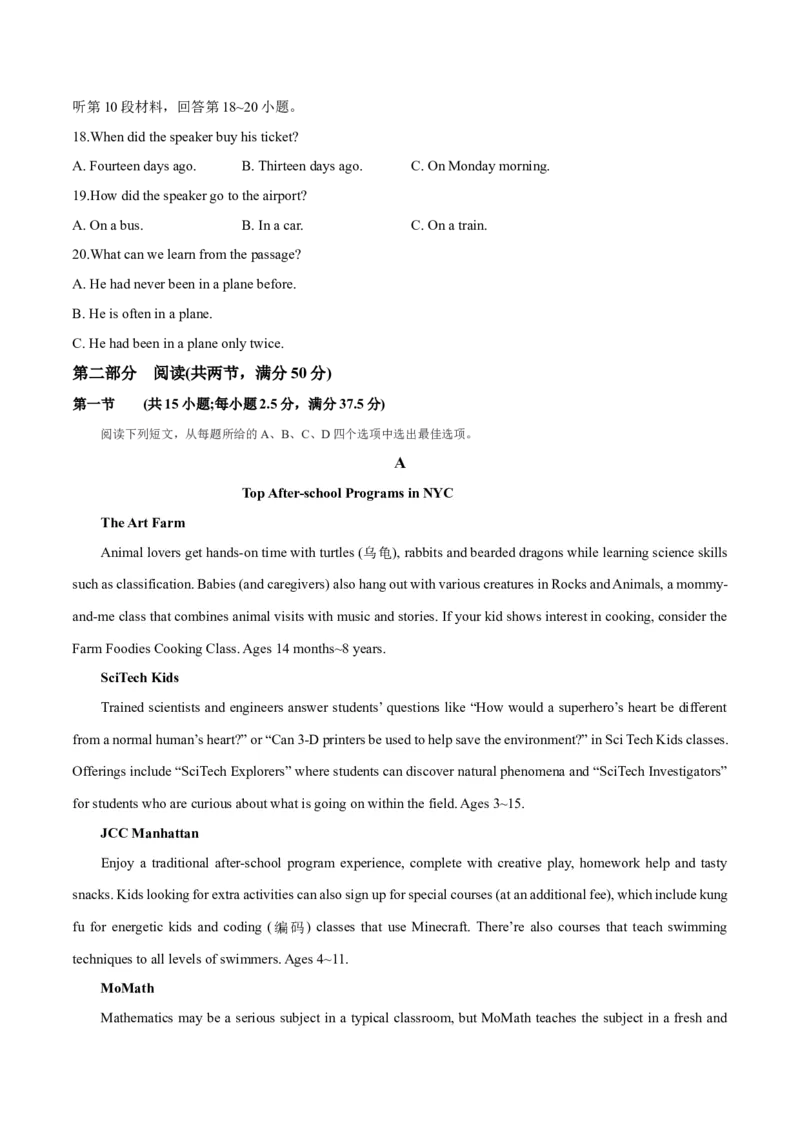
Top After-school Programs in NYC
The Art Farm
Animal lovers get hands-on time with turtles (乌龟), rabbits and bearded dragons while learning science skills
such as classification. Babies (and caregivers) also hang out with various creatures in Rocks and Animals, a mommy-
and-me class that combines animal visits with music and stories. If your kid shows interest in cooking, consider the
Farm Foodies Cooking Class. Ages 14 months~8 years.
SciTech Kids
Trained scientists and engineers answer students’ questions like “How would a superhero’s heart be different
from a normal human’s heart?” or “Can 3-D printers be used to help save the environment?” in Sci Tech Kids classes.
Offerings include “SciTech Explorers” where students can discover natural phenomena and “SciTech Investigators”
for students who are curious about what is going on within the field. Ages 3~15.
JCC Manhattan
Enjoy a traditional after-school program experience, complete with creative play, homework help and tasty
snacks. Kids looking for extra activities can also sign up for special courses (at an additional fee), which include kung
fu for energetic kids and coding (编码) classes that use Minecraft. There’re also courses that teach swimming
techniques to all levels of swimmers. Ages 4~11.
MoMath
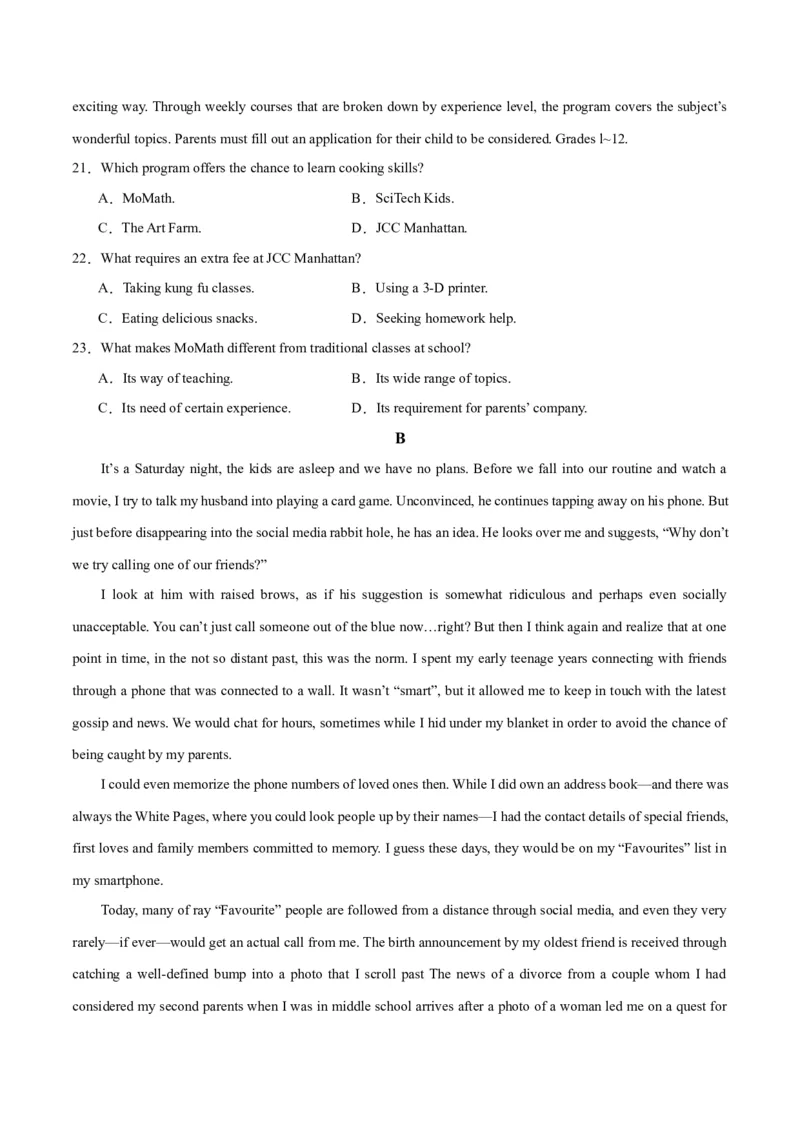
Mathematics may be a serious subject in a typical classroom, but MoMath teaches the subject in a fresh andexciting way. Through weekly courses that are broken down by experience level, the program covers the subject’s
wonderful topics. Parents must fill out an application for their child to be considered. Grades l~12.
21.Which program offers the chance to learn cooking skills?
A.MoMath. B.SciTech Kids.
C.The Art Farm. D.JCC Manhattan.
22.What requires an extra fee at JCC Manhattan?
A.Taking kung fu classes. B.Using a 3-D printer.
C.Eating delicious snacks. D.Seeking homework help.
23.What makes MoMath different from traditional classes at school?
A.Its way of teaching. B.Its wide range of topics.
C.Its need of certain experience. D.Its requirement for parents’ company.
B
It’s a Saturday night, the kids are asleep and we have no plans. Before we fall into our routine and watch a
movie, I try to talk my husband into playing a card game. Unconvinced, he continues tapping away on his phone. But
just before disappearing into the social media rabbit hole, he has an idea. He looks over me and suggests, “Why don’t
we try calling one of our friends?”
I look at him with raised brows, as if his suggestion is somewhat ridiculous and perhaps even socially
unacceptable. You can’t just call someone out of the blue now…right? But then I think again and realize that at one
point in time, in the not so distant past, this was the norm. I spent my early teenage years connecting with friends
through a phone that was connected to a wall. It wasn’t “smart”, but it allowed me to keep in touch with the latest
gossip and news. We would chat for hours, sometimes while I hid under my blanket in order to avoid the chance of
being caught by my parents.
I could even memorize the phone numbers of loved ones then. While I did own an address book—and there was
always the White Pages, where you could look people up by their names—I had the contact details of special friends,
first loves and family members committed to memory. I guess these days, they would be on my “Favourites” list in
my smartphone.
Today, many of ray “Favourite” people are followed from a distance through social media, and even they very
rarely—if ever—would get an actual call from me. The birth announcement by my oldest friend is received through
catching a well-defined bump into a photo that I scroll past The news of a divorce from a couple whom I had
considered my second parents when I was in middle school arrives after a photo of a woman led me on a quest formore gossip. Bits of such information, a collection of wonderful, exciting, shocking and also boring news, may have
been a part of my digital feed for years. The idea of actually picking up the phone to reconnect with a long-lost
friend is an intimidating one—even seeing the name of an old friend pop up in an incoming call can make us have
a panic attack.
I ask my husband, “Who would we call?” After tossing around a few names, we agree on some potential
candidates—people whose lives have taken them in different directions, but with whom we still share deep
friendships.
24.How does the author feel about her husband’s suggestion at first?
A.Surprised. B.Nervous. C.Motivated. D.Excited.
25.With the phone, the author’s teenage years was __________.
A.difficult but interesting
B.peaceful and meaningful
C.pleasant and unforgettable
D.inconvenient but enjoyable
26.What does the underlined word “intimidating” possibly mean?
A.Fresh. B.Scary. C.Thrilling. D.Natural.
27.In the following days, the couple may__________.
A.share more of their private information with others
B.contact more long-lost friends through social media
C.have more personal communications with their friends
D.add more friends’ names to the contact lists in their phones
C
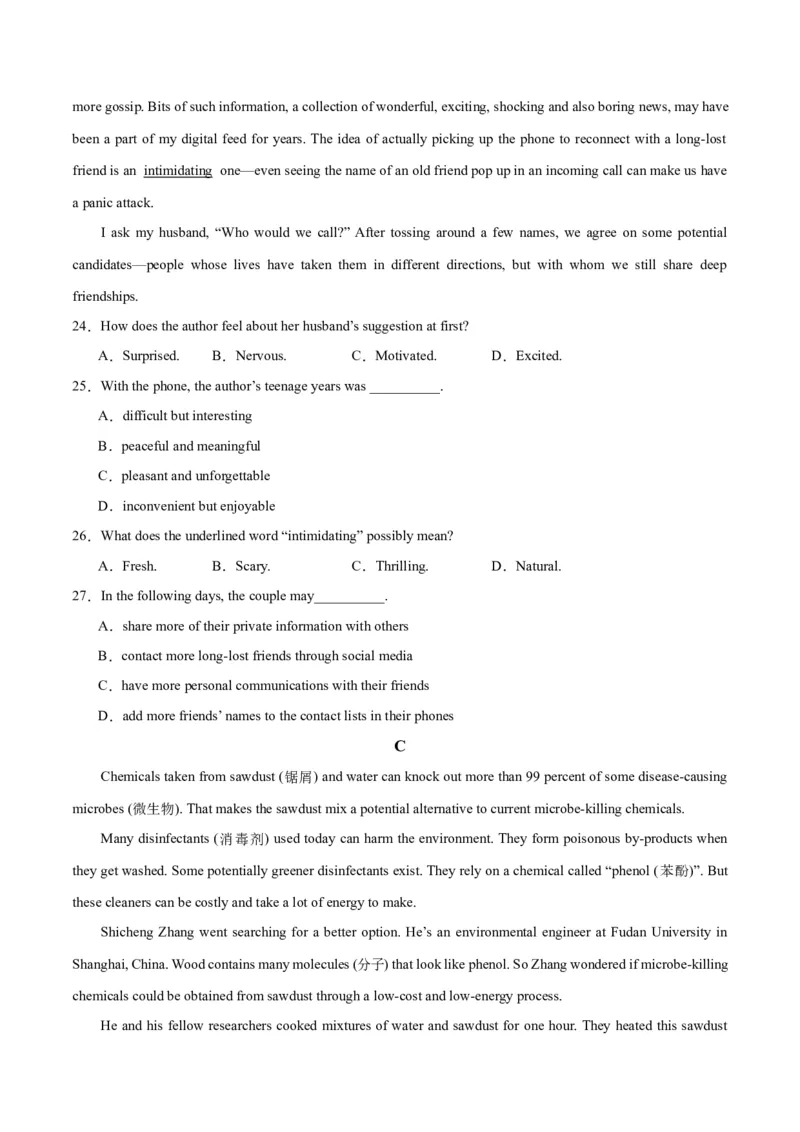
Chemicals taken from sawdust (锯屑) and water can knock out more than 99 percent of some disease-causing
microbes (微生物). That makes the sawdust mix a potential alternative to current microbe-killing chemicals.
Many disinfectants (消毒剂) used today can harm the environment. They form poisonous by-products when
they get washed. Some potentially greener disinfectants exist. They rely on a chemical called “phenol (苯酚)”. But
these cleaners can be costly and take a lot of energy to make.
Shicheng Zhang went searching for a better option. He’s an environmental engineer at Fudan University in
Shanghai, China. Wood contains many molecules (分子) that look like phenol. So Zhang wondered if microbe-killing
chemicals could be obtained from sawdust through a low-cost and low-energy process.
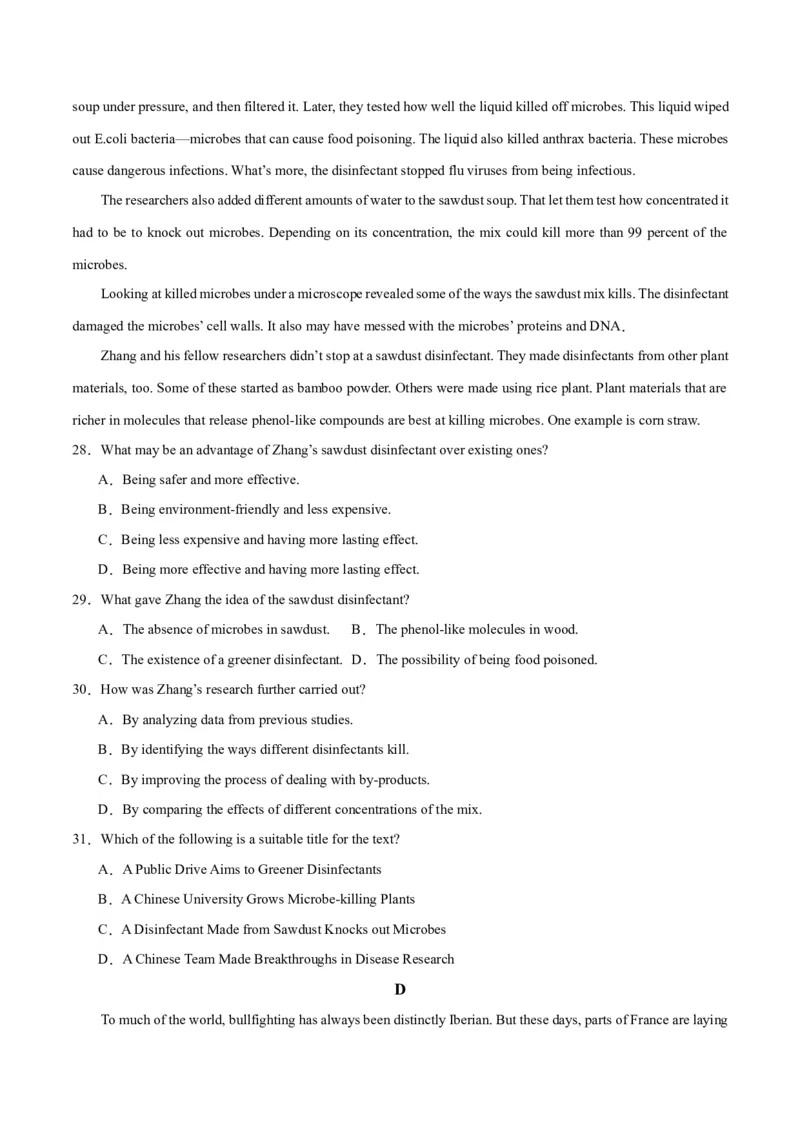
He and his fellow researchers cooked mixtures of water and sawdust for one hour. They heated this sawdustsoup under pressure, and then filtered it. Later, they tested how well the liquid killed off microbes. This liquid wiped
out E.coli bacteria—microbes that can cause food poisoning. The liquid also killed anthrax bacteria. These microbes
cause dangerous infections. What’s more, the disinfectant stopped flu viruses from being infectious.
The researchers also added different amounts of water to the sawdust soup. That let them test how concentrated it
had to be to knock out microbes. Depending on its concentration, the mix could kill more than 99 percent of the
microbes.
Looking at killed microbes under a microscope revealed some of the ways the sawdust mix kills. The disinfectant
damaged the microbes’ cell walls. It also may have messed with the microbes’ proteins and DNA.
Zhang and his fellow researchers didn’t stop at a sawdust disinfectant. They made disinfectants from other plant
materials, too. Some of these started as bamboo powder. Others were made using rice plant. Plant materials that are
richer in molecules that release phenol-like compounds are best at killing microbes. One example is corn straw.
28.What may be an advantage of Zhang’s sawdust disinfectant over existing ones?
A.Being safer and more effective.
B.Being environment-friendly and less expensive.
C.Being less expensive and having more lasting effect.
D.Being more effective and having more lasting effect.
29.What gave Zhang the idea of the sawdust disinfectant?
A.The absence of microbes in sawdust. B.The phenol-like molecules in wood.
C.The existence of a greener disinfectant. D.The possibility of being food poisoned.
30.How was Zhang’s research further carried out?
A.By analyzing data from previous studies.
B.By identifying the ways different disinfectants kill.
C.By improving the process of dealing with by-products.
D.By comparing the effects of different concentrations of the mix.
31.Which of the following is a suitable title for the text?
A.A Public Drive Aims to Greener Disinfectants
B.A Chinese University Grows Microbe-killing Plants
C.A Disinfectant Made from Sawdust Knocks out Microbes
D.A Chinese Team Made Breakthroughs in Disease Research
D
To much of the world, bullfighting has always been distinctly Iberian. But these days, parts of France are layingclaim to this tradition. From the Cte Basque to the arenas of Arles and Beziers, it has spread to towns where bullfighting
has long been banned, and been embraced with such enthusiasm you’d think the sport had been born there.
The rising passion for blood and sand has been resisted by animal-rights activists. Last month someone set off
a bomb near the bullring in Carcassonne. Yet France’s enthusiasts fiercely defend their right to these moral rituals.
Bullfighting, they insist, is part of the heritage, an expression of a shared regional culture that should be protected.
The rest of the Continent should take note. The paradox (自相矛盾) of an ever-more-united Europe is that as
borders between member states become less important, so do the nations themselves-and regional identities are
valued. It’s easy to forget that most European nation-states were created as we know them only during the 19th
century, after a long series of bloody conflicts. “If the chances of war had been a little different, all the regions sharing
bullfight might have been together,” argues Jean Michel Mariou, a huge fan of bullfighting. On both sides of the
Pyrenees there are Basques, there are Catalans, there are common cultures, he says. “Bullfighting is only one
expression of it.”
Bullfighting isn’t the only cultural tradition that has begun to go beyond borders, of course. To name but one
other: the Celtic revival, built largely around musical groups along the coast of Ireland, Scotland and Cornwall,
Brittany and Normandy. But while bagpipes (风笛) may stir the blood, they don’t spill it. And the violence of
bullfighting horrifies many people who don’t feel they share in its culture.
“The concept of lasting local tradition doesn’t mean anything anymore,” says Josyane Wuerelle, coordinator of
the Federation de Liasions Anti-Corrida in Agde. Bullfighting is about attracting tourists, not honoring local history,
she argues. Robert Marge doesn’t see it that way, of course. He recently declined an invitation to organize a bullfighting
in Paris’s enormous Stade de France. “We didn’t want to sell our souls by bringing bullfight to a region where it
doesn’t exist,” he explains. But he has also got the sense to know that some traditions don’t travel well.
32.What can we learn about bullfighting from the first two paragraphs?
A.It is legal in France. B.It will boom tourism in France.
C.It has become popular in France. D.It is part of the heritage of France.
33.What can we infer according to Jean Michel Mariou?
A.Shared cultures could bring people together.
B.The continent of Europe is more united than ever.
C.Bullfighting is a popular culture in many regions.
D.Regions sharing bullfight were separated by wars.
34.Why did Robert Marge refuse to organize a bullfight in Paris?A.It ignores animal rights. B.It honors local tradition.
C.It is intended for money. D.It is too violent for Paris.
35.What is the best title for the text?
A.Fight over Bullfight B.Culture or Violence
C.Bullfight and Tourism D.Passion for Blood and Sand
第二节 (共5小题;每小题2.5分,满分12.5分)
阅读下面短文,从短文后的选项中选出可以填入空白处的最佳选项。选项中有两项为多余选项。
Anger is the most destructive emotion. When you are in a temper, you make hasty ill-considered decisions that
you will probably regret. You will also regret reckless language spoken without thought. 36 Here are some
ways that you can combat the causes of anger.
37 You have to accept that sometimes things do go wrong and that people are not always lovely. Try
to accept that other people do behave in ways that will make you both frustrated and angry. Often, there might be an
excellent reason why a person acted in away that you found unacceptable.
Realizing that no one is perfect is a good start to avoiding getting angry. 38 Neither will they behave in
the same way that you would in a given situation.
Reacting angrily is a hard habit to break. The trick is to avoid reacting when faced with a situation that usually
angers. Anger is a negative reaction, but in this type of situation, there is no value in reacting by forming positive
thoughts. 39 This way,your anger will not get the emotional food it needs to survive.
Don’t take the easy way when you get angry. We all get tempted to throw something, hit something, or scream
when we are angry. You might say you feel better after an angry outburst, but that is just the after-effect of the
adrenalin (肾上腺素) your body released while you were angry. A reaction like that is the easy way. It is much harder
to stay calm, to walk away from conflict, or to take a deep breath and act normally. 40
A.Stop trying to manage your anger.
B.What can be done to control anger?
C.You need to learn not to respond at all.
D.That, however, is what you must do if you are to stop anger.
E.You need to change your attitude to the way the world works.
F.Taking positive steps will help you overcome feelings of anger.
G.Also, you need to accept that not everyone has the same standards as you.
第三部分 语言运用(共两节,满分30分)
第一节 (共15小题;每小题1分,满分15分)阅读下面短文,从每题所给的A、B、C、D四个选项中选出可以填入空白处的最佳选项。
“Challenge-based learning is often focused on the challenges that have global impact. The students, who
41 the challenge, often don’t know what the solution will be. The facilitator is keeping them from 42
a solution too early, and encourages to analyze the challenge from multiple points of view, and from different scientific
perspectives,” says Vilma Sukacke, a researcher at Kaunas University of Technology (KTU), Lithuania.
Such a learning approach is very fitting to sustainability education, which, according to various scholars, 43
a contextual, problem-oriented, reflective, interdisciplinary (跨学科), collaborative, participatory and empowered
learning environment. In other words, educators have to 44 from more traditional teacher-centred
education to becoming instructional designers of student-centred education.
Aiming to evaluate the 45 of such approaches, a group of researchers from Lithuanian, Danish,
German, Portuguese and Spanish universities conducted a systematic literature review, 46 the three active
learning methods, i.e.. project, problem and challenge-based learning according to the ADDIE (analysis, design,
development, implementation, and evaluation) framework.
47 the educators agree that problem-based learning (PBL), project-based learning (PJBL) and, more
recently, challenge-based learning (CBL) are efficient in teaching the students to 48 technology in real-
life situations and improving their transversal (横向) skills, such as teamwork, communication and conflict resolution,
the application of these methods in the classroom may be challenging for both sides.
“In my practice, I have noticed that sometimes students are 49 innovative learning methods and are
considering them as a sort of a game. As these classes often take place in a play full environment, full of different
pencils, colorful notes and building blocks, it’s difficult for the students to take them 50 . Therefore, it’s
very important to 51 the methods and the goals to the learners very clearly,” says Professor Saule Petroniene
from KTU Faculty of Social Sciences, Arts and Humanities, a co-author of the study.
According to her, to successfully apply unconventional teaching methods is a challenge for a beginning teacher.
However, this effort 52 , especially when students continue their activities outside school and focus on
solving 53 social problems.
Rescarchers believe that the 54 of CBL, PJBL, and PBL requires a paradigm (范式) shift, where
organization, staff and students change their view to education and learning. In this process, both teachers and students
need to apply new skills and 55 roles that they might not have needed before.
41.A.allow B.introduce C.accept D.expect
42.A.carrying on B.focusing on C.applying for D.inquiring about43.A.cares about B.tells of C.turns to D.calls for
44.A.shift B.differ C.suffer D.learn
45.A.outcome B.efficiency C.impact D.value
46.A.exploring B.applying C.modifying D.explaining
47.A.Whether B.As long as C.Although D.Because
48.A.develop B.include C.associate D.integrate
49.A.approving B.questioning C.preventing D.adopting
50.A.affectionately B.calmly C.seriously D.coolly
51.A.transfer B.change C.communicate D.express
52.A.pays off B.goes away C.gives off D.breaks down
53.A.subjective B.real C.imaginary D.virtual
54.A.combination B.organization C.realization D.cooperation
55.A.take on B.put away C.send for D.deal with
第二节 (共10小题;每小题1.5分,满分15分)
阅读下面材料,在空白处填入适当的内容 (1个单词) 或括号内单词的正确形式。
FIFA World Cup is going on in Doha, Qatar (卡塔尔). Its mascot is La’eeb, a cute figure 56 name
means “super-skilled player” in Arabic. Chinese fans jokingly dubbed (起绰号) the mascot as the “wonton
wrapper” (馄饨皮) because of its resemblance to the food.
Qatar FIFA World Cup has also made a Qatari youngster a social media sensation (网红) in China. During the
live broadcast of the opening match 57 Qatar and Ecuador, a teenage boy in the audience wearing a
kaffiyeh (头巾), a traditional headdress for men in Qatar, 58 (grab) people’s attention by making dramatic
facial expressions showing his 59 (happy) about his team’s performance — The Qatari team ultimately
lost the match.
Chinese fans began posting screenshots of him next to La’eeb 60 (make) the same poses and facial
expressions, and he was dubbed the “wonton wrapper prince”. People also have drawn cartoons of him and made his
facial expressions into memes.
It was found out later that 61 teen is actually a member of the Qatari royal family. One Thursday last
month, prince Abdulrahman recorded a video expressing his gratitude for the love he 62 (receive) from
the Chinese people. It 63 (post) on Chinese social media on Thursday.
“Hello, this is my message for all of my Chinese fans,” he said in the video. “I’m here just 64 (say)thank you for all of your beautiful comments and all of your beautiful videos. I’ve seen all of them. Thank you so
much, 65 you’ re more than welcome to come to Qatar. You can experience and watch this amazing event — the
World Cup. Thank you.”
第四部分 写作(共两节,满分40分)
第一节 (满分15分)
假定你是高三学生李华,你的英国好友Jim在做关于“中学生做家务”的调查,想了解你做家务的情
况。请你给他回复邮件,内容包括:
1. 你平时做哪些家务;
2. 你对做家务的看法。
注意:1. 词数80左右;
2. 可以适当增加细节,以使行文连贯。
____________________________________________________________________________________________
____________________________________________________________________________________________
____________________________________________________________________________________________
____________________________________________________________________________________________
________________________________________________________________________________________
第二节 (满分25分)
阅读下面材料,根据其内容和所给段落开头语续写两段,使之构成一篇完整的短文。
I watched my dad scowl (绷着脸) as he listened to the voice coming through the telephone receiver. I heard him
say, “Yes, Miss Beisner,” and “I understand what you’re saying, Miss Beisner. I appreciate you sharing this information.
We’ll see what we can do about the situation. Thank you for calling. Goodbye.”
Miss Beisner was my first-grade teacher, and I loved her. I thought she felt the same about me, but now I was
beginning to wonder. The tone of Dad’s voice, the redness in his cheeks, and his repeated clenching. And unclenching
of fists made it pretty clear. This was not a warm and fuzzy good news-from-the-teacher call.
As I was deciding whether I should lock myself in my bedroom for the rest of my life or run away from home,
Dad hung up the phone. “Jacquie, come here and sit down. We need to talk.”
Uh-oh. When Dad said, “We need to talk,” it meant he needed to talk, and I needed to listen.
I shuffled (拖着脚走) over to the well-worn brown chair in the corner of the living room, plopped down, and
waited to hear the nature of my crime.Dad told me that Miss Beisner thought I was bright but not working up to my ability. She said I had strong verbal
skills but weak study habits. Translation: I never closed my mouth, and I seldom opened a book. Apparently, my
failure to memorize the addition facts, or even attempt to, was more than she was willing to put up with. Hence, the
telephone call.
Dad ended our one-way conversation with a verbal outline for his plan of attack. Bubbles, our Toy Manchester
Terrier, was going to teach me math. Silently, I thought, No way is any dumb dog going to teach me how to add, not
even our beloved Bubbles. Out loud, I said, “How?”
Dad summoned Bubbles from her bed near the stove and commanded her to sit. “Bubbles,” Dad said, “how
much is five plus three?” Bubbles let out eight loud, crisp barks.
I was incredulous (满腹狐疑的). I couldn’t understand how a dog could add, and I was more than a little
embarrassed by the fact that the family dog was smarter than me.
注意:
1. 续写词数应为150左右;
2. 请按如下格式在答题卡的相应位置作答。
Paragraph 1: After that, I threw myself into math with newfound determination.
____________________________________________________________________________________________
____________________________________________________________________________________________
____________________________________________________________________________________________
____________________________________________________________________________________________
____________________________________________________________________________________
Paragraph 2: One day, I asked Dad whether Bubbles really knew how to add.
________________________________________________________________________________________
____________________________________________________________________________________________
____________________________________________________________________________________________
____________________________________________________________________________________________
______________________________________________________________________________________