绝密★启用前
2011 年全国硕士研究生招生考试
英语(二)
(科目代码:204)
☆考生注意事项☆
1. 答题前,考生须在试题册指定位置上填写考生编号和考生姓名;在答题卡指定位
置上填写报考单位、考生姓名和考生编号,并涂写考生编号信息点。
2. 考生须把试题册上的“试卷条形码”粘贴条取下,粘贴在答题卡的“试卷条形码
粘贴位置”框中。不按规定粘贴条形码而影响评卷结果的,责任由考生自负。
3. 选择题的答案必须涂写在答题卡相应题号的选项上,非选择题的答案必须书写在
答题卡指定位置的边框区域内。超出答题区域书写的答案无效;在草稿纸、试题
册上答题无效。
4. 填(书)写部分必须使用黑色字迹签字笔书写,字迹工整、笔迹清楚;涂写部分
必须使用2B铅笔填涂。
5. 考试结束,将答题卡和试题册按规定交回。
(以下信息考生必须认真填写)
考生编号
考生姓名2011年全国硕士研究生入学统一考试英语(二)试题
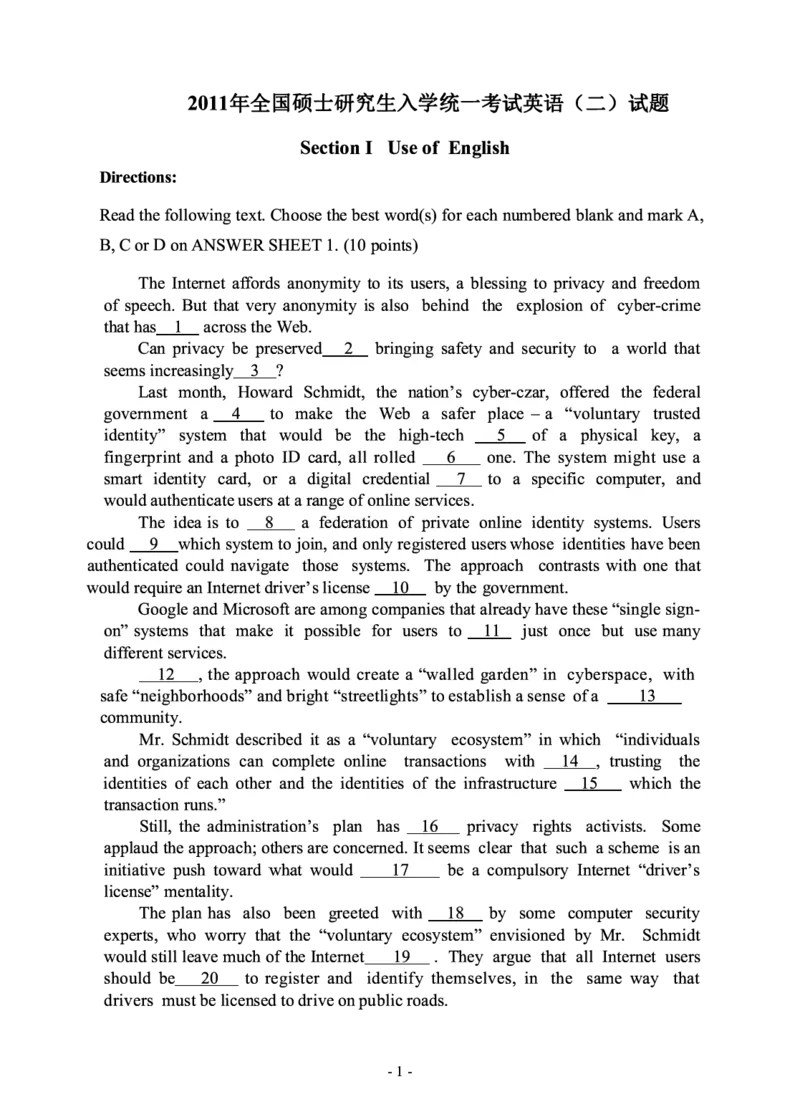
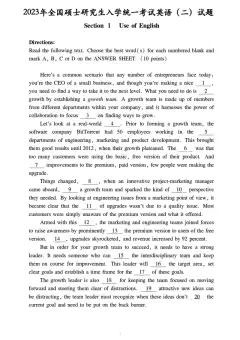
Section I Use of English
Directions:
Read the followin text. Choose the best word(s) for each numbered blank and mark A,
g
B, C or Don ANSWER SHEET 1. (10 points)
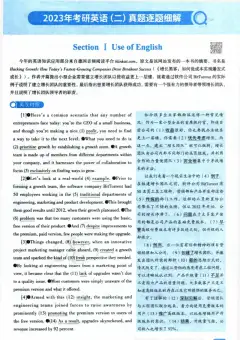
The Internet affords anon mity to its users, a blessin to privac and freedom
y g y
of speech. But that very anonymit is also behind the explosion of c ber-crime
y y
that has 1 across the Web.
Can privac be preserved 2 brin in safet and securit to a world that
y g g y y
seems increasin l 3 ?
g y
Last month, Howard Schmidt, the nation's c ber-czar, offered the federal
y
overnment a 4 to make the Web a safer place - a "voluntary trusted
g
identit " s stem that would be the hi h-tech 5 of a ph sical ke , a
y y g y y
fin erprint and a photo ID card, all rolled 6 one. The s stem mi ht use a
g y g
smart identity card, or a di ital credential 7 to a specific computer, and
g
would authenticate users at a ran e of online services.
g
The idea is to 8 a federation of private online identity s stems. Users
y
could 9 which s stem to join, and onl re istered users whose identities have been
y y g
authenticated could navi ate those systems. The approach contrasts with one that
g
would require an Internet driver's license 10 b the overnment.
y g
Goo le and Microsoft are amon companies that alread have these "sin le si n
g g y g g
on" s stems that make it possible for users to 11 just once but use man
y y
different services.
12 , the approach would create a "walled arden" in c berspace, with
g y
safe "nei hborhoods" and bri ht "streetli hts" to establish a sense of a 13
g g g
communit .
y
Mr. Schmidt described it as a "voluntary ecosystem" in which "individuals
and or amzat10ns can complete onlme transact10ns with 14 , trustm the
g g
identities of each other and the identities of the infrastructure 15 which the
transaction runs."
Still, th e adm1mstratlon's plan has 16 pnvacy ri hts activists. Some
g
applaud the approach; others are concerned. It seems clear that such a scheme is an
initiative push toward what would 17 be a compulsory Internet "driver's
license" mentality.
The plan has also been reeted with 18 by some computer securit
g y
experts, who worry that the "voluntary ecos stem" envisioned by Mr. Schmidt
y
would still leave much of the Internet 19 . They argue that all Internet users
should be 20 to re ister and identif themselves, in the same way that
g y
drivers must be licensed to drive on public roads.
- 1 -1. [A] swept [B] skipped [C] walked [D] ridden
2. [A] for [B] within [C] while [D] though
3 . [A] careless [B] lawless [C] pointless [D] helpless
4. [A] reason [B] reminder [C ] compromise [D] proposal
5. [A] information [B] interference [C] entertamment [D] equivalent
6. [A] by [B] into [C] from [D] over
7. [A] linked [B] directed [C] chained [D] compared
8. [A] dismiss [B] discover [C] create [D] improve
9. [A] recall [B] suggest [C] select [D] realize
10. [A] released [B] issued [C] distributed [D] delivered
11. [A] carry on [B] linger on [C] set in [D] log in
12. [A] In vain [B] In effect [C] In return [D] In contrast
13 . [A] trusted [B] modernized [C] thriving [D] competing
14. [A] caution [B] delight [C] confidence [D] patience
15. [A] on [B] after [C] beyond [D] across
16. [A] divided [B] disappointed [C ] protected [D] united
17. [A] frequently [B] incidentally [C] occasionally [D] eventually
18. [A] skepticism [B] tolerance [C ] indifference [D] enthusiasm
19. [A] manageable [B] defendable [C] vulnerable [D] invisible
20. [A] invited [B] appointed [C] allowed [D] forced
Section II Reading Comprehension
Part A
Directions:
Read the following four texts. Answer the questions after each text by choosing A,
B, C or D. Mark your answers on ANSWER SHEET 1. (40 points)
- 2 -Text 1
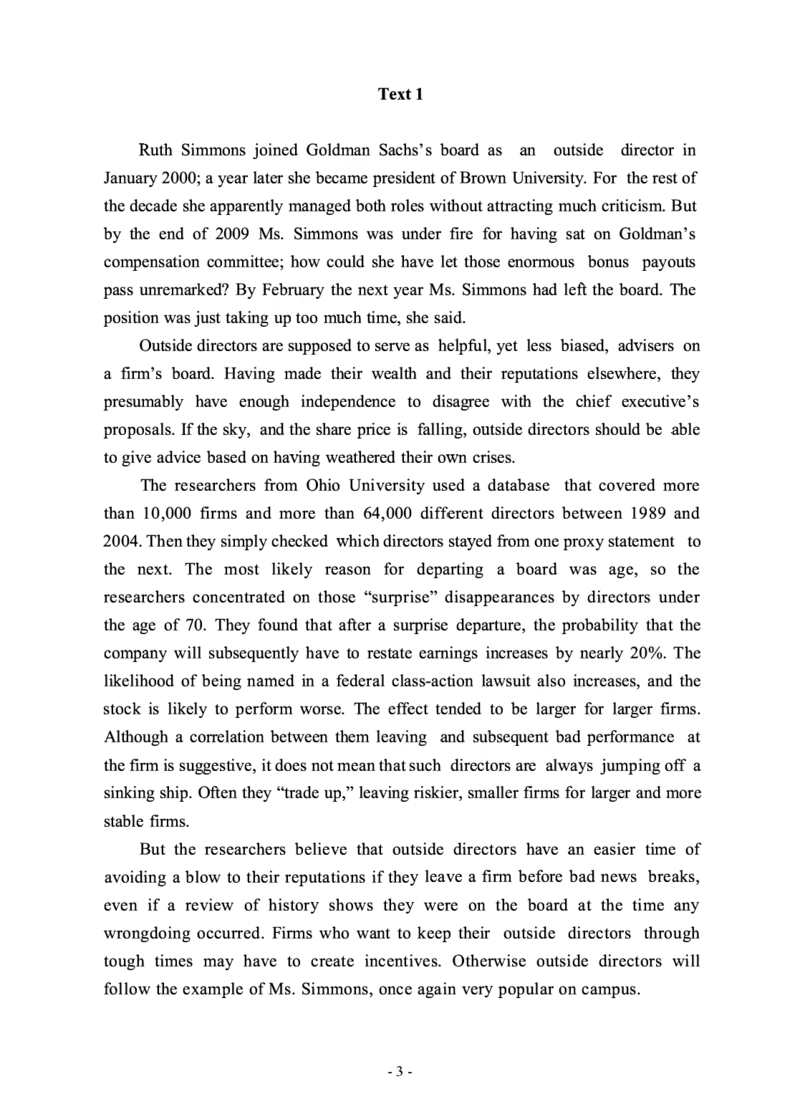
Ruth Simmons joined Goldman Sachs's board as an outside director in
January 2000; a ear later she became president of Brown University. For the rest of
y
the decade she apparentl managed both roles without attracting much criticism. But
y
b the end of 2009 Ms. Simmons was under fire for having sat on Goldman's
y
compensation con皿ittee; how could she have let those enormous bonus pa
y
outs
pass unremarked? B February the next ear Ms. Simmons had left the board. The
y y
position was just taking up too much time, she said.
Outside directors are supposed to serve as helpful, et less biased, advisers on
y
a 伍m's board. Having made their wealth and their reputations elsewhere, the
y
presumabl have enough independence to disagree with the chief executive's
y
proposals. If the sk , and the share price is falling, outside directors should be able
y
to give advice based on having weathered their own crises.
The researchers from Ohio Universit used a database that covered more
y
than 10,000 firms and more than 64,000 different directors between 1989 and
2004. Then the simpl checked which directors sta ed from one prox statement to
y y y y
the next. The most likel reason for departing a board was age, so the
y
researchers concentrated on those "surprise" disappearances b directors under
y
the age of 70. The found that after a surprise departure, the probability that the
y
compan will subsequentl have to restate earnings increases b nearl 20%. The
y y y y
likelihood of being named in a federal class-action lawsuit also increases, and the
stock is likel to perform worse. The effect tended to be larger for larger firms.
y
Although a correlation between them leaving and subsequent bad performance at
the firm is suggestive, it does not mean that such directors are alwa s jumping off a
y
sinking ship. Often the "trade up," leaving riskier, smaller 伍ms for larger and more
y
stable firms.
But the researchers believe that outside directors have an easier time of
avoiding a blow to their reputations if the leave a firm before bad news breaks,
y
even if a review of histor shows the were on the board at the time an
y y y
wrongdoing occurred. Firms who want to keep their outside directors through
tough times ma have to create incentives. Otherwise outside directors will
y
follow the example of Ms. Simmons, once again ver popular on campus.
y
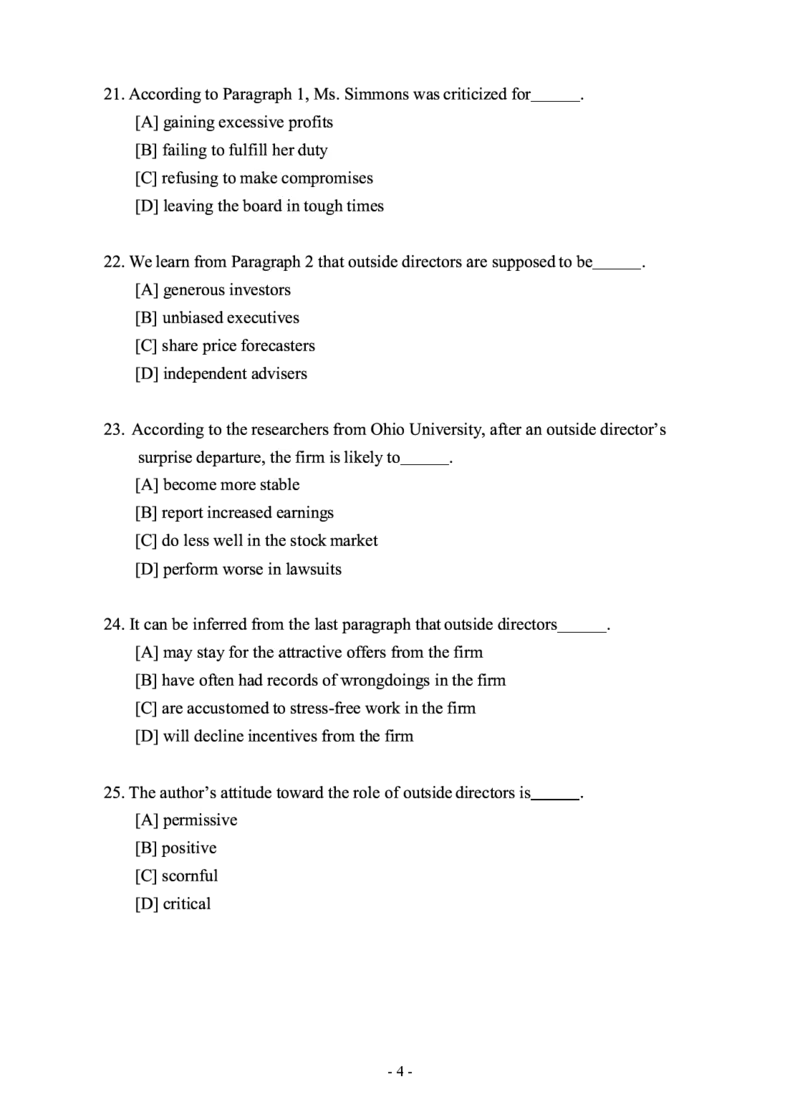
- 3 -21. According to Paragraph 1, Ms. Simmons was criticized for .
[A] gaining excessive profits
[B] failing to fulfill her duty
[C] refusing to make compromises
[D] leaving the board in tough times
22. We learn from Paragraph 2 that outside directors are supposed to be .
[A] generous investors
[B] unbiased executives
[C] share price forecasters
[D] independent advisers
23. According to the researchers from Ohio University, after an outside director's
surprise departure, the firm is likely to .
[A] become more stable
[B] report increased earnings
[C] do less well in the stock market
[D] perform worse in lawsuits
24. It can be inferred from the last paragraph that outside directors .
[A] may stay for the attractive offers from the firm
[B] have often had records of wrongdoings in the伍m
[C] are accustomed to stress-free work in the firm
[D] will decline incentives from the firm
25. The author's attitude toward the role of outside directors is
[A] perm1ss1ve
[B] positive
[C] scornful
[D] critical
- 4 -Text2
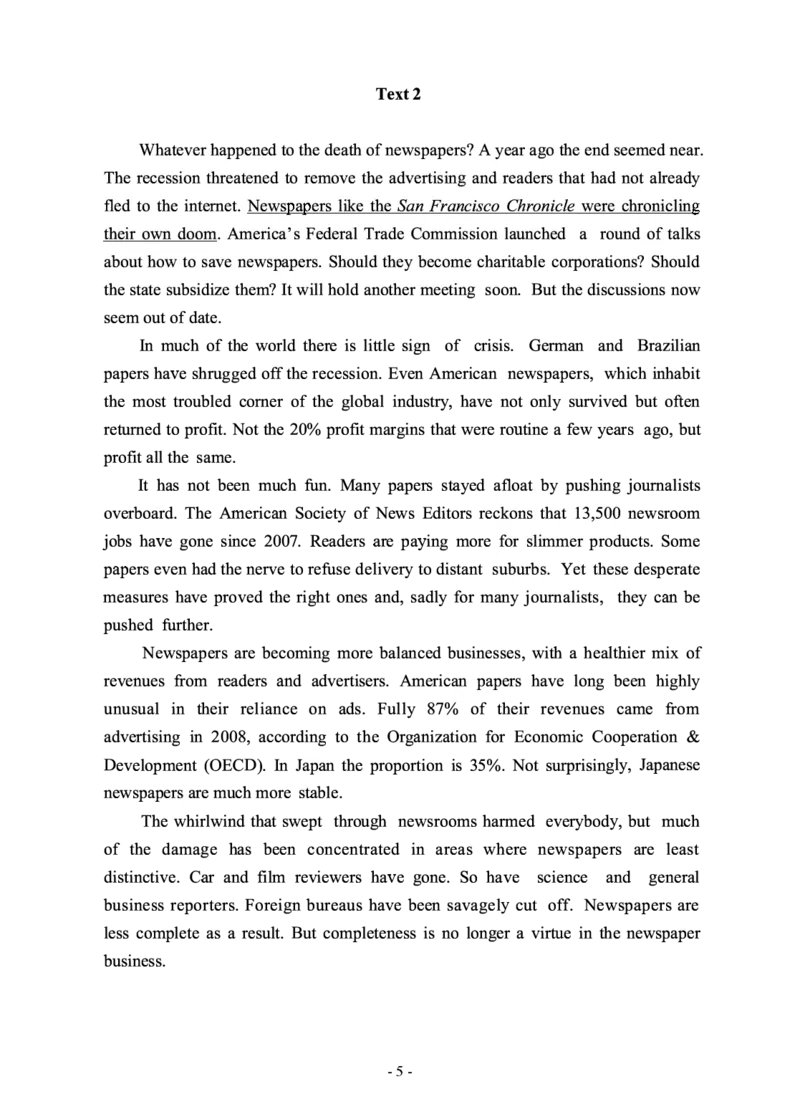
Whatever happened to the death of newspapers? A ear a o the end seemed near.
y g
The recession threatened to remove the advertisin and readers that had not alread
g y
fled to the internet. News a ers like the San Francisco Chronicle were chroniclin
their own doom. America's Federal Trade Commission launched a round of talks
about how to save newspapers. Should the become charitable corporations? Should
y
the state subsidize them? It will hold another meetin soon. But the discussions now
g
seem out of date.
In much of the world there is little sign of crisis. German and Brazilian
papers have shru ed off the recession. Even American newspapers, which inhabit
gg
the most troubled corner of the lobal industry, have not onl survived but often
g y
returned to profit. Not the 20% profit mar ins that were routine a few ears a o, but
g y g
profit all the same.
It has not been much fun. Man papers sta ed afloat b pushin journalists
y y y g
overboard. The American Societ of News Editors reckons that 13,500 newsroom
y
jobs have one since 2007. Readers are pa in more for slimmer products. Some
g y g
papers even had the nerve to refuse delivery to distant suburbs. Yet these desperate
measures have proved the ri ht ones and, sadl for man journalists, the can be
g y y y
pushed further.
Newspapers are becomin more balanced businesses, with a healthier mix of
g
revenues from readers and advertisers. American papers have lon been hi hl
g g y
unusual in their reliance on ads. Full 87% of their revenues came from
y
advertisin in 2008, accordin to the Or anization for Economic Cooperation &
g g g
Development (OECD). In Japan the proportion is 35%. Not surprisin l , Japanese
gy
newspapers are much more stable.
The whirlwind that swept throu h newsrooms harmed everybod , but much
g y
of the dama e has been concentrated in areas where newspapers are least
g
distinctive. Car and film reviewers have one. So have science and eneral
g g
business reporters. Forei n bureaus have been sava el cut off. Newspapers are
g g y
less complete as a result. But completeness is no lon er a virtue in the newspaper
g
business.
- 5 -26. By saying "Newspapers like…their own doom" (Lines3-4, Para.1), the author
indicates that newspapers
[A] neglected the sign of crisis
[B] failed to get state subsidies
[C] were not charitable corporations
[D] were in a desperate situation
27. Some newspapers refused delivery to distant suburbs probably because .
[A] readers threatened to pay less
[B] newspapers wanted to reduce costs
[C] journalists reported little about these areas
[D] subscribers complained about slimmer products
28. Compared with their American counterparts, Japanese newspapers are much
more stable because they .
[A] have more sources of revenue
[B] have more balanced newsrooms
[C] are less dependent on advertising
[D] are less affected by readership
29. What can be inferred from the last paragraph about the current newspaper
business?
[A] Distinctiveness is an essential feature of newspapers.
[B] Completeness is to blame for the failure of newspaper.
[C] Foreign bureaus play a crucial role in the newspaper business.
[D] Readers have lost their interest in car and film reviews.
30. The most appropriate title for this text would be .
[A] American Newspapers: Struggling for Survival
[B] American Newspapers: Gone with the Wind
[C] American Newspapers: A ThrivingBusiness
[D] American Newspapers: A Hopeless Story
- 6 -Text3
We tend to think of the decades immediatel followin World War II as a
y g
time of prosperit and rowth, with soldiers returnin home b the millions,
y g g y
oin off to colle e on the G. I. Bill and linin up at the marria e bureaus.
g g g g g
But when it came to their houses, it was a time of common sense and a belief
that less could trul be more. Durin the Depression and the war, Americans had
y g
learned to live with less, and that restraint, in combination with the postwar
confidence in the future, made small, efficient housin positivel stylish.
g y
Economic condition was onl a stimulus for the trend toward efficient livin .
y g
The phrase "less is more" was actuall first popularized b a German, the
y y
architect Ludwi Mies van der Rohe, who like other people associated with the
g
Bauhaus, a school of design, emigrated to the United States before World War II
and took up posts at American architecture schools. These designers came to exert
enormous influence on the course of American architecture, but none more so
than Mies.
Mies's si nature phrase means that less decoration, properl or anized, has
g y g
more impact than a lot. Ele ance, he believed, did not derive from abundance.
g
Like other modern architects, he emplo ed metal, lass and laminated wood —
y g
materials that we take for ranted toda but that in the 1940s s mbolized the
g y y
future. Mies's sophisticated presentation masked the fact that the spaces he
designed were small and efficient, rather than bi and often empty.
g
The apartments in the ele ant towers Mies built on Chica o's Lake Shore
g g
Drive, for example, were smaller — two-bedroom units under 1,000 square feet —
than those in their older nei hbors alon the city's Gold Coast. But the were
g g y
popular because of their airy lass walls, the views the afforded and the ele ance
g y g
of the buildin s' details and proportions, the architectural equivalent of the
g
abstract art so popular at the time.
The trend toward "less" was not entirel forei n. In the 1930s Frank Llo d
y g y
Wri ht started buildin more modest and efficient houses — usuall around 1,200
g g y
square feet—than the spreadin two-story ones he had desi ned in the 1890s and the
g g
earl 20th century.
y
The "Case Stud Houses" commissioned from talented modern architects b
y y
California Arts & Architecture ma azine between 1945 and 1962 were et another
g y
homegrown influence on the "less is more" trend. Aesthetic effect came from the
landscape, new materials and forthri ht detailin . In his Case Stud House, Ralph
g g y
Rapson ma have mispredicted just how the mechanical revolution would impact
y
everyda life — few American families acquired helicopters, thou h most eventuall
y g y
ot clothes dryers — but his belief that self-sufficienc was both desirable and
g y
inevitable was widel shared.
y
- 7 -31. The postwar American housing style largely reflected the Americans' .
[A] prosperity and growth
[B] efficiency and practicality
[C] restraint and confidence
[D] pride and faithfulness
32. Which of the following can be inferred from Paragraph 3 about the Bauhaus?
[A] It was founded by Ludwig Mies van der Rohe.
[B] Its designing concept was affected by World War II.
[C] Most American architects used to be associated with it.
[D] It had a great influence upon American architecture.
33. Mies held that elegance of architectural design .
[A] was related to large space
[B] was identified with emptiness
[C] was not reliant on abundant decorat10n
[D] was not associated with efficiency
34. What is true about the apartments Mies built on Chicago's Lake Shore Drive?
[A] They ignored details and proportions.
[B] They were built with materials popular at that time.
[C] They were more spacious than neighboring buildings.
[D] They shared some characteristics of abstract art.
35. What can we learn about the design of the "Case Study Houses"?
[A] Mechanical devices were widely used.
[B] Natural scenes were taken into consideration.
[C] Details were sacrificed for the overall effect.
[D] Eco-friendly materials were employed.
- 8 -Text4
Will the European Union make it? The question would have sounded stran e
g
not lon a o. Now even the project's reatest cheerleaders talk of a continent facin
g g g g
a "Bermuda trian le" of debt, population decline and lower growth.
g
As well as those chronic problems, the EU faces an acute crisis in its
economic core, the 16 countries that use the sin le currenc . Markets have lost
g y
faith that the euro zone's economies, weaker or stron er, will one da conver e
g y g
thanks to the discipline of sharin a sin le currenc , which denies uncompetitive
g g y
members the quick fix of devaluation.
Yet the debate about how to save Europe's sin le currenc from
g y
disinte ration is stuck. It is stuck because the euro zone's dominant powers,
g
France and German , a ree on the need for reater harmonisation within the
y g g
euro zone, but disa ree about what to harmonise.
g
German thinks the euro must be saved b stricter rules on borrowin ,
y y g
spendin and competitiveness, backed b quasi-automatic sanctions for overnments
g y g
that do not obe . These mi ht include threats to freeze EU funds for poorer re ions
y g g
and EU me a-projects, and even the suspension of a country's votin ri hts in EU
g g g
ministerial councils. It insists that economic co-ordination should involve all 27
members of the EU club, amon whom there is a small majority for free-market
g
liberalism and economic ri our; in the inner core alone, German fears, a small
g y
majority favour French interference.
A "southern" camp headed b France wants somethin different: "European
y g
economic overnment" within an inner core of euro-zone members. Translated,
g
that means politicians intervenin in monetary polic and a s stem of redistribution
g y y
from richer to poorer members, via cheaper borrowin for overnments throu h
g g g
common Eurobonds or complete fiscal transfers. Finall , fi ures close to the Franch
y g
overnment have murmured, euro-zone members should agree to some fiscal and
g
social harmonisation: e. ., curbin competition in corporate-tax rates or labour costs.
g g
It is too soon to write off the EU. It remains the world's lar est tradin block.
g g
At its best, the European project is remarkabl liberal: built around a sin le market
y g
of 27 rich and poor countries, its internal borders are far more open to oods, capital
g
and labour than an comparable tradin area. It is an ambitious attempt to blunt the
y g
sharpest ed es of lobalisation, and make capitalism benign.
g g
- 9 -36. The EU is faced with so many problems that
[A] it has more or less lost faith in markets
[B] even its supporters begin to feel concerned
[C] some of its member countries plan to abandon euro
[D] it intends to deny the possibility of devaluation
37. The debate over the EU's single currency is stuck because the dominant
powers .
[A] are competing for the leading position
[B] are busy handling their own crises
[C] fail to reach an agreement on harmonisation
[D] disagree on the steps towards disintegration
38. To solve the euro problem, Germany proposed that
[A] EU funds for poor regions be increased
[B] stricter regulations be imposed
[C] only core members be involved in economic co-ordination
[D] voting rights of the EU members be guaranteed
39. The French proposal of handling the crisis implies that .
[A] poor countries are more likely to get funds
[B] strict monetary policy will be applied to poor countries
[C] loans will be readily available to rich countries
[D] rich countries will basically control Eurobonds
40. Regarding the future of the EU, the author seems to feel .
[A] pessimistic
[B] desperate
[C] conceited
[D] hopeful
- 10 -PartB
Directions:
Read the followin text and answer the questions b findin information from the
g y g
ri ht column that corresponds to each of the marked details iven in the left
g g
column. There are two extra choices in the ri ht column. Mark our answers on
g y
ANSWER SHEET 1. (10 points)
Leadin doctors toda wei h in on the debate over the overnment's role in
g y g g
promotin public health b demandin that ministers impose "fat taxes" on
g y g
unhealth food and introduce ci arette-st le warnin s to children about the
y g y g
dan ers of a poor diet.
g
The demands follow comments made last week b the health secretar ,
y y
Andrew Lansle , who insisted the overnment could not force people to make
y g
health choices and promised to free businesses from public health re ulations.
y g
But senior medical fi ures want to stop fast-food outlets openin near
g g
schools, restrict advertisin of products hi h in fat, salt or su ar, and limit
g g g
sponsorship of sports events b fast-food producers such as McDonald's.
y
The argue that overnment action is necessary to curb Britain's addiction to
y g
unhealth food and help halt spiralin rates of obesity, diabetes and heart disease.
y g
Professor Terence Stephenson, president of the Ro al Colle e of Paediatrics and
y g
Child Health, said that the consumption of unhealth food should be seen to be
y
just as dama in as somkin or excessive drinkin .
g g g g
"Thirt ears a o, it would have been inconceivable to have ima ined a ban
y y g g
on smokin in the workplace or in pubs, and et that is what we have now. Are we
g y
willin to be just as coura eous in respect of obesity? I would su est that we should
g g gg
be," said the leader of the UK's children's doctors.
Lansle has alarmed health campai ners b su estin he wants industry
y g y gg g
rather than overnment to take the lead. He said that manufacturers of crisps and
g
candies could pla a central role in the Chan e4Life campaign, the centrepiece of
y g
overnment efforts to boost health eatin and fitness. He has also criticised the
g y g
celebrit chef Jamie Oliver's hi h-profile attempt to improve school lunches in
y g
En land as an example of how "lecturin " people was not the best wa to chan e
g g y g
their behaviour.
Stephenson su ested potential restrictions could include bannin TV
gg g
advertisements for foods hi h in fat, salt or su ar before 9 pm and limitin them
g g g
on billboards or in cinemas. "If we were reall bold, we mi ht even be in to think
y g g
of hi h-calorie fast food in the same wa as ci arettes — b settin strict limits on
g y g y g
advertisin , product placement and sponsorship of sports events," he said.
g
- 11 -Such a move could affect firms such as McDonald's, which sponsors the
outh coachin scheme run b the Football Association. Fast-food chains should also
y g y
stop offerin "inducements" such as to s, cute animals and mobile phone credit to
g y
lure oun customers, Stephenson said.
y g
Professor Dinesh Bhu ra, president of the Ro al Colle e of Ps chiatrists, said:
g y g y
"If children are tau ht about the impact that food has on their rowth, and that
g g
some thin s can harm, at least information is available up front."
g
He also ur ed councils to impose "fast-food-free zones" around schools and
g
hospitals—areas within which takeawa s cannot open.
y
A Department of Health spokesperson said: "We need to create a new vision for
public health where all of society works to ether to et health and live lon er. This
g g y g
includes creatin a new 'responsibility deal' with business, built on social
g
responsibilit , not state re ulation. Later this ear, we will publish a white paper
y g y
settin out exactl how we will achieve this."
g y
The food industry will be alarmed that such senior doctors back such radical
moves, especiall the call to use some of the tou h tactics that have been deplo ed
y g y
a ainst smokin over the last decade.
g g
[A] "fat taxes" should be imposed on fast-food
producers such as McDonald's.
41. Andrew Lansle held that [B] the overnment should ban fast-food outlets
y g
in the nei hborhood of schools.
g
42. Terence Stephenson agreed [C] "lecturin " was an effective wa to improve
g y
that school lunches in En land.
g
43. Jamie Oliver seemed to [D] ci arette-st le warnm s should be
g y g
believe that in traduced to children about the dan ers of a
g
poor diet.
44. Dinesh Bhugra su ested [E] the producers of crisps and candies could
gg
that contribute significantl to the Chan e4Life
y g
campaign.
45. A Department of Health [F] parents should set ood examples for their
g
spokesperson proposed that children b keepin a health diet at home.
y g y
[G] the overnment should stren then the sense
g g
of responsibility amon businesses.
g
- 12 -Section III Translation
46. Directions:
In this section there is a text in English. Translate it into Chinese. Write your translation
on ANSWER SHEET 2. (15 points)
Who would have thought that, globall , the IT industry produces about the
y
same volume of gree呻ouse gases as the world's airlines do — roughl 2 percent of
y
all CO2 emissions?
Man ever da tasks take a surprising toll on the environment. A Google
y y y
search can leak between 0.2 and 7 .0 grams of CO2, depending on how man
y
attempts are needed to get the "right" answer. To deliver results to its users
quickl , then, Google has to maintain vast data centres around the world, packed
y
with powerful computers. While producing large quantities of CO2, these
computers emit a great deal of heat, so the centres need to be well air-conditioned,
which uses even more energy.
However, Google and other big tech providers monitor their efficienc
y
closel and make improvements. Monitoring is the first step on the road to reduction,
y
but there is much more to be done, and not just b big companies.
y
- 13 -Section IV Writing
Part A
47. Directions:
Suppose your cousin Li Ming has just been admitted to a university. Write
him小era letter to
1) congar tulate him加r,and
2) give him加rsuggestions on how to get prepared for university life.
You should write about 100 words on ANSWER SHEET 2.
Do not sign your own name at the end of the letter. Use "Zhang Wei" instead.
Do not write the address. (10 points)
PartB
48. Directions:
Write an essay based on the following chart. In your writing, you should
1) interpret the chart and
2) give your comments.
You should write at least 150 words.
Write your essay on ANSWER SHEET 2. (15 points)
40%
35%
30%
25%
20%
15%
10%
5%
0%
2008年 2009年
口国产品牌 • 日系品牌 口美系品牌
2008、 2009年国内轿车市场部分品牌市场份额示意图
- 14 -