绝密★启用前
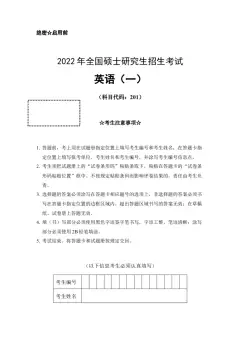
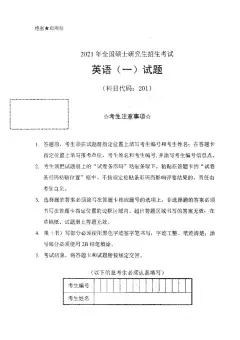
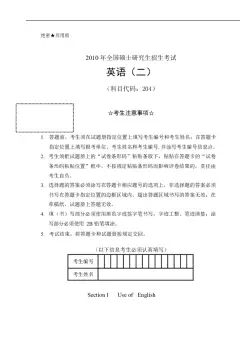
2021年全国硕士研究生招生考试
英语(一)
(科目代码:201)
☆考生注意事项☆
1. 答题前,考生须在试题册指定位置上填写考生编号和考生姓名;在答题卡
指定位置上填写报考单位、考生姓名和考生编号,并涂写考生编号信息点。
2. 考生须把试题册上的“试卷条形码”粘贴条取下,粘贴在答题卡的“试卷
条形码粘贴位置”框中。不按规定粘贴条形码而影响评卷结果的,责任由
考生自负。
3. 选择题的答案必须涂写在答题卡相应题号的选项上,非选择题的答案必须
书写在答题卡指定位置的边框区域内。超出答题区域书写的答案无效;在
草稿纸、试题册上答题无效。
4. 填(书)写部分必须使用黑色字迹签字笔书写,字迹工整、笔迹清楚;涂
写部分必须使用 2B 铅笔填涂。
5. 考试结束,将答题卡和试题册按规定交回。
(以下信息考生必须认真填写)
考生编号
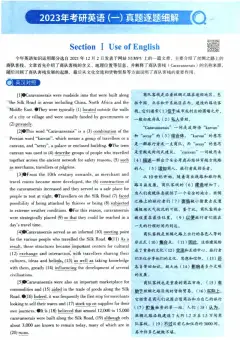
考生姓名Section Ⅰ Use of English
Directions:
Read the following text. Choose the best word(s) for each numbered blank and mark
A, B, C or D on the ANSWER SHEET. (10 points)
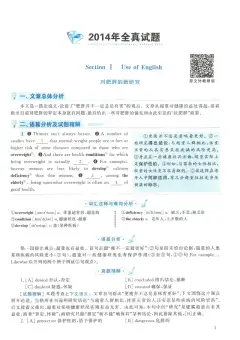
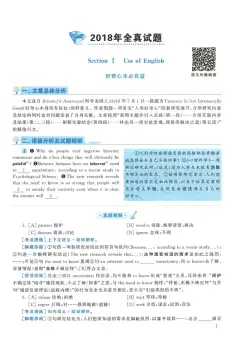
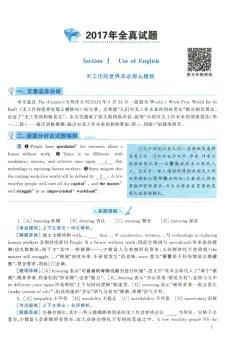
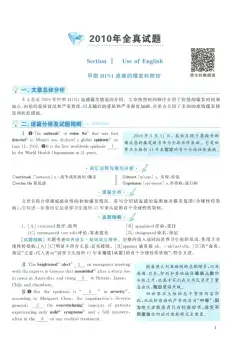
Fluid intelligence is the type of intelligence that has to do with short-term memory
and the ability to think quickly, logically, and abstractly in order to solve new
problems.It 1 in young adulthood, levels out for a period of time, and then 2
starts to slowly decline as we age. But 3 aging is inevitable, scientists are finding
out that certain changes in brain function may not be.
One study found that muscle loss and the 4 of body fat around the abdomen
are associated with a decline in fluid intelligence. This suggests the 5 that lifestyle
factors might help prevent or 6 this type of decline.
The researchers looked at data that 7 measurements of lean muscle and
abdominal fat from more than 4,000 middle-to-older-aged men and women and 8
that data to reported changes in fluid intelligence over a six-year period. They found
that middle-aged people 9 higher measures of abdominal fat 1 0
worse on measures of fluid intelligence as the years 11 .
For women, the association may be 12 to changes in immunity that resulted
from excess abdominal fat; in men, the immune system did not appear to be 13 . It
is hoped that future studies could 14 these differences and perhaps lead to
different 15 for men and women.
16 there are steps you can 17 to help reduce abdominal fat and maintain
lean muscle mass as you age in order to protect both your physical and mental 18
The two highly recommended lifestyle approaches are maintaining or increasing your
19 of aerobic exercise and following Mediterranean-style 20 that is high in fiber
and eliminates highly processed foods.
.1.1. [A] pauses [B] returns [C] peaks [D] fades
2. [A] alternatively [B] formally [C] accidentally [D]generally
3. [A] while [B] since [C]once [D]until
4. [A] detection [B] accumulation [C] consumption [D]separation
5. [A] possibility [B] decision [C] goal [D] requirement
6. [A] delay [B] ensure [C] seek [D]utilize
7. [A] modified [B] supported [C] included [D] predicted
8. [A] devoted [B] compared [C] converted [D] applied
9. [A] with [B] above [C]by [D] against
10. [A] lived [B] managed [C] scored [D] played
11. [A] ran out [B] set off [C] drew in [D] went by
12. [A] superior [B] attributable [C] parallel [D] resistant
13. [A] restored [B] isolated [C]involved [D] controlled
14. [A] alter [B] spread [C] remove [D] explain
15. [A] compensations [B] symptoms [C] demands [D] treatments
16. [A] Likewise [B] Meanwhile [C] Therefore [D] Instead
17. [A] change [B] watch [C] count [D] take
18. [A] well-being [B] process [C] formation [D]coordination
19. [A] level [B] love [C] knowledge [D] space
20. [A] design [B] routine [C] diet [D] prescription
SectionⅡ Reading Comprehension
Part A Directions:
Read the following four texts. Answer the questions after each text by choosing A, B,
C or D. Mark your answers on the ANSWER SHEET. (40 points)
.2.Text 1
How can the train operators possibly justify yet another increase to rail passenger
fares? It has become a grimly reliable annual ritual: every January the cost of travelling by
train rises, imposing a significant extra burden on those who have no option but to use the
rail network to get to work or otherwise. This year’s rise, an average of 2.7 per cent, may
be a fraction lower than last year’s, but it is still well above the official Consumer Price
Index (CPI) measure of inflation.
Successive governments have permitted such increases on the grounds that the cost of
investing in and running the rail network should be borne by those who use it, rather than
the general taxpayer. Why, the argument goes, should a car-driving pensioner from
Lincolnshire have to subsidise the daily commute of a stockbroker from Surrey? Equally,
there is a sense that the travails of commuters in the South East, many of whom will face
among the biggest rises, have received too much attention compared to those who must
endure the relatively poor infrastructure of the Midlands and the North.
However, over the past 12 months, those commuters have also experienced some of
the worst rail strikes in years. It is all very well train operators trumpeting the
improvements they are making to the network, but passengers should be able to expect a
basic level of service for the substantial sums they are now paying to travel. The
responsibility for the latest wave of strikes rests on the unions. However, there is a strong
case that those who have been worst affected by industrial action should receive
compensation for the disruption they have suffered.
The Government has pledged to change the law to introduce a minimum service
requirement so that, even when strikes occur, services can continue to operate.This should
form part of a wider package of measures to address the long-running problems on
Britain’s railways.Yes, more investment is needed, but passengers will not be willing to
pay more indefinitely if they must also endure cramped, unreliable services, punctuated by
regular chaos when timetables are changed,or planned maintenance is managed
incompetently. The threat of nationalisation may have been seen off for now, but it will
return with a vengeance if the justified anger of passengers is not addressed in short order.
.3.21. The author holds that this year’s increase in rail passenger fares
[A] has kept pace with inflation.
[B] is a big surprise to commuters.
[C] remains an unreasonable measure.
[D] will ease train operators’ burden.
22. The stockbroker in Paragraph 2 is used to stand for
[A] car drivers.
[B] rail travelers.
[C] local investors.
[D] ordinary taxpayers.
23. It is indicated in Paragraph 3 that train operators
[A] are offering compensation to commuters.
[B] are trying to repair relations with the unions.
[C] have failed to provide an adequate service.
[D] have suffered huge losses owing to the strikes.
24. If unable to calm down passengers, the railways may have to face
[A] the loss of investment.
[B] the collapse of operations.
[C] a reduction of revenue.
[D] a change of ownership.
25. Which of the following would be the best title for the text?
[A] Who Are to Blame for the Strikes?
[B] Constant Complaining Doesn’t Work
[C] Can Nationalisation Bring Hope?
[D] Ever-rising Fares Aren’t Sustainable
Text 2
Last year marked the third year in a row of when Indonesia’s bleak rate of
deforestation has slowed in pace. One reason for the turnaround may be the country’s
antipoverty program.
In 2007, Indonesia started phasing in a program that gives money to its poorest
residents under certain conditions, such as requiring people to keep kids in school or get
regular medical care. Called conditional cash transfers or CCTs, these social assistance
programs are designed to reduce inequality and break the cycle of poverty.They’re already
used in dozens of countries worldwide. In Indonesia, the program has provided enough
food and medicine to substantially reduce severe growth problems among children.
But CCT programs don’t generally consider effects on the environment. In fact,
.4.poverty alleviation and environmental protection are often viewed as conflicting goals,
says Paul Ferraro , an economist at Johns Hopkins University.
That’s because economic growth can be correlated with environmental degradation,
while protecting the environment is sometimes correlated with greater poverty.However,
those correlations don’t prove cause and effect. The only previous study analyzing
causality, based on an area in Mexico that had instituted CCTs, supported the traditional
view. There, as people got more money, some of them may have more cleared land for
cattle to raise for meat,Ferraro says.
Such programs do not have to negatively affect the environment, though. Ferraro
wanted to see if Indonesia’s poverty-alleviation program was affecting deforestation.
Indonesia has the third-largest area of tropical forest in the world and one of the highest
deforestation rates.
Ferraro analyzed satellite data showing annual forest loss from 2008 to 2012—
including during Indonesia’s phase-in of the antipoverty program—in 7,468 forested
villages across 15 provinces. “We see that the program is associated with a 30 percent
reduction in deforestation,” Ferraro says.
That’s likely because the rural poor are using the money as makeshift insurance
policies against inclement weather, Ferraro says. Typically, if rains are delayed, people
may clear land to plant more rice to supplement their harvests.
Whether this research translates elsewhere is anybody’s guess.Ferraro suggests the
results may transfer to other parts of Asia, due to commonalities such as the importance of
growing rice and market access.And regardless of transferability, the study shows that
what’s good for people may also be good for the environment. Even if this program didn’t
reduce poverty, Ferraro says, “the value of the avoided deforestation just for carbon
dioxide emissions alone is more than the program costs.”
.5.26. According to the first two paragraphs, CCT programs aim to
[A] facilitate healthcare reform.
[B] help poor families get better off.
[C] improve local education systems.
[D] lower deforestation rates.
27. The study based on an area in Mexico is cited to show that
[A] cattle raising has been a major means of livelihood for the poor.
[B] CCT programs have helped preserve traditional lifestyles.
[C] antipoverty efforts require the participation of local farmers.
[D] economic growth tends to cause environmental degradation.
28. In his study about Indonesia, Ferraro intends to find out
[A] its acceptance level of CCTs.
[B] its annual rate of poverty alleviation.
[C] the relation of CCTs to its forest loss.
[D] the role of its forests in climate change.
29. According to Ferraro, the CCT program in Indonesia is most valuable in that
[A] it will benefit other Asian countries.
[B] it will reduce regional inequality.
[C]it can protect the environment.
[D] it can benefit grain production.
30. What is the text centered on?
[A] The effects of a program.
[B] The debates over a program.
[C] The process of a study.
[D] The transferability of a study.
Text 3
As a historian who’s always searching for the text or the image that makes us re-
evaluate the past,I’ve become preoccupied with looking for photographs that show our
Victorian ancestors smiling ( what better way to shatter the image of 19th-century
.6.prudery?). I’ve found quite a few, and—since I started posting them on Twitter—they
have been causing quite a stir. People have been surprised to see evidence that Victorians
had fun and could,and did, laugh. They are noting that the Victorians suddenly seem to
become more human as the hundred-or-so years that separate us fade away through our
common experience of laughter.
Of course, I need to concede that my collection of ‘Smiling Victorians’ makes up
only a tiny percentage of the vast catalogue of photographic portraiture created between
1840 and 1900, the majority of which show sitters posing miserably and stiffly in front of
painted backdrops, or staring absently into the middle distance.How do we explain this
trend?
During the 1840s and 1850s, in the early days of photography, exposure times were
notoriously long: the daguerreotype photographic method (producing an image on a
silvered copper plate) could take several minutes to complete, resulting in blurred images
as sitters shifted position or adjusted their limbs. The thought of holding a fixed grin as the
camera performed its magical duties was too much to contemplate, and so anon-committal
blank stare became the norm.
But exposure times were much quicker by the 1880s, and the introduction of the Box
Brownie and other portable cameras meant that, though slow by today’s digital standards,
the exposure was almost instantaneous.Spontaneous smiles were relatively easy to capture
by the 1890s, so we must look elsewhere for an explanation of why Victorians still
hesitated to smile.
One explanation might be the loss of dignity displayed through a cheesy grin. “Nature
gave us lips to conceal our teeth,” ran one popular Victorian maxim, alluding to the fact
that before the birth of proper dentistry, mouths were often in a shocking state of hygiene.
A flashing set of healthy and clean, regular ‘pearly whites’ was a rare sight in Victorian
society, the preserve of the super-rich (and even then,dental hygiene was not guaranteed).
A toothy grin ( especially when there were gaps or blackened gnashers) lacked class:
drunks,tramps,and music hall performers might gurn and grin with a smile as wide as
Lewis Carroll’s gum-exposing Cheshire Cat, but it was not a becoming look for properly
bred persons. Even Mark Twain, a man who enjoyed a hearty laugh, said that when it
came to photographic portraits there could be “nothing more damning than a silly, foolish
smile fixed forever”.
.7.31. According to Paragraph 1, the author’s posts on Twitter
[A] changed people’s impression of the Victorians.
[B] highlighted social media’s role in Victorian studies.
[C] re-evaluated the Victorian’s notion of public image.
[D] illustrated the development of Victorian photography.
32. What does the author say about the Victorian portraits he has collected?
[A] They are in popular use among historians.
[B] They are rare among photographs of that age.
[C] They mirror 19th-century social conventions.
[D] They show effects of different exposure times.
33. What might have kept the Victorians from smiling for pictures in the 1890s?
[A] Their inherent social sensitiveness.
[B] Their tension before the camera.
[C] Their distrust of new inventions.
[D] Their unhealthy dental condition.
34. Mark Twain is quoted to show that the disapproval of smiles in pictures was
[A] a deep-root belief.
[B] a misguided attitude.
[C] a controversial view.
[D] a thought-provoking idea.
35. Which of the following questions does the text answer?
[A] Why did most Victorians look stern in photographs?
[B] Why did the Victorians start to view photographs?
[C] What made photography develop in the Victorian period?
[D] How did smiling in photographs become a post-Victorian norm?
.8.Part B
Directions:
Read the following text and answer the questions by choosing the most suitable
subheading from the list A-G for each of the numbered paragraphs (41-45). There are two
extra subheadings. Mark your answers on the ANSWER SHEET. (10 points)
In the movies and on television, artificial intelligence is typically depicted as
something sinister that will upend our way of life. When it comes to AI in business, we
often hear about it in relation to automation and the impending loss of jobs, but in what
ways is AI changing companies and the larger economy that don’t involve doom-
andgloom mass unemployment predictions?
A recent survey of manufacturing and service industries from Tata Consultancy
Services found that companies currently use AI more often in computer-to-
computeractivities than in automating human activities. Here are a few ways AI is aiding
companies without replacing employees:
Better hiring practices
Companies are using artificial intelligence to remove some of the unconscious
biasfrom hiring decisions. “There are experiments that show that, naturally, the results of
interviews are much more biased than what AI does,” says Pedro Domingos, author of
The Master Algorithm: How the Quest for the Ultimate Learning Machine Will Remake
Our World and a computer science professor at the University of Washington. “(41)
” One company that’s doing this is called Blendoor. It uses analytics to help identify
where there may be bias in the hiring process.
More effective marketing
Some AI software can analyze and optimize marketing email subject lines to
increase open rates. One company in the UK, Phrasee, claims their software can
outperform humans by up to 10 percent when it comes to email open rates. This can mean
millions more in revenue. (42) _________ These are "tools that help people use data, not
a replacement for people,” says Patrick H. Winston, a professor of artificial intelligence
and computer science at MIT.
Saving customers money
Energy companies can use AI to help customers reduce their electricity bills, saving
them money while helping the environment.Companies can also optimize their ownenergy
use and cut down on the cost of electricity. Insurance companies, meanwhile, can base
.9.their premiums on AI models that more accurately access risk. Domingos says, “ (43)
”
Improved accuracy
“Machine learning often provides a more reliable form of statistics which makes data
more valuable,” says Winston. It “ helps people make smarter decisions.” (44) __
Protecting and maintaining infrastructure A number of companies, particularly in energy
and transportation, use AI image processing technology to inspect infrastructure and
prevent equipment failure or leaks before they happen. "If they fail first and then you fix
them , it’s very expensive,” says Domingos. “(45)
”
[A] AI replaces the boring parts of your job. If you're doing research, you can have AI go
out and look for relevant sources and information that otherwise you just wouldn’t have
time for.
[B] One accounting firm, BY, uses an AI system that helps review contracts during
anaudit. This process, along with employees reviewing the · contracts, is faster and more
accurate.
[C] There are also companies like Acquisio, which analyzes advertising performance
across multiple channels like Adwords, Bing and social media and makes adjustments or
suggestions about where advertising funds will yield best results.
[D] You want to predict if something needs attention now and point to where it's useful
for employees to go to.
[E] Before, they might not insure the ones who felt like a high risk or charge them too
much, or they would charge them too little and then it would cost the company money.
[F] We’re also giving our customers better channels versus picking up the phone to
accomplish something beyond human scale.
[G] AI looks at resumes in greater numbers than humans would be able to, and selects the
more promising candidates .
.10.Part C Directions:
Read the following text carefully and then translate the underlined segments into
Chinese. Your translation should be written neatly on the ANSWER SHEET. (10
points)
World War II was the watershed event for higher education in modem Western
societies.(46) Those societies came out of the war with levels of enrollment that had been
roughly constant at 3-5% of the relevant age groups during the decades before the war.
But after the war, great social and political changes arising out of the successful war
against Fascism created a growing demand in European and American economies for
increasing numbers of graduates with more than a secondary school education. (47) And
the demand that rose in those societies for entry to higher education extended to groups
and social classes that had not thought of attending a university before the war. These
demands resulted in a very rapid expansion of the systems of higher education, beginning
in the 1960s and developing very rapidly (though unevenly) during the 1970s and 1980s.
The growth of higher education manifests itself in at least three quite different ways,
and these in turn have given rise to different sets of problems. There was first the rate of
growth: (48) in many countries of Western Europe, the numbers of students in higher
education doubled within five-year periods during the 1960s and doubled again in seven ,
eight, or 10 years by the middle of the 1970s. Second, growth obviously affected the
absolute size both of systems and individual institutions. And third, growth was reflected
in changes in the proportion of the relevant age group enrolled in institutions of higher
education.
Each of these manifestations of growth carried its own peculiar problems in its wake.
For example, a high growth rate placed great strains on the existing structures of
governance, of administration, and above all of socialization. When a faculty or
department grows from, say, five to 20 members within three or four years, (49) and when
the new staff are predominantly young men and women fresh from postgraduate study ,
they largely define the norms of academic life in that faculty. And if the postgraduate
student population also grows rapidly and there is loss of a close apprenticeship
relationship between faculty members and students, the student culture becomes the chief
socializing force for new postgraduate students, with consequences for the intellectual and
academic life of the institution-this was seen in America as well as in France, Italy, West
Germany, and Japan. (50) High growth rates increased the chances for academic
innovation; they also weakened the forms and processes by which teachers and students
are admitted into a community of scholars during periods of stability or slow growth. In
the 1960s and 1970s, European universities saw marked changes in their governance
arrangements, with empowerment of junior faculty and to some degree of students as well.
.11.Section III Writing
Part A
51.Directions:
A foreign friend of yours has recently graduated from college and intends to find a
job in China. Write him/her an email to make some suggestions .
You should write about 100 words on the ANSWER SHEET.
Do not sign your own name at the end. Use “Li Ming” instead.
Do not write the address. ( 10 points)
Part B
52. Directions:
Write an essay of 160 - 200 words based on the following picture. In your essay, you should
1) describe the picture briefly,
2) interpret its intended meaning, and
3) give your comments.
You should write neatly on the ANSWER SHEET. (20 points)
.12.