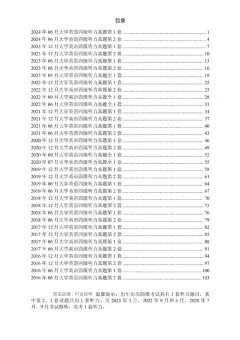
目录
2024年06月大学英语六级听力真题第1套...................................1
2024年06月大学英语六级听力真题第2 套..................................4
2023年 12月大学英语六级听力真题第1套..................................7
2023年 12月大学英语六级听力真题第2 套..................................10
2023年06月大学英语六级听力真题第1套..................................13
2023年06月大学英语六级听力真题第2 套..................................16
2023年03月大学英语六级听力真题全1套..................................19
2022年 12月大学英语六级听力真题第1套.................................22
2022年 12月大学英语六级听力真题第2 套.................................25
2022年09月大学英语六级听力真题全1套.................................28
2022年06月大学英语六级听力真题全1套................................. 31
2021年 12月大学英语六级听力真题第1套................................. 34
2021年 12月大学英语六级听力真题第2 套................................. 37
2021年06月大学英语六级听力真题第1套.................................40
2021年06月大学英语六级听力真题第2 套.................................43
2020年 12月大学英语六级听力真题第1套.................................46
2020年 12月大学英语六级听力真题第2 套.................................49
2020年09月大学英语六级听力真题全1套................................. 52
2020年07月大学英语六级听力真题全1套................................. 55
2019年 12月大学英语六级听力真题第1套................................. 58
2019年 12月大学英语六级听力真题第2 套................................. 61
2019年06月大学英语六级听力真题第1套................................. 64
2019年06月大学英语六级听力真题第2 套................................. 67
2018年 12月大学英语六级听力真题第1套................................. 70
2018年 12月大学英语六级听力真题第2 套................................. 73
2018年06月大学英语六级听力真题第1套................................. 76
2018年06月大学英语六级听力真题第2 套................................. 79
2017年 12月大学英语六级听力真题第1套................................. 82
2017年 12月大学英语六级听力真题第2 套................................. 85
2017年06月大学英语六级听力真题第1套................................. 88
2017年06月大学英语六级听力真题第2 套................................. 91
2016年 12月大学英语六级听力真题第1套................................. 94
2016年 12月大学英语六级听力真题第2 套................................. 97
2016年06月大学英语六级听力真题第1套.................................100
2016年06月大学英语六级听力真题第2 套.................................103
淘宝店铺:叮当助考 温馨提示:历年六级考试共有3套题,其中第2、3套
试题共用1套听力。另:2023年3月、2022年9月、2022年6月,2020年7月、9月考试
特殊,实考1套。2024年 06月大学英语六级听力真题第1 套
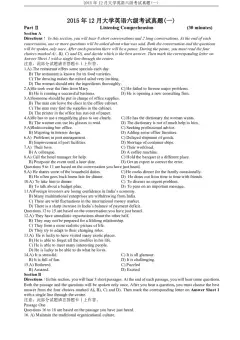
Section A
Directions: In this section, you will hear two long conversations. At the end of each
conversation, you will hear four questions. Both the conversation and the questions will be
spoken only once. After you hear a question, you must choose the best answer from the four
choices marked A) , B) , C) and D). Then mark the corresponding letter on Answer Sheet 1
with a single line through the centre.
Questions 1 to 4 are based on the conversation you have just heard.
1. A) Read numerous comments users put online.
B) Blended all his food without using a machine.
C) Searched for the state-of-the-art models of blenders
D) Did thorough research on the price of kitchen appliances.
2. A) Eating any blended food. C) Using machines to do her cooking.
B) Buying a blender herself. D) Making soups and juices for herself.
3. A) Cooking every meal creatively in the kitchen.
B) Paying due attention to his personal hygiene.
C) Eating breakfast punctually every morning.
D) Making his own fresh fruit juice regularly.
4. A) One-tenth of it is sugar. C) One's fancy may be tickled by it.
B) It looks healthy and attractive. D) It contains an assortment of nutrients.
Questions 5 to 8 are based on the conversation you have just heard.
5. A) How he has made himself popular as the mayor of Berkton.
B) How the residents will turn Berkton into a tourist attraction.
C) How charming he himself considers the village of Berkton to be.
D) How he has led people of Berkton to change the village radically:
6. A) It was developed only to a limited extent.
B) It was totally isolated as a sleepy village.
C) It was relatively unknown to the outside.
D) It was endowed with rare natural resources.
7. A) All the properties in Berkton were designed by the same architect.
B) The majority of residents lived in harmony with their neighbours.
C) The majority of residents enjoyed cosy housing conditions.
D) All the houses in Berkton looked aesthetically similar.
8. A) They have helped boost the local economy.
B) They have made the residents unusually proud.
C) They have contributed considerably to its popularity.
D) They have brought happiness to everyone in the village.
Section B
Directions: In this section, you will hear two passages. At the end of each passage, you will
语六级听力真题2016-2024第 1 页 共 108页hear three or four questions. Both the passage and the questions will be spoken only once.
After you hear a question, you must choose the best answer from the four choices marked A), B)
t
C) and D), Then mark the corresponding letter on Answer Sheet 1 with a single line through
the centre.
Questions 9 to 11 are based on the passage you have just heard.
9. A) They have created the smallest remote-controlled walking robot in the world.
B) They are going to publish their research findings in the journal Science Robotics.
C) They are the first to build a robot that can bend, crawl, walk, turn and even jump.
D) They are engaged in research on a remote-controlled robot which uses special power.
10. A) It changes its shape by complex hardware.
B) It is operated by a special type of tiny motor.
C) It moves from one place to another by memory.
D) It is powered by the elastic property of its body.
11. A) Replace humans in exploratory tasks.
B) Perform tasks in tightly confined spaces.
C) Explore the structure of clogged arteries.
D) Assist surgeons in highly complex surgery.
Questions 12 to 15 are based on the passage you have just heard.
12. A) She threw up in the bathroom. C) She dozed ofF for a few minutes.
B) She slept during the entire ride. D) She boasted of her marathon race.
13. A) They are mostly immune to cognitive impairment.
B) They can sleep soundly during a rough ride at sea.
C) They are genetically determined to need less sleep.
D) They constitute about 13 percent of the population.
14. A) Whether there is a way to reach elite status.
B) Whether it is possible to modify one's genes.
C) Whether having a baby impacts one's passion
D) Whether one can train themselves to sleep less.
15. A) It is in fact quite possible to nurture a passion for sleep.
B) Babies can severely disrupt their parents' sleep patterns.
C) Being forced to rise early differs from being an early bird.
D) New parents are forced to jump out of bed at the crack of dawn.
Section C
Directions: In this section, you will hear three recordings of lectures or talks fallowed by three
or four questions. The recordings will be played only once. After you hear a question, you must
choose the best answer from the four choices marked A) , B) , C) and D), Then mark the
corresponding letter on Answer Sheet 1 with a single line through the centre.
Questions 16 to 18 are based on the recording you have just heard.
16. A) We have poor awareness of how many controversial issues are being debated.
B) No one knows better than yourself what you are thinking about at the moment.
C) No one can change your opinions more than those who speak in a convincing tone.
语六级听力真题2016-2024第 2 页 共 108页D) We are likely to underestimate how much we can be swayed by a convincing article.
17. A) Their belief about physical punishment changed.
B) Their memory pushed them toward a current belief.
C) The memory of their initial belief came back to them.
D) Their experiences of physical punishment haunted them.
18. A) They apparently have little to do with moderate beliefs.
B) They don't reflect the changes of view on physical punishment.
C) They may not apply to changes to extreme or deeply held beliefs.
D) They are unlikely to alter people's position without more evidence.
Questions 19 to 21 are based on the recording you have just heard.
19. A) American moms have been increasingly inclined to live alone.
B) The American population has been on the rise in the past 25 years.
C) American motherhood has actually been on the decline.
D) The fertility rates in America have in fact been falling sharply.
20. A) More new mothers tend to take greater care of their children.
B) More new mothers are economically able to raise children.
C) A larger proportion of women take pride in their children.
D) A larger proportion of women really enjoy motherhood.
21. A) The meaning of motherhood has changed considerably.
B) More and more mothers go shopping to treat themselves.
C) More mothers have adult children celebrating the holiday.
D) The number of American mothers has been growing steadily.
22. A) Add to indoor toxic pollutants. C) Beautify the home environment.
B) Absorb poisonous chemicals. D) Soak up surrounding moisture.
Questions 22 to 25 are based on the recording you have just heard.
23. A) NASA did experiments in sealed containers resembling the super insulated offices of
1970s.
B) It was based on experiments under conditions unlike those in most homes or offices.
C) NASA conducted tests in outer space whose environment is different from ours.
D) It drew its conclusion without any contrastive data from other experiments.
24. A) Natural ventilation proves much more efficient for cleaning the air than houseplants.
B) Houseplants disperse chemical compounds more quickly with people moving around.
C) Natural ventilation turns out to be most effective with doors and windows wide open.
D) Houseplants in a normal environment rarely have any adverse impact on the air.
25. A) The root cause for misinterpretations of scientific findings.
B) The difficulty in understanding whafs actually happening.
C) The steps to be taken in arriving at any conclusion with certainty.
D) The necessity of continually reexamining and challenging findings.
英语六级听力真题2016-2024第 3 页 共 108页2024年 06月大学英语六级听力真题第2 套
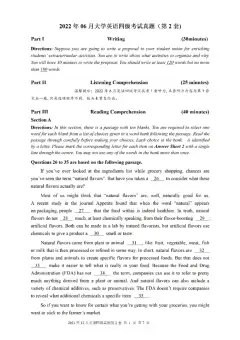
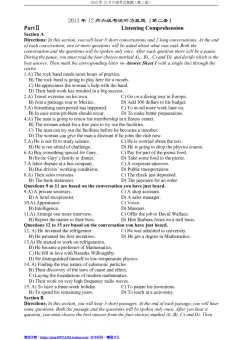
Section A
Directions: In this section, you will hear two long conversations. At the end of each
conversation, you will hear four questions. Both the conversation and the questions will be
spoken only once. After you hear a question, you must choose the best answer from the four
choices marked A) , B) , C) and D) . Then mark the corresponding letter on Answer Sheet 1
with a single line through the centre.
Questions 1 to 4 are based on the conversation you have just heard.
1. A) Reply to the man's last proposal within a short time.
B) Sign the agreement if one small change is made to it.
C) Make a sponsorship deal for her client at the meeting.
D) Give the man some good news regarding the contract.
2. A) They are becoming impatient. C) They are used to making alterations.
B) They are afraid time is running out. D) They are concerned about the details.
3. A) To prevent geographical discrimination. C) To avoid any conflict of interest.
B) To tap the food and beverage market. D) To reduce unfair competition.
4. A) It is a potential market for food and beverage.
B) It is very attractive for real estate developers.
C) It is a negligible market for his company.
D) It is very different from other markets.
Questions 5 to 8 are based on the conversation you have just heard.
5. A) They are thrilled by a rare astronomic phenomenon.
B) They are celebrating a big event on mountain tops.
C) They are enthusiastic about big science-related stories.
D) They are joined by astronomers all across North America.
6. A) It will be the most formidable of its kind in over a century.
B) It will come closest to Earth in more than one hundred years.
C) It will eclipse many other such events in human history.
D) It will be seen most clearly from Denver5 s mountain tops.
7. A) A blur. C) The edge of our galaxy.
B) Stars. D) An ordinary flying object.
8. A) Use professional equipment. C) Fix their eyes due north.
B) Climb to the nearby heights. D) Make use of phone apps.
Section B
Directions: In this section, you will hear two passages. At the end of each passage, you will
hear three or four questions. Both the passage and the questions will be spoken only once.
After you hear a question, you must choose the best answer from the four choices marked A),
B) , C) and D) . Then mark the corresponding letter on Answer Sheet 1 with a single line
through the centre.
英语六级听力真题2016-2024第 4 页 共 108页Questions 9 to 11 are based on the passage you have just heard.
9. A) Whether consumers should be warned against ultra-processed foods.
B) Whether there is sufficient scientific consensus on dietary guidelines.
C) Whether guidelines can form the basis for nutrition advice to consumers.
D) Whether food scientists will agree on the concept of ultra-processed foods.
10. A) By the labor cost for the final products.
B) By the degree of industrial processing.
C) By the extent of chemical alteration.
D) By the convention of classification.
11. A) Increased consumers5 expenses.
B) Greater risk of chronic diseases.
C) People's misunderstanding of nutrition.
D) Children's dislike for unprocessed foods.
Questions 12 to 15 are based on the passage you have just heard.
12. A) They begin to think of the benefits of constraints.
B) They try to seek solutions from creative people.
C) They try hard to maximize their mental energy.
D) They begin to see the world in a different way.
13. A) It is characteristic of all creative people.
B) It is essential to pushing society forward.
C) It is a creative person's response to limitation.
D) It is an impetus to socio-economic development.
14. A) Scarcity or abundance of resources has little impact on people's creativity.
B) Innovative people are not constrained in connecting unrelated concepts.
C) People have no incentive to use available resources in new ways.
D) Creative people tend to consume more available resources.
15. A) It is key to a company's survival. C) It is essential to meeting challenges
B) It shapes and focuses problems. D) It thrives best when constrained.
Section C
Directions: In this section, you will hear three recordings of lectures or talks fallowed by three
or four questions. The recordings will be played only once. After you hear a question, you must
choose the best answer from the four choices marked A) B) C) and D) . Then mark the
f f
corresponding letter on Answer Sheet 1 with a single line through the centre.
Questions 16 to 18 are based on the recording you have just heard.
16. A) Because they are learned.
B) Because they come naturally.
C) Because they have to be properly personalized.
英语六级听力真题2016-2024第 5 页 共 108页D) Because there can be more effective strategies.
17. A) The extent of difference and of similarity between the two sides.
B) The knowledge of the specific expectation the other side holds.
C) The importance of one5s goals and of the relationship.
D) The approaches one adopts to conflict management.
18. A) The fox. C) The shark.
B) The owl. D) The turtle.
Questions 19 to 21 are based on the recording you have just heard.
19. A) Help save species from extinction and boost human health.
B) Understand how plants and animals perished over the past.
C) Help gather information publicly available to researchers.
D) Find out the cause of extinction of Britain5s 66, 000 species.
20. A) It was once dominated by dinosaurs.
B) It has entered the sixth mass extinction.
C) Its prospects depend on future human behaviour.
D) Its climate change is aggravated by humans.
21. A) It dwarfs all other efforts to conserve, protect and restore biodiversity on earth.
B) It is costly to get started and requires the joint efforts of thousands of scientists.
C) It can help to bring back the large numbers of plants and animals that have gone extinct.
D) It is the most exciting, most relevant, most timely and most internationally inspirational.
Questions 22 to 25 are based on the recording you have just heard.
22. A) Cultural identity. C) The Copernican revolution.
B) Social evolution. D) Human individuality.
23. A) It is a delusion to be disposed of.
B) It is prevalent even among academics.
C) It is a myth spread by John Donne's poem.
D) It is rooted in the mindset of the 17th century.
24. A) He believes in Copernican philosophical doctrines about the universe.
B) He has gained ample scientific evidence at the University of Reading.
C) He has found that our inner self and material self are interconnected.
D) He contends most of our body cells can only live a few days or weeks.
25. A) By coming to see how disruptive such problems have got to be.
B) By realising that we all can do our own bit in such endeavours.
C) By becoming aware that we are part of a bigger world.
D) By making joint efforts resolutely and persistently.
英语六级听力真题2016-2024第 6 页 共 108页2023年 12月大学英语六级听力真题第1 套
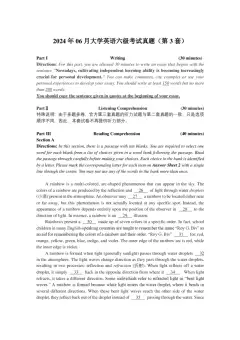
Section A
Directions: In this section, you will hear two long conversations. At the end of each
conversation, you will hear four questions. Both the conversation and the questions will be
spoken only once. After you hear a question, you must choose the best answer from the four
choices marked A), B) C) and D). Then mark the corresponding letter on Answer Sheet 1 with
f
a single line through the centre.
Questions 1 to 4 are based on the conversation you have just heard.
1. A) It is clear that he is expected to enjoy a healthy life.
B) There is nothing wrong with his digestive system.
C) There is some indication of an issue with his blood circulation.
D) He doesn5t know he has long been suffering from poor health.
2. A) Mistaking symptoms of illness for stress.
B) Complaining they are being overworked.
C) Being unaware of the stress they are under.
D) Suffering from illness without recognising it.
3. A) Prescribe some medication for him.
B) Give him another physical check-up.
C) Explain to him the common consequence of stress.
D) Buy some sleeping pills for him from the drugstore.
4. A) It calls for responsible management. C) It is remarkably promising.
B) It proves to be quite profitable. D) It is full of competition.
Questions 5 to 8 are based on the conversation you have just heard.
5. A) To avoid being in the limelight.
B) To seek medical help for his injury.
C) To pursue a less competitive career.
D) To stay away from his hostile teammates.
6. A) It has ups and downs. C) It does not last long.
B) It proves rewarding. D) It is not so profitable.
7. A) He was a financial advisor. C) He became a basketball coach.
B) He suffered from poor health. D) He was back in the news.
8. A) Study issues of public health. C) Raise sufficient public funding.
B) Alleviate the obesity problem. D) Train young basketball players.
Section B
Directions: In this section, you will hear two passages. At the end of each passage, you will
hear three or four questions. Both the passage and the questions will be spoken only once. After
英语六级听力真题2016-2024第 7 页 共 108页you hear a question, you must choose the best answer from the four choices marked A) , B), C)
and D). Then mark the corresponding letter on Answer Sheet 1 with a single line through the
centre.
Questions 9 to 11 are based on the passage you have just heard.
9. A) When she started teaching at Edinburgh University in Scotland.
B) While she was doing her doctoral studies on American Literature.
C) After publishing her first novel Behind the Scenes at the Museum.
D) After winning the 1986 Woman's Own Short Story Competition.
10. A) The themes of love and loss. C) The sins and flaws of eccentrics.
B) The code of human behaviour. D) The manners of fashionable circles.
11. A) They are usually ignorant of complex human relations.
B) They successfully imitate the maimers of celebrities.
C) They often get rewarded instead of being punished.
D) They are generally looked down upon in society.
Questions 12 to 15 are based on the passage you have just heard.
12. A) It is what members use to alleviate tension in a team.
B) It is what employers are increasingly seeking after.
C) It is conducive to getting over a recession.
D) It is necessary for learning a new task.
13. A) Make better choices. C) Achieve recognition duly.
B) Follow innovative ideas. D) Accumulate work experience.
14. A) Workers show more emotional intelligence.
B) Workers use brains more than muscles.
C) People usually work flexible hours.
D) People often work in teams.
15. A) Leave the group as soon as possible. C) Decide on new priorities speedily.
B) Anticipate setbacks well in advance. D) Stick to original goals confidently.
Section C
Directions: In this section, you will hear three recordings of lectures or talks fallowed by three
or four questions. The recordings will be played only once. After you hear a question, you must
choose the best answer from the four choices marked A), B) C) and D). Then mark the
f
corresponding letter on Answer Sheet 1 with a single line through the centre.
Questions 16 to 18 are based on the recording you have just heard.
16. A) What differentiates people from animals.
B) Why philosophers disagree with scientists.
C) Where humans9 great cognitive capacity originates.
D) When being creative becomes a biological mandate.
英语六级听力真题2016-2024第 8 页 共 108页17. A) It is what tells apart two adjacent generations.
B) It is what sharpens our appetite for novelty.
C) It is something only geniuses can achieve.
D) It is something every human being can do.
18. A) It seeks inspiration for novel inventions.
B) It constantly absorbs new information.
C) It uses existing ideas to create new ones.
D) It repeats precedent on a regular basis.
Questions 19 to 21 are based on the recording you have just heard.
19. A) Dogs know when their owners are not feeling well.
B) Dogs have the cognition for telling right from wrong.
C) Dogs have an aptitude for developing skills to interact with humans.
D) Dogs know when their human companions can no longer stand them.
20. A) They can readily detect different ill smells of viruses.
B) They can easily tell what bacteria cause odor change.
C) They are particularly sensitive to strange smells.
D) They have an extremely powerful sense of smell.
21. A) It can ensure owners suffer fewer chronic diseases.
B) It can benefit owners both physically and mentally.
C) It can reduce owners9 risk of getting cancer or diabetes.
D) It can alert owners to the seriousness of their conditions.
Questions 22 to 25 are based on the recording you have just heard.
22. A) Crack down on courses like science, technology, engineering and math.
B) Restrict the ability of creative arts courses to recruit new students.
C) Look at how to reform technical and vocational education.
D) Ensure creative arts students get better value for money.
23. A) Seemingly reasonable. C) Extremely irrational.
B) Clearly well-grounded. D) Apparently simplistic.
24. A) A high proportion of them haven 9t tried to save money.
B) Most of them never hope to buy a house or to retire.
C) Forty percent of them earn less than £25,000 a year.
D) The majority of them have fairly well-paying jobs.
25. A) The context of a bank balance. C) The specific degree a student earns.
B) Britain's economy as a whole. D) Britain5s defective educational system.
英语六级听力真题2016-2024第 9 页 共 108页2023年 12月大学英语六级听力真题第2 套
Section A
Directions: In this section, you will hear two long conversations. At the end of each
conversation, you will hear four questions. Both the conversation and the questions will be
spoken only once. After you hear a question, you must choose the best answer from the four
choices marked A), B), C) and D). Then mark the corresponding letter on Answer Sheet 1 with
a single line through the centre.
Questions 1 to 4 are based on the conversation you have just heard.
1. A) Spending their holidays in a novel way
B) Exploring more summer holiday resorts.
C) Surfing online to check out the best deals.
D) Renting a car instead of driving their own.
2. A) He did not like to be locked into one place.
B) He did not find holiday homes appealing.
C) He was well travelled.
D) He once owned a van.
3. A) Generate their own electricity.
B) Drive under any weather condition.
C) Receive instructions via computers.
D) Ensure the safety of passengers.
4. A) Riding one's mountain bike on vacation.
B) Slowing down in one's increasingly hectic life.
C) Enjoying the freedom to choose where to go and work.
D) Having one's basic needs covered while away from home.
Questions 5 to 8 are based on the conversation you have just heard.
5. A) Her physical health has deteriorated these past few weeks.
B) She has lagged behind most of her co-workers in output.
C) Her job performance has worsened over the past month.
D) She has missed several important appointments lately.
6. A) Penalty for curtailed output. C) Disturbance of her mind.
B) Some problems at home. D) Serious health issues.
7. A) The woman's whole-hearted support.
B) The woman's work proficiency.
C) His management capability.
D) His engaging personality.
8. A) The man will help the woman get back to her usual self.
B) The man will be back at his 100% in a couple of weeks.
C) The woman will be off work on the next two Mondays.
D) The woman will resume her work in two weeks.
Section B
英语六级听力真题2016-2024第 10页 共 108页Directions: In this section, you will hear two passages. At the end of each passage, you will
hear three or four questions. Both the passage and the questions will be spoken only once. After
you hear a question, you must choose the best answer from the four choices marked A) , B), C)
and D). Then mark the corresponding letter on Answer Sheet 1 with a single line through the
centre.
Questions 9 to 11 are based on the passage you have just heard.
9. A) It can have an impact on our moods and emotions.
B) It can improve our financial status significantly.
C) It can help us achieve better work performance.
D) It can enable us to live a healthier and longer life.
10. A) One's health tends to differ before and after marriage.
B) The spouse's level of education can impact one's health.
C) The wealthier one's spouse is, the healthier one becomes.
D) One's health status is related to one's social background.
11. A) They had more education than their spouses.
B) They had much in common with their spouses.
C) They benefited a lot from their career achievements.
D) They showed interest in their spouse's occupations.
Questions 12 to 15 are based on the passage you have just heard.
12. A) Finding out the changing climate patterns.
B) Identifying the cities9 geological features.
C) Forecasting flood risks accurately.
D) Eliminating their root cause.
13. A) To validate his hypothesis about the gravity of floods.
B) To determine the frequency of high tides causing floods.
C) To see the feasibility of his project on flooding.
D) To improve his mathematical flooding model.
14. A) To forecast rapid floods in real time.
B) To classify the flooding data processed.
C) To study the consequences of high tides on flooded areas.
D) To teach local citizens how to collect data of incoming floods.
15. A) They tracked the rising tides with video-cameras.
B) They set up Internet-connected water-level sensors.
C) They used newly-developed supercomputing facilities.
D) They observed the direction of water flow on the spot.
Section C
Directions: In this section, you will hear three recordings of lectures or talks followed by three
or four questions. The recordings will be played only once. After you hear a question, you must
choose the best answer from the four choices marked A), B), C) and D). Then mark the
corresponding letter on Answer Sheet 1 with a single line through the centre.
Questions 16 to 18 are based on the recording you have just heard.
16. A) To debate the validity of current survey data.
英语六级听力真题2016-2024第 11页 共 108页B) To argue about the value of a college degree.
C) To account for the drastic decline in employment among men.
D) To compare men without college degrees with those who have.
17. A) The issue of changing job requirements.
B) The increase in women taking up jobs.
C) The impact of inflation.
D) The factor of wages.
18. A) The sharp decline in marriage among men with no college degrees.
B) The wage gap between those with college degrees and those without.
C) More jobs requiring their holders to have a college degree nowadays.
D) Men's unwillingness to accept low wages in times of growing inflation.
Questions 19 to 21 are based on the recording you have just heard.
19. A) More and more people attach importance to protecting endangered animals.
B) An increasing number of people demand to free animals being kept in cages.
C) More and more people prioritize animal welfare when buying things to wear.
D) An increasing number of people follow the latest trend of becoming vegetarians.
20. A) Utilized a silk substitute made from mushrooms.
B) Refrained from using chemicals in their products.
C) Labelled all their products as vegan.
D) Avoided the use of leather and fur.
21. A) Whether they can be regarded as ethical.
B) Whether they can be considered sustainable.
C) Whether they actually signify a substantial change.
D) Whether they effectively protect animals at large.
Questions 22 to 25 are based on the recording you have just heard.
22. A) The belief is less prevalent that the world is going to hell.
B) The environmental welfare has worsened in the world.
C) The world has seen more violence in recent years.
D) The era we live in is the most peaceful in history.
23. A) They did not wish to live in the previous century.
B) They were convinced by the statistics presented to them.
C) They believed the world was deteriorating.
D) They were actually not in their right mind.
24. A) Our ancestors5 influence.
B) Our psychological biases.
C) The current state of affairs.
D) The subjectivity of mass media.
25. A) Paying attention to negative information.
B) Calculating dangerous risks to our survival.
C) Vacuuming up depressing or enraging stories.
D) Spreading exciting news around us far and wide.
英语六级听力真题2016-2024第 12页 共 108页2023年 06月大学英语六级听力真题第1 套
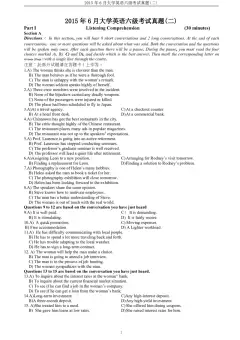
Section A
Directions: In this section, you will hear two long conversations. At the end of each
conversation, you will hear four questions. Both the conversation and the questions will be
spoken only once. After you hear a question, you must choose the best answer from the four
choices marked A), B) C) and D). Then mark the corresponding letter on Answer Sheet 1 with
f
a single line through the centre.
Questions 1 to 4 are based on the conversation you have just heard.
1. A) It was spacious and tranquil. C) It was shabby and solitary.
B) It was warm and comfortable. D) It was tiny and noisy.
2. A) She no longer hates people talking loudly in the dorm.
B) She misses her roommates she used to complain about.
C) She begins to enjoy the movies she once found irritating.
D) She finds the crowded dorm as cozy as her new apartment.
3. A) He found the apartment perfectly furnished.
B) He had a feeling of despair and frustration.
C) He had a similar feeling to the woman 5s.
D) He felt the new place was like paradise.
4. A) Go to see the woman5s apartment. C) Buy some furniture for the woman.
B) Make a phone call to his parents. D) Decorate the woman's apartment.
Questions 5 to 8 are based on the conversation you have just heard.
5. A) He works as a literary critic. C) He has initiated a university reform.
B) He hosts an educational program. D) He has published a book recently.
6. A) It fails to keep up with the radical changes of society.
B) It fails to ensure universities get sufficient resources.
C) It has not prepared young people for the job market.
D) It has not fostered the growth of the arts disciplines.
7. A) More of the budget should go to science and technology.
B) The underfunded music discipline should be prioritized.
C) Subdisciplines like sculpture should get more funding.
D) Literature should get as much funding as engineering.
8. A) Build a prosperous nation. C) Create ingenious artists.
B) Make skilled professionals. D) Cultivate better citizens.
Section B
Directions: In this section, you will hear two passages. At the end of each passage, you will
hear three or four questions. Both the passage and the questions will be spoken only once. After
you hear a question, you must choose the best answer from the four choices marked A) , B), C)
and D). Then mark the corresponding letter on Answer Sheet 1 with a single line through the
英语六级听力真题2016-2024第 13页 共 108页centre.
Questions 9 to 11 are based on the passage you have just heard.
9. A) It is quite common. C) It seldom annoys people.
B) It is rarely noticed. D) It occurs when one is alone.
10. A) Seeing things in black and white.
B) Engaging in regular contemplation.
C) Having a special understanding of creativity.
D) Knowing how to make their mental batteries work.
11. A) Engaging in intense activity. C) Working on a particular project.
B) Fantasizing in one's down time. D) Reflecting during one's relaxation.
Questions 12 to 15 are based on the passage you have just heard.
12. A) Fanners helped Native Americans grow crops.
B) There were expansive university campuses.
C) There existed post offices.
D) Migrants found gold there.
13. A) It helped to boost the economy in the American West.
B) It provided job opportunities for many gold seekers.
C) It extended the influence of the federal government.
D) It kept people in the deserts and plains connected.
14. A) It employed Native Americans to work as postmen.
B) It commissioned private wagons to carry the mail.
C) It subsidized the locals who acted as postmasters.
D) It centralized postal services in its remote areas.
15. A) He analyzed interactive maps of mail routes.
B) He read a large collection of books on the topic.
C) He examined its historical trends with data science.
D) He collected data about its impact on local business.
Section C
Directions: In this section, you will hear three recordings of lectures or talks fallowed by three
or four questions. The recordings will be played only once. After you hear a question, you must
choose the best answer from the four choices marked A), B), C) and D). Then mark the
corresponding letter on Answer Sheet 1 with a single line through the centre.
Questions 16 to 18 are based on the recording you have just heard.
16. A) Higher levels of anxiety may improve people's memory.
B) Some experiences are easier to remember than others.
C) Most people tend to remember things selectively.
D) Simple things may leave a deep impression on one's memory.
英语六级听力真题2016-2024第 14页 共 108页17. A) They classified the participants5 mindset.
B) They showed some photos to the participants.
C) They measured the participants5 anxiety levels.
D) They tested the size of the participants9 vocabulary.
18. A) Anxiety has become a serious problem for an increasing number of people.
B) Extreme levels of anxiety can adversely affect cognitive performance.
C) People diagnosed with anxiety disorder may forget things selectively.
D) There is no direct correlation between memory and levels of anxiety.
Questions 19 to 21 are based on the recording you have just heard.
19. A) They compare products from different companies before making a choice.
B) They get information from other consumers5 postings and comments.
C) They lose patience when their phone call is not promptly answered.
D) They expect to get instantaneous responses to their inquiry.
20. A) Giving them rewards on the spot.
B) Broadening their scope of interest.
C) Speaking directly to their emotions.
D) Focusing on the details of the product.
21. A) Change the rules of the game in the market every year.
B) Keep up with the latest technological developments.
C) Learn from technological innovators to do business.
D) Make greater efforts to build up consumers5 confidence.
Questions 22 to 25 are based on the recording you have just heard.
22. A) People have only one social engagement per week.
B) Working together enhances friend ship.
C) Few people have devoted friends.
D) Friendships benefit work.
23. A) The impact of friends on people's self-esteem.
B) How supportive friends can be in the worlq)lace.
C) How to boost one5s sense of value and worthiness.
D) The role of family ties in people's mental well-being.
24. A) They show little interest in their friends5 work.
B) They tend to be much more difficult to make.
C) They are more trustworthy and reliable.
D) They increase people's job satisfaction.
25. A) Allow employees to have a flexible work schedule.
B) Encourage employees to be friends with colleagues.
C) Help employees balance work and family responsibilities.
D) Organize activities to nourish friendships outside of work.
英语六级听力真题2016-2024第 15页 共 108页2023年 06月大学英语六级听力真题第2 套
Section A
Directions: In this section, you will hear two long conversations. At the end of each
conversation, you will hear four questions. Both the conversation and the questions will be
spoken only once. After you hear a question, you must choose the best answer from the four
choices marked A), B) C) and D). Then mark the corresponding letter on Answer Sheet 1 with
f
a single line through the centre.
Questions 1 to 4 are based on the conversation you have just heard.
1. A) She is attracted to the beauty of modem buildings.
B) She is preoccupied with her dream to be an architect.
C) She is influenced by her father who teaches architecture.
D) She is drawn to its integration of design and engineering.
2. A) Through hard work. C) By studying the subject online.
B) With the professor9s help. D) By taking prerequisite courses.
3. A) It is groundbreaking. C) It is immaterial.
B) It is long-lasting. D) It is immortal.
4. A) Economics. C) Computer science.
B) Philosophy. D)Westem art.
Questions 5 to 8 are based on the conversation you have just heard.
5. A) He has occasionally been harassed by his fans.
B) He has been guarded by a discreet assistant.
C) He is well known to the public.
D) He is a famous football coach.
6. A) Serve as a personal assistant.
B) Play a key role in Real Madrid.
C) Run common daily chores for the woman.
D) Help promote Mr. Sanchez5s public profile.
7. A) He is honest and always tells the truth.
B) He once worked part-time in university.
C) He cares little about his working hours.
D) He has little previous work experience.
8. A) He has a strong ability to connect with people.
B) He has a high proficiency in several languages.
C) He has a sound knowledge of sports consultancy.
D) He has a natural capacity to cooperate with others.
Section B
Directions: In this section, you will hear two passages. At the end of each passage, you will
hear three or four questions. Both the passage and the questions will be spoken only once. After
you hear a question, you must choose the best answer from the four choices marked A) , B), C)
英语六级听力真题2016-2024第 16页 共 108页and D). Then mark the corresponding letter on Answer Sheet 1 with a single line through the
centre.
Questions 9 to 11 are based on the passage you have just heard.
9. A) They bring more benefits to young people.
B) They require less supervision and training.
C) They are more suitable to young people.
D) They have fewer rules and pressures.
10. A) They prevent kids from enjoying adventure sports.
B) They help kids guard against any possible injuries.
C) They rob kids of the chance to cultivate their courage.
D) They deprive kids of the opportunity to develop team spirit.
11. A) Help them take up these sports when they are more mature.
B) Let them participate in some less risky outdoor activities.
C) Ask them to try some forms of indoor sports.
D) Introduce them to these sports step by step.
Questions 12 to 15 are based on the passage you have just heard.
12. A) Consumers often have a craving for the latest model.
B) Such products tend to comprise parts that are irreplaceable.
C) Tech firms intentionally design products to have short lifespans.
D) Manufacturers use effective strategies to promote fancier products.
13. A) Indicate the competitiveness of their products.
B) List a repairability score of their products.
C) Specify the major parts of their products.
D) Detail the life cycle of their products.
14. A) Take the initiative to reduce electronic waste.
B) Take due caution in upgrading their products.
C) Invest in constructing more recycling facilities.
D) Substitute all toxic substances with non-toxic ones.
15. A) It can be solved. C) It will be fixed by tech companies.
B) It is certain to worsen. D) It is unavoidable in the long run.
Section C
Directions: In this section, you will hear three recordings of lectures or talks fallowed by three
or four questions. The recordings will be played only once. After you hear a question, you must
choose the best answer from the four choices marked A), B) C) and D). Then mark the
f
corresponding letter on Answer Sheet 1 with a single line through the centre.
Questions 16 to 18 are based on the recording you have just heard.
16. A) How internet monitoring can be implemented.
B) How to encourage productive internet surfing.
英语六级听力真题2016-2024第 17页 共 108页C) How cyberloafing affects overall productivity.
D) How to prevent employees from cyberloafing.
17. A) Cyberloafing is a sign of workers9 laziness.
B) Cyberloafing may relieve employees of stress.
C) Employee engagement is closely related to job satisfaction.
D) Overuse of social media may lead to decline in productivity.
18. A) Taking mini-breaks means better job performance.
B) Cyberloafing generally does more harm than good.
C) Worker turnover is linked to the time allowed for cyberloafing.
D) Employees who indulge in internet surfing are most likely to quit.
Questions 19 to 21 are based on the recording you have just heard.
19. A) There were no wooden buildings. C) There were no trees.
B) There were environmental problems. D) There were few settlers.
20. A) He served as chairman of the Nebraska State Board of Agriculture.
B) He urged the state to start the Nebraska State Gardening Society.
C) He engaged himself in a large number of aesthetic projects.
D) He founded a newspaper and used it to promote his ideas.
21. A) A special prize was awarded to Julius Morton.
B) One million trees were planted throughout Nebraska.
C) The state government declared it the official Arbor Day.
D) Nebraska earned the nickname “the Tree Planters State”.
Questions 22 to 25 are based on the recording you have just heard.
22. A) They spread across Europe and Asia in a few decades.
B) They lived mostly in Africa for about 200,000 years.
C) They preferred to live in Europe rather than in Asia.
D) They moved out of Africa about 60,000 years ago.
23. A) The discovery of two modem human teeth in China.
B) The traces of human migration out of Africa to Asia.
C) The human fossils discovered most recently in Africa.
D) The Luna cave in Guangxi Zhuang Autonomous Region.
24. A) There must have been some reason for human migration.
B) There have been changes in animals9 living conditions.
C) Humans adapted themselves to the environment there.
D) Humans had access to abundant food sources there.
25. A) How humans settled down on the Arabian Peninsula.
B) When modem humans started to disperse out of Africa.
C) What path modem humans took to migrate out of Africa.
D) Why fresh water is so important for human survival.
英语六级听力真题2016-2024第 18页 共 108页2023年 03月大学英语六级听力真题全1 套
Section A
Directions: In this section, you will hear two long conversations. At the end of each
conversation, you will hear four questions. Both the conversation and the questions will be
spoken only once. After you hear a question, you must choose the best answer from the four
choices marked A), B), C) and D). Then mark the corresponding letter on Answer Sheet 1 with
a single line through the centre.
Questions 1 to 4 are based on the conversation you have just heard.
1. A)Ina restaurant. C) In a food store.
B) In a kitchen. D) In a supermarket.
2. A) She eats meat occasionally. C) She is allergic to seafood.
B) She enjoys cheeseburgers. D) She is a partial vegetarian.
3. A) Dealing with ones colleagues. C) Following the same diet for years.
B) Changing ones eating habit. D) Keeping awake at morning meetings.
4. A) They enjoy perfect health. C) They only eat organic food.
B) They are both animal lovers. D) They are cutting back on coffee.
Questions 5 to 8 are based on the conversation you have just heard.
5. A) The man got a poor evaluation from his colleagues.
B) The man made little contribution to the company.
C) The man paid attention to trivial things.
D) The man had an attitude problem.
6. A) They make unhelpful decisions for solving problems.
B) They favor some employees5 suggestions over others5.
C) They use manipulative language to mask their irrational choices.
D) They reject employees5 reasonable arguments for work efficiency.
7. A) It is a must for rational judgment.
B) It is more of a sin than a virtue.
C) It is a good quality in the worlq)lace.
D) It is more important now than ever.
8. A) Smoothing relationships in the workplace.
B) Making rational and productive decisions.
C) Focusing on employees career growth.
D) Preserving their power and prestige.
Section B
Directions: In this section, you will hear two passages. At the end of each passage, you will
hear three or four questions. Both the passage and the questions will be spoken only once. After
you hear a question, you must choose the best answer from the four choices marked A), B) C)
t
英语六级听力真题2016-2024第 19页 共 108页and D). Then mark the corresponding letter on Answer Sheet 1 with a single line through the
centre.
Questions 9 to 11 are based on the passage you have just heard.
9. A) They show genius which defies description.
B) They accomplish feats many of us cannot.
C) They create very high commercial value.
D) They bring great honor to their country.
10. A) They take part in kids5 extra-curricular activities.
B) They work in spare time to teach children sports.
C) They try to be positive role models to children.
D) They serve as spokespersons for luxury goods.
11. A) Separating an athlete5 s professional life from their personal life.
B) Preventing certain athletes from getting in trouble with the law.
C) Keeping athletes away from drug or alcohol problems.
D) Being super sports stars without appearing arrogant.
Questions 12 to 15 are based on the passage you have just heard.
12. A) They always cost more than expected.
B) They are joyous and exciting occasions.
C) They should be paid up by the attendees.
D) They are dreams coming true to the brides.
13. A) It cost $ 60,000. C) It had eight guests only.
B) It was cancelled. D) It was held in Las Vegas.
14. A) Postpone her wedding. C) Keep to her budget.
B) Ask her friends for help. D) Invite more guests.
15. A) She called it romantic. C) She said she would think about it.
B) She welcomed it with open arms. D) She rejected it flatly.
Section C
Directions: In this section, you will hear three recordings of lectures or talks fallowed by
three or four questions. The recordings will be played only once. After you hear a question,
you must choose the best answer from the four choices marked A), B), C) and D). Then mark
the corresponding letter on Answer Sheet 1 with a single line through the centre.
Questions 16 to 18 are based on the recording you have just heard.
16. A) It determines people's moods.
B) It can impact people's wellbeing.
C) It is closely related to people's emotions.
D) It can influence people's personalities.
语六级听力真题2016-2024第 20页 共 108页17. A) They make people more reproductive.
B) They increase people's life expectancy.
C) They tend to produce positive feelings.
D) They may alter people's genes gradually.
18. A) The link between temperature and personality is fairly weak.
B) People share many personality traits despite their nationalities.
C) People in the same geographical area may differ in personality.
D) The Americans are apparently more outgoing than the Chinese.
Questions 19 to 21 are based on the recording you have just heard.
19. A) The number of older Americans living alone is on the rise.
B) Chronic loneliness does harm to senior citizens in particular.
C) Correlations have been found between loneliness and ill health.
D) A growing number of US seniors face the risk of early mortality.
20. A) Medication is available for treating loneliness.
B) Loneliness rarely results from living alone.
C) Being busy helps fight loneliness.
D) Loneliness is probably reversible.
21. A) Living with one5s children. C) Meaningful social contact.
B) Meeting social expectations. D) Timely medical intervention.
Questions 22 to 25 are based on the recording you have just heard.
22. A) She had a successful career in finance.
B) She wrote stories about women travelers.
C) She made regular trips to Asian countries.
D) She invested in several private companies.
23. A) Buy a ranch.
B) Start a blog.
C) Travel round the world.
D) Set up a travel agency.
24. A) Work hard to attract attention from publishers.
B) Gain support from travel advertising companies.
C) Try to find a full-time job in the travel business.
D) Create something unique to enter the industry.
25. A) Attracting sufficient investment.
B) Creating an exotic corporate culture.
C) Avoiding too much advertising early on.
D) Refraining from promoting similar products.
语六级听力真题2016-2024第 21页 共 108页2022年 12月大学英语六级听力真题第1 套
Section A
Directions: In this section, you will hear two long conversations. At the end of each
conversation, you will hear four questions. Both the conversation and the questions will be
spoken only once. After you hear a question, you must choose the best answer from the four
choices marked A), B) C) and D). Then mark the corresponding letter on Answer Sheet 1 with
f
a single line through the centre.
Questions 1 to 4 are based on the conversation you have just heard.
1. A) She hasn5t started writing it. C) She is proofreading the first draft.
B) She hasn't decided on a topic. D) She is working on the references.
2. A) He lent many books to the man for reference.
B) He offered the man advice on resource hunting.
C) He published a lot in a number of reputable journals.
D) He told the man to be selective when using e-resources.
3. A) He didn't think her dissertation topic viable.
B) He wasn't interested in her dissertation topic.
C) He didn't want her to rush through her dissertation.
D) He wasn't specific about the length of her dissertation.
4. A) Change her research methodology. C) Consult her professor more.
B) Narrow down her dissertation topic. D) Follow the man's advice.
Questions 5 to 8 are based on the conversation you have just heard.
5. A) He has translated 12 books. C) His books sell well worldwide.
B) He is a well-known nutritionist. D) His latest book sold a million copies.
6. A) The desire of Americans to try exotic cuisines.
B) The demand for information about food safety.
C) The fact that over half of Americans are overweight.
D)The fact that science books are difficult to read.
7. A) The general public. C) Those who want to lose weight.
B) Those who are overweight. D) The medical community.
8. A) Switch to a vegetarian diet. C) Adhere to doctors5 advice.
B) Follow a personalized diet. D) Cut carbohydrate intake.
Section B
Directions: In this section, you will hear two passages. At the end of each passage, you will hear
three or four questions. Both the passage and the questions will be spoken only once. After you
hear a question, you must choose the best answer from the four choices marked A), B), C) and D).
英语六级听力真题2016-2024第 22页 共 108页Then mark the corresponding letter on Answer Sheet 1 with a single line through the centre.
Questions 9 to 11 are based on the passage you have just heard.
9. A) The rate of their growth increased dramatically.
B) The growth of their new brain cells doubled.
C) They began to show signs of depression.
D) They began to get irritated and restless.
10. A) To avoid them in the future. C) To make good sense of them.
B) To warn others against them. D) To reflect on their causes.
11. A) Produce a surprising healing effect.
B) Weaken one's immunity in the long run.
C) Make people more susceptible to illness.
D) Provide protection against mental illnesses.
Questions 12 to 15 are based on the passage you have just heard.
12. A) Placing their own interests over their staffs.
B) Being overwhelmed by their daily routines.
C) Lacking the ability to relate to their staff.
D) Spending too much time handling email.
13. A) Their leadership may be challenged. C) Unexpected events may occur.
B) Their companies may go bankrupt. D) Major problems may result.
14. A) Keep an eye on their employees.
B) Motivate and inspire their team.
C) Sacrifice some of the immediate goals.
D) Have greater ambition in overall planning.
15. A) Cultivate self-control. C) Respond only after work.
B) Filter their email boxes. D) Check only when necessary.
Section C
Directions: In this section, you will hear three recordings of lectures or talks fallowed by three
or four questions. The recordings will be played only once. After you hear a question, you must
choose the best answer from the four choices marked A), B), C) and D), Then mark the
corresponding letter on Answer Sheet 1 with a single line through the centre.
Questions 16 to 18 are based on the recording you have just heard.
16. A) The key to increasing healthy food supply.
B) The best way to improve marketing research.
C) The impact of advertisements on consumption.
D) The importance of the appearance of food.
17. A) By focusing on the nutrients in different foods.
语六级听力真题2016-2024第 23页 共 108页B) By emphasizing the diversity of food.
C) By stressing pleasing aesthetics of food.
D) By winning the support of marketing professors.
18. A) They can attract customers with the healthy qualities of their products.
B) They can boost sales of healthy foods by making them visually appealing.
C) They can turn to marketing professors for advice.
D) They can rely on advertising for sales promotion.
Questions 19 to 21 are based on the recording you have just heard.
19. A) It has witnessed a spectacular surge in demand.
B) It has met much criticism from environmentalists.
C) It has seen more small businesses offering environment-friendly products.
D) It has experienced increasingly fierce competition among global companies.
20. A) Consumers now know much more about technology.
B) Their mass production has sharply reduced the price.
C) Consumers tend to favor all that is novel.
D) Their quality has been greatly improved.
21. A) Purchasing only this kind of products for home cleaning.
B) Writing positive comments about them on social media.
C) Demonstrating on TV how effective these products are.
D) Telling one another about their incomparable virtues.
Questions 22 to 25 are based on the recording you have just heard.
22. A) Increasing cleaners9 workload. C) Breaking a time-honored ritual.
B) Blocking the fountains5 works. D) Polluting the fountains5 water.
23. A) They are occasionally retrieved by curious tourists.
B) They are regularly donated to charity organizations.
C) They are mostly used for the fountains5 maintenance.
D) They are usually used as wages for fountain cleaners.
24. A) It is invested in a series of businesses.
B) It is used exclusively for its maintenance.
C) It is used to run a supermarket for the needy.
D) It is estimated to be about $40,000 a month.
25. A) He was arrested for stealing money from four fountain cleaners.
B) He was sentenced to 34 years9 imprisonment.
C) He collected rare coins from around the world.
D) He stole a lot of money from a fountain with a magnetic stick.
英语六级听力真题2016-2024第 24页 共 108页2022年 12月大学英语六级听力真题第2 套
Section A
Directions: In this section, you will hear two long conversations. At the end of each
conversation, you will hear four questions. Both the conversation and the questions will be
spoken only once. After you hear a question, you must choose the best answer from the four
choices marked A), B) C) and D). Then mark the corresponding letter on Answer Sheet 1 with
f
a single line through the centre.
Questions 1 to 4 are based on the conversation you have just heard.
1. A) Prioritizing happiness over money.
B) Joining the club to get her new book.
C) Managing one's personal finances wisely.
D) Consuming more only when earning more.
2. A) She was in debt. C) She earned $30,000 a month.
B) She was a financial adviser. D) She enjoyed a happy life.
3. A) It reflects one's earning power. C) It mirrors one's sense of wellbeing.
B) It varies with one's environment. D) It changes with one's goals in life.
4. A) It would give him more time to be with his loved ones.
B) It would be good for those who value relationships.
C) It would mean major sacrifices for him.
D) It would deprive him of his individuality.
Questions 5 to 8 are based on the conversation you have just heard.
5. A) It was the artisfs first landscape. C) It was donated by the artist herself
B) It was a painting by Christopher. D) It was displayed at a retirement party.
6. A) It was the painting that instantly made her nch.
B) It has cost him a lot of money to purchase it.
C) It was recently purchased by the gallery.
D) It is owned by an anonymous collector.
7. A) It reflects her emotions. C) It appears perfectly symmetrical.
B) It contains ample details. D) It depicts the beauty of desolation.
8. A) She is eccentric like any other artist. C) She is as lucky as any acclaimed artist.
B) She is a very nice and intelligent artist. D) She is one of the most productive artists.
Section B
Directions: In this section, you will hear two passages. At the end of each passage, you will hear
three or four questions. Both the passage and the questions will be spoken only once. After you
hear a question, you must choose the best answer from the four choices marked A), B), C) and D).
英语六级听力真题 第 页共 页
2016-2024 25 108Then mark the corresponding letter on Answer Sheet 1 with a single line through the centre.
Questions 9 to 11 are based on the passage you have just heard.
9. A) It is vital to one's mental health. C) It promotes interpersonal relationship.
B) It leads to reconciliation and peace. D) It keeps one from traumatic experience.
10. A) When the offender has power over the victim.
B) When the offender is not willing to apologize.
C) When the offender is not duly penalized.
D) When the offender adds insult to injury.
11. A) Talk with the offender calmly.
B) Accept the offender's apology.
C) Find out why he committed the offense.
D) Determine how serious the offense was.
Questions 12 to 15 are based on the passage you have just heard.
12. A) The number of passengers dropped sharply.
B) It served more and more commuters.
C) The number of stations increased to 50.
D) It became the longest in the United Kingdom.
13. A) To increase capacity to meet growing needs.
B) To make way for other means of transport.
C) To have its systems modernised.
D) To avoid further financial losses.
14. A) It is generally recognised as a world heritage site.
B) It is the fastest way to reach the city9 s south side.
C) It constitutes a source of revenue for the city.
D) It helps reduce traffic jams in the city centre.
15. A) They are usually crowded. C) They accept smartcards only.
B) They use high-tech systems. D) They are colourfully decorated.
Section C
Directions: In this section, you will hear three recordings of lectures or talks fallowed by three
or four questions. The recordings will be played only once. After you hear a question, you must
choose the best answer from the four choices marked A), B) C) and D). Then mark the
f
corresponding letter on Answer Sheet 1 with a single line through the centre.
Questions 16 to 18 are based on the recording you have just heard.
16. A) They are quite friendly to humans. C) They are unafraid of humans.
B) They are shrinking in numbers. D) They are especially fond of garbage.
英语六级听力真题2016-2024第 26页 共 108页17. A) It is strictly forbidden. C) It is a gesture of human generosity.
B) It is an uncommon sight. D) It is allowed only in certain areas.
18. A) Share their food with the bear they see.
B) Be prepared to run into a hungry bear.
C) Try to be friendly with the bear they meet.
D) Refrain from teasing bears with cubs.
Questions 19 to 21 are based on the recording you have just heard.
19. A) It refers to opinions that are radical and widespread.
B) It means making judgments without adequate knowledge.
C) It refers to deep-rooted beliefs about someone or something.
D) It means sticking to one5s judgments even when proved wrong.
20. A) They often lead to war between religious groups.
B) They keep certain occupations from thriving.
C) They allow myths and half-truths to persist.
D) They prevent us from getting to the truth.
21. A) When we start to feel superior.
B) When we mix with prejudiced people.
C) When we live in an isolated neighborhood.
D) When we try to keep up with those around us.
Questions 22 to 25 are based on the recording you have just heard.
22. A) Motivated. C) Perplexed.
B) Disappointed. D) Shocked.
23. A) They would change with the passage of time.
B) They would benefit young people's adult life.
C) They would help kids grow.
D) They would last a lifetime.
24. A) He had become mature.
B) He suffered poor health.
C) He had lots of stories to tell.
D) He regretted leaving Vietnam.
25. A) Make friends with his students.
B) Show his students how to do their best.
C) Help his students get through the growing pains.
D) Share his personal experience with his students.
英语六级听力真题2016-2024第 27页 共 108页2022年 09月大学英语六级听力真题全1 套
Section A
Directions: In this section, you will hear two long conversations. At the end of each
conversation, you will hear four questions. Both the conversation and the questions will be
spoken only once. After you hear a question, you must choose the best answer from the four
choices marked A), B) C) and D). Then mark the corresponding letter on Answer Sheet 1 with
f
a single line through the centre.
Questions 1 to 4 are based on the conversation you have just heard.
1. A) It enables people to earn more money.
B) It teaches the importance of financing.
C) It helps people with budgeting.
D) It introduces a novel way to invest.
2. A) Many Americans are not satisfied with their income.
B) Many Americans have no idea about how to invest.
C) Most Americans do not know how to save money.
D) Most Americans do not stick to a budget.
3. A) Keep track of his money. C) Find more sources of income.
B) Live within his means. D) Refrain from buying luxuries.
4. A) It offers a greater variety of items. C) It changes one's way of living.
B) It helps avoid unnecessary spending. D) It saves one5s time for shopping.
Questions 5 to 8 are based on the conversation you have just heard.
5. A) It is brand-new. C) It belongs to her mother.
B) It has plenty of rooms. D) It has been vacant for months.
6. A) Space. C) Appliances.
B) Tranquillity. D) Location.
7. A) Talk to his wife about the contract terms.
B) Pay the first month's rent and a deposit.
C) Check the references of the flat owner.
D) Consult his solicitor one more time.
8. A) She can have a wonderful view of the pond.
B) She will be much closer to her work place.
C) She can make friends with new neighbours.
D) She will have plenty of space for her shoes.
Section B
Directions: In this section, you will hear two passages. At the end of each passage, you will
英语六级听力真题2016-2024第 28页 共 108页hear three or four questions. Both the passage and the questions will be spoken only once. After
you hear a question, you must choose the best answer from the four choices marked A) , B), C)
and D). Then mark the corresponding letter on Answer Sheet 1 with a single line through the
centre.
Questions 9 to 11 are based on the passage you have just heard.
9. A) The more commercials they see, the more brands they get to know.
B) The more commercials they see, the more they adore celebrities.
C) The more television they watch, the fewer conflicts in the family.
D) The more television they watch, the greater their parents5 stress.
10. A) Inform children of the family's financial situation.
B) Shift children's attention to interesting activities.
C) Involve children in making purchasing decisions.
D) Help children understand advertising's intent.
11. A) Their limited cognitive ability. C) Their admiration for celebrities.
B) Their strong natural curiosity. D) Their lack of social experience.
Questions 12 to 15 are based on the passage you have just heard.
12. A) Bad guys may do good deeds. C) Good guys may not always cooperate.
B) Bad guys may go unpunished. D) Good guys may get unfair treatment.
13. A) By what we do. C) In comparison with others.
B) By fair evaluation. D) In accordance with set standards.
14. A) Learn from them earnestly. C) Leave them alone temporarily.
B) Compete with them actively. D) Cooperate with them sincerely.
15. A) Being dismissed as hypocritical.
B) Not getting the reward they deserve.
C) Having to make too many sacrifices.
D) Being misunderstood by people around.
Section C
Directions: In this section, you will hear three recordings of lectures or talks followed by three
or four questions. The recordings will be played only once. After you hear a question, you must
choose the best answer from the four choices marked A), B), C) and D), Then mark the
corresponding letter on Answer Sheet 1 with a single line through the centre.
Questions 16 to 18 are based on the recording you have just heard.
16. A) They are increasingly aware of gender differences.
B) They engage themselves in positive recollection.
C) They begin to see the importance of friendship.
D) They make friends with peers of the same sex.
英语六级听力真题2016-2024第 29页 共 108页17. A) Competing for position. C) Pursuing fashion.
B) Forging close ties with friends. D) Fulfilling family obligations.
18. A) They prioritize romance over friendship.
B) They try to strengthen same-sex friendships.
C) They begin to take friendship more seriously.
D) They compete intensely for romantic partners.
Questions 19 to 21 are based on the recording you have just heard.
19. A) They regard it as a matter of sheer privacy.
B) They are worried about being turned down.
C) They fear that their condition will be made widely known.
D) They are afraid to be discriminated against once recruited.
20. A) After receiving a job offer.
B) During a job interview.
C) When confirming an interview.
D) Upon completing a cover letter.
21. A) Describe the true state of their health.
B) Provide all the information required.
C) Stress the irrelevance of their disability to the job.
D) Avoid mentioning the name of their disability.
Questions 22 to 25 are based on the recording you have just heard.
22. A) Their scores were least affected by music with speech.
B) It was the poorest when there was background speech.
C) Their scores were most depressed with instrumental music.
D) It was disrupted by the sound of an air conditioner or fan.
23. A) It has to do with the type and volume of the background noise.
B) It has to do with short-term memory for listening comprehension.
C) It depends on the overlap in processing different kinds of information.
D) It depends on the participants5 ability to concentrate on the task at hand.
24. A) Keep everything as quiet as possible.
B) Play nothing but instrumental music.
C) Use vocal material as little as possible.
D) Wear a pair of earphones or headphones.
25. A) Sociable people were immune to all distractions.
B) Shy quiet people were most adversely impacted.
C) Less outgoing people were more affected by silence.
D) Confident people were unaffected by high-arousal music.
英语六级听力真题2016-2024第 30页 共 108页2022年 06月大学英语六级听力真题全1 套
Section A
Directions: In this section, you will hear two long conversations. At the end of each
conversation, you will hear four questions. Both the conversation and the questions will be
spoken only once. After you hear a question, you must choose the best answer from the four
choices marked A), B) C) and D). Then mark the corresponding letter on Answer Sheet 1 with
f
a single line through the centre.
Questions 1 to 4 are based on the conversation you have just heard.
1. A) He is a staff writer. C) He is an author of fiction.
B) He is an adventurer. D) He is a father of four kids.
2. A) They are interested in fairy tales. C) They are a headache to their parents.
B) They are curious and autonomous. D) They are ignorant of politics.
3. A) He offers them ample editorial guidance. C) He gives them encouragement.
B) He recommends model essays to them. D) He teaches them proofreading.
4. A) Her tastes in books changed.
B) She realized the power of reading.
C) Her reading opened her eyes to the world.
D) She began to perceive the world differently.
Questions 5 to 8 are based on the conversation you have just heard.
5. A) She is a website designer. C) She is a main street store owner.
B) She is a university graduate. D) She is a successful entrepreneur.
6. A) They were repeatedly rejected by shops. C) They showed her natural talent.
B) They were popular with her classmates. D) They were mostly failures.
7. A) She had a strong interest in doing it.
B) She did not like ready-made clothes.
C) She could not find clothes of her size.
D) She found clothes in shops unaffordable.
8. A) Study fashion design at college. C) Add designs for women.
B) Improve her marketing strategy. D) Expand her business.
Section B
Directions: In this section, you will hear two passages. At the end of each passage, you will
hear three or four questions. Both the passage and the questions will be spoken only once. After
you hear a question, you must choose the best answer from the four choices marked A) , B), C)
and D). Then mark the corresponding letter on Answer Sheet 1 with a single line through the
centre.
Questions 9 to 11 are based on the passage you have just heard.
英语六级听力真题2016-2024第 31页 共 108页9. A) Utilizing artificial intelligence to find a powerful new antibiotic.
B) Discovering bacteria which are resistant to all known antibiotics.
C) Identifying bacterial strains that are most harmful to human health.
D) Removing a deadly strain of bacteria in humans with a new antibiotic.
10. A) Ever-increasing strains of bacteria.
B) Bacteria's resistance to antibiotics.
C) The similarity between known drugs.
D) The growing threat of bacteria to health.
11. A) Dispense with experimental testing.
B) Predict whether compounds are toxic.
C) Foresee human reaction to antibiotics.
D) Combat bacteria's resistance to antibiotics.
Questions 12 to 15 are based on the passage you have just heard.
12. A) By theorization. C) By observation.
B) By generalization. D) By conversation.
13. A) They are easy to detect. C) They are groundless.
B) They are well intended. D) They are harmless.
14. A) Mostly by chance. C) Subject to their mental alertness.
B) Basically objective. D) Dependent on their analytical ability.
15. A) Looking the speaker in the eye.
B) Listening carefully to the speaker.
C) Measuring the speaker's breathing rate.
D) Focusing on the speaker's facial expressions.
Section C
Directions: In this section, you will hear three recordings of lectures or talks fallowed by three
or four questions. The recordings will be played only once. After you hear a question, you must
choose the best answer from the four choices marked A), B), C) and D). Then mark the
corresponding letter on Answer Sheet 1 with a single line through the centre.
Questions 16 to 18 are based on the recording you have just heard.
16. A) They don5t treat patients with due respect.
B) They witness a lot of doctor-patient conflicts.
C) They have to deal with social workers5 strikes.
D) They don5t care how much patients have to pay.
17. A) Appear submissive and grateful to doctors and nurses.
B) Express a strong desire to be consulted or informed.
语六级听力真题2016-2024第 32页 共 108页C) Refrain from saying anything that sounds negative.
D) Note down the names of all the doctors and nurses.
18. A) Cooperative. C) Passive.
B) Appreciative. D) Responsive.
Questions 19 to 21 are based on the recording you have just heard.
19. A) Its members work together despite risks of failure.
B) It prioritizes recruiting young energetic members.
C) Its members stay in touch even after it breaks up.
D) It grows more and more mature professionally.
20. A) Their differences are likely to impact productivity.
B) Their similarity is conducive to future collaboration.
C) Their connections strengthen with the passage of time.
D) Their mutual understanding stems from a common goal.
21. A) It is characterized by diversity.
B) Its goals are quite inconsistent.
C) Its members have similar backgrounds.
D) It is connected by a unique mechanism.
Questions 22 to 25 are based on the recording you have just heard.
22. A) Putting aside twenty percent of one's earnings.
B) Spending in anticipation of becoming wealthy.
C) Living off a small proportion of one's income.
D) Saving as much as one can possibly manage.
23. A) It empowers them to cope with irrational emotions.
B) It will guarantee the profits from their investments.
C) It will turn them into successful financial planners.
D) It enables them to focus on long-term investments.
24. A) They count on others to take the responsibility.
B) They change their investment strategy in time.
C) They think they themselves are to blame.
D) They persist rather than get discouraged.
25. A) They do not resist novel lifestyles.
B) They do not try to keep up with others.
C) They do not care what they have acquired.
D) They do not pressure themselves to get rich.
英语六级听力真题2016-2024第 33页 共 108页2021年 12月大学英语六级听力真题第1 套
Section A
Directions: In this section, you will hear two long conversations. At the end of each
conversation, you will hear four questions. Both the conversation and the questions will be
spoken only once. After you hear a question, you must choose the best answer from the four
choices marked A), B) C) and D). Then mark the corresponding letter on Answer Sheet 1 with
f
a single line through the centre.
Questionsl to 4 are based on the conversation you have just heard.
1. A) He was enjoying his holiday. C) He was busy writing his essays.
B) He was recovering in hospital. D) He was fighting a throat infection.
2. A) He broke his wrist. C) He slipped on ice and fell.
B) He lost his antibiotics. D) He was laughed at by some girls.
3. A) Turn to her father for help. C) Ask the manufacturer for repairs.
B) Call the repair shop to fix it. D) Replace it with a brand-new one.
4. A) Help David retrieve his essays. C) Offer David some refreshments.
B) Introduce David to her parents. D) Accompany David to his home.
Questions 5 to 8 are based on the conversation you have just heard.
5. A) She is a critic of works on military affairs.
B) She is an acclaimed hostess of Book Talk.
C) She is a researcher of literary genres.
D) She is a historian of military history.
6. A) It is about the military history of Europe.
B) It is set in the 18th and 19th centuries.
C) It is her fifth book of military history.
D) It is a war novel set in the future.
7. A) She visited soldiers5 wives and mothers.
B) She conducted surveys of many soldiers.
C) She met a large number of soldiers in person.
D) She looked into the personal lives of soldiers.
8. A) She doesn't have much freedom for imagination.
B) It is not easy to make her readers believe in her.
C) It is difficult to attract young readers.
D) She has to combine fact with fiction.
Section B
英语六级听力真题2016-2024第 34页 共 108页Directions: In this section, you will hear tv^o passages. At the end of each passage, you will hear
three or four questions. Both the passage and the questions will be spoken only once. After you
hear a question, you must choose the best answer from the four choices marked A) B) C) and D).
f t
Then mark the corresponding letter on Answer Sheet 1 with a single line through the centre.
Questions 9 to 11 are based on the passage you have just heard.
9. A) Santa Claus. C) Cocoa seeds.
B) A polar bear. D) A glass bottle.
10. A) To attract customer attention. C) To combat counterfeits.
B) To keep up with the times. D) To promote its sales.
11. A) It resembles a picture in the encyclopedia.
B) It appears in the shape of a cocoa seed.
C) It has the drink5 s logo in the middle.
D) It displays the image of Santa Claus.
Questions 12 to 15 are based on the passage you have just heard.
12. A) It often occurs among commuters. C) It improves their mood considerably.
B) It promotes mutual understanding. D) It takes a great deal of effort to sustain.
13. A) Social anxiety. C) Lack of social skills.
B) Excessive caution. D) Preference for solitude.
14. A) People usually regard it as an unforgettable lesson.
B) Human brains tend to dwell on negative events.
C) Negative events often hurt people deeply.
D) People generally resent being rejected.
15. A) Contagious. B) Temporary. C) Unpredictable. D) Measurable.
Section C
Directions: In this section, you will hear three recordings of lectures or talks followed by three
or four questions. The recordings will be played only once. After you hear a question, you must
choose the best answer from the four choices marked A), B), C) and D), Then mark the
corresponding letter on Answer Sheet 1 with a single line through the centre.
Questions 16 to 18 are based on the recording you have just heard.
16. A) It depends heavily on tourism.
B) It is flourishing in foreign trade.
C) It is mainly based on agriculture.
D) It relies chiefly on mineral export.
17. A)Tobacco. B) Bananas. C) Coffee. D) Sugar.
英语六级听力真题2016-2024第 35页 共 108页18. A) They toil on farms.
B) They live a poor life.
C) They live in Spanish-style houses.
D) They hire people to do housework.
Questions 19 to 21 are based on the recording you have just heard.
19. A) They will be more demanding of their next generation.
B) They will end up lonely, dependent and dissatisfied.
C) They will experience more setbacks than successes.
D) They will find it difficult to get along with others.
20. A) Failure to pay due attention to their behavior.
B) Unwillingness to allow them to play with toys.
C) Unwillingness to satisfy their wishes immediately.
D) Failure to spend sufficient quality time with them.
21. A) It will enable them to learn from mistakes.
B) It will help them to handle disappointment.
C) It will do much good to their mental health.
D) It will build their ability to endure hardships
Questions 22 to 25 are based on the recording you have just heard.
22. A) Failing to make sufficient preparations.
B) Looking away from the hiring manager.
C) Saying the wrong thing at the wrong time.
D) Making a wrong judgment of the interview.
23. A) Complaining about their previous job.
B) Inquiring about their salary to be paid.
C) Exaggerating their academic background.
D) Understating their previous achievements.
24. A)Those who have both skill and experience.
B) Those who get along well with colleagues.
C) Those who take initiative in their work.
D) Those who are loyal to their managers.
25. A) Ability to shoulder new responsibilities.
B) Experience of performing multiple roles.
C) Readiness to work to flexible schedules.
D) Skills to communicate with colleagues.
英语六级听力真题2016-2024第 36页 共 108页2021年 12月大学英语六级听力真题第2 套
Section A
Directions: In this section, you will hear tv^o long conversations. At the end of each
conversation, you will hear four questions. Both the conversation and the questions will be
spoken only once. After you hear a question, you must choose the best answer from the four
choices marked A), B) C) and D). Then mark the corresponding letter on Answer Sheet 1 with
f
a single line through the centre.
Questions 1 to 4 are based on the conversation you have just heard.
1. A) It has given rise to much controversy.
B) It has been very favorably received.
C) It was primarily written for vegetarians.
D) It offends many environmentalists.
2. A) She neglects people's efforts in animal protection.
B) She tries to force people to accept her radical ideas.
C) She ignores the various benefits of public transport.
D) She insists vegetarians are harming the environment.
3. A) They are significant. C) They are rational.
B) They are revolutionary. D) They are modest.
4. A) It would help to protect the environment.
B) It would generate money for public health.
C) It would need support from the general public.
D) It would force poor people to change their diet.
Questions 5 to 8 are based on the conversation you have just heard.
5. A) Where successful people's strengths come from.
B) Why many people fight so hard for success.
C) How she achieved her life5 s goal.
D) What makes people successful.
6. A) Having someone who has confidence in them.
B) Having someone who is ready to help them.
C) Having a firm belief in their own ability.
D) Having a realistic attitude towards life.
7. A) They adjust their goals accordingly. C) They stay positive.
B) They try hard to appear optimistic. D) They remain calm.
8. A) An understanding leadership. C) Mutual respect among colleagues.
B) A nurturing environment. D) Highly cooperative teammates.
Section B
Directions: In this section, you will hear two passages. At the end of each passage, you will hear
英语六级听力真题2016-2024第 37页 共 108页three or four questions. Both the passage and the questions will be spoken only once. After you
hear a question, you must choose the best answer from the four choices marked A) B) C) and D).
f t
Then mark the corresponding letter on Answer Sheet 1 with a single line through the centre.
Questions 9 to 11 are based on the passage you have just heard.
9. A) They use their sense of hearing to capture their prey.
B) Their food mainly consists of small animals and fish.
C) They have big eyes and distinctive visual centers.
D) Their ancestor is different from that of micro bats.
10. A) With the help of moonlight. C) With the aid of daylight vision.
B) By means of echolocation. D) By means of vision and smell.
11. A) To make up for their natural absence of vision.
B) To adapt themselves to a particular lifestyle.
C) To facilitate their travel over long distances.
D) To survive in the ever-changing weather.
Questions 12 to 15 are based on the passage you have just heard.
12. A) They acquire knowledge not found in books.
B) They learn how to interact with their peers.
C) They become more emotionally aggressive.
D) They get much better prepared for school.
13. A) They are far from emotionally prepared.
B) They tend to be more attracted by images.
C) They can5t follow the conflicts in the show.
D) They lack the cognitive and memory skills.
14. A) Choose appropriate programs for their children.
B) Help their children understand the program's plot.
C) Outline the program's plot for their children first.
D) Monitor their children's watching of TV programs.
15. A) Explain its message to their children.
B) Check if their children have enjoyed it.
C) Encourage their children to retell the story.
D) Ask their children to describe its characters.
Section C
Directions: In this section, you will hear three recordings of lectures or talks followed by three
or four questions. The recordings will be played only once. After you hear a question, you must
choose the best answer from the four choices marked A), B), C) and D), Then mark the
corresponding letter on Answer Sheet 1 with a single line through the centre.
Questions 16 to 18 are based on the recording you have just heard.
16. A) They are afraid of injuring their feet.
英语六级听力真题2016-2024第 38页 共 108页B) They have never developed the habit.
C) They believe a little dirt harms no one.
D) They find it rather troublesome to do so.
17. A) Different types of bacteria existed on public-toilet floors.
B) There were more bacteria on sidewalks than in the home.
C) Office carpets collected more bacteria than elsewhere.
D) A large number of bacteria collected on a single shoe.
18. A) The chemicals on shoes can deteriorate air quality.
B) Shoes can upset family members with their noise.
C) The marks left by shoes are hard to erase.
D) Shoes can leave scratches on the floor.
Questions 19 to 21 are based on the recording you have just heard.
19. A) It is sinful and immoral. C) It is an uncontrollable behavior.
B) It is deemed uncivilized. D) It is a violation of faith and trust.
20. A) Assess their consequences. C) Accept them as normal.
B) Guard against their harm. D) Find out their causes.
21. A) Try to understand what messages they convey.
B) Pay attention to their possible consequences.
C) Consider them from different perspectives.
D) Make sure they are brought under control.
Questions 22 to 25 are based on the recording you have just heard.
22. A) Cultivation of new varieties of crops.
B) Measures to cope with climate change.
C) Development of more effective pesticides.
D) Application of more nitrogen-rich fertilizers.
23. A) The expansion of farmland in developing countries.
B) The research on crop rotation in developing countries.
C) The cooperation of the world5 s agricultural scientists.
D) The improvement of agricultural infrastructure.
24. A) For encouraging fanners to embrace new fanning techniques.
B) For aligning their research with advances in farming technology.
C) For turning their focus to the needs of fanners in poorer countries.
D) For cooperating closely with policymakers in developing countries.
25. A) Rapid transition to become a food exporter.
B) Substantial funding in agricultural research.
C) Quick rise to become a leading grain producer.
D) Assumption of humanitarian responsibilities.
英语六级听力真题2016-2024第 39页 共 108页2021年 06月大学英语六级听力真题第1 套
Section A
Directions: In this section, you will hear two long conversations. At the end of each
conversation, you will hear four questions. Both the conversation and the questions will be
spoken only once. After you hear a question, you must choose the best answer from the four
choices marked A), B) C) and D). Then mark the corresponding letter on Answer Sheet 1 with
f
a single line through the centre.
Questionsl to 4 are based on the conversation you have just heard.
1. A) He will tell the management how he really feels.
B) He will meet his new manager in two weeks.
C) He is going to attend a job interview.
D) He is going to leave his present job.
2. A) It should be kept private.
B) It should be carefully analyzed.
C) It can be quite useful to senior managers.
D) It can improve interviewees5 678job prospects.
3. A) It may leave a negative impression on the interviewer.
B) It may adversely affect his future career prospects.
C) It may displease his immediate superiors.
D) It may do harm to his fellow employees.
4. A) Prepare a comprehensive exit report.
B) Do some practice for the exit interview.
C) Network with his close friends to find a better employer.
D) Pour out his frustrations on a rate-your-employer website.
Questions 5 to 8 are based on the conversation you have just heard.
5. A) Her unsuccessful journey. C) Her latest documentary.
B) Her month-long expedition. D) Her career as a botanist.
6. A) She had to live like a vegetarian. C) She had to endure many hardships.
B) She was caught in a hurricane. D) She suffered from water shortage.
7. A) A hurricane was coming. C) They had no more food in the canoe.
B) A flood was approaching. D) They could no longer bear the humidity.
8. A) It was memorable. C) It was uneventful.
B) It was unbearable. D) It was fruitful.
Section B
Directions: In this section, you will hear two passages. At the end of each passage, you will
hear three or four questions. Both the passage and the questions will be spoken only once. After
you hear a question, you must choose the best answer from the four choices marked A), B), C)
and D). Then mark the corresponding letter on Answer Sheet 1 with a single line through the
语六级听力真题2016-2024第 40页 共 108页centre.
Questions 9 to 11 are based on the passage you have just heard.
9. A) It diminishes laymen5s interest in science.
B) It ensures the accuracy of their arguments.
C) It makes their expressions more explicit.
D) It hurts laymen's dignity and self-esteem.
10. A) They can learn to communicate with scientists.
B) They tend to disbelieve the actual science.
C) They feel great respect towards scientists.
D) They will see the complexity of science.
1 l.A) Find appropriate topics. C) Explain all the jargon terms.
B) Stimulate their interest. D) Do away with jargon terms.
Questions 12 to 15 are based on the passage you have just heard.
12. A) The local gassy hill might start a huge fire.
B) There was oil leakage along the Gulf Coast.
C) The erupting gas might endanger local children.
D) There were oil deposits below a local gassy hill.
13. A) The massive gas underground.
B) Their lack of the needed skill.
C) The sand under the hill.
D) Their lack of suitable tools.
14. A) It rendered many oil workers jobless.
B) It was not as effective as he claimed.
C) It gave birth to the oil drilling industry.
D) It was not popularized until years later.
15. A) It radically transformed the state5s economy.
B) It resulted in an oil surplus all over the world.
C) It totally destroyed the state's rural landscape.
D) It ruined the state5s cotton and beef industries.
Section C
Directions: In this section, you will hear three recordings of lectures or talks followed by three
or four questions. The recordings will be played only once. After you hear a question, you must
choose the best answer from the four choices marked A), B), C) and D), Then mark the
corresponding letter on Answer Sheet 1 with a single line through the centre.
Questions 16 to 18 are based on the recording you have just heard.
16. A) Unsuitable jobs. C) Insufficient motivation.
B) Bad managers. D) Tough regulations.
语六级听力真题2016-2024第 41页 共 108页17. A) Ineffective training. C) Lack of regular evaluation.
B) Toxic company culture. D) Overburdening of managers.
18. A) It collected feedback from both employers and employees.
B) It was conducted from frontline managers9 point of view.
C) It provided meaningful clues to solving the problem.
D) It was based only on the perspective of employees.
Questions 19 to 21 are based on the recording you have just heard.
19. A) It is seeing an automation revolution.
B) It is bringing prosperity to the region.
C) It is yielding an unprecedented profit.
D) It is expanding at an accelerating speed.
20. A) It exhausts resources sooner.
B) It creates a lot of new jobs.
C) It causes conflicts between employers and employees.
D) It calls for the retraining of unskilled mining workers.
21. A) They welcome it with open arms.
B) They will wait to see its effect.
C) They are strongly opposed to it.
D) They accept it with reservations.
Questions 22 to 25 are based on the recording you have just heard.
22. A) Their cost to the nation's economy is incalculable.
B) They kill more people than any infectious disease.
C) Their annual death rate is about twice that of the global average.
D) They have experienced a gradual decline since the year of 2017.
23. A) They show a difference between rich and poor nations.
B) They don't reflect the changes in individual countries.
C) They rise and fall from year to year.
D) They are not as reliable as claimed.
24. A) Many of them have increasing numbers of cars on the road.
B) Many of them are following the example set by Thailand.
C) Many of them have seen a decline in road-death rates.
D) Many of them are investing heavily in infrastructure.
25. A) Foster better driving behavior.
B) Provide better training for drivers.
C) Abolish all outdated traffic rules.
D) Impose heavier penalties on speeding.
英语六级听力真题2016-2024第 42页 共 108页2021年 06月大学英语六级听力真题第2 套
Section A
Directions: In this section, you will hear two long conversations. At the end of each
conversation, you will hear four questions. Both the conversation and the questions will be
spoken only once. After you hear a question, you must choose the best answer from the four
choices marked A), B) C) and D). Then mark the corresponding letter on Answer Sheet 1 with
f
a single line through the centre.
Questionsl to 4 are based on the conversation you have just heard.
1. A) Weird. B) Efficient. C) Tolerant. D) Toxic.
2. A) They are arrogant. C) They are ambitious.
B) They are ignorant. D) They are accommodating.
3. A) They can think big. C) They can break conventions.
B) They can air their views. D) They can work flexible hours.
4. A) It can alter people's mindsets.
B) It can lead to new discoveries.
C) It enables people to learn and grow.
D) It is conducive to critical thinking.
Questions 5 to 8 are based on the conversation you have just heard.
5. A) He kept looking for the best place to stay.
B) He met many tourists from other countries.
C) He had a great time sightseeing and relaxing.
D) He managed to visit a different city each day.
6. A) Prioritize what is essential to their best advantage.
B) Stretch out the process in search of the optimal.
C) Deliberate the consequences that may occur.
D) Take all relevant factors into consideration.
7. A) Time pressure. C) Modem technology.
B) Tight budget. D) Fierce competition.
8. A) Research as many different options as possible. C) Focus on what is practical.
B) Avoid going over the same options repeatedly. D) Trust their gut instinct.
Section B
Directions: In this section, you will hear two passages. At the end of each passage, you will
hear three or four questions. Both the passage and the questions will be spoken only once. After
you hear a question, you must choose the best answer from the four choices marked A), B), C)
and D). Then mark the corresponding letter on Answer Sheet 1 with a single line through the
centre.
Questions 9 to 11 are based on the passage you have just heard.
英语六级听力真题2016-2024第 43页 共 108页9. A) It is beneficial to poor as well as rich communities.
B) It is conducive to children's future development.
C) It is welcome to parents but not to children.
D) It is not of much help to younger children.
10. A) It may put some students in remote areas at a disadvantage.
B) It gives the majority of students ready access to their teachers.
C) It effectively improves the learning quality of students in rural areas.
D) It can bridge the learning gap between kids of different backgrounds.
11. A) Diligent students tend to do their homework independently.
B) The focus of homework should always be on school subjects.
C) Doing homework exerts a positive effect on kids5 personality development.
D) The benefits of doing homework vary widely from individual to individual.
Questions 12 to 15 are based on the passage you have just heard.
12. A) It was something he apologized for later. C) It was a fbrty-nine-year plan.
B) It was ridiculed by the New York Times. D) It was considered visionary.
13. A) It was of great significance to rocket science.
B) It was completed in the state ofNew Mexico.
C) It was somehow delayed about 12 minutes.
D) It failed due to a sudden change of weather.
14. A) A laboratory and test range was already set up there.
B) Its climate was ideal for year-round rocket launching.
C) A weather expert invited him to go there for his mission.
D) Its remote valleys were appealing to him and his family.
15. A) He won an award from the US government for his work.
B) He gained recognition from rocket scientists worldwide.
C) He was granted over 200 patents in rocket technology.
D) He boosted the military strength of the United States.
Section C
Directions: In this section, you will hear three recordings of lectures or talks followed by three
or four questions. The recordings will be played only once. After you hear a question, you must
choose the best answer from the four choices marked A), B) C) and D). Then mark the
f
corresponding letter on Answer Sheet 1 with a single line through the centre.
Questions 16 to 18 are based on the recording you have just heard.
16. A) It requires entrepreneurial experience. C) It can be quite frustrating.
B) It is usually financially rewarding. D) It can be rather risky.
17. A) It contributes to rapid business expansion.
英语六级听力真题2016-2024第 44页 共 108页B) It inspires willingness to make sacrifices.
C) It reduces conflict among team members.
D) It encourages creation and innovation.
18. A) They have unrealistic expectations. C) Few can find willing investors.
B) They often work without any pay. D) Many are idealistic dreamers.
Questions 19 to 21 are based on the recording you have just heard.
19. A) They have better dietary habits.
B) They bear fewer social responsibilities.
C) They are bom with a stronger ability to socialize.
D) They are better able to survive or handle disease.
20. A) They have a limited reproductive ability.
B) They depend on adequate sleep to thrive.
C) They keep dividing throughout one's life.
D) They strengthen with regular exercise.
21. A) The process of ageing can ultimately be brought under control.
B) Improved health care for the elderly will contribute to longevity.
C) Prevention of heart disease and stroke will increase life expectancy.
D) The resolution of age-related diseases will solve the mystery of ageing.
Questions 22 to 25 are based on the recording you have just heard.
22. A) They are reluctant to follow instructions.
B) They fail to answer emails promptly.
C) They cannot understand directives.
D) They do not show due respect.
23. A) They have not been trained to follow the rules.
B) They are not satisfied with the management.
C) They want to avoid unnecessary losses.
D) They find their voice go unheeded.
24. A) When they are on good terms with their managers.
B) When they find their job goals easily attainable.
C) When they find their supervisors helpful.
D) When they are financially motivated.
25. A) They are a useless tool for managers to change employee behavior.
B) They prove to be a good means for managers to give instructions.
C) They should be reserved for urgent communication.
D) They are seldom used for sharing confidential data.
语六级听力真题2016-2024第 45页 共 108页2020年 12月大学英语六级听力真题第1 套
Section A
Directions: In this section, you will hear two long conversations. At the end of each
conversation, you will hear four questions. Both the conversation and the questions will be
spoken only once. After you hear a question, you must choose the best answer from the four
choices marked A), B), C) and D). Then mark the corresponding letter on Answer Sheet 1 with
a single line through the centre.
Questionsl to 4 are based on the conversation you have just heard.
1. A) Her house has not been repaired in time.
B) She has failed to reach the manager again.
C) Her claim has been completely disregarded.
D) She has not received any letter from the man.
2. A) The ground floor of their cottage was flooded.
B) Their caravan was washed away by the flood.
C) Their entire house was destroyed by the flood.
D) The roof of their cottage collapsed in the flood.
3. A) The woman5 s misreading of the insurance company's letter.
B) The woman5 s ignorance of the insurance company's policy.
C) The woman9 s inaccurate description of the whole incident.
D) The woman9 s failure to pay her house insurance in time.
4. A) File a lawsuit against the insurance company.
B) Talk to the manager of Safe House Insurance.
C) Consult her lawyer about the insurance policy.
D) Revise the terms and conditions of the contract.
Questions 5 to 8 are based on the conversation you have just heard.
5. A) They work in different fields of AI technology.
B) They disagree about the future of Al technology.
C) They differ greatly in their knowledge of modem technology.
D) They are both worried about the negative impact of technology.
6. A) Simply writing Al software.
B) Stimulating and motivating.
C) Less time-consuming and focusing on creation.
D) More demanding and requiring special training.
7. A) There could be jobs nobody wants to do.
B) Digital life could replace human civilization.
C) Humans would be tired of communicating with one another.
D) Old people would be taken care of solely by unfeeling robots.
8. A) Life will become like a science fiction film.
B) It will take away humans5 jobs altogether.
英语六级听力真题2016-2024第 46页 共 108页C) Chips will be inserted in human brains.
D) It will be smarter than human beings.
Section B
Directions: In this section, you will hear two passages. At the end of each passage, you will
hear three or four questions. Both the passage and the questions will be spoken only once. After
you hear a question, you must choose the best answer from the four choices marked A), B), C)
and D). Then mark the corresponding letter on Answer Sheet 1 with a single line through the
centre.
Questions 9 to 11 are based on the passage you have just heard.
9. A) Restrain themselves from high-risk investments.
B) Save one-fifth of their net monthly income.
C) Invest shrewdly in lucrative businesses.
D) Try to earn as much money as possible.
10. A) Start by doing something small. C) Try to stick to their initial plan.
B) Ask a close friend for advice. D) Cut 20% of their daily spending.
11. A) An optimistic attitude. C) A proper mindset.
B) An ambitious plan. D) A keen interest.
Questions 12 to 15 are based on the passage you have just heard.
12. A) She was uninterested in advertising.
B) She found her outfit inappropriate.
C) She was unhappy with fashion trends.
D) She often checked herself in a mirror.
13. A) To save the trouble of choosing a unique outfit every day.
B) To meet the expectations of fashion-conscious clients.
C) To keep up with the current trends.
D) To save the expenses on clothing.
14. A) It enhances people's ability to work independently.
B) It helps people succeed in whatever they are doing.
C) It matters a lot in jobs involving interaction with others.
D) It boosts one's confidence when looking for employment.
15. A) Design their own uniform to appear unique.
B) Wear classic pieces to impress their clients.
C) Fight the ever-changing trends in fashion.
D) Do whatever is possible to look smart.
Section C
Directions: In this section, you will hear three recordings of lectures or talks followed by three
or four questions. The recordings will be played only once. After you hear a question, you must
choose the best answer from the four choices marked A), B), C) and D), Then mark the
corresponding letter on Answer Sheet 1 with a single line through the centre.
英语六级听力真题2016-2024第 47页 共 108页Questions 16 to 18 are based on the recording you have just heard.
16. A) Their obsession with consumption.
B) Their failure to accumulate wealth.
C) The ever-increasing costs of housing.
D) The deterioration of the environment.
17. A) Things that are rare to find. C) Things that boost efficiency.
B) Things that cost less money. D) Things that we cherish most.
18. A) They serve multiple purposes. C) They are mostly durable.
B) They benefit the environment. D) They are easily disposable.
Questions 19 to 21 are based on the recording you have just heard.
19. A) All respondents were afraid of making a high expense claim.
B) A number of respondents gave an average answer of 400 miles.
C) Over 10% of the respondents lied about the distance they drove.
D) Most of the respondents got compensated for driving 384 miles.
20. A) They responded to colleagues5 suspicion.
B) They cared about other people's claims.
C) They wanted to protect their reputation.
D) They endeavored to actually be honest.
21. A) They seem positive. C) They are illustrative.
B) They seem intuitive. D) They are conclusive.
Questions 22 to 25 are based on the recording you have just heard.
22. A) Deterioration in the quality of new music.
B) Insights into the features of good music.
C) Older people's changing musical tastes.
D) Older people's aversion to new music.
23. A) They no longer listen to new music.
B) They find all music sounds the same.
C) They can make subtle distinctions about music.
D) They seldom listen to songs released in their teens.
24. A) The more you are exposed to something, the more familiar it'll be to you.
B) The more you are exposed to something, the deeper you'll understand it.
C) The more you experience something, the longer you'll remember it.
D) The more you experience something, the better you5ll appreciate it.
25. A) Teenagers9 memories are more lasting.
B) Teenagers5 emotions are more intense.
C) Teenagers are much more sensitive.
D) Teenagers are much more sentimental.
英语六级听力真题2016-2024第 48页 共 108页2020年 12月大学英语六级听力真题第2 套
Section A
Directions: In this section, you will hear two long conversations. At the end of each
conversation, you will hear four questions. Both the conversation and the questions will be
spoken only once. After you hear a question, you must choose the best answer from the four
choices marked A), B) C) and D). Then mark the corresponding letter on Answer Sheet 1 with
f
a single line through the centre.
Questions 1 to 4 are based on the conversation you have just heard.
1. A) A driving test. C) Traffic routes.
B) A video game. D) Cargo logistics.
2. A) He found it instructive and realistic. C) He was really drawn to its other versions.
B) He bought it when touring Europe. D) He introduced it to his brother last year.
3. A) Traveling all over the country. C) The details in the driving simulator.
B) Driving from one city to another. D) The key role of the logistics industry.
4. A) Clearer road signs. C) Stricter traffic rules.
B) More people driving safely. D) More self-driving trucks on the road.
Questions 5 to 8 are based on the conversation you have just heard.
5. A) It isn't so enjoyable as he expected.
B) It isn't so motivating as he believed.
C) It doesn't enable him to earn as much money as he used to.
D) It doesn't seem to offer as much freedom as he anticipated.
6. A) Not all of them care about their employees5 behaviors.
B) Few of them are aware of their employees5 feelings.
C) Few of them offer praise and reward to their employees.
D) Not all of them know how to motivate their employees.
7. A) Job satisfaction. C) Autonomy.
B) Self-awareness. D) Money.
8. A) The importance of cultivating close relationships with clients.
B) The need for getting recommendations from their managers.
C) The advantages of permanent full-time employment.
D) The way to explore employees5 interests and talents.
Section B
Directions: In this section, you will hear two passages. At the end of each passage, you will
hear three or four questions. Both the passage and the questions will be spoken only once. After
you hear a question, you must choose the best answer from the four choices marked A), B), C)
and D). Then mark the corresponding letter on Answer Sheet 1 with a single line through the
centre.
Questions 9 to 11 are based on the passage you have just heard.
英语六级听力真题2016-2024第 49页 共 108页9. A) Consumers visualize their activities in different weather.
B) Good weather triggers consumers5 desire to go shopping.
C) weather conditions influence consumers5 buying behavior.
D) Consumers? mental states change with the prices of goods.
10. A) Active consumption. C) Individual association.
B) Direct correlation. D) Mental visualization.
11. A) Enabling them to simplify their mathematical formulas.
B) Helping them determine what to sell and at what price.
C) Enabling them to sell their products at a higher price.
D) Helping them advertise a greater variety of products.
Questions 12 to 15 are based on the passage you have just heard.
12. A) A naturally ventilated office is more comfortable.
B) A cool office will boost employees9 productivity.
C) Office air-conditioning should follow guidebooks.
D) Air-conditioning improves ventilation in the office.
13. A) People in their comfort zone of temperature are more satisfied with their productivity.
B) People in different countries vary in their tolerance to uncomfortable temperatures.
C) Twenty-two degrees is the optimal temperature for office workers.
D) There is a range of temperatures for people to feel comfortable.
14. A) It will have no negative impact on work.
B) It will be immediately noticeable.
C) It will sharply decrease work efficiency.
D) It will cause a lot of discomfort.
15. A) They tend to favor lower temperatures.
B) They suffer from rapid temperature changes.
C) They are not bothered by temperature extremes.
D) They become less sensitive to high temperatures.
Section C
Directions: In this section, you will hear three recordings of lectures or talks followed by three
or four questions. The recordings will be played only once. After you hear a question, you must
choose the best answer from the four choices marked A), B), C) and D), Then mark the
corresponding letter on Answer Sheet 1 with a single line through the centre.
Questions 16 to 18 are based on the recording you have just heard.
16. A) It overlooked the possibility that emotions may be controlled.
B) It ignored the fact that emotions are personal and subjective.
C) It classified emotions simply as either positive or negative.
D) It measured positive and negative emotions independently.
语六级听力真题2016-2024第 50页 共 108页17. A) Sitting alone without doing anything seemed really distressing.
B) Solitude adversely affected the participants5 mental well-being.
C) Sitting alone for 15 minutes made the participants restless.
D) Solitude had a reductive effect on high-arousal emotions.
18. A) It proved hard to depict objectively.
B) It went hand in hand with sadness.
C) It helped increase low-arousal emotions.
D) It tended to intensify negative emotions.
Questions 19 to 21 are based on the recording you have just heard.
19. A) It uses up much less energy than it does in deep thinking.
B) It remains inactive without burning calories noticeably.
C) It continues to bum up calories to help us stay in shape.
D) It consumes almost a quarter of the body's total energy.
20. A) Much of the consumption has nothing to do with conscious activities.
B) It has something to do with the difficulty of the activities in question.
C) Energy usage devoted to active learning accounts for a big part of it.
D) A significant amount of it is for performing difficult cognitive tasks.
21. A) It is believed to remain basically constant.
B) It is a prerequisite for any mental activity.
C) It is conducive to relieving mental exhaustion.
D) It is thought to be related to food consumption.
Questions 22 to 25 are based on the recording you have just heard.
22. A) Job candidates rarely take it seriously.
B) Job seekers tend to have a ready answer.
C) Job seekers often feel at a loss where to start in answering it.
D) Job candidates can respond freely due to its open-ended nature.
23. A) Follow their career coaches5 guidelines.
B) Strive to take control of their narrative.
C) Do their best to impress the interviewer.
D) Repeat the information on their resume.
24. A) To reflect on their past achievements as well as failures.
B) To produce examples for different interview questions.
C) To discuss important details they are going to present.
D) To identify a broad general strength to elaborate on.
25. A) Getting acquainted with the human resources personnel.
B) Finding out why the company provides the job opening.
C) Figuring out what benefits the company is able to offer them.
D) Tailoring their expectations to the company5 s long-term goal.
英语六级听力真题2016-2024第 51页 共 108页2020年 09月大学英语六级听力真题全1 套
Section A
Directions: In this section, you will hear two long conversations. At the end of each
conversation, you will hear four questions. Both the conversation and the question will be
spoken only once. After you hear a question, you must choose the best answer from the four
choices marked A), B) C) and D). Then mark the corresponding letter on Answer Sheet 1 with
f
a single line through the centre.
Questionsl to 4 are based on the conversation you have just heard.
1. A) She can devote all her life to pursuing her passion.
B) Her accumulated expertise helps her to achieve her goals.
C) She can spread her academic ideas on a weekly TV show.
D) Her research findings are widely acclaimed in the world.
2. A) Provision of guidance for nuclear labs in Europe.
B) Touring the globe to attend science TV shows.
C) Overseeing two research groups at Oxford.
D) Science education and scientific research.
3. A) A better understanding of a subject.
B) A stronger will to meet challenges.
C) A broader knowledge of related fields.
D) A closer relationship with young people.
4. A) By applying the latest research methods.
B) By making full use of the existing data.
C) By building upon previous discoveries.
D) By utilizing more powerful computers.
Questions 5 to 8 are based on the conversation you have just heard.
5. A) They can predict future events. C) They have cultural connotations.
B) They have no special meanings. D) They cannot be easily explained.
6. A) It was canceled due to bad weather. C) She dreamed of a plane crash.
B) She overslept and missed the flight. D) It was postponed to the following day.
7. A) They can be affected by people's childhood experiences.
B) They may sometimes seem ridiculous to a rational mind.
C) They usually result from people's unpleasant memories.
D) They can have an impact as great as rational thinking.
8. A) They call for scientific methods to interpret.
B) They mirror their long-cherished wishes.
C) They reflect their complicated emotions.
D) They are often related to irrational feelings.
Section B
Directions: In this section, you will hear two passages. At the end of each passage, you will
英语六级听力真题2016-2024第 52页 共 108页hear three or four questions. Both the passage and the questions will be spoken only once. After
you hear a question, you must choose the best answer from the four choices marked A), B) C)
t
and D). Then mark the corresponding letter on Answer Sheet 1 with a single line through the
centre.
Questions 9 to 11 are based on the passage you have just heard.
9. A) Radio waves. B) Sound waves. C) Robots. D) Satellites.
10. A) It may be freezing fast beneath the glacier.
B) It may have micro-organisms living in it.
C) It may have certain rare minerals in it.
D) It may be as deep as four kilometers.
11. A) Help understand life in freezing conditions.
B) Help find new sources of fresh water.
C) Provide information about other planets.
D) Shed light on possible life in outer space.
Questions 12 to 15 are based on the passage you have just heard.
12. A) He found there had been little research on their language.
B) He was trying to preserve the languages of the Indian tribes.
C) His contact with a social worker had greatly aroused his interest in the tribe.
D) His meeting with Gonzalez had made him eager to learn more about the tribe.
13. A) He taught Copeland to speak the Tarahumaras language.
B) He persuaded the Tarahumaras to accept Copeland5 s gifts.
C) He recommended one of his best friends as an interpreter.
D) He acted as an intermediary between Copeland and the villagers.
14. A) Unpredictable. B) Unjustifiable. C) Laborious. D) Tedious.
15. A) Their appreciation of help from the outsiders.
B) Their sense of sharing and caring.
C) Their readiness to adapt to technology.
D) Their belief in creating wealth for themselves.
Section C
Directions: In this section, you will hear three recordings of lectures or talks followed by three
or four questions. The recordings will be played only once. After you hear a question, you must
choose the best answer from the four choices marked A), B) C) and D). Then mark the
f
corresponding letter on Answer Sheet 1 with a single line through the centre.
Questions 16 to 18 are based on the recording you have just heard.
16. A) They tend to be silenced into submission.
B) They find it hard to defend themselves.
C) They will feel proud of being pioneers.
D) They will feel somewhat encouraged.
17. A) One who advocates violence in effecting change.
英语六级听力真题2016-2024第 53页 共 108页B) One who craves for relentless transformations,
C) One who acts in the interests of the oppressed.
D) One who rebels against the existing social order.
18. A) They tried to effect social change by force.
B) They disrupted the nation9 s social stability.
C) They served as a driving force for progress.
D) They did more harm than good to humanity.
Questions 19 to 21 are based on the recording you have just heard.
19. A) Few of us can ignore changes in our immediate environment.
B) It is impossible for us to be immune from outside influence.
C) Few of us can remain unaware of what happens around us.
D) It is important for us to keep in touch with our own world.
20. A) Make up his mind to start all over again.
B) Stop making unfair judgements of others.
C) Try to find a more exciting job somewhere else.
D) Recognise the negative impact of his coworkers.
21. A) They are quite susceptible to suicide.
B) They improve people's quality of life.
C) They suffer a great deal from ill health.
D) They help people solve mental problems.
Questions 22 to 25 are based on the recording you have just heard.
22. A) Few people can identify its texture.
B) Few people can describe it precisely.
C) Its real value is open to interpretation.
D) Its importance is often over-estimated.
23. A) It has never seen any change.
B) It has much to do with color.
C) It is a well-protected government secret.
D) It is a subject of study by many forgers.
24. A) People had little faith in paper money.
B) They could last longer in circulation.
C) It predicted their value would increase.
D) They were more difficult to counterfeit.
25. A) The stabilization of the dollar value.
B) The issuing of government securities.
C) A gold standard for American currency.
D) A steady appreciation of the U.S. dollar.
英语六级听力真题2016-2024第 54页 共 108页2020年 07月大学英语六级听力真题全1 套
Section A
Directions: In this section, you will hear two long conversations. At the end of each
conversation, you will hear four questions. Both the conversation and the questions will be
spoken only once. After you hear a question, you must choose the best answer from the four
choices marked A), B), C) and D). Then mark the corresponding letter on Answer Sheet 1 with
a single line through the centre.
Questions 1 to 4 are based on the conversation you have just heard.
1. A) She is a great athlete. C) She is a famous scientist.
B) She is a famed speaker. D) She is a noted inventor.
2. A) How knowledge of human biochemistry has been evolving.
B) How nutrition helps athletes5 performance in competitions.
C) How scientific training enables athletes to set new records.
D) How technology has helped athletes to scale new heights.
3. A) Our physical structures. C) Our biochemical process.
B) Our scientific knowledge. D) Our concept of nutrition.
4. A) It may increase the expenses of sports competitions.
B) It may lead to athletes5 over reliance on equipment.
C) It may give an unfair advantage to some athletes.
D) It may change the nature of sports competitions.
Questions 5 to 8 are based on the conversation you have just heard.
5. A) Experience. C) Family background.
B) Flexibility. D) Business connections.
6. A) Buying directly from factories.
B) Shipping goods in bulk by sea.
C) Having partners in many parts of the world.
D) Using the same container back and forth.
7. A) Warehouses. C) Investors.
B) Factories. D) Retailers.
8. A) Trendy style. C) Lower import duties.
B) Unique design. D) Lower shipping costs.
Section B
Directions: In this section, you will hear two passages. At the end of each passage, you will
hear three or four questions. Both the passage and the questions will be spoken only once. After
you hear a question, you must choose the best answer from the four choices marked A), B), C)
and D). Then mark the corresponding letter on Answer Sheet 1 with a single line through the
centre.
英语六级听力真题2016-2024第 55页 共 108页Questions 9 to 11 are based on the passage you have just heard.
9. A) It helps employees to reduce their stress.
B) It prevents employees from feeling bored.
C) It strengthens harmony among employees.
D) It helps employees to view things positively.
10. A) Weekends are conducive to reducing stress.
B) Humor is vital to interpersonal relationships.
C) All workers experience some emotional stress.
D) Humor can help workers excel at routine tasks.
11. A) Smash the toys to release their bottled-up resentments.
B) Take the boss doll apart as long as they reassemble it.
C) Design and install stress-reducing gadgets.
D) Strike at the boss doll as hard as they like.
Questions 12 to 15 are based on the passage you have just heard.
12. A) The recent finding of a changed gene in obese mice.
B) A breakthrough in understanding gene modification.
C) A newly discovered way for people to lose weight.
D) The self-repairing ability of a gene in obese mice.
13. A) It renders an organism unable to fight diseases.
B) It prevents the mice's fatty tissues from growing.
C) It helps organisms adapt to environmental changes.
D) It renders mice unable to sense when to stop eating.
14. A) Human beings have more obesity genes than most mice do.
B) Half of a person's total weight variation can be controlled.
C) People are bom with a tendency to have a certain weight.
D) The function of the obesity genes is yet to be explored.
15. A) The worsening of natural environment.
B) The abundant provision of rich foods.
C) The accelerated pace of present-day life.
D) The adverse impact of the food industry.
Section C
Directions: In this section, you will hear three recordings of lectures or talks fallowed by three
or four questions. The recordings will be played only once. After you hear a question, you must
choose the best answer from the four choices marked A), B), C) and D), Then mark the
corresponding letter on Answer Sheet 1 with a single line through the centre.
Questions 16 to 18 are based on the recording you have just heard.
英语六级听力真题2016-2024第 56页 共 108页16. A) Similarity in interests. C) Openness.
B) Mental stimulation. D) Compassion.
17. A) The willingness to offer timely help. C) Personal bonds.
B) The joy found in each other9s company. D) Emotional factors.
18. A) Failure to keep a promise. C) Feelings of betrayal.
B) Lack of frankness. D) Loss of contact.
Questions 19 to 21 are based on the recording you have just heard.
19. A) Along the low-lying Colorado River.
B) At the Dinosaur National Monument.
C) Along the border of the U.S. and Canada.
D) At museums of natural history in large cities.
20. A) Volcanic explosions could bring whole animal species to extinction.
B) Some natural disaster killed a whole herd of dinosaurs in the area.
C) The pit should be carefully preserved for the study of dinosaurs.
D) The whole region must have been struck by a devastating flood.
21. A) They floated down an eastward flowing river.
B) They lay buried deep in the sand for millions of years.
C) They were skeletons of dinosaurs inhabiting the locality.
D) They were remains of dinosaurs killed in a volcanic explosion.
Questions 22 to 25 are based on the recording you have just heard.
22. A) Indulging in seeking leisure and material comfort.
B) Attaching too much importance to independence.
C) Failing to care for parents in the traditional way.
D) Leaving their parents on the verge of starvation.
23. A) They have great difficulty living by themselves.
B) They have little hope of getting any family care.
C) They have fond memories of their good old days.
D) They have a sense of independence and autonomy.
24. A) People in many parts of the world preferred small-sized families.
B) There have been extended families in most parts of the world.
C) Many elderly people were unwilling to take care of their grandchildren.
D) So many young Americans refused to live together with their parents.
25. A) Leave their younger generations alone.
B) Avoid being a burden to their children.
C) Stay healthy by engaging in joyful activities.
D) View things from their children's perspective.
英语六级听力真题2016-2024第 57页 共 108页2019年 12月大学英语六级听力真题第1 套
Section A
Directions: In this section, you will hear tv^o long conversations. At the end of each
conversation, you will hear four questions. Both the conversation and the question will be
spoken only once. After you hear a question, you must choose the best answer from the four
choices marked A), B), C) and D). Then mark the corresponding letter on Answer Sheet 1 with
a single line through the centre.
Questions 1 to 4 are based on the conversation you have just heard.
1. A) Magazine reporter. C) Website designer.
B) Fashion designer. D) Features editor.
2. A) Designing sports clothing. C) Answering daily emails.
B) Consulting fashion experts. D) Interviewing job-seekers.
3. A) It is challenging. C) It is tiresome.
B) It is fascinating. D) It is fashionable.
4. A) Her persistence. C) Her competence.
B) Her experience. D) Her confidence.
Questions 5 to 8 are based on the conversation you have just heard.
5. A) It is enjoyable. C) It is divorced from real life.
B) It is educational. D) It is adapted from a drama.
6. A) All the roles are played by famous actors and actresses.
B) It is based on the real-life experiences of some celebrities.
C) Its plots and events reveal a lot about Frankie 9s actual life.
D) It is written, directed, edited and produced by Frankie himself
7. A) Go to the theater and enjoy it. C) Watch it with the man.
B) Recommend it to her friends. D) Download and watch it.
8. A) It has drawn criticisms from scientists. C) It is a ridiculous piece of satire.
B) It has been showing for over a decade. D) It is against common sense.
Section B
Directions: In this section, you will hear two passages. At the end of each passage, you will
hear three or four questions. Both the passage and the questions will be spoken only once. After
you hear a question, you must choose the best answer from the four choices marked A), B), C)
and D). Then mark the corresponding letter on Answer Sheet 1 with a single line through the
centre.
Questions 9 to 11 are based on the passage you have just heard.
9. A) They are likely to get injured when moving too fast.
B) They believe in team spirit for good performance.
C) They need to keep moving to avoid getting hurt.
英语六级听力真题2016-2024第 58页 共 108页D) They have to learn how to avoid body contact.
10. A) They do not have many years to live after retirement.
B) They tend to live a longer life with early retirement.
C) They do not start enjoying life until full retirement.
D) They keep themselves busy even after retirement.
11. A) It prevents us from worrying.
B) It slows down our aging process.
C) It enables us to accomplish more in life.
D) It provides us with more chances to learn.
Questions 12 to 15 are based on the passage you have just heard.
12. A) It tends to dwell upon their joyous experiences.
B) It wanders for almost half of their waking time.
C) It has trouble concentrating after a brain injury.
D) It tends to be affected by their negative feelings.
13. A) To find how happiness relates to daydreaming.
B) To observe how one's mind affects one's behavior.
C) To see why daydreaming impacts what one is doing.
D) To study the relation between health and daydreaming.
14. A) It helps them make good decisions.
B) It helps them tap their potentials.
C) It contributes to their creativity.
D) It contributes to clear thinking.
15. A) Subjects with clear goals in mind outperformed those without clear goals.
B) The difference in performance between the two groups was insignificant.
C) Non-daydreamers were more focused on their tasks than daydreamers.
D) Daydreamers did better than non-daydreamers in task performance.
Section C
Directions: In this section, you will hear three recordings of lectures or talks fallowed by three
or four questions. The recordings will be played only once. After you hear a question, you must
choose the best answer from the four choices marked A), B) C) and D). Then mark the
f
corresponding letter on Answer Sheet 1 with a single line through the centre.
Questions 16 to 18 are based on the recording you have just heard.
16. A) They are the oldest buildings in Europe.
B) They are part of the Christian tradition.
C) They are renovated to attract tourists.
D) They are in worsening condition.
英语六级听力真题2016-2024第 59页 共 108页17. A) They have a history of 14 centuries.
B) They are 40 metres tall on average.
C) They are without foundations.
D) They consist of several storeys.
18. A) Wood was harmonious with nature.
B) Wooden buildings kept the cold out.
C) Timber was abundant in Scandinavia.
D) The Vikings liked wooden structures.
Questions 19 to 21 are based on the recording you have just heard.
19. A) Similarities between human babies and baby animals.
B) Cognitive features of different newly bom mammals.
C) Adults5 influence on children.
D) Abilities of human babies.
20. A) They can distinguish a happy tune from a sad one.
B) They love happy melodies more than sad ones.
C) They fall asleep easily while listening to music.
D) They are already sensitive to beats and rhythms.
21. A) Infants5 facial expressions. C) Babies5 interaction with adults.
B) Babies9 emotions. D) Infants9 behaviors.
Questions 22 to 25 are based on the recording you have just heard.
22. A) It may harm the culture of today's workplace.
B) It may hinder individual career advancement.
C) It may result in unwillingness to take risks.
D) It may put too much pressure on team members.
23. A) They can hardly give expression to their original views.
B) They can become less motivated to do projects of their own.
C) They may find it hard to get their contributions recognized.
D) They may eventually lose their confidence and creativity.
24. A) They can enlarge their professional circle.
B) They can get chances to engage in research.
C) They can make the best use of their expertise.
D) They can complete the project more easily.
25. A) It may cause lots of arguments in a team.
B) It may prevent making a timely decision.
C) It may give rise to a lot of unnecessary expenses.
D) It may deprive a team of business opportunities.
英语六级听力真题2016-2024第 60页 共 108页2019年 12月大学英语六级听力真题第2 套
Section A
Directions: In this section, you will hear two long conversations. At the end of each
conversation, you will hear four questions. Both the conversation and the questions will be
spoken only once. After you hear a question, you must choose the best answer from the four
choices marked A), B), C) and D). Then mark the corresponding letter on Answer Sheet 1 with
a single line through the centre.
Questions 1 to 4 are based on the conversation you have just heard.
1. A) It focuses exclusively on jazz.
B) It sponsors major jazz concerts.
C) It has several branches in London.
D) It displays albums by new music talents.
2. A) It originated with cowboys. C) Its listeners are mostly young people.
B) Its market has now shrunk. D) It remains as widespread as hip hop music.
3. A) Its definition is varied and complicated.
B) It is still going through experimentation.
C) It is frequently accompanied by singing.
D) Its style has remained largely unchanged.
4. A) Learn to play them. C) Listen to them yourself
B) Take music lessons. D) Consult jazz musicians.
Questions 5 to 8 are based on the conversation you have just heard.
5. A) She paid her mortgage. C) She made a business plan.
B) She called on the man. D) She went to the bank.
6. A) Her previous debt hadn't been cleared yet.
B) Her credit history was considered poor.
C) She had apparently asked for too much.
D) She didn5t pay her mortgage in time.
7. A) Pay a debt long overdue. C) Start her own business.
B) Buy a piece of property. D) Check her credit history.
8. A) Seek advice from an expert about fundraising.
B) Ask for smaller loans from different lenders.
C) Build up her own finances step by step.
D) Revise her business proposal carefully.
Section B
Directions: In this section, you will hear two passages. At the end of each passage, you will
hear three or four questions. Both the passage and the questions will be spoken only once. After
you hear a question, you must choose the best answer from the four choices marked A), B), C)
英语六级听力真题2016-2024第 61页 共 108页and D). Then mark the corresponding letter on Answer Sheet 1 with a single line through the
centre.
Questions 9 to 11 are based on the passage you have just heard.
9. A) It is profitable and environmentally friendly.
B) It is well located and completely automated.
C) It is small and unconventional.
D) It is fertile and productive.
10. A) Their urge to make farming more enjoyable.
B) Their desire to improve fanning equipment.
C) Their hope to revitalize traditional farming.
D) Their wish to set a new farming standard.
11. A) It saves a lot of electricity. C) It causes hardly any pollution.
B) It needs little maintenance. D) It loosens soil while weeding.
Questions 12 to 15 are based on the passage you have just heard.
12. A) It has turned certain insects into a new food source.
B) It has started to expand business outside the UK.
C) It has imported some exotic foods from overseas.
D) It has joined hands with Sainsbury5s to sell pet insects.
13. A) It was really unforgettable. C) It hurt his throat slightly.
B) It was a pleasant surprise. D) It made him feel strange.
14. A) They are more tasty than bee£ chicken or pork.
B) They are more nutritious than soups and salads.
C) They contain more protein than conventional meats.
D) They will soon gain popularity throughout the world.
15. A) It is environmentally friendly. C) It requires new technology.
B) It is a promising industry. D) It saves huge amounts of labour.
Section C
Directions: In this section, you will hear three recordings of lectures or talks followed by three
or four questions. The recordings will be played only once. After you hear a question, you must
choose the best answer from the four choices marked A), B) C) and D). Then mark the
f
corresponding letter on Answer Sheet 1 with a single line through the centre.
Questions 16 to 18 are based on the recording you have just heard.
16. A) To categorize different types of learners.
B) To find out what students prefer to learn.
C) To understand the mechanism of the human brain.
D) To see if they are inherent traits affecting learning.
英语六级听力真题2016-2024第 62页 共 108页17. A) It was defective. C) It was original in design.
B) It was misguided. D) It was thought-provoking.
18. A) Auditory aids are as important as visual aids.
B) Visual aids are helpful to all types of learners.
C) Reading plain texts is more effective than viewing pictures.
D) Scientific concepts are hard to understand without visual aids.
Questions 19 to 21 are based on the recording you have just heard.
19. A) Not playing a role in a workplace revolution.
B) Not benefiting from free-market capitalism.
C) Not earning enough money to provide for the family.
D) Not spending enough time on family life and leisure.
20. A) People would be working only fifteen hours a week now.
B) The balance of power in the workplace would change.
C) Technological advances would create many new jobs.
D) Most workers could afford to have house of their own.
21. A) Loss of workers5 personal dignity.
B) Deprivation of workers5 creativity.
C) Deterioration of workers9 mental health.
D) Unequal distribution of working hours.
Questions 22 to 25 are based on the recording you have just heard.
22. A) It is the worst managed airport in German history.
B) It is now the biggest and busiest airport in Europe.
C) It has become something of a joke among Germans.
D) It has become a typical symbol of German efficiency.
23. A) The city9 s airports are outdated.
B) The city had just been reunified.
C) The city wanted to boost its economy.
D) The city wanted to attract more tourists.
24. A) The municipal government kept changing hands.
B) The construction firm breached the contract.
C) Shortage of funding delayed its construction.
D) Problems of different kinds kept popping up.
25. A) Tourism industry in Berlin suffers.
B) All kinds of equipment gets rusted.
C) Huge maintenance costs accumulate.
D) Complaints by local residents increase.
英语六级听力真题2016-2024第 63页 共 108页2019年 06月大学英语六级听力真题第1 套
Section A
Directions: In this section, you will hear two long conversations. At the end of each
conversation, you will hear four questions. Both the conversation and the questions will be
spoken only once. After you hear a question, you must choose the best answer from the four
choices marked A), B), C) and D). Then mark the corresponding letter on Answer Sheet 1 with
a single line through the centre.
Questions 1 to 4 are based on the conversation you have just heard.
1. A) A six- month-long negotiation. C) A project with a troublesome client.
B) Preparations for the party. D) Gift wrapping for the colleagues.
2. A) Take wedding photos. C) Start a small business.
B) Advertise her company. D) Throw a celebration party.
3. A) Hesitant. B) Nervous.
C) Flattered. D) Surprised.
4. A) Start her own bakery. C) Share her cooking experience.
B) Improve her baking skill. D) Prepare for the wedding.
Questions 5 to 8 are based on the conversation you have just heard.
5. A) They have to spend more time studying.
B) They have to participate in club activities.
C) They have to be more responsible for what they do.
D) They have to choose a specific academic discipline.
6. A) Get ready for a career. C) Set a long-term goal.
B) Make a lot of friends. D) Behave like adults.
7. A) Those who share her academic interests.
B) Those who respect her student commitments.
C) Those who can help her when she is in need.
D) Those who go to the same clubs as she does.
8. A) Those helpful for tapping their potential.
B) Those conducive to improving their social skills.
C) Those helpful for cultivating individual interests.
D) Those conducive to their academic studies.
Section B
Directions: In this section, you will hear two passages. At the end of each passage, you will
hear three or four questions. Both the passage and the questions will be spoken only once. After
you hear a question, you must choose the best answer from the four choices marked A) B) C)
t t
and D). Then mark the corresponding letter on Answer Sheet 1 with a single line through the
centre.
英语六级听力真题2016-2024第 64页 共 108页Questions 9 to 11 are based on the passage you have just heard.
9. A) They break away from traditional ways of thinking.
B) They are prepared to work harder than anyone else.
C) They are good at refining old formulas.
D) They bring their potential into full play.
10. A) They contributed to the popularity of skiing worldwide.
B) They resulted in a brand-new style of skiing technique.
C) They promoted the scientific use of skiing poles.
D) They made explosive news in the sports world.
11. A) He was recognized as a genius in the world of sports.
B) He competed in all major skiing events in the world.
C) He won three gold medals in one Winter Olympics.
D) He broke three world skiing records in three years.
Questions 12 to 15 are based on the passage you have just heard.
12. A) They appear restless. C) They become upset.
B) They lose consciousness. D) They die almost instantly.
13. A) It has an instant effect on your body chemistry.
B) It keeps returning to you every now and then.
C) It leaves you with a long lasting impression.
D) It contributes to the shaping of your mind.
14. A) To succeed while feeling irritated.
B) To feel happy without good health.
C) To be free from frustration and failure.
D) To enjoy good health while in dark moods.
15. A) They are closely connected.
B) They function in a similar way.
C) They are too complex to understand.
D) They reinforce each other constantly.
Section C
Directions: In this section, you will hear three recordings of lectures or talks followed by three
or four questions. The recordings will be played only once. After you hear a question, you must
choose the best answer from the four choices marked A), B) C) and D). Then mark the
f
corresponding letter on Answer Sheet 1 with a single line through the centre.
Questions 16 to 18 are based on the recording you have just heard.
16. A) They differ in their appreciation of music.
英语六级听力真题2016-2024第 65页 共 108页B) They focus their attention on different things.
C) They finger the piano keys in different ways.
D) They choose different pieces of music to play.
17. A) They manage to cooperate well with their teammates.
B) They use effective tactics to defeat their competitors.
C) They try hard to meet the spectators9 expectations.
D) They attach great importance to high performance.
18. A) It marks a breakthrough in behavioral science.
B) It adopts a conventional approach to research.
C) It supports a piece of conventional wisdom.
D) It gives rise to controversy among experts.
Questions 19 to 21 are based on the recording you have just heard.
19. A) People's envy of slim models.
B) People's craze for good health.
C) The increasing range of fancy products.
D) The great variety of slimming products.
20. A) They appear vigorous. C) They look charming.
B) They appear strange. D) They look unhealthy.
21. A) Culture and upbringing. C) Peer pressure.
B) Wealth and social status. D) Media influence.
Questions 22 to 25 are based on the recording you have just heard.
22. A) The relation between hair and skin. C) The color of human skin.
B) The growing interest in skin studies. D) The need of skin protection.
23. A) The necessity to save energy.
B) Adaptation to the hot environment.
C) The need to breathe with ease.
D) Dramatic climate changes on earth.
24. A) Leaves and grass.
B) Man-made shelter.
C) Their skin coloring.
D) Hair on their skin.
25. A) Their genetic makeup began to change.
B) Their communities began to grow steadily.
C) Their children began to mix with each other.
D) Their pace of evolution began to quicken.
英语六级听力真题2016-2024第 66页 共 108页2019年 06月大学英语六级听力真题第2 套
Section A
Directions: In this section, you will hear two long conversations. At the end of each
conversation, you will hear four questions. Both the conversation and the questions will be
spoken only once. After you hear a question, you must choose the best answer from the four
choices marked A), B), C) and D). Then mark the corresponding letter on Answer Sheet 1 with
a single line through the centre.
Questions 1 to 4 are based on the conversation you have just heard.
1. A) Why Roman Holiday was more famous than Breakfast at Tiffany9 s.
B) Why Audrey Hepburn had more female fans than male ones.
C) Why the woman wanted to be like Audrey Hepburn.
D) Why so many girls adored Audrey Hepburn.
2. A) Her unique personality.
B) Her physical condition.
C) Her shift of interest to performing arts.
D) Her family's suspension of financial aid.
3. A) She was not an outgoing person.
B) She was modest and hardworking.
C) She was easy-going on the whole.
D) She was usually not very optimistic.
4. A) She was influenced by the roles she played in the films.
B) Her parents taught her to sympathize with the needy.
C) She learned to volunteer when she was a child.
D) Her family benefited from other people's help.
Questions 5 to 8 are based on the conversation you have just heard.
5. A) Give a presentation. C) Start a new company.
B) Raise some questions. D) Attend a board meeting.
6. A) It will cut production costs. C) No staff will be dismissed.
B) It will raise productivity. D) No new staff will be hired.
7. A) The timeline of restructuring. C) The communication channels.
B) The reasons for restructuring. D) The company9 s new missions.
8. A) By consulting their own department managers.
B) By emailing questions to the man or the woman.
C) By exploring various channels of communication.
D) By visiting the company5 6 7 8s own computer network.
Section B
英语六级听力真题2016-2024第 67页 共 108页Directions: In this section, you will hear two passages. At the end of each passage, you will
hear three or four questions. Both the passage and the questions will be spoken only once. After
you hear a question, you must choose the best answer from the four choices marked A), B) C)
t
and D). Then mark the corresponding letter on Answer Sheet 1 with a single line through the
centre.
Questions 9 to 11 are based on the passage you have just heard.
9. A) It helps passengers to take care of their pet animals.
B) It has animals to help passengers carry their luggage.
C) It uses therapy animals to soothe nervous passengers.
D) It allows passengers to have animals travel with them.
10. A) Avoiding possible dangers. C) Identifying drug smugglers.
B) Finding their way around. D) Looking after sick passengers.
11. A) Schedule their flights around the animal visits.
B) Photograph the therapy animals at the airport.
C) Keep some animals for therapeutic purposes.
D) Bring their pet animals on board their plane.
Questions 12 to 15 are based on the passage you have just heard.
12. A) Beside a beautifully painted wall in Arles.
B) Beside the gate of an ancient Roman city.
C) At the site of an ancient Roman mansion.
D) At the entrance to a reception hall in Rome.
13. A) A number of different images. C) Various musical instruments.
B) A number of mythological heroes. D) Paintings by famous French artists.
14. A) The originality and expertise shown. C) The stunning images vividly depicted.
B) The worldly sophistication displayed. D) The impressive skills and costly dyes.
15. A) His artistic taste is superb. C) He was a collector of antiques.
B) His identity remains unclear. D) He was a rich Italian merchant.
Section C
Directions: In this section, you will hear three recordings of lectures or talks fallowed by three
or four questions. The recordings will be played only once. After you hear a question, you must
choose the best answer from the four choices marked A), B) C) and D). Then mark the
f
corresponding letter on Answer Sheet 1 with a single line through centre.
Questions 16 to 18 are based on the recording you have just heard.
16. A) They encourage international cooperation.
B) They lay stress on basic scientific research.
C) They place great emphasis on empirical studies.
语六级听力真题2016-2024第 68页 共 108页D) They favour scientists from its member countries.
17. A) Many of them wish to win international recognition.
B) They believe that more hands will make light work.
C) They want to follow closely the international trend.
D) Many of their projects have become complicated.
18. A) It requires mathematicians to work independently.
B) It is faced with many unprecedented challenges.
C) It lags behind other disciplines in collaboration.
D) It calls for more research funding to catch up.
Questions 19 to 21 are based on the recording you have just heard.
19. A) Scientists tried to send a balloon to Venus.
B) Scientists discovered water on Venus.
C) Scientists found Venus had atmosphere.
D) Scientists observed Venus from a space vehicle.
20. A) It resembles Earth in many aspects.
B) It is the same as fiction has portrayed.
C) It is a paradise of romance for alien life.
D) It undergoes geological changes like Earth.
21. A) It might have been hotter than it is today.
B) It might have been a cozy habitat for life.
C) It used to have more water than Earth.
D) It used to be covered with rainforests.
Questions 22 to 25 are based on the recording you have just heard.
22. A) Causes of sleeplessness. C) Cultural psychology.
B) Cross-cultural communication. D) Motivation and positive feelings.
23. A) They attach great importance to sleep.
B) They often have trouble falling asleep.
C) They pay more attention to sleep efficiency.
D) They generally sleep longer than East Asians.
24. A) By asking people to report their sleep habits.
B) By observing people's sleep patterns in labs.
C) By having people wear motion-detecting watches.
D) By videotaping people's daily sleeping processes.
25. A) It has made remarkable progress in the past few decades.
B) It has not yet explored the cross-cultural aspect of sleep.
C) It has not yet produced anything conclusive.
D) It has attracted attention all over the world.
语六级听力真题2016-2024第 69页 共 108页2018年 12月大学英语六级听力真题第1 套
Section A
Directions: In this section, you will hear two long conversations. At the end of each
conversation, you will hear four questions. Both the conversation and the questions will be
spoken only once. After you hear a question, you must choose the best answer from the four
choices marked A), B), C) and D). Then mark the corresponding letter on Answer Sheet 1 with
a single line through the centre.
Questionsl to 4 are based on the conversation you have just heard.
1. A) It can benefit professionals and non-professionals alike.
B) It lists the various challenges physicists are confronting.
C) It describes how some mysteries of physics were solved.
D) It is one of the most fascinating physics books ever written.
2. A) Physicists5 contribution to humanity.
B) Stories about some female physicists.
C) Historical evolution of modem physics.
D) Women5s changing attitudes to physics.
3. A) By exposing a lot of myths in physics.
B) By describing her own life experiences.
C) By including lots of fascinating knowledge.
D) By telling anecdotes about famous professors.
4. A) It avoids detailing abstract concepts of physics.
B) It contains a lot of thought-provoking questions.
C) It demonstrates how they can become physicists.
D) It provides experiments they can do themselves.
Questions 5 to 8 are based on the conversation you have just heard.
5. A) He is too busy to finish his assignment in time.
B) He does not know what kind of topic to write on.
C) He does not understand the professor^ instructions.
D) He has no idea how to proceed with his dissertation.
6. A) It is too broad. C) It is challenging.
B) It is a bit outdated. D) It is interesting.
7. A) Biography. C) Philosophy.
B) Nature. D) Beauty.
8. A) Improve his cumulative grade. C) Stick to the topic assigned.
B) Develop his reading ability. D) List the parameters first.
Section B
Directions: In this section, you will hear two passages. At the end of each passage, you will
hear three or four questions. Both the passage and the questions will be spoken only once.
英语六级听力真题2016-2024第 70页 共 108页After you hear a question, you must choose the best answer from the four choices marked
A), B) C) and D), Then mark the corresponding letter on Answer Sheet 1 with a single line
f
through the centre.
Questions 9 to 11 are based on the passage you have just heard.
9. A) The unprecedented high temperature in Greenland.
B) The collapse of ice on the northern tip of Greenland.
C) The unusual cold spell in the Arctic area in October.
D) The rapid change of Arctic temperature within a day.
10. A) It has created a totally new climate pattern.
B) It will pose a serious threat to many species.
C) It typically appears about once every ten years.
D) It has puzzled the climate scientists for decades.
11. A) Extinction of Arctic wildlife. C) Emigration of indigenous people.
B) Iceless summers in the Arctic. D) Better understanding of ecosystems.
Questions 12 to 15 are based on the passage you have just heard.
12. A) A good start. C) A strong determination.
B) A detailed plan. D) A scientific approach.
13. A) Most people get energized after a sufficient rest.
B) Most people tend to have a finite source of energy.
C) It is vital to take breaks between demanding mental tasks.
D) It is most important to have confidence in one5s willpower.
14. A) They could keep on working longer.
B) They could do more challenging tasks.
C) They found it easier to focus on work at hand.
D) They held more positive attitudes toward life.
15. A) They are part of their nature. C) They are related to culture.
B) They are subject to change. D) They are beyond control.
Section C
Directions: In this section, you will hear three recordings of lectures or talks followed by three
or four questions. The recordings will be played only once. After you hear a question, you must
choose the best answer from the four choices marked A), B) C) and D). Then mark the
f
corresponding letter on Answer Sheet 1 with a single line through the centre.
Questions 16 to 18 are based on the recording you have just heard.
16. A) About half of current jobs might be automated.
B) The jobs of doctors and lawyers would be threatened.
C) The job market is becoming somewhat unpredictable.
D) Machine learning would prove disruptive by 2013.
17. A) They are widely applicable for massive open online courses.
英语六级听力真题2016-2024第 71页 共 108页B) They are now being used by numerous high school teachers.
C) They could read as many as 10,000 essays in a single minute.
D) They could grade high-school essays just like human teachers.
18. A) It needs instructions throughout the process.
B) It does poorly on frequent, high-volume tasks.
C) It has to rely on huge amounts of previous data.
D) It is slow when it comes to tracking novel things.
Questions 19 to 21 are based on the recording you have just heard.
19. A) The engineering problems with solar power.
B) The generation of steam with the latest technology.
C) The importance of exploring new energy sources.
D) The theoretical aspects of sustainable energy.
20. A) Drive trains with solar energy.
B) Upgrade the city5s train facilities.
C) Build a new ten-kilometre railway line.
D) Cut down the city5s energy consumption.
21. A) Build a tank for keeping calcium oxide.
B) Find a new material for storing energy.
C) Recover super-heated steam.
D) Collect carbon dioxide gas.
Questions 22 to 25 are based on the recording you have just heard.
22. A) The lack of supervision by both the national and local governments.
B) The impact of the current economic crisis at home and abroad.
C) The poor management of day centres and home help services.
D) The poor relation between national health and social care services.
23. A) It was mainly provided by voluntary services.
B) It mainly caters to the need of privileged.
C) It called for a sufficient number of volunteers.
D) It has deteriorated over the past sixty years.
24. A) Their longer lifespans.
B) Fewer home helpers available.
C) Their preference for private services.
D) More of them suffering serious illnesses.
25. A) They are unable to pay for health services.
B) They have long been discriminated against.
C) They are vulnerable to illness and diseases.
D) They have contributed a great deal to society.
英语六级听力真题2016-2024第 72页 共 108页2018年 12月大学英语六级听力真题第2 套
Section A
Directions: In this section, you will hear two long conversations. At the end of each
conversation, you will hear four questions. Both the conversation and the questions will be
spoken only once. After you hear a question, you must choose the best answer from the four
choices marked A), B), C) and D). Then mark the corresponding letter on Answer Sheet 1 with
a single line through the centre.
Questionsl to 4 are based on the conversation you have just heard.
1. A) Stop worrying about him. C) Take a picture of him.
B) Keep away from the statue. D) Put on a smile for the photo.
2. A) Gaining great fame on the Internet. C) Collecting the best photos in the world.
B) Publishing a collection of his photos. D) Becoming a professional photographer.
3. A) Surfing various websites and collecting photos.
B) Editing his pictures and posting them online.
C) Following similar accounts to compare notes.
D) Studying the pictures in popular social media.
4. A) They are far from satisfactory. C) They make an impressive album.
B) They are mostly taken by her mom. D) They record her fond memories.
Questions 5 to 8 are based on the conversation you have just heard.
5. A) A journal reporting the latest progress in physics.
B) An introductory course of modem physics.
C) An occasion for physicists to exchange ideas.
D) A series of interviews with outstanding physicists.
6. A) The future of the physical world. C) Sources of radiation.
B) The origin of the universe. D) Particle theory.
7. A) How matter collides with anti-matter. C) Why there exists anti-matter.
B) Whether the universe will turn barren. D) Why there is a universe at all.
8. A) Matter and anti-matter are opposites of each other.
B) Anti-matter allowed humans to come into existence.
C) The universe formed due to a sufficient amount of matter.
D) Anti-matter exists in very high-temperature environments.
Section B
Directions: In this section, you will hear two passages. At the end of each passage, you will
hear three or four questions. Both the passage and the questions will be spoken only once. After
you hear a question, you must choose the best answer from the four choices marked A), B), C)
and D). Then mark the corresponding letter on Answer Sheet 1 with a single line through the
英语六级听力真题2016-2024第 73页 共 108页centre.
Questions 9 to 11 are based on the passage you have just heard.
9. A) She found herself speaking a foreign language.
B) She woke up speaking with a different accent.
C) She found some symptoms of her illness gone.
D) She woke up finding herself in another country.
10. A) It is usually caused by a stroke or brain injury.
B) It has not yet found any effective treatment.
C) It leaves the patient with a distorted memory.
D) It often happens to people with speech defects.
11. A) British. B) Irish. C) Russian. D) Australian.
Questions 12 to 15 are based on the passage you have just heard.
12. A) Water sports. C) Stories about women swimmers.
B) Racing in rivers. D) Books about swimming.
13. A) She succeeded in swimming across the English Channel.
B) She published a guide to London's best swimming spots.
C) She told her story of adventures to some young swimmers.
D) She wrote a book about the history of swimwear in the UK.
14. A) They loved vacationing on the seashore.
B) They had a unique notion of modesty.
C) They were prohibited from swimming.
D) They were fully dressed when swimming.
15. A) She designed lots of appropriate swimwear for women.
B) She once successfully competed against men in swimming.
C) She was the first woman to swim across the English Channel.
D) She was an advocate of women's right to swim in public pools.
Section C
Directions: In this section, you will hear three recordings of lectures or talks followed by three
or four questions. The recordings will be played only once. After you hear a question, you must
choose the best answer from the four choices marked A), B), C) and D), Then mark the
corresponding letter on Answer Sheet 1 with a single line through the centre.
Questions 16 to 18 are based on the recording you have just heard.
16. A) Build a machine that can detect lies. C) Test the credibility of court evidence.
B) Develop a magnetic brain scanner. D) Win people's complete trust in them.
17. A) They are optimistic about its potential.
B) They are sceptical of its reliability.
英语六级听力真题2016-2024第 74页 共 108页C) They think it is but business promotion.
D) They celebrate it with great enthusiasm.
18. A) It is not to be trusted at all.
B) It does not sound economical.
C) It may intrude into people's privacy.
D) It may lead to overuse in court trials.
Questions 19 to 21 are based on the recording you have just heard.
19. A) Most of its residents speak several languages.
B) Some of its indigenous languages are dying out.
C) Each village there speaks a totally different language.
D) Its languages have interested researchers the world over.
20. A) They are spread randomly across the world.
B) Some are more difficult to learn than others.
C) More are found in tropical regions than in the mild zones.
D) They enrich and impact each other in more ways than one.
21. A) They used different methods to collect and analyze data.
B) They identified distinct patterns of language distribution.
C) Their conclusions do not correspond to their original hypotheses.
D) There is no conclusive account for the cause of language diversity.
Questions 22 to 25 are based on the recording you have just heard.
22. A) Its middle-class is disappearing.
B) Its wealth is rationally distributed.
C) Its population is rapidly growing.
D) Its cherished dream is coming true.
23. A) Success was but a dream without conscientious effort.
B) They could realize their dreams through hard work.
C) A few dollars could go a long way.
D) Wealth was shared by all citizens.
24. A) Better working conditions. C) High social status.
B) Better-paying jobs. D) Full employment.
25. A) Reduce the administrative costs.
B) Adopt effective business models.
C) Hire part-time employees only.
D) Make use of the latest technology.
英语六级听力真题2016-2024第 75页 共 108页2018年 06月大学英语六级听力真题第1 套
Section A
Directions: In this section, you will hear tv^o long conversations. At the end of each
conversation, you will hear four questions. Both the conversation and the questions will be
spoken only once. After you hear a question, you must choose the best answer from the four
choices marked A), B), C) and D). Then mark the corresponding letter on Answer Sheet 1 with
a single line through the centre.
Questions 1 to 4 are based on the conversation you have just heard.
1. A) It is a typical salad. C) It is a weird vegetable.
B) It is a Spanish soup. D) It is a kind of spicy food.
2. A) To make it thicker. C) To add to its appeal.
B) To make it more nutritious. D) To replace an ingredient.
3. A) It contains very little fat. C) It uses no artificial additives.
B) It uses olive oil in cooking. D) It is mainly made of vegetables.
4. A) It does not go stale for two years. C) It comes from a special kind of pig.
B) It takes no special skill to prepare. D) It is a delicacy blended with bread.
Questions 5 to 8 are based on the conversation you have just heard.
5. A) They come in a great variety. C) They do not vary much in price.
B) They do not make decent gifts. D) They go well with Italian food.
6. A) $30-$40. C) $50-$60.
B) $40-$50. D) Around $150.
7. A) They are a healthy choice for elderly people.
B) They are especially popular among Italians.
C) They symbolize good health and longevity.
D) They go well with different kinds of food.
8. A) It is a wine imported from California.
B) It is less spicy than all other red wines.
C) It is far more expensive than he expected.
D) It is Italy5 s most famous type of red wine.
Section B
Directions: In this section, you will hear two passages. At the end of each passage, you will
hear three or four questions. Both the passage and the questions will be spoken only once. After
you hear a question, you must choose the best answer from the four choices marked A), B) C)
t
and D). Then mark the corresponding letter on Answer Sheet 1 with a single line through the
centre.
Questions 9 to 11 are based on the passage you have just heard.
英语六级听力真题2016-2024第 76页 共 108页9. A) Learning others5 secrets. C) Decoding secret messages.
B) Searching for information. D) Spreading sensational news.
10. A) They helped the U.S. army in World War IL
B) They could write down spoken codes promptly.
C) They were assigned to decode enemy messages.
D) They were good at breaking enemy secret codes.
11. A) Important battles fought in the Pacific War.
B) Decoding of secret messages in war times.
C) A military code that was never broken.
D) Navajo Indians' contribution to code breaking.
Questions 12 to 15 are based on the passage you have just heard.
12. A) All services will be personalized.
B) A lot of knowledge-intensive jobs will be replaced.
C) Technology will revolutionize all sectors of industry.
D) More information will be available.
13. A) In the robotics industry. C) In the personal care sector.
B) In the information service. D) In high-end manufacturing.
14. A) They charge high prices.
B) They need lots of training.
C) They cater to the needs of young people.
D) They focus on customers9 specific needs.
15. A) The rising demand in education and healthcare in the next 20 years.
B) The disruption caused by technology in traditionally well-paid jobs.
C) The tremendous changes new technology will bring to people's lives.
D) The amazing amount of personal attention people would like to have.
Section C
Directions: In this section, you will hear three recordings of lectures or talks fallowed by three
or four questions. The recordings will be played only once. After you hear a question, you must
choose the best answer from the four choices marked A), B) C) and D). Then mark the
f
corresponding letter on Answer Sheet 1 with a single line through the centre.
Questions 16 to 18 are based on the recording you have just heard.
16. A) It was the longest road in ancient Egypt.
B) It was constructed some 500 years ago.
C) It lay 8 miles from the monument sites.
D) It linked a stone pit to some waterways.
17. A) Saws used for cutting stone. C) An ancient geographical map.
英语六级听力真题2016-2024第 77页 共 108页B) Traces left by early explorers. D) Some stone tool segments.
18. A) To transport stones to block floods.
B) To provide services for the stone pit.
C) To link the various monument sites.
D) To connect the villages along the Nile.
Questions 19 to 21 are based on the recording you have just heard.
19. A) Dr. Gong didn5t give him any conventional tests.
B) Dr. Gong marked his office with a hand-painted sign.
C) Dr. Gong didn5t ask him any questions about his pain.
D) Dr. Gong slipped in needles where he felt no pain.
20. A) He had heard of the wonders acupuncture could work.
B) Dr. Gong was very famous in New York's Chinatown.
C) Previous medical treatments failed to relieve his pain.
D) He found the expensive medical tests unaffordable.
21. A) More and more patients ask for the treatment.
B) Acupuncture techniques have been perfected.
C) It doesn't need the conventional medical tests.
D) It does not have any negative side effects.
Questions 22 to 25 are based on the recording you have just heard.
22. A) They were on the verge of breaking up.
B) They were compatible despite differences.
C) They quarreled a lot and never resolved their arguments.
D) They argued persistently about whether to have children.
23. A) Neither of them has any brothers or sisters.
B) Neither of them won their parents9 favor.
C) They weren5t spoiled in their childhood.
D) They didn't like to be the apple of their parents5 eyes.
24. A) They are usually good at making friends.
B) They tend to be adventurous and creative.
C) They are often content with what they have.
D) They tend to be self-assured and responsible.
25. A) They enjoy making friends.
B) They tend to be well adjusted.
C) They are least likely to take initiative.
D) They usually have successful marriages.
英语六级听力真题2016-2024第 78页 共 108页2018年 06月大学英语六级听力真题第2 套
Section A
Directions: In this section, you will hear tv^o long conversations. At the end of each
conversation, you will hear four questions. Both the conversation and the questions will be
spoken only once. After you hear a question, you must choose the best answer from the four
choices marked A), B), C) and D). Then mark the corresponding letter on Answer Sheet 1 with
a single line through the centre.
Questionsl to 4 are based on the conversation you have just heard.
1. A) She advocates animal protection. C) She is going to start a cafe chain.
B) She sells a special kind of coffee. D) She is the owner of a special cafe.
2. A) They bear a lot of similarities. C) They cater to different customers.
B) They are a profitable business sector. D) They help take care of customers789 pets.
3. A) By giving them regular cleaning and injections.
B) By selecting breeds that are tame and peaceful.
C) By placing them at a safe distance from customers.
D) By briefing customers on how to get along with them.
4. A) They want to learn about rabbits. C) They love the animals in her cafe.
B) They like to bring in their children. D) They give her cafe favorite reviews.
Questions 5 to 8 are based on the conversation you have just heard.
5. A) It contains too many additives. C) It can cause obesity.
B) It lacks the essential vitamins. D) It is mostly garbage.
6. A) Its fancy design. C) Its taste and texture.
B) TV commercials. D) Peer influence.
7. A) Investing heavily in the production of sweet foods.
B) Marketing their products with ordinary ingredients.
C) Trying to trick children into buying their products.
D) Offering children more varieties to choose from.
8. A) They hardly ate vegetables.
B) They seldom had junk food.
C) They favored chocolate-coated sweets.
D) They liked the food advertised on TV.
Section B
Directions: In this section, you will hear two passages. At the end of each passage, you will
hear three or four questions. Both the passage and the questions will be spoken only once. After
you hear a question, you must choose the best answer from the four choices marked A), B), C)
and D). Then mark the corresponding letter on Answer Sheet 1 with a single line through the
centre.
英语六级听力真题2016-2024第 79页 共 108页Questions 9 to 11 are based on the passage you have just heard.
9. A) Stretches of farmland. C) Tombs of ancient rulers.
B) Typical Egyptian animal farms. D) Ruins left by devastating floods.
10. A) It provides habitats for more primitive tribes.
B) It is hardly associated with great civilizations.
C) It has not yet been fully explored and exploited.
D) It gathers water from many tropical rain forests.
11. A) It carries about one fifth of the world's fresh water.
B) It has numerous human settlements along its banks.
C) It is second only to the Mississippi River in width.
D) It is as long as the Nile and the Yangtze combined.
Questions 12 to 15 are based on the passage you have just heard.
12. A) Living a life in the fast lane leads to success.
B) We are always in a rush to do various things.
C) The search for tranquility has become a trend.
D) All of us actually yearn for a slow and calm life.
13. A) She had trouble balancing family and work.
B) She enjoyed the various social events.
C) She was accustomed to tight schedules.
D) She spent all her leisure time writing books.
14. A) The possibility of ruining her family.
B) Becoming aware of her declining health.
C) The fatigue from living a fast-paced life.
D) Reading a book about slowing down.
15. A) She started to follow the cultural norms.
B) She came to enjoy doing everyday tasks.
C) She learned to use more polite expressions.
D) She stopped using to-do lists and calendars.
Section C
Directions: In this section, you will hear three recordings of lectures or talks followed by three
or four questions. The recordings will be played only once. After you hear a question, you must
choose the best answer from the four choices marked A), B) C) and D). Then mark the
f
corresponding letter on Answer Sheet 1 with a single line through the centre.
Questions 16 to 18 are based on the recording you have just heard.
16. A) They will root out native species altogether.
B) They contribute to a region9 s biodiversity.
英语六级听力真题2016-2024第 80页 共 108页C) They pose a threat to the local ecosystem.
D) They will crossbreed with native species.
17. A) Their classifications are meaningful. C) Their definitions are changeable.
B) Their interactions are hard to define. D) Their distinctions are artificial.
18. A) Only a few of them cause problems to native species.
B) They may turn out to benefit the local environment.
C) Few of them can survive in their new habitats.
D) Only 10 percent of them can be naturalized.
Questions 19 to 21 are based on the recording you have just heard.
19. A) Respect their traditional culture. C) Research their specific demands.
B) Attend their business seminars. D) Adopt the right business strategies.
20. A) Showing them your palm.
B) Giving them gifts of great value.
C) Drinking alcohol on certain days of a month.
D) Clicking your fingers loudly in their presence.
21. A) They are very easy to satisfy.
B) They have a strong sense of worth.
C) They tend to be friendly and enthusiastic.
D) They have a break from 2:00 to 5:30 p.m.
Questions 22 to 25 are based on the recording you have just heard.
22. A) He completely changed the company5s culture.
B) He collected paintings by world-famous artists.
C) He took over the sales department of Reader's Digest.
D) He had the company9 s boardroom extensively renovated.
23. A) It should be sold at a reasonable price.
B) Its articles should be short and inspiring.
C) It should be published in the world9s leading languages.
D) Its articles should entertain blue -and pink-collar workers.
24. A) He knew how to make the magazine profitable.
B) He served as a church minister for many years.
C) He suffered many setbacks and misfortunes in his life.
D) He treated the employees like members of his family.
25. A) It carried many more advertisements.
B) George Grune joined it as an ad salesman.
C) Several hundred of its employees got fired.
D) Its subscriptions increased considerably.
英语六级听力真题2016-2024第 81页 共 108页2017年 12月大学英语六级听力真题第1 套
Section A
Directions: In this section, you will hear two long conversations. At the end of each
conversation, you will hear four questions. Both the conversation and the questions will be
spoken only once. After you hear a question, you must choose the best answer from the four
choices marked A), B), C) and D). Then mark the corresponding letter on Answer Sheet 1 with
a single line through the centre.
Questions 1 to 4 are based on the conversation you have just heard.
1. A) They reward businesses that eliminate food waste.
B) They prohibit the sale of foods that have gone stale.
C) They facilitate the donation of unsold foods to the needy.
D) They forbid businesses to produce more foods than needed.
2. A) It imposed penalties on businesses that waste food.
B) It passed a law aiming to stop overproduction.
C) It voted against food import from outside Europe.
D) It prohibited the promotion of bulk food sales.
3. A) It has warned its people against possible food shortages.
B) It has penalized businesses that keep overproducing foods.
C) It has started a nationwide campaign against food waste.
D) It has banned supermarkets from dumping edible foods.
4. A) The confusion over food expiration labels.
B) The surplus resulting from overproduction.
C) Americans5 habit of buying food in bulk.
D) A lack of regulation on food consumption.
Questions 5 to 8 are based on the conversation you have just heard.
5. A) It has started a week-long promotion campaign.
B) It has just launched its annual anniversary sales.
C) It offers regular weekend sales all the year round.
D) It specializes in the sale of ladies5 designer dresses.
6. A) Price reductions for its frequent customers.
B) Coupons for customers with bulk purchases.
C) Free delivery of purchases for senior customers.
D) Price adjustments within seven days of purchase.
7. A) Mail a gift card to her. C) Credit it to her account.
B) Allow her to buy on credit. D) Give her some coupons.
8. A) Refunding for goods returned. C) Prolonged goods warranty.
B) Free installing of appliances. D) Complimentary tailoring.
Section B
英语六级听力真题2016-2024第 82页 共 108页Directions: In this section, you will hear two passages. At the end of each passage, you will
hear three or four questions. Both the passage and the questions will be spoken only once. After
you hear a question, you must choose the best answer from the four choices marked A), B) C)
t
and D). Then mark the corresponding letter on Answer Sheet 1 with a single line through the
centre.
Questions 9 to 11 are based on the passage you have just heard.
9. A) They are thin, tall, and unlike real human beings.
B) They have more than twenty different hair textures.
C) They have twenty-four different body shapes in total.
D) They represent people from virtually all walks of life.
10. A) They do not reflect young girls' aspirations.
B) They are not sold together with the original.
C) Their flat feet do not appeal to adolescents.
D) Their body shapes have not changed much.
11. A) In toy stores. C) On the Internet.
B) In shopping malls. D) At Barbie shops.
Questions 12 to 15 are based on the passage you have just heard.
12. A) Moveable metal type began to be used in printing.
B) Chinese printing technology was first introduced.
C) The earliest known book was published.
D) Metal type was imported from Korea.
13. A) It had more than a hundred printing presses.
B) It was the biggest printer in the 16th century.
C) It helped the German people become literate.
D) It produced some 20 million volumes in total.
14. A) It pushed handwritten books out of circulation.
B) It boosted the circulation of popular works.
C) It made writing a very profitable career.
D) It provided readers with more choices.
15. A) It accelerated the extinction of the Latin language.
B) It standardized the publication of grammar books.
C) It turned translation into a welcome profession.
D) It promoted the growth of national languages.
Section C
Directions: In this section, you will hear three recordings of lectures or talks fallowed by
three or four questions. The recordings will be played only once. After you hear a question,
you must choose the best answer from the four choices marked A), B), C) and D). Then
mark the corresponding letter on Answer Sheet 1 with a single line through the centre.
英语六级听力真题2016-2024第 83页 共 108页Questions 16 to 18 are based on the recording you have just heard.
16. A) They get bored after working for a period of time.
B) They spend an average of one year finding a job.
C) They become stuck in the same job for decades.
D) They choose a job without thinking it through.
17. A) See if there will be chances for promotion.
B) Find out what job choices are available.
C) Watch a film about ways of job hunting.
D) Decide which job is most attractive to you.
18. A) The qualifications you have. C) The culture of your target company.
B) The pay you are going to get. D) The work environment you will be in.
Questions 19 to 22 are based on the recording you have just heard.
19. A) It is as important as Christmas for African-Americans.
B) It is a cultural festival founded for African-Americans.
C) It is an ancient festival celebrated by African-Americans.
D) It is a religious festival celebrated by African-Americans.
20. A) To urge African-Americans to do more for society.
B) To call on African-Americans to worship their gods.
C) To help African-Americans to realize their goals.
D) To remind African-Americans of their sufferings.
21. A) Faith in self-determination. C) Unity and cooperative economics.
B) The first fruits of the harvest. D) Creative work and achievement.
22. A) They recite a principle. C) They drink wine from the unity cup.
B) They take a solemn oath. D) They call out their ancestors9 names.
Questions 23 to 25 are based on the recording you have just heard.
23. A) It is one of the world5s most healthy diets.
B) It contains large amounts of dairy products.
C) It began to impact the world in recent years.
D) It consists mainly of various kinds of seafood.
24. A) It involved 13, 000 researchers from Asia, Europe and America.
B) It was conducted in seven Mid-Eastern countries in the 1950s.
C) It is regarded as one of the greatest researches of its kind.
D) It has drawn the attention of medical doctors the world over.
25. A) They care much about their health.
B) They eat foods with little fat.
C) They use little oil in cooking.
D) They have lower mortality rates.
英语六级听力真题2016-2024第 84页 共 108页2017年 12月大学英语六级听力真题第2 套
Section A
Directions: In this section, you will hear two long conversations. At the end of each
conversation, you will hear four questions. Both the conversation and the questions will be
spoken only once. After you hear a question, you must choose the best answer from the four
choices marked A), B), C) and D). Then mark the corresponding letter on Answer Sheet 1 with
a single line through the centre.
Questions 1 to 4 are based on the conversation you have just heard.
1. A) Say a few words to thank the speaker.
B) Introduce the speaker to the audience.
C) Give a lecture on the history of the town.
D) Host a talk on how to give a good speech.
2. A) He was the founder of the local history society.
B) He has worked with Miss Bligh for 20 years.
C) He has published a book on public speaking.
D) He joined the local history society when young.
3. A) She was obviously better at talking than writing.
B) She had a good knowledge of the town's history.
C) Her speech was so funny as to amuse the audience.
D) Her ancestors came to the town in the 18th century.
4. A) He read exactly what was written in his notes.
B) He kept forgetting what he was going to say.
C) He made an embarrassing remark.
D) He was too nervous to speak up.
Questions 5 to 8 are based on the conversation you have just heard.
5. A) What their retailers demand. C) How they are going to beat their rivals.
B) What their rivals are doing. D) How dramatically the market is changing.
6. A) They should be taken seriously. C) Their business strategy is quite effective.
B) They are rapidly catching up. D) Their potential has been underestimated.
7. A) She had given it to Tom. C) She had not seen it yet.
B) It simply made her go frantic. D) It was not much of a big concern.
8. A) Restructuring the whole company. C) Promoting cooperation with Jayal Motors.
B) Employing more forwarding agents. D) Exporting their motorbikes to Indonesia.
Section B
Directions: In this section, you will hear two passages. At the end of each passage, you will
hear three or four questions. Both the passage and the questions will be spoken only once. After
英语六级听力真题2016-2024第 85页 共 108页you hear a question, you must choose the best answer from the four choices marked A), B), C)
and D). Then mark the corresponding letter on Answer Sheet 1 with a single line through the
centre.
Questions 9 to 11 are based on the passage you have just heard.
9. A) It makes claims in conflict with the existing research.
B) It focuses on the link between bedtime and nutrition.
C) It cautions against the overuse of coffee and alcohol.
D) It shows that “night owls“ work much less efficiently.
10. A) They pay greater attention to food choice.
B) They tend to achieve less than their peers.
C) They run a higher risk of gaining weight.
D) They stand a greater chance to fall sick.
11. A) Get up late. C) Exercise more.
B) Sleep 8 hours a day. D) Go to bed earlier.
Questions 12 to 15 are based on the passage you have just heard.
12. A) All of the acting nominees are white. C) It is prejudiced against foreign films.
B) It has got too much publicity on TV. D) Only 7% of the nominees are female.
13. A) 22 percent of movie directors were people of color.
B) Half of the TV programs were ethnically balanced.
C) Only one-fifth of TV shows had black characters.
D) Only 3.4 percent of film directors were women.
14. A) Non-white males. C) Females of color over 40.
B) Program creators. D) Asian speaking characters.
15. A) They constitute 17% of Hollywood movie characters.
B) They are most underrepresented across TV and film.
C) They contribute little to the U.S. film industry.
D) They account for 8.5% of the U.S. population.
Section C
Directions: In this section, you will hear three recordings of lectures or talks followed by three
or four questions. The recordings will be played only once. After you hear a question, you must
choose the best answer from the four choices marked A), B), C) and D), Then mark the
corresponding letter on Answer Sheet 1 with a single line through the centre.
Questions 16 to 18 are based on the recording you have just heard.
16. A) One that can provide for emergency needs.
B) One that can pay for their medical expenses.
C) One that covers their debts and burial expenses.
英语六级听力真题2016-2024第 86页 共 108页D) One that ensures a healthy life for their later years.
17. A) Purchase insurance for their children.
B) Save sufficient money for a rainy day.
C) Buy a home with a small down payment.
D) Add more insurance on the breadwinner.
18. A) When their children grow up and leave home.
B) When they have saved enough for retirement.
C) When their family move to a different place.
D) When they have found better-paying jobs.
Questions 19 to 22 are based on the recording you have just heard.
19. A) They do more harm than good. C) They do not help build friendship.
B) They have often been ignored. D) They may not always be negative.
20. A) Biased sources of information. C) Misinterpretation of Shakespeare.
B) Ignorance of cultural differences. D) Tendency to jump to conclusions.
21. A) They are hard to dismiss once attached to a certain group.
B) They may have a negative impact on people they apply to.
C) They persist even when circumstances have changed.
D) They are often applied to minorities and ethnic people.
22. A) They impact people more or less in the same way.
B) Some people are more sensitive to them than others.
C) A positive stereotype may help one achieve better results.
D) A negative stereotype sticks while a positive one does not.
Questions 23 to 25 are based on the recording you have just heard.
23. A) Use some over-the-counter medicine instead.
B) Quit taking the medicine immediately.
C) Take some drug to relieve the side effect.
D) Ask your pharmacist to explain why it occurs.
24. A) It may help patients fall asleep.
B) It may lead to mental problems.
C) It may cause serious harm to one's liver.
D) It may increase the effect of certain drugs.
25. A) Tell their children to treat medicines with respect.
B) Keep medicines out of the reach of their children.
C) Make sure their children use quality medicines.
D) Ask their children to use legitimate medicines.
英语六级听力真题2016-2024第 87页 共 108页2017年 06月大学英语六级听力真题第1 套
Section A
Directions: In this section, you will hear tv^o long conversations. At the end of each
conversation, you will hear four questions. Both the conversation and the questions will be
spoken only once. After you hear a question, you must choose the best answer from the four
choices marked A), B), C) and D). Then mark the corresponding letter on Answer Sheet 1 with
a single line through the centre.
Questions 1 to 4 are based on the conversation you have just heard.
1. A) Doing enjoyable work. C) Earning a competitive salary.
B) Having friendly colleagues. D) Working for supportive bosses.
2. A) 31%. B) 20%. C) 25%. D) 73%.
3. A) Those of a small size. C) Those that are well managed.
B) Those run by women. D) Those full of skilled workers.
4. A) They can hop from job to job easily. C) They can better balance work and life.
B) They can win recognition of their work. D) They can take on more than one job.
Questions 5 to 8 are based on the conversation you have just heard.
5. A) It is a book of European history. C) It is about the city of Bruges.
B) It is an introduction to music. D) It is a collection of photos.
6. A) When painting the concert hall of Bruges.
B) When vacationing in an Italian coastal city.
C) When taking pictures for a concert catalogue.
D) When writing about Belgium9s coastal regions.
7. A) The entire European coastline will be submerged.
B) The rich heritage of Europe will be lost completely.
C) The seawater of Europe will be seriously polluted.
D) The major European scenic spots will disappear.
8. A) I ts waterways are being increasingly polluted.
B) People cannot get around without using boats.
C) It attracts large numbers of tourists from home and abroad.
D) Tourists use wooden paths to reach their hotels in the morning.
Section B
Directions: In this section, you will hear two passages. At the end of each passage, you will
hear three or four questions. Both the passage and the questions will be spoken only once. After
you hear a question, you must choose the best answer from the four choices marked A), B), C)
and D). Then mark the corresponding letter on Answer Sheet 1 with a single line through the
centre.
英语六级听力真题2016-2024第 88页 共 108页Questions 9 to 12 are based on the passage you have just heard.
9. A) They make careful preparations beforehand.
B) They take too many irrelevant factors into account.
C) They spend too much time anticipating their defeat.
D) They try hard to avoid getting off on the wrong foot.
10. A) A person's nervous system is more complicated than imagined.
B) Golfers usually have positive mental images of themselves.
C) Mental images often interfere with athletes5 performance.
D) Thinking has the same effect on the nervous system as doing.
11. A) Anticipate possible problems. C) Picture themselves succeeding.
B) Make a list of do's and don9ts. D) Try to appear more professional.
12. A) She wore a designer dress. C) She did not speak loud enough.
B) She won her first jury trial. D) She presented moving pictures.
Questions 13 to 15 are based on the passage you have just heard.
13. A) Its long-term effects are yet to be proved.
B) Its health benefits have been overestimated.
C) It helps people to avoid developing breast cancer.
D) It enables patients with diabetes to recover sooner.
14. A) It focused on their ways of life during young adulthood.
B) It tracked their change in food preferences for 20 years.
C) It focused on their difference from men in fiber intake.
D) It tracked their eating habits since their adolescence.
15. A) Fiber may help to reduce hormones in the body.
B) Fiber may bring more benefits to women than men.
C) Fiber may improve the function of heart muscles.
D) Fiber may make blood circulation more smooth.
Section C
Directions: In this section, you will hear three recordings of lectures or talks /Mowed by three
or four questions. The recordings will be played only once. After you hear a question, you must
choose the best answer from the four choices marked A), B) C) and D). Then mark the
f
corresponding letter on Answer Sheet 1 with a single line through the centre.
Questions 16 to 18 are based on the recording you have just heard.
16. A) Observing the changes in marketing.
B) Conducting research on consumer behavior.
C) Studying the hazards of young people drinking.
D) Investigating the impact of media on government.
英语六级听力真题2016-2024第 89页 共 108页17. A) It is the cause of many street riots. C) It is getting worse year by year.
B) It is a chief concern of parents. D) It is an act of socialising.
18. A) They spent a week studying their own purchasing behavior.
B) They researched the impact of mobile phones on young people.
C) They analysed their family budgets over the years.
D) They conducted a thorough research on advertising.
Questions 19 to 22 are based on the recording you have just heard.
19. A) It is helping its banks to improve efficiency.
B) It is trying hard to do away with dirty money.
C) It is the first country to use credit cards in the world.
D) It is likely to give up paper money in the near future.
20. A) Whether it is possible to travel without carrying any physical currency.
B) Whether it is possible to predict how much money one is going to spend.
C) Whether the absence of physical currency causes a person to spend more.
D) Whether the absence of physical currency is going to affect everyday life.
21. A) There was no food service on the train.
B) The service on the train was not good.
C) The restaurant car accepted cash only.
D) The cash in her handbag was missing.
22. A) By putting money into envelopes.
B) By drawing money week by week.
C) By limiting their day-to-day spending.
D) By refusing to buy anything on credit.
Questions 23 to 25 are based on the recording you have just heard.
23. A) Population explosion.
B) Chronic hunger.
C) Extinction of rare species.
D) Environmental deterioration.
24. A) They contribute to overpopulation.
B) About half of them are unintended.
C) They have been brought under control.
D) The majority of them tend to end halfway.
25. A) It is essential to the wellbeing of all species on earth.
B) It is becoming a subject of interdisciplinary research.
C) It is neglected in many of the developing countries.
D) It is beginning to attract postgraduates5 attention.
英语六级听力真题2016-2024第 90页 共 108页2017年 06月大学英语六级听力真题第2 套
Section A
Directions: In this section, you will hear tv^o long conversations. At the end of each
conversation, you will hear four questions. Both the conversation and the questions will be
spoken only once. After you hear a question, you must choose the best answer from the four
choices marked A), B), C) and D). Then mark the corresponding letter on Answer Sheet 1 with
a single line through the centre.
Questions 1 to 4 are based on the conversation you have just heard.
1. A) He would feel insulted. C) He would be embarrassed.
B) He would feel very sad. D) He would be disappointed.
2. A) They are worthy of a prize. C) They make good reading.
B) They are of little value. D) They need improvement.
3. A) He seldom writes a book straight through.
B) He writes several books simultaneously.
C) He draws on his real-life experiences.
D) He often turns to his wife for help.
4. A) Writing a book is just like watching a football match.
B) Writers actually work every bit as hard as footballers.
C) He likes watching a football match after finishing a book.
D) Unlike a football match, there is no end to writing a book.
Questions 5 to 8 are based on the conversation you have just heard.
5. A) Achievements of black male athletes in college.
B) Financial assistance to black athletes in college.
C) High college dropout rates among black athletes.
D) Undergraduate enrollments of black athletes.
6. A) They display great talent in every kind of game.
B) They are better at sports than at academic work.
C) They have difficulty finding money to complete their studies.
D) They make money for the college but often fail to earn a degree.
7. A) About 15%. C) Slightly over 50%.
B) Around 40%. D) Approximately 70%.
8. A) Coaches lack the incentive to graduate them.
B) College degrees do not count much to them.
C) They have little interest in academic work.
D) Schools do not deem it a serious problem.
Section B
英语六级听力真题2016-2024第 91页 共 108页Directions: In this section, you will hear two passages. At the end of each passage, you will
hear three or four questions. Both the passage and the questions will be spoken only once. After
you hear a question, you must choose the best answer from the four choices marked A), B) C)
t
and D). Then mark the corresponding letter on Answer Sheet 1 with a single line through the
centre.
Questions 9 to 12 are based on the passage you have just heard.
9. A) Marketing strategies. C) Shopping malls.
B) Holiday shopping. D) Online stores.
10. A) About 50% of holiday shoppers. C) About 136 million.
B) About 20-30% of holiday shoppers. D) About 183.8 million.
11. A) They have fewer customers.
B) They find it hard to survive.
C) They are thriving once more.
D) They appeal to elderly customers.
12. A) Better quality of consumer goods.
B) Higher employment and wages.
C) Greater varieties of commodities.
D) People having more leisure time.
Questions 13 to 15 are based on the passage you have just heard.
13. A) They are new species of big insects.
B) They are overprescribed antibiotics.
C) They are life-threatening diseases.
D) They are antibiotic-resistant bacteria.
14. A) Antibiotics are now in short supply.
B) Many infections are no longer curable.
C) Large amounts of tax money are wasted.
D) Routine operations have become complex.
15. A) Facilities. B) Expertise. C) Money. D) Publicity.
Section C
Directions: In this section, you will hear three recordings of lectures or talks followed by three
or four questions. The recordings will be played only once. After you hear a question, you must
choose the best answer from the four choices marked A), B) C) and D). Then mark the
f
corresponding letter on Answer Sheet 1 with a single line through the centre.
Questions 16 to 18 are based on the recording you have just heard.
16. A) It is accessible only to the talented.
B) It improves students5 ability to think.
C) It starts a lifelong learning process.
英语六级听力真题2016-2024第 92页 共 108页D) It gives birth to many eminent scholars.
17. A) They encourage academic democracy.
B) They promote globalization.
C) They uphold the presidents9 authority.
D) They protect students5 rights.
18. A) His thirst for knowledge. C) His contempt for authority.
B) His eagerness to find a job. D) His potential for leadership.
Questions 19 to 22 are based on the recording you have just heard.
19. A) Few people know how to retrieve information properly.
B) People can enhance their memory with a few tricks.
C) Most people have a rather poor long-term memory.
D) People tend to underestimate their mental powers.
20. A) They present the states in a surprisingly different order.
B) They include more or less the same number of states.
C) They are exactly the same as is shown in the atlas.
D) They contain names of the most familiar states.
21. A) Focusing on what is likely to be tested.
B) Having a good sleep the night before.
C) Reviewing your lessons where the exam is to take place.
D) Making sensible decisions while choosing your answers.
22. A) Discover when you can learn best.
B) Change your time of study daily.
C) Give yourself a double bonus afterwards.
D) Follow the example of a marathon runner.
Questions 23 to 25 are based on the recording you have just heard.
23. A) He is a politician. C) He is a sociologist.
B) He is a businessman. D) He is an economist.
24. A) In slums. C) In pre-industrial societies.
B) In Africa. D) In developing countries.
25. A) They have no access to health care, let alone entertainment or recreation.
B) Their income is less than 50% of the national average family income.
C) They work extra hours to have their basic needs met.
D) Their children cannot afford to go to private schools.
英语六级听力真题2016-2024第 93页 共 108页2016年 12月大学英语六级听力真题第1 套
Section A
Directions: In this section, you will hear two long conversations. At the end of each
conversation, you will hear four questions. Both the conversation and the questions will be
spoken only once. After you hear a question, you must choose the best answer from the four
choices marked A), B), C) and D). Then mark the corresponding letter on Answer Sheet 1 with
a single line through the centre.
Questions 1 to 4 are based on the conversation you have just heard.
1. A) It tries to predict the possible trends of global climate change.
B) It studies the impacts of global climate change on people's lives.
C) It links the science of climate change to economic and policy issues.
D) It focuses on the efforts countries can make to deal with global warming.
2. A) It will take a long time before a consensus is reached on its impact.
B) It would be more costly to deal with its consequences than to avoid it.
C) It is the most pressing issue confronting all countries.
D) It is bound to cause endless disputes among nations.
3. A) The transition to low-carbon energy systems.
B) The cooperation among world major powers.
C) The signing of a global agreement.
D) The raising of people's awareness.
4. A) Carry out more research on it. C) Plan well in advance.
B) Cut down energy consumption. D) Adopt new technology.
Questions 5 to 8 are based on the conversation you have just heard.
5. A) When luck plays a role. C) Whether practice makes perfect.
B) What determines success. D) How important natural talent is.
6. A) It knocks at your door only once in a while.
B) It is something that no one can possibly create.
C) It comes naturally out of one's self-confidence.
D) It means being good at seizing opportunities.
7. A) Luck rarely contributes to a person5s success.
B) One must have natural talent to be successful.
C) One should always be ready to seize opportunities.
D) Practice is essential to becoming good at something.
8. A) Putting time and effort into fUn things is profitable.
B) People who love what they do care little about money.
C) Being passionate about work can make one wealthy.
英语六级听力真题2016-2024第 94页 共 108页D) People in need of money work hard automatically.
Section B
Directions: In this section, you will hear two passages. At the end of each passage, you will
hear three or four questions. Both the passage and the questions will be spoken only once. After
you hear a question, you must choose the best answer from the four choices marked A), B), C)
and D). Then mark the corresponding letter on Answer Sheet 1 with a single line through the
centre.
Questions 9 to 12 are based on the passage you have just heard.
9. A) The stump of a giant tree. C) The peak of a mountain.
B) A huge piece of rock. D) A tall chimney.
10. A) Human activity. C) Chemical processes.
B) Wind and water. D) Fire and fury.
11. A) It is a historical monument.
B) It was built in ancient times.
C) It is Indians5 sacred place for worship.
D) It was created by supernatural powers.
12. A) By sheltering them in a cave.
B) By killing the attacking bears.
C) By lifting them well above the ground.
D) By taking them to the top of a mountain.
Questions 13 to 15 are based on the passage you have just heard.
13. A) They will buy something from the convenience stores.
B) They will take advantage of the time to rest a while.
C) They will have their vehicles washed or serviced.
D) They will pick up some souvenirs or gift items.
14. A) They can bring only temporary pleasures.
B) They are meant for the extremely wealthy.
C) They should be done away with altogether.
D) They may eventually drive one to bankruptcy.
15. A) A good way to socialize is to have daily lunch with one5s colleagues.
B) Retirement savings should come first in one5s family budgeting.
C) A vacation will be affordable if one saves 20 dollars a week.
D) Small daily savings can make a big difference in one5s life.
Section C
英语六级听力真题2016-2024第 95页 共 108页Directions: In this section, you will hear three recordings of lectures or talks followed by three
or four questions. The recordings will be played only once. After you hear a question, you must
choose the best answer from the four choices marked A), B) C) and D). Then mark the
f
corresponding letter on Answer Sheet 1 with a single line through the centre.
Questions 16 to 18 are based on the recording you have just heard.
16. A) They should be done away with. C) They enrich our experience.
B) They are necessary in our lives. D) They are harmful to health.
17. A) They feel stressed out even without any challenges in life.
B) They feel too overwhelmed to deal with life5s problems.
C) They are anxious to free themselves from life's troubles.
D) They are exhausted even without doing any heavy work.
18. A) They expand our mind. C) They narrow our focus.
B) They prolong our lives. D) They lessen our burdens.
Questions 19 to 22 are based on the recording you have just heard.
19. A) It is not easily breakable. C) It represents the latest style.
B) It came from a 3D printer. D) It was made by a fashion designer.
20. A) When she had just graduated from her college.
B) When she attended a conference in New York.
C) When she was studying at a fashion design school.
D) When she attended a fashion show nine months ago.
21. A) It was difficult to print. C) It was hard and breakable.
B) It was hard to come by. D) It was extremely expensive.
22. A) It is the latest model of a 3D printer.
B) It is a plastic widely used in 3D printing.
C) It gives fashion designers room for imagination.
D) It marks a breakthrough in printing material.
Questions 23 to 25 are based on the recording you have just heard.
23. A) They arise from the advances in technology.
B) They have not been examined in detail so far.
C) They are easy to solve with modem technology.
D) They can't be solved without government support.
24. A) It is attractive to entrepreneurs. C) It focuses on new products.
B) It demands huge investment. D) It is intensely competitive.
25. A) Cooperation with big companies. C) In-service training of IT personnel.
B) Recruiting more qualified staff D) Sharing of costs with each other.
英语六级听力真题2016-2024第 96页 共 108页2016年 12月大学英语六级听力真题第2 套
Section A
Directions: In this section, you will hear tv^o long conversations. At the end of each
conversation, you will hear four questions. Both the conversation and the questions will be
spoken only once. After you hear a question, you must choose the best answer from the four
choices marked A), B), C) and D). Then mark the corresponding letter on Answer Sheet 1 with
a single line through the centre.
Questions 1 to 4 are based on the conversation you have just heard.
1. A) They were all good at cooking. C) They were proud of their cuisine.
B) They were particular about food. D) They were fond of bacon and eggs.
2. A) His parents. C) His schoolmates.
B) His friends. D) His parents5 friends.
3. A) No tea was served with the meal. C) No one of the group ate it.
B) It was the real English breakfast. D) It was a little overcooked.
4. A) It was full of excitement. C) It was a risky experience.
B) It was really extraordinary. D) It was rather disappointing.
Questions 5 to 8 are based on the conversation you have just heard.
5. A) The woman9s relationship with other shops.
B) The business success of the woman's shop.
C) The key to running a shop at a low cost.
D) The woman5 s earnings over the years.
6. A) Improve its customer service. C) Keep down its expenses.
B) Expand its business scale. D) Upgrade the goods it sells.
7. A) They are sold at lower prices than in other shops.
B) They are very-popular with the local residents.
C) They are delivered free of charge.
D) They are in great demand.
8. A) To follow the custom of the local shopkeepers.
B) To attract more customers in the neighborhood.
C) To avoid being put out of business in competition.
D) To maintain friendly relationships with other shops.
Section B
Directions: In this section, you will hear two passages. At the end of each passage, you will
hear three or four questions. Both the passage and the questions will be spoken only once. After
you hear a question, you must choose the best answer from the four choices marked A) B) C)
t t
and D). Then mark the corresponding letter on Answer Sheet 1 with a single line through the
centre.
英语六级听力真题2016-2024第 97页 共 108页Questions 9 to 12 are based on the passage you have just heard.
9. A) They can be used to deliver messages in times of emergency.
B) They deliver pollutants from the ocean to their nesting sites.
C) They carry plant seeds and spread them to faraway places.
D) They are on the verge of extinction because of pollution.
10. A) They migrate to the Arctic Circle during the summer.
B) They originate from Devon Island in the Arctic area.
C) They travel as far as 400 kilometers in search of food.
D) They have the ability to survive in extreme weathers.
11. A) They were carried by the wind. C) They were less than on the continent.
B) They had become more poisonous. D) They poisoned some of the fulmars.
12. A) The threats humans pose to Arctic seabirds.
B) The diminishing colonies for Arctic seabirds.
C) The harm Arctic seabirds may cause to humans.
D) The effects of the changing climate on Arctic seabirds.
Questions 13 to 15 are based on the passage you have just heard.
13. A) It has decreased.
B) It has been exaggerated.
C) It has become better understood.
D) It has remained basically the same.
14. A) It develops more easily in centenarians not actively engaged.
B) It is now the second leading cause of death for centenarians.
C) It has had no effective cure so far.
D) It calls for more intensive research.
15. A) They care more about their physical health.
B) Their quality of life deteriorates rapidly.
C) Their minds fall before their bodies do.
D) They cherish their life more than ever.
Section C
Directions: In this section, you will hear three recordings of lectures or talks followed by three
or four questions. The recordings will be played only once. After you hear a question, you must
choose the best answer from the four choices marked A), B), C) and D), Then mark the
corresponding letter on Answer Sheet 1 with a single line through the centre.
Questions 16 to 18 are based on the recording you have just heard.
16. A) They are focused more on attraction than love.
B) They were done by his former colleague at Yale.
C) They were carried out over a period of some thirty years.
D) They form the basis on which he builds his theory of love.
英语六级听力真题2016-2024第 98页 共 108页17. A) The relationship cannot last long if no passion is involved.
B) Intimacy is essential but not absolutely indispensable to love.
C) It is not love if you don't wish to maintain the relationship.
D) Romance is just impossible without mutual understanding.
18. A) Which of them is considered most important.
B) Whether it is true love without commitment.
C) When the absence of any one doesn5t affect the relationship.
D) How the relationship is to be defined if any one is missing.
Questions 19 to 22 are based on the recording you have just heard.
19. A) Social work as a profession.
B) The history of social work.
C) Academic degrees required of social work applicants.
D) The aim of the National Association of Social Workers.
20. A) They try to change people's social behavior.
B) They help enhance the well-being of the underprivileged.
C) They raise people's awareness of the environment.
D) They create a lot of opportunities for the unemployed.
21. A) They have all received strict clinical training.
B) They all have an academic degree in social work.
C) They are all members of the National Association.
D) They have all made a difference through their work.
22. A) The promotion of social workers5 social status.
B) The importance of training for social workers.
C) Ways for social workers to meet people's needs.
D) Social workers9 job options and responsibilities.
Questions 23 to 25 are based on the recording you have just heard.
23. A) To fight childhood obesity. C) To encourage kids to play more sports.
B) To help disadvantaged kids. D) To urge kids to follow their role models.
24. A) They best boost product sales when put online.
B) They are most effective when appearing on TV.
C) They are becoming more and more prevalent.
D) They impress kids more than they do adults.
25. A) Always place kids9 interest first.
B) Do what they advocate in public.
C) Message positive behaviors at all times.
D) Pay attention to their image before children.
英语六级听力真题2016-2024第 99页 共 108页2016年 06月大学英语六级听力真题第1 套
Section A
Directions: In this section, you will hear two long conversations. At the end of each
conversation, you will hear four questions. Both the conversation and the questions will be
spoken only once. After you hear a question, you must choose the best answer from the four
choices marked A), B), C) and D). Then mark the corresponding letter on Answer Sheet 1 with
a single line through the centre.
Questions 1 to 4 are based on the conversation you have just heard.
1. A) Project organizer. C) Marketing manager.
B) Public relations officer. D) Market research consultant.
2. A) Quantitative advertising research. C) Research methodology.
B) Questionnaire design. D) Interviewer training.
3. A) They are intensive studies of people's spending habits.
B) They examine relations between producers and customers.
C) They look for new and effective ways to promote products.
D) They study trends or customer satisfaction over a long period.
4. A) The lack of promotion opportunity. C) Designing questionnaires.
B) Checking charts and tables. D) The persistent intensity.
Questions 5 to 8 are based on the conversation you have just heard.
5. A) His view on Canadian universities.
B) His understanding of higher education.
C) His suggestions for improvements in higher education.
D) His complaint about bureaucracy in American universities.
6. A) It is well designed. C) It varies among universities.
B) It is rather inflexible. D) It has undergone great changes.
7. A) The United States and Canada can learn from each other.
B) Public universities are often superior to private universities.
C) Everyone should be given equal access to higher education.
D) Private schools work more efficiently than public institutions.
8. A) University systems vary from country to country.
B) Efficiency is essential to university management.
C) It is hard to say which is better, a public university or a private one.
D) Many private universities in the U.S. are actually large bureaucracies.
Section B
Directions: In this section, you will hear two passages. At the end of each passage, you will
hear three or four questions. Both the passage and the questions will be spoken only once. After
you hear a question, you must choose the best answer from the four choices marked A) B) C)
t t
and D). Then mark the corresponding letter on Answer Sheet 1 with a single line through the
英语六级听力真题2016-2024第 100页 共 108页centre.
Questions 9 to 11 are based on the passage you have just heard.
9. A) Govemmenfs role in resolving an economic crisis.
B) The worsening real wage situation around the world.
C) Indications of economic recovery in the United States.
D) The impact of the current economic crisis on people's life.
10. A) They will feel less pressure to raise employees5 wages.
B) They will feel free to choose the most suitable employees.
C) They will feel inclined to expand their business operations.
D) They will feel more confident in competing with their rivals.
11. A) Employees and companies cooperate to pull through the economic crisis.
B) Government and companies join hands to create jobs for the unemployed.
C) Employees work shorter hours to avoid layoffs.
D) Team work will be encouraged in companies.
Questions 12 to 15 are based on the passage you have just heard.
12. A) Whether memory supplements work.
B) Whether herbal medicine works wonders.
C) Whether exercise enhances one's memory.
D) Whether a magic memory promises success.
13. A) They help the elderly more than the young.
B) They are beneficial in one way or another.
C) They generally do not have side effects.
D) They are not based on real science.
14. A) They are available at most country fairs.
B) They are taken in relatively high dosage.
C) They are collected or grown by farmers.
D) They are prescribed by trained practitioners.
15. A) They have often proved to be as helpful as doing mental exercise.
B) Taking them with other medications might entail unnecessary risks.
C) Their effect lasts only a short time.
D) Many have benefited from them.
Section C
Directions: In this section, you will hear three recordings of lectures or talks fallowed by three
or four questions. The recordings will be played only once. After you hear a question, you must
choose the best answer from the four choices marked A), B) C) and D). Then mark the
f
corresponding letter on Answer Sheet 1 with a single line through the centre.
Questions 16 to 18 are based on the recording you have just heard.
英语六级听力真题2016-2024第 101页 共 108页16. A) How catastrophic natural disasters turn out to be to developing nations.
B) How the World Meteorological Organization studies natural disasters.
C) How powerless humans appear to be in face of natural disasters.
D) How the negative impacts of natural disasters can be reduced.
17. A) By training rescue teams for emergencies.
B) By taking steps to prepare people for them.
C) By changing people's views of nature.
D) By relocating people to safer places.
18. A) How preventive action can reduce the loss of life.
B) How courageous Cubans are in face of disasters.
C) How Cubans suffer from tropical storms.
D) How destructive tropical storms can be.
Questions 19 to 22 are based on the recording you have just heard.
19. A) Pay back their loans to the American government.
B) Provide loans to those in severe financial difficulty.
C) Contribute more to the goal of a wider recovery.
D) Speed up their recovery from the housing bubble.
20. A) Some banks may have to merge with others.
B) Many smaller regional banks are going to fail.
C) It will be hard for banks to provide more loans.
D) Many banks will have to lay off some employees.
21. A) It will work closely with the government. C) It will try to lower the interest rate.
B) It will endeavor to write off bad loans. D) It will try to provide more loans.
22. A) It won't help the American economy to turn around.
B) It won't do any good to the major commercial banks.
C) It will win the approval of the Obama administration.
D) It will be necessary if the economy starts to shrink again.
Questions 23 to 25 are based on the recording you have just heard.
23. A) Being unable to learn new things.
B) Being rather slow to make changes.
C) Losing temper more and more often.
D) Losing the ability to get on with others.
24. A) Cognitive stimulation. C) Balanced diet.
B) Community activity. D) Fresh air.
25. A) Ignoring the signs and symptoms of aging.
B) Adopting an optimistic attitude towards life.
C) Endeavoring to give up unhealthy lifestyles.
D) Seeking advice from doctors from time to time.
英语六级听力真题2016-2024第 102页 共 108页2016年 06月大学英语六级听力真题第2 套
Section A
Directions: In this section, you will hear two long conversations. At the end of each
conversation, you will hear four questions. Both the conversation and the questions will be
spoken only once. After you hear a question, you must choose the best answer from the four
choices marked A), B), C) and D). Then mark the corresponding letter on Answer Sheet 1 with
a single line through the centre.
Questions 1 to 4 are based on the conversation you have just heard.
1. A) The project the man managed at Cucin Tech. C) The man's switch to a new career.
B) The updating of technology at Cucin Tech. D) The restructuring of her company.
2. A) Talented personnel. C) Competitive products.
B) Strategic innovation. D) Effective promotion.
3. A) Expand the market. C) Innovate constantly.
B) Recruit more talents. D) Watch out for his competitors.
4. A) Possible bankruptcy. C) Conflicts within the company.
B) Unforeseen difficulties. D) Imitation by one5s competitors.
Questions 5 to 8 are based on the conversation you have just heard.
5. A) The job of an interpreter. C) The importance of language proficiency.
B) The stress felt by professionals. D) The best way to effective communication.
6. A) Promising. B) Admirable. C) Rewarding. D) Meaningful.
7. A) They all have a strong interest in language.
B) They all have professional qualifications.
C) They have all passed language proficiency tests.
D) They have all studied cross-cultural differences.
8. A) It requires a much larger vocabulary.
B) It attaches more importance to accuracy.
C) It is more stressful than simultaneous interpreting.
D) It puts one's long-term memory under more stress.
Section B
Directions: In this section, you will hear two passages. At the end of each passage, you will
hear three or four questions. Both the passage and the questions will be spoken only once.
After you hear a question, you must choose the best answer from the four choices marked
A), B) C) and D). Then mark the corresponding letter on Answer Sheet 1 with a single line
t
through the centre.
Questions 9 to 11 are based on the passage you have just heard.
9. A) It might affect mother's health. C) It might increase the risk of infants5 death.
英语六级听力真题2016-2024第 103页 共 108页B) It might disturb infants5 sleep. D) It might increase mothers5 mental distress.
10. A) Mothers who breast-feed their babies have a harder time falling asleep.
B) Mothers who sleep with their babies need a little more sleep each night.
C) Sleeping patterns of mothers greatly affect their newborn babies' health.
D) Sleeping with infants in the same room has a negative impact on mothers.
11. A) Change their sleep patterns to adapt to their newborn babies9.
B) Sleep in the same room but not in the same bed as their babies.
C) Sleep in the same house but not in the same room as their babies.
D) Take precautions to reduce the risk of sudden infant death syndrome.
Questions 12 to 15 are based on the passage you have just heard.
12. A) A lot of native languages have already died out in the US.
B) The US ranks first in the number of endangered languages.
C) The efforts to preserve Indian languages have proved fruitless.
D) More money is needed to record the native languages in the US.
13. A) To set up more language schools.
B) To document endangered languages.
C) To educate native American children.
D) To revitalise America's native languages.
14. A) The US govemmenfs policy of Americanising Indian children.
B) The failure of American Indian languages to gain an official status.
C) The US govemmenfs unwillingness to spend money educating Indians.
D) The long-time isolation of American Indians from the outside world.
15. A) It is being utilised to teach native languages.
B) It tells traditional stories during family time.
C) It speeds up the extinction of native languages.
D) It is widely used in language immersion schools.
Section C
Directions: In this section, you will hear three recordings of lectures or talks fallowed by three
or four questions. The recordings will be played only once. After you hear a question, you must
choose the best answer from the four choices marked A), B) C) and D). Then mark the
f
corresponding letter on Answer Sheet 1 with a single line through the centre.
Questions 16 to 18 are based on the recording you have just heard.
16. A) It pays them up to half of their previous wages while they look for work.
B) It covers their mortgage payments and medical expenses for 99 weeks.
C) It pays their living expenses until they find employment again.
D) It provides them with the basic necessities of everyday life.
英语六级听力真题2016-2024第 104页 共 108页17. A) Creating jobs for the huge army of unemployed workers.
B) Providing training and guidance for unemployed workers.
C) Convincing local lawmakers to extend unemployment benefits.
D) Raising funds to help those having no unemployment insurance.
18. A) To offer them loans they need to start their own businesses.
B) To allow them to postpone their monthly mortgage payments.
C) To create more jobs by encouraging private investments in local companies.
D) To encourage big businesses to hire back workers with government subsidies.
Questions 19 to 22 are based on the recording you have just heard.
19. A) They measured the depths of sea water. C) They explored the ocean floor.
B) They analyzed the water content. D) They investigated the ice.
20. A) Eighty percent of the ice disappears in summer time.
B) Most of the ice was accumulated over the past centuries.
C) The ice ensures the survival of many endangered species.
D) The ice decrease is more evident than previously thought.
21. A) Arctic ice is a major source of the worlds9 fresh water.
B) The melting Arctic ice has drowned many coastal cities.
C) The decline of Arctic ice is irreversible.
D) Arctic ice is essential to human survival.
22. A) It will do a lot of harm to mankind.
B) There is no easy way to understand it.
C) It will advance nuclear technology.
D) There is no easy technological solution to it.
Questions 23 to 25 are based on the recording you have just heard.
23. A) The reason why New Zealand children seem to have better self-control.
B) The relation between children's self-control and their future success.
C) The health problems of children raised by a single parent.
D) The deciding factor in children's academic performance.
24. A) Children raised by single parents will have a hard time in their thirties.
B) Those with a criminal record mostly come from single parent families.
C) Parents must learn to exercise self-control in front of their children.
D) Lack of self-control in parents is a disadvantage for their children.
25. A) Self-control can be improved through education.
B) Self-control can improve one's financial situation.
C) Self-control problems may be detected early in children.
D) Self-control problems will diminish as one grows up.
英语六级听力真题2016-2024第 105页 共 108页