2021 年 12 月大学英语四级考试真题试卷 (第 3 套)
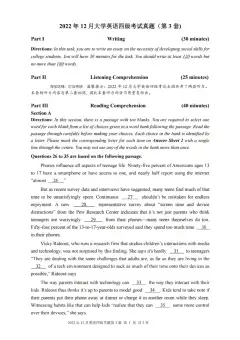
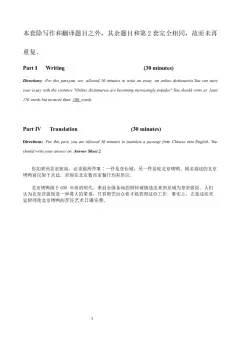
Part I Writing (30 minutes)
Directions:Suppose you have just participated in a school project of collecting used books on
campus.You are now to write a()report about the project,which may include its aim,organizers,
participants ana activities.You will have 30 minutes to write the report. You should write at least
120 words but no more than180 words.
Part II Listening Comprehension (25 minutes)
说明:由于2021年12月四级考试全国共考了两套听力,本套真题听力与前两套内容相同,
只是选项顺序不同,因此在本套真题中不再重复出现。
Part III Reading Comprehension (40 minutes)
Section A
Directions: In this section,there is a passage with ten blanks.You are required to select one word
for each blank from a list of choices given in a word bank following the passage. Read the passage
through carefully before making your choices.Eachchoice in the bank is identified by a letter.Please
mark the corresponding letter for each item on Answer Sheet 2 with a single line through the
centre.You may not use any of the words in the bank more than once.
The sheets are damp with sweat. You' re cold, but your heart is racing as if a killer just chased
you down a dark street. It was just a nightmare, you tell yourself; there's nothing to be afraid of. But
you' re still filled with26 .
Given how unsettling and haunting nightmares can be, is there a way for dreamers to 27
or even turn off, these bad dreams as they happen?
Research is 28 , but some studies suggest that people who can master lucid dreaming-that
is, the ability to be 29 that a nightmare is happening and possibly even control it without waking
up-may hold the 30 .
Nightmares are part of the human experience, especially for kids. Doctors_ 31 don't
consider occasional nightmares a problem. They can just be symptoms of a sleep disorder that can
32 from an unpleasant experience, stress, or certain drugs.
To treat the disorder, there are a number of medicines and therapies that are backed by 33
research, according to the American Academy of Sleep Medicine, which analyzed the available
research on the treatment of nightmare disorder in a recent 34 published in the Journal of
Clinical Sleep Medicine.
However, nightmares are complicated, and researchers are still struggling to understand them,
said Dr. Rachel Salas, an expert on sleep disorders and an associate professor at Johns Hopkins
Medicine in Baltimore. What we do know is that people 35 to have different kinds of
nightmares at different points during the sleep cycle.
A) amount I) mechanical
B) answer J) result
C) avoid K) review
D) aware L) rigorous
E) depart M) tendF) drastically N) timidity
G) fear O)typically
H) limited
Section B
Directions: In this section, you are going to read a passage with ten statements attached to it. Each
statement contains information given in one of the paragraphs. Identify the paragraph from which
the information is derived. You may choose a paragraph more than once, Each paragraph is marked
with a letter. Answer the questions by marking the corresponding letter on Answer Sheet 2.
Why it matters that teens are reading less
A) Most of us spend much more time with digital media than we did a decade ago. But today's
teens have grown up with smartphones. Compared with teens a couple of decades ago, the way
they interact withtaditional media like books and movies is fundamentally different.
B) Analysis of surveys of over one million teens in the United States collected since 1976 reveals
a major shift in how teens are spending their leisure time. Paper books are being ignored, in
favor of screens Digital devices are changing other behaviors, too. More and more, young
people choose spending time on their electronic devices over engaging in other activities,
regardless of the type. Indeed, by 2016, the average American high school senior said they spent
six hours a day writing text messages, on social media, and online during their free time. And
that covers just three activities, and if other digital media activities were included, that estimate
would no doubt rise.
C) Teens did not always spend that much time with digital media. Online time has doubled since
2006, and social media use hasmoved from a periodic activity to a daily one in the same period.
By 2016, nearly nine out of ten young women in the 12th grade said they visited social media
sites every day. Meanwhile, time spent playing video games rose from under an hour a day to
an hour and a half on average. One out of ten American 8th grade students in 2016 spent 40
hours a week or more playing video games. Let me emphasize that this is equal to the time most
adults spend per week at work.
D) If teens are spending so much time usingelectronic devices, does that mean they have to give
up some they activities? Maybe not. Over the years, many scholars have insisted that time
online does not necessarily take away time spent engaging with traditional media or on other
activities. Some people, they argue, are just more interested in certain kinds of media and
entertainment. Thus, using more of one type of media does not necessarily mean less of the
other.
E) That may be true, but that still does not tell us much about what happens across a wholegeneration of people when time spent on digital media grows. Large surveys conducted over the
course of many years tell us that American youth are not going to the cinema nearly as often as
they did in the past. While 70 percent of 8th and 10th grade students used to go to the movies
once a month or more, now only about half do this. More and more, watching a movie is
something teens choose to do on their electronic devices. Why is this a problem? One reason is
that going to the cinema is generally a social activity. Now, watching movies is something that
most teens do alone. This fits a larger pattern. In another analysis, researchers found that today's
teens go out with their friends much less often than previous generations did.
F) But the trends related to movies are less disturbing compared with the change in how teens spend
their time. Research has revealed an enormous decline in reading. In 1980, about 60 percent of
senior high school students said they read a book, newspaper or magazine every day that was not
assigned for school. By 2016, only 16 percent did. This is a huge drop and it is important to note
that this was not merely a decline in reading paper books, newspapers or magazines. The survey
allowed for reading materials on a digital device.
G) Indeed, the number of senior high school students who said they had not read any books for
pleasure in the last year was one out of three by 2016. That is triple the number from two decades
ago. For today's youth, books, newspapers and magazines have less and less of a presence in their
daily lives. Of course, teens are still reading. But they are generally reading short texts. Most of
them are not reading long articles or books that explore deep themes and require critical thinking
and reflection. Perhaps not accidentally, in 2016 reading scores were the lowest they have ever
been since 1972.
H) This might present problems for young people later on. When high school students go on to
college, their past and current reading habits will influence their academic performance.
Imagine going from reading texts as short as one or two sentences to trying to read entire books
written in complex language and containing sophisticated ideas. Reading and comprehending
longer books and chapters takes practice, and American teens are no longer getting that practice.
I) So how can this problem be solved? Should parents and teachers take away teens' smartphones
and replace them with paper books? Probably not. Research has shown that smartphones are
currently American teens' main form of social communication. This means that, without a
smartphone, teens are likely to feel isolated from their peers. However, that does not mean teens
need to useelectronic devices as often as they do now. Data connecting excessive digital media
time to mental health issues suggests a limit of two hours a day of free time spent with screens,
a restriction that will also allow time for other activities—like going to the movies with friends
or reading longer, more complicated texts.J) The latter is especially important. I would argue that of all the changes brought about by the
widespread use of digital devices, the huge decline in reading is likely to have the biggest
negative impact on today's teens because reading books and longer articles is one of the best
ways to learn critical thinking. It helps people to understand complex issues and to separate fact
from fiction. Thus, deep reading is crucial for being a good citizen, a successful college student
and a productive employee. If serious reading dies, a lot will go with it
36. Many years' surveys reveal that young people in America are going to the cinema much less
often than they usedto.
37. Survey analysis shows American teens now spend their leisure time on digital devices rather
than reading printed books.
38. The number of senior high schoolers not reading books for pleasure in a year increased three
times over 20 years.
39. Many scholars claim that spending time on electronic devices doesn't necessarily mean a
decrease of time for other activities.
40. Most people spend much more time interacting with digital media than they did ten years ago.
41. The author claims that it will bea great loss if we no longer read books and longer articles
42. Over a decade or so,American teens' social media use shifted from an occasional activity to
a routine one.
43. A more disturbing trend in America today is that teens are spending far less time reading than
around four decades ago
44. Some five years ago,high school seniors in America generally spent more than six hours a
day on electronic devices.
45. It was found that American youngsters today don't socialize nearly as much as the earlier
generations.
Section C
Directions:There are 2 passages in this section.Each passage is followed by some questions or
unfinished statements.For each of them there are four choices marked A),B),C)and D).You
should decide on thebest choice and mark the corresponding letter on Answer Sheet 2 with a single
line through the centre.
Passage One
Questions 46 to 50 are based on the following passage.
Have you ever wondered how acceptable it is to hug or touch someone?While it may sound
safe to avoid all physicalcontact so as not to offend anyone,the lack of touching might imply cold
attitudes or indifference in interpersonal relationships.So,what should we do?The simple answer is to thoroughly learn unique cultural norms for
physical contact. In nonverbal communication terminology(术语),physical contact and the study
of touching are generally referred to as haptics.
Haptics in communication often suggest the level of intimacy. They are usually classified into
two groups:high-contact and low-contact.
Asia and quite surprisingly the United States,Canada and Britain belong to low-contact
cultures. People from the rest of the world,such as Latin America,are considered to be in high-
contact cultures where they tend to expect touching in social interactions and feel more comfortable
with physical closeness. Despite the classification,there are more complex factors such as relational
closeness,gender,age,and context that can affect how someone views physical contact.
One common French custom of greetings is cheek-kissing,but it is mostly restricted to friends,
close acquaintances and family members. While cheek-kissing for Latin Americans is also a
universalgreeting form,it does not require such a high degree of relational closeness. However,
gender matters more for them because check-kissing often only happens between women or a man
and a woman but not two men.
In contrast,in certain Arabian,African,and Asian countries,men can publicly hold hands
or show physical affection as signs of brotherhood or friendship while these behaviors may suggest
a romantic relationship in other parts of the world. Although men's touching is more normal in these
cultures,physical contact between persons of opposite sexes who are not family members is
negatively perceived in Arabian countries.
These factors could definitely affect the degree to which someone is comfortable with tactile
(触觉的)communication and physical intimacy.Therefore,if you are someone who loves to show
physical affection,you should not be afraid to show it or drastically changeyour behaviors-just ask
for consent beforehand!
46. What does the author say in the first paragraph about physical contact?
A)Its role in interpersonal relationships is getting increasingly important.
B)It is becoming more acceptable to many who used to think it offensive.
C)Its absence might suggest a lack of warmth in interpersonal relationships.
D)It might prompt different responses from people of different social backgrounds.
47. What does physical contact in communication suggest?
A)What social classpeople belong to.
B)How civilized the communicators are.
C)What family background people come from.
D)How close the communicators' relationships are.48. What do we learn about people in high-contact cultures?
A)They are sensitive to the way people express their emotions.
B)They take touching as a cultural norm in social interactions.
C)They attach great importance to close ties among people.
D)They tend to be more open in interpersonal relationships.
49. What do we learn about social customs in Arabian countries?
A)Men can show friendship in public through physical affection.
B)Non-traditional romantic relationships are simply unacceptable.
C)Physical contact between unfamiliar people is negatively perceived.
D)People of different ages and genders showaffection in different ways.
50. What does the author tell us to do concerning tactile communication?
A)Lay emphasis on nonverbal communication.
B)Learn to use appropriate body language first.
C)Pay attention to the differences between genders.
D)Take other people's preference into consideration.
Passage Two
Ouestions 51 to 55 are based on the following passage.
From climate change to the ongoing pandemic(大流行病)and beyond,the issues facing
today's world are increasingly complex and dynamic. Yet solving problems like these requires new
approaches that extend beyond traditional ways of thinking. A study led by Yale Professor of
Psychology,Paul O'Keefe,found that having a growthmindset(思维倾向)of interest may spark
this type of innovation.
Professor O'Keefe established in earlier studies that people hold different beliefs about the
nature of interest. Those with a growth mindset of interest tend to believe that interests can be
developed and cultivated,while those with a fixed mindset of interest tend to believe that interests
are inherent(与生俱有的)and simply need to be found.' Building on these findings,the latest
research examined how a growth mindset of interest can boost integrative thinking across the
traditional disciplinary boundaries of arts and sciences.
For example,in one task,rescarch participants were instructed to create new college majors
by combining two or more existing academic Arts or Science programs at their university. After
coding and analyzing the ideas they generated,the team found that peoplewith a growth mindset
of interest were more likely to bridge programs across the arts and sciences to create new majors
like computational economics rather than creating majors that drew from only one of those areas,
like computational chemistry.As Professor O'Keefe pointed out,"This research provides a useful direction for organizations
whose products and services call for integrated and creative solutions. Take smartphones for
example. You need not only computer science and engineering knowledge,but also an
understanding of psychology and visual design to create a better product. Employees with a growth
mindset may be more likely to devise innovative ideas that bridge multiple areas of knowledge to
achieve better solutions."
The benefits of a growth mindset of interest may also extend to those seeking employment.
This is a pressing issue because many people are becoming unemployed due to the COVID-19
pandemic. Having a growth mindset of interest can help job seekers expand their interests and
become more adaptable to different fields,and take the initiative to learn new skills.
51. What does the author say about the world today?
A)It faces problems that are getting more varied and complicated.
B)It has done away with many of the traditional ways of thinking.
C)It is undergoing radical and profound changes.
D)It is witnessing various types of innovations
52. What did Professor O'Keefe find in his earlier studies?
A)Pcople's interests tend to change with age.
B)People's interests determine theirmindsets.
C)People are divided about the nature of interest.
D)People of different ages have different mindsets.
53. What is the focus of Professor O'Keefe's recent research?
A)How boundaries can be removed between arts and science disciplines.
B)Howfeasible it is to create new disciplines like computational economics.
C)How students in arts and sciences view the two types of mindset of interest.
D)How a growth mindset of interest can contribute to cross-disciplinary thinking.
54. What docs the author want to illustrate with the example of smartphones?
A)Hi-tech products are needed in interdisciplinary research.
B)Improved technology gives birth to highly popular products.
C)Making innovative products needs multidisciplinary knowledge.
D)Hi-tech products can boost people's integrative thinking.
55. What is the author's suggestion to those who are seeking employment?
A)Learning practical skills.
B)Broadening their interests.
C)Staying safe in the pandemic.D)Knowing their pressing issues.
Part Ⅳ Translation (30 minutes)
Directions:For this part,you are allowed 30 minutes to translate a passage from Chinese into
English.You should write your answer on Answer Sheet 2.
都江堰(Dujiangyan)坐落在成都平原西部的岷江上,距成都市约50公里,始建于公元
前三世纪。它的独特之处在于无需用堤坝调控水流。两千多年来,都江堰一直有效地发挥着
防洪与灌溉作用,使成都平原成为旱涝保收的沃土和中国最重要的粮食产地之一,都江堰工
程体现了我国人民与自然和谐共存的智慧,是全世界年代最久、仍在使用、无坝控水的水利
工程。