2021 年 12 月大学英语四级考试真题试卷 (第 2 套)
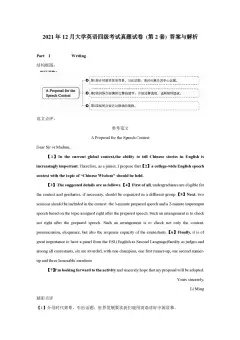
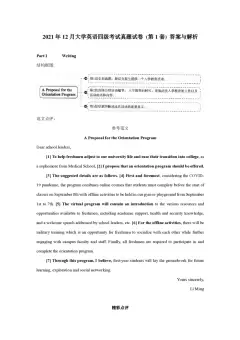
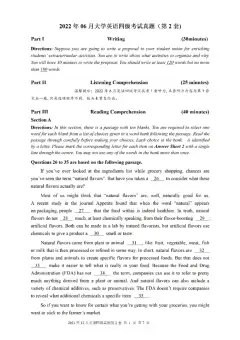
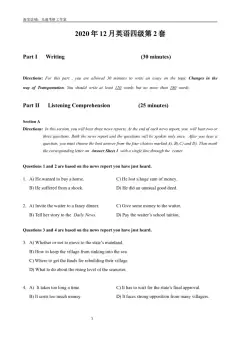
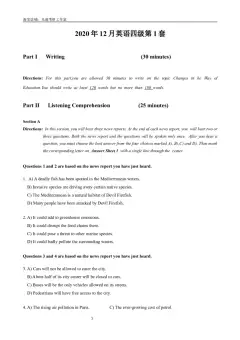
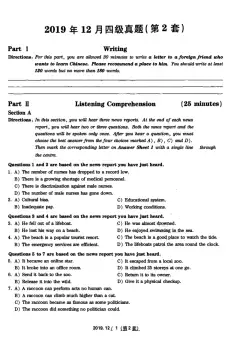
Part I Writing (30 minutes)
Directions:Suppose your university student union is planning to hold a speech contest.You are now
to write a proposal for organizins the contest.The proposal may include the topic, aim, procedure
and selection of contestants.You will have 30 minutes to write the proposal.You should write at
least120 words but no more than180 words.
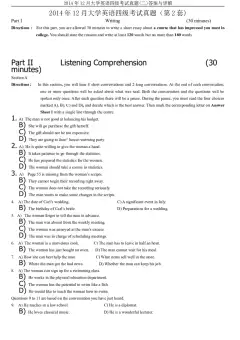
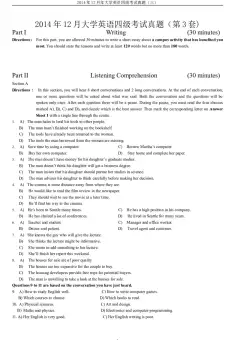
Part II Listening Comprehension (25 minutes)
Section A
Directions: In this section, you will hear three news reports. At the end of each news report, you
will hear two or three questions. Both the news report and the questions will be spoken only once.
After you hear a question, you must choose the best answer from the four choices marked A), B),
C) and D). Then mark the corresponding letter on Answer Sheet 1 with a single line through the
centre.
Questions 1 and 2 are based on the news report you have just heard.
1. A) She was pierced by a chicken bone.
B) She was coughing all the time.
C) She suffered from lung cancer.
D) She suffered from shock.
2. A) By eating chicken soup daily.
B) Through regular exercising.
C) Through a surgical operation.
D) By using traditional Chinese medicine.
Questions 3 and 4 are based on the news report you have just heard.
3. A) It was born 13 years ago.
B) It was Alice Gray's lovely pet.
C) It got injured in a big bushfire.
D) It ran away into a nearby forest.
4. A) They rebuilt the fencing around their farm.
B) They spent seven years replanting theirfarm.
C) They claimed damages for their heavy losses.
D) They installed a camera to monitor sheep activity.
Questions 5 to 7 are based on the news report you have just heard.5. A) The disappearance of some gold and diamonds.
B) The transfer of tons ofprecious metal by air.
C) The crash of a Russian cargo airplane.
D) The loss of gold from an airplane.
6. A) It made an emergency landing.
C) It contacted the goldmine company.
B) It informed the local police at once.
D) It had a crew member fix the problem.
7. A) They will cooperate with the police.
B) They had checked the plane carefully.
C) They will be questioned by the police.
D) They took some gold bars and diamonds.
Section B
Directions: In this section, you will hear two long conversations. At the end of each conversation,
vou will hear four questions. Both the conversation and the questions will be spoken only once.
After you hear a question, you muest choose the best answer from the four choires marked A). B),
C) and D). Then mark the corresponding letter on Answer Sheet 1 with a single line through the
centre.
Ouestions 8 to 11 are hesed on the conversation you have iust heard.
8. A) For the company's records.
B) For future training purposes.
C) To follow the company's rule.
D) To ensureinformation sccurity.
9. A) To check her customer reference number.
B) To inquire about the price of office chairs.
C) Toget her money back for the returned chair.
D) To make complaints about its customer service.
10. A) She had to update its information.
B) She forgot where she had left it.
C) She lost it about three days ago.
D) She was issued a new card.
11. A) Reconsider her options for payment methods.
B) Make a specific note on the company's system.
C) Update her bank card details on the company'swebsite.D) Upload her personal information to the company's website.
Questions 12 to 15 are based on the conversation you have just heard.
12. A) He is feeling exhausted.
B) He is tired of cooking.
C) He has to work late.
D) He wants to try Asian foods.
13. A) Book a table.
B) Order a delivery.
C) Download a menu.
D) Locate a restaurant.
14. A) It is not tasty. B) It is not healthy.
C) It is too oily. D) It is too spicy.
15. A) She is too concerned about money.
B) She is too weight-conscious.
C) She is too picky about food.
D) She is too eager to please.
Section C
Directions: In this section, you will hear three passages. At the end of each passage, you will hear
three or four questions. Both the passage and the questions will be spoken only once. After you hear
a question, you must choose the best answer from the four choices marked A), B), C) and D). Then
mark the corresponding letter on Answer Sheet 1 with a single line through the centre.
Ouestions 16 to 18 are based on the passage you have just heard.
16. A) Owners' personalities affect their cats' behaviour and wellbeing.
B) Parents' personalities can affect the personalities of their children.
C) Parents and cat owners alike experience high levels of anxiety.
D) More and more people are treating pet cats like their children.
17. A) Give their pets behavioural training.
B) Provide their pets with the best care.
C) Know their pets' feelings and desires.
D) Interact with their pets in novel ways.
18. A) More convincing explanation.
B) More extensive sampling.
C) Collection of more data.
D) Further investigation.Questions 19 to 21 are based on the passage you have just heard.
19. A) People should do more running than mere walking.
B) Running is the best exercise for extending one's life.
C) People should exercise at least 60 minutes every day.
D) Running is the easiest form of exercise for most people.
20. A) Improving their brain function.
B) Regulating their breathing rate.
C) Slowing down their ageing process.
D) Accelerating their bloodcirculation
21. A) They found it easy to control their emotions.
B) They struggled to handle negative emotions.
C) They were moreeager to enjoy a movie.
D) They were less affected by sad movies.
Questions 22 to 25 are based on the passage you have justheard.
22. A) He is a tour guide.
B) He is a famous architect.
C) He is a local entrepreneur.
D) He is the owner of the Hill House.
23. A) He studied the blueprints of other famous buildings.
B) He inquired about his client's family background.
C) He observed his client's life and habits.
D) He took a tour of his client's old home.
24. A) A house made of timber and brick.
B) A house with a lot of free space.
C) A house of the current fashion.
D) A house of a unique design.
25. A) They are well preserved and in pretty good shape.
B) They are copies built to the architect's designs.
C) They were designed by another architect.
D) They were badly damaged but restored.
Part III Reading Comprehension (40 minutes)
Section A
Direetions:In this section,there is a passage with ten blanks. You are required to select one wordfor each blank from a list of choices given in a word bank following the passage.Read the passage
through carefully before making vour choices.Each choice in the hank is identified bya letter.Please
mark the corresponding letter for each item on Answer Sheet 2 with a single line through the
centre.You may not use any of the words in the bank more than once.
It is commonly believed that the great English dramatist and poet William Shakespeare was
born in Stratford-on-Avon on April 23, 1564. But it is impossible to know the 26 day on
which he was born. Church records show he wasbaptized (施洗礼)on April 26,and three days was
a customary amount of time to wait before baptizing a newlyborn baby. Shakespeare's date of death
is 27 known. However: it was April 23, 1616. He was 52 and had retired to Stratford three
years before.
Although few plays have been performed or analyzed as extensively as the 38 plays
Shakespeare wrote, there are few surviving details about his life. This 28 of biographical
information is due primarily to his social 29 ;he was not a noble,but the son of a leather trader.
Shakespeare 30 attended the grammar school in Stratford, where he would havestudied
Latin and read 31 literature. He did not go to university and at age 18 married Anne Hathaway,
who was eight years his_32 . They had four children, including the twins, Hamnet and Judith.
Nothing is known of the period between the birth of the twins and Shakespeare's 33 as a
dramatist in London in the early 1590s.
In a million words written over 20 years, he 34 the full range of human emotions and
conflicts with a 35 that remains sharp today. As his great contemporary the poet and dramatist
Ben Jonson said, "He was not of an age, but for all time."
A) captured I) precision
B) classical J) probably
C) conclusively K) quality
D) emergence L) scarcity
E) exact M) senior
F) generated N) separated
G) particular O) systematically
H) position
Section B
Directions:In this section, you are going to read a passage with ten statements attached to it.Each
statement contains information given in one of the paragraphs.Identify the paragraph from which
the information is derived.You may choose a paragraph more than once.Each paragraph is markedwith a letter.Answer the questions by marking the corresponding letter on Answer Sheet 2.
How to not be boring
A) Humans are creatures of habit. We love to establish a routine and stick with it. Then we often
put ourselves on auto-pilot. Routines can be incredibly useful in helping you get things done.
However, too much of a routine can also make you incredibly boring. Nevertheless, many
people live lives that are boringly predictable, or live a life where everything is outlined or
planned.
B) To tell the truth, interesting people are more popular among their friends. If you don't arouse
someone's curiosity or brighten someone's day, you probably come across as being a little bit
dull. But that doesn't mean your life has ended and you can't do anything to change it. If you
find yourselt scarching for something to say beyond small talk, try these tactics to find more
interesting approaches to conversation.
C) Recently,I was at a gathering of colleagues when someone turned to me and asked,"So,what's
new with you?" Ordinarily, I think I'm a good conversationalist. After all,it's literally my job
to talk to people and tell their stories or share their advice. And that's not exactly an unexpected
question. Still the only "new-to-me" topics that came to mind were my daughter's basketball
tournament(锦标赛)and my feelings about that morning's political headlines-neither amusing
nor appropriate topics at that moment.
D) Oh,no, I thought. Have I become boring? But sharing our experiences in an authentic way to
connect with other people is what makes us interesting,says associate professor Michael Pirson.
The hesitation I felt in not sharing the ordinary things that were happening in my life, and the
wild mental searchfor something more interesting, may have backfired and made me seem less
interesting.
E) "If someone is making up some conversation that might be interesting, it's probably not going
to land well, "says Pirson, whose expertise includes trust and well-being, mindfulness, and
humanistic management. "It's going to feel like a made-up conversation that people don't
necessarily want to tune in to."
F) The most interesting people aren't those who' ve gone on some Eat, Pray, Love journey to find
themselves. Instead, Pirson says, they' re those who examine the ordinary. "Often, the "boring
things' may not be boring at all. Maybe they are actually little miracles," he says. Share your
observations about the world around you-interesting stories you heard or things you noticed-
and you may be surprised by the universal connection they inspire.
G) This is essentially how Jessica Hagy starts her day. The author of How to Be Interesting: An
Instruction Manual, Hagy spends a lot of time thinking about what's interesting toher. Peoplewho are interesting are persistently curious, she says.
H) Think about the everyday things around you and ask questions about them. What is that roadside
monument I see on my way to work every day? Who built that interesting building in my city?
What nearby attractions haven't I visited? Why do people do things that way? Use what you
find to ask more questions and learn more about the world around you. "Having that sort of
curiosity is almost like a protective gear from getting into boredom,"she says. And when you
find things that are truly interesting to you, share them.
I) Television veteran Audrey Morrissey, executive producer of NBC's The Voice, is always
looking for what will make a person or story interesting to viewers: It's usually a matter of
individuality. "Having a strong point of view, signature style, or being a super-enthusiast in a
particular field makes someone interesting,"she says. That means embracing what is truly
interesting or unique about yourself. "Many people are "not boring' in the way that they can
carry a conversation or can be good at a social gathering, etc. To be interesting means that you
have lived life, taken risks, traveled, sought out experience to learn for yourself and sharewith
others," she says.
J) Of course, it's possible to be a fountain of knowledge and a boring person, says public relations
consultant Andrea Pass. Paying attention to the listener is an important part of having a
conversation that's interesting to both parties. Talking on and on about what's interesting toyou
isn't going to make you an interesting person, she says.
K) "If the listener is not paying attention, it's your sign to shorten the story or change direction. Make
sure to bring the audience into the conversation so that it is not one-sided," Pass says. Be a better
listener yourself, and give others opportunities to participate in the conversation by inviting them
with questions or requests to share their own experiences or thoughts. (e.g. , "Now, tell me about
your favorite book," or "Have you ever been to that attraction?") Questions are a powerful tool,
especially when they encourage others to disclose information about themselves. A 2012 study
from the University of California, Santa Barbara, found that roughly 40% of the time we are
talking, we' re disclosing subjective information about our experience. And when we' re doing
so, our brains are more engaged. So one strategy to leave others with the impression that you' re
a sparkling conversation partner is to get others to talk about themselves.
L) Being relatable is also essential, Morrissey says. "The best entertainment and storytelling comes
from people who are relatable-those who don't shy away from opening up but freely share who
they are and what they care about. These are the pepple viewers most relate to and find
interesting. Being authentic, honest, and vulnerable is always interesting."
M) I have now come to realize that being boring, in actuality, is not only about who you are as aperson, but also how you present yourself. No matter what, make sure vou are having fun in
life. Because when you are enjoying, people around you will begin to enioy as well. Show some
interest in them and they will definitely show some in you. If you are a very reserved person,
this could be a little difficult at first. But with a little effort,you can definitely improve.
36. Pirson claims that some ordinary things may often prove to be miraculously interesting.
37. To make a conversation interesting, it is important that you listen to the other party attentively.
38. A person who is unable to stimulate others' curiosity or make their life enjoyable may appear
somewhat boring
39. Interesting people usually possess certain unique qualities, according to a TV program producer
40. Be interested in others and they are sure to be interested in you.
41. The author considers himselfusually good at conducting conversations.
42. Interesting people are always full of curiosity.
43. Falling into a routine can turn a person into an utter bore.
44. One strategy to be a good conversationalist is to motivateyour partner to tell their ownstories.
45. Interesting as it might appear, a made-up conversation will probably turn out to be dull.
Section C
Directions: There are 2 passages in this section.Each passage is followed by some questions or
unfinished statements.For each of them there are four choices marked A),B),C)and D).You should
decide on thebest choice and mark the corresponding letter on Answer Sheet 2 with a single line
through the centre.
Passage One
Questions 46 to 50 are based on the following passage.
With obesity now affecting 29% of the population in England,and expected to rise to 35% by
2030,should we now recognise it as a disease?Obesity,in which excess body fat has accumulated
to such an extent that health may be adversely affected,meets the dictionary definitionof disease,
argues Professor John Wilding. He points out that more than 200 genes influence weight. "Thus
body weight is strongly influenced by biology-it is not an individual's fault if they develop obesity."
Yet the widespread view is that obesity is self-induced and that it is entirely the individual's
responsibility to do something about it. Recognising obesity as a chronic disease with severe
complications rather than a lifestyle choice"should help reduce thestigma (耻辱)and discrimination
experiencedby many people with obesity," he adds.
Professor Wilding disagrees that labelling a high proportion of the population as having a
disease removes personal responsibility or may overwhelm health services,pointing out that other
common diseases,such ashigh blood pressure and diabetes,require people to take action to managetheir condition. He suggests that most people with obesity will eventually develop complications.
“But unless we accept that obesity is a disease,we are not going to be able to tackle it," he concludes.
But Dr. Richard Pile,a physician with a special interest in diabetes,argues that adopting this
approach "could actually result in worse outcomes for individuals and society." He believes that the
dictionary definition of disease "is so vague that we can classify almost anything as a disease" and
says the question is not whether we can,but whether we should,and to what end.
If labelling obesity as a disease was harmless then it wouldn't really matter, he writes. But
labelling obesity as a disease "risks reducing autonomy,disempowering and robbing people of the
intrinsic(内在的)motivation that is such an important enabler of change." What's more,making
obesity a discase" may not benefit patients, but it will benefit healthcare providers and the
pharmaceutica(l 制药的)industry when health insurance and clinical guidelines promote treatment
with drugs and surgery,"he warns
46. What does Professor John Wilding argue about obesity?
A)Its impact on socicty is expected to rise.
B)It is now too widespread to be neglected.
C)It should be regarded as a genctic disease.
D)Its dictionary definition should be updated
47. What is the popular view of obesity?
A)It is difficult to define.
B)It is a modern disease.
C)It has much to do with one's genes.
D)It results from a lack of self-control
48. Why are some people opposed to labelling obesity as a disease?
A)Obese people would not feel responsible to take any action.
B)Obese people would not be able toafford the medical costs.
C)Obese people would be overwhelmed with anxiety.
D)Obese people would be discriminated against.
49. What does Dr. Richard Pile think of the dictionary definition of disease?
A)It is of no use in understanding obesity.
C)It helps little to solve patients' problems.
B)It is too inclusive and thus lacks clarity.
D)It matters little to the debate over obesity.
50. What is Dr. Richard Pile's concern about classifying obesity as a disease?
A)It may affect obese people's qualityof life.B)It may accelerate the spread of obesity.
C)It may cause a shortage of doctors.
D)It may do little good to patients.
Passage Two
Questions 51 to 55 are based on the following passage.
Nationwide,only about three percent of early childhoodteachers are male in the U.S. Experts
say this can have an impact on young children whose understanding of gender roles and identity are
rapidly forming. Research has found that having access to diverse teachers is beneficial for children.
For the youngest learners,it means they are more likely to get exposed to different varieties of play
and communication. It also helps them develop healthy ideas around gender.
"In our world and our society, we have very specific stereotypes(模式化形象)of gender
roles,"saidMindi Reich-Shapiro,an assistant professor in the teacher education department of the
Borough of Manhattan Community College,and one of the authors of a recent study. "It's important
for children to see other possibilities and other paths they can take."
Despite mostly feeling supported by colleagues and family members, many of the male
educators surveyed in the study reported facing social or cultural resistance in their careers as carly
education teachers. Some also reported that there were parents surprised or concerned that their
child had a male teacher. And they had been advised by colleagues or other staff not to hug children.
Reich-Shapiro and fellow researchers made several recommendations to increase male
representation in the field. Low pay has long been acknowledged as a major issue in the early
childhood field. Over 70% of male educators who said they intended to stay in the carly education
workforce noted an increased salary was a major motivating factor for them to commit to the career
long-term. The report suggests paying all early childhood educators the way elementary school
teachers are paid.
Cities and programs should establish support groups for male early childhood educators and
provide mentoring and professional development advice for male educators and their program
leaders.
The authors also suggest that traditional recruitment approaches for early childhood educators
"do not address the gender gap in the field."They recommend providing young men opportunities
to work with children through training and volunteer programs, targeting groups of men who are
considering a career change, such as fathers.
51. What do we learnfrom the first paragraph about early childhood education in the U.S.?
A) It helps raise children's awareness of genderroles.B) It exposes children to different ways of interaction.
C) It is negatively impacted by a lack of male teachers.
D) It clearly aims to form children's identity through play
52. What does Mindi Reich-Shapiro emphasize in her comment on childhoodeducation?
A) The importance of broadening children's horizons.
B) The responsibilities of fathers for children's growth.
C) The urgency of creating teacher education programs.
D) The role of teachers in motivating children to learn.
53. What do we learnabout male teachers from their responses in the study?
A) Some of them find it awkward when hugging children.
B) They feel pressured to keep up with female colleagues.
C) They find it hard to meet the expectations of kids' parents.
D) Many of them feel prejudiced against socially and culturally.
54. What is needed for men to commit to early childhood education?
A) Higher pay.
C) Social recognition.
B) Job security.
D) Better working conditions.
55. What do the authors of the study recommend to bridge the gender gap in early childhood
education?
A) Recruiting young men who have a passion for education young children.
B) Taking measures to attract prospective male teachers to work in the field.
C) Persuading prospective fathers to consider a change in theircareer.
D) Providing male teachers with more opportunities for advancement.
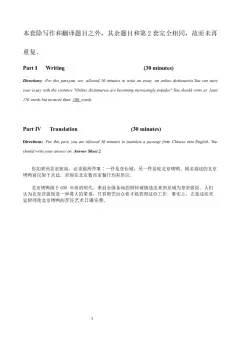
Part Ⅳ Translation (30 minutes)
Directions: For this part, you are allowed 30 minutes to translate a passage from Chinese into
English. You should write your answer on Answer Sheet 2.
坎儿井(Karez)是新疆干旱地区的一种水利系统,由地下渠道将水井连接而成。该系
统将春夏季节渗入(seep into)地下的大量雨水及积雪融水收集起来,通过山体的自然坡度
引到地面,用于灌溉农田和满足人们的目常用水需求。坎儿井减少了水在地西的蒸发
(evaporation),对地表破坏很小,因而有效地保护了自然资源与生态环境。坎儿井体现了
我国人民与自然和谐共存的智慧,是对人类文明的一大贡献。