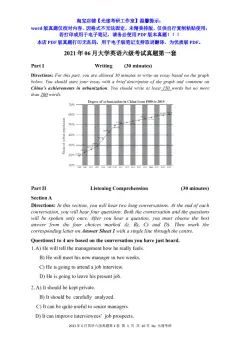
Model Test One
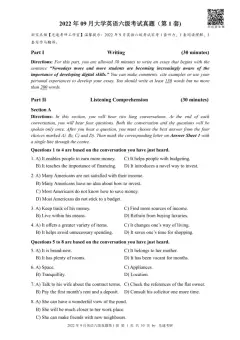
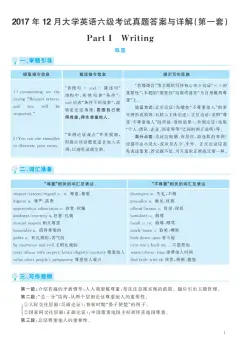
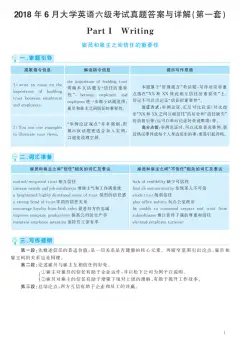
Part I Writing (30 minutes)
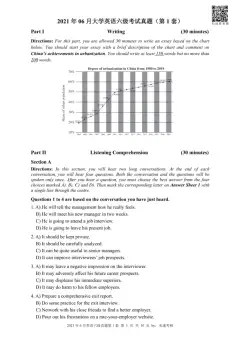
Directions : For this part you are allowed 30 minutes to write an essay on how to be a civilized tourist. You
9
are required to write at least 150 words but no more than 200 words.
Part H Listening Comprehension (30 minutes)
Section A
Directions: In this section, you will hear two long conversations. At the end of each conversation, you will
hear four questions. Both the conversation and the questions will be spoken only once. After you hear a
question, you must choose the best answer from the four choices marked A), B), C) and D). Then mark
the corresponding letter on Answer Sheet 1 with a single line through the centre.
Questions 1 to 4 are based on the conversation you have just heard.
1. A) It has caused the death of at least 10 more children this week.
B) It has claimed 73 lives so far for the season.
C) It is as widespread as the 2009 epidemic.
D) It has caused a serious epidemic in the US.
2. A) Doctors haven't found out the virus causing the flu yet.
B) The current vaccine doesn't work well against the dominant virus.
C) The flu has run out of control and circulated around the world.
D) People haven't realized the seriousness of the flu yet.
3. A) The workaholics. C) Those who lack physical exercise.
B) The alcoholics. D) Pregnant women.
4. A) Take antiviral medicines. C) Drink more warm water.
B) Stay indoors. D) Be hospitalized immediately.
Questions 5 to 8 are based on the conversation you have just heard.
5. A) Most of them are poor at numeracy.
B) Most of them have no customer awareness.
C) Many of them are unqualified for thriving in the workplace.
D) Many of them have no clear occupational planning.
6. A) Making training plans for employees in her company.
B) Recruiting young qualified graduates for her company.
C) Doing remedial training for new employees in her company.
D) Running numeracy lessons for employees in her company.
7. A) Offering high-qualified teaching. C) Helping students achieve all-round development.
B) Developing students5 numeracy skill. D) Being strict with students5 academic achievement.
六级 18. A) The poor teaching quality of schools nowadays.
B) The decreasing number of graduates nowadays.
C) The reduction of cost in business payroll nowadays.
D) The reduction of funding for further education nowadays.
Section B
Directions: In this section, you will hear two passages. At the end of each passage, you will hear three or
four questions. Both the passage and the questions will be spoken only once. After you hear a question, you
must choose the best answer from the four choices marked A ), B ), C) and D). Then mark the
corresponding letter on Answer Sheet 1 with a single line through the centre.
Questions 9 to 11 are based on the passage you have just heard.
9. A) They had declined for almost two decades. C) They had declined for five years.
B) They had risen for almost two decades. D) They had risen for five years.
10. A) It did not examine teens5 use of smartphones.
B) It involves many other possible influencing factors.
C) It proves the serious influence of social media on teen suicide.
D) It provides weak evidence for social media influencing teen suicide.
11. A) They are the main factors influencing teen suicide.
B) They are being unfairly criticized.
C) Kids should be forbidden to use them.
D) Kids' use of them should be reasonably limited.
Questions 12 to 15 are based on the passage you have just heard.
12. A) Stop selling energy drinks to customers under 16.
B) Ask customers to present their IDs when buying soft drinks.
C) Announce new energy drink restrictions.
D) Reduce the number of soft drinks containing caffeine.
13. A) They were first announced last year. C) They are caused by a nationwide soda tax.
B) They are a voluntary measure. D) They will end at the beginning of March.
14. A) Because they contain too much sugar. C) Because the additives contained are bad to health.
B) Because their nutrition value is exaggerated. D) Because the caffeine contained can prevent sleep.
15. A) Because supermarket chains will not follow the rules.
B) Because kids might lie about their age.
C) Because energy drinks are still available in small stores.
D) Because customers do not support them.
Section C
Directions: In this section, you will hear three recordings of lectures or talks followed by three or four
questions. The recordings will be played only once. After you hear a question, you must choose the best
answer from the four choices marked A ), B) , C) and D). Then mark the corresponding letter on Answer
Sheet 1 with a single line through the centre.
Questions 16 to 18 are based on the recording you have just heard.
16. A) How to control emotions in daily life. C) How to study grammar efficiently.
B) How to think and act optimistically. D) How to deal with emotions under pressure.
17. A) By advising yourself to think in different perspectives.
B) By slowing down your reaction to stress gradually.
C) By keeping a psychological distance between you and your emotions.
D) By distracting you from the thing that makes you stressful.
六级 218. A) His own experience of being nervous during a flight.
B) His desire as a mental health expert to help patients.
C) His failure in curing people suffering from depression.
D) His new strategies for controlling emotions under pressure.
Questions 19 to 22 are based on the recording you have just heard,
19. A) Two. B) Four. C) Six. D) Twelve.
20. A) The ability to cope well with long-term mental and emotional problems.
B) The ability to collect the needed information from the space.
C) The ability to make maps of the planets being studied.
D) The ability to adapt well to the living structure in the space.
21. A) It takes 20 minutes for a radio signal to travel from Mars to Earth.
B) It is a method of training the crew members5 patience.
C) It takes 20 minutes to prepare for communications.
D) It is essential for making sure the content of communications is clear.
22. A) The one in Hawaii includes women research subjects.
B) The one in Hawaii is conducted in a special structure.
C) The one in Hawaii lasts for nearly three years.
D) The one in Hawaii provides an environment most like Mars.
Questions 23 to 25 are based on the recording you have just heard.
23. A) Having a good start every day. C) Having a sense of direction.
B) Having strong self-confidence. D) Having specialist knowledge.
24. A) Our brains and muscles have just had enough rest during the night.
B) People who rise early in the morning have a clear head.
C) Our willpower and attention span are strongest in the morning.
D) People are influenced by the saying “The early bird gets the worm.??
25. A) It helps us review our mistakes. C) It helps us set our goals.
B) It helps us make full use of our time. D) It helps us get prepared.
Part ]][ Reading Comprehension (40 minutes)
Section A
Directions: In this section,there is a passage with ten blanks. You are required to select one word for each
blank from a list of choices given in a word bank following the passage. Read the passage through carefully
before making your choices. Each choice in the bank is identified by a letter. Please mark the corresponding
letter for each item on Answer Sheet 2 with a single line through the centre. You may not use any of the
words in the bank more than once.
Intelligence makes for better leaders- from undergraduates to executives to presidents- according to multiple
studies. It certainly makes sense that handling a market shift or legislative logjam (僵局) 26 cognitive oomph
(活力).But new research on leadership suggests that, at a certain 27 , having a higher IQ stops helping and
starts hurting.
Although 28 research has shown that groups with smarter leaders perform better by objective measures,
some studies have hinted that followers might 29 view leaders with supreme intellect as less effective. Decades
ago Dean Simonton, a psychologist at the University of California, Davis, proposed that brilliant leaders5 words may
simply go over people's heads, their solutions could be more 30 to implement and followers might find it harder
to relate to them.
The researchers looked at 379 male and female business leaders in 30 countries, across fields that included
六级 3banking, retail and technology. The managers took IQ tests and each was rated on leadership style and effectiveness
by an average of eight co-workers. IQ positively correlated with ratings of leader effectiveness, strategy formation,
vision and several other 31 —up to a point. The ratings peaked at an IQ of around 120, which is higher than
roughly 80 percent of office workers. Beyond that, the ratings 32
The researchers suggest that the right interpretation of the finding would be that it 33 a need to understand
what high-IQ leaders do that leads to lower perceptions by followers. Leaders should use their intelligence to generate
creative metaphors that will persuade and 34 others- the way former US President Barack Obama did. The
only way a smart person can signal their intelligence 35 and still connect with the people is to speak in
charismatic (有超凡魅力的)ways.
A) appropriately F) decreased K) requires
B) characteristics G) highlights L) significant
C) complicated H) inspire M) stage
D) continuously I) point N) subjectively
E) declined J) previous O) transcend
Section B
Directions: In this section, you are going to read a passage with ten statements attached to it. Each
statement contains information given in one of the paragraphs. Identify the paragraph from which the
information is derived. You may choose a paragraph more than once. Each paragraph is marked with a
letter. Answer the questions by marking the corresponding letter on Answer Sheet 2.
Inequality Quantified: Mind the Gender Gap
A) Female scientists have made steady gains in recent decades, but they face persistent career challenges. US
universities and colleges employ far more male scientists than female ones and men earn significantly more in
science occupations.
B) As an aspiring engineer in the early 1970s, Lynne Kiorpes was easy to spot in her undergraduate classes. Among a
sea of men, she and a handful of other women made easy targets for a particular professor at Northeastern
University in Boston, Massachusetts. On the first day of class “he looked around and said 'I see women in the
9
classroom. I don't believe women have any business in engineering, and I'm going to personally see to it that you
all fail.H e wasn't bluffing. All but one of the women in the class ultimately left engineering; Kiorpes went on
to major in psychology. Such blatant (公然的)sexism is almost unthinkable today, says Kiorpes, now a
neuroscientist at New York University. But Kiorpes, who runs several mentoring programmes for female students
and postdoctoral fellows, says that subtle bias persists at most universities. And it drives some women out of science
careers.
C) By almost any metric, women have made great gains in closing the scientific gender gap, but female scientists
around the world continue to face major challenges. According to the US National Science Foundation, women
earn about half the doctorates in science and engineering in the United States but comprise only 21% of full science
professors and 5% of full engineering professors. And on average, they earn just 82% of what male scientists make
in the United States- even less in Europe. Scientific leaders say that they continue to struggle with ways to level
the playing field and encourage more women to enter and stay in science.
D) One of the most persistent problems is that a disproportionate (不成比例的)fraction of qualified women drop out
of science careers in the very early stages. A 2006 survey of chemistry doctoral students by the Royal Society of
Chemistry in London, for example, found that more than 70% of first-year female students said that they planned
a career in research; by their third year, only 37% had that goal, compared with 59% of males.
E) Many experts say that a big factor driving this trend is the lack of role models in the upper divisions of academia
(学术界),which have been slow to change. The Royal Society of Chemistry has found, for instance, that female
chemistry students are more likely than males to express low self-confidence and to report dissatisfaction with
六级 4mentorship. Female students conclude consciously and unconsciously that these careers are not for them because
they don't see people like them. That effect—the sense of not belonging—is very, very powerful. The attrition
continues at later stages. In biology, for example, women comprised 36% of assistant professors and only 27% of
tenure candidates in a 2010 study by the US National Research Council. "We're not talking about a lack of talent
here. Part of the story is that women leave earlier.
F) Many of the UK chemistry students viewed research as an all-consuming attempt that was incompatible with raising
a family. Meeting the demanding schedule of academic research can seem dispiriting for both mothers and fathers.
But family choices seem to weigh more heavily on the career goals of women.
G) It is found that male and female postdocs without children are equally likely to decide against research careers,
each leaving at a rate of about 20%. But female postdocs who become parents or plan to have children abandon
research careers up to twice as often as men in similar circumstances. Furthermore, women who do become faculty
members in astronomy, physics and biology tend to have fewer children than their male colleagues- 1. 2 versus
1. 5, on average- and also have fewer children than they desire.
H) In response to these concerns, many universities have taken steps to establish family-friendly policies such as
providing child-care assistance and extending tenure docks for new parents. Shirley Tilghman, president of
Princeton University in New Jersey, believes that such initiatives provide crucial support for women, but that other
solutions are still needed. "I don't think there's a single obstacle,?? she says. "I think there's a whole series of
phenomena that add up. ”
I) At Yale University in New Haven, Connecticut, microbiologist Jo Handelsman is one of many researchers who
think that gender discrimination continues to be a significant part of the problem. In a much-talked-about
experiment last year, her team showed that science faculty members of both sexes exhibit unconscious biases
against women. Handelsman^ group asked 127 professors of biology, chemistry and physics at 6 US universities to
evaluate the CVs of two fictitious (虚构的)college students for a job as a laboratory manager. The professors said
they would offer the student named Jennifer US $ 3,730 less per year than the one named John, even though the
CVs were identical. The scientists also reported a greater willingness to mentor John than Jennifer.
J) Her findings match well with the results of a survey done in 2010 by the American Association for the
Advancement of Science. Of the 1, 300 or so people who responded, 52% of women said that they had
encountered gender bias during their careers> compared with just 2% of men.
K) Still, other concrete evidence of bias is hard to find. Some measures show female scientists outperforming male
rivals in landing interviews and job offers early in their careers. The National Research Council study showed that
women accounted for 19% of the interview pool and received 32% of job offers for tenure-track electrical
engineering positions. Women fared just as well as men in tenure evaluations, but female assistant professors in
many disciplines seemed less likely to reach tenure consideration compared with men.
L) Several groups, such as the UK Medical Research Council and biomedical research charity the Wellcome Trust,
have since investigated their grant programmes and found negligible or very subtle effects of gender. The Canadian
Medical Research Council found no differences in success rate in most of its research grant programmes, but
reported lower success rates for women in some training grants. In the United States, women are slightly more
successful than men in obtaining grants from the National Science Foundation, but the trend is reversed for the
National Institutes of Health (NIH). The NIH also gives women smaller awards on average.
M) Information provided to Nature by the NIH through a Freedom of Information Act request indicates that the
percentage of women on review panels has improved marginally over the past decade, from 25% in 2003 to 30% in
2012. Those figures roughly parallel the percentage of women applying for and receiving grants in that time.
N) The inequalities also extend to salaries. In the European Union, female scientists earned on average between 25%
and 40% less than male scientists in the public sector in 2006. Although the average pay gap is smaller in the
United States, the disparity (不平等)is particularly large in physics and astronomy, where women earn 40% less
than men. For young academic scientists? however, those differences may be fading. The National Research
Council found an 8% pay gap at the level of full science and engineering professors but no significant differences
六级 5among junior faculty members. Some experts argue, however, that the salary gap may reflect other continued
trends, such as the fact that a disproportionate share of women move into non-tenure positions or faculty jobs at
lower-status universities.
O) Tilghman says that Princeton and many other universities have grown increasingly conscious of the need to track
and rectify gender gaps in salary and other institutional support. wAbsolutely, it needs eternal vigilance (警,惕)
she says. "But we're in a much better place.n
36. Changes in the senior sectors of academia are emphasized to narrow the gender gap in science.
37. Many universities have adopted family-friendly policies in order to help women scientists out of the family-or-
career dilemma.
38. The gender gap concerning scientific research grants is comparatively slight.
39. During the early 1970s, female students in science may encounter declared sexism that is unimaginable nowadays.
40. A Yale University research revealed unconscious prejudice against female students even among women faculty.
41. Despite the considerable progress that has been made, efforts are still needed for equal rights of women in the
scientific community.
42. The phenomenon of unequal pay for female scientists exists in both the United States and EU countries.
43. It is problematic that a considerable proportion of women give up their scientific work in the initial phase.
44. Even though they perform better than their male rivals, female scientists can hardly obtain equal career
development opportunities.
45. Compared with their male peers, female scientific workers are more likely to give up their research careers when
they become parents or plan to get pregnant.
Section C
Directions: There are 2 passages in this section. Each passage is followed by some questions or unfinished
statements . For each of them there are four choices marked A), B) , C) and O). You should decide on the
best choice and mark the corresponding letter on Answer Sheet 2 with a single line through the centre.
Pass^e One
Questions 46 to 50 are based on the following passage.
A six-week-old infant who died some 11,500 years ago in central Alaska is now providing clues about how the
Americas first came to be populated.
Genomic data from remains of the girl—named wXach,itee?aanenh T'eede Gaay” (Sunrise Girl-Child) by the local
indigenous community—broadly support a migration model that scientists have long argued for, while also revealing
the existence of an ancient population previously unknown to science. The girl was a member of an ancient population
that the report authors have named “Ancient Beringiansw. Beringia is the name given to Alaska, Eastern Siberia, and
the land bridge that periodically connected the two during the last ice age.
The findings suggest a revised family tree: a single ancestral Native American group split from East Asians about
35,000 years ago, before later splitting, some 20, 000 years ago, into two distinct groups. One was the Ancient
Beringians, and the other constituted the ancestors of modern-day Native Americans, who later split into northern and
southern populations about 15,700 years ago.
“Trying to integrate these findings with what we know from archaeology (考古学)and paleoecology (古生态学)
presents exciting new puzzles,“ says Ben Potter, an anthropologist (人类学家)at the University of Alaska. "The
peopling has been shown now to be more complex than we thought previously.w Scientists have sought ancient human
remains from Beringia at the end of the last ice age, but Xach5iteeJaanenh T'eede Gaay's genome held a surprise: it
was clearly Native American, but not from either of the two major modern Native American groups. It represented a
population that diverged from that common ancestor.
All of this helps narrow down and strengthen the theories of just how those populations arrived in the Americas.
But mysteries remain, including definitive answers about where and when some of these population splits occurred and
which migration routes were used.
六级 6Researchers outline two possible models. In one scenario, which Dr. Potter favors since it matches well with
archaeological data and paleoecological data, the split occurred in Northeast Asia, and the two separate populations
later crossed over the land bridge prior to 15,700 years ago, when the Native American ancestors split again. In the
other theory, the ancestral population had already arrived in Alaska or eastern Beringia by 20,000 years ago, and the
split occurred there, with the second split into North and South American populations occurring south of the ice
sheets. What happened to the Ancient Beringians? They might have died out, says Potter, or they could have been
absorbed by Northern Native Americans who migrated back to the far North.
Researchers liken the puzzle to a murder mystery. "You read the book, and the author reveals new clues over the
course of the book. Every time a new genome is analyzed and reported, it provides a new clue that's making the
pathway to uncover the real story that much clearer.??
46. What can we learn about the girl called "Xach'itee'aanenh T5eede Gaay”?
A) She was found dead about six years old some 11,500 years ago.
B) She provided new clues for the study on the first American population.
C) She belonged to an ancient population that used to dwell in Beringia.
D) She migrated to central Alaska sometime during the last ice age.
47. Which of following is mentioned by Ben Potter as the uexciting new puzzles”?
A) Whether Xach?itee?aanenh TJeede Gaay belonged to Native American groups.
B) How Xach5itee5aanenh T'eede Gaay's population separated from major groups.
C) Why the two major Native American groups diverged from the common ancestor.
D) When the populations crossed over the land bridge and arrived in the Americas.
48. What can we infer from the two possible migration models?
A) The first model seems to have acquired more support from research data.
B) The first split occurred about 15,700 years ago according to the second model.
C) The split of ancient Native Americans happened on the ice sheets in the first model.
D) The second model provides conclusive proof of the ending of the Ancient Beringians.
49. Researchers compare their study to a murder mystery as they share similarity i n .
A) the way of approaching the truth C) the analysis of the course of books
B) the need to acquire new clues D) the pursuit for the real story
50. What can be the best title of this passage?
A) Debates Aroused by the Remains of Sunrise Girl-Child
B) New Puzzles About the Ancient Beringians to Be Solved
C) Two Possible Models of Native American Migration
D) Native American Family Tree Sprouts a New Branch
Passage Two
Questions 51 to 55 are based on the following passage.
Is science infinite? Can it keep giving us profound insights into the world forever? Or is it already bumping into
limits? In his 2011 book The Beginning of Infinity physicist David Deutsch made the case for boundlessness. When I
asked him about consciousness, he replied: ”I think nothing worth understanding will always remain a mystery. And
consciousness seems apparently worth understanding.
At a meeting I just attended in Switzerland, “The Mystery of Human Consciousness,99 another famous British
physicist, Martin Rees, challenged Deutsch's optimism. In that essay Rees calls The Beginning of Infinity provocative
and excellent^ but disputes Deutsch's central claim that science is boundless. Science “will hit the buffers (缓冲区)at
some point,“ Rees warns.
There are two reasons why this might happen. The optimistic one is that we clean up and understand certain areas
(such as atomic physics) to the point that there's no more to say. A second, more worrying possibility is that well
reach the limits of what our brains can grasp. There might be concepts, crucial to a full understanding of physical
reality. Efforts to understand very complex systems, such as our own brains, might well be the first to hit such limits.
六级 7Perhaps complex collectives of atoms, whether brains or electronic machines, can never know all there is to know
about themselves.
The riddle of consciousness is a synecdoche for the riddle of humanity. What are we, really? For most of our
history, religion has given us the answer. Most modern scientists reject these religious explanations, but they cannot
agree on an alternative. They have proposed a bewildering variety of answers to the question of what we really are.
Science will never resolve these disagreements and converge on a single, true theory of what we are, for two
reasons. One is that we will never have a ^consciousness meter,an objective means of measuring consciousness in
non-human things. The other is that we are too varying? too creative, to be captured by a single theory. Science itself
keeps transforming us, with technologies as diverse as brain implants, genetic therapy and ideas as diverse as queer
theory and integrated information theory. To be human means to be a work in progress.
Deutsch's claim that science is infinite also has a contradiction at its core. He wants science to solve the deepest
mysteries, like consciousness, and yet to have more mysteries to solve, forever. That is a radical assertion about the
structure of nature, which to my mind reflects wishful thinking rather than hardheaded realism.
Deutsch is both wrong and right. He is wrong that science can solve every mystery, and especially consciousness.
We will never understand, once and for all, who we are. But Deutsch is right that science is potentially infinite, if
infinite means never-ending. It is precisely because we can never achieve total self-knowledge that we will keep
seeking it forever.
51. Which of the following statements may David Deutsch agree with?
A) The case study of physics should be unlimited. C) The puzzle of consciousness will be worked out.
B) The scientific mysteries are worth understanding. D) Science will finally hit a bottleneck somewhere.
52. The real reason for science to “hit the buffers“ may be t h a t .
A) science will inevitably experience its bottleneck period
B) the cognitive ability of humanity cannot be boundless
C) people are over-optimistic about the development of science
D) complicated systems are unable to be fully understood
53. According to the author, the riddle of co n scio u sn ess.
A) has been properly worked out by religious theories
B) is made more perplexing by modern science
C) will be solved in science's debate against religion
D) is the utmost challenge of human understanding
54. What does the author mean by saying "To be human means to be a work in progress.99 (Line 5, Para. 5)?
A) Human consciousness is hard to be measured. C) Humanity is working hard to make progress.
B) Human consciousness is forever advancing. D) Humanity is always changing and developing.
55. What does the author think of Deutsch's point of view?
A) Partially acceptable. C) Somewhat groundless.
B) Completely irrational. D) Quite encouraging.
Part N Translation (30 minutes)
Directions: For this part, you are allowed 30 minutes to translate a passage from Chinese into English. You
should write your answer on Answer Sheet 2.
喝中国茶有两种方式:大碗茶给人一种随意的感觉;功夫茶(gongfu tea)则令人对茶道有所体会。功夫茶不是一种
茶叶或茶的名字,而是一种极具传统文化特色的冲泡手艺,在中国古代被视为长生不老之药。人们叫它功夫茶是因为
它的冲泡过程很注重茶壶、茶叶、水质甚至泡茶的工序、倒茶的动作与喝茶的方式。制作功夫茶主要使用的茶叶是乌龙
茶(oolong tea),因为它能满足功夫茶色、香、味的要求。
六级 8Model Test Two
Part I Writing (30 minutes)
Directions: For this part, you are allowed 30 minutes to write an essay commenting on square dancing, a
popular pastime among the elderly in China. You are required to write at least 150 words but no more than
200 words.
Part H Listening Comprehension (30 minutes)
Section A
Directions: In this section, you will hear two long conversations. At the end of each conversation, you will
hear four questions. Both the conversation and the questions will be spoken only once. After you hear a
question, you must choose the best answer from the four choices marked A) B) , C) and D). Then mark
9
the corresponding letter on Answer Sheet 1 with a single line through the centre.
Questions 1 to 4 are based on the conversation you have just heard.
1. A) Open a deposit account for her company.
B) Withdraw some money to pay a bill.
C) Transfer some money to a company account.
D) Change her address she registered in the bank before.
2. A) Within two days. C) After the woman have got the needed information.
B) Right now. D) After the man have got his manager's approval.
3. A) Because there is a very big sum of money in her account.
B) Because he has no authority to close accounts for customers.
C) Because the bank doesn't have so much money right now.
D) Because he needs to arrange a security guard for the woman.
4. A) Tired. B) Exited. C) Alert. D) Impatient.
Questions 5 to 8 are based on the conversation you have just heard.
5. A) How confidence helps people. C) How over-confidence harms people.
B) How lack of confidence harms people. D) How to develop self-confidence.
6. A) They are likely to die earlier.
B) They are likely to prolong their lives.
C) Two thirds of them are likely to get cured in the end.
D) They are twice as likely to get cured in the end.
7. A) They come into his laboratory with passion.
B) They come into his laboratory full of confidence.
C) They have been in the middle of their classes.
D) They have struggled hard to enter the university.
六级 98. A) Evidence is needed in every step of teaching.
B) Confidence is a must for a qualified teacher.
C) Knowledge can be gained from critical thinking.
D) Opportunities can be gained from self-confidence.
Section B
Directions: In this section, you mil hear two passages. At the end of each passage, you will hear three or
four questions. Both the passage and the questions will be spoken only once. After you hear a question, you
must choose the best answer from the four choices marked A ), B ), C) and D). Then mark the
corresponding letter on Answer Sheet 1 with a single line through the centre.
Questions 9 to 11 are based on the passage you have just heard.
9. A) It is a program for girls to practice outdoor skills. C) It is a program charging no fee.
B) It is a program for women explorers. D) It is a program for mountaineering enthusiasts.
10. A) Five. C) Twelve.
B) Nine. D) Fourteen.
11. A) Participants should have a higher education background.
B) Interested girls should write to explain why they want to participate.
C) Knowing some basics of outdoor skills is a must for participants.
D) Easy-going girls are more likely to be accepted as participants.
Questions 12 to 15 are based on the passage you have just heard.
12. A) They are terrifying in appearance. C) They are on the edge of extinction.
B) They are attractive but poisonous. D) They are native to the North Pacific.
13. A) They are threatening the sea life in the area. C) They are simplifying the food-chain of the area.
B) They are diversifying its marine environment. D) They are affecting the local tourism.
14. A) It is a government-funded team. C) It is an expert-led team.
B) It is a private team. D) It is a student-led team.
15. A) By putting it into a tank full of the fish. C) By showing it thousands of images of the fish.
B) By remote-controlling it to attack the fish. D) By equipping it with a sensing device.
Section C
Directions: In this section, you will hear three recordings of lectures or talks followed by three or four
questions. The recordings will be played only once. After you hear a question, you must choose the best
answer from the four choices marked A ),B) , C) and D). Then mark the corresponding letter on Answer
Sheet 1 with a single line through the centre.
Questions 16 to 18 are based on the recording you have just heard.
16. A) It is a scientific group doing research in Antarctica.
B) It is an independent group aiming to protect wildlife.
C) It is an independent group aiming to protect the environment.
D) It is a scientific group exploring the currents around the Antarctica Ocean.
17. A) Approximately 1.8 million tons. C) Approximately 18 million tons.
B) Approximately 8 million tons. D) Approximately 80 million tons.
18. A) Ban all single-use plastic by 2022.
B) Organize more waste clean-up activities.
C) Develop and produce degradable plastic bags.
D) Ask movie stars to promote environmental protection.
六级 10Questions 19 to 22 are based on the recording you have just heard.
19. A) People tend to choose the latest brand of cars.
B) The auto industry is undergoing intense competition.
C) More and more buyers want to buy eco-friendly cars.
D) A large number of automakers are desperate for innovation.
20. A) They cost twice as much as traditional cars.
B) They are now available only in a few countries.
C) Drivers need to replace the batteries often to avoid sudden breakdown.
D) Drivers need to charge the batteries frequently during a long journey.
21. A) It is now popular all around the world. C) It can be built into existing roads.
B) It can only be built into specially designed roads. D) It has undergone three years5 development.
22. A) It is implemented by one single company. C) It is not effective under extreme weather.
B) It costs 5 million dollars per kilometer. D) It has not been ready for wide industrial use yet.
Questions 23 to 25 are based on the recording you have just heard.
23. A) Its moving path. B) Its intensity. C) Its formation. D) Its scale.
24. A) They are of finite use. C) They are misleading.
B) They are not referential. D) They are quite accurate.
25. A) It involves more than eight low-orbit satellites.
B) It can send back all needed information about hurricanes.
C) It has successfully helped predict the intensity of hurricanes in 2017.
D) It can measure surface winds in and near the centre of tropical storm systems.
Part ]][ Reading Comprehension (40 minutes)
Section A
Directions: In this section, there is a passage with ten blanks. You are required to select one word for each
blank from a list of choices given in a word bank following the passage. Read the passage through carefully
before making your choices. Each choice in the bank is identified by a letter. Please mark the corresponding
letter for each item on Answer Sheet 2 with a single line through the centre . You may not use any of the
words in the bank more than once.
Suddenly, everywhere you look, everyone's taking cold showers. Not literally—that would be weird- but there's
no mistaking a lifestyle trend when you see one. They're 26 in a new book, What Doesn't Kill Us, which
27 the exploits of the Dutch extreme-cold enthusiast (狂热者)Wim Hof, who once spent nearly two hours in
an ice bath. In The New York Times, the novelist Ben Dolnick reports that cold showers changed his “entire 28
toward the outside world”. The benefits include everything from 29 immunity to slowing ageing and fighting
depression. It5s environmentally better, too, so you'll feel the warm glow of being moral, which is fortunate, given
that you're going to be extremely bloody cold.
As someone who has always preferred the cold, and 30 the way hot days are considered “good weather”,
I'm a natural candidate for the craze. Finding myself sleepy at 5 p.m.——having woken with the baby at 5 a.m.—I
tried taking naps, 31 that plan, and then started jumping under icy water instead. It worked 32 ,
helping me squeeze out a few more hours of energy. When I took another cold shower before bed, I slept better, too.
But Fil admit there's something a little 33 about this, as there is with many strategies for “breaking out of
your comfort zone”. What are we all trying to prove» exactly? It's hard to avoid the conclusion that behind the desire
to 34 over extreme cold, there's a desire to somehow conquer yourself, since both participants in this wrestling
六级 11match, as you may have noticed, are you. The far more likely result is just more 35 conflict.
A) abandoned F) exciting K) overcome
B) boosting G) goal L) recommended
C) brilliantly H) initial M) resents
D) charts I) inner N) self-punishing
E) disposition J) intelligently O) triumph
Section B
Directions: In this section, you are going to read a passage with ten statements attached to it. Each
statement contains information given in one of the paragraphs. Identify the paragraph from which the
information is derived. You may choose a paragraph more than once. Each paragraph is marked with a
letter. Answer the questions by marking the corresponding letter on Answer Sheet 2.
Exercise Is Good for Your Body and Your Mind
A) The benefits of exercise are widely known: it helps you live longer and lowers risk of heart disease, stroke and
diabetes. A new study published Wednesday in The Lancet Psychiatry journal suggests that when done in
moderation, it leads to better mental health as well. The researchers analyzed responses from 1.2 million adults in
the United States taken from a US Centres for Disease Control and Prevention survey given in 2011, 2013 and
2015. The average number of days of poor mental health per person in the past month was around 3.4, according
to the study. Those who reported exercising had about 1. 5, or 43%, fewer days of “bad self-reported mental
health“ in the past month compared to those who did not exercise. Poor mental health was reported in the study as
stress, depression and trouble with emotions.
B) “I think in comparison to all other treatments, when a patient successfully exercises at the right dose, there is a
sense of self-efficacy and confidence that the patient develops that is absolutely also a remarkably positive thing,”
said Dr. Madhukar Trivedi, Director of the Centre for Depression Research and Clinical Care at the Peter
O'Donnell Jr. Brain Institute at UT Southwestern Medical Centre in Dallas. He was not involved with the study but
recently published a paper in JAMA Psychiatry linking midlife fitness with lower risk of depression.
C) “I think it's a huge deal,“ said Adam Chekroud, an author of the study and Assistant Professor of Psychiatry at
Yale University. "Even just walking just three times a week seems to give people better mental health than not
exercising at all. I think from a public health perspective, it's pretty important because it shows that we can have
the potential for having a pretty big impact on mental health for a lot of people.
D) The sweet spot for exercising was found to be 45-minute sessions three to five times a week. There wasn't a big
difference in benefit for exercising beyond 90 minutes in a session—until one hit the three-hour mark. After that,
there appeared to be worse mental health associated with those people compared to others who did not exercise at
all.
E) “I think it makes sense,w Chekroud said. "If you're not exercising enough, perhaps that's not giving you the
biological aspect of exercise, maybe you're not putting your body through the intensity and through the changes
that it needs to stimulate those biological changes in the brain. And on the high end, anecdotally we hear a lot
about people who get addicted to exercise or maybe you're kind of running yourself into the ground. ”
F) Though all forms of exercise resulted in better mental health compared to doing nothing, the strongest association
was found in people who played popular team sports (a 22% lower mental health burden), cycling (22%) and
other aerobic and gym activities (20%). Even completing household chores led to about a 10% drop in days of
poor mental health in a month, the researchers found. Exercise in group settings could have a slightly higher
benefit than exercise alone,“ Trivedi said. "There's not enough evidence to be very strong but that could be what
happened.
六级 12G) As for cycling, Chekroud, who is also chief scientist at Spring Health, a mental health company based in New
York that provides mental health services to large employers and an avid cyclist himself, said? ”There's …the
biological benefit of exercise. And you'll have increases in your respiratory (与呼吸有关的)rate and your heart
rate and that kind of thing. But also, it's an opportunity where you're not working for a relatively long period of
time and you get to think things through, perhaps reevaluate situations that happen in your life* "
H) The authors adjusted for various physical and sociodemographic factors like age, race, gender, marital status,
socioeconomic status, education, self-reported physical health and previous diagnosis of depression. Still the
improvement seen from exercise was more than what could be seen from any other modifiable social or
demographic factor such as education, body mass index or household income.
I) Seventy-five types of ,exercise“ were included in the report, leading to some experts preferring another label
instead. "In the current study, we see the inclusion of activities such as childcare, housework, lawn-mowing,
carpentry, fishing, and yoga as forms of exercise,“ wrote Dr. Gary Cooney, a psychiatrist at Gartnavel Royal
Hospital in the United Kingdom in an accompanying commentary published with the article. "The study -in its all-
encompassing approach, might more accurately be considered a study in physical activity rather than exercise.
J) Though the study is purportedly the largest of its size, and uunprecedented in scale",it does have a few
limitations, Cooney said. Mental health disorders are not a monolith and there are discrete factors involved in
research and clinical purposes of various conditions like dementia, substance misuse or personality disorder, he
said.
K) “There is an uncomfortable interchangeability between mental health and depression, as if these concepts were
functionally equivalent, or as if other mental disorders were somewhat peripheral,w wrote Cooney, who also cited
the authors' choice to research previous studies regarding exercise and primarily depression. Consequently, the
study may offer the most guidance in depression research.
L) “I think that particular concern is more of an academic concern rather than a practical concern,Chekroud
countered. "I think part of the reason that we were less concerned about that than the particular commentary was
that we know that depression and anxiety are the most common mental health conditions. And when we talk about
mental health, most people have mood or anxiety disorders. So it5s true that some people will have things like
schizophrenia (精神分裂症)or bipolar disorder (狂躁抑郁症)but those conditions make up a very small
percentage of the population.w "In the future we can start to maybe hone in on different illness categories and
maybe we would see a different pattern, but I think overall though it's kind of an edge case in this situation,he
added.
M) And because the answers to the survey are self-reported, individuals who have conditions like schizophrenia)
schizoaffective disorder (分裂’情感性障碍)or bipolar affective disorder, may have a diminished ability to do so
accurately, Cooney said.
N) The next step in research is asking more detailed questions and following up with people long-term, Trivedi said.
The authors of the study also propose collecting data from wearable trackers, like Fitbit, to more precisely
determine how frequency, duration and intensity of exercise and mental health burden are connected.
O) “People and patients should actually get well informed and become informed consumers and ask their doctors about
whether this is a valid treatment for them or not,“ Trivedi said. "And if the doctor says yes, then you try to figure
out a plan to make sure like any other treatment- if you get pills, then you figure out a way to take them regularly.
If your doctor and you decide exercise is your treatment, then you develop strategies to make sure you basically
swallow the pill. ”
36. People who exercised for between 1.5 and 3 hours were almost in the same mental health condition as those who
did for three quarters of an hour.
37. The chief scientist at Spring Health believes that people can consider things thoroughly or reassess what goes on in
六级 13their life when cycling.
38. Dr. Gary Cooney prefers to use the label of physical activity instead of exercise in the report.
39. Respondents with psychological problems like bipolar affective disorder may be less able to make correct self
reports.
40. According to the data from the US Centres for Disease Control and Prevention, participants without exercise felt
stressful or depressed more often than those who exercised.
41. In Chekroud?s opinion, the mental health problems except depression and anxiety are less mentioned in the study
partly because they are edge cases.
42. The contribution made to mental health by changeable social or demographic factors was less than that made by
exercise.
43. After doctors5 verification, patients should make a plan for exercise and perform it regularly like taking medicine.
44. What Dr. Madhukar Trivedi has written in JAMA Psychiatry is that keeping fit in middle age can reduce the
incidence of depression.
45. Even doing housework can reduce about 10% of days of poor mental health every month.
Section C
Directions: There are 2 passages in this section. Each passage is followed by some questions or unfinished
statements . For each of them there are four choices marked A), B) , C) and D). You should decide on the
best choice and mark the corresponding letter on Answer Sheet 2 with a single line through the centre .
Pass例e One
Questions 46 to 50 are based on the following passage.
A UK supermarket has become the first in the world to let shoppers pay for groceries using just the veins in their
fingertips.
Customers at the Costcutter store, at Brunel University in London, can now pay using their unique vein pattern to
identify themselves.
The firm behind the technology, Sthaler, has said it is in wserious talks“ with other major UK supermarkets to
adopt hi-tech finger vein scanners at pay points across thousands of stores.
It works by using infrared (红夕卜线)to scan people's finger veins and then links this unique biometric (生物特征识
另!!的)map to their bank cards. Customers5 bank details are then stored with payment provider Worldpay, in the same
way you can store your card details when shopping online. Shoppers can then turn up to the supermarket with nothing
on them but their own hands and use it to make payments in just three seconds.
It comes as previous studies have found fingerprint recognition, used widely on mobile phones, is vulnerable to
being hacked and can be copied even from finger smears left on phone screens.
But Sthaler claims vein technology is the most secure biometric identification method as it cannot be copied or
stolen.
Sthaler said dozens of students were already using the system and it expected 3,000 students out of 13,000 to have
signed up by November.
Vein scanners are also used as a way of accessing high-security UK police buildings and authorising internal trading
at least one major British investment bank.
The firm is also in discussions with nightclubs, gyms about using the technology to verify membership and even
Premier League football clubs to check people have the right access to VIP hospitality areas.
The technology uses an infrared light to create a detailed map of the vein pattern in your finger. It requires the
person to be alive, meaning in the unlikely event a criminal hacks off someone's finger, it would not work. Sthaler
said it takes just one minute to sign up to the system initially and, after that, it takes just seconds to place your finger
in a scanner each time you reach the supermarket checkout.
六级 14Simon Binns, commercial director of Sthaler, told the Daily Telegraph : ”This makes payments so much easier for
customers. They don't need to carry cash or cards. They don't need to remember a pin number. You just bring
yourself. This is the safest form of biometrics. There are no known incidences where this security has been breached.
When you put your finger in the scanner it checks you are alive, it checks for a pulse, and it checks for haemoglobin
(血红蛋白). Your vein pattern is secure because it is kept on a database in an encrypted form, as binary numbers. No
card details are stored with the retailer or ourselves; it is held with Worldpay, in the same way it is when you buy
online.w
46. It can be inferred from the first two paragraphs t h a t .
A) the Costcutter store offers the finger vein payment in the world first
B) there are no two identical fingerprints in the world
C) Sthaler has spread its finger vein recognition technology to the overseas market
D) customers have their finger veins scanned at the checkout in British supermarkets
47. Making payments with the finger vein scanners in physical stores and submitting payments o n l i n e .
A) show the difference in how to link to shoppers5 bank cards
B) choose the same storage location for users' bank details
C) yield the same better-than-expected results
D) differ in the degree of difficulty in the payment process
48. Fingerprint identification technology i s .
A) widely applied in communication C) likely to be duplicated from finger marks
B) most exposed to cyber attacks D) the safest way of biometric recognition
49. The finger vein scanners are already used to authenticate users to get i n t o .
A) universities C) investment banks
B) police stations D) VIP sections
50. As to the technology developed by his company, Simon Binns pointed out t h a t .
A) there was no use paying with someone elseJs finger
B) customers didn't have to waste energy memorizing ID numbers
C) no severe safety accidents arose in its system
D) neither Sthaler nor the sellers preserved customers5 card details
Passage Two
Questions 51 to 55 are based on the following passage.
The Trades Union Congress (TUC) has urged the government to use productivity gains from the greater use of
robots and artificial intelligence to reverse planned changes to the state pension age.
Before its annual congress in Brighton, the TUC said higher levels of productivity thanks to technological
innovation ought to bring greater benefits for working people. It said recent progress had mainly benefited business
owners, rather than being shared across the workforce through better wages and working conditions.
Analysis from the accountants PricewaterhouseCoopers suggests GDP could receive a 10% boost from productivity
gains linked to artificial intelligence by 2030, helping to bolster the British economy as it seeks to escape a period of
weak output growth. That could relieve the pressure on workers to stay in employment into their late 60s, according to
the TUC. The government announced in July that it would increase the state pension age from 67 to 68 between 2037
and 2039. Frances O'Grady, the TUC general secretary, said: MRobots and AI could let us produce more for less,
boosting national prosperity. But we need a debate about who benefits from this wealth, and how workers get a fair
share.w
There have been previous waves of technological advances since the first Industrial Revolution, when inefficient
jobs have been replaced by machines or the number of people required to do work has been reduced. Such advances
六级 15have not led to an overall loss of jobs, but have disrupted the type of work people do.
There are concerns that the current phase of innovation could be more damaging, while the rewards from higher
productivity have not necessarily translated into higher wages. The latest available figures show low levels of
unemployment unseen since the mid-1970s, but growth in real wages remains negative as inflation outstrips (超过)a
sluggish (迟缓的)earnings growth.
In 1950, almost one in three workers worked in manufacturing, while one in twelve worked in professional and
technical services. By 2016 the proportions had reversed, but the jobs lost in manufacturing were not replaced by jobs
of similar or better quality in the communities affected. Wages in former industrial areas were still 10% below the
national average.
The increase in the state pension age, which was controversially brought forward by seven years by the Work and
Pensions Secretary, David Gauke, is expected to affect about 7 million people in their late 30s and early 40s. As well
as reversing the move on the pension age, the TUC said workers should be given the right to a midlife career review,
while firms should invest more in workplace training. At present, the UK invests just half of the EU average, it said.
O'Grady said: ”Robots are not just terminators. Some of today's jobs will not survive, but new jobs will be created.
We must make sure that tomorrow's jobs are no worse than today's. ”
51. According to the TUC, what should be the result of the application of robots and artificial intelligence?
A) Technological advances. C) Benefits for working people.
B) Higher levels of productivity. D) More wealth of business owners.
52. The author cites the data from PricewaterhouseCoopers t o .
A) testify the impact of robots and AI C) analyze causes of economic growth
B) provide proofs for the TUC's argument D) illuminate policies of the government
53 . Which of the following statements is Frances O'Grady most likely to agree with?
A) Technological advances should result in people's well-being.
B) Sixty-seven should be the upper limit for the state pension age.
C) The cost saved by robots and AI should be shared among people.
D) The use of robots and AI is bound to reduce the number of jobs.
54. It can be inferred that the waves of technological a d v a n c e s .
A) were the outcome of the Industrial Revolution C) slowly raised the real income of working people
B) tended to be more damaging than constructive D) exerted a profound influence on the labor structure
55. What can we learn about the proposal of David Gauke?
A) It reflects the real needs of economic growth. C) It meets with strong opposition from the TUC.
B) It has produced a widespread influence. D) It will help to create new types of jobs.
Part IV Translation (30 minutes)
Directions: For this part, you are allowed 30 minutes to translate a passage from Chinese into English. You
should write your answer on Answer Sheet 2.
在中国,数百万计的人通过网络视频直播(live streaming)与世界分享他们的生活。网络视频直播并不是一个新概
念。在中国,各种各样的在线直播应用程序层出不穷。这些应用程序也被用于商业目的,个人和公司都用它们来销售
各种各样的产品。明星们也使用视频直播直接与粉丝互动。网络直播在人们的生活中扮演着重要角色,不仅让人们的
生活变得越来越多样,而且让人与人之间的交流更加便捷、有趣。
六级 16Model Test Three
Part I Writing (30 minutes)
Directions: For this part, you are allowed 30 minutes to write a short essay to express your views on the
phenomenon of keeping pets in dormitories. You should write at least 150 words but no more than 200
words.
Part H Listening Comprehension (30 minutes)
Section A
Directions: In this section, you will hear two long conversations. At the end of each conversation, you will
hear four questions. Both the conversation and the questions will be spoken only once. After you hear a
question, you must choose the best answer from the four choices marked A) , B) , C) and D). Then mark
the corresponding letter on Answer Sheet 1 with a single line through the centre.
Questions 1 to 4 are based on the conversation you have just heard.
1. A) He has opened a new account. C) He began to pay back a car loan.
B) Something's wrong with his account. D) He had to deal with a financial crisis.
2. A) The bank is providing more favorable incentives.
B) The bank is collecting more fees than he expected.
C) He receives a bank statement every month.
D) He can pay bills by credit cards without additional fees.
3. A) By getting a direct deposit for his salary. C) By getting a check for his salary.
B) By having a new checking account. D) By using the ATM to make a purchase.
4. A) He has many credit cards. C) He pays more attention to the accounts.
B) He didn't consult the woman before. D) He pays little attention to the terms.
Questions 5 to 8 are based on the conversation you have just heard.
5. A) The building with the log shape. C) Senior homes with logs.
B) Traditional log cabins. D) The blocking beams and walls.
6. A) In a river valley of Europe. C) In a remote area.
B) Along the Delaware River Valley. D) In some European counties.
7. A) The shape of log homes was suitable for them.
B) They had easy access to logs in that area.
C) They wanted to change the European traditions.
D) The way of building a house with logs was easy.
六级 178. A) Look at the slides of modern log houses.
B) See some pictures of mountain retreats.
C) Listen to the presentation of a New Yorker.
D) Take a trip to the Delaware River Valley.
Section B
Directions: In this section, you mil hear two passages. At the end of each passage, you will hear three or
four questions. Both the passage and the questions will be spoken only once. After you hear a question, you
must choose the best answer from the four choices marked A ), B ), C) and D). Then mark the
corresponding letter on Answer Sheet 1 with a single line through the centre.
Questions 9 to 12 are based on the pass咫e you have just heard.
9. A) Stop to buy an umbrella. C) Seek shelter from the rain.
B) Run quickly than usual. D) Walk at normal speed.
10. A) Running gets a person wetter while raining.
B) Running fast keeps a person totally dry while raining.
C) Running has a little impact on keeping people dry while raining.
D) Running cannot protect people from getting wet while raining.
11. A) The researchers made a wrong calculation of the average walking pace.
B) The researchers ignored the distance running in the rain.
C) The researchers overestimated the psychological effects.
D) The researchers didn5t use advanced technology to analyze data.
12. A) Running when caught in a storm. C) Taking an umbrella with you.
B) Sheltering from the rain under a tree. D) Walking in the rain rather than running.
Questions 13 to 15 are based on the passage you have just heard.
13. A) It still can be used. C) It should be thrown away.
B) It will break down. D) It will become bent.
14. A) The gift card's validity time is short. C) Shoppers have to pay gift card fees.
B) The gift card has a few chances to use. D) The gift card lacks protective measures.
15. A) They have overwhelming advantages. C) They are the symbol of people's status.
B) They are sold at very low prices. D) They meet customers' psychological needs.
Section C
Directions: In this section, you will hear three recordings of lectures or talks followed by three or four
questions. The recordings will be played only once. After you hear a question, you must choose the best
answer from the four choices marked A) B), C) and D ). Then mark the corresponding letter on Answer
9
Sheet 1 with a single line through the centre.
Questions 16 to 19 are based on the recording you have just heard,
16. A) The factors that affect our decision-making.
B) Some ways to develop our skills and talents.
C) Some guidelines on hunting part-time jobs.
D) The advice on how to be versatile.
17. A) It is a trait we are born with. C) It is a skill that can be learned.
B) It is the key to success. D) It helps with reasoning ability.
六级 1818. A) It will make you analyze others5 arguments better.
B) It will help you have better conversations.
C) It will inspire you to new viewpoints.
D) It will increase your influence on others5 choices.
19. A) A strategic narrative with digits. C) Pictures and photos.
B) Large numbers and figures. D) Diagrams and charts.
Questions 20 to 22 are based on the recording you have just heard.
20. A) Parents never ask their children for advice.
B) Parents always give their children constructive advice.
C) Most teenagers seldom follow their parents' advice.
D) Most teenagers have got good advice from their parents.
21. A) Being too repetitive and critical. C) Being too harsh and forcible.
B) Being too frequent and compulsive. D) Being too subjective and overwhelming.
22. A) Workmates seldom give advice. C) We believe in ourselves more than others.
B) We don't have good opportunities. D) We are afraid to suffer embarrassment.
Questions 23 to 25 are based on the recording you have just heard.
23. A) They are more important than professional skills. C) They make you invaluable to employers.
B) They improve your personal relationship. D) They help little in the technology area.
24, A) Get involved in both STEM and liberal arts. C) Learn something that your friends have learned.
B) Major in what they are interested in. D) Make some friends with the same interests.
25. A) It lays a bad foundation for your career life. C) It allows you to amass professional skills.
B) It provides you with different knowledge. D) It makes you know more about society.
Part ]][ Reading Comprehension (40 minutes)
Section A
Directions : In this section, there is a passage with ten blanks. You are required to select one word for each
blank from a list of choices given in a word bank following the passage. Read the passage through carefully
before making your choices. Each choice in the bank is identified by a letter. Please mark the corresponding
letter for each item on Answer Sheet 2 with a single line through the centre . You may not use any of the
words in the bank more than once.
Facebook is cracking down on cryptocurrencies (力口密数字货币)by using one of its most powerful tools: access to
its massive advertising megaphone (宣传).The social networking giant said on Tuesday that it will not 26 ads
for financial products that “are frequently associated with misleading or deceptive promotional practices,“ specifically
27 currencies and initial coin offerings,“ a fundraising (筹款的)tactic that new cryptocurrencies use to
attract fresh investors. "We want people to continue to discover and learn about new products and services through
Facebook ads without fear of 28 or deception,“ wrote Rob Leathern, a product management director at
Facebook, in a blog post.
The spectacular 29 in prices last year of bitcoin and many alternative cryptocurrencies has sparked a surge
of interest among investors and companies of all kinds. The rampancy has led to schemes that, in some case, promise
triple-digit returns and have 30 the investigation of the Securities and Exchange Commission (SEC). uMarket
六级 19professionals, especially gatekeepers, need to act 31 and hold themselves to high standards, SEC Chairman
Jay Clayton said in recent speech. "To be frank, from what I have seen recently, 32 in the initial coin offering
space, they can do better.w
Facebook provided a number of examples to illustrate its new policy, such as ad 33 that advises users to
convert their retirement funds into bitcoin or promotions for “norisk“ cryptocurrencies.
The announcement comes weeks after Facebook chief executive Mark Zuckerberg acknowledged the potential of
cryptocurrencies to 34 power away from acentralized systems.w "They come with the risk of being harder to
control,w Zuckerberg said in a Facebook post. "I'm interested to go deeper and study the positive and negative aspects
of these technologies, and how best to use them in our 35 ”
A) attracted F) eliminate K) scams
B) authorize G) essential L) services
C) capture H) increase M) simultaneously
D) copy I) particularly N) strategy
E) display J) responsibly O) virtual
Section B
Directions: In this section, you are going to read a passage with ten statements attached to it. Each
statement contains information given in one of the paragraphs. Identify the paragraph from which the
information is derived. You may choose a paragraph more than once . Each paragraph is marked with a
letter. Answer the questions by marking the corresponding letter on Answer Sheet 2.
Your weight affects how long you live- but it's extremely complicated
A) We often think about weight loss in the short term, hoping to drop 5 pounds in time for vacation or 10 in time for
a wedding. Of course, this kind of yo-yo dieting isn't the greatest for our health. If you're going to ask how much
you should weigh, you want to think long term- what weight will keep you healthy?
B) This question has been at the forefront of researchers' minds for a while, and for good reason. Global obesity rates
are high and steadily increasing, with 1.3 billion adults considered overweight and 600 million in the weight range
categorized as obese.
C) While it5s true that muscle weighs more than fat, most people who are carrying around a few extra pounds are
doing so in the form of adipose (月旨肪的)tissue. Unlike bone and muscle, fat cells can generate inflammation (炎
症),allowing us to heal infections and protect our bodies from further damage. But having too many fat cells
causes our bodies to release inflammatory proteins all the time. Many studies indicate this can increase our risk of
developing cancer.
D) Carrying around extra fat cells also affects other physiological pathways, many of which—high blood pressure,
hyperglycemia (高血糖症),and high cholesterol, for example- can lead to potentially fatal heart problems.
E) We all need some amount of body fat. So how much is too much? Using BMI (body mass index, the body mass
divided by the square of the body height) and rates of overall mortality, scientists studying this question initially
came to a surprising conclusion: On a population level, the relationship between BMI and mortality formed a
U-shaped curve, in which the lowest point (the one where mortality was at its lowest) was actually at a BMI range
considered nearly overweight (about 24.5, when 25 is overweight). Bring on all the healthy fats and carbs (含碳
水化合物的食物).
F) But some scientists- including Andrew Stokes, a chronic disease and global health researcher at Boston
六级 20University- challenged those conclusions. Instead of a U-shaped curve, his group's follow-up studies saw the risk
of mortality increase with higher BMIs. The lowest risk category, he says? is somewhere in the low-normal weight
range, and risk increases pretty consistently as BMI goes up.
G) The earlier studies failed to account for two important factors, according to Stokes. "Thu normal weight category
used in most of the studies combines low-risk, stable weight people with high-risk individuals who have lost
weight,?? he says. If a study subject spends most of his life obese and then loses weight, he might accumulate years
of negative health effects. Not all of those risks disappear with weight loss. "Much of the research on obesity just
uses a snapshot (简要描述)of weight currently,?? says Stokes.
H) Stokes equates this to the way we study smoking. You can5t simply compare non-smokers to smokers. Non-smokers
include those who have never smoked as well as those who may have smoked for several decades and then quit.
I) And smoking itself is another crucial factor in these BMI studies, Stokes says. Smoking can present a huge bias in
estimating risks associated with obesity, because the habit affects body weight through metabolic effects and
reduced appetite. By failing to take smoking into account, your analysis may include people who have a low body
weight but smoke heavily, upping their chance of an early death. Once those outliers are removed, Stokes and his
colleagues argue, the relationship between excess body weight and early mortality is clear.
J) Of course, the range for normal BMI is pretty broad. For example, someone who is 5'4" has a normal BMI if they
weigh anywhere from 108 pounds to 145 pounds. If we want to know which sliver of the range is actually best,
Stokes says, researchers have a lot more work to do.
K) And then there's the question of whether BMI is the right metric to use at all. BMI is often criticized as a poor
indicator of health. Because muscle weighs more than fat, a weightlifter could have a BMI in the overweight
range, and that's to say nothing of all the other variations the human form can take. Even two folks with the same
BMI and the same amount of actual body fat might face different risks due to their adipose, if one carries more in
their belly and the other stores more in their hips. Studies that compare BMI to superior methods like the Dexa
scan a type of X-ray that can determine exactly how much body fat you have and where, show that the potential
9
misclassification is not trivial. But Stokes argues that on a population level, BMI is a pretty good parameter to use.
Variations in its accuracy do exist, but it's not so wildly off-base as to be useless when we make generalizations
about risks throughout an entire population.
L) But that's the key here: We're talking about average risk. None of this is to say that someone with an ideal BMI is
bound to outlive someone who is obese. There are plenty of other factors at play in determining our health,
including genetics, exercise, diet, and especially stress. The degree of fat we carry often intertwines with these
other characteristics, but it's still only one factor. An individuaFs health can't be determined by a number on a
scale, and one should always talk to a doctor when considering major lifestyle changes.
M) Still, while there's no scientific consensus on what range of normal BMI equates to lowest overall mortality, Stokes
hazards a guess for the lower end, perhaps 20 to 22. He also points out that many studies (on rodents and
primates, anyway) show calorie restriction can increase longevity. One population he thinks we should study more
are those humans who have always had a very low BMI. Ping-ponging your weight around to try to get on the
lowest possible end of the healthy threshold is definitely not a good idea, but living your entire life with a BMI on
the lower end- maybe even under 20- could decrease risk of diseases like cancer and diabetes. It's an important
question, Stokes says, and one that not enough researchers are asking.
36. If a person is overweight for long, even though his weight drops later, he may still have potential health
problems.
37. Smoking can bring weight loss through a series of mechanisms, such as losing people's appetite.
六级 2138. Carrying around a proper number of fat cells can help us to treat infections and contribute to our physical health.
39. Researchers have to make more efforts to identify the best range for BML
40. We may as well consider BMI as a good parameter though it5s sometimes inaccurate.
41. Those people who have always had a very low BMI need our more research.
42. Our health condition is determined by a mass of factors and obesity is just one of them.
43. What weight we should have to keep fit in the long term is a significant question we should think about.
44. There are 600 million people who are obese in the world and the proportion is still growing.
45. Scientists originally knew how much body fat we should have by studying BMI and rates of overall mortality.
Section C
Directions: There are 2 passages in this section. Each passage is followed by some questions or unfinished
statements . For each of them there are four choices marked A), B) , C) and D). You should decide on the
best choice and mark the corresponding letter on Answer Sheet 2 with a single line through the centre.
Pass嘤 One
Questions 46 to 50 are based on the following passage.
Using data from a research study that took place in the U. K. which asked families to report on their diets, the
team found that vegetarian males were more likely to be depressed than their carnivorous (食肉的)counterparts. The
sample included nearly 10,000 men who had a pregnant partner, and everyone identified their dietary preference.
Only 350 were reported being vegetarian.
The scientists compared how both plant- and meat-eaters fared on the Edinburgh Postnatal Depression Scale, used
by U. K. doctors to determine if women are likely to develop postpartum (产后的)depression. The team found that
vegetarians were more likely to have scores higher than 10, the minimum threshold of possible depression. They
report their findings in the current issue of the Journal of Affective Disorders.
The survey ferreted out some honesty about what exactly the participants meant by “vegetarian." Although the
men who said they followed such a diet didn't eat burgers or hot dogs, they did consume nearly as much oily fish and
shellfish as meat-eaters. And those who identified as vegetarian actually did indulge in red meat: 72 reported some
consumption while only 16 of the vegetarians admitted to cheating.
The researchers don't assert that being vegetarian causes depression. Instead, they5re suggesting a link between
plant-based diets and mental health. The primary theory for this link is that vegetarians receive fewer nutrients found
in red meat, vitamin B12 specifically, and that could contribute to depressive symptoms. But the study authors believe
this new data should spur a randomized controlled trial to further examine the relationship between meat and mood.
Studies have increasingly shown that nutrition and depression are linked. As researchers noted in a paper,
nutritional neuroscience has just begun looking at how nutrition impacts cognition, behavior and emotion. Many
patients with mental disorders have deficiencies in certain nutrients, including omega-3 fatty acids and B vitamins. In
a small study of patients, doctors found that coupling vitamin B12 supplements with antidepressants significantly
decreased symptoms.
46. From the data of the research study that took place in the U. K., we k n o w .
A) vegetarians account for a small percentage of the respondents
B) males get depressed more easily than their pregnant partners
C) carnivorous pregnant women are more likely to be depressed
D) being a vegetarian does good to one's physical and mental health
六级 2247. What can we infer from the findings of the team?
A) People who scored higher than 10 were less depressed.
B) The Edinburgh Postnatal Depression Scale needs revising.
C) Meat-eaters were likely to score lower than 10 on the scale.
D) The scores of all plant-eaters were higher than 10 on the scale.
48. Why do researchers suggest associating plant-based diets with mental health?
A) Because many vegetarians become mentally disturbed.
B) Because the lack of nutrients in vegetarian diets may lead to depression.
C) Because some vegetarians admitted to cheating in the previous experiment.
D) Because plant-based diets prove to provide more nutrients for curing depression.
49. What do we know about patients with mental disorders?
A) They bounced back by taking B vitamins.
B) Most of them used to be strict vegetarians.
C) They were found to be short of certain nutrients.
D) They failed to value the importance of having meat.
50. What is the main purpose of this passage?
A) To help people have better understanding of vegetarians.
B) To explore the relationship between vegetarianism and depression.
C) To find out the means to cure depression by further study of nutrition.
D) To tell people to prevent depression by taking vitamins and supplements.
Passage Two
Questions 51 to 55 are based on the following pass^e.
It's well established that smoking cigarettes, especially large quantities of them, is bad for your health. But a new
study shows the risk exists even with a minimal amount of smoking. Just one cigarette a day can increase the likelihood
of cardiovascular (心血管的)disease. Researchers from University College London found that having a single
cigarette each day raises the risk of coronary heart disease or stroke. "No safe level of smoking exists for
cardiovascular diseasethe authors conclude in their paper published Wednesday in BMJ.
The team analyzed 141 previously published studies conducted between 1946 and 2015, which included data from
millions of men and women. They specifically looked at the cardiovascular effects of people who smoked one, five or
twenty cigarettes per day compared to those who had never smoked. When adjusting for confounding factors, such as
age and blood pressure, they found that men who smoked one cigarette per day had a 74-percent higher risk of heart
disease than non-smokers and a 30-percent higher risk of stroke. Among women, the risk of heart disease among one-
per-day smokers was increased by 119 percent and the risk of stroke by 46 percent compared to non-smokers.
“There's a misconception by many smokers that if you cut down you will reduce harm,“ Allan Hackshaw, a study
co-author and epidemiology professor at University College London, told Newsweek. "This seems to be true for lung
cancer, but people aren't aware that only a little bit of tobacco smoke has a big effect on the cardiovascular system.??
Although light smoking can negatively affect your health, cutting down is still helpful. "I think a lot of people
who work in the tobacco and the health industry right now forget how difficult it is to quit,“ Hackshaw said. "Going
cold turkey is hard. " Hackshaw suggests finding an appropriate cessation (中止)method to help cut back. But he also
emphasizes that the end goal should be to quit.
One in every three deaths from cardiovascular disease is caused by smoking, according to the Centers for Disease
六级 23Control and Prevention. Understanding the role of minimal smoking in this risk could help reduce the incidence of
cardiovascular disease.
Hackshaw and his colleagues hope their findings will be used to ^strengthen public health campaigns (including
those on smoking cessation services) and to provide a strong health incentive for smokers to quit (particularly
women), rather than cut down,“ they wrote in their paper.
51. What do we know about the minimal amount of smoking from the first paragraph?
A) Its negative effects haven't been recognized.
B) It makes many people get addicted to smoking.
C) It can be a contributor to cardiovascular disease.
D) It can be roughly seen as the safe level of smoking.
52. What did the team find after analyzing 141 previously published studies?
A) Passive smoking posed a significant threat to non-smokers.
B) Men were more vulnerable to the harm of smoking.
C) Smoking women were at much higher risk of heart disease and stroke than smoking men.
D) Age and blood pressure were less likely to affect heart disease.
53. What's the misconception held by many smokers according to Allan Hackshaw?
A) Smoking won't lead to cardiovascular damage.
B) Harm can decrease as soon as one reduces smoking.
C) There is little significance in cutting down on smoking.
D) Reducing smoking helps in the treatment of lung cancer.
54. What does the underlined sentence “Going cold turkey is hard” mean in the passage?
A) It is far from easy to form good habits.
B) Self-discipline is extremely challenging.
C) Quitting a bad habit is not as hard as it seems.
D) It is difficult to get rid of bad habits suddenly.
55. The researchers hope their findings can be used t o .
A) encourage smokers to give up smoking
B) remind smokers about the bad effects of smoking
C) warn smokers to smoke less for the sake of health
D) appeal to policy-makers to take preventive measures
Part IV Translation (30 minutes)
Directions: For this part, you are allowed 30 minutes to translate a passage from Chinese into English. You
should write your answer on Answer Sheet 2.
黄海是中国三大边箜海(marginal sea)之一,其面积约38万平方公里。黄海生物种类多,水巨资逸(aquatic
resources)丰富,周边形成了许多良好的渔场,带动了周边城市经济的发展。与此同时,工业污染使黄海的生态环境面
临着日益严峻的挑战。黄海沿岸有许多重要的港口,如大连港、青岛港等,这些港口多辟为中国对外开放港口,促进了
中国与周边国家的多边贸易,这使黄海成为对外贸易的重要海域。
六级 24Model Test Four
Part I Writing (30 minutes)
Directions: For this part, you are allowed 30 minutes to write an essay commenting on the proverb “He who
makes no mistakes makes nothing.9, You can give an example or two to illustrate your point of view. You
should write at least 150 words but no more than 200 words.
Part H Listening Comprehension (30 minutes)
Section A
Directions: In this section, you will hear two long conversations. At the end of each conversation, you will
hear four questions. Both the conversation and the questions will be spoken only once. After you hear a
question you must choose the best answer from the four choices marked A ), B), C) and D). Then mark
9
the corresponding letter on Answer Sheet 1 with a single line through the centre.
Questions 1 to 4 are based on the conversation you have just heard.
1. A) He wants to move into another room.
B) He has too much stuff.
C) His filing cabinet is too old to be used.
D) He couldn't do anything without a filing cabinet.
2. A) They believed in Montgomery Ward and Richard Sears.
B) They could get the things they wanted at a low price.
C) It was convenient for them to buy things from catalogs.
D) It was easy for them to return the goods if they weren't satisfied.
3. A) They used catalogs as textbooks to teach spelling and calculating.
B) They told the students the history of catalogs in class.
C) They made their purchase as the farmers did.
D) They got new information from catalogs.
4. A) They made some small stores have no confidence in sale.
B) They forced some small stores to lower the price.
C) They promoted the sales in some small stores.
D) They drove some small stores out of business.
Questions 5 to 8 are based on the conversation you have just heard.
5. A) A product designed for newborn babies.
B) A company providing babysitting services.
C) A television program regarding babies.
D) A toy for newborn babies.
6. A) It is water-proof. C) It keeps babies absolutely safe.
B) It can calm down crying babies. D) It has clowns painted outside.
六级 257. A) Sitting. B) Bending. C) Lying down. D) Upright.
8. A) Demonstrate how the product works.
B) Invite a volunteer to try the product.
C) Talk about another product.
D) Explain the product in more detail.
Section B
Directions: In this section, you will hear two passages. At the end of each passage, you will hear three or
four questions. Both the passage and the questions will be spoken only once. After you hear a question,you
must choose the best answer from the four choices marked A ), B ), C) and D). Then mark the
corresponding letter on Answer Sheet 1 with a single line through the centre.
Questions 9 to 12 are based on the pass咫e you have just heard.
9. A) To win over the majority of passengers from airlines in twenty years.
B) To reform railroad management in western European countries.
C) To electrify the railway lines between major European cities.
D) To set up an express train network throughout Europe.
10. A) Major European airlines will go bankrupt.
B) Europeans will pay much less for traveling.
C) Traveling time by train between major European cities will be cut by half.
D) Trains will become the safest and most efficient means of travel in Europe.
11. A) Train travel will prove much more comfortable than air travel.
B) Passengers will feel much safer on a train than on a plane.
C) Rail transport will be environmentally friendlier than air transport.
D) Traveling by train may be as quick as, or even quicker than, by air.
12. A) In 1981. B) In 1989. C) In 1990. D) In 2000.
Questions 13 to 15 are based on the passage you have just heard.
13. A) There can be no speedy recovery for mental patients.
B) Approaches to healing patients are essentially the same.
C) The mind and body should be taken as an integral whole.
D) There is no clear division of labor in the medical profession.
14. A) A doctor's fame strengthens the patients5 faith in them.
B) Abuse of medicines is widespread in many urban hospitals.
C) One-third of the patients depend on harmless substances for cure.
D) A patient's expectations of a drug have an effect on their recovery.
15. A) Expensive drugs may not prove the most effective.
B) The workings of the mind may help patients recover.
C) Doctors often exaggerate the effect of their remedies.
D) Most illnesses can be cured without medication.
Section C
Directions: In this section, you will hear three recordings of lectures or talks followed by three or four
questions. The recordings will be played only once. After you hear a question, you must choose the best
answer from the four choices marked A) B ), C) and D). Then mark the corresponding letter on Answer
9
Sheet 1 with a single line through the centre .
Questions 16 to 19 are based on the recording you have just heard.
16. A) It can brighten someone else's life.
B) It can help analyze the causes of air pollution.
C) It may force people to donate their shoes and clothes.
D) It can ensure people's physical fitness.
六级 2617. A) The money from the recycling helps the poor.
B) Some of the shoes are not proper footwear.
C) Many children die because of the lack of proper shoes.
D) Wearing recycled shoes can save much money.
18. A) Give it to the poor. C) Put it away in drawers.
B) Give it to young people. D) Recycle it into cash.
19. A) Bury them locally. C) Ask local experts to recycle them.
B) Throw them away. D) Deliver them to other recycling companies.
Questions 20 to 22 are based on the recording you have just heard.
20. A) They could move around the country. C) They paid attention to their purposes.
B) They could fast-track their business. D) They got opportunities to make money.
21. A) Bad guys in old films. C) Religion or politics.
B) A person's life project. D) People's goal or purpose.
22. A) His project or life is a train wreck. C) He is from the bad side of the town.
B) He has come to the end of something. D) He pays attention to his goal or purpose.
Questions 23 to 25 are based on the recording you have just heard.
23. A) College graduates have difficulty in finding jobs.
B) People overlook the correlation between education and income.
C) The number of better-educated graduates cannot satisfy the economy.
D) The economy fails to absorb better-educated graduates.
24. A) There are not enough economic opportunities for students not going to college.
B) Schools fail to educate students properly.
C) Educational attainment cannot guarantee career advancement.
D) Students have no adequate professional knowledge.
25. A) They are not ready to function in the workplace.
B) They do not gain as much as before.
C) Their college education is considered useless.
D) Their working experience is not enough.
Part J[ Reading Comprehension (40 minutes)
Section A
Directions : In this section, there is a passage with ten blanks. You are required to select one word for each
blank from a list of choices given in a word bank following the passage. Read the passage through carefully
before making your choices. Each choice in the bank is identified by a letter. Please mark the corresponding
letter for each item on Answer Sheet 2 with a single line through the centre. You may not use any of the
words in the bank more than once.
Waffles? French toast? Bacon? Big breakfasts may be a thing of the past. According to the Associated Press,
more Americans are consuming breakfast in stages thanks to on-the-go lifestyles and the belief that multiple, smaller
meals are 26 than three large ones.
Serial eating is only expected to increase in the coming years. The NPD Group, a market research company,
27 that the number of times people will snack in the mornings will increase 23% in a decade, 28 with
20% and 15% increases in afternoon and evening snacking, 29
Unlike their evening alter-egos, morning snackers tend to be more health 30 , looking for low-calorie
foods with more fiber, antioxidants (抗氧化物)and whole grains. For instance, General Mills introduced its
六级 27140-calorie Fiber One bars in 2007, but recently added three more flavors as well as 90-calorie versions.
This may be new in the US, but a second breakfast is 31 in countries such as Germany. In Bavaria, a
traditional second breakfast 32 of white sausages pretzels (椒盐卷饼),sweet mustard and, of course, beer.
9
But snackers, beware: Though spreading calories across several meals is generally accepted to be healthier, it can
actually cause people to over-consume and gain weight, David Levitsky, a professor of nutrition and psychology at
Cornell University, told the AP.
Maybe the trend toward portable, quick-hit breakfasts will 33 more people to eat in the morning.
According to the Huffington Post,a 34 by the NPD Group found that 31 million Americans 35 the most
important meal of the day.
A) compared F) estimates K) particularly
B) connected G) healthier L) respectively
C) conscious H) inspire M) skip
D) consists I) made N) supervision
E) easier J) necessary O) survey
Section B
Directions: In this section, you are going to read a passage with ten statements attached to it. Each
statement contains information given in one of the paragraphs. Identify the paragraph from which the
information is derived. You may choose a paragraph more than once. Each paragraph is marked with a
letter. Answer the questions by marking the corresponding letter on Answer Sheet 2.
How Can Girls Win in Math and Science?
A) Math is a cumulative subject, unlike say history, which can be learned in discrete units. College algebra (代数)is
basically a course in the language of mathematics. Some might say that algebra is the mechanics of mathematics.
The examples included at this level are simple, designed to reinforce that the student has learned the "how”. The
next layer of courses teaches how to use this language, or this set of tools, to describe and model the real world.
Being able to do this should leave no doubt in the student's mind that they are mathematically competent.
B) For years, feminists have lamented (悲叹)the sorry state of girls in math and science, as they lag behind their
male peers in test scores and shy away from careers in engineering and technology. Yet perhaps the most
frustrating recent development on the topic is that some of the very programs designed to help girls get ahead may
be holding them back- or are simply misguided. Take single-sex math and science classes. While they seem like a
logical way to give girls a jump-start in these subjects, new research suggests this initiative- championed over the
past two decades as a possible solution- may backfire.
C) In a study published last year, psychologist Howard Glasser at Bryn Mawr College examined teacher-student
interaction in sex-segregated science classes. As it turned out, teachers behaved differently toward boys and girls in
a way that gave boys an advantage in scientific thinking. While boys were encouraged to engage in back-and-forth
questioning with the teacher and fellow students, girls had many fewer such experiences. Glasser suggests they
didn't learn to argue in the same way as boys, and argument is the key to scientific thinking. Glasser points out that
sex-segregated classrooms can construct differences between the sexes by giving them unequal experiences.
Unfortunately, such differences can impact kids5 choices about future courses and careers. It's worth noting that
the girls and boys in these science classes had similar grades, which masked the uneven dynamic. It was only when
researchers reviewed videotapes of the lessons that they got a deeper analysis of what was actually going on, and
what the kids were really learning.
D) Glasser's research got a boost last September when the journal Science published a scathing (严厉的)report on the
larger issue of single-sex education, titled “The Pseudoscience of Single-Sex SchoolingIn the article, eight
leading psychologists and neuroscientists debunked (揭穿……的真相)research supporting single-sex education,
六级 28and argued that sex segregation increases gender stereotyping and legitimizes institutional sexism”.
E) Another misguided- or, mistimed- effort to improve girls' performance is the “you can do it” messaging directed
toward girls in middle school, the period when their scores start lagging. New research shows that even when
preteen girls say they believe this message, ^stereotype threat”—when negative cultural stereotypes affect a group's
behavior- has a dampening effect on their actual performance.
F) In a 2009 study, psychologist Pascal Huguet of France's Aix-Marseille University found that middle-school girls
scored highest on tests measuring visual-spatial abilities- which are key to success in engineering, chemistry,
medicine, and architecture, fields that promise high-paying, prestigious jobs down the road- when they were led
to believe that there were no gender differences on the tasks. Not surprisingly, when they were told that boys do
better on these tasks? they did poorly. But curiously, when they were given no information, allowing cultural
stereotypes to operate, they also did poorly. The stereotypes were already firmly established. The authors
discovered: By middle school it's too little, too late.
G) To disarm stereotypes, we must actively arm girls against them—starting at a very young age. By first or second
grade, both girls and boys have the notion that math is a “boy thing”. But a 2011 study by psychologist Anthony
Greenwald of the University of Washington found that there's a window of opportunity during these early years in
which, while girls do see math largely as a male preserve, they haven?t yet made the connection that<6because I am
a girl, math is not for me”. During this short period, girls are relatively open to the idea that they can enjoy and
do well at math.
H) One strategy? Researchers suggest we take gender out of the equation in teaching about occupations. Rather than
saying girls can be scientists”, we should talk about what scientists do. For example, kids may be especially
interested to know that scientists study how the world around them really works. Psychologists Rebecca Bigler of
the University of Texas at Austin and Lynn Liben at Penn State say that when girls are encouraged to think this
way, they're much more likely to retain what they're taught than they would be if they were just given the generic
“girls can do science” message.
I) Finally, while women teachers can lead the way for girls in math and science, acting as role models, parents should
be on the lookout for teachers' math anxiety. A 2010 study of first- and second-graders led by psychologist
Sian L. Beilock at the University of Chicago found that girls may learn to fear math from their earliest
instructors- and that female elementary-school teachers who lack confidence in their own math skills could be
passing their anxiety along to their students. The more anxious teachers were about their own skills, the more
likely their female students were to agree that “boys are good at math and girls are good at reading”. And
according to Beilock, elementary-education majors at the college level have the highest math anxiety level of any
major, and may be unwittingly passing along a virus of underachievement to girls.
J) Parents can “vaccinate“ girls against their teachers5 math anxiety, according to new research. But there may be a
silver lining to this story for parents. Even if your daughter has a teacher with high math anxiety, it's not
inevitable that she's going to experience problems with math—it turns out that parents (or others) can “vaccinate”
girls against their teachers' qualms (疑虑).Beilock found that teachers5 anxiety alone didn't do the damage. If
girls already had a belief that “girls aren't good at math”, their achievement suffered. But the girls who didn't buy
into that stereotype, who thought, of course I can be good at math, didn't tumble into an achievement gulf.
K) Now that we have reason to believe that gender stereotyping starts much earlier than previously thought, we also
need to accept that countering it requires more sophisticated approaches than those we now use. If girls continue to
lag behind in math areas, our future economy and competitiveness could suffer. It's critical that we start our
efforts in the primary grades and look beyond the obvious to succeed. If we look “under the hood“ at what's really
going on with girls, instead of just skimming the surface, we can provide more than mere cosmetic solutions.
36. Dissimilar to history, math should be learned through sequential lessons.
六级 2937. It's better to help girls get rid of gender stereotypes before they think they cannot be good at math as girls.
38. New research suggests that single-sex math and science classes may have negative effects which are opposite to the
intended purpose on girls.
39. Rather than talking about gender differences in teaching about occupations, researchers suggest that we encourage
kids to think what scientists do.
40. In sex-segregated science classes, girls are offered few opportunities to engage in argument which is crucial to
scientific thinking.
41. Though women teachers are likely to guide the way for girls in math and science classes as role models, parents
should pay attention to teachers5 math anxiety.
42. Sex-segregated education increases sex stereotyping and makes sexism seem acceptable.
43. According to Beilock, at the college level, elementary-education majors have the highest math anxiety level among
all majors.
44. Stereotype threat restrains girls from performing well in real situations.
45. Instead of using the current approaches, fighting against gender stereotyping needs to use more sophisticated
approaches.
Section C
Directions: There are 2 passages in this section. Each passage is followed by some questions or unfinished
statements. For each of them there are four choices marked A) , B) , C) and D). You should decide on the
best choice and mark the corresponding letter on Answer Sheet 2 with a single line through the centre .
Passage One
Questions 46 to 50 are based on the following passage.
The Alzheimer's Association and the National Alliance for Caregiving estimate that men make up nearly
40 percent of family care providers now, up from 19 percent in a study conducted by the Alzheimer's Association a
decade ago. About 17 million men are caring for an adult. Women still provide the bulk of family care, especially
intimate tasks like bathing and dressing. Many complain that their brothers are treated like heroes just for showing up.
But with smaller families and more women working full-time, many men have no choice but to take on roles that would
have been alien to their fathers.
Often they are overshadowed by their female counterparts and faced with employers, friends, support
organizations and even parents who view caregiving as an essentially female role. Male caregivers are more likely to
say they feel unprepared for the role and become socially isolated, and less likely to ask for help. Isolation affects
women as well, but men tend to have fewer lifeline. They are less likely to have friends going through similar
experiences? and depend more on their jobs for daily human contact," Dr. Donna Wagner, the director of gerontology
(老年学)at Towson University and one of the few researchers who has studied sons as caregivers, said.
In past generations, men might have pointed to their accomplishments as breadwinners or fathers. Now, some
men say they worry about the conflict between caring for their parents and these other roles. In a study at three
Fortune 500 companies, Dr. Donna Wagner found that men were less likely to use employee-assistance programs for
caregivers because they feared it would be held against them. “Even though the company has endorsed the program,
your supervisors may have a different opinion," Dr. Wagner said. Matt Kassin, 51, worked for a large company with
very generous benefits, and his employer had been understanding. But he was reluctant to talk about his caregiving
because he thought “when they hire a male, they expect him to be 100 percent focused.And he didn't want to appear
to be someone who had distractions that detracted (破坏)from performance.
For many men, the new role means giving up their self-image as experts, said Louis Colbert, director of the office
of services for the aging in Delaware County, Pa., who has shared care of his 84-year-old mother with his siblings
since her Alzheimer's made it necessary. Once a year, Mr. Colbert organizes a get-together for male caregivers. The
六级 30concerns they raise, he said, are different from those of women in support groups. "Very clearly, they said they
wanted their roles as caregivers validated, because in our society, as a whole, men as caregivers have been invisible,“
he said.
46. What can we know about men according to the Alzheimer's Association and the National Alliance for Caregiving?
A) More men are playing the leading role in caring for elderly parents.
B) Men count on their wives to take care of their parents.
C) Men undertake all family care, including washing and cooking.
D) Men tend to be viewed as heroes for caring for their parents.
47. Why do men tend to feel more stressed and socially isolated according to Donna Wagner?
A) Because they feel overwhelmed by the pressure from their parents.
B) Because they face the competition from their female counterparts.
C) Because they find few people to talk and share their experiences with.
D) Because they are psychologically unprepared for the role.
48. In Donna Wagner's study, the solution to the conflict between caring for parents and other social roles is t o .
A) take advantage of employee-assistance programs
B) make adjustments both physically and emotionally
C) spend more time with their parents and children
D) involve themselves in social activities
49. Why was Matt Kassin unwilling to talk about his caregiving with his employer?
A) Because the company did not provide support programs.
B) Because he was threatened with losing his job.
C) Because he felt embarrassed to send his parents to nursing homes.
D) Because he feared his boss may think it would distract him from his work.
50. What might be the concerns of male caregivers according to Louis Colbert?
A) They lack professional knowledge and skills.
B) They find it inappropriate for them to do the job.
C) Their roles as caregivers is not acknowledged.
D) They feel what they do is not enough.
Pass 叫 Two
Questions 51 to 55 are based on the following passage.
What if we could read the mind of a terrorist? Researchers at Northwestern University in Chicago say they have
taken a step closer to that reality with a test that could uncover evil plans by measuring brain waves.
In a study published in the journal Psychophysiology, psychologists John Meixner and Peter Rosenfeld used
electrodes (电极)to measure the brain waves of 29 undergraduates who had been told to mock-plan either a terrorist
bombing in Houston in July, or a vacation in a different city in a different month. The researchers then presented the
students with the names of various cities, methods of terrorist attack and dates. As they did so they scanned the
9
subjects5 brains. They watched for a particular brainwave- dubbed the P300, because it fires every 300 milliseconds一
which signals recognition of something familiar.
“The P300's amplitude (振幅)is very large when you see an object that is rare and personally meaningful to you,“
Meixner says. "So the amplitude of P300 was large when we presented the word Houston5, the city where the attack
was planned. In total we were able to identify 10 out of 12 'terrorists'”. The investigators also correctly matched 20
out of 30 crime-related details, such as types of explosives and specific sites and dates.
The P3005s potential as a method for confirming concealed information was first recognized in the 1980s. But
while it has long been touted as a possible substitute for the polygraph test, it has yet not been used by law enforcement
六级 31anywhere in the world. One of the reasons is that it becomes difficult to use if investigators do not know the
information they are trying to confirm. For instance, in Meixner and Rosenfeld's study, the researchers would have
struggled had they not known that the city in which the attack was planned was Houston, since it would be only by luck
or guesswork they would have included it in the sample list of names.
What's more, the P300 is vulnerable to what scientists call confounding factorsJ,. For instance, if the mock
terrorists in the study were raised in Houston, which was also the location of the attack, the researchers would not
know for sure what was causing the P300 spike.
But Meixner and Rosenfeld say that despite these shortfalls, the technology holds more potential than the
polygraph. The polygraph measures responses like respiration and sweating, which can certainly be triggered by a lie,
but can also result from any high-stress situation—including the mere experience of being interrogated by a police
officer. While there is nothing that can correct this problem with polygraphs, P300s can at least be made more
accurate by increasing the number of details you show a suspect.
51. What can we learn about the P300 from the research by John Meixner and Peter Rosenfeld?
A) It is related to a person's reaction to stimulus.
B) It is widely used in polygraph tests.
C) It fires when an insignificant stimulus is given.
D) It is 100 percent accurate in the laboratory.
52. Why has the P300 not been used by law enforcement in even one country?
A) Because it has not proved to be a reliable way of getting information.
B) Because information to be confirmed should be exact.
C) Because suspects5 relatives need to be involved in the process.
D) Because the technology is too sophisticated to be put into practice.
53. The limitation of the P300's aconfounding factors” is likely t o .
A) hide the truth C) offer concealed information
B) present details of a study D) affect the results of a study
54. How can the P300 be made more accurate?
A) By measuring responses like respiration and sweating.
B) By triggering a lie or getting rid of any high-stress situation.
C) By eliminating the interrogation of the police.
D) By presenting more details to a suspect.
55. What would be the best title for the passage?
A) Advantages of the P300 Over a Polygraph Test C) Fighting Crime by Reading Minds
B) Application of the P300 in Anti-terrorism D) Merits and Demerits of the P300
Part N Translation (30 minutes)
Directions: For this part, you are allowed 30 minutes to translate a passage from Chinese into English. You
should write your answer on Answer Sheet 2.
北京的胡同大多形成于13世纪的元朝,至今已有几百年的历史。北京胡同的走向多为正东正西,宽度一般不超过
九米。胡同文化是一种封闭的文化。住在胡同里的居民安土重迁,不大愿意搬家。胡同里有一住几十年的,甚至有住
了几辈子的。胡同里的房屋大多很旧了,旧房根(purlin),断砖墙。下雨天常是外面大下,屋里小下。一到下大雨,总可
以听到房塌的声音,那是胡同里的房子。但人们舍不得“挪窝儿”,因为“破家值万贯”。
六级 32Model Test Five
Part I Writing (30 minutes)
Directions: For this part, you are allowed 30 minutes to write an essay based on the picture below. You
should start your essay with a brief description of the picture and then discuss the importance of grammar in
English learning. You should give sound arguments to support your views and write at least 150 words but
no more than 200 words.
PLEASE HELP ME WITH
MY ENGLISH GRAMMAR.
z
Part H Listening Comprehension (30 minutes)
Section A
Directions: In this section, you will hear two long conversations. At the end of each conversation, you will
hear four questions. Both the conversation and the questions will be spoken only once. After you hear a
question, you must choose the best answer from the four choices marked A) B), C) and D ). Then mark
9
the corresponding letter on Answer Sheet 1 with a single line through the centre.
Questions 1 to 4 are based on the conversation you have just heard.
1. A) Your heart rate is lowered. C) You become too tired to sleep.
B) It becomes harder to relax. D) Sleep rhythms are disrupted.
2. A) Having a rest frequently during the day. C) The lack of exercise in the evening.
B) The lack of sleep on weekends. D) Eating cheese before going to bed.
3. A) They might actually cause more serious sleeping problems.
B) They help produce a substance that induces sleep.
C) You must not drink milk if you take them.
D) They make it unnecessary to take naps.
4. A) At a doctor's office. C) At a radio station.
B) In a biology lab. D) In a lecture hall.
六级 33Questions 5 to 8 are based on the conversation you have just heard.
5. A) A movie. B) A book. C) A poem. D) A drama.
6. A) It is as good as the previous ones. C) It is funnier than the previous ones.
B) It is more fantastic than the previous ones. D) It is worse than the previous ones.
7. A) The funny dialogues. C) The outstanding actors.
B) The special effects. D) The mysterious roles.
8. A) The overall plot. C) The boring writing.
B) The theme song. D) The character development.
Section B
Directions: In this section, you will hear two passages. At the end of each passage, you will hear three or
four questions. Both the passage and the questions will be spoken only once. After you hear a question, you
must choose the best answer from the four choices marked A),B ),C) and D). Then mark the
corresponding letter on Answer Sheet 1 with a single line through the centre.
Questions 9 to 11 are based on the passage you have just heard.
9. A) Improve themselves. C) Follow the cultural tradition.
B) Get rid of empty dreams. D) Attempt something impossible.
10. A) By finding sufficient support for implementation.
B) By taking into account their own ability to change.
C) By constantly keeping in mind their ultimate goals.
D) By making detailed plans and carrying them out.
11. A) To show people how to get their lives back to normal.
B) To show how difficult it is for people to lose weight.
C) To remind people to check the calories on food bags.
D) To illustrate how easily people abandon their goals.
Questions 12 to 15 are based on the passage you have just heard.
12. A) Germany. B) Japan. C) The US. D) The UK.
13. A) By doing odd jobs at weekends. C) By putting in more hours each week.
B) By working long hours every day. D) By taking shorter vacations each year.
14. A) To combat competition and raise productivity. C) To help them maintain their living standards.
B) To provide them with more job opportunities. D) To prevent them from holding a second job.
15. A) Change their jobs. C) Reduce their working hours.
B) Earn more money. D) Strengthen the government's role.
Section C
Directions: In this section, you will hear three recordings of lectures or talks followed by three or four
questions . The recordings will be played only once . After you hear a question, you must choose the best
answer from the four choices marked A ), B) , C) and D). Then mark the corresponding letter on Answer
Sheet 1 with a single line through the centre.
Questions 16 to 19 are based on the recording you have just heanL
16. A) Try different classes to make sure which major fits you.
B) Never change majors once you've just started the course.
C) Change majors once a year to prepare for your future career.
D) Make a right decision about majors before you start college.
17. A) Learning how to change majors. C) Learning how to manage time.
B) Deciding which professor to follow. D) Making sure how to learn.
18. A) Different experiences in Europe. C) Different majors in your college.
B) Different social and sport organizations. D) Different part-time jobs.
六级 3419. A) We can spend most time having fun in college.
B) We are able to find our spouse in college.
C) We can keep healthy mentally and physically in college.
D) We can develop our personalities and make friends in college.
Questions 20 to 22 are based on the recording you have just heard,
20. A) Practicing in a friendly environment. C) Giving members the chance to practice.
B) Writing articles on relevant subjects. D) Going to different weekly meetings.
21. A) Sending all messages simultaneously to the audience. C) Simplifying and breaking down the presentation.
B) Learning from a famous public-speaking professor. D) Using a book named Speaking of Speech.
22. A) The visual message shown to the audience.
B) The physical message sent through body movements.
C) The three basic messages sent by presenters.
D) The verbal message presenters say to the audience.
Questions 23 to 25 are based on the recording you have just heard.
23. A) They affect all agricultural production worldwide.
B) They impact most part of the crops in the field.
C) They destroy up to 22% of the crops before harvest.
D) They destroy about 10% to 16% of the world's crops in the field.
24. A) Unusual insects. C) Different organisms.
B) Crop pests and diseases. D) Only viruses and bacteria.
25. A) It will put the productive farmland in danger.
B) It may improve conditions for some invasive species.
C) It is a warning sign for people to do something.
D) It may push crop pests moving toward the poles.
Part ]][ Reading Comprehension (40 minutes)
Section A
Directions: In this section, there is a passage with ten blanks. You are required to select one word for each
blank from a list of choices given in a word bank following the passage. Read the passage through carefully
before making your choices. Each choice in the bank is identified by a letter. Please mark the corresponding
letter for each item on Answer Sheet 2 with a single line through the centre. You may not use any of the
words in the bank more than once.
Children's Healthcare of Atlanta wants to move Georgia out of the top 10 list for childhood obesity (肥胖),
officials said.
Doctors at Children's Healthcare of Atlanta, the largest children healthcare organization in the United States,
said they treat patients in their Health4Life Clinic as young as age 3 for complications (并发症) 26 to obesity.
The healthcare system's officials said it began its Strong4Life in early 2011, a large-scale public awareness
27 , along with programs and partnerships to 28 kids and their parents. The first phase of the
campaign, the “warning“ ads, was designed to raise awareness and 29 conversation about childhood obesity.
“A 30 finding in the research is that while 96 percent of respondents viewed childhood obesity as a
somewhat or very serious problem, only 28 percent of parents of an obese child considered their child overweight or
obese, and only 36 percent were 31 about their child's weight," Dr. Richard Lutz of the University of
Florida's Warrington College of Business Administration said in a statement.
六级 35“This 32 disconnect, known as the * perceived personal immunity5 effect, has been 33 for issues
such as being 34 affected by lung cancer, skin cancer and AIDS. ”
The program also included training more than 1,000 healthcare providers, nurses and dietitians to discuss obesity
with their patients; going to more than 100 schools to share with children the importance of healthy eating and
physical 35 and educating more than 430 daycare centre staff to use Strong4Life tool kits to teach healthy
habits at an early age.
A) activity F) documented K) practice
B) apparent G) easily L) reach
C) campaign H) fatal M) related
D) concerned I) immediately N) remarkable
E) contributed J) interact O) spark
Section B
Directions: In this section you are going to read a passage with ten statements attached to it. Each
9
statement contains information given in one of the paragraphs. Identify the paragraph from which the
information is derived. You may choose a paragraph more than once. Each paragraph is marked with a
letter. Answer the questions by marking the corresponding letter on Answer Sheet 2.
A Best Friend? You Must Be Kidding
A) From the time they met in kindergarten until they were 15, Robin Shreeves and her friend Penny were
inseparable. They rode bikes, played kickball in the street, swam all summer long and listened to music on the
stereo. They told each other secrets like which boys they thought were cute, as best friends always do.
B) Today, Ms. Shreeves, of suburban Philadelphia, is the mother of two boys. Her 10-year-old has a best friend. In
fact, he is the son of Ms. Shreeves's own friend, Penny. But Ms. Shreeves's younger son, 8, does not. His
favorite playmate is a boy who was in his preschool class, but Ms. Shreeves says that the two don't get together
very often because scheduling play dates can be complicated; they usually have to be planned a week or more in
advance. "He'll say, 'I wish I had someone I can always call,5 " Ms. Shreeves said.
C) One might be tempted to feel some sympathy for the younger son. After all, from Tom Sawyer and Huck Finn to
Harry Potter and Ron Weasley, the childhood “best friend” has long been romanticized in literature and pop
culture- not to mention in the sentimental memories of countless adults.
D) But increasingly, some educators and other professionals who work with children are asking a question that might
surprise their parents : Should a child really have a best friend?
E) Most children naturally seek close friends. In a survey of nearly 3,000 Americans aged 8 to 24 conducted last year
by Harris Interactive 94 percent said they had at least one close friend. But the classic best-friend bond—the two
9
special pals who share secrets and exploits, who attract each other on the playground and who head out the door
together every day after school- signals potential trouble for school officials intent on discouraging anything that
hints at exclusivity, in part because of concerns about cliques (帮派)and bullying.
F) “I think it is kids5 preference to pair up and have that one best friend. As adults- teachers and counselors- we try
to encourage them not to do that,“ said Christine Laycob, the director of counseling at Mary Institute and
St. Louis Country Day School in St. Louis. "We try to talk to kids and work with them to get them to have big
groups of friends and not to be so possessive about friends."Parents sometimes say Johnny needs that one special
friend,?? she continued. "We say he doesn't need a best friend.??
G) For many child-rearing experts, the ideal situation might well be that of Matthew and Margaret Guest, 12-year-old
twins in suburban Atlanta, who almost always socialize in a pack. One typical Friday afternoon, about 10 boys and
六级 36girls filled the Guest family backyard. Kids were jumping on the trampoline (蹦床),shooting baskets and playing
hide-and-seek. Neither Margaret nor Matthew has ever had a best friend. "I just really don't have one person I
like more than others,“ Margaret said. "Most people have lots of friends.Matthew said he considers 12 boys to
be his good friends and he sees most of them "pretty much every weekend”. Their mother, Laura Guest, said their
school tries to prevent bullying through workshops and posters. And extracurricular activities keep her children
group-oriented- Margaret is on the swim team and does gymnastics; Matthew plays football and baseball.
H) As the calendar moves into summer, efforts to manage friendships don5t stop with the closing of school. In recent
years Timber Lake Camp, a co-ed sleep-away camp in Phoenicia, N・ Y. , has started employing “friendship
coaches“ to work with campers to help every child become friends with everyone else. If two children seem to be
too focused on each other, the camp will make sure to put them on different sports teams, seat them at different
ends of the dining table or, perhaps, have a counselor invite one of them to participate in an activity with another
child whom they haven't yet gotten to know. "I don't think it's particularly healthy for a child to rely on one
friend,said Jay Jacobs, the camp's director. "If something goes wrong, it can be devastating. It also limits a
child's ability to explore other options in the world.
I) But such an attitude worries some psychologists who fear that children will be denied the strong emotional support
and security that comes with intimate friendships. "Do we want to encourage kids to have all sorts of superficial
relationships? Is that how we really want to rear our children?” asked Brett Laursen, a psychology professor at
Florida Atlantic University whose specialty is peer relationships. " Imagine the implication for romantic
relationships. We want children to get good at leading close relationships, not superficial ones." Many
psychologists believe that close childhood friendships not only increase a child's self-esteem and confidence, but
also help children develop the skills for healthy adult relationships- everything from empathy, the ability to listen
and console, to the process of arguing and making up. If children's friendships are designed and cleaned by adults,
the argument goes: How is a child to prepare emotionally for both the affection and rejection likely to come later in life?
J) “No one can teach you what a great friend is what a fair-weather friend is, what a betraying friend is except to
9
have a great friend, a fair-weather friend or a betraying friend,w said Michael Thompson, a psychologist who is an
author of the book Best Friends , Worst Enemies : Understanding the Social Lives of Children. "When a teacher is
trying to tone down a best-friend culture, I would like to know why," Dr. Thompson said. "Is it causing misery
for the class? Or is there one girl who does have friends but just can't bear the thought that she doesn't have as
good a best friend as another? That to me is normal social pain. If you're intervening in the lives of kids who are
just experiencing normal social pain, you shouldn5t be. ”
K) Schools insist they don't intend to break up close friendships but rather to encourage courtesy respect and kindness
9
to all. "I don't see schools really in the business of trying to prevent friendships as far as they are trying to give
students an opportunity to interact socially with other students in a variety of different ways,“ said Patti Kinney,
who was a teacher and a principal in an Oregon middle school for 33 years and is now an official at the National
Association of Secondary School Principals.
L) Still, school officials admit they watch close friendships carefully for adverse effects. "When two children discover
a special bond between them, we honor that bond, provided that neither child overtly or covertly excludes or
rejects others,said Jan Mooney, a psychologist at the Town School, a nursery through eighth grade private school
on the Upper East Side of Manhattan. uHowever, the bottom line is that if we find a best friend pairing to be
destructive to either child, or to others in the classroom, we will not hesitate to separate children and to work with
the children and their parents to ensure healthier relationships in the future.??
36. Some psychologists believe that close friendships can offer strong emotional support and security.
37. Ms. Shreeves's younger son does not play with his favorite playmate very often due to the complexity of scheduling
六级 37play dates.
38. Patti Kinney thinks that schools are not against close friendships but trying to help kids socialize with all
fellow students.
39. For school officials, the best-friend bond can be troublesome partly because it may result in cliques or bullying.
40. According to Dr. Thompson, kids should experience for themselves normal social pain without the intervention
of adults.
41. Christine Laycob believes that adults should discourage kids from being possessive about friends.
42. Brett Laursen encourages children to have close relationships rather than superficial ones.
43. Many child-rearing experts advocate that children socialize in a pack like Matthew and Margaret.
44. If an intimate friendship brings about adverse effects, school officials will take measures to separate the
intimate friends.
45. In Timber Lake Camp, campers are prevented from relying on one friend too much.
Section C
Directions: There are 2 passages in this section. Each passage is followed by some questions or unfinished
statements. For each of them there are four choices marked A ), B) , C) and O). You should decide on the
best choice and mark the corresponding letter on Answer Sheet 2 with a single line through the centre.
Passage One
Questions 46 to 50 are based on the following passage.
Clues suggesting that Quasimodo, the tragic hero of Victor Hugo's novel The Hunchback of Notre Dame, is based
on a historical figure have been uncovered in the memoirs of Henry Sibson, a 19th-century British sculptor who was
employed at the cathedral at around the time the book was written and who described a hunchbacked (驼背的)
stonemason also working there.
The documents were acquired by the Tate Archive in 1999 after they were discovered in the attic of a house in
Cornwall. However, the references to a hunchbacked sculptor“ working at Notre Dame were just discovered, as the
memoirs were catalogued ahead of the archived 40th anniversary this year.
The seven-volume memoirs documented Sibson's time in Paris during the 1820s, when he was employed by
contractors to work on repairs to Notre Dame Cathedral. In the course of work, he met with Trajan, a carver under
the government sculptor whose name he forgot, all that he knew was that he was humpbacked and he did not like to
mix with carvers. In a later entry, Sibson again mentioned the sculptor, this time recalling his name as "Mon. Le
Bossu”. Le Bossu is French for “the hunchback”.
Adrian Glew, the Tate archivist, who made the discovery, said: ”When I saw the references to the humpbacked
sculptor at Notre Dame, and saw that the dates matched the time of Hugo's interest in the Cathedral, the hairs on the
back of my neck rose and I thought I should look into it.”
Hugo began writing The Hunchback of Notre Dame in 1828 and the book was published three years later. He had
a strong interest in the restoration of the Cathedral, with architecture features as a major theme in the book. Hugo
publicly opposed the original neoclassical (新古典主义的)scheme for Notre Dame's restoration led by the architect
Etienne-Hippolyte Godde—the same scheme which Sibson describes Le Bossu and Trajan working on—favoring a more
Gothic style for the cathedral. The publication of The Hunchback of Notre Dame in 1831, which made Hugo one of
France's most acclaimed authors, was widely credited with prompting the Gothic restoration of the Cathedral in 1844,
designed by the architect Eugene Viollet-le-Duc, which Hugo had championed.
Professor Sean Hand, the head of the Department of French Studies at the University of Warwick, and an expert
on Hugo, said: "It is a fascinating discovery. Many scholars have tried to link Quasimodo's deformities with certain
medical conditions, but I have never seen any reference to a historical character that he may have been based upon. It
六级 38sounds entirely plausible, and if Hugo was indeed inspired by this deformed stonemason at Notre Dame, it further
renews our appreciation of his amazing imaginative powers to take details from real life and weave them into magical
literature.
46. What has been found in the memoirs of Henry Sibson?
A) The background information of the 19th-century France.
B) The imagination and mythical creation of Victor Hugo.
C) The real-life inspiration behind the deformed Quasimodo.
D) The private life and associations of Victor Hugo.
47. When did people discover the references to the hunchbacked sculptor working at Notre Dame?
A) After the documents were discovered in the attic of a house in Cornwall.
B) After the documents were acquired by the Tate Archive in 1999.
C) Long before the ceremony of the Tate Archive's 40th anniversary.
D) Just as the staff catalogued the memoirs before the ceremony of the Tate Archive's 40th anniversary.
48. What made Adrian Glew look into the memoirs?
A) The appearance of the carver Trajan.
B) The restoration of Notre Dame.
C) The mention of working with government sculptors.
D) The same dates as the time of Hugo5s interest in Notre Dame.
49. The publication of The Hunchback of Notre Dame was thought to result i n .
A) the Gothic restoration of Notre Dame in 1844 C) the championship of Eugene Viollet-le-Duc
B) the neoclassical restoration of Notre Dame D) the reputation of Le BossuJs and Trajan's work
50. How does Professor Sean Hand think of the discovery?
A) It needs further evidence to prove the relationship.
B) It sounds reliable with regard to the story.
C) It is significant for estimating Hugo's life.
D) It is an appreciative effort but may draw no valuable conclusions.
Pass 晒e Two
Questions 51 to 55 are based on the following passage.
Everyone remembers the whitewashing scene in The Adventures of Tom Sawyer. But how many recall the scene
that precedes it? Having escaped from Aunt Polly, Tom is teaching himself to whistle when he spies a “newcomer” in
his village- a newcomer with “a citified air”. They quarrel and wrestle in the dirt. Tom wins the battle but returns
home late and is thus commanded to whitewash the famous fence.
After this incident, the reader's sympathies are meant to lie with Tom. But imagine how a boy like Tom Sawyer
would be regarded today. As far as I can tell, that fight is not justMinappropriate behavior”, to use current educational
terminology (术语),but is also one of the many symptoms of aoppositional defiant disorder” (ODD) , a condition that
Tom manifests throughout the book. And Tom is not merely ODD: He clearly has attention deficit hyperactivity
disorder (ADHD) as well, judging by his inability to concentrate in school.
In fact, Tom manifests many disturbing behaviors. He blames his half-brother for his poor decisions,
demonstrating an inability to take responsibility for his actions. He provokes his peers, often using aggression. He
deliberately ignores rules and demonstrates defiance toward adults. He is frequently dishonest, at one point even
pretending to be dead. Worst of all, he skips school- behavior that might, in our time, lead him to be diagnosed with
conduct disorder.
I am not being entirely sarcastic here: I have reread “Tom Sawyerw several times in recent years, precisely
because Twain draws such fascinating portraits of children whose behavior is familiar, even if we now describe it
六级 39differently. As a mother of boys, I find this weirdly reassuring: Although ADHD and ODD are often dismissed as
recently “invented“ disorders, they describe personality types and traits that have always existed. A certain kind of
boy has always had trouble paying attention in school.
But if the behavior or actions of the children and the parents are familiar, the society surrounding them is not.
Tom Sawyer turns out fine in the end. In 19th-century Missouri, there were still many opportunities for impulsive kids
who were bored and fidgety (坐立不安的)in school: The very qualities that made him so tiresome- curiosity,
hyperactivity, recklessness- are precisely the ones that get him the girl, win him the treasure and make him a hero.
Nothing like that is available to children who don't fit in today. Instead of striking out into the wilderness, they
get sent to psychologists and prescribed medication- if they are lucky enough to have parents who can afford that sort
of thing. Every effort will be made to help them pay attention, listen to the teacher, stop picking fights in the
playground. Nowadays, there aren't any other options.
51. Tom Sawyer's behavior makes him in current educational te rm in o lo g y .
A) a boy of sympathetic disorder C) a kid of attention deficiency disorder
B) a boy of oppositional defiant disorder D) a sufferer from concentration disorder
52. From what can we conclude that Tom Sawyer is a child of conduct disorder?
A) He avoids responsibility. C) He provokes his peers.
B) He skips school. D) He defies his teachers.
53. How did the author feel when she reread The Adventures of Tom Sawyer?
A) The portrait of Tom was extremely ironical.
B) Schooling was fascinating but troublesome.
C) She was familiar with and interested in the life of Tom's time.
D) She took strange comfort from Twain's description.
54. What may happen to a kid like Tom Sawyer in contemporary society?
A) He may have many opportunities to achieve something.
B) He may turn out quite well with no problematic behavior.
C) He may get sent to psychologists and prescribed medication.
D) He may change the notion of many adults about children.
55. The passage is mainly a b o u t .
A) an introduction to The Adventures of Tom Sawyer by Mark Twain
B) Tom Sawyer and today's children: the same behavior, different treatment
C) some truth about ODD and ADHD- speaking from Tom Sawyer
D) an analysis of Tom Sawyer's personalities in contemporary pedagogy
Part IV Translation (30 minutes)
Directions: For this part, you are allowed 30 minutes to translate a passage from Chinese into English. You
should write your answer on Answer Sheet 2.
中国将削减煤炭消费量,以减少空气污染。关于有效利用煤炭的2015〜2020年行动计划表明了中国使用绿色能
源的努力和目标。减少煤炭消费量将涉及淘汰落后产能(outdated production capacity),并使用更清洁的能源,如核能、
风能和太阳能。该行动计划的亮点是利用财政和金融政策,通过注入更多的资金与污染作斗争,促进煤炭消费量的削
减。中国的目标是,到2030年,非化石能源份额达到20%。
六级 40