文档文本内容
Unit12 What did you do last weekend?
七年级英语下册必备知识清单
一、词汇知识清单
I、课标词汇[注意英译汉]
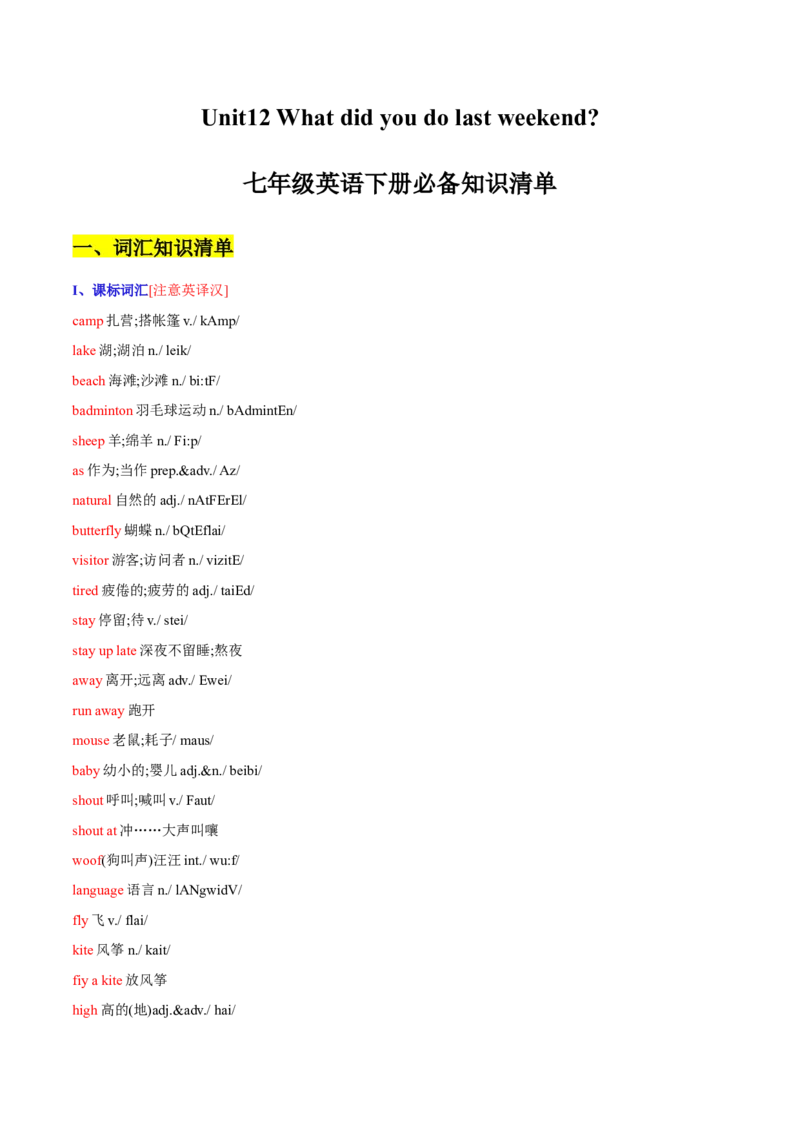
camp扎营;搭帐篷v./ kAmp/
lake湖;湖泊n./ leik/
beach海滩;沙滩n./ bi:tF/
badminton羽毛球运动n./ bAdmintEn/
sheep羊;绵羊n./ Fi:p/
as作为;当作prep.&adv./ Az/
natural自然的adj./ nAtFErEl/
butterfly蝴蝶n./ bQtEflai/
visitor游客;访问者n./ vizitE/
tired疲倦的;疲劳的adj./ taiEd/
stay停留;待v./ stei/
stay up late深夜不留睡;熬夜
away离开;远离adv./ Ewei/
run away跑开
mouse老鼠;耗子/ maus/
baby幼小的;婴儿adj.&n./ beibi/
shout呼叫;喊叫v./ Faut/
shout at冲……大声叫嚷
woof(狗叫声)汪汪int./ wu:f/
language语言n./ lANgwidV/
fly飞v./ flai/
kite风筝n./ kait/
fiy a kite放风筝
high高的(地)adj.&adv./ hai/high school中学
ago以前adv./ EgEu/
India印度n./ indjE/
tent帐篷n./ tent/
put up搭起;举起
moon月亮n./ mu:n/
surprise惊奇;惊讶;使吃惊n.&v./ sEpraiz/
get a surprise吃惊
snake蛇n./ sneik/
scared惊慌的;吓坏了的.adj.
move移动v./ mu:v/
shout to对……大声喊叫
start开始;着手v./ stB:t/
jump跳;跃v./ dVQmp/
up and down上上下下;起伏
wake 弄醒;醒v./ weik/
wake…up把……弄醒
into到……里面;进入prep./ intu:/
forest森林n./ fRrist/
ear耳朵n./ iE/
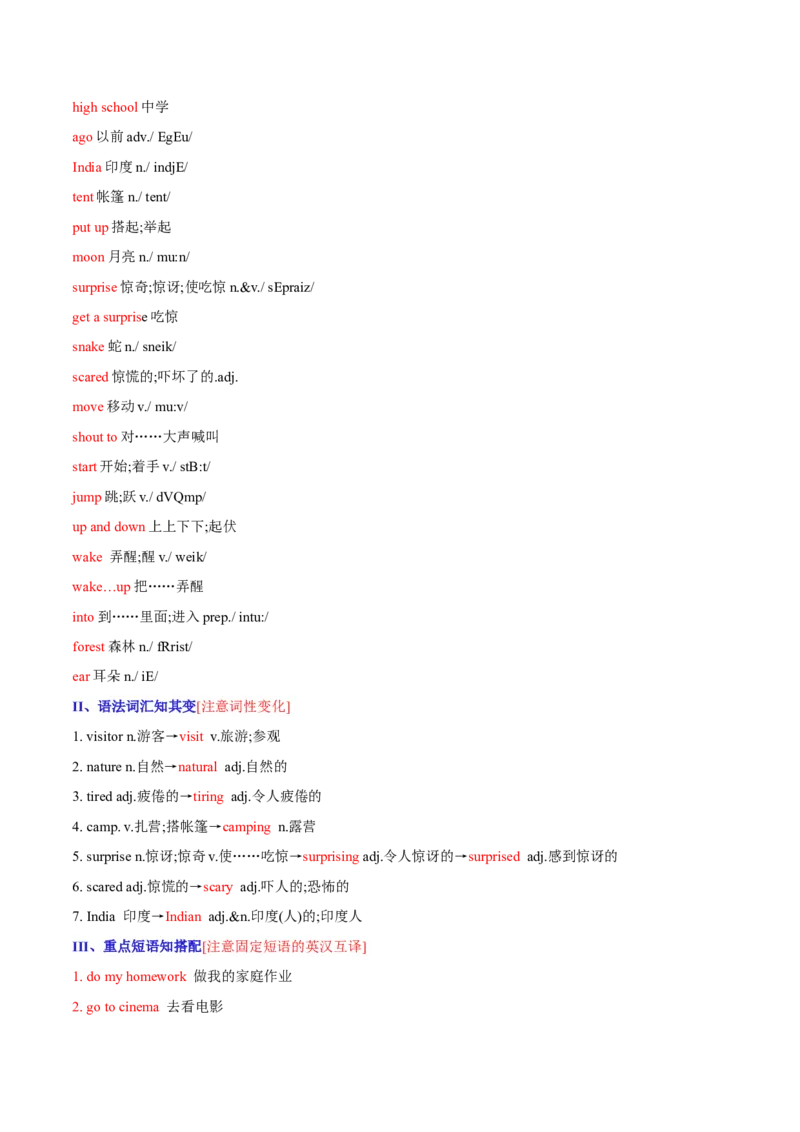
II、语法词汇知其变[注意词性变化]
1. visitor n.游客→visit v.旅游;参观
2. nature n.自然→natural adj.自然的
3. tired adj.疲倦的→tiring adj.令人疲倦的
4. camp. v.扎营;搭帐篷→camping n.露营
5. surprise n.惊讶;惊奇v.使……吃惊→surprising adj.令人惊讶的→surprised adj.感到惊讶的
6. scared adj.惊慌的→scary adj.吓人的;恐怖的
7. India 印度→Indian adj.&n.印度(人)的;印度人
III、重点短语知搭配[注意固定短语的英汉互译]
1. do my homework 做我的家庭作业
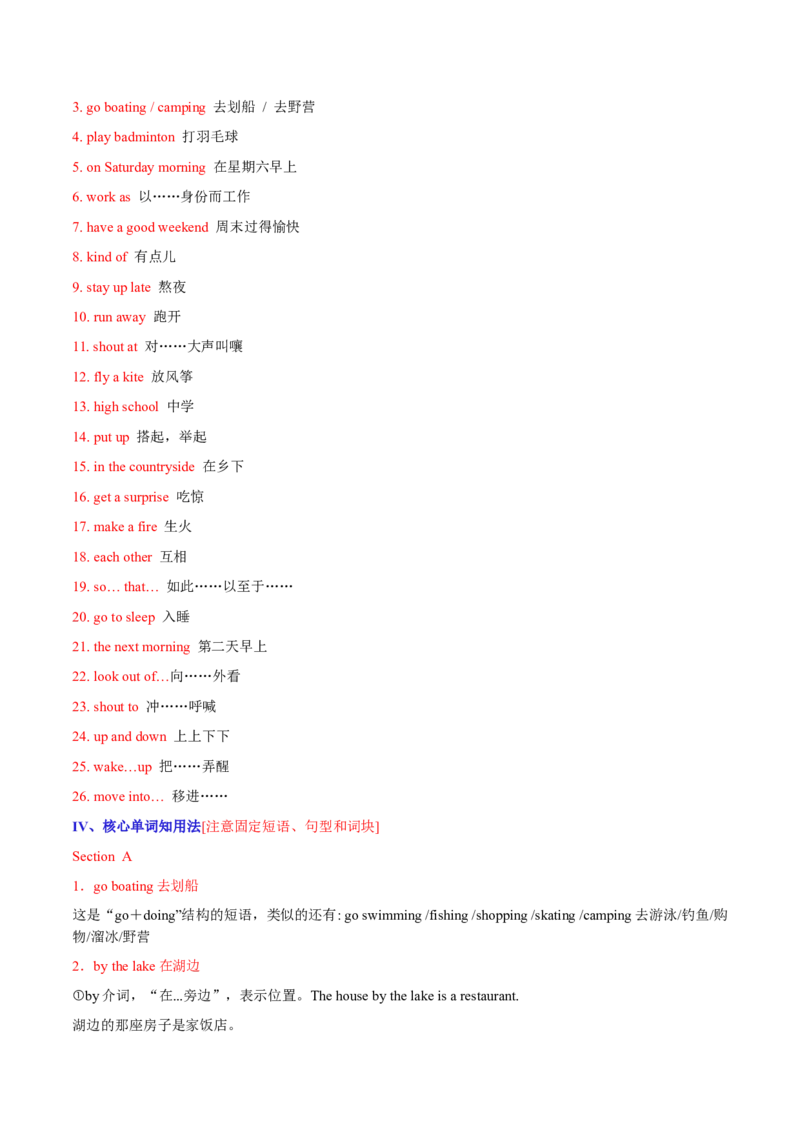
2. go to cinema 去看电影3. go boating / camping 去划船 / 去野营
4. play badminton 打羽毛球
5. on Saturday morning 在星期六早上
6. work as 以……身份而工作
7. have a good weekend 周末过得愉快
8. kind of 有点儿
9. stay up late 熬夜
10. run away 跑开
11. shout at 对……大声叫嚷
12. fly a kite 放风筝
13. high school 中学
14. put up 搭起,举起
15. in the countryside 在乡下
16. get a surprise 吃惊
17. make a fire 生火
18. each other 互相
19. so… that… 如此……以至于……
20. go to sleep 入睡
21. the next morning 第二天早上
22. look out of…向……外看
23. shout to 冲……呼喊
24. up and down 上上下下
25. wake…up 把……弄醒
26. move into… 移进……
IV、核心单词知用法[注意固定短语、句型和词块]
Section A
1.go boating去划船
这是“go+doing”结构的短语,类似的还有: go swimming /fishing /shopping /skating /camping去游泳/钓鱼/购
物/溜冰/野营
2.by the lake在湖边
①by介词,“在...旁边”,表示位置。The house by the lake is a restaurant.
湖边的那座房子是家饭店。②介词,“乘坐” Are you to go there by bike or by bus?你骑车还是坐车去?
③“经过”He goes by the hospital every day.每天他都路过那家医院。
④“不迟于”Please come here by 10 o’clock.请在十点之前来这儿。
3.on Saturday morning=on the morning of Saturday在星期六的上午
表示在具体某一天、某一天的某段时间均用介词on。
E.g:on a windy morning在一个多风的早上
4.sheep 名词,“绵羊”,其复数形式仍为sheep。
a sheep一只绵羊 a lot of sheep 许多只绵羊
【拓展】单复数同形的名词:deer鹿 fish鱼
5.natural 形容词,“自然的”
E.g:He spoke in quite a natural voice.他说话声音很自然。
nature 名词,“天性;自然界”
E.g:She has a good nature.她性情温和。
6.I told the visitors about them and their living habits.
visitor=tourist名词,“游客;访问者”
London is full of visitors during May and June.五、六月间伦敦挤满了游客。
visit 动词,“参观;拜访”
They are visiting in Shanghai.他们正在上海参观访问。
We visited our uncle last week.上周我们探望了叔叔。
【拓展】以-or结尾表示职业的名词:doctor医生 actor演员
以-er结尾表示职业的名词:reader读者 singer歌手 writer作家 driver司机
teacher教师
7.I stay up late to watch the soccer game.我熬夜看足球比赛。
stay up“熬夜;整晚不睡”
stay at home 待在家里 stay in bed待在床上
8.away 副词,“离开;远离”
run away跑开 go away走开
Please go away!请走开
far away from...远离
They live far away from the city.他们住在远离这个城市的地方。
9.mouse 名词,“老鼠”
其复数形式为mice。a family of mice一窝老鼠E.g:There are lots of mice in the kitchen.厨房里有许多老鼠。
When the cat is away, the mice will play.山中无老虎,猴子称大王。
【拓展】church mice 穷光蛋
名词复数的不规则变化:
child—children(孩子) tooth—teeth(牙齿) foot—feet(脚)
man—men(男人) woman—women(女人)
Section B :
1.fly 动词,“飞;飞逝”,其过去式为flew。
E.g:Mr. Li flew to Shanghai.李先生乘飞机去上海了。
How time flies!时间过得真快呀!
【拓展】fly 名词,“苍蝇”
There is a fly in my porridge.我的粥里有一只苍蝇。
2.Did you do anything interesting last weekend?上个周末你做了什么有趣的事吗?
(1)anything意为“一些事情”,它是不定代词,常用于否定句或疑问句中,用在肯定句中 anything表示
“任何事情”
E.g:He didn't do anything this morning.今天早上他没做什么事情。
Anything is possible.一切皆有可能。
(2)anything interesting意为“有趣的事情”,形容词修饰不定代词应后置,在句子中作后置定语。
E.g:Is there anything interesting in today's newspaper?今天的报纸上有什么有趣的事情吗?
3.ago 副词,“以前”
常用于“一段时间+ago”结构中,表示“……以前”,常和具体时间连用,用于一般过去时态。
E.g:
two days ago两天前 a month/year ago一个月/一年以前
long time ago很久以前
He started working for us three years ago.他3年前开始为我们干活了。
【拓展】before意为“以前”,一般不与具体时间连用
E.g:We got up before evening.我们在夜晚之前起床。
4.put up搭起;举起 put up a tent搭建帐篷 put up hands举起手
【拓展】
put up 张贴
E.g:We should put up a picture here.我们应该在这儿贴一幅图。
put down放下 put on 穿上put off推迟 put away收好
5.ear名词 “耳朵”
【拓展】ear+ring=earring 耳环
Even the walls have ears.隔墙有耳。
6.each other“互相;相互”
help each other互相帮助 learn from each other互相学习
E.g:We must learn from each other and help each other.我们必须互相学习,互相帮助。
They talk to each other happily.他们开心地互相交谈。
7.surprise 名词,动词 ,“惊奇,惊讶;使吃惊”
(1)作名词,意为“惊奇;惊讶”
常用短语:in surprise吃惊地,to one's surprise令某人吃惊的是,get a surprise吃惊
E.g:John turned around and looked at me in surprise.约翰转过身来,惊奇地望着我。
To my surprise,his face looked very happy.令我吃惊的是,他的表情看起来很开心。
(2)作动词,意为“使吃惊”。surprise sb.使某人吃惊。
E.g:The news greatly surprised them.这消息使他们大为吃惊。
【拓展】
(1)surprising作形容词,意为“令人吃惊的”,形容事物。
(2)surprised作形容词,意为“感到吃惊的”,形容人。
二、语法知识清单
Ⅰ.一般过去时态Ⅱ
谓语动词为be:
肯定句: 主语+ was/were + 其他.
否定句: 主语+ was/were + not + 其他.
一般疑问句: Was/Were + 主语+ 其他?
两种回答: Yes,…was;No,…wasn't.
特殊疑问句: 特殊疑问词+was/were + 主语+ 其他?
谓语动词为实义动词:
肯定句: 主语+ 过去式 + 其他.
否定句: 主语+ didn't + 动词原形 + 其他.
一般疑问句: Did + 主语+动词原形 + 其他?
两种回答: Yes, … did; No,… didn't.特殊疑问句: 特殊疑问词 + did + 主语+动词原形 + 其他? 如:
My weekend was pretty good.
→My weekend wasn't pretty good.
→Was your weekend pretty good?
→Yes, it was; No, it wasn't.
→How was your weekend?
She went to Beijing last week.
→She didn't go to Beijing last week.
→Did she go to Beijing last week?
→Yes, she did; No, she didn't.
→Who went to Beijing last week?
→Where did she go last week?
→When did she go to Beijing?
Ⅱ.感叹句
感叹句通常由what, how引导,表示赞美、惊叹、喜悦等感情。what修饰名词,how 修饰形容词、副词或
动词。
感叹句结构:
1.What +名词+ 陈述语序.
What + a+形容词+名词+ 陈述语序.
What + 形容词+复数名词+ 陈述语序.
What + 形容词+不可数名词+ 陈述语序.
2.How +形容词+ a/an +名词+ 陈述语序.
How+形容词或副词+ 陈述语序.
如: What noise they are making! What a clever boy he is!
What wonderful ideas (we have)! What cold weather it is!
How clever a boy he is! How lovely the baby is!
三、语篇知识清单
【写作话题】本单元以过去发生话题,谈论学校旅行及假期生活,描述过去发生的事情及感受。
【写作题目】根据下面提示写短文: 上周星期天,刘明贺他的朋友在山脚下野炊。他们中的一些人正在
做游戏,一些在跳舞,他们感到很放松。突然,刘明看到一头山羊正在跑。他对此很感兴趣,平且开始追它跑了很长一段时间。当他想起他的朋友们时,他不知道他在哪儿。他迷路了。在那时,一个农夫过来,
在他的帮助下,刘明又找到了他的朋友们。他感谢这位农夫平且向你告别。
【优秀满分范文】
Last Sunday, Liu Ming and his friends went for a picnic at the foot of the mountain.
Some of them were playing games. Some were dancing. They felt very relaxed. Suddenly, Liu Ming saw a
goat running . He was interested in it and began to run after it for a long time . When he thought of his friends
again, he got lost. At that time, a farmer came. With his help ,Liu Ming found his friends again. He thanked the
farmer and said "Goodbye” to him.