文档文本内容
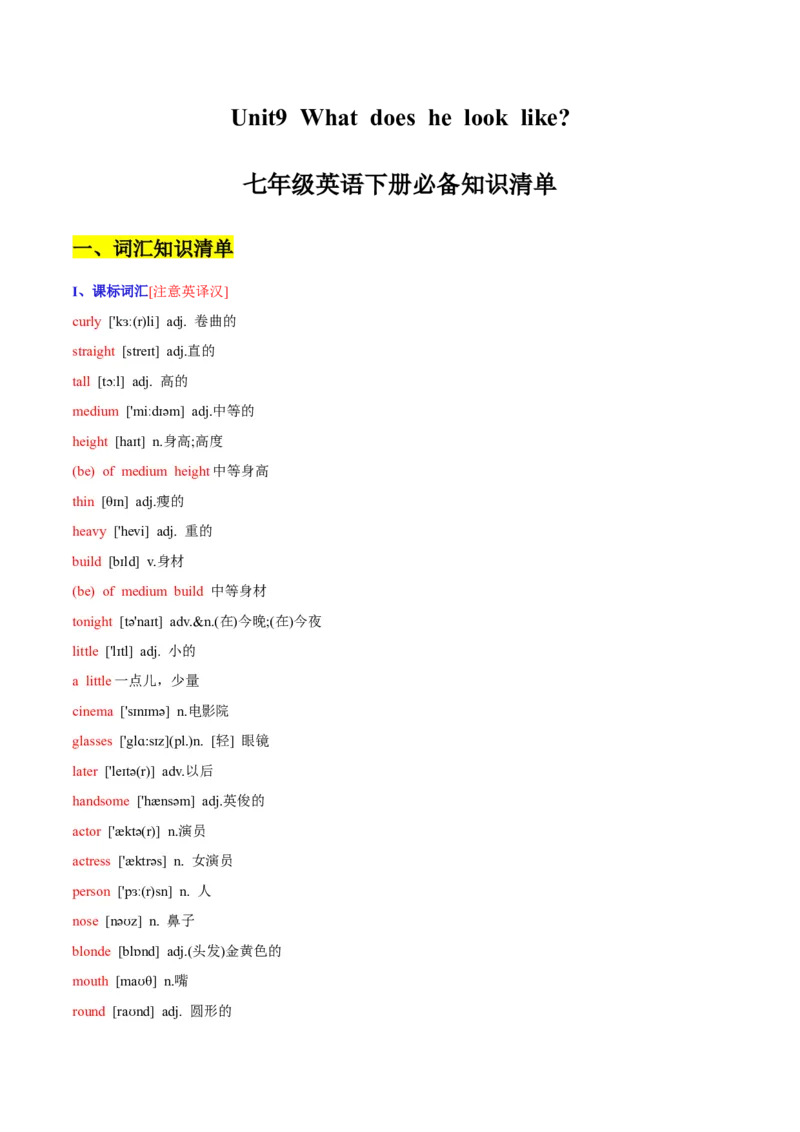
Unit9 What does he look like?
七年级英语下册必备知识清单
一、词汇知识清单
I、课标词汇[注意英译汉]
curly ['kɜː(r)li] adj. 卷曲的
straight [streɪt] adj.直的
tall [tɔːl] adj. 高的
medium ['miːdɪəm] adj.中等的
height [haɪt] n.身高;高度
(be) of medium height中等身高
thin [θɪn] adj.瘦的
heavy ['hevi] adj. 重的
build [bɪld] v.身材
(be) of medium build 中等身材
tonight [tə'naɪt] adv.&n.(在)今晚;(在)今夜
little ['lɪtl] adj. 小的
a little一点儿,少量
cinema ['sɪnɪmə] n.电影院
glasses ['glɑ:sɪz](pl.)n. [轻] 眼镜
later ['leɪtə(r)] adv.以后
handsome ['hænsəm] adj.英俊的
actor ['æktə(r)] n.演员
actress ['æktrəs] n. 女演员
person ['pɜː(r)sn] n. 人
nose [nəʊz] n. 鼻子
blonde [blɒnd] adj.(头发)金黄色的
mouth [maʊθ] n.嘴
round [raʊnd] adj. 圆形的face [feɪs] n. 脸
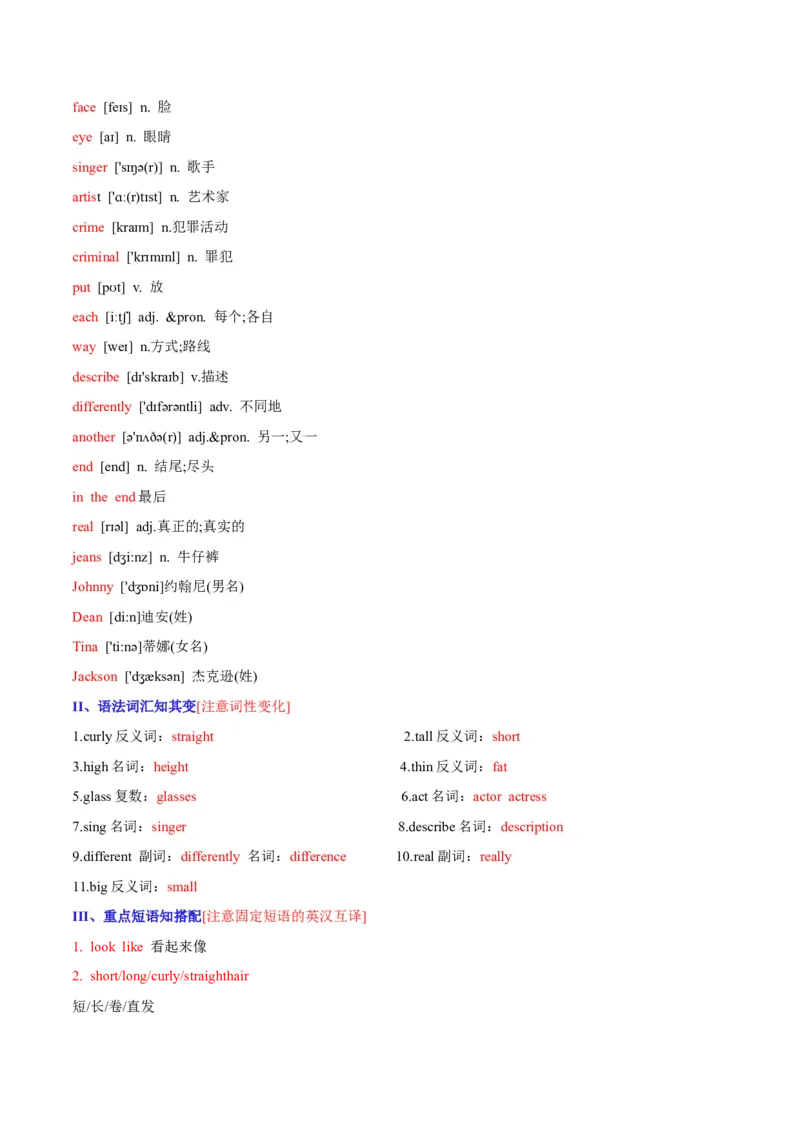
eye [aɪ] n. 眼睛
singer ['sɪŋə(r)] n. 歌手
artist ['ɑː(r)tɪst] n. 艺术家
crime [kraɪm] n.犯罪活动
criminal ['krɪmɪnl] n. 罪犯
put [pʊt] v. 放
each [iːtʃ] adj. &pron. 每个;各自
way [weɪ] n.方式;路线
describe [dɪ'skraɪb] v.描述
differently ['dɪfərəntli] adv. 不同地
another [ə'nʌðə(r)] adj.&pron. 另一;又一
end [end] n. 结尾;尽头
in the end最后
real [rɪəl] adj.真正的;真实的
jeans [dʒi:nz] n. 牛仔裤
Johnny ['dʒɒni]约翰尼(男名)
Dean [di:n]迪安(姓)
Tina ['ti:nə]蒂娜(女名)
Jackson ['dʒæksən] 杰克逊(姓)
II、语法词汇知其变[注意词性变化]
1.curly反义词:straight 2.tall反义词:short
3.high名词:height 4.thin反义词:fat
5.glass复数:glasses 6.act名词:actor actress
7.sing名词:singer 8.describe名词:description
9.different 副词:differently 名词:difference 10.real副词:really
11.big反义词:small
III、重点短语知搭配[注意固定短语的英汉互译]
1. look like 看起来像
2. short/long/curly/straighthair
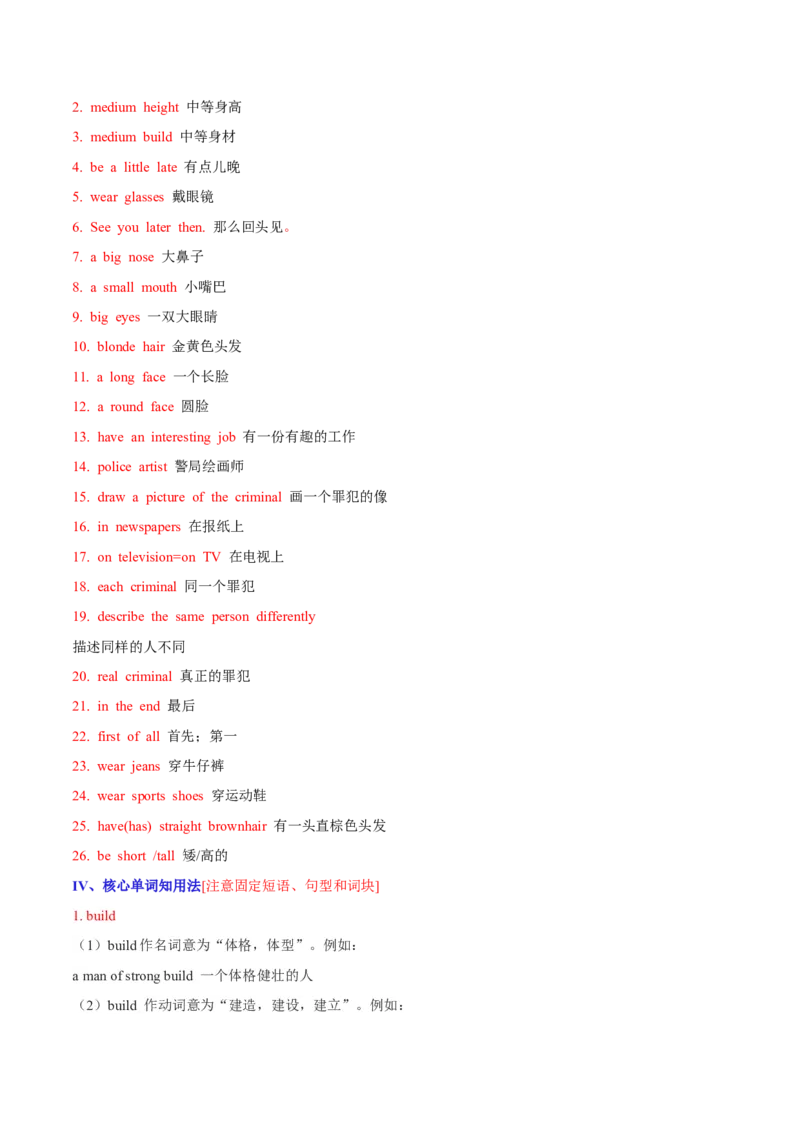
短/长/卷/直发2. medium height 中等身高
3. medium build 中等身材
4. be a little late 有点儿晚
5. wear glasses 戴眼镜
6. See you later then. 那么回头见。
7. a big nose 大鼻子
8. a small mouth 小嘴巴
9. big eyes 一双大眼睛
10. blonde hair 金黄色头发
11. a long face 一个长脸
12. a round face 圆脸
13. have an interesting job 有一份有趣的工作
14. police artist 警局绘画师
15. draw a picture of the criminal 画一个罪犯的像
16. in newspapers 在报纸上
17. on television=on TV 在电视上
18. each criminal 同一个罪犯
19. describe the same person differently
描述同样的人不同
20. real criminal 真正的罪犯
21. in the end 最后
22. first of all 首先;第一
23. wear jeans 穿牛仔裤
24. wear sports shoes 穿运动鞋
25. have(has) straight brownhair 有一头直棕色头发
26. be short /tall 矮/高的
IV、核心单词知用法[注意固定短语、句型和词块]
1. build
(1)build作名词意为“体格,体型”。例如:
a man of strong build 一个体格健壮的人
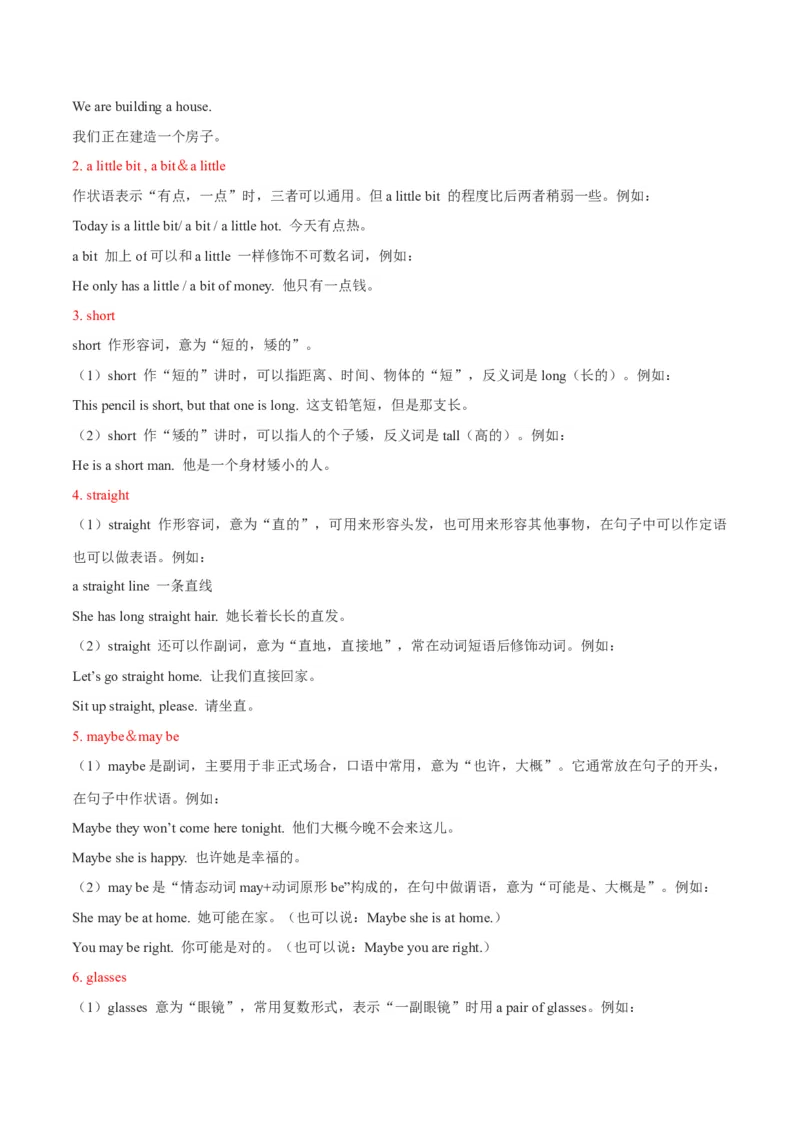
(2)build 作动词意为“建造,建设,建立”。例如:We are building a house.
我们正在建造一个房子。
2. a little bit , a bit&a little
作状语表示“有点,一点”时,三者可以通用。但a little bit 的程度比后两者稍弱一些。例如:
Today is a little bit/ a bit / a little hot. 今天有点热。
a bit 加上of可以和a little 一样修饰不可数名词,例如:
He only has a little / a bit of money. 他只有一点钱。
3. short
short 作形容词,意为“短的,矮的”。
(1)short 作“短的”讲时,可以指距离、时间、物体的“短”,反义词是long(长的)。例如:
This pencil is short, but that one is long. 这支铅笔短,但是那支长。
(2)short 作“矮的”讲时,可以指人的个子矮,反义词是tall(高的)。例如:
He is a short man. 他是一个身材矮小的人。
4. straight
(1)straight 作形容词,意为“直的”,可用来形容头发,也可用来形容其他事物,在句子中可以作定语
也可以做表语。例如:
a straight line 一条直线
She has long straight hair. 她长着长长的直发。
(2)straight 还可以作副词,意为“直地,直接地”,常在动词短语后修饰动词。例如:
Let’s go straight home. 让我们直接回家。
Sit up straight, please. 请坐直。
5. maybe&may be
(1)maybe是副词,主要用于非正式场合,口语中常用,意为“也许,大概”。它通常放在句子的开头,
在句子中作状语。例如:
Maybe they won’t come here tonight. 他们大概今晚不会来这儿。
Maybe she is happy. 也许她是幸福的。
(2)may be是“情态动词may+动词原形be”构成的,在句中做谓语,意为“可能是、大概是”。例如:
She may be at home. 她可能在家。(也可以说:Maybe she is at home.)
You may be right. 你可能是对的。(也可以说:Maybe you are right.)
6. glasses
(1)glasses 意为“眼镜”,常用复数形式,表示“一副眼镜”时用a pair of glasses。例如:Her grandma always wears a pair of glasses.
她祖母总是戴着一副眼镜。
(2)glass作“玻璃杯”讲时,是可数名词,其复数形式是 glasses; 作“玻璃”讲时,是不可数名词。例
如:
Be careful of the glass. 小心玻璃。
There are two glasses of water on the table. 桌子上有两杯水。
7. each&every
(1)each和every都可以用作形容词,作定语,修饰单数可数名词,但 each强调个体,而every强调整
体。例如:
Each child gets a present. 每一个孩子都得到一份礼物。
Every student has a pen. 每个学生都有一支钢笔。
= All students have pens.
(2)each指两个或两个以上中的每一个;而every指三个或三个以上中的每一个,不能指两个中的。例
如:
There are trees on each side of the road.
马路的两边都有树。
I go out for a walk every day.
我每天都出去散步。
(3)each可作代词,作主语或宾语,可与of直接连用,而every则只能作形容词。例如:
Each of us has a ticket. 我们每人都有一张票。
口诀:
every指全体each强调单,each两个以上every三。
every指定each却不限,each同位every它不管。
every复合不接of短,each不与not句中现。
every,not句中若相连,部分否定理解难。
other可与every,each连,含义有别记心间。
8. person&people
person 可数名词,有单、复数形式,着重指个人方面,可与不定冠词a或数词连用。例如:
He is a good person. 他是一个好人。
people 是一个集合名词,着重指全体方面。只用来表示复数概念,不能与不定冠词或数词one连用。例
如:Some people are playing games. 一些人在做游戏。
9. heavy
heavy 既可修饰物体,表示“沉重的”,也可以修饰人,表示“体胖的、重的”。用fat表达人胖时不太礼
貌,委婉的说法是heavy,反义词为thin。例如:
The box is heavy. 这个箱子很重。
His sister is a little heavy. 他妹妹有一点胖。
拓展:heavy 还有“大(量)的,猛烈的”之意,用来表示雨或者雪很大,其副词为heavily。例如:
It’s raining heavily. 现在雨下的很大。
There will be a heavy snow. 将有一场大雪。
10. enjoy
enjoy是及物动词,意为“享受……的乐趣;欣赏;喜欢”。其用法如下:
enjoy sth.(名词或代词)
enjoy oneself(反身代词)=have a good time
enjoy doing sth.(只接v.-ing形式,不接 to do sth.)
例如:I enjoy the songs sung by Jay Chou. 我喜欢周杰伦的歌。
We enjoyed ourselves at the party.
昨晚的聚会,我们玩得很高兴。
In my class, most of the students enjoy singing English songs.
在我们班,大多数学生喜欢唱英语歌。
12. turn
(1)turn 做动词时,可以做行为动词也可以做连系动词。做行为动词时,意为“转弯,转身,翻转,旋
转”;作连系动词时,意为“变得……”,主要强调变化或转变成与以前不同的东西。例如:
Turn left at the end of the road. (行为动词)
在路的尽头左转。
The leaves turn yellow. 叶子变黄了。(连系动词)
(2)turn 还可以作名词,意为“轮流,顺序”。例如:
It’s your turn to clean the room.
轮到你打扫房间了。
二、语法知识清单
1. 询问及描述某人的外貌特征问:What do/does + 主语 + look like? “……看上去什么样?”/ “……长什么样?”
答:主语 + be + 形容词。(强调某人是……样子的外形,常用于描述大概的体形、身高等。)
主语 + have/has + 形容词 + 名词(强调某人的相貌特征,常用于描述五官、相貌等)。
主语 + be of +名词 (指描述某人的体形、身材等)
E.g. What does your friend look like?
He is short and thin.
He has short, black hair.
She is of medium build.
【拓展】be like
像……一样 ,指品德、相貌等像(指人的个性特征)
如果询问人的性格、人品时,多用What be(am/is/are)…like?
E.g. —What’s he like? 他是个什么样的人呢?
—He’s friendly and kind. 他友好善良。
三、语篇知识清单
【写作话题】本单元以外表为话题,描述人的外貌爱好服饰等。
【写作题目】根据以下信息用英语写一则寻人启事。
Peter,今年四岁,今天在商店和妈妈走散。中等个头,短头发,小圆脸,大眼睛,上身穿白色的 T恤,
下身穿白裤子,脚穿一双黑色的运动鞋,还背着一个蓝色的小背包,请看到他的顾客把他领到广播室。
【优秀满分范文】
Ladies and Gentlemen,
we are looking for Peter. Peter, a four-year-old boy, was missing in the shop. He is of medium
height, and he has short hair. His face is round, and his eyes are big. He wears a white T-shirt and
white trousers, and a pair of black sports shoes. And he has a blue bag.
If someone finds him, please bring him into the Broadcasting Room. His mother is there.
Thank you.