泉州市 2026 届高中毕业班模拟考试(一)
高 三 英 语
(试卷满分:150 分,考试时间:120 分钟)
★龙马精神★
注意事项:
1. 答题前,考生须在试题卷、答题卡规定的位置填写自己的准考证号、姓名。考生应认真
核对答题卡上粘贴的条形码的 “准考证号、姓名” 与考生本人准考证号、姓名是否一致。
2. 回答选择题时,选出每小题答案后,用铅笔把答题卡上对应题目的答案标号涂黑。如需
改动,用橡皮擦干净后,再选涂其他答案标号。回答非选择题时,将答案写在答题卡上。写
在本试卷上无效。
3. 考试结束,考生须将试题卷和答题卡一并交回。
第一部分 听力(共两节,满分 30 分)
做题时,先将答案标在试卷上。录音内容结束后,你将有两分钟的时间将试卷上的答案转涂到答题卡
上。
第一节(共 5 小题;每小题 1.5 分,满分 7.5 分)
听下面 5 段录音,每段录音后有一个小题。从题中所给的 A、B、C 三个选项中选出最佳选项。听完
每段录音后,你都有 10 秒钟的时间来回答有关小题和阅读下一小题。每段录音播放两遍。
1. What kind of book does the man want to borrow?
A. Economics. B. Literature. C. Computer.
2. What are the speakers going to do?
A. Attend a painting class.
B. Visit an art exhibition.
C. Buy a notebook.
3. What does the man think of the cafe?
A. It is lively and fun.
B. It helps concentration.
C. It offers spacious desks.
4. What are the speakers mainly discussing?
A. A contest preparation. B. A science project. C. A weekend trip.
5. When will the man return the dictionary?
A. On Tuesday. B. On Wednesday. C. On Friday.
第二节(共15小题;每小题1.5分,满分22.5分)
听下面5段录音,每段录音后有几个小题,从题中所给的A、B、C三个选项中选出最佳选项。听每段
录音前,你将有时间阅读各个小题,每小题5秒钟。听完后,每小题都有5秒钟的作答时间,每段录音播
放两遍。听第6段录音,回答第6、7题。
6. Where does the conversation probably take place?
A. At a lecture. B. At a store. C. In a workshop.
7. Why does the man have interest in the tablet?
A. He believes it benefits his work.
B. He thinks it suitable for his niece.
C. He needs one to learn digital art.
听第7段录音,回答第8至10题。
8. How does Steven feel now?
A. Surprised. B. Disappointed. C. Conflicted.
9. What is the woman's suggestion for Steven?
A. Consulting his family.
B. Writing full - time.
C. Having a try.
10. What is the main topic of the conversation?
A. Career change consideration.
B. Risks of quitting a job.
C. Ways to improve writing.
听第8段录音,回答第11至13题。
11. Why is the woman talking to Mr. Janson?
A. To finish a class assignment.
B. To seek advice on interviews.
C. To write a newspaper feature.
12. What does Mr. Janson do?
A. A network engineer. B. A career planner. C. A school librarian.
13. What is considered the biggest change?
A. The digitisation of books.
B. The collection of documents.
C. The invention of scanners.
听第9段录音,回答第14至17题。
14. What is the main goal of the UTeach programme?
A. To involve students in STEM teaching.
B. To attract students to major in STEM.
C. To enhance learning efficiency.
15. What is one proven outcome of the programme?
A. It guarantees jobs for graduates.
B. Most graduates stay to teach.
C. The training is very enjoyable.16. What first made John consider teaching?
A. He had a free trial class.
B. He was poor at lab work.
C. A professor recommended it.
17. Why does John want to continue teaching?
A. He likes flexible hours.
B. He expects higher pay later.
C. He values connection with students.
听第10段录音,回答第18至20题。
18. What does Debrah Roundy regularly do in China?
A. She learns about Chinese music.
B. She dances in parks and squares.
C. She volunteers to translate.
19. How does Debrah Roundy communicate with her teammates now?
A. By turning to others.
B. By exchanging notes.
C. By using an app.
20. What does the dance mean to Debrah Roundy?
A. A daily form of exercise.
B. A bridge to learn China.
C. A chance to help neighbours.
第二部分 阅读(共两节,满分50分)
第一节(共15小题;每小题2.5分,满分37.5分)
阅读下列短文,从每题所给的A、B、C和D四个选项中选出最佳选项。
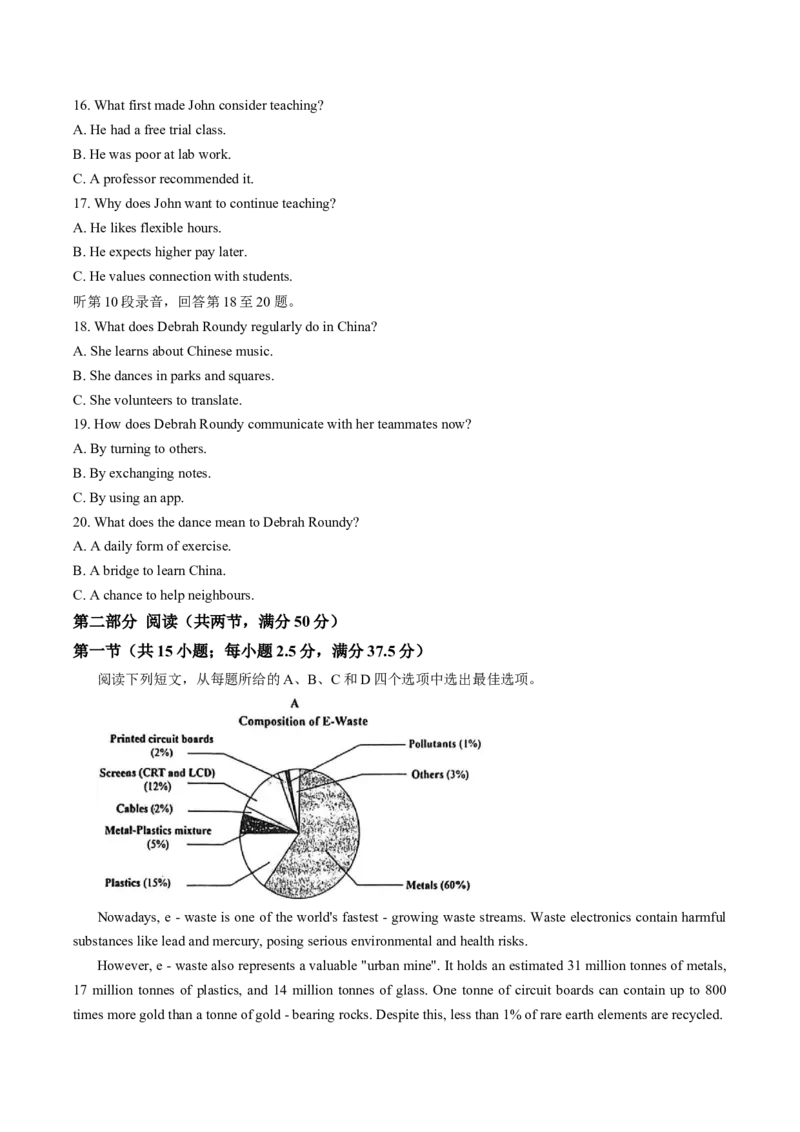
Nowadays, e - waste is one of the world's fastest - growing waste streams. Waste electronics contain harmful
substances like lead and mercury, posing serious environmental and health risks.
However, e - waste also represents a valuable "urban mine". It holds an estimated 31 million tonnes of metals,
17 million tonnes of plastics, and 14 million tonnes of glass. One tonne of circuit boards can contain up to 800
times more gold than a tonne of gold - bearing rocks. Despite this, less than 1% of rare earth elements are recycled.Recycled e - waste is a valuable resource for sustainable manufacturīng (制造业). Its metals, e.g. gold and
copper, are reused in electronics, vehicles, and renewable energy systems. Recovered plastics find new life in
durable products, while glass is processed into building materials. This circular (循环的) approach cuts energy use,
reduces mining demand, and transforms waste into industrial resources, supporting both the economy and the
environment.
The e - waste management market is projected to more than double by 2027. While 81 countries have adopted
Extended Producer Responsibility laws, collection rates still fall behind policy goals.
To improve recycling, governments should strengthen EPR laws. and invest in facilities. Institutions can
promote research and public awareness. Individuals should properly drop off e - waste at collection points, fix
items rather than throw them away, and support brands with strong environmental commitments.
21. What percentage do screens and cables account for in all e - waste compositions?
A. 12%. B. 14%. C. 17%. D. 60%.
22. What is a key advantage of e - waste compared to natural mines?
A. It contains a greater variety of rare elements.
B. It provides more recoverable non - metals.
C. It can be richer in precious metals.
D. It works better as building materials.
23. What is suggested for individuals to help recycle e - waste?
A. Invest in formal recycling facilities.
B. Launch public awareness campaigns.
C. Set clear personal take - back plans.
D. Choose repair over replacement.
B
At 24, Carina Hong founded an AI company called Axiom Math. With its unique technical ideas and clear
development goals, the company has changed traditional views in the Silicon Valley investment capital circle.
Born in Guangzhou in 2001, Hong came from a family where neither parent had received higher education.
She grew up like other kids, and showed no special talent until she started learning Olympiad mathematics in junior
high school — this unlocked her potential and surprised everyone.
In high school, Hong was selected into Guangdong Provincial Olympiad Mathematics Team, and in 2018, she
entered the Massachusetts Institute of Technology (MIT) with excellent results. She double - majored in Maths and
Physics, completed over 20 advanced courses, and served as president of student organisations to help international
students. Later, she won the Rhodes Scholarship to study Neuroscience at Oxford, then pursued two doctoral
degrees at Stanford while offering legal aid to low - income people.
During this period, Hong focused on the combination of AI and mathematics. Noticing AI's big shortcomings
in mathematical reasoning, she founded Axiom Math, whose core idea is to transform English mathematical
content from textbooks, papers and journals into programmable knowledge. This allows AI to not only solve
complex mathematical problems but also confirm solutions through strict validation (验证). Axiom Math's goal isto develop a real "AI Mathematician" with logical reasoning ability, and Hong even hopes that "AI
mathematicians" will put forward brand - new mathematical conjectures (猜想) in the future. With her good
academic reputation and clear technical goals, she attracted many top talents to Axiom Math. A famous
mathematician even left his permanent teaching position to join the team, and they worked together to build a strict
logical reasoning training system by adopting a new model.
Carina Hong's story is one of vision and commitment. Built on solid academic training and driven by a clear
goal — to give AI true mathematical reasoning ability — she is leading Axiom Math toward a future where
machines and mathematicians work side by side.
24. What awakened Carina Hong's potential in her youth?
A. Her parents' educational background. B. Learning Olympiad maths.
C. Her ambition to study at MIT. D. Helping international students.
25. What can we infer about Carina Hong from the text?
A. She is academically and socially excellent.
B. She focuses on earning academic titles.
C. She owes her success to her family's support.
D. She plans to leave the tech industry for legal work.
26. Why did Carina Hong set up Axiom Math?
A. To offer legal aid to the poor.
B. To train more AI professionals.
C. To change views in the capital circle.
D. To develop an AI with reasoning skills.
27. What is the best title of the text?
A. A Rhodes Scholar's Academic Journey B. Axiom Math Redefining Artificial Intelligence
C. From Olympiad Maths to AI Mathematician D. The Founding of a Silicon Valley Startup
C
Have you ever thought, “Maybe this is all I’m ever meant to be?” Many of us are trapped by labels like “not
talented enough” — as if life were a one - way road with no turns. Barbara Oakley’s Mindshift works like a wise
guide, helping us remove these mental blocks. It doesn’t offer empty encouragement, but breaks down the science
behind change.
The first part of the book tells stories of ordinary people who dared to reshape their lives. Graham Keir, a
musician, once believed he had “no brain for science” and today walks the halls of medical school. Or Ali, who
once struggled with basic maths, only to later master coding (编程) and earn multiple promotions. These are not
tales of sudden genius, but of imperfect practice through setbacks and slow progress. Oakley introduces a powerful
concept — second - skilling. In today’s fast - changing world, relying on just one area of expertise is risky.
Developing a second skill can make you more adaptable.
If the first part helps us see what’s possible, the second is a guide for making it happen. Oakley draws on
interviews with dozens of career changers to show what strategies worked and what pitfalls to avoid. Beyondlearning from others, the book’s second part offers honest advice for quieting self - doubt and turning learning from
a chore into a habit. One of the book’s most valuable insights is that what matters is not “intense practice every
day”, but “practise every day, without fail”. Even fifteen minutes daily sends steady signals that quietly reshape
your brain.
That said, the book’s perspective isn’t universal. Rooted in a Western context, it draws largely on stable
professionals — leaving quieter questions about those facing real hardship. And while it prioritises practice over
passion, some may find this approach cool to the touch.
Yet perhaps that coolness is its strength: it doesn’t sell miracles, but offers a solid framework. After reading,
you may not have all the answers. But you might ask: “Could what I once thought impossible actually be within
reach?”
Ultimately, Mindshift gives something better: a mind open and flexible, ready for change. And that, perhaps, is
the truest mindshift of all.
28. What can we learn about Mindshift from paragraph 1?
A. It describes life as a fixed path.
B. It emphasises the importance of talent.
C. It helps overcome inner obstacle for change.
D. It provides readers with emotional comfort.
29. What do the examples of Graham and Ali mainly show?
A. The value of second - skilling. B. The power of sudden genius.
C. The importance of passion. D. The risk of changing careers.
30. What does the underlined word “pitfalls” in paragraph 3 probably mean?
A. Complicated skills. B. Hidden traps. C. Strong biases. D. Imagined threats.
31. What is the author’s overall attitude towards Mindshift?
A. Cautiously opposed. B. Appreciative yet critical. C. Highly favourable. D. Imagined threats.
D
In the global effort to fight climate change, scientists are exploring solutions in unexpected places — including
the soil beneath our feet. A recent study published in Nature highlights a promising discovery: specific bacteria that
can dramatically reduce agricultural emissions of nitrous oxide (N O), a powerful greenhouse gas.
Nitrous oxide, largely released from farm fields due to nitrogen fertiliser (肥料) use, is a major climate
₂
concern. According to co - author Professor Lars Bakken of the Norwegian University of Life Sciences, the gas is
265 times more effective at warming the atmosphere than carbon dioxide and can remain in the air for over a
century.
To develop the solution, researchers grew the bacteria using organic waste. Building on past work, they looked
for a microorganism that would reduce nitrous oxide emissions without staying in the soil for so long that it harmed
other life forms important for crop health. The bacteria reduced emissions after a second fertiliser treatment by
about half two weeks later. After three months, the makeup of microbial ( 微生物的) life was unchanged,
suggesting the bacteria would not harm the soil.The bacteria, which are not genetically modified, occur naturally in anaerobic digesters — facilities that
transform organic waste into biofuels. That might ease acceptance of their use, said Paul Carini of the University of
Arizona, who was not involved in the research. Moreover, Bakken stated that this "opens up a number of new
possibilities" for managing farmland. The bacteria could be added to fertilisers, offering a potential direct
application for farmers. As Carini noted, using a waste product from one industrial process to benefit another is
cost - effective.
However, significant challenges remain before widespread use. Professor Lori Hoagland of Purdue University,
an expert in the field, noted that soils vary globally, requiring more field testing to ensure effectiveness. More
critically, farmers currently get no financial motivation to adopt such methods. Bakken argued that authorities must
create policies to make emission reductions profitable. If these limitations can be addressed, this bacterial treatment
could have a major impact on reducing agriculture's contribution to climate change.
32. Why is nitrous oxide a major climate concern?
A. It is released in larger amounts than CO .
B. It stays in the atmosphere for a very short time.
₂
C. It comes mainly from industrial production.
D. It has a much stronger effect than CO .
33. What did the researchers find?
₂
A. A way to help farmers increase fertiliser use.
B. A bacterium that stays in the soil forever.
C. A method to produce more biofuels from waste.
D. A microbe that cuts N O without harming soil.
34. Which aspect of the bacteria is mainly discussed in paragraph 4?
₂
A. Its potential benefits. B. Its working principle. C. Its producing process. D. Its research value.
35. What prevents the application of the finding?
A. Shortage of necessary bacteria. B. Difficulty in large - scale testing.
C. Lack of economic benefit for farmers. D. Uncertainty about its effect.
第二节(共5小题;每小题2.5分,满分12.5分)
阅读下面短文,从短文后的选项中选出可以填入空白处的最佳选项。选项中有两项为多余选项。
The Power of Small Steps
In a world that often celebrates big achievements and overnight success, it's easy to overlook the power of
small, consistent steps. Many of us set grand goals, only to feel discouraged when progress is slow or invisible,
failing to realise that lasting success is rarely built in a flash. 36
Small steps are the building blocks of great things. Think about how a seed grows into a tall tree. It doesn't
happen in a day. 37 Every day, it absorbs sunlight and water, pushing its roots deeper into the soil, until one
day, it stands tall and strong, a proof of patience and persistence (坚持). Our goals are like that seed — they need
time and daily care.
38 For example, if your goal is to improve your English, reading a short passage every day is better than
trying to finish a thick book in one weekend. The former builds a habit; the latter often leads to burnout.Consistency is key, and small steps make consistency possible by keeping the task manageable.
Another advantage of small steps is that they reduce anxiety. When you take on a huge task, it's natural to feel
nervous. 39 However, breaking it into small steps helps. You'll feel a sense of accomplishment with each small
win, which will motivate you to keep going. This positive cycle can turn even the most difficult goal into
something manageable.
Small steps teach a growth lesson. 40 So, the next time you're faced with a big goal, don't be afraid to start
small. Remember, every great journey begins with a single step.
A. Small steps help form good habits.
B. We may even give up before starting.
C. Work on the huge task a little bit daily.
D. It changes quietly and steadily underground.
E. But small steps have the power to change this.
F. Small steps can by no means change the situation.
G. They remind us that progress, not perfection, is what matters.
第三部分 语言运用(共两节,满分30分)
第一节 (共15小题;每小题1分,满分15分)
阅读下面短文,从各题所给的A、B、C和D四个选项中选出可以填入空白处的最佳选项。
My parents have a 91 - year - old neighbour, Helen, who is cared for by nearby friends. Recently, my dad made
it his 41 to move Helen's mailbox, as it was 42 placed down a steep (陡峭的) driveway off a busy highway.
He 43 the mail service and arranged to 44 the mailbox location. Since Helen's house is brick, attaching
a mailbox directly was not an 45 . Then, at a flea (跳蚤) market, my dad, a keen collector, 46 an old -
fashioned metal milk can, which 47 him of the first mailbox he and my mother shared years ago. Several days
later, he managed to secure an old mailbox, 48 the milk can with concrete, set the mailbox on top, and 49 it
near Helen's front door. Now Helen can safely fetch her mail.
Later that week, Helen called to thank my dad, expressing how 50 she felt to have such loving 51 . She
even invited him to 52 some timeless treasure from her backyard. After hanging up, my dad thought aloud
about the whole thing.
When we drove by Helen's house, my dad looked at the old mailbox, reborn through his quiet 53 . This
small action brings fresh tears to my eyes, though it is no surprise that my dad lives to 54 others. My father, in
his thoughtful and well - timed way, 55 said, "That was your mother's and my first mailbox. I can still picture it
standing by the road all those years ago."
41.A. mission B. proposal C. reaction D. ambition
42.A. conveniently B. dangerously C. cautiously D. strategically
43.A. rescued B. established C. restored D. contacted
44.A. change B. check C. mark D. register
45.A. example B. item C. option D. order
46.A. captured B. invested C. grabbed D. spotted
47.A. warned B. convinced C. reminded D. informed48.A. compared B. filled C. provided D. mixed
49.A. placed B. stretched C. relieved D. hid
50.A. inspired B. blessed C. rewarded D. exhausted
51.A. postmen B. neighbours C. collectors D. drivers
52.A. take over B. hand in C. pick out D. put away
53.A. support B. struggle C. reflection D. kindness
54.A. respect B. impress C. serve D. entertain
55.A. frankly B. sorrowfully C. critically D. simply
第二节(共10小题:每小题1.5分,满分15分)
阅读下面短文,在空白处填入1个适当的单词或括号内单词的正确形式。
At the Beijing Stone Carving Art Museum, formerly a temple, stand two giant ginkgos (银杏树). These
ginkgos, each more than 600 years old, guard an ancient pagoda with timeless grace.
"Our museum 56 (house) more than 2,600 artifacts, including stone sculptures and stone carvings, 57
only these two ancient ginkgos are truly living relics," Wu Di, a management worker, says.
Upon entering the museum, visitors are immediately greeted 58 the grand Vajra Throne Pagoda. From
59 distance, the pagoda appears to rest atop a tall base, with five smaller towers constructed on it. Accompanying
the pagoda 60 (be) the two ginkgo trees, standing like steadfast guardians of the pagoda.
Wu's primary 61 (responsible) is the preservation of ancient towers, stone carvings and other cultural relics.
Due to the 62 (harmony) natural landscape created by the ginkgos and the pagoda, the museum has gathered
funds in recent years for the trees' protection.
In September, three national government departments announced the first list of ancient, famous trees and
historic places that will be protected together. The ginkgo trees at the Beijing Stone Carving Art Museum were
among the 28 places 63 (choose).
This new initiative 64 (systematic) integrates the protection of historic sites with the preservation of ancient
trees. By treating these trees as "living history", the combined protection model aims to strengthen public
awareness of the need 65 (safeguard) both cultural and ecological heritage.
第四部分 写作(共两节,满分40分)
第一节(满分15分)
假定你是李华,你校将为外国交换生开设体育选修课“Chinese Wushu”和“Table Tennis”。请你给交换
生领队 Terry 写一封邮件,简要介绍这两个课程的特点,并针对不同兴趣的同学给出选择建议。
注意:
1. 写作词数应为80个左右;
2. 请按如下格式在答题卡的相应位置作答。
第二节(满分25分)
阅读下面材料,根据其内容和所给段落开头语续写两段,使之构成一篇完整的短文。
It was one of those Saturday mornings when the to - do list stretched longer than the daylight hours. Our
backyard, once my pride and joy, had become a wild grassland where weeds staged a full - scale occupation overthe flower beds. To make matters more challenging, my three children — Mike, Emma, and little Sam — had been
bursting with restless energy all week, their stored excitement from school ready to burst forth before a long
weekend.
“We're having a backyard exploration today,” I announced at breakfast, already expecting complaints. The
reaction was mixed: ten - year - old Mike asked if this was one of those “fun chores,” while Emma simply sighed.
But Sam's eyes lit up. I handed out old hats and gloves — comically large on Sam — and explained our mission:
reclaim the kingdom from the weeds.
We started pulling weeds. Sam proudly held up every weed as if it were a captured enemy flag, while Mike fell
into a rhythm of quiet determination. “That's how you know you're really working,” he said wisely when Emma
complained about her back. To keep their spirits up, I played upbeat music, and soon we were pulling and dancing
down the flower bed — all except Emma, who still sat apart, arms crossed.
I walked over and knelt beside her. "Come see something," I said gently. She hesitated but followed me to a
flower bed, where among the thick green leaves, something small and purple caught the morning light — a
lavender (薰衣草) flower, half - hidden, still alive. Emma bent down for a closer look, her eyes widening. Her
fingers, once unwilling, now moved with care as she gently parted the leaves, revealing more tiny purple flowers
beneath.
She looked up at me, and for the first time that morning, she smiled. Without a word, she began carefully
clearing the weeds around the lavender. The others noticed and gathered around, their pulling becoming more
purposeful.
In that quiet moment, the garden began to feel like ours again — not because the weeds were gone, but because
we had discovered something worth protecting together.
注意:
1. 续写词数应为 150 左右;
2. 请按如下格式在答题卡的相应位置作答。
泉州市2026届高中毕业班模拟考试(一)
英语试题参考答案及评分标准
第一部分 听力(共两节,满分30分)
1—5 ABBAA 6—10 BBCCA 11—15 CCAAB 16—20 ACBCB
第二部分 阅读(共两节,满分50分)
第一节(共15小题;每小题2.5分,满分37.5分)
21—25 BCDBA 26—30 DCCAB 31—35 BDDAC
第二节(共5小题;每小题2.5分,满分12.5分)
36—40 EDABG
第三部分 语言运用(共两节,满分30分)
第一节 (共15小题;每小题1分,满分15分)
41—45 ABDAC 46—50 DCBAB 51—55 BCDCD
第二节(共10小题;每小题1.5分,满分15分)
56. houses 57. but/yet 58. by 59. a 60. are61. responsibility 62. harmonious 63. chosen 64. systematically 65. to safeguard
第四部分 写作(共两节,满分40分)
第一节 (满分15分)
【作答示例】
One possible version:
Dear Terry,
I'm writing to introduce the two optional PE courses for exchange students.
Chinese Wushu offers more than just physical training — it's a window into traditional Chinese culture. The
course helps students develop balance and flexibility through graceful movements, offering students a unique
experience they might not find elsewhere. As for table tennis, our national sport, it is fast - paced and exciting. It
develops quick reactions and basic skills. Plus, it's easy to learn and highly social — perfect for making friends
across cultures.
For students seeking to learn more about Chinese culture, I'd suggest Wushu. For those who enjoy competition
and social interaction, table tennis is an excellent choice. Hope this helps with their decision!