英语试题
(满分: 150 分;考试时间: 120 分钟)
2026 年 3 月
注意事项:
1.答题前,考生先将自己的姓名、班级、考场/座位号、准考证号填写在答题卡上。
2.答选择题时,必须使用 2B 铅笔填涂;答非选择题时,必须使用 0.5 毫米的黑色签字笔
书写;必须在题号对应的答题区域内作答,超出答题区域书写无效;保持答卷清洁、完整。
3.考试结束后,将答题卡交回(试题卷学生保存,以备评讲)。
第一部分 听力(共两节,满分 30 分)
做题时,先将答案标在试卷上。录音内容结束后,你将有两分钟的时间将试卷上的答
案转涂到答题卡上。
第一节(共 5 小题;每小题 1.5 分,满分 7.5 分)
听下面 5 段录音。每段录音后有一个小题,从题中所给的 A、B、C 三个选项中选出最佳选项。听
完每段录音后,你都有 10 秒钟的时间来回答有关小题和阅读下一小题。每段录音读两遍。
1. What is the man trying to settle on?
A. Where to take a business trip. B. Where to spend the holiday. C. Where to go to university.
2. Why is the airport noise not a problem?
A. Sound recording isn't needed. B. The airport is far. C. It's not loud enough.
3. What are the speakers probably doing now?
A. Advertising a museum. B. Studying architecture. C. Enjoying a holiday.
4. How does the man feel about his work?
A. Confused. B. Stressed. C. Confident.
5. What award did the man receive?
A. A new computer. B. A new notebook. C. A new pen.
第二节(共 15 小题;每小题 1.5 分,满分 22.5 分)
听下面 5 段录音。每段录音后有几个小题,从题中所给的 A、B、C 三个选项中选出最佳选项。听
每段录音前,你将有时间阅读各个小题,每小题 5 秒钟;听完后,各小题将给出 5 秒钟的作答时间。每
段录音读两遍。
听第 6 段录音,回答第 6、7 题。
6. Where does the conversation take place?
A. In a library. B. In a classroom. C. In a bookstore.
7. How much does the man end up paying?
A.$5. B.$7. C.$10.
听第 7 段录音,回答第 8、9 题。
8. What is special about the woman's project design?
A. It's very quiet. B. It's small in size. C. It's able to climb stairs.
9. What is the probable relationship between the speakers?
A. Competitors. B. Teammates. C. Strangers.
听第 8 段录音,回答第 10 至 13 题。
10. What are the speakers mainly talking about?
A. How to avoid getting ill.B. How to overcome anxiety.
C. How to make people laugh.
11. Why is the woman feeling uncomfortable?
A. She is about to act in a play.
B. She is standing on her toes.
C. She is going to show her make-up.
12. How long has the man been in this line of work?
A.5 years. B.10 years. C.12 years.
13. What does the man do before going on stage?
A. He drinks a little water to calm down.
B. He talks to others to ease his nerves.
C. He takes some deep breaths to relax.
听第 9 段录音,回答第 14 至 17 题。
14. Why does Jim think yoga is not for him at first?
A. He finds it uninteresting.
B. He doesn't have great flexibility.
C. He can't afford time to attend a class.
15. What does the woman think of yoga?
A. It helps her handle pressure.
B. It allows her to get close to nature.
C. It improves her work productivity.
16. How does Jim find playing soccer?
A. It's very interesting.
B. It's his favorite way to stretch.
C. It makes him feel refreshed after class.
17. What will Jim probably do next?
A. Go jogging. B. Practice yoga. C. Play soccer.
听第 10 段录音,回答第 18 至 20 题。
18. Where did Maggie find the teeth-whitening pens?
A. At a local supermarket. B. At a factory in Boston. C. On an online store.
19. Why did Maggie decide to move to China?
A. She wanted to cooperate with Chinese factories.
B. She was invited by Chinese make-up brands.
C. She was able to learn Chinese there.
20. Why did Maggie start the brand Sparkling?
A. To make beauty products.
B. To grow ingredients for beauty cream.
C. To help companies find suppliers in China.
第二部分 阅读 (共两节,满分 50 分)
第一节 (共 15 小题; 每小题 2.5 分, 满 37.5 分)
阅读下列短文,从每题所给的 A、B、C、D 四个选项中选出最佳选项。A
AI has officially moved out of sci-fi movies and into our daily work, changing how we solve problems.
If you' re just starting out, a beginner's AI course will help you get a handle on what AI is and how you can
start using it.
What exactly is a beginner's AI course?
A beginner's AI course is not designed to turn you into an expert. You won't be digging through
complex academic papers. The point is to pull back the curtain on the fundamental ideas behind the
technology in a way that just makes sense.
Criteria for an ideal beginner's AI course
· Beginner focus: Cut technical terms and explain concepts clearly.
• Practical learning: Provide examples and use cases that show how AI is being used.
· Reliable instruction: Invite well-known institutions and experts in the field.
· High engagement: Mix things up with videos, exercises, and projects.
· Good value: Offer both free and paid options that really deliver.
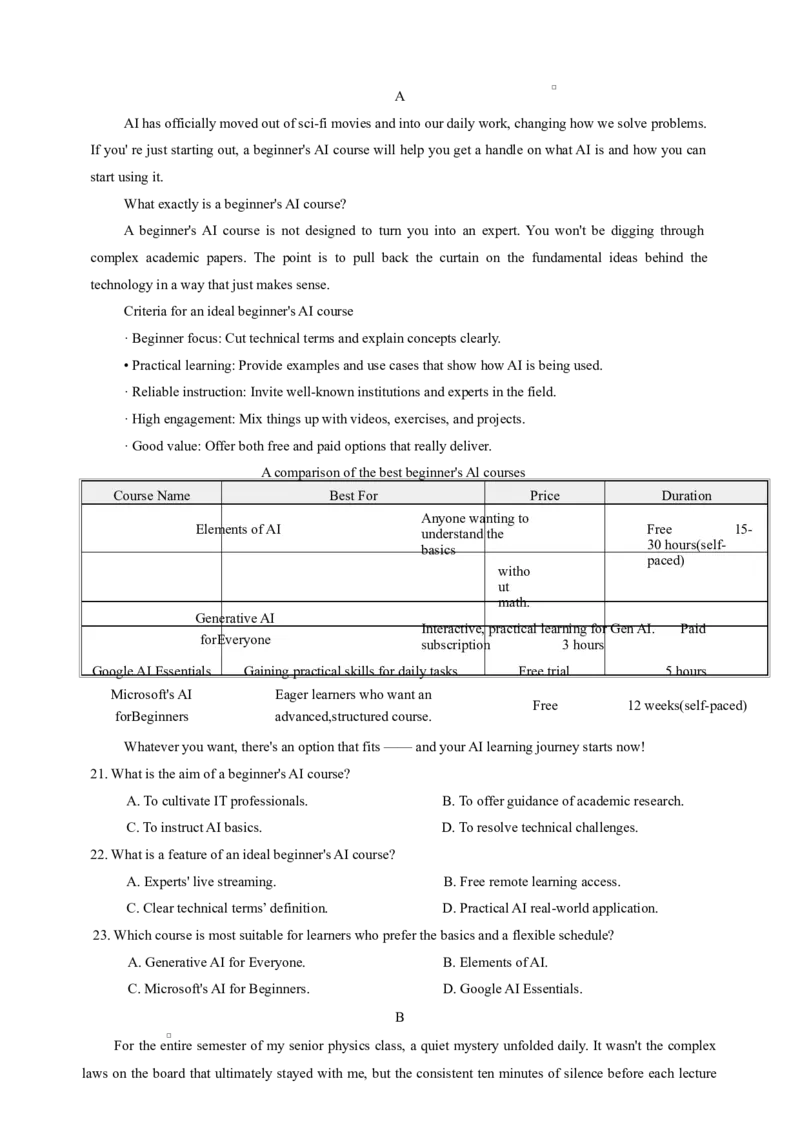
A comparison of the best beginner's Al courses
Course Name Best For Price Duration
Anyone wanting to
Elements of AI Free 15-
understand the
30 hours(self-
basics
paced)
witho
ut
math.
Generative AI
Interactive, practical learning for Gen AI. Paid
forEveryone
subscription 3 hours
Google AI Essentials Gaining practical skills for daily tasks. Free trial 5 hours
Microsoft's AI Eager learners who want an
Free 12 weeks(self-paced)
forBeginners advanced,structured course.
Whatever you want, there's an option that fits —— and your AI learning journey starts now!
21. What is the aim of a beginner's AI course?
A. To cultivate IT professionals. B. To offer guidance of academic research.
C. To instruct AI basics. D. To resolve technical challenges.
22. What is a feature of an ideal beginner's AI course?
A. Experts' live streaming. B. Free remote learning access.
C. Clear technical terms’ definition. D. Practical AI real-world application.
23. Which course is most suitable for learners who prefer the basics and a flexible schedule?
A. Generative AI for Everyone. B. Elements of AI.
C. Microsoft's AI for Beginners. D. Google AI Essentials.
B
For the entire semester of my senior physics class, a quiet mystery unfolded daily. It wasn't the complex
laws on the board that ultimately stayed with me, but the consistent ten minutes of silence before each lecturebegan. Mr. Davies, known for his energetic and engaging teaching style, would enter the room, place his notes
on the desk, and then simply sit. His gaze, often directed out the window at a towering pine tree, seemed distant.
A cup of tea steamed and then cooled beside him, untouched.
We, a group of typically restless seventeen-year-olds, initially fidgeted (躁动), whispered, and wondered.
Was he tired? Disappointed in us? Daydreaming? As weeks passed, a gradual change occurred. The whispered
questions died down. The restless movements stilled. Without a single word of instruction, the room learned to
settle into a collective, respectful quiet. It became a strange, shared routine. I came to see it as his personal
preparation time, a teacher's brief mental shift from the chaos(混乱) of the world to the order of science.
The truth, however, was far more serious and remained hidden for years. I learned it only at a class
reunion, a decade later, from an old colleague of his. That very year, Mr. Davies' wife had been battling a severe,
long-term illness. Those silent minutes were not for preparation, but for preservation —— his only private
moment to gather enough strength to face us, to perform the role of the lively teacher we all expected. He
neither mentioned it nor let the shadow cross his classroom doorway.
Yet, in that unspoken, shared space, he taught a lesson more profound than any curriculum could contain.
We had unknowingly witnessed quiet dignity, the immense strength required to bear personal burdens while
faithfully fulfilling one's duties. The classroom, I realized, had held not just a teacher of physics, but a man
teaching, through simple example, the weight and grace of adulthood.
24. Why is Mr. Davies described as still and distant?
A. To reflect his lack of focus on teaching. B. To show his fading enthusiasm for teaching.
C. To highlight his vivid teaching style. D. To suggest his unspoken personal hardship.
25. What does the underlined word“It” in paragraph 2 refer to?
A. The process of calming down into silence. B. The period of mental preparation.
C. The change in students’ behaviour. D. The brief verbal instruction.
26. How does the author feel about Mr. Davies?
A. Curious about his strange behaviour. B. Respectful of his powerful quiet.
C. Astonished by his self-control. D. Sympathetic toward his personal hardship.
27. What does the story show?
A. A teacher's unprepared curriculum. B. A misunderstanding cleared up years later.
C. The hidden strength in silence. D. The uncovered mystery in physics class.
C
We already know how watching other people's lives on social media can negatively affect our self-esteem(
自尊) and satisfaction with our own lives. Apparently, using apps to track your own calories or fitness activities
can have a similar effect. New research from scientists at University College London(UCL) suggests that fitness
apps can actually become major demotivators.The researchers analyzed nearly 60,000 posts on the X platform. This data is particularly valuable because,
unlike traditional surveys, people tend to share honest, unfiltered (直白真实的) opinions online. The posts
included feedback on popular apps, such as MyFitnessPal. Around 13,000 posts contained negative keywords
the researchers tracked —— and over half mentioned the calorie-counting app MyFitnessPal.
At first glance, MyFitnessPal seems to offer everything you need to stay on top of your fitness and diet. It
allows users to track calorie intake, monitor proteins, and set personalized goals. You can simply import recipes
or scan bar codes from food packages —— the app will do the rest, offering you guidance on what and when to
eat. Sounds like working with a personal dietitian.
However, many people are not necessarily that gratified about it. Senior author Dr. PaulinaBondaronek
explained, “In these posts, we found a lot of blame and shame, with people feeling they were not doing as well
as they should be. These emotional effects may end up harming people's motivation and health.”
MyFitnessPal is also pretty easy to“fool”, since it’ s up to users whether to log or skip a meal. This creates
a false sense that if something isn't recorded in the app, it“didn't happen”. Many admitted cheating(e. g., not
logging a post-dinner cup of ice cream) to feel better, but this only led to more guilt.In some cases, people quit
the app and their healthy habits altogether.
It's important to note the study only analyzed negative posts, so there's no scientifically proven data on
fitness apps' benefits. However, their harm is hard to ignore. This is a clear wake-up call for developers to
consider their products’ unintended consequences.
28. What do we know about MyFitnessPal?
A. It offers comprehensive fitness support. B. It tracks health via exercise data.
C. It automatically logs every meal intake. D. It provides personalized dietitian services.
29. What does the underlined word“gratified” in Paragraph 4 probably mean?
A. Puzzled. B. Satisfied. C. Astonished. D. Concerned.
30. What should app developers do according to the author?
A. Highlight the interactivity of apps. B. Make apps more user-friendly to use.
C. Adapt superior technology to track activities. D. Be mindful of apps' harmful impacts.
31. What is the best title for the text?
A. Social Media vs Fitness Apps B. How to Choose Fitness Apps
C. MyFitnessPal: A Perfect Fitness App D. Fitness Apps: Unexpected Harms
D
In New Jersey's suburban intersections, an immature Cooper's hawk (鹰) was at work. It was unfolding a
novel hunting strategy that would astonish even seasoned ethologists, which was documented by University of
Tennessee researcher Vladimir Dinetes in his study Street smarts: a remarkable adaptation in a city- wintering
raptor(猛禽).
Over 18 freezing winter mornings, Dinetes observed from a parked vehicle as birds gathered on the
sidewalk to eat food left by residents. In a nearby tree, a young hawk waited, listening, for a specific electricsound that signals it's safe to cross the street. This high tone, tied to a red- light extension from30 to 90 seconds,
meant cars would stretch farther back along the block, forming a dense line. When that line reached a certain
point, the hawk would launch an attack, flying low along the sidewalk, hidden by the line of waiting cars. Then
it would slip, bursting into the birds' feeding space and securing an exceptionally high hunting success rate.
Critically, the hawk avoided attacks on weekends when cars didn't line up sufficiently long to provide a
visual barrier. This selectivity proved no accident: The hawk had learned to link the signal sound, traffic
patterns and hunting opportunities.
Cooper's hawks, once restricted to deep woodlands, have inhabited North American cities since the 1970s,
but only one urban- adapted behavior —— hunting near sunset lights —— was previously recorded. Dinetes'
finding adds a far more complex strategy, one that demands mapping environments,tracking time- based clues
and carrying out plans.
Dinetes explains,“The hawk doesn't evolve urban skills anew but uses pre- existing problem-solving
ability meant for forest hunts where it measures flight angles and escape paths amid branches.Its forest hunting
skill translates into viewing city traffic as branches and crosswalks as tree gaps. This cross- contextual thinking
—— where a biological instinct is adapted to an artificial landscape —— is one of the hallmarks of intelligence
in the animal kingdom.”
As cities grow, understanding how animals adapt will be crucial for conservation and coexistence
strategies. The study highlights the interplay between wildlife and human environments.
32. What does the author primarily intend to tell us in paragraph 2?
A. Local residents care for birds well. B. Prolonged signal duration causes traffic jam.
C. The hawk is skilled at timing its hunt. D. The hawk tends to launch attacks randomly.
33. Why did the hawk avoid its hunt on weekends?
A. Birds didn't search for food then. B. Light traffic failed to provide enough cover.
C. Traffic lights were out of function. D. Bystanders interfered with its behavior.
34. What lesson can we learn from the hawk's cross- contextual thinking?
A. Use available resources strategically. B. A patient heart eats the sweet fruit.
C. Don't follow others blindly. D. The early bird catches the worm.
35. What kind of writing method is mainly used in the text?
A. Explaining a finding with relevant data. B. Defending a view through an experiment.
C. Presenting a study with specific facts. D. Narrating a story in time order.
第二节(共 5 小题;每小题 2.5 分,满分 12.5 分)
阅读下面短文,从短文后的选项中选出可以填入空白处的最佳选项。选项中有两项为
多余选项。
Have you ever walked away from a conversation with the sinking feeling that you said too
much?Not because you were impolite or inconsiderate—— but because you tried to explain
yourself to someone who didn't really want to understand? 36
Over-explaining happens often in our daily life. This behavior originated in early survival
strategies. For those raised in emotionally unpredictable households, clarity may be a form of
self-protection. Anticipating others' reactions, smoothing things over, or presenting a“bulletproof”reason may prevent punishment or emotional fallout (后遗症). 37 People who have ever
undergone trauma(创伤) tend to explain a lot to avoid conflict or rejection.
Regardless of origin, the pattern is the same: We spend unnecessary energy trying to justify
our right to take up space, to say no or to make choices others might not like. 38 Clear
language like“I' ve made my decision.” and“Let's shift the conversation.” can actually do the trick.
These direct statements prioritize emotional honesty without over-disclosure. And they don't leave
space for negotiation where none is guaranteed.
39 You spend less time practicing, defending, or recovering and you needn't always react
to others' discomfort. You also start attracting a different kind of relationship, which is based not
on performance or submission, but on mutual respect. 40 You begin healing the part of you
that believed love had to be earned through explanation. The version of you who felt unsafe being
misunderstood learns a new truth: Your worth was never conditional or dependent on being
agreeable or persuasive.
A. If so, you are not alone.
B. But maybe the biggest shift is internal.
C. Like any behavioral change, this takes practice.
D. But it's not impossible to rid ourselves of the trouble.
E. When you stop over-explaining, you regain emotional energy.
F. Have you ever explained to show your politeness and consideration?
G. Over-explaining can also come from the way your brain is wired by past experiences.
第三部分 语言运用(共两节,满分 30 分)
第一节 (共 15 小题;每小题 1 分,满分 15 分)
阅读下面短文,从每题所给的 A、B、C、D 四个选项中选出最佳选项。
In 2019,I decided to get a job, so I sent my resume to every shop and cafe in my village. Luckily,I was
41 an interview at a local restaurant.
The interview went well, but before I left, the manager asked me to try out serving a customer. To my
horror, I couldn't 42 a word on the menu. The customer stood impatiently as I froze.Unsurprisingly, I
received a 43 email the next morning. All my dreams were destroyed.
I was born with poor eyesight. As a child, I struggled to see the board in class, even from the front row. I
44 this by copying notes from my friends. As I got older, I buried the secret even more.I 45 tried to
escape from my poor eyesight.
However, when I got back from that job interview, I made the first step toward dealing with life with a
disability—— 46 . From my doctor, I learned that glasses wouldn't 47 and that Iwould never be
allowed to drive. Each new detail felt like a fresh blow. For the first time, I 48 my official diagnosis——
visual disability. To my surprise, I was filled with 49 .
The next step was 50 the independence I'd developed over the years. I had to learn to ask for help,
something I'd always avoided.As I started reaching out for help, the love and support of my friends moved me. They 51 my
confidence so that I no longer felt 52 to ask for assistance. When I asked strangers to help read cafe
menus or cross the road, I was surprised at how kind they were.
Today, I'm much more confident than ever. Though my vision can't be changed, I treat every 53 as
a new challenge. I speak up when something isn't 54 and ask for adjustments. IfI feel shy about my
vision, how will over two million people in Britain with sight loss 55 ? I'm not just speaking up for myself
but for the millions like me.
41. A. awarded B. spared C. promised D. offered
42. A. make out B. take down C. get across D. pick up
43. A. response B. proposal C. refusal D.
confirmation
44. A. defeated B. hid C. admitted D. denied
45. A. eventually B. firmly C. gradually D.
desperately
46. A. patience B. balance C. acceptance D.
tolerance
47. A. protect B. help C. change D. fit
48. A. read B. valued C. ignored D. checked
49. A. pressure B. relief C. fear D. unease
50. A. abandoning B. challenging C. expecting D. building
51. A. saw B. gained C. shook D. boosted
52. A. annoyed B. hopeless C. embarrassed D.
disappointed
53. A. attempt B. barrier C. opportunity D. failure
54. A. satisfactory B. reliable C. accessible D. possible
55. A. think B. imagine C. adjust D. speak
第二节(共 10 小题;每小题 1.5 分,满分 15 分)
阅读下面短文,在空白处填入 1 个适当的单词或括号内单词的正确形式。
Tracing the Origins of China: A Journey Through Luoyang
“As a traveler captivated by China's 5,000-year civilization, it's my mission to share the vitality of its
historical heritage,” said Lin Wei, a cultural explorer, upon exploring Luoyang, 56 city that weaves past
and present into a story of cultural continuity.
Over the decades, Luoyang 57 (preserve) layers of history across its sites, showcasing how ancient
wisdom and modern life coexist 58 (inspire) cultural pride and cross-era connection.
Lin's journey into Luoyang's soul began with a four-hour high-speed train ride from Beijing,during which
the quiet anticipation of 59 (step) into a“living museum” made his heart race.The echoes of dynasties in
every alley, alongside the warmth of local traditions he felt at a morning beef soup stall, 60 (make) him fall
in love with this city of timeless stories.
Wandering through Luoyang has taken Lin to relics and ruins, immersing him in the rhythm of its
historical pulse. Among his most 61 (impress) experiences was a visit to the Erlitou Site, which revealed
62 early Chinese communities took advantage of river access and flood-safe terrain to build ordered,
harmonious settlements. There, interactive exhibits let visitors“chat” with ancient residents, 63 daily livesreminded him of humanity's shared joys.
Influenced by Luoyang's legacy, Lin now views history with deeper empathy.“Cultural heritage is
extremely significant because it links our roots 64 our future, and that is undeniably the key to nurturing
65 (unite) and a sense of identity,” said Lin.
第四部分 写作(共两节,满分 40 分)
第一节(满分 15 分)
假设你是校体育节志愿者,上周你参观了学校举办的“运动风采摄影展”(Sports in FocusPhotography
Exhibition)。请给校英文报写一篇宣传稿,内容包括:
1.展览时间、地点;
2.观展感受;
3.推荐观展。
注意:
1.词数 80 左右;
2.可适当增加细节,使行文连贯。
第二节(满分 25 分)
阅读下面材料,根据其内容和所给段落开头语续写两段,使之构成一篇完整的短文。
The summer of 2018 changed my life unexpectedly. My parents' work relocation took us from the bustling
city to a quiet mountain town. As a senior high school student who had spent all my life in the urban area, I
struggled to adapt—— no familiar friends, no favorite cafes, and the slow pace of life made me feel lost and
isolated. With no extracurricular activities to join, I often wandered alone in the forest behind our house, a habit
I'd developed since childhood to soothe my mood, carrying only a notebook to jot down random thoughts.
Autumn arrived sooner than expected, bringing cool winds and occasional light rains. After a drizzly
afternoon, I was walking back home when a faint whimper caught my attention. Following the sound, I found a
tiny tabby kitten (小猫) huddled under a maple tree, its fur soaked and matted. It couldn't have been more than
two months old, with one hind leg twisted awkwardly—— clearly injured and abandoned. Its big round eyes,
filled with fear, stared up at me as it trembled violently. Something stirred in my heart——I, too, felt like a
stranger struggling to survive in an unfamiliar place. Without hesitation, I took off my jacket, wrapped it gently
around the kitten, and held it close to my chest,hurrying home. That night, I searched online for how to care for
injured kittens, cleaned its wound carefully with antiseptic (消毒剂), and made a soft bed with an old sweater in
a cardboard box.
The next morning, the kitten seemed a little better. It meowed weakly when I approached, its tail twitching
slightly. I fed it warm milk with a small spoon, and to my surprise, it licked the spoon eagerly,then nuzzled my
palm with its tiny wet nose. Looking at this fragile yet resilient little creature, I felt a warmth I hadn't
experienced since moving here. I sat by the box for hours, talking to it softly, as if it could understand everyword I said.
注意: 1.续写词数应为 150 个左右;
2.请按如下格式在答题卡的相应位置作答。
“I will take care of you.” I whispered, pressing a gentle kiss on its soft fur.
At that moment, I realized that as I devoted myself to the kitten's care, something within me had shifted.