kmkm 第1/11页 1170
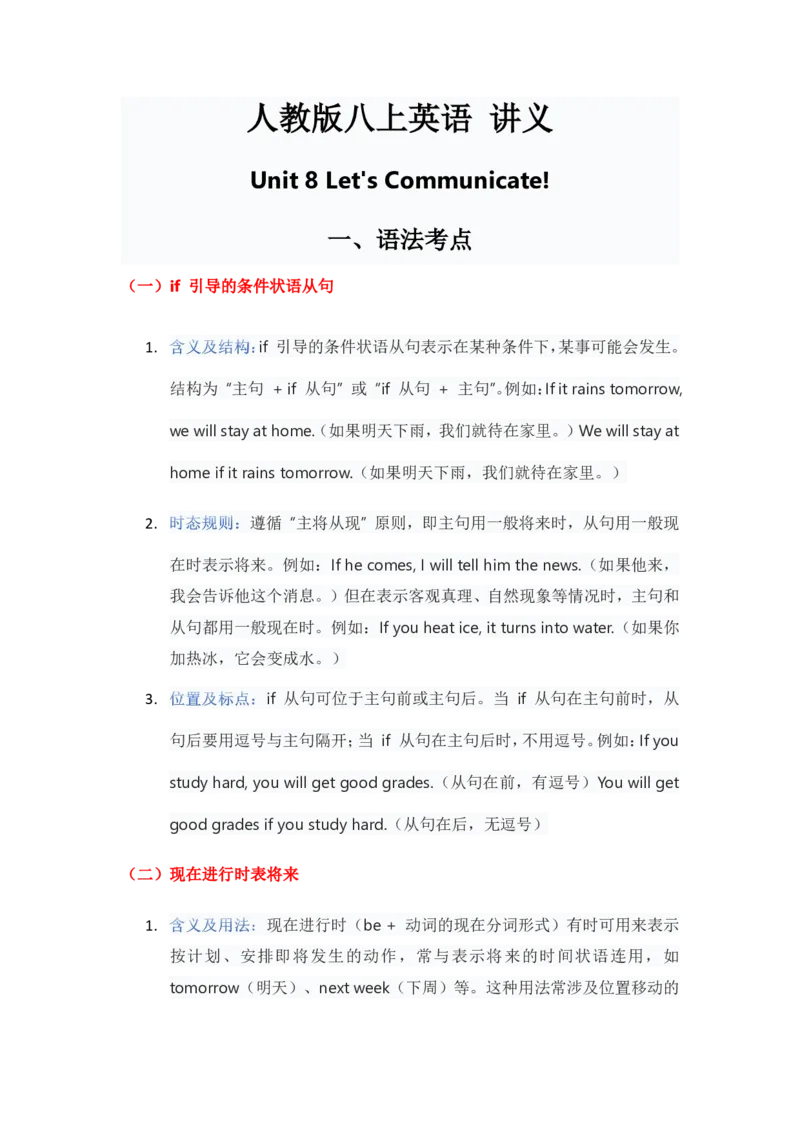
人教版八上英语 讲义
Unit 8 Let's Communicate!
一、语法考点
(一) 引导的条件状语从句
if
1. if 引导的条件状语从句表示在某种条件下,某事可能会发生。
结构为 主句 从句 或 从句 主句 。例如:
“ + if ” “if + ” Ifit rainstomorrow,
(如果明天下雨,我们就待在家里。)
wewill stayat home. Wewill stay at
(如果明天下雨,我们就待在家里。)
home if it rains tomorrow.
2. 遵循 “ 主将从现 ” 原则,即主句用一般将来时,从句用一般现
在时表示将来。例如: (如果他来,
If he comes, I will tell him the news.
我会告诉他这个消息。)但在表示客观真理、自然现象等情况时,主句和
从句都用一般现在时。例如: (如果你
If you heat ice, it turns into water.
加热冰,它会变成水。)
3. if 从句可位于主句前或主句后。当 if 从句在主句前时,从
句后要用逗号与主句隔开;当 从句在主句后时,不用逗号。例如:
if Ifyou
(从句在前,有逗号)
study hard, you will get good grades. You will get
(从句在后,无逗号)
good grades if you study hard.
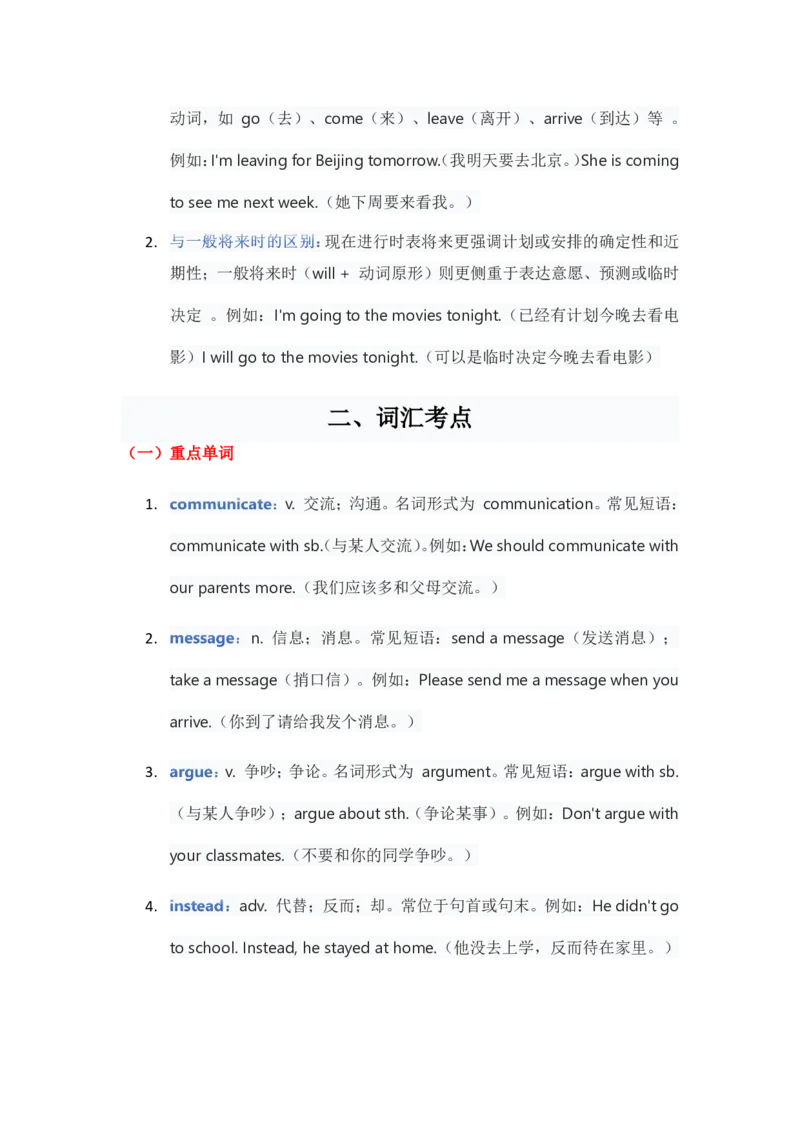
(二)现在进行时表将来
1. 现在进行时( be + 动词的现在分词形式)有时可用来表示
按计划、安排即将发生的动作,常与表示将来的时间状语连用,如
(明天)、 (下周)等。这种用法常涉及位置移动的
tomorrow next week
暴小雪原创 左右上角是薇kmkm 第2/11页 1170
动词,如 (去)、 (来)、 (离开)、 (到达)等 。
go come leave arrive
例如: (我明天要去北京。)
I'mleaving for Beijing tomorrow. Sheis coming
(她下周要来看我。)
to see me next week.
2. 现在进行时表将来更强调计划或安排的确定性和近
期性;一般将来时( 动词原形)则更侧重于表达意愿、预测或临时
will +
决定 。例如: (已经有计划今晚去看电
I'mgoing tothe movies tonight.
影) (可以是临时决定今晚去看电影)
I will go to the movies tonight.
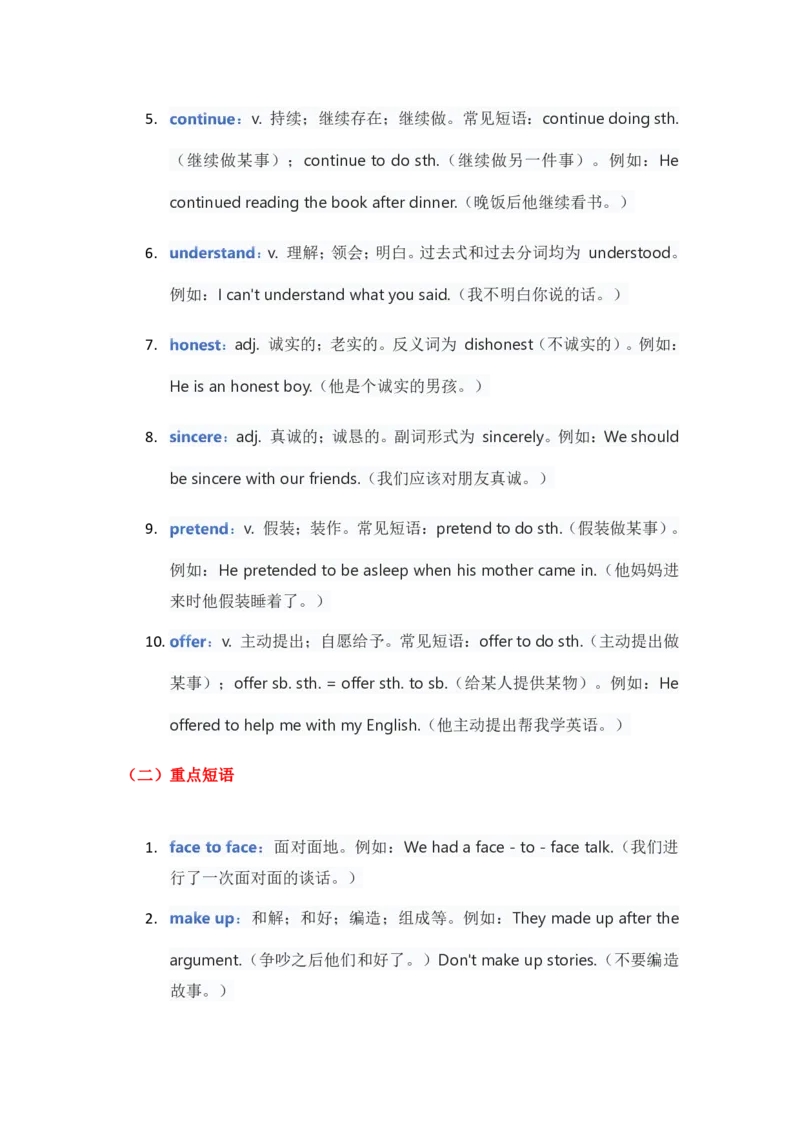
二、词汇考点
(一)重点单词
1. v. 交流;沟通。名词形式为 communication 。常见短语:
(与某人交流)。例如:
communicatewith sb. Weshould communicatewith
(我们应该多和父母交流。)
our parents more.
2. n. 信息;消息。常见短语: send a message (发送消息);
(捎口信)。例如:
takeamessage Please send me a message whenyou
(你到了请给我发个消息。)
arrive.
3. v. 争吵;争论。名词形式为 argument 。常见短语: arguewith sb.
(与某人争吵); (争论某事)。例如:
argueabout sth. Don't arguewith
(不要和你的同学争吵。)
your classmates.
4. adv. 代替;反而;却。常位于句首或句末。例如: Hedidn'tgo
(他没去上学,反而待在家里。)
to school. Instead, he stayed at home.
暴小雪原创 左右上角是薇kmkm 第3/11页 1170
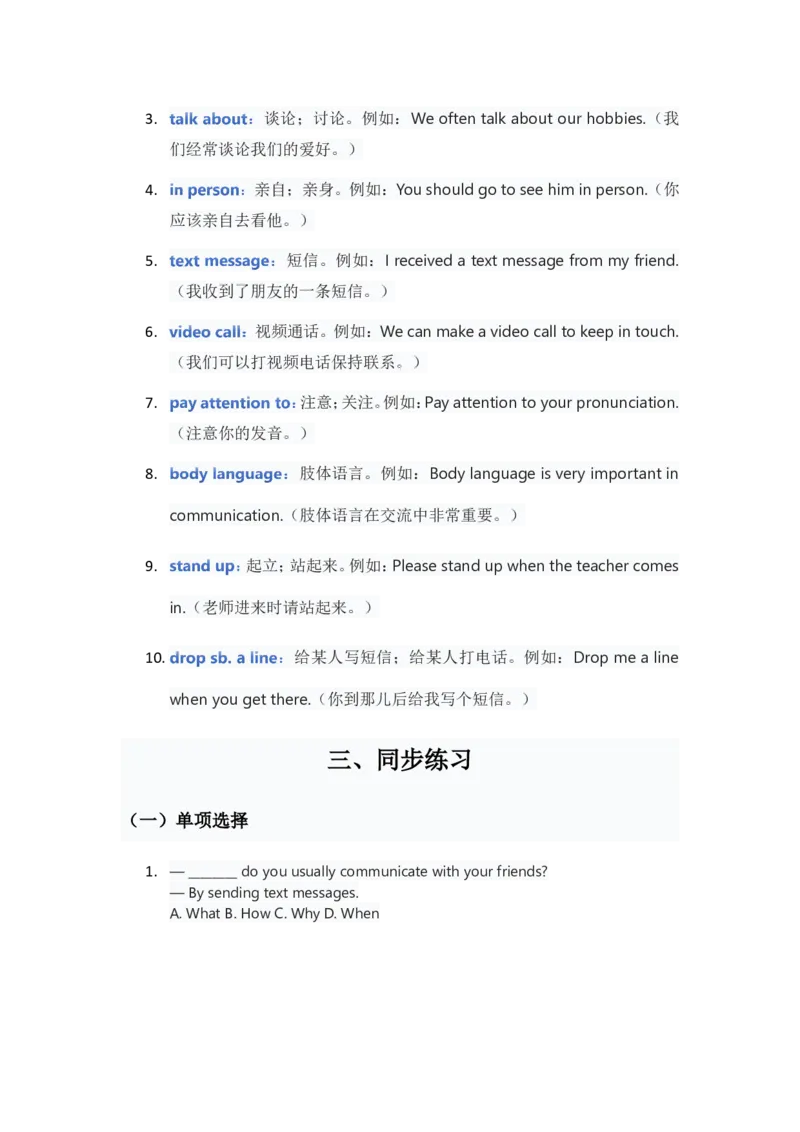
5. v. 持续;继续存在;继续做。常见短语: continuedoingsth.
(继续做某事); (继续做另一件事)。例如:
continue to do sth. He
(晚饭后他继续看书。)
continued reading the book after dinner.
6. v. 理解;领会;明白。过去式和过去分词均为 understood 。
例如: (我不明白你说的话。)
I can't understand what you said.
7. adj. 诚实的;老实的。反义词为 dishonest (不诚实的)。例如:
(他是个诚实的男孩。)
He is an honest boy.
8. adj. 真诚的;诚恳的。副词形式为 sincerely 。例如: Weshould
(我们应该对朋友真诚。)
be sincere with our friends.
9. v. 假装;装作。常见短语: pretend todo sth. (假装做某事)。
例如: (他妈妈进
He pretended to be asleep when his mother came in.
来时他假装睡着了。)
10. v. 主动提出;自愿给予。常见短语: offertodo sth. (主动提出做
某事); (给某人提供某物)。例如:
offer sb. sth. = offer sth. to sb. He
(他主动提出帮我学英语。)
offered to help me with my English.
(二)重点短语
1. 面对面地。例如: We had a face - to - face talk. (我们进
行了一次面对面的谈话。)
2. 和解;和好;编造;组成等。例如: They made up after the
(争吵之后他们和好了。) (不要编造
argument. Don't make up stories.
故事。)
暴小雪原创 左右上角是薇kmkm 第4/11页 1170
3. 谈论;讨论。例如: We often talk about our hobbies. (我
们经常谈论我们的爱好。)
4. 亲自;亲身。例如: Youshould gotosee himinperson. (你
应该亲自去看他。)
5. 短信。例如: I received a text message from my friend.
(我收到了朋友的一条短信。)
6. 视频通话。例如: Wecan makea video calltokeep in touch.
(我们可以打视频电话保持联系。)
7. 注意;关注。例如: Payattentiontoyour pronunciation.
(注意你的发音。)
8. 肢体语言。例如: Body language is very important in
(肢体语言在交流中非常重要。)
communication.
9. 起立;站起来。例如: Please stand upwhen theteacher comes
(老师进来时请站起来。)
in.
10. 给某人写短信;给某人打电话。例如: Drop me a line
(你到那儿后给我写个短信。)
when you get there.
三、同步练习
(一)单项选择
1. —________do youusually communicatewithyour friends?
—Bysendingtextmessages.
A. WhatB. HowC. WhyD.When
暴小雪原创 左右上角是薇kmkm 第5/11页 1170
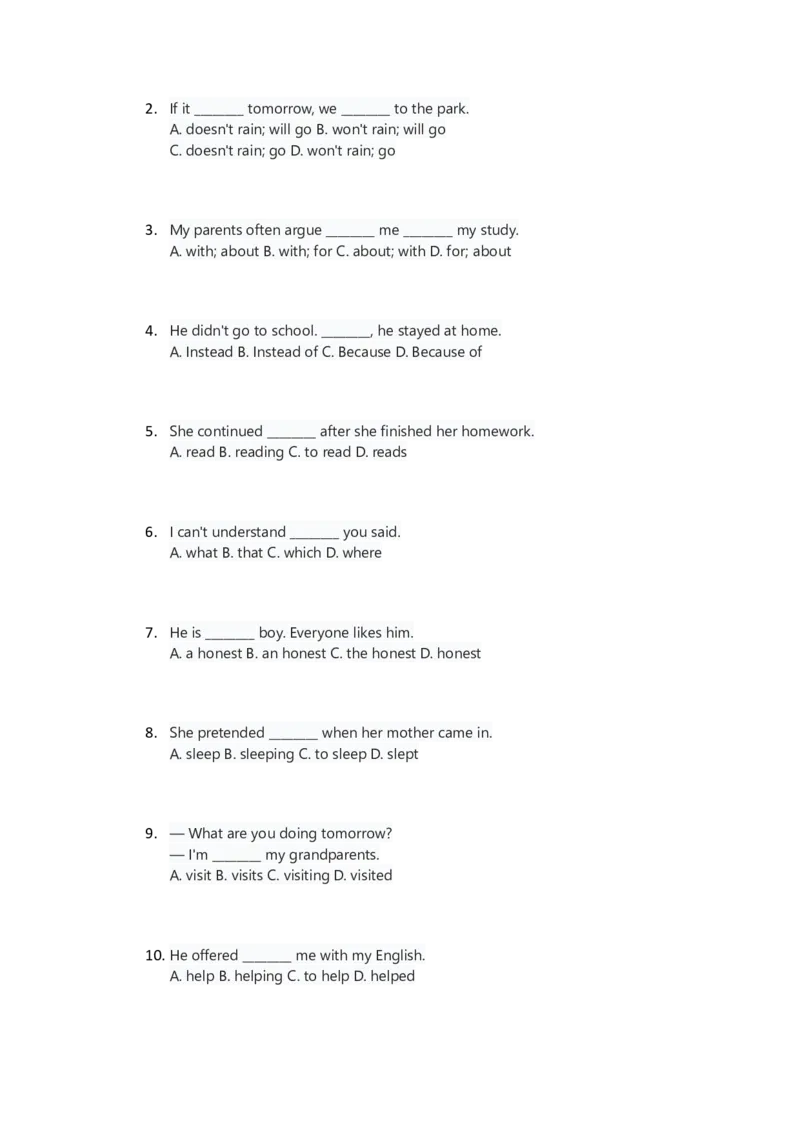
2. If it________ tomorrow,we________tothe park.
A. doesn'train;will go B. won'train;will go
C. doesn'train; go D.won'train; go
3. Myparentsoftenargue________ me________my study.
A. with; aboutB. with; for C.about; withD.for; about
4. Hedidn'tgo to school.________, hestayedathome.
A. InsteadB.InsteadofC.BecauseD.Becauseof
5. Shecontinued________ after shefinishedherhomework.
A. readB. readingC. toreadD.reads
6. Ican'tunderstand________ yousaid.
A. whatB.thatC. which D.where
7. Heis________ boy.Everyonelikeshim.
A. a honestB. anhonestC. thehonestD.honest
8. Shepretended________ whenhermother camein.
A. sleepB.sleepingC. tosleepD.slept
9. —Whatareyoudoingtomorrow?
—I'm________my grandparents.
A. visitB. visitsC. visitingD.visited
10.Heoffered________me withmyEnglish.
A. helpB.helping C.tohelpD.helped
暴小雪原创 左右上角是薇kmkm 第6/11页 1170
11.Wehada________ talk andsolvedthe problem.
A. face-to- faceB.facetofaceC. faces- to- facesD.facestofaces
12.Pleasesendme a________ whenyouget there.
A. newsB. informationC. messageD.advice
13.If youwanttosolvetheproblem,youshouldhavea talk withhim________.
A. inpersonB. inthepersonC.in personsD.ina person
14.Weshouldpayattention________ourbodylanguagewhenwetalkwith others.
A. atB.toC. inD.for
15.—Canyouhelpme withmy math?
—Sure. ________.
A. NoproblemB. I'm sorry C. ThankyouD.You'rewelcome
16.Whenyoumeetsomeoneforthefirst time, it'spoliteto________.
A. askhisageB. talkabouttheweather
C. askhisweightD.talk abouthispersonalinformation
17.Sheis ________toothers. Everyonelikestomakefriendswith her.
A. sincereB.angry C.strict D.nervous
18.If youstay calmandsaysorry,it will________.
A. helpB.helpsC. helpingD.tohelp
19.Theymadeupafter they________.
A. argueB.arguedC. arguingD.toargue
暴小雪原创 左右上角是薇kmkm 第7/11页 1170
20.Wecanuse________to communicatewithothers.
A. bodylanguageB. bodylanguagesC. languagesbodyD.languagesbodies
(二)用所给单词的正确形式填空
1. If it________ (notrain)tomorrow,wewillgo to thezoo.
2. Weshouldlearnhow________ (communicate)with others.
3. Myparentsoftenhavean________ (argue) aboutme.
4. Hecontinued________(write)after ashort break.
5. I'mlookingforwardto________ (hear) fromyou.
6. It'simportant________ (be)honestwithothers.
7. Shepretended________ (notknow) mewhenshesawme.
8. Wehadagreattime________ (play)basketballyesterday.
9. Myfather offered________(buy) mea newbike.
10.Theyaregoodat________(use)bodylanguage.
暴小雪原创 左右上角是薇kmkm 第8/11页 1170
11.If youwanttomakefriends,youshouldbe________(friend)toothers.
12.Weshouldpayattention to ________(listen)whenothersaretalking.
13.Hedidn'tgo to school.Instead,he________ (stay)athome.
14.Sheis ________(make) avideo call toher friendnow.
15.Whenwe meetsomeonefor thefirst time, weshould choosethe right________
(topic).
16.If you want to improve your communication skills, you need to practice
________(talk)with others.
17.Wehadaface- to- face________(talk)andunderstoodeachother better.
18.Mymotheroftenasksme________ (send)messagesto my grandparents.
19.Theyarearguingabouthow________(solve) theproblem.
20.It'simpolite________(ask) someone'sweight.
(三)阅读理解
暴小雪原创 左右上角是薇kmkm 第9/11页 1170
有效沟通的重要性
Communication is an important part of our lives. It helps us build
relationships, share ideas, and understand others. Good communication skills
can make our lives easier and more successful.
There are many ways to communicate with others. Face - to - face
communication is one of the most common and effective ways. When we talk
face to face, we can see the expressions on the other person's face and hear
the tone of their voice. This helps us understand their feelings better. For
example, if someone is smiling and speaking in a friendly tone, we can tell that
they are happy. On the other hand, if someone has a serious expression and
speaks in a loud voice, we may think they are angry.
However, in modern society, we also rely a lot on electronic
communication, such as text messages, emails, and video calls. These forms of
communication are convenient, especially when we can't meet in person. But
they also have some disadvantages. For example, it's easy to misunderstand
the meaning of a text message because we can't see the person's face or hear
their tone of voice.
To communicate effectively, we need to be good listeners. We should pay
attention to what the other person is saying and try to understand their point
of view. We should also be clear and honest when we express our own ideas.
Using simple and direct language can help avoid misunderstandings.
暴小雪原创 左右上角是薇kmkm 第10/11页 1170
In addition, body language plays an important role in communication. Our
posture,facial expressions, and gestures can all convey messages. Forexample,
standing up straight and making eye contact shows that we are confident and
interested in the conversation.
1. ( )Whatisanimportantpart ofourlivesaccordingtothepassage?
A. Exercise. B.Communication. C. Study. D.Travel.
2. ( )Whyis face-to- facecommunication effective?
A. Becausewecanonlyseetheexpressionsontheotherperson'sface.
B.Becausewe canonlyhear thetoneoftheother person'svoice.
C. Because we can see the expressions and hear the tone, which helps
understandfeelings.
D.Becauseitistheonly waytocommunicate.
3. ( )Whatarethedisadvantagesofelectroniccommunication?
A. It istoo expensive.
B.It takestoomuchtime.
C. It'seasytomisunderstandthemeaning.
D.It can'tbeusedwhenwecan'tmeetinperson.
4. ( )Howcanwecommunicateeffectively?
A. Bynotlisteningtoothers.
B.Byusingcomplex language.
C. Bybeinggoodlistenersandbeingclearandhonest.
D.Bynotexpressingour ownideas.
5. ( )Whatcanshowthatweareconfidentandinterestedintheconversation?
A. Standingupstraightandmakingeyecontact.
B.Slouchingandavoidingeyecontact.
C. Usingalotofgestures.
D.Speakingina lowvoice.
暴小雪原创 左右上角是薇