文档文本内容
Unit 6 单元知识清单
Section A
基础知识清单
一、
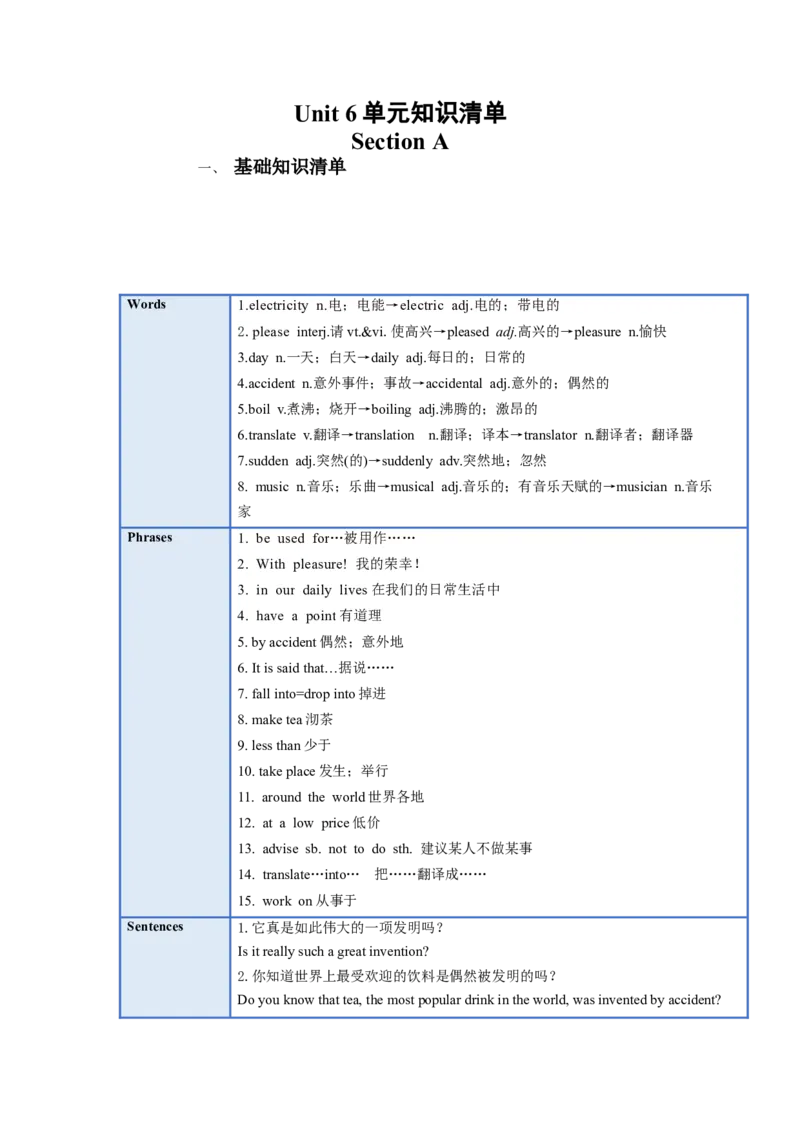
Words 1.electricity n.电;电能→electric adj.电的;带电的
2.please interj.请vt.&vi.使高兴→pleased adj.高兴的→pleasure n.愉快
3.day n.一天;白天→daily adj.每日的;日常的
4.accident n.意外事件;事故→accidental adj.意外的;偶然的
5.boil v.煮沸;烧开→boiling adj.沸腾的;激昂的
6.translate v.翻译→translation n.翻译;译本→translator n.翻译者;翻译器
7.sudden adj.突然(的)→suddenly adv.突然地;忽然
8. music n.音乐;乐曲→musical adj.音乐的;有音乐天赋的→musician n.音乐
家
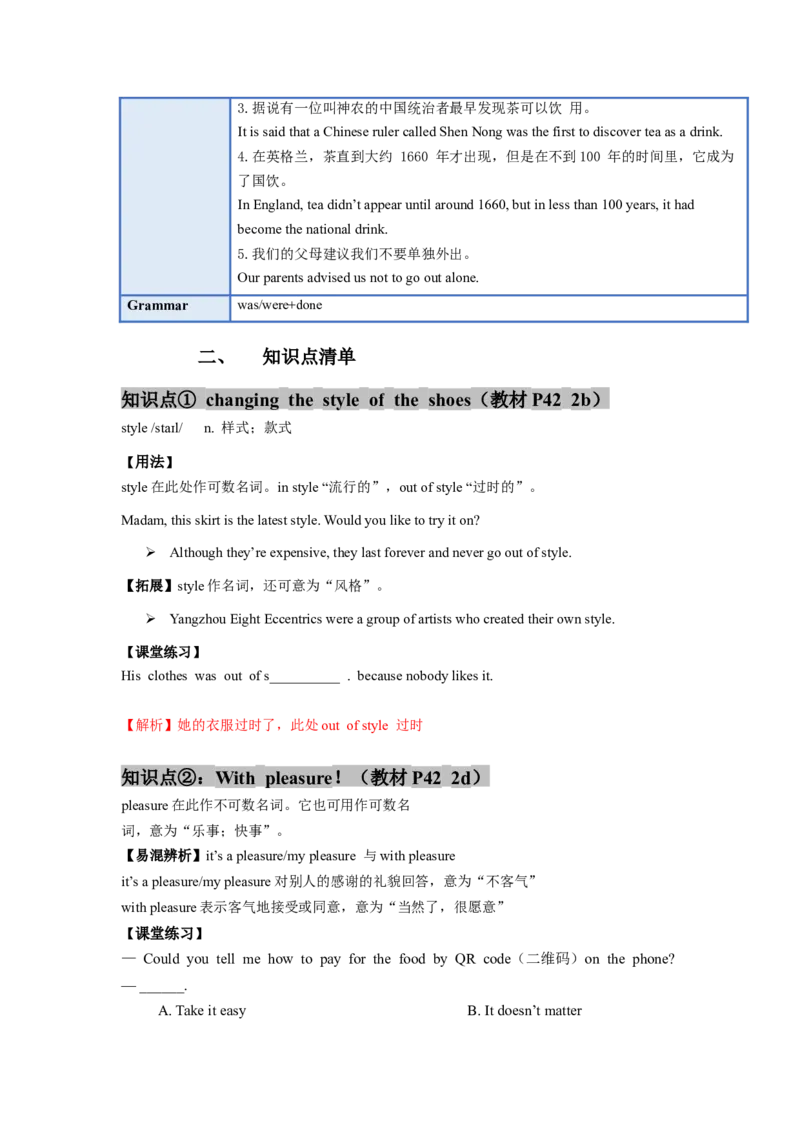
Phrases 1. be used for…被用作……
2. With pleasure! 我的荣幸!
3. in our daily lives在我们的日常生活中
4. have a point有道理
5. by accident偶然;意外地
6. It is said that…据说……
7. fall into=drop into掉进
8. make tea沏茶
9. less than少于
10. take place发生;举行
11. around the world世界各地
12. at a low price低价
13. advise sb. not to do sth. 建议某人不做某事
14. translate…into… 把……翻译成……
15. work on从事于
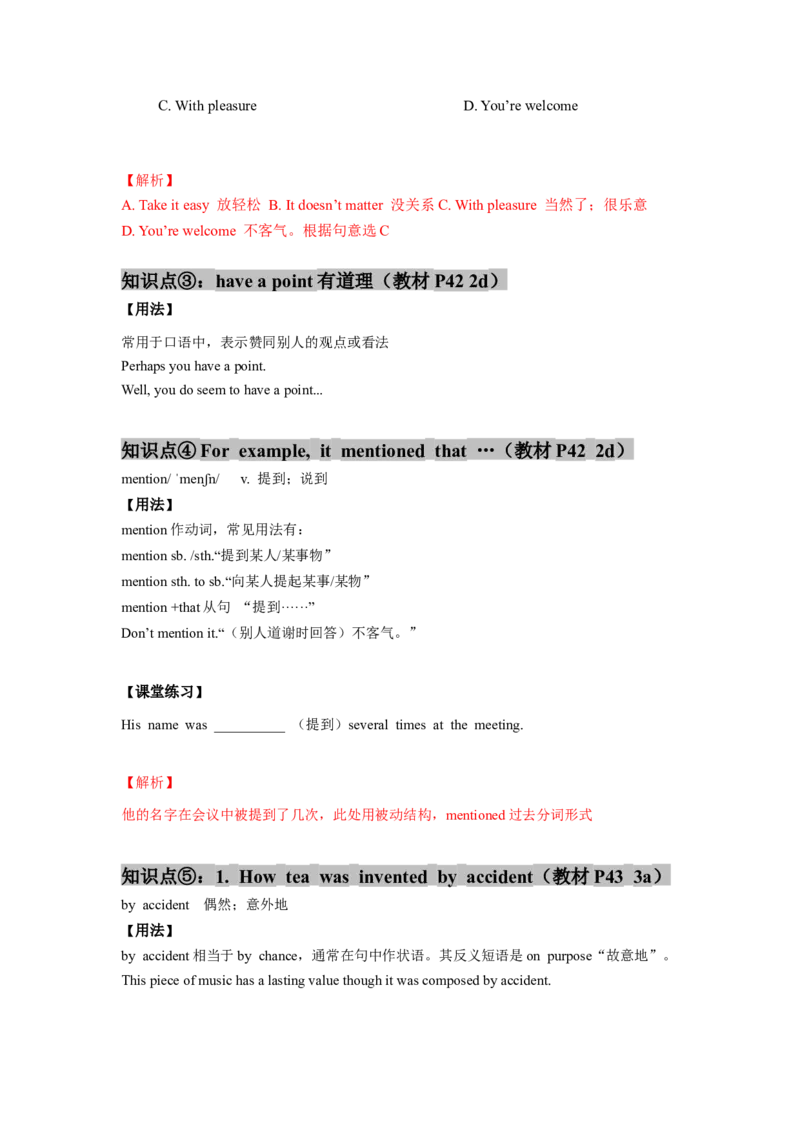
Sentences 1.它真是如此伟大的一项发明吗?
Is it really such a great invention?
2.你知道世界上最受欢迎的饮料是偶然被发明的吗?
Do you know that tea, the most popular drink in the world, was invented by accident?3.据说有一位叫神农的中国统治者最早发现茶可以饮 用。
It is said that a Chinese ruler called Shen Nong was the first to discover tea as a drink.
4.在英格兰,茶直到大约 1660 年才出现,但是在不到100 年的时间里,它成为
了国饮。
In England, tea didn’t appear until around 1660, but in less than 100 years, it had
become the national drink.
5.我们的父母建议我们不要单独外出。
Our parents advised us not to go out alone.
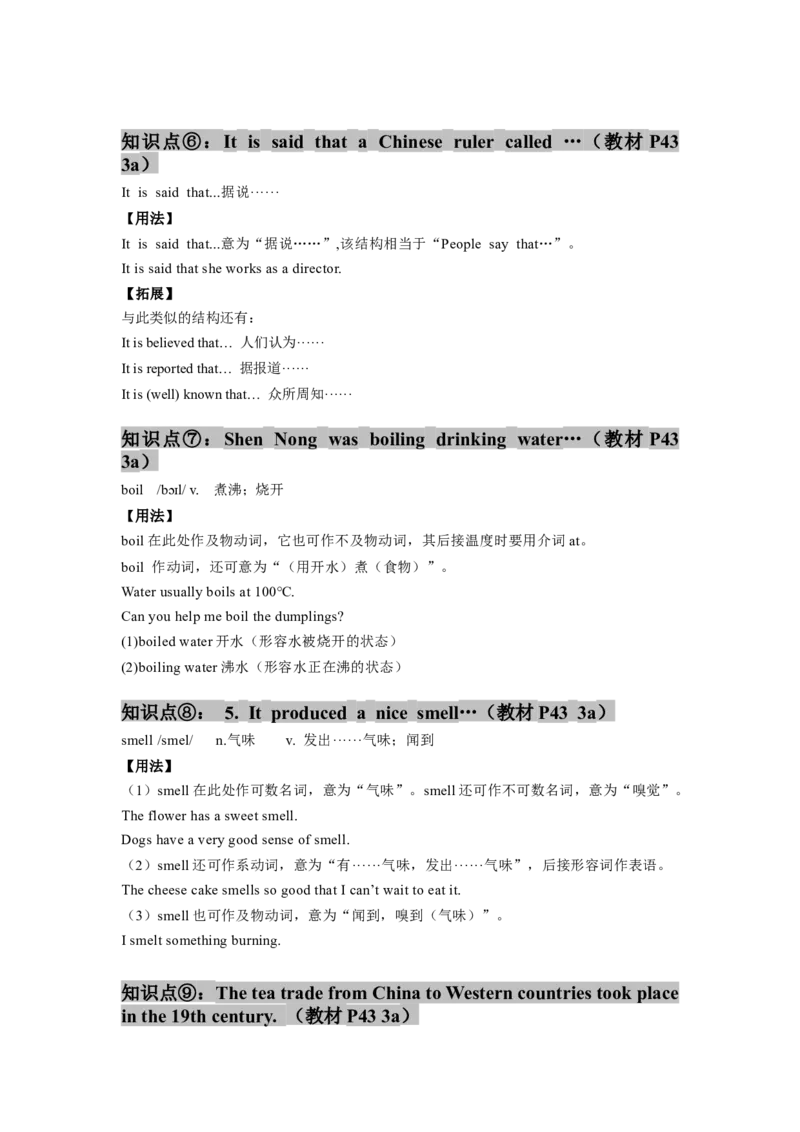
Grammar was/were+done
二、 知识点清单
知识点① changing the style of the shoes(教材P42 2b)
style /staɪl/ n. 样式;款式
【用法】
style在此处作可数名词。in style “流行的”,out of style “过时的”。
Madam, this skirt is the latest style. Would you like to try it on?
Although they’re expensive, they last forever and never go out of style.
【拓展】style作名词,还可意为“风格”。
Yangzhou Eight Eccentrics were a group of artists who created their own style.
【课堂练习】
His clothes was out of s__________ . because nobody likes it.
【解析】她的衣服过时了,此处out of style 过时
知识点②:With pleasure!(教材P42 2d)
pleasure在此作不可数名词。它也可用作可数名
词,意为“乐事;快事”。
【易混辨析】it’s a pleasure/my pleasure 与with pleasure
it’s a pleasure/my pleasure对别人的感谢的礼貌回答,意为“不客气”
with pleasure表示客气地接受或同意,意为“当然了,很愿意”
【课堂练习】
— Could you tell me how to pay for the food by QR code(二维码)on the phone?
— ______.
A. Take it easy B. It doesn’t matterC. With pleasure D. You’re welcome
【解析】
A. Take it easy 放轻松 B. It doesn’t matter 没关系C. With pleasure 当然了;很乐意
D. You’re welcome 不客气。根据句意选C
知识点③:have a point有道理(教材P42 2d)
【用法】
常用于口语中,表示赞同别人的观点或看法
Perhaps you have a point.
Well, you do seem to have a point...
知识点④For example, it mentioned that …(教材P42 2d)
mention/ ˈmenʃn/ v. 提到;说到
【用法】
mention作动词,常见用法有:
mention sb. /sth.“提到某人/某事物”
mention sth. to sb.“向某人提起某事/某物”
mention +that从句 “提到······”
Don’t mention it.“(别人道谢时回答)不客气。”
【课堂练习】
His name was __________ (提到)several times at the meeting.
【解析】
他的名字在会议中被提到了几次,此处用被动结构,mentioned过去分词形式
知识点⑤:1. How tea was invented by accident(教材P43 3a)
by accident 偶然;意外地
【用法】
by accident相当于by chance,通常在句中作状语。其反义短语是on purpose“故意地”。
This piece of music has a lasting value though it was composed by accident.知识点⑥:It is said that a Chinese ruler called …(教材 P43
3a)
It is said that...据说······
【用法】
It is said that...意为“据说……”,该结构相当于“People say that…”。
It is said that she works as a director.
【拓展】
与此类似的结构还有:
It is believed that… 人们认为······
It is reported that… 据报道······
It is (well) known that… 众所周知······
知识点⑦:Shen Nong was boiling drinking water…(教材 P43
3a)
boil /bɔɪl/ v. 煮沸;烧开
【用法】
boil在此处作及物动词,它也可作不及物动词,其后接温度时要用介词at。
boil 作动词,还可意为“(用开水)煮(食物)”。
Water usually boils at 100℃.
Can you help me boil the dumplings?
(1)boiled water开水(形容水被烧开的状态)
(2)boiling water沸水(形容水正在沸的状态)
知识点⑧: 5. It produced a nice smell…(教材P43 3a)
smell /smel/ n.气味 v. 发出······气味;闻到
【用法】
(1)smell在此处作可数名词,意为“气味”。smell还可作不可数名词,意为“嗅觉”。
The flower has a sweet smell.
Dogs have a very good sense of smell.
(2)smell还可作系动词,意为“有······气味,发出······气味”,后接形容词作表语。
The cheese cake smells so good that I can’t wait to eat it.
(3)smell也可作及物动词,意为“闻到,嗅到(气味)”。
I smelt something burning.
知识点⑨:The tea trade from China to Western countries took place
in the 19th century. (教材P43 3a)trade /treɪd/ n. 贸易;交易 v.做买卖;从事贸易
【用法】
(1)trade在此处作名词,意为“贸易;交易”,此时常用作不可数名词。
Trade between the two countries has increased
(2)trade还可作动词,意为“做买卖;从事贸易”。
常用结构:trade (in sth.) with sb.与某人交易(某物)。
They had years of experience of trading with the West.
知识点⑩ The tea trade from China to Western countries took
place in the 19th century. (教材P43 3a)
take place 发生;出现
【用法】
take place为不及物动词短语,不能用于被动语态。表示根据安排或计划发生,含有事先
预料或计划的意思。
The 2022 Winter Olympics will take place in Beijing, China.
【拓展】
happen意为“发生”,为不及物动词,不能用于被动语态。指具体客观事件的发生,有
偶然性,未能预见。
A car accident happened last night.
三、 语法清单
知识点:was/were+done
英语动词有两种语态,主动语态和被动语态。
主动语态的主语是动作的执行者;被动语态的主语是动作的承受者,理解为“被……”
不同时态的被动语态:
被动语态的结构是“be+过去分词”,be动词有时态、人称和数的变化。
当不知道动作的执行者或没必要指出动作的执行者,只强调突出动作的承受者时,用被动
语态。
一般过去时的被动语态:
1. 肯定结构:was / were+过去分词;
It was invented by Dr. Jhon.
2. 否定结构:wasn’t / weren’t+过去分词;
Potato chips were not invented on purpose.
3. 一般疑问句 把was / were放到句首。
Were you invited to the party?
4. 特殊疑问句:特殊疑问词+一般疑问句?When were you invited ?
被动语态的特殊情况:
1.含有短语的主动语态变被动语态
My father fixed up the house. (主动变被动)
The house was fixed by my father. ( × )
The house was fixed up by my father ( √ )
2. 含有双宾语的主动语态变被动语态
Tom gave me a book yesterday. (主动变被动)
I was given a book by Tom yesterday
A book was given to me by Tom yesterday.
3. 感官动词和使役动词的被动语态:口诀:一感二听三让四看(feel; listen to/hear;let/make/
have; notice/see/watch/notice)
I saw a heavy man enter the house. (主动变被动) 主动to出去被动to回来
A heavy man was seen to enter the house.
4. 不能使用被动语态的动词
①系动词;不及物动词:(get/turn/become/seem/look/sound/smell/taste/feel+adj.) (happen,
cost)
②个别短语: (take place, run out, come true, fall asleep)
e.g. What happened to Mr. Brown? 布朗先生发生什么事了?
This blouse belongs to Mary. 这件上衣是玛丽的。
The book cost Laura twenty dollars.这本书花了劳拉20美元