

文档内容
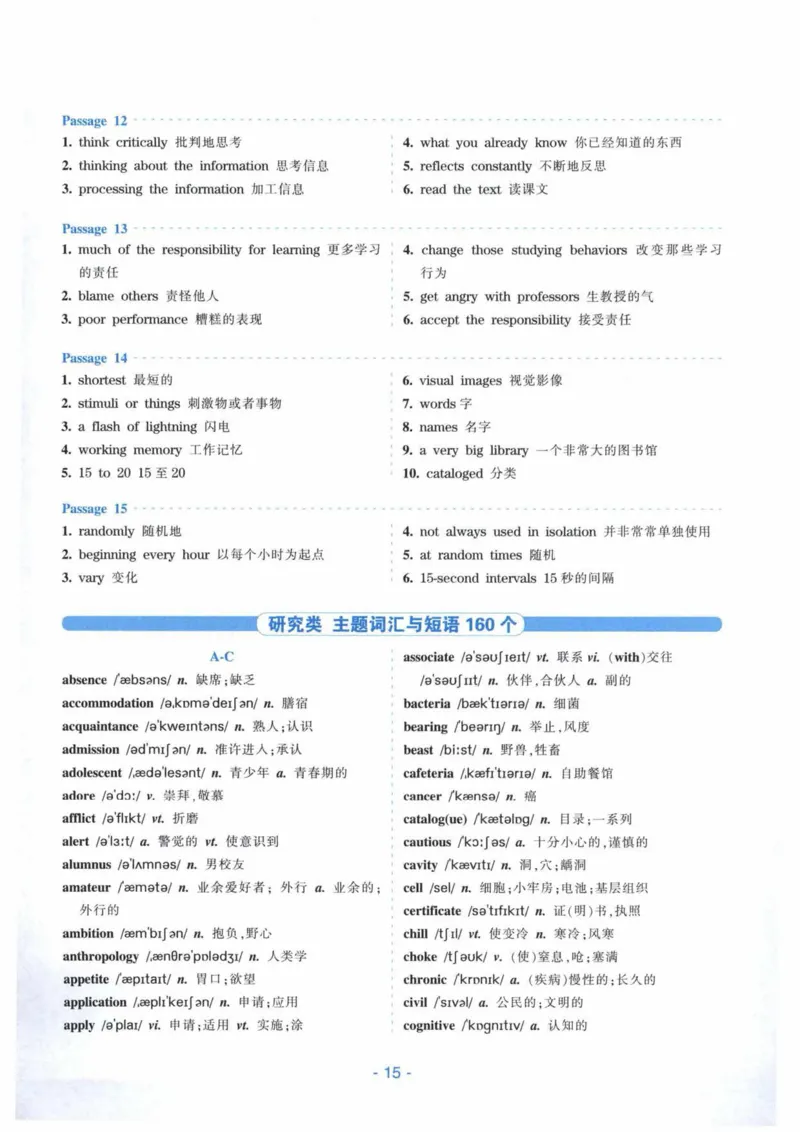
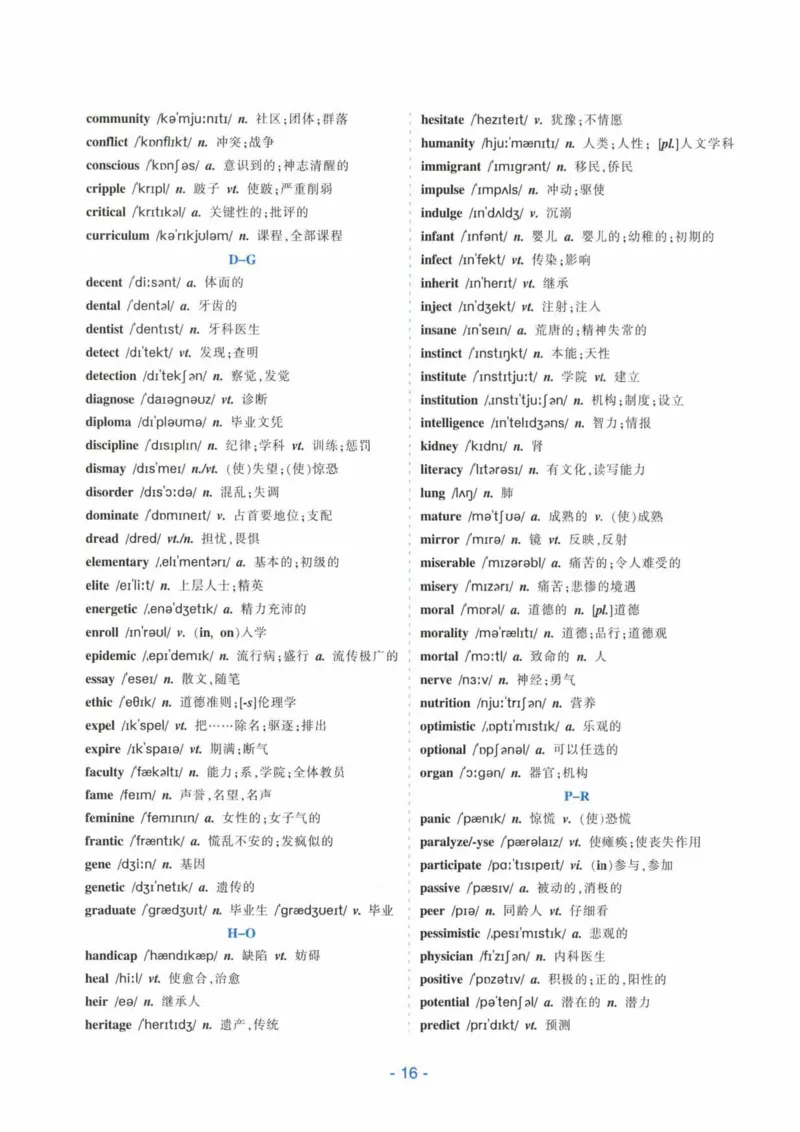
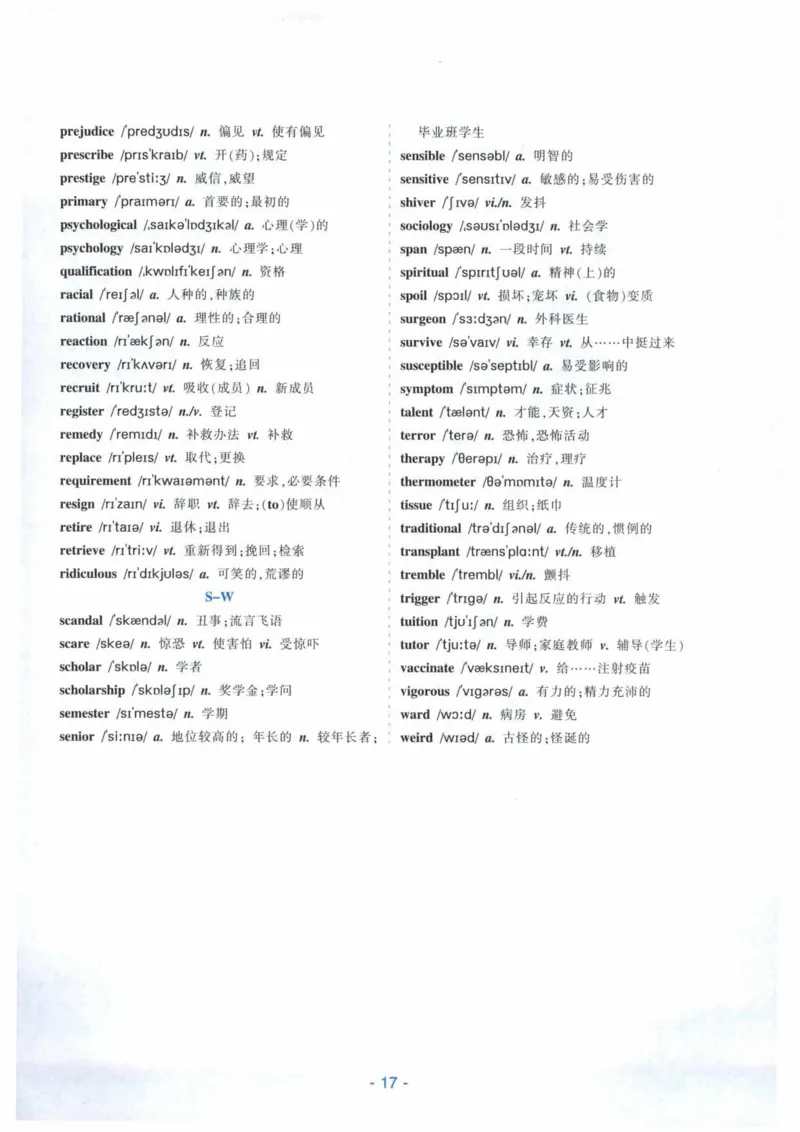
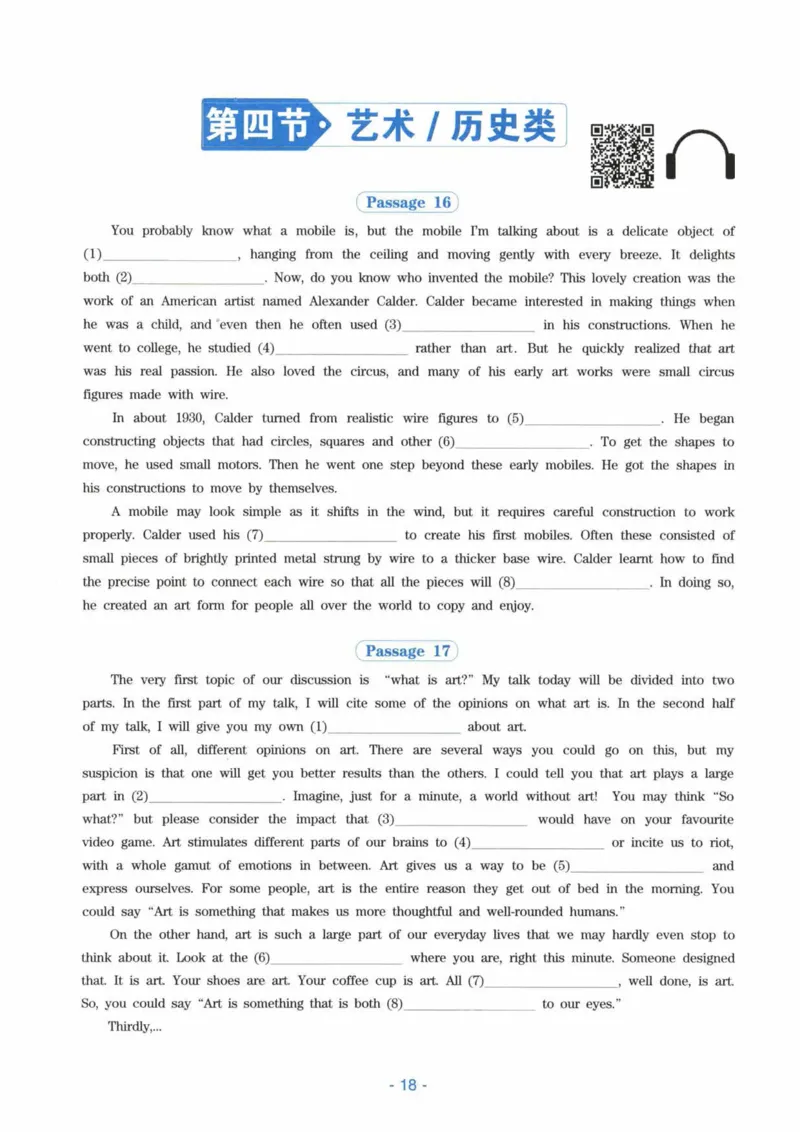
(专八听力 >是一本严格按照最新英语专业八级考试大纲要求编写的听力读物。本书提供了海题的听力训练题
以及相关的主题同汇讲解,帮助专八考生进行听力、词汇双突破。
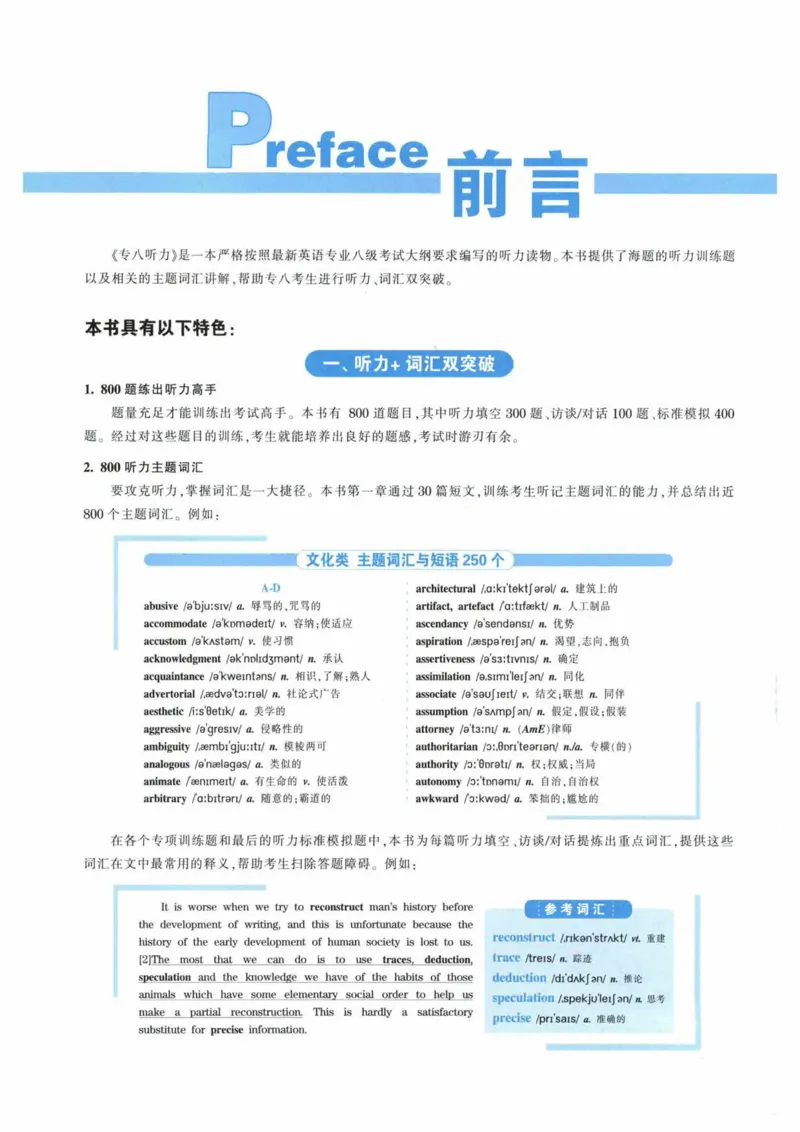
本书具有以下特色:
1. 800题练出听力高手
题M 充足才能训练出考试高手。本书有800道题目,其中听力填空300题、访谈/对话100题、标准模拟400
题。经过对这些题日的训练,考生就能培养出良好的题感,考试时游刃有余。
2. 800听力主题词汇
要攻克听力,掌握词汇是一大捷径。本书第一章通过30篇短文,训练考生听记主题词汇的能力,并总结出近
800个主题词汇。例如:
^ ■ ■ 1文化类主题词汇与短语250个
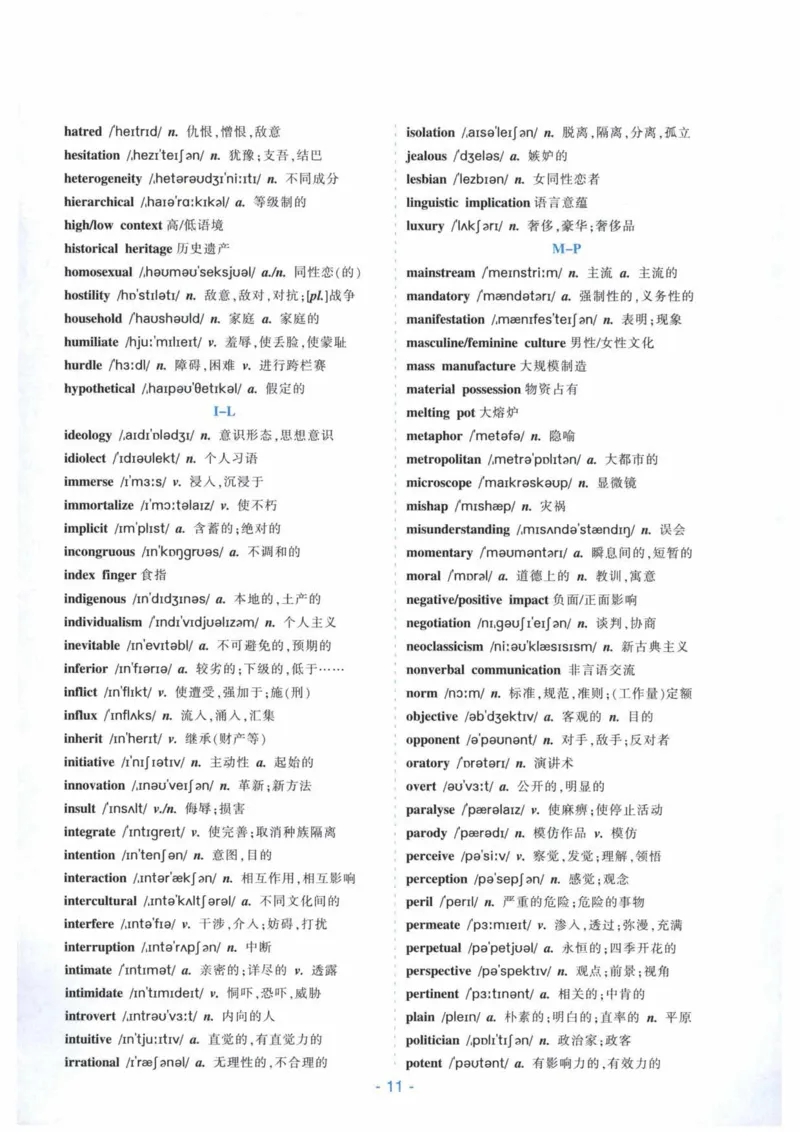
A-D architectural /.a:ki’tektjaral/ a. 违筑上的
abusive /a'bju:siv/ a .辱骂的,咒骂的 artifact^ artefact /a:tifsekt/ /t. 人 1.制品
accommodate /a'kDmadeit/ f. 荇纳;使适应 ascendancy /d'sendansi/ n.
accustom /akAstam/ v.使习惯 aspiration /.aespa reijan/ n•渴窀,志向.抱负
acknowledgment /9k nDlid3mant/ /*•承认 assertiveness /as3:tivms/ n .确定
acquaintance /a kwe丨ntans/ n .相识,f 解;熟人 assimi丨ation /a.simi’leij^n/ n•同化
advertorial AsBdvd'to: net/ n•社论式广告 associate /9'saujieit/ v.结交;联想 /i. 同伴
aesthetic /i:s'8etik/ a. $ 学的 assumption /a’SAmpJ an/ /i• 假定,假设;假装
aggressive /a’gresiv/ a .沒辂性的 attorney /0*t3:m/ n. (Am£)律师
ambiguity /.aembi'gju:iti/ /i.模棱两nf authoritarian /3:.0Dri tearian/ /!./〇. 令横(的)
analogous /9'naelagas/ a .类似的 authori丨y A):’0nrat丨/n. 权;权威;当局
animate /aenime丨t/ «• 有生命的v. 使活泼 autonomy /:):’tnnami/ n .自治,ft 治权
arbitrary /*a:bitrari/ a .随意的;fi ifi 的 awkward /b:kwed/ a .笨拙的;祖尬的
在各个专项训练题和最后的听力标准模拟题中,本书为每篇听力填空、访谈/对话提炼出® 点词汇,提供这些
词汇在文中最常用的释义,帮助考生扫除答题障碍。例如:
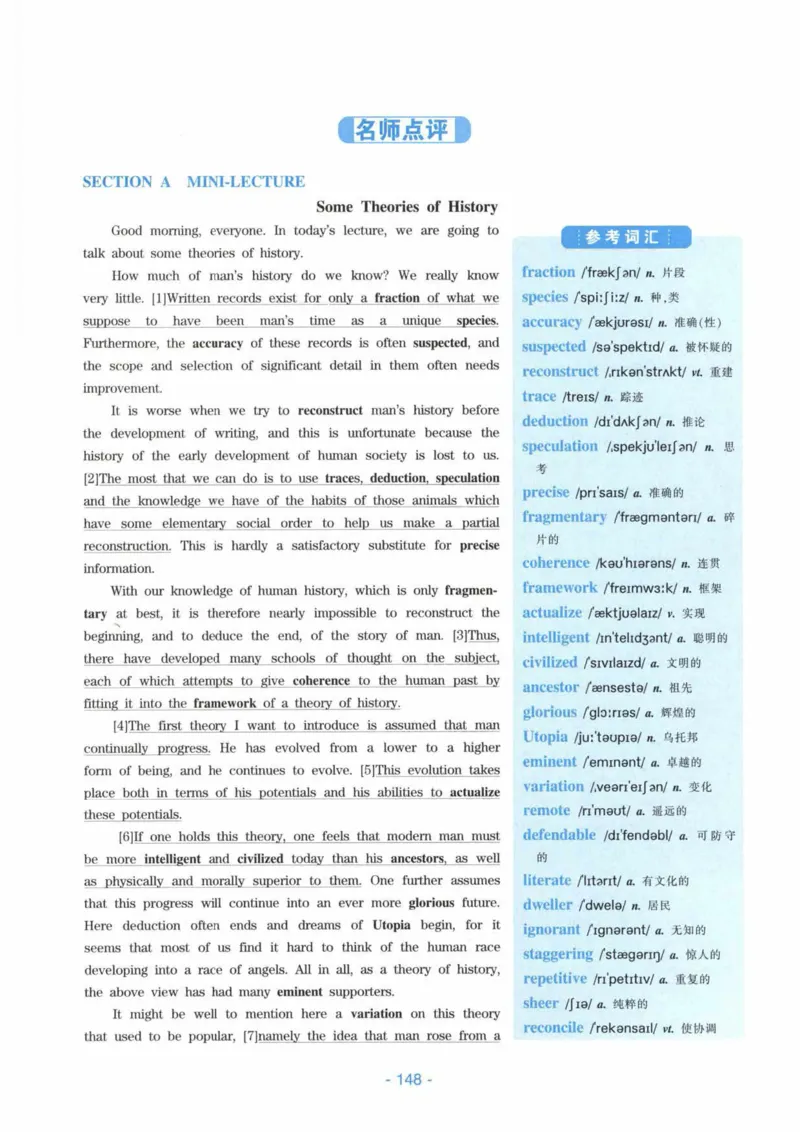
It is worse when we try to reconstruct man's history before
the development of writing, and this is unfortunate because the
history of the early development of human society is lost to us. reconstruct /.nkenstrAkt/ w.
[2]The _ most that we can do is to use traces, deduction, trace /treis/ n.踪迹
speculation and the knowledge we have of the habits of those deduction /di’dAkJan/ 推论
animals which have souu* (*h»montaiy social order to help us
speculation /.spekjuleijan/a
make a partial reconstruction. This is hardly a satisfactory
precise /pri sais/ a.准确的
substitute for precise information.二、专项+ 套题分阶突破
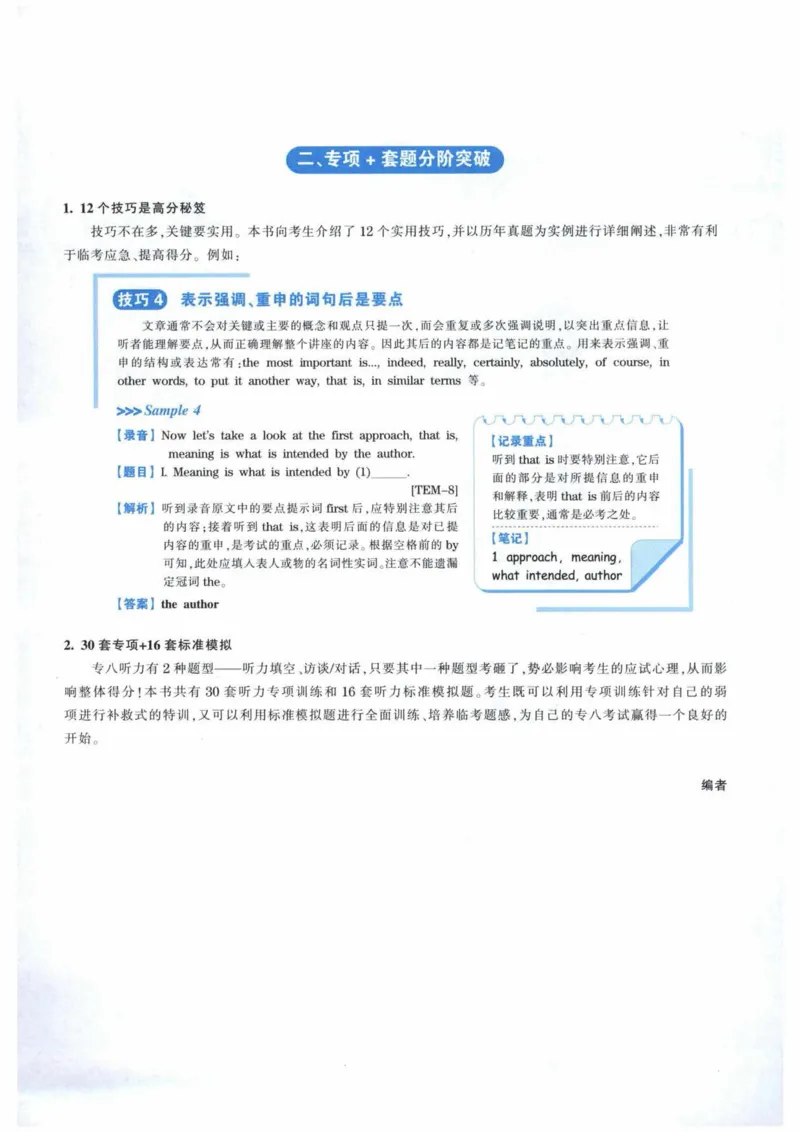
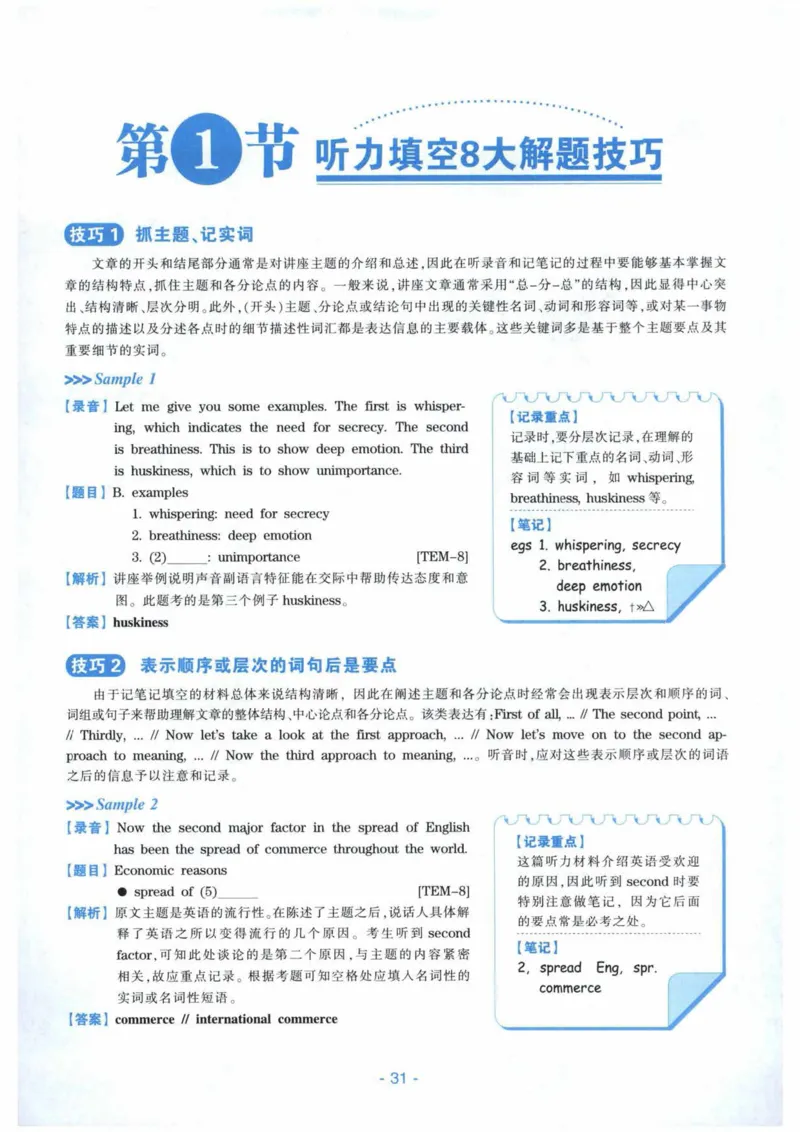
1. 12个技巧是高分秘笈
技巧不在多,关键要实用。本书向考生介绍了 12个实用技巧,并以历年真题为实例进行详细阐述,非常有利
于临考应急、提高得分。例如:
表示强调、重申的词句后是要点
文章通常不会对关键或主要的槪念和观点只提一次,而会重复或多次强调说明,以突出重点信息,让
听者能理解要点,从而正确理解粮个讲座的内容。因此其后的内容都是记笔记的重点。用来表示强调、t
申的结构或表达常有:the most important is..., indeed, really, certainly, absolutely, of course, in
other words, to put it another way, that is, in similar terms 等。
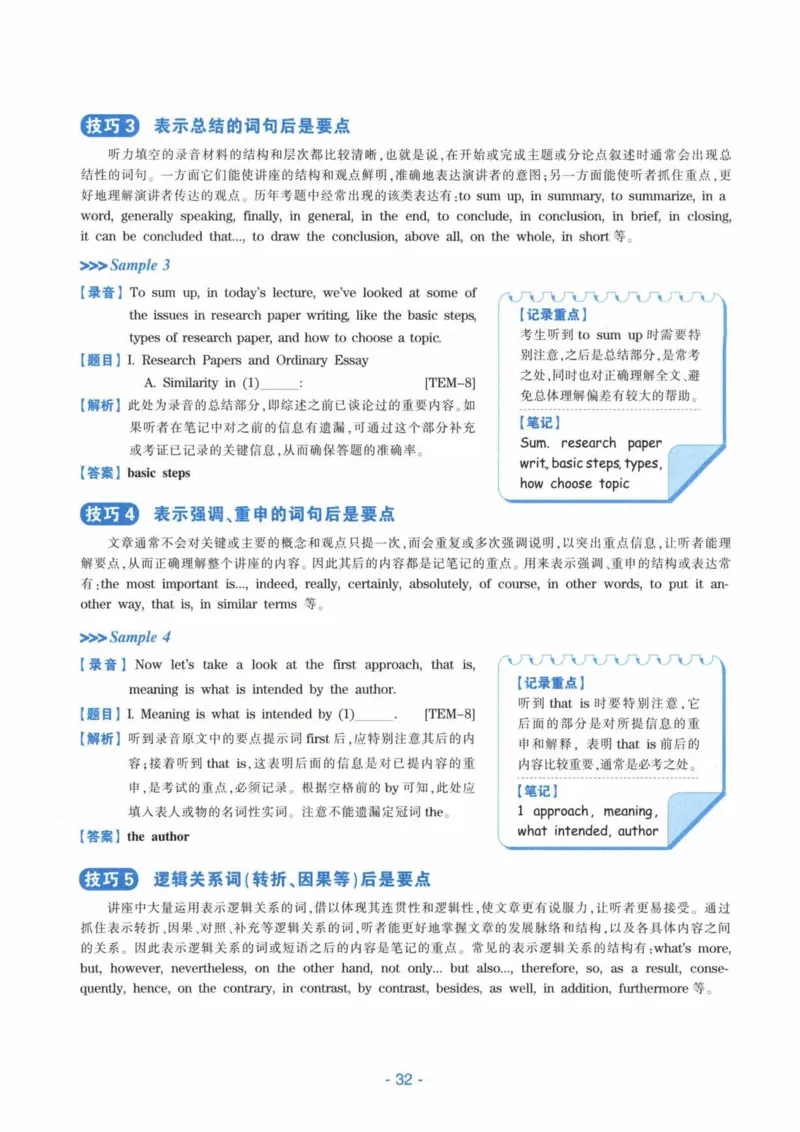
»> Sample 4
【录音】Now let’s take a look at the first approach, that is,
【记录重点】
meaning is what is intended by the author.
听到that is时要特别注意,它后
【題目】L Meaning is what is intended by (1)______•
面的部分是对所提信息的亟中
[TEM-8]
和解释,表明that is前后的内容
【解析】听到录音原文中的要点提示词first后,应特别注意其后
比较重要,通常是必考之处。
的内容;接着听到that is,这表明后面的信息是对已提
【笔记r
内容的重申,是考试的觅点,必须记录。根据空格前的by
1 approach, meaning,
可知,此处应填入表人或物的名词性实词。注意不能遗漏
what intended, author
定冠词the。
【答案】the author
2. 30套专项+16套标准模拟
专八听力有2 种题型—— 听力填空、访谈/对话,只要其中一种题型考砸势必影响考生的应试心理,从而影
响幣体得分!本书共有30套听力专项训练和16套听力标准模拟题。考生既可以利用专项训练针对自己的弱
项进行补救式的特训,又可以利用标准模拟题进行全面训练、培养临考题感,为自己的专八考试眹得一个良好的
开始。
编者第一章3 0 篇短文记关键词
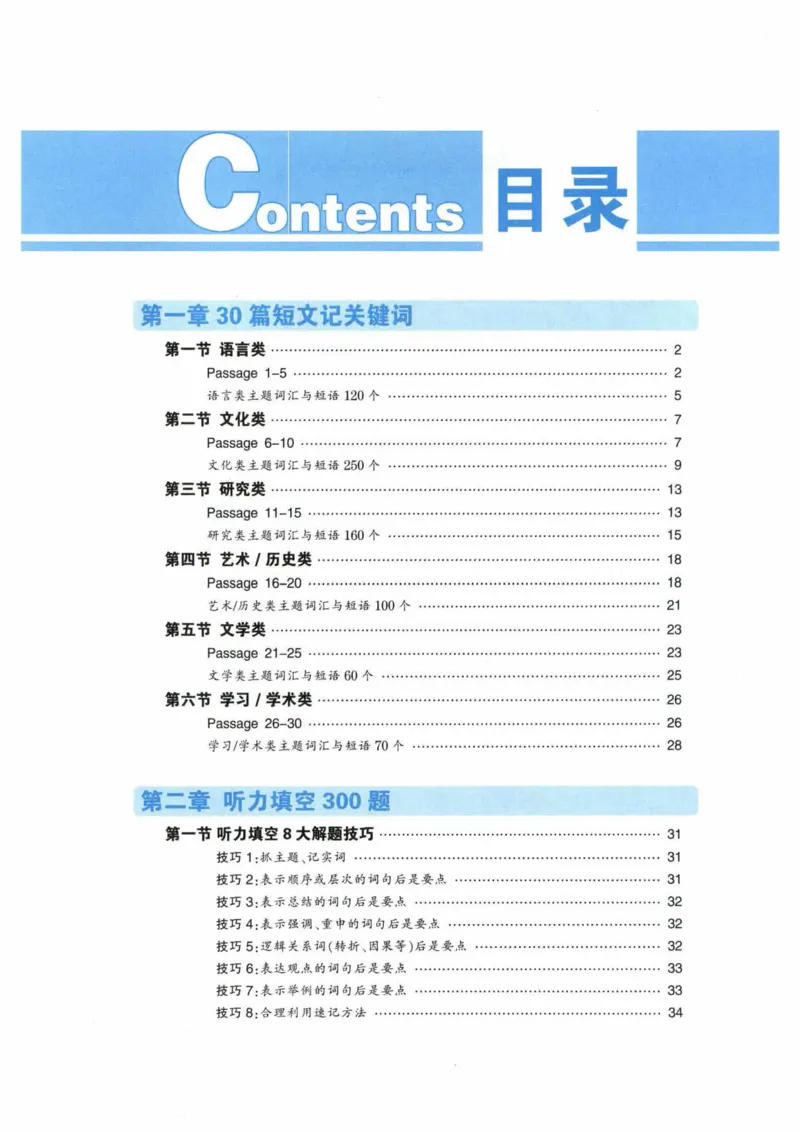
第一节语言类...................................................................................................................2
Passage 1-5 .......................................................................................................... 2
语言类主題词汇与短语120个 ...............................................5
第二节文化类...................................................................................................................7
Passage 6-10........................................................................................................ 7
文化类主題词汇与短语250个 ...............................................9
第三节研究类.................................................................................................................13
Passage 11-15..................................................................................................... 13
研究类主题词汇与短语160个 ...............................................................................15
第四节艺术/历史类....................................................................................................18
Passage 16-20..................................................................................................... 18
艺术/历史类主題词汇与短语100个 .........................................21
第五节文学类.................................................................................................................23
Passage 21-25 ..................................................................................................... 23
文学类主題词汇与短语60个 ...............................................25
第六节学习/学术类...................................................................................................26
Passage 26-30 ..................................................................................................... 26
学习/学术类主題词汇与短语70个 ..........................................28
第二章听力填空300题
第一节听力填空8 大解®技巧..................................................................................31
技巧1:抓主題、记实词................................................... 31
技巧2:表示顺序或层次的词句后是要点...................................31
技巧3:表示总结的词句后是要点......................................... 32
技巧4:表示译调、重申的词句后是要点..............................................................32
技巧5:逻辑关系词(转折、因果等)后是要点............................... 32
技巧6:表达观点的词句后是要点......................................... 33
技巧7:表示举例的词句后是要点........................................................................33
技巧8:合理利用速记方法................................................34第二节听力填空训练300题
..................................................... 35
Test 1 ....................................................................... 35
Test 2 ....................................................................... 38
Test 3 ....................................................................... 42
Test 4 ....................................................................... 45
Test 5 ....................................................................... 49
Test 6 ....................................................................... 53
Test 7 ....................................................................... 56
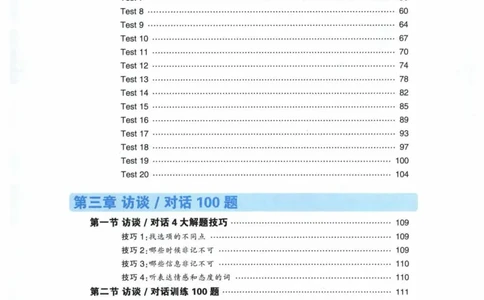
Test 8 ....................................................................... 60
Test 9 ....................................................................... 64
Test 10 ...................................................................... 67
Test 11 ...................................................................... 70
Test 12 ...................................................................... 74
Test 13 ...................................................................... 78
Test 14 ...................................................................... 82
Test 15 ...................................................................... 85
Test 16 ...................................................................... 89
Test 17 ...................................................................... 93
Test 18 ...................................................................... 97
Test 19 .................................................................... 100
Test 20 .................................................................... 104
第三章访谈/ 对 话 100题
第一节访谈
/
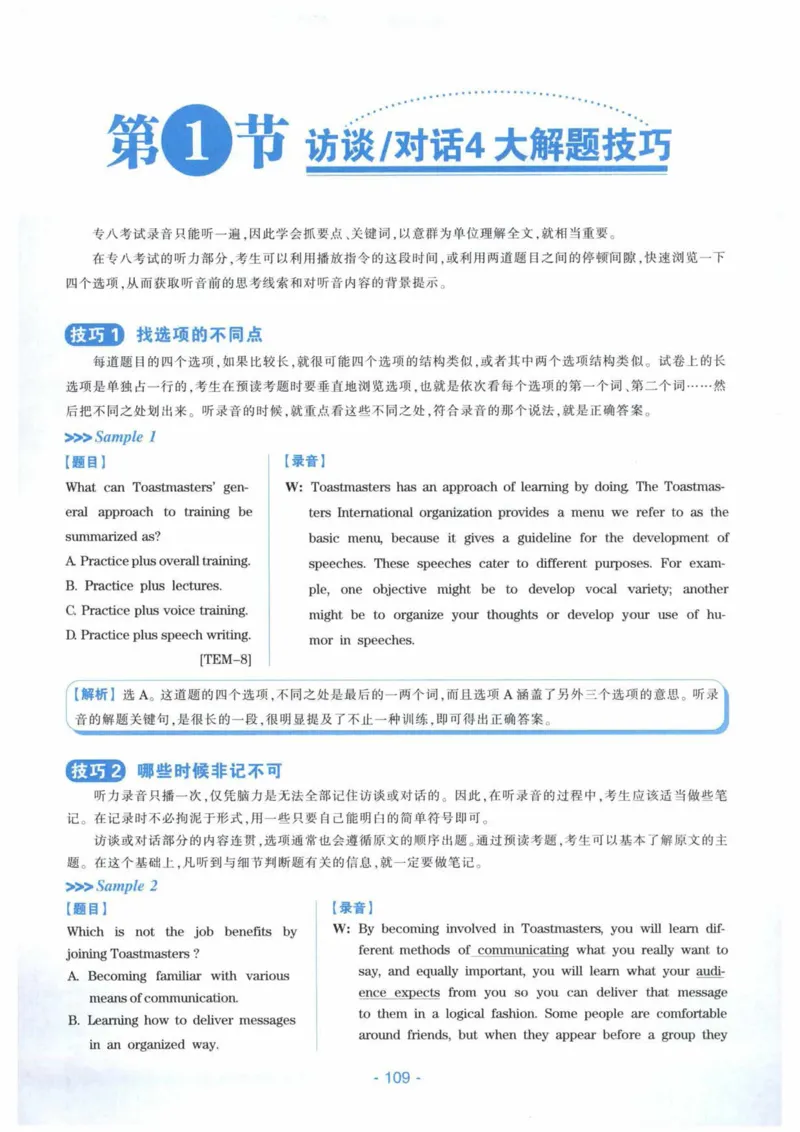
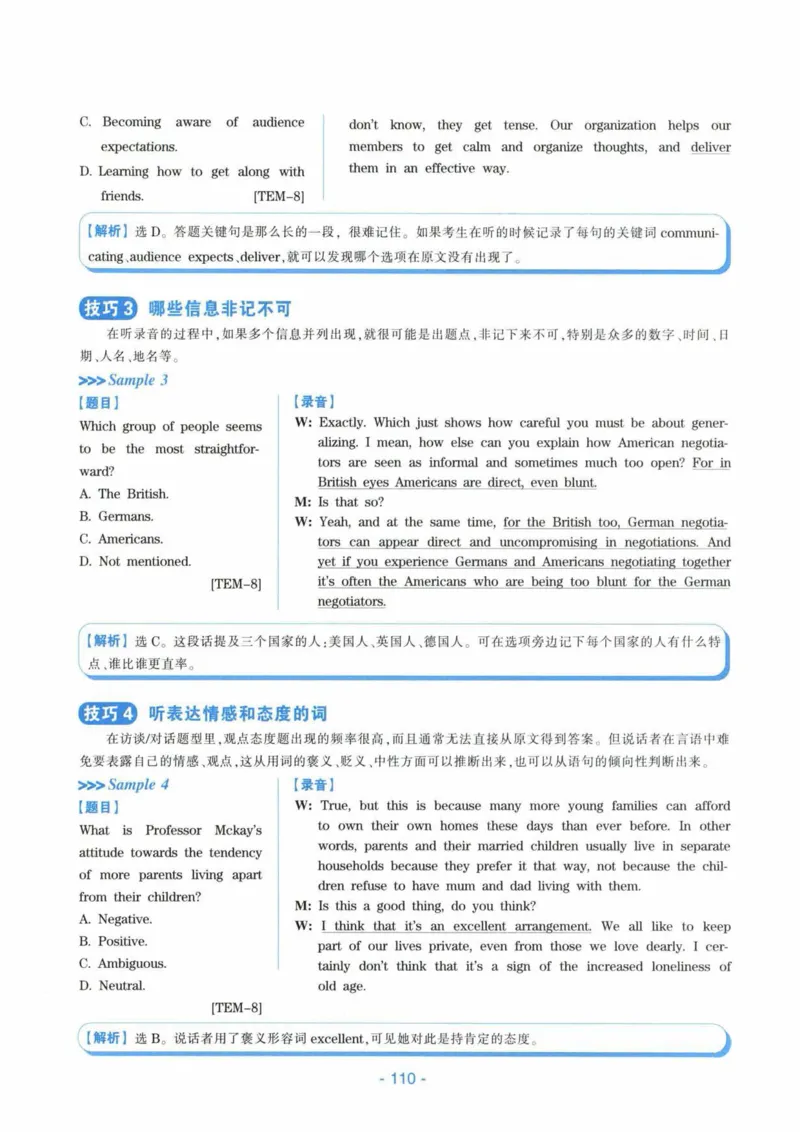
对话4 大解题技巧
............................................... 109
技巧1:找选项的不同点.....................................................109
技巧2:哪些时候非记不可...................................................109
技巧3:哪些信息非记不可...................................................110
技巧4 :听表达情感和态度的词..............................................110
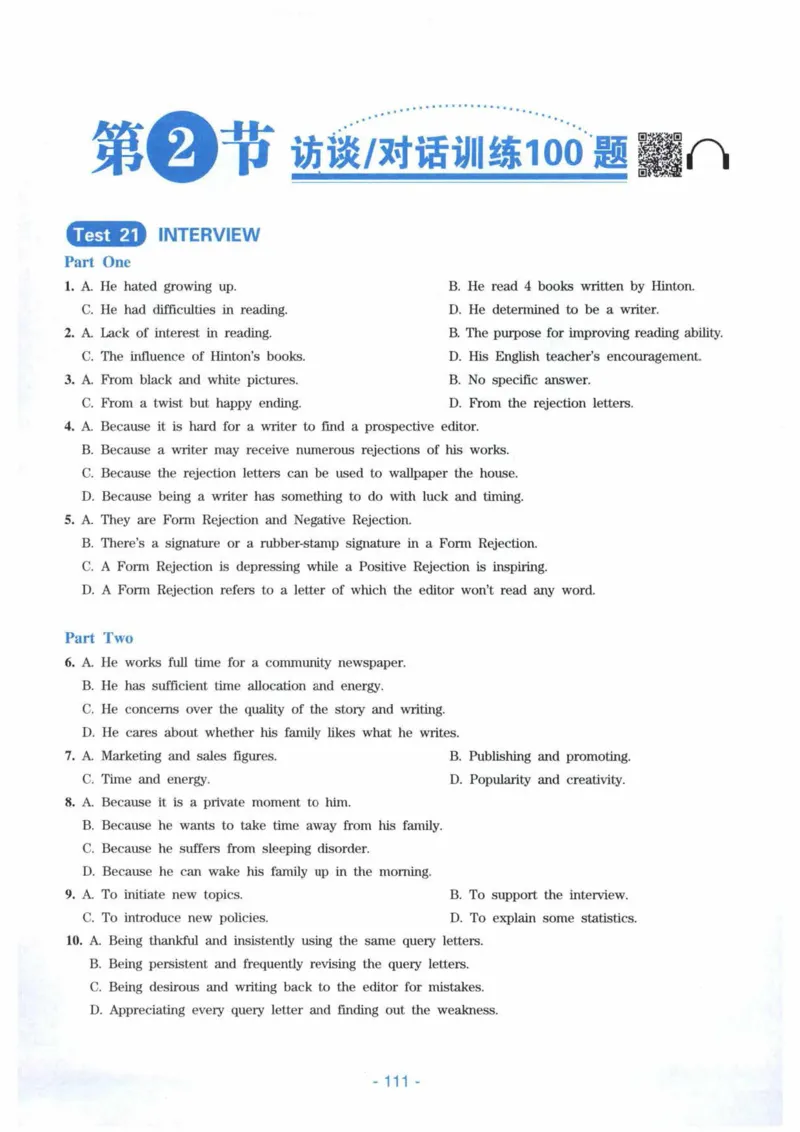
第二节访谈/ 对话训练100题 ........................................................................111
Test 21 .................................................................... 111
Test 22 .................................................................... 114
Test 23 .................................................................... 118
Test 24 .................................................................... 121
Test 25 .................................................................... 124
Test 26 .................................................................... 128
Test 27 .................................................................... 131
Test 28 .................................................................... 135
Test 29 .................................................................... 138
Test 30 .................................................................... 141第四章标准模拟400题
Model Test 1 ................................................................................................. 146
Model Test 2 ................................................................................................. 154
Model Test 3 ................................................................... 162
Model Test 4 ................................................................................................. 170
Model Test 5 ................................................................................................. 177
Model Test 6 ................................................................................................. 185
Model Test 7 ................................................................................................. 193
Model Test 8 ...................................................................................................201
Model Test 9 ...................................................................................................209
Model Test 10.................................................................................................217
Model Test 11.................................................................................................225
Model Test 12.................................................................................................233
Model Test 13.................................................................................................241
Model Test 14.................................................................................................248
Model Test 15.................................................................................................255
Model Test 16.................................................................................................262
附录常用笔记符号....................................................................2703 0
篇 短 文 记 关 键 词
我们知道,如果没有掌握一定的词汇量,一切的英语学习都会举步
维艰。而在听力方面,若能快速抓住相关的主题词汇,则有助于我们迅速
了解文章大意。本章精选出30篇代表性强、主题鲜明的短文,以挖空听写的
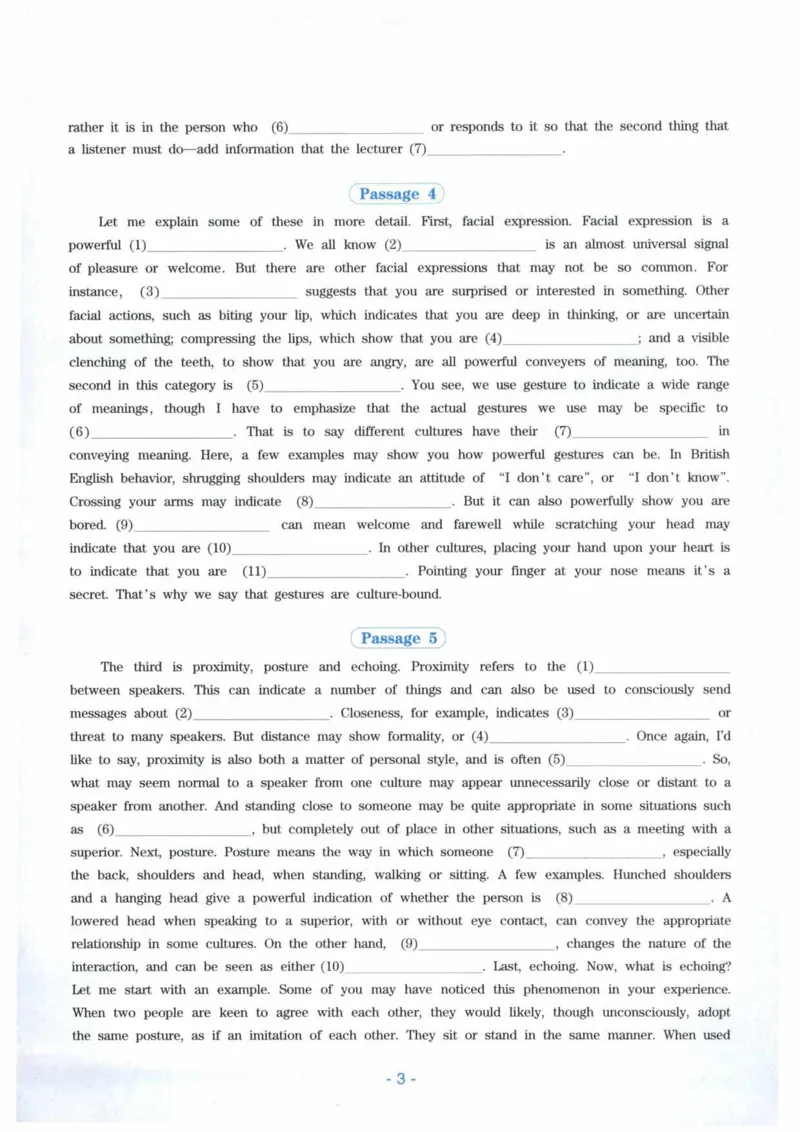
形式训练考生抓听关键词的能力。rather it is in the person who (6)_______________________ or responds to it so that the second thing that
a listener must do—add information that the lecturer (7)_______________________•
Passage 4
Let me explain some of these in more detail. First, facial expression. Facial expression is a
powerful (1) . We all know (2) is an almost universal signal
of pleasure or welcome. But there are other facial expressions that may not be so common. For
instance, (3) suggests that you are surprised or interested in something. Other
facial actions, such as biting your lip, which indicates that you are deep in thinking, or are uncertain
about something; compressing the lips, which show that you are (4)_______________________; and a visible
clenching of the teeth, to show that you are angry, are all powerful conveyers of meaning, too. The
second in this category is (5)_________________________. You see, we use gesture to indicate a wide range
of meanings, though I have to emphasize that the actual gestures we use may be specific to
(6)_________________________. That is to say different cultures have their (7)— in
conveying meaning. Here, a few examples may show you how powerful gestures can be. In British
English behavior, shrugging shoulders may indicate an attitude of “I don’t care”,or “I don’t know".
Crossing your arms may indicate (8)________________________. But it can also powerfully show you are
bored. (9) can mean welcome and farewell while scratching your head may
indicate that you are (10)_______________________ . In other cultures, placing your hand upon your heart is
to indicate that you are (11)________________________• Pointing your finger at your nose means it*s a
secret. That’s why we say that gestures are culture-bound
The third is proximity, posture and echoing. Proximity refers to the (1)
between speakers. This can indicate a number of things and can also be used to consciously send
messages about (2)________ Closeness, for example, indicates (3)_ — or
threat to many speakers. But distance may show formality, or (4)_______________________ • Once again, I’d
like to say, proximity is also both a matter of personal style, and is often (5)_______________________ . So,
what may seem normal to a speaker from one culture may appear unnecessarily close or distant to a
speaker from another. And standing close to someone may be quite appropriate in some situations such
as (6)_______________________ , but completely out of place in other situations, such as a meeting with a
superior. Next, posture. Posture means the way in which someone (7)_______________________ f especially
the back, shoulders and head, when standing, walking or sitting. A few examples. Hunched shoulders
and a hanging head give a powerful indication of whether the person is (8)________________________. A
lowered head when speaking to a superior, with or without eye contact, can convey the appropriate
relationship in some cultures. On the other hand, (9)_______________________ , changes the nature of the
interaction, and can be seen as either (10)_______________________ . Last, echoing. Now, what is echoing?
Let me start with an example. Some of you may have noticed this phenomenon in your experience.
When two people are keen to agree with each other, they would likely, though unconsciously, adopt
the same posture, as if an imitation of each other. They sit or stand in the same manner. When used
3
- -in this way, echoing appears to complement the (11)_______________________ • Of course, when such
imitation is carried out consciously, it often indicates that someone is (12) at
another speaker.
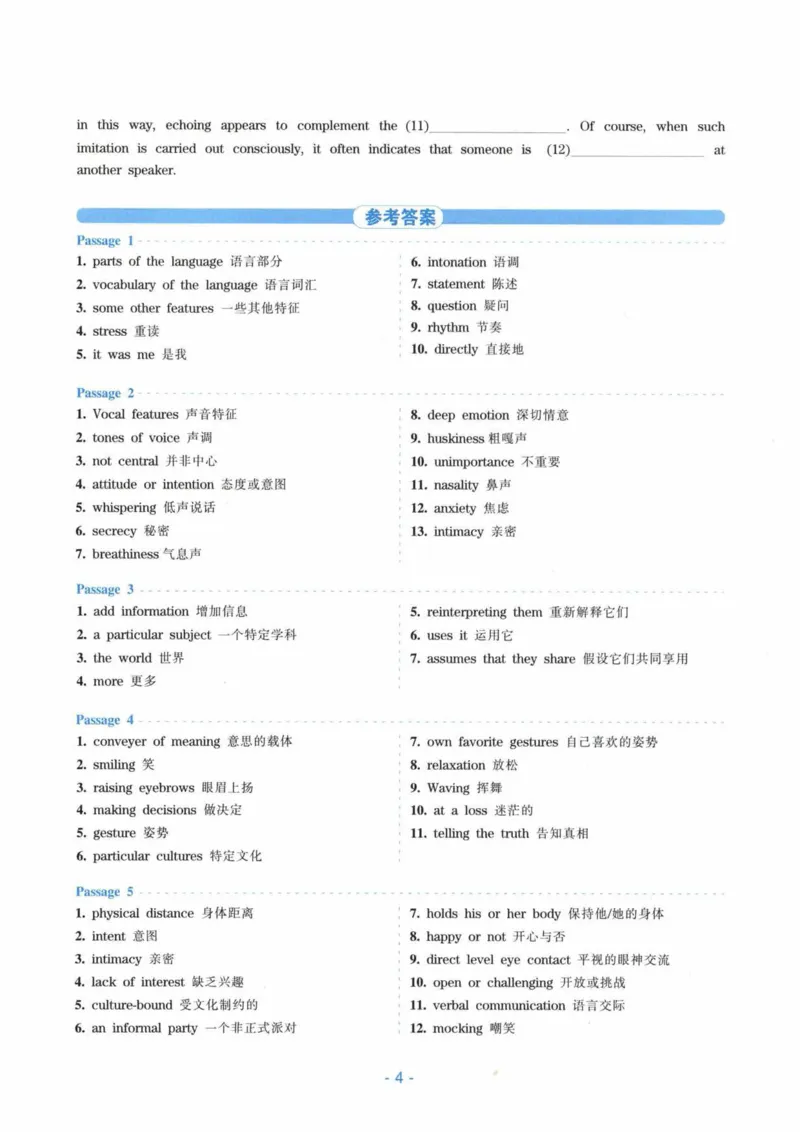
参考答案
Passage 1......
1. parts of the language 语言部分 6. intonation 语调
2. vocabulary of the language 语言词汇 7. statement 陈述
3. some other features —些其他特征 8. question 疑问
4. stress ® 读 9. rhythm 节奏
10. directly 直接地
5. it was me 是我
Passage 2 ---------------
1. Vocal features 声音特征 8. deep emotion 深切情意
2. tones of voice 声调 9. huskiness 粗嘎声
3. not central并非中心 10. unimportance 不欺要
I
4. attitude or intention 态度或意图 11. nasality 羚声
5. whispering低声说话 12. anxiety 焦虑
6. secrecy 秘密 13. intimacy 亲密
7. breathiness 气息卢
Passage 3 ............
1. add information 增加信息 5. reinterpreting them ® 新解释它们
2. a particular subject —个特定学科 6. uses it运用它
3. the world 世界 7. assumes that they share假设它们共同享用
4. more更多
Passage 4 ........................
1. conveyer of meaning 意思的载体 7. own favorite gestures自己喜欢的姿势
2. smiling 笑 8. relaxation 放松
3. raising eyebrows 眼眉上扬 9. Waving 挥舞
4. making decisions 做决定 10. at a loss 迷茫的
5. gesture 姿势 11. telling the truth 告知處相
6. particular cultures 特定文化
Passage 5 ...........................
1. physical distance 身体距离 7. holds his or her body保持他/她的身体
2. intent 意图 8. happy or not开心与否
3. intimacy 亲密 9. direct level eye contact 平视的眼神交流
4. lack of interest 缺乏兴趣 10. open or challenging 幵放或挑战
5. culture-bound受文化制约的 11. verbal comniunication 语言交际
6. an informal party —个非正式派对 12. mocking 嘲笑
4
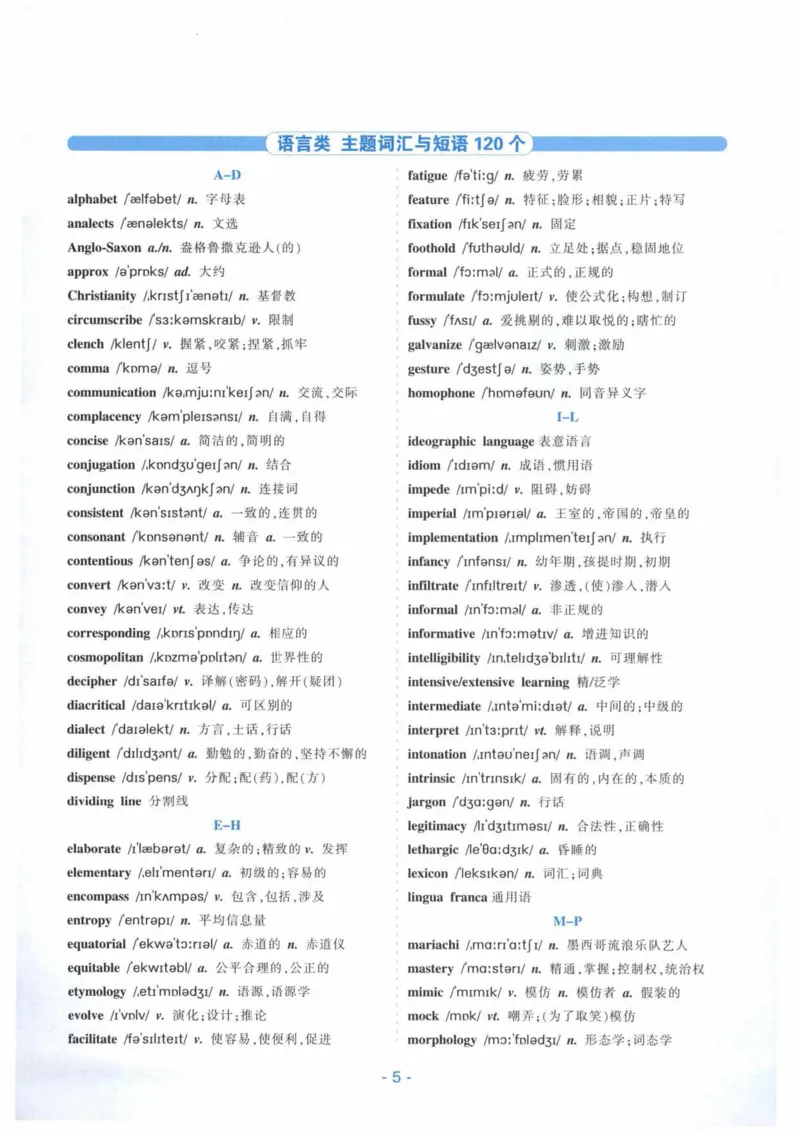
- -« ■ ■ ■ ■ ■ ■ ■ ■ ■ ■ ■匾语言类主题词汇与短语120个 :
A-D fatigue /f‘ti:g/ /!• 疲劳,劳累
alphabet /aelfebet/ n. 字母表 feature /I• 特征;脸形;相貌;正片;特写
analects /aenalekts/ /i•文选 fixation /fik’seij an/ /!•固定
Anglo-Saxon fl./n• 盎格待撒克逊人(的) footho丨d /futhauld/ /i.立足处;据点,稳间地位
approx /a.pmks/ d •大约 formal 正式的,正规的
Christianity /.kristji aenati/ n•堪督教 formulate /*f〇:mjuleit/ v• 使公式化;构想,制汀
circumscribe /*S3:kamskraib/ v•限制 fussy /fASi/tf.爱挑剔的,难以取悦的;瞎忙的
I
clench /klentJV v.握紧,咬紧;捏紧,抓牢 galvan丨ze /gaelvanaiz/ v.剌激;激励
comma /koma/ /i•逗号 gesture AJ3estJa/ /I.姿势,手势
communication /ka.mjumi'keijan/ n .交流,交际 homophone /hmmafaun/ /!•同音异义字
complacency /kampleisansi/ /i. fl 满,fl 得 I-L
concise /kan’sais/ a.简洁的,简明的 ideographic language 表意语言
conjugation /,kDnd3u'geiJ an/ n. 结合 idiom /*idiam/ /i.成语,惯用语
conjunction /kan’d3Ar]kj^n/ n•连接词 impede /im’pi:d/ v• 阻碍,妨碍
consistent /kan’sistant/ a.—致的,连货的 imperial /mVpi0ri9l/〇• 王室的,帝国的,帝皇的
♦
consonant /*knnsanant/ /i•辅音 a. —致的 implementation /.implimen'teijan/ n. tt.fr
contentious /kantenjas/ 亿 争论的,有#议的 infancy /infansi/ n.幼年期,孩提时期,初期
convert /kanV3:t/ v• 改 变 w. 改变信仰的人 infiltrate Anfiltreit/ v• 渗透,(使)渗入,潜人
convey /kan’vei/ v/.表达,传达 informa丨 /irVf3:mal/tf•非正规的
corresponding /.korispnndir]/ a. 相应的 informative /info:mativ/ fl•增进知识的
cosmopolitan /.knzma’pDlitan/ a. 世界性的 intelligibility /in.telid3‘biliti/ w•可理解性
I
decipher /di’sarfa/ v.译解(密码),解开(疑团) intensive/extensive 丨earning 精/泛学
diacrit丨cal /daia'kritikal/ a•可区别的 intermediate /,intaVni:diat/ a.中间的;中级的
dia丨ect ,daialekt/ w•方 n ,土话,行话 interpret /irVt3:prit/ v/•解释,说明
dUigem /dilid33nt/fl• 勤勉的,勤奋的,坚持不懈的 intonation /.intauneijan/ n.语调,声调
dispense /dis'pens/ v.分配;配(药),配(方) intrinsic /in'trinsik/fl• 固有的,内在的,本质的
dividing丨ine分割线 jargon fd^Qiqen/ n. 行话
E-H legitimacy /Ii'd3itimasi/ n• 合法性,正确性
elaborate /I’laebarat/ a. 杂的;精致的 v•发挥 lethargic /Ie’0a:d3ik/ a. S•睡的
elementary /.eli’mentari/at• 初级的;矜易的 lexicon /leksikan/ /i.词汇;词典
encompass /irVkAmpas/ v.包含,包括,涉及 lingua franca 通用语
entropy /"entrapi/ /!•平均信息 tt M-P
equatoria丨 /*ekwa't〇:rial/ •赤道的 it. 赤道仪 mariadii /.mcKri’CKtjV n. ® 两哥流浪乐队艺人
equitable /*ekwitabl/fl• 公平合理的,公正的 mastery /ma:stari/ w• 精通,掌捤;控制权,统治权
etymology /.etiVnDlad3i/ 源,ift源学 mimic /Vmmik/ v•模 仿 /I.模仿者a.假装的
evolve /I'volv/ v. 演化;设计;推论 mock /mDk/ v/• 嘲厍;(为了取笑)模仿
facilitate /fa’siliteit/ v.使容易,使便利,促进 morpho丨ogy /mo:’fr)lad3i/ /I• 形态学;词态学
- 5
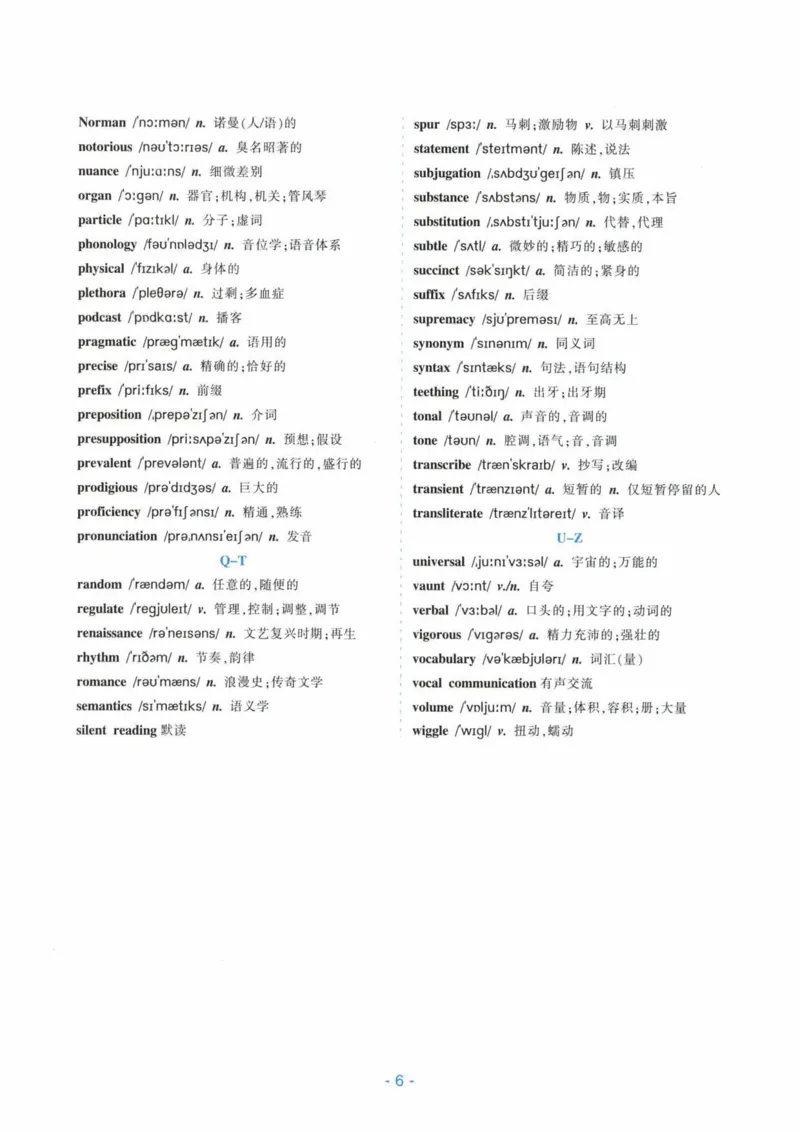
-Norman /*no:man/ /i.谈46(人/语)的 spur /sp3:/ /i• 马刺;激励物v. 以马刺刺激
I
notorious /nau'to:rias/ •臭名昭著的 statement /"steitmant/ n• 陈述,说法
nuance /*nju:a:ns/ n.细微差别 subjugation /,SAbd3ugeiJ an/ n, 镇压
organ /*o:gan/ /i.器官;机构,机关;管风琴 substance /sAbstans/ n.物质,物;实质,本旨
particle /*pa:tikl/ /!•分子;虚词 substitution /•SAbsti’tju:Jan/ /!• 代替,代理
phono丨ogy /fau'nnlad3i/ /!• 音位学;语音体系 subtle/sAtl/o• 微妙的;精巧的;敏感的
physical Aizikal/ a. 身体的 succinct /sak’sirjkt/ a• 简洁的;紧身的
plethora /ple0ara/ w.过剩;多血症 suffix /*SAfiks/ /I•后缀
podcast /pr>dka:st/ n•播客 supremacy /sju premasi/ /i. 至高无上
pragmatic /praeg'maetik/ a. ift 用的 synonym /sinanim/ /i. 同义词
precise /pri'sais/ a• 挤确的;恰好的 syntax /sintaeks/ n.句法,语句结构
prefix /priifiks/ n. 前缀 teething /ti:&ir]/ /i.出牙;出牙期
preposition /.prepa’zij" an/ /i•介词 tona丨/taunel/ 〇• 声音的,音调的
presupposition /pri:SApa’zij3n/ /i.预想;假设 tone /t9un/ /!• 腔调,语气;音,音调
i
prevalent /prevalant/a.普遍的,流行的,盛行的 transcribe /traen'skraib/ v.抄写;改编
prodigious /pra'did3as/ a. 巨大的 transient /traenziant/fl.短暂的/I. 仅短暂停留的人
proficiency /pr‘fiJansi/ /i• 精通,熟练 transliterate /traenzlitareit/ v•音译
pronunciation /prarwnsi’eij an/ /i•发音 U-Z
Q-T universa丨 /ju:ni’V3:S3l/fl• 宇宙的;万能的
random /raendam/ a.任意的,随便的 vaunt /vo:nt/ v.//i.自夸
regulate /regjuleit/ v•管理,控制;调整,调节 verbal/V3:b3l/fl• 口头的;用文字的;动词的
renaissance /ra’neisans/ /!• 文艺复兴时期;冉生 vigorous /vigaras/ a• 精力充沛的;强壮的
rhythm /ViSam/ /I.节奏,韵律 vocabulary /va’kaebjulari/ n•词汇(fit)
romance /rauVnaens/ /!• 浪漫史;传奇文学 vocal communication 有声交流
semantics /si’maetiks/ w. 语义学 volume /VDlju:m/ /I• 音W;体积,容积;册;大M
silent reading 默读 wiggle /*wigl/ v• 扭动,蝴动
6
- -Aft" H H,
► 文 化 类
第 一 p
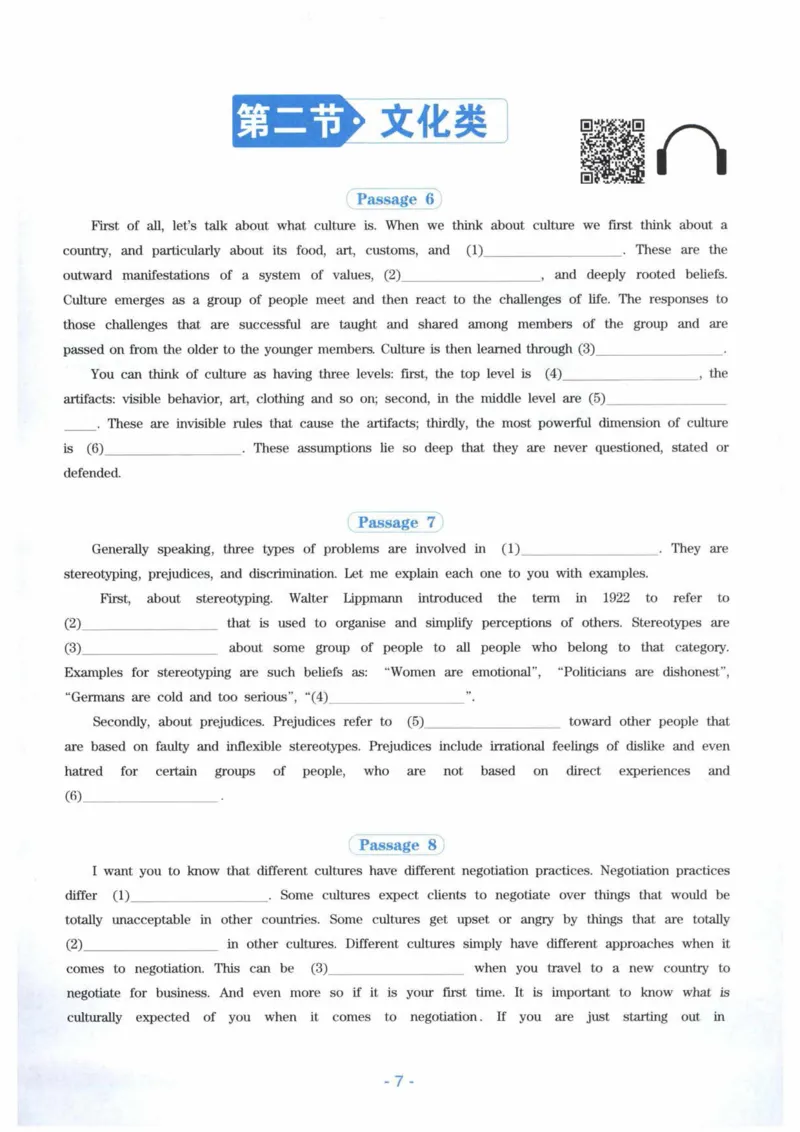
Passage 6
First of all, let^ talk about what culture is. When we think about culture we first think about a
country, and particularly about its food, art, customs, and (1)________________________. These are the
outward manifestations of a system of values, (2)________________________, and deeply rooted beliefs.
Culture emerges as a group of people meet and then react to the challenges of life. The responses to
those challenges that are successful are taught and shared among members of the group and are
passed on from the older to the younger members. Culture is then learned through (3)______________________•
You can think of culture as having three levels: first, the top level is (4)_______________________ , the
artifacts: visible behavior, art, clothing and so on; second, in the middle level are (5)
. These are invisible rules that cause the artifacts; thirdly, the most powerful dimension of culture
is (6)_______________________ . These assumptions lie so deep that they are never questioned, stated or
defended.
Passage 7
Generally speaking, three types of problems are involved in (1)______________________ . They are
stereotyping, prejudices, and discrimination. Let me explain each one to you with examples.
First, about stereotyping. Walter Lippmann introduced the term in 1922 to refer to
(2)_ ______________________ that is used to organise and simplify perceptions of others. Stereotypes are
(3)_ ______________________ about some group of people to all people who belong to that category.
Examples for stereotyping are such beliefs as: “Women are emotional”, “Politicians are dishonest”,
“Germans are cold and too serious”,“(4)_______________________'
Secondly, about prejudices. Prejudices refer to (5)_______________________ toward other people that
are based on faulty and inflexible stereotypes. Prejudices include irrational feelings of dislike and even
hatred for certain groups of people, who are not based on direct experiences and
⑹ _______________________•
Passage 8
I want you to know that different cultures have different negotiation practices. Negotiation practices
differ (1)________________________• Some cultures expect clients to negotiate over things that would be
totally unacceptable in other countries. Some cultures get upset or angry by things that are totally
(2)_______________________ in other cultures. Different cultures simply have different approaches when it
comes to negotiation. This can be (3)_______________________ when you travel to a new country to
negotiate for business. And even more so if it is your first time. It is important to know what is
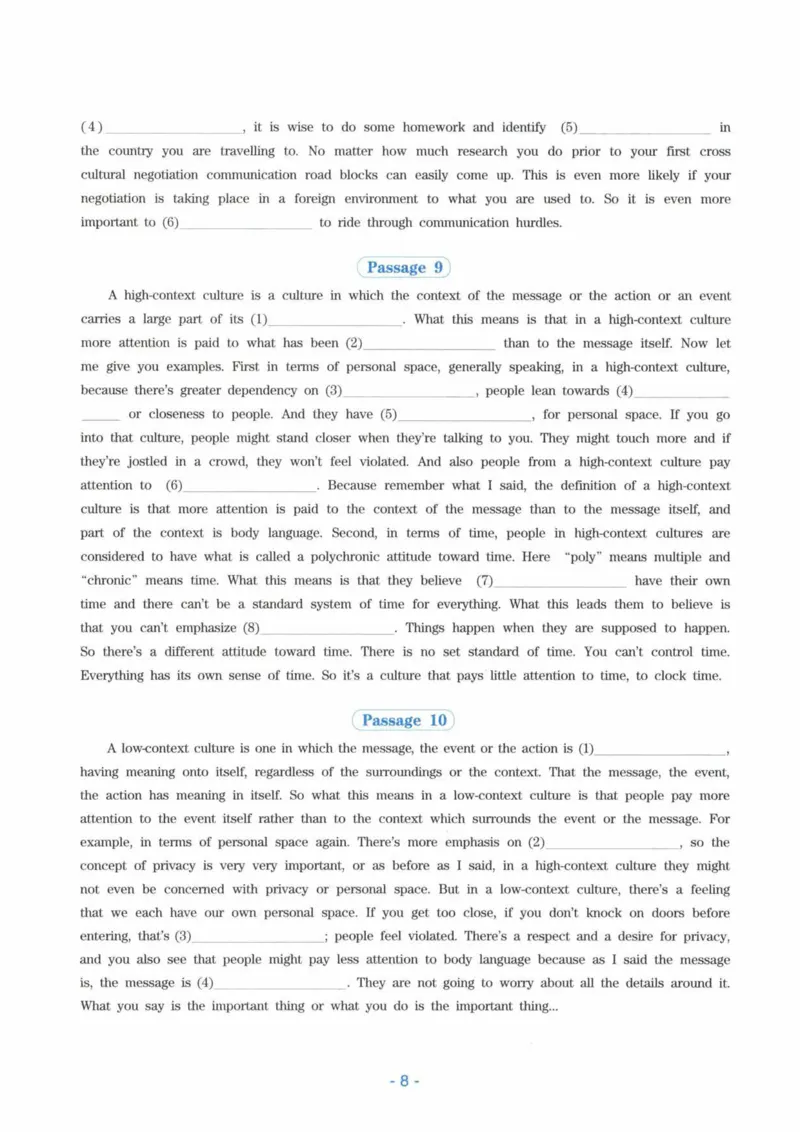
culturally expected of you when it comes to negotiation. If you are just starting out in(4) , it is wise to do some homework and identify (5) in
the country you are travelling to. No matter how much research you do prior to your first cross
cultural negotiation communication road blocks can easily come up. This is even more likely if your
negotiation is taking place in a foreign environment to what you are used to. So it is even more
important to (6)_______________________ to ride through communication hurdles.
Passage 9
A high-context culture is a culture in which the context of the message or the action or an event
carries a large part of its (1)_______________________. What this means is that in a high-context culture
more attention is paid to what has been (2)_______________________ than to the message itself. Now let
me give you examples. First in terms of personal space, generally speaking, in a high-context culture,
because there’s greater dependency on (3) , people lean towards (4)
or closeness to people. And they have (5)_______________________, for personal space. If you go
intx) that culture, people might stand closer when theyYe talking to you. They might touch more and if
theyVe jostled in a crowd, they won*t feel violated. And also people from a high-context culture pay
attention to (6)_______________________. Because remember what I said, the definition of a high-context
culture is that more attention is paid to the context of the message than to the message itself, and
part of the context is body language. Second, in terms of time, people in high-context cultures are
considered to have what is called a polychronic attitude toward time. Here "poly" means multiple and
"chronic" means time. What this means is that they believe (7)_______________________ have their own
time and there can^t be a standard system of time for everything. Wliat this leads them to believe is
that you can’t emphasize (8)_______________________. Things happen when they are supposed to happen.
So there's a different attitude toward time. There is no set standard of time. You can*t control time.
Everything has its own sense of time. So it^s a culture that pays little attention to time, to clock time.
Passage 10
A low-context culture is one in which the message, the event or the action is (1)_______________________,
having meaning onto itself, regardless of the surroundings or the context. That the message, the event,
the action has meaning in itself. So what this means in a low-context culture is that people pay more
attention to the event itself rather than to the context which surrounds the event or the message. For
example, in terms of personal space again. There^ more emphasis on (2) , so the
concept of privacy is very very important, or as before as I said, in a liigh-context culture they might
not even be concerned with privacy or personal space. But in a low-context culture, there's a feeling
that we each have oiir own personal space. If you get too close, if you don*t knock on doors before
entering, that’s (3)_________________people feel violated. There’s a respect and a desire for privacy,
and you also see that people might pay less attention to body language because as I said the message
is, the message is (4) . They are not going to worry about all the details around it.
What you say is the important thing or what you do is the important thing...
-8
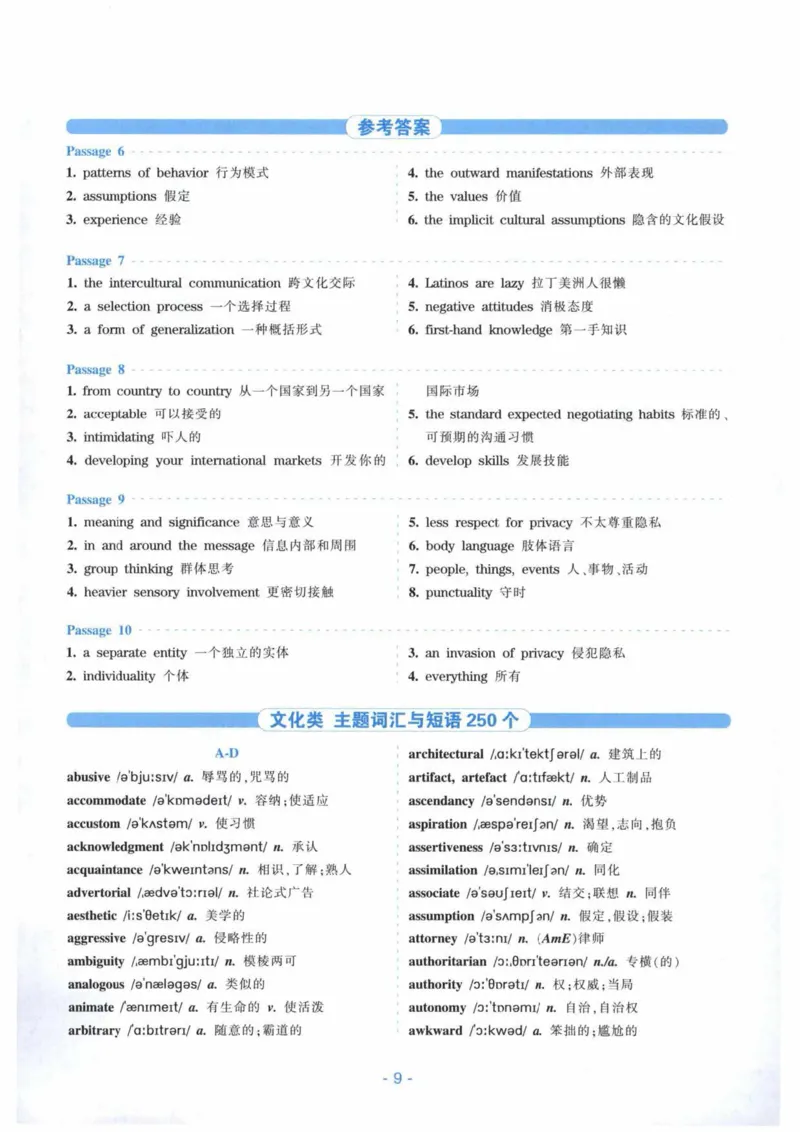
•u . … • 、参考苔栗
I’assdge 6 -•**•-,••-•••••••••••-•••••-••-•••-
1. patterns of behavior 行为模式 4. the outward manifestations 外部表现
2. assumptions 假定 5. the values 价值
3. experience 经验 6. the implicit cultural assumptions 隐含的文化假设
Passage 7 ......... -- ---
1. the intercultural communication 跨文化交际 4. Latinos are lazy拉丁美洲人很懒
2. a selection process —个选择过程 5. negative attitudes 消极态度
3. a form of generalization —种概括形式 6. first-hand knowledge 第一手知识
Passage 8 ——
1. from country to country从一个国家到另一个国家 国际市场
2. acceptable可以接受的 5. the standard expected negotiating habits 标准的、
3. intimidating 吓人的 可预期的沟通习惯
4. developing your international markets 开发你的 6. develop skills 发展技能
1. meaning and significance 意思与意义 5. less respect for privacy 不太约重隐私
2. in and around the message 信息内部和周FH 6. body language 肢体语言
3. group thinking 群体思考 7. people,things, events 人、啭物、活动
4. heavier sensory involvement 更密切接触 8. punctuality 守时
Passage 10.......................... ..........--
1. a separate entity 一个独立的实体 3. an invasion of privacy 侵犯隐私
2. individuality 个体 4. everything 所有
■ [ 文化类主题词汇与短语250个
AD architectural /.a:ki’tektjaral/ a•建筑上的
abusive /9'bju:siv/ a•辱骂的,5C骂的 artifact, artefact /aitifaekt/ n. AT$iJ〇p
accommodate /9'knmedeit/ v.容纳;使适应 ascendancy /a'sendansi/ n. 优势
accustom /akAstam/ v.使习惯 aspiration /.aespa'reijan/ n•渴望,志向,抱负
acknowledgment /aknDlid3mant/ n. 承认 assertiveness /e’S3:tivnis/ /i.确定
acquaintance /a’kweintans/ n• 相识,了 解;熟人 assimilation /e.simi leij an/ n.同化
advertoria丨 /.aedv9t3:rial/ /I•社论式广告 associate /a’saujieit/ v.结交;联想 ft•同伴
aesthetic /i:s'0etik/ a.美学的 assumption /9'SAmpj^n/ n• 假定,假设;假装
aggress丨ve /a'gresiv/ a•设略性的 attorney /a_t3:ni/ /i. (>4/nE)律师
ambiguity /•aembi’gju:iti/ /i•模棱两可 authoritarian /〇:,0nri’tearian/ /i./a• 专横(的)
analogous /e naelagas/ a•类似的 authority /3:’0Drati/ /i• 权;权威;当局
animate /*aenimeit/ a•有生命的 v.使活泼 autonomy /o:’tr>nami/ /I• 自治,自治权
arbitrary /a:bitr9ri/u.随意的;簕道的 awkward /*o:kwad/ a.笨拙的;跋尬的
-9
-backbone /*baekbaun/ /i.脊#;支柱 decisive /di’saisiv/ fl.有决定作用的;确定的
bail out保释;保证偿还 default/di’fo:lt/n.违约;预设 v.不履行
<
banner /baena/ /i.旗帜;横幅 deference /defarans/ /I.顺从;尊 1:
i
blunder /bl/\nd9/ ;i. 错误 v• 弄错,犯大错 deflect /di’flekt/ v•(使)偏斜,转向
1
body language肢体语言 democracy /diVrmkrasi/ /I.民主政体;民主作风
bow /bau/ v.鞠躬;屈服n•点 头 /bau/ /i.弓 demography /di:'mDgrafi/ /丨• 人口统计学,人n 学
brevity /brevati/ /I•简短,简洁,短暂 dimens丨on /di’menjan/ ;!•尺寸;规模;范[¥1
I
category /kaetigari/ /I• 类別,类型,种类 discrimination /dis.krimi’neijan/ /!•区别;歧视
chauvinism /^auvinizam/ /!•沙文主义 display /dis’plei/ v• 陈列,展示,展览
civilisation /.sivilai'zeijan/ /!• 文明,文化 dissent Absent/ /I./V•不同意,持异议
collectivism /ka’lektivizam/ /!•集体主义 domestic /dau'mestik/ fl.家的;驯养的;国产的
colloquial /ka'leukwi9l/a. 口语的,会话的,通俗的 dominant AJnminant/fl.占优势的;统治的
colony /*knlani/ w•殖 K 地 drawback AJro:baek/ /!• 缺点,不利条件,短处
commence /ka’mens/ v•开始 dynamic /dai’naemik/ a• 有活力的;动力的
commonality Aknma’naeliti/ /!•共性;公民 E-H
competitiveness /kam’petitivniz/ /i.竞争性 empathy /*empa0i/ /i.同情,同感;感情移人
I
condescension /•knndi’senj'an/ /i. IS 虚 enchant /irVtJa:nt/ v• 使狞魔;使入迷,使陶醉
conditiona丨 /kan'dijanal/fl. 附有条件的 encounter /in’kaunta/ v• 偶遇;iff 到 n•会战
conduct /"kondAkt/ n•指导;实行 /kaiVdAkt/ v•带领 encroach /in'krautj/ v•侵占,侵犯,侵害
conflict /kmiflikt/ n• 抵触,冲突 entity /entiti/ n•独立存在体,实体
confrontation /.kDnfrAn’teiJan/ /i• 对抗,冲突 equivalent /I'kwivalant/ a* 相等的 II.相等物
confusion /kan'fju:33n/ /i• 混乱(状态),骚乱 ethnica丨 /*e0nikal/ a.人种的
connotation /.konauteijan/ n .含蓄,涵义 ethnicity /e8’nisiti/ /i•种族划分
consensus /kan'sensas/ tu 共iR ethnocentrism /.e0nau’sentrizam/ /i•民族优越感
i:
consent /kan'sent/ v.同意,答应,承访 explicit /iks'plisit/ a.外在的
consultant /kan'SAltant/ n• 顾问,专家 extraordinary /ik'stro.’danari/fl•非凡的;卓越的
converse /kan’v3:s/ v•交谈 a.相反的 /i.相反词 extrovert /ekstrav3:t/ n•性格外向者
costume /*kDstju:m/ w.服装,剧装,戏服 familiarity /famili’aeriti/ /i• 熟悉,精通
courtroom /*ko:tru:m/ n• 法庭,审判室 flexib丨e /fleksibl/ a• 灵活的;柔韧的
couturier /ki/tjuariei/ /i• 女裁缝师,女服设计师 flirtatious /fl3:'teijas/ a.轻浮的
crane /krein/ v• 伸长(脖子)看 w•吊车 framework /*freimw3:k/ /i.框架,骨架,架构
\
credentials /kri'denjalz/ /i.资格证书;证件 frown /fraun/ v• 皱眉,表示不满n.皱眉,蹙额
cross-culture /I.跨文化 frustrate /frA’streit/ v• 挫败,阻挠;使灰心
cue /kju:/ w.提示,提词;暗示,指引 generalisation /•d3er^ralai’zeij^n/ /!•槪括,归纳
cuisine /kwi_zi:n/ /I•烹 1$ genre /3Dgra/ /!•(文艺作品的)类型,流派,风格
cultura丨 difference/discrepancy 文化差异 geography /d3i’r>grafi/ /!• 地理学;地形,地势
cultura丨 distinctiveness 文化独特性 grandeur /*graend3e/ /I• 宏伟,壮观
culturaMdentity 文化M —性 grief /gri:f//i•悲痛,悲伤;不幸,灾难,伤心亊
cultural variable 文化变M group thinking 群体思维
I
cumulative /*kju:mjulativ/ a• 累积的,渐增的 guideline /*gaidlain/ /I• 方针,准贝fl
custom /kAstam/ w• 习惯,风俗,惯例 harmonious re丨ationship 和谐关系
10
- -hatred /heitrid/ n•仇恨,憎恨,敌意 iso丨ation /.aisa’leijan/ /I.脱离,隔离,分离,孤立
hesitation /.hezi’teijan/ w. 犹豫;支吾,结巴 jealous /*d3elas/ a.嫉妒的
heterogeneity /•hetaraud3i’ni:iti/ /i•不同成分 lesbian /lezbian/ /!•女同性恋者
hierarchical /.haia’ra:kikal/ a•等级制的 linguistic implication 语言意组
high/low context 高/低语境 luxury /lAkJari/ /i• 奢侈,豪华;奢侈品
historica丨 heritage Pi 史遗产 M-P
homosexual /•haumau’seksjual/fl./n.间性恋(的) mainstream /*meinstri:m/ /!•主流 a. 主流的
hostility /hn’stilat丨/ /i• 敌意,敌对,对抗;[p/.]战争 mandatory Anaendatari/fl• 强制性的,义务性的
househo丨d /haushauld/ /I•家庭 a 家庭的 manifestation /.maenifes’teijan/ /I.表明;现象
humiliate /hju:'milieit/ v•羞辱,使丢脸,使蒙耻 masculine/femin丨ne culture 男性/女性文化
hurdle /*h3:dl/ ii•障 碍 ,困 难 v. 进行跨栏赛 mass manufacture大规模制造
hypothetical /.haip9U’0etikal/ a•假定的 materia丨 possession 物资占有
I-L me丨ting pot大馆炉
ideology /4aidi’Dlad3i/ /i.意识形态,思想意识 metaphor /metafa/ /!•隐喻
idiolect Adieulekt/ /i.个人习语 metropolitan /•metropolitan/ a•大都市的
immerse /iVn3:s/ v• 沒人,沉浸于 microscope /maikraskaup/ n. 显微镜
immortalize /iVno:t9laiz/ v•使不朽 mishap /Vrushaep/ /i. 灾祸
implicit /im'plist/ 〇•含蓄的;绝对的 misunderstanding /•miSAnda’staendif]/ /i•误会
incongruous /in'knQgruas/ a.不调和的 momentary Anaumantan/ at• 瞬息间的,短暂的
index finger 食指 mora丨/"mDral/fl• 道德上的n.教训,寓意
indigenous /in'did3inas/ a• 本地的,土产的 negative/positive impact 负面/正面影响
individuaHsm AndiVidjuslizam/ /i•个人主义 negotiation /ni.gaujI’eiJan/ /!• 谈判,协商
inevitable /irVevitabl/ a•不可避免的,预期的 neodass丨cism /ni:au'klaesisism/ /i. 新古典主义
inferior /in'fiena/ a•较 劣的;下级的,低于...... nonverbal communication 非言语交流
Inflict /irVflikt/ v. 使遭受,强加于;施(刑) norm /no:m/ n• 标准,规范,准则;(工作进)定额
influx /inflAks/ /!• 流人,涌人,汇集 objective /ab’d3ektiv/ a•客观的 w•目的
inherit /in’herit/ v• 继承(财产等) opponent /a’paunant/ n• 对手,敌手;反对者
initiative /iVuJiativ/ /!•主动性 a•起始的 oratory /nratari/ /!•演讲术
innovation /,in9u'veijan/ w.革新;新方法 overt /auV3:t/ 〇•公开的,明显的
insuU AnsAlt/ 侮祥;损害 paralyse /paeralaiz/ v•使麻痹;使停止活动
integrate Antigreit/ v• 使完善;取消种族隔离 parody /paeradi/ n•模仿作品 v•模仿
intention /in’tenj an/ /I.意图,目的 perceive /pa’si:v/ v.察觉,发觉;理解,领悟
\
interaction /,intar’aekj"an/ n.相互作用,相互影响 perception /pa'sepjan/ /!•感觉;观念
intercu丨tura丨 /.inta’kAltJaral/a.不同文化间的 peril /peril/ /i.严軍的危险;危险的事物
interfere /.inta’fia/ v.干涉,介人;妨碍,打扰 permeate /*p3:mieit/ v•渗入,透过;弥漫,充满
interruption /.inta rApJ an/ /!•中断 perpetual /pa’petjual/ a• 永恒的;四季开花的
intimate Antimet/ 〇•亲 密的;详尽的v. 透露 perspective /pa’spektiv/ n.观点;前景;视角
intimidate /irTtimideit/ v•恫吓,恐吓,威胁 pert 丨 nent/*p3:tinant/fl• 相关的;中肯的
introvert /.intrau’V3:t/ /I. 内向的人 plain /plein/fl. t卜素的;明白的;直率的/I. 平原
intuitive /in'tju:itiv/ a• 直觉的,有直觉力的 politician ApDli'tiJ^n/ /I• 政治家;政客
irrational /I’raejanal/ a• 无理性的,不合理的 potent/*pautant/fl•有影响力的,有效力的
- 11
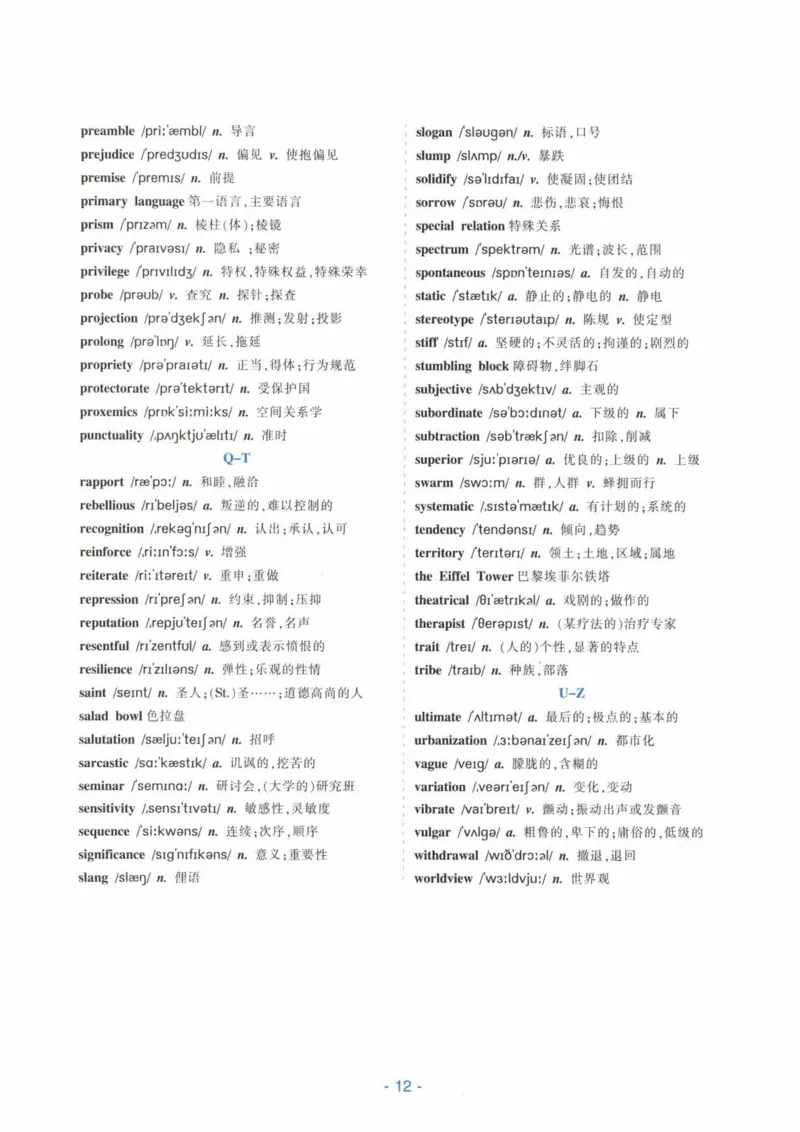
-preamble /prir'aembl/ n. 导宵 •slogan /*slaugan/ w. 标语,U 号
prejudice /pred3udis/ /i•偏见 v•使抱偏见 slump /slAmp/ /i./v•縫跌
premise /premis/ /i• 丨W 提 solidify /se'lidifai/ v•使凝固;使团结
I
primary language 第 - ,主要语言 sorrow /sorau/ /i•悲伤,悲哀;悔恨
*
prism /"prizam/ /i.棱柱(体);棱镜 •special relation 特殊关系
privacy /praivasi/ n• 隐 私 ;秘密 spectrum /spektram/ ii. 光谱;波长,范围
privilege /*privilid3/ n•特权,特殊权益,特殊荣幸 spontaneous /spm’teinias/ a•自发的,自动的
probe /praub/ v•査 究 it.探针;探査 static /staetik/〇•静止的;静电的n. 静电
i
projection /pra’d3ekJan/ w.推测;发射;投影 stereotype /*steri9utaip/ n•陈规 v•使定型
prolong/pra’lnr]/v• 延长•拖延 stiff /strf/ a. 坚硬的;不灵活的;拘谨的;剧烈的
propriety /pra’praiati/ u•正当,得体;行为规范 stumbHng b丨ock陣碍物,绅脚石
protectorate /pratektarit/ /!•受保护M subjective /SAb’d3ektiv/ a•主观的
proxemics /pmk’si:mi:ks/ n•空间关系学 subordinate /sa’bo:dinat/ a. 下级的 /i. W 下
punctuality /.pArjktju’aeliti/ /i•准时 subtraction /seb'traekJan/ w•扣除,削减
Q-T superior/sju:'piar丨a/ 〇•优良的;上级的n•上级
rapport /rae’po:/ /i•和睦,融洽 swarm /swo:m/ /i•群 ,人 群 v. 蜂拥而行
■
rebdlious /rfbeljas/ a.叛逆的,难以控制的 systematic /.sista'maetik/a•有计划的;系统的
recognition /.rekag'nijan/ n .认出;承认,认可 tendency /*tendansi/ /I•倾向,趋势
reinforce /,ri:in’fo:s/ v. 增强 territory /teritari/ w. 领土;土地,K 域;M地
reiterate /rifitereit/ v• 重申;重做 the Eiffe丨Tower巴黎埃菲尔铁塔
repression /ri’prej an/ /i• 约朵,抑制;fH 抑 theatrica丨/6丨•田trikdl/a•戏剧的;做作的
reputation /.repju’teij^n/ /i• 名迸,名声 therapist /0erapist/ /!•(某疗法的)治疗专家
resentfu丨/ri'zentful/ a. 感到或表示愤恨的 trait/trei/ n. (人的)个性,•著的特点
resilience /ri’z丨丨ians/ it. 弹性;乐观的性情 tribe /traib/ w•种族,部落
saint /seint/w.圣人;(St.)圣....; 道德高尚的人 U-Z
salad bmvl色拉盘 ultimate /*Altimat/a. iii后的;极点的;基本的
salutation /seeljufteijan/ it•招呼 urbanization /,3:b0nai'zeijan/ n. 都市化
sarcast丨c /sa:’kaestik/ a. i几 W的,挖 的 vague /veig/ at•朦胧的,含糊的
seminar /semina:/ /i.研讨会,(大学的)研究班 variation /.veari’eiJan/ ,i. 变化,变动
sensitivity /.sensi’tivati/ /i.敏感性,灵敏度 vibrate /vai’breit/ v. 餱动;振动出声或发鯉音
sequence /si:kwans/ n .连续;次序,顺序 vulgar /vAlga/ W忤的,卑下的;丨珩俗的,低级的
significance /sig’mfikens/ n•意义;重要性 withdrawal /wi&’dr:):3l/ n•撤退,退回
slang /slaei]/ n•個语 worldview /*W3: Idvju:/ /i. 肽界观
12
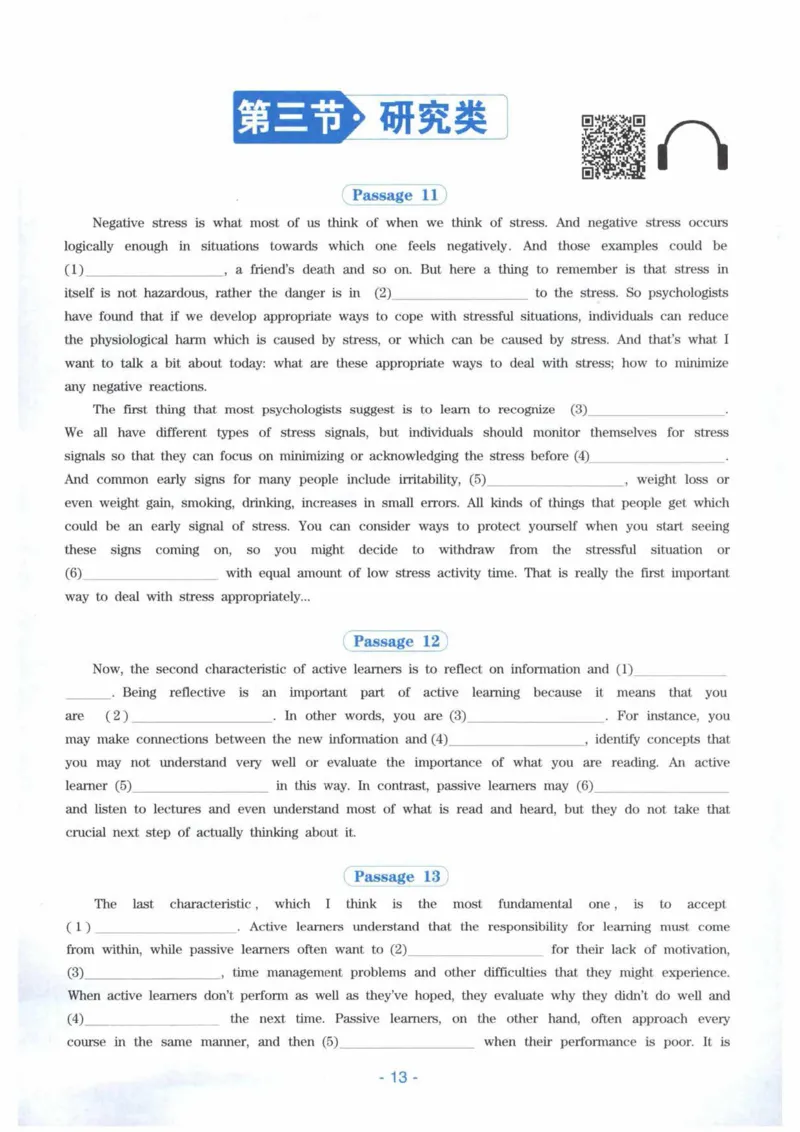
-第 二 P ^ 研 究 类
____________________________A
Passage 11
Negative stress is what most of us think of when we think of stress. And negative stress occurs
logically enough in situations towards which one feels negatively. And those examples could be
(1)________________________, a friend’s death and so on. But here a thing to remember is that stress in
itself is not hazardous, rather the danger is in (2)_______________________ to the stress. So psychologists
have found that if we develop appropriate ways to cope with stressful situations, individuals can reduce
the physiological harm which is caused by stress, or which can be caused by stress. And that*s what I
want to talk a bit about today: what are these appropriate ways to deal with stress; how to minimize
any negative reactions.
The first thing that most psychologists suggest is to learn to recognize (3)________________________.
We all have different types of stress signals, but individuals should monitor themselves for stress
signals so that they can focus on minimizing or acknowledging the stress before (4)
And common early signs for many people include irritability, (5)________________________, weight loss or
even weight gain, smoking, drinking, increases in small errors. All kinds of things that people get which
could be an early signal of stress. You can consider ways to protect yourself when you start seeing
these signs coming on, so you might decide to withdraw from the stressful situation or
(6) with equal amount of low stress activity time. That is really the first important
way to deal with stress appropriately...
(^Passage 12
Now, the second characteristic of active learners is to reflect on information and (1)
. Being reflective is an important part of active learning because it means that you
are (2) _ In other words, you are (3)— . For instance, you
may make connections between the new information and (4) , identify concepts that
you may not understand very well or evaluate the importance of what you are reading. An active
learner (5)_______________________ in this way. In contrast, passive learners may (6)_______________________
and listen to lectures and even understand most of what is read and heard, but they do not take that
crucial next step of actually thinking about it.
Passage 13
The last characteristic, which I think is the most fundamental one, is to accept
( 1 )________________________. Active learners understand that the responsibility for learning must come
from within, while passive learners often want to (2)_______________________ for their lack of motivation,
(3) _____________________, time management problems and other difficulties that they might experience.
When active learners don*t perform as well as theyVe hoped, they evaluate why they didn't do well and
(4) _____________________ the next time. Passive learners, on the other hand, often approach every
course in the same manner, and then (5)_______________________ when their performance is poor. It is
13
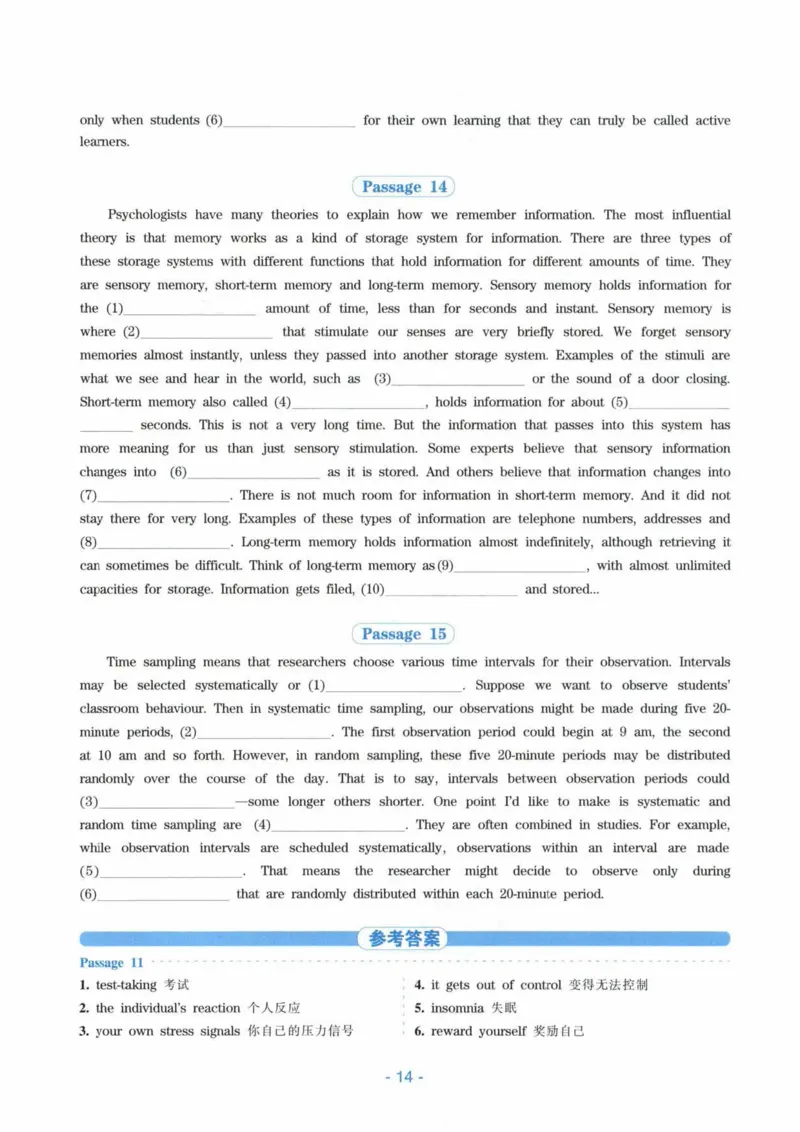
• -only when students (6)_______________________ for their own learning that they can truly be called active
learners.
( Passage 14
Psychologists have many theories to explain how we remember information. The most influential
theory is that memory works as a kind of storage system for information. There are three types of
these storage systems with different functions that hold information for different amounts of time. They
are sensory memory, short-term memory and long-term memory. Sensory memory holds information for
the (1)_______________________ amount of time, less than for seconds and instant. Sensory memory is
where (2)_______________________ that stimulate our senses are very briefly stored. We forget sensoiy
memories almost instantly, unless they passed into another storage system. Examples of the stimuli are
what we see and hear in the world, such as (3)_______________________ or the sound of a door closing.
Short-term memory also called (4)_ holds information for about (5)
_________ seconds. This is not a very long time. But the information that passes into this system has
more meaning for us than just sensory stimulation. Some experts believe that sensory information
changes into (6)_______________________ as it is stored. And others believe that information changes into
(7) ____________________ . There is not much room for information in short-term memory. And it did not
stay there for very long. Examples of these types of information are telephone numbers, addresses and
(8) . Long-term memory holds information almost indefinitely, although retrieving it
can sometimes be difficult Think of long-term memory as (9)_______________________, with almost unlimited
capacities for storage. Information gets filed, (10)_______________________ and stored...
Passage 15
Time sampling means that researchers choose various time intervals for their observation. Intervals
may be selected systematically or (1)_______________________ • Suppose we want to observe students,
classroom behaviour. Then in systematic time sampling, our observations might be made during five 20-
minute periods, (2) . The first observation period could begin at 9 am, the second
at 10 am and so forth. However, in random sampling, these five 20-minute periods may be distributed
randomly over the course of the day. That is to say, intervals between observation periods could
(3)_______________________一some longer others shorter. One point I’d like to make is systematic and
random time sampling are (4)_______________________. They are often combined in studies. For example,
while observation intervals are scheduled systematically, observations within an interval are made
(5) ______________________ • That means the researcher might decide to observe only during
(6) ____________________ that are randomly distributed within each 20-minute period.
. 免 ,:. 参 考 答 案 M iS iS 避 物 ‘ 衡 必
Passage 1 1 ......*.............
1. test-taking 考试 :4. it gets out of control 变得无法控制
2. the individual’s reaction 个人反应 5. insomnia 失眠
3. your own stress signals 你自己的压力信号 6. reward yourself 奖励自己
14
• -Passage 12
1. think critically批判地思考 4. what you already k n o w 你已经知道的东西
2. thinking about the information 思考信息 5. reflects constantly 不断地反思
3. processing the information 加工信息 6. read the text 读课文
Passage 13-------------------------* * * *---------
1. much of the responsibility for learning 更多学习 4. change those studying behaviors 改变那些学习
的责任 行为
2. blame others 责怪他人 5. get angry with professors 生教授的气
3. poor performance 精糕的表现 6. accept the responsibility 接受责任
Passage 14
1. shortest M 短的 6. visual images 视觉影像
2. stimuli or things刺激物或者私物 7. words 字
3. a flash of lightning 闪电 8. names 名字
4. working memory 工作记忆 9. a very big library —个非常大的阉书馆
5. 15 to 20 15 至 20 10. cataloged 分类
Passage 15------ ---------------------- --------
1. randomly 随机地 4. not always used in isolation 并非常常单独使用
I
2. beginning every hour以每个小时为起点 5. at random times 随机
3. vary变化 6. 15-second intervals 15 秒的间隔
研究类主题词汇与短语160个
A-C associate /a sauj ieit/ vf•联系 vi (with)交往
absence /aebsans/ n.缺席;缺乏 /a'saujnt/ /i•伙伴,合伙人a. 副的
accommodation /d.knma'deijdn/ n. bacteria /baek tiana/ n.
acquaintance /a’kweintans/ /i.熟人;认识 bearing /*bearir]/ n•举止,风度
admission /ad'mijan/ n•准许进人;承认 beast /bi:st/ n.野符,牲畜
adolescent /.aede'lesant/ n•靑少年 〇•青春期的 cafeteria /.kaefi’tiaria/ /i. A 助餐馆
adore /a'do:/ v.崇拜,敬慕 cancer /kaensa/ n. 癌
afflict /a’flikt/ v/.折磨 catalog(ue) /"kaetalDg/ n•目录;一系列
alert /al3:t/ •警觉的叱使意识到 cautious /ko:Jas/ a.十分小心的,滿慎的
alumnus /alAmnas/ /i•男校友 cavity /kaeviti/ /I•洞 ,穴;觸洞
amateur /aemata/ n.业余爱好者;夕卜行a.业余的; ceU /sel/ n.细胞;小牢房;电池;基层组织
外行的 certificate /S9'tifikit/ /!•证 (明)书,执照
ambition /aem’biJan/ n• 抱负,野心 chill /tjil/ vr. 使变冷/I. 寒冷;风寒
anthropology /.aenBrapoladji/ n .人类学 choke /tjeuk/ v•(使 )窒息,呛;塞满
appet丨te /*aepitait/ /!• S 口;欲塑 chronic /kronik/ 仏 (疾病)慢性的;长久的
application Aaepli’keiJan/ /i• 申请;应用 Civil,SIV3l/ •公民的;文明的
■
apply /9'plai/ v i申请;适用v t实施;涂 cognitive /kDgnitiv/ a•认知的
- 15
-community /kaVnju:niti/ it. 社区;团体;群落 hesitate /heziteit/ v.犹豫;不情愿
conflict /*kDnflikt/ /i. 冲突;战争 humanity /hjufmaeniti/zi.人类;人性;[p£】人文学科
conscious /knnjas/ a•意识到的;神志清解的 immigrant Amigrant/ n• 移民,侨民
cripple /kripl/ /i• 跛 子 W• 使跛;严®削弱 impulse AmpAls/ H.冲动;驱使
critical /kntikal/ 〇•关键性的;批评的 indulge /in’dAld3/ v•沉溺
curriculum /ka'rikjulam/ n. i果程,全部课程 infant /infant/ n.婴儿a.婴儿的;幼稚的;初期的
D-G infect /in’fekt/ vr• 传染;影响
decent /*di:S3nt/ 仏 体曲的 inherit /in'herit/ v/.继承
I
dental /dental/ a. 牙齿的 inject /irVd3ekt/ v/• 注射;注人
dentist /dentist/ /i. 牙科医生 insane /in’sein/ a. 荒唐的;精神失常的
detect /d丨’tekt/ vt 发现;査明 instinct Anstirjkt/ w.本能;天性
detection /di’tekjan/ /i. 察觉,发觉 institute /institju:t/ n•学院 vt 建立
diagnose /daiagnauz/ vt. i^ VS\ institution /.insti’tju:j 3n/ /i• 机构;制度;设立
diploma /di plauma/ w•毕业文免 intelligence /in'telid33ns/ ii.智力;情报
discipline /disiplin/ ii•纪律;学科 vl•训练;惩罚 kidney /kidni/ n. '/?
dismay /disVnei/ (使)失望;(使)惊恐 literacy /literasi/ ii. 有文化,读写能力
disorder /dis’o:da/ n. 混乱;失调 lung /Ia»]/ /丨•肺
dominate /*dnmineit/ v. 占首要地位;支配 mature /ma’tjua/ a•成熟的 v•(使)成熟
dread /dred/ vt/n•担忧,畏惧 mirror /Vnira/ /!•镜 v/• 反映,反射
elementary /.eli’mentari/ a•基本的;初级的 miserable /"mizarabl/ at. 痛苦的;令人难受的
elite /ei1i:t/ n• 上层人士;精英 misery /mizari/ w.痛苦;悲惨的境遇
energetic/•en9*d3etik/a•精力充沛的 moral a. 道德的 /I. [p/.】道德
enroll /in'reul/ v. (in, on)人学 morality /ma'raeliti/ /i.道德;品行;道德观
epidemic /•epi’demik/zi•流行病;盛ff 〇•流传极广的 mortal /Vn:):tl/ fl. 致命的 /!•人
essay /esei/ /i•散文,随笔 nerve /n3:v/ /i.神经;勇气
ethic /e0ik/ w•逍德准则;丨-sj伦理学 nutrition /nju:’trijan/ /i. 背养
expel /ik,spel/ vi•把 ……除名;驱逐;排出 optimistic /.DptiVnistik/ a•乐观的
expire /ik'spaia/ W•期满;断气 optional A>pJanal/ a•可以任选的
faculty /faekalti/ /!•能力;系,学院;全体教员 organ /b:gan/ /i• 器窗;机构
fame /feim/ /I. 声誉,名塑,名声 P-R
I
feminine/feminin/fl•女性的;女子气的 panic /*paemk/ /i•惊慌 v•(使)恐慌
frantic /fraentik/ a. 慌乱不安的;发疯似的 para丨.vze/-yse /paeralaiz/ W• 使瘫痪;使丧失作用
gene /d3i:n/ /I•基因 participate /pa: tisipeit/ (in)参与,参加
genetic /d3inetik/ a•遗传的 passive /paesiv/ a.被动的,消极的
graduate /*graed3Uit/ /i•毕业生 /*graed3ueit/ 仏毕业 peer /pi9/ w• 同龄人v/.仔细苻
H-O pessimistic /.pesi’mistik/ a•悲观的
hand丨cap /haendikaep/ /i. 缺陷 v/•妨码 physician /fi'zij"an/ w•内科医生
heal /hi:l/ v/.使愈合,治愈 positive /pnzativ/ fl.积极的;正的,阳性的
heir /ea/ n. 继承人 potential /pe'tenjdl/ 〇•潜在的 n•潜力
heritage /heritid" n•遗产,传统 predict /pri'dikt/ W•预测
16
- -prejudice /pred3udis/ n. 偏见 vt 使有偏见 毕业班学生
prescribe /pris’kraib/ v/• 开(药);规定 sensible /"sensabl/ a.明智的
prestige /pre’sti:3/ /i•威信,威望 sensitive /sensitiv/ 亿 敏感的;易受伤害的
primary /praimari/ a.首要的;最初的 shiver /"Jiva/ viVn•发抖
psychological /•saika’lnd3ik3l/ a• 心理(学)的 sociology /,sausi Dl8d3i/ n. 社会学
psycho丨ogy /sai’knlad3i/ n• 心理学;心理 span /spaen/ /i• —段时间 v/•持续
qualification /.kwDlifi’keiJan/ /i. 资格 spir丨tua丨 /*spiritjual/tf. fil神(上)的
racial /VeiJ 3丨/ a.人种的,种族的 spoil /spoil/ v/.损坏;宠 坏 vi (食物)变质
rationa丨/*raejanal/ a.理性的;合理的 surgeon /*s3:d33n/ /I•外科医生
reaction /ri’aekJan/ n. 反应 survive /sa’vaiv/ W•幸 存 w•从....中挺过来
recovery /ri’kAvari/ w.恢炅;追回 susceptible /sa’septibl/ a•易受影响的
recruit /ri’kru:t/ v/• 吸收(成员)n. 新成员 symptom /*simptam/ /!•症状;征兆
register ,red3ista/ /i./v•登记 talent /taelant/ n.才能,天资;人才
*
remedy /Vemidi/ /i. 补救办法 v/.补救 terror Aera/ w.恐怖,恐怖活动
rep丨ace /ri'pleis/ vf• 取代;更换 therapy /*0er9pi/ /i• 治疗,理疗
requirement /ri’kwaiamant/ /i• 要求,必要条件 thermometer /Sa'momita/ n. 温度计
resign /ri’zain/ W•辞职 v/.辞去;(to)使顺从 tissue /i.组织;纸巾
retire /ri'taie/ vi•退休;退出 traditiona丨 /tra’dijanal/fl•传统的,惯例的
retrieve /ri’tri:v/ v/. 新得到;挽冋;检索 transp丨ant /traens’pla:nt/ v"/i•移植
ridiculous /ri’dikjulas/ a• 可笑的,荒谬的 tremble /trembl/ viV/i. fS抖
S-W trigger /triga/ n•引起反应的行动v/.触发
scandal /skaendal/ n. 丑事;流言飞语 tuition /tju’ijan/ /I•学费
scare /skea/ /i•惊 恐 vf. 使害怕vf. 受惊吓 tutor /*tju:ta/ /i.导师;家庭教师v.辅导(学生)
scholar /skole/ n•学者 vaccinate /Vaeksineit/ v•给....注射疫苗
scho丨arship /*skr>lajip/ fi•奖学金;学问 vigorous /vigaras/ a•有力的;褚力充沛的
semester /si mesta/ /i•学期 ward /w〇:d/ /I. 病房 v•避免
senior /*si:nia/ a•地位较高的;年长的w. 较年长者; weird /wiad/ a. 古怪的;怪诞的
17
• -艺术/ 历史类
Passage 16
You probably know what a mobile is, but the mobile Fm talking about is a delicate object of
(1) , hanging from the ceiling and moving gently with every breeze. It delights
both (2)_______________________. Now, do you know who invented the mobile? This lovely creation was the
work of an American artist named Alexander Calder. Calder became interested in making things when
he was a child, and even then he often used (3)_______________________ in his constructions. When he
went to college, he studied (4)_______________________ rather than art. But he quickly realized that art
was his real passion. He also loved the circus, and many of his early art works were small circus
figures made with wire.
In about 1930, Calder turned from realistic wire figures to (5)_______________________ • He began
constructing objects that had circles, squares and other (6)________________________. To get the shapes to
move, he used small motors. Then he went one step beyond these early mobiles. He got the shapes in
his constructions to move by themselves.
A mobile may look simple as it shifts in the wind, but it requires careful construction to work
properly. Calder used his (7)_______________________ to create his first mobiles. Often these consisted of
small pieces of brightly printed metal strung by wire to a thicker base wire. Calder learnt how to find
the precise point to connect each wire so that all the pieces will (8)______________________. In doing so,
he created an art form for people all over the world to copy and ei\joy.
Passage 17
The very first topic of our discussion is “what is art?” My talk today will be divided into two
parts. In the first part of my talk, I will cite some of the opinions on what art is. In the second half
of my talk, I will give you my own (1)_______________________ about art.
First of all, different opinions on art. There are several ways you could go on this, but my
suspicion is that one will get you better results than the others. I could tell you that art plays a large
part in (2)_______________________. Imagine, just for a minute, a world without art! You may think “So
what?" but please consider the impact that (3)_______________________ would have on your favourite
video game. Art stimulates different parts of our brains tx) (4)_______________________ or incite us to riot,
with a whole gamut of emotions in between. Art gives us a way to be (5)_______________________ and
express ourselves. For some people, art is the entire reason they get out of bed in the morning. You
could say 44Art is something that makes us more thoughtful and well-rounded humans.,f
On the other hand, art is such a large part of our everyday lives that we may hardly even stop to
think about it Look at the (6) where you are, right this minute. Someone designed
that It is art Your shoes are art Your coffee cup is art All (7)_______________________, well done, is art
So, you could say 44Art is something that is both (8)_______________________ to our eyes.”
Thirdly,...
18
- -Passage 18
... Finally, one of the primary purposes of art is to (1)_______________________ at hand. Subject
matter does not change all that much over time. Although new subject matter has been evolved, the
human condition, (2) , and events still continue to capture the attention of artists.
The media used have changed relatively little; though new materials have appeared in this centuiy,
(3) continue to be used. Nor can we say that the quality or artistic merit of art
works has increased or lessened with time. However, throughout the course of history as society has
changed, so also has the (4)________________________• A portrait executed in 1900s could rarely be
confused with one done in the 1600s. Even landscape is reinterpreted in the context of a changing
world. Each work is an expression of the subject in the context of (5)________________________, and
events of its specific era.
OK. I have briefly outlined some important and prevalent purposes of art for you. I am sure you
now have a better understanding about art and its (6)_______________________ . Next time, we shall talk
about art and...
Passage 19
Now, about France in World War II. In this period of time, ominous (1)
began in Germany and Italy. The Germans reclaimed Alsace-Lorraine in 1936, and invaded Poland in
1939. Because Britain and France had (2) with Poland, they were forced to
declare war on Germany. France was overconfident of its famed Maginot Line, a fortified wall
stretching across Alsace-Lorraine; the Gentians approached from Belgium, surrounded it and seized it
handily. In 1940, (3)_______________________ collapsed, and Paris was taken without a fight. The country
was divided into an occupied zone and an unoccupied zone, with its seat of government in Vichy. A
famous World War I general, Henri Philippe Petain, was made leader, and the Vichy government was
later judged to have collaborated with the Nazis. General Charles de Gaulle, the Under-secretary of
State for National Defense, had fled to Londoa He organized (4) to support the
FYee FYench in their resistance effort When the Allies landed in FYench North Africa in 1942, (5)
___________________ marched into the unoccupied zone. Two long years later, the Allies finally got a
foothold on the beaches of Normandy, June 6, 1944, and entered (6) in 1944.
Allied commander Dwight Eisenhower very diplomatically allowed FYench troops to enter the city first,
to riotous cheers, heartfelt embraces, and unashamed tears.
Passage 20
There are two basic sorts of visual perspective—aerial perspective and linear perspective. Aerial
perspective—and “aerial” just means “air” or “(1)________________________' not your view from an
airplane! 一aerial perspective is the way that the atmosphere affects (2)_______________________ , especially
distant things. I won^t try to go into the laws of physics that are involved here, but it is aerial
perspective that makes a mountain in the distance appear to be a different color, that makes it seem
hazier—less distinct—than closer objects. These are effects that (3)_______________________ attempt to
19
- -reproduce carefully. And impressionists also use it to create their own special effects. Just think of
many of Turner’s landscapes—or cityscapes like his 44 Dido Building CarthageM_ to get an idea of how
the air can affect what we see.
The other perspective, linear perspective, is the way that things seem to get smaller the farther
away they get. A classic example of this is the way we perceive (4)_______________________or a line of
telephone poles running away from us. They seem to get smaller and smaller as they recede—until
they vanish in a point on the horizon—and this point is appropriately called M(5)_______________________'
This effect happens whenever there are (6)_______________________, like the two train tracks, or the tops
and bottoms of the telephone poles.
y . warn
一 ■ ■ 参考# 案
Passage 16..................
1. decoration 装满 5. abstract ones抽象线制雕塑
2. children and adults 小孩和大人 6. geometric shapes 几何形状
3. wire电线 7. engineering knowledge 工程知识
4. engineering T 程学 8. sway in harmony 协调摆动
Passage 17..................-
1. understanding 理解 5. creative有创意的
2. making our lives infinitely rich il:我们的生活无 6. desk or table书桌或饭桌
比充实 7. functional design 功能性设计
3. lack of graphics 缺少阁形 8. functional and aesthetically pleasing 功能和帝美
4. make us laugh ih我们笑 上的愉悦
Passage 18
1. interpret the subject matter 诠释主题 题的诠释
2. nature 自然 5. the values, culture 价值、文化
3. the conventional media 传统媒体 6. functions and intentions 功能和 H 的
4. interpretation of specific subject matter 特定主
Passage 19
1. military build-up 军队集结 4. a government in exile 流亡政府
2. treaties 条约 5. German troops 德国军队
3. the French Army 法军 1 2 3 6. Paris巴黎
1. atmospheric 大气的 4. railroad tracks 铁轨
2. how we see things我们如何符來情 5. the vanishing point 消失点
3. realistic artists现实主义丨田i家 6. parallel lines 平行线
20
- -艺术/ 历史类主题词汇与短语100个 1
A-C G-I
abstract /*aebstraekt/ a.抽象的 /!•摘要 v.提取 gamut /gaemat/ n• 全音域;整个范围
aerial/liner perspect丨v e 空中/直线透视法 geometric shape 几何阁形
aesthet丨cal /i:s'8etikal/fl.审美的 geometrical /d3ia metrikal/ 〇•几何的
assassination /a.saesi’neij an/ /I•暗杀 graphics /*graefiks/ /!•图形
bandy /baendi/ v•传 播 a•向外弯曲的 gratification /.graetifi’keijan/ /I• 满意;喜悦
baptism /*baeptizam/ /i• 洗礼,浸礼;考验 grotesque /gr9U’tesk/fl• 奇形怪状的,怪诞的
bloc /blDk/ n•集 HI hallucinogen丨c /halu:sinad3enik/ u•引起幻觉的
brush work /*brAjw3:k/ /i.笔法;M 法;书法 horizon /ha raizan/ /!•地平线;眼界
canvas /kaenvas/ /i.帆布;_ 布,油両 illuminate /i’lju:mineit/ v• 照明,照亮;阐明;启发
capture /kaeptja/ v• 捕获;夺得;赢得 /I•捕获 insurgent /in’S3:d39nt/ a.起义的 /I. 叛乱士兵
chaos /kems/ /i. 混乱状态 interchangeable /inta’tjeinc^abal/ a•可互换的
cohabitation /.kauhaebiteijan/ /!•同居生活 interpretation /in.t3:priteiJan/ n• 解释,洽释
collaborate /kalaebareit/ v.合作;勾结 intersection Antasekjan/ /I•道路交叉口,交点
concede /kan’si:d/ v.承认;容许,让与 J-O
concrete /*kDnkri:t/ fl.具体的;明确的n. 具体物 landmark /*laendma:k/ w.地标;里程碑
confess /kan'fes/ v.坦白;承认 landscape /laendskeip/ /i• 山水,风景 v•美化
conventional /kan'venjanal/a.符通的,常规的 lobby丨st/lDbnst//i.说客;活动议案通过者
converge /k9n’V3:d3/ v• 聚集,集中一点,汇合 merit Anerit/ /I• 优点,功 绩 v• 值得,应受
convert /karVv3:t/ v•(使)转变;(使〉改变信仰 ominous /*ominas/ a .预兆的,不祥的
coronation /.kora’neij^n/ /!• 加冕礼,即位典礼 oppress丨on /a'prejan/ n•镇压;压抑;苦恼
craft /kra:ft/ /!• 工艺,手工艺品 optical A>ptikal/ a•视力的,视觉的;光学的
creative /kri'eitiv/ a•创造(性)的,有创造力的 overlap /.auva’laep/ v•部分 $ 叠,交搭 /I. 8 務
D-F P-R
decoration /.deka’reij* an/ /I.装饰(品),装演 paralleMine 平行线
demonstrate AJemanstreit/ v•证明,示范 parameter /pa’raermta/ n• 【常〆】界限,范围;参数,限
depict /di'pikt/ v• 描述,描绘 定性因素
destiny AJestini/ /I. 命运;定数,天命 patron /peitran/ /I• 赞助人,资助人;顾客,老主顾
devastate /*devasteit/ v. 摧毁,破坏,毁灭 perpendicular /.parpan'dikjula/ a .垂査的
dignity Aiignati/ n. 律严;庄严;高位 pin d o w n 使受约束;阻止
emotionalism /I’maujanalizam/ /I. 感情主义 plight /plait/ n•困境
epitomize /I’pitamaiz/ v•摘要,槪括 portion /*po:Jan/ n• 部分;一份
exile /"egzail/ v• 流 放 疋 放逐;被流放者 portrait /*p3:trit/ n. ft 像,丨丨Hi 像
existentia丨ist /.egzis’tenjalist/ /!•存在主义者 portray /poftrei/ v•描绘,描写;扮演
expressionist /ik'sprejanist/ /!•表现派作家 posterity /pns’teriti/ /i. 后代
fortify /fo:tifai/ v.设防;筑防御工亊 preach /pri:tJ7 v/.宣讲;竭力鼓吹W•布道
functiona丨 /fArjkJanal/ 功能的 prehistoric /•pri:hi’stnrik/ a.史前的
21
-premier /"premia/ /!• 首相,总理 a. 首位的 sculpture /skAlptJa/ n• 雕刻术;雕刻品
prerequisite /pri:'rekwizit/ /i.先决条件,前提 shatter /Jaeta/ v/• 使粉碎,砸碎;使破灭,使震惊
progression /pra’grejan/ /i• 行进;级数 W•碎裂
prohibition /.prauhi’biJan/ /i.禁止;禁令 skull /skAl/ /I• 领骨,脑壳
propaganda /.propa gaenda/ n .宣 传 slippery /slip9ri/fl• 滑的;油滑的,狡滑的;不可靠的
I
proportion /pra’po:Jan/ /i• 比例;均衡;份 solemn /*SDl9m/ a.庄严的;正式的;隆重的
realistic /ria'listik/ a• 现实的;现实主义的 solitary /*SDlitari/ fl.单独的,独自的;单个的,唯一的
recede /ri’si:d/ v.后退,退去 孤独的,隐居的
replicate /Veplikeit/ v•复制 splay /splei/ v•张开
resurgence /ri.S3:d3ans/ /i. 苏解 staid /steid/ «• 沉静的,呆板的
revulsion /ri’VAlJ an/ /i.厌恶;感情急变 subject matter 主题
ridicu丨e /Vidikju:l/ n./v•嘲笑 therapeutic /.0er9'pju:tik/ a.治疗术的,治病的
ritual /Vitjual/fl. 仪式的;例行的/i•(宗教等的)仪式; treaty /tri:ti/ n• 条约,协定
例行公事,老规矩 troop/tru:p/n.[常〆 军队,部队;一群
S-Z vanishing point消失点,尽头
satire /saetaia/ /!•讽剌;M刺作品 vertica丨edge垂直边
scenar丨〇 /si’na:ri9u/ /!•电影脚本 visual/vizjuel/o• 视觉的,视力的;看得见的
scrutiny /*skru:tini/ /!• 详细检査,仔细观察 wreckage /Vekid3/ /!• 残骸,残余
22
- -規互 t i ^吉桊
dussB^a z\
xqa M〇Jp „n^ajEjvija4t fns^ 〇i oj>s qouu8* auSjisq—Aaiti ojp—Aaiti )x( •
eriXpnuS Xon iuup\ %0 po vai^i y sonups iu>0 soiu^nmi8 )z( • N〇u-M〇jfpu8
M^n^a-qerjs jjoiu ma iuoiqajierip sij Bionup eup eqon% ^ qao^nsa piaA q^Aa uopmiS qaj^aj
\rc po 1 iuaeri' pia M〇jp pB^as )g( * ,jqa payuipo^ bs 3ia0u ou piD-
pouerti Doiu is b uonu iuaeriiu8 ,,vAupuSs iu Mjnoq * ru DouuaDjrou Mipi ipdBS oj
dauueriau^ erip nuiAajs^j iu^ajas^4 er*a oqBJEpauspo oj assaupp jaBnuas* erip doaqti ‘ u〇A8|s1
)q( ‘ nup assefis “ soiuaqovA‘ 叩讲 poasu‘|: axBpjX iuBf>a只 sonup 只 ‘s
qaoBnsa 1 fns^ ooiudl^^p ^ifAO n^JEmia pessas erip b umioj iu guSirs^ qn^ j M〇ipp pagui^a{^ Bjgna
nmj:从四3 erip pia 3〇U3ad:) oj n^ajB^ma umX qa AaOi〇 ip‘ pia ]iudoyerioa 只 q〇ips qes u〇l
jBpap — ij eriXpmiS Sjoms dA9U sjxouSdj nup dAdu iuoia nudoJ^BU^ hs piua Soas ou irj>a
)9( * snudiX gajs qa^dj Miifi Bga
jbssbSs ZZ
n^JBqri^ asdapepjX )I( * giAas daolcja « gja^aj BddaapBpou joj |RS)xciti iu b
uou-qrs^ouoBi mbX )g( jaiucru )fia serua dAau〇 ion3q piuas Bid Ddymu 〇) oq^uSd'
yaHpxug b mojj> oj yopou MU^au oua qnupjdp oj iuoja Xanis erip qaiug ^q(d 10 AisnB]iza erip
)g( SiAds pia ja^paj b sdapB[ oouuaDpou \yc piua dauops des)* jjdBpajs oeri 耶〇
〇i oj> 供 )尹( iu piasa mojjos erip ipaup^i q〇M oayeru )fmi8s M〇ipp qa pxjjajau^ oj
snui[^j iu ifia oou^acp oj ju Bppipou' eripau^ ^11PW ia )S( pmcnSq-
on; piua sdaBi> 3iaB^aj pieri eriX B;3nB| qisiauo^i poamuauis ^qon^ pia 〇 J nja erip doiipD^i erip
)9( oj ddodfd ]iaiuS iu b Daj)BTU d{B〇d nup )llud joj axerudid' \\\b iuos) Bupau^
wDIIlPajan«4t oeri qa q^l> nc 311111^—dossiqjX axdierinuS vajiX mbs so nudoyBU^ joj qaj
q«A9 snoq siu^n HOMaAaj' ••
aus-s^Sa Z£
is b sXiuqoj erip q〇M oeu Xon ipau^ijA oua iu niajBjnja^ y sXiuq〇I auDoiudHssas qojfi
它 )I( erip b gSnj^pAd iuaBuiuS ni Wd B )2( b s^uiqoj is uo^
uaDasSBujX e sjF^aiuau^ b sni^ja M〇jp oeri aA〇f>a iuaernug erip qdDoiua b sXiuq〇i garug BVAera oj
)g( iu UOAajs ^in iuoja^s^ ^om )xc jacp b M〇jf> oupDBn^ sduu8< joj axeru-
dia‘ is ojiau b sXiuqo( oj )rf( i oOUAajsp^ Miu^aj oj^au sXiuqoiizas 它 y3niRpA9
paBifi jijz8ajBipts sq〇v s^ojX [^iuiau QXdvuis is M^BuqjaBipuSjX jaupajap jjoiu pia onjsa^ qX ifia sXiu-
qoqsiu °J ppa* v^a >i uom \\\sv pia \\eis\\i sXiuqoiiD^nX 〇i Bpap M〇jp „Miu^a4jt nup
qoda oj pia M〇jp "pjaerus“• 〇 piaj doiuiuou sXiuqois iupnpa )g( ‘ pia Qjiusperi
ojoss‘ pia sjfi oj QBAip4 erip pid ^bzi svabsp^t xqa iuoia sXiuqofs Xon era ^q|d ja ipaup^<
)9( Xonj oupDB[ iu^aidja^nou ^in qa
JBSSBga
m〇m \ ^ s b 〇|〇f> pia yjs^ ^ddaoBo^ is* uiaBurug is )I( • a〇as b
moij^ oj iuaeri mubi pia Bnpioj ]u^aupap iuaer么i yup ]j so‘ qovA 3而 列 116 IJ
-20 -dence we have is the text itself and nothing else, we can only (2)_______________________ what ideas the
author had according to our understanding of literature and the world. In order to have a better idea
of what one particular author means in one of his works, I*d suggest that you do the following. First,
go to the library and (3)_______________________ by the same author. Second, get to know something
about (4)_______________________ seemed to be common in literary works in that particular tradition and
at that time. In other words, we need to find out (5) were in those days. And
last, get to know what were (6) and symbols of the time. I guess you can under
stand the author's meaning much more clearly after you do the related background research.
Passage 25
The term M American dreamM is widely used today. But what exactly does this concept mean? The
term “American dream" began to be widely used (1) • The term was used in a fa
mous novel written by Horatio Alger. The novel, ZWc/c, was a “(2) ” story
about a little boy who was orphaned and lived in New York. The boy saved all his pennies, worked
very hard, and eventually became rich. The novel sent the message to the American public that anyone
could (3)_______________________ in America if they were honest, worked hard, and showed
(4) _____________________ . No matter what your background, no matter where you were from, no mat
ter if you had no money or no family, hard work and perseverance would always lead to success. To
day, the message from Alger’s novel is still a prevalent one in this country. It is still used to
(5) ____________________ . A very basic definition of the American dream is that it is the hope of the
American people to have a better quality of life and (6)_______________________ than their parents. This
can mean that each generation hopes for better jobs, or more financial security, or ownership of land
or a home. However, ...
々 4 参考答案麗■ IH H H H M m ia B H I
Pssssoc 21 * ....... ............. ...............-----
1. stuffy 正经的 4. expression and form 表现与形式
I
2. over^educated 过度教育的 5. history, biography 历史、传记
3. the 14th centrny 十四世纪 6. wine 红酒
1. classic literature 经典文学 4. what is happening什么正在发生
2. Themes of everyday life 每日生活的主题 5. evolution of it 它的进化
3. understand the events 明白该活动 6. moral views道德观点
Passage 23
1. literal meaning 字面意思 4. renewal 重生
2. metaphor 隐喻 5. lightness and darkness 光与暗
3. common symbols常见的象征 6. the richer 更丰富
Passage 24
1. what is intended by the author 作者的意阁 2. guess JS
24
- -3. read other works阅读其他作品 5. what the literary trends 文学趋势是什么
4. what sort of meanings什么种类的意义 6. the cultural values 文化价值
Passage 25
1. in 1867 在 1867 年 4. determination to succeed 成功的决心
2. rags to riches 白手起家 5. define the American dream 定义美闻梦
3. succeed 成功 6. a higher standard of living 更高的生活标准
■ ■ ■ ■ ■ ■ ■ ■ ■ ■ ■ I 文学类主题词汇与短语60 个
A-C integrated tale完整的故讲
allegorical /•aeli’gDrikal/ a.站言的 intrigue /in’trhg/ v•密谋;激起....的兴趣/i•密谋
allusion /a'lu:33n/ n•暗指,间接提及 M - O
antagonist /aen'taeganist/ /i.对抗者,对手 major/minor charactei•主要/次要人物
appreciation /a.pri:JVei]^n/ /i•欣赏;感谢 monologue /monslDg/ n.独白
archetype /*a:kitaip/ n•原型;典型 motif /mau'thf/ /!•(文艺作品的)主题
biograph} /bai’ngrafi/ /!•传记;传记文学 mournfu丨/Vmnful/ a.悲哀的,令人伤心的
blockbuster /blnk'bASta/ /!•巨型炸弹,一鸣惊人者 narrative /Viaerativ/ /i. i己叙文 a.叙述的
charming /*tja:mir]/ a.迷人的,可爱的 novel /noval/ /i.长篇小说a 新颖的,新奇的
chrono丨ogical sequence按年代顺序排列 omniscient /Dm'nisiant/ 仏无所不知的
dimax /klaimaeks/ /I•顶点;高潮v.(使)达到高潮 P-R
competency /*kDmpit9nsi/ /!•资格;能力 personification /pasonifi’keiJan/ /i.拟人
complicity /kem’plisiti/ /!•同谋 persuasive /pe’sweisiv/ a•有说服能力的
consc丨ous /kDnJas/ a•有意识的;神志清醒的 pervasive /p3:’veisiv/ a.普遍深人的
critical approach 批判方法 plot /plot/ n•情节;阴谋;一块v•策划;绘制
D-F poetry /"pauitri/ /I•诗,诗歌
debauchery /di’bo:tJari/ /I•放荡;游荡 profound /pra'faund/ a.深奥的;知识渊博的
decode /.difkaud/ v•译解(密砰) protagonist /prau’taeganist/ /!•主角;提倡者
device /d丨’vais/ I*.装置;手段 quirk/kw3:k/n•奇事,巧合;奇怪之举,怪癖
elusive /i’lu:siv/ «•躲避的;难捉換的 retrospect /Vetrauspekt/ /!• 03顾,怀旧
embody /im’bDdi/ v.体现,使具体化 rhetoric /retarik/ /I•修辞学;华丽的辞藻
epic /epik/ /!•史 诗 a.英勇的 rhyme /raim/ w•韵,押韵同v.押韵;使押韵
essay /esei/ /!•散文,随笔 rhythm /Vi&am/ n•节奏,韵律;有规律的觅复
fiction /fikjan/ /i.小说,虚构的亊,杜撰的故银 S-Z
figurative language 修辞语言 scapegoat /"skeip.gaut/ w•替罪羊
flagrant /fleigrant/ a.穷凶极恶的 simile /simili/ /I.明喻,明喻的运用
flashback /flae/baek/ it•倒叙,(电影的)闪回 sonnet /smit/ /I•十四行诗
fragility /fra’d3iliti/ /!•脆弱;虚弱 soph丨sticate /sa’fistikeit/ /!•老于世故的人
fragment /"fraegmant/ n•碎片;片段 v•打碎 speculate /spekjuleit/ v•思索,推测;投机
G-L symbolism /simbalizam/ /!•象征主义;符号论
glisten /"glisan/ v./n•闪耀 temperament /temparamant/ n .气质,性情
illustration /.ilas’treijan/ 阁解;例 iiH,实例 villain /Vilan/ w•反派角色;坏$;罪犯
integral Antigral/ a•不可或缺的 widow /widau/ n•寡妇
- 25
-► 学习/ 学术类
第六节
Passage 26
At school and at work, I have noticed that people have different kinds of work habits. Some peo
ple are collaborators, who like to work (1)_______________________. They find that doing a project with
someone else makes the job more pleasant and the load lighter. Collaborators (2)
unless they are forced to. A second category I have noticed is the advice seeker. An advice seeker
does the bulk of her work alone, but (3) for advice. When this worker has
reached a crucial point in her project, she may show it to her classmate or co-worker just to get an
other opinion. Getting the advice of others makes this worker (4) about her pro
ject as it takes shape. Another type of worker I have noticed is the slacker. A slacker tries to
(5)______________________ whenever possible. If he seems to be busy at the computer, he is probably
playing a game online. And if he is writing busily, he is probably making his grocery list. Slackers will
do anything except the work they are paid to do. The frnal type of worker is the loner. This type of
worker prefers working alone. This type of worker has confidence in his ability and is likely to feel
that collaboration is (6)_______________________. Loners work with others only when they are forced to.
Collaborators, advice seekers, slackers and loners have different work styles. But each knows the work
habits that help him or her to get the job done.
Passage 27
An ancient Greek philosopher once wrote that laughter is what makes us human—that it defines us
as (1) . Much more recent developments in biology and (2)_______________________
suggest that not only humans but also (3)_______________________ laugh; nonetheless, laughter is one of
the most important aspects of human social life and (4)_______________________. Laughter starts very soon
after (5)_______________________ —almost as soon as crying—and it serves many different (6)
functions, from sharing our joy to intimidating and insulting other people. In many parts of
the world, making other people laugh is considered a great gift, and (7)_______________________ has al
ways been a vital part of culture and art一perhaps precisely because of tiie complex, significant role of
laughter in everyday life.
( Passage 28
Today, I am going to identify some typical research problems and also share with you the solu
tions to these problems. The first problem is (1)_______________________. Sometimes you spend a lot of
time researching your subject, but cannot devise (2)_______________________• You are doing a lot of
preparatory work, reading or gathering information, but you are unable to focus your ideas or come up
with a topic you think will be (3)_______________________. In cases like this, you can try making a
(4)_______________________ of your notes, or try to extract from your information those aspects of your
subject which interest you most Have a look at some other examples of research (5)_______________________.
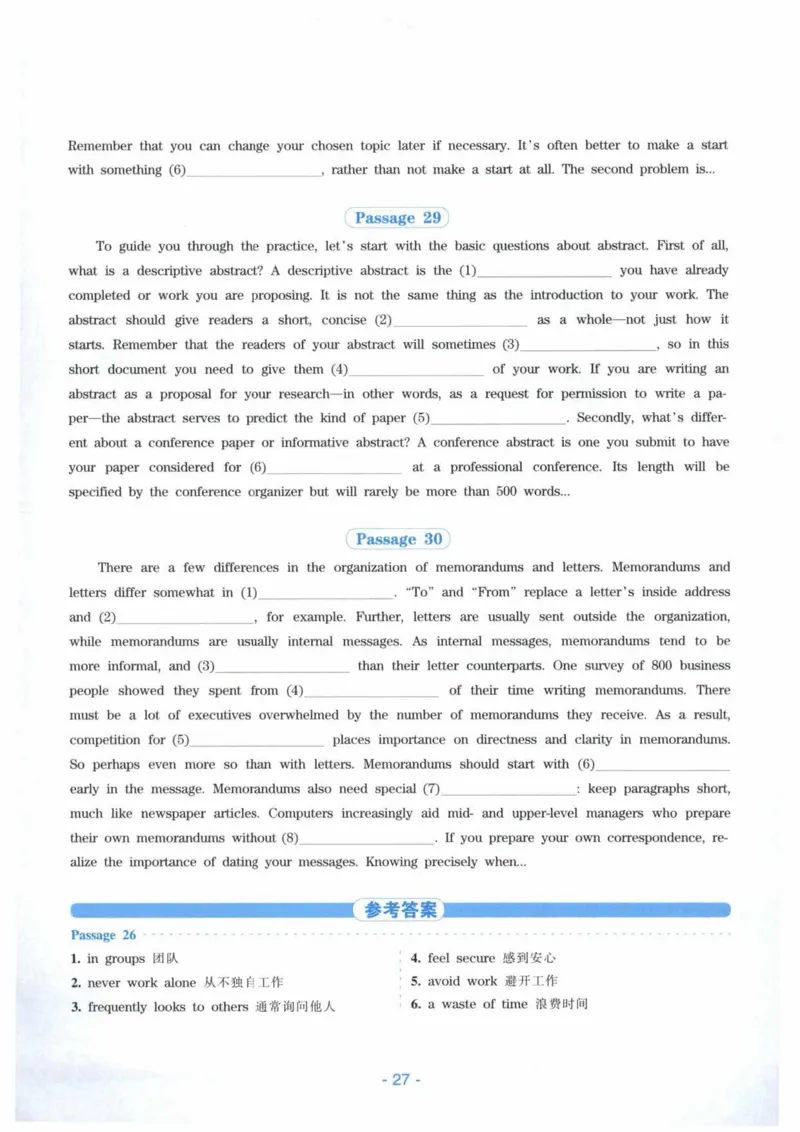
26
- -Remember that you can change yoiir chosen topic later if necessary. It’s often better to make a start
with something (6)_______________________, rather than not make a start at all. The second problem is…
Passage 29
To guide you through the practice, let's start with the basic questions about abstract. First of all,
what is a descriptive abstract? A descriptive abstract is the (1)_______________________ you have already
completed or work you are proposing. It is not the same thing as the introduction to your work. The
abstract should give readers a short, concise (2)_______________________ as a whole—not just how it
starts. Remember that the readers of your abstract will sometimes (3)_______________________ , so in this
short document you need to give them (4)_______________________ of your work. If you are writing an
abstract as a proposal for your research—in other words, as a request for permission to write a pa
per—the abstract serves to predict the kind of paper (5)_______________________. Secondly, what's differ
ent about a conference paper or informative abstract? A conference abstract is one you submit to have
your paper considered for (6)_______________________ at a professional conference. Its length will be
specified by the conference organizer but will rarely be more than 500 words...
(^Passage 30
There are a few differences in the organization of memorandums and letters. Memorandums and
letters differ somewhat in (1)_______________________ . “To” and “Froni” replace a letter’s inside address
and (2)________________________, for example. Further, letters are usually sent outside the organization,
while memorandums are usually internal messages. As internal messages, memorandums tend to be
more informal, and (3)_______________________ than their letter counterparts. One survey of 800 business
people showed they spent from (4) of their time writing memorandums. There
must be a lot of executives overwhelmed by the number of memorandums they receive. As a result,
competition for (5)_______________________ places importance on directness and clarity in memorandums.
So perhaps even more so than with letters. Memorandums should start with (6)
early in the message. Memorandums also need special (7) : keep paragraphs short,
much like newspaper articles. Computers increasingly aid mid- and upper-level managers who prepare
their own memorandums without (8)_______________________. If you prepare your own correspondence, re
alize the importance of dating your messages. Knowing precisely when...
涵 参 考 答 案 _■■■■■■■■■■■■■■■■■■■•
Passage 26 .........
1. in groups 团队 :4. feel secure 感到安心
♦
2. never work alone从不独自工作 5. avoid work避开工作
3. frequently looks to others 通常询问他人 6. a waste of time 浪费时间
- 27
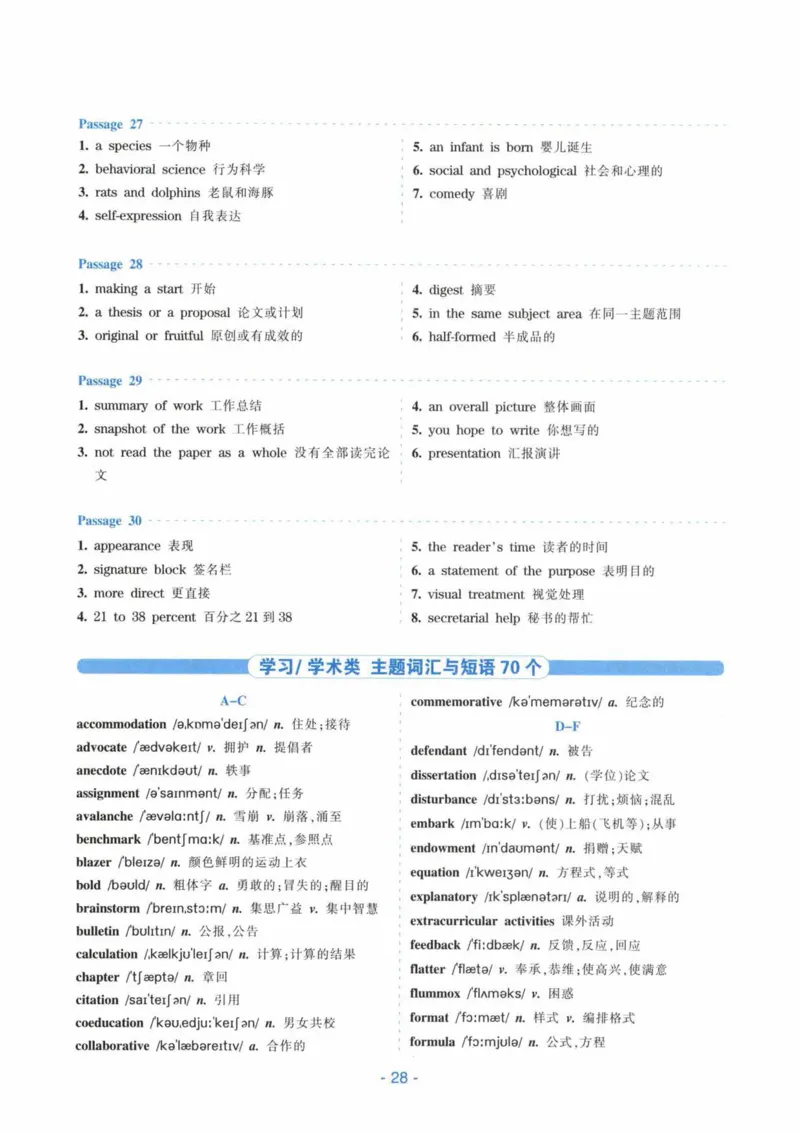
-Passage 27 ----
1. a species —个物种 5. an infant is bom 婴儿诞生
2. behavioral science 行为科学 6. social and psychological 社会和心理的
3. rats and dolphins 老鼠和海脉 7. comedy 喜剧
4. self-expression ft 我表达
Passage 28
1. making a start 开始 :4. digest 摘要
2. a thesis or a proposal 论文或计划 5. in the same subject area 在同一主题范
3. original or fruitful原创或有成效的 6. half-formed半成品的
Passage 2 9 ........................................
1. summary of work T•作总结 4. an overall picture 幣体_ifij
2. snapshot of the work 丁.作槪括 5. you hope to write 你想写的
3. not read the paper as a whole 没有全部读完论 6. presentation 汇报演讲
文
Passage 3 0 .......................................
1. appearance 表现 5. the reader’s time 读者的时间
2. signature block 签名栏 6. a statement of the purpose 衮明 R 的
3. more direct 更直接 7. visual treatment 视觉处理
4. 21 to 38 percent 百分之 21 到 38 8. secretarial help 秘书的帮忙
■ ■ ■ ■ ■ ■ ■ ■ a ■ [ 学习/ 学术类主题词汇与短语7〇个
A-C commemorative /ka’memarativ/ a•纪念的
accommodation /aknmadeijan/ n• 住处;接待 D-F
advocate /*aedvakeit/ v•拥护 w. 提倡者 defendant /di fendant/ /i•被告
anecdote /aenikdeut/ /i. 轶,K dissertation /.disa’teijan/ /i.(学位)论文
assignment /a'sainmant/ n .分fid;任务 disturbance /di’st3:bens/ n.打扰;烦恼;混乱
ava丨anche/*aeva丨a:ntJ7/l•宵 崩 v•崩落,浦至
embark /im'ba:k/ v• (使)上船(飞机等);从事
benchmark /*bentjma:k/ /i• 基准点,参照点
endowment /in’daumant/ /I• 捐W ;天陚
blazer /bleiza/ n. 颜色鲜明的运动上衣
equation /丨'kwei3an/ n.方程式,等式
bold /bauld/ n. 粗 体 字 明 敢 的 ;H 失的;醱目的
explanatory /ik'splaenatari/«• 说明的,解释的
brainstorm /*brein,st3:m/ /i. 集思广益 v. 集中智恝
extracurricular activities {夕卜活动
bulletin /bulitin/ n.公报,公告
feedback /fi:dbaek/ /i.反馈,反应,回应
calculation /.kaelkju’leijan/ /I• 计箅;i十算的结果
flatter /flaeta/ v .奉承,恭维;使高兴,使满意
chapter AJaepta/ /I•章回
flummox /fUmaks/ v.
citation /sai’teiJan/ n•引用
format /f〇:maet/ /i. 样式 v•编排格式
coeducation /*kau.edju:’keijan/ /i•男女共校
i
col丨aborative /ka’laebareitiv/ a. 合作的 formula /*fo:mjula/ n• 公式,方程
28
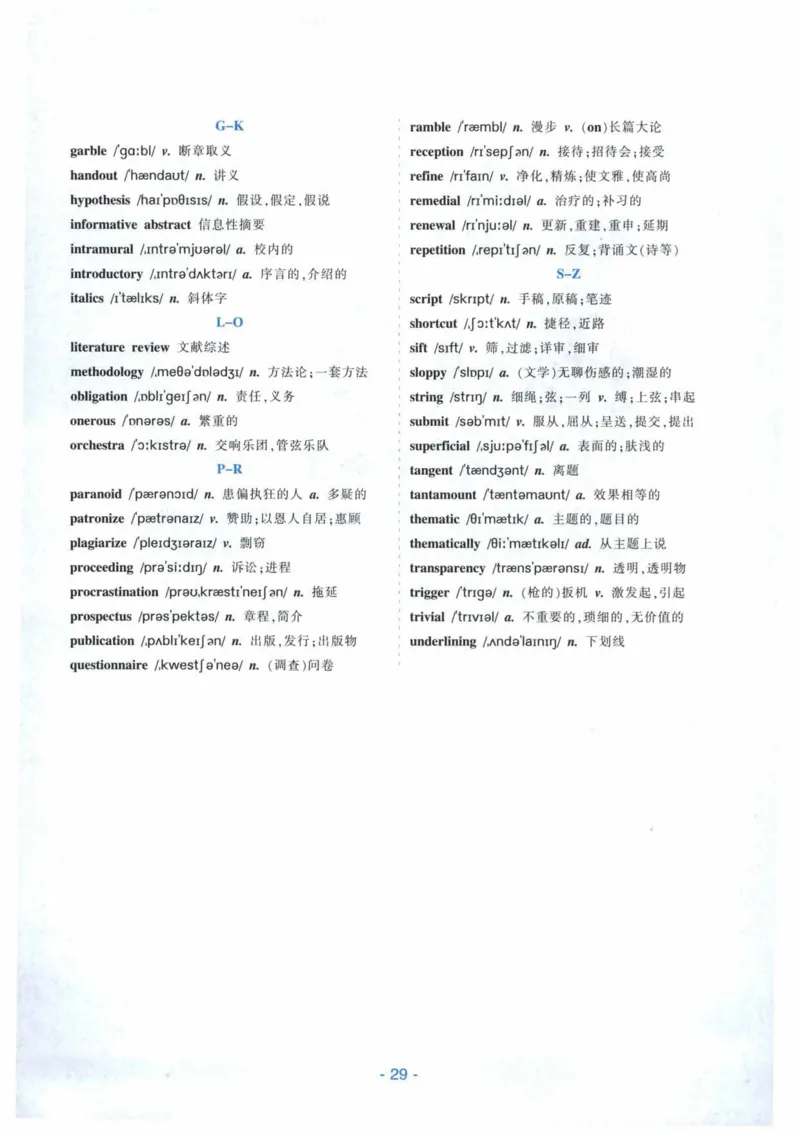
- -G-K ramb丨e /Vaembl/ /i.漫步 v. (on)长篇大论
garble /*ga:bl/ v•断章取义 r e c e p t i o n /i•接待;招待会;接受
handout /haendaut/ n•讲义 refine /n'fain/ v•净化,精炼;使文雅,使高尚
hypothesis /hai’pnBisis/ n• 假设,假定,假说 remedia丨 /ri’mi:dial/ a•治疗的;补习的
informative abstract 信息性摘要 renewal /ri’nju:al/ /I. 更新,重建,重申;延期
intramural /.intra'mjuaral/ a .校内的 repetition /.repi'tiJan/ /I•反复;背诵文(诗等)
introductory /.intr9’dAktari/ 仏 序言的,介绍的 丨 S-Z
italics /I'taeliks/ n.斜体字 script /skript/ n• 手稿,原稿;笔进
L-O shortcut /.Jo: t’kAt/ it.捷径,近路
literature review 文献综述 sift /sift/ v. 筛,过滤;详审,细审
methodology Ame0a’dnlad3i/ /i• 方法论;一套方法 sloppy /slopi/亿 (文学)无聊伤感的;潮湿的
obligation /.obli geij an/ /i• 责任,义务 string /strif]/ w•细绳;弦;一 列 v•缚 ;上弦;串起
onerous /*Dn9r9S/ a•繁 的 submit /S9b>mt/ v•服从,屈从;呈送,提交,提出
orchestra /〇:kistre/ it•交响乐团,管弦乐队 superficial /•sju:p9'fijal/fl•表面的;肤浅的
P-R tangent /taend3ant/ /!•离题
paranoid /paeranoid/ /i.患偏执狂的人a.多疑的 tantamount /taentamaunt/ a•效果相等的
patron丨ze /paetranaiz/ v.赞助;以恩人自居;患顾 thematic /0i'maetik/ a.主题的,题目的
I
plagiarize /*pleid3iaraiz/ v•刹窃 thematica丨ly /0i:’maetikali/ 似/•从主题 i:说
proceeding /prd.shdiQ/ n•诉 讼;进程 transparency /traens’paeransi/ n• 透明,透明物
procrastination /prau.kraesti neijan/ /i.拖延 trigger /triga/ /i.(枪的)板 机 v•激发起,引起
prospectus /pras’pektas/ /i• 章程,简介 trivial /trivial/a•不重要的,琐细的,无价值的
t
publication /.pAbli'keiJan/ n•出版,发行;出版物 underlining /.Anda'lainir]/ n•下划线
questionnaire /.kwestJVnea/ /!•(凋査)问卷
- 29
-听 力 填 空 3 0 0 题
TEM- 8 听力考试的第一部分MINI-LECTURE是由一个约900个单
词的讲座和一项填空任务组成。要求考生先边听边做笔记,然后完成填空
任务。共 15题。
《英语专业八级考试大纲》要求考生能够听懂有关政治、经济、历史、
文化、教育、语言文学、科普方面的演讲。由于讲座一般为独白或演讲,因
而句式具有口语化的特点,语速为每分钟约150个单词。第 ❶ 节 听力填空8大解题技巧
IT g H 抓主题、记实词
文章的开头和结尾部分通常是对讲座主题的介绍和总述,因此在听录音和记笔记的过程中要能够基本掌握文
章的结构特点,抓住主题和各分论点的内容。一般来说,讲座文章通常采用“总-分-总”的结构,因此显得中心突
出、结构清晰、层次分明。此外,(开头)主题、分论点或结论句中出现的关键性名词、动词和形容词等,或对某一亊物
特点的描述以及分述各点时的细节描述性词汇都是表达信息的主要载体。这些关键同多是基于整个主题要点及其
重要细节的实词。
» > Sample I
【最音】 Let me give you some examples. The first is whisper
【记录重点】
ing, which indicates the need for secrecy. The second
记录时,要分层次记录,在理解的
is breathiness. This is to show deep emotion. The third
基础上记下重点的名词、动词、形
is huskiness, which is to show unimportance.
容 词 等 实 词 ,如 whispering
【理目】 B. examples
breathiness^ huskiness 等〇
1. whispering: need for secrecy
【笔记】
2. breathiness: deep emotion
egs 1. whispering, secrecy
3. (2)_______: unimportance [TEM-8]
2. breathiness,
【解析】讲座举例说明声音副语言特征能在交际中帮助传达态度和意
deep emotion
图。此题考的是第三个例子huskiness。
3. huskiness, t»A
【答案】 huskiness
< 3 ® 表示晒序或层次的词句后是要点
由于记笔记填空的材料总体来说结构清晰,因此在阐述主题和各分论点时经常会出现表示层次和顺序的词、
词组或句子来帮助理解文章的整体结构、中心论点和各分论点。该类表达有:First of aH ... // The second point ...
// Thirdly, ... // Now let's take a look at the first approach, ... // Now let's move on tx> the second ap
proach to meaning, Now the third approach to meaning,...。听音时,应对这些表示顺序或层次的词语
之后的信息予以注意和记录。
» > Sample 2
【录音】 Now the second m^jor factor in the spread of English
【记录重点】
has been the spread of commerce throughout the world.
这篇听力材料介绍英语受欢迎
【題目】 Economic reasons
的原因,因此听到second时要
參 spread of (5)______ [TEM-8]
特别注意做笔记,因为它后面
【解析丨原文主题是英语的流行性。在陈述了主题之后,说话人具体解
的要点常是必考之处。
释了英语之所以变得流行的几个原因。考生听到second
【笔记】
factor.可知此处谈论的是第二个原因.与主题的内容紧密
2, spread Eng, spr.
相关,故应重点记录。根据考题可知空格处应填入名词性的
commerce
实词或名词性短语。
【答案】commerce // international commerce
-31
-(
33D
表示总结的词句后是要点
听力填空的录音材料的结构和层次都比较清晰,也就是说,在开始或完成主题或分论点叙述时通常会出现总
结性的词句。一方面它们能使讲座的结构和观点鲜明,准确地表达演讲者的意图;另一方面能使听者抓住® 点,更
好地理解演汫者传达的观点历年考题中经常出现的该类表达有:to sum up, in summaiy, to summarize, in a
word, generally speaking, finally, in general, in the end, to conclude, in conclusion, in brief, in closing,
it can be concluded that...,to draw the conclusion, above all, on the whole, in short 等。
» > Sample 3
【录音】To sum up, in today’s lecture, we’ve looked at some of
the issues in research paper writing, like the basic steps, 【记录重点】
types of research paper, and how to choose a topic 考生听到to sum up时®要特
别注意,之后是总结部分,是常考
【题目】i. Research Papers and Ordinary Essay
之处,同时也对正确理解全文、避
A. Similarity in (1)______ : [TEM-8】
免总体理解偏差有较大的帮助。
【解析丨此处为录音的总结部分,即综述之前已谈论过的取要内容。如
果听者在笔记中对之前的信息有遗M ,可通过这个部分补充
Sum. research paper
或考证已记录的关键信息,从而确保答题的准确率9
writv basic steps, types,
【答案】basic steps
how choose topic
fT E g l表示强调、重申的词句后是要点
文章通常不会对关键或主要的槪念和观点只提一次,而 会 或 多 次 强 调 说 明 ,以突出重点信息,让听者能理
解要点,从而正确理解整个汫座的内容。W 此其后的内容都是记笔记的重点。用来表示强调、重中的结构或表达常
有:the most important is.", indeed, really, certainly, absolutely, of course, in other words, to put it an
other way, that is, in similar terms 等
» > Sample 4
【录 音 】 Now let*s take a look at the first approach, that is,
【记录重点】
meaning is what is intended by the author.
听到that is时耍特别注意,它
【题目】1. Meaning is what is intended by (1) . [TEM-8]
后面的部分是对所提信息的觅
【解析】听到录音原文中的要点提示词first后,应特別注意其后的内
申和解释,表明that is前后的
容;接着听到that is,这表明后面的信息是对已提内容的重 内容比较1 要,通常是必考之处。
申,是考试的ffi点,必须记录。根据空格前的by可知,此处应
【笔记】
填人表人或物的名间性实词注意不能遗漏定冠同the 1 approach, meaning,
what intended, author
author
逻辑关系词(转折、因果等)后是要点
讲座中大ffl运用表示逻辑关系的词,借以体现其连贯性和逻辑性,使义章更有说服力,让听者史易接受„ 通过
抓住表示转折、W 果、对照、补充等逻辑关系的词,听苦能更好地卞握文章的发展脉络和结构,以及各具体内容之间
的关系。因此表示逻钳关系的词或短语之后的内容是笔记的歌点。常阽的表示逻辑关系的结构有:what’s more,
but, however, nevertheless, on the other hand, not only... but also..., therefore, so, as a result, conse
quently, hence, on the contraiy, in contrast, by contrast, besides, as well, in addition, furthermore ^ 〇
32
- -> » Sample 5
【录 音 】By contrast, one of the main characteristics of art in
the Middle East was, and still is, its absence of human 【记录遭点】
听到逻辑关系词by contrast
and animal images. This reflects the Islaauc belief that
these images are unholy* 时要特别注意,它后面的部分是
【题目】 Reason: human and (5)_______ are not seen as holy 常考之处。
[TEM^8]
【笔记】
【解析】逻辑关系结构by contrast表示细节之间的对照关系。这说
S * , 1 art, ab
明它后面提及的内容是和已谈论话题进行比较,得出相同或 sence, humon & animal im
不同之处^ 此题通过比较欧洲和中东的艺术特征,得出中东
ages,
艺术主要特征之一仍旧是缺少人和动物的形象,,根据考题可
belief, unholy
知空格处应填入与human并列的名词或名同性短语D
【答案】anima丨images
< 3 ® 表达观点的词句后是要点
在听力填空的录音材料中,演讲者一般都向听# 传递r=i己对某一主题或话题的主张和看法,带有很浓的主观
色彩。w 此为了区分具体的客观事实和主观想法,文章中通常会出现表达观点的词句。它们是理解整篇文章的基础
和灵魂,因此其后的内容都是记笔记的恿点。录音材料中常见的表达观点的结构有:believe, maintain,consider,
in my point of view, in my opinion, as I see it, in the eyes of,,.T as for me, as far as Ym concerned,
according to 等0
» > Sample 6
【录音】As far as I am concerned, the meaning is not only to
be found in the literary traditions and grammatical
【记录C 点J
conventions of meaning but also in the cultural codes
讲座中,演讲者使用as far as
which have been handed down from generation to gen
I am concerned这一短语结构
eration. 时,通常g 在强调其后的内容为
I 题目】speaker’s view: meaning is created by both conventions 演讲人句己的观点,因此要特别
of meaning and (5)_______ [TEM-8] 注意,并加以记录^
【解析】要点提示结构as far as I am concerned表示之后的内容
【笔记I
涉及演讲者对meaning这个话题的看法,突出演讲者与一些
meaning, found, literary tra.
学者对此话题的不同观点。根据考题可知,空格处应填入与
& gramm. conventions,
inventions of meaning并列的内容。录音原文屮的结构
t cultural codes,"
not only... but also— 进一步暗示听者,cultural codes 是
有待记录的关键信息
LturaL codes
表示举例的词句后是要点
讲座中经常会采用举例的方法来解释,说明某一 M 要观点或概念.从而使关键佶息更通俗和具体;同时使听者
能更准确.清晰地了解关键内容。举例时运用的语言通常会比文章中抽象的概念或观点易備.因此听者要尽可能地
记下相关信息. 并运用所记朵的信息来了解文竞中的难点。真题中呰出现过的表示举例的结构有:f〇r example,
for instance, such as, like, that is, namely, to illustrate, as an illustration ^ 0
-33
-> » Sample 7
【录音】 Some scholars argue that the formal properties of the
【记录雪点】
text, like grammar, diction, uses of image and so on
听到like时要特别注意在听到
and so forth, contain and produce the meaning...
这类表示举例的i司时,一般耑要
【题 目 】1) some people’s view: meaning is produced by the 记录1~2个关键词,以免试埋中
formal properties of the text like (4)______, etc [TEM-8】 考到。
【解析】由like可知,其后的内容是对formal properties of the
【笔记]
text的具体举例,这是常考之处,记笔记时不可忽视。此种类 scholars, formal prope. text,
(gramm. / diction / use image)
型的题 0 比较容易,grammar, diction, uses of image 这三
contain A produce
个例子中,考生只要填入其中一个即可、,
meaning
【答案】 grammar // diction // uses of image
€ 3 3 1 ) 合理利用速记方法
考生没有必要专门去学速i己方法,但可从中借鉴一些简单的符号和方法,冇时也可用简单的中文或缩写帮助
记录。
1. 数学符号:如 用 〈表示less than, > 表术more than,用 + 表示many, good等义,用 - 表 示 little, few,
be short of,用 = 表示 in other words 或 be equal to,用 x 表示 not, negative, wrong,用 •••表示 be
cause, •••表示 therefore 等c
2. 箭头符号:用 T 表* increase, add, higher,川 1 表示 decrease, reduce, lower,用 / 表示 develop,用
—► 表示 lead to, result in,用 — 表示 result from,caused by 等。
3. 英语符号和缩写:用 & 表 示 and,用w/表示with,用 w/o表示without,用 vs表示against,用e.g.表示exam-
pie,用 dept 表示 department,用 pres 表示 presentation,用 subj 表示 subject,用 max 表示 maxinuim,川 in
tro 表示 introduction, 用 prob 表示 problem 等
值得注意的是考生一定要运用自己明白的符号,并不一定要局限于统一的规定。而且注意记录相同信息时一
定要运用相同的符号,避免引起混乱此外在记录时要层次分明,以方便之后答题时的笔记阅读和理解。
» > Sample 8
【录音】 For most Europeans and Americans, art is mainly for
decoration.
【记录置点】
【題 目 】 How people see art is related to their cultural back 运用考生熟悉的简争符号、缩写
ground 和中文来记录原文重要信息.可
以有效地帮助考生记忆讲座内
A. Europeans and Americans
容,并且为答题提供有效的提示。
—(7)______ [TEM-8)
【解析】在记录时为r 加快速度,可以运用听者a 己熟悉的符号记笔 【笔记】
most Euro A Ameri.,
记。如用“Euro”表示原文中的“Europeans", “& ”代表“and”,
art, dec.
“dec ” 代表 “ decoration ” 等。
J
【答案】decoration
-34
-第 ❷ 节 听^填空训练300题
MINI-LECTURE
Effective Note-taking
The difficulty of taking notes: Note-taking requires a high level of ability
due to the (1)___________ of spoken language. ⑴
I. Before taking notes:
A. Be sure of the (2)___________ of yours and the speaker’s. (2)
B. Review relevant background materials if (3)___________. (3)
II. While taking notes:
A. Understand the new words by (4)___________ the meanings from the context ⑷
B. Study carefully the (5)___________, which usually implies (5)
the most important information.
C. Catch the speaker’s (6)___________ through tone, gesture, repetition and ⑹
illustration on the board.
D. Pay attention to the speakers indirect (7)___________ to indicate what is important, (7)
like changes in speed, volume or (8)___________. (8)
E. While writing down the main points, develop a system of mechanics:
jotting down (9)___________; using shorthand, abbreviations and symbols; (9)
leaving out (10)___________ words. (10)
F. While selecting words to write down, pick those having the (11)___________ (11)
information, like nouns, verbs or (12)___________ , and those indicating (12)
the proceeding direction of the lecture, like (13)___________• (13)
III. After taking notes:
A. Review and (14)___________ them as soon as possible. (14)
B. (15)___________ notes with others to learn from them. (15)
»>名师点评
Effective Note-taking
Good morning, everyone! Today I’d like to continue our se 参考词汇
ries of talks about study skills in university. This morning I’m go
diffuse /di’fju:z/ v•扩散
ing to discuss how to take notes effectively.
anticipate /aen’tisipeit/ vi•预期
【11 As we all know, note-taking is difficult since spoken lan
pattern /paetan/ u. 模式
guage is more dtfftised than written language and its organization is
not immediately apparent. In addition, spoken language is quickly
strain /strein/ n.极度紧张
gone, which makes analysis difficult. So it can be seen that to strait>htawa\ /streita.wei/ a .直
achieve such a complex task as note-taking, a high level of ability 的
in many separate skills is required. Now let*s discuss these skills solel> /*sauli/zw/.单独地
35
- -in details.
accurately /aekjuratli/
ad.
Before taking notes, prepare yourself mentally. [21Be sure of
Hlustration Ailas’treijan/ u•插阁
your purpose and the speaker's purpose. [3]Review your notes and
intonation /.inWneiJan/ /i•语调
other background material if available because increased knowl
edge results in increased interest. Besides, a clear sense of pur
device /di’vais/ n•手段
pose on your part will make the speaker's content more relevant. conversely /kan’v3:sli/ ad. 相反
Be ready to understand and remember. Anticipate what is to (地)
come, and later evaluate how well you were able to do this. incidental /.insi’dental/ 〇•次要的
While taking notes, the student has to understand what the mechanic /mi’kaenik/ /i.方法
lecturer says as he says it. The student cannot stop the lecture in shorthand /7〇:thaend/ n. 速记
order to look up a new word or check an unfamiliar sentence
contraction /kan’traekJan/ /i•缩辂
pattern. This puts the non-native speaker of English under a par
词
ticularly severe strain. Often he may not be able to recognize
abbreviation /a’bri:vieiJan/ it•缩
words in speech which he understands straightaway in print. He^ll
写词
also meet words in a lecture which are completely new to him.
adjective /*aed3iktiv/ 形容词
[4] While he should, of course! try to develop the abili^ to infer
connective /ka’nektiv/ n.连接词
their meanings from the context he won’t always be able to do
proceed /pra'shd/ vi 进行
this successfully. He must not allow failure of this kind to dis
reminisce /.remi’nis/ v•追忆
courage him, however. It is often possible to understand much of
a lecture by concentrating solely on those points which are most uncritically /An'kritikali/ ad. +加
important. But how does the student decide what is important? It 批评地
inconsistency /inkan’sistansi/
is, in fact, the second skill I want to talk about today. n.
[5]Probably the most important piece of information in a lec 矛盾
ture is the title itself. If this is printed beforehand, the student
should study it carefully and make sure he is in no doubt about Its meaning. Whatever happens he
should make sure that he writes it down accurately and completely, A title often implies many of the
mgjor points that will later be covered in the lecture itself.
[61Be alert to the speaker’s emphasis through tone, gesture, repetition and illustration on the board. A
good lecturer, of course, often signals what is important or unimportant. [7]He may give direct signals
or indirect signals. Many lecturers, for example, explicitly tell their audience that a point is important
and that the student should write it down. It is worth remembering that most lecturers also give indi
rect signals to indicate what is important [8]They either pause or speak slowly or speak loudly or use
a greater range of intonation, or they employ a combination of these devices, when they say something
important Conversely, their sentences are delivered quickly, softly, within a narrow range of intonation
and with short or infrequent pauses when they are saying something which is incidental. It is, of
course, helpful for the student to be aware of this and for him to focus his attention accordingly.
Having sorted out the main points, however, the student still has to write them down. And he has
to do this quickly and clearly. In order to write at speed, try to develop a suitable system of mechan
ics: [91i〇t down words or phrases, not entire sentences: develop some system of shorthand and be con
sistent in its use; [10]leave out small service words; use contractions^ abbreviations and symbols.
Most students find it helpful to abbreviate. [ll)They also tiy to select only those words which give
maximum information. [12)Th('st' an* usually nouns, but sometimes verbs or adjectives. Writing only one
36
- -point on each line also helps the student to understand his notes when he comes tx> read them later.
An important difficulty is, of course, finding time to write the notes. If a student chooses the wrong
moment to write, he may miss a point of greater importance. Connecting words or connectives may
guide him to a correct choice here. [13)Those connectives which indicate that the argument is proceed
ing in the same direction also tell the listener that it is a safe time to write. “Moreover”,“ftirther-
more”, “also”,etc.,are examples of this. Connectives such as “however”,“on the other hand” or
“nevertheless” usually mean that new and perhaps unexpected information is going to follow. Therefore,
it may, on these occasions, be more appropriate to listen.
After taking notes, [14]review and reword them as soon as possible. Don^ just recopy or type with
out thought Reminiscing may provide forgotten material later. Rewrite incomplete parts in greater detail.
Fill in gaps as you remember points heard but not recorded, f 151 Arrange with another student to com
pare notes. Sharpen your note-taking technique by looking at other students* notes. How are they better
than your own? How are your notes superior? Compare the information in your notes with your own
experience. Don*t swallow everything uncritically. DonTt reject what seems strange or incorrect. Check it
out. Be willing to hold some seeming inconsistencies in your mind over a period of time. Make mean
ingful associations. Memorize that which must be memorized.
OK. In todays lecture, weVe discussed several skills that can help one in taking notes effectively.
In our next lecture, we’ll explore how to read effectively.
1• 【答案】diffusion
【解析】讲座的主题为“how to take notes effectively(如何有效地i己笔记)”。随后演讲人比较了口语与书面
语的区别,其中提到口语要比书面语更加散乱(difftise)。根据题目要求,空格处应填名词,故用diffuse的名同
形式 diffusion
2• 【答案】purpose(s)
【解析】在谈到记笔记之前的准备时,演讲人认为,要确定your purpose and the speaker’s purpose对应题
目,填入purpose⑻即可D
3• 【答案】available
【解析】记笔记之前准备的另一个方面,就是review your notes and other background material if avail-
able。空格考査的内容是讲座出现的原词,故填人available即可。
4• 【答案】inferring
【解析】在谈到new word和unfamiliar sentence pattern时,演讲人并不提议立即査字典,而是建议develop
the ability to infer their meanings from the context (培养从语境中推测词义的能力)。注意空格前的介词
by,空格处应用动名词inferring。
5.【答案】title
【解析】为了解决“学生如何确定fi要信息”,演讲人提到了记笔记时的第二个要点:最® 要的信息往往体现在
标题(title)上。随后演讲人进一步地说明了 title的1 要性。故此空填title。
6• 【答案】emphasis
【解析】此题谈论记笔记过程中的第三个要点:be alert to the speaker’s emphasis through…(注意说话
者通过……所进行的强调)。空格处待填内容为emphasis。
7• 【答案】signals
【解析】在讲完be alert to the speaker’s emphasis之后,讲座接着提到,一 个好的演讲人,通常会对重点和
非重点的地方发出直接或间接的信号(signals)。因此,空格缺少的是signals —词。
8• 【答案】intonation
37
- -【解析】在谈到indirect signals(间接信号)时提到,演i并人要么放慢语速,要么提高音ft,要么使用抑扬顿挫的
语调。题目中的speed对应原文的slowly, volume对应loudly, W 而填人intonation
9• 【答案】words or phrases
【解析】在谈到如何记录时,讲座人列举了一些方法,其中第一个就是jot down words or phrases(i2下单词
或短语)。故此处填入words or phrases。
10• 【答案】small service
【解析】此处考査演讲人列举的另一个方法:leave out small service words(备略不8 要的修饰语)。空格处
待填的是small service
11• 【答案】maximum
【解析j 在谈到abbreviation(缩写)时,演讲人称许多学生选择使用那些能够提供最多信息的单词。空格处应
填入修饰information的形容词或名词,根据原文内容,填maximum
12• 【答案】a(^ectives
【解析】此题是上一题的具体例子。能够提供最多信息的单词通常是名词,有时候是动词或形容词。结合题目,
这里缺少的是形容词,B卩adjectives。
13• 【答案】connectives // connecting words
【解析】在谈到应记录的内容时,演讲人还建议要注意connecting words or connectives(连接词),文章中修
饰 connectives 的定语从句 which indicate that the argument is preceding in the same direction 与题目
内容相对应,因而填入connectives或connecting words即可。
14• 【答案】reword
【解析】此题考査记笔记之后的情况其中讲座提到的第一个方面就是review and reword them as soon
as possible(尽快冋顾和改写所记录的内容)。题目已经给出了 review—词,故填入reword。
15• 【答案】Compare
【解析】在After taking notes方面,演讲人提到了两个方面:①尽快回顾和改写所记录的内容;②与其他同学
对比笔记内容。题目考査第二个方面,即compare notes。
MINI-LECTURE
Learning How to Learn
I. Views on learning
A. Learning is something so natural
一 we don’t even (1)___________ we’re doing it (1)
— we get caught up in the process of it
B. The preconditions of how much one will learn
一 the absolute (2)___________: people have to learn (2)
— the infinite (3)___________: people want to learn (3)
II. The basic and overall (4)__________ to learning (4)
A. (5)___________ of the right subject (5)
B. (6)___________ (6)
a) books, tapes and videos
b) (7)___________: expert can help you to learn (7)
C. action
a) (8)___________ of what people have learnt (8)
b) misunderstanding: know everything before taking actions
38
- -D. (9) : the majority of learning occurs ⑼
a) acting as a filter to tell people what they have to get again
b) showing them what they need to know
c) the (10)___________ of knowledge and experience (10)
d) determining whether people really learn or not
III. Other factors crucial to learning
A. A (11)___________ attitude (11)
— acknowledgment of the fact that one knows little
— intention to learn
- (12)_______ (12)
— gaining a lot of information about the subject
B. Listening
一 most people love to talk about what they are (13) (13)
— you would learn a lot if you are truly listening
C. (14)___________ (14)
—— not afraid of mixing up things when applying what one has learnt
— pointing to an area of refinement
— leading one to learning new things
_ emphasis on the choice of (15) (15)
at the beginning of learning
»>名师点评
Learning How to Learn
Good evening. Today*s lecture is about the phrase ** learning 参考词汇
how to learn". I remember reading that learning how to learn is
associate /a’saujie丨t/ v/.使有联系
one of the best skills you can develop. That phrase "learning how
indicator Andi.keita/ fi. 指标
to learn" got stuck in my head and I turned that concept over
absolute /*aebsalu:t/fl.绝对的
and over in my mind and asked myself: “Do we have to learn
minimum /Vninimam/n•最低限度
how to learn?** After thinking about it, [l]IVe realized that learning
methodology /.meBa'doladsi/
n.
is something so natural that we^ don^t even ^recognize that weYe
方法论
doing it because we get so caught up in the process of it
curve /k3:v/ 曲线
Most of us associate learning as something difficult, something
refinement /ri’fainmant/ n.精细加
reserved for extremely intelligent people, but that is not the case
工
at all. I think the biggest indicator that will tell you how much loop /lu:p/ v•(使)成环
you will learn is what makes you want to learn in the first place. compound /kam’paund/ w•使合成
I know that sounds pretty obvious, but that single factor is very exponentially /.ekspau'nenjall/
important as youll soon see. Take for example, learning the latest d 指数地
accounting rules because your job requires it as opposed to learn capitalize on充分利用(某物)
ing about cars because that^ something you like. If you have to leverage /*li:v9rid3/ w•促使.....改
learn something,[21youTl only learn as much as you*re required 变
to—in other words the absolute minimum. [3]but if you want to humble /"hAmbl/ a. 谦虚的
learn something, the sky*s the limit.
torrent /torant/ /i.迸发
-39
-[4] There are some basic overall methodologies to learning.
[5] It really begins first with choosing the right subject. This is key. This choice alone can deter
mine how much you are willing to learn. You have to develop a love for learning and that becomes
really easy when you love the subject itself.
[6] After the right subject is chosen, then comes tlie education. When education comes to mind, we
tend to think of books, tapes, videos [7】but there’s one element that a lot of people seem to miss and
that element is the human being. People who are experts in any particular subject can filter through
everything and tell you the information you need to read, the actions you need to take, etxr., and by
doing so, can cut your learning curve in half. Thafs the whole logic behind mentors and their students.
[8]After thg knowledge 马ction. have to apply what you’ve learned. This stage is where
most people fall into a trap. They want to know everything before they take any sort of action. That^
the wrong mentality to have because by doing so, you effectively block yourself from the most impor
tant stage of learning, that is refinement. [91The stage of refinement is where the majority of learning
occurs because refinement acts as a filter to guide you to the knowledge you need to get again from
books, tapes, videos, people, etc., to further your learning experience. This puts you back to the second
stage, education which then leads to the third stage—appbcation, which leads again to the fourth stage,
refinement and on and on and on. This cycle is where the majority of learning takes place. After the
action is taken, they want to learn how to do more so the refinement is showing them what they need
to know and they go back to learning, applying what theyVe learned, refining, [10]in essence, loop
themselves from educate to apply to refine and as they do sot the knowledge plus experience starts
compounding on one another until their learning starts to grow exponentially. The refinement stage is
very important because that will determine whether or not you really learn because anybody can learn
something and apply it, but few will go the extra mile and get caught up in the cycle of learn to apply
to refine. Again, people who are knowledgeable about a subject can help you in the refinement stage
because you can ask exactly the questions you need and they can respond accordingly to give you the
exact knowledge you request. That's something books, tapes, and videos cannot do because those are
one sided conversations. You can further capitalize on asking people by leveraging those relationships tx>
ask for introductions to other people who are knowledgeable about the subject as well.
Now let's take a look at other factors crucial to learning.
flllFirst a humble attitude is critical to learning and is best applied when it comes to asking people
for information. Acknowledge the fact that you know little about the subject and that you wish to learn
and [121then ask people to help you and you will be amazed at the torrent of information that comes
pouring out from them. People will be less inclined to give out information to somebody who claims
they know a lot about the subject as opposed to those who are humble and willing to learn.
Secondly, listening. [131The majority of people love to talk about subjects they are knowledgeable
about and are more than willing to dish everything out, provided the other party is truly listening.
[141Thirdlyt experimenting. Don’t be afraid to mix things up when you apply what you’ve learned
because that in turn can point to an area of refinement you never knew existed. Experimenting shakes
things up and can even lead you to learning something that's never be known before! [15]Leaming be
gins with choosing the right subject, one that you, and you alone are truly interested in and I know
that sounds obvious, but people try to learn things that they are not interested in for reasons outside
themselves.
-40
-Generally speaking, it turns out learning is pretty easy, so long as you like the subject. When that
happens, you*ll realize that all that time you spent on it was actually time spent learning. It just didn’t
feel like it at all.
1• 【答案】recognize
【解析】讲座的主题是探讨“Do we have to learn how to leam(人们是否应学会如何学习?)”紧接着提到了
学习是很自然的行为以至于人们都没有意识到(recognize),对照问题,可知答案为recognize
2• 【答案】minimum
【解析】此题举例说明人们学会东西的多少取决于人们学习的动机,并举例说明“你只会学要求的那部分——
换句话说,也就是最低限度(minimum)的学H ’,可知答案为minimum。
3• 【答案】limit
【解析I 讲座提到,你只学会要求的那部分,这是最低限度的学习tt;而你想学一些东西,天空是边界。换句话
说,想学的时候,学习是无止境的。故这里用infinite limit表示。
4• 【答案】methodologies
【解析】此题涉及整个学习的过程。录音材料提到下文开始分别介绍学习的基本方法(methodologies),可知答
案为 methodologies
5• 【答案】choice
【解析】学习的基本方法的第一点是选择合适的科目。因此空格处填人choice。
6• 【答案】education
【解析】此题涉及学习过程中的第二阶段,根据原文“在选择了合适的科目之后,随之而来的就是教育(educa
tion) 了”,可知答案为 education.
7• 【答案】human being
【解析】讲座谈到,有一个很多人都忽视的因素是人(human being),专家能够帮你过滤掉所有的事情并告诉你
: 要的信息。这里缺少的是human being。
8• 【答案】application // practice
【解析】此题涉及学习过程中的第三阶段,根据原文“知识学习之后就是行动了,你必须将所学知识加以应用
(apply) ”,可知答案为application或其同义词practice。
9• 【答案】refinement
【解析】此题涉及学习过程中的第四阶段,根据原文“大部分学习都有精细加工(refinement)的阶段”,可知答案
为 refinement。
10• 【答案】compound // mixture // combination
【解析】此题具体探讨refinement的阶段情况和特点,根据原文“本质上……知识和经验开始结合(com-
pounding)直到....”,可知答案为compound要点提示词in essence后的信息是常考点,笔记应注意。
11• 【答案】humble // modest
【解析】此题讲述的是学习中其他的ffi要因素。根据“首先要持谦虚的(humble)态度,它对学习很重要,可知答
案为 humble 或 modest
12• 【答案】asking for help
【解析】谦虚态度在询问他人信息时至关重要。讲座人认为,要俎诚你所知甚少,想要学习,接肴寻求帮助,那
么你将会惊讶于你所收获的信息空格出缺少的是asking for help
13• 【答案】knowledgeable about
【解析】这里讲的是学习中其他重要因素的第二个方面:listening其中谈到,大多数人喜欢谈论的是他们所知
晓的学科。空格处填入讲座提到的原同knowledgeable about即可。
14• 【答案】Experimenting // Experiment
41
• -【解析】A 、B 、C 并列,此题继续讲述学习中其他的重要因素„录音中提到Thirdly, experimenting可知答案为
Experimenting 或 Experiment。
15• 【答案】the right subject
【解析】此题涉及细节信息,谈到学习的开始阶段,选择正确subject,根据原文“学习从选择合适的科目开始,
—个你真正感兴趣的科目”,可知答案为the right subject。
MINI-LECTURE
How to Find Time for Yourself
I. Introduction: ways to carve out your own time
A. (1)___________: too busy (1)
B. Desire: some time for yourself
II. Scheduling time for yourself
A* Evenings with yourself
— saving certain (2)___________just for you (2)
— doing whatever you want on those nights
B. (3)___________ (3)
C. Buying tickets (4)___________ (4)
一 tickets for anything you er\joy: sports, conceits, etc.
— scheduling the plans with a friend later
D. Leaving work on time
E. Joining a(n) (5)___________ (5)
F. Taking an adult education class
G. Doing some exercise
—— deciding today
— making it (6)___________tomorrow (6)
III. Keeping yourself on the go
A* Commuting via (7)___________ transportation, using that time (7)
一 for some reading or (8)___________ (8)
— for meditation
B. Driving in your car
— making the most of the time
— (9)___________ you spend that time (9)
— changing “waiting time” into “(10)___________” (10)
— doing reading, writing or entertainment items
IV. Trying to be in synergy
A. Two birds, one stone
B. Getting to work (11)___________ (11)
— getting exercise
一 using the time to think or ei\joy music
C. Arriving early, using the time
一 for relaxation
— for thinking, whatever
-42
-D. (12)___________ (12)
一 making a difference for others
— esc叩ing work and personal (13)____________ (13)
— growing as a person
E. Taking a(n) (14)___________job (14)
一 making money
— doing something you love
F. Having (15)___________ (15)
»>名师点评
How to Find Time for Yourself
Good morning. Welcome to today’s lecture on how to find 参考词汇
time for yourself. To begin with one question: Do you ever find
carve out 创造
yourself longing for some time for yourself? HIMany of us are so
busy with work,school, and home life that often there is no time rejuvenate /ri'dsuivineit/ v. 使返
left over to do something that you enjoy. What follows are some 老还童
ways to carve out that essential time you need to slow down, en ultimate 极瑙的
joy life, and rejuvenate yourself. astronomj /a'stmnami/ u.天文学
For one thing, scheduling time for yourself. One, evenings quilting /*kwilti»]/ n.缝被子
with yourself. [21Try to save certain weeknights just for you. If archery /aitjari/ n.
others ask you to do things those nights, just tell them you have
belly-dance w• 跳81:皮舞
plans. Use the time for gardening, reading, exercise, thinking, or
holy cow 天啊
the ultimate luxury of doing nothing! [3]Two, monthly treat.
wander A/vonda/ vi••漫游
Schedule a treat for yourself once a month. It could be on your
ditch /ditj/ w. 抛弃
lunch break, a weekend, or it could be leaving work early. Maybe
meditation /.medi’teijan/ n•冥想
you get a spa treatment, go see a movie, get a haircut, play golf,
or whatever treat you’re always thinking about but rarely get to perceive /pa_si:v/ w.认知
do. Schedule it in and it will happen! Three, [4)buy tickets in ad syner your favorite music! Here are a couple travel audio books you could bor
row from your local library that will take you on a journey to a foreign land while you are walking or
jogging: "Holy Cow: An Indian AdventureM by Sarah MacDonald or "The Places in BetweenM by Rory
Stewart. If you’ve been exercising for a while and you usually listen to music, try to go without any
input for a change. Instead, let your mind wander and expand.
Then, keeping yourself on the go. [71〇nef commute via public transportation. If you can, ditch your
car, and let someone else do the driving. Use that time to plan your day, [81do some reading, writing,
creative thinking, or even meditation. Two, driving in your car. Make the most of this time. [9]Vary
how you spend that time. If you always listen to music, perhaps also try: educational radio, positive
audio tapes or even totally quiet time. Use that quiet time for brain storming. Either think in your head
or even talk your ideas out loud. Bring a voice recorder. You could write a book via voice recorder
over time. Three, waiting in the car. If you find that you have a certain amount of “waiting time" in
your life, change how you perceive it. [lOjlnstead of」*waiting time’二you can instantly change it into
ume timeM by bringing along reading, writing, or entertainment items. Or if you find yourself waiting
and you don*t have any of these things use the time for creative thinking about your life or try some
meditation.
Lastly, trying to be in synergy. One, two birds, one stone. Look for ideas where you can fit in time
for you within things you need to do already or that will have multiple benefits. See the ideas below to
give you an idea Two, [ll]walk to work. This is a great one because youYe accomplishing many things
at once. You’re getting exercise, you have time to think or ei\joy music, and you’re helping to save the
environment. Three, arrive early. Any appointment that you have, plan to arrive 15-30 minutes early.
Then use this time for you: reading, writing, meditation, relaxation, thinking, whatever. [12]Fourt volun
teering. There are so many benefits with this. [13]You make a difference for othere, you escape work
and personal worries, and you grow as a person. If you could help one organization or group, which
would it be? OK,now go ahead and Google them and find out how you can help—even if it’s just
once a year. Five, [141side job. Find a side job at which you makejmoneyj but that will also allow
you to do something you love. Some ideas: coaching, teaching a class, or training others. [15]Sixt lunch
alone. Try sneaking away for a quiet lunch alone on a park bench or even in your car. Ei\joy some
quiet time with no one to talk to and no audio inputs.
To summarize, weVe covered three factors to consider in finding time for yourself. Thank you.
1• 【答案】Reality
【解析】此题需要考生运用概括能力解答。根据下一行的Desire—词,可知too busy是现实的情况,因此川
reality—同概括,根据题0 设置要求和Desire的提示.reality要大写首字母。
2• 【答案】weeknights
【解析】讲座的主题是“how to find time for yourself(如何腾出时间厂’,接矜列举了几种方式。第一种是进行
时间安排,具体做法是 Try to save certain weeknights just for you,可知答案为 weeknights
3• 【答案】Monthly treat
【解析】如何安排时间的第二点是monthly treat(每月犒赏)。同样注意大写首字母。
4• 【答案】in advance // beforehand
【解析】此题继续谈如何安排时间,其中第三点为buy tickets in advance,可知答案为in advance表示顺序
44
• -或层次的词句后是要点。此外,根据理解还可以填人其近义词beforehand ,
5• 【答案】group // club // society
【解析】此题继续谈如何安排时间,根据具体内容join a group,可知答案为group或d u b或society,
6• 【答案】happen
【解析】录音材料提到decide today and then make it a reality tomorrow,对照考题,可知答案为happen。
7• 【答案】public
【解析】此题谈到为自己腾出时间的第二种方法。录音材料提到commute via public transportation,可知答
案为 public。
8• 【答案】writing // creative thinking
【解析】讲座提到,在乘坐大众交通工具时,可以看看书,写点东西,创造性思考,或者冥想。空格前给出了
reading,下一行给出了 meditation,因此空格处填入writing或 creative thinking都可以。
9• 【答案】varying/diversifying how/the ways
【解析I 此题谈论keeping yourself on the go的具体内容。根据录音原文vary how you spend that time,
可知答案为 varying how/the ways 或 diversifying how/the ways。
10• 【答案】me time
【解析】录音材料提到,根据与其等待,不如把“等待时间”变成“我时间”,做些阅读、写作或休闲活动,可知答
案为 me time。
11• 【答案】on foot
【解析】此题谈到为自己腾出时间的第三种方法trying to be in synergy,walk to work,由此可知答案为on
foot。
12• 【答案】Volunteering
【解析】这里是trying to be in synergy的第四个方面,即volunteering注意首字母大写。
13• 【答案】worries
【解析】录音材料提到,“你对别人来说很重要,你也可以远离工作和私人杂念(worries),可以得到更好的自我
发展”,可知答案为worries。
14• 【答案】side
【解析】此题继续谈论第三种方法。录音材料提到,“找个副业兼职(side job),这能让你多赚点钱”,可知答案
为 side。
15• 【答案】lunch alone
【解析】此题考査最后一个方面----lunch alone,
f f g g l MINI-LECTURE
The Skills Required to Get a Job
I. Academic skills: (1)______________________________ (1).
1. Communication skills
一 Understand and speak the languages in (2)___________ (2)
— Be (3)_______________________________________________ (3)
— Read written materials
一 (4)_________________________________________________ ⑷
-45
-2. Thinkin aa skius
— Think (5) _ _ _ _ _ and act logically (5)
e.g. technology, physical science, the arts, skilled trades,
social science, etc.
3. Learning skills
e.g. learn to use (6) _ _ _ _ _ after a few tutorials (6)
H. persona:?} _ _ _ _ _ skills: combination of attitudes, skills and behaviors 3
L Positive attitudes and behaviors
丨 Have (8) _ _ _ _ _ and confidence (8)
丨 Be honest, haveintegrity and (9) _ _ _ _ _ (9)
I Have positive attitudes toward work, learning, etc.
丨 Be energetic and ( I_ s _ _ _ (10)
^responsibility
—— set Qro oals and priorities
I 2an and manage time, money, etc.
3. Adaptability
—— Have a positive attitude toward (11) _ _ _ _ _ in the job (11)
HL (12) _ _ _ _ _ s i (12)
L Importance
丨 Brin afo Inore resources to the proble3 situation
I Be more (13) _ _ _ _ _ and morale b8stin Qa than *5 dividual work (13)
2. How to improve the AC kills
I Involvedinthe group
I Be (14) _ _ _ _ _ and listen to others (14)
丨 Be a leader rather than a(n) (15) _ _ _ _ _ (15)
v v v ^ s ^
The skills»equired to Get a Job
# 神 s ir
conduct / k )a r v d > l <..5 t & / ^
instsm 作 nt Anstrumant/
tutorial Aju: rc :rI9l/ ? > - 窆 S C4
adaptability / D( d a e pro rc l l l t l / /!• li
Jeff
integrity /irVtegnti/ ? X E »
persistence /P9-Sls rs nsl/
赛
a . 阀 ^ 眾
accountability .ra k a c .ra D b l l l t l / /!•
diversity /da -< 3:sltl/
-46
Good
-
morning, everyone. In today-s lecture, I will tall< about
the skills required t o QTQ e t a QO 8 d job. Well, it is true that now
competition for employment is more so than ever. So it begs the
obvious question, r= o\v .Q o you stand out? There will be three main
points I will be discussing. They are academic, personal manage-
3ent, and teamwork skills. I will give you examples of these
skills, and reasons why these skills are important for you to get a
job.
First of all, academic skills. Academic skills are probably the
most important skill you will need to get a job. It is one of the
or the first thing an e3ployer looks forinan e3ployee. UlThey
are skills whichi give you the basic foundation to acquire, hold on
t OL and advance in a job, and to achieve the best results. Aca
demic skills can be furtherdividedinto three sub-groups: commu-nication, thinking, and leamin lcpQ skius.
【2 一 Qommunicati^l skills require you to understand and
s >T<: i 爸 g c ^ g AC: ^J l } ^ so! i l l > u-5: e ^s ; s-K! ir o 3 d u c t e d.
s or e a k
f 31 You must be a
good listener, and be able to understand things easily. One of th 卬
most important communicatin QO should be reading. You
should be able to comprehend and use written materialsincludin QrQ
things such as graphs, charts, and displays. One of the newest things we can add to communicatin QfQ
skills would be the Internet, since it is so widely used all around the world, t4jana rs' ence you should
have agood understanding of what it is and how to use it
Then, thinking skills. f51Thinkin QP criticany and acting logically to evaluate situatio5 will get you far
in your job. Thinking skills consist of things such as solving 彐 athesaucal problems, usin QTQ new technol-
ogy, instruments, tools, and information systems effectively. Some examples of these would be technol-
ogy, physical science, the arts, skilled trades, social science, and mucli more.
After that, leamin QO is very important for any job. fgFor example, if your company gets some new
sopware, y o; u 3i ^ *gi a rc! l >tr! -s! l e a r n h o o! u \ V s e J it quickly and effectively afterpfew tutorials. You
must continue doing this for the rest of your career. It is one thing that will always be usefulinany
situation, not just jobs.
The second m .^ o r job skill I want to&scuss is management skills.^ personal management skill is
the combination of astudesj skills, and behaviors required t o QO e t, keep, and progresson a job and Jo
achievethe best results. Personal management skills can be further dividedinto three sub- QTQ roups just
as academic skills, which are positive attitudes and behaviors, responsibility, and adaptability.
p s s v e attitudes and behaviors are also very important to keep a job.【8】Ypcmust h a v ^l QFb o o d self-
? wl s! «; 3: 芎 a oi o n g .Q; m 3; o. ^_ *5: y o! m * s Dr! l— £ 5C 1YOU must be honest, have inte2ri? and personal ethics. You 3ust
show your employer you are happy at what you are doing and have positive attitudes toward learning,
growth, and personal -D ealth. uolshow energy and persistence t o QO e t the job done, these can help you
t o QP e t promoted or a raise.
responsibility and adaptability are also essentialwesponsibEty is the ability to set goals and priori-
Uesinwork and personalEe. It is the ability to plan and manage time, money, and other resources to
achieve QO oals, and accountability for actions taken, fl 一一 While adaptability m eans having a positive atti,
tude toward changes in your job, and recognition of re AC pect for people-s diversity and individual differ-
ences. Creativity is also important You must have the ability to identify and suggest new ideas to get
the job aone.
【2】L*ast bul 031 二 ⑦ 艮 I want to emphasize teamwork skills.【13】wmploy tfl rs now focus on employees-
teamwork skills simply because teams can bring m ore talent experience, knowledge and skill to the
problem situation and teamwork can be more satisfying and morale boosting for people than working
alone. There are two reasons. First, team recommendations are 彐 ore likely to be carried out than re?
ommendations by an individual because people are more willing to support an effort that they have
helped to develop. Second, teams can react to a variety of problems that are beyond the technical
competence of anindividual, since teams can be composed of individuals cross aepjartment anadivision
lines. Teamwork skills are those skills needed to work with others co-operatively on a job and to
achieve the best results. You should show your employer you-re able to work with others, understand
and contribute to the organization's goals. Involve yourselfinthe group, make good decisions with oth-
丄 7 丨
morale /iva:l/ ? ± 名
boost /bu:sV vr • 嫌 斯
cc-operatively < w /.>n s= i &
nMrrow-minded ? --r s * »T sers and support the outcomes. [HlDon^ be^ narrow-minded, listen to what others have to say and give
your tho^}^ toward their comments. [151Be a leader not a loner in the group.
In conclusion, I would like to say that all these skills I have discussed are critical to getting and
keeping a job and to achieve the best results possible for you. Of these skills though academic skills
would be the most important skills you will learn, I think. So if you keep at these skills you will be
happy with what you are doing unlike a lot of people who are forced to get jobs that they do not like.
After you get a desirable job, here comes the second question on how to advance in the job you
have already acquired. Of course this is the topic we shall discuss in the next lecture. Thank you for
your attention.
1• 【答案】basic foundation
【解析】在谈到academic skills时,讲座提到这是起码的基础,原文中的They指的就是前面提到过的aca
demic skills, 在 They are skills*., results 这个描述理论技能的句子中 ,中心词就是 basic foundation, 故为答案。
2• 【答案】workplace
【解析】讲座的主题是“the skills required to get a good job (获得好工作的技能)”。其中第一点是aca
demic skills, 它包括 communication skills、thinking skills 和 learning skills。演讲人认为,communication
skills要求人们在工作场合(in which business is conducted)能够听慷并运用语言。根据题目要求,每个空格
最多填 3 个单词,故将 in which business is conducted 浓缩为 workplace — 词。
3• 【答案】a good listener
【解析】在谈到communication skills时,演讲人认为你必须是个好的倾听者,能够很容易地理解唭情,空格前
已给出来be,故应填入a good listener、
4• 【答案】Use the Internet
【解析】演讲人在谈论communication skills的最后一个方面时提到了 Internet。并认为,Internet是可以作为
一个添加在沟通技巧中的新内容。根据题目规律,空格处应填一个动宾短语,故填Use the Internet。
5• 【答案】critically
【解析】在谈到thinking skills时,演讲人提到,用批判式思考和逻辑行为来评估形势能让你在工作中走得更
远。题目中已给出act logically,故填与think搭配的critically。
6• 【答案】some new software
【解析】讲座提到,学习对任何1:作来讲都是非常重要的,接着举例,如果你的公司到了一些新软件,依照指南
你应该能够迅速地学会如何使用它,句子中的it指的就是前半句提到的some new software,故为答案
7• 【答案】management
【解析】讲座的第二点为personal management,这在讲座一开始便提到,随后在讲座中也再次提及,此题不
难。表示顺序或层次的词句后是要点,当听到The second m^jor job skill...时就要立刻做i己录。
8• 【答案】good self-esteem
【解析】积极的态度和行为对维持一项工作也是非常重要的,你必须有自尊和自信,空格处要填人和confi
dence 并 列的词 ,故 应填人 good self-esteem j
9• 【答案】personal ethics
【解析】在谈到positive attitudes and behaviors时,演讲者认为除了自牌和自信外,还应诚实、正直、有道德。
题丨1已给出前两项内容,故应填人personal ethics。
10• 【答案】persistent
【解析】在谈到positive attitudes and behaviors时,演讲者最后提到要展现活力和耐力来完成T 作 空 格处
应填人与energetic并列的形容间,故将原文中的persistence改为persistent^
11• 【答案】changes
- 48
-【解析】在谈到adaptability时,演讲人称,适应性意味# 对丁.作的变化持乐观态度。对应题H ,填 changes,
12.【答案】Teamwork
【解析丨演讲者想强调的最后但同样® 耍的一点是闭队技能。故应填入原文中emphasize后面的内容,即为
Teamwork 3
13• 【答案】satisfying
【解析丨讲座的第三点为teamwork skills讲座分别从其重要性和如何提升团队技能两方面讨论。在谈到重
要性时说到,闭队技能能给团队带来吏多的才能、经验等资源,还能让团队更令人满意、士气更为高涨。空格处
缺少的是satisfying —词。
14. 【答案】open-minded
【解析】在提到提升团队技能时,演i井人呼吁don’t be narrow-minded,题tl空格前为Be,故填人opeiwninded„
15. 【答案】loner
【解析】演讲者还呼吁,be a leader not a loner in the group,题目中的rather than对应原文的not,填loneru
MINI-LECTURE
Different Types of Learning
I. The definition of learning
A. A process of people experiencing relationship between events
B. (1)___________ of subject’s changing behavior (1)一
C. A process of recognizing how (2)___________ (2)^
II. Two basic stages of learning
A. (3)____________: gradual process with trial and error (3)^
B. Maintenance: acting on the new information (4)___________ (4)_
III. Four types of learning
A. Instrumental or (5)___________ (5)^
— The common one in dog training
— Behavior produces event
which can be a(n) (6)___________ or negative experience (6) 一
— Dogs (7)___________ when rewarded by the experience (7)—
— Humans get burned when touching a hot stove
— Events/consequences change the behavior
B. Classical/respondent (8)___________ (8)^
— Learning that things go together
_ Dogs begin (9)___________ when hearing the bell rings (9)_
—— The first form of learning is (10)___________ (10乂
— For humans, it’s likely to rain when it’s cloudy
C. (11)___________ learning (11乂
— Also called single event learning
— Events are (12)___________ (12) _
一 Dogs won*t perk up ears when hearing an irrelevant noise
— People get (13)___________ to noises (13),
D. Social learning
— As a result of being in social groups
49
- -- Chimpanzees learning how to (14)___________ by watching (14)
— People learn from others
一 Frequently occurs in a situation of (15) or being dynamic (15)
»>名师点评
Different Types of Learning
Good morning, everybody. Today, I’m going to talk about 参 考 词 汇 : ^
learning.
Let*s start with the definition of learning. Then what is learn
i»t、(|uisitiun /•aekwi’zijan/n•习得
• /Vneintanans/ n. 保
ing? [l]We define learning as a process where a living being ex
periences certain relationships between events and is able to rec- 持
o^ni/A* an ass〇( iation between events, and as a consequence the trial and error 反复实验
subject’s behavior changes because of that experience. Or, more arm /aim/ v/. VX.....装备
simply, [2]leaming is \\w i)rocess of recognizing how a living be plateau /plaetau/ n• ( 上升后的)稳
ings actions cl\an^(' its t'ii\ir〇mm*nt, 〇IIu»r actions, etc. All
定状态
living things can learn, even goldfish! operant A>perent/a•操控的
[3]There are two basic stages of learning: acquisition and
conditioning /kan'dijaniQ/ n. 条
maintenance. WIhmi an individual is first learning something, this is
件反射作用
called the acquisition stage. This stage of learning is not all or
raid /reid/ w.(突然)袭击
none; rather, it is usually gradual. You may have heard someone
tidbit /*tid.bit/ 口
use the phrase “trial and error.” [41〇nce armed with new
diminish /di’minijV vi••变少
information, an individual will act on the new information when it
demonstrate /demanstreit/ vt. ife
is appropriate. This is known as the maintenance stage. Learning
证
begins to plateau during the maintenance stage.
investigative /in’vestigeitiv/ a•调
Learning is done in four types: [5]Instrumontal learning, which
査的
is more commonly known as operant conditioning, classical condi
salivation /.saliVeiJan/ n•分 泌唾
tioning, non-associative learning, and social learning.
液
[5]Oj)eranl condiiioning is a fonn that may he very familiar to
slimulus /stimjulas/•剌激(物)
you if you have v\n- traiiu^l a dog. The majority of learning is
some form of operant conditioning. The simplest way to explain
responcleni /ri’spDndant/ a•有反
this type of learning is that behavior produces events. [6]An event 应的
ran be a rewarding experience or a negative exj)(Ti(»nc(\ As a re /in’VDlantari/ a•无意
sult of such events the behavior changes. A dog learns that his 识做的
behavior has consequences and that he can control what happens rt*nexi\*e /ri’fleksiv/ a•本能反应的
to him by behaving in certain ways, or refraining from behaving perk /p3:k/ v•活跃起来
in those ways. [7]If yoiu* dog raids the garbage, he is rewarded by orient /*o:riant/ 砍 以.....为方向
this experience by getting tidbits of food, and is more likely to
habituation /.habitju'eijan/ n. 驯
repeat the behavior. Human beings are also products of this
化
learning. We learn from a young age that if we touch a hot stove,
prevalent ,prevalent/〇•普遑的
we’ll get burned. If we put on a raincoat, we’ll stay dry. This
/.tjimpaen’zi:/ /i•黑猓
form of learning is characterized by Thorndike's Law of Effect.
猩
The law states that if the consequence is pleasant the preceding
50
- -behavior becomes more frequent, whereas if the consequence is unpleasant, the behavior will diminish
and in some cases become extinct.
[8]Ql^ssical 丄 another form of learning that is increasing in popularity. This type of
learning results from learning that certain things go together. This learning was demonstrated by the
Russian physiologist, Ivan Pavlov. In an investigative experiment, Pavlov was able to demonstrate in
dogs that salivation could be started by non-food stimuli such as bells, buzzers, and tones. [91In his ex-
penmentSj he was able to show that dogs will salivate when they anticipate food. Thus he created an
unrelated stimulus, such as a bell, moments before giving the dog food. Soon the dogs learned that
when the bell rings, food is on its way, and thus they began salivating. Humans also learn through
classical conditioning. For example, we know that if it is cloudy, that rain is a possibility. Or when
something is burning on the stove, the fire alarm may go off. [lOlThis type of learning called clas^i-
cal conditioning because it was the first forni of learning demonstrated experimentally. f81It is also
sometimes called respondent conditioning, because the first step in changing a behavior due to this type
of learning, require involuntary or reflexive behaviors.
[ll]Non-associative learning is one of the most basic forms of leaiTdng. It is also called single event
learning. [12]ThisJ3pe of learning involvtvs kuiming that some events are unrelated and irrelevant. For
example, if a dog hears a noise, he may respond by perking up his ears. This response is called an
orienting response. If the noise is something which has no relevance to the dog, the dog will not re
spond when it hears this noise; however, the dog must first learn which noises are or are not relevant
This is known as habituation. One example of this might happen when you move to a house that is on
a busy street. The first night you may have trouble sleeping due to your increased awareness of the
sounds. [1310ver the next few days you will become habituati'd to Hs(、noises, and soon you won t
even notice they are there. Non-associative learning is learning that there are not always significant as
sociations between events.
Social learning is a form of learning that occurs as a result of being in social groups. In most ani
mals, this type of learning is only responsible for a small amount of behavior change. This type of
learning is most prevalent in animal forms similar to humans. Chimpanzees do a great deal of social
learning amongst their social group. [14]Chimps will learn how to use tools by watching older members
of the group manipulating those same tools. Humans are also extremely adept at social learning. We
learn from others how things are done. [15]Social learning occurs most frequently in a situation where
then* is somt' sort of social hierardiy or dynamic*.
To sum up briefly, today weVe discussed the definition of learning, the two stages involved in the
process of learning and the four types of learning. So now you must have a clear idea of what learn
ing is. I hope youVe enjoyed this lecture.
1• 【答案】A consequence/result
【解析】讲座的主题是“learning (学习)”,讲座人认为learning是a process where a living being experi
ences..., a consequence the subject’s behavior changes..., 可知答案为 A consequence 表*定义的 词句是
重点,特别是涉及讲话人观点或关键概念的定义,做笔id时要对其® 视。此题也可填入consequence的何义
词 result。
2.【答案】action changes environment
【解析】在讲到学习的定义时,讲座后来乂给出厂31简单的说法,学习是认识到人的行为是如何改变环境还有
- 51
-其他人的行为等等的过程,把原文中how后面的句子进行总结,可以得出答案为action changes environ
ment 0
3• 【答案】Acquisition
【解析】此题开始具体分述学习的两个基本阶段。录音材料提到学习分为两个基本阶段:前者为acquisition,由
此可知答案。由B 点的Maintenance可知A 点为另一个阶段Acquisition,注意首字母应大写,
4• 【答案】appropriately
【解析】录音材料提到“一旦具备了新信息,就会在适当(appropriate)的时候使用”,由此可知答案为appropri
ately, 要点提示词 once 后的信息常考,笔记中应特别注意。根据考题空格前的词可知,空白处应填入修饰
acting的副同,故将词性转换。
5• 【答案】operant learning
【解析】讲到四种学习类型时,第一种为ins_ental learning,后面用了一个非限制性定语从句来解释它,说
更众所周知的就是operant conditioning(操控反射),后面一个句子也提到如果你训练过狗的话,操控反射可
能是你很熟悉的一种形式,所以答案为operant learning
6• 【答案】rewarding // beneficial // positive
【解析】此题具体谈论四种学习方式中的第一种类型。录音原文“这一事件可以是正面的经验,也可以是反面的
经验”,由此可知答案为rewarding,或beneficial,positive,,如没听清原文,可由空格后的negative推测与之反
义的答案 positive 或 beneficial。
7• 【答案】repeat the behavior
【解析】如果你的狗突袭了垃圾,因而吃了美食,那它很可能会重复这个行为,故应填入repeat the behavior。
8• 【答案】conditioning
[解析丨此题谈论第二种类型。根据录音原文“Classical conditioning是另一种越来越流行的学习模式”,可知
答案为conditioning,此题作为四种类型中的第二种,文中多次提及,考生应记录其内容。
9• 【答案】salivating
【解析】此题通过对动物狗的实验,举例说明学习的第二种类型。录音中提到狗在渴望食物时会分泌唾液(sali
vate), 可知答案为 salivating, 注意 begin 后接动词-ing 或 to do 形式,根据上下文应填入 salivating
1(>•【答案】demonstrated experimentally
【解析】命名为Classical conditioning的原因是它是第一个以试验方法来论证的学习方式,所以答案为
demonstrated experimentally 〇
11• 【答案】Non-associative
【解析】此题谈论四种学习方式中的第三种类型。根据录音原文Non-associative learning is one of the
most basic forms of learning,可知答案为Non-associative关于主题的分项内容是常考之处,另外,材料中
多次提及non-associative learning,笔记当然不能漏。» 同时要注意首字母大写。
12• 【答案】unrelated // irrelevant
【解析】录音中具体提到“此类的学习涉及了许多不相关的事项”,可知答案为unrelated或irrelevant。细心的
考生可能会将unrelated和irrelevant都记录笔记中,此题填人其中之一便可。
13.【答案】habituated // used // accustomed
【解析】此题通过列举人们睡觉时对噪音的反应,说明学习的第H 种类型。录音中提到“儿天之后你会习惯
(habituated)这些噪音,而且不久后,你甚至会感觉不到它们的存在”再对照题目可知答案为habituated。涉
及列举的例子,是常考之处,听音时不应忽视。另外根据上下文,也可填人used或accustomed等词。
14• 【答案】use tools
【解祈】此题通过黑猩猩的行为,举例说明学习方式中的第四种类录音中提到“黑猩猂能够通过观察种群
- 52
-中长者们如何使用工具来学会这一技能。”由此可知答案为use tools。本题属于细节题,涉及列举的例子,是常
考之处,听音时应给予注意。
15• 【答案】social hierarchy
【解析】讲座的最后提到社交学习最经常发生在存在着某种社会阶层的场合,故应填人social hierarchy。
MINI-LECTURE
Story Telling
L Status of story telling
A. In the past
• provided cultural (1)___________ (1)—
• provided moral education
B. Today
• stories are still much valued as a way tx> deliver a personal,
(2)___________ message (2)_____________
II. Function and criteria of stories
A* To capture the interest of the audience , story teller has to
• take the needs of the (3)___________ into account. (3)—
• (4)___________ the story to fit (4)_
a. the time available
b. the age of the audience
c. the location and (5)___________ (5)_____________
B. Good stories are complete stories with a⑻ (6)___________ (6)_____________
C. Adding a twist to make the ending (7)___________ will definitely (7)
make the story more fun
III. Sources of stories
A. The sources of stories can be (8)___________ (8)_____________
B. The best source is the story tellers’ own (9)___________, because it (9)
• sounds true
• has a greater (10)___________ (10)_____________
IV. Presentation of stories
A. Before giving a story publicly
• memorize the (11)___________ (11)_____________
• pay attention to (12)___________ and names (12)_____________
• try to tell the story in (13)___________ (13)_____________
B. When telling the story
• keep every thing in control and establish your (14)___________ (14)
• watch your speaking speed and use (15)___________ (15)_____________
-53
-»>名师点评
Story Telling
Good morning, everyone. Today we are gonna talk about 参考词汇
story telling. Story telling is an ancient and honored art. Story
tellers entertained during the long dark hours before sleep arrived
continuity /.kDnti’nju:9ti/ /i•连续
after the sun disappeared over the western horizon. But the story
(性)
teller's job is more than just entertainment. [ljBefore the printed
cannibalism /kaembalizam/
n.
R
pagt* appeami, story iHUts cullural continuity, pnvseiving 类相食
th(、past i〇 serve as guide tlirou^h the futinv. Story tellers told cowardice /kauadis/ /i. 怯懦
tales of heroes to provide positive examples, the legends that held mediation/.mhdi'eijan/n•调停
the tribe together and provided its identity, and the stories of permanent /^manant/ a•永久
foolish or evil beings to remind young and old the penalties for not 的
living correctly. Even behavior too horrible to speak of directly, reproducible /.riipra'djuisibl/ a.
such as cannibalism, cowardice or death, could be examined 可复制的
through the mediation of a stoiy. amuse /9’mju:z/ 时•逗乐
Even today, books, magazines, radio, television and movies deterrent /di’terant/ n.阻碍物
still have not replaced the story teller. [2]None of these perma
ego/*i:gau/n•自我
nent, reproducible media are abh' t〇 (iHiv(、r a pi'isonal, individu
predicament /pri’dikamant/ n•闲
alized message with the impact of a well told story. Whether ilu、
境
purpose of a story is to set a mood, to entertain, to teach a les
twist /twist/ n.转折
son, to amuse or to scare, nothing works like a good story at the
lingering /*lir]garir]/ a•犹存的
right moment. A story with an obvious message concerning the
susceptible /sa’septibl/ a•易受影
results of “another persons” misbehavior can deliver a warning
响的
and deterrent that a direct confrontation can not produce and the
story will do so without hurting egos. A positive relationship can vitality /vai’teeliti/ ”• 生侖力
be maintained and, sometimes, even strengthened while still deliv encounter /in’kaunta/ /i. 遇到
ering an unwelcome message. This is the power of the story hinge on取决于
teller. narrative /Viaerativ/ n.故唞
Not every story will fit every situation. [31/[41/[51The story anchor ,aer]ka/ w•使固定
U、lh、r tu s(»l(»(.t a stpiy which will mr(M llir m 、eds of the
verbatim /v3:’beitim/ 似/ 字不差
. 一
situation and tluMi tlu、story iHlrr must tailor tin1 sloiy to fit tin*
anticipation /aen'tisipeiJan/ n. m
Iimr available, the age ol* tlu、 llu* location and the mood
期
desired. A good story choice will capture the interest of the
tempo /tempau/ 节奏
audience. Audience members will relate to a location, experience
distract /di’straekt/ w. 使分心
or emotion that they share in common with the story teller and
will suspend disbelief long enough to be drawn into the story as it unfolds. [6]Good stories build to a
climax with a beginning, a middle and an end. The elements of the story revealed in each section will
lead to the next. Predicaments and solutions will depend on the details of the story revealed in an
earlier section. [7111(mv\vr, 1>(、iut stories may add a twist to make the ending unexiM*( led and,
therefore, more interesting. Scary stories should be matched to the age of the audience. A little feeling
of fright as the story is told may be beneficial in learning how to deal with scary things, but the use
of lingering fear that is carried away from the story is simply terrorizing a sasceptible person and helps
54
• •no one. It is the responsibility of the story teller to determine what is appropriate and not to abuse
the audience’s good faith.
[8】Stori(、s can come tVom nearly anywhm、. Folk tales, myths, legends, history (csp(、( ially local
history), Indian stories, adventure yams and other story tellers are all sources of inspiration. A short
listing of collected stories is appended along with several examples of good stories.[⑴However, the
best sources of stories for good story tellers are their own exp(、r“、n(、、s. When inspiration and
opportunity unite, a story is ready to be bom.
No matter what the source, the best stories are those of which the story teller has some personal
experience or knowledge. This can be combined with other sources and a little practice to produce
the tale to be told. [10]When personal experience is the^base on which a story is built, the stoiy will
^ring trueM to the audience and have a greater vitality. A dislike of insects crawling on your skin, an
encounter with a wild animal or the memory of a weird noise experienced when you were home alone
can each provide the experience or feeling that will form the basis of a story. The experience need only
be a wee part of the story, but that can be enough.
When you have chosen a source from a book or another story teller, learn the story thoroughly
before giving it publicly. Do not memorize the story! [ll]Memorize the outline and flow of the story.
[12]Take special n()t(、()f k(、y points, wvnis and nanuvs that \hv story hinges on. Also note where and
how they fit in the narrative. If there are key phrases, make sure you anchor them in your memory so
they come out naturally where they should. [13]Don’t try to deliver a story verbatim, a story should be
told in your own words. Make the story a part of you and then share that part with your audience.
Live the story as you tell it
[14]As you continue, you will find that telling a story is more than choosing the right words to
sayt it also involves establishing your presence. When you are the story teller, you are in control. Walk
confidently forward to your place, stand, pause, relax, gather your thoughts and become part of your
stoiy as you build anticipation, wait for quietness and attention, and then and only then, quietly start
your story. Try not to explain what you are about to do, instead choose a first sentence that will
capture the audience's interest. Speak slowly in your normal voice, establish a tempo and a mood
appropriate to your story. [151Use gestures as needed, but avoid gestures that distract from the ston
Use your words and their visual images to carry the story and the audience along. Establish contact
with your audience, watch their body language and responses. Use these to guide and pace your
delivery. Live the story as you tell it.
1• 【答案】continuity
【解析】文中提到了在纸质印刷品出现之前,story teller提供了 cultural continuity,并进一步解释这种文化持
续性 preserving the past to serve as guide through the future 入 continuity
2• 【答案】individualized
【解析丨表示并列之处往往是听点。在谈到stoiy teller未能被取代时,演讲人说到了故亊的信息传递具有
personal,individualized 的特点,故应if(individualized
3• 【答案】situation
【解析】讲座谈到并非所有故事都适合任何情况,Wifi丨要对号入座。在叙述故# 时要考虑到situation,并且要对
故事做适当的刪减TI作。空格应填situation
4• 【答案】tailor
【解析】讲故事的人耑要根据当时的情况选择一个故事,然后还要进行调整。填人tailor。
- 55
-5• 【答案】the mood desired
【解析】表示并列之处是常考点,一定要做好笔记。谈到对故亊进行tailor时,演讲人谈到了要依照3 个方面:时
间、听众年龄、地点和所需的情绪。空格处缺少的是the mood desired。
6• 【答案】climax
【解析】讲座中说,好的故事要有开头、过程、结局,还要有高潮部分,填climax。
7• 【答案】unexpected
【解析】演讲人谈到,更好的故事可能会增加一个twist让故事的结局更加出人意料。However是听音重点,其
后的内容必须做笔记。答案填unexpected。
8• 【答案】various
【解析】在讲到故事来源的时候,讲座提到故事可以来自几乎任何地方,换句话说,故事的来源是多方面的,所
以答案可总结为various。
9• 【答案】experiences
【解析】此题比较容易,文中多次提及好故事的来源应与自身经历相关。填experiences。
10• 【答案】vitality
【解析】在谈到与自身相关的故事更能吸引观众的原因时,演讲人谈到它能让听众感觉真实,也能给观众带来
更强的脚面感。填vitality。
11• 【答案】outline and flow
【解析】在谈到故事的叙述时,演讲人提到了叙述前的注意事项:无须把故事背下来,记住故事的大纲以及故事
的过程即可。填 outline and flow〇
12. 【答案 I key points, events
【解析】在故事的表达上,要特别注意关键点、时间和名字,原文中的take special note of对应空格前的pay
attention to,所以答案为 key points, events。
13• 【答案】your own words
【解析】讲座提到,不要设法一字不差地陈述一个故事,应该用自己的语言讲述,所以空格处应填入your own
words 〇
14• 【答案】presence
【解析】演讲人在结尾处还进一步说到了叙述故事并不仅仅是选用恰当的词语,还应建立你的气场(presence),
让一切尽在掌握中。填录音原文提到的presence。
15• 【答案】gestures as needed
【解析】讲故事的时候,应该注意语速,用® 要的手势,但是要避免使故事分散的手势,所以答案为gestures as
needed〇
MINI-LECTURE
How to Study English in Your Dream: the Theory
I. Introduction
A. Connections among English study, (1)___________ (1)____
B. Two related fields:
— foreign language acquisition
— (2)___________ psychology (2)_____________
II. English Study
A. Human Beings: to get all kinds of information by five senses
56
- -B. Seeing: to (3)___________ 83.3% of all information (3)
— vision has (4)___________ (4)
— the more visualized and (5)___________, the better memorized (5)
C. Daydreams: to serve better than visualized lessons because
— you can live your past experience repeatedly
— you can apply to all senses (6)___________ or not (6)
D. Other techniques: to magnify, minify, (7)___________, etc. (7)
— closely related to (8)___________ (8)
— very professional topics
III. Dream: a(n) (9)________ of living experience and imagination (9)
A. Imagination is a(n) (10)___________ (10)
B. Living experience is the collection of memories
— (11)___________ of one’s own experience begins as a person (11)
could remember things
C. Imagination can greatly improve English study
IV. Review
A. English study: to be enhanced by (12)___________ through five senses (12)
B. Living experience: collection of memories
C. Dream: composed of imagination and living experience
D. Dream goes with sub-consciousness
一 imagination can (13)___________ (13)
and fantasy matches with consciousness
V. Conclusion
You can have a dream in English language with:
A. A good preparation of (14)___________ (14)
B. A (15)___________ int» vivid imagination in your mind (15)
»>名师点评
How to Study English in Your Dream: the Theory
Good afternoon. Today we are going to discuss how to study 参考词汇
English in your dream. [llFirstly, let me give a brief introduction
ongoing/Dn.geuiQ/fl.持续的
focusing on connections among English study, imagination, and
dniam. [2]As this is an ongoing research concerning at least two respectively /ri'spektivli/ 分别
proft'ssional fields』respectivelyj Foreign Language Acquisition and 地
Cognitive Psychology, which are not that easy to be perceived Cognitive Psychology 认知心理
without a certain amount of basic knowledge. Thus, I will try my 学
best to explain how dreams affect language learning. census /*sensas/ n•统计
Human Beings receive all kinds of information by five sens solid丨y /sDlidli/ a立稳间地
es—seeing, hearing, smelling, touching, and tasting. [31 According to deliberate /di’libarit/ a .故意的
reliable census, of all information, 83.3% is taken by seeing, 11%
consciousness /konjasms/ n. 意
by hearing, 3.5% by smelling, 1.5% by touching, and only 1% by
识
-57
-tasting, [4]from which we can see that vision has vital importanre
fragrance /"freigrans/ ii•芳香
in receipt of data. [SlTherefore, the more visualized and vivid the
(.()im、nt is, l 1h、 impression ii wouhi l(*av(* you, the more teaspoonful /*ti:spu:n.f3l/ n .—茶
匙的诚
solidly you would lock it up in your memory. That best explains
why most people prefer multimedia rather than text book along in imaginative /i’maed3inativ/ a•苽
English learning. 有想象力的
Although seeing and hearing together absorb 94.3% of all magnif} /maegnifai/ v/•放大
information, and this can be simply achieved by visualized lessons minify /Vninifai/ v•缩小
given by the modem technology, such as, video both on tape and accumulate /akju:mjuleit/ vt 枳
on line, TV, and so on, imagination, or better still, daydreams, 祺
that is a mere imagination that floats in your mind normally slight /slait/ 仏 轻微的
without any deliberate purposes while being fully in consciousness,
sub-consciousness /i. 潜意识
usually serve better, for you can easily utilize all your senses for
manipulate /m3_nipjuleit/ w.操纵
the acquirement of new knowledge. It is more like playing a
movie in yoiir mind: [6]not only ran you li\c' your past ('xpc^rionco over and over again but also apply
to all your senses available or not in order to engrave what you would like to learn deeply upon your
heart.
According to the theory given above—the application of all senses in imagination, in this case you
are supposed to hear how sweet the woman asking for the coffee sounds, to see how lovely the
waiters smile look, to feel how hot the coffee is, to taste on the surface of your tongue the remaining
fragrance of the black coffee with a teaspoonful of sugar. It is pretty much similar to watching a
movie. The only difference between movie and imagination is that by watching a film, you only see
and hear what people do and say. Although that means, that 94.3% of all information is received, you
never know the coffee is hot and the perfume smells nice unless the woman or the waiter tells you
how hot and how nice. Every time, someone offers you a cup of coffee, you might replay "Please, and
with a teaspoonful of white sugar in it Thank you.'* Although you may prefer no sugar in it, it just
somehow becomes an instinctive reaction. Whenever familiar signals received, you respond naturally
without even thinking about the answer. That is how people acquire their first and second language
since very early age.
[TJTTiere are few other techniques to enhance the imaginative effect, such asf magnifying, minifying,
exaggerating and etc. [8]Although they are closely related to development of imagination, they are Joo
professional to be included here.
[9】According to the definition of dream by FkmkI, dream is the combination of living experience
and imagination. [10]We can see that imagination is a part of dream. We just proved how imagination
works with English study through five senses. Now let us concentrate on the living experience which
takes another part in dream. Literally speaking, living experience is actually nothing more than what
you have experienced. [ll]As long as oiu* could nMiuMnln'i* things, \w (ommenced to accumulate his
own experience.
We have already known that dreams consist of imagination and living experience of both past and
presence. That living experience is the collection of memories; that through five senses imagination can
greatly improve English study. However, there is a slight difference between imagination in a dream
and that in fantasy, the former being controllable by consciousness while the latter by sub-consciousness.
58
- -In another words, one can not manipulate his dream; but he can take firm hold of everything in his
fantasy. Thus, your imagination runs freely with your sub-consciousness while it can be manipulated by
your consciousness.
Here comes a review: [12]firstly, English study can be enhanced by imagination through five senses.
Secondly, living experience is merely the collection of your own memories of what you have been
through since the day you could remember things. Thirdly, dream is composed of imagination and living
experience of both past and presence. [13]Fourthly, the difference between dream and fantasy is that
dream goes with sub-consciousness in which imagination can run free) and fantasy matches with
consciousness in which imagination can be controUed.
Putting the conclusions above together, [141we can find out that with a good preparation of living
experience concerning English you would like to leamt [151 with a conversion from the English material
into vivid imagination in J^our mind, you can have a dream in English language as depicted at the
outset of this lecture.
1• 【答案】imagination and dream
【解析】讲座一开头便提到要简要介绍在英语学习、想象力和梦之间的联系,所以答案为imagination and dream
2• 【答案】cognitive
【解析】讲座的主题关于“how to study English in your dream(如何在梦中学习英语)”,随后紧接着涉及英语学
习、想象和梦之间的关系。根据录音原文提及的两个学利—— Foreign Language Acquisition和 Cognitive
Psychology,可知答案为 cognitive
3• 【答案】receive // absorb
【解析】此题介绍了 5 种感官接受信息的区別根据录音原文“调査显示,在所有的信息中,83.3%是通过视觉获得
的”,可推测答案为receive或其同义词absorb ,
4• 【答案】vital importance
【解析】在讲到5 种感官的时候,视觉在接收资料的过程中是最® 要的,空格处应填人vital importance。
5• 【答案】vivid
【解析】此题具体谈论视觉和信息之间的关系。录音原文提到“内容越形象、生动,给人留下的印象就越深”,对
照题目,可知答案为vivid。
6• 【答案】available
【解析】此题继续具体谈论学习、感官和梦之间的关系,根据录音原文“不仅能够回忆过往经历,而且能应用可
获得的感觉",答案为available」
7• 【答案】exaggerate
【解析】此题谈及增强想象力效果的方法。录音提到“增强想象力效果的方法包括放大、缩小、夸张等”。根据原文
中的关键信息magnifying, minifying, exaggerating,得题目给出了 to,要求填人动词原形,故应填入exagger-
ate〇
8• 【答案】development of imagination
【解析】讲座在谈到英语学习的其他技巧时,说到它们和想象力的发展紧密相连,所以答案为development of
imagination 〇
9• 【答案】combination // mixture
【解析】此题涉及梦的定义。录音原文中提到“根据弗洛伊德对梦的定义,梦是生活经历和想象的混合物”,由此
可知答案为 combination 或 mixture ,
10• 【答案】part of dream
- 59
-【解析】讲到梦的时候,讲座说想象力是梦的一部分,原文中用的是a part of dream,题目已给出介词a(n),
所以答案为part of dream
11• 【答案】accumulation
【解析】此题具体解释经验是记忆的汇集这一说法。原文录音中提到“只要人们能记忆事情,就能开始积累K
经历”,原文出现的是动词accumulate,题fl空格后的of提示了要填入名同,由此可知答案为accumulation
12• 【答案】imagination
【解析】此题答案在review部分可直接获得。根据录音原文“首先,英语学习可以通过五种感官的想象得到提
商”,因此答案为imagination。
13.【答案】run free // not be controlled " not be manipulated
【解析】录音原文提到“梦与幻想之间的区別在于,梦和潜意识有关,在梦里想象是没有束缚的;幻想和知觉有
关,在幻想里想象是被控制的”。对照题日可知答案为run free或not be controlled,not be manipulated
14• 【答案】living experience
【解析】讲座最后提到,有了和英语有关的生活经历的准备,你可以像讲座开始描述的那样有一个英语梦,空
格处应填人 living experience。
15• 【答案】conversion
【解析】此题是全文总结部分。其中录音提到“我们发现,有了和英语有关的生活经历的准备,我们通过从英语
材料到生动想象的转变来学习英语”,由此可知答案为convereion ,
fflg g l MINI-LECTURE
Developing an Advertising Campaign
Generally speaking, four m^jor steps are involved in the development of an advertising campaign.
I. (1)_______ and analyzing the advertising target (1)
A. Have (2)___________ of your advertising target (2)
— critical: it is the (3)___________ of other steps (3)
B. (4)___________ to develop an information (4)
base for the campaign
II. (5)_______ the advertising platform (5)
Advertising platform refers to the selling points
which an advertiser thinks are important to (6)___________• (6)
One of the best ways to determine what the selling points are
is through (7)___________• (7)
III. Developing the media plan
A. Formulation of a media plan involves
一 the (8)___________ of exact media (8)
一 time arrangement with each medium
B. Factors to be considered in this step include
— characteristics of (9)___________ (9)
一 the (10)___________ of media (10)
— the (11)___________ (11)
IV. (12)___________ (12)
A. Execution of an advertising campaign requires much
planning and (13)__________ (13)
-60
-B. Detailed (14)___________ are required to ensure everything (14)
is done on time
C. (15)___________ of the quality of work is also necessary (15)
to make improvements
»>名师点评
Developing an Advertising Campaign
Several steps are required to develop an advertising campaign. 参考词汇
The number of steps and the exact order in which they are
carried out may vary according to an organization’s resources, the guide丨ine /"gaidlain/ /i.指导方针
nature of its product, and the types of audiences to be reached. seize /si:z/ 抓住
However, the m^jor steps in the creation of an advertising campaign geographic /d3i’Dgrafik/ a. 地理的
are (1) [llidentifying and analyzing the advertising target, (2) distribution /‘distn’bju:Jan/ n•分
[51 creating the advertising platform, (3) developing the media plan, 布
(4) [121executing the campaign. These general guidelines for platform />丨田行3:〇1/ n .台,平台
developing an advertising campaign are appropriate for all types of
formulate /■fwmjuleit/ 构想出
organizations.
outdoor/1autdo:/a.(ft)PHM
[21A basic question that marketers must answer as they begin
demographic /.dema'graefik/ 〇.
to develop an advertising campaign is: “Whom are we trying to
人口统计学的
reach with our message?” The advertising target is the group of
circulation/.S3:kju’leijan/"•流通
people toward which advertisements are aimed. [31Identiiying and
troublesome /trAblsam/ 〇•令人烦
analyzing the advertising target is critical because tixe other steps
恼的
in developing the campaign are based on this The advertising target
coverage /"kAV3rid3/ /I•覆盖范围
often includes everyone in a firm’s target market. Marketers may,
however, seize some opportunities to direct a campaign at only a reproduction /.riipra'dAkJan/ n.
复制
portion of the target market.
[41Adveitisers analyze advertising targets to develop an
appetizing/*aepitaizn]/fl.开胃的
information base for a campaign. Information that is commonly implementation
needed includes the location and geographic distribution of the /.implimen’teijan/n. 彻
target group; the distribution of age, income, race, sex, and personnel /.p3:sa’nel/ n. 人亊部门
education; and consumer attitudes regarding the purchase and use
both of the advertisers products and of competing products. The exact kinds of information that an
organization will find useful depend on the typ>e of product being advertised, the characteristics of the
advertising target, and the type and amount of competition.
Generally, the more advertisers know about the advertising target, the more able they are to
develop an effective advertising campaign. When the advertising target is not precisely identified and
properly analyzed, the campaign has less chance of success.
[51Now le^s come to the second step: creating the advertising platform. By advertising platform, we
mean the basic issues or selling points that an advertiser wishes to include in the advertising campaign.
【6】A market^r’i advertising platform should consist of issues that are important to consiuners. [7]
One of _the^ best ways to determine what those issues are Js to survey consumers to learn what they
consider most important in the selection and use of the product involved. The selling features must not
-61
•only be important to consumers; if possible, they should also be features that competitive products do
not have.
A media plan sets forth the exact media to be used, specific magazines, television stations,
newspapers, and so forth, and the dates and times that the advertisements will appear. [8]To formulate
a media plan, the planner selects the media for a campaign and draws up a time schedule for each
medium. The media planner's primary goal is to reach the largest number of persons in the advertising
target per dollar spent on media.
Media planners begin by making rather broad decisions; eventually, however, they must make very
specific choices. A planner first must decide which kinds of media to use. The m^yor kinds are radio,
television, newspapers, magazines, direct mail, outdoor displays, and mass transit vehicles. After making
the general media decision, the planner selects specific categories within each medium. A toothpaste
marketer, for example, might decide to use television and magazines. The marketer then must consider
whether to use children^, women*s daytime, family, and/or late-night adult television programming and
whether to use men’s, women’s, teen-agers’,children’s, and/or general audience magazines. Finally, the
planner must select the specific media vehicles. Having chosen family television programs and women's
magazines, the toothpaste marketer, for instance, must select the exact television programs and stations
as well as the specific womens magazines to be used.
[9】Media planners take many factors into account as they prepare a media plan. They analyse the
location and demographic charart( listi( s of people in the advertising target, since the various media
appeal to particular groups of people in particular locations. For example, there are radio stations
especially for teenagers, magazines for men in the 18 to 34 age group, and television programs aimed
at adults. Media planners also should consider the sizes and types of audiences reached by specific
media. Several data services collect and periodically publish information about the circulation and
audiences of various media
[10]The cost of media is an important hut troublesome consi(l(*rati〇n. Planners try to obtain the best
coverage possible for each dollar spent. Yet there is no accurate way of comparing the cost and impact
of a television commercial with the cost and impact of a newspaper advertisement.
[lllThe content of the message sometimes affects the choice of media Print media can be used more
effectively than broadcast media to present many issues or numerous details. If an advertiser wants to
promote beautiful colors, patterns, or textures, then media that offer high-quality color reproduction
magazines or television should be used instead of newspapers. For example, food can look extremely
appetizing and delicious in a full-color magazine advertisement, but it might look far less so in black
and white.
[12]/[131The execution of an advertising campaign requires an ( amount of planning and co-
ordinatioa Regardless of whether an organization uses an advertising agency, a large number of people
and firms are involved in the execution of a campaign. Production companies, research organizations,
media firms, printers, and commercial artists are just a few examples of the types of people and orga
nizations that contribute to a campaign.
[14]Implementation requires detailed schedules to ensure that various phases of the^work are done
on limr. [ lo]Advertising management personnel must evaluate the quality of the work and make im
provements when necessary. In some instances, changes have to be made during the campaign to make
it more effective in meeting campaign objectives.
62
- -1• 【答案】Identifying
【解析】演讲人在提到广告宣传活动时,第一个步骤便是identifying and analyzing the advertising target。
所填内容在文中多次出现,只要做好笔记,此题不难填人答案Identifying。
2• 【答案】a clear idea
【解析】在商人幵始广告宣传活动时必须回答的一个基本问题是“我们的广告要影响谁”,也就是说对于广告的
对象要有清楚的了解,所以答案可总结为a clear idea,
3• 【答案】basis // foundation
【解析】critical是个关键词,其后because从句的内容表明原因,应做好相应的记录。廪文出现的是based,题
目要求填人名词,故填名词形式basis,或与其意思相近的foundation。
4• 【答案】Analyze advertising targets
【解析】广告商分析广告对象以形成活动的信息基础,所以答案为Analyze advertising targets,注意疔字母要
大写。
5• 【答案】Creating
【解析】讲座中有几处都提到广告宣传活动的第二个步骤是创造广告平台,空格处应填入Creating
6• 【答案】consumers
【解析】演讲人在谈及第二个步骤creating the advertising platform时,谈到了 advertising platform应该包
含对消费者最重要的事项。空格处填consumers。
7• 【答案】survey // surveys
【解析】谈到如何确定issues时谈到了通过survey的方式,空格前为介词through,因此®填入名词形式的
survey 或 surveys
8• 【答案】selection // choice
【解析】在谈到 formulate a media plan 时•演讲人谈到 the planner selects the media for a campaign,此
空需要一个名词,故填入select的名间形式selection,或者其同义词choice。
9• 【答案】the target audience
【解析】媒体策划人在准备媒体计划时要考虑很多因素,他们分析广告B 标中的人的位K 和人口统计学特征,原
文中 characteristics of 后面的 people in the advertising target 可以总结为 the target audience,即为答案。
10• 【答案】cost
【解析】在谈到 factors 时,演讲人提及了 characteristics、cost of media 和 content of message F•方面,空
格处为第二个方面。
11• 【答案】 content of message
【解析】此空为factors的第三个方面,即the content of message
12• 【答案】Executing the campaign
【解析】第四个步骤是执行活动,如果没有听清楚的话,答案也可以从下面的Execution of an advertising
campaign 推出,故应填人 Executing the campaign。
13• 【答案】coordination
【解析】在谈到execution of an advertising campaign时,演讲人说广告活动的执行® 要大爾:的 planning
and coordination,空格处应填 coordination。
14• 【答案】schedules
【解析】演讲人在结尾处提到“执行需要详细的时间表来确保……”,空格前已给出了 detailed,填入原文提及
的 schedules 即酊。
63
- -15• 【答案】Evaluation
【解析】原文提到“在必要时,广告管理人事部必须评估工作的质tt并改进”,原文出现的是evaluate,空格处应
填人名词,故应将动词evaluate变为evaluation,注意要大写首字母。
f l i S R MINI-LECTURE
General Ideas about Rhetoric
I. The definition & understanding of rhetoric
A. Dictionary definition: the art of using words (1)___________ (1)
in speaking or writing
B. The definition in this lecture:
一 the art of harnessing (2)___________, etc., through language (2)
— the persuasion and convincing of an audience
a) to act
b) to (3)___________ (3)
c) to identify with given values
C. Rhetoric in political events: to manipulate
II. Rhetoric in history
A. In Ancient (4)___________ (4)
— a use of words
一 a (5)___________ of words (5)
B. Aristotle’s discussion on rhetoric as a means of (6)___________ (6)
—— an appeal to (7)___________ (7)
— an appeal to the character of the speaker
C. In the Middle Ages: being one of the main subjects of the
(8)_________ (8)
D. In the Renaissance: the application of
rhetorical principles to (9)___________ (9)
III. Later development of rhetoric
A. Negative (10)___________ were taken on (10)
— a focus on the words themselves
— ignore intonations or large, bold type
B. In an English class, one is encouraged to (11)___________ (11)
— how the words were (12)____________ (12)
— how the way they were laid out on the
page might (13)___________ the meaning of the text (13)
C. New definition of rhetoric today
— the proficiency in the use of language
_ the knowledge of how to use graphic and other elements
to (14)___________ the verbal meaning of a message (14)
D. Rhetoric of (15)__________ (15)
— the coordination of words with other nonverbal elements
— purpose: the effective use of language
64
- ->»名师点评
General Ideas about Rhetoric
Good morning. Today our lecture will focus on the rhetoric. 参 考 词 汇 ;
First of ail, what is the rhetoric. [1]According to the dictionary,
rhetoric /Vetank/ u•修辞
rhetoric refers to tfie art of using words effectively in speaking or
writing especially, now, the art of prose composition. Although harness /*ha:nis/ v/•利用
there are many different definitions about rhetoric, [21in this lec convince /kanVins/ v/•使信服
ture we consider rhetoric as the art of harnessing reason, emo connotation /.konauteijan/ n. 含
tions and authority, through language, [3】with a view to persuade 义
an au(Ji^n逆 and, by persuading to convince this audience to act】 manipulative /manipjulativ/ a.
to pass judgment or to identify with given values. 操控的
However, nowadays, the word “rhetoric” often has negative derive from 源于
connotations. If we say of a politician's speech that it was just
oratory A>ratari/ n .演讲术
“rhetoric,” we mean that it sounded good but it didn’t really say
discourse /diskois/ n. iSS
anything important. We might even mean that it was manipula
Renaissance /ri’neisans/ n. 文艺复
tive—it used language in a slick way to get us to agree with
兴
something we wouldn’t otherwise agree with.
ornamentation /.oinaman'teijan/
But it wasn’t always so. In fact, for much of Western history,
/».装饰
"rhetoric** was considered very important. [41From ancient Greece
bold /bauld/ a (iil’k'ivnt mciining. [15]It is
Ix'romin^ ( oininon today to talk of the “rhetoric” pf visual art—the means at its disposal to contribute
to meaning. This doesn't mean that we can pay any less attention to language. In fact, since we will be
using fewer words and coordinating those words with visual and other nonverbal elements, it is important
that we use language as effectively as possible.
To sum up what we have discussed today, in this lecture, we mainly concentrated on the
development and evolution of rhetoric. After tliat, we have presented you with the underlying reasons
of why people are beginning to pay attention to rhetoric again nowadays. I hope at this time with the
overwhelmed computer power, this would recall peopled attention on the correct use of language and
the polishing of their words. One of the aims of this mini-lecture is to encourage you to pay attention
to what surrounds, supports and modifies verbal meaning.
1• 【答案】effectively
【解析】讲座的主题是关于修辞的基本介绍,录音首先提到修辞学在字典中的定义,即在说话时有效(effec
tively) 地使用 同语的 艺术, 结合题 目可知 答案为 effectively
2• 【答案】reason // emotions // authority
【解析】修辞学在课堂上被认为是harnessing reason, emotions and authority的一种艺术。由T 空格后有
etc.,那么只要填入reason、emotions、authority中任何一个即可c,
3• 【答案】pass judgment
【解析】在提到讲座中对修辞的定义时,讲座人提到了... to convince this audience to act, to pass
judgment...,结合题目可知答案为pass judgment
4• 【答案】Greece
【解析】讲座紧接着提到我们对修辞的理解可上溯到古希腊,W 此答案为Greece。从题干可知,此题说的适修
辞的历史,根据空内处前的Ancient,可推知空白处要填的很可能是闰家名或地名,听音时注意记下关键词。
5• 【答案】manipulation
【解析】讲座提到,修辞这个字暗含了多文字的使用,甚至是对文字的操控。空格上一行给出了 a use of
words,故空格填人manipulation即可。
6• 【答案】persuasion
【解析】i并座提到Aristotle对修辞的理解与讨论,他认为,修辞是游说(persuasion)的一种可用的方法,结合题
0 可知此处答案应为persuasion。由题干可知,空丨4 处和Aristotle的观点有关,听音时要特别注意和Aristotle
有关的内容。
- 66
-7• 【答案】emotions
【解析】讲座提到,人们也可以被情感吸引,也会被说话者的性格吸引。填人录音原同emotions即可。
8• 【答案】curriculum
【解析】此题说的是中世纪对于修辞的理解以及修辞的地位,录音提到,在中世纪修辞是课程(curriculum)中的
主要科目,因此答案应为curriculum
9• 【答案】written discourse
【解析】录音紧接着提到了修辞发展中的最后一个阶段—— 文艺复兴时期,说明修辞原则被广泛应用到了文字
表达中。因此答案为written discourse
10• 【答案】connotations // implications
【解析】在结束了对rhetoric的历史回顾之后,讲座紧接着讲到了 rhetoric新进的发展,提出了三点并一一进行
论述,录音提到修辞开始具有了贬义的意味(connotation),因此应填入connotations或其同义词implications
11• 【答案】disregard // overlook
【解析】修辞新进的发展第二点讲述的是在英语课堂上学生们被鼓励去忽略(disregard)除了单词本身之外的
任何东西。因此答案应为disregard或其同义词overlook
12• 【答案】pronounced
【解析】这里讲的是需要忽略的内容。其中讲座提到,要忽略词的发音。由于空格前给出了 were,填入
pronouncedu
13• 【答案】influence
【解析】本题为修辞学的现代定义内容之一。录音提到,学生可以不用去在意单词的形式会影响(influence)文
章的意思。因此应填入influence
14• 【答案】reinforce
【解析】录音提到,我们要知道怎样利用图表和其他元素增强(reinforce)信息的文字上的意义。因此应填入
reinforce 〇
15• 【答案】visual art
【解析】讲座最后讲到的是视觉艺术的修辞学,填入录音原词visual art。
MINI-LECTURE
Conversational Skills
People who usually make us feel comfortable in conversations are good talkers. And they have
something in common, i.e. skills to put people at ease.
I. Skill to ask questions
1) Be aware of the (1)___________: readiness to answer other’s (1)
questions regardless of (2)___________; (2)
2) Start a conversation with some personal but (3)___________ questions, (3)
e.g. questions about one’s (4)___________job, (4)
questions about one*s activities in the (5)___________; (5)
3) Be able tx) spot signals for further talk.
II. Skill to (6)________ for answers (6)
1) Don’t shift from subject to subject,
— sticking to the same subject: signs of (7)___________ in (7)
conversation;
2) Listen to (8)___________ of voice, (8)
— if people sound unenthusiastic, then (9)___________; (9)
-67
-3) Use (10)___________, (10)
— steady your gaze while listening.
III. Skill to laugh
Effects of laughter
一 ease people’s (11)___________; (11)
— help start (12)___________. (12)
IV. Skill to (13)_______ (13)
1) Importance: open up possibilities for future friendship or contact;
2) Ways:
— men: a smile, a (14)___________; (14)
一 women: same as (15)___________ now; (15)
一 how to express pleasure in meeting someone.
»>名师点评
Conversational Skills
Good morning. Today's lecture will focus on how to make 参 考 词 汇 :
people feel at ease in conversations. I guess all of you sitting
extrovert/extravert /ekstravsit/
here can recall certain people who just seem to make you feel
n.性格外向者
comfortable when they are around. You spend an hour with them
notoriously /nau'toiriasli/ ad. ^
and feel as if youVe known them half your life. These people
名地
who have that certain something that makes us feel comfortable
have something in common, and once we know what that is, we
prominent /pmminant/a.杰出的
can go about getting some of that something for ourselves. How confess /kan'fes/ v•承认
is it done? Here are some of the skills that good talkers have. If catchword /*kaetjw3:d//i.流行语
you follow the skills, they wiU help you put people at their ease, component /kampaunant/ n.
make them feel secure, and comfortable, and turn acquaintances (组)成(部)分
into friends. astonishment /a'stomj mant/ n.
First of all, good talkers ask questions. [l]/[2]Almost anyone,
惊讶
no matter how shy, will answer a question. In fact, according to imagery Amid3ari/ ii•意象
my observation, very shy persons are often more willing to
unanimated Mn’aenimeitid/ a•无
answer questions than extroverts. They are more concerned that
生气的
someone will think them impolite if they don’t respond to the
glare /glee/ w. (〇/)怒 B 而视
questions. [3]So most skillful conversaUon^ists recommend starting
cement /si’ment/ w•使团结
with a question that is personal, hui not harmful. [4]For example*.
〇nc (j a famous American TV presenter got a long and fascinating interview from a notoriously pri\ai(k
billionaire by asking hini about his firetAnother example, one prominent woman executive
confesses that at business lunches, [5] “I always ask people what they did that morning. It’s a dull
question, but it gets things going." From there, you can move on to other matters, sometimes to really
personal questions. Moreover, how your responder answers will let you know how far you can go. A
few simple catchwords like " Really?M 14Yes?M are clear invitations to continue talking.
[GjSecond, once good talkers have asked questions, they listen for answers. This point seems
obvious, but isn’t in fact. Making people feel comfortable isn’t simply a matter of making idle
68
- -conversation. Your questions have a point. YouYe really asking, “What sort of person are you?” and to
find out, you have to really listen. There are at least three components of real listening. For one thing,
real listening means not changing the subject. [7]If someone sticks to the topic, you can assimu* that
he or she is really interested in it. [8]Another component of real listening is listening not to just words
but to tones of voice. I once mentioned D. H. Lawrence to a friend. To my astonishment, she launched
into an academic discussion of the imagery in Lawrence’s works. Midway through, I listened to her
voice. It was, to put it mildly, unanimated, and it seemed obvious that the imagery monologue was
intended solely for my benefit, and [9]I quickly changed the subject. At last, real listening means [10]
using your eyes as well as your ears. When yoiir gaze wanders, it makes people think they*re boring
you, or what they are saying is not interesting. Of course, you don't have to stare, or glare at them.
Simply looking attentive will make most people think that you think theyYe fascinating.
Next, good talkers are not afraid to laugh. If you think of all the people you know who make you
feel comfortable, you may notice that all of them laugh a lot. [lllLaughter is not only wanning and
friendly, it s also a good way to ease oth(»r |KM)|)h» s (iiscomfort. I have a friend who I ei\joy watching
in gatherings of other people who do not know each other well. The first few minutes of talk are a bit
uneasy and hesitant, for the people involved do not yet have a sense of each other. Invariably, a light
comment or joke is made, and my friend's easy laughter appears like sunshine in the conversation.
There is always then a visible softening that takes place. [12]Other people smile and loosen in response
to her laughter, and the conversation goes on with more warmth and ease.
[13】FinaUy. good talkers are ones who cement a parting, that is, they know how to make use of
parting as a way to leave a deep impression on others. Last impressions are just as important as first
impressions in determining how a new acquaintance will remember you. People who make others really
feel comfortable take advantage of that parting moment to close the deal. [141Men have had it easier.
They have done it with a smile, and a good firm handshake. What about women then? tlu、
last several^ears, women have stalled lo take over that custom as well between themselves or with
men. If youVe saying goodbye, you might want to give him or her a second extra hand squeeze. It*s a
way tx> say, I really er\joyed meeting you. But it*s not all done with body language. If you’ve ei\joyed
being with someone, if you want to see that person again, don*t keep it a secret. Let people know how
you feel, and they may walk away feeling as if theyVe known you half their life.
Okay, just to sum up. Today, we’ve talked about four ways to make people feel at ease in
conversations. These skills are important in keeping conversations going, and in forming friendships
later on. Of course, these skills are by no means the only ones we can use. The list is much longer. I
hope you will use these four skills, and discover more on your own in your conversations with other
people.
1• 【答案】human nature
【解析】讲座首先谈到,会说话的人会问问题。不管一个人有多害羞,都愿意冋答问题因为这是人的天性。此
空需要槪括得出答案,填 human nature
2• 【答案】shyness
【解析】原文中提到:“几乎所有人,不管他或她有多害羞,邡愿意N 答 问 题 "此处:要名词,故川shyness。注意
比较一下考题:原文中的no matter与题0 中的regardless of M 义,regardless of接名间,所以应根据原文
how shy填shyness此题容易记下形容词shy,难在正确地给出〗t•名词形式。
3• 【答案】not harmful
- 69
-【解析】讲座提到,开始谈话时可提一些无伤大雅的个人问题空格处填人原词not harmful
4. 【答案】first
【解析I原文指出,开始谈话时可提一些无伤大雅的个人问题(personal,but not harmftiU,然后举例说,可
通过询问某人的first job来开始一个访谈,故填入first。
5. 【答案】morning
【解析】关于如何开始谈话的另一个例子就是“问别人早上都干了什么”。因此这里应填人morning
6• 【答案】listen
【解析】此题考査要做一个good talker需掌握的第二种技巧,B|1:“一旦健谈的人问了问题,他们会倾听冋答。”
故填 listen。
7. 【答案】interest
【解析丨原文提到“如果有人紧盯着一个话题不放,你就可以认为他或她对这个话题很感兴趣"。原文出现的是过
去分词interested,题目空格前的of提示这里需要名词,故应填人interest,..,
8. 【答案】tones
【解析】原文提到“真正倾听的另一个要素是不仅倾听字词,还要听明白语调3 ”故这里应该填人tones
9. 【答案】change a subject
【解析】讲话人举了一个讨论Lawrence作品的例子来说明对方如果没兴趣这个话题,就应该更改话题,,填
change a subject 〇
10• 【答案】eyes and ears
【解析】原文提到“真正的聆听意味着运用你的眼睛和耳朵。”故这里填人eyes and ears。
11.【答案】discomfort
【解析】录音说:“笑声让人感到心暖,也让人感到亲近,还是一种解除不安的好方法。”直接将原词
discomfort填人即可。
12• 【答案】conversation
【解析】短文说其他人随着她的笑声而微笑放松,对话变得温馨而轻松。”因此,笑声有助于谈话(converse
tion)顺利进行。
13• 【答案】part
【解析】讲座最有一点谈论的是离别时的情况。由空格前的to表明这里是不定式短语,故将讲座出现的
parting转换为动词原形part.
14• 【答案】handshake
【解析丨考生从以下录音原文可获取关键间语来填空:“男人做起来要容易些。他们会面带微笑,紧紧地握t 你的
手。”故填 handshake.:
IS.【答案】men
【解析丨录音原文中相关的信息为:“女人也在她们之间和与男人之间开始这种做法”,考生需要充分理解此句,
才可将此空填出。研读本部分内容可以看出,提到告别的方法(ways)时,首先说到men的情况,故此处的
women: same as now应与男人(men)形成对照,判断答案是menu
MINI-LECTURE
Journey in Catastrophes: Three Forms of Violent Storms
I. Winds and storms
A. Winds, moving in violent storms
— bringing about a great deal of (1)___________ (1)
_ being so strong that is terrifying
-70
-B. Storms* occurring: the (2)___________ of massive hot air and cold air (2)
— gales: strong enough to uproot trees and blow down chimneys, etc.
— thunderstorms: hot enough to expand the air to (3)___________ (3)
C. Gales and thunderstorms: happening all over the world
D. Tornadoes, waterspouts and hurricanes: happening only (4)___________ (4)
II. Tornado
A. Basic knowledge
— a very violent wind-storm in the (5)___________ over land (5)
— cause: gathering of (6)___________ hot, moist air and cold, dry air (6)
— season: generally March through August
— time of occurrence: (7)___________ (7)
B. Damage of a tornado
— making (8)___________ things into dangerous weapons (8)
— sucking everything in (9)___________ (9)
一 tearing, (10)___________ things (10)
III. Waterspout
A. A tornado that h^jpens (11)__________ (11)
B. Sucking up water
IV. Hurricane
A. Basic information
— other names: tropical cyclones, (12)___________, and willy-willies (12)
— beginning over tropical oceans in late summer
一 speed: between 12 and 24 miles per hour
一 blowing in a large spiral around a relative calm center,
known as the (13)___________: generally 20 to 30 miles wide (13)
— the storm: likely to extend outward 400 miles
B. Damages
— bringing (14)___________ , high winds, and storm surges (14)
— flattening trees and buildings
— flooding everything with the torrential rain
— sometimes sweeping inland over sea walls and (15)___________ (15)
»>名师点评
Journey in Catastrophes: Three Forms of Violent Storms
Good morning. Today’s lecture will continue our journey in
参 考 词 汇 :
catastrophes. In this session, we are going to have a brief look at
three forms of violent storms: tornadoes, waterspouts and catastrophe /ka’taestrafi/ /I•大灾
难
hurricanes.
As we know, sometimes [11 winds move in violent storms tornado /to:.neidau/ /i. 龙卷风
which do a great deal of damage and are so strong that they are waterspout /Vwtaspaut/ n•海上
龙卷风
terrifying. [21These storms happen when a mass of^hot air meete
a mass of cold air. Winds are measured by the speed at which hurricane /hArikan/ n .飓风
-71
•they travel. They are called gales when they are strong enough to
gale /geil/ />•强风
uproot trees and blow down chimneys, and at sea to whip up
uproot Mp’ru:t/ v• 将(植物)连根拔起
high waves with long crests that curl over and break in great
whip u p 激起
patches of foam.
cres丨 /krest/ n•顶峰
Thunderstorms happen when hot, damp air rises from the
ground and meets cold air. As it mixes with colder air, there are patch /paetj/ n•碎片
very violent up currents and down currents and swirling eddies of foam /faum/ w. 泡沫
air, and great clouds foani. The lightning flashes when accompany suirl /sw3:l/ v•打漩
ing thunderstorms are enormous sparks caused by electric changes eddy /"edi/ ii•漩涡
in the air. [3]Tliey have such great heat that the air they touch
whir丨 /w3:l/ w•旋转
expands vioh'nlly, making the sound we call thundt'r.
grayish /greiiJV a•浅灰色的
Gales and thunderstorms happen all over the world. [4jToma-
funnel-shaped 〇•漏 I 形的
doest waterspouts and hurricanes happen only in certain areas.
moist /moist/ a.潮湿的
[5]Tomadoes happen in tlu、 tropics over land, especially
spiral /spaiaral/ vi••盘旋上升
over the southern states of USA and also over southern-eastern
hiss /his/ v.发出“• ”声
Australia and north-west India. A tornado is a very violent wind
storm, in which the air whirls rapidly upward in a grayish funnel tropica丨 /trnpikal/ 热带的
shaped cloud, with its tip near the ground. It twists and sways in cyclone /saikleun/ n•气旋
the sky like a diving thing and moves in a straight line over the willy-wH丨 (溴大利亚的)大旋W
countryside at about 6 to 30 miles per hour. No one knows
islet /*ailit/ /i. 小岛
exactly what starts a tornado, [6]but it certamly_ha^M_j^en gramophone /graemafaun/ n. ffl
extremely hot, moist air meets cold, dry air. When two kinds of # 机
air try to pass each other, they get locked together, and the hot torrential /torenjal/ a•似急流的
air spirals upward more and more quickly until it may be whirling
round at between 400 and 500 meters per hour. Tornado season is generally March through August,
although tornadoes can occur at any time of year. [7]They tend to occur in the afternoons and
evenings: over 80 percent of all tornadoes strike between noon and midnight. Tornadoes do a vast
amount of damage, even though they seldom last for more than an hour or two. [8]The speed of the
whirling air makes (jiiitc small things such as grains of sand into dangerous weapons. Once in America
a com cob picked up by a tornado was shot through a horse's skull and killed the horse. [9]The hot
air spiraling upward sucks (、v(、i)thing in its path, rather as a vacuum (.h、am、i,does. [10]Tomadoes have
Ihhmi known to tear steel bridges from their foundaiions. i〇 uproot "ves, and to lift trains off
their lines. People and animals have been lifted and carried some distances; a horse, for example, was
once picked up, carried 2 miles, and put down again unhurt.
[11]A waterspout is a tornado that happens over sea. The whirling air sucks up water, and the
waterspout moves along with a hissing, roaring, crashing noise. Sometimes tiny fishes are caught up,
and their scales make the whirling column sparkle. When a waterspout passes from sea to land it
becomes a tornado.
Hurricanes are even more terrible than tornadoes. Nowhere are they more terrible and more
frequent than in the West India, and the name “hurricane" comes from the name of the West Indian
god of storms, Hiinraken. [12]They are called tropical cyclones in India, tyi^hoons in China and Japan,
-72
-and willy-willies in northern Australia. Hurricanes begin over tropical oceans in late summer. August and
September are peak months during the hurricane season that lasts from June 1 through November 30.
Hot, moist air rises as if in a chimney, perhaps over a tropical islet. It gets pulled by the turning of
the Earth into a whirling movement, faster and faster until it is like an enormous thick gramophone
record of air whirling madly round as it moves across the sea at between 12 and 24 miles per hour.
[13]Humcane winds blow in a large spiral around a relative calm center laiown as the “eye". The
Meye,f is generally 20 to 30 miles wide, and the storm may extend outward 400 miles. As a hurricane
approaches, the skies will begin to darken and winds will grow in strength. [141As a hurricane nears
land, it can bring torrential rains, high winds, and storm surges. Many hurricanes never reach land but
die out over the tropical oceans, having perhaps moved as much as 1800 miles during their life of 9 to
25 days. Those that reach land die swiftly, for they need the heat and moisture of ocean air. But
before dying they cause terrible destruction. They flatten trees and buildings, flood everything with the
torrential rain they bring with them, [15]and sometimes create enormous waves which sweep inland
over sea walls and harbors. In a terrible typhoon in Japan in 1934, over 4000 people were killed and
ships were lifted over sea walls into the streets. Hurricanes are given names, always feminine ones
such as Besty or Alice. The first of the season is given a name beginning with A, the second with B,
and so on. Hurricanes in some years have reached Janey or Katy.
OK, that is all for this session. Thank you!
1• 【答案】damage // harm // loss
【解析】录音材料提到,风在风暴中的移动带来极大的危害(damage),由此可知答案为damage,或其同义词
harm 或 loss。
2• 【答案】meeting // gathering
【解析】汫座提到了风暴的形成原理,B|J“大M 热空气和冷空气相遇形成了风暴”,结合题目可知答案为meeting
// gathering,
3• 【答案】make thunder
【解析】此处考査雷暴的情况。讲座提到,极热的空气碰撞,发出的声音我们称之为雷声。由空格前的to提示这
里是不定式结构,故用make thunder表达。
4• 【答案】in certain areas // in some areas
【解析】此题说的是3 种风暴的共性,录音提到,龙卷风、海龙卷和飓风都只在一定区域发生,因此答案为in
certain areas或 in some areas若笔记没有记录,可根据下文推测,录音原文分別提到Tornadoes happen
in the tropics over land、A waterspout is a tornado that happens over sea,以及 Hurricanes begin
over tropical oceans...,由此可知这3 种风暴的发生不是在全世界范围,而只是在某个特定的区域
5• 【答案】tropics
【解析】讲座提到,龙卷风发生在热带陆地,填人录音原词tropics即
6• 【答案】extremely
【解析】录音原文提到龙卷风的成因,即“当极热、潮湿的空气遇到寒冷、干燥的空气就会形成龙卷风”,nr知答案
为extremely若此处笔记没有记录,根据录音内容可知这3 种风暴都是极端气候现象,由此可推测出答案
7• 【答案】afternoons and evenings
【解析】此题询问龙卷风发生的时间。讲座谈到,他们通常发生在下午和傍晚。填 afternoons and evenings
8• 【答案】quite small
【解析】此题讲述的是龙卷风的危害。录音材料提到,气旋的速度会让很小的(quite small)亊物诸如细小的沙粒
73
- -成为危险的武器,结合题H 可知答案为quite small,
9• 【答案】its path
【解析】在谈论龙卷风的危害时,讲座提到,上旋的热气能将一路经过的所有东西都吸走。填入录音原词
its path
10• 【答案】uprooting and lifting
【解析】此题仍是讲龙卷风的危害。录音中提到Tornadoes have been known to tear steel bridges..., to
uproot large trees, and to lift trains off their lines,包含 3 个动词 tear, uproot, lift,题目给出的是动名词
tearing,答案为uprooting and lifting听音时要记下关键动词〇
11• 【答案】 over sea
【解析】此题i并述的是第二种风暴waterepout录音中提到“海龙卷是在海域发生的龙卷风",因此答案为
over s e a 注意答案是over sea,切不可因为粗心大意而写成overseas,笔记时应注意这一点。
12.【答案】typhoons
【解析】录音材料提到,“飓风在印度被叫做热带气旋(tropical cyclones),在中国和日本被叫做台风
(typhoons ),在澳大利亚北部被叫做大旋风(willy-willies) ”,由此可知答案为typhoons。
13• 【答案】eye
【解析】录音原文提到,“风眼”一般有20英里到30英里宽,可知答案为eye。
14• 【答案】torrential rains
【解析】讲到飓风的损害时,讲座提到,随着飓风接近陆地,它会带来暴雨、狂风和巨浪。题目已经给出了狂风
和巨浪,因此填人表述暴雨的torrential rains ,
15• 【答案】harbors
【解析】讲座M 后提到了 Ml风的危害。录音原文提到... create enormous waves which sweep inland
over sea walls and harbors,结合题目可知答案为 harbors,
MINI-LECTURE
Why We Don’t Like English Classes
I. People’s _______ of how to learn English (1)
A. Preconception: intention—registration—paying—attending classes:
then one will get (2)___________ (2)
B. Actually, classes are a(n) (3)___________ way of learning English (3)
II. Things students can do at an English class
A lot of (4)___________ are spent when attending English classes (4)
A. Listening to bad English from peers
B. Having the poor (5)___________ (5)
C. Reading a boring textbook
— textbook makes (6)___________ easier (6)
— but makes learning boring
D. Learning stupid grammar rules
— (7)___________ of so many grammar rules is impossible (7)
— the practice of them in speaking is also impossible
— as a result, test score may be improved but (8)___________ (8)
E. Doing useless (9)___________ (9)
-74
-— reviewing the useless grammar rules
— testing English but not teaching any English
F. Getting boring homework (10)___________ (10)
— usually a grammar exercise or a composition
— usually you don’t care about the subject of the composition
G. (11)___________ can’t be gained (11)
一 this fact is ignored by teachers
— how to avoid making (12)____________ is seldom taught (12)
— how to pronounce or use dictionary to learn about
word pronunciation is seldom taught
III. (13)_______ to replace boring classes with interesting things (13)
A. Watching International or English-language channel
B. Attending (14)___________ or speaking English with friends (14)
C. Reading interesting texts and books
D. Reading and listening to English; increasing the (15)___________ (15)
E. Writing compositions for yourself instead of teachers
»>名师点评
Why We Don’t Like English Classes
Good afternoon. Welcome to attend today’s lecture on why 参考词汇
we don’t like English classes. It’s well known that English class
automatic /.o:taVnaetik/ a•自动的
es are the most popular way in which people study English.
[1 IThey are so amazingly popular that most people do not even pronunciation /pra.nAnsi'eiJ dn/
think about how to learn English. The process is automatic: I
ii. 发音
want to learn English, so I sign up for an English course. I will jungle /*d3Ar]gl/ /i•丛林
pay some money, sit in class for a few hours a week, [2]and_| memorize /Vnemaraiz/ v•记住
will get good English. [31This is very surprising^ because English assignment /9’sainmant/ n.作业
classes are a very poor way of learning English. We have spent a motivation /.mauti'veij an/ n. 积
large part of our lives in English classes and we know what they
级性
are like. With all our knowledge of English classes and courses,
input /input/ u•输人
we would be surprised if we met a person who has learned to
summarize /*SAmaraiz/ w•总结
speak English very well by going to English classes.
[41If you attend English classes, you spend many hours a week on them. Often, you also spend lots
of your money. What do you get for your time and money? Here is what you can do at an English
class:
Listen to some bad English. The pronunciation, grammar, and vocabulary of other students will be
bad. Surely listening to these people will not make your English better.
Say five sentences in English. There are usually 10-20 students in the class, so there is little time
for you to speak English. [51 Normal English classes are very poor speaking practice.
Read a boring textbook. Almost all English teachers use textbooks. Want to know why? [6]Because
it makes their work easier. They donTt have to prepare for every class. They just do the next unit in
the book. [61Textbooks make teaching easy. And they make learning boring and ineffective. You have to
75
- -read stupid stories about Michael Jackson or a woman who lived in the African jungle for two years.
Then you have to answer questions about them and talk about them with other students. This is
madness! All this nonsense that you don*t care about makes you think that learning English is boring.
Listen to a few grammar rules, such as "the present continuous tense is used for talking about
developing and changing situations”. Learning grammar rules is the stupidest thing you can do. Here
are the two main reasons. First, [7]it is impossibh4 to memorize all th〇s(' hundn'ds of grammar rules
anyway. And second, when speaking English, you don’t have time to think: “What tense should I use?
Let^s see... I want to present the idea of action continuing up to the present time, so I should use the
present perfect tense." You want to use your English naturally. [8]Gramniar rules may improve your
scores in tests, but they do not improve your English.
[9]Do some grammar exercises. After talking about grammar rules, teachers usually give you some
exercises, such as multiple choice or gap filling tests. Grammar exercises have two functions: one, they
make you repeat the grammar rules; two, they test your English. The first function is useless because
grammar rules are useless. The second function, testing, is okay if you want to compare your knowl
edge with other people. But testing does not teach you any English.
[10|Get a homework assignment. The homework is usually a grammar exercise or a composition.
The subject of the composition will usually be something that you don’t care about. Doing boring
things is not going to help your English. It will only decrease your motivation.
[ll]In addition, English classes will not teach you good pronunciation. Most teachers completely
ignore it, sometimes because their own pronunciation is bad. Some teachers will correct your mistakes
when you speak. [12】But veiy few teachers will tell you how you can avoid making the same mistakes
again. Very few teachers will tell you about the sounds of English and how to use a dictionary to
learn about the pronunciation of words. Most teachers will not encourage you tx) read in English, to
buy a good English-English dictionary, to listen to English-language recordings. They will just do their
textbook and the exercises in it. If your teacher is different, you are lucky. This is what most English
classes look like. Think about your classes. If they are like that—boring and ineffective—then you are
simply wasting your time. Don?t worry: you are not alone. Millions of people around the world waste
their time by going to English classes.
\V)\To solve these problems, you can rephu c* inrliVciive and boring classcvs with int(*n sting things
which will really improve your English:
Instead of listening to bad English in the classroom, turn on your TV and watch CNN International
or another English-language channel. You will get lots of perfect sentences in excellent English.
Instead of sitting for two hours to say five sentences in English, [14)sign up for a conversation
class with a native speaker. Or start speaking English with your best friend.
Instead of working with a boring textbook, read something interesting. There are so many
interesting texts in English! Surf to English-language sites on the Web. Read a good book in English.
Simply, read something that interests you. Something that won*t bore you to death.
Instead of memorizing grammar rules and doing grammar exercises, read and listen to English. [15]
Input is the only way to learn impressive, natural English.
Instead of writing compositions about the subject that your teacher gave you, write about
something that you care about. For example, write some e-mail in English. Don't write for your
teacher—write for yourself!
-76
-To summarize, weVe covered some reasons to explain why students don*t like English classes and
provide you with specific solutions. Hope these suggestions will be of great help to you. Thank you.
1• 【答案】misunderstanding
【解析】讲座一开始就谈到,很多人根本没有去想要怎么学英语。根据空格前的People’s 和空格后的of...判断
这里填入名词,故用misunderstanding —词概括。
2• 【答案】good English
【解析】讲座提到,人们遵照一定的流程,就以为自己会学好英语。填入录音原词good English即珂。
3• 【答案】poor // ineffective
【解析】讲座的主题是“why we don’t like English classes(人们不爯欢英语课的原因)”,提到英语课是人们
学习英语最广泛的方式,它实际上是M 无趣和无效的,讲座人认为“英语课堂是一种非常糟糕(poor)的学习方
式”,可知答案为poor或 ineffective。
4• 【答案】time and money
【解析】录音材料提到“如果你参加英语课堂,你每周要花上数小时去上课。此外,你还要花很多钱”,根据题目后
半部分的内容可知此处答案为time and money
5• 【答案】speaking practice // speaking training // speaking opportunity
【解析】此题涉及列举的第二个方面,具体说明在英语课上say five sentences in English的原因录音中
提到,一般的英语课都不重视口语训练(speaking practice),经过推理可知答案为speaking practice或
speaking training speaking opportunity
6• 【答案】teaching // teachers’ work
【解析】此题具体说明在英语课上read a boring textbook的悄况。录音中提到“因为教科书减轻了教师的工
作负担”,由此可知答案为teaching或 teachers’ work、
7• 【答案】memorization // recitation
【解析】此题关于英语课上listen to a few grammar rules的情况,用两个理由解释说明学习语法规则足M 愚
蠢的,第一个理由是“要想把这上W 条的语法全记住(memorize)是不可能的”,题目要求填入名词,由此可知答案
为 memorization,或近义词 recitation
8• 【答案】not English
【解析】在谈到学习愚蠢的语法方面,演讲人说语法能提高你的考试分数,但没法提高你的英语水平。空格前已
经有了转折词but,填入not English即可。
9.【答案】grammar exercises
【解析】此题涉及列举的第五个方面,在英语课上do grammar exercises的缺陷,根据录音Do some
grammar exercises...,可知答案为 grammar exercises
10• 【答案】assignment // task
【解析】此题和前几题并列,列举在英语课h 获得的homework assignment根据朵音Get a homework as
signment , 可知 答案。
11• 【答案】Good pronunciation
【解析】此题涉及列举的最后一个方面,即英语课教不会好的发音。空格后已经出现r can’t be gained,故填
入Good pronunciation,注意题H 设置规律,首字母要大写。
12• 【答案】the same mistakes
【解析】此题指出英语课不能教给学也正确的发音,并给出原因解释,原文“但很少会有老师告诉你如何避免
再次犯同样的错误(the same mistakes)”,可知答案为the same mistakes。
B • 【答案】Solutions // Methods
【解析】此题转换话题,开始谈论如何砬对无趣无效的英语课堂,提供了几种解决办法。录音原文说“要解决
- 77
-(solve)这些问题,我们可以采取一些冇趣的事情来替换这些乏味的英语课”。空A 处需填人可与to搭配的名
词,因此须把动同solve转化为名间solution,也可填近义词Methods此外,还应考虑名词的单复数形式和首
字母要大写。
14• 【答案】conversation classes // a conversation class
【解析】讲座提到,与其坐两个小时说五句英语,不如参加一个与英语国家交流的谈话班。填人convereation
classes 即可 0
15• 【答案】input // amount of input // quantity of input
【挎?析】此题具体谈论解决方法 read and listen to English 录音原文 Input is the only way to learn impressive,
natural English,联系到题目,可知答案为input c
MINI-LECTURE
Non-Verbal Communication
In this talk, we are going to talk about the definition of non-verbal communication, dimensions of
non-verbal communication and impression formation and management of nonverbal communication.
I. Definition and the five primary functions
A. Definition: Communication that is produced by some means other than words
B. The five primary functions
1. (1)__________ (1)_____________
— Through the face, (2)___________, and voice (2)
2. (3)___________ of interpersonal attitudes (3)_____________
— Tone of voice, gaze, and touch
3. Accompany and support speech
— Nodding one’s head
一 Using phrases like 4tuh-huhM when another is talking
4. Self-presentation
— Appearance
5.⑷ ___________ ⑷ _____________
— Greetings, handshakes or other rituals
II. Traditional dimensions of nonverbal communication
1. Physical appearance
一 The first nonverbal messages
— Can be used to (5) (5)_
2. Territory and personal space
一 Personal space: the space an individual maintains around him or herself
— Territory: a larger area an individual controls that can provide (6) ⑹ —
3. (7)___________ ⑺―
Happiness, surprise, fear, sadness, anger, disgust/contempt
4. (8)_ W —
— Reflect individual thought processes and regulate communication
5. Touch
— An interpersonal bond is being offered or established
-78
-6. Time
— Past-oriented: use past to (9)___________ (9)
— Future-oriented: work for tomorrow
— Present-oriented: live for today
III. Impression formation and management of nonverbal communication
A. Definition: an individual^ conscious attempt at control over communi
cation behaviors t» (10)___________ others (10)
B. Two important functions for impression management:
— (11)___________ function: consciously trying to control the impression one (11)
makes on the person with whom one is communicating with
— (12)___________: consciously controlling your emotional response (12)
C. Four dimensions of impressions:
- (13)___________ (13)
— Likeability
—— Interpersonal attractiveness
— Dominance
D. Factors that influence the impressions we form about other people:
- (14)___________ (14)
一 First impressions
-(15)___________ (15)
— Last impressions
»>名师点评
Non-Verbal Communication
Good morning, everyone. Today, I am going to give you a 参考词汇
brief introduction of non-verbal communication. My lecture is
composed of three parts. Definition of non-verbal communication, non-verbal a•非语言的
dimensions of non-verbal communication and impression formation compose /kam’pauz/ w.组成
and management of nonverbal communication. interpersonal /.intapaisanal/ a.
Now, first of all, how do you define non-verbal communica 人际的
tion? Communication is generally defined as having both a verbal synchronize /sinkronaiz/ v. M 时
and nonverbal component. Whereas verbal communication often 发生
refers to the words we use in communication, nonverbal commu attractiveness /a'traektivnis/ n.
吸引力
nication refers communication that is produced by some means
other than words: eye contact, body language, or vocal cues, for credibility /.kredi’biliti/ /i•可靠性
example. The five primary functions of Non-verbal Behavior are: territory /teritari/ /i.领域
1. [llExpression (rfJ?rn〇tion—⑵emotions are expressed mainly collectivist /kalektivist/o•集体主
through the face, body, and voice. 义者的
2. [3]Communication of Interpersonal Attitudes—the establishm collaboration /ka.laebarei/an/ n.
ent and maintenance of relationships is often done through 合作
nonverbal signals (tone of voice, gaze, touch, etc.). categorize /kaetigaraiz/ v•将......
3. Accompany and Support Speech—vocalization and nonverbal 分类
-79
-behaviors are synchronized with speech in conversation (nodding
disgust /dis’gAst/ n. 反感
one’s head or using phrases like “uh-huh” when another is
contempt /kan’tempt/ n. 轻蔑
talking).
tactile /*taek.tail/ a. 触觉的
4. Self-Presentation—presenting oneself to another through
consolation /.kansa'leijan/ n. 安
nonverbal attributes like appearance.
慰
5. [4]Rituals—the use of greetings, handshakes or other rituals.
elicit /I’lisit/ w. 诱出
Secondly, let's talk about traditional dimensions of nonverbal
communication. There are mainly six dimensions of nonverbal configuration /kan.figa reijan/ n.
communication. 结构,外貌
No.l Physical Appearance—Appearance messages are generally interval /intaval/ n.间隔
the first nonverbal messages received and [5]can be used to routine /ru:’ti:n/ n•惯例
develop judgments about people based on how they look, what orientation /.oinan'teijan/ « . 方
they wear, and their level of attractiveness, among other things 向
Physical attractiveness impacts how people perceive others as likeability /.laika’biliti/ u•疼爱
similar to themselves and is used to evaluate credibility and assertiveness /a’s3:tivnis/ /!• ft 信
general attractiveness.
stereotype /"steriataip/ n. 陈规
No.2 Territory and Personal Space—Personal space refers to
micro-expression /i. 激表悄
the space an individual maintains around him or herself, while [6]
macro-expression /i•宏观表情
territory is a larger area an individual controls that can provide
decode /.difkaud/ v•译解
privacy—for example, an office or a specific chair in the confer
ence room. Invading another^ territory may cause that person discomfort and the desire to defend his
or her space by turning away or creating a barrier, for example. Culture can influence the way that in
dividuals use space. Individualist societies like the United Stales emphasize personal rights and respon
sibilities, privacy, and freedom, whereas more collectivist societies emphasize community and collabora
tion.
No.3 [7]Facial Expressions—The most important non-verbal channel for expressing attitudes and
emotions to other people is the face. Researchers have attempted to categorize facial expressions that
express emotion and typically agree on six: happiness, surprise, fear, sadness, anger, disgust/contempt.
No.4 [8]Gestures and Postures—Gestures and postures are frequent and continuous movements of
the body that reflect individual thought processes and regulate communication. For body language to be
interpreted as positive and genuine, it is important that it appear to be natural. Lewis suggests
individuals stand erect and walk with shoulders back and stomach in. This helps communicate a
message of self-confidence, awareness, and enthusiasm.
No.5 Touch (Tactile Communication)—People believe that the most basic meaning of touch is that
an interpersonal bond is being offered or established. While touch can be used for consolation, support,
and congratulations depending on the relationship, touch is often culturally regulated in organizations
meaning it may be regulated to behaviors such as handshakes. Touch, like any other communication
message, may elicit negative and positive reactions depending on the configuration of people and the
circumstances.
No.6 Time—The way an individual talks about or uses time can communicate much nonverbal
information about him or her. Individuals may view time as the location or duration of events, the
interval between events, or as patterns of intervals, routines or cycles of behavior. Individuals may also
80
- -have differing psychological time orientations that influence how they think about and perceive time in
their daily lives. [9]Individuals may be more past-orientedr using tlu、j)iLst to shape the present, or
future-oriented, working towards tomorrow. Individuals can also be present-oriented, living mostly for
today. Culture can play a role in determining time orientation, so it is important to be aware of these
differences and their potential impact on communication.
The third part of my talk is about impression formation and management of nonverbal communi
cation. [lQIImpression management is an individual^ conscious attempt at control over communication
behaviors and cues for the purposes of making a desired impression often with nonverbal communica
tion. There are two functions important for impression management: 1) [1 "Presentational function,
which means consciously trying to control the impn\ssi〇M lu slu* makes on the person with whom he/
she is communicating with, and 2) [ 12]Affect management, which means consciously controlling your
e:
motional response. The impressions we make on others are subsequentiy defined by four dimensions:
[13]credibi]ity—how competent iuul tnistworthy you are, likeability—that another will judge you likable,
interpersonal attractiveness, and dominance—showing power and assertiveness. The kind of person you
are judged to be is influenced more by nonverbal than verbal cues. When we make judgments about
others we typically give disproportionate weight to nonverbal behaviors and cues than to their actions,
for example, looking at their posture to judge their level of self confidence. Factors that influence the
impressions we form about other people: a) [14]Stereotypes tha^ we hold about individuals that be
long to certain groups; b) First impressions that might affect all subsequent perceptions and may be
resistant to change; c) [15]Selective perceptions whereby we pay attention to things that are consistent
with our own past experiences and concerns; and d) Last impressions in which we disproportionately
weigh the influence of an individual^ most recent action or our last contact with the individual.
O K I have outlined the six aspects of non-verbal communication and how non-verbal communication
affects our image and impression. In our next lecture, we shall discuss the micro-expression and macro
expression, two concepts central to decoding human behaviors.
1 • 【答案】Expression of emotion
【解析】非语言交际的五大功能中第一个就是情感表达。注意题目设置规律,首字母大写。
2• 【答案】body
【解析】本题考査的是表达情感这一功能可以通过哪些方面来实现。讲座中提到可以通过脸、身体和声音来表
达情感。因此,这里填的是body
3• 【答案】Communication
【解析】非语言文字交际也可以表达人际关系之间的态度,即人际关系的建立与维系通常是通过非语言文字信
号来表达的(比如声调、凝视和触碰等)。本题的答案为Communication,
4• 【答案】Rituals
【解析】非语言文字交际的第五大功能是仪式,即打招呼、握手等K 他类似的仪式。本题的答案为Rituals
5• 【答案】develop judgments
【解析】讲座提到,外貌是第一个非语言文字信息,常被丨H来判断他人。填入录音原词develop judgments。
6• 【答案】privacy
【解析】这里考査territoiy的情况讲座谈到.territory是个人能够控制的较大的K 域,可以保护隐私。空格处
缺少的是privacy。
7• 【答案】Facial expressions
【解析】从传统的意义上说,非语言文字交际分为几大方面,人们最常使用面部表情这种非语言文字交际的方
- 81
•式来表达态度以及情感^ 所以答案为Facial Expressions。
8. 【答案】Gestures and postures
【解析】动作和姿势也是反映人们思考过程和交流方式的一种手段,本题的答案为Gestures and Postures。本
题考査的是关键信息,应在听力时适当做笔记,如果在听力中未能记录下信息,学生应能从下文的分论点中辨
別出本段话的中心思想,推理出答案。
9. 【答案 1 shape the present
【解析丨时间也是非语言文字交流的一种手段,人们谈论时间或者使用时间的方式可以反映出一个人的性格,
有些人是为未来而工作,有的人则活在当下,还有一些人用过去塑造现在。所以本题的答案为shape the present。
10• 【答案】impress
【解析丨非语言文字交流也可以用于印象管理。印象管理指的是人们有意识的控制交流行为和提示,以达到S
的,令对方产生自己想获得的印象这里考生需要把make a desired impression转化为动词impress,
11• 【答案】Presentational
【解析)印象管理右■几种功能,其中的一种是presentational function,即展示功能,人们通过非语言文字交流
等手段有意识地控制交流对象对他们的印象。所以本题的答案为Presentational
12• 【答案】Affect management
【解析j 第二种印象管理的功能是Affect management。注意题目设置规律,苜字母大写。
13. 【答案】Credibility
【解析】印象分为四大方面,本题考査的是第一方曲“可轱度即一个人看起来能力多大,可信赖程度有多高。
所以本题的答案为Credibility
14. 【答案】Stereotypes
【解析丨讲座的M 后部分谈到了影响印象形成的因素,其中第一个就是Stereotypes,即间有成见。
15• 【答案】Selective perceptions
【解析丨影响一个人的印象的有几个方面,其中的一个为“选择性的看法”,即我们更为注意的方面.总是与我
们过去的经历和关注的问题联系更为紧密的本题的答案为Se丨ective perceptions。
MINI-LECTURE
Five Things for College Graduates to Know
I. Degree does not (1)_______ you to a job (1)
A. Your situation after graduation
一 other graduates too got degrees
B. Reminders for your attention
— learn to differentiate (2)____________ (2)
— stop (3) _ (3)
— take personal responsibility
— shape your future with (4)____________ (4)
II. Find what you really love to do
A. The time you have after college
— don’t burden with heavy (5)___________: a mortgage, family, etc. (5)
— to move back home or room with a buddy
B. Use that time to find what you*d love to do
— never (6) _ (6)
一 avoid falling into a(n) (7)___________ (7)
82
- -— have a goal, plan, or passion to shoot for
III. Learn how to interact with people: a (8) skill ⑻
A. Put it into practice constantly
B. Learn to greet people with a smile
C. Make small talk, get to know your (9)___________ , etc. (11 9
D. Learn to be (10)
r 0N
v J
IV. Learn to practice (11) 1
(
)
A. Office politics does exist and it*s not pretty
B. Keep all emails, have everything (12) r1 2
v
C. Document a potential (13)___________ 1 3
r
v
V. Learn to build & maintain a strong social (14) 1 4
(
A. Don’t stay at home and play video games X
B. Don't expect friends to (15)___________ show up f v5)
C. Go to places where you have a genuine interest
D. Meet people there who share your interests
»>名师点评
Five Things for College Graduates to Know
Hi, everyone. My name is David Owen. Today’s lecture will 参 考 词 汇 ;
focus on what every college grad should know. I felt obligated to
grad /graed/ /i. 毕业生
let you, college students, know what things to look out for when
you graduate so you don’t get railroaded. I will not waste your obligated /.Dbli’geitid/a•有责任的
time with a long introduction, so without further ado, I present to clone /klaun/ /i. 复制品
you: 5 things every college grad should know. mortgage /Vn3:gid3/ it•抵押
(l)First of all, you have to understand: a degree does not en
dependent /di’pendant/ /i.依靠
title you to a job. It’s amazing to hear recent college graduates
bleak /bli:k/ a•没有希望的
get so worked up about not being able to find a job. Here comes
co-worker n. 同亊
the tough love that you know is coming. Just because you got a
frat /fraet/ n. 兄弟会
degree, it doesn’t entitle you to a job. It’s time to get your head
doorstep AJo:.step/;i•门阶
out of the sand. The days when all you needed was a college de
fodder /*foda/ n. 饲料
gree to get a job are long gone. Deep down inside, you know it*s
true. Think back to your graduation. Remember your fellow class
mates graduating with you? They too got degrees. Now, think of the thousand other graduations across
the nation that occurred in the same month. They got degrees too. What’s going to separate you from
them? Why should employers hire you instead of all the other clones? [21 You must learn to differentiate
yourself. What can you offer that these other people can’t? It’s not enough to put your future in the
hands of an educational institution. [3】It’s time to stop blaming the world. It’s time to take personal re
sponsibility, [4]and to have the courage to shape your future with your own hands.
Secondly, please make sure to find what you love to do. The time you have after college is the
time to find what you love to do. [5]You are not burdened with the heavy responsibilities of a
family, or dependents. You’ll most likely move back home or room with a buddy. Use that
time to find what you love to do. [6]Don’t put it off. [7]Otherwiset you may fall into the trap of getting
- 83
-a job just to get 如 and into a routine. I’m not saying it’s bad to get a job just to get by, but if
that is all you are doing, and if you don^t have a goal, plan, or passion, to shoot for, the future looks
very bleak for you.
Aside from your job, you are also required to learn how to interact with people. [8]Leaming how
to interact with people is probably one of the most valuable skills you can have in your belt. This is a
“street smart” skill. Sure there are books on this, but the only way you can develop this skill is by
putting it into practice constantly until it becomes second nature. This skill will come into play when
you get your first job. Learn to make a habit of greeting people with a smile. [91Make small talk, get
to know your co-workers, help them when they have a problem. Eat lunch with them. Talk about the
TV shows you watch when youVe at the water cooler or about the cool blogs you visit on the net. [10)
Learn to be positive. Make people smile when they see you coming your way. You will find that the
skill of comfortably interacting with people will help you when it comes time for promotion. This will
also protect you from the next subject.
In addition, [ll]you have to know: Practice CYA,you know, cover your ass. Office politics—
yes, everything youVe heard is true. Office politics does exist and it is not pretty. When it comes to
downsizing, IVe seen employees turn on the quiet employee in the comer like a pack of wolves and
whisper to the managers that he or she must go. That^ why you should learn how to interact with
people. When it comes to personal differences between employees and managers, managers will look
for the smallest excuse to fire their employees. But even if you are the most charming employee ever,
you should stiU CYA. [12]Keep all emails. Back them up. Have everything in writing. [ 13]If a potential
problem 〇x situation comes up, document it as fully as you can. Don’t trust your memory. If someone
accuses you of something so bad that it could cost you your job, then you can calmly pull out all the
information you saved and effectively CYA.
[14]The last tWng is^ build and maintain a new social network. When you graduate, you’re not
going to be surrounded by your classmates and dorm buddies. The only people you will probably keep
in touch with are your roommates and your frat buddies or any other close friends you made, but they
will all be doing their own thing in different places. Building a social network is crucial. Studies have
shown that having a strong social network leads to positive mental and physical health over the course
of one’s life. So start building your social network. [15]Don’t just stay 辦 home and play video games
and expect friends to magically show up at your doorstep. Go to places where you have a genuine
interest and you will meet similar people there who share your interests, which is perfect fodder for
friendships.
Yn\ sure there are other things that every college grad should know, but I feel that the 5 discussed
here are some of the more important ones that should be made known. So college grads: Take person
al responsibility, find what you love to do, learn how to positively interact with people, always CYA,
and build a strong social network. By doing these things, you will find it to be extremely beneficial
and a worthwhile investment on your part.
1• 【答案】entitle
【解析】讲座的主题为大学毕业生须知的5 件事,其中第一件为a degree does not entitle you to a job,可
知答案为entitle。
2• 【答案】yourself
【解析】录音提到“你必须学会让自己与众不同”,即differentiate yourself。由此可知答案。
- 84
-3• 【答案】blaming the world
【解析】录音提到“是时候停止抱怨世界了",即blaming the world。
4.【答案】your own hands
【解析】此题与上一题并列,简述毕业生在毕业之后应如何对待将来,录音提到“是时候提起勇气用双手创迮自
己的未来了”,可知答案为your own hands。
5• 【答案】responsibilities
【解析】此题谈到毕业生要做自己喜欢做的事情。原因之一是“你不必肩负贷款、家庭等重任,也无须依靠父母”,
对照题目,由此可知答案为responsibilities
6• 【答案】put it off // have it delayed
【解析】根据录音原文Don’t put it off知道it指代前文提到的毕业生应利用毕业后的时间找到自己喜欢做的
事情,不要拖延。可知答案为put it off,或其近义表达have it delayed。
7• 【答案】routine
【解析】在讲完不要拖延之后,录音提到,否则你会陷入一个惯例之中。填人录音原词routine。
8• 【答案】street smart
【解析】此题谈到毕业生要学会如何与他人交往。录音提到与人打交道是一个人拥有的最有价值的能力之一,这
也是一种 street smart skill,可知答案为 street smarts
9• 【答案】coworkers
【解析】录音提到,闲聊一下,认识你的同事。空格处缺少的是coworkers,
10• 【答案】positive
【解析】此题是上一题的分项内容,进一步说明要如何掌捤人际交往的技能。录音中提到Learn to be
positive,由此可知答案为positive
11• 【答案】CYA
【解析】录音提到,Practice CYA,接着进一步解释C Y A 即cover your ass。空格处填入C Y A 即可。
12.【答案】in writing // on record
【解析】此题谈到毕业生要CYA (cover your ass)。录音中提到Keep all emails. Back them up. Have
everything in writing.由此可知答案为in writing或根据“保留书面记录”这个意思,填入on record,
13• 【答案】problem or situation
【解析】录音提到,如果一个潜在的问题或情况出现,尽可能地提供证明。空格前已经给出了 a potential,故填
人 problem or situation。
14• 【答案】network
【解析】录音中提到最后一个方面:build and maintain a new social network,由此可知答案为network
15• 【答案】magically // unexpectedly // surprisingly
【解析】此题进一步说明要建立和保持新的社会关系网。其中录音提到“别老待在家里打游戏,而幻想朋友们会
像变魔术般地出现在你家门前”,由此可知答案为magically。或其近义词unexpectedly, surprisingly,
MINI-LECTURE
How to Be an Expert
I. Background information about the speaker
A. Being an expert in anthropology himself
B. Starting considering the question when attending a(n) (1)___________ (1)
thinking about how to become the person to be needed
and how to become experts in one’s field
-85
-II. What’s an expert: five (2)_______ of being real experts (2)
A. Immense working knowledge of a specific field
- 0)___________ ⑶
— knowing where to (4)___________ not memorized (4)
B. Significant experience working with that knowledge
一 applying it in (5)___________ (5)
— solving problems with (6)___________ solutions to refer (6)
— identifying problems not noticed
C . ⑺ ______ ⑺
— making one (8)___________ to the problem without such ability (8)
— having no time to develop your expertise without such ability
D . ⑼ __________ ⑼
— embedded in a web of other experts
一 embedded in a wider social web
E. Curiosity
一 curious about their fields
一 able to recognize their (10)___________, etc. (10)
III. How to become an expert
A. Through schooling, (11)___________, etc. (11)
B. No “quick and easy” way
C. Things for you to focus on
— perpetual learning
a) being aware of one’s (12)___________ of current knowledge (12)
b) lifelong learning process
— (13)___________ (13)
a) strong connections vsith people in the same field
b) earning to promote oneself
— practice: (14) one’s expertise through daily practice (14)
— presentation skills
a) web design and power point
b) writing, drawing, public speaking, the way you dress
_ (15)___________ widely, so that (15)
a) people understand why they need an expert
b) you won’t be the only person to solve a problem
»>名师点评
How to Be an Expert
Hi, everyone. IVe been thinking lately, what makes someone 参 考 词 汇 ;
an “expert” in his or her field, which is also the topic of today’s
expertise /,eksp3:’ti:z/ /i•专门知识
lecture. As far as I know, Lorelle has been thinking the same
thing, because she recently wrote a post called What Gives You dissertation /.disa’teijan/ /i. 论文
the Right to Tell Me? at the Blog Herald that explores the issue counterinsurgency
86
- -of expertise in some depth.
/•kaunt8rin.s3:d3asi/ n .反暴动
[l]For me, tlus quesUon started to ^ccur to me when I was
connectedness /kanektidms/ n.
invited to speak at an academic conference on anthropology
连通性
recently. Apparently, I have become an expert on the topic,
immense /iVnens/ a .巨大的
someone people look to when they want more information.
embed /im’bed/ w•嵌入
How did that happen? This is not a topic I studied at school
or the subject of my dissertation; in fact, it wasn’t even really a avenue /aevinju:/ n. 途径
topic at all until the US Army released their new counterinsurgen perpetual /pa'petjual/ a. 永恒的
cy field manual last year and started for operations in Iraq and preach /pri:tj/讨•竭力鼓吹
Afghanistan. Thinking about how I came to be a “goto” person schmuck /JmAk/ /i•笨蛋
on this topic has gotten me thinking about how anyone becomes
one-trick pony /i.只有种才能的
the person to call when you need help, about how people become
人
experts in their field. In fact, anyone who thinks they have
learned everything there is to know about a topic probably isn't an expert—Fd call them something
closer to “rank amateur”.
Let’s start with this question: What’s an expert? While knowledge is obviously an important quality
of expertise, its only one of several factors that make someone an expert in their field. [21Fve come
up with five characteristics of real experts: [7]/[9]knowledge, experience, communication ability connect
edness and curiosity. Now let’s come to them respectively in detail.
Clearly being an expert requires an immense working knowledge of your subject. [31Part of this is
memorized information, and [4]part of it is knowing where to find information you haven*t memorized.
In addition to knowledge, an expert needs to have significant experience working with that knowl
edge. [5JHe or she needs to be able to apply it in creative ways, [6]to be able to solve problems that have_no
pre-existing solutions they can look up—and to identify problems that nobody else has noticed yet.
[7]Expei1is(' without the ability i〇 communirato it is practically pointless. [8]Being the only person
in the world who can solve a problem, time after time after time, doesn^t make you an expert, it
makes you a slave to the problem. It might make you a living, but it’s not going to give you much
time to develop your expertise—meaning sooner or later, someone with knowledge and communication
ability is going to figure out your secret, teach it to the world, and leave you to the dustbin of histoiy.
[9lESxpertise ist ultimately, sociaL Experts are embedded in a web of other experts who exchange new
ideas and approaches to problems, and they are embedded in a wider social web that connects them
to people who need their expertise.
[10]Experts are curious about their field and reco^nizt* the* limitations of their own understanding of
it They are constantly seeking new answers, new approaches, and new ways of extending their field.
Then, let’s move on to this topic: How to become an expert? Sometimes becoming an expert just
kind of happens, which is how I became an expert in anthropology and counterinsurgency without real
ly trying. But most of the time, [lllwe carefully pursue expertise, whether through schooling, self-edu
cation, on-the-job training or some ojlier avenue. There’s no "quick and easy" path to expertise. That
said, people do become experts every day, in all sorts of fields. You become an expert by focusing on
these things:
Firstly, that is perpetual learning. [12lBeing an expert means being aware, sometimes painfully
aware』of the limitations of your current level of knowledge. There simply is no point as which you're
-87
-**doneM learning your field. Invest yourself in a lifelong learning process. Constantly be on the lookout for
ideas and views both within and from outside your own field that can extend your own understanding.
Then, build strong connections with other people in your field. Seek out mentors—and make your
self available to the less experienced. [13]Also, leani to promote yourself to the people who need your
skills—the only way you'll gain experi(Mu*(» is by getting out and doing, which is what^s we called net-
worldng.
Furthermore, not just in the **gain experience" sense but in your the "practice what you preach”
sense. You wouldn't trust a personal organizer who always forgot your appointments, or a search en
gine optimization expert whose site was listed on the 438th results page in Google, right? [14]Your dai
ly practice needs to reflect your expertise, or people will not trust you as an expert So, practice is
necessary.
The fourth thing is presentation skills: Learn to use whatever technologies you need to present your
expertise in the best possible way. And by “technologies" I don’t just mean web design and PowerPoint,
I mean writing, drawing, public speaking—even the way you dress will determine whether you're taken
for an expert or a know-it-all schmuck.
Lastly, remember to share: 10 years ago, nobody knew they needed expert bloggers on their staff
to promote themselves. 5 years ago, nobody knew they needed SEO experts to get attention for their
websites. A handful of early experts—experts that, in some cases, didn't even know what they were
experts in_ [15]shared enough of what they knew to make people understand why they needed experts.
Share your knowledge widely, so that people understand why they need an expert, and you don*t be
come a one-trick pony who is the only person who can fix a particular problem.
To sum up briefly, we’ve discussed what an expert is and how to become one. Hope all of you
have er\joyed this lecture. Thank you.
1• 【答案】academic conference
【解析】讲座的主题是what makes someone an expert in his/her field,接狞演i并者提到了他在一次受邀
参加有关人类学的学术会议演讲时开始思考这个问题,因此答案为academic conference。文章一开始介绍讲
座的主题和演讲者对主题的看法或相关叙述,是常考之处。
2• 【答案】characteristics // features
【解析】此题开始谈论作为真正领域专家的5 个特征,故答案为characteristics或features-要点提示let’s start
with后是常考内容,笔i己不可忽略D
3• 【答案】memorized information
【解析】此题涉及第一个特征的具体信息,包括两种类S!:memorized information和knowing where to find
information 因此答案为 memorized information
4• 【答案】find information
【解析丨此题涉及第二个特征,根据空格前的不定式标志to,判断填人动词原形,填原同find information。
5• 【答案】creative ways
【解析】讲座提到,他/她能够用一种创新的方式运用。因此填人creative ways ,
6• 【答案】no pre~existing // no ready-made
【解析】此题涉及第二个特征experience讲座提到,他/她应能解决无前例可参考的问题,因此,空白处应为
no pre-existing 或同义词 no ready-made。
7• 【答案】Communication ability // Ability to communicate
【解析】此题涉及第三个特征在之前的录音中已出现过该信息knowledge, experience, communication
- 88
-ability, connectedness and curiosity,而 且 根 据 具 体 的 深 人 解 释 ,Expertise without the ability to
communicate it is lyactically pointless,可知答案应为 Communication ability 或 Ability to communicate
8• 【答案】a slave
【解析】讲座提到,作为世界上唯一一个能解决问题的人,随若时间推移,这不会让你成为专家,反而会让你成
为问题的奴隶。空格处缺少的是a slave。
9• 【答案】Connectedness // Being socialized
【解析】此题在之前的录音中也出现过。此外,讲座还提到Expertise吆 ultimately, social, 因此答案为
Connectedness或 Being socialized分论点或分标题是常考之处,笔记需注意。
10• 【答案】understanding limitations
【解析】讲座提到,专家对自己的领域很好奇,而且知道自己的极限。由于空格最多填入三个词,故将录音提到
的内容概括为 understanding limitations。
11• 【答案】self-education // on-the-job training
【解析】此题开始谈论文章的第二个主题,如何成为专家。列举了几种方式••• pursue expertise, whether
through schooling, self-education, on-the-job training, or some other avenue,结合题目出现的 etc.,只需填
入其中一个内容即可。可知答案为selteducation或on-the^job training,列举是常考之处,尤其是多个方式,笔
记应特别留意。
12• 【答案】limitations // lack // shortages
【解析】考査perpetual learning的内容。讲座提到“作为专家,就意味着要保持清醒,有时会是痛苦的清醒,因为你
必须知晓你目前知识水平所存在的缺陷(limitation)。”故答案为limitations,或根据句意填入同义词lack,
shortages
13• 【答案】networking
【解析】根据题B 设S1,填入的内容与perpetual learning并列。讲座提到,将自己推销给需要你的技能的人,
我们称之为networking填入networking —词即可。
14• 【答案】reflecting // showing // presenting
【解析】考査practice的内容。根据“你的每日练习需反映(reflect)出你的专业技能,否则人们不会相信你是位
专家”,故答案为 reflecting 或 showing,presenting
15• 【答案】sharing your knowledge
【解析】由原文Share your knowledge widely可知本题答案。关于分论点或分标题的内容是常考之处,笔记
需注意。
fljg g T I MINI-LECTURE
Controlling Your Concentration
I. The concerned information of concentration
A. Your attention span (1) ⑴
e.g. the ticking of a watch sounds
as if it increases and fades
although the intensity of it is constant
B. You pay attention to one thing at a time
— a(n) (2)___________ : you attend to several concepts at a ti (2)
— In high concentration: the shift from focus of attention is
a) of short (3) ⑶
b) ⑷ _______ ⑷
- 89
-C. (5)__________ of your attention vary to different degrees (5)
— high level: long periods of attending; short distraction periods
_ low level: short periods of attending; long distraction periods
一 moderate level: (6)___________ (6)
e.g. One can’t concentrate because (7)___________ are too strong (7)
II. Two sorts of distractors
A. Psychological distractors
— (8)___________ are the most powerful distractors (8)
a) angry man forgets the pain
b) fearful man is hard to be happy
c) anxious man is uneasy about the smallest of matters
— people act (9)___________ under pressure (9)
B. (10)__________ (10)
_ traits: always present and rarely understood
— physical distractors on mental tasks
a) background music could affect
comprehension and (11)___________ (11)
b) distractors affect the ability to recall accurately
c) (12)___________ affects mental task adversely (12)
III. Routine and (13)_______ are affected differently by distractors (13)
A. Distraction may not affect (14)___________ in some backgrounds (14)
B. Exceptional people do well under (15)___________ because (15)
一 motivation plays importantly
— differences exist in individual spans of attention
»>名师点评
Controlling Your Concentration
Good morning, everyone. Today our topic is on how to con
trol your concentration. First of all, we have to look at definition 参考词汇
of concentration. Psychologically defined, concentration is the pro
span /spsen/ /i. —段时间
cess of centering one's attention over a period of time. In practi
fluctuate /flAktJueit/ vi••波动
cal application, however, concentration is not as simple to deal
successfully with as the definition may imply. For this reason, it
apparent /a’paerant/ a•敁然的
is helpful to keep the following points in mind.
intensity /in’tensiti/ w.强度
UlThe first point your attention span varies. Even with the
fade /feid/ w•(声音等)变傲弱
greatest effort, [Hour span of attention fluctuates. You can demon infrequent /in’fri:kwant/ 〇•不常的
strate for yourself this fluctuation of attention. In a quiet room,
fancy /faensi/ w.想象
place a watch so that it can just scarcely be heard. Listen care
remedy /Vemidi/ v/.补救
fully and notice how the ticking increases in apparent intensity,
retention /Vi'tenJ an/ n•记忆
fades to a point where it cannot be heard, and then increases a
output /autput/ n•产出
gain. This phenomenon reveals how our span of attention fluctu exceptional /ik’sepjanal/ a 杰出的
ates, for the intensity of the ticking is actually constant.
hinder /*hinda/ w.阻碍
-90
-Secondly, you pay attention to one thing at a time. Evidence to date indicates that you attend to
one idea at a time. [2) It is possible for your attention to shift so rapidly that it seems that you attend
to several concepts at once. But apparently this is only an illusion. In high concentration the shift from
[3]/[4]the focus of attention is of short duration and relatively infrequent
Thirdly, [51 we will talk about levels of high, moderate, and low attention. High-level attention has
long periods of attending and short distraction periods. In low-level attention the periods of attending
are short and the distraction periods long. [6]In m〇d( rat(»-level attention, there is a mixture of the ex
tremes. Thus it is easy to see that it is highly unlikely that the student who has most of his attention
centered on fancying at large will be able to recall even the m^jor points of a lecture. Lack of concen
tration is a symptom, not a cause, of difficulty. When a student says “I can’t concentrate”,what he is
really saying is, **[7]I can't attend to \hv task at hand hocaust* my disirariors an* i〇〇 strong.
Fourthly, [10]we come to the two sorts of distractors—psychological and physical. A distractor is
anything which causes attention to vary from a central focal point. In the study situation distractors
may be thought of as either psychological or physical in nature. Both types of distxactors must be un
derstood before the student can attempt to remedy his lack of concentration. It has been proven by sci
entists that [8]emotions are the most powerful distractors. The angry man forgets the pain of iryiiry, the
fearful man finds it difficult to er\joy pleasure and the tense or anxious person may react violently to
the smallest of matters. In the student^ life there are many psychological pressures and tensions which
block effective productivity. The fears about making the grade, the doubts of the friendliness of a
friends behaviour and the pressures of limited finances—these are only a few of the emotional forces
which affect the student [9]Emotional reaction varies greatly from person to person. Some persons gain
goal and direction from their tensions and actually do better because of them. Others fall apart under
pressure, while a few people do well despite the pressure. [lOJPhysical distractors are always present
and rarely understood. Our environment is much more important to how we feel and react than we of
ten think. Particularly is this true of the effect of physical distractors on mental tasks. One research
report has shown that [ll]comprehension and retention of reading were decreased when students lis
tened to lively m usic. However, rate of reading was not affected, so that many students were not
aware that they were affected by the background distractor. Another study found that the ability to re
call accurately was affected by distracting conditions. [12]Most of the evidence indicates that noise af
fects adversely higher mental task output. Still, the effect of distractors is seldom fully appreciated by
students.
Next, [13)we are going to talk about routine^ and reasoning tasks are affected differently by dis
tractors. [14]Many routine tasks can be performed with distraction in the background with litth' or no
adverse effect on output Most students have found this fact to be true from their own experience.
They may have had high school homework which was drill or merely copying assignments. It was pos
sible to do such work with the latest recordings or the television set playing in the background. In
time such students began to feel certain that they could do all work—routine or problem-solving—in
the same manner. The evidence indicates the contrary conclusion.
Last but not least, weVe got to remember that exceptions may mislead you. Typically when stu
dents are faced with the evidence on distractors the argument is given that their cousin, friend, or
classmate can study in “Grand Central Station.” And he makes “all A’s” too! There is evidence, of
course, that motivation plays an important role in overcoming the effects of distractors and that there
-91
-are considerable differences in individual spans of attention. Either of these factors could account for
some individuals being able to do well using inefficient methods. The fact that [ 15 ] some exceptional
people do well under adveree conditions scarcely justifies your assuming that you are exceptional in
the same manner. Your chances of success are higher if you avoid the distracters which are known to
hinder the typical student.
To sum up what we have discussed today. Generally speaking, today we mainly focused on con
centrations and we have provided with you six suggestions on how to control your concentration. We
hope these suggestions will be helpful.
1• 【答案】varies // fluctuates
【解析】整篇讲座的主题是如何控制注意力。首先提出concentration的定义,接下来讲述第一个要点“你的注
意力范围是变化(varies)的”,接着又再次提到“即使付出M 大努力,我们注意力的范闱还是波动(fluctuates)
的”。因此,此空可填入varies或fluctuates
2• 【答案】illusion // misconception
【解析】录音原文提到,“你的注意力可能转移得很快,似乎能立刻注意到几个槪念”,似紧接肴说这种现象“是
错觉(illusion)”。因此,此处应填人illusion或misconception。要点提示词but表示转折关系,其后的信息是常
考之处,笔记中不可忽视。
3• 【答案】duration // period
【解析】针对上一题提到的illusion(错觉),本题说的是对注意力的正确认识,录音提到“注意力的焦点转移是
在很短时间(duration)内”,结合题目应填人duration或其同义词period。
4• 【答案】relatively infrequent
【解析】这里考査的是注意力转移的另一个情况:relatively infrequent。
5• 【答案】Levels
【解析】录音提到了 attention的三种level,即high level, moderate level, low level。应填人Levels如果笔
记中没有记下,还可以从题目后的分项内容中找到答案.level出现了三次!注意首字母大写。
6• 【答案】mixture of extremes
【解析】录音提到,中度的注意力,是两者的结合。由于每个空格最多填入三个单词,故用mixture of extremes。
7• 【答案】distractors
【解析】录音提到:“因为分散我的注意力的干扰物(distractors)太强,我不能专心手头的工作。”由此可知答案
为distractors。录音中多次提到distractors —词,多次提及的内容为常考处,笔记时笛特別注意。
8• 【答案】emotions
【解析】录音提到,科学家证实情绪(emotions)是造成分心的最大因素。由此可知填人emotions若笔记中没有
记录,还可根据题目中的angry, fearftil, anxious进行推断,这些词分別表达了各种情绪。
9• 【答案】differently // variedly
【解析】录音原文描述了情绪对注意力的影响后,紧接着提到“对情绪的反应因人而异”,结合空格处前后的文
字可以推断答案为differently或variedly。如果没有听清或听懂varies greatly from person to person,也可
以从其后的Some persons... Others…得知,人们在压力之下会有“不同的(different)”表现。
1()•【答案】Physical distractors
【解析】填入的同与Psychological distractors件列。结合录音不难发现这里填Physical distractors。
11• 【答案】retention
【解析】录音提到“研究报告表明,在听轻快的音乐时读书的理解力和记忆力(retention)降低了”。题目中已有
了 comprehension,因此空白处填人 retention。
- 92
-12• 【答案】noise
【解析】录音提到,噪音影响思想的产出。缺少的是noise。
13• 【答案】reasoning tasks
【解析】录音最后提到了 distractors(干扰物)对于routine(日常工作)和 reasoning tasks(推理性工作)的影
响。题目中已有routine,所以应填人reasoning tasks。
14• 【答案】routine tasks
【解析】录音提到,很多的日常工作在干扰的情况下让人可以进行。空格所在句缺少的正是routine tasks
15• 【答案】adverse conditions
【解析】录音原文提到“有些人能在不利条件下(adverse conditions)做得很好”,此处讲的是例外的情况。空
白处应填人adverse conditions。若笔记没有记录,依据题目exceptional people do well可推测,这些个别
的人或者例外的情况应当是不常见的,即与正常情况相反,结合题目,可推测答案应为adverse conditions。
f f ig g n MINI-LECTURE
Five Types of Books
I. Introduction
A. Reading for information, hoping to
— improve our minds with the information acquired
— give us the means to improve our lives
B. Reading prodigiously & reading (1)__________ : two different things (1)
— to read books that increase (2)___________ (2)
— to read books that helps improve our chances of a happy living
II. The first choice: books about (3)__________ (3)
A. Including not only scientific text books, but also
the books that increase our understanding of the (4)___________ (4)
B. The value of these books:
— the development of (5)___________ (5)
— the methods of learning
— how to investigate our intuition and validate it
with evidence
— inspiring wonder and respect for (6)___________ (6)
III. The second choice: philosophy
A. Teaching us to understand (7)___________ (7)
B. Including:
一 the classic philosophical works
—— the great texts of (8)___________ (8)
IV. The third choice: serious fiction
A. Great works of fiction: containing more truth
B. Fiction: (9)___________ experiences (9)
C. Serious fiction: containing a lot of philosophy,
psychology & history
D. Great fiction: being also (10)___________ (10)
93
- -V. The fourth choice: (11) 11
( )
A. helping us to interpret our own times
B. recognizing modem prejudices and the nature of humanity
C. Increasing our self understanding
D. Teaching us that ideas and morality are (12) (12)
VI. The last type: poetry
A. Producing a feeling of (13)___________ for the power of words (13)
B. Appreciation of poetry: essential for reading
— sharpening language skills
- (14) (14)
VII. Resources
A. No formal set of (15) (15)
B. The Internet
»>名师点评
Five Types of Books
Good morning. This lecture is going to introduce 5 types of 参 考 词 汇 ;
books that can increase intelligence. As you know, we read for
allocate /aelakeit/ w.
information, with the hope that information we acquire will im
prove our minds, giving us the means to improve our lives. In the prodigiously /pra didsasli/ ad. E
modem Age of Information, more reading material is available 大地
than ever, making it increasingly difficult to allocate our reading profitably /pmfitabli/ 有益地
time efficiently. All books are not created equal, and it follows that permanently /*p3:manantli/fldi 永
all readers are not equal either. [l]To read prodigiously and to read 久地
profitably are two very different things. A great amount of time is unify /*ju:nifai/ w•统一
wasted reading books that are forgotten a short time after they're validate /Vaelideit/ w,证实
completed. [2] But time spent reading books that cultivate intelli- analytical /.aena’litikal/ fl.分析的
g(knc(* and wisdom is a labor that yields continuous benefit over a
dogma /dogma/ /i•教条
lifetime. Although it is certainly necessary, for the purposes of
pious /paias/ a•虔诚的
business and everyday life, to read about the latest news and
shrine /Jrain/ /i•神圣
trends, that type of reading is outside the scope of this article.
discredit /dis’kredit/ v. 不相信
My aim is to encourage the reading of books that permanently in
crease intelligence and, as a result, improve our chances of lead anecdote /aenikdaut/ n. ft V
ing prosperous and fulfilling lives. morality /ma’raeliti/ il 道德
[3]The first choice is books about science. Science is not re recite /ri’sait/ v/.背诵
stricted to scientific text books. [4]It includes all books that in flowery /*flauari/fl.辞藻华丽的
crease our understanding of the natural world. This includes books rhyme /raim/ u•韵脚
on commerce and society, with the unifying theme being the use
applicability /.aeplikabiliti/ />•适
of evidence to explain events. [5]The great value of these books
用性
c〇nu\s, not from the theories they prove which will likely be dis-
coincidence /kau’insidans/ n•巧合
nroved in the futun*. but from the development of curiosity and
prophet /*pmfit/ u•预宵家
the methods of learning. Scientific books teach us how to in-
-94
-vestigate our intuition and validate it with evidence. [GIThey also
fusion /*fju:3dn/ n•联合
inspire wonder and resp(、(t f(>i the physical world and for our
eloquence /elakwans/ n. 口才
own intellect.
exhilarating /ig’zilareitiry 〇•使人
Then, philosophy comes as our second choice. In ancient
兴奋的
times, science and philosophy grew from the seed of analytical
thought. [7jlf science teaches us to understand the outside world, philosophy teaches us to understand
ourselves. It could very well be called the science of human life. [8]In addition to the classic philo
sophical works, this category also includes the great religious texts. The Bible, Koran, Bhagavad Gita,
etc. are not universally valuable because of religious dogma, but because of the wisdom and beauty
that has inspired billions to live loving, pious lives. It is an unfortunate modem bias that philosophy is
considered irrelevant. Although we worship at the shrine of modem technology, this is still a veiy hu
man world. Philosophy will increase your understanding of human needs and desires, knowledge that is
essential for spreading ideas and predicting human behavior.
The third one is serious fiction. Fd like to permanently discredit the belief that fictional works are
inferior because they’re only 4*made up storiesM. Only a person totally devoid of imagination could be
lieve that. Great works of fiction contain more truth than any other literary genre because they allow
the reader to experience a new reality. [9] Fiction creates experiences that elevate your level of con
sciousness. Serious fiction also contains a great deal of philosophy, psychology, and history. Truman
Capote said that a good novel is worth more than any scientific study. For the purpose of increasing
individual human intelligence, Tm inclined to agree. [lOlGreat fiction is also great language. And as
IVe written before, reading great language is the only way to become a better writer. It will also make
you a better thinker, speaker, and conversationalist.
[llJMoreover, histoiy books are also included. History feels boring because as children it meant
dull text books, memorizing dates, and tedious lectures. And who can blame us? The public schools
have done their best tx> take the humanity out of history. But at its best, history is fascinating anec
dotes, remarkable characters, and the evolution of ideas that have shaped civilization. By learning about
the past we are able to interpret our own times. We are able to recognize modem prejudices and the
nature of humanity. Although history may not help us predict the future, it increases self understand
ing and awareness. [12jU 兮s 啤 thp Uinel兮發ne努 ide與 and moraiitL
The last type is poetiy. I saved poetry for last because convincing you to take it seriously provides
the greatest challenge. Poetry arouses images of Shakespearian actors reciting flowery rhymes. It’s no
wonder most people think it lacks substance and applicability. But to maintain this opinion is to ignore
one of the great joys of human intelligence and underestimate the mysterious power of words. It’s no
coincidence that many languages use the same word for poet and prophet. [131The reading of great pa-
etry produces a feeling that cannot be adequately doscrilxMi, a f(、(、ling (>f awe and ivv(”vnc(» f()r th(、
power of words. Great poetry is the fusion of music and meaning. It is the medium of humanity^ most
ancient masterpieces. [141Poetry sharpens language skills and develops eloquence. Meaning is only half
of the great language. The best authors write with a style that is both pleasurable and instructive. An
appreciation of poetry is essential for reaching this degree of excellence.
As to resources, [1511 csn't make a formal set of recommendations. There are just too many great
books and my experience is too limited. How could I presume to know your tastes or area of interest?
What I can do is point out a couple of places where you'll be sure to find something of interest. Any
-95
-one who follows this site knows that Tin a whore for the old stuff. Strangely, the Internet is the best
thing that*s happened to old books since the printing press. Bartleby contains an extensive collection of
materials that are well formatted for online reading. You should read for self improvement, not to feel
educated and superior. Reading, even the most rigorous intellectual type, should be a labor of love. It
might be easier to read lighter books, but the moments of discovery created by challenging books are
more pleasurable and exhilarating than any suspense novel. If you make an effort to read more prof
itably, you'll be rewarded with wisdom, beauty, and many hours of productive leisure.
1• 【答案】profitably // usefully
【解析】i并座的主题是“5 types of books that can increase intelligence(五类能够提高智力的书)”,根据原
文“广泛地阅读和有益地阅读是不同的",可知答案为profitably(也可填意思相近的usefully)。
2• 【答案】intelligence and wisdom
【解析】i并座谈到,花时间读书是个苦力活,它能够培养智力和智葸,让你在一生中受益。空格处缺少的正是
intelligence and wisdom
3• 【答案】science
【解析】此题开始列举5类提高智力的书,基于原文,第一类是关于science,即可知答案。
4• 【答案】natural world
【解析】科学类的书是指那些能够增加我们对自然世界认识的书。填人录音原词natural world即可。
5• 【答案】curiosity // learning desire
【解析】此题是上一题的分项内容,具体说明此类书的价值。根据原文“这类书的价值不在于其中包含的理论,
而在于其激发了人们的求知欲(curiosity),提供了学习方法”,由此可知答案为curiosity,也可填表示“学习兴
趣”的 learning desire。
6• 【答案】the physical world // our own intellect
【解析】此题和上一题并列,继续具体说明此类书的价值。根据原文“它们能激发对物质世界及人类智力的好奇
和牌敬”,可知答案为 the physical world 或 our own intellect。
7• 【答案】ourselves
【解析】此题具体谈论关于科学和哲学这两类书的不同之处。根据原文“如果说科学教我们理解外部的世界,ff
学则教我们理解我们自己(oureelves) ”,可知答案为ourselves D
8• 【答案】religion
【解析】此题具体说明哲学书所包含的内容,原文提到“除了经典哲学作品,这一类书目也包含伟大的宗教(religious)
篇章"原文出现的是形容词,而题目需要填入名词,因此答案为religion。
9• 【答案】creating // building
【解析】此题具体谈到第三种类型的书,B|J“小说能提供提升意识水平的经验",根据考题空格前后内容可知B 、
C 并列,空白处应填入和containing形式相同的间。原文中的关键间为creates,需变为动闾-ing形式,故答案为
creating 或 building 〇
10• 【答案】great language
【解析】讲座提到,伟大的小说也是伟大的语言,即great language
11• 【答案】history books
【解析】讲座提到的第四种类型的书是历史书,即history books。
12• 【答案】timeless
【解析】此题具体谈到第四种类型的书,录音材料提到It teaches us the timelessness of ideas and morality,原
文出现的是名词timelessness,题目要求填入形容同,故填人timeless ,
- 96
-13• 【答案】awe and reverence
【解析】此题具体谈到第五种类型的书,根据原文“读好诗会使人产生一种感觉,一种对文字力tt的敬畏感”,
再对照考题可知答案为awe and reverence。
14• 【答案】developing eloquence
【解析】讲座提到,诗歌增强了人们的语言技巧和口才。根据题目设置规律,这里用_ing形式,与sharpening...
并列。填 developing eloquence ,
15• 【答案】recommendations
【解析】此题改变话题,谈到resources,作者的观点是I can’t make a formal set of recommendations。由
此可知答案为recommendations。
fljR K EI MINI-LECTURE
The Popularity of English
I. Present status of English
A English as a native/first language
B English as a lingua franca: a language for communication
among people whose (1)_________ are different
C Number of people speaking English as a first or a second language:
• (2)_________ -380 million native speakers
• 250-(3) million speakers of English as a second
language
II. Reasons for the popular use of English
A (4)_________ reasons
• (5)_________ brought the language to America;
• British settlers brought the language to Australia;
• English was used as a means of control in (6)
B Economic reasons
• spread of (7)
• language of communication in the (8)
C (9)_________ in international travel
• use of English in travel and tourism
• (10)
• language of announcement
• language of (11)
D (12)
• use of English in the academic world
• language of (13) or journal articles
E Popular culture
• pop music on (14)
• films from the USA
III. Questions to think about
A status of English in the future
B (15) of distinct varieties of English
■
l y
x
n
y
.
(
(
(1 2
3
\ ly
^
⑷
(5)
⑹
见
10)
11)
12)
13)
14)
⑻
⑻
15)
97
• ->»名师点评
The Popularity of English
Good morning, everyone!
参 考 词 汇 :
Today's lecture is about the popularity of English. As we all
know, English is widely used in the world. Although English is lingua franca 通用语
not the language with the largest number of native or first lan interlocking /.inta'lDkir]/ a.联锁的
guage speakers, it has really become a lingua franca. Then what colonization /.kolanaizeijan/ n.
is a lingua franca? [HThe term refers to a language which is 殖民地化
widely adopted for communication between two speakers whose convict /*kDnvikt/ n•囚犯
native languages are different from each other’s, and where one or
problematic /.problaVnaetik/ a. 未
both speakers are using it as a second language. For example,
解决的
when an Indian talks to a Singaporean using English, then English
imposition /•impai/zij^n/ n. 加强
is the lingua franca. Then actually how many people speak Eng
multilingualism
lish as either a first or a second language? [21Some researchers
/•mAlti'lirjgwalizam/ /»•多语制
suggested a few years ago that between 320 to 380 million people
astronomy /a’strDnami/ /i. 天文学
spoke English as a first language and anywhere [3]between 250 to
zoology /zau’nlad3i/ ii. 动物学
350_million as a second language. And of course if we include
default /di’f3:lt/ n.默认值
people who are learning English as a foreign language all over the
world, that number may increase dramatically. subtitled/*SAbtaitld/fl. fid字筋的
Then we may ask a question, “How did English get there?” mutually /Vnju:tju9li/ 〇名师点评
Good morning. In today’s lecture we shall discuss what
参考词汇
meaning is in literary works. When we read novels, poems, etc.
we invariably ask ourselves a question, that is “What does the invariably /in’veariabli/ •总是
writer mean here?** In other words, we are interested in finding property /propati/ n. 14 tt
out the meaning. But meaning is a difficult issue in literature. diction /"dikJan/ n. 用语
How do we know what a work of literature is supposed to mean? competent /"kDmpitant/ a•有能力
Or what its real meaning is? I’d like to discuss three ways to 的
explain what meaning is. UlNumber One: meaning is what is convention /kan’venjan/ /i•习惯
iiitended by the author. Number Two: meaning is created by and code /kaud/ /i. 代码
contained in the text itself and Number Three: meaning is created
perspective /pa’spektiv/ /i. 视角
by the reader.
inescapable /.ine’skeipabl/ a•无
[l]Now \eVs take a look at the first approach, that iSj mean
法逃脱的
ing is what is intended by the author. Does a work of literature
insofar /.insaufa:/ ad. ft.....范围
mean what the author intended to mean? And if so, how can we
contextual /kon'tekstjusl/ a. ift%
tell? If all the evidence we have is the text itself and nothing
的
else, we can only guess what ideas the author had according to
competency /kompitansi/ /i•能力
our understanding of literature and the world. In order to have a
better idea of what one particular author means in one of his works, Fd suggest that you do the fol
lowing. [21First, go to the library and read other works by the same author. Second, get to know
something about what sort of meanings seemed to be common in literary works in that particular tra
dition and at that time. [3]In other words, we need to find out what the literary trends were in those
days. And last, [4]get to know what were the cultural values and symbols of the time. I guess you
can understand the authors meaning much more clearly after you do the related background research.
Now let’s move on to the second approach to meaning, that is, meaning is created by and con
tained in the text itself. Does the meaning exist in the text? [5]Some scholars argue that the formal
properties of the text, like grammar, diction, uses of image and so on and so forth, contain and pro
duce the meaning, so that any educated or competent reader will inevitably come to more or less the
same interpretation as any other. [6]As far as I am concerned, the meaning is not only to be found in
-101
-lh(k literaiy traditions and grammatical conventions of meaning but also in the cultural codes which ha\(>
been handed down from generation to generation. So when we and other readers including the author
as well are said to come up with similar interpretations, [7]that kind of agreement could be created
hy common iradilions and convc'ntions of usag(\ praclirt4 and inh'rprt'lalion. In other words, we have
some kind of shared basis for the same interpretation. But that does not mean that readers agree
on the meaning all the time.丨8]In (丨il’ferent tim(、丨>(、丨i(>ds with different cultural perspectives, including
class, belief and worldview, readers, I mean, ivad('rs, ( an arrive at different interpretations
of texts. So meaning in the text is determined by how readers see it. It is not contained in the text in
a fixed way.
[9]Now the third approach to meaning, that is. meaning is (rratcd by the reader. Does Uu* mean
ing then exist in the reader's response? In a sense, this is inescapable. Meaning exists only insofar as it
means to someone. And literary works are written in order to evoke sets of responses in the reader.
This leads us to consick i three essential issues. [IOITIh* fn>>t is, meaning is s〇( ial, that is. language* and
conventions work only as shared meaning. And our way of viewing the world can exist only as shared
or sharable. Similarly when we read a text, we are participating in social or cultural meaning, so re
sponse to a piece of literary work is not merely an individual thing, but is part of culture and history.
Second, [lUmeaning is contextual. If you change the context, you often change the meaning. [12]And
last, meaning requires reader competency. Texts constructed as literature have their own ways of ex
pressions or sometimes we say styles. And the more we know of them, the more we can understand
the text Consequently, there is in regard to the question of meaning the matter of reader competency as
it is called the experience and knowledge of comprehending literary texts. Your professors might insist
that fl31you practice and improve competency in n ading and they might also insist that you interpret
meaning in the context of the whole work. [14]But you may have^o^leam other competencies, too. [15]
F()r instaiu(、, in n'ading .Mulk An如(l’s The TnUnirlu山k、s, ymi might hav(、丨(> learn whal tlu* sorial
structure of India was like at that time, what traditions of writing were in prarlic(' in India in tin' vay\\
1930s,_what political, cultural and personal influences Mulk R^j Anand came under when constructing the
imaginative world of this short novel.
OK, you may see that this idea that meaning requires competency in reading, in fact, brings us
back to the historically situated understandings of an author and his works, as we mentioned earlier in
this lecture: to different conventions and ways of reading and writing and to the point that meaning re
quires a negotiation between cultural meanings across time, culture, class etc. As readers you have in
fact acquired a good deal of competency already, but you should acquire more. The essential point of
this lecture is that meaning in literature is a phenomenon that is not easily located, that meaning is
historical, social and derived from the traditions of reading and thinking and understanding of the world
that you are educated about. Thank you for your attention.
1• 【答案】the author
【解析】录音原文开篇就提到了讲座的主题是literacy works“文学作品”,在提到解释作品怠义是什么的时候,
讲座人提到了K种方法,并分别具体论述了这三种方法。第一种足作者的怠阁what is intended by the au-
thor,由此丨丨〖知答案为the author
2• 【答案】other works
【解析】录音原文中提到:“首先,去阁书馆阅读同一个作者的K•他作品。”故此处应填other works ,
- 102
-3• 【答案】the literary trends
【解析】录音材料提到:“第二点,应知道在特定的传统和特定的时代里哪牲意义是普遍的,换句话说就是我们
® 要找到耶个时代的文学趋势”本段话都与要回答的问题相关,但是要在三个词之内来确定答案,所以the
literary trends是M 理想的答案。
4• 【答案】cultural values
【解析】在讲述第一种方法时,录咅提到的敁后一点是“知道当时的文化价值(cultural values)和象征",本题填
上cultural values即可,可査接在泌音中听到
5• 【答案】grammar // diction // uses of image
【解析】录音原文中提到:“一些学者认为文本的外在形式如语法、措辞、意象的运用等等都包含并产生意义。”
空格后面有etc.,所以此处可以在grammar、diction、uses of image中任选一个填,
6• 【答案】the cultural codes
【解析】录音原文提到:“对我来说,意义不光来自字词传统和语法惯例,也来自代代相传的文化代码(cultural
codes)。 ”
7• 【答案】common traditions
【解析】录音原文提到,相同的理解是基于大众传统(common traditions)和用法、实践和理解的惯例(conven
tions of usage, practice and interpretation) 而产生的
8• 【答案】cultural
【解析】录音原文中提到:“在不同的时期,采用不同的文化视角,包括阶级、信仰、世界观和读者,合格的读者也
会得到不同的理解。”
9• 【答案】the reader
【解析】录音原文中提到:“现在要说研究意义的第三种方法,就是认为读者创造意义。"
10• 【答案】social
【解析】录音原文中提到:“首先,怠义是社会性的,也就是说语言和惯例共同作用,才会有意义。"
11 • 【答案】contextual
【解析】录 提 到 的 第 二 点 是 意 义 是 存 在 境 中 的 (contextual),答案填上contextual即可
12• 【答案】reader competency
【解析】录音提到的第三点是意义是需要读者的能力的(meaning requires reader competency),答案填
reader competency
13• 【答案】competency in reading
【解析】录音提到,教授竹先会坚持,你应该训练并提A 阅读能力(practice and improve competency in
reading),故答案填 competency in reading
14• 【答案】other competencies
【解析】除了阅读能力,诂音还提到,要学会其他的能力(learn other competencies)。
15• 【答案】background information // social structure^) // literary tradition // political influence (s) // cul
tural influence(s) // personal influence(s)
【解析】录音原文在提到別的能力时,举例说,比如3 你在阅读Mulk RW Anand的《不可触換的》时,你可能要
了解那时候印度的社会结构,20世纪30年代所盛行的写作惯例,Mulk取)Anand在逮构他的短篇小说的想
象世界时所受到的政治、文化及个人的 影 响 “可以矜出,要理解文学的含义要对文学作品的背贵知识有所常
_ 所以,答案可槪括为 background information 或名"k nf 以选择答 social structure(s)、literary traditions、
political influence'cultural influence(s)、personal influence⑻等
103
- -MINI-LECTURE
Writing Experimental Reports
l. Content of an experimental report, e.g.
— study subject/area
— study purpose (1)_________ (1)
II. Presentation of an experimental report
-(2)_______ (2)
— regarding readers as (3)________ (3)
m. Structure of an experimental report
— feature: highly structured and (4)_________ (4)
— sections and their content:
INTRODUCTION (5)_________; why you did it (5)
METHOD how you did it
RESULTS what you found out
(6)_________ what you think it shows (6)
IV. Sense of readership
_ (7)_________: reader is the marker (7)
— (8)_________: reader is an idealized, hypothetical, intelligent person (8)
with little knowledge of your study
— tasks to fulfill in an experimental report:
- introduction to relevant area
- ⑼ _ ⑼
- development of clear arguments
- definition of (10) _ (10)
- precise description of data (11)_________ (11)
V. (12)_______ in report writing (12)
— early stage:
- understanding of study subject/area and its (13)__________ (13)
- basic grasp of the report’s format
— later stage:
(14)_________ on research significance (14)
— things to avoid in writing INTRODUCTION:
- inadequate material
-(15)_________ of research justification for the study (15)
»>名师点评
Writing Experimental Reports
Good morning, everyone. Today we’ll discuss some prelimi 参考词汇
naries concerning how to write experimental reports.
methodology /.meBa'dnladsi/ n.
When you first signed up for a course in university, like a
方法论
psychology course, chances are that you didn't really expect what
- 104
-was coming in your study; particularly, the course emphasis on
statistics /ste’tistiks/ /«.统计学
methodology and statistics. For a few of you, this may have come
, ▲ • l , assumption /a'SAmpJan/ n•假定
as a pleasant surprise, provided that you have already known
something about the course. For most, however, I dare say, it will l»>p〇thesis /haipoBasis/n. hi'i.
undoubtedly have been a shock to the system. prominence /prominens/ n•突出
No doubt in other parts of your course study, you will read in accordance with 与...一致
books and journals, examining, critically, models and theories, as- convention /kan'venj an/ /i•习俗
sumptions and hypotheses put forward by scholars and specialists. dictate /dik teit/ v•口授
My task today is to help you understand some of the important sequence /si :kwans/
n. W Y
features of experimental reports, because you will have to write
chunk n•厚片
up some kind of report of this nature if your course gives promi
on behalf of 代表
nence to practical work, especially experimenting.
hypothetical /.haipD0atikal/ a.假
Then what is an experimental report?
设的
[1]A11 a report is, really, is the place in which you tell the
implication /.impli'keijan/ n. 念意
story of your study, like what you did, why you did it, what you
adequate /*aedikwit/fl•充足的
found out in the process, and so oil In doing this, you are more
undertaking /.Ande'teikir]/ (r;
like an ancient storyteller, whose stories were structured in ac
cordance with widely recognized and long-established conventions, 务
justification /.djAstifi'keiJan/ n.
than a modem novelist who is free to dictate form as well as
content. Moreover, like the storyteller of old, although you will in- 正当的理山
variably be telling your story to someone who knows quite a bit contradict /.kontra dikt/ w•与....
about it already, you are expected to present it as if it had never 发生矛盾
been heard before. [2]/[31This means that you will need to spell out the details and assume little
knowledge of the area on the_part of your audience.
Then, perhaps, you may ask, what is the nature of the conventions governing the report?
A clue, I think, can be found in its basic structure. [41A highly structured and disciplined report is
written in sections, and th(、s(» sections,l)y and large, follow an established sequence. What this means is
that, in the telling, your story is to be cut up into chunks: different parts of the story are tx> appear in
different places in the report. [5]What you did and why you did it appear in the section called INTRO
DUCTION. How you did it is in the METHOD section. And what you found out is in the RESULT sec
tion. [61Andt finally, what you think it shows appears in the DISCUSSION part. As you can see, the re
port, therefore, is a formal document composed of a series of sections in which specific information is
expected to appear. We will discuss the precise conventions governing each section as we go along.
For example, what are the subsections in the METHOD?
But today,I will introduce to you certain general rules straight away.
The first of these concerns the person to whom you should address your report, whom I shall call
4*your reader,\ [7]A very common mistake, (spcH ially early on, is to assume that your reader is the
person who will be marking the report [81In reality, however, the marker will be assessing your report
on behalf of someone else — an idealized, hypothetical person who is intelligent but unknowledgeable
about your study and the area in which it took place. Your marker will, therefore, be checking to see
that you have written your report with this sort of reader in mind. So you need to make sure that you
have:
-105
-1. introduced the reader to the area relevant to your study;
2. [9]provided the reader with the background necessary to understand what you did and why you
did it;
3. spelt out and developed your arguments clearly;
4. [10]defined technical terms;
And 5. HHprovided precise details of the^ way in which you went about collecting and analyzing
the data that you obtained.
In short, you should write for someone who knows little about your area of study, taking little for
granted about your reader's knowledge of your area of study. So when in doubt, spell it out. This is
my advice to you.
If you find this difficult to do, then a useful approach is to write the report as if it would be read
by someone you know who is intelligent but unknowledgeable about your subject. A friend of yours,
say. Write it as if this person were going to have to read and understand it. Indeed, it is a good idea,
if you can, to get just such a person to read your report before handing it in.
[12]The demands and expectations placed upon you will of course, vary with your experience of
report writing. Early on in your study, as an author of experimental reports, less will be expected of
you than later. At this early stage, you will be expected mainly to show that [13]you understand what
you did in your report and its implications, together with evidence that you have, at least a basic grasp
of the demands of the report's format.
[14] Later on, however, you will be ejected to pay more attention to this research significance of
what you did. The "why you did itM part will become more important because in being responsible for
the choice of topic and design, you will be expected to be able to justify this choice. So you must be
able to tell us why it is, that given the options available to you, you decided to conduct your particu
lar study. You will need, therefore, to develop the habit of thinking about how the ideas that you are
entertaining for your experiment or study will look in the report, paying particular attention to how
they will fit into the part of INTRODUCTION. Specific dangers that you must watch out for here are:
First, a lack of adequate material to put in the section;
[15) And second, the undertaking of a project that lacks any research justification, because Jt is based
on assumptions that are contradicted by existing findings in the area.
Thinking dearly in advance will help you to avoid making these mistakes.
OK. Today weVe had a brief look at the format of an experimental report, what each section is
about and some of the basic issues like reader awareness, so on and so forth. Next time, we will dis
cuss how to write up the INTRODUCTION section.
1• 【答案】study method // study findings // results // discussion // discoveries
【解析】原文说,实验报告包括“研究问题/领域”“研究目的”以及what you found out in the process。因此,
应填study findings .results或记忆中的其他内容
2• 【答案】spelling out details // providing details
【解析】本题与第三题紧密相连,原文说,写实验报告:要把细节都说出来(spell out the details),由下一行的
regarding 可知,空格处应该用 doing 形式,故"I* spelling out details,或者用近义的 providing details 等
表达。
3• 【答案】audience // non-professionals // ordinary people // laymen
【解析】原文提到写实验报告时要把ft己的读者当作“对该报告的研究领域一无所知的听众”,故吋用audi-
- 106
-ence,也可用 non-professionals,laymen 或 ordinary people。
4• 【答案】disciplined
【解析】原文说,实验报告具有较强的结构性和规范性。答案disciplined可直接从听力原文中得出。
5• 【答案】what you did
【解析】原文提到实验报告中关于“做过什么?为什么做? ”的是“引言”部分,因此,根据后面的why you did it
直接填入短句what you did即可。
6• 【答案】DISCUSSION
【解析】题干所给内容是what you think it shows,这是报告的“讨论”部分的内容,故填DISCUSSION。注意
与前面的METHOD和 RESULT等统一,用全大写。
7•【答案】a common mistake // mistaken assumption // wrong // incorrect
【解析】材料提到,如果实验报告的作者把该报告的评阅者当作自己的读者,这样假设就错了。因此,应填a
common mistake,或填入 mistaken assumption 等表示“错误”的表达。
8. 【答案】reality // truth // correct assumption // correct // right
【解析】根据材料中的信号词however可知本题所在句子是对前一句的转折,前一句是错误的假设,这一句应
该就说“事实、真相”或“正确的假设”。
9. 【答案】necessary background information
【解析】材料中提到了五项任务,其中第二项是给读者提供必要的背景(provided the reader with the back
ground necessary to...), 让他们明白你在做什么和你为什么这么做,此处应填人名词(词组 ), 将原文槪括一
下,答案可填 necessary background information。
10• 【答案】technical terms
【解析】材料中提到的第四项任务是定义专有名词(defined technical terms),答案可从原文直接得出,注意
要用复数形式。
11• 【答案】collecting // collection // collection and analysis // analysis
【解析】文中说要详细、准确地描述你收集、分析数据的方法。这里填“收集、分析”的名词或动名词形式即可。
12• 【答案】Demands and expectations
【解析】材料中在说三个时期前提到,对你的要求和期望(demands and expectations)会因你的写作经验而
有所不同。故此处填入Demands and expectations,注意首字母要大写。
13• 【答案】implications
【解析】材料提到,在最初的时期,你要明白你报告中是在做什么,以及报告的含义(implications),答案可直接
从录音中得出。
14• 【答案】focus // stress // lay emphasis // more / greater / stronger emphasis
【解析】文中说,在第二阶段就得更加注意(pay more attention to)所做研究的意义。既要表示“注意”,又要
与介词on连用,故应填focus或 stress或 lay emphasis等词。
15• 【答案】a lack // lack // absence
【解析】原文指出研究中需避免的第二点是“缺乏调査论证”,故填入表示“缺乏”意义的短语a lack of、lack
of 或 absence of。
-107
-TEM- 8 听力考试的第二 部 分 INTERV1EW/C0 NVERSATION是由一
个 约 1000词的访谈/对话组成,共 10道选择题,分两部分完成。每道题目后
有 10秒钟的答题时间。
《英语专此八级考试大纲》要求考生能听懂真实交际场合中的各种英语
会话和讲话。语速为每分钟约150个单词。第 〇 节 访‘ 对话4 大解题技古
专八考试录音只能听一遍,因此学会抓要点、关键丨司,以意群为单位理解全文,就相当重要。
在专八考试的听力部分,考生可以利用播放指令的这段时间,或利用两道题目之间的停顿间隙,快速浏览一下
四个选项,从而获取听音前的思考线索和对听音内容的背景提示。
找选项的不同点
每道题目的四个选项,如果比较长,就很可能四个选项的结构类似,或者其中两个选项结构类似。试卷上的长
选项是单独占一行的,考生在预读考题时要垂直地浏览选项,也就是依次看每个选项的第一个词、第二个词……然
后把不同之处划出来。听录音的时候,就重点看这些不同之处,符合录音的那个说法,就是正确答案。
» > Sample 1
【题目】 【录音】
What can Toastmasters* gen W: Toastmasters has an approach of learning by doing. The Toastmas
eral approach to training be ters International organization provides a menu we refer to as the
summarized as? basic menu, because it gives a guideline for the development of
A Practice plus overall training. speeches. These speeches cater to different purposes. For exam
B. Practice plus lectures. ple, one objective might be to develop vocal variety; another
C. Practice plus voice training.
might be to organize your thoughts or develop your use of hu
D. Practice plus speech writing.
mor in speeches.
ITEM-8]
【解析】选A 。这道题的四个选项,不同之处是最后的一两个词,而且选项A 涵盖了另外三个选项的意思。听录
W音 的P V解题关键句,是很长的一段,很明显提及了不止一种训练,即可得出正确答案。
< 3 ® 哪些时候非记不可
听力录音只播一次,仅凭脑力是无法全部记住访谈或对话的。因此,在听录音的过程中,考生应该适当做些笔
记。在记录时不必拘泥于形式,用一些只要自己能明白的简单符号即可。
访谈或对话部分的内容连贯,选项通常也会遵循原文的顺序出题。通过预读考题,考生可以基本r 解原文的主
题在这个基础上,凡听到与细节判断题有关的信息,就一定要做笔i己。
» > Sample 2
【题目】 【录音】
Which is not the job benefits by W: By becoming involved in Toastmasters, you will learn dif
joining Toastmasters ? ferent methods of communicating what you really want to
say, and equally important, you will learn what your audi
A. Becoming familiar with various
ence expects from you so you can deliver that message
means of communication.
to them in a logical fashion. Some people are comfortable
B. Learning how to deliver messages
around friends, but when they appear before a group they
in an organized way.
-109
-C. Becoming aware of audience don’t know, they get tense. Our organization helps our
expectations. members to get calm and organize thoughts, and deliver
D. Learning how to get along with them in an effective way.
friends. [TEM-8]
【解析】选D 。答题关键句是那么长的一段,很难i己住。如果考生在听的时候记录了每句的关键同communi
cating 、 audience expects 、 deliver , 就可以 发现哪 个选项 在原文 没有出 现了。
(JS3D
哪些信息非记不可
在听录音的过程中,如果多个信息并列出现,就很可能是出题点,非i己下来不可,特别是众多的数字、时间、n
期、人名、地名等。
» > Sample 3
【题目】 【录音】
Which group of people seems W: Exactly. Which just shows how careful you must be about gener
alizing. I mean, how else can you explain how American negotia
to be the most straightfor
tors are seen as informal and sometimes much too open? For in
ward?
British eyes Americans are clin»cl, ('ven l)lunt.
A. The British.
M: Is that so?
B. Germans.
W: Yeah, and at the same time, for the British too, German negotia
C. Americans. tors can appear direct and uncompromising in negotiations. And
D. Not mentioned. yet if you experience Germans and Americans negotiating together
[TEM-8] ifs Hu* AnuMi(*iins who are being too blunt for the German
negotiators.
【解析】选c 。这段话提及三个国家的人:美国人、英国人、德闻人。可在选项旁边记下每个国家的人有什么特'
点、谁比谁更直率。
@ 3 ) 听表达情感和态度的词
在访谈/对话题塑里,观点态度题出现的频率很高,而且通常无法直接从原文得到答案但说话齐在苒语中难
免要表露f彳己的情感、观点,这从用词的褒义、贬义、中性方面可以推断出来,也可以从语句的倾向性判断出来。
» > Sample 4 【录音】
【题目】 W: True, but this is because many more young families can afford
to own their own homes these days than ever before. In other
What is Professor Mckay’s
words, parents and their married children usually live in separate
attitude towards the tendency
households because they prefer it that way, not because the chil
of more parents living apart
dren refuse to have mum and dad living with them.
from their children?
M: Is this a good thing, do you think?
A. Negative.
W: I think that it*s an excellent arrangement. We all like to keep
B. Positive.
part of our lives private, even from those we love dearly. I cer
C. Ambiguous. tainly don^t think that it*s a sign of the increased loneliness of
D. Neutral. old age.
[TEM-8]
【解析】选 B 。说话者用了褒义形容词excellent,可见她对此是持肯定的态度:
- 110
-第 ❷ 节 访锤/对话训练100题
INTERVIEW
Part One
1. A. He hated growing up. B. He read 4 books written by Hinton.
C. He had difficulties in reading. D. He determined to be a writer.
2. A. Lack of interest in reading. B. The purpose for improving reading ability.
C. The influence of Hinton’s books. D. His English teachers encouragement.
3. A. From black and white pictures. B. No specific answer.
C. FYom a twist but happy ending. D. FYom the rejection letters.
4. A. Because it is hard for a writer to find a prospective editor.
B. Because a writer may receive numerous rejections of his works.
C. Because the rejection letters can be used to wallpaper the house.
D. Because being a writer has something to do with luck and timing.
5. A. They are Form Rejection and Negative Rejection.
B. There’s a signature or a rubber-stamp signature in a Form Rejection.
C. A Form Rejection is depressing while a Positive Rejection is inspiring.
D. A Form Rejection refers to a letter of which the editor won^ read any word.
Part Two
6. A. He works full time for a community newspaper.
B. He has sufficient time allocation and energy.
C. He concerns over the quality of the stx>ry and writing.
D. He cares about whether his family likes what he writes.
7. A. Marketing and sales figures. B. Publishing and promoting.
C. Time and energy. D. Popularity and creativity.
8. A. Because it is a private moment to him.
B. Because he wants to take time away from his family.
C. Because he suffers from sleeping disorder.
D. Because he can wake his family up in the morning.
9. A. To initiate new topics. B. To support the interview.
C. To introduce new policies. D. To explain some statistics.
10. A. Being thankful and insistently using the same query letters.
B. Being persistent and frequently revising the query letters.
C. Being desirous and writing back to the editor for mistakes.
D. Appreciating every query letter and finding out the weakness.
111
• -»>名师点评
Part One
W: Today we have the famous children^ books writer, Grant R.
Philips here. Fm Liana. Thanks for your coming, Mr. Philips.
disability /.disa'biliti/ /t. 1^63
M: It's my pleasure.
catapult /*kaetapAlt/ v•弹射
W: Could you tell us how and when did you get started as a
writer? inspire /in’spaia/ w•绐.....以灵感
M: Growing up I hated reading. I did all I could to avoid books. rejection /ri’dsekj"an/ /i.拒绝
UlTums out later I learned I was suffering from a reading wallpaper /woil.peipa/ v•貼墙纸于
comprehension disability. It wasn’t until 7th grade that things rubber-sUimpo•使 HI 橡皮阁 $的
changed. My English teacher announced that we’d be reading
4 books written by S.E. Hinton that year, respectively The Outsiders, Rumble Fish, Tex and That
Was Then This Is Now. She explained that Hinton was 16 when she wrote The Outsiders. [2JFYom
page one until the end of the book, I was catapulted into another world. The book amazed me. I
thought about it for days after reading it. I could not wait to read another book. And it was like
that for all of Hinton’s books. Before I knew what was happening to me, I was buying books in
stores and reading at least a book a month. [21And I knew, at age 13,由辦 I w^|it€?d tp b! a writer.
When I was a freshman in high school, I wrote a short story about a busboy working at a party
house. It was published in the school^ annual magazine. My career, you might say, had begun.
W: How do you usually find your ideas?
M: It’s a great question. [31〇ne I can*t answer in black and white. Sometimes I get a character in
mind. 汪 plpt^pr ^ tw^t; end^& Lots 〇f Umes I just start writing and see whepe it leads
me. Occasionally I get inspired with something that has a beginning, middle and end
W: Did you ever get any rejections of your works?
M: Hmmm. [41Maybe only enough to wallpaper my entire house, monthly. Part of being a writer is
having a thick skin. Finding an interested editor, I believe, has to do a lot with luck and timing.
W: If yes, how did you react to them?
M: There are two types of rejections. Form Letter and what I call Positive Rejection. A Form Letter is
just like it sounds, no signature or a rubber-stamp signature. You wonder if they didn^ just open
your submission, attach a Form Letter, and return it to you without so much as reading a word.
[5]A little depressing at times. But what can you do? The Positive Rejection is when an editor ac
tually takes the time to personalize the rejection letter in some way. "Close, try us with your next
story idea.'* Anything that makes it more than just a Form Letter Rejection. [5]Those I consider in
spiring.
1. What happened to Philips when he was under 7th grader?
[C]【解析】i方谈一开始,作家就说他小时候很不喜欢看书,后来发现他有阅读障碍。直到七年级,他才开始阅读
Hinton 的作品。题[:】问七年级之前的情况,C 是 I was suffering from a reading comprehension disability
的同义表达。
2. According to Philips, what inspires him to begin his career as a writer?
[Cl【解析】作家刚幵始时很不喜欢阅读,阅读理解能力较差。而这一现象在他的英语老师要求学生阅读Hinton的
112
• -四本书后发生了改变。由关键词句 catapulted into another world、amazed、thought about、could not wait
和wanted to be a writer等可知,Hinton的 t5激起了作家的阅读兴趣,也促使他萌生了成为作家的愿望,因
此答案为C 。A 项“缺乏阅读兴趣”是在接触Hinton的书之前的情况,不是激起他想成为作家的原因;B 、D 项
文中并没有提及。
3. How does Mr. Philips usually find his idea?
[B]【解析】当访谈人问作家怎么找到灵感时,作家回答说,很难用单一的言语槪括,有时候角色就出现在心中,有
时候是剧情或结局,很多时候就是开始写,看看剧情怎么发展等等。可见,灵感来源是没有特定答案的,故选
8 项。
4. Why does Philips say that a writer should have a thick skin?
[B]【解析】当被问及是否收到很多作品的拒绝信函时,作家说足以用作整间房子的墙纸。接着便解释说,作家的脸皮
要厚。由此可见,脸皮厚是因为作品会不断遭到拒绝,故答案为B 。作家提到找一位感兴趣的编辑需要luck
and timing,其脷重点是显示其艰巨性,并不是作家脸皮要厚的原因,A 不正确;C 项只是作家对拒绝信函的数
量所作的比喻;D 项偷换了原文的概念。
5. What can we learn about the two types of rejections?
[C】【解析】录音提到有两种不同的拒绝方式,分別是Form Letter和 Positive Rejection。Form Letter通常是没
有署名或加盖署名,通常让人觉得有些沮丧。而Positive Rejection还是会ih人觉得受鼓舞,因为它会有Close,
try us with your next story idea等回复文字。可见C 的表述是正确的。D 项有一定的干扰性,由文中的
wonder if可知,编辑没有读信件只是作家的猜测,事实是否真是这样并没有提及,故D 项的表述太绝对化了。
Part Two
W: What are the mgjor challenges that you have faced in your
参考词汇丨
career?
paralegal /.paera’li:gal/ ii•律师助理
M: There are many msyor challenges I think most writers face.
For me, frustration is one of them. [61Fm always wondering if freelance /•frhlains/ w. 当自由作家
my stx)iy is good enough, if my writing is good enough. Then icing on the cake 锦上添花
once I sell a work and it is published, I worry that no one is quer> ,kwiari/ /»,疑问
going to buy the books, read them, like them. I worry about revamp /ri:’vaemp/ v•翻新
marketing and sales figures and getting out and promoting.
Then there is finding enough time in a day to do all that needs to be done. I work full time as an
employment law paralegal, I freelance part-time for a community newspaper, write book reviews for
a web site and am married with three children. I try to schedule 40-60 book signings a year, teach
creative writing classes a few times a year and give presentations to schools and clubs as often as
possible. So where do I find time to write? [81 Saturdays and Sundays I wake-up at 3:00 AM. I
write until about 9:00, when the family starts to stir. By this way I do not take time away from
them, as I have them at mail bookstores all over the place at least once a week, almost every
week, from September until May. [71So for me, time and energy are the most frustrating. But I
wouldn’t do it, if I didn’t love it You have to want it. Write because you love it. If it sells, that’s
icing on the cake.
W: What do you advise new writers to do?
M: There is an old saying. I forget who said it So forgive me. 44If you always do what you have al-
-113
-ways done, then you will always get what you have always gotten." Those are words to live by.
[10]The key is never give up. Save every qyery le_rs. Worlc and itwork ypiy gyieiy jitters. Those
are, perhaps, more vital than the stoiy themselves. They are the first thing and maybe the only
thing an editor will look at. If the query letter is full of mistakes, the editor won’t bother with
your story. If youVe been using the same style letter for years and are getting no where—try re
vamping it. Look at some other letters. And keep at it. If it*s what you want, always keep at it.
W: I appreciate your help! Thanks a lot!
M: Thank you, Liana.
6. What can we learn from Philips?
[Cl【解析】录音提到大部分作家都会遇到很多挑战,其中提到,他总是想知道自己的故事是否足够好,自己的作品
是否足够好。这与C项的表述相符。作家在社区报纸做兼职,故A不对;他没有充足的时间,B项的sufficient
表述错误;录音并未提及作家担心他的家人是否喜欢他的作品,故D 项不对。
7. What is the most frustrating thing to Philips?
[C l【解析】题目询问对Philips来说最大的闲扰是什么。对话中,作家很明确地提到,AJ大的闲扰是时间和梢力。选
C 项。
8. Why does Philips write from 3 am to 9 am every Saturday and Sunday?
[A1【解析】题目询问为什么作家要在周六日的凌晨三点到九点写作^作家说,九点之后孩子们就睡醒吵闹了(starts
to stir),这样做也不会占用陪伴家人的时间。换句话说,这个时间段是作家的私人时间,故选择A项。
9. What is the role of the interviewer throughout the talk?
|A|【解析】本题询问采访者在访谈中的作用D 根据常识,采访者的一个重要作用就是引出话题,引导访谈的进行。
因此不难选出A 项。
10. What Ls the suggestion that Philips gives to new writers?
IB]【解析】由关键语句 the key is never give up,work and rework your query letters 等可得知,Philips 建议
新手作家要有永不放弃的精神,即坚持到底;并且要不断修订咨询信件,正确答案为B 。他不主张长期用同一
封咨询信函,故排除A 项;C 项均偏离了录音原文,文中并未提及;D 项只是建议之一,概括不全面,
INTERVIEW
Part One
1. A. Making violin and composing. B. Knocking out some tunes.
C. Managing a language school. D. Writing articles for students* magazines.
2. A. It is out of stock now. B. It is a text book.
C. It is published by Mark Powell. D. It is the first book on ELT.
3. A. Kaleidoscope. B. Games for Language Learning.
C. Shakespeare. D. Characters,
4. A. Because it focuses on teaching English as a language.
B. Because it emphasizes more on trivial stories and drills in language teaching.
C. Because it proposes a new vision of learning other things of interest and value.
D. Because it combines other subjects in the curriculum such as science and social studies.
5. A. Any one but Shakespeare. B. Books written in 19th century.
C. Books on survival skills. D. Books about living in big cities.
114
• -Part Two
6. A. They have no idea why Andrew Wright gets salaries.
B. They usually feel good about themselves after class.
C. They can spend hours in discussing their courses.
D. Theyhavegreattimesofchattingwithnativespeakers.
7. A. English is the world’s language no matter how societies change.
B. The drive to learn is less important than all the fancy materials and methods.
C. The demand for English Language Teaching is not as massive as before.
D. Andrew is optimistic about ELT in the future as it is influenced by the drive to learn.
8. A. He somewhat approves of it. B. He has reservations about it.
C. He has different opinions. D. He has no comment on it
9. A. There was more emphasis on logic in the 1960s.
B. More humanistic approaches are needed.
C. Language teaching changes as societies change.
D. Changes in the West are not relevant in other societies.
10. A. The learners^ enthusiasm of learning English.
B. The relation between societies change and methodologies.
C. The importance of values and perceptions.
D. The way that logic applied in the 1960s.
»>名师点评
Part One
W: Good evening. Tm going to talk with Andrew Wright. He is an
参 考 词 汇 ;
author and language teacher for many years. Nice to meet
tune /tju:n/ n• 曲?
you here, Andrew. First of all, can you tell us when, where
and why did you begin teaching English? recipe /Vesipi/ /i. 食谱
M: I have always been a worker for teachers rather than a Ian- layout /leiaut/ n.
guage teacher. Ifs a bit like being a maker of violins for oth trivial /trivial/ a.琐碎的
ers to play. Of course, I can and have knocked out some drill /dnl/ n•搡练
tunes on the violin myself but basically I am a maker. compensation /.kompanseijan/
W: What is your involvement now in English language teaching? /i. 补偿
M: [1]I run a language srliool with my wife. My school organizes intriguing /irVtri:gir]/ fl. 引起好奇
London Chamber of Commerce Cert TEB courses for teachers 心的
of Business English with Mark Powell. I do some work with
teachers in various countries each year. I write articles for teachers^ magazines.
W: How many books have you published? Which are you most proud of?
M: I have been writing non-stop for forty years, almost exactly. So I can*t list all my books. I have
been lucky to have been thrown forward by the wave of developments in language teaching for
much of that time. [211 am very proud of being the writer of the venr flgst topic based text book
ever written: Kaleidoscope, published by Macmillan in the 1960s. Now out of print. [3]I am also
115
- -proud of the fact that my ( V " h ,(miit”f, is still going strong after 25 years. It
was the first book on ELT to be based on the cook book recipe layout of the activities.
W: What in language teaching have most influenced you?
M: In the 1960s I was very influenced by the work of SCOPE, a course book for teaching English as a
second language.【4jlt showed me that language learning can also be about learning other things of
inl('K4si aiui value and not hr n(»ct\ssarily based on trivial stories and drills. I was also inniu'nctul
by books and materials published for teaching other subjects in the curriculum, for example, histo
ry, science and social studies.
W: Which three non-ELT books would you take to a desert island?
M: You should have said "apart from Shakespearel because Shakespeare would be my first book to
take. Perhaps one of Henry Mayhew's books on Life in London in the mid-nineteenth century, for
example, Mayhew's Characters. It is fascinating and it would make me feel that there are compen
sations in not having to struggle to exist in a big city... it may not be so bad to live on a desert
island. And perhaps [5]I would take a book on sunival that has all kiiuis of intri}>uin^ idt'as lor
remaining alive and well in nature.
1. What does Andrew Wrighfs work cover?
[C】【解析】主持人问Andrew参与了哪些英语教学T.作,Andrew回答中谈到他和他的妻子经营着一家语言学校。
W 此C 项的表述是正确的。
2. What can we learn about the book Kaleidoscope^
|B|【解析】丐主持人问Andrew Jii自豪的出版物时,他提到了 /fa/eidoscope这本书根据对话中的••• of the very
first topic based text book吋以判断,他参与编写了教科书/fa/eidoscope的第一个话题可以得知,
/fa/eidoscope是一本教科书,选 B 项
3. Which book has received a warm welcome for more than two decades?
|B1【解析】3 被问及最(*彳豪的是哪一本书时,Andrew谈到r Gam從 /or Learning由文中信息still
going strong after 25 years可知,此书25年来一 很受读者輿爱。故答案为B 。,
4. Why does the work of SCOPE impose a great impact on Andrew?
[C]【解析】the work of SCOPE给 Andrew所带来的影响是它展示了语言学习不一定基于琐碎的故货和训练
(not be necessarily based on trivial stories and drills),可以从兴趣和价愤视人手学习,由关键㈣句 can
also be about learning other things of interest and value 便可得出答案是 C 。A 项是 the work of
从70/來的内容,不是其带来的影响;B 、D 项表述与原文不符。
5. What kind of book would Andrew Wright take to a desert island?
[Cl【解析】访谈第一部分的最后主持人问,会带哪三本非英语教学用15到孤岛上? Andrew酋先提到会带汾
speare,此外还会带Henry Mayhew的书,Ai后带上求生方面的作品。可见(3项正确
Part Two
W: Which level do you prefer teaching? Why? 参 考 词 汇 ;
M: I love working with beginners because it is amazing that
privilege /*privilid3/ /i•特权
[0 ] lu^inners can spend an hour with a native speaker and
massive /maesiv/fl. 大的
go out of the classroom l(、(、ling that they have undtMNiood
reflection /ri’flekj^n/ n•反映
116
• -what was being said. They can feel so good. And I love
exploration /,iksplo:.reiJan/ u•探
working with advanced students and wonder why I am being
索
paid because it is such a privilege to be paid for spending
audio /*3:diau/fl. 听觉的
time with people.
humanistic /,hju:ma'nistik/ a .人
W: Are you optimistic or pessimistic about ELT in the future?
文主义的
M: I don’t really understand the question. [7]There is a massive
demand by |H'〇j)le all over the world to learn the worlcTs language which happens to be English,
for the time being. That drive to learn is the main thing and is much more important than all the
fancy materials and methods we might dream up.
W: Any other thoughts to pass on about language teaching?
M: [9]/[10]Language teaching changes as smi(、tU*s change. [8]I don’t beli(、v(、that ri\s(»arch findings se
riously influence how aims and methodologies change. The reason for students wanting to learn
English or not wanting to learn it is largely a reflection of the society, or sub-cultural group, they
are living in. This background and its values and perceptions also help to determine the method
ologies which are accepted by the learners.
W: Can you be more specific?
M: In the 1960s when I began, Western societies believed that logic could provide answers to every
thing from military efforts, exploration in space, housing and language teaching. So we had the au
dio lingual and then the audio visual methodologies which were going to make language learning
possible for eveiybody. In the 1970s there was a rejection of these global and logical answers and
there was more concern for the individual; more humanistic approaches. That was in the West. In
other parts of the world societies did not move in the same way and the aims and methodologies
relevant to the West were and are not necessarily relevant in other societies.
W: It’s such a pleasure talking to you.
M: My pleasure.
6. According to Andrew Wright, what do we learn about the beginners?
[B]【解析】Andrew Wright谈到,很多初学者上完课后会花一小时与英语本土人士交流,走出教室会发现他们明
白上课所学的内容,可知B 项正确。D 项的表述完全是推测,从汸谈中没法判断初学者与英语本土人士的聊天
是否非常愉快。
7. What do we learn form the conversation?
[DI【解析】今主持人问Andrew对 ELT的未来是乐观还是悲观时,Andrew说他不明A 为什么这样问,因为现在
学习的X 求非常大(a massive demand),而且他认为学习的动力比很多事悄都® 要 由 此 "T见,他的态度应
该是乐观的,故选D 项。
8. What is Andrew Wrighfs view on research findings seriously influence how aims and methodologies
change?
[C】【解析I当谈到研究发现都很大程度上影响目标和方法论时,Andrew并没有保沼意见(排除B 项),而是很明
确地表态I don’t believe...,W 此答案为C 项。
9. Why did Andrew Wright use the example of applying audio lingual and audio visual methodologies to
teaching?
[Cl【解析】录音结尾部分谈到了“语言教学随笤社会的变化而发生改变”,随后便详尽列举了例子进行说明,从关
键句 can you be more specific 便吋推出,后面的例子都是 fffi 绕 language teaching changes as societies
117
• -change这一主题展开解释的,故答案为
10. What is the last part of the interview about?
|B |【解析】题n 洵问采访M 后谈论的内容采i方M 后Andrew列举的例子是为了说明“语言教学随符社会的变化
而发生改变”这 •观点。B 项“社会变化与(学习)方法的关系”与之相符
CONVERSATION
Part One
1. A. Fascinating. B. Tedious. C. Interesting. D. Valueless.
2. A. Because he didn't prepare for it B. Because he didn’t finish his paper.
C. Because he will do it to his tutorial next week. D. Because Britney doesn’t like his topic.
3. A. Bananas were among the first plants to be domesticated in UK.
B. The Cavendish banana was actually originated in South China.
C. The Cavendish banana went straight from China to Australia
D. The UK people didn't like the taste of banana at first.
4. A. Because they are quite popular there and people may steal them.
B. Because the soil there is not fertile enough to grow them.
C. Because the climate in the UK is not warm enough to grow them.
D. Because bananas grown in the hothouse are more nutritious.
5. A. It can take up to three years for a banana tree to bear fruit if it is taken care of.
B. You can harvest several biinches of bananas from a banana tree.
C. Modem growing methods have shortened the time for a banana tree to bear fruits.
D. When the bananas are harvest, the banana tree doesn^t need to be cut down.
Part Two
6. A. Because of the growth habits of banana plants. B. Because of the fertility of the soil there.
C. Because of the specific planting design. D. Because of the high productivity they yield.
7. A. Soil fertility. B. Weather. C. Pollution. D. Planting technique.
8. A. To keep banana trees growing fast. B. To prevent bananas from going bad.
C. To protect the bunches from cold weather. D. To make the bananas ripen beforehand.
9. A. They use plastic bags around the bunches to keep them fresh.
B. They adopt modem techniques to stop them going bad.
C. They use the ripe bananas to keep the other ones fresh.
D. They pick the banana bunches which are not fully ripe.
10. A. Europe. B. Asia. C. Australia. D. New Zealand.
»>名师点评
Part One
W: Hi there, Martin. How are you going with your Australian
参考词汇
studies tutorial paper?
domesticate /dau’mestikeit/ v•栽
M: Oh good. IVe finished it actually.
培
W: Lucky you. What did you do it on? Fm still trying to find an
-118
-interesting topic.
nourishing a•有背养的
M: Well... after some consideration I decided to look at the histo-
Cavendish /kaevandij/ /i•卡文迪什
ry of banana growing in Australia.
roundabout /Vaundabaut/ a•绕道
W: (surprised) Banana growing!
的
M: Yes, banana growing. route /ru:t/ n•路线
W: (sarcastically) Fascinating, Tm sure! plantation /plaen’teijan/ /i. 种梢阅
M: [llWeU,.^ Britney, ifs not as boring as you'd thinks And I bunch /bAntJ/ n•南
wanted to tie it into the work IVe been doing on primary in
dustries and the economy. Anyway I bet there are a few things you didn^t know about bananas!
W: Such as?
M: Such as the fact that bananas were among the first plants ever to be domesticated.
W: Oh, really?
M: Yes, they Ye an extremely nourishing food.
W: I suppose you’re going to tell me the whole history of banana growing now, aren’t you?
M: Well, f21it’d be a good practice run for my tutorial next week. IT! do the same for you scmie time.
W: OK. So where were these bananas first domesticated?
M: According to my research, [3]the Cavendish banana^ which is a type of banana and the first type to
be cultivated here, actually originated in China but they had a fairly roundabout route before they
got to Australia.
W: You mean they didn*t go straight from China to Australia?
M: No, they didn't. It seems that in 1826, bananas were taken from South China to England.
W: I suppose they would have made a welcome addition to the English diet.
M: Yes, Tm sure. Well apparently there was an English Duke who was particularly fond of bananas
and he used to cultivate them in his hothouse, [4)which is where you have to grow them in Eng
ird, of course, because of \\w cool climate and 山rv h(、( am(* (jiiite popular in the UK. So he was
the one responsible for cultivating the Cavendish banana which was then introduced into Australia.
W: I see. And weVe been growing them ever since?
M: Yes.
W: Are they hard to grow?
M: Well, yes and no. To grow them in your garden, no, not really. But to grow them commerciallyy ou
need to know what youVe doing. You see you only get one bunch of bananas per tree and it can
take up to three years for a tree to bear fruit if you don’t do anything special to it. [51But this pe
riod is greatly r(、(lii(.e(l with modem growing methods, particularly in plantations vvIumh4 you have
perfect tropical conditions.
W: Right! So what are you looking at? One year? Two years?
M: No, no, around 15 months in good conditions for a tree to produce a bunch of bananas. And once
youVe got your bunch you cut the bunch and the plant down.
1. What does Britney think about the topic of Martin's research at first?
[B】【解析】女士在听到男士说他的论文主题是香蕉史时大为惊讶,并用嘲M 的n 吻挖苦男士,男士随后说:不像你
想象的耶么无趣啦!可推测女士起初认为男士的研究很无趣,选 B 项
- 119
-2. Why Martin doesn't want to tell Britney the whole history of banana growing a( the moment?
[Cl【解析丨对话中,女七以为男士会告诉她整个香蕉种植历史,但男士说下周导师会安排练习。C 项的表述与男士
的意思一致。
3. What do we learn from Martin's tutorial paper?
|B|【解析】ft谈到M 初品种的许蕉—— the Cavendish banana时,男士说,它源(4于中国,几经辗转才到达澳大利
亚 B 项 正 确 A 项错在地点状语,男士研究的是澳大利亚的香蕉种植,并非英国。
4. According to the conversation, why do bananas have to be grown in the hothouse in the UK?
|C]【解析】在谈到# 蕉如何';l进英丨i;!时,男士提到,有个英W 伯爵酷爱香蕉,并把香蕉树种植在M 室里,以避开英
M 凉爽的天气。C 为正确答案。
5. What can we learn from the conversation?
|C]【解析Ki:对话第部分的M 后,男士说到,现代技术已经大大地缩短了香蕉的种植周期,C 项的表述与之相
符无特殊照料的情况下才会三年结果,故A 项不对;每棵# 蕉树只会结一串香蕉,B 项错;香蕉树结果后耑要
砍掉,D 项也不对
Part Two
W: So how do the trees reproduce then?
参考词汇
M: Well, [Glbananas are nomially grown from suckers whicli spring
reproduce Ari:p「9’dju:s/ v•繁殖
up around the parent plant, usually just above the plant. They
tt nd to like to grow uphill or a( U、a.st that's the common wis sucker /*saI<9/ u.吸根
dom. spring u p 迅速成长
W: So thafs why banana plantations are usually on hillsides, is it? overseas /.auva'sirz/ ad.
M: Yes. They grow best like that. oddly /*Ddli/ 奇特地
W: That’s interesting!
M: [7]If you plant them in rich soil and give them plenty of water at the beginning of summer, then
they should be well advanced by the beginning of winter when growth virtually stops. But in a
country like England, they’re hard to grow, although you can grow them in a hoth()iis(、.
W: But in Australia, ifs not difficult?
M: [8]No, though even here, the growers put plastic bags around the bunches to keep them wann. If
you go up to the banana growing districts, youll see all these banana trees with plastic bags on them.
W: But how do they stop the bananas going bad before they reach the shops?
M: Well,I9]tlu' hanana hunches are picked w(»ll ilu* fruit is ripe. Once you cut the bunch, the
bananas stop growing but they do continue to ripen. The interesting thing is that once one banana
ripens, it gives off a gas which then helps ail the others to ripen so they pretty much all ripen
within a few hours of each other.
W: Amazing! So do we export lots of bananas overseas, to Europe and Asia for instance?
M: Well, oddly enough, no. [1011 believe New Zealand takes a small proportion of the^rop other-
uisr ilu'y n* mostly grown for (lie domestic- mark(»l, which is surprising when you think about it
because we grow an enormous number of bananas each year.
W: Yes, well thank you for all that information. Fm sure the tutorial paper will go really well. You
certainly seem to have done your research on the subject
M: Let’s hope so.
-120
-6. Why are banana tree plantations usually on hillsides?
|A1【解析】对话中男士说,新生的香蕉树从母树的周围生出,它们3 惯于生长在山坡上。吋见,这是由它们的生长
习性决定的,因此A 项正确,
7. According to Martin, which factor will affect the growth of banana trees most?
[BJ【解析】男士说,在芨天开始的时候,在肥沃的土壤栽培香蕉树并给予足够的水,到了冬天也会生长缓慢;即便
英国的温室种植,也很难收成。可见,气候对杵蕉树的影响特別大,故选B 项。
8. What is the aim of putting plastic bags around the bunches?
1C]【解析】男士提到,即使在澳洲,人们也会用塑料袋将抨蕉束包住以便保持温度。C 项为正确答案。
9. How do people keep the bananas fresh before they reach the shops?
IDl【解析丨在谈到如何ik件蕉不变坏的时候,男十说人们在香蕉还没有成熟的时候就进行了采摘.许蕉M 然停止
了生长,但还是会继续成熟。可见,人们在香蕉即将成熟的时候采摘,可以保证它们在出售时是新鲜成熟的,因
此选D 项。
10. From the conversation, which country imports bananas from Martin's country?
[D]【解析】在谈到出口时,男士说没什么闻家会从澳大利亚进口香蕉,只有新西兰有小部分是从澳大利亚进口,即
D 。后面还进一步说,虽然澳大利亚每年种梢大tf香蕉.但都是给国内市场的。
INTERVIEW
Part One
1. A. Many people began to have enough time to relax.
B. The economy was as weak as twenty years ago.
C. The 1920s was an exciting time in American history.
D. Many companies had to shrink their scale of business.
2. A. New ideas about wars. B. A feeling of independence.
C. New weapon against violence. D. An outlet of freedom.
3. A. People began to stay away from parents and grandparents.
B. Young people wore thicker clothes dresses to cover bcxlies.
C. Some of the traditions were challenged by young people.
D. Both men and woman began to smoke and drink alcohol.
4. A. They didn^t want to dress conservatively. B. They smoked more cigarettes than before.
C. They only drank wine with peers in public. D. They listened to rock music at home.
5. A. People are reluctant to talk about privacy publicly in the 1920s.
B. American women were given more rights and choices in the 1920s.
C. Many women were forced to join the army during the 1920s.
D. The number of students attending high school decreased in the 1920s.
Part Two
6. A. Inventions. B. Demands in marketplace.
C. Ongoing economic growth. D. Education.
7. A. People in America all witnessed a radical change in their life.
B. Blacks, foreigners, and other minority groups led an easier life.
-121 -C. The nuinber of women reporters and doctors increased.
D. The number of women working outside the homes was still small.
8. A. It was very popular among Americans. C. It was an adaptation from a real story.
B. It was about a young man’s adventure. D. It was published by the Neiv York Times.
9. A. “Big Bill” Tilden. B. Bobby Jones. C. Babe Ruth. D. Gene Tiinney.
10. A. Music. B. Sport games. C. Interests. D. Social changes.
»>名师点评
Part One
M: The nineteen twenties were a time of economic progress for 参 考 词 汇 ;
most Americans. During tliat time, many companies grew larg
roaring /roiriQ/
a.
er, creating new jobs. Wages for most Americans increased.
Many people began to have enough money to buy new kinds alcohol /aelkahnl/ n. if!
of products. The strong economy also created the right envi
amendment /a'mendmant/ n. 修
订
ronment for many important changes in the day-today social
troop /tru:p/ n•军队
life of Americans. [l]Th(、niiu't(u»n twcMilirs an、r(、mrml)riv(i
now as an exciting time tliat historians call the ' Roaring "rwenties." And today, we invited Profes
sor Smith to talk about the nineteen twenties in the United States. Hello, Professor Smith.
W: Hello.
M: Whafs the most important thing that the nineteen twenties brought to Americans?
W: [2]The ninrhvn twvntit's l)r〇ughl a tVt'ling of fr(、(、dum and indn)(、n(l(、nce to millions of Anu、ri(ans,
especially young Americans. Young soldiers returned from the world war with new ideas. They had
seen a different world in Europe. They had faced death and learned to eryoy the pleasures that
each day offered Many of these young soldiers were not willing to quietly accept the old traditions
of their fam出es and villages when they returned home. Instead^ they wanted to try new ways of living.
M: New ways of living?
W: Yes. ih'w ways of living. [3]Many young Anu ric ans. l)〇th hhmi aiui \v(>iiu、n, lu'gan to challen.^r s〇nu'
of the traditions of their parents and grandparents. [4] For example, some young women began to
ikx{KiriiiH*nt with new kinds of cloilus. Tht、y no lon^tT wore dresses that hid the shape of tlu、ir
bodies. Inst(、a(l, tlu'y wow thinner dn'sst's that un((>\(、r(、ries up in a short time.
C. They have tx> do everything on their own. D. They are required to report stories in depth.
8. A. Because she had to do a number of reports during the day.
B. Because she had no idea which version would be favored.
C. Because the story changed greatly from time to time.
D. Because the story would be published in different papers.
9. A. Male-dominated. B. Female-dominated. C. Almost equal. D. Hard to tell.
10. A. Rebekah Wade is the deputy editor of the Express.
B. Male staffs are more competent in story editing.
C. People are not interested in reading celebrities scandals.
D. The press sometimes invades the privacy of certain people.
»>名师点评
Part One
M: Tcxlay we have journalist Jane Young on our shows. Glad to 参 考 词 汇 :
meet you, Jane.
journalist Annalist/ /i. 新闻记奔
W: Me too.
scrap /skraep/ 以.抛弃
M: Being a journalist is really hard work. What inspired you to
scheme /ski:m/ n•计划
be a journalist? Was it family or did you just er\joy story
misconception /.miskansepjan/
writing at school?
/i. 错误观念
W: [1 ll’ve always loved writing since I was a kid. It took me a
edge /ed3/ /i•优势
while to work out what sort of job I could do that I could
use some sort of creative writing in. 1^ was only when I left university that I realised .journalism
would provide that opportunity. Interestingly enough, it was only after qualifying as a journalist that
-125
-I found out my great uncle was a reporter for the paper that is now the Evening Standairl.
M: Would I be able to go straight into working for a national paper after getting a suitable degree?
W: [2]It is possible but only if you’re in the very lucky 1% who are accepted onto a graduate
training programme nin by a national newspaper. You’ve just got to apply. I’m not sure how many
they take on but ifs a very small amount. Some newspapers have scrapped these schemes altogeth
er. A lot of people who get on these schemes tend to be from Oxford or Cambridge.
M: If someone wants to be a newspaper journalist, what subjects should he be taking in school?
W: [41Newspapers want people from all walks of life and with all different skills and areas of
expertise, because obviously they want to reflect the society they're writing about [3]so there’s no
particular subjects you should take. A lot of journalists would have studied English because they
like the written word, but I know people who have studied all sorts like politics and history.
TheyVe all good background knowledge as you have to write stories about many different things.
ItTs only progressing in your career that you become a specialist writer. There^s a common miscon
ception that a media studies course of some kind will help, but that*s not always true.
M: Is it useful to work on school newspapers if you want to be a journalist?
W: Definitely. [5]Any kind of work experience you can get will help you get on to your training course
and help you get your first job. It gives you something to talk about in an interview. You*Il always
be competing against a lot of people. It will give you a little edge. You’ll learn of course, and you’ll
have cuttings—stories that have been printed—to show everyone.
1. What is the reason for Jane Young to be a journalist?
[Cl【解析】从对话幵头部分的关键语句 always loved writing,use some sort of creative writing...可知 Jane
选抒新闻工作者这一职业是出于爱好写作,C项为正确答案B 项是她参加工作后才知道的唞情;A 、D 项文中
并没有提及。
2. According to the interview, what do we learn about the national paper?
[AI【解析】在谈到国家级报刊时,女士说单縮获得合适的学位去应聘闺家级报刊只会有1%的聘用机会,说明它的
招聘要求很卨,A 项正确阔家级报W 会开展毕业生培训项目,ii聘用人数非常少,排除B 和C 项。女士只说
a lot of people是毕业于牛津大学或剑桥大学的,D 项All太绝对。
3. According to Jane Young, what subjects should be taken in school in order to be a journalist?
[Cl【解析】在谈到成为记者所笛要学习的科目方面,女士说没有专门的科目(no particular subjects),故选择
(:项。
4. Which is a requirement of a journalist?
【解析】报刊行业报道社会方方面面的信息,因此x 要来ft各行各业且秸通不同领域的新w r作人员,这和a
项表述相符。B 和D 项的every都过于绝对,C 项是女士否定的内容。
5. What do we learn about work experience during school time?
[AI【解析】在第一部分访谈的最后,主持人问在学校报刊的丁.作经验对以后想成为记者是否冇帮助女h•的回答
是肯定的,女士认为任何的工作经验对找工作都是有帮助的,在众多竞争中,工作经验能给你一点优势这与
A 项的表述相符。
- 126 -Part Two
M: Do reporters for newspapers look down on reporters from TV 参 考 词 汇 :
and vice versa?
compile /kam'pail/ w.汇编
W: It is quite a different discipline and there is an element of
that, both ways. I think [6]a journalist has to compile a muc h backup /*baek.Ap/ /i.支援
more (ietailed story U 、(.aus(、it’s going inlo print vvlu、ivas TV occurrence /a kArans/ n. 亊件
journalists generally hav(、to fill a coupU' of minutes an(i llu'y dominate AJomineit/ v/.支配
tend to have a lot of backup with them—they have a team. deputy editor 副总编
We think we work harder for our money and we*re required
topless /Copies/ 〇•裸 h身的
to understand the story in greater depth. [61/[71You have to
admire the TV reporters though for their ability to sum something up in such a short time, you
tend to think they’re sat around all day just taking notes but they’re not thoughtless when the
lights are turned on. TheyVe not just pretty faces after all!
M: How do you cope with deadlines?
W: They are just a normal daily occurrence. You always think you're not going to hit it but you nor
mally do. There is some bartering going on, but you can tell the shouts get louder when you get
closer to the deadlines. TV journalists tend to have tx> do a number of reports during the course of
the day whereas we only have to make one edition—[81quite often a story wUl change quite dra
matically so we might file four different versions of the same story to hit that deadline.
M: Would you say that the industry is still largely male dominated?
\V: [9jL would say that probably 50-50 male and female staff now. The divide comes when you
look at the senior management posts—there are very few female editors. Rebekah Wade, editor of
the News of the World, the deputy editor of the Express, Nicola Briggs, tha^s about it.
M: [lOjDo y(ni think tlmt tlu、 press thr privacy (>1’ ( rilain p(*()ph、?
W: [10jYes we definitely do. The question is whether that’s justified or not. That depends on who’s
privacy you're invading and why. I personally don^t know why we would be taking pictures of peo
ple topless on the beach, but if they are celebrities and they have done something of public inter
est, for example, developed a drug habit and sought treatment for that, then we should report that,
as theyVe happy to take part in the media circus to secure them millions of pounds a year.
M: Nice talking to you.
W: Nice to be here.
6. What is the main difference between a newspaper journalist and a TV journalist?
[A]【解析】5I1被问及报刊记者与电视iti者是否会互相瞧不起时,Jane讲述了两者工作的不同之处由compile a
much more detailed story,have to fill a couple of minutes,sum something up in such a short time
等关键同可推出两者不同之处在于前者需要洋尽报道-•个新闻事件且要有深刻的主题,而后者则简要槪述新
闻事件,因此X 要有很强的概括能力。故A 项正确
7. What do we know about TV journalists?
[B1【解析】此题考査电视id者的情况。女十谈到,电视记者耑要在短时间内概括事件的情况,故选B 项。其他三项
基本上都是对报刊记者的要求。
- 127
-8. Why did Jane Young file four different versions of the same story?
[C】【解析】女士说到,报刊记者只做一个编辑版面,但故事的发展往往变化剧烈,因此她为了完成任务,对同•个
新闻做了四个版本的报道。因而选C 项。
9. According to Jane Young, what is the ratio between male and female in her industry?
【c i 【解析】在谈到新闻界员r.的男女比例时,女士说基本上是50比50,也就是男女比例相当。选c 项。
10. What can we learn from the interview?
[DI【解析丨访谈第二部分的后半部分谈到了侵犯隐私的问题,主持人问,出版界是否侵犯着一些人的隐私,女士给
予肯定的冋答。故答案为D 项。
CONVERSATION
Part One
1. A. The woman is applying for a new job. B. The man is frightened about the presentation.
C. Part of the applicants is asked to give a talk D. Work experience is a requirement for the job.
2. A. It serves as a part of selecting applicants. B. The time limit of it is less than 20 minutes.
C. Its subject will be chosen by interviewers. D. It should be presented by using the projector.
3. A. Choosing a suitable topic. B. Being passionate and interested.
C. Being familiar with the contents. D. Writing the scripts on cards.
4. A. Not fast, not slowly. B. With a bit of change.
C. Slowly but clearly. D. With a roaring voice.
5. A. Great general knowledge. B. Frequent interaction.
C. More spontaneity. D. Good intonation.
Part Two
6. A. It produces a visual effect and makes the talk more dynamic.
B. It makes the talk well delivered and more attractive to the audience.
C. It helps the audience build their confidence and get involved in the talk.
D. It helps the speaker get more chance of being employed.
7. A. It provides feedbacks to the talk. B. It can raise the audience^ interest.
C. It gives the presenter a logic mind. D. It amuses both the presenter and audience.
8. A. Entertain the audience by telling jokes. B. Outline your main points to the audience.
C. Find a clear and memorable conclusion. D. Say something that is relevant to the subject.
9. A. It is not as significant as the first and last parts.
B. It is the least er\joyable part for every audience.
C. It is a make-or-break moment for the presenter.
D. It is memorable to most of the audience.
10. A. Well arranged structures plus clear and eryoyable talking.
B. A good start and a clear conclusion plus a detailed script
C. A long time explanation plus indulged audiences.
D. A speech full of various anecdotes and analogies.
128
- -» > 名师点评
Part One
[l]rm
M: really scared about this talk IVe got to give next week. 参 考 词 汇 :
Do you think you could help me? YouVe had loads more ex
overhead projector 高射投影仪
perience of that kind of thing than I have.
enthusiastic /in.0ju:zi’aestik/ a•满
W: Yes, yeah, sure. If I can help, I will. What*s it about and
腔热情的
whyVe you got to give a talk, anyway?
spontaneous /spnn.teinies/ a. 自
M: Well, IVe applied for this job. You see, it*s with an advertising
发的
company and [2]theyVe asked all the applicants to give a talk
irritating Aateitir]/ a•气人的
as part of the ^election process. I do want the job, so IVe
strain /strein/ vi 尽力
got to try and do something good.
W: Well, what’ve you got to talk about?
M: We can choose our own subject. I think that makes it harder. We just have to talk for twenty min
utes. And we can use an overhead projector if we want.
W: Right, then the first thing to do is to decide what you're going to talk about. Pick something that
you feel strongly about. That’ll make it easier for you to sound enthusiastic and interested yourself
which is very important if you want to hold your audience^ attention.
M: So how on earth do I manage to sound enthusiastic and interested when Tm feeling scared out of
my mind?
W: Well, I suppose the first thing to do is to prepare your talk well so that you know exactly what
you want to say and in what order. [3]Do not just read a script, thafs very dull for the listeners.
Talk from \n\v\' n〇t(ks you ( an wriii* ilu in on cards, perhaps—so that it sounds a bit more sponta
neous than reading a prepared script and yoiir eyes are free to make contact with the audience. If
you feel really scared just before the talk, take a deep breath; that should be enough to calm you
down.
M: Anything else about how I should speak? I mean, slowly or fast?
W: Well, you must talk clearly of course and not too fast, though, mind you, [41a bit of variety of pace
is a good idea. [5]It s also impoiiant that your voice goes up and down and doesn't sound too flat.
You don’t want them to fall asleep while you’re talking. And it goes without saying that you must
project your voice well—you know how irritating it can be if you have to strain to hear someone
speaks.
M: It certainly is.
1. What do we learn from the beginning of the conversation?
[B]【解析】男士在对话一开始就谈到他对将要进行的演讲很害怕,B 项中的frightened对应对话中的scared -词,
故为答案。
2. According to the man, what do we learn about the talk?
[A】【解析】女士问男士是关于什么方面的演yf时,男士说他在申请一个新I:作,该公司要求应聘者进行一个20分
钟的演讲,并以此作为筛选环节的一部分。A 项的表述正确
3. According to the woman, which factor is not important to a talk?
[D I【解析】录音讲到演i并 前 选 取 一 个 长 的 话 题 很 T( © ,必须做好充分准备,清 楚 ft己要讲什么并以什么顺序讲,
129
- -同时要有激情且自己也感兴趣,这样才能使听众认真听讲这分別与A 、B 、C 项内容相对应:0 项表述不正确,
应聘# 的朋友建议写一些简短的笔记(notes)在卡片上,这样能使幣个演讲敁得更加流畅,而不是纯梓的读稿
子,他并没有说把整个稿子(scripts)都写在卡片上,
4. In the woman's view, what is the appropriate pace for a talk?
|B1【解析】在第一部分对话的最后,男士问女士,演i并速度是要快一些还是慢一些。女士则坦然,有一些节#变化
是个好主意(a bit of variation of pace is a good idea),闪此不难判断应选B 项
5. What should be paid attention to during a talk?
[D]【解析】此题洵问在演i并过程中要注意什么。其中女士说到声音的起伏也很® 要,这会让人听起来没那么单调
因此D 项的intonation是需要注意的。女士没有提到演讲人要有很好的卞识,也没提到要与观众频繁Y 动和
更多的即兴发挥,排除A 、B 和C 项。
Part Two
M: And what about the overhead projector? Do you think I
should use it?
transparency Araens'paeransi/ n.
W: Well, yes, you do. [6]Carefully prepared overhead projector trans
幻灯片
parencies will make^ou feel more confident auid will help your
illustrate Atestreit/ 吣 配阁说明
audience to understand the_^oints_youYe making. [6/7]Any visu
amusing /a’mju:zir]/ •逗笑的
al aids you use will interest the audi(MU*(» and will provide
striking /straikir]/ a•突出的
some welcome variety_to your presentation. Perhaps you could
take something else with you to illustrate your talk too.
outset /autset/ /i•幵始
M: I’ll think about that—once I’ve made up my mind about what memorable /Vnem9r9bl/a.值得纪
Fm going to talk about! What about the talk itself? Any tips 念的
anecdote /aemkdaut/ n. ^ ^
there?
W: Well, it’s difficult when you don’t know what you’ve going to talk about yet but I suppose some
things are relevant whatever the subject. [10]Make sure you get off to a good start. [8JOutline for
your audience what you*re planning to talk about. Also try to say something interesting or amusing
or striking in some way at the very outset so that you capture their attention at the start. [10]Then
it^s almost as important to finish on a high with a clear and memorable conclusion. In other words,
remember that first and last impressions are particularly significant.
M: And what about the middle?
W: Well, [91the middle part of what you say can take care of itself in a way. [ 10jJust remember
make the structure—and point of what you’re saying obvious to the audience. Don’t be afraid to
rephrase and summaries your main points to make sure you get them across. But 110]make it
enjoyable for the audience too by being amusing, if appropriate,or by, perhaps, illustrating points
you make with an anecdote or an analogy. Something that is too abstract and theoretical can be a
bit tedious to listen to for too long. Anyway we can discuss that more when youVe got your sub
ject chosen.
M: Yes, when Fm a bit more prepared would you listen to me having a go at it and give me more
advice?
W: Course, I will. Oh, it*d be great if you get that job!
130
• -6. According to the woman,what is the main benefit of the overhead projector?
|B]【解析】投影仪作为视觉工具,能产生一定视觉效果,但录音没提到投影仪会使演讲变得生动或是增加被聘用
的机会,因此可排除A 、D 项;文中make you feel more confident说的是演讲者,故 C 不正确 山 help
your audience to understand the points,interest the audience 和 provide some welcome variety 可知
B 项正确。
7. What do we learn about visual aids?
[B1【解析】谈到视觉帮助时,女士说任何一种视觉帮助都会引起观众的兴趣,因此选择B项,
8. After getting ofT a g(H>d start, what does the woman suggest to do next?
[B】【解析】女十谈完要有一个好的开始之后,接符说Outline for your audience what you’re planning to talk about
由此可见,B 项的表述最接近女士的原意3
9. What can we learn about the middle part of a talk?
[A]【解析】女士认为,最初印象和最终印象非常重要,至于演讲的中间部分can take care of itself in a w a y 言
外之意就是中间部分不及前后部分重要,因而选A 项( B 项的every —词过于绝对化,故不选。
10. According to the conversation, what can a good talk be summarized as?
【A1 【解析】整个谈话都是围绕如何做好演讲这一话题,录音后半部分具体讲述了演讲的开头、中间和结尾要怎么
组织,开头要有趣并能引起观众的注意力,中间部分讲述要有趣明了,可适当举一些相关的趣W 轶1 同时要
有一个清晰难忘的结尾。A 项的概括符合录音内容B 项后半部分a detailed script不正确,录音刚开始时只
提到作演讲时不要像是在读稿子那样;C 、D 的概括有些偏颇,故答案为A,
INTERVIEW
Part One
1. A. Alexis engaged in show business when he was 20.
B. Alexis plays a leading role in every film he acts.
C. Alexis is an easy-going and passionate actor.
D. Alexis's craft in acting needs to be improved.
2. A. HeVe got talent. B. He can show many skills.
C. He has an ordinary face. D. He attends the Fame school.
3. A. His interest in acting. B. His talent in acting.
C. His cute appearance. D. The director’s remarks.
4. A. Severe and impromptu. B. Severe and tedious.
C. Severe and easy. D. Severe and inordinate.
5. A. Alexis Cruz found himself in a dilemma at the age of 7.
B. Marc Anthony was Alexis Cruz's mentor when he was 13.
C. Studying in the Fame school was a turning point of Alexis1 life.
D. Alexis learn from James Woods about working his knowledge.
Part Two
6. A. There are no challenges in his show business.
B. It is important to work challenges to advantages.
-131
-C. He regards them as the most empowering thing.
D. He can't tell the difference between challenges and advantages.
7. A. It is important to ignore the disadvantages against you.
B. It is ignorant to take being an underdog as a disadvantage.
C. One can invoke great challenge through practicing.
D. One can be inspired by the triumph of spirit.
8. A. He is ethical but self-centered. B. He is an idealist in his work.
C. He finds conflicts between his idea and reality. D. He is thoughtful and impractical.
9. A. He does things just for the sake of doing them. B. He challenges the justice to win causes.
C. He is keen on competition and winning lost causes D. He always looks down upon his rivals.
10. A. Because it gives him inspiration to write scripts.
B. Because it can make him think out of the box.
C. Because it inspires him to do something unusual.
D. Because he likes imagination and meditation.
»>名师点评
Part One
W: Alexis Cruz may be young, but this up and coming actor has 参考词汇
had a solid 20 years in show business. After attending the
legendary /*led33adari/ a. 传奇的
legendary **FameM school, Alexis has landed one role after an
enhance /irVha: ns/ w•提尚
other in films starring actors such as Johnny Depp, Halle
craft /kra:ft/ /i.技能
Berry, Vivica A. Fox and Marlon Brando. [1]I found Alexis to
audition /oi'dijan/v. tfii'iS
be not only enthusiastic al>〇ut acting and enhancing his craft,
stun /stAn/ w•使蓰惊
but he is without a doubt one of the kindest and wanne st
monologue /monalog/ n. flirt
actors I’ve had the pleasure of interviewing. Hello, Alexis.
gauge /geid3/ v/•估计
How are you doing?
celebrity /si’lebriti/ it•名人
M: Great. Good to see you.
W: When did you decide show business was the path you wanted to take?
M: I started when I was 9 and it was something I had interest in and I was aware that I wanted to
go further, I just didn't know how. [2]Even when I started at 9, when you’re that young, if
you’ve got tah»nt, you ran rrad tlu* lines and you'n' ruic\ thai s rnough. But, when I was about 1:夂
I was auditioning for a role and I was up against Marc Anthony, the director sits me down and
says, “You know, you’re not a very good actor, you’re a terrible actor, but I’m going to give you
this part anyway.'* It just stunned me! [3]But some part of my brain clicked in that he was say
ing sonu lhing to me and that I need to take acting classes. So I decided to listen to him and
that same year I started training at the School for Performing Arts, the Fame school. [5]It turned
out to be the biggest turning point of life. That^s where I learned to become an actor.
W: You attended the infamous Fame school, what “extra something” did you have that scored a spot
in the school?
M: It wasn'l anything. [4]When I was auditioning, tlu'ir standanis wnv regally strict. I wrn\ through
132
• -two days of the auditioning process with various exercises, tests and monologues to gauge your tal
ent. [4]There,s really no way to prepare for it.
W: You have starred in films with some of the biggest names in the business. Which celebrity has giv
en you the best advice through the years?
M: I learned from Anthony Quinn about working my knowledge. I learned from him what it meant to
learn my knowledge. Many, many, many years later, I learned from James Woods a combination of
what I had learned... not to be a jerk.
1. What do we learn from the beginning of the interview?
【C】【解析】由关键语句 kindest and warmest .enthusiastic about acting and enhancing his craft 可推知 Alexis
很随和,工作中是富有激情的,故 C 项为正确答案录音只提到Alexis从亊演艺界有20年,故 A 错误;B 项太
绝对,文中只是说Alexis钤与Johnny Depp、Halle Berry等演员合作,并不能由此推出他在每部电影中都是
主角;D 项表述偏颇,录音开头只提到Alexis很热心于提岛他的演技。
2. According to Alexis Cruz, what is enough for a 9-year-old actor?
【A ] 【解析】在对话中,Alexis说在他9 岁时,有一些表演天分,能i己住台词并且长得可爱,已经足以。因此A 项是正
确答案3
3. According to the interview, what impels Alexis Cruz to take acting classes?
[D]【解析】 音关键语句 some part of my brain clicked,he was saying something to m e ,need to take acting
classes等可知导演对Alexis演技的评价促使他参加丫表演课程正确答案为D 项。
4. What can the auditioning process of the Fame school be summarized as?
【AJ【解析】从对话中的 really strict.two days of the auditioning process .various exercises and tests and mono
logues和no way to prepare等可知整个试演过程是非常严厉而且根本无法准备,A 项 “严厉旦事先无准备
的”符合题意B 项的tedious带有贬义色彩,文中并没有暗示试演很冗长,只是提及了整个试演过程花贽了两
天时间,说话者的态度很中肯,故排除B;C项中的easy表述不正确;D 项 inordinate偏离了原文
5. What can we learn from the interview?
[Cl【解析】Alexis Cruz在谈到他ft the Fame school的学习时,他说这段时间成为他人生中M ® 要的转折点。C
项的表述正确。
Part Two
W: Being Hispanic, what advantages and disadvantages have you
faced in the business?
empowering /im’pauarirj/ a•激励
M: There have been no disadvantages at all. There have when
的
people have tried to use that against me, but that’s never
thrive on在.....中取乐
been a disadvantage. I’ve found it empowering. I thrive on
underdog /*八ndadog/ /i. 弱荇
challenge. [。1 You have to thrive on a challrn^t* to work it to
triumph /traiamf/ /!•胜利
its advantage, particularly if you*re in the position of being the
invoke /in’vauk/ v•唤起
underdog. [7]I really believe in the triumph of spirit that single heritage /*heritid3/ /i.遗产
people can invoke great change through example, I greatly be ignorance Agnarans/ /i.无知
lieve that I have seen it happened, I have practiced it. So, district attorney (美闻)地方检察官
when people have tried to use my heritage against me, I’m protig在 /*protigei/ »•门徒
-133
-very clear that it*s their own ignorance.
compliment /knmpliment/ v/. ^
W: Tell me about your character on Shark. 维
M: My character is Martin Allende, a deputy district attorney. at stake 处 j 地
Martin is morally and ethically centered, however, I think genre /^nnra/ /i.类 ®
there is a line within him, which is struggling in that we’ve sci-fi /i•科幻
seen the reality that justice is blind, though we believe in
those ideals. We have seen when things don’t work out right. There’s a moral and ethical conflict
being Starke protege. [8)IIe wants to do things pr(>p(*rly, hul lu、’s discovering as llu' pr()(vss
goes, that there is a lot of red tape. He’s much more comfortable with research than public
speaking. He*s very, very quiet. He*s a thinker who does things rather than talk about it.
W: How do you think Martin will compliment Sebastian’s character?
M: I think he’s going to show Sebastian that there’s something to be said for fighting a losing cause.
As it is now, [91S( bastian is all about winning and lu’ll win lost (auses. but for him it’s
competition. He may be completely uninterested in a case, but if a rival dangles it on liis
face, thatll get him going. Martin on the other hand, will do things just for the sake of doing
them. Tliere^ virtue in justice if justice is at stake. If you go down losing, you go down making a
point. Once you make a point, there is another generation waiting to pick up that point. I think
Martin has that understanding.
W: Do you have favorite movies or favorite genre?
M: Tm still into the sci-fi/fantasy genre. [10)It sparks my imagination, particularly when it*s out of con
text.
W: Well, Alexis, thank you very much for corning to the show and talking to us.
M: Ifs my pleasure.
6. What is Alexis Cruz^ attitude towards challenges?
[B1【解析】Alexis指出在演艺界并没有所谓的不利,要利用挑战之机发挥出其自身优势,故 B 项是正确的。A 项将
对话中的disadvantages偷换成challenges; C 项中的most _ 蛇添足
7. What do we learn from Alexis Cruz\s remarks?
|l)l【解析】对话提到Alexis深信the triumph of spirit,并将之付诸实践,说明人可以从中获得鼓舞,W 此 D 项是
it确的。对话只说到tried to use my heritage against m e 是愚昧的行为,没有说视失败为劣势是无知的,排
除 B 项。
8. What do we learn about Alexis Cruz's character Martin Allende on Sharkl
【C l 【解析】Martin Allende是电视剧S/wirA: 1 边的一个角色,他想正确地做嘻却发现现实中打太多的官僚作风
(red tape >,说明现实与想法有冲突,因此C 项 正 确A 项的self-centered和D 项的impractical 4〈对;对话米
提到他是理想主义者,只是说他为“现实中没冇真正的公平"而战斗荇,B 项不对。
9. What do we learn about Sebastian's character?
[C]【解析】此题询问Sebastian的角色在句中.Sebastian是一个能够将失败的案 子 打 的 人 ,他关T•竞,,故 C
项正确,A 项是Martin的角色;B 、D 两项是用个別千扰词胡乱拼凑的选项
- 134
-10. Why does Alexis Cruz like sci-fi genre?
[Bj【解析】在访谈的M 后,主持人问Alexis有没布涔欢的电影或题材,Alexis说他4 欢科幻类,W 为能够激发想象
空间。B 项中的think out of the box怠为“打破陈规思考”,与对话内容一致。
CONVERSATION
Part One
1. A. It is in the center of Colchester. B. It is surrounded by faceless neighbors.
C. It is far away from the Roger’s company. D. There is no primary school nearby.
2. A. Roger prefers to live in town.
B. Julia prefers to live in a village.
C. Roger prefers to live with familiar neighbors.
D. Julia prefers tx> travel back and forth to London.
3. A. Because Roger is too realistic on the house issue.
B. Because Roger prefers living in popular villages.
C. Because she thinks Roger can never stand in her shoes.
D. Because she can’t understand Roger’s romantic attitude.
4. A. Living in the center of London. B. Don*t judge by personal preferences.
C. Never living in a beautiful village house. D. Don*t waste time on public transport.
5. A. Far from working place. B. More spare time.
C. No nursery school nearby. D. More people in the area.
Part Two
6. A. The golf course. B. The outdoor sports.
C. The outdoor environment. D. The landscape.
7. A. He doesn't ei\joy the nature very much. B. He doesn’t do well in golf.
C. He has been drinking too much beer. D. He loves getting up early.
8. A. It has fields and trees nearby. B. Everything is convenient.
C. It has an ornamental fish pond. D. It’s east of uptown.
9. A. Manchester. B. Colchester. C. London. D. Lay-de-la-Haye.
10. A. He can spend the rest of time along the river.
B. He can sail the boat to wherever he want.
C. He can give something he’d never had to the kids.
D. He can remain as young as before.
» > 名师点评
Part One
W: What I don’t understand is why you’re so keen on the Layer-
参 考 词 汇 ;
de-la-Haye house, Roger. Why on earth should we actually
face 丨 ess/*feislis/fl•姓名不详的
choose, to live out in a village, even if it is a popular village,
-135
-or so the house agents description says, when we could get a
wriggle out of 逃避.....
place right in the center of Colchester? Look... weVe got all
preference ,pref㊀rans/ n. AS 爱
these house descriptions. And we’ve got time to go and see
nursery /Vasari/ ;i.托儿所
all of them. You know that Td much prefer to be in the town
and...
M: [21... and be hoxiHl in by a thousand 〇i1hm- houses... sunounded by a thousand faceless neigh
bors? No Julia... let’s go for the village. After all I’m the one who has to do all the traveling. Back
and forth to London every day. [l]And I'd ralh(M- add a fillrrn mimilr lmsridet()tlu、ti.ainri(i(\
W: That's all very well... all very well to take that romantic attitude. You know... you think you can
get out of everything and wriggle out of any argument. [3]Wliat about my preferences? You are be
ing selfish you know.
M: Selfish? Me?
W: Yes you. Think of the children, Roger. It seems to me that youYe so carried away with the idea of
living in the village and far from the crowd. [4] I think your personal likes and dislikes are making
you anything but practical. Alex for example... hell be going to secondary school next year. And as
far as I’m concerned, the nearer the school the better. Have you read the description of your
beautiful village house? Wliere is it? Yes... here we are... local primary school within walking dis
tance it says. That of course means tliat the nearest secondary school will be in Colchester.
M: There are such things as school buses you know. And even if there weren% Alex is perfectly able...
perfectly capable of using public transport.
W: Why at his age?... And think of Sylvia. She^ just getting used to the idea of being in the nursery,
[5]can you imagine there being a niirseiy school in Layer-de-la-Haye? And I must say I... yes, I like
to be free of her for part of the day, so that I can get the shopping and the housework done...
quite apart from it being good for her.
1. What can we learn about the Layer-de-la-Haye house?
[Cl【解析】对话一开始女I:便提到r Layer>de-la-Haye house,并说它太远r < 男十则说他的公司在伦敦,他宁組
多花15分钟坐巴士到火车站,可见该地点距离男士的公司比较远,故选C 项
2. What can we learn from the conversation?
[C|【解析】女士想搬到Colchester,男士则反问:你想被上T-个faceless(不知名的)邻居包闱吗?言外之意是他喜
欢周闹都是ft己熟悉的人,C 为正确答案。听录音时注意双方说话的语气。
3. Why does Julia say Roger is a selfish person?
[Cl【解析】对话中两人意见有分歧,女士认为男:t是 个 私 的 人 ,只根据自己的喜好来选择房子。言外之意是她认
为男士没有站在对方的角度考虑问题stand in one’s shoes的意思是“站在某人的角度思考”,故选C 项.,
4. In Juliafs view, what is more practical?
|B|【解析】对话中,女士对男士说“我觉得你只肴ft己菸欢的和不喜欢的,一点都不实际”,并列举了例子来说明
吋见女士认为不要按照个人喜好来评判亊情会更加实际一些故选B 项。
5. According to Julia, what could be seen as a disadvantage?
【C l 【解析】女士在抱怨Layer-de-la-Haye的房子位置时说到:想想Sylvia,她正要•去托儿所,你觉得这附近能冇托
儿所吗?可见C 项对Julia来说是个不便之处至于A 项只是男士的情况,与女士无关,况且男士自身不认为
这是不便之处。
136
- -Part Two
M: All right... all right. You’ve made your point. But after all
参考词汇
these years in London I would have preferred [61a bit of fresh
greenery /*gri:nari/ n.绿叶
a|r and and... you know… the occasional toddle round
toddle /tDdl/ it•溜达
the [6]nine:hole golf course they mention. It is nine-hole, isn*t
ornamental /•o:ne’mantl/ a.装饰
it? Yes... Anyway... It*s goodbye to that... to the M[6]pleasant
的
and neat gardens front and rear, apple tree and ornamental
brisk /brisk/ a.轻快的
fish Pond, patio and…”
sailing-boat /t.帆船
W: Stop talking through your hat. [7]You’ve never been a lover of hitch /hitj/ v. 钩住
tn sh air... your overcoats on as soon as the first gentle touch trailer Areila/zi•拖车
of the firet spring breeze. And as for golf... well... we both
know you love a beer at the clubhouse rather than any outdoor sports. Why is it that you're al
ways insisting that you like the country life, you love getting up early, you adore a good brisk
walk, and so on and so on, when in fact...
M: But I do like the country... I would love getting up early... Fd often be out there having a good
brisk walk... if only...
W: If only what?
M: If only... well... if only we lived somewhere that would make it all possible and worthwhile. Never
mind. [91Colchester is good enough I suppose. There'll be fields and trees nearby.
W: Exactly. Now just look at this, the description of this house. I think we ought to go and see it. It*s
east of the town center, so [8]you won't be too boxed in as you say, and shops, schools and ev
erything else are in easy reach. We’d have the best of both worlds, you with your golf and beer…
me with my fenceless neighbors.
M: And there^ another consideration. It costs... what...? 2300 less. With that we*ll be saving for quite a
nice sailing-boat.
W: Oh no!
M: You know Julia.. IVe always wanted to have a little sailing-boat... out there in the front garden.
Then on Saturdays or Sundays or Bank Holidays we can hitch the trailer to the car and go to the
nearest bit of river or sea. It’d do the children a world of good. [lOJI’d like them to have what I’ve
never had… while they’re still young...
6. What triggers Roger to decide to buy the Layer-de-la-Haye house?
[C】【解析]第二部分的对话一开始男士就说到他想要一些新鲜空气和绿色植物,接着提到了高尔夫球场以及花
园、苹果树等等,可见吸引男士想要购买Layer名师点评
Part One
M: Good morning, Mrs. Collins! Welcome to our studio. As a 参考词汇
distinguished member of Toastmasters International, [5]could
distinguished /di’stirjgwijt/ a•杰
you tell us a bit about the background of the organization?
出的
W: I am delighted to have that opportunity. [lJToastmasters is an
headquarter /‘hed’kwo:ta/ v•将总
international organization, designed to develop effective speak
部设ft
ing and listening skills. It was founded in 1924 by Ralph
two-fold a .仅 f(的
Smedley and [ljifs headquartered in California.
overall /.auvaro:!/ a.
M: What is [5]tfie purpose of Toastmasters?
feedback /*fi:dbaek/ n.反馈
W: Toastmasters has a two-fold purpose: the personal growth of
the individual and strong effective communication skills.
M: Then, who is Toastmasters opened to? And what kind of members do you have now?
W: Well, many people think Toastmasters is open only to those individuals who wish to be professional
speakers, but that is definitely not true. [2]Toastmasters is open to the public at large. Any individ
ual who wishes to improve his public speaking is welcome. And also, those who just want to in
crease their overall self-confidence are encouraged to attend.
M: Another question is how can Toastmasters help you in job situations?
W: [3]By becoming involvi'd in Toast mast t*rs. you will l(、am dillmMit m(、tlm(is of communicating vvhal
you really want to say, and equally important, you will learn what your audience expects from you
so you can deliver that message to them in a logical fashion. Some people are comfortable around
friends, but when they appear before a group they don^ know, they get tense. Our organization
helps our members to get calm and organize thoughts, and deliver them in an effective way.
M: Is Toastmasters concerned with total communication, not just for speaking but other communication
skills?
W: Most often, people assume tliat when you are listening, you are also paying attention. This is not
always true. [4jMaiiy tiines p(»(>pl(、aiv vvaiting thrii lurn to sp(、ak and arr n(>t ivallv
紐• Toastmasters can develop a person overall in tenns of organizing their thoughts, getting input
from others and then receiving effective feedback.
1. According to Mrs. Collins, what can we learn about Toastmasters?
[D】【解析】访谈一开始就谈到了 Toastmasters的 相 关 景 其 中 谈 到 ,Toastmasters S —个闲阿组织,设计于开
发有效的听说技巧,迮立于1924年,总部/I:加 州 吋 见 D 项的表述疋确
2. Who is Toastmasters opened to?
[B1 【解析】Collins提到Toastmasters设立的初衷是培养'7:员的演汫和倾听技巧,并且对所有公众开放,任何想提
高演讲能力的人都可参加。据此,B 项正确
- 139
-3. How can Toastmasters help people in job situations?
[A1【解析】在谈到Toastmasters如何在丁-作环境中帮助人们时,Collins女士提到,参与Toastmasters学 能 够
帮助你学会不同的沟通方法。其中A 项的表述与之相符,是正确答案。
4. What does Mrs. Collins say about listening?
[C]【解析I在谈到listening时,Collins女士觉得很多人并没有认ft倾听他人,而是在等待ft己的发g 机 会 由 此
可见,有时候说话人的信息外没有被接收,选C 项。
5. What can we learn from the interview?
[C|【解析】此题X 要根据第一部分的汸谈内容进行解答。访谈一开始就谈论了 Toastmasters的相关背欤,接莕谈
到其H 的、对谁开放以及如何帮助学员学习等信息。四个选项中只有C 项的表述在这部分访谈出现,故
为答案。
Part Two
M: Then, how does Toastmasters train people?
参考词汇
W: [7JToastmasters has an approach of learning by doing. [6]Tlu'
Toastmasters International organization provides a itumiu uv
guideline /gaidlain/ n•准則
refer to as the basic menu, because it giv(、s a guideline for vocal /Vaukal/ a. 声音的
parliamentary /.pailamentari/ a.
llu' d(4V('l()piiHMU of sjH'eclu's. Tlu\se» sihhh*1u\s (aUT to (iiffVr-
议会的
ent purposes. For example, [7jone objective might be to devel
ceremony/serimani//i.典礼
op vocal variety; another might be to organize your thouulits
MC (Master of Ceremonies)
or develop your use of humor in speeches.
司仪
M: Can you also learn other skills, such as parliamentary proce
dure or being master of ceremonies?
W: [8]Yes, different assignments within Toastmasters involve not only preparation of speeches and then
pn sc nting (h(»so before an audienc(\ hut also the opportunity of serving as toastmaster of th('
m(、(、ting. This assignment helps members pra(.ti( (、being an \1C for a meeting, that is, a masi w of
ceremonies. Other assignments include senin^ as an evaluator for another speaker, or serving as a
grammarian who will monitor use of filler words or phrases, such as “and”, “uh”, “er” or “you
know*. Both of these assignments will allow llu、member to increase or t、nhaiu.(、tlu*ir listening
skills.
M: I know that there is an eight-week progran^ for young people and also an eight-week speech craft
course offered for adults. What do these involve?
W: They are basically introduction to Toastmasters in general. A sample, providing the opportunity for
an individual to determine whether or not they wish to get involved in Toastmasters by joining a
club.
M: What can an individual gain from being in Toastmasters?
W: I would say, self-confidence and some tricks of the trade in the development of speeches. But that
is only the beginning. As an individual continues to give speeches and improve, [91he progresses
from the point of being fearful i〇 siand hr fore a group of peers to the point where he can address
any group of jxoplr with a of st^ir-confidriuv. leadership skills are also developed by learn
ing to organize and conduct meetings.
M: OK. Thank you very much, Mrs. Collins, for talking to us in the studio.
W: You're most welcome.
-140
-6. According to Mrs. Collins, what is the basic menu?
[B1【解析】访谈中Collins女 I:说到,Toastmasters提供了一个他们称之为basic menu的菜单,它为演讲的开发
提供一个指导。可见B 项正确。
7. What can Toastmasters' general approach to training be summarized as?
[A】【解析】文中提到Toastmastere对学员的培训是全面的,包括声音的多样性、思想组织能力及幽默感等,W 此,
B 、C 都M 于培训的某一方面而并非总括而D 项不诚于培训目标。故A 为正确答案。
8. Which is not an aim of Toastmasters?
[B]【解析】采访中提到Toastmasters的培训帮助学员成为public speakers .evaluators和 masters of cere
monies,故 A 、C 、D 都是 Toastmasters 的培训 H 标。文中虽提到 grammarian( 文法家 ), 但与选项中的 granv
mar teachere诚于不同槪念,因此,B 项为正确选项。
9. What can an individual get from being in Toastmasters?
[B1【解析】在被主持人问到个人能从Toastmasters得到什么时,Collins女士问答首先是自信和演讲技巧,接狞提
到领导技巧。B 项的表述属于获得ft信的范畴. W 此正确对话提到了 evaluator—词,但对话提到的是
serving an evaluator for another speaker,而 D 项的 others 语义太广,故排除。
10. What does this part of the interview mainly focus on?
[B1【解析】主持人与Collins女士的对话主要ffl绕 Toastmastere的培训课程展幵,这可从对话中approach.as^
signments等关键词得出。W 此,B 为正确选项。A 、C 、D 选项虽都与培训课程相关,但不全面,
iiffliclil INTERVIEW
Part One
1. A. He is a Visiting Professor of Australia National University.
B. He has won many titles during his long academic career.
C. He went to the most famous university of his country in 1949.
D. He still feels shameful for his university days as a student.
2. A. Students worked very hard. B. Students felt they needed a second degree.
C. Education was not career-oriented. D. There were many specialized subjects.
3. A. Universities are much larger than before. B. Things are more specialized today.
C. General education is no longer compulsory. D. Competition is less tough than before.
4. A. To turn out an adequate number of elite for the society.
B. To prepare students for their future career.
C. To offer practical and utilitarian courses in each program.
D. To set up as many technical institutions as possible.
5. A. They require good education. B. They are secondary to education.
C. They don’t call for good education. D. They don’t conflict with education.
Part Two
6. A. Shifting from one program to another. B. Working out ways to reduce student number.
C. Emphasizing better quality of education. D. Setting up stricter examination standards.
7. A. Those who can adapt to different professions.
B. Those who have a high flexibility of mind.
-141
-C. Those who are thinkers, historians and philosophers.
D. Those who possess only highly specialized skills.
8. A. A society without regulations. B. A society without scholars.
C. Everybody cares about the future. D. Everyone makes contributions.
9. A. The constructions. B. The faculties.
C. The adaptable minds. D. The challenges.
10. A. The quality of education. B. The future of education.
C. The changing trends in education. D. The essence of education.
»>名师点评
Part One
W: Good evening, Fm Nancy Johnson. The guest on our radio talk
参 考 词 汇 !
this evening is Professor Wang Gongwu. Hello, Professor Wang.
emeritus /I'mentes/ a•荣誉退职的
M: Hello.
vice chancellor 副校长
W: Professor Wang, you’re now Professor Emeritus of Australia
dramatically /dra'maetikali/ ad.
National University, [l]and in your long academic—career,
巨大地
you’ve worn many hats as tutor, lecturer, department head,
specialized /*spej alaizd/ a. t 门的
deai^ professor, and vice chancellor. However, as I know,
elite /ei’li:t/ n•拚英
youVe still very fond of your university days as a student
utilitarian /ju:tili’teari9n/ a. 实用
M: Thafs right. That was in 1949. The university that I went to
的
was a brand new university then, and the only one in the
country at that time. When I look back, it was an amazingly small university, and we knew
everybody.
W: How did the students like you, for example, study then?
M: We didn’t study very hard, because we didn’t have to. We didn’t have all this fantastic competition
that you have today. Mmm. [2] We were always made to feel that getting a first degree in the Arts
Faculty was not preparation for a profession. It was a general education. We were not under any
pressure to decide on our careers, and we had such a good time. We were left very much on our
own, and we were encouraged to make things happen.
W: What do you see as the most striking difference in university education since then?
M: University education has changed dramatically since those days. [3]Things are very specialized today.
W: Yes, definitely so. And, in yoiir subsequent career experience as an educator and later administrator
in various institutions of higher education in Asia and elsewhere, Professor Wang, you have repeat
edly noted that one has to look at the development of education in one particular country in a
broad context. What do you mean by that?
M: Well, the whole world has moved away from elite education in universities to meet the needs of
mass education, and entering universities is no longer a privilege for the few. [4]And universities
today are more concerned with providing jobs for their graduates in a wav that universities in our
time never had to be bothered about. Therefore, the emphasis of university programmes today is
now on the practical and the utilitarian, rather than on a general education or on personal devel
-142
-opment.
W: Do you think that is a welcome development?
M: Well, I personally regret this development. But the basic bachelor’s education now has to cater to
people who really need a piece of paper to find a decent job.
W: So you’re concerned about this development.
M: Yes, Tm very concerned. [51 With technical changes, many of the things that you learn are technical
skillSj which don't require you to become veiy well educated. Yet, if you can master those skills,
you can get very good jobs. So the technical institutions are going to be increasingly popular at the
expense of traditional universities.
1. According to the interview, what do we know about Professor Wang?
[BJ【解析】主持人在介绍王教授的时候谈到,他现在是澳大利亚国立大学的荣誉教授,一生中获得了非常多的职
称。因此B 项的表述与之相符。A 项的Visiting Professor为“客座教授”,故A 项不对;王教授上学的时候只有
一所大学,谈不上是不是最著名,排除C 项;王教授至今还很喜欢大学生涯,排除D 项。
2. What was education like in Professor Wang's days?
【C l 【解析】教授谈到自己的大学生涯时说,获得文科学士学位并“不是为职业做准备”,而是一种通识教育,学生也
没有决定未来就业的压力。可见.当时的教育不以就业为目的,选项C 正确、
3. According to Professor Wang, what Is the greatest difference of university education between now and
past?
丨B 1 【解析】在谈到现在的大学教育与王教授时代的M 大不同时,王教授说现在的大学教育更加专门化,选 B 项。
4. According to Professor Wang, what is the purpose of the present-day education?
[B1【解析】说到目前的大学教會,王教授说它更关注的是为毕业生提供就业机会。因此,B 正确。选项C 与原文字
眼相近,容易误选。原文说,“当今大学课程的重点是一些实用和功利的东西,而不是综合教育或个人的发展。”
这与 C “To offer practical and utilitarian courses in each program.”并不一致。
5. In Professor Wang’s opinion, what are technical skills?
【C 】【解析】在谈话中王教授说,学习技术能力不需要多高的教育水平。因此答案C 正确。选项A 的含义正与原文
相反;B 、D 则未在原文中提及。
Part
Two
W: Professor Wang, let’s look at a different issue. How do you 参考词汇
comment on the current phenomenon because of the fees they
contend /kan’tend/ w.竞卞
pay?
adaptability /a.daepta'biliti/ n, iS
M: Well, once you accept students on financial grounds, one won
应性
ders whether you have to pass them as well. But this devel
legacy /legasi/ n.
opment in education is one that we have to contend with. [6]
essence /esans/ n•本质
Yet if we are concerned about maintaining standards, what
trend /trend/ /i.趋势
we can do is to concentrate on impr〇\ii\^ tlu、duality of edu
cation.
W: Yes, you're right. A university is judged by the quality of education it offers. Professor Wang, let’s
turn to the future. What type of graduates, in yoiir view, do universities of the future need to pro
143
- -duce, if they are to remain relevant?
M: I think their graduates must be able to shift from one profession to another, because they are
trained in a very independent way. If you can do that, you raise the level of the flexibility of the
mind. Today's rapid changes in technology demand this adaptability. [7]And you see the best uni
versities in \hv world are already trying to ^uaranliM^ that their studrnls will l>t、technically trained,
hul will \n' ilu4 kiiul <,1 that can adapt to any change in situation.
W: I guess many people would agree with you on that point. University education should focus on
both personal and professional development of students. But still some might believe there is a
definite place for education in a broader sense—that is, in personal intellectual development.
M: No doubt about that. We need people who will think about the future, about the past, and also
people who will think about society.【8】If a socie奴 doesn’t have philosophers, or people who think
about tlu* valur of life, it’s a very sad society indeed
W: Professor Wang, my last question: do you see any common ground in education between your gen
eration and the young generation now?
M: [91Adapting to new challenges is perhaps the true cornerstone of our generation^ legacy to educa
tion. And the future of education in a country rests not so much on the construction of better
buildings, labs, etc., [9]but in the development of an ever-adaptable mind.
W: That's true. The essence of education is the education of the mind. Okay, thank you very much,
Professor Wang, for [10)talking to us on tin* sliow about tlu* changing trends in ('ducation.
M: You’re welcome.
6. What does Professor Wang suggest to cope with the situation caused by increasing numbers of fee-pay
ing students?
[C]【解析】对于付费学生数域增加的情形,王教授提出的解决办法是:应该提高教育质tt,W 此[K确答案为C 。
7. What type of graduates does future education not need to produce?
|D|【解析】本题要求选择不是未来教育应该培养的毕业生的类ffl,可以通过推断结合排除法解题。A 、B 、C 在谈话
中可以听到,都是王教授赞同的。原文中提到“世界上最好的大学总是努力确保他们的毕业生不仅有一技之
长,还要能适应任何变化的环境. ”因此,仅有专业技术是不够的,故D 项不符合王教授的观点。
8. According to Professor Wang, what can be seen as a sad society?
丨B | 【解析】王教授谈到,如果一个社会没有竹学家,或者没有人去思考生命的价值,这是一个可悲的世界竹学家
W 于学者范畴,故选择B 项。
9. According to the interview, what is common in education between past and now?
[Cl【解析】主持人的最后一个问题问的也是过去与现在在教育方面的共同点。王教授回答,不断地适应新的挑战,
有着不断适应的想法是相通的。故选C 项
10. What does the interview mainly focus on?
[C]【解析】整个访谈从王教授当年的大学情况谈起,直到现在的教育和未来的教育,可见访谈讨论的足•教合的变
化趋势 W 此 C 项正确。此外,主持人在最后也提到了感谢王教授今天与大家讨论教疗的变化趋势
- 144
-A f odelTjest
SECTION A MINI-LECTURE
In this section you will hear a mini-lecture. You will hear the mini-lecture ONCE ONLY. While
listening to the mini-lecture, please complete the gap-Jllling task on ANSWER SHEET ONE and write NO
MORE THAN THREE WORDS for each gap. Make sure the word(s) you fill in is (are) both grammatically
and semantically acceptable. You may use the blank sheet for note-taking.
You have THIRTY seconds to preview the gap-filling task.
NoWy listen to the mini-lecture. When it is over, you will be given THREE minutes to check your work.
Some Theories of History
I. The problems of understanding history
• History with written records: the records may be (1) and inaccurate. (1)
• History before writing: we can only make a partial (2) . (2)
II. Some theories have been proposed to give (3) to human history (3)
Theory 1
• Man continually (4)___________ in terms of his potentials and (4)
his abilities to (5)___________ these potentials. (5)
• Modem man is superior to his ancestors
(6)___________, physically and morally. (6)
• A branch of the theory: man rose to a (7) before. (7)
Theory 2
• Man’s history is a (8)___ of stages of development, whose pattern is (8)
the (9)___________ and fall of civilization. (9)
• Whether modem man is superior to his ancestors depends on
what (10)___________ of civilization he is in. (10)
Theory 3
• In this theory, the first two tlieories (11)___________ with each other. (11)
• It is known as the (12)___________ of history. (12)
Theory 4
• This theory views human history from the (13) (13)
of (14)___________ groups. (14)
• Human history can be interpreted as the (15) of class struggle. (15)
SECTION B INTERVIEW
In this section you will hear ONE interview. The interview will be divided into TWO parts. At the end
-146
-of each part, five questions will be asked about what was said. Both the interview and the questions will be
spoken ONCE ONLY. After each question there will be a ten-second pause. During the pause, you should
read the four choices of A), B)f C) and D)y and mark the best answer to each question on ANSWER
SHEET TWO.
You have THIRTY seconds to preview the questions.
Now listen to Part One of the interview.
1. A. She worked for ABC Family's new series before her acting career.
B. She was once a singer and then became an actress.
C. Amber is regarded as an energetic and plain girl.
D. She went to Greek college at the age of twenty.
2. A. Desire plus talents. B. Desire plus family background.
C. Fame plus desire. D. Music plus talents.
3. A. It was a Christmas special show aired on ABC.
B. All the cast from that season was asked to perform.
C. Amber Stevens was singing her solo on the stage.
D. It was a rehearsal for the brand new ABC Family series.
4. A. One goes through the first audition and then waits for the answer.
B. One has to go directly to meet directors and show them the talents.
C. One should go through all the procedures from first audition to the network.
D. One should meet the director first and have the first audition.
5. A. It is a show aiming to introduce the fictional school Cyprus-Rhodes.
B. It is a show about life in college and relationships.
C. It is a show focusing on the Greek system and its influence.
D. It is a show aiming to reflect Amber's life in college.
Now listen to Part Two of the interview.
6. A. She is the leader of the sorority. B. She is always having her own dramas.
C. She is the best friend of Kappa. D. She is a party animal.
7. A. She took part in some sororities to get ideas.
B. She related her own college life to the role.
C. She combined Ashleigh with some people she met.
D. She tried to get help from her friends in sororities.
8. A. Face of Verizon. B. Commercials for Soul Mates.
C. Selling cute stuff. D. Shooting a commercial.
9. A. To encourage people to watch her show. B. To illustrate people must work hard.
C. To deny nothing is taken for granted. D. To show her passion to work with him.
10. A. Reasons for getting into acting career. B. Introduction of Amber's role on Greek.
C. Mention of Amber's future work. D. The prospective future of show business and advice.
147
-■名师点评i
SECTION A MINI-LECTURE
Some Theories of History
Good morning, everyone. In today’s lecture, we are going to
参考词汇
talk about some theories of history.
How much of man’s history do we know? We really know
fraction /*fraekjan/ it•片段
very little. [ljWritten K (oids exist for only a fraction of what we species /*spi:Ji:z/ n• 种,类
suppose to have been man’s time as a unique species. accuracy /aekjurasi//i.准确(性)
Furthermore, the accuracy of these records is often suspected, and suspected /sa'spektid/ 〇•被怀疑的
the scope and selection of significant detail in them often needs reconstruct /,rikan’strAkt/ 吆觅建
improvement.
trace /treis/ n.踪迹
It is worse when we try to reconstruct man^s history before
deduction /di’dAkJan/ n.推论
the development of writing, and this is unfortunate because the
speculation /.spekju'leijan/ n. 思
history of the early development of human society is lost to us.
考
[2]Tlie most that we can do is to use traces, deduction, speculation
precise /prfsais/ a.准确的
and the^ knowledge we have of the habits of those animals which
fragmentan /fraegmentari/ a. 6f
have some elementary social order to help us make a partial
片的
reconstruction. This is hardly a satisfactory substitute for precise
coherence /kau丨hiarans/ n. 连 K
information.
With our knowledge of human history, which is only fragmen framework /*freimw3:k/ •框架
tary at best, it is therefore nearly impossible to reconstruct the actualize /"aektjualaiz/ v•实现
、
beginning, and to deduce the end, of the story of man. [3]Thust intelligent /irVtelid3ant/fl. 聪明的
th(»re have many sdiools 〇l thought on the subject, civilized /*sivilaizd/ give coherence to the human past by
ancestor /aensesta/ n.祖先
fitting it into the framework of a throiy of histoiy.
glorious /*glo:rias/fl. 辉煌的
[41The first theory I want to introduce is assumed that man
Utopia /ju:’t9upia/ /i•乌托邦
continually progress. He has evolved from a lower to a higher
eminent /eminant/ a.卓越的
form of being, and he continues to evolve. [5]This evolution takes
variation /.veari'eijan/n. 变化
place both in terms of his potentials and his abilities to actualize
these potentials.
remote /ri'maut/ a.遥远的
[6]If one holds this theory, one feels that modem man must defendab丨e /di'fendabl/ a .可防守
be more intelligent and civilized today than his ancestors, as vv(iU 的
as physically and morally superior to Uieni. One further assumes literate /litarit/ a.有文化的
that this progress will continue into an ever more glorious future. dweller Aiwela/ n•居民
Here deduction often ends and dreams of Utopia begin, for it ignorant Agnarant/a.无知的
seems that most of us find it hard to think of the human race
staggering ,staegari〇/ a.惊人的
developing into a race of angels. All in all, as a theory of history,
repetitive/ri’petitiv/a. ®:复的
the above view has had many eminent supporters.
sheer /Jia/ a•纯粹的
It might be well to mention here a variation on this theory
reconcile /Vekansail/ w.使协调
that used to be popular, [7]namely the idea that man rose from a
148
- -low condition to a Golden Age at some time in the remote past
spiral /spaiaral/u. 蟫旋的
and that things have gone straight downhill ever since. Many
perspective /paspektiv/ n .现点
eminent men have found a sort of gloomy comfort in this idea,
conquest /*k〇r]kwest/ u.攻取
but science has now opened up possibilities for the future which
differentiation /.difarenj ieij an/
makes this theoiy less defendable. Perhaps for this reason the
n. 区分
theory has little modem support.
socioeconomic
A second theory of history is held by those men who see
/sausiau.eka'nomik/ a.社会经济
man’s history as something quite different froni a simple progres
学的
sion from a lower to a higher state. 【8jTh^y s 兮兮 it as a pf
interpret /iiVt3:prit/ w. 解释
stages of development which are predictably in their broad 〇电-
lines and main features. As surely as a civilization rises and disappearance /.disapiarans/ n.
comes into being, so also must it decline and fall. [91The chief 消失
pattern one sees in history is the rise and fall of civilization.
To holders of this theory, modem man is not looked upon as the most superior social being yet
produced. He is simply the typical product of the current stage in the cycle of our civilization. In fact
he may actually be inferior to members of past civilizations. [10]It all depends upon what stage of
civilization we happen to be living in. Indeed, it has been said that the average modem literate city
dweller is comparatively more ignorant of his era^ fund of knowledge than other literate city dwellers of
the past While the staggering fund of knowledge in our technologically advanced world is undoubtedly
greater than that of any past civilization, it is probably true that the average modem man, relying on
such repetitive forms of entertainment as television and working in a narrowly specialized job, knows a
great deal less sheer information about his world than did earlier people.
[llUn a third theory of history, the two above theories are to some degree reconciled. [121Accord-
ing to this theory, which is often (ernuMl the spiral view of history, human societies do repeat a cycle
of stages, but overall progress observable in the long historical perspective. Civilizations do rise and fall,
as the advocates of the second theory maintain, but the new civilization which replaces the first, usu
ally by conquest, contains superior qualities which enable it to rise to a higher stage of development
until it, too, declines and is replaced by yet a third civilization.
The above theories interpret history in term as if the overall progress of mankind in general with
out respect to difTerentiatioas within the social order. [13/141It is also possible to view human history in
terms of the interaction of socioeconomic groups. [15]Human history, according to this theoiy, is most
(l(*arly interpreted as the disappearance of class struggle. Most people who hold this theory assume an
eventual resolution of the struggle through the disappearance of class differences, although it would be
just as correct t» assume that the struggle could continue unresolved. Those who assume that the
struggle can eventually be resolved hold that history has a goal and that progress can be measured in
terms of how quickly mankind is reaching that goal.
OK. This brings us to the end of today’s lecture. I hope now you can have a better understanding
of what history is. Thank you for your attention.
1• 【答案】incomplete // fractional
【解析】讲座的主题是“some theories of hist〇ry(—些历史理论)”。原文一开头说,书写的记录仅仅是人类历
史的一部分。也就是说,书写的记录是不完整的。空格后的inaccurate提示此空应填形容同,故用incomplete
“不完整的”或 fractionaT部分的”
-149
-2• 【答案】reconstruction
【解析】汫座后来i并到现在我们尽力“冉现”书写之前的人类历史,我们能做的M 多的就是利用踪迹、推论、思索
还有一些我们拥有的关于那些具备基本的社会秩序的动物的4 性的知识来帮助我们做部分的“冉现"此处应
填入原文出现的reconstruction
3• 【答案】coherence
【解析】汫座提到关于这一主题有很多理论学派,每一种都尝试和人类过去保持一致,使之适合历史理论的框
架此处应填入原文出现的coherence
4• 【答案】progress
【解析】汫座第一个要介绍的理论是假设人类是不断进步的。根据题目给出的continually,"〖知此处填入
progress “进步”
5• 【答案】actualize
【解析】讲座提到人类是从低级向高级进化的,进化体现在两个方面:他的潜力以及实现这些潜能的能力此处
填入原文职间actualize
6• 【答案】mentally
【解析】讲座随后说,在这个理论下,人们觉得现代人肯定比他们的祖先更加有才智、史文明,而且在身体和道
德上也优于祖先。题目已经给出了 physically和morally,:要用一个同来表示“有才钙、文明",可填入men
tally “智力上”。 这道题没有现成答案要考生根据笔记进行归纳,
7• 【答案】Golden Age
【解析】i并座提到这样一个idea:在远古的某个时期,人类从一个较低级的状态提升到一个黄金时代。此处填人
原文出现的Golden Age
8• 【答案】cycle
【解析】讲座说到第二个理论:有人认为人类历史是阶段式的循环发展过程(a cycle of stages of develop^
ment),大致轮廓和主要特征都是可预测的此处填入原文出现的cycle。
9• 【答案】rise
【解析】第二个理论提到人类历史是循环的,-•种文明会起源、形成,它也榉定会衰落、垮台,历史上主嬰的模式
就是文明的兴衰史此处应填入原文出现的rise,和fall形成对应。
U)• 【答案】stage // period
【解析] 在第二种理论下,现代人是优于祖先还是不如祖先,取决于这个人是生活在文明的哪个阶段(all de
pends upon what stage of civilization we happen to be living ir〇 此处 故填入原文 出现的 stage, 也丨1f 填
入表示相N 意思的同period
11• 【答案】reconcile
【解析】汫座提及的第三种理论是前曲两种理论某种程度上的融合(reconcile)。此处应填入原文出现的rec
oncile “融合"。要注意,原文用的是被动语态,而题 目用的是主动语态。
12• 【答案】spiral view
【解析】根据第乏种理论,这种理论经常被称为历史螺旋观(the spiral view of history),人类社会确实在®
阶段式的循环,但长远来符,总的来说是进步的。此处填人原文原词spiral view
13• 【答案】interaction
【解析】讲座Ai后提到,还可以从社会经济群体互相作用(the interaction of socioeconomic groups)的角度
来符待W 史此处填入原文出现的interaction
14• 【答案】socioeconomic
【解析】空格处位于of和名间groups之间,推测应填入修饰groups的闾,和上道题汫的同样内容,此处W 入
原文出现的socioeconomic
150
- -15• 【答案】disappearance
【解析】根据这一理论,随费阶级斗争的消失(the disappearance of class struggle),历史就得到了M 淸晰的
解释此处填入原文出现的disappearance
SECTION B INTERVIEW
Part One
M: Whether they are attending college or working their first jobs, 参 考 词 汇 ;
by the age of twenty, most young adults are barely starting
back-up /i. 备人员
their lives. In the case of Amber Stevens, her exciting life be
special /*spej3l/w•特別节目
gan several years ago when [llshe had the unique opportunity
to sing back-up for Gladys Knight and even sang on stage at nab /naeb/ v•抓住
an American Idol special. When Amber decided to pursue an series /*siari:z/ /i.连续剧
acting careen she quickly nabbed the role of a lifetime on go for it 追求
ABC Family's new series Greek. I had the pleasure of speak on-stage 在舞台上的
ing with the very vigorous and incredibly sweet Amber
chorus /*lo:ras/ /i•合唱
Stevens about life before Greek, her experience on Amei'ican
air /ee/ v.播送
Idol and what viewers can expect from this brand new ABC
cast /ka:st/ n•全体演员
Family series. [1]I understand you were a singer before you
audition /ofdijan/ /i•试演
got into acting. What made you decide to pursue acting?
producer /pra’dju:sa/ /i.制作人
W: [2]I always wanted to act』 I thought it was something I
could do, something I was capable of doing. Singing was
fraternity /fra’t3:nati/ n.兄弟会
more of a priority when I was younger. I started playing pi sorority /sa’roriti/ /i.姐妹会
ano when I was really young. My dad was in radio, so he fictional /fikjanel/fl. 虚构的
knew a lot about music and had a lot of friends who were in ensemble /Dn’SDmbal/ 总效果
music, I was just surrounded by it. [2]As I got older, I real
ized that I had multiple talents, so I decided to just go for it and pursue acting.
M: You sang in the on-stage chorus for American Idol, tell us about your experience.
W: It was a special performance that aired on Fox. It was a Christmas special show. I believe it was
the second or third season of Amei^ican Idol. [3]It had all of the cast from that season—Ruben
Studdard, Clay Aiken and all the kids from that season. We sang Christmas songs and I was invit
ed to sing in the on-stage chorus. It was very cool.
M: How did the role of Ashleigh on Greefc come to you?
W: Just like everyone else, it was a regular audition. [411 had to go through the whole thing just like
(>\oryone else where you go through your first audition, then yo^re invitee 1 back and you meet
witli thg producers andl then you mget with the director and finally, Uip network. I guess they liked
me!
M: Could you give us a general description of Greek?
W: \b\Greek is a show based on fraternity and sorority life in college. It takes place at a fictional
school called Cyprus-Rhodes and focuses on a girl called Zeta Beta Zeta and two boys, Omega Chi
and Kappa Tait It’s all about the parties, all the relationships that you have, and what it’s like be-
mg a part of the Greek system. Ifs an ensemble cast of eight of us—five boys and three girls and
our relationships with each other. Anyone can relate to the show because it follows all the differ
-151 -ent aspects and things you can get involved with in college.
1. According to the interview, what do we know about Amber Stevens?
[B1 【解析】在介绍完采访崧宾时,主持人总结到,你(即Amber Stevens)在演戏之前是个歌手,是什么让你开始追
求表演的?由此可见,B 项的槪括是正确的。在ABC Family的新剧是Amber演艺生涯的开始,A 项不对;访
谈中没有提到Amber是个平凡的人,C 项的plain不对
2. What causes Amber to pursue her acting career?
|A] 【解析】访谈提到Amber从事演艺丁.作,其一是出于她想这么做,其二是她发现自己有才能,故 A 项为正确答
案。由于父亲从事无线电广播t.作,她常与音乐人接触,于是音乐成r 她年轻时的首选,但这些不是促使她选
择从事演艺的原因,故排除B、C、D项。
3. What do we learn about the American Idol special show?
|B1 【解析】在谈到《芙国偶像》的特別节H时,Amber提到该季所有的人员都符参与。故B项的表述正确。《美阔偶
像》是 Fox的节目,不会山ABC播出,排除A 项;Amber被安排的是chorus而不是solo,排除C 项,
4. According to Amber Stevens, what does a regular audition look like?
【C】【解析】在谈到常规的试音流程,Amber提到,她要参加初试,接着被邀请与制作人和导演见面,最后才进入电
视网络(即通过)。n『见C 项的表述正确。
5. According to the interview, what can we learn about Greekl
|B| 【解析】由关键语句 based on fraternity and sorority life in college,all about the parties,all the relation-
ships等可以推出,Greek主要i并述的是美闰大学生活中的男女联谊会以及各角色间的人际关系,B项符合原文
怠 思 Greek以Cyprus-Rhodes学校为背景,fH主题不是Cyprus-Rhodes,排除A项;C、D项槪括偏离f 对话
内容。
Part Two
M: Do you think it’s an accurate depiction? 参 考 词 汇 ;
W: Oh yeah. It’s something weVe tried really hard to do; we
depiction /di’pikjan/ w•描述
don’t want to upset anyone in the Gree/c system. We want to
upset Mp’set/ v/•使苦恼
show how great it is, and that it*s not all about parties and
that kind of lifestyle. It depicts every aspect of it. It*s some party gir丨派对女孩
thing weVe really proud of. drama /*dra:ma/ /i•闹剧
M: Tell us about AsWeigh. commercial /ka’m3:j3l/ /!.商业
W: [6]Ashleigh is the parly girl, the one who really wants to 广告
go out and have fun. She’s very social; she arranges all the hiatus /hai'eitas/ n•空隙
social events for the sorority, so she's always party planning. take sth. for granted 认为理
She’s the best friend of Casey. Casey is always having her
所当然
own dramas and Ashleigh is always there for her. She’s the
one people always ei\joy being around.
M: How did you prepare for the role?
W: I have a lot of friends who are in sororities. [7]The past two or three years alter high school, I
sjH'nt some' lime going to their parties and evenls that they have. I’ve tried tu ivlatr Ashleigh to
some of the people IVe met over the years. She’s not the hardest girl to play, she ei\joys life and
likes to have a good time and I can relate to that.
M: Do you have any other projects in the works?
W : 【8]There’s a commercia里 I (li(J fQL wWch was really fun to do. I am now one
-152
-of the faces for a company called Soul Mates. ItTs a womens clothing company and they have re
ally cute stuff. Other than that, Greek takes up all of my time.
M: Where do you see yourself five years from now?
W: [lOlHopefully this show will go on for another five years! I have so much fiin doing Greek right now
and Fd like to continue doing it for some time^ Maybe during hiatus I could get a couple fdnis in
and continue being an actress.
M: What advice do you have for teens and young adults looking to break into show business?
W: [9]I’d say work hard and go for it. There’s no reason why you shouldn’t do what you think you
should be doing with your life when you really have a passion for it. Don’t take it for granted, it
is something you have to work hard at no matter what stage youVe at in your work. Johnny Depp
still has to work so hard, things don*t just come to him.
6. What do we know about the role of Ashleigh on Greekl
[DI【解析】在谈到Ashleigh这个角色时,Amber说她是个派对女孩,D 项中的party animaT派对动物”形容的就
是这类人,故为答案。
7. How did Amber prepare for the role of Ashleigh?
【C ] [解析】Amber提到她有很多朋友在女学生联谊会。高中毕业后的两三年里.她经常参加她们的派对与各种活
动。由 I’ve tried to relate Ashleigh to some of the people I’ve met over the years 可推出正确答案为
0项〇
8. Apart from acting, what project does Amber Stevens have?
|D|【解析】在被主持人问到有什么其他项目时,Amber说她帮Verizon拍了个广告,还是Soul Mates的代言人,D
项“拍广告”是正确答案。
9. Why did Amber Stevens mention Johnny Depp?
|B1【解析】当主持人问有什么建议可以给想要进入演艺阁的年轻人时,Amber回答说,要努力并去做,没有什么是理
所当然的,无论你处于什么地位。随后举出Johnny Depp来说明,即使是Johnny Depp,也还需努力。可见B 项
正确。
10. What can we learn from the last part of the interview?
IC1【解析】访谈的最后主持人问及了 Amber对未来的打算,她说想要继续出演Gr從fc,期间还可以拍些电影可见
C 项是汸谈最后部分提到的内容。A 、B 项都不是访谈最后部分的内容;访谈结尾时Amber只对想从事演艺事
业的年轻人提了些建议,并未谈及演艺事业的前景,因此D 项表述不正确。
153
- -SECTION A MINI-LECTURE
In this section you will hear a mini-lecture. You will hear the miniAecture ONCE ONLY. While
listening to the mini-lecture} please complete the gap-filling task on ANSWER SHEET ONE and write NO
MORE THAN THREE WORDS for each gap. Make sure the word(s) you fill in is (are) both grammatically
and semantically acceptable. You may use the blank sheet for note-taking.
You have THIRTY seconds to preview the gap-filling task.
Now. listen to the mini-lecture. When it is over, you will be given THREE minutes to check your work.
Understanding Depression
I. Misunderstanding of depression
_ Mistakenly believe that depression comes from (1) r v 1l y
一 (2) the depressed person’s low energy r 2x n
一 A wrong belief that the depressed attitude can be (3)
v
3 ly
y
r
II. Causes of depression v
1. Genetics
一 depression mns in families
2. Life events
r
一 e.g. (4)___________ of a close family member or friend can lead to depression 4)
5v)
6 )
7)
3. Family and social environment 8 )
— it includes (5) living situations such as poverty; homelessness; r
v
and (6) in the family, relationships, or community
4. ⑺
r
— substance use and abuse have impacts on mood v
III. (8)_______ of depression
1. Depressed mood r
v
2. Weight (9) (9
3. Sleep (10)
1-
4. Feelings of guilt or (11)
5. Brain fog }
6. Thoughts of (12) 21)
IV. Means to survive depression 1
l
1. (13)_________ 3x)
— help people understand depression and what they can do about it
2. Medication
— make sure to get the right dose
3. A combination of both
4. Suggestion for friends:
- help the (14)___________ depressed person receive the right treatment — 4N
A l
rather than cheer up them or (15) with them
ly
y
I
X
-154
- 5SECTION B INTERVIEW
In this section you will hear ONE interview. The interview will be divided into TWO parts. At the end
of each part, five questions will be asked about what was said. Both the interview and the questions will be
spoken ONCE ONLY. After each question there will be a ten-second pause. During the pausey you should
read the four choices of A), B), C) and D)y and mark the best answer to each question on ANSWER
SHEET TWO.
You have THIRTY seconds to preview the questions.
Now listen to Part One of the interview.
1. A. She doesn't know how to do with lottery e-mails.
B. She is overwhelmed by the amount of spam mail.
C. She dares not to click the inbox button any more.
D. She doesn’t know how to check e-mails in a proper way.
2. A. Be aware of whom you give your e-mail address.
B. Ask your friends and contacts to delete your emails.
C. Use different address for work email and home email.
D. Leave your e-mail address to someone you can trust.
3. A. Because third parties will do harm to you. B. Because your e-mail address will be sold.
C. Because illegal individuals are nowhere. D. Because the internet is lack of supervision.
4. A. Gather e-mail addresses for companies such as Yahoo and Hotmail.
B. Leave e-mail addresses on the message board for third parties.
C. Create a new e-mail account.
D. Search for e-mails addresses.
5. A. They can be easily gathered by illegal software.
B. They are provided by Yahoo or Hotmail.
C. They are not worthy of signing up.
D. They can sell your information to tliird parties.
Now listen to Part Two of the interview.
6. A. Most people don't care about e-mail leakage.
B. It is impractical to create a new account for everyone.
C. It is unrealistic to fight back against the spammers.
D. Antispam tools are installed in users* accounts.
7. A. It filters messages into categories. B. It helps to separate junk mails.
C. It deletes all the incoming messages. D. It lists all the potential threats.
8. A. Blue font. B. Return address.
C. Capitalization. D. Obscene content.
9. A. You are unaware of the dangers online.
B. You get a mail claims to be from a bank
C. You are asked to give infomiation about your account password.
D. You are asked to click on a link and visit an unfamiliar site.
10. A. Strategies to deal with spam e-mails. B. People’s view on the Internet.
C. Phenomenon of phishing. D. ISP technology.
-155
-I 名师点评膨
SECTION A MINI-LECTURE
Understanding Depression
Good morning, everyone. Today wefll talk about the topic of 参 考 词 汇 ;
depression. As we all know, depression is very common and af
fects people of every color, race, economic status, or age. Unfor depression /di’prej^n/ n.抑郁
tunately, not everyone recognizes depression when it happens to mistaken belief 错误观念
someone they know. [IJSome people have the mistaken belief Jhat flaw /fb:/ if•缺陷
depression comes from weakness or is a character flaw. Some
crit丨cism /kntisizm/ /i.批评
people don’t really understand about depression. [21People who
shake off 摆脱
don’t understand may react to a depressed person’s low energy
rough /rAf/ a.粗略的
with cnticisin, yelling at the person for acting lazy or not trying
harder. [31S(>nu' people mistakenly believe that depression is just domain /da'mein/ n.领域
an attitude or a mood that a person can shake off. It’s not that symptom /simptam/ u•症状
easy. genetics /d3i’netiks/ /i•遗传学
In today’s lecture, in order to erase these misunderstandings
inherit /in’herit/ w.继承
and draw a rough picture of this issue, we will cover three do
gene /d3i:n/ n•基因
mains of depression. They are causes, symptoms of depression and
makeup /meik.Ap/ /i.组成
the way to get over it.
Firstly, let us begin with the causes of depression. Actually remarry /.ri'maeri/ v.
there is no single cause for depression. Many factors play a role trigger /triga/ w•引起
including genetics, life events, environment, and medical conditions. self-esteem u•自尊
Research shows that depression runs in families and that
substance ZsAbstans/ n•物质
some people inherit genes that make it more likely for them to
abuse /a’bju:s/ n•滥用
get depressed. Not everyone who has the genetic makeup for de
depreSvSant /di’presant/ a. 有镇静
pression gets depressed, though. And many people who have no
作用的
family history of depression have the condition. So although genes
hormone balance荷尔蒙平衡
are one factor, they aren’t the single cause of depression.
The second factor is some upset life events. [4]The death of adolescent /.aeda’lesant/ /i. S少年
a Icimily member, friend, or pet can go beyond normal grief and irritability /.irita’biliti/ n.易怒
sometimes lead to depression. Other difficult life events, such as indicative /in’dikativ/ a.指示的
when parents divorce, separate, or remarry, can trigger depres
disturbance /di’st3:bans/ n•障碍
sion. Even events like moving or changing schools can be emo
insomnia /in’snmnia/ /i.失眠
tionally challenging enough that a person becomes depressed.
worthlessness /waiBlisms/ n. 尤
Family and social environment also play a role. For some
价值
people, a negative,stressful, or unhappy family atmosphere can
affect their self-esteem and lead to depression. [5]This can also in inappropriately /.ina'praupriitli/
clude high-stn\ss living situations such as poverty; homeless^ ss; 不适肖地
[6]and \iolence in the family, relationships, or communilv suicide/*sju:isaid//f. ft 杀
Substance use and abuse also can cause chemical changes in treatable /*tri:t9bl/ a.能治疗的
the brain that affect mood一alcohol and some drugs are known
therapy /*0erapi/ n.治疗
to have depressant effects. [71Ceitain medical conditions can af-
156
- -hormone balance and Uu'ivfore have an r"W.t on mood.
medication Amedi’keiJan/ /i.药物
When these medical conditions are diagnosed and treated by a
治疗
doctor, the depression usually disappears.
combination /.kombi'neij an/ n.
Secondly, [8]let^ us take a look at the symptoms of depres
结合
sion. Although depression varies from person to person, there are
prescribe /pris’kraib/ v/• 开(药)
some common signs and symptoms. Here are some m^jor symp
reason /Vi:zan/ v•劝说
toms that people have when they're depressed.
1. Depressed mood, a person may report feeling “sad” or outweigh /.aut’wei/ v•超过
"empty" or may cry frequently. Children and adolescents may ex obesity /au’bi:sati/ n•过度肥胖
hibit irritability.
2. f91Weight changes, significant changes in weight when not attempting to gain or lose may be
indicative of depression.
3. [10]Sleep disturbances, insomnia or sleeping too much may be a symptom of depression.
4. [lllFeelings of worthlessness or guilt a depressed person may feel that they have no value or
they may feel inappropriately guilty about things they have no control over.
5. u Brain FogM, it means a depressed person may have a diminished ability to think, concentrate or
make decisions.
6. [121Thoughts of suicide, a depressed person may have recurring thoughts of death, especially
thoughts of suicide, with or without a specific plart
When someone has five or more of these symptoms most of the time for two weeks or longer,
that person is probably depressed. Depression is more than occasionally feeling blue, sad, or down, but
a strong mood involving sadness, discouragement, despair, or hopelessness that lasts for weeks, months,
or even longer. It interferes with a person^ ability to participate in normal activities.
Next, lefs turn to the next main point, how to get help if someone gets depressed. Depression is
one of the most common emotional problems. The good news is that it*s also one of the most treat
able conditions. There are professionals who can help. In fact, about 80% of people who get help for
their depression have a better quality of life—they function better and eryoy themselves in a way that
they weren’t able to before.
Treatment for depression can include talk therapy, medication, or a combination of both.
[13]Talk therapy with a mental health professional iseffective in treating depression. Therapy
sessions help people understand depression and what they can do about it.
Sometimes, doctors prescribe medicine for a person who has depression. When prescribing
medicine, a doctor will carefully monitor patients to make sure they get the riglit dose. The doctor will
ac^ust the dose as necessary. It can take a few weeks before the person feels the medicine working.
Because every person’s brain is different, what works well for one person might not be good for an
other.
[141〇ne more suggestion I want to give to the friend of a depressed perecm is that fritMuls need to
st(、p in if someone seems st^verely depressed and isn't getting help. Although it*s important to be sup
portive, trying to cheer up a friend or reasoning with him or her probably won^ work to help depres
sion or suicidal feelings go away. [15]Depression can be strong tJiat it outweighs a person s ability to
respond to reason. Even if your friend has asked you to promise not to tell, this is a situation where
telling could save a life. The most important thing a depressed person can do is get the right treat
ment
Up till now, weVe got a general idea of depression, including causes, and symptoms of depression
157
- -and the way to survive depression. In our next lecture, we'll continue to discuss another health prob
lem, obesity.
1• 【答案】weakness
【解析】这篇iif座的主题是“depression(抑邡症)” 在正式讨论抑郁症之前,演讲人先谈论了人f|丨对抑部症的一
些误解其中谈到T有些人错误地认为抑郁源f丨于软弱(weakness)或者是一种性格缺陷(character flaw),空
格处填weakness
2• 【答案】Criticize
【解析】对抑郎症的误解包括不了解的人会对情绪低落的人进行批评(with criticism),空格后为名词,可以推
断空格应填入动词,故用criticism的动词形式Criticize,注意铉字母要大写。
3• 【答案】shaken off
【解析】在谈到人们对抑郎症的误解时,演汫人M 后说到,人们错误地认为抑郁症只是一种态度或情绪,而人们
是可以摆脱这种态度或情绪的。空格前的be提示此处为被动,即填shaken off
4• 【答案】death
【解析】演讲人认为,引起抑郁症的原因有以下几种:基因(genetics)、生活事件(life events)、环境(environ-
ment)以及医疗条件(medical conditions^在谈到life events时,演汫人提到亲人等的death会引起抑部症,
此空缺少的正是death —词
5• 【答案】high-stress
【解析】表示举例的词句是要点待填的内容为原文原词high-stress.只要做好笔记,此题并不难解答
6• 【答案】violence
【解析】演讲提到抑郁症的其中一个原W —— 家庭和社会环境时,提到包括高的居住环境,例如贫穷、无家可
归还有暴力。空格处填人violence
7• 【答案】Medical conditions
【解析】演丨并人在谈及causes of depression时已经提到了 medical conditions,it•后乂分点讲解E 中的词句
是要点,笔记不可缺少。此外还要注意要大写首字母M
8• 【答案】Symptoms
【解析】在讲完抑郁症的原因之后,接狞作者以secondly开头,乂讲到f 抑郁症的症状此空缺少的正是
Symptoms—词,注意首字母也要大写。
9• 【答案】changes
【解析】抑郎症的第二个衣现为体取变化(weight changes),题目中已给出weight,故填入changes
10• 【答案】disturbances
【解析】抑郁症症状的第三个表现为睡眠闲扰(sleep disturbances) 表示顺序或层次的同句后是记汆要点
11• 【答案】worthlessness
【解析】抑郁症症状的第四个表现为无价值感或罪恶感(feelings of worthlessness or guilt)。题目中已给出
guilt,故填 worthlessness
12• 【答案】suicide
【解析】抑郁症症状的第六个表现为杀的念头(thoughts of suicide)。
13• 【答案】Talk therapy
【解析】在谈及抑郁症患者如何获得帮助这一问题时,演讲人提到f 以下方面:会谈性治疗(talk therapy)、药
物治疗(medication )、两者结合治疗(combination of both) 此空填Talk therapy,注意首字母大写
14• 【答案】severely
【解析】如果有人严fi抑郁(severely depressed),还没有得到帮助,演汫人给抑郁症患荇的朋友乂提r —条
it议 空 格 后 的 depressed提示这里应填入修饰depressed的词,故填severely
15• 【答案】reason
【解析】演汫人在最后还提出了一项给抑郁症患者的朋友的建议,逑议朋友们要给予患者帮助尽竹朋友的支
- 158 -持很®:要,但是试阉使朋友幵心(cheer up)或与他们现论(reason with...)并非好的方法cheer up在题目中
已给出,故填入与with搭 的 reason:
SECTION B INTERVIEW
Part One
W: Good evening. My name is Jenny Fowler and I would like to 参 考 词 汇 ;
welcome all our listeners to Net News, your weekly program
dealing with all matters online. Tonight we are fortunate to be on earth 究竞
joined by David Akris, head of the Internet security company spam mai丨垃圾邮件
WebLock. David, welcome to Net News. ridiculous /ri’dikjulas/ a. 荒谬的
M: Good evening Jenny.
lottery /*lntar丨/ n. 彩欺
W: Right, what I would really like to know first from you David
combat /"kombaet/ w•与.....斗争
is this: [l]how on earth can I reduce the amount of spam
admittedly /ad'mitidli/ arf. 公认地
mail I find eveiy morning in my inbox? I think things are
getting absolutely ridiculous. I mean, this morning there must
annoying /a’noiu]/ a.烦人的
have been about 30 to 40 e-mails covering everything from guard /ga:d/ v•保护
having won the lottery to purchasing things I would rather not navigate /"naevigeit/ v. 浏览
mention on this show. What can a normal e-mail user such as unscrupulous /An.skru:pjulas/ a.
myself do tx> combat this ever-growing problem?
不择手段的
M: Now there are a couple of strategies that we can employ to
third party第三方
reduce this admittedly annoying problem. First of all, you have
化3评丨/^:):1/1拖(网>
to be really guarded about where you leave your e-mail ad
innocently Anasantli/ 〇 look at them as opportunities for per
sonal growth. If your own poor choices contributed to a stressful situation, reflect on them and learn
from your mistakes.
Share your feelings. Talk to a trusted friend or make an appointment with a therapist. Expressing
what you’re going through can be very cathartic,even if there’s nothing you can do to alter the stress
ful situation.
Learn to forgive. Accept the fact that we live in an imperfect world and that people make mis
takes. Let go of anger and resentments. FYee yourself from negative energy by forgiving and moving on.
[141Number 5: Make time for fun and relaxation. Beyond a take-charge approach and a positive at
titude, you can reduce stress in your life by nurturing yourself. Don't get so caught up in the hustle
and bustle of life that you forget to take care of your own needs. Nurturing yourself is a necessity, not
a luxury. If you regularly make time for fun and relaxation, you'll be in a better place to handle life*s
stressors when they inevitably come.
165
• -Number 6: Adopt a healthy lifestyle. You can increase your resistance to stress by strengthening
your physical health. [15]Remember to exercise regularly, eat a healthy diet and get enough sleep. All
these play a key role in reducing and preventing the effects of stress.
OK. This brings us to the end of today's lecture. I hope now you can have a better understanding
of stress management. Thank you for your attention.
1• 【答案】schedule
【解析】这篇座的主题是关于“stress management(压力管理)”。讲座一开始便提到排解压力其实就楚在掌
控你的思想、情绪、计划、环境和处理问题的方式,因此答案为schedule,
2• 【答案】ultimate goal // final goal
【解析I i并座谈到,M 终的目的就是生活平衡填人原词ultimate goal或者近义间final goal都可以。
3• 【答案】overlook
【解析】讲 座 提 到 压 力 的 来 源 并 不 明 而 且 人 们 很 容 易 忽 视 (overlook)自身的压力。此空缺少的是
overlook — i*»]
4• 【答案】Strategies
【解析】根据i并座的表述:Here are some strategies to manage stress丨知,这里填人Strategies,注意根ft;
题H 设置规律,首字母大写。
5• 【答案】added responsibilities
【解析】排解压力的策略之一就是要学会说“不”,无论是私人生活还是工作生活,要備得拒绝接受额外的炎任。
由 refuse to accept added responsibilities ■知,此空位填人 added responsibilities
6• 【答案】analysis
【解析】避免不必要的压力的方法之一就是要削减任务清平,根据空格后的提示词of以及录音中的关键语句ana-
lyze your schedule, responsibilities, and daily tasks,可推断出此处应填人 analyze 的名间形式 analysis
7• 【答案】eliminate them (entirely)
【解析】在谈到削减任务淸单的最后,讲座提到,放弃那些不必要的任务或者完全刪除,故填eliminate them
(entirely)
8• 【答案】Alter the situation
【解析】此空很简单,可从录音原文直接找到答案,即排解压力的第二个策略:改变处境因此答案为Alter the
situation表示顺序或层次的词句后是要点,笔i己中不可缺少。
9• 【答案】management
【解析】演讲人讲到排解压力的策略时提到,要更好的管理时间,差劲的时间管理会导致很多压力的出现,使人
难以平静下来或集中褚力。根据题H 要求,此处应坑人名同management。
10• 【答案】reframe
【解析】在谈到第三点“适应压力”时,讲座提到,要 reframe problems(重构问题),即从一个更积极的角度看
待压力。此空填reframe
11• 【答案】reasonable
【解析】讲座提到,适应压力笛要调整个人标准,不能过于追求完美,应该为自己和他人设定合理的标准(set
reasonable standards),因此答案为 reasonable。
12.【答案】unchangeable things
【解析】讲座谈到的第四个策略是接受你不能改变的东西。如果用原词the things you can’t change的话,超
过了 S 个词,故槪括为 unchangeable things。
13• 【答案】beyond control
【解析】讲座提到不要试图去改变无法改变的事情生活中很多事情是超乎人所能控制的,应该把焦点放在你
所能改变的事情上,而不是那些改变不了的。根据笔记归纳答案beyond control
14• 【答案】fun and relaxation
- 166
-【解析】讲座谈到的第五个策略是花时间娱乐。填入原文提到的ftm and relaxation即可。
15• 【答案】regular
【解析】讲座提到排解压力的M 后的一个策略就是健康的生活方式(healthy lifestyle),包括定期地做运动、健
康的饮食和充足的_ 眠等。此空注意要将原文中regularly的转变为其形容词regular。
SECTION B CONVERSATION
Part One
M: Hi, Cindy. 参 考 词 汇 :
W: Hello, John.
M: Did you er\joy Bob’s party the other night? tomboy /tDraboi/ /i.假小子
W: Yes, I did. It was really nice to see everyone again after all elegant /eligant/ a•优雅的
these years. I could hardly recognize Nancy. [l]She used to be surfing /*s3:fir]/ /i. 冲浪
such a tomboy. Now she is so beautiful and elegant
be up t o 适合
M: As the old saying goes: A girl changes fast and becomes
special dea丨特价
beautiful. You know, she has married a general manager with
a large company.
W: Really? But she deserves it
M: James must feel sorry to hear it. and sh(» used t(> h(、g()<>(l frinuls in (>ui. d 哗 .
W: [2]I know what^ou mean.
M: Anyway, what about tliat holiday we were talking about? Do you still want to go ahead with it?
W: You bet I do! IVe been very busy at work and I really need a break. You know, [31iust lie in the
sun and relax.
M: Are you kidding? I was thinking about something more active, like sightseeing or swimming. Maybe
even surfing if you are up to it.
W: I think I could be persuaded. Yes, why not? Surfing sounds like fun t» me. Then what destination
do you have in mind?
M: Well, I called the travel agent this morning and picked up some brochures. Here, take a look. I
have got one on the South of FYance which looks nice. Or there^s Italy if you fancy some culture.
Or of course, there’s Greece.
W: Greece sounds good. I haven*t been there before. Look at that picture. Blue sky, white sands and a
beautiful clear blue sea.
M: I know. [4]But have you seen the price? 450 pounds for one week. And that doesn't include the
hotel!
W: Yeah, [4]it is a bit ejgjensive, isnJt it? What about the South of FYance?
M: [5]Thafs a lot cheaper. In fact there is a special deal on at the moment. 10 days, including \hv
hotel, for only 250 pounds.
W: Let’s have a look at Italy.
M: I already have. It^s far too expensive.
W: France it is then, I think.
1. According to the conversation, what do we know about Nancy?
【A 】【解析】女士说她差点没认出Nancy,并提到Nancy以前就是个假小子,现在变得这么漂亮端庄。可见Nancy
改变了不少,A 正确。B 、C 、D 都由个別信息拼凑而成。
2. According to the conversation, what do we know about James?
|B1【解析】对话中女士提到James和Nancy以前是好朋友,男士则说他慷女士的意思,肓外之意是James和Nancy
167
- -曾经在一起,选 B 项。
3. What was Cindy9s original plan on the holiday?
[B1【解析】此题问Cindy M 初的想法是什么。对话中女士说她M 近很忙,耑要一些休息,想明个太阳放松一下。故
B 项“晒太阳”是她M 初的打箅
4. Why did the two speakers not choose Greece as their destination?
[B|【解析】放弃去希腊的原因是他们觉得太贵了,450英镑一周的价格还不包含酒店费用。故选B 项
5. Why did the two speakers choose France?
[D1【解析】影响对话双方选择旅游0 的地的关键W 素是价格,他们之所以选择法国是因为其价格是最便宜的。故
D 正确
Part Two
W: But can we choose the hotel? I don't want to get there and 参 考 词 汇 i
find they’ve put us up in a really cheap place miles away
put sb. up提供某人住宿的地方
from the beach.
M: No problem. There are three hotels to choose from. This one surcharge/*sat{a:d3/;i•额外费用
looks the best. indulge /in’dAld3/ w.沉溺于
W: Which one? Paradise Rock or the Sea View? strenuous /*strenjues/ a.费劲的
M: The Paradise Rcxrk. It*s only a 10-minute walk from the beach.
suntan/*SAntaen/n.日光浴
[6]Half that if you take a bus. And breakfast is included in
the price. We do have to pay a surcharge, though.
W: How much?
M: 10 pounds. But I guess it's worth it. The location is great and they even have an outdoor swim
ming pool.
W: What about a gym?
M: Oh yes, [10]they have a gym that the guests can use.
W: That^s OK. The hotel sounds great. And the price is certainly too good to miss. So when shall we
go?
M: [7]The offer doesn^ apply to Imu\ or July for lhal matter. So I guess itll have to be May or Au
gust.
W: August is too far away. I feel tired and desperately need a holiday, so May gets my vote.
M: May is fine for me too. Now we need to plan our schedule. [811 guess we can plan a day when
we just indulge ourselves in water sports.
W: I don't mind really. Nothing too strenuous though. How about a spot of fishing while we are there?
M: Why not? Maybe we’ll be able to catch our lunch?
W: Don*t bet on it. You know what my fishing skills are like! Just a minute. Isn’t there a film festival
on in May?
M: Yes, there is. It*s a full three day event I believe.
W: You are not suggesting we spend a full three days there, are you?
M: Not at all. Maybe half a day will be enough.
W: Let's make it a day.
M: OK. Then put down a few days on the beach. [9] I can't come back without a suntan.
W: What do you think, three days or four?
M: [9】Make it four, plus a day’s shopping.
W: A day’s shopping. OK.
168
-M: And the other days?
W: Well, tell you what, why don’t we go to the library and get a guide book? That’ll give us more
ideas.
M: OK, let’s go.
6. According to the conversation, what do we know about the hotel of Paradise Rock?
[A1【解析I在谈到Paradise Rock时,男士提到,从该酒店步行到海边只X 10分钟,坐车只X 5 分钟。可见A 项正
确。酒店包含了早餐,但对比the Sea View,他们需额外支付10英镑,所以Paradise Rock的费用比the
Sea View岛,排除B 、C 项;游泳池在室外,排除D 项。
7. Why can't the two speakers go to France in July?
[B]【解析】女士问男士什么时候可以出发前往,男士说该价格在6 月和7 月均不适用,可知B 为答案。
8. How many days will the two speakers spend on water sports?
IB1【解析】男士说可以花一天时间让大家沉浸在水上运动中,女士说不介意。W 此选B 项。
9. What are the two speakers going to spend the longest time on?
丨C ] 【解析】题目询问对话双方将花最多时间在什么上,对于这类需要比较才能得出答案的问题,一定要做好笔记。
他们在钓鱼上花的时间相对较少,参观电影节需1天,晒太阳花4 天,昀物1 天。可见C 正确。
10. What can we learn from the conversation?
1B|【解析】在谈到Paradise Rock的健身房时,男士说该酒店有个供客人使用的健身房,可见B 项的表述是正确
的。对话没有提及the Sea View的地理位置,A 项无法比较;电影节是三天,排除C 项:他们晒太阳要花4 天
时间,购物1 天,因而D 项的表述不准确
- 169
-❹ 圖 〇
i l o d e l i s *
SECTION A MINI-LECTURE
In this section you will hear a mini-lecture. You will hear the mini-lecture ONCE ONLY. While
listening to the mini-lecture, please complete the gap-filling task on ANSWER SHEET ONE and write NO
MORE THAN THREE WORDS for each gap. Make sure the word(s) you fill in is (are) both grammatically
and semantically acceptable. You may use the blank sheet for note-taking.
You have THIRTY seconds to preview the gap-filling task.
Now, listen to the mini-lecture. When it is over, you will be given THREE minutes to check your work.
Types of Language Testing
I. Placement
_ sort new students into (1) (1)
一 test the student’s (2) rather than specific points of learning (2)
— Interview as a good form of placement tests:
-(3)___________ both positive and negative factors that ⑶
are not revealed by written tests
- assess both (4) and fluency ⑷
II. Diagnostic
— also called (5)___________ or progress tests
— check student's progress after learning (6)
— the results (7) those learning well, meanwhile,
give feedback to those not
III. (8)
一 also called (9)
— examine a longer period of learning than diagnostic tests
— determine which level a student lies with (10) standard
IV. Proficiency
— assess the student’s ability in (11)___________ (11)
一 test student’s ability to repair (12)___________ in communication (12)
— An example of proficiency test: (13)___________ (13)
- (14)___________: to measure the ability to understand English (14)
as it is spoken in US
- Structure and Written Expression: to examine the knowledge of
structural and (15)___________ points in standard written English (15)
- Vocabulary and Reading Comprehension: to test the ability to understand
a variety of reading materials
SECTION B INTERVIEW
In this section you will hear ONE interview. The interview will be divided into TWO parts. At the end
of each party Jive questions will be asked about what was said. Both the interview and the questions will be
spoken ONCE ONLY. After each question there will be a ten-second pause. During the pause, you should
• 170 -read the four choices of A), B)f C) and D), and mark the best answer to each question on ANSWER
SHEET TWO.
You have THIRTY seconds to preview the questions.
Now listen to Part One of the interview.
1. A. She desires to look younger.
B. She is excited that she looks mature.
C. She doesn’t have a problem with her age.
D. She wishes she could go back to her teenage years.
2. A. She started singing opera at a pretty young age. B. She played music with friends in Detroit.
C. Besides music, she had no extra activities. D. She's been taking music lessons until now.
3. A. Lack of identity. B. Inability to mimic.
C. Lack of interest. D. Inability to write music.
4. A. It is the only birthplace of rock-and-roll.
B. It is a place with lots of music talents.
C. It is the place where Alex started her debut show.
D. It is like no other city in the world.
5. A. Alex Winston was trying to cover her real age.
B. Alex Winston started band at the age of 10.
C. Alex Winston couldn’t read music.
D. Alex Winston likes all kind of music but folk.
Now listen to Part Two of the interview.
6. A. Her different style. B. Her distinctive voice.
C. Her young age. D. Her cool music.
7. A. He hates people say he's a new musician.
B. He is one of the greatest artists in Alex’s list.
C. He was a great rock star in 1980s.
D. He shared the stage with everybody.
8. A. She was terribly sick. B. She wrote songs with a guitar.
C. She felt excited about everything. D. She went through a tedious time.
9. A. It is a heartfelt real song. B. It is a song album.
C. It is a music band. D. It is a vocal song.
10. A. Alex’s music tour. B. Alexis performing.
C. Alex’s unique voice. D. Alex's new album.
I 名师点评I
SECTION A MINI-LECTURE
Types of Language Testing
参 考 词 汇 ;]
Good morning, everyone. Today, we'll talk about the language
tests. As we know, the testing history in the world can be traced placement /pleismant/ n. HW
back to nearly two thousand years ago. And in today's lecture, Fd approximately /aproksimatli/ ad.
like to mainly discuss the different types of language testing. 大约
[llThe first one is a placement test which is designed to sort assessment /a’sesmant/ n•评估
new students into teaching groups, so that they can start a course
allocation /•aela.keijan/ 分配
at approximately the same level as the other students in the class.
disclose /dis'klauz/ vt. WsS
f21It is concerned with the student’s present standing, and so
-171
-relates to general ability rather tlian specific points of learning. As
stammer /*staema/ n•结巴
a rule, the results are needed quickly so that teaching may begin.
fluency /*flu:ansi/ n•流畅
A variety of tests is necessary because a range of different
activities is more likely to give an accurate overall picture of a
diagnostic /.daiag'nDstik/ a•诊断
student’s level than a single assessment. 的
Sometimes one member of staff sees each student individually formative /*f3:m9tiv/ 仏 发展的
before the final class allocation is made. This procedure has sev extension /ik’stenj" an//i•延长
eral advantages. [3]It helps to complete the assessment for each remedial /n’midial/ a. 治疗的
individual student by disclosing laciors which inv not ri'vt'ak'd by
morale /mo'ra:l/ /i•斗志
the written tests, either positive ones such as a friendly, outgoing
indication Aindi.keiJan/ n•指示
character or a higher level of production than a writing test sug
fall short 缺乏
gests, or negative ones such as a slight stammer or more than
average shyness. [4]P(irha|)s tlu、greatest advanta^(* of the inter
revision /ri’vi3an/ /i•修改
view is that tlu'iv is now the oppoilunity to assess both oral attainment /a.teinmant/ n. 成就
production (the ability to make English sounds) and fluency (the proficiency /pra'fiJ ansi/ it•熟练
ability to sound English in a social situation) at one and the breakdown /breikdaun/ n. 破裂
same time.
repetition /.repi'tijan/ n. fig
Secondly, let us look at diagnostic tests. [51This test,
rephrase /rffreiz/ v. ® 新表述
sometimes called a formative or progress i( si, checks on student’s
indicator Andikeita/ /i. 指标
progress in learning particular elements of the course. [6]It is
used, for ^xamplet at the end of a unit in the course book or
prospective /pra’spektiv/ a•预期
after a lesson designed to teach ow particular point. Tht、s(、trsts 的
can take the form of an extension of the lesson from a practice mastery /moisten/ n.
phase into an assessment phase. They can provide information evolution /.i:va'lu:Jan/ n•演变
about progress which may be used systematically for remedial
work. The diagnostic test tries to answer the question “How well have the students learned this
particular material?" [7]If his h'aming has been sik ( ( ssfiil, the results will give a considt^rabk' lift to the
student’s morale and he is lik( ly to approach the next learning tasks with fresh enthusiasm. If he finds
he has not mastered the point at issue, the test should give him clear indication of how he falls short,
so tliat he can do some useful revision.
[8]Next, achievement test. An adiievement test, [9]also called an attainment test, looks back over a
longer period of learning than the diagnostic test, for example a year’s work, or a whole course, or
even a variety of different courses. It is intended to show the standard which the students have now
reached in relation to other students at the same stage. This standard may be established for a
coiintiy, as with school-leaving certificates; or it may relate to an individual school or group of schools
which issues certificates to students attending courses. [10]But the important point which is common to
all these situations is that the standard remains constant as far as possihh' from course to course and
from year to year and is external to the individual class or textbook.
Lastly, proficiency. [ll]The aim of a proficiency test is to assess the student’s ability^o apply in
actual situations what he has learnt It seeks to answer the question: "Having learnt this much, what
can the student do with it?,f This type of test is not usually related to any particular course because it
is concerned with the students current standing in relation to his future needs. Efforts must be made
to use in the tests the kind of language which actually occurs in the situation the student will meet.
For example, a test which sets out to assess the proficiency of a student hoping to follow a university
-172
-course in an English-speaking countiy would need to take into account not only his level of skill in
listening to lectures, but also his ability to take notes, to make full use of what is gained from the
lecture in his subsequent writing. [12】A〇 in proficiency testing is to assess in some
way the student’s ability to repair breakdowns in communication, by asking for a repetition or an
explanation, for example, or by rephrasing what he has just tried to say.
[131A rather typical example of a standardized proficiency test is the Test of English as a
Foreign Language or TOEFL It is used by nearly 1,000 institutions of higher education in the United
States as an indicator of a prospective students ability to undertake academic work in English. The
TOEFL consists of the following sections:
一[141Listening Comprehension measures the ability to understand English as it is spoken in the
United States.
一fl51Structure and Written Expression measures mastery of important structural and grammatical
points in standard written English.
—Vocabulary and Reading Comprehension tests the ability to understand the meanings and uses of
words in written English as well as the ability to understand a variety of reading materials. Proficiency
tests sometimes add sections that involve free writing and/or oral production.
Lastly, I want to remind you that though it is convenient to say that the purpose of any test can
be defined in this way, there are in practice several different purposes for every test.
Now, to sum up, in today’s lecture, we have discussed some main types of language testing,
namely, placement, diagnostic, achievement and proficiency. In our next lecture, we will take a look at
the evolution of the language testing.
1• 【答案】teaching groups
【解析】讲座的主题是“types of language testing (语言测试的类别)”。其中,第 •种是安1IS性测试(places
ment tests),即把新生分为不同的教学组(sort new students into teaching groups)。此处填入原文原词
teaching groups
2• 【答案】general ability
【解析】安置性测试关注的是学生目前的状况,看综合能力而不是看具体的知识点。此处填入原文出现的general
ability “综合能力”。
3• 【答案】disclose
【解析】讲座提到,有的教员在期末考试之前单独会见每个学生,这有助于通过发现笔试所发现不了的W 素来
完整评估每个学生。在原文中出现的单同是disclosing,但根据题目,每个小点的动词用的都是原形。故此处填
入动词原形disclose。,
4• 【答案】oral production
【解析】这里填入的内容表示访问的好处。讲座谈到,访问的好处是有机会评估话语产出和流利程度。由于空格
后已给出了 fluency,故填入 oral production。
5• 【答案】formative
【解析】说到诊断性测试(diagnostic test)的时候,讲座说,该测试有时被称为影响发展的或进步的测试
(formative or progress test)。题目已经给出了 progress,此处应填人 formative。
6• 【答案】a/one particular point
【解析】讲座提到,诊断性测试是为了在讲完某个特别点之后进行 检 测 故填入a/one particular point
7. I答案】encourage
【解析】演讲人说,如果学生的学习是成功的,测试结果会大大提升他的士气、让他充满热悄地去开始下一个学
习任务。也就是说,测试结果能够鼓励成绩好的学生。此处应填入encourage。这道题无法直接从原文获得答案,
需要根据笔记的内容进行总结。
173
- -8• 【答案】Achievement
【解析】讲座接下来提到的适成绩测试(achievement tests) 报据题R ,此处应填入Achievement,注意A 要
大写。
9• 【答案】an attainment test // attainment tests
【解析】讲座提到,成绩测试也叫an attairnnent test,故填人an attainment test或attainment tests都可以
10• 【答案】constant
【解析】汫座提到,M 取要的是该标准尽可能地在不同课程、年复一年的过程中都保持不变(standard remains
constant),片II延伸到个人深堂或者教科书中。此处填入原文出现的constant
11• 【答案】actual situations
【解析】 座还说到熟练程度测试(proficiency).这种测试的目的是评佔学生把所学知识应用到实际情况中的
能力此处填入职文出现的actual situations“实际情况”。
12• 【答案】breakdowns
【解析】熟练程度测试还有另一个$」要《素,就是用某些方法来评估学生修复沟通失败的能力,比如:通过要求
® 复、解释,或者通过更换措辞亟新i并述fl己刚刚试阁表达的话。此处填人原文出现的breakdowns、沟通)
失败”。
13• 【答案】TOEFL
【解析】讲座提到,•个标准化流利程度的测试叫做托福,即T O E F L 注意该词的拼写。
14• 【答案】Listening Comprehension
【解析】讲座提到,听力理解是对美同人所说的英语的理解能力。这里缺少Listening Comprehension:根据题
目设置形式,L 和C 都要大写。
15• 【答案】grammatical
【解析】讲座提到,结构和写作表达衡tt的是对标准英语写作中重要的结构点与语法点的常捉此处应填入原
文出现的grammaticaT语法的'
SECTION B INTERVIEW
Part One
M: Well, we have Alex Winston in the studio today. Hi, Alex.
W: Nice to see you.
M: How old are you? rumor /Vu:ma/ u•谣言
W: I am 23, but for some reason everyone thinks Tm 19. 1 don’t opera /"opara/ /i.歌剧
know who started that rumor, but Tm 23. mimic /Vnimik/ v•模仿
M: IVe seen on a lot of posts that you're 19! crescendo /kre'Jendau/ v. (音 W)
W: I mean, the thing is, most people would probably be excited
渐强
about that, but Tm really okay with my age. Fm like... can
Detroit /di'troit/ n•底特律
you guys get it right? I’m 23. I never want to re-live those
[l]rm Motown /Vnautaun/ 摩城 5•乐
teenage years. totally content being 23,
(底特律黑人音乐)
M: How did you start out performing?
the Stooges 愧ffi 乐队
W: Well, I feel like IVe been doing it my entire life. I started
taking music lessons and singing when I was about ten. I
rock-and-rock /i.摇滚
started bands at a pretty young age and played with my bandmate/*baendmeit//i•乐队伙伴
friends back in Detroit. IVe always known that I wanted to
do this. It was all I was ever interested in doing. [2]I never had, outside of music, any
extracurricular activities that I took part in,
M: Are... are you a classically-trained opera singer?
-174
-W: I guess. I took opera lessons. [5H can’t read music to save my life, but I would just copy and get
away with it I think that they thought I could read music, but I can*t. I would just listen. I did
that for about ten years. I would listen to my teacher and the melodies. She would sing it. It was
really me just mimicking. Thafs one of the reasons I decided I didn't want to do that anymore. I
felt that I really couldn’t be creative with opera. You’re supposed to sound this way here. You’re
supposed to crescendo here. You’re supposed to do that. [3]I had no sense of identity while singing
that kind of music.
M: Who and what are some of your influences?
W: Well, really all over the place. Detroit, definitely because of Motown and Stooges. When you come
from a place like Detroit, [41you,re really proud of what you have there. I grew up listening to a
lot of that stuff, but also early rock-and-roll like Chuck Berry, Little Richard, Jerry Lee Lewis, and
Elvis. I feel like as I grew older, IVe been working with different musicians, people that are
constantly showing me different things. One of my old bandmates was really into metal and J80s
rock, so I really got into that, too. I also love country, folk, and strong female voices, like Alison
Krauss, Dolly Parton, PJ Harvey, and Kate Bush.
1. What does Alex Winston think of her age?
[C l【解析】访谈从年龄话题开始。对于外界说她19岁的传言,女士一再强调她已经23岁了,不想®新过一遍那些
青春期的时光,而且她很满意A 己的年龄。故 C 项的表述是正确的u
2. Why did Alex Winston say she feels like she's been doing performing her entire life?
[C] 【解析】访谈中,Alex说她觉得自己一生都在演出。这可以从她随后的话语中得到诠释,她谈到,除 f 音乐,她从
没有参加过其他的活动因此选择C 项
3. What is the reason for Alex Winston to quit opera?
[A】【解析】在谈到歌剧的时候,女士坦言她不喜欢歌剧这种无法再创新的东西,这让她在演唱时觉得ft己奄无个
性。A 是正确答案。
4. According to Alex Winston, what can we learn about Detroit?
[B1 【解析】Alex非常热爱Detroit,并将其与很多音乐类型和音乐人联系在一起,可见有很多音乐人在Detroit因
此选择B 项。
5. What do we learn from the interview?
【C】【解析】Alex在谈到她退出歌剧学习的时候提到她无法read music,由此可见C 项是正确的其他选项都是利
用访谈出现的个别词语拼凑的干扰项。
Part Two
M: I was trying to think of comparisons, [6]but I was having a 参 考 词 汇 :
reaUy hard time because your voice is so different. I could
definitely see a lot of that in your music. I couldn^ really comparison /kam'paerisan/ n .比
define it, which is cool because ifs so hard to find something 较
so original. left-of-center a•中间偏左的
W: That makes me really happy, because it seems like everybody touring Auarir]/ iS?%
n.
wants to do this comparison game. Just because Fm a young spectrum /spektram/ n•范闱
girl that makes somewhat “left-of-center” pop music, they
impressive /im'presiv/ a.印象深刻
want to tell you that youYe like this person instead of taking
的
it for what it is.
mess up弄错
M: Which artists have you had a great experience touring with?
chord /ko:d/ /i•和弦
W: I hate saying I’m a new musician, because IVe been doing
175
- -this forever, but they like to put new musicians on a lot of
heartfelt /*ha:tfelt/ 〇•至诚的
weird bills. I’ve toured with Freelance Whales and Ted
mini-LP /I. 迷你哨片
Nugent; the spectrum is that crazy. I’d say opening for Chuck
polygamist /pa’ligarmst/».多配偶
Berry was such an important night for me. Anyone that IVe
ever wanted to share the stage with, [71he’s in my top five.
That was really cool. I just felt like, where am I supposed to go from here—I played with one of
my idols. It’s just impressive to me that he is still doing what he does. He’s been playing since
^Os. He just puts on such a good show. Even if he messes up a few chords, I mean, come on!
It’s Chuck Berry!
M: [9]What was the most meaningful song to you on Sister Wife?
W: [9]I think the most heartfelt real song on that album was "Don^ Care About Anything. ** It*s the only
song IVe ever written with just a guitar and singing. Obviously, you’ve spent some time in New
York. I moved there and it was a bit much. It was a bit overwhelming for me. [811 didn’t want to
i^o out. I just felt a little homesick. I was just waiting to feel excited about something. I went
through a phase of feeling kind of dull. It*s really easy to shut off in New York and stay in your
apartment.
M: Why the name Sister Wife for your mini-LP?
W: I call my backup singers my sister wives. To me, they are my best friends. We are all super close.
It’s kind of like the closest relationship you can have without being blood related, to me. It’s a
joke that theyYe sister ivives—obviously’we’renotpolygamists.
6. What docs the host think Alex Winston is marked by?
|B1【解析1主持人说他试着将Alex与其他歌手进行比较,却发现根本没有可比性。因为女士的声音太独特了。故
答案为B 项。
7. According to Alex Winston, what do we know about Chunk Berry?
|B|【解析丨在访谈中不椎发现,Alex非常g 欢Chunk Berry,齊作为Chunk Beny的开场卨宾让她非常f丨豪在
所有想要同台演出的歌手中,Chunk Berry是Alex心中的前五名。可见B 项的表述正确
8. What happened 丨〇 Alex Winston when she was in New York?
[D1【解析】在谈到Sister 这张专辑时,女士谈到了她在纽约的生活状态:懒得出门、想家、想找点刺激的亊、
觉得无聊。可见D 项符合问题、至于B“她用吉他写了一些歌”在对话中无法得知,因为女士只说了她用吉他
写了一筲歌,并且也无法判断这首歌是否是她在纽约时所写。
9. What is Sister Wife"!
IB1 【解析】在谈到Sister IVi/e时,主持人问里tfii意义M 取大的歌是那一首时,Alex说 这 张 辑 里 ……,可见Sister
是一张专辑的名字。选 B 项。
10. What is the man's focus in the last part of the interview?
II)丨【解析丨在这部分i方谈的最后,主持人都是闱绕荇Alex的专辑沒5stju:m/ 戏服
I’ll never forget. [6]My mother was crying, sitting on the recreation/.rekri.eij^n//i.冉创造
couch watching the news, and I was very young. And it was archive /a:kaiv/ n.
this very powerful moment in my childhood watching my feminist /feminist/ /i. 93 女平等主
mother so connected to someone. So I guess you could say 义者
she is one of my biggest icons. As well as, you know, David replicate /Veplikeit/ v. K 制
Bowie, wonderful.
M: Did the family encourage you to sing and dance and perform?
W: Yes. My mother was actually in musical theater when she was younger, and my dad was in a
Bmce Springsteen cover band for many years. He was a real Jersey Shore boy. And they were al
ways very supportive. They always—you know, I think more than anything in my house growing
up, my parents instilled a very strong work ethic in me and my sisters. [7]So as long as I worked
hard at whatever it is that I wanted to do, they were OK with me^ doing it. But if I was ever lazy,
I would—I would reckon that they would perhaps not want me to do it.
M: How did you come up with the idea—[S]ilu* incTedihle id('a of ilu s(* costumes? Of not just singing
and dancing, but the way you present yourself. How did that come about?
183
- -W: Well, some of the tilings I wear are obviously created for me by designers or they*re recreations of
archives of things worn in the ’70s and in the ’80s. But lots of the newer more original pieces,
theyYe meant to be kind of a rejection of what people view about women. I am a feminist. [9]And
I want to change the way people view women and change. Fm trying to push the limits, push the
boundaries as much as I can. And I also really love—love the way I dress. And it brings me a
personal joy and satisfaction in my own life that I like to share with my fans. I also txy to create
things that are quite easy for my fans to replicate. Some of them not so much. But some of them
are very easy for my fans to replicate, and that bonds us in a way. It’s quite nice to have this
connection to them outside of everything else.
M: OK. This is CNN, and we have Lady Gaga tonight. Stay tuned, we’ll be right back.
6. What influence did Princess Diana's death bring to Gaga's family?
【B | 【解析】Lady Gaga在谈到鉞安娜王妃去世的时候,她说她看到她的妈妈哭笤看电视。可见她妈妈对戴安娜王
妃的去世感到很痛心,选B 项。
7. What do we know about Gaga^s parents?
[ci【解析丨在谈及Gaga的家庭时她提到父母对她的看法:即只要她努力,做什么都O K 。可见,父母对Gaga在音
乐上的努力是持支持态度的,C 项是正确答案。对于这类题,考生应一边听录音,一 边在选项旁边做笔记,逐个
核对选项。
8. What do we know about Gaga's dressing style?
[CJ【解析】在谈到Gaga的穿着时,主持人问你是怎么有穿着这种戏服的想法的。可见Gaga的穿着风格非常戏服
化,选C 项。
9. What does Gaga believe her way to dress can do?
|A1【解析】Gaga的穿着一直是个热门话题。当主持人问到这方面时,Gaga称她想要改变人们对女性服装的传统
看法,挑战极限。A 项与之相符,为答案。至于C 和D 项,都只是一些片面的情况,Gaga并未提及她要引领70、
80年代的复古风潮;她提到她的一些服装很容易让粉丝们模仿制作,但并非要“吸引更多的粉丝去复制”,D项
推断过度。
10. What do we learn from this part of the interview?
|A]【解析】在第二部分访谈刚开始时,主持人就问Gaga冇没有觉得A 己是一个icon(风云人物)时,Gaga说不会,
她希望自己死了之后众人才称其为icon,可见A 项的表述是正确的„
184
- -odelTjWt
❻
SECTION A MINI-LECTURE
In this section you will hear a mini-lecture. You will hear the mini-lecture ONCE ONLY. While
listening to the mini-lecture, please complete the gap-filling task on ANSWER SHEET ONE and write NO
MORE THAN THREE WORDS for each gap. Make sure the word(s) you fill in is (are) both grammatically
and semantically acceptable. You may use the blank sheet for note-taking.
You have THIRTY seconds to preview the gap-filling task.
Now, listen to the mini-lecture. When it is over, you will be given THREE minutes to check your work.
The Journey of Self Improvement
I. Phases of the journey of self improvement
A. The first phase: relying on (1)___________, speakers, or tapes (1)
to tell you:
1) You can do it
2) Everything you need is (2)___________ of you (2)
— This is the (3)___________ for all self improvement (3)
— Everything hangs upon that simple fact
B. The second phase: absorbing knowledge (4)___________ (4)
1) Starting to look for ways to achieve your goals
一 Gaining knowledge on (5)_________ , visualization, (5)
goal setting etc.
— Each discovered method is (6)___________ only for a while (6)
2) Feeling overwhelmed with (7)___________ (7)
一 There is so much to learn but so little time
— There seems to be so many keys to success
C. The third phase: putting the pieces of the puzzle (8)___________ (8)
1) Realizing that (9)___________ is linked to (9)
your power to shape reality.
2) Realizing that your beliefs were acting like (10)___________ (10)
D. The fourth phase: realizing a(n) (11)___________ to achievement (11)
1) The cycle completes full circle
一 You come back to the first phase
— But this time you are conscious of it
2) Your (12)___________ of this point reaches a deeper level (12)
that you couldn't feel before because
— you are not hindered by formula
— you are (13)___________ by nature in its simplicity (13)
-185
-II. Advice
A. Starting to see how eveiything (14)___________ (14)
B. Realizing that there is no one key to (15)___________ (15)
SECTION B INTERVIEW
7/1 this section you will hear ONE interview. The interview will be divided into TWO parts. At the end
of each part, five questions will be asked about what was said. Both the interview and the questions will be
spoken ONCE ONLY. After each question there will be a ten-second pause. During the pause, you should
read the four choices of A)f B), C) and D)9 and mark the best answer to each question on ANSWER
SHEET TWO.
You have THIRTY seconds to preview the questions.
Now listen to Part One of the interview.
1. A. Millions of high school students are competing for 3,500 college spots.
B. Princeton University ranks the best among the 361 colleges.
C. Robert Franek is a coauthor of the new Princeton Review rankings.
D. Princeton Review is a guidebook for smart students.
2. A. Because they are read by 110,000 students this year.
B. Because they are designed for students in 361 colleges.
C. Because they are of different sources and aspects.
D. Because they are recommended by power experts.
3. A. Harvard University. B. Yale University. C. Read College. D. MIT.
4. A. Students in Reed College er\joy good relationships with the professors.
B. There are more than 200 professors in Reed College.
C. Reed Collegers only got regional reputation compared with other colleges.
D. Reed College is well-known for its scientific subjects.
5. A. It follows the Ivy Leagues rankings.
B. It gets information from school administrators.
C. It analyses students* SAT, ACT, GPA scores.
D. It evaluates every college and university in US.
Now listen to Part Two of the interview.
6. A. Raising students* tuition and charging them more dorm fees.
B. Giving aid packages to students who come from rural areas.
C. Giving aid packages according to students* academic performance.
D. Evaluating the students' needs and giving them aid packages accordingly.
7. A. It is a very expensive private school.
B. It is a super competitive university.
C. It has a strong academic atmosphere.
D. It has wonderful athletic spirit.
8. A. The campus of Pepperdine is on the beach B. The students of Pepperdine score high marks.
C. Girls in Pepperdine are quite beautiful. D. Male students in Pepperdine ei\joy boating.
186
- -9. A. University of Florida is No. 1 on the list.
B. Ohio University is on the bottom of the list.
C. Alcohol abuse is common in party schools.
D. Less study hours are required in party schools.
10. A. The rankings of universities in the US. B. The reputations of universities in the US.
C. The financial status of universities in the US. D. The professors in the US universities.
I 名师点评I
SECTION A MINI-LECTURE
The Journey of Self Improvement
Good morning, everyone. In today’s lecture I want to 参 考 词 汇 ;
elaborate on the journey of self improvement that all of you may
elaborate /i.laebareit/ w•详述
experience. Do you still remember your first self improvement
unconquerable /An'kDQkarabl/
book? After reading it, you probably got "pumped" up. You may
不可征服的
have felt like you could do anything. Open that business, get that
invincible /in'vinsabl/ a•不可战胜
job, and get that raise. You felt unconquerable and then a couple
的
of weeks later, you were down again. So you went to the
absorption /ab’so:pJ an/ n•吸收
bookstore and got another book. Another incredible high after
visualization /visualaizeijsn/
n.
you read it You believed in yourself, took action, felt invincible
想象
and then a couple weeks later, you became down again.
reframing /ri'freimii]/ n•构造 tifi
This depicts the first phase that people go through on their
discipline /disiplin/ ft•训练
journey of self improvement. [l]They rely on books, speakers, or
jigsaw puzzle拼图游戏
taints to “duiud” them up. to tell them that they can do it. Its
get stuck 被困
true though. You can do it. [2]^eiything ^ou need to accomplish
anything you want is already inside of you. You can do it. [3]This stubbornly /*stAbanli/ 间执地
is the basis, tlu、Ibundation, tlu、tlu'sis if you will, of all self im affirmation /a.f3:meijan/ /i•断言
provement. Everything hangs upon that simple fact. This addiction perceive /pa.si:v/ w, 感知
to the pump of can do,f it lasts until that fact gets deep in conducive /kan.dju:siv/ a•有助于
your mind. ««• • •«
[4)( )ncc that happens, you go on to the second phase of self assemh丨e /a’sembl/ w•聚烺
improvement which is mass absorption of knowledge. You start hinder Aunda/ w•阻碍
looking for the how to part. It^s not enough to know that every formula /*f:):mjula/ /i•公式
thing you need is already inside of you. You want to know how simplicity /sim’plisati/ /i•简单
to use that something which is inside of you to achieve your
goals. [5]Slowly you start to gain knmvl(、(ige on positive thinking, visualization, goal setting, the power
of beliefs, refraining, discipline, etc. You find you have some measure of success with each “tool” you
discover, [6]but you then r(、aliz(、it’s only (、fT(*(.li\(、for a lilll(» while. [7)Tlu»n» an» so many i)irc(\s to \hv
puzzle of human achievement out there that you feel overwhelmed with information. You feel as if
there's so much to learn and so little time and each time you think you found the key to it all, you
-187
-read about yet, another key to success, and another, and another, to the point where you go on a
seemingly never ending hunt to gather all tlie pieces of the jigsaw puzzle together. This is the phase
where most people get stuck. They start chasing their own tails. One more book, one more article, one
more principle, one more tip, then I’ll find that missing link Tm looking for. They never apply what
they learn and instead seek comfort in knowledge alone. Whafs worse is that some stubbornly insist
on one principle, thinking that's it's the key to it all, like afTirniations, or visualization, but they in
evitably find out that itfs not what they were looking for. When youVe read enough literature on the
subject of goal achievement and start to apply some of the knowledge youVe learned, you then start
the journey of your third phase.
[8JThis third phase involves putting the pieces of the puzzle together. You cease looking at the
things you learned as separate from one another and you start to realize that they are all part of one
big picture. You start putting two and two together. [9]You realize that positive thinking is linked to
your power of choice to shape reality, which then influences the way you perceive things, hence influences
your future actions. [lOJYou realize your beliefs were acting like lens that perceived reality to be con
ducive to _your beliefs, thereby shaping your actions without even knowing it. Slowly you start to merge
the little pieces into bigger pieces in order to assemble the big picture and then the fourth and final
phase hits you like a ton of bricks.
[ll]The fouilh and final ph;LS(' of st'lf iinprovenu'nt involves realizing tliat \hnv is a natural process
to human achievement and the cycle then completes full circle. You come back to the first phase,
namely that everything you needed to accomplish anything you wanted was inside of you, but this
time, you are conscious of it. [12]Y〇u understand it on a deeper level that you couldn’t feel before,
because now you^re not hindered by formula or technique, [13]but rather freed by nature in all its sim
plicity. Realize that there is a natural process to achieving your goals. Long before any self improve
ment books were ever written, people were achieving great things without them. They dicing need Tony
Robbins or Jim Rohn. It was inside them the entire time. The reason why you see so much literature
on self improvement whenever you go to a bookstore is that people have forgotten this basic fact, that
what they are seeking is already within them, that they already have the means within them to achieve
their goals. These books just provide people with the **pumpM to wake them up. Now the search begins
for the how. When they accept the fact that they have what it takes and go on that how to phase,
they find themselves overwhelmed with so much information that they just don*t know what to make
of it
In addition, how to deal with the barrier when you find yourself stuck there. Here's my advice:
[14]YouVe got to start seeing how everything fits together. [15]Realize that there is no one key to suc
cess. I know youVe read countless books and articles that highlight one principle as the key to suc
cess, like believing, or perseverance, or hard work. Clear your niind of that kind of narrow minded
thinking right now. Once you figure out how to achieve your goals naturally, you won’t need those
books like you used to. You’ll have come full circle and that’s when the real fun begins.
1• 【答案】books
【解析】讲座的主题为“the journey of self improvement(自我提高的过程)”,随后提到第一个阶段,录音原文
提到rely on books, speakers, or tapes,很容易得到答案b o o k s 表示举例、并列的词句后是要点
- 188
-2• 【答案】already inside
【解析】根据录音原文“你已具备了你所需要的一切”,对照题目,由此可知答案为already inside
3. 【答案 I basis // foundation // thesis
【解析】根据录音 This is the basis, the foundation, the thesis if you will, of all self improvement,可确
认答案为 basis 或 foundation 或 thesis。
4• 【答案】massively
【解析】此题涉及自我提高过程中的第二阶段,即“大ft吸收资讯”。此空笛要一个修饰动词absorb的副词,故将
文中提到的mass变为副词massively
5• 【答案】positive thinking
【解析】录音原文提到了 6 个并列名词或短语:positive thinking visualizatioi% goal setting the power of
beliefs, reframing, discipline,对照题目,可知答案为 positive thinking
6• 【答案】effective
【解析】根据录音“但你会发现每一个你发现的工具都只是在短期内有效",空格处缺少的是形容词effective。
7• 【答案】information
【解析】录音原文提到“……会感觉对资讯不知所措",对照题目,可知答案为information,
8.【答案】together
【解析】此题涉及自我提高过程中的第三阶段,即putting the pieces of the puzzle together,对照题目,可
知答案为together。
9• 【答案】positive thinking
【解析】讲座提到,你会发现积极性思考与你选择现实形成的能力息息相关。空格出缺少的正是positive
thinkings
10• 【答案】lens
【解析】录音材料提到了两个realize,其后一个表明“你会发现,信仰就像透镜一样……”,此空填入原文提到的
lens —词。
11• 【答案】natural process
【解析】讲座提到的第四个阶段是自我提高,包括认识到提高有一个自然过程,可见这里填人natural process。
12• 【答案】understanding // comprehension // realization
【解析】此题具体谈论自我提高过程的最后一个阶段。录音中提到“你明白(understand)你以前所不明白的
深层含义,因为……”,由此可知答案为understanding。
13• 【答案】freed
【解析】此题解释对自己有更深层次了解的原因,即freed by nature in all its simplicity,对照题目,由此可
知答案为freed ,
14• 【答案】fits together
【解析】在讲座的最后,演讲人讲到了相关的建议。其中提到,你会开始看到每件事实如何在一起的。填入录音
原词fits together即可。
15• 【答案】success
【解析】此题转换话题,谈论如何处理所遇到的困难。其中提到Realize that there is no one key to success,
由此可知答案为success。
-189
-SECTION B INTERVIEW
Part One
W: Two million high school seniors are gearing up this fall to 参 考 词 汇 ;
apply to nearly 3,500 US colleges. So, which are the strongest
gear up准备好
academically that are toughest to get into, and yah, of course
academically /.aekademikali/ ad.
top party schools. We all need to know that, right? Well the
学术上
Piinceton Review ranks The Best 361 Colleges: The Smart
lead author酋席作者
Students Guide to Colleges. [l]Roberl FYanek is the lead
ranking /Vaerjkir]/ /i•排名
author. Rob, good morning, go〇(l to see you again.
M: Well. Thanks for having me back.
qualitative /kwnlitativ/
〇 .
(性)质
的
W: Look at the size of this thing. I mean this is a lot of informa
liberal arts 文科
tion here. And...
M: It’s a lot of information, you’re right. WeVe reached up to so
ratio /Veijiau/ u.比率
many students一110,000_ students to put best 361 colleges this respectively /ri'spektivli/ 分別
year. 地
W: So this is a survey of just the students then with their feedback on their campuses?
M: Exactly. We think we know a lot about schools at Princeton Review, but we went directly to
whom we considered power experts.
W: To the source? How does, how does this differ to US News and World Repoiis rankings, and
Newsweek along with Kaplan^ rankings?
M: Yah, it is just that. [2jit’s a qualitative survey of the students* experience both academically, as well
as outside the classroom.
W: All right. So let*s take a look at some of the strongest schools academically talking first here. And
usually of course we expect the Harvards, Princetons, Yales, which they’re up there as well, but
this year, kind of a little bit of surprise is, [3]Reed College in Portland, Oregon score highest marks.
M: [31Yeah! No. L Ur... Best overall...
W: Why is it? You surprised?
M: Actually not surprised. I mean, Reed College is a great school. It’s got great regional reputation,
and growing national reputations, only 1,300 students, but a wonderful liberal arts, liberal arts
school, we went directly to students, they told us that their professors were great, both inside as
well as outside the classroom.
W: Tiny school! About ten students per class?
M: Yeah! Well. It*s averaged... uh... ten to one, student to faculty ratio. [4]So certainly small and they
pride themselves on their relationships with the professors.
W: All right! Ivy Leagues did very well in other categories as well, like toughest schools to get into
and top in that list, MIT was first, followed then by Yale, Princeton, ur, and Harvard, second, third,
fourth respectively. So any surprises there with them?
M: There are some unusual suspects on that list. [5j\VV iva( li (lir(、(.tly out to school administrators
through our website Princetonreview.com, and finding oul inlornialion on schools s|H'cifically. \vh(、r(*
they're looking from the SAT, ACT, GPA coming into a high school, so thatTs how we come up
with our list.
190
- -1. What do we learn from the beginning of the interview?
【C J 【解析】在访谈刚幵始时,主持人介绍了来宾.Robert Franek是 Princeton Review大学排行榜一书的&席作
者。因此C 项正确主持人说今年有两百多万岛中毕业生申请3500所大学,而不是3500个名额,排除A 项。
2. According to Robert Franek, why are Princeton Review rankings difTerent from the others?
[Cl【解析】当 主 持 人 问 到 的 排 名 与 其 他 刊 物 的 排 名 有 什 么 不 同 时 ,Rob提到他们的来源取决
于学生对其课内(academically)和 课 外 (outside the classroom)两方面情况的问卷调査,言外之意是
Princeton 与其他刊物在信息来源上不同,故 C 项为答案
3. Which school ranks 1st academically according to Princeton Review?
[Cl【解析】在谈到Princeton Review的大学排行第一位时,主持人提到是Read College,故选0 项。
4. According to the interview, what do we learn about Reed College?
[A】【解析I在谈到Reed College时,男十说该校的学生与教授比例为10:1,且学生对该校的师生关系感到自豪
可见,A 为正确答案。Reed College在校学生为1300人,按师生人数10:1的情况计算,教授大约只有130人,
B 项夸大了数字,错误。
5. Hoh does Princeton Review come up with its list?
[B1【解析】Robert Franek说他们通过Princetonreview网站直接联系学校的管理人员来获得信息,故选B 项
Part Two
W: Students* happiest with their financial aid packages, Princeton
参考词汇
University. So what are they doing differently? Obviously, it’s
aid package 资助包
generally a very expensive private school. What are they doing
now? intercollegiate Aintaka'li:d3iit/ 〇>
大学之间的
M: [6)Yeah, one of the most aggressive policies that Princeton has
pul inio place over the last couph* of years is matching intramural /.intramjuaral/ a. 校
内的
students* aid packages, so thaLthey need to be allowed to get
mat on the mountain 垫底
that aid package for every students. TheyVe mat^hmg aid
that the student needs, once they have been admitted to the university.
W: The overall happiest students, Stanford University.
M: Stanford is a terrific place to go to school. [7|CertainIy a super competitive school but when we
think about quality of life, oh, it*s a beautiful campus, great food, great dorms, great library, overall
quality of life. And great and happy students.
W: All right! Now speaking of beautiful campuses, Pepperdine scored top, Malibu. How can you go
wrong? Right?
M: How can you go wrong4? It*s perfect It*s perfect [81Boater-by students. Of courset right on the beach,
it*s a lovely campus, you know, certainly a wonderful school academically, but thinking about quali
ty of life and overall beauty of campus it certainly came to the top of the list.
W: I mean that’s like a travel destination, right there, right?
M: Yeah!
W: All right! Let's also talk about best for athletics intercollegiate and intramural, intramural and Uni
versity of Florida in Gainesville.
M: Yeah! Again, I mean, a school that has wonderful school spirit, and so many students are gonna
get excited, not only about academics and the experience theyVe gonna have there, but the athletic
-191
-experience overall at school. So University of Florida is certainly No. 1 on the list.
W: Can't let you go without talking about the category best party school.
M: Yes. Certainly.
W: And topping that list, Fm sure the focus is at University of Wisconsin in Madison. Probably take a
little issue with it, but..., they ranked the highest. And of course, [9|Ohio University mats on the
niPillltalO-
M: Yes. Mats on the mountain.
W: You surely talked it about right.
M: That’s right. And again we went directly onto students; we asked them about alcohol use on
campus, hours of studies spent outside the classroom and popularity for tourism and on, that's how
we came up with that party school list this year.
W: All right. Robert FYanek, always great with the Princeton Review, good to see you.
M: Good to see you.
W: So good to see you again. Thank you so much.
6. According to the interview, what kind of financial policies has Princeton University adopted?
[D|【解析】在谈到Princeton Univereity时,男士说,该校在过去几年开始了对学生需求的评估,并按情况给予财
政补助。选 D 项。
7. What can we learn about Stanford University?
[B1【解析】在谈到Stanford University时,主持人说这里有最开心的学生。男士补充道,该大学非常具有竞争力,
学生的生活质最也很好。故选B 项。
8. During the interview, what does Robert Franek indicate?
[A】【解析】至于Pepperdine大学,男士提到right on the beach,可知该大学位于海边,即A 项。
9. What do we know about the party schools?
[B】【解析】在谈到party schools时,主持人说University of Wisconsin是排第一位的,蛰底(mats on the moun-
tain)的是 Ohio University,即 B 项。
10. What does the interview mainly focus on?
【A ] 【解析】此题询问全文主旨。全文听下来,所谈之处均为各类大学的排名情况,根据两人不断提到的rankings可
知A 项为正确答案。
192
- -SECTION A MINI-LECTURE
In this section you will hear a mini-lecture. You will hear the mini-lecture ONCE ONLY. While
listening to the mini-lecture, please complete the gap-filling task on ANSWER SHEET ONE and write NO
MORE THAN THREE WORDS for each gap. Make sure the word(s) you Jill in is (are) both grammatically
and semantically acceptable. You may use the blank sheet for note-taking.
You have THIRTY seconds to preview the gap-filling task.
Nowf listen to the mini-lecture. When it is over, you will be given THREE minutes to check your work.
Advice for Students: How to Talk to Professors
I. Introduction
A. Professors: normal people, just like everyone else
B. Students: learn to interact with them
with basic respect and (1)___________ (1)
C. Finding: professors react with the same
II. Things for you to keep in mind
A. Call them by the (2)___________ title (2)
_ “Professor” is usually acceptable, unless told otherwise
B. (3)___________ ⑶
一 try to be (4)___________ to professors (4)
— otherwise theyYe not going to respond as expected
C. Be prepared to do the work
— (5)___________ an assignment or test you missed (5)
— don’t expect professors to say "don’t worry about it”
D. Be clear and (6)___________ (6)
— get to the point quickly
— tell professors (7)___________ and be done with it (7)
E. Pay social calls
一 talk to your professors
—— build (8)___________ with them (8)
— at least let them remember you
III. Things for you to remember not to do
A. Do not (9)___________ under any circumstances (9)
一 flirtation will make professors (10)___________ (10)
B. Do not always prepare for (11)___________ (11)
— sometimes professors won't or can*t help you
— you need to (12) into damage control (12)
193
- -C. Do not threaten
— professors aren’t going to respond very well to (13)___________ (13)
IV. Summary
A. Professors usually respond in kind if
they receive open and decent (14)___________ (14)
B. They respect commitment and (15)___________ (15)
SECTION B INTERVIEW
In this section you will hear ONE interview. The interview will be divided into TWO parts. At the end
of each part, five questions will be asked about what was said. Both the interview and the questions will be
spoken ONCE ONLY. After each question there will be a ten-second pause. During the pause, you should
read the four choices of A)9 B), C) and D)t and mark the best answer to each question on ANSWER
SHEET TWO.
You have THIRTY seconds to preview the questions.
Now listen to Part One of the interview.
1. A. Doing all kinds of duties from locating books to refilling paper in printers.
B. Helping students and teachers use the public-access computers.
C. Buying new books and posting new information to the blogs.
D. Teaching computer lessons and handing over Consumer Reports.
2. A. Few librarians need to have a graduate degree.
B. Librarians dislike lending popular DVDs to readers.
C. Librarians are stodgy, boring, and formal.
D. Librarians should have updated computer knowledge.
3. A. Because there were a lot of choices for women.
B. Because she happened to be offered the chance.
C. Because being a librarian is a glamour profession.
D. Because she had lost her teaching credential.
4. A. A librarian should be a multi-tasker. B. A librarian should have tattoos.
C. Neatly dressed is required. D. A Bachelor degree is required.
5. A. Computers have taken all the boring parts of the librarian’s work.
B. TheyVe changed a lot by the involvement of technology.
C. They require much more practical experience nowadays.
D. TheyVe changed the way people locating books.
Now listen to Part Two of the interview.
6. A. Dealing with readers well. B. Answering strange questions.
C. Recommending books to readers. D. Helping patrons locate books.
7. A. Classics recommended by the school. B. Classics on which Disney films are based.
C. Stories about murders and poetry. D. Stories restricted by her parents.
8. A. It^ much more action-oriented. B. It has more detailed descriptions.
C. It tends to have a much slower pace. D. It has a lot of philosophizing.
9. A. They use registration system. B. They are more computerized.
C. They adopt unique technology. D. They allow people to read online.
194
-10. A. Jessica spends lots of money in buying DVDs.
B. Jessica used to borrow the classics during her school time.
C. Most of children's books have been put on TV.
D. Online books are available in every library.
I 名师点评I
SECTION A MINI-LECTURE
Advice for Students: How to Talk to Professors
Good afternoon. Today Fd like to give you advice on how to 参 考 词 汇 i
talk to professors. A while back, I recommended that students get
intimidate /irTtimideit/ w•恐吓
to know their professors. I realize, though, that many students are
intimidated or put off by their professors. This is especially so put o ff延期
when students need something—a favor, special help with an decency /diis^nsi/ n . «}{*
assignment, or a second chance on a test. jaded /*d3eidid/ a. 褚疲力尽的
It doesn’t need to be that way. ["Professors are people, just
take sth. with a grain of salt
like everyone else, and if you approach your professors with the 半信半疑
same basic respect and decency you off(T
v\r\y〇\w
else you ini(M-
flaming /fleimir]/ a.猛烈的
act with, you’ll probably find that they react with the same.
whopper /*wt)pa/ w•弥天大谎
There are, though, a few things that you should keep in mind
dispensation /.dispenseijan/ n .
when you talk to your professors, especially if you*re going to ask
分配
for a particular favor:
felony/felani/n. iRIP-
[21The first thing you should remember to do is: call them by
conviction /kan'vikjan/ n.定邪
the right title. A M Doctoris someone with a PhD; not all pro
reference letter 推荐信
fessors have a PhD • “Professor" is usually appropriate, unless
you’ve been told otherwise. I prefer to be called by my first hint /hint/ n. 细微的迹象
name, and I make that point clearly on the first day of class; if favoritism /feivaritizm/ /I.偏爱
your professor hasn’t said anything about this, you’re better off sleazebag /*sli:z.baeg/ /i.卑關人
not using their first name. If you’re totally unsure, a “Mr.” or flirtation /fl3:’teijan/ /i. 调悄
MMs.M is usually fine. Do not use "Mrs.w unless the professor her
slide /slaid/ v. 下降
self uses it
syllahus ,sil3bas/ n•教学大纲
no mallrr under what situations, t(、ll lh(k truth.
lawsuit /b:sju:t/ /i. 官司
After the first couple of semesters of teaching, your average
miserable /"mizarabl/ a. 痛苦的
professor has much heard it all. It’s a sad fact, but true
commitment /ka’rmtmant/ /i•投
nonetheless, that we grow jaded and take all students’ excuses
人
with a grain of salt. If a professor thinks he or she is being
curiosity /.kjuari’nsiti/ n.好奇
played, they’re not going to respond very well to whatever
request you have to make, [4]so you migh^ as well be honest. If
you feel you absolutely must lie, at least make it a huge flaming whopper of a lie, so the professor
can get a good laugh when they share it at the next faculty meeting.
Thirdly, be prepared to do the work. If you’ve missed an assignment or a test or are falling behind
-195
-in your reading, [5jand you are seeking help to get caught up or a special dispensation to make up the
assignment you*d better be prepared to do the work—and generally under more difficult circumstances.
I get the impression that a lot of students imagine I might just say 4tdon*t worry about it, Til give you the
points anywaywhich, of course, is not going to happen.
[6]Fourthly, be clear and concise. Unless youVe paying a "social callM, get to the point quickly: [7]tell
your professor what you need or want and be done with it. Don’t spend 30 minutes explaining your
childhood and family arrangements and how hard it is getting a job with a few felony convictions on
your record and blah blah blah for a 10-point assignment. Simply say "Professor, I missed an assign
ment, can I make it up? Can I do something else?'*
Lastly, remember to pay social calls. Your professor is probably required by school policy to be in
his or her office and available to students for a set number of hours per week. On top of that, most
professors like talking to students—it’s part of the reason we took the job. Pay your professor a visit
or two, just to talk. Tell him or her about the work youYe interested in or about problems you*re hav
ing. [81Build relationships with your professors—at the very least they’ll remember you when you call
up three years later asking for a reference letter.
On the other hand, there are things you should remember not to do:
[9)First of all, do notj under any circumstances, flirt. The days of professors marrying their
promising students are long, long gone. Nowadays, even the hint of favoritism can ruin a professors
career—let alone any actual relationship-type behavior. Unless your professor is a total sleazebag,
[101 any sign of flirtation will make him or her shut down immediately. They simply cannot risk it.
[lllSecond don’t always prepare for satisfaction. Depending on how far youVe let your studies
slide, there might not be anything a professor can do and still be fair to the rest of his or her stu
dents. Or it might not be technically possible: arranging make-up tests, for example, is difficult Your
professor probably spent hours writing his or her syllabus, and probably spent another hour explaining
it to you at the beginning of the class, so he or she’s got a lot invested in the rules it explains. So of
ten a professor won^ or can*t help you. [12]Your only option might be to shift into damage control,see
what you can do, and ask honestly if you can continue in the class.
Third, don*t threaten. Professors get threatened with lawsuits a lot, and even threats of physical vi
olence are not unheard of when things don't go a student's way. [13]Obviously, professors aren’t going
to respond very well to threats. If you find yourself needing to resort to threats, chances are you proba
bly don^t have much of a reason for a professor to help you out, and you should start thinking about
how to do better next time.
[14]As I said, most professors will respond in kind if you treat them openly and decently. We dici
ng become professors because we wanted to make students* lives miserable. We became professors out
of a passion for our disciplines and a desire to share our knowledge with you. [15]As a general rule,
professors respect commitment and genuine curiosity, and will go out of their way to help if they feel
you are honestly interested in doing well. On the other hand, professors get to feeling pretty used by
the numerous students who work hard only at gaming the system, and if they feel youYe one of those
students, they’re not likely to bend very far to make life easier for you. Good luck!
1• 【答案】decency
【解析】讲座的主题是如何与教授交谈,接着谈到学生们遇到的闲难,讲座人提出“如果你带着基本的諄取和礼
- 196
-节(basic respect and decency)与教授交谈,你会发现他们的反应会与其他人没什么两样”,可知答案为de
cency。
2• 【答案】right // appropriate
【解析】此题开始讲述应注意的事项。根据录音原文,第一件应注意的事为call them by the right title,由此
可知答案为right,也可填其近义词appropriate
3• 【答案】Tell the truth
【解析】注意事项的第二点就是“无论在什么情况下,说实话”。填入原词Tell the truth,注意题目设置规律,首
字母大写。
4• 【答案】honest
【解析】录音材料提到“因此,你也应该诚实”,由此可知答案为honest。
5• 【答案】make up
【解析】录音材料提到“如果你正在寻求帮助以便赶上课程进度,又或者你想通过一种特别形式来弥补(make up)
功课”,由此可知答案为make up。
6• 【答案】concise
【解析】此题具体介绍与教授交谈中应注意的第四个事项,即be clear and concise,可知答案为concise。
7• 【答案】what you want/need
【解析】注意事项的第四点之后谈到,告诉教授你想要的或需要的,并完成它。由于每个空格最多填三个词,故填
人 what you want 或 what you need 都可以。
8• 【答案】relationships
【解析】在介绍与教授交谈中应注意的第五个事项时,录音提到“至少,要与教授建立关系”,可知答案为re*
lationships,
9• 【答案】flirt
【解析】在On the other hand后,文章开始转换视角,谈论与教授交谈中不应该有的行为。录音中昏先提到在
任何情况下也不要与教授打情骂俏(flirt),由此可知答案为flirt。
10• 【答案】shut down immediately
【解析】在谈到不要与教授调情的时候,讲座提到,调情会让教授立刻拒绝你。填人录音原词shut down im
mediately 即可。
11• 【答案】satisfaction
【解析】此題考査与教授交谈中不该有的第二个行为,即don’t always prepare for satisfaction空格缺少的
正是 satisfaction。
12.【答案】shift
【解析】原文提到,你唯一的选择是转换到控制损害方面,对照题目,可知答案为shift。
13• 【答案】threats
【解析】此题谈论与教授交谈中不应该有的第三个行为,即don’t threaten。录音中提到“显然,教授对威胁行
为不会有太明显的反应”,对照题目,可知答案为threats。
14• 【答案】treatment
【解析】第 10题是对全文的综述。录音提到“正如我所说,如果你用公开、礼貌的方式对待教授们,他们会乐意
帮忙”,其中openly和decently都是修饰treat的副词,题目中将其转换为形容词,故用treat的名词形式treat
ment。
15• 【答案】genuine curiosity
【解析】讲座最后谈到,教授尊重投入度和真正的好奇心。空格前已经给出了 commitment,故填入genuine
curiosity,
197
- -SECTION B INTERVIEW
Part One
M: Next Sunday begins the National Library Week. I love libraries 参考词汇
and I thought that in celebration of the occasion it would be
librarian /lai'brearian/
great to interview a librarian in a public library. Hi, Jessica. n.
长或馆员
How're you doing?
W: Great, Good to see you. display /dis’plei/ w•陈列
M: My first question is what kind of training did you need to refill /ri’fil/ * 装
qualify for the position? unblock /VuVblok/ v•解封
W: In most places, you need to have a Master of library Informa porn /po:n/ n•色情
tion Science in order to be a librarian.
stodgy /*stDd3i/ a•乏味的
M: Would you please describe a typical day at work?
tattoo /talu:/ n. 文身
W: In a public library, that can vaiy widely from day to day. [1)/
tech-savvy /i.技术派
[4] Most days, I spend a lot of time helping people use the
credential /kri’denjal/ /i. 证明
public-access computers, and I help patrons locate the books
glamour /glaema/ n. Ifcij
they need. I help students find resources for papers, I help
culinary /kAlinari/ a•烹饪的
people find new fiction to read, I make jiisplay^ teach com
puter classes, buy the young adult books, do programming, technocratic /.teknD’kraetik/ a. 技
post to the blogs, and I answer strange questions. And there 术专家的
are some days where all I do is refill the paper in the print
er, explain that no. I will nol unblock that pom site, and hand ovrr \\w latest ('onsimu'r R(*|)〇ris.
M: What are the biggest misconceptions about librarians?
W: That we're stodgy, boring, formal. New librarians are just as likely to have tattoos. Many people
don't know that being a librarian requires a graduate degree, and most people don't know that [2]
todays librarians are very tech-savvy.
M: Did you always want to be a librarian?
W: No. In my generation, there were not a lot of choices for women. [3]It opened up to me to work
in a libraiy while I was getting my t(*a( hinj» credential. I really liked it much better than \hr leach
ing, b(、(.ausr you hav(、a \vi(i(»r ^radc rangi\ but it’s not a glamour profession. You have to really
love it, to do it.
M: What would you be doing if you weren't doing this?
W: Fd own a bakery or cafe; I love to bake, and almost went to culinary school.
M: How much have libraries changed over the years? When did you eryoy it more, now or back then?
W: [r)]Tlu' work of a librarian today is more technocratic because of the greater availability of inibrma-
tion and also because computers takes a bigger par^of the librarian^ work. Personally, I eryoyed
more the kind of work we did back then in the old days.
1. According to Jessica^ what is a typical day at work?
[A]【解析】,主持人问Jessica符理M 每天都做些什么时,Jessica说了很多要做的枣,从帮助读者到给打印机放
纸,再到递交消费者报告可见A 项的槪述正确
2. Which is the correct understanding of a librarian's life and work?
fD]【解析】访谈中,Jessica提到人们对图15管理员最大的误解时说,人们不知道阁书管理员的电脑技术相当好,
后来乂多次提到电腩在其工作中的重要性。闪此D 项为正确答案。
• 198 -3. Why did Jessica become a librarian instead of a teacher?
[B1【解析】Jessica说她的志向不是当阁书管理员,而是在她等待领取教师资格证的时候,阁朽宵理员T.作的大门
恰好向她敞开了。可见她成为图书管理员只是刚好碰到合适的机会罢了。因此,B 为正确答案,当听到说话
人作否定回答时,应注意其后紧接着的补充说明,此处Jessica在M 答了 N o 之后解释了她成为图书管理员
的巧合。
4. What is Jessica's view on being a librarian?
[A】【解析】此题洵问Jessica对图书管理员的翁法。访谈一开始Jessica就说一个图书管理员要干这干那,还要有
学历等等。可见,在她看来,一个图书管理员应该是一个多面手,可以处理多种事情,故选A 项。
5. In Jessica's view, how much have libraries changed over the years?
[BI【解析】在谈到阁书馆这些年的变化时,Jessica提到最主要的就是电脑的运用。可见科技的介人改变了图书馆
很多方面,故选B 项。
Part Two
M: What do you think is the most important part in the work of 参考词汇
librarians?
murder mystery 谋杀之谜
W: [6]Good^ontacL with the people who come to the library,
adventure-tjpe a. VI险类别的
which I think encourages r(、a(lingj knowh、(以(、,you have to stay
action-oriented a•动作向导的
up t(> (iaU、with the latest books, an(i (>r t() ivad,read
n.
philosophizing /fi'lDsafaiziQ/
and read.
哲学思维
M: What do you like most and what do you like less in your
work?
W: I like to read books and recommend those that I liked. I don't like to lend DVDs and see that they
get more and more popular at the expense of books.
M: What specific kinds of books did you ei\joy reading when you were young?
W: I seldom borrowed the classics because we had to read them in school during the regular year.
[7]IVe always loved murder mysteries, a lot of poetry from World War I. We just read about anything
we could get our hands on, and I was lucky to have parents that didn't restrict what we read.
M: Among children's books, are there some older classics that continue to be popular today?
W: Anything Disney made a movie of. That gave a lot of publicity to some good books. The Tom
Sawyer, adventure-type things; Agatha Chi'istie for some of the sixth graders. Of course, families
that read together often pick Heidi, Treasure Island—just good children's books. Interestingly, [10]
with the advent of TV. they don’t have to put those long (k、sni|>ii(>ns uf sui ()r ilu、m. We
also elect congressmen from single-member districts. For example, we elect 435 members of the House
of Representatives from 435 districts, one member for each district. Statistically, this kind of election fa
vors the m^jor parties. The system of elections makes it easy for the [9]m^jor parties to maintain their
dominant position, because they are likely to win more than their share of the offices.
203
- -As it has been clearly showed that one of the great consequences of the system is that [10]it
produces majorities au^on)班ically. Because there are only two competitors in the running, it is almost
inevitable that one will receive a majority. [11 IMoreovei*, th§ system tends sUghtly to exaggerate the
victory of the winning party. This is not always true, but the strong tendency to produce majorities is
built into the system.
[121In over 200 years of constitutional history, Americans have learned much about the way in
which the system can be managed so as to maki' possible tiw peac eful transfer of power from one
party to the other. At the level of presidential elections, the party in power has been overturned by the
party out of power nineteen times, almost once a decade. In the election of 1860, the political system
broke down, and the Civil War, the worst disaster in American history, resulted. Our history justifies
our confidence in the system but also shows that it is not foolproof.
[13]The second m^jor party is able to survive a defeat because the statistical tendency that ex
aggerates the victory of the winning party operates even more strongly in favor of the second party a
gainst the third, fourth, and fifth parties. As a result, [14]the defeated m^jor party is able to maintain a
monopoly of the opposition. The advantage of the second party over the third is so great that it is the
only party that is likely tx> be able to overturn the party in power. It is able, therefore, to attract the
support of everyone seriously opposed to the party in power. The second party is important as long as
it can monopolize the movement overthrow the party in power, because it is certain to come into
power sooner or later.
Another consequence of the two-party system is that whereas minor parties are likely to identify
themselves with special interests or special programs and thus take extreme positions, [15|the major
parties are so large that they tend to be moderate. Evidence of the moderation of the m^yor parties is
that much business is conducted across party lines. What happens when the Democrats control one
house of Congress and the Republicans control the other? About the same volume of legislation is
passed as when one party controls both houses, although some important legislation is likely to be
blocked temporarily. It is possible to carry on the work of the government even when party control is
divided because party differences are not fundamental.
Finally, to sum up the lecture today. As we know that it is not an easy job to fully understand
the two-party system in the United States of America. Therefore, I hope this lecture will at least give a
gist of the history of the two-party system and how it works as one of the most complete political sys
tems in the world.
1 • 【答案】Republican
【解析】在提到dominant party的时候,讲座人提到了两大政党“民主党(Democratic)和共和党(Republi
can)”, 因此答案为 Republican。 4 音中多次提及美 M 两大政党的名称 ,多次提及之处为常考内容 ,做笔记时需
注意。此题也可根据文化常识直接得出答案。
2• 【答案】rivalries " competitors
【解析】讲座开篇就提到了美国两党之间的竞争,“是世界上最早的政治竞争(rivalries)之一”。由此可知答案为
rivalries,或其同义词competitors要点提示词one of后的信息是常考之处,笔记中不可忽视
3• 【答案】presidential candidates
【解析】讲座谈到,通常来说,有十来个政党都会提名总统候选人。空格处填入录音原词presidential candi
dates 〇
204
- -4• 【答案】belong
【解析】录音提到“多数美国人知道A 己诚T (belong)两党中的哪一派”,结合题H 可知答案为belong。
Moreover为表示递进意义的连词,其后内容往往是出题点,应特别注意。
S.【答案】rooted
【解析】讲座人提到“两党制是如何能如此坚实地扎根于(rooted)美国政治中的呢”,可知答案为rooted, 讲座
人通过问句的形式来引起听众的注意,其后的内容通常比较重要,笔记中不可忽视。
6• 【答案】elections
【解析】在谈到为什么会出现两党制时,讲座谈到,可能是由于选举方式。空格处缺少的是elections—词。
7. 【答案】president
【解析】在美国,人们不仅可以选举总统,还可以选80万的官员。官员在下一行出现,可见这里填入president。
8. 【答案】officials
【解析】在讲到为什么两党制在美国的地位如此稳固时,讲座人提到了两个原因,第一个原因是美国的选举方
式,“不仅选举了总统,还选举了很多官员(officials),大概有80万”。因此答案为officials。如果笔记中未能记下
相关内容,可以分析空格上下的分项并列内容,判断美国除了总统和国会议员之外,还有其他的政府官员,也可
推测答案应为officials。
9. 【答案】dominant position " dominance
【解析】讲座人接着提到两党制在美国的地位如此稳固的第二个原因,即House of R印resentatives的组织方
式的保证。其中提到“选举制度使大党轻而易举地保持着他们的统治地位(dominant position)”,因此答案应为
dominant position或 dominance。也可以根据常识,美国两大政党占据着重要的地位,推测空白处应填人
dominant position 〇
10• 【答案】automatic " natural
【解析】录音原文提到两党制产生的结果,其中一个就是“自动地(automatically)产生了多数党”。结合题目可
知应填入automatically的形容词automatic,也填入其同义同natural。“one of., is that...”表达的内容常为
出题点,做笔记时要注意。
11.【答案】exaggeration
【解析】录音原文中提到“这种制度似乎有些夸大(exaggerate)获胜党的胜利"。结合题目可推知答案为exag
geration。 并列细节信息是常考之处,笔记中时应特別注意。 注意填写答案时必须将录音原文中的动词 exag
gerate 变成名词 exaggeration 〇
12• 【答案】transfer of power
【解析】讲座谈到,美国人已经学会了只要党派之间和平地转交政权,制度就能够被管理。根据空格前的提示
词peaceful,这里填人录音出现的transfer of power。
13• 【答案】second m^jor party
【解析】录音原文提到“第二大党(second mj〇or party)能在失败下继续生存”,因此填人second m^jor
party,分析本题所在的分项内容的关键词defeat和讲座的主题“两党制”也可推测空格处应填人second
m£u〇r party,
14. 【答案】monopoly
【解析】讲座提到,失败的大党能够维持对反对派的垄断。录音使用的是monopoly—词,填入空格完全合适。
15. 【答案】moderate // mild
【解析】录音原文提到“大党很强大所以倾向于温和(moderate)",可知应填人moderate,或其同义词mild。表
示结果的内容是常考之处,笔记时应注意。
- 205
-SECTION B CONVERSATION
Part One
W: Lee, where are you going? 参 考 词 汇 ;
M: To the post office, Sarah. I am going to send some packets to
compensation /.kompan'seijan/
Mary. Do you know the best way to send them?
/i. 赔偿
W: Well, if your need is for a record of posting and delivery
rather tiian compensation for loss, [1]recorded delivery is par recorded delivery 挂号邮寄
ticularly suitable for sending docimu'nts and papers of little or monetary AriAnitari/fl. 金钱的
no monetary value. inland /inland/ 〇•内陆的
M: Well, what can we send for recorded delivery? Irish Republic爱尔兰共和闻
W: [2]A11 kinds of inland postal packets except parcels, airway reverse /ri.v3:s/ /i•背面
and railway letters and parcels. The service does not apply
bank note 纸币
to mail for the Irish Republic.
currency note通货票据
M: I see. How do I post them?
addressee /a’dresi:/ n.收件人
W: You should get a certificate of posting from the container in
inadmissible Ainad’misabl/ a•不
the post office and follow the instructions shown on the re
verse. The certificate will be your record of posting.
M: Can I send anything in the post?
W: No, you can’t. You must not send bank notes, currency notes, and some valuable things because
there is no special handling in the post. Recorded delivery mail is carried with the ordinary unreg
istered post. And there is no special security treatment.
M: How do we use recorded delivery?
W: Well, f51when your letter or packet is delivered it is signed for by the recipient and a record is
kept by the post office. The post office does not undertake to deliver recorded delivery or any
other mail, to the addressee in person, but to the address shown. You can obtain confirmation of
delivery by completing an Advice of Delivery Form either at the time of posting or later. This form
will be signed by a post office official, not by the addressee of the recipient. [31A fee is payable,
which is lower if the form is handed in at the time of posting.
M: Is there any compensation for loss?
W: Well, (4]compensation is limited. Compensation may be paid for loss or damage, but will not be
paid for money or any other inadmissible item. If you want a speedy service for articles of value
with extra security of handling en route, and wish to have compensation in the event of loss or
damage you should use registered post.
L According to Sarah, what is recorded delivery?
【C ] 【解析】男士询问女士寄包裹的方式,女士首先提及了 recorded delivery,并提到该邮寄方式特别适合于邮寄
一些不太值钱的文件。C 是女士话语的同义表述。其他三个选项都是运用对话中提到的个别词语胡乱搭配而
成的干扰项。
2. What can be sent by recorded delivery?
|D】【解析】男十问什么东两才用挂号邮寄,女士说各种内陆邮政小包裹(All kinds of inland postal packets)都
»T以邮寄,除了航空、铁路信件和包裹之外,因此选D 。其他三项都不在挂号邮寄的范围
3. According to Sarah, what do we learn about the Advice of Delivery Form?
[D]【解析】女士提到,在邮寄时填写回执(the Advice of Delivery Form),应付的费用会少一些,因此D 正确,同
206
- -时排除C 给问执签字的是a post office official,故排除A;B项错在the recipient
4. What do we know about the compensation of recorded delivery?
[A]【解析】对话最后女士提到了 recorded delivery的赔偿,A 项中is limited是录音听到的原词,不难选出本题
答案为A 。其他三项都是利用录音中提到的个别词语胡乱拼凑的干扰项。
5. What can we learn from this part of the conversation?
[C][解析】在谈到如何使W recorded delivery时,女十提到,包裹/信件投递后收件人需签收,同时邮局会留有记
录存們,因此 C 正确 A 错在 valuable things;B 与 there is no special security treatment(没有进行特别的
安全处理)相反;D 与对话中出现的 The post office does not undertake to deliver... to the ad
dressee in person 相反 ,也 可排除
Part Two
M: What can we send if we use registered post? 参考词汇
W: HOlAny first-class letter or packet except airway letter or rail
way letter.
reg
丨
stered post挂号邮件(若丟失可
索赔)
M: How do we post? I mean what should we do?
wax /waeks/ n.
W: Well, [6]you should make sure that the packet is made up in
a st3x>ng cover and then, it is fastened with wax, gum or oth gum /gAm/ •胶
er adhesive substance. Hand the packet to the post office adhesive /acThi:siv/ a. 带粘性的
counter clerk together with the cost of postage and the regis stamp /staemp/ w•在...上盖印
tration fee. Do not post it in the posting box. Make sure that safeguard ,seifgo:d/ /f•安全措施
the fee paid is adequate to cover the value of the contents. enclose /in’klauz/ w•附人
The counter clerk will give you a certificate of posting which
he has initiated with the date stamped.
M: Is there any special security for the registered post?
W: Yes. [7]A11 registered mail receives special security treatment Packing is very important because
registration is not in itself a safeguard against damage. The contents of registered packets must be
adequately packed.
M: How do we pack them? Do we have to use special envelopes?
W: Yes, you have to send the articles in one of the registered letter envelopes sold by the post office.
[8]Th(\s(4 tMwelopes are already stamped for first-class postage and have the minimum registration
fee.
M: What about the compensation?
W: Compensation will not be paid for the following articles, such as bank notes, currency notes, trad
ing stamps, l”]rmip()ns and some valuable' things unless they are enclosed in one of the resist( khI
letter envelopes sold by the^post office.
M: I see. How does it deliver?
W: The recipient on delivery signs for your registered mail. The post office does not undertake to de
liver registered or any other mail to the addressee in person, but to the address shown. You can
obtain confirmation of delivery by paying an additional fee, and completing an Advice of Delivery
Form either at the time of posting or later. If you require the recipient^ signature on the Advice of
Delivery, the form must be handed in at the time of posting otherwise a post office official will
-207
-sign the certificate. The advice of delivery fee is lower if the form is handed in at the time of
posting.
M: Thank you very much for all this useful information.
6. What is a requirement for sending a registered post?
[A1【解析】在谈到registered post时,女士提到包裹必须用黏合剂粘贴好,A 正确,其他三项内容与女士提到的
相反。
7. What do we know about the special security for the registered post?
|D1【解析丨女士提到所有的registered mail都会得到特别的安全处理,因此D 正确,同时排除C A 是利用对话中
个別词语拼凑的干扰项;B 与对话内容相反,女士说的是挂号(registraticm)本身不是预防损坏的保护措施。
8. According to the conversation, what do we know about first-class postage?
|B|【解析】在谈到邮资的问题上,女士说到,邮局会出售挂号信封,且这些信封已经包含了 fxrstniu、( h、(i to me, and in a altruism /"aeltrLuzm/ /i.利他主义
way I was going on my own journey and connecting to these
generosity /.d3ena.rositi/ n•慷慨
children and wanting to in a way heal myself whilst helping
fad /faed/ n. (—时的)狂热
them.
toast /taust/ 向.....祝酒
M: And hearing about their suffering? Something opened tx> you?
traumatic /tro:'maetik/ 〇•令人痛
W: Yeah. [2]I grew up a motherless child I had a roof over my
苦的
head and I had food and I had a school to go to. And I still
though that my world was going to collapse on me, so how
could it be for these children who, most of them, having lost both of their parents, having no roof
over their head, no food to eat, how horrifying and frightening it must be for them!
M: You know, I wonder how this revelation came to you, you know, this is going to be a thing, for
you. [3]This is not how people see you.
W: [4]I think having children and having a family force you to think about people besides yourself, I
mean you don^ really have a choice, I think I just got to a point in my life. I thought I have so
much, and it’s a great tragedy if I don’t use what I have to make the world a better place. I know
that sounds silly, or cheesy, or like a cliche, whatever... but it*s the truth. If I was challenging peo
ple to open up their minds and their hearts, then I had to be willing tx) stand at the front of the
line. And... and I appreciate and understand how people could be cynical, that's fine, I accept that.
M: Why do you appreciate that people can be cynical?
W: [51Because I think we live in a society, that,where people are naturally suspicious of acts of al
truism or generosity.
M: Or maybe they might be suspicious because they might think, well, you know, Madonna changes all
the time. Is this simply another fad, a trend, or just a new; is this something that is really core to
Madonna.
-214
-W: My re-inventions are part of my evolution and my growth as a person. TheyYe aspects of it that
are full of lesson. They are aspects of it that are real. I don^ see how anybody who really under
stands how complicated it is to adopt a child could say that someone toasts tx> do that as a fad.
It’s just too difficult... it’s too traumatic.
1. Why did Madonna feel morally obliged lo help children in the African nation of Malawi?
【C ] 【解析】主持人问麦当娜为何觉得有责任帮助那些孩子,麦巧娜说,那些孩子所处的境况与她以前的经历有些
类似,随后又说到她小时候失去了母亲。可见,C项中的shared something in common是原文的同义锌换,
符合题意。
2. What do we learn about Madonna's childhood?
[Cl【解析】麦当娜说到她很小的时候就失去了母亲,虽然有房子住、有食物可以吃、有学可以上,但没有妈妈il:她
很崩溃,C 项表述与此一致。A 厲于张冠李戴,失去双亲的是非洲的一些孤儿;B 中的stepmother和D 中的
“被亲戚收养”属于无中生有。
3. What do we learn from the interview?
[BI【解析】(抚养)事件公开后,主持人谈到民众对该唭件的看法时提到,This is not how people see you,再结
合她后来说的可以理解人们为什么会冷嘲热讽(cynical)可推断 般民众可能认为麦当娜并不能很好地时行
,一
抚养责任,选 B 。
4. What makes Madonna begin to think about people besides herself?
[AI【解析】麦当娜说只有当有了孩子和家庭之后,才会考虑到自己以外的人,A 与此相符,为本题答案。其他选项
都是利用对话中的只言片语制造的干扰。
5. What does Madonna indicate during the interview?
|D1【解析】当主持人问到麦当娜为何能理解民众的冷嘲热讽时,她说,W 为在我们生活的社会,人们怀疑别人的利
他主义行为和慷慨大方是很自然的。因而D 为正确答案。
Part Two
M: [61It’s been hard then to adopt David. 参 考 词 汇 :
W: We have not even been granted the full adoption. It’s sup
foster parent 养父母
posed to be happening in the next month. So for the last 18
months I have been a foster parent. [711 have been visited ev- social worker 社工
eiy 6 weeks by social workers who come into the house and thriving /*0raivir]/ a. 兴旺的
make sure that you are being a good parent and David’s invasive /inVeisiv/ fl•攻击性的
health is thriving, and asking you all kinds of invasive ques fingerprint /*fir]gaprint/ v•取.....
tions, and you have to put up with it and endure it and you
的指纹
know, I have been fingerprinted about 20 times, and under anonymous /a’nmimas/ a. ll$ 名的
gone psychological evaluations and I think everybody who
goes through adoption has to do this. I am not alone and, but you know, I’d do it again.
M You would?
W Yeah.
M: Why?
W: Because David is amazing, because he*s brought so much joy to our lives and more than about
him. And so, it was worthy. [8]I think most people will suffer^ for the things they love.
M: And now at this point in your life, it seems you’re opening,to some part of you, it’s softening,
something that is looking for wisdom, usefulness.
- 2 1 5 -W: Well, thank God
M: Em... what do you mean by that?
W: Well, thank God I am searching for wisdom and usefulness. Em, one hopes that one gets to that
point in their lives sooner or later.
M: Do you wish that you could just be anonymous?
W: No, no...
M: No?
W: I mean, yeah, I have moments of it, [91but I don’t wanna wish that I am not me. I don’t wish I
were someone else.
M: What is it that you want to feel about your life?
W: [10】That my s()^l reached its true potential. And that I did gv母ything that I was put on this Earth
to do…
M: Well, thank you, Madonna.
6. According to the interview, what do we know about David?
[A】【解析】麦当娜提及收养David的过程很闲难,可见A 正确对话没有提到收养David时,他有多大,也没提到
他淘气得让人无法忍受,因此B 和C 属于无中生有;D 属张冠李戴,成为养父母的是麦当娜。
7. Why do social workers go to Madonna's home?
[A】【解析】在谈到养子David B;丨,麦肖娜还提及了 social workers对她做的事情,包括了检査她是否是一位合格
的母亲、David的健康状况、提问各种攻击性的问题以及进行心理评估等。A 与对话内容相符合,故为答案。
8. In Madonna*s view, what are wisdom and usefulness?
ID]【解析】养子David给麦当娜的生活带来了很多的欢乐,让麦当娜觉得所有辛苦的付出是值得的,而这正是麦
肉娜要寻找的wisdom and usefulness,因此选D 。
9. Why does Madonna not want to be anonymous?
【C 】【解析】男士问麦当娜是不是希望自己默默无闻,没有个性可言。麦当娜说当然不是,虽然偶尔想这样,但她想
成为自己,不想成为别人,C 与此一致,为本题答案。
10. According to the interview, what is Madonna's life goal?
|B]【解析】在谈到对自己生命的看法时,麦当娜间答:我的灵魂发挥了真正的潜力,我做了我在地球上能做的每
一件事。B 是麦当娜原话的同义替换,为正确答案。
216
- -❿ 圖 〇
odel t e s t
SECTION A MINI-LECTURE
In this section you will hear a mini~lecture. You will hear the mini-lecture ONCE ONLY. While
listening to the mini-lecture, please complete the gap-filling task on ANSWER SHEET ONE and write NO
MORE THAN THREE WORDS for each gap. Make sure the word(s) you Jill in is (are) both grammatically
and semantically acceptable. You may use the blank sheet for note-taking.
You have THIRTY seconds to preview the gap-filling task.
Now, listen to the mini-lecture. When it is over, you will be given THREE minutes to check your work.
Time Management for College Students
Time you spent in high school is totally different from that in college. It is a
critical transition and is important for you to recognize that you are alone (1)___________ (1)_____________
how you spend your time.
I. Differences of time spent from high school
1. (2)___________ time by yourself rather than others (2)
2. having (3)___________ workloads (3)
3. focusing on true (4)___________ of a subject (4)
4. filling with conflicting (5)___________ (5)
II. Tips of time management
1. using a (6)___________ (6)
benefits: a) add (7)___________ structures to your schedule (7)
b) (8)___________ your schedule (8)
2. planning your time
a) reason: may not have enough time to accomplish all tasks
b) give (9)___________ for each assignment (9)
c) (10)___________ some time for study breaks (10)
3. (11)___________ tasks: avoid over-committing your time (11)
4. avoiding procrastinations and (12)___________ (12)
5. (13)___________ time management (13)
a) take (14)___________ and be organized (14)
b) do not (15)___________ from the schedule (15)
SECTION B INTERVIEW
In this section you will hear ONE interview. The interview will be divided into TWO parts. At the end
of each part. Jive questions will be asked about what was said. Both the interview and the questions will be
- 2 1 7 -spoken ONCE ONLY. After each question there will be a ten-second pause. During the pause, you should
read the four choices of A), B)f C) and D)f and mark the best answer to each question on ANSWER
SHEET TWO.
You have THIRTY seconds to preview the questions.
Now listen to Part One of the interview.
1. A. She has mainly done outbound call center work.
B. She learned about the job through her friends.
C. She applied for the position because she is good at it.
D. She used to work for the organization for a short while.
2. A. It involves most inbound call.
B. It involves most outbound call.
C. It is a customer service position in a clothing company.
D. It is a customer service position in a telephone company.
3. A. Dependability and honesty. B. Dependability and diligence.
C. Organized and flexible. D. Seasoned and flexible.
4. A. Being honest and loyal.
B. Being seasoned and mature.
C. Getting a task completed in a timely manner.
D. Knowing what is expected of her in the work place.
5. A. Multi-tasking skill. B. Customer service expertise.
C. Having worked as a typist. D. Being a quick learner.
Now listen to Part Two of the interview.
6. A. She has few shortcomings. B. Her frankness sometimes offends others.
C. She is a champion of the underdog. D. She tends to be an opportunist.
7. A. Because she wants to be sure of her career paths.
B. Because she wants to switch her job to another field.
C. Because her department was gone due to downsizing.
D. Because she was not promoted to the team leader position.
8. A. Being able to cope with problems. B. Praising others in a timely manner.
C. Evaluating others constructively. D. Constructing a strong team.
9. A. Chris believes she will offer timely help to the company.
B. Chris believes she will be a great asset to the company.
C. Chris believes she can help co-workers get their work done efficiently.
D. Chris believes she can help evaluate other workers' transcript quickly.
10. A. In a few weeks. B. Right away. C. March 31, 2007. D. Not mentioned.
- 2 1 8 -着名师点评I
SECTION A MINI-LECTURE
Time Management for College Students
Good morning, everyone. Today Tm going to talk about time 参考词汇丨
management in college for you. In college, as with life in general,
workload /"w3:k.laud/ ;».工作量
there never seems to be enough time to go around. One of the
cram /kraem/ v•死记硬背
most difficult challenges you will face [l]as you make the transi
time chart时间表
tion from high school to college is to recognize and deal con-
plot /plot/ vt 计划
贫inct|y€|ly with JJie fapt 访越 and you alone, are now in
calendar /"kaelinda/ /i•曰历
charge of determining how your valuable time is spent.
break /breik/ n•休息
[2]One of the^ reasons that high school seems so easy in
insane /in’sein/ a.格抻失常的
comparison to coUege is that others manage time for you. In high
school, both your teachers and your parents actively involved
prioritize /prai'oritaiz/ v•优先考虑
themselves in making sure your day was full, that you got where allot /a‘bt/ v. 分配
you needed to go, and that all your work was done on schedule. over-commit v. 过度使用
[SlMoreover, yoiir high school workloads were generally lighter drain /drein/ n.消耗
procrastination
than those^jrou will encounter in college, and also [4]because
more of the^work in high school involved simple memorization as /prau’kraesta.neijan/n•拖延
opposed to true understanding of a subject it was probably easy distraction /di’straekjan/ 分心
for you to “cram” the night before a test and still get a good budge /bAd3/ v.(使)微微移动
grade. flawlessly /*fb:lisli/«/.无瑕地
In college, the responsibility for scheduling your time and
making room for all you have to do rests squarely on your shoulders. It is one of the most important
study skills that you need to master, but it^s also one of the most difficult. [5]When you're in college,
conflicting responsibilities pile up quickly—m ultiple classes, work, campus activities, social obligations,
and so forth. Learning how to best use your time and to avoid a semester filled with all night study
sessions is a challenge. One of the most serious mistakes you may make is to commit the error of
thinking that you have "plenty of to get things done.
College is not like high school in this regard. You simply cannot get by in college with only last-
minute efforts on assignments, and thus you must learn to manage your time wisely.
Here are some time management tips for you.
[GJFirst, use a time chart. It*s almost impossible to remember everything you need to do in your
head. You need a system to keep track of all your deadlines and obligations. A time chart is a tool
that you can use to find the best time for different types of activities. College students have a unique
time management challenge in that portions of their schedule are fixed classes with lots of "free" time
in between, while the rest is pretty much wide open.
[7JAs a student, tim^ charts help you add some additional structures to your schedule based on the
best times for different types of activities. For example, you may find your peak times for mentai con
-219-centration and studying, and schedule study blocks for your most difficult classes during these periods.
[8]Time charts can also help you add more balance to your schedule. Some college students focus too
much on studying, and not enough on other types of activities like sports, recreation, and social events.
Second, plan out your time. It’s not a good idea to pick up your books and start working until
you*re finished—because you may not have enough time to accomplish all your tasks. Figure out how
much time you have for each assignment, and plot this out in your calendar. [91Try to give yourself
some ejctra time for each assignment in case one takes longer than you expected.
[10]When you plot out your time^ be sure to schedule Jn study breaks. Working straight through
without a break can make you less efficient and somewhat insane.
[lljThird, prioritize. If you have a long list of tasks to complete, you may need to prioritize and
spend more time with some tasks than others. If that chemistry lab is simply more important than that
history paper, allot more time to the lab—although be sure to leave yourself a reasonable amount of
time for the paper as well. You^il also need to prioritize activities, work, and any other obligations.
An important part of prioritization is to avoid over-committing your time. In order to get the most
important tasks completed well, it may be necessary to make fewer obligations to campus organiza
tions, friends, or other drains on your schedule. Learn how to say no.
[^jFprthj avoid procrastinations and distractions. Scheduled study breaks are a good thing. Procras
tination is not. Ifs difficult and perhaps impossible to avoid all procrastination, but if youVe going to
manage your time effectively, you need to learn how to keep it to a minimum. In a world full of text
messaging and computer games, the distractions available to students are abundant and hard to resist.
A detailed schedule is one good way to help you keep on track and avoid wasting time.
[131Finallyt take responsibility for time management In college, nobody is there to manage your
time but yourself. Constant reminders about deadlines and obligations won*t frequently come to you as
you were in middle school. [14]You need to take the initiative and get yourself organized. [15]Do
not budge from your schedule of activities iinle^ is an emergency situation. Only by practice,
your skills for time management will be utilized to its fullest.
To sum up briefly, we've discussed the differences of time spent in college and in high school as
well as tips of time management. Remember, time management is a learned skill, and it might be a
new skill for you. If you txy to organize your time and it doesn^t go flawlessly at first, never fear. The
more you manage your time, the easier this habit will become. I hope all of you have enjoyed this
lecture. Best of luck, students!
1• 【答案】in determining
【解析】这篇讲座的主题是“time management(时间管理)”。讲座一开始便指出,从岛中到大学的过渡阶段中
会面临很多挑战,其中一项最难的挑战就是要消楚认识并正确面对这样一个啦实:独14决定如何利用时间 W
此答案为 in determining 3
2• 【答案】managing
【解析】讲座提到,大学与高中的不同点之一是,读高中时老师和父母都会参与到你的时间安排中去,而大学里
是自己独自管理ft己的时间。根据讲座,答案为managing
- 220 -3• 【答案】heavier
【解析】在谈到学习请时,讲座讲到高中的学习量一般比大学里遇到的学习tt要轻些,也就是说,大学的学习tt
更重些,所以空格处应填人原文中出现的lighter的反义词heavier。
4• 【答案】understanding
【解析】讲座提到,高中学习更多的是简单的记忆,大学则®要真正理解一个主题(true understanding of a
subject〉,可判断此空应填人understanding。
5• 【答案】responsibilities
【解析】讲座讲到大学与高中的另外一个不同之处就是大学里有大ft的责任堆积一起,除了要上很多课,还有
校园活动、社会交往等。因此答案为responsibilities。
6• 【答案】time chart
【解析】讲座讲到的第一条时间管理技巧就是使用时间计划表,因此答案为time chart。表示顺序或层次的词
句后是考査要点。
7• 【答案】additional
【解析】作为学生,时间计划表可以帮助添加额外的任务到计划表中去,可判断此空应填入additional。
8• 【答案】balance
【解析】讲座提到了使用时间计划表的两个好处:第二是有助于平衡各种安排。根据题目要求,每个空最多填入
三个单词,故选取balance的动词含义“平衡”。答案为balance。
9• 【答案】extra time
【解析】在谈到安排和分配时间时,除了分配好每个任务所用的时间,要尽fi多预留些时间给每个任务。根据题
目上下文此处应填人extra time。
10• 【答案】reserve
【解析】在谈到安排时间时,讲座提到一定要安排学习中的休息时间,也就是说学习之余要留些时间休息。原
文中此处的表达是schedule in study breaks,空格后为some time,schedule用在这里不合适,故填入其近
义词 reserve。
11 • 【答案】prioritizing
【解析】讲座谈到了时间管理技巧的第三点—— 优化(prioritize)。根据题目上下文的规律,此处应填入prior
itize 的-ing 形式修饰 tasks。
12• 【答案】distractions
【解析】讲座谈到的第四点为避免耽掏和分心(avoid procrastinations and distractions)。填写时注意别忘了-s。
13• 【答案】taking responsibility for
【解析】关于时间管理的技巧的最后一点是对时间管理负责,原文中出现的词是take responsibility for,空
格处的几条技巧都是用现在分词形式,所以这里应把take转化成taking
14• 【答案】the initiative
【解析】讲座最后讲到管理时间要有责任心,要积极主动(take the initiative)并有条理地做事情,不要轻易改
变原计划。因此答案为the initiative,
15• 【答案】budge
【解析】讲座最后还提到不要改变计划除非有紧急情况,这里填入原词budge即可。
-221 -SECTION B INTERVIEW
Part One
M: Chris, first of all tell me what led you to apply for this posi
参考词汇
tion, what caught your attention in the ad?
expertise /.eksp3:’ti:z/ n•专门技能
W: [1]/[2]I applied for the customer service position because this
inbound Anbaund/a•进的
is my area of expertise. I have many years of experience in the
outbound /*atrtbaund/fl•出的
customer service field, specifically in a call center environment I
have done inbound and outbound call center work. I was at dependability /di.penda bildti/ n.
可信任
tracted to your company name because I am familiar with the
seasoned /*si:zand/fl, 有经验的
company and know it to be a very good company to work for
dedication /"dedikeijan//i. 贡献
through friends that have worked for the organization.
multi-tasker n. 多面手
M: Let’s talk a little about our company. What do you know
about us?
W: [211 am aware of the company name as it applies to clothing.
M: Now Fd like to know more about you... what do you consider to be your strengths?
W: [3)1 consider my strengths to be dependability} organized, seasoned, mature, honest and loyal.
I am dependable because I can always be expected to be in the work place on time bringing my
14aM game every day. I am very organized because I always try to find the most efficient way to
get a task completed in a timely manner correctly the first time. Being seasoned and mature, I
know what is expected of me in the work place and anything else is to be left outside. I also feel
at this phase in my life, I am certainly looking for a career and not just a job and I do know the
difference. [4JBeing honest and loyal shows my dedication to the company and th(、task stM h(、
fore me.
M: Fd like to know more about your dedication. Give me some examples of what you do to demon
strate your dedication.
W: What I would do to demonstrate my dedication is first and foremost. I feel that dedication is
shown by my desire to get the job done efficiently and correctly. There are times when you may
be asked to do something that is not in "your job description**. As a dedicated employee and part
of the team, you must step up to do what is needed.
M: Just so I understand, what unique skills can you bring to this position over other applicants?
W: [511 am a multi-tasker. I am able to do as many things as needed at the same time to get th(、
job done. My customer service skills have been strengthened through many years of experience. I
am an efBcient typist with great computer skills such as Microsoft Word, Excel and PowerPoint
The fact that I ani intelligent aids my abili印 Ip learn all new Jasks quickly. I am also past the age
group of employees that are still trying to "find themselvesM and are unsure of their career paths. I
know that my career is in customer service and it is what I like to do.
1. According to the beginning of the interview, what do we learn about Chris?
[Cl【解析】本题考査根据访谈开头可以得知有关Chris的什么信息。根据录音可知,Chris提到她之所以申请客服
这个职位,是因为客户服务是她擅长的领域(this is my area of expertise)。C 项中的be good at也表
长"之义,该项表述与Chris的原话相符,故为答案。B 项“她是从朋友那里得知这份T 作的”干扰性较大,但结
- 222 -合录音可知,Chris说得是通过朋友得知这是一家不错的公司,而非通过朋友得知这份工作。
2. What do we learn about the position Chris applies for?
[C| 【解析】本题要求选出关于Chris所申请职位表述正确的一项。访谈开头部分Chris明确提到了申请的客户服
务(customer service position)这个职位,随后面试考官问了她有关他们公司的情况,Chris回答从公司名字
可知这是一家服装公司(clothing company)。C 的表述与此相符,故为答案
3. According to Chris, what is her strength?
[A1 【解析】本题要求选出与Chris的长处(strengths)相符的表述。面试中男士让Chris说明一下她的长处,Chris
提到了 dependability “可锥 ”、organized “有条理"、seasoned ••经验丰富的”、mature “成熟的”、honest “诚实
的”、loyal“忠诚的”。四个选项中与Chris的描述完全相符的是A 项,故A 项为答案。
4. In Chris' view, what is dedication?
[A]【解析】本题考杳在Chris看来奉献是什么。Chris在回答面试官关于她的长处的问题时提到,诚实和忠诚(being
honest and loyal)可以表明我对公司和摆在面前的任务的奉献因此,在 Chris看来奉献就是要诚实和忠诚>
A 为答案。
5. Which is not described by Chris as her strengths over other applicants?
[C] 【解析】面试中男士问Chris有什么胜过其他应聘者的独特技巧,其实就是在问她的优势y Chris虽然提到自己
是efficient typist,但这并不是说她曾当过打字员,而是指她打字能力很强、能熟练操作各种办公软件。因此选
C。听 Interview应注意抓住描述应聘#素质的词语,例如multi-task、intelligent等
Pari Two
M: Now, what about the other side. Tell me about areas where
参 考 词 汇 ;
you think you could use some improvement.
W: Fortunately for me, [6]I donH think I have too many bad traits.
trait /treit/ /i.特性
outspoken /.autspaukan/ a. ftW
I can be outspoken about something I truly believe in. I will
的
stand for the underdog almost always to give everybody an
underdog /V\ndadi>g/ /i•受欺压者
equal opportunity.
consolidation /kan.soli'deijan/ n.
M: Let's talk for a moment about your current position in your
合并
company. Help me understand what is happening that is lead
downsize /daun.saiz/ v•栽员
ing you to consider leaving your company.
supervisor/*su:pavaiza//i•主tf
W: I most recently worked for a company where I was a student
loan consolidation counselor for federal loans. I was also a constructi\c /kanstrAktiv/ a. it
team leader. [71My company downsized and sold this depart
ment to another company in Florida. I would have definitely transcript /traen.skript/ n.
stayed with the company if the position was still there. My entire department was laid off, includ
ing my supervisor.
M: Since you mentioned the idea of leadership, tell me, what does that mean to you?
W: [8】Being a leader is a very important role in any situation in life. You always want to demoiv
stoite the best method to solve any situation. You want to always provide a great example. Being
a good leader also means being able to give and take constructive criticism and praise.
M: That concludes our interview for today. What else, if anything, would you like to tell me about
your experiences that I should consider when evaluating your traascript?
223
- -W: I would like you to know that I am very interested in the position as a customer service represen
tative. [91If hired, I will be a great asset to the compaav because of my experience and my ability
to learn a job and get it done efficiently.
M: When are you available to start in this position?
W: [10]I am available to start work immediately. I was laid off of my last job due tx) downsizing on
March 31, 2007. My severance pay and unemployment are running out and [10]I am more than ready
to get back to work.
M: Thank you for your time today, Chris. I appreciate you providing this detailed portrait of your ex
periences. Your interview will be evaluated, and we will be in touch in the next few weeks.
6. What can we learn about Chris’ demerits?
|A|【解析】面试中考官在问完Chris的优势后紧接着提出了一个尖锐的问题,让 Chris说说自己在哪些方面需要
提高,其实就是问她有什么缺点t Chris首先提到,庆幸的是自己认为缺点不多(I don’t think I have too
many bad traits ),A 项的表述与此相符,为答案。虽然Chris有提到outspoken、underdog以及opportunity,
但说的并不是自己的坦率有时会冒犯他人、自己是弱者中的胜利者或者自己是机会主义者,因此B 、C 、D 均
不对。
7. Why did Chris decide to leave her current company?
[C】【解析】男士问Chris为什么要离开之前的公司,Chris说因为那家公司裁员,她所在的部门将由佛罗里达的另
一家公司接手,因此整个部门包括主管都失业了。她表示,若非如此她- 定仍在那里丁作。因此C 正确3
8. According to Chris, what does a good leadership mean?
|A1【解析】面试中男士问Chris对leadership的理解,Chris提到了好领导应具备的几种能力,其中包括总是想出
最好的办法应付各种问题、总是提供好榜样以及可以提供和接受有建设性的批评和表扬。A 项与Chris的其中
一个表述相符,为答案。
9. What can we learn from the interview?
|B1【解析】面试接近尾声时面试官问Chris还有什么是想告知的,Chris说自己对客服的职位非常感兴趣,如果被
录用将是公司的宝贵财富(I will be a great asset to the company)。B 项的表述与此相符,为答案。
10. When will Chris he able to start work if she is hired?
[B1【解析】面试接近尾声时,男士问Chris若被录用什么时候可以开始工作,Chris说随时都可以工作。!™!^^-
ately,more than ready to go back to work等同表明她非常乐意马上投入工作。因此B 正确。
- 224
-SECTION A MINI-LECTURE
In this section you will hear a mini-lecture. You will hear the mini-lecture ONCE ONLY. While
listening to the m\mAecturey please complete the gap-filling task on ANSWER SHEET ONE and write NO
MORE THAN THREE WORDS for each gap. Make sure the word(s) you Jill in is (are) both grammatically
and semantically acceptable. You may use the blank sheet for note-taking.
You have THIRTY seconds to preview the gap-filling task.
Nowy listen to the mini-lecture. When it is over, you will be given THREE minutes to check your work.
How Practice Can Damage Your English
I. New interpretations of speaking and writing in learning English
A. Speaking and writing stand for mistakes making
— speaking and writing (1)___________ the mistakes (1)
— incorrect sentences occur when writing
— later,a bad habit formed: (2)___________ mistakes (2)
B. The more (3)___________, the worse English becomes (3)
C. Solution to the problem: never make mistakes
— write (4)___________ sentences (4)
— add more (5)___________ ones gradually (5)
— (6)___________ only correct sentences from the beginning (6)
D. Speaking and writing: not the way to (7)___________ mistakes (7)
— speaking: unlikely to improve (8)___________ (8)
— (9)___________: likely to correct English sentences (9)
— people: likely to correct a few mistakes but not many
II. Conclusion: (10)__________ (10)
A. The use of rules of error-free speaking
— don’t open the mouth at the very beginning
_ get more (11)___________ by reading and listening in English (11)
_ follow (12)___________ to learn (12)
B. The techniques to learn the correct usage of English
一 (13)___________ may tell the correct usage (13)
_ the other person may tell how to use
— learn the correct way to speak
C. The (14)___________ to use this technique (14)
— already know your saying is wrong
一 the other person will correct you when making mistakes
— use it only (15)___________ (15)
-225
-SECTION B CONVERSATION
In this section you will hear ONE conversation. The conversation will be divided into TWO parts. At
the end of each part, five questions will be asked about what was said. Both the interview and the questions
will be spoken ONCE ONLY. After each question there will be a ten-second pause. During the pausey you
should read the four choices of A), B), C) and D), and mark the best answer to each question on ANSWER
SHEET TWO.
You have THIRTY seconds to preview the questions.
Now listen to Part One of the conversation.
1. A. It devotes more pages to sports events. B. It puts the horoscopes on the front page.
C. It has a much longer history. D. It contains more pictures.
2. A. Doing something worthwhile and rewarding. B. Scaring the people walking in the street.
C. Attracting people’s attention. D. Criticizing the authorities.
3. A. It is a national newspaper. B. It has many amateur journalists.
C. It offers very little space for baseball stats. D. It aims to compete with the national press.
lA^Thewomanisasportsfan.
B. The woman seems to like The City Journal.
C. Gary wants to read about the famine in Africa.
D. Gary feels ashamed at having a baseball team in his city.
5. A. Local baseball results. B. International famine.
C. Things going on in the rest of the country. D. Things going on in the rest of the world.
Now listen to Part Two of the conversation.
6. A. Jobs around the country. B. Jobs overseas.
C. Jobs on the other side of the state. D. Local jobs.
7. A. Half of the jobs are around the country.
B. Most of the jobs are Jobs overseas.
C. Half of the jobs are on the other side of the state.
D. Most of the jobs are on the other side of the state.
8. A. Because this newspaper is not as good as The Ho'ald.
B. Because one of the other two newspapers can take its place.
C. Because people don't rely much on the jobs section these days.
D. Because business nowadays have other channels to place ads.
9. A. The scrutiny of the local authority. B. The readers' protest against high prices.
C. Efficient staff in The Journal. D. The low price of The Times.
10. A. The man will stop buying newspapers if The Times closes down.
B. People will continue to buy a local newspaper as often as in the past.
C. New newspaper will emerge and look for saving, efficiency and so on.
D. There used to be 5 local newspapers in the city when the woman was a kid.
-226
-I iri
名师点
SECTION A MINI-LECTURE
How Practice Can Damage Your English
Good morning, everyone. Today, I am going to talk about the 参 考 词 汇 :
negative role of practice in English learning.
reinforce /,ri:in’fa:s/ 加强
If you ask “How can I learn to speak English better?’’,many
constantly /"knnstantli/ <«/.不断地
people will tell you "Practice, practice, practice". “Speak and write
in English whenever you can"一they will say. All English classes paradox /peeradoks/ n .似是而非
are full of activities which involve speaking and writing which are 的说法
supposed to help you with your English.
approach /a’praut" n•方法
We agree that practice can be very useful. It*s even necessaiy eliminate /ilimineit/ w .消除
to learn English well. So what^s the problem? The problem is contrary /"kontrari/ n. 相反
that for many learners, “speaking" or “writing" means “making a invent /in’vent/ v/.发明
lot of mistakesSome people make a mistake in every sentence! fluency /flu:ansi/ n. 流利
If you don't make many mistakes, then you can speak or write in correction /ka’rekJan/ 更正
English and it can only help. HIBut if you make many mistakes, error-free fl. 无差错的
then eveiy time you write or speak, you reinforce your mistakes. motivation /.mauti'veijan/ n. 动
As you write or speak, you repeat your mistakes constantly and
机
your incorrect habits become stronger. input /"input/ n•输人
Imagine this situation: You are writing an e-mail message in
imitate /丨miteit/ 吡 模仿
English. Your English is not perfect and you want to write the
technique /tek.ni:k/ n. 技术
message quickly. You write incorrectly: “I want speak English.”
occasionally /a’kei3anali/ •偶尔
When you write a sentence, you also read it. So the incorrect
地
sentence goes intx) your head. The next time you write a message,
you will be more likely to write 41I want finish** or 44I want be happy". Why? Because MI want speak
English” is fresh in your head—youVe just used it! [2]And when you write “I want do something” the
second time, you^ve got a^bad habit”,or a reinforced mistake.
Now do you see our point? You write~you make mistakes—those mistakes become your habit, they
become your way of writing in English. [3]So, the more you write, the worse your English becomes. We
have said that you need practice to learn English. We have also said that when you practice, you
reinforce your mistakes.
Michal suggests a simple solution to this paradox: Never make mistakes! According to what he
says, it is close to the truth that you have never written an incorrect English sentence. You knew
many grammatical structures and you used only those that you knew. Your sentences were similar to
sentences which you knew to be correct You followed good examples, so all your sentences were good.
[4Pn the beginning, you could write only very simple sentences, but all the simple sentences were
correct. [5]Then as you advanced, you —added more and more complicated structures, and again all
your sentences were correct. Because of this approach, you were never reinforcing bad habits. You
never had any bad habits! [61From the beginning, you copied only correct sentences. With every
-2 2 7 -sentence that you wrote, you reinforced your good habits.
[7) On the other side, if you makejnany mistakes, speaking and writing is not the way to eliminate
them! On the contrary, it reinforces them, as we have shown earlier.
[8] You have to realize that speaking does not improve your grammar or your vocabulary. It’s
really very simple. Can you learn a new word from yourself? If you don’t know how to say “Good
bye” in English, can you invent it by yourself? No, you can^t. You can only learn it by reading or
listening to English. So what you should do if you can’t help but make mistakes in your English
sentences? If you make mistakes, that means you don*t know how to say things in English. You need
to learn how to say them. You won*t learn that by speaking or writing. [91 You must read and listen to
correct English sentences. You can speak and write later —when you can already build correct English
sentences and want to improve your fluency. Perhaps you can benefit from corrections if you get a few
corrections per week. But when there are many mistakes, you become unable to concentrate on them.
If a teacher returns your composition with 20 corrected mistakes, how many of these corrections can
you keep in your mind? Besides, your teacher is not always there. What if you're writing an e-mail
message on your own or talking to someone else? Other people usually ignore your mistakes, and even
your teacher does not point out all of them.
[lOIThe conclusion would be that fighting your mistakes is not easyj so itfs better to avoid making
mistakes altogether,
First, try to be more careful by using the rules of error-free speaking. If you still make a lot of
mistakes, or if you find that the rules are killing your motivation, you probably shouldn’t open your
mouth just now. UlUnstead, try to get more input by reading and listening in English. True, but believe
us一you can learn English with almost no mistakes. How? [12]You can fiU your brain with correct
sentences and imitate them. You can simply follow good examples.
Moreover, sometimes you can say or write something which you think is wrong. You can do it if
you want to learn how to say something in English. [131For example, if you are talking to a native
speaker you can do this: First, say urm not sure how to say this in English, but..." and then say your
sentence which is probably wrong. And the other person can tell you how to say it in English
correctly. FYom that you learn the correct way to say the sentence.
[141 Notice that this technique is only safe if you know that you are saying something
which may be wrong, or you are sure that the other person will correct you if you make a mistake.
And [151you use it only occasionally.
In summary, it should be noted that practice can also serve as a negative factor in English
learning. Hope all of you can find the solution to it from today*s lecture.
1• 【答案】 reinforce // increase
【解析】讲座的主题是“the negative role of practice in English learning(练习在英语学习中的消极作用)”,
在提到人们对于practice看法的时候,讲座人提到了“但如果你练习时有很多错误,那么,每当你写作或说话
时,你是在巩固你的错误”,由此可知答案为reinforce或increase。
2• 【答案】making the same
【解析I 讲座中提到a bad habit的情形是当你第二次写“I want do something”时,第一次写这个句子是犯错
误,第二次写即是犯同样的错误,所以应填人making the same。
228
- -3• 【答 案 】practice // speaking and writing
【解析】此题谈论练习的消极作用,录音中提到“因此,你写得越多,犯的错误也就越多。”根据原文可知,speaking
& writing都是练习的方式,因此答案应为practice或 speaking and writing ,
4• 【答 案 】simple but correct
【解析】在谈到解决问题的方法时讲座提到,一开始你可以只写很简单的句子,但是所有简单的句子都是正确
的,空格处要求填入sentences的修饰语,根据原文可以总结为simple but correct。
5• 【答 案 】complicated // complex // difficult
【解析】此题谈到避免犯错的方法,从简单到复杂。录音中提到“随着你不断进步,你使用越来越复杂的结构,你
所有的句子乂都是正确的。”可知答案为complicated,也可填入近义词complex或 difficult。
6• 【答 案 】copy
【解析I 使用这种方法就不会有任何坏习惯的原因是从一开始你就只拷贝正确的句子,文中的原词是copied,
而空格处需要填入动词原形,故答案为copy。
7• 【答 案 】eliminate // eradicate // get rid of
【解析】在谈论练习会引发错误后,此题从另一方面谈到练习并不能减少错误。录音原文“另一方面,如果你犯了
许多错误,谈话和写作并不能成为消除错误的方法”,由此可知答案为eliminate或eradicate, get rid of,,
8• 【答 案 】grammar or vocabulary
【解析】在谈到说的时候讲座提到,说不会改善你的语法或词汇,原文中出现的是your grammar or your
vocabulary,题0 要求空格填入的同不超过三个,所以精简为grammar or vocabulary
9• 【答 案 】reading and listening
【解析】此题说明如果不能避免犯错,应该怎么办。录音原文中提到“你必须通过听和读来纠正错误”,由此可知
答案为 listening and reading。
10• 【答 案 】avoid making mistakes
【解析】此题处于结论部分,录音提到“结论是:如果你无法战胜错误,那么你M 好避免错误”。由此可知答案为
avoid making mistakes,
11• 【答 案 】 input
【解析】讲座提到通过用英语读和听,尽W 得到更多的输入信息。由此可知答案为input。
12• 【答 案 】good examples // correct sentences
【解析】此题是回答原文中How?如何在学习英语时几乎不犯错误这一问题。原文录音“你可以把正确的句子
都塞进脑子并对其进行模仿。你只要遵照好的例子即可。”由此可知答案为good examples或 correct
sentences,
13• 【答 案 】native speakers
【解析】此题涉及如何学习正确英语的一些方法。录音中提到“比如,如果你正在跟一个说本族语的人交谈,你
就可以这样做”,由此可知答案为native speakers
14• 【答 案 】conditions // preconditions // premises
【解析】最后综述的时候,提到了一些方法后,进一步说明某一具体方法的使用条件,录音Notice that this
technique is only safe if:...,因此可以槪括出答案为 conditions 或 preconditions,premises。
15• 【答 案 】occasionally // now and then
【解析】此题反映了上一题的具体内容,谈到3 个前提条件,其中第三个为you use it only occasionally,联
系到题目,可知答案为occasionally,也可填其近义表达now and then。
229
- -SECTION B CONVERSATION
Part One
M: Have you seen this story in The Hei'aid? It says The Times is 参 考 词 汇 i
closing down in three months' time.
journal /*d33:nl/ n.期刊
W: Gary, that’s good news, that newspaper is terrible. I won’t
awful A):bl/ 〇•不舒服的
miss it.
M: What do you mean? The Times is the best newspaper in the horoscope /horaskaup/ n.
city. If that closes, we^ll only have The Herald and that City campaign /kaem’pein/ •宣传活
Journal which is too awful for words. 动
W: UlYou only like The Times because it takes up to 20 pages
ultimate /Vvltimit/ /i.终极
every day with sports. This is a newspaper which puts the populist ,pnpjulist/ a.平民主义
horoscopes on the bottom of the front page. I think that tells 的
you how serious it is. journalism /d33:nalizm/ n. Si
M: Come on. That’s hardly fair now, is it? Remember the 闻业
campaign they did last year to save the children’s hospital.
authorit) /o:’0i>rati/ ft•当局
You can’t tell me you didn’t think that was a worthwhile ashamed /a'Jeimd/fl•惭愧的
thing to do. authentic /o:'0entik/ a.真正的
W: [21They only did that because they knew it would strike a famine /faemin/ n. 饥荒
nerve with the average guy in the street. You know, saving a ambitious /aem’bij"as/ a. 雄心勃
children’s hospital. It’s like the ultimate in populist journalism. 勃的
Do you remember reading their article a couple of months fish /fij/ 寻找
before criticizing the local authorities wasting money on out- cynical /*sinikal/ 口. 愤世嫉俗的
of-date healthcare facilities, including the very same children^
hospital? They have only ever written what they think will sell more newspapers.
M: Well, it obviously didn’t work if they’re closing, did it?
W: No, and thank heavens for that. [3]/[4]7//f ('it// niaf is a great paper and you don’t like it
because it doesn’t devote 5 pages every day to baseball stats.
M: [5]This is a baseball city. WeVe got a great team. Why shouldn’t we read about it? Where are we
going to get the results now? [3]Tlie Journal puts all the results in one tiny box on the back page
and The Herald gives them maybe a half page. It’s almost as if they feel ashamed at having a
successful team here. I just don*t see why people buy The Journal.
W: Err, maybe because [4]it has authentic Journalists working there, journalists who know something
about what is going on in the rest of the country and the rest of the world. I think a newspaper
needs to meet all the needs of its readers, not just those who like sports. [4]77?^ Journal did a
great piece^ on famine in Africa last week, did you read it?
M: No, I can^t say I did. I think they should leave that stuff for the national papers or for the TV
news. If I buy a local newspaper, I don't want to read about the famine in Africa. Those articles
are only written by the ambitious journalists who are fishing for jobs in the national press.
W: Oh, you*re so cynical.
1. Why does Gary prefer The Times to The Herald and City Journal1]
|A1【解析】从交谈中可以知道,男士认为The Times是城里最棒的报纸D 女士则W 刺道:你喜欢77说 是W
230
- -为它每天都有20页的体育版吧!可推断A 是正确答案。至于把星座放在报纸首页只是女士顺带提出的不满情
况,并非男士喜欢该报的原因,故B 不对。
2. According to the woman, what is the purpose of The Times'* campaign of saving the children’s
hospital?
【C l 【解析】关于“拯救儿童医院”的报道,女士认为这只是一个噱头,因为这样的事件能够剌激到每一个人的神经。
言外之意是,77w乃_ 这样做只是为了吸引更多读者。故选C 。
3. According to the conversation, what can ne learn about the City Journal*]
【C J 【解析】由女士所说的“你不喜欢77w eAmmo/的原因是它没有每天都用5 页的篇幅报道棒球赛数据”,
以及男士所说的“该报竞然把棒球比赛结果放到了报纸的最后一页,还用小框框围起来”,可知该报对棒球赛
的赛果报道篇幅很有限,C 为答案。
4. What can we learn from the conversation?
[B】【解析】由女士说的77犯 t/oimwi/是一份很棒的报纸(a great paper)、该报有真正的记者(authentic
journalists)、该报上周对非洲的饥荒做了很棒的报道(did a great piece),可知女士对77w? Joizrmii是
持赞赏喜欢的态度的,B 项为答案。男士是足球迷而女士不是,A 项应排除;男士明确提到不想看关于非洲饥荒
的报道,C项与此矛盾;D 项混淆了主语,并非男士感到ashamed
5. In the man's view, what should local papers report?
【A 1 【解析】由男士所说的“我们这里是棒球之城”“我们有很棒的球队”“要去哪里看这些球赛的结果? ”以及非洲饥
荒一类的新闻应留给全国性报纸或电视新闻报道,可知A 项“当地棒球赛结果”为答案,(WB项“国际饥荒”、C
项“国内其他地方发生的事”和D 项“世界上其他地区发生的事”均应排除。
Part Two
M: And another thing. What about the jobs section in The Times?
参考词汇
That was one of the most useful parts of it. [61Three or four
wreck /rek/ w•破坏
pages of good quality jobs and always local. \7]The Herald
morbid /Vno:bid/仏不正常的
has one too… look,here on ^age 17..^_one pa^e… and look,
merge /m3:d3/ v•合并
half ofjthese jobs are on the other side of the state. Every
efficiency /i’fij ansi/ .效率
business, every store in this city knows, if they want to
survival of the fittest 适者生存
employ someone, get someone to work for them, they have to
place an ad in The Times. How are ail these people going to get work now? This will absolutely
wreck the local economy.
W: You certainly know how to exaggerate, Gary. Destroy the local economy, will it? [8]I admit the
jobs section was pivuy good in The Times but one of the other two n(、ws”a”(、rs will just get the
ads instead. That’s how things work. This city just isn’t big enough for three local newspapers and
you know it People only get them to see what’s on in town and to see who’s died.
M: That’s so morbid!
W: It*s true. People use the TV or the Internet for everything else. It*s not like it used to be 10 years
ago.
M: The Times was the cheapest of them all too. You can bet all the prices are going to go up.
W: Hmm, you could be right. [9]I think The Times' low price was the only thing keeping The Journal
and The Herald from increasing their prices. I donft buy a local paper that often to be honest. If I
-231 -do get one, I find myself reading no more than a few pages anyway.
M: [10】W ell,if The Times really does close down, tha^s my newspaper buying days finished. I think,
in ten years’ time, nobody in this city will even buy a local paper. It’s a shame really, don’t you
think?
W: My dad told me when he was a kid, there used to be 5 local newspapers in the city and two
others serving only this comer of the state. But you know how it is, companies merge, everyone is
looking for savings, efficiency and so on. Now we^ only have two. It*s survival of the fittest.
6. According to Gary, what kind of jobs are offered in The Times'* jobs section?
|I>1【解析】在谈及jobs section时,男十说The Times刊登的都是一些3 地的职位(always local),可见D 为正
确答案、,注意题0 问的是77w Times刊登的T.作岗位。
7. What do we learn about the Heralds jobs section?
[Cl【解析】在谈及77祕 //mr/d的jobs section时,男士说77论 //ero/d所刊登的职位中有一半是在州的另一边
的(half of these jobs are on the other side of the state),可见 C 为正确答案。注意题目问的是 77说
//era/d刊登的工作岗位情况。
8. Why doesn't the woman care about the closing down of The Times even though she admits its jobs
section is pretty good?
[B1【解析】对话中,男士谈到77w TYmes的jobs section部分刊登的大多是当地的职位,而所有本市的企业如果
要招聘员工的话,就得在77w TYmes刊登招聘广告。因此如果该报停办会破坏当地的经济(wreck the local
economy)。女士对此并不担心,原因是尽宵77紀 的jobs section相当不错,但其他两家报纸一样可以
刊登招聘广告(will just get the ads instead)。换言之,就是其他两家报纸可以取而代之,B项为答案。
9. According to the woman, what keeps The Journal and The Herald from raising their prices?
[D】【解析】在谈到报纸的价格时,男士说The Times是这几家报纸中最便宜的。女士表示同意,并提到,由于77说
Times价格低,导致77w Jowma/和77w feem/d都不能提价。可知,D 是正确答案。
10. What can we learn from the last part of the conversation?
【A 1 【解析】对话结尾部分,男士遗憾地表示如果77祕 真的停办,那他购买的报纸的时光也会随之结束,言
下之意是他会停止购买报纸。A 项所述与此相符,故为答案。
- 232
-SECTION A MINI-LECTURE
In this section you will hear a mini-lecture. You will hear the mini-lecture ONCE ONLY. While
listening to the mini-lecturef please complete the gap-filling task on ANSWER SHEET ONE and write NO
MORE THAN THREE WORDS for each gap. Make sure the word(s) you fill in is (are) both grammatically
and semantically acceptable. You may use the blank sheet for note-taking.
You have THIRTY seconds to preview the gap-filling task.
Now, listen to the mini-lecture. When it is over, you will be given THREE minutes to check your work.
Five Common Mistakes in Conversation and Their Solutions
I. Not listening
A. Problem: most people don^ listen
— wait eagerly for their turn to talk
一 only care for themselves
B. Solutions
— Avoid (1)___________ question (1)_____________
— Probe into the question
II. Asking too many questions
A. Problems
— conversation sounds like a(n) (2)___________ (2)_____________
— you don’t have much to contribute
B. Solution
— (3)___________ questions with statements (3)_____________
III. Poor delivery
A. Problems
一 speak too fast
— speak in (4)___________ (4)_____________
—— speak unclear
— speak without emotion
B. Solutions
— Slow down
— Speak loudly
— Do not (5)___________. (5)
— Don’t use a (6)___________voice. (6)
— Try to use (7)___________ (7)
— Improve your (8)___________ , e.g. posture, etc. (8)
IV. Talking about a weird or (9)__________ topic (9)
A. Problems—talking about:
— your bad health or relationships
-233
-— your (10)___________job or boss, serial killers (10)
— (11) that only you and some other guy understands (11)
一 about religion and (12)___________• (12)
B. Solution: Avoid the above topics
V. Being boring
A. Problem
— clinging to one topic for too long and make people bored
B. Solutions
— lead an interesting life, and focus on (13)___________ (13)
— broaden your interest
— (14)___________ talk (14)
— make the conversation feel more (15)___________ (15)
SECTION B INTERVIEW
In this section you will hear ONE interview. The interview will be divided into TWO parts. At the end
of each party five questions will be asked about what was said. Both the interview and the questions will be
spoken ONCE ONLY. After each question there will be a ten-second pause. During the pause, you should
read the four choices of A)9 B)y C) and D), and mark the best answer to each question on ANSWER
SHEET TWO.
You have THIRTY seconds to preview the questions.
Now listen to Part One of the interview.
1. A. She owned a car. B. She drove well.
C. She liked drivers* uniforms. D. It was her childhood dream.
2. A. The right sense of direction. B. The sense of distance judgment.
C. The skill of maneuvering. D. The size of vehicles.
3. A. The driver can judge distance. B. The driver knows every street well.
C. The driver keeps knowledge updating. D. The driver lives the city for a long time.
4. A. She has no annual leaves. B. She has ten days off this year.
C. It increases as the time goes by. D. It's three weeks with no pay.
5. A. She doesn't know the vacation city well. B. She likes experiencing other cities* taxi service.
C. She wants to have a good relaxation. D. She thinks train or plane safer and faster.
Now listen to Part Two of the interview.
6. A. Seeing interesting buildings in the city. B. Being able to ergoy the world of nature.
C. Driving in unsettled weather. D. Taking long drives outside the city.
7. A. Uncaring. B. Strict. C. Affectionate. D. Permissive.
8. A. They are rather difficult to please. B. They are rude to women drivers.
C. They are talkative and generous with tips. D. They are different in personality.
9. A. Straightforward. B. Honest. C. Friendly. D. Humorous.
10. A. Juliet thought about changing the job before a few years.
B. Juliet got much satisfaction from driving the taxi.
C. Most women passengers feel discontent about Juliet.
D. Most passengers prefer to have a woman driver.
• 234-_名 师 点 评 I
SECTION A MINI-LECTURE
Five Common Mistakes in Conversation and Their Solutions
Good morning. Today's lecture will be fcxrused on the 5 most 参考词汇
common seen mistakes in a conversation and the ways to avoid
ingrained AirTgreind/ a•根深蒂阂
them. But, first of ail, I have a question for you, that is: Can you
的
improve your conversation skills? The answer is certainly. It might
eagerly /*i:gali/ ^ •热切地
take a while to change the conversation habits that’s been in
ego/*i:gau/n•自我
grained throughout your life, but it is very possible. Here are a
couple of mistakes.
delve /delv/ v•探索
First: not listening. Ernest Hemingway once said: “1 like to prod /p「Dd/ v•剌
listen. I have learned a great deal from listening carefully. Most auto-pilot ft•自动驾驶
people never listen.” Don’t be like most people. Don’t just wait interrogation /in'terageij an/ n.
eagerly for your turn to talk. Put your own ego on hold. Learn to 审问
really listen to what people actually are saying. When you start to vital /Vaitl/fl. 极其敢要的
really listen, you’ll pick up on loads of potential paths m the
mumble /VnAmbl/ v•咕哝
conversation. [ 1 ]But avoid yes or no type of questions as they
monotone /monataun/ n.
will not give you much information. If someone mentions that
tension /*ter\f3n/ /i•紧张
they went fishing with a couple of friends last weekend you can
anticipation /aen’tisipeij an/ n. 期
for instance ask: 44Where did you go fishing?" or “What do you
待
like most about fishing?” You may also ask “What did you do
podcast /*pmlka:st/ /i. 播客
there besides fishing?" The person will delve deeper into the sub
crappy ,kraepi/ a 讨厌的
ject giving you more information to work with and more paths for
serial /siariel/ a.连环的
you choose from. If they say something like: “Oh, I don’t know”
lingo /lirjgau/ ii• 听不懞的话(方含、
at first, don’t give up. Prod a little further. Ask again. They do
术语等)
know, they just have to think about a bit more. As they start to
steer /st 19/ v. 驾驶
open up the conversation becomes more interesting because it’s
not on auto-pilot anymore. prattle /*praetl/ v•闲聊
Second: asking too many questions. [21If you ask too many whine /wain/ v. 发牢骚
questions the conversation can feel like a bit of an interrogation. anecdote /aenikdaut/ /i•轶 V
Or like you don^ have that much to contribute. [3]One alternative cHng /klir]/ vi•.紧紧抓住
is to mix questions with statements. And then the conversation desperately /*desparitli/ 〇//•不顾
can flow on from there. And you can discuss Frisbee golf, the 一切地
advantages or disadvantages of different lures or your favourite
beer.
Third: poor delivery. One of the most important things in a conversation is not what you say, but
how you say it. A change in these habits can make a big difference since your voice and body lan
guage are vital parts of communication. Some things to think about: One, slowing down. When you get
excited about something it*s easy to start talking faster and faster. Try and slow down. It will make it
much easier for people to listen and for you to actually get what you are saying across to them.
235
- -[4]Two^speaking up. Don*t be afraid to talk as loud as you need to for people to hear you. Three,
[51speaking clearly. Don’t mumble. Four, speak with emotion. [6]No one listens for that long if you
speak with a monotone voice. Let your feelings be reflected in your voice. Five, [7]using pauses. Slow
ing down your talking plus adding a small pause between thoughts or sentences creates a bit of tension
and anticipation. People will start to listen more attentively to what youVe saying. Listen to one of Bri
an Tracys’ cds or Steve Pavlina’s podcasts. Listen to how using small pauses makes what they are say
ing seem even more interesting. Six, [811eam a bit about improving your body language as it can make
your delivery a lot more effective. Read about laughter, posture and how to hold your drink in 18 ways
to [8]improve your body language.
[91Fourth: talking about a weird or negative topic. If you’re at a party or somewhere you are just
getting to know some people you might want to avoid some topics. [lOlTalking about your bad health
or relationships, your crappy job or boss, serial killers, [llltechnical lingo that 〇nly_ypu and some other
guy understands or anything that sucks the positive energy out of the conversation are topics to steer
clear from. [12]You might also want to save religion and politics for conversations with your friends.
Last but not least: being boring. Don’t prattle on about your new car for 10 minutes oblivious to
your surroundings. Always be prepared to drop a subject when you start to bore people. Or when ev
eryone is getting bored and the tx)pic is starting to run out of steam.
[131〇ne good way to have something interesting to say is simi)lvf to lead an interesting life, and to
focus on the positive stuff. Don’t start to whine about your boss or your job, people don’t want to hear
that. Instead, talk about your last trip somewhere, some funny anecdote that happened while you were
buying clothes, your plans for New Years Eve or something funny or exciting. Another way is just to
be genuinely interested. As Dale Carnegie said uYou can make more friends in two months by becom
ing really interested in other people than you can in two years by trying to get other people interested
in you, which is just another way of saying that the way to make a friend is to be one." [14]Knowing
a little about many things or at least being open to talk about them instead of trying to steer the
conversation back to your f^ypujrit兮 subject is a nice quality. The meaning is that talking for what
seems like hours about one topic. Topics may include work, favourite rock-band, TV-shows and more
work. [15]Opening up a bit and not clinging desperately to on(» topic will make the convoi-salion lr(、l
more relaxed and open. Youwillcomeacrosslikeaperscmwhocantalkaboutmanythingswithease.
As youVe probably experienced with other people; this quality is something you appreciate in a conver
sation and makes you feel like you can connect to that person easily.
Okay, just to sum up. Today weVe talked about five easily made mistakes in a conversatioa These
mistakes can be well-improved if you follow our solutions. Although the list is not complete, I hope it
would be helpful.
1• 【答案】yes or no
【解析】录音开篇就提到了讲座的主题是“对话中5 种常见错误以及对策"。在提到第一点not listening的时
候,讲座人给出了解决方法“避免提问是非题”,闲此答案为yes or no。
2• 【答案】interrogation
【解析I 在提到第二点对话常见错误“问太多问题”时,讲座指出“如果你问太多的问题,对话就会像审讯(inter
rogation) ” 。 W 此 答案为 interrogation
236
- -3• 【答案】mix
【解析】本题谈论交谈过程中如何避免犯“问太多问题”的错误,录音原文提到“一种办法就是边叙述边发问”。
因此答案为mix。
4• 【答案】undertone
【解析】录音在提到poor delivery时,讲到需要考虑的第二个事情是speaking up “大声说",所 以 poor
delivery表现出来的问题之一就是说话小声,所以填入undertone。
5• 【答案】mumble
【解析】提出第三点之后,录音原文中紧接着列举了 poor deliveiy(表达技巧欠佳)的六种具体表现,并说明了
每种问题的solutions (解决方法)。在第三个解决办法中提到“说话要清晰,不要含糊不清”。因此答案为
mumble。若此处漏掉了笔记,从空白处上面A 中的第三点问题speak unclear可以推测解决方法应为讲话不
含糊,即为 do not mumble。
6• 【答案】monotone
【解析】在讲到说话要有感情时,讲座人说如果你说话很单调,没人愿意听很久,所以解决方法就是不要用“单
调的”声音,答案为monotone。
7.【答案】pauses
【解析】第五个解决办法是使用停顿,因此答案为pauses。
8• 【答案】body language
【解析】录音提到“学会改善你的body language”,因此答案为body language,在这一段里body language反
复出现,厲于关键词,应该做好笔记。
9.【答案】negative
【解析】录音提到,“第四个问题是谈论古怪或消极的话题”,可知答案为negative。若此处没有笔记,可由之后A
中的具体内容serial killers(连环杀手)推测,此类问题应该不是正面的话题。
10• 【答案】crappy
[解析】讲座提到谈论你“讨厌的”工作或老板以及连环杀手是要绕开的话题,因此答案为crappy。
11• 【答案】technical lingo
【解析】关于要绕开的话题还包括只有你和其他一些家伙才能理解的技术术语,因此答案为technical lingo
12. 【答案】politics
【解析】录音提到,“应该避免宗教和政治话题”。因此答案为politics。由空格前的并列内容religion可知,空白
处应填人名词性实词,再结合题H 确定应填人politics。
13. 【答案】positive stuff
【解析丨木题讲的是最后一个问题的解决方法,录音提到“想要有大家都感兴趣的话题可讲,方法之一就是过
有趣的生活,重点关注积极的事物。”W 此答案为positive stuff ,
14• 【答案】be open to
【解析】在讲到最后一个问题的解决方法时,讲座提到对很多事情都了解一些或者至少对于讨论这些话题是
敞开的,而不是尽力操纵谈话回到你喜欢的主题,是很棒的一个优点,文中的原词是being open to,空格处应
填入动词原形,因此答案为be open to。
15.【答案】relaxed and open
【解析】本题与上一题厲于并列内容,都是最后一个问题(being boring)的解决方法。录音提到“会让对话更加
轻松和不受限制",可知答案为relaxed and open。
237
- -SECTION B INTERVIEW
Part One
M: Hello, Juliet. I know you are one of the few women taxi
参考词汇
drivers in the city now, and you drive for a living. What made
take pride in 以……为傲
you want to become a taxi driver in the first place?
uniform /*ju:nifo:m/ /i. 制服
W: [1]I took pride in driving well even when I was young, for
I had to wait until I had a car to learn to drive. When I fi scary /skeari/ a.吓人的
nally learned, it was something I really eryoyed and still er\joy. annual leave 年假
I remembered how smart those taxi drivers had seemed driv
ing so well, and dressed so neatly in their uniforms and I thought Fd like to do that myself.
M: You really er\joy driving, I see. And how long have you been a taxi driver?
W: Er, all together 12 years.
M: Mm, for quite some time already, hasn*t it?
W: Yeah.
M: Then, what did you find the most difficult about becoming a taxi driver?
W: I can still remember when I was first learning to drive—it was scary. [2]I didn't know yet how to
judge distance, and when a big truck came^near it seemed like its wheels would just come right
over me. Anyway, soon I learned to judge distance. I began looking ahead, stopped worrying about
trucks and about what was moving on either side.
M: In your opinion, what does it take to become a good driver?
W: Eh, besides driving well, |31the most important thing a taxi driver needs to know is the streets, and
I knew the city well because I had lived in it for a long time. I knew all the main streets, and
even the side streets. And of course you have to keep updating your knowledge of the streets, be
cause the city changes. There might be a new road appearing somewhere one day.
M: Now, what about annual leaves? Do you have them?
W: Oh, yes. [4]When I first started, I had only ten days. Now, I have tlu*ee weeks every year, with pay.
M: Just out of curiosity. When you go on vacation to another place or city, do you drive there as well?
W: In most cases, not. I prefer to be driven by others, if we go by car. I would also prefer to go by
train or plane, if there is a choice. [511 have already had too much driving in my life. Sot when on
holiday, I just want to relax.
M: I see.
1. Why did Juliet become a taxi driver?
[D|【解析】此题需要根据相关内容进行推理和归纳。女士说她从小就想学车,学会后觉得很快乐。看到出租车司机
车开得好、穿着整洁的制服,觉得他们很潇洒,ft己也想这样。可以看出当出租车司机是她儿时的梦想D 为正
确答案。
2. According to Juliet, what was the most difficult about becoming a taxi driver?
[B1【解析】在谈到成为司机的过程中碰到最闲难的事情时,女士明确提到:我不知道如何判断距离因此,B “对距
离的判断力”为正确答案。
3. In Juliet's view, what is a good driver?
|B|【解析】从选项共有的主语driver可知本题与什么样的司机相关。在谈到成为好司机需要什么时,女士说:对出
238
• -租车司机来说,最1 要的是认识街道故B 项 knows every street well正确女士提到司机对街道的了解要
及时更新,C “让知识更新”缺少具体所指,不正确。
4. What can we learn about Julia's annual leaves?
[C]【解析】从选项中的she, annual leaves和ten days off可预测本题与年假相关。女士提到,她刚T 作时,每年
有十天年假,现在有三个星期,是带薪的。由此可知C “年假随着时间增加”正确。
5. Why does Julia prefer not to drive when she's on vacation?
[C】【解析】最后部分,男士问女士去其他地方度假时,开不开车,女士说大部分地方都不开。接着说了几点原W :开
车去的话,喜欢让别人开;有选择的话,也喜欢坐火车和飞机;生活中开太多车了,想要好好放松。C 项 have a
good relaxation是对原文relax的同义替换,为答案
Part Two
M: Let^ come back to your work. Are there any unpleasant as 参考词汇
pects in your job?
outdoor /*autcb:/亿 (在〉户夕卜的
W: The only serious difficulty in this work is that it*s sometimes
talkative /*to:kativ/ a. 健谈的
dangerous to drive at night. But you have a choice, and I al
ways choose to work days rather than nights. object /*Dbd3ikt/ vi. (/d)反对
M: Then, what is the best part of your job? fussing /fAsiry ;!.大惊小怪
W: [6]I soon found that what I liked best about this job was
being outdoors, seeing how the city changes from season to season. And there are places IVe
seen that I probably never would have seen in another job, and I love all kinds of weather. I like
to leave the window down in a fine rain. And, and when I have a long drive near the end of the
day, I sometimes go past my home to tell my two little children Fll be home soon, and they always
want to come along in my car.
M: Oh, do they? I guess all kids like to be taken for a ride sometimes.
W: Yeah. But you cannot take anyone along unless they pay or you pay for them. [7]So Til have to
pay their fares one of these days and take them out in my taxi, because they really think it*s fun.
Out in the countiyside on a long drive, with the air fresh and the sun shining, you just seem to
want to drive forever. At least, that^ how it is for me.
M: Being a taxi driver, you have to meet all kinds of people. How do you feel about that?
W: I eryoy meeting many different people. I might not have met some if not for this job, and I’ve
learned a lot about how people behave in these years.
M: Can you tell us a bit more about it?
W: [8]The biggest advantage is that you come across various characters in your work. Some peo
ple are interesting, some rushed, some pleasant, some funny, some talkative. Some are so pressed
for time that they change clothes in the taxi. Those who are in the greatest rush would sometimes
forget to pay.
M: Have you ever met someone who doesn’t like women drivers?
W: Yes. Once a passenger really objected to having a woman driver, [9】and I laughed at him so much
that he stopped his fussing. Although there has been one or two cases like this, I still think most
people are nice to women drivers. So, this is really an interesting part of my work.
239
- -M: Now, my last question. Have you ever thought of changing your job?
W: Not yet. I might, in a few years1 time. But not at this moment, because I really er\joy my work,
and I do get a lot of satisfaction out of it. So, why should I?
M: Ok, our interview is coming to the end. Fd like tx) wind up our interview by wishing you good
luck. Thank you very much for your time, Juliet
W: Pleasure.
6. What does Juliet like best about her job?
[B1【解析】当问到“你的T 作最大的好处是什么? ”时,女士的间答是最喜欢能够待在室外(being outdoors),以及
看城市在不同季节的变化,由此可推断B“能欣赏自然世界”为正确答案。A “看城市的有趣逮筑”、C“在多变的
天气时驾车"和D “在城外开很久的车”都没有在原文中出现相关信息。
7. According to the interview, what kind of mother Juliet is?
[C]【解析】访谈中Juliet提到,她为了让孩子们开心,而又不违反出租车公司的规定,宁愿付钱让孩子们坐自己的
出租车外出。A 项Uncaring“不关心的",B项 Strict“严格的”,C 项Affectionate“慈爱的”,D项 Permissive“纵
容的”,四个选项中,C 项最合适。
8. According to Juliet, how does she feel about the people she met?
|DI【解析】Juliet明确讲到,最大的优势就是在工作中你能遇到各种性格的人。D 项 different in personality是原
文various characters的同义替换,为答案。
9. According to the interview, what is Juliet9s personality?
|A1【解析】Juliet说到她有一次遇到反对女司机的乘客,她把他嘲笑到他停止大惊小怪。由此可推断Juliet的个性
最有可能是A 项straightforward“正直的,坦率的”。
10. What can we learn from the last part of the interview?
IB]【解析】访谈最后,男士问Juliet是否想问他是否想过换I:作。Juliet回答说还没有,也许一些年后会,但不是现
在,因为她真的很喜欢自己的工作,也获得了很多满足感。因此B 项正确。
- 240
-SECTION A MINI-LECTURE
In this section you will hear a mini-lecture. You will hear the mini-lecture ONCE ONLY. While
listening to the mini-lecture, please complete the gap-filling task on ANSWER SHEET ONE and write NO
MORE THAN THREE WORDS for each gap. Make sure the word(s) you fill in is (are) both grammatically
and semantically acceptable. You may use the blank sheet for note-taking.
You have THIRTY seconds to preview the gap-filling task.
Now, listen to the mini-lecture. When it is over, you will be given THREE minutes to check your work.
How to Write a Dissertation
I. Two necessary preparations
A. Planning (1)___________ (1)
B. The (2)___________ of balanced life (2)
all you have to do: devote time to physical, social,
intellectual, (3)___________ well-being (3)
II. The general idea
A. A thesis is a hypothesis or cor\jecture
B. A dissertation is a lengthy, (4)___________ (4)
1. Scientific method
The scientific method needs a (5)___________ of evidence (5)
一 to support a hypothesis
— to deny a hypothesis
2•⑹ ___________ ⑹
— the essence of a dissertation
— a dissertation (7)___________ principles (7)
3. Supporting materials
A dissertation must (8)___________ every statement with a (8)
reference or original work
— It does not repeat details of published materials
— It uses the results as fact
III. Learning from the exercise
A. Getting trained to (9)___________ with other scientists (9)
B. Learning to think deeply
IV. Definitions and terminology
A. Each technical term must be defined
— by a reference to a definition (10)___________ (10)
— by a precise, unambiguous definition before
a) the term is used for a new term
b) a standard term used in an unusual way
B. Each term should be used in one and only one way
throughout the dissertation
-241
-V. Language points
A. Good writing is (11)__________ in a dissertation (11)
B. Using active constructions
C. Writing in the (12)___________ tense (12)
D. (13)___________ negation early (13)
E. Paying attention to (14)___________ (14)
VI. Key to success: (15)___________ (15)
SECTION B CONVERSATION
In this section you will hear ONE conversation. The conversation will be divided into TWO parts. At
the end of each part, Jive questions will be asked about what was said. Both the interview and the questions
will be spoken ONCE ONLY. After each question there will be a ten-second pause. During the pause, you
should read the four choices of A)y B), C) and D)y and mark the best answer to each question on ANSWER
SHEET TWO.
You have THIRTY seconds to preview the questions.
Now listen to Part One of the conversation.
1. A. To make a special plea for future cooperation. B. To seek advice on her son’s m^jor in college.
C To show her regret at the school’s education. D. To guarantee William's security in school.
2. A. An acting career. B. A sporting career.
C. Becoming a teacher. D. Becoming an architect.
3. A. They recruit students from technical colleges.
B. Most students graduated there would be cartoonists.
C. The entrance competition is awfully fierce.
D. The students must take a foundation course there.
4. A. They don^t prefer to choose hobbies as their majors.
B. They accept the fact that parents make decisions for them.
C. They know what their passions are before entering colleges.
D. They are unconcerned about security when choosing majors.
5. A. Choosing art as a m^jor takes a risk.
B. Mrs. Harris thinks art schools are hard to enter for.
C. The entry qualifications of colleges are tough.
D. Going to art schools requires 3 A’s and 2 O’s.
Now listen to Part Two of the conversation.
6. A. Because William is interested in it. B. Because William is good at this field.
C. Because it promises a well-paid job. D. Because her firm is in want of scientists.
7. A. William has no enthusiasm of painting now. B. Mrs. Harris is happy about Williams1 decision.
C. William’s mother runs her own business. D. A science degree guarantees one outstanding.
8. A. William can make a comfortable living as an artist.
B. Mrs. Harris should persuade William to come down to earth.
C. It?s unwise to force William to choose an art m^jor.
D. William won't make a change of his decision easily.
9. A. It’s highly appreciated by Mr. Simms. B. He*s good at painting pictures on the wall.
C. It made him easily choose art for a living. D. It helps him to ^>ply for a science m^jor.
10. A. Persuade her son into making a more realistic decision.
B. Prepare her son for an art course at a technical college.
C. Wait until the headmaster discusses with Mr. Simms.
D. Talk with Mr. Simms about William’s chance of acceptance.
-242-i a i
名师点
SECTION A MINI-LECTURE
How to Write a Dissertation
Good afternoon, everyone. Welcome to today’s lecture about 参考词汇
writing. I have known that you are preparing to write a disserta
tion at present. Unless you have written many formal documents dissertation /.disa’teij an/ n•(学
before, you are going to find that it*s difficult! So, in todays lec 位)论文
ture, I will talk about methods for writing a dissertation. completion /kom’plijan/ /i•完成
The foremost things you should know are two necessary
drift /drift/ vi•游获
preparations for successful completion of a dissertation.
aimlessly/"eimlesli/iwi 漫无目的地
【l】The first is A plan imposes a structure on
the project and prevents you from drifting aimlessly for long peri sacrifice /saekrifais/ w. Wtt
ods of time. It will help motivate you to work during tedious or resentful /ri’zentfal/ a.僧恨的
difficult phases and provides the incentive to make sacrifices.
frustrated /frA'streitid/ a.挫败的
[2]The second is the maintenance of healthy balance. The dis
overwhelmed /.auvawelmd/ a.
sertation is such a time-consuming project that it can seem im
不知所措的
possible to lead a balanced life. Without a healthy balance of life,
depressed /di’prest/ a•沮丧的
you may feel angry, resentful, frustrated, overwhelmed, and de
pressed on a consistent basis. [3】In order to maintain a healthy well-being n•健康
balance, ii is often lu、lpi’iil to devote time eveiy day and week to
hypothesis /hai’pn08sis/ n•假设
your physical, social, intellec luaL emotional and spiritual well-being.
conjecture /ken'd3ektje/ n•猜测
Next, I will provide you with a few general ideas about a
coherent /kau’hiarant/ 〇•连贯的
dissertation. As we know, a thesis is a hypothesis or conjecture.
[4)A dissertation is a lengthy, formal document that argues in de essence ,es3ns/ /i.本质
fense a particular thesjs. So many people use the term t4thesisM jargon /*d3a:gan/ n•行话
to refer to the document that a current dictionary now includes it
defensib丨e /di'fensibl/ a.能辩护的
as the third meaning.
rigorous /Vigeras/ a•缜密的
No. 1: Scientific method [51The scientific method adopted in a
(liss(*iiaii〇n means starting with a hypothesis and then collecting terminology /.t3:mi’rmlad3i/ /i.术
evidence to support or deny it Before one can write a disserta- 语
tion defending a particular thesis, one must collect evidence that unambiguous / •八 naem bigjuas/
supports it. Thus, the most difficult aspect of writing a disserta- 不含糊的
tion consists of organizing the evidence and associated discussions introductory /intra.dAktari/ «•引
into a coherent form. _ ...
导的
No. 2: Critical thinking. [61The essence of a dissertation is
intuition/.intju’ijan//!•/!:觉
critical thinking, not expt'rimental data. Analysis and concepts
form the heart of the work. [7]A dissertation also concentrates
negation /ne’geijan/ /i. 否定
on principles: it states the lessons learned, and not merely the discourse AJiskws/ u•论文
facts behind them.
No. 3: Supporting materials. f811n general, every statement in a dissertation must be supported either
1)> a n'lVri'nce to puhlislu'd scit'niific li!('ralunk or by original work. But, a dissertation does not repeat
the details of critical thinking and analysis found in published sources; it uses the results as fact and
refers the reader to the source for further details. Each sentence in a dissertation must be complete
and correct in a grammatical sense. Moreover, a dissertation must satisfy the strict rules of formal
-243
-grammar. For example, no undefined technical jargon, no hidden jokes, and no slang, even when such
terms or phrases are in common use in the spoken language. Indeed, the writing in a dissertation must
be clear. Shades of meaning matter; the terminology and prose must make fine distinctions. The words
must convey exactly the meaning intended, nothing more and nothing less. Each statement in a disserta
tion must be correct and defensible in a logical and scientific sense. Furthermore, the discussions in a
dissertation must satisfy the strictest niles of logic applied to mathematics and science.
Thirdly, we have to know what one should learn from the exercise. [9]A11 scientists need to com
municate discoveries; the disst'ilation provides training for comnumication with other scic'ntisis. Writing
a dissertation requires a student to think deeply, to organize technical discussion, to muster arguments
that will convince other scientists, and to follow rules for rigorous, formal presentation of the argu
ments and discussion.
When writing a dissertation, we should also be clear about definitions and terminology. [10]Each
technical term used in a dissertation must be defined either by a reference to a previously published
definition for standard tenns with^their usual meaning or by a precise, unambiguous definition that ap
pears before the term is used for a new term or a standard term used in an unusual way. And each
term should be used in one and only one way throughout the dissertation. The easiest way to avoid a
long series of definitions is to include a statement. Then, only define exceptions. The introductory
ch^)ter can give the intuition of terms provided they are defined more precisely later.
Last but not least important is language points. There is a principle we should remember, i.e. [11]
good writing is essential in a dissertation. As for voice, remember to use active constructions. For ex
ample, say 41the operating system starts the device^ instead of *4the device is started by the operating
system•” [121Then write in the present tense. For example, say "The system writes a page to the disk
and then uses the frame" instead of "The system will use the frame after it wrote the page to disk".
[13]Moreover, you should define negation early. For instance, say "no data block waits on the output
queueM instead oft4a data block awaiting output is not on the queue/' [14]At last, you should be careful
that the subject of each sentence really does what the verb says it does. All computer s(.i(”“isis should
know the rules of logic. Unfortunately the rules are more difficult to follow when the language of dis
course is English instead of mathematical symbols. When written using mathematical symbols, the dif
ferences are obvious because “for all” and “there exists” are reversed.
[15]As far as the language points are coiKenunl,山(、n* is a key to success: practice. No one ever
learned to write by reading essays like this. Instead, you need to practice and practice. This is the se
cret to writing a good dissertation.
To conclude, we have discussed some necessary preparations before writing a dissertation. What
follows are some guiding principles, including some general ideas of a dissertation and how to reach a
good writing. Finally, I provide you with a key to successful writing, i.e. practice. After this lecture, I
hope you may find your dissertation-writing smooth.
1• 【答案】ahead // beforehand
【解析】讲座的主题是“methods for writing a dissertation(撰写学位论文的方法)”,接 提 出 2 个必要准U C
中之一就是planning ahead,可知答案为ahead,或其近义表达beforehand
2• 【答案】maintenance
【解析】两个必要的准备中的另外一个是和谐生活的维持,由此可知答案为maintenance
3• 【答案】emotional and spiritual
【解析】为了维持健康的平衡,需要做的就是把时间投入到身体、交际、腩力、情感以及褚神的健谈t ,前面几项都
已列出,可知答案为emotional and spiritual
4• 【答案】formal document
【解析】录音材料提到博丨:学位论文是一种lengthy, formal document,由此可知答案为formal document定
义性或概念性的信息是常考之处,也是理解全文的关键。
244
- -5• 【答案】collection
【解析】原文材料提到“科学的方法为:先提出假设,再收集证据对其进行论证或推翻”,空格处需要一个名词,由
此可知答案为collection。序列词之后的信息为常考点。
6• 【答案】Critical thinking
【解析】录音材料提到第二点为“批判地思考”,其后又提及“学位论文的精髓要求批判地思考”,对照考题,由此
可知答案为Critical thinking
7• 【答案】concentrates on
【解析】讲座在讲述批判性思考时,还提到学位论文还侧® 于原理,由此可知答案为concentrates on。
8• 【答案】support
【解析】根据录音原文“一般来说,论文中的每一个论证都应具备相应的支持(support),无论是已出版的科技文
章还是原著”,可知答案为support
9• 【答案】communicate
【解析】此题谈到人们应从练习中学习的其中一个方面,即“所有的科学家都需要对所发现的事物进行交流探
讨,W 士论文就为此提供了训练的机会”,可知答案为communicate。
10• 【答案】previously published
【解析】此题谈论文写作中的下定义和术语界定,具体提到“用于学术论文中的每一个术语,都必须收录在之前
出版的标准术语参考文献中”,由此可知答案为previously published,
11• 【答案】essential // important // vital
【解析】此题涉及人们必须知道的最歃要原则,即 Good writing is essential in a dissertation•由此可知
答案为essential,或其近义表达important或vital。
12• 【答案】present
【解析】此题涉及论文写作中的时态,录音原文建议write in the present tense,再对照考题,可知答案为
present。
13• 【答案】Defining
【解析】在讲到语言点的时候,讲座还提到了你应该提早明确否定,原文中出现的原词是define,而空格处霱要
填入动词的现在分词形式,所以答案为Defining,注意首字母要大写。
14• 【答案】grammar and logic
【解析】原文提到你应该当心每个句子的主语要和动词保持一致,还有所有的电脑科学家应该慷得逻辑规则,
总结起来就是要注意语法和逻辑,所以答案为grammar and logic。
15• 【答案】practice
【解析】此题总结成功的秘決,即there is a key to success: practice。由此可知答案为practice。
SECTION B CONVERSATION
Part One
Mrs. Harris has come to see the headmaster of her son’s school to ask his advice about her son’s fur
ther education,
M: Good morning. Mrs. Harris. Do sit down. I understand you’d 参考词汇
like to have a word with me about William.
W: Yes, that's right, headmaster. I hope I should see you as soon sympathy /*simpa0i/ /f•同情
as possible before William does anything he*ll regret. tricky /*tnki/ 〇•棘手的
M: Regret? Mrs. Harris? endeavor /in'deva/ /i.尝试
W: Well, you see, he has his heart set on becoming an artLst. graphic /graefik/ 〇•绘 _ 的
[lJMy husband and I think he ought to take up something more
cartoonist /ka:'tu:nist//i.溲_师
secure. I mean even if he went to art school, there would be no
stiff /stif/ 艰难的
guarantee that he could get a good job afterwards.
grant /gra:nt/ n•助学金
M: He could probably teach, Mrs. Harris.
chancy AJa:nsi/a. 3险的
W: He wouldn’t like that. He says he wouldn’t be a teacher if it
-245
-were the last job on earth. Oh, ha, beg your pardon, headmaster, I didn't mean...
M: Not at all, Mrs. Harris. [2]I wouldn’t have been a teacher myself if I’d had rny way. I’d have been
an actor Jf my parents had let me. So I have some sympathy with Williams problems. Now, let's
see, if he wants to be an artist, he^ll have to decide what sort of artist he wants to be.
W: I don't quite follow you, headmaster.
M: Well, choosing a m^jor can be a tricky endeavor that requires a great deal of planning. What I
mean is if he wants to be a commercial graphic artist or cartoonist, that sort of thing, he might do
very well if he took an art course at a technical college. And besides, the entry qualifications
wouldn’t be so stiff. On the other hand, if he wants to go to one of the m^jor art schools, you’d
better not raise his hopes too high. [3jThere’s a good deal of competition to get accepted. And he’d
have to have at least three O levels and two A*s at good grades before he'd even be considered.
Oh, and there is another thing, he*d have to do a years foundation course first, probably at anoth
er college. He'd get a grant of course, provided he^d got the right 0*s and A's.
W: [5]But art, headmaster,it’s so chancy.
M: I don^ think you should stand in his way, Mrs. Harris. If I were you, Yd let him decide himself.
You'd better accept the fact that [4 ]nowadays young people don^t wony about security the way we
did when we were young. Hobbies are often a predictor of what one should choose as his m^yor.
It is great that your son starts identifying his passions.
1. What is the purpose of Mrs. Harris' visit to the headmaster?
[B1【解析】对话一开始Mre. Harris就开门见山说明来意,想让校长帮忙确保儿子William选择相对保险的专业
以利将来谋生。可见Mrs. Harris目的是为儿子的专业选择征求意见,故 B 为正确答案。
2. What did the headmaster set heart on when he was young?
|A1【解析】对话中Mre. Harris担心William若选抒艺术专业将找不到安稳的丁作,校长安慰说William将来可以
教书,Mre. Harris说儿子绝不会当老师,并为此话可能ft犯校长而道歉,校长却坦言,自己年轻时如果父母同
意他14由选择,他也不会当老师,而会选择当演员。因此A 为正确答案。
3. According to the headmaster, what do we learn about major art schools?
[C] 【解析】问题Mmyor art schools有关。对话提到,如果William想要去专业艺术院校,最好不要抱太高期望,
因为竞争激烈,必须成绩优异才有录取机会,还得先读一年基础课,有可能还在外校读。由此可知,C “入学竞争
相当激烈"是符合专业艺术院校亊实的表述。
4. According to the headmaster, what do nowadays young people like?
[D]【 解析】问题与现在的年轻人有关。对话中校长劝Mrs. Harris不要代替William做决定,现在的年轻人不像他
们当年那样抱心安稳(don’t worry about security) D 项are unconcerned about是原文的同义表达,故正
确。A “不愿意选择兴趣当专业”和B“接受父母替他们做决定的事实”都与事实相反。C “在进大学前知道自己
酷爱什么"指的是William,而非现在的年轻人普遍都这样:
5. What can we learn from this part of the conversation?
[AI【解析】对话开头Mre. Harris就担心儿子选择艺术专业会找不到安稳的T.作,校长介绍专业艺术院校的情况
后,她史加觉得选择艺术专业很3 险 (so chancy)。A 项的take a risk是其同义替换,为答案。C 错在把
in^jor art schools 放宽到 colleges 厂
Part Two
W: Well, I must admit my husband and I wouldVe felt much hap 参 考 词 汇 ;
pier if he'd chosen to do something else. Perhaps it's still not
too late for him to change his mind. You know, [61/1711 could make a difference 有影响
^(*i him a good job with my own firm if he had a s< ic iu at any rate无论如何
decree. You know, and future possibilities... a great salary,
stick to 坚持
opportunities to make a difference in the community, and sup
porting...
246
• -M: From what I know of him, Mrs. Harris, [8]I don’t think heTs the sort of boy to change his mind,
not in a hurry, at any rate. In any case, I think you ought to let him decide. Let him focus on his
strengths and stick to what he is good at. If he eryoys art, don*t force a science mayor, or it will
probably prove disastrous and he will end up changing later anyway.
W: But an artist, headmaster, whafs he going to live on?
M: Making a career as an artist isn't easy, of course. But William's always been interested in painting;
you know that, and this field will give hini the opportunity to live out his dream. It would be a
good idea if you had a talk with your Art Master Mr. Simms. He can tell you more about the pos
sibilities than I can. [9]Lkn〇w he^ thinks very highly of William’i work, though you’d better not tell
William that IVe said so.
W: I suppose I shouldn't wony so much, headmaster. But I can’t say I like the idea—painting pictures
and that, it doesn't seem like real work to me.
M: [10]()n second thoughts, I think the best thing would be for me to have a word with Mr. Simms
first and find out what he thinks of William^ chances of being accepted at art school. It’s a very
liberal training, you know, not just painting pictures.
W: No, of course not. Thank you very much for your advice, headmaster. Fd be gratelFul if you let me
know what Mr. Simms says.
M: Til do that, Mrs. Harris, and in the mean time, don't worry about William. He'll be all right so long
as he does as well as he’s doing at present.
6. Why does Mrs. Harris want her son William to he a science degree holder?
[Cl【解析】Mre. Harris提到,如果William能拿到理科学位,自己的公司可以为他提供一份不错的T 作 a good
job,a great salaries等溢美之词表明她对于儿子找到好工作的厚望,因此C 正确 > 注意说话人婉转表明自己
立场的用语,例如 I could... if,I must admit...。
7. What can we learn form the conversation?
[C】【解析】Mrs. Harris说如果William有理科学位,会在自己的公司给他找个好工作。由此可知C 项“ William的
妈妈经营自己的公司”正确。对话中校长提到,William—直 对 感 兴 趣 (always been interested in),A 项
说他现在没有,与原文不符;虽然Ms. Harris觉得理科学位宥保障,但不能等同于学理科让人出色,D 项的
outstanding没有依据。
8. What do we learn about the headmaster's opinion?
[D】【解析】校长说,以他对William的了解,他不是一个会改变想法的男生(don’t think he’s...)。D “William不会
轻易改变自己的决定”与原文一致。校长明确说以艺术家作为职业不容易,A 项的comfortable与此相反;B
“Mrs. Harris应劝William回到现实”与校长说的let him decide“让他做决定”不符;William (1己想选艺术
专业,C 项中的force“强迫”不对。
9. According to the conversation, what do we learn about William's art talent?
[A1【解析】问题询问与William的艺术才能相关的选项。校长建议Mre. Harris找William的美术老师Mr. Simms
聊聊,他对William的作品评价很高。A 项 is highly appreciated是把原文thinks very highly of转换成了被
动表达,意思一致,为答案。
10. What does the headmaster suggest Mrs. Harris do at the end of the conversation?
【C l 【解析】对话接近尾声时,校长先是建议Mrs. Harris向Mr. Simms征求意见,但在Mr. Harris坚持认为艺术
作为谋生手段不切实际时,校长决定亲自与Mr. Simms探讨William被艺术院校录取的可能性,因此C 为正
确答案。
247
- -SECTION A MINI-LECTURE
In this section you will hear a mini-lecture. You will hear the mini-lecture ONCE ONLY. While
listening to the miniAecture, please complete the gap-filling task on ANSWER SHEET ONE and write NO
MORE THAN THREE WORDS for each gap. Make sure the word(s) you Jill in is (are) both grammatically
and semantically acceptable. You may use the blank sheet for note-taking.
You have THIRTY seconds to preview the gap-filling task.
Nowf listen to the mini-lecture. When it is over, you will be given THREE minutes to check your work.
What Can We Learn from Art?
I. Introduction
A. Difference between general history and art history
—Focus:
—general history: (1)___________. (1)
—art history: political values, emotions, (2)___________, etc. (2)
B. Significance of study
—More information and better understanding of human (3)___________ (3)
II. Types of information
A. Information in histx>iy book is (4)___________ (4)
B. Information in art history is subjective
—(5)___________ and opinions (5)
e.g. —Spanish painter's works: misuse of (6)___________ (6)
_ Mexican artists1 works: attitudes toward social problems
III. Art as a religious belief
A. Europe: (7)___________ in pictures in churches (7)
B. Middle East: pictures of flowers and patterns in mosques, palaces
Reason: human and (8)___________ are not seen as holy (8)
C. Africa and the Pacific Islands: masks, headdresses
and (9)___________ in special ceremonies (9)
Purpose: to seek the help of (10)___________to protect crops, animals
and people (10)
IV. Perceptions of Art
How people see art is related tx> their cultural background.
A. Europeans and Americans
-(H )_________ (11)
—expression of ideas
B. People in other places
—part of everyday life
一(12)___________ use (12)
248
-V. Art as a reflection of social changes
A. Cause of changes: (13)__________ of different cultures (13)
—tribal people: effect of (14)___________ on art forms (14)
—European artists: influence of African traditional art in their works
—American and Canadian artists: study of (15)___________ (15)
SECT7 ON B INTERVIEW
In this section you will hear ONE interview. The interview will be divided into TWO parts. At the end
of each part, five questions will be asked about what was said. Both the interview and the questions will be
spoken ONCE ONLY. After each question there will be a ten-second pause. During the pause, you should
read the four choices of A, B, C and D, and mark the best answer to each question on ANSWER SHEET
TWO.
You have THIRTY seconds to preview the questions.
Now listen to Part One of the interview.
1. A. Unfavourable weather conditions. B. Airports1 handling capacity.
C. Inadequate ticketing service. D. Overbooking.
2. A. The airport is not big enough. B. The airport is in lack of skillful staff.
C. The weather is always terrible. D. All flights arrive and leave at almost the same time.
3. A. Free ticket. B. Free phone call.
C. Cash reward. D. Seat reservation.
4. A. Different passengers have different schedules.
B. The airlines encourage people to choose less popular flights.
C. There is an increasing number of public holidays.
D. Passengers have few options because there are limited flights.
5. A. Because all flights in and out of there are full.
B. Because the volume of traffic is heavy.
C. Because there are more popular flights.
D. Because there are more delays and cancellations.
Nowy listen to Part Two of the interview.
6. A. Booking on less popular flights. B. Buying tickets at full price.
C. Carrying excessive luggage. D. Planning long business trips.
7. A. Taking red-eye flights.
B. Ordering discount tickets.
C. Buying cheaper tickets to destinations beyond.
D. Comparing the prices of flights before ordering.
8. A. Because there are always things unexpected.
B. Because passengers may encounter delays.
C. Because there may be a typhoon in summer.
D. Because passengers are negative about the plan.
9. A. Because the travel agent does enough volume of business.
B. Because passengers trust the travel agent.
C. Because passengers ask for that.
D. Because the travel agent wants to offer the best service.
249
• -10. A. By keeping trips short. B. By consulting the travel agent.
C. By staying on a plane. D. By arranging for stopovers.
■名师点评I
SECTION A MINI LECTURE
What Can We Learn from Art?
Good morning. Today’s lecture is the very first of a series of
参 考 词 汇 :
lectures on art history. So Fd like to spend some time discussing
with you the following topic: Why do we need to study art history
objective /ab’d3ektiv/fl•容观的
and what can we learn from it?
subjective /sAb’d3ektiv/ a.主观的
First of all, I’d say,if you study art history, this might be a
Islamic /iz1a:mik/ •伊斯兰教的
good way to learn more about a culture than is possible to learn
in general history classes. [l]You know, most typical histoiy cours
unholy Mn’hauli/ a•邪恶的
es concentrate on politics, economics and war. But art history fo mosque /mosk/ 清真寺
cuses on much more than this, because [2)art reflects not only the decoration /.deka’reijan/ n. 装饰
political values of a people, but also their religious beliefe, emo geometric /d3i’Dmitrik/ a.儿何学的
tions etc. In addition, information about the daily activities of our
headdress /hed.dres/ n•头饰
ancestors can be provided by art, like what people did for a liv
statue /*staetju:/ n•離像
ing, what kind of dress they wore, what ceremonies they held etc.
tribal /*traibal/ 仏 部落的
In short, art can express the essential qualities of a time and a
place, and a study of it clearly offers us a deeper understanding
perception /p9_sepj an/ /i.认识
than can be found in most history books and [31enables us to
learn more things about human society and civilization.
The second point I’d like to make, is about the type of information. [4】In history books, information
is objective. That is, facts about political, economical life of a country are given, but opinions are not
expressed. Art, on the other hand, is subjective. [5]It reflects personal emotions and opinions. For
example, Francisco Goya was a great Spanish painter, and also perhaps the first truly political artist, In
his famous painting, The Third of May, 1808、he showed soldiers shooting a group of simple people.
His description of soldiers and their victims has become a symbol of the enormous power or [6]the
misuse of this power that a government ran have over its peophv Ov(M* a hundn'd \cars lairr, on
another continent, the powerful paintings of Mexican artists depicted their deep anger and sadness
about social problems. In summary, through art you can find a personal and emotional view of history.
Thirdly, art can reflect a cultured religious beliefs. For hundreds of years in Europe, religious art
was almost the only type of art that existed. [7]Churches and other religious buildings were filltMi with
paintings that showed people and stories from the Bible. [8]By contrast, one of the main characteristics
of art in the Middle East was, and still is, its absence of human and animal images. This reflects the
Islamic belief that tJiese images are unholy. Thus, on palaces, mosques and other buildings, Islamic
artists have created unique decoration of great beauty with images of flowers and geometric forms, for
example, circles, squares, and triangles. The same is true of other places like Africa and the Pacific is
lands. Art also reflects the religious beliefs of traditional cultures in these places. As a matter of fact,
religion is the purpose for this art and is, therefore, absolutely essential to it. Traditional art in Africa
and the Pacific islands is different from Christian art. Christian art influences peopled religious feelings
250
• -towards God, but the goal of traditional art in Africa and the Pacific islands is to influence spiritual
powers, that is, gods, to enter people’s lives. [91/[l〇1Each tribe or village there has special cere
monies with songs and dances to make sure that crops, animals and people are healthy and increase in
number. The dancers in thesr < ( ivmonit s wear masks, headdresses^ and costunu^s that they beli(、v(、aiv
necessary to influence gods. So these masks and headdresses themselves are a very part of the art. As
weVe said, art depends on culture. Different forms of art result from different cultures.
Similarly, the way that people view art also depends on their cultural background. This is my
fourth point. [ll)For most Europeans and Americans, art is mainly for decoration. It is something on a
museum wall or in a glass case. It makes homes more attractive. People look at it and admire it:
“Oh, what a beautiful painting! ” Besides, ideas are often expressed in this art “This is a wonderful
statue/' an admirer might say. "It makes such a strong anti-war statement" [12】But in other places, art
is not considered to be separate from everyday existence. It has a function. It has a practical role to
play in people’s lives. A person in a tribal society might look at a mask and say, "Oh, this is a good
mask: it will keep my house safe.M In brief, the way in which people eryoy or appreciate art depends
on their culture.
To conclude my lecture, we can say that art is a reflection of various cultures. [13]But at the
samr timr, we have to renuMiil)(*r that art also reflects the changes in society that take pla(.(、uhrii
different cultures influence one another. [141As people from tribal societies move to urban areas, their
values and beliefs change accordingly, and their traditional art forms begin to lose their function. At the
same time, urban artists begin to learn a lot from traditional art. For example, African masks and fig
ures had a great infliumce on Picasso^ works. [15]And many American and Canadian artists studied Ww
simplicity of Japanese painting. The result is that as the world gets “smaller”,the art of each culture
becomes more international.
OK. This brings us to the end of our lecture. I hope that after today’s lecture, you’ll understand
better the significance of a study of art history. Art enables us to know more about human history, for
example, peopled views and opinions about certain historical events, and what's more important, about
different cultures: their religious beliefs, perception of art etc.
1• 【答案】politics, economics, war
【解析】录音原文中提到:“典哦的历史课程大多关注的是政治、经济和战争。”因此,此处应填politics, eca
nomics, war,
2• 【答案】religious beliefs
【解析】j# 音在介绍art history关注的啪情时,提到广几个例子:政治观(political values)、宗教信仰(religious
beliefs)和情绪(emotions)等,此处可参照原文填religious beliefs。
3• 【答案】society and civilization
【解析】录音在介绍学习art history的意义时提到,这种学习可以使我们加深理解,并且使我们对人类社会和
文明(human society and civilization) 了解史'多 由 于 字 数 限 制 ,此处填人 society and civilization 即可。
4• 【答案】objective
【解析】录音原文中提到:“历史书中的信息具有客观性。”所以本题应填objective。
5• 【答案】emotions
【解析】在谈到文化史中的信息时,讲座人提到:“它反映的是个人情感和观点。”所以此题应填emotions
6.【答案】government power // political power
【解析】讲座中介绍了一幅ffl班牙丨Wi家的作品(The Third of May, 1080),说到该両是一种权力的误用(mis
use of this power) 的象征 ,而这种 power 是政 府加于人民的 (power that a govemn丨 ent can have over its
people ),故归纳起来就是政府权力或政治权力的误用,故填government power或political power
- 251 -7• 【答案】Bible/Biblical stories
【解析】讲座人在谈到欧洲艺术时说到:教堂和其他宗教建筑里到处都布满了“表现圣经人物和故嘴的绘_”。
此处应该填 Bible stories 或 Biblical stories
8• 【答案】animal images
【解析】录音原文中提到:“相比之下,中东艺术的主要特点之一是过去和现在一直缺少人与动物的阁像这反
映了伊斯兰的教义,认为这些图像是不神圣的。”所以,该题应填animal images
9• 【答案】costumes
【解析】录音提到在非洲和一些太平洋上的岛屿部族在进行一些庆典时,会戴一些他们相倍能影响神灵的面具
(masks )、头饰(headdresses)和服装(costumes),前曲' 两个已在提纲中列出,空格处填costumes
1〇• 【答案】gods
【解析】空格处要求填那些部落特殊庆典的目的,录音原文中提到,他们为的是确保注稼、牲畜和人能够健康,
并且越来越多,并对神产生影响(influence gods)。所以,该题应填gods
11• 【答案】decoration
【解析】录音原文中提到:“对于大多数欧洲人和美国人来说,艺术主要用于装饰”所以,此题应填decora-
tion;,
12• 【答案】practical
【解析】录音中谈到其他地方的艺术时,说到:“艺术有一个功能,它在人们的生活中具有实用性。”所以此处应
该填 practical,
13• 【答案】(mutual) influence
【解析】录音原文中提到:“但同时,我们必须牢记艺术也反映社会变化社会变化产生的原因是不同文化的相
互 影 响 ”所以,此处应该填influence或mutual influence
14• 【答案】urban life
【解析】根据录音原文,“随矜部落社会的居民向城市迁移,他们的价值观和信念都会相应地改变传统艺术
形式开始失去其功能。"此题填入对艺术形式产生影响的“城镇生活",即urban life。当然也可以用changing
living environment表示相关含义。
15• 【答案】Japanese painting
【解析】录音中提到许多美国和加拿大_ 家会学习日本油画中的简洁(simplicity of J冲anese painting),由
于字数限制,空格处填上Japanese painting即可。
SECTION B INTERVIEW
Part One
Nigel Lynch is editor of Business Travel Weekly.
W: Nigel, thanks for being on the show. Now what kind of prob 参考词汇
lems do airline passengers face nowadays?
takeoflVteik.o:f/ •起 H
M: [l]Well, most of the problems are caused by the heavy volume
of traffic. You know, all airports have a limit to the number
line up排队
of takeoffs and landings they can handle. lounge /Iaund3/ w•休息室
W: So what seems to be the problem? overbook /.auva'buk/ v. 超额汀购
M: [21A11 flights from a busy airport arrive and leave at more or bribe /braib/ ii•贿略
less the same time. If sixty aircraft are scheduled to take off
voucher /Vautja/ u•代用券
between five PM and five fifteen, and the airport can only
off-peak a .作高峰期的
handle a hundred and twenty an hour, that means some will
always be late landing or taking off. And if the weather is bad, you can imagine what the situation
is like. So passengers have to be loaded into each plane and then the planes have to line up to
•252
-take off.
W: So waiting at the lounge or on the plane is quite common.
M: Certainly. And another problem thafs very common is overbooking. Quite often you hear an an
nouncement on the airport loudspeakers,44We have oversold on this flight and would like volunteers
to go on the next flight out" [3]If you decide to volunteer, you may get a cash bribe or a free trip
voucher, but make s^r专 ypu get a gu^i^nteed ^ 夺t on Jh^ flight and 或 立 caJl tp w )\q-
号卿每 n)兔e迦g op 並 e other end. And worse st田,yQu
you discover youVe been bumped off the flight
W: Presumably, if you choose to travel at off-peak times, there are fewer problems.
M: Well, there are no off-peak times. All flights seem to be full, except Saturday. I don't quite under
stand why this is so. You know if there is a public holiday, things are likely to be especially busy.
[4 IThe special fare systems on the airlines* computers encourage more people to fly on less popular
flights. And this means that as a result, all flights are equally full.
W: So what advice would you give to business travelers?
M: I’d say, avoid big airports if you can. [5jThe reason is there are too many flights there. Then re
member not to check your baggage if you can help it. Another thing is, be prepared for delays.
Take something to eat and drink in your hand luggage.
1. According to Nigel, what cause(s) most problems of air travel?
[B1【解析】在采访的开头部分,主持人问到现在的空中乘客面临哪些问题3 Nigel回答,大部分问题是由于空中交
通繁忙而机场的吞吐« 又有限造成的。因此,本题答案为B 项。
2. Why is there limit to the number of takeofTs and landings?
[D1【解析丨Nige丨说到机场的吞吐M 有限时,主持人接# 问是什么导致这个问题.Nigel回答说,“机场的航班降落
和起飞几乎是同时进行的”,因此,选择D 项。
3. Whal is NOT mentioned as compensation for volunteers for the next flight out?
|D1【解析】本题考査对于主动转乘下一航班的旅客的补偿。根据录音,这样的旅客有可能得到cash bribe或 a
free trip voucher,排除A 项“免费机票”和C 项“现金奖励”。但旅客须确保下一航班有座位,并能打免费电话
通知接机人员。接着男士说:更糟的是,你确认过给你预留了座位,到达后却发现自己上不了机。由此可见,预
订机位这一条是不保险的,不在优患措施之列。故选D 项。
4. Why are all flights equally full?
【B】【解析】本题问为何所有的航班基本都是满员的,原文提到,由于航空公司的购票系统鼓励乘客购买冷门的航
班,因此选择B 项。
5. Why does Nigel suggest that business travelers avoid big airports?
[BJ【解析】Nigel谈到,商务旅行者要避开大型机场,原因是这些地方航班太多。因此B 项为正确答案i
Part Two
W: Nigel, what kind of mistakes do inexperienced travelers make? 参 考 词 汇 :
M: [61The first mistake business travelers make is to take far too
much luggage. Remember, take only carry-on luggage, because
typhoon /.tai’fu:n/ "•台风
at most airports, you can get away with two small bags.
breakdown /breikdaun/ n•故障
W: Oh, I see.
overnight /.auva'nait/ •在整个夜
M: [6]Another mistake people make is to think that you have^to
里
pay full price for air tickets. You should find out about the
different ticket options. For example, an RTW fare can save up
stopover /■stDp.auva/ n•中途停留
to forty percent on normal fare.
253
- -W: Excuse me, what is RTW?
M: Round the world. For example, if you are going to Australia from the USA, you could go out via
Singapore and come back via North America [7]And another w ay to save money is to see if a
ticket to a destination beyond is cheaper. For example, a ticket from Amsterdam from London to
New York may be cheaper than one straight from London to New York.
W: That is very useful information...
M: [6jAnd another mistake is to go away for too long. Most people’s efficiency and energy start
to fall off after two weeks away. So my advice is, keep your trips short, only go for two weeks
and never for longer than three. [8]Another point is don’t expect everything to go according to
plan. You need to learn to expect the unexpected. There may be a typhoon in summer, or your
taxi may break down on the way to the airport. In other words, don*t be optimistic about plans
and don't schedule important meetings too closely together. You need to allow time for delays and
breakdowns.
W: Yeah, this is something travelers have to remember when they plan their trips.
M: And another thing, get to know a good travel agent and make sure he gives you the best possible
service. [9|Take discounts for example. A good travel^gent^an get firs! ( lass tickets for tlie price
of business class. This is because he does enough volume of business, and he can get discounts
with airlines on his own behalf. He should pass them on to you. So make sure he indeed does.
W: I think the worst part of a trip is having to travel overnight or being stuck for a weekend in some
dreadful place. Are there any ways of avoiding that?
M: Yes. [10]A weekend break or a stopover in a more relaxing or lively place is often available at a
special cheap weekend rate. Various airlines and hotel chains offer these, and it*s always more
pleasant to stay the night in a hotel than on a plane even if you travel business class.
W: Yes. OK. Thank you Nigel, for all the useful information and advice.
M: Pleasure.
6. What is NOT mentioned by Nigel as the mistake likely made by inexperienced travelers?
【A 】【解析】Nigel提到,没有经验的旅客常犯的错误有:买全价票、携带过多行李,以及旅游计划时间过长。A 项“预
订没那么热门的航班”未在这里提及,故为答案。
7. According to Nigel, what is the other way to save money of air tickets except for RTW?
[Cl【解析】原文中,Nigel在给主持人解释了什么是“RTW"后,指出还有一种省钱的方式是査肴一下过站的票是
不是更便宜。由此,选择C 项。
8. Why can't passengers expect everything to go according to plan?
|AI【解析】本题问的是为何游客不能期望每件亊都按照计划执行。原文中Nigel指出,不要想着完全按照计划执
行一切,要作好心理准备,意外总是会冇的。因此选择A 项。
9. Why might a g(H)d agent get discounts of tickets for passengers?
[AJ【解析】本题考査的是为何好的旅行社可以为游客购得打折机票。原文说,好的旅行社可以以经济舱的价格购
得头等舱的票是因为它承接了大tt的业务。因此,选择A 项。
10. How can one avoid travel overnight or being stuck in terrible places for a weekend?
|D1【解析】本题问的是如何避免夜间旅行或者周末被堵在糟糕的地方,原文提到周末休息或中途停留均可避免上
述情况的出现。选D 项。
254
• -SECTION A MINI-LECTURE
In this section you will hear a mini-lecture. You will hear the mini-lecture ONCE ONLY. While
listening to the mini-lecture, please complete the gap-filling task on ANSWER SHEET ONE and write NO
MORE THAN THREE WORDS for each gap. Make sure the word(s) you fill in is (are) both grammatically
and semantically acceptable. You may use the blank sheet for note-taking.
You have THIRTY seconds to preview the gap-filling task.
Now, listen to the mini-lecture. When it is overf you will be given THREE minutes to check your work.
Creative Thinking
I. Facts to be known about creative thinking
A. People are creative (1)___________ (1)
B. It isn’t developed enough in (2)___________ (2)
C. It’s the distinctive (3)___________ of human being (3)
IL The role of creative thinking in all areas of one9s life
A. Creative thinking will always be (4) whatever you do (4)
— it gives one the edge that really (5)___________ (5)
himself from other people
— it helps generate what repetitive procedure should first be
— developing the skill of it helps one to get to (6) of a field (6)
— it helps one (7)___________ a new set of procedures to follow (7)
— it helps one to absorb new knowledge and experiences
B. Creative thinking is the key to opportunities
— wide application of man*s creativity in the Internet, airplane, etc.
一 a whole new realm of opportunities resulting from (8)___________ (8)
a) a happier home atmosphere
b) more (9)___________ brought about by diet and exercise (9)
c) an additional stream of income brought about by (10)___________ (10)
d) interpersonal relationship brought about by gym and network
C. Creativity promotes initiative and (11)__________ (11)
一 people having strong sense of (12)___________ and initiative (12)
— (13)___________, people becoming more optimistic (13)
_ one of the best ways to cope with the (14)___________ (14)
III. Easiest ways to develop creative thinking, and your gains
A. Taking your ideas seriously and (15)___________ (15)
B. Getting to know the true power of creative thinking
255
- -SECTION B CONVERSATION
In this section you will hear ONE conversation. The conversation will be divided into TWO parts. At
the end of each part, five questions will be asked about what was said. Both the conversation and the
questions will be spoken ONCE ONLY. After each question there will be a ten-second pause. During the
pause, you should read the four choices of A, B, C and D, and mark the best answer to each question on
ANSWER SHEET TWO.
You have THIRTY seconds to preview the questions.
Now listen to Part One of the conversation.
1. A. Because the existing airports are to be wasted.
B. Because more people will be encouraged to travel.
C. Because more oil will be consumed.
D. Because more airplanes will be purchased.
2. A. It encourages people to conserve oil and fuel.
B. It encourages people to use oil and fuel.
C. It encourages people to travel less and less.
D. It encourages people to help prevent fuel crisis.
3. A. Because the airports have been used for ages.
B. Because the handling capacity of the airports is weakened.
C. Because people go on too many unnecessary trips and so on.
D. Because the maintenance of the airports is inadequate.
4. A. It is a reasonable climate of sun. B. It is a certain mild climate.
C. It is cold in winter and hot in summer. D. It is always rainy in summer.
5. A. Because the land could be used for more important things.
B. Because the land can't be used to the full.
C. Because the existing airport can still be used.
D. Because the land will be desolated.
Now, listen to Part Two of the conversation,
6. A. Because the airports can replace the existing airports swamped.
B. Because the airports can help develop the local tourism.
C. Because the airports can provide jobs and boost local economy.
D. Because the airports can make the locals become rich.
7. A. The airport offers employment. B. The airport is convenient for people to travel.
C. The airport brings noise and motorways. D. The airport occupies farm land.
8. A. Less emphasis on personal contact. B. Advances in modem telecommunications.
C. Recent changes in people's concepts. D. More potential damage to the area
9. A. Because personal contact through travel is significant
B. Because travel offers people chances to relax themselves.
C. Because travel can boost the local economy greatly.
D. Because people can make cultural exchanges through travel.
10. A. Freddy is strongly in favour of Mary's ideas. B. Freddy is mildly in favour of Mary’s ideas.
C. FYeddy is strongly against Mary's ideas. D. FYeddy is mildly against Mary's ideas.
256
- -_名 师 点 评 I
SECTION A MINI LECTURE
Creative Thinking
Good morning,everyone. In today’s lecture, I’d like to discuss 参 考 词 汇 :
the very hot issue: creative thinking, which is especially important
for college students. irony ,ai9r9ni/ n•讽刺
[11 Whether you personally believe it or not, we are all monopoly /manopali/ n.
active by nature. Every one of us. Think back to when you were a byproduct /bai.prodAkt/ n .副产
child and there will lay all the proof you need to realize this sim 品
ple fact.
component /kam'paunant/n. (Si)
[2]The problem is that creative thinking is something that*s
成(部)分
not emphasized or developed enough in secondaiy education. It’s
majority /ma_d3Driti/ /».大多数
encouraged in_pninaiy school, but slowly discouraged later on as
engage /irVge丨d3/吐从琪于
you are taught to follow instruction instead.
execute /"eksikju:t/ vz.执行
The irony here is that creative thinking is one of the most
important skills that you will ever develop in your life and it’s utilize /ju:tilaiz/ w.
one of the only things that humans will ever have a monopoly on. implement /impliment/ 实施
[3]No animal or supercomputer can compare to the^ human ca rea丨 m /relm/ 领域
pability of creative thinlang. Creative thinking is a critical life skill
stitch /s titj/at
and it's the byproducts of creative thinking that make it such an
optimism /"Dptimizm/ n•乐观主义
important skill wortli developing. Creative thinking helps in all ar
aggressive /a’gresiv/ 〇•侵略的
eas of your life. To illustrate, let's look at one component of your
life, namely work as it takes up a majority of your time to show subtle /"sAtl/ a 傲妙的
this simple fact. beneficial/.beni’fijal/〇•有益的
[4]At the beginning, one of the most important point is that stifle ,staifl/ 吡 使窒息
creativity will always be in demand, regardless of what industry soar /so:/ vf. 高飞
you’re working in. It's cross marketable and if you’ve developed
your creative thinking skills tx) a point where you can draw upon it at any time, it’s one of those
things [5]that will give you the edge that really differentiates yourself from other people. If you think
about it, most jobs out there are “systemized”,meaning that each person is trained to engage in
repetitive activity. Businesses want to profit and in order to profit, they have to develop efficient sys
tems where each worker is doing their part well and in order to do their part well, they must be con
stantly executing roughly the same set of procedures. Anybody can execute a given set of procedures
with training, but it takes creative thinking to generate what that procedure should be in the first
place. Because of that, [6]deyeloping creative thinking skills is one of the quickest ways to get to the
top of your respective field [7Ibecause instead of following procedure, you initiate and create it. By
utilizing your creative thinking, you can present those ideas and more often than not, if approved by
management, you will be the one initiating and creating a new set of procedures to follow. So instead
of following the repetitive system that was laid before you, you lead thanks to your creative thinking.
You implement your ideas and as you do, you start to absorb new knowledge and experiences that will
help you further down the road. You start separating yourself from other people and what this does is
it starts to open a whole new set of opportunities.
-257
-Secondly, creative thinking is the key that opens doors to a whole new realm of opportunities.
Look at what the Internet did. The airplane. The automobile. [8]The opportunities that resulted from
these ( ivativ(、(、n(l( avors are countless. Everywhere you look, you see the end result of man's creative
thinking at work. When you use creative thinking, you create opportunities all around you. So as you
start researching time management, health and fitness, business and finance, and use your creative
thinking to **stitchM together the knowledge youVe acquired and implement the ideas that result, which
creates opportunities that seem to come pouring into your life. You spend more time with the wife and
kids, have a happier home atmosphere, [9]you have^ more energy thanks to your diet and exercise,
[10]you saw nKmey and nv(\\r an additional sln^am of inconu* lltal you us(» to finiinc(' a sn\v husiiu\ss
you’re working on, you meet people that can help you with your business at the gym and network
with them, etc. The opportunities will come thanks to the fruits of your creative thinking.
[1 "Thirdly, creative thinking promotes initiative and optimism. To be more specific, creative think
ing gets you out of playing a passive role and puts you in more aggressive mode. [ 121A strong sense of
personal responsibility and initiali\i* instilled an(i that in turn, really makes you feel “alhv” be
cause you fVel firmly in control of your life. |13jWith that n(nvtmin(l strong sense of initiative, you t>(、-
c〇mr l(ss of a pessimist and more of an optimist because even if a problem represents itself, you
know you have the creative faculty to figure out what the solution is. [14]As a result, in a world where
change is so constant, creative thinking becomes one of the best ways to cope with it. Creative think
ing is one of the most important ways you can develop that initiative of doing it yourself. So take the
initiative and see what path creative thinking leads you on.
So what's the easiest way to develop creative thinking skills? [lSlIfs to take seriously your ideas
and implement them. When you do, you give a subtle signal to yourself that implies your ideas are
worth it, and when you implement those ideas and see the opportunities and the beneficial byproducts
that ensue, youll then know the true power of creative thinking. Encourage and breathe life into it. Do
not stifle it. Let it soar free.
To sum up, creative thinking is one of the best skills you will ever develop in your lifetime and
the great thing about it is you already have it within you. You just have to develop it.
1• 【答案】by nature
【解析】讲座一开始就提到不管你信不信,我们天生有创造性,可知答案为by nature
2• 【答案】secondary education
【解析】讲座的主题& 创造性思维,其中说到创造性思维在中学教育(secondary education)中并没W 被圮分地
强凋或展开,可知答案为secondary education
3• 【答案】capability // ability
【解析】此题讲到创造性思维是人类拥打的M ® 要和独特的技能,即任何动物或超级计箅机都无法与人的创造
性思维能力(capability)相比较,可知答案为capability或ability提水W compare to后的信息是常考之处,应
注意做笔记。
4• 【答案】in demand // required // demanded
【解析】此题谈论创造性思维的角色和作用,原文录音“其中最t 要的一点是:创造性思维一直备受® 求”,可知
答案为 in demand 或 required, demanded
5• 【答案】differentiates
【解析】录音提到,创造性思维会给予可以真正K 分你和其他人的优势,可知答案为differentiates >
6• 【答案】the top
【解析】录音材料提到,发展创造思维技能让你用最短的时间在自己的行业脱颖而出,用原文提及的the top
-258
-7• 【答案】initiate and create
【解析】此题谈论创造力在重复性T 作中的重要性,录音材料提到,因为你是在创造它,而不是紧跟流程,可知答
案为initiate and create。表因果的信息是常考之处,笔记中不可忽视。
8.【答案】creative endeavors // creative thinking
【解析】此题讲述创造性思维和机会之间的关系。录音原文提到,由这些创意(creative endeavors)所产生的
机会数不胜数,可知答案为creative endeavors或 creative thinking,注意,文章中反复提到的槪念或关键词
也是常考之处。
9• 【答案】energy
【解析】此题具体举例说明创造性思维可带来机会。录音中提到,由于你的日常饮食和锻炼,你获取了更多的能
域(energy),由此可知答案为energy,
10• 【答案】a side business
【解析】在谈到全新领域的机会时,录音中说另外的行业可以创造额外的源源不断的收入,所以空格处应填入
a side business,
11• 【答案】optimism
【解析】;音中提到 Thirdly, creative thinking promotes initiative and optimism, 由此可知答案为 opti-
mism,序列词之后的信息是常考之处,笔记时应特别注意。
12• 【答案】personal responsibility
【解析】录音中提到强烈的个人责任感和主动性可以使你保持活力,所以空格处应填入personal responsibility
13• 【答案】with initiative
【解析】有了新发现的强烈的主动性,你就不大可能是悲观主义者,更多的可能是乐观主义者,原文中此处的表
达是 with that found strong sense of initiative,可以精简为 with initiative。
14• 【答案】constant change
【解析】此题解释说明创造力为何能使人们变得乐观,原文录音“结果,在不断变化(where change is so con
stant) 的世界里, 创造性思维成了与之抗衡的最佳方式之一。”对照题目,由此可知答案为 constant change,
15• 【答案】implementing them // carrying them out
【解析】文章先谈论创造性思维的重要性,在总结部分提出如何培养此项技能,并给予冋答,即It’s to take seriously
your ideas and implement them,由此可知答案为 implementing them 或 carrying them out 总结部分的
内容是重要信息,在笔记中不可忽视。此外,语气的转变也应引起注意,特別是对问题的回答。
SECTION B CONVERSATION
Part One
W: Hello, Freddy!
参 考 词 汇 :
M: Hello, Mary! How nice to see you again! How is everything
going? conserve /kan’s3:v/ w•保护
W: Fine. Busy these days? jet /d3et/ n•喷气式飞机
M: Yeah, with lots of things to do. Would you like to join me for a heck of a (加强语气)了不得
a drink?
rationale /.raeJVna:l/ n•基本原理
W: OK. Thanks!
swamp /swDmp/ w•淹没
M: Any news recently?
unbearably /An’bearabli/ •不能
W: Oh, well, I read in the local paper the other day that the
忍受地
government is planning to build an airport here. You know
that? sympathize /*simpe0aiz/ w•体谅
M: Afraid not.
W: [l)/[2]Well, my real objection to this idea of a new airport is, is that the whole thing is so waste-
259
- -fill. I mean we knowjve^re currently in a fuel crisiSj we know that weVe got to conserve oil and
fiu'l and all the rest of it and y(” hen* th(、gmmimrnt scions qiiiu、dt'liherately to h(、(、nc.ouraging
people to, to travel, to use. And these jets use a heck of a lot of oil—I mean it takes a ton (>f (“1,
a ton of petrol before one of these big jets even takes off.
M: Mm.
W: It seems so completely short-sighted to me quite apart from all the waste of land and so on, I
can’t see, I can’t see the rationale behind really wanting an, an airport at all.
M: Well, surely you must admit that the existing airports nearby are, are becoming swamped. I mean
why should people er...
W: Well, they are being swamped.
M : … be treated like cattle when there’s a chance of a new airport here?
W: But, but really people shouldn’t be travelling as nuich. That’s, that’s why most of the journeys, [311
mean Jhey are swaniped because there^s far too much unnecessaiy tourism and so on. It isn't nec
essary for people* to travel so fast or even so oft(*n.
M: Well, you take the climate here in this country. Now, just before Christmas, [4Jthere was this
dreadful cold spell and there was a tremendous increase in the number of people who wanted to
leave and spent Christmas and the New Year in a reasonable climate of the sun and a certain mild
climate. And, and in sumnu»r the same situation occurs. It is unbearably hot here and people want
to go somewhere cool.
W: Well, yes. I can sympathize with that. But, it is still not really necessary to do whereas it is neces
sary to, to conserve fuel, and it is necessary to, well, not to waste land. [511 mean land for a new
airport could be used for far more important things which would benefn tin* people here far more.
I mean it could be used for farming, for instance.
M: True.
W: It could also be used for housing, or it could be used for parks, you know. People then could
come and ei\joy themselves without having to travel far.
1. Why doesn't Mary favour the idea of a new airport?
[Cl【解析】Maiy认为现在有能源危机,砬该储存石油,而不是鼓励使用,建造新机场是一种浪费因此,C 项
正确。
2. According to Mary? that's the attitude of the local government?
|B1【解析】本题考査在Maiy符来,当地政府的态度a 对话中Mary说,现在有能源危机,应该储存石油,ifii地方政
府却鼓励人们出游和使用石油。B 项与录音内容相符,故为答案。
3. According to Mary, why are the existing airports swamped?
【C 】【解析】本题考査在Maiy#来现有机场面临闲境的原因。录音中Maiy提到,机场面临闲境的原W 是有太多不
必要的出行等。因此选C 项。
4. What Is the climate like in the speakers' country?
【C l 【解析】本题考査说话人所在国家的气候情况。录音中提到,圣诞节前有严觅的寒流,而在季天气乂特别热,
因此选C 项“冬冷S 热”。
5. Why does Mar>' think the land for a new airport is a waste?
[A1【解析】本题考杏Mary为什么认为机场逑设用地是一种浪费。根据录音可知,Mary认为机场建设用地可以用
于对人们有益的更为亟要的爭情上(far more important things which would benefit…)£ A 项表述与此
一致,故为答案。
- 260
-Part Two
M: [61But, airports do bring some local advantages. They bring
参考词汇
roads: there’s obviously extra employment. For instaiut*, nvw
hotels, shops, restaurants will have to be built This means reckon ,rek9n/ w•认为
more jobs for the locals and it is good for local economy. motorway /Vneutawei/ n. 高速公
W: But you ask the people, you ask those who are now living 路
near the airport, for instance whether, whether they reckon desolate /"desaleit/ w. 使荒芜
that airports are bringing them advantages? [71 All the, all the
infrastructure /infra.strAktJ a/
n.
airports are bringing are noise and vast motorways and the
基础逮设
whole area is, is desolated, isn*t it?
stewardess /stjuadis/ n•空姐
M: But the airport infer, infrastructure relies on housing and other
facilities for the great number of people who would be employed in the airport, the pilots even,
the stewardesses. They have to live somewhere near the airport, right?
W: Yeah. But it’s, it*s just so, so damaging to the whole area [811 think airports, from my point of
view,由e whole is out-dated it ally. Um, with modem technology, we are going to make a
lot of travel unnecessary really. For example, it won*t be necessaiy for businessmen to fly out to a
foreign country to talk to somebody. They can just lift up a telephone in the office, press a button
and see the person they, they want to do business with. You see, business deals can be made
without having to travel back and forth, right?
M: [91Yest you are right. But for a lot of people, personal contact is important And this means travel,
and means quick travel, air travel. And, we just need a new airport.
6. Why does Freddy think airports bring advantages to the locals?
[CJ【解析】Freddy提到机场为当地带来的好处包括道路ii设以及一些配套设施,而这意味* 就业岗位增加,同时
促进当地经济增长。C 项所述与此相符,故为答案。
7. According to Mary, how do people living near the airport remark the airport?
【C 】【解析】本题芩査在Maiy肴来,住在机场附近的人们如何看待机场。根据录音可知,Mary说机场附近的人认为
机场只是带来了噪音和高速公路,使那些地方不适合居住。选 C 项。
8. What makes Mary think that people don9t need to do much travel nowadays?
[B】【解析】M a n y 说现代科技发达,使得许多旅行变得奄无必要,比如生意人用不着t到国外谈生意,用视频电话
就可以解决。所以此题选B 项。
9. Why does Freddy think travel is necessar>?
【A 】【解析】本题考査为何Freddy认为旅行是必要的。根据录音可知,Freddy指出个人交往对于许多人来说是很
t 要的,而这意味着需要旅行,因此选A 项。
10. What can we learn from the conversation about Freddy and Mar>?
【D 】【解析】本题考査Freddy和Maiy的观点相近还是相左。从大的方面来说,Freddy支持建机场,而 Maiy反对
建机场,两人观点相反。但在一些细节上,Freddy对Maiy说的许多内容都是赞同的,使用了 “True”“Yes,
you are right.”等用语。因此答案是D 项。
-261 -i l o d e i T e s t ' 0 S n
SECTION A MINI-LECTURE
In this section you will hear a mini-lecture. You will hear the mini-lecture ONCE ONLY. While
listening to the mini-lecture, please complete the gap-filling task on ANSWER SHEET ONE and write NO
MORE THAN THREE WORDS for each gap. Make sure the word(s) you fill in is (are) both grammatically
and semantically acceptable. You may use the blank sheet for note-taking.
You have THIRTY seconds to preview the gap-filling task.
Nowf listen to the mini-lecture. When it is over, you will be given THREE minutes to check your work.
Maslow’s Hierarchy of Needs
Abraham Maslow has developed a famous theory of human needs,
which can be arranged in order of (1)___________• (1)
Physiological needs: the most (2)___________ ones for survival. They (2)
include such needs as food, water, etc. And there is usually one way
to (3)___________ these needs. (3)
(4)___________ needs: needs for a) physical security; (4)
b) (5)___________ security. (5)
The former means no (6)___________, while the latter is concerned with (6)
freedom from (7) , misfortunes, etc. These needs can be met (7)
through a variety of means, e.g. job security, (8)___________ plans, and (8)
safe working conditions.
Social needs: human requirements for a) (9)___________; (9)
b) a sense of belonging.
There are two ways to satisfy these needs: a) formation of relationships
at workplace;
b) formation of relationships
outside workplace.
Esteem needs: a) self-esteem i.e. one^ (10)___________ of achievement. (10)
b) esteem of others, i.e. others’ respect as a result
of one’s (11)___________• (11)
These needs can be fulfilled by (12)___________, etc. (12)
Self-realization needs: needs to realize one’s potential. Ways to
realize these needs are individually (13)___________. (13)
Features of the hierarchy of needs:
a) Social, esteem and self-realization needs are exclusively
human needs.
b) Needs are satisfied in a fixed order from the bottom up.
c) (14)___________ for needs comes from the lowest un-met level. (14)
•262
-d) Different levels of needs may (15) when they come (15)
into play.
SECTION B INTERVIEW
In this section you will hear ONE interview. The interview will be divided into TWO parts. At the end
of each party five questions will be asked about what was said. Both the interview and the questions will be
spoken ONCE ONLY. After each question there will be a ten-second pause. During the pause, you should
read the four choices of Af Bt C and D, and mark the best answer to each question on ANSWER SHEET
TWO.
You have THIRTY seconds to preview the questions.
Now listen to Part One of the interview.
1. A. She felt bored. B. She felt lonely.
C. She cherished them. D. The subject was easy.
2. A. She just followed the crowd. B. Someone else gave her the advice.
C. She was interested in that area. D. She conceded to her parents* thoughts.
3. A. The teachers just gave lectures and asked students to read books.
B. The teachers were excellent and they had a special teaching method.
C. The teachers described a particular situation and told students what might happen.
D. The teachers ask students to do some reading and confirm teachers1 ideas.
4. A. Doing surveys at workplace. B. Analyzing survey results.
C. Designing questionnaires. D. Taking a psychology course.
5. A. The nature of work. B. Office decoration.
C. Office location. D. Work procedures.
Nowf listen to Pari Two of the interview.
6. A. She felt unhappy inside the company. B. She felt work there too demanding.
C. She was denied promotion in the company. D. She longed for new opportunities.
7. A. She was willing and ready. B. She sounded mildly eager.
C. She was a bit surprised. D. She sounded very reluctant.
8. A. She learned how to do word processing. B. She did a secretarial course.
C. She taught others typing and shorthand. D. She got a job in an advertising agency.
9. A. She would do experimental design only.
B. She would continue to be an administrative assistant
C. She would be a teacher.
D. She aimed to be a lecturer.
10. A. A career path the company would encourage Miss Green to take.
B. The salary and welfare the company would offer.
C. An M A in Experimental Psychology.
D. The courses Miss Green would take.
263
- -_ 名师点评I
SECTION A MINI-LECTURE
Mas丨ow’s Hierarchy of Needs
G o o d morning, everybody. T o d a y ’s lecture is about A b r a h a m h 参 考 词 汇 ;1
Maslow's hierarchy of needs. This s e e m s like a psychological topic.
hierarchy /hairaiki/ n.
Actually, it is something psychological. A b r a h a m M a s l o w is a
psychological /,saika'lnd3ik3l/ a.
psychologist, a n d h e ’s especially k n o w n for his theory of h u m a n
心理的
needs.
physiological /.fizia'lodsikal/ a. ±
O K , first of ail, w h a t is a need? Here, w e c a n simply define
理的
it as a personal requirement. M a s l o w believed that h u m a n s are
shelter /^elta/ n.住所
“wanting" beings w h o seek to fulfill a variety of needs. [1]
misfortune /mis*fo:tJan/ n.不幸
According to his theory, these needs ca n b e arranged in a n order
foreseeable /fWsi:abl/ a. 坷预见到
according to their importance. It is this order that has b e c o m e
的
k n o w n as Masiow's hierarchy of needs.
esteem /i’sti:m/ /i•牌 ®:
|2]In this hierarchy of needs, at the m o s t basic level are
recognition /.rekag’nij^n/ n. 认可
physiological needs. Fundamentally, h u m a n s are just o n e species of
animal. W e n e e d to ke e p ourselves alive. Physiological needs are award /a'woid/ n. ^
j)recedin 上升/增长 /
不好 冰
less … bad up, increase ’
下降/减少 \
……得多 十十 较差 的r
much more/less worse down, decrease ^
A
最…… 最差 放缓 \
most, -est worst slow down ^
j
稳步上升 ;
某些 9fA. / s i.
good ¥ some steady increase ^
更好 任一 V/ 赤字 xi
better any deficit
- 270
-盈 余 什 辟 , 很 多 /好 些 ______
surplus not the same 厂 many, quite a few
相同 多于 >
same more
a
相 似 /类 似 /近 似
similar, approximately, near
常用is丨的记法
国家 CZ ] 价 值 /货 币 # 会议 (£)
country value 只 conference, meeting
发 展 中 国 家 通 货 膨 胀 /升 值 & CH
⑽ ?
developing countries J appreciation ^ development f
J q
发 达国家 门 人 问题
developed countries people, person issue, problem, question •
ID
国内 我 〇
_ 私 *
domestically, within the country teacher ^ I J
国外 ~ 0 ~ IA 2.° 你 i ;
abroad, outside the country, foreign worker you
世 界 :
说
global, world, international speak important, essential
关系 听 g x^r
〇 不重
relationship listen unimportant
冲突 C 例 如
联 合 7
conflict, confrontation ^ united for example, for instance 」
提出 > > 尤其 6/^ p .
economy propose especially, particularly 1
h q q
商 业 、 同意 文 件 /小 说
business to * 2- agree, consent document, novel *31
j
技 术 /科 技 改变 e s fe
science/technology change including
政|台 二 取 决 于 i ^
/ 7[ 开 心
politics 1 happy depend on, dependant on •
生 气 -• 角 色 A
文化 〇
culture angry role
环 境 , ⑧ 伤 心 、 * 差 别 轉
environment sad 。 difference " *
担 忧 y 质置
/Q
trade worried, concerned quality
- 271 -关于长英文单铽的记法
省略元音字母,只记三个辅音字母
以 " 乙
Market .j/.-t Background 色 = n — al
叫
MKT BKG
截取前面的几个字母
-ijuA p
Information \1 ^ Technology Presentation l n 〇
info irj tech • pre
转换成汉语单字
Democracy Threatening Characteristics
胁 則 特 ^
多种手段融合
4
Multilingualism 7L Globalization ^ L,
多 GL 分
Collectivism /]! Modernization ^
集sm 芥 〜 现n 劣l
- 272
-