大20学15英年月语6真四题级(考第试二 套)
Part I Writing
(30minutes)
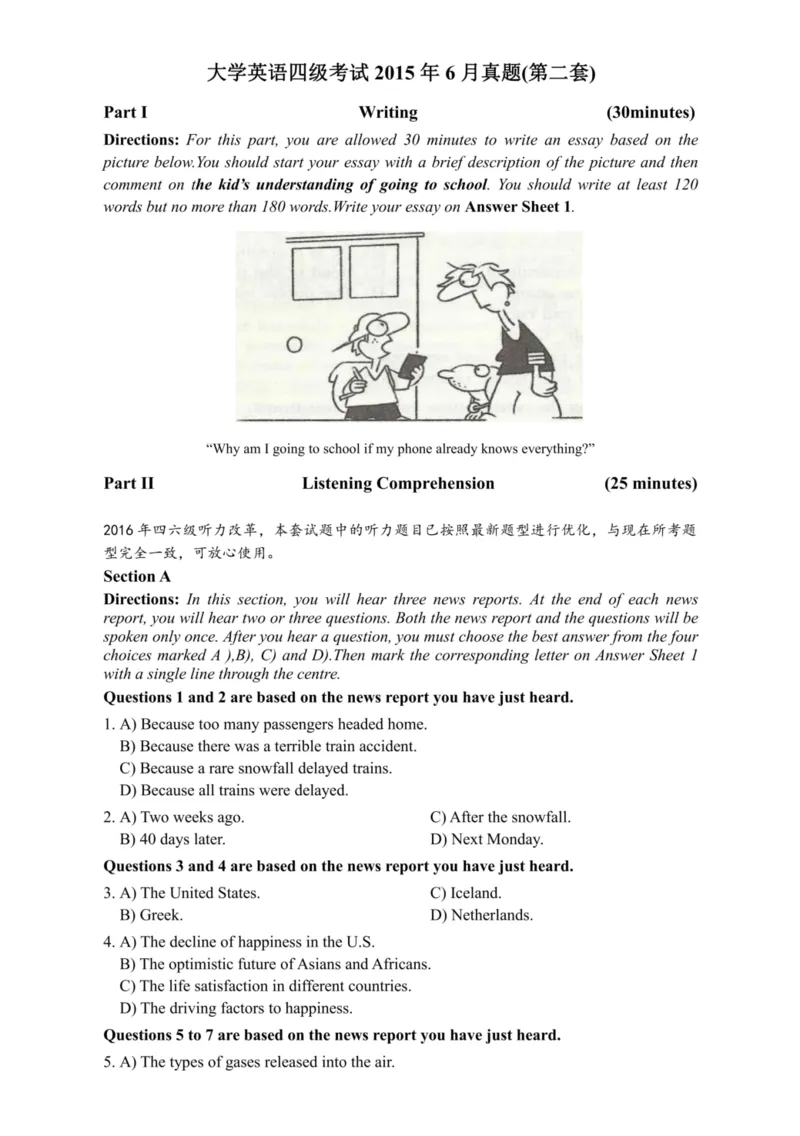
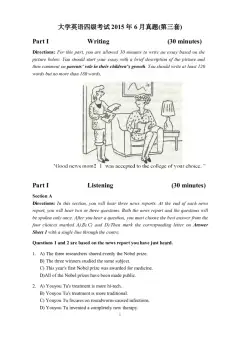
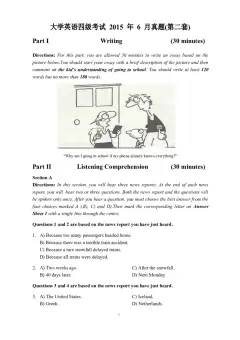
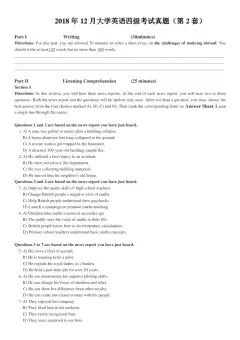
Directions: For this part, you are allowed 30 minutes to write an essay based on the
picture below.You should start your essay with a brief description of the picture and then
comment on the kid's understanding of going to school. You should write at least 120
words but no more than 180 words.Write your essay on Answer Sheet 1.
"Why am I going to school if my phone already knows everything?"
Part II
Listening Comprehension (25 minutes)
2016年四六级听力改革,本套试题中的听力题目已按照最新题型进行优化,与现在所考题
型完全一致,可放心使用。
Section A
Directions;In this section,you will hear three news reports. At the end of each news
report,you will hear two or three questions. Both the news report and the questions will be
spoken only once.After you hear a question,you must choose the best answer from the four
choices marked A ),B),C) and D).Then mark the corresponding letter on Answer Sheet 1
with a single line through the centre.
Questions 1 and 2 are based on the news report you have just heard.
1.A) Because too many passengers headed home.
B) Because there was a terrible train accident.
C) Because a rare snowfall delayed trains.
D) Because all trains were delayed.
2.A)Two weeks ago. C) After the snowfall.
B) 40 days later. D) Next Monday.
Questions 3 and 4 are based on the news report you have just heard.
3. A) The United States. C) Iceland.
B) Greek. D) Netherlands.
4.A) The decline of happiness in the U.S.
B)The optimistic future of Asians and Africans.
C) The life satisfaction in different countries.
D) The driving factors to happiness.
Questions 5 to 7 are based on the news report you have just heard.
5.A)The types of gases released into the air.B)The fast-rising sea level.
C) The causes of breaking-off of the glaciers.
D) Climate impact on the temperature.
6.A) Stefan Rahmstorf from the Climate Impact Research Center.
B) Stefan Rahmstorf from the Potsdam Institute.
C) Robert Kopp from National Academy of Sciences.
D) Robert Kopp from Rutgers University.
7.A) Since two decades ago. C) Since 1880.
B) Since 20th century. D) Since 2800 years ago.
Section B
Directions: In this section, you will hear two long conversations. At the end of each
comversation, you will hear four questions. Both the conversation and the questions will be
spoken only once.After you hear a question, you must choose the best answer from the four
choices marked A),B),C) and D).Then mark the corresponding letter on Answer Sheet 1
with a single line through the centre.
Questions8 to 11 are based on the conversation you have just heard.
8.A)They pollute the soil used to cover them.
B)They are harmful to nearby neighborhoods.
C) The rubbish in them takes long to dissolve.
D) The gas they emit is extremely poisonous.
9.A) Growing population. C) Changed eating habits.
B) Packaging materials. D) Lower production cost.
10.A) By saving energy.
B) By using less aluminum.
C) By reducing poisonous wastes.
D) By making the most of materials.
11.A)We are running out of natural resources soon.
B)Only combined efforts can make a difference.
C)The waste problem will eventually hurt all of us.
D)All of us can actually benefit from recycling.
Questions 12 to 15 are based on the conversation you have just heard.
12.A) Miami. C) Bellingham.
B) Vancouver. D) Boston.
13.A)To get information on one-way tickets to Canada.
B)To inquire about the price of"Super Saver"seats.
C)To get advice on how to fly as cheaply as possible.
D)To inquire about the shortest route to drive home.
14.A) Join a tourist group.
B) Choose a major airline.
C) Avoid trips in public holidays.
D) Book tickets as early as possible.
15.A)By coach. C) By bike.
B)By car. D)By train.Section C
Directions: In this section,you will hear 3 short passages. At the end of each passage,you
will hear three or four questions.Both the passage and the questions will be spoken only
once.After you hear a question, you must choose the best answer from the four choices
marked A),B),C) and D).Then mark the corresponding letter on Answer Sheet I with a
single line through the centre.
Questions 16 to 18 are based on the passage you have just heard.
16.A) There are mysterious stories behind his works.
B) There are many misunderstandings about him.
C) His works have no match worldwide.
D) His personal history is little known.
17.A)He moved to Stratford-on-Avon in his childhood.
B) He failed to go beyond grammar school.
C) He was a member of the town council.
D) He once worked in a well-known acting company.
18.A) Writers of his time had no means to protect their works.
B)Possible sources of clues about him were lost in a fire.
C)His works were adapted beyond recognition.
D) People of his time had little interest in him.
Questions 19 to 21 are based on the passage you havejust heard.
19.A)It shows you have been ignoring your health.
B)It can seriously affect your thinking process.
C) It is an early warning of some illness.
D) It is a symptom of too much pressure.
20.A)Reduce our workload. C) Use painkillers for relief.
B) Control our temper. D) Avoid masking symptoms.
21.A)Lying down and having some sleep. C) Going out for a walk.
B)Rubbing and pressing one's back. D) Listening to light music.
Questions 22 to 25 are based on the passage you have just heard.
22.A)Depending heavily on loans.
B)Having no budget plans at all.
C) Spending beyond one's means.
D) Leaving no room for large bills.
23.A) Many of them can be cut.
B) All of them have to be covered.
C) Their payment cannot be delayed.
D)They eat up most of the family income.
24.A)Rent a house instead of buying one.
B)Discuss the problem in the family.
C) Make a conservation plan.
D) Move to a cheaper place.
25.A)Financial issues plaguing a family.B) Difficulty in making both ends meet.
C) Family budget problems and solutions.
D) New ways to boost family income.
Part II
Reading Comprehension (40 minutes)
Section A
Directions: In this section, there is a passage with ten blanks. You are required to select
one word for each blank from a list of choices given in a word bank following the passage.
Read the passage through carefully before making your choices. Each choice in the bank is
identified by a letter: Please mark the corresponding letter for each item on Answer Sheet
2 with a single line through the centre.You may not use any of the words in the bank more
than once.
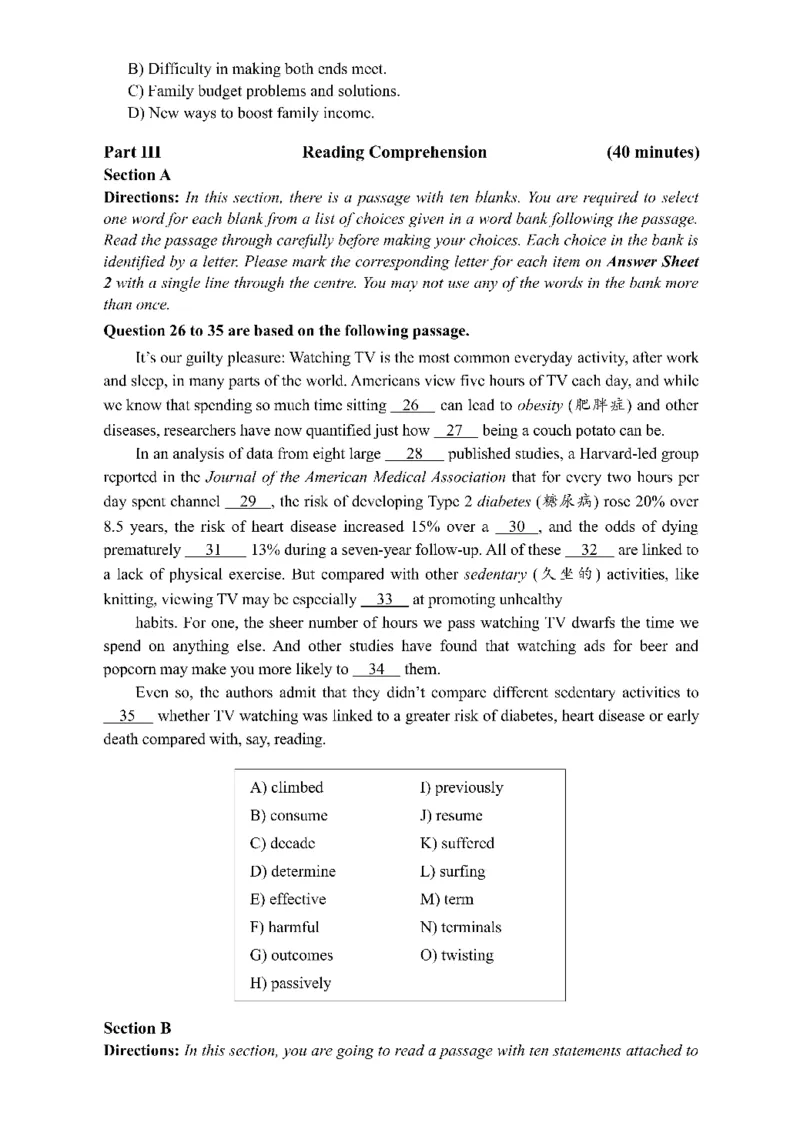
Question 26 to 35 are based on the following passage.
It's our guilty pleasure: Watching TV is the most common everyday activity,after work
and sleep, in many parts of the world.Americans view five hours of TV each day,and while
we know that spending so much time sitting26_can lead to obesity(肥胖症)and other
diseases, researchers have now quantified just how27_being a couch potato can be.
In an analysis of data from eight large28_published studies,a Harvard-led group
reported in the Journal of the American Medical Association that for every two hours per
day spent channel 29, the risk of developing Type 2 diabetes(糖尿病)rose 20over
8.5 years, the risk of heart disease increased 15over a 30,and the odds of dying
prematurely _31__13uring a seven-year follow-up.All of these32_ are linked to
a lack of physical exercise. But compared with other sedentary(久坐的)activities, like
knitting, viewing TV may be especially_ 33_ _at promoting unhealthy
habits. For one, the sheer number of hours we pass watching TV dwarfs the time we
spend on anything else. And other studies have found that watching ads for beer and
popcorn may make you more likely to 34__them.
Even so, the authors admit that they didn't compare different sedentary activities to
35__whether TV watching was linked to a greater risk of diabetes, heart disease or early
death compared with, say, reading.
A) climbed D) previously
B) consume J) resume
C)decade K) suffered
D) determine L) surfing
E) effcive M) term
F) harmful N) terminals
G) outcomes O) twisting
H) passively
Section B
Directions: In this section, you are going to read a passage with ten statements attached toit. Each statement contains information given in one of the paragraphs. Identify the
paragraph from which the information is derived. You may choose a paragraph more than
once. Each paragraph is marked with a letter.Answer the questions by marking the
corresponding letter on Answer Sheet 2.
The Changes Facing Fast Food
A)Fast-food firms have to be a thick-skinned bunch. Health experts regularly criticise
them severely for selling food that makes people fat. Critics even complain that
McDonald's, whose logo symbolises calorie excess, should not have been allowed to
sponsor the World Cup. These are things fast-food firms have learnt to cope with. But
not perhaps for much longer. The burger business faces more pressure from regulators
at a time when it is already adapting strategies in response to shifts in the global
economy.
B)Fast food was once thought to be recession-proof. When consumers need to cut
spending, the logic goes, cheap meals like Big Macs and Whoppers become even
more attractive. Such "trading down"proved true for much of the latest recession,
when fast-food companies picked up customers who could no longer afford to eat at
casual restaurants. Traffic was boosted in America, the home of fast food, with
discounts and promotions, such as $ 1 menus and cheap combination meals.
C) As a result, fast-food chains have weathered the recession better than their more
expensive competitors. In 2009 sales at full-service restaurants in America fell by
more than 6?but total sales remained about the same at fast-food chains. In some
markets, such as Japan, France and Britain, total spending on fast food increased.
Same-store sales in America at McDonald's, the world's largest fast-food company,
did not decline throughout the downturn. Panera Bread, an American fast-food chain
known for its fresh ingredients, performed well, too, because it offers higher-quality
food at lower prices than restaurants.
D)But not all fast-food companies have been as fortunate. Many, such as Burger King,
have seen sales fall. In a severe recession, while some people trade down to fast food,
many others eat at home more frequently to save money. David Palmer,an analyst at
UBS, a bank, says smaller fast-food chains in America, such as Jack in the Box and
Carl's Jr., have been hit particularly hard in this downturn because they are competing
with the global giant McDonald's, which increased spending on advertising by more
than 7last year as others cut back.
E) Some fast-food companies also sacrificed their own profits by trying to give
customers better value. During the recession companies set prices low, hoping that
once they had tempted customers through the door they would be persuaded to order
more expensive items. But in many cases that strategy did not work. Last year Burger
King franchisees(特许经 营人)sued(起 诉)the company over its double-
cheeseburger promotion, claiming it was unfair for them to be required to sell these
for $ 1 when they cost $1.10 to make. In May ajudge ruled in favour of Burger King.
Nevertheless, the company may still be cursing its decision to promote cheap choices
over more expensive ones because items on its"value menu"now account for around
20of all sales, up from 12last October.
F) Analysts expect the fast-food industry to grow modestly this year. But the downturn is
making companies rethink their strategies. Many are now introducing higher-priced
items to entice(引诱)consumers away from $1 specials. RFC,a division of Yum!
Brands, which also owns Taco Bell and Pizza Hut, has launched a chicken sandwichthat costs around $5.And in May Burger King introduced barbecue(烧烤)pork ribs
at $7 for eight.
G) Companies are also trying to get customers to buy new and more items, including
drinks. McDonald's started selling better coffee as a challenge to Starbucks. Its
"McCafe"line now accounts for an estimated 6of sales in America. Starbucks has
sold rights to its Seattle's Best coffee brand to Burger King, which will start selling it
later this year.
H) As fast-food companies shift from"super-size"to "more buys", they need to keep
customer traffic high throughout the day. Many see breakfast as a big opportunity, and
not just for fatty food. McDonald's will start selling porridge(粥)in America next
year. Breakfast has the potential to be very profitable, says: Sara Senatore of
Bernstein, a research firm, because the margins can be high. Fast-food companies are
also adding midday and late-night snacks, such as blended drinks and wraps. The idea
is that by having a greater range of things on the menu,"we can sell to consumers
products they want all day,"says Rick Carucci,the chief financial officer of Yum!
Brands.
D) But what about those growing waistlines? So far, fast-food firms have cleverly
avoided government regulation. By providing healthy options, like salads and low-
calorie sandwiches, they have at least given the impression of doing something about
helping to fight obesity(肥胖症).These offerings are not necessarily loss-leaders, as
they broaden the appeal of outlets to groups of diners that include some people who
don't want to eat a burger. But customers cannot be forced to order salads instead of
fries.
J) In the future, simply offering a healthy option may not be good enough."Every
packaged-food and restaurant company I know is concerned about regulation right
now,"says Mr. Palmer of UBS. America's health-reform bill, which Congress passed
this year, requires restaurant chains with 20 or more outlets to put the calorie-content
of items they serve on the menu. A study by the National Bureau of Economic
Research, which tracked the effects on Starbucks of a similar calorie-posting law in
New York City in 2007, found that the average calorie-count per transaction fell 6%
and revenue increased 3t Starbucks stores where a Dunkin Donuts outlet was
nearby—a sign, it is said, that menu-labelling could favour chains that have more
healthy offerings.
K) In order to avoid other legislation in America and elsewhere, fast-food companies will
have to continue innovating(创新). Walt Riker of McDonald's claims the change it
has made in its menu means it offers more healthy items than it did a few years ago.
"We probably sell more vegetables, more milk, more salads, more apples than any
restaurant business in the world,"he says. But the recent proposal by a county in
California to ban McDonald's from including toys in its high-calorie "Happy Meals",
because legislators believe it attracts children to unhealthy food, suggests there is a lot
more left to do.
36. Some people propose laws be made to stop McDonald's from attaching toys to its
food specials for children.
37.Fast-food firms may not be able to cope with pressures from food regulation in the
near future.
38. Burger King will sart to sell Seattle's Best coffee to increase sales.39. Some fast-food firms provide healthy food to give the impression they are helping to
tackle the obesity problem.
40. During the recession,many customers turned to fast food to save money.
41. Many people eat out less often to save money in times of recession.
42.During the recession, Burger King's promotional strategy of offering low-priced items
often proved ineffective.
43. Fast-food restaurants can make a lot of money by selling breakfast.
44. Many fast-food companies now expect to increase their revenue by introducing
higher-priced items.
45.A newly-passed law asks big fast-food chains to specify the calorie count of what they
serve on the menu.
Section C
Directions: There are 2 passages in this section. Each passage is followed by some
questions or unfinished statements. For each of them there are four choices marked A),B),
C) and D). You should decide on the best choice and mark the corresponding letter on
Answer Sheet 2 with a single line through the centre.
Passage One
Questions 46 to 50 are based on the conversation you have just heard.
If you think a high-factor sunscreen(防晒霜)keeps you safe from harmful rays,
you may be wrong. Research in this week's Nature shows that while factor 50 reduces
the number of melanomas(黑瘤)and delays their occurrence, it can't prevent them.
Melanomas are the most aggressive skin cancers.You have a higher risk if you have red or
blond hair, fair skin, blue or green eyes, or sunburn easily, or if a close relative has had one.
Melanomas are more common if you have periodic intense exposure to the sun. Other skin
cancers are increasingly likely with long-term exposure.
There is continuing debate as to how effective sunscreen is in reducing melanomas—
the evidence is weaker than it is for preventing other types of skin cancer. A 201l
Australian study of 1,621 people found that people randomly selected to apply
sunscreen daily had half the rate of melanomas of people who used cream as needed.
A second study, comparing l,167 people with melanomas to 1,101 who didn't have the
cancer, found that using sunscreen routinely, alongside other protection such as hats, long
sleeves or staying in the shade, did give some protection. This study said other forms of
sun protection—not sunscreen—-seemed most beneficial. The study relied on people
remembering what they had done over each decade of their lives, so it's not entirely
reliable. But it seems reasonable to think sunscreen gives people a false sense of security in
the sun.
Many people also don't use sunscreen properly—applying insufficient amounts,
failing to reapply after a couple of hours and staying in the sun too long. It is sunburn that
is most worrying—recent research shows five episodes of sunburn in the teenage years
increases the risk of all skin cancers.
The good news is that a combination of sunscreen and covering up can reducemelanoma rates, as shown by Australian figures from their slip-slop-slap campaign. So if
there is a heat wave this summer,it would be best for us, too, to slip on a shirt,slop on(抹
上) sunscreen and slap on a hat.
46. What is people's common expectation of a high-factor sunscreen?
A) It will delay the occurrence of skin cancer.
B)It will protect them from sunburn.
C) It will keep their skin smooth and fair.
D) It will work for people of any skin color.
47.What does the research in Nature say about a high-factor sunscreen?
A)It is ineffective in preventing melanomas.
B) It is ineffective in case of intense sunlight.
C) It is ineffective with long-term exposure.
D) It is ineffective for people with fair skin.
48.What do we learn from the 201ll Australian study of 1,621 people?
A) Sunscreen should be applied alongside other protection measures.
B)High-risk people benefit the most from the application of sunscreen.
C)Irregular application of sunscreen does women more harm than good.
D) Daily application of sunscreen helps reduce the incidence of melanomas.
49.What does the author say about the second Australian study?
A) It misleads people to rely on sunscreen for protection.
B) It helps people to select the most effective sunscreen.
C) It is not based on direct observation of the subjects.
D) It confirms the results of the first Australian study.
50.What does the author suggest to reduce melanoma rates?
A) Using both covering up and sunscreen.
B) Staying in the shade whenever possible.
C) Using covering up instead of sunscreen.
D) Applying the right amount of sunscreen.
Passage Two
Questions 51 to 55 are based on the conversation you have just heard.
Across the rich world,well-educated people increasingly work longer than the less-
skilled. Some 65of American men aged 62-74 with a professional degree are in the
workforce,compared with 32of men with only a high-school certificate. This gap is part
of a deepening divide between the well-educated well-off and the unskilled poor. Rapid
technological advance has raised the incomes of the highly skilled while squeezing those
of the unskilled. The consequences, for individuals and society, are profound.
The world is facing an astonishing rise in the number of old people, and they will live
longer than ever before.Over the next 20 years the global population of those aged 65 or
more will almost double, from 600 million to 1.1 billion. The experience of the 20th
century, when greater longevity (长寿) translated into more years in retirement rather thanmore years at work, has persuaded many observers that this shift will lead to slower
economic growth,while the swelling ranks of pensioners will create government budget
problems.
But the notion of a sharp division between the working young and the idle old misses
a new trend, the growing gap between the skilled and the unskilled. Employment rates are
falling among younger unskilled people, whereas older skilled folk are working longer.
The divide is most extreme in America,where well-educated baby-boomers(二战后生育
高峰期出生的美国人)are putting off retirement while many less-skilled younger people
have dropped out of the workforce.
Policy is partly responsible.Many European governments have abandoned policies
that used to encourage people to retire early.Rising life expectancy(预期寿命),combined
with. the replacement of generous defined-benefit pension plans with less generous
defined-contribution ones, means that even the better-off must work longer to have a
comfortable retirement. But the changing nature of work also plays a big role. Pay has
risen sharply for the highly educated, and those people continue to reap rich rewards into
old age because these days the educated elderly are more productive than the preceding
generation.Technological change many well reinforce that shift:the skills that complement
computers, from management know how to creativity, do not necessarily decline with age.
51.What is happening in the workforce in rich countries?
A) Younger people are replacing the elderly.
B) Well-educated people tend to work longer.
C) Unemployment rates are rising year after year.
D) People with no college degree do not easily find work.
52.What has helped deepen the divide between the well-off and the poor?
A) Longer life expectancies.
B) A rapid technological advance.
C) Profound changes in the workforce.
D) A growing number of the well-educated.
53.What do many observers predict-in view of the experience of the 20th century?
A) Economic growth will slow down.
B) Government budgets will increase.
C) More people will try to pursue higher education.
D)There will be more competition in the job market.
54.What is the result of policy changes in European countries?
A)Unskilled workers may choose to retire early.
B) More people have to receive in-service training.
C)Even wealthy people must work longer to live comfortably in retirement.
D)People may be able to enjoy generous defined-benefits from pension plans.
55.What is characteristic of work in the 2lst century?
A) Computers will do more complicated work.B) More will be taken by the educated young.
C) Most jobs to be done will be creative ones.
D) Skills are highly valued regardless of age.
Part IV
Translation (30 minutes)
Directions:For this part, you are allowed 30 minutes to translate a passage from Chinese
into English. You should write your answer on Answer Sheet 2.
据报道,今年中国快递服务(courier services)将递送大约120亿件包裹。这将使中国有可
能超越美国成为世界上最大的快递市场。大多数包裹里装着网上订购的物品。中国给数百
万在线零售商以极具竞争力的价格销售商品的机会。仅在 11月11日,中国消费者就从国内最
大的购物平台购买了价值90亿美元的商品。中国有不少这样的特殊购物日。因此,快递业在
中国扩展就不足为奇了。