机密*启用前
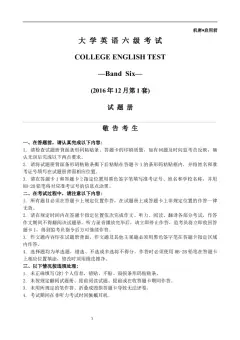
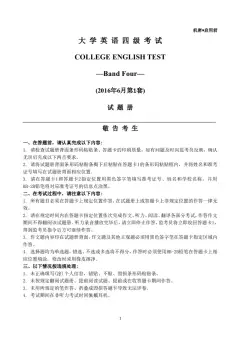
大 学 英 语 六 级 考 试
COLLEGE ENGLISH TEST
—Band Six—
(2016年6月第1套)
试 题 册
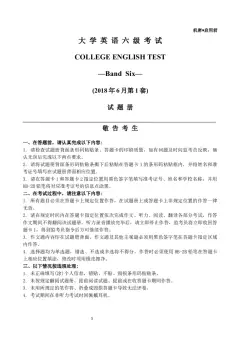
敬 告 考 生
一、在答题前,请认真完成以下内容:
1. 请检查试题册背面条形码粘贴条、答题卡的印刷质量,如有问题及时向监考员反映,确认
无误后完成以下两点要求。
2. 请将试题册背面条形码粘贴条揭下后粘贴在答题卡1的条形码粘贴框内,并将姓名和准考
证号填写在试题册背面相应位置。
3. 请在答题卡1和答题卡2指定位置用黑色签字笔填写准考证号、姓名和学校名称,并用
HB-2B铅笔将对应准考证号的信息点涂黑。
二、在考试过程中,请注意以下内容:
1. 所有题目必须在答题卡上规定位置作答,在试题册上或答题卡上非规定位置的作答一律无
效。
2. 请在规定时间内在答题卡指定位置依次完成作文、听力、阅读、翻译各部分考试,作答作文
期间不得翻阅该试题册。听力录音播放完毕后,请立即停止作答,监考员将立即收回答题卡1,
得到监考员指令后方可继续作答。
3. 作文题内容印在试题册背面,作文题及其他主观题必须用黑色签字笔在答题卡指定区域内
作答。
4. 选择题均为单选题,错选、不选或多选将不得分,作答时必须使用HB-2B铅笔在答题卡上相
应位置填涂,修改时须用橡皮擦净。
三、以下情况按违规处理:
1. 未正确填写(涂)个人信息,错贴、不贴、毁损条形码粘贴条。
2. 未按规定翻阅试题册、提前阅读试题、提前或在收答题卡期间作答。
3. 未用所规定的笔作答、折叠成毁损答题卡导致无法评卷。
4. 考试期间在非听力考试时间佩戴耳机。
1全国大学英语四、六级考试委员会
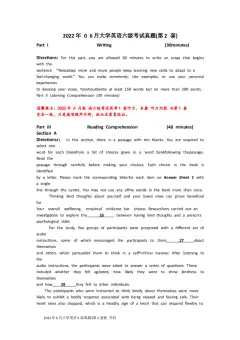
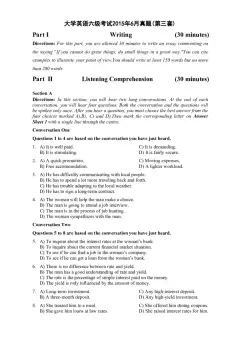
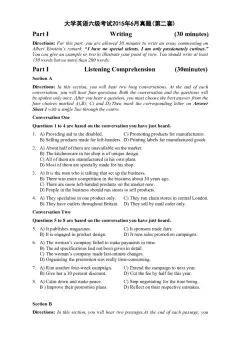
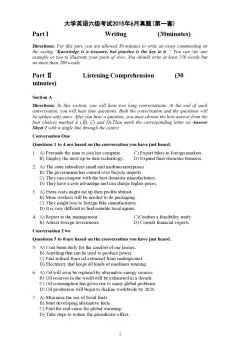
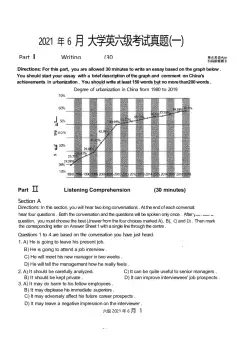
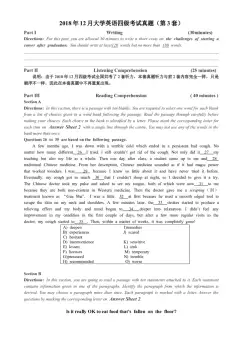
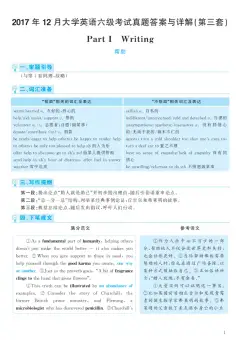
2Part Ⅰ Writing (30 minutes)
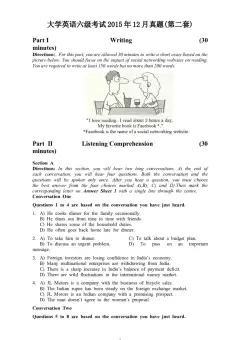
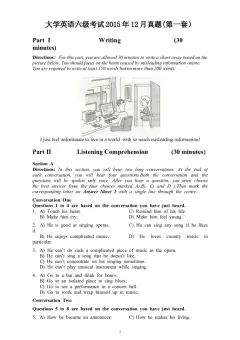
Directions:For this part,you are allowed 30 minutes to write a short essay on living in the virtual world.Try to
imagine what will happen when people spend more and more time in the virtual world instead of interacting in the
real world.You are required to write at least l50 words but no more than 200 words.
Part Ⅱ Listening Comprehension (25 minutes)
Section A
Directions: In this section.you will hear two long conversations, At the end of each conversation, you will, hear
four questions.Both the conversation and the questions will be spoken only once.After you hear a question, you
must choose the best answer from the four choices marked A , B , C and D .Then mark the corresponding letter on
Answer Sheet 1 with a single line through the centre.
1.A.Project organizer.
B.Public relations officer.
C.Marketing manager.
D. Market research consultant.
2.A.Quantitative advertising research.
B.Questionnaire design.
C.Research methodology.
D.Interviewer training.
3.A.They are intensive studies of people's spending habits.
B.They examine relations between producers and customers.
C.They look for new and effective ways to promote products.
D.They study trends or customer satisfaction over a long period.
4.A.The lack of promotion opportunity.
B.Checking charts and tables.
C. Designing questionnaires.
D. The persistent intensity.
Questions 5 to 8 are based on the conversation you have just heard.
5.A. His view on Canadian universities.
B.His understanding of higher education.
C.His suggestions for improvements in higher education.
D.His complaint about bureaucracy in American universities.
36.A.It is well designed.
B.It is rather inflexible.
C.It varies among universities.
D.It has undergone great changes.
7.A.The United States and Canada can learn from each other.
B.Public universities are often superior to private universities.
C.Everyone should be given equal access to higher education.
D.Private schools work more efficiently than public institutions.
8.A. University systems vary from country to country.
B.Efficiency is essential to university management.
C.It is hard to say which is better,a public university or a private one.
D.Many private universities in the U.S.are actually large bureaucracies.
Section B
Directions:In this section.you will hear two passages.At the end of each passage,you will hear three or four
questions.Both the passage and the questions will be spoken only once.After you hear a question,you must choose
the best answer from the four choices marked A, B, C and D .Then mark the corresponding fetter on Answer Sheet
1 with a single line through the centre.
Questions 9 to 11 are based on the passage you have just heard.
9.A.Government's role in resolving an economic crisis.
B.The worsening real wage situation around the world.
C.Indications of economic recovery in the United States.
D.The impact of the current economic crisis on people's life.
10.A.They will feel less pressure to raise employees' wages.
B.They will feel free to choose the most suitable employees.
C.They will feel inclined to expand their business operations.
D.They will feel more confident in competing with their rivals.
11.A.Employees and companies cooperate to pull through the economic crisis.
B.Government and companies join hands to create jobs for the unemployed.
C.Employees work shorter hours to avoid layoffs.
D.Team work will be encouraged in companies.
4Questions 12 to 15 are based on the passage you have just heard.
12.A.Whether memory supplements work.
B.Whether herbal medicine works wonders.
C.Whether exercise enhances one's memory.
D.Whether a magic memory promises success.
13.A.They help the elderly more than the young.
B.They are beneficial in one way or another.
C.They generally do not have side effects.
D.They are not based on real science.
14.A.They are available at most country fairs.
B.They are taken in relatively high dosage.
C.They are collected or grown by farmers.
D.They are prescribed by trained practitioners.
15.A.They have often proved to be as helpful as doing mental exercise.
B.Taking them with other medications might entail unnecessary risks.
C.Their effect lasts only a short time.
D.Many have benefited from them.
Section C
Directions:In this section.you will hear three recordings of lectures or talks followed by three or four
questions.The recordings will be played only once.After you hear a question, you must choose the best answer
from the four choices marked A, B, C and D .Then mark the corresponding letter on Answer Sheet 1 with a single
line through the centre.
Questions 16 to 18 are based on the recording you have just heard.
16.A.How catastrophic natural disasters turn out to be to developing nations.
B.How the World Meteorological Organization studies natural disasters.
C.How powerless humans appear to be in face of natural disasters.
D.How the negative impacts of natural disasters can be reduced.
17.A.By training rescue teams for emergencies.
B.By taking steps to prepare people for them.
C.By changing people's views of nature.
D.By relocating people to safer places.
518.A.How preventive action can reduce the loss of life.
B.How courageous Cubans are in face of disasters.
C.How Cubans suffer from tropical storms.
D.How destructive tropical storms can be.
Questions 19 to 22 are based on the recording you have just heard.
19.A.Pay back their loans to the American government.
B.Provide loans to those in severe financial difficulty.
C.Contribute more to the goal of a wider recovery.
D.Speed up their recovery from the housing bubble.
20.A.Some banks may have to merge with others.
B.Many smaller regional banks are going to fail.
C.It will be hard for banks to provide more loans.
D.Many banks will have to 1ay off some employees.
21.A.It will work closely with the government.
B.It will endeavor to write off bad loans.
C.It will try to lower the interest rate.
D.It will try to provide more loans.
22.A. It won't help the American economy to rum around.
B.It won't do any good to the major commercial banks.
C.It will win the approval of the Obama administration.
D.It will be necessary if the economy starts to shrink again.
Questions 23 to 25 are based on the recording you have just heard.
23.A.Being unable to learn new things.
B.Being rather slow to make changes.
C.Losing temper more and more often.
D.Losing the ability to get on with others.
24.A.Cognitive stimulation.
B.Community activity.
C.Balanced diet.
D.Fresh air.
625.A.Ignoring the signs and symptoms of aging.
B.Adopting an optimistic attitude towards life.
C.Endeavoring to give up unhealthy lifestyles.
D.Seeking advice from doctors from time to time.
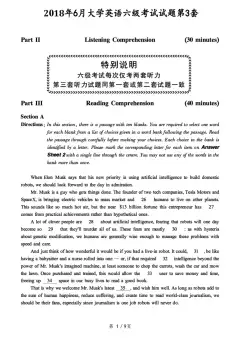
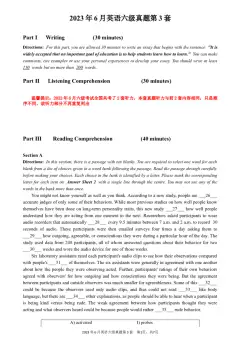
Part Ⅲ Reading Comprehension (40 minutes)
Section A
Directions: In this section.there is a passage with ten blanks.You are required to select one word for each blank
from a list of choices given in a word bank following the passage.Read the passage through carefully before
making your choices.Each choice in the bank is identified by a letter Please mark the corresponding letter for
each item on Answer Sheet 2 with a single line through the centre.You may not use any of the words in the bank
more than once.
Questions 26 to 35 are based on the following passage.
Pursuing a career is an essential part of adolescent development. “The adolescent becomes an adult when he 26
a real job. ”To cognitive researchers like Piaget, adulthood meant the beginning of an 27 .
Piaget argued that once adolescents enter the world of work, their newly acquired ability to form hypotheses
allows them to create representations that are too ideal. The 28 of such ideals. without the tempering of the reality
of a job or profession, rapidly leads adolescents to become 29 of the non. idealistic world and to press for reform
in a characteristically adolescent way. Piaget said:“True adaptation to society comes 30 when the adolescent
reformer attempts to put his ideas to work. ”
Of course, youthful idealism is often courageous, and no one likes to give up dreams. Perhaps, taken 31 out of
context, Piaget’s statement seems harsh. What he was 32 , however,is the way reality can modify idealistic
views. Some people refer to such modification as maturity. Piaget argued that attaining and accepting a vocation is
one of the best ways to modify idealized views and to mature.
As careers and vocations become less available during times of 33 , adolescents may be especially hard hit.
Such difficult economic times may leave many adolescents 34 about their roles in society. For this reason,
community interventions and government job programs that offer summer and vacation work are not only
economically 35 but also help to stimulate the adolescent’s sense of worth.
A.automatically I.incidentally
B.beneficial J.intolerant
C.capturing K.occupation
D.confused L.promises
E.emphasizing M.recession
F.entrance N.slightly
G.excited O.undertakes
H.existence
7Section B
Directions:In this section, you are going to read a passage with ten statements attached to n. Each statement
contains information given in one of the paragraphs. Identify the paragraph from which the information is
derived. You may choose a paragraph more than once. Each paragraph is marked with a letter. Answer the
questions by marking the corresponding letter on Answer Sheet 2.
Can societies be rich and green?
[A] “If our economies are to flourish, if global poverty is to be eliminated and if the well-being of the world’s
people enhanced~not just in this generation but in succeeding generations—we must make sure we take care of
the natural environment and resources on which our economic activity depends. ” that statement comes not, as
you might imagine, from a stereotypical tree—hugging. Save-the-world-greenie(环保主义者), but from Gordon
Brown, a politician with a reputation for rigour thoroughness and above all, caution.
[B] A surprising thing for the man who runs one of the world’s most powerful economies to say?Perhaps:though
in the run-up to the five—year review of the Millennium(千年的)Goals, he is far from alone. The roots of his
speech, given in March at the round table meeting of environment and energy ministers from the G209roup of
nations, stretch back to 1972, and the United Nations Conference on the Human Environment in Stockholm.
[C] “The protection and improvement of the human environment is a major issue which affects the well-being of
peoples and economic development throughout the world, ”read the final declaration from this gathering, the first
of a sequence which would lead to the Rio de Janeiro Earth Summit in 1992 and the World Development Summit
in Johannesburg three years ago.
[D] Hunt through the reports prepared by UN agencies and development groups—many for conferences such as
this year’s Millennium Goals review—and you will find that the linkage between environmental protection and
economic progress is a common thread.
[E] Managing ecosystems sustainably is more profitable than exploiting them, according to the Millennium
Ecosystem Assessment. But finding hard evidence to support the thesis is not so easy. Thoughts turn first to some
sort of global statistic, some indicator which would rate the wealth of nations in both economic and environmental
terms and show a relationship between the two.
[F] If such an indicator exists, it is well hidden. And on reflection, this is not surprising ; the single
word“environment”has so many dimensions. and there are so many other factors affecting wealth—such as the oil
deposits—that teasing out a simple economy-environment relationship would be almost impossible.
[G] The Millennium Ecosystem Assessment, a vast four—year global study which reported its initial conclusions
earlier this year,found reasons to believe that managing ecosystems sustainably—working with nature rather than
8against it—might be less profitable in the short term, but certainly brings long-term rewards.
[H] And the World Resources Institute(WRI)in its World Resources 2005 report, issued at the end of August,
produced several such examples from Africa and Asia;it also demonstrated that environmental degradation affects
the poor more than the rich, as poorer people derive a much higher proportion of their income directly from the
natural resources around them.
[I] But there are also many examples of growing wealth by trashing the environment, in rich and poor parts of the
world alike, whether through unregulated mineral extraction, drastic water use for agriculture, slash—and—bum
farming, or fossil-fuel-guzzling(大量消耗)transport. Of course, such growth may not persist in the long term—
which is what Mr. Brown and the Stockholm declaration were both attempting to point out. Perhaps the best
example of boom growth and bust decline is the Grand Banks fishery. For almost five centuries a very large
supply of cod(鳕鱼)provided abundant raw material for an industry which at its peak employed about 40, 000
people, sustaining entire communities in Newfoundland. Then, abruptly,the cod population collapsed. There were
no longer enough fish in the sea for the stock to maintain itself,let alone an industry. More than a decade
later,there was no sign of the ecosystem rebuilding itself. It had, apparently,been fished out of existence;and the
once mighty Newfoundland fleet now gropes about frantically for crab on the sea floor.
[J] There is a view that modem humans are inevitably sowing the seeds of a global Grand Banks-style disaster.
The idea is that we are taking more out of what you might call the planet’s environmental bank balance than it can
sustain;we are living beyond our ecological means. One recent study attempted to calculate the extent of
this“ecological overshoot of the human economy”, and found that we are using 1.2 Earth’s—worth of
environmental goods and services—the implication being that at some point the debt will be called in. and all
those services—the things which the planet does for us for free—will grind to a halt.
[K] Whether this is right, and if so where and when the ecological axe will fall, is hard to determine with any
precision—which is why governments and financial institutions are only beginning to bring such risks into their
economic calculations. It is also the reason why development agencies are not united in their view of
environmental issues;while some, like the WRI,maintain that environmental progress needs to go hand-in-hand
with economic development, others argue that the priority is to build a thriving economy, and then use the wealth
created to tackle environmental degradation.
[L]This view assumes that rich societies will invest in environmental care. But is this right?Do things get better or
worse as we get richer?Here the Stockholm declaration is ambiguous. “In the developing countries, ”it says, “most
of the environmental problems are caused by under—development. ”So it is saying that economic development
should make for a cleaner world?Not necessarily;“In the industrialised countries, environmental problems are
generally related to industrialisation and technological development, ”it continues. In other words, poor and rich
both over-exploit the natural world, but for different reasons. It’s simply not true that economic growth will surely
make our world cleaner.
9[M] Clearly,richer societies are able to provide environmental improvements which lie well beyond the reach of
poorer communities. Citizens of wealthy nations demand national parks, clean rivers, clean air and poison-free
food. They also, however,use far more natural resources—fuel, water(all those baths and golf courses)and
building materials.
[N]A case can be made that rich nations export environmental problems, the most graphic example being climate
change. As a country’s wealth grows, so do its greenhouse gas emissions. The figures available will not be
completely accurate. Measuring emissions is not a precise science, particularly when it comes to issues
surrounding land use;not all nations have released up-to-date data, and in any case, emissions from some sectors
such as aviation are not included in national statistics. But the data is exact enough for a clear trend to be easily
discernible. As countries become richer,they produce more greenhouse gases;and the impact of those gases will
fall primarily in poor parts of the world.
[O]Wealth is not, of course, the only factor involved. The average Norwegian is better off than the average US
citizen, but contributes about half as much to climate change. But could Norway keep its standard of living and
yet cut its emissions to Moroccan or even Ethiopian levels?That question, repeated across a dozen environmental
issues and across our diverse planet, is what will ultimately determine whether the human race is living beyond its
ecological means as it pursues economic revival.
36. Examples show that both rich and poor countries exploited the environment for economic progress.
37. Environmental protection and improvement benefit people all over the world.
38. It is not necessarily true that economic growth will make our world cleaner.
39. The common theme of the UN reports is the relation between environmental protection and economic growth.
40. Development agencies disagree regarding how to tackle environment issues while ensuring economic
progress.
41. It is difficult to find solid evidence to prove environmental friendliness generates more profits than exploiting
the natural environment.
42. Sustainable management of ecosystems will prove rewarding in the long run.
43. A politician noted for being cautious asserts that sustainable human development depends on the natural
environment.
1044. Poor countries will have to bear the cost for rich nations’economic development.
45. One recent study warns us of the danger of the exhaustion of natural resources on Earth.
Section C
Directions:There are 2 passages in this section. Each passage is followed by some questions or unfinished
statements。For each of them there are。four choices marked A), B), C)and D). You should decide on the best
choice and mark the corresponding letter on Answer Sheet 2 with a single line through the centre.
Passage One
Questions 46 to 50 are based on the following passage.
Interactive television advertising, which allows viewers to use their remote controls to click on advertisements,
has been pushed for years. Nearly a decade ago it was predicted that viewers of“Friends”, a popular situation
comedy,would soon be able to purchase a sweater like Jennifer Aniston’s with a few taps on their remote control.
“It’s been the year of interactive television advertising for the last ten or twelve years, ”says Colin Dixon of a
digital—media consultancy.
So the news that Cablevision, an American cable company,was rolling out interactive advertisements to all its
customers on October 6th was greeted with some skepticism. During commercials. an overlay will appear at the
bottom of the screen, prompting viewers to press a button to request a free sample or order a catalogue.
Cablevision hopes to allow customers to buy things with their remote controls early next year.
Television advertising could do with a boost. Spending fell by 10 %in the first half of the year. The
popularization of digital video recorders has caused advertisers to worry that their commercials will be skipped.
Some are turning to the Internet, which is cheaper and offers concrete measurements like click—through rates-
especially important at a time when marketing budgets are tight. With the launch of interactive advertising, “many
of the dollars that went to the Internet will come back to the TV,”says David Kline of Cablevision.Or so the
industry hopes.
In theory,interactive advertising can engage viewers in a way that 30。second spots do not. Unilever recently ran
an interactive campaign for its Axe deodorant(除臭剂), which kept viewers engaged for more than three minutes
on average.
The amount spent on interactive advertising on television is still small Magna, an advertising agency,reckons it
will be worth about$138 million this year. That falls far short of the billions of dollars people once expected it to
generate. But DirecTV,Comcast and Time Warner Cable have all invested in it.A new effort 1edbv Canoe
Ventures, a coalition of leading cable providers, aims to make interactive advertising available across America
later this year. BrightLine iTV,which designs and sells interactive ads, say8 interest has surged:it expects its
revenues almost to triple this year. BSkyB, Britain’s biggest satellite-television service,already provides 9 million
customers with interactive ads.
Yet there are doubts whether people watching television, a“lean back”medium, crave interaction.Click-though
rates have been high so far(around 3-4%, compared with less than 0. 3%online), but that may be a result of the
11novelty. Interactive ads and viewers might not go well together.
46. What does Colin Dixon mean by saying“It's been the year of interactive television advertising for the last ten
or twelve years”(Line 4, Para. 1)?
A.Interactive television advertising will become popular in 10-12 years.
B.Interactive television advertising has been under debate for the last decade or so.
C.Interactive television advertising is successful when incorporated into situation comedles.
D.Interactive television advertising has not achieved the anticipated results.
47. What is the public’s response to Cablevision’s planned interactive TV advertising program?
A.Pretty positive.
B.Totally indifferent.
C.Somewhat doubtful.
D.Rather critical.
48. What is the impact of the wide use of digital video recorders on TV advertising?
A.It has made TV advertising easily accessible to viewers.
B.It helps advertisers to measure the click-through rates.
C. It has placed TV advertising at a great disadvantage.
D.It enables viewers to check the sales items with ease.
49. What do we learn about Unilever’s interactive campaign?
A.It proves the advantage of TV advertising.
B.It has done well in engaging the viewers.
C.It helps attract investments in the company.
D.It has boosted the TV advertising industry.
50. How does the author view the hitherto high click—through rates?
A.They may be due to the novel way of advertising.
B.They signify the popularity of interactive advertising.
C.They point to the growing curiosity of TV viewers.
D.They indicate the future direction of media reform.
Passage Two
Questions 51 to 55 are based on the following passage·
What can be done about mass unemployment?All the wise heads agree:there’re no quick or easy answers.
There, s work to be done, but workers aren’t ready to do it—they’re in the wrong places, or they have the wrong
skills. Our problems are“structural, ”and will take many years to solve.
12But don't bother asking for evidence that justifies this bleak view. There isn’t any. On the contrary, all the facts
suggest that high unemployment in America is the result of inadequate demand.Saying that there’re no easy
answers sounds wise, but it's actually foolish:our unemployment crisis could be cured very quickly if we had the
intellectual clarity and political will to act. In other words, structural unemployment is a fake problem, which
mainly serves as an excuse for not pursuing real solutions.
The fact is job openings have plunged in every major sector,while the number of workers forced
into part—time employment in almost all industries has soared. Unemployment has surged in every major
occupational category. Only three states, with a combined population not much larger than that of Brooklyn, have
unemployment rates below 5%. So the evidence contradicts the claim that we’re mainly suffering from structural
unemployment. Why,then, has this claim become so popular?
Part of the answer is that this is what always happens during periods of high unemployment—in part because
experts and analysts believe that declaring the problem deeply rooted, with no easy answers, makes them sound
serious.
I’ve been looking at what self-proclaimed experts were saying about unemployment during the Great
Depression:it was almost identical to what very Serious People are saying now. Unemployment cannot be
brought down rapidly,declared one 1935 analysis, because the workforce is“unadaptable and untrained.It cannot
respond to the opportunities which industry may offer. "A few years later,a large defense buildup finally provided
a fiscal stimulus adequate to the economy’s needs—and suddenly industry was eager to employ those“unadaptable
and untrained”workers.
But now. as then, powerful forces are ideologically opposed to the whole idea of government action on a
sufficient scale to jump. start the economy. And that, fundamentally,is why claims that we face huge structural
problems have been multiplying:they offer a reason to do nothing about the mass unemployment that is crippling
our economy and our society.
So what you need to know is that there’s no evidence whatsoever to back these claims. We aren't suffering from a
shortage of needed skills;we’re suffering from a lack of policy resolve. As I said, structural unemployment isn’t a
real problem, it's an excuse—a reason not to act on America, s problems at a time when action is desperately
needed.
51. What does the author think is the root cause of mass unemployment in America?
A.Corporate mismanagement.
B.Insufficient demand.
C.Technological advances.
D.Workers, slow adaptation.
52. What does the author think of the experts’ claim concerning unemployment?
A.Self-evident.
B.Thought—provoking.
C.Irrational.
D.Groundless.
1353.What does the author say helped bring down unemployment during the Great Depression?
A.The booming defense industry.
B.The wise heads’ benefit package.
C.Nationwide training of workers.
D.Thorough restructuring of industries.
54. What has caused claims of huge structural problems to multiply?
A.Powerful opposition to government’s stimulus efforts.
B.Very Serious People’s attempt to cripple the economy.
C.Evidence gathered from many sectors of the industries.
D.Economists’ failure to detect the problems in time.
55. What is the author’s purpose in writing the passage?
A.To testify to the experts’ analysis of America’s problems.
B.To offer a feasible solution to the structural unemployment.
C.To show the urgent need for the government to take action.
D.To alert American workers to the urgency for adaptation.
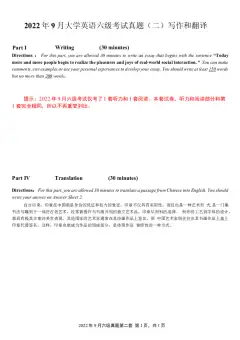
Part Ⅳ Translation (30minutes)
Directions: For this part you are allowed 30 minutes to translate a passage from Chinese into English.You
should write your answer on Answer Sheet 2.
中国的创新正以前所未有的速度蓬勃发展:为了在科学技术上尽快赶超世界发达国家, 中国近年来大
幅度增加了研究开发资金:中国的大学和研究所正在积极开展创新研究, 这些研究覆盖了从大数据到生物
化学、从新能源到机器人等各类高科技领域。它们还与各地的科技园合作, 使创新成果商业化:与此同时, 无
论在产品还是商业模式上, 中国企业家也在努力争做创新的先锋, 以适应国内外消费市场不断变化和增长
的需求。
14