机密*启用前
大 学 英 语 六 级 考 试
COLLEGE ENGLISH TEST
—Band Six—
(2020年7月)
试 题 册
敬 告 考 生
一、在答题前,请认真完成以下内容:
1. 请检查试题册背面条形码粘贴条、答题卡的印刷质量,如有问题及时向监考员反映,确认无误后完成
以下两点要求。
2. 请将试题册背面条形码粘贴条揭下后粘贴在答题卡1的条形码粘贴框内,并将姓名和准考证号填写在
试题册背面相应位置。
3. 请在答题卡1和答题卡2指定位置用黑色签字笔填写准考证号、姓名和学校名称,并用HB-2B铅笔将
对应准考证号的信息点涂黑。
二、在考试过程中,请注意以下内容:
1. 所有题目必须在答题卡上规定位置作答,在试题册上或答题卡上非规定位置的作答一律无效。
2. 请在规定时间内在答题卡指定位置依次完成作文、听力、阅读、翻译各部分考试,作答作文期间不得
翻阅该试题册。听力录音播放完毕后,请立即停止作答,监考员将立即收回答题卡1,得到监考员指令后
方可继续作答。
3. 作文题内容印在试题册背面,作文题及其他主观题必须用黑色签字笔在答题卡指定区域内作答。
4. 选择题均为单选题,错选、不选或多选将不得分,作答时必须使用HB-2B铅笔在答题卡上相应位置填
涂,修改时须用橡皮擦净。
三、以下情况按违规处理:
1. 未正确填写(涂)个人信息,错贴、不贴、毁损条形码粘贴条。
2. 未按规定翻阅试题册、提前阅读试题、提前或在收答题卡期间作答。
3. 未用所规定的笔作答、折叠成毁损答题卡导致无法评卷。
4. 考试期间在非听力考试时间佩戴耳机。
全国大学英语四、六级考试委员会
1使用须知:
本套试题四六级组委会仅给出了听力原文,翻译和写作试题,其余部分试题未
给出,听力试题由本机构自行编写而成,其余题型由往年真题拼凑而成,故而
不再重复,请知悉。
Part I Writing (30 minutes)
Directions: For this part, you are allowed 30 minutes to write an essay on the saying " The best preparation for
tomorrow is doing your best today. " You should write at least 150 words but no more than 200 words.
Part II Listening Comprehension (30 minutes)
Section A
Directions: In this section, you will hear two long conversations. At the end of each conversation, you will hear
four questions. Both the conversation and the questions will be spoken only once. After you hear a question, you
must choose the best answer from the four choices marked A) , B) , C) and D) . Then mark the corresponding
letter on Answer Sheet 1 with a single line through the centre.
Questions 1 to 4 are based on the conversation you have just heard.
1. A) She is a great athlete. C) She is a famous scientist.
B) She is a famed speaker. D) She is a noted inventor.
2. A) How knowledge of human biochemistry has been evolving.
B) How nutrition helps athletes' performance in competitions.
C) How scientific training enables athletes to set new records.
D) How technology has helped athletes to scale new heights.
3. A) Our physical structures. C) Our biochemical process.
B) Our scientific knowledge. D) Our concept of nutrition.
4. A) It may increase the expenses of sports competitions.
B) It may lead to athletes' over-reliance on equipment.
C) It may give an unfair advantage to some athletes.
D) It may change the nature of sports competitions.
Questions 5 to 8 are based on the conversation you have just heard.
5. A) Experience. C) Family background.
B) Flexibility. D) Business connections.
6. A) Buying directly from factories.
2B) Shipping goods in bulk by sea.
C) Having partners in many parts of the world.
D) Using the same container back and forth.
7. A) Warehouses. B) Factories. C) Investors. D) Retailers.
8. A) Trendy style. C) Lower import duties.
B) Unique design. D) Lower shipping costs.
Section B
Directions : In this section , you will hear two passages. At the end of each passage , you will hear three or four questions.
Both the passage and the questions will be spoken only once. After you hear a question, you must choose the best answer
from the four choices marked A) , B) , C) and D) . Then mark the corresponding letter on Answer Sheet 1 with a single
line through the centre.
Questions 9 to 11 are based on the passage you have just heard.
9. A) It helps employees to reduce their stress.
B) It prevents employees from feeling bored.
C) It strengthens harmony among employees.
D) It helps employees to view things positively.
10. A) Weekends are conducive to reducing stress.
B) Humor is vital to interpersonal relationships.
C) All workers experience some emotional stress.
D) Humor can help workers excel at routine tasks.
11. A) Smash the toys to release their bottled-up resentments.
B) Take the boss doll apart as long as they reassemble it.
C) Design and install stress-reducing gadgets.
D) Strike at the boss doll as hard as they like.
Questions 12 to 15 are based on the passage you have just heard.
12. A) The recent finding of a changed gene in obese mice.
B) A breakthrough in understanding gene modification.
C) A newly discovered way for people to lose weight.
D) The self-repairing ability of a gene in obese mice.
13. A) It renders an organism unable to fight diseases.
B) It prevents the mice’s fatty tissues from growing.
C) It helps organisms adapt to environmental changes.
D) It renders mice unable to sense when to stop eating.
14. A) Human beings have more obesity genes than most mice do.
B) Half of a person's total weight variation can be controlled.
C) People are born with a tendency to have a certain weight.
D) The function of the obesity genes is yet to be explored.
15. A) The worsening of natural environment.
3B) The abundant provision of rich foods.
C) The accelerated pace of present-day life.
D) The adverse impact of the food industry.
Section C
Directions : In this section , you will hear three recordings of lectures or talks followed by three or four questions. The
recordings will be played only once. After you hear a question, you must choose the best answer from the four choices
marked A ) , B) , C) and D) . Then mark the corresponding letter on Answer Sheet 1 with a single line through the centre.
Questions 16 to 18 are based on the recording you have just heard.
16. A) Similarity in interests. C) Openness.
B) Mental stimulation. D) Compassion.
17. A) The willingness to offer timely help.
B) The joy found in each other’s company.
C) Personal bonds.
D) Emotional factors.
18. A) Failure to keep a promise. C) Feelings of betrayal.
B) Lack of frankness. D) Loss of contact.
Questions 19 to 21 are based on the recording you have just heard.
19. A) Along the low-lying Colorado River.
B) At the Dinosaur National Monument.
C) Along the border of the U.S. and Canada.
D) At museums of natural history in large cities.
20. A) Volcanic explosions could bring whole animal species to extinction.
B) Some natural disaster killed a whole herd of dinosaurs in the area.
C) The pit should be carefully preserved for the study of dinosaurs.
D) The whole region must have been struck by a devastating flood.
21. A) They floated down an eastward flowing river.
B) They lay buried deep in the sand for millions of years.
C) They were skeletons of dinosaurs inhabiting the locality.
D) They were remains of dinosaurs killed in a volcanic explosion.
Questions 22 to 25 are based on the recording you have just heard.
22. A) Indulging in seeking leisure and material comfort.
B) Attaching too much importance to independence.
C) Failing to care for parents in the traditional way.
D) Leaving their parents on the verge of starvation.
23. A) They have great difficulty living by themselves.
B) They have little hope of getting any family care.
C) They have fond memories of their good old days.
D) They have a sense of independence and autonomy.
24. A) People in many parts of the world preferred small-sized families.
4B) There have been extended families in most parts of the world.
C) Many elderly people were unwilling to take care of their grandchildren.
D) So many young Americans refused to live together with their parents.
25. A) Leave their younger generations alone.
B) Avoid being a burden to their children.
C) Stay healthy by engaging in joyful activities.
D) View things from their children's perspective.
Part III Reading Comprehension (40 minutes)
Section A
Directions: In this section, there is a passage with ten blanks. You are required to select one word for each blank
from a list of choices given in a word bank following the passage. Read the passage through carefully before
making your choices. Each choice in the bank is identified by a letter. Please mark the corresponding letter for
each item on Answer Sheet 2 with a single line through the centre. You may not use any of the words in the bank
more than once.
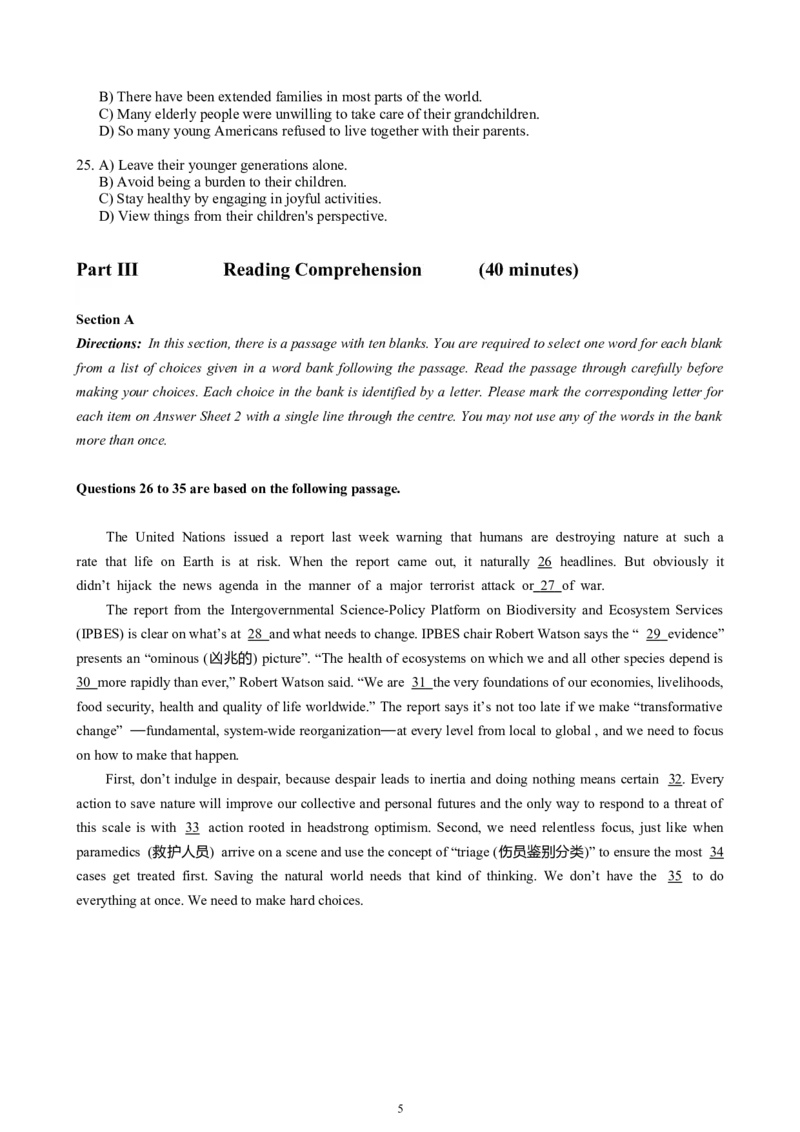
Questions 26 to 35 are based on the following passage.
The United Nations issued a report last week warning that humans are destroying nature at such a
rate that life on Earth is at risk. When the report came out, it naturally 26 headlines. But obviously it
didn’t hijack the news agenda in the manner of a major terrorist attack or 27 of war.
The report from the Intergovernmental Science-Policy Platform on Biodiversity and Ecosystem Services
(IPBES) is clear on what’s at 28 and what needs to change. IPBES chair Robert Watson says the “ 29 evidence”
presents an “ominous (凶兆的) picture”. “The health of ecosystems on which we and all other species depend is
30 more rapidly than ever,” Robert Watson said. “We are 31 the very foundations of our economies, livelihoods,
food security, health and quality of life worldwide.” The report says it’s not too late if we make “transformative
change” —fundamental, system-wide reorganization—at every level from local to global , and we need to focus
on how to make that happen.
First, don’t indulge in despair, because despair leads to inertia and doing nothing means certain 32. Every
action to save nature will improve our collective and personal futures and the only way to respond to a threat of
this scale is with 33 action rooted in headstrong optimism. Second, we need relentless focus, just like when
paramedics (救护人员) arrive on a scene and use the concept of “triage (伤员鉴别分类)” to ensure the most 34
cases get treated first. Saving the natural world needs that kind of thinking. We don’t have the 35 to do
everything at once. We need to make hard choices.
5A) capacity I) Junction
B) declaration J) Monotonous
C) deteriorating K) overwhelming
D) determined L) stagnation
E) disaster M) stake
F) eroding N) stifled
G) grabbed O) urgent
H) inventory
Section B
Directions: In this section, you are going to read a passage with ten statements attached to it. Each statement
contains information given in one of the paragraphs. Identify the paragraph from which the information is
derived. You may choose a paragraph more than once. Each paragraph is marked with a letter. Answer the
questions by marking the corresponding letter on Answer Sheet 2.
Children Understand Far More About Other Minds Than Long Believed
A) Until a few decades ago, scholars believed that young children know very little, if anything, about
what others are thinking. Swiss psychologist Jean Piaget, who is credited with founding the scientific
study of children’s thinking, was convinced that preschool children cannot consider what goes on in the
minds of others. The interviews and experiments he conducted with kids in the middle of the 20th
century suggested that they were trapped in their subjective viewpoints,incapable of imagining what
others think, feel or believe.
B) Much of the subsequent research on early childhood thinking was highly influenced by Piaget’s ideas.
Scholars sought to refine his theory and empirically confirm his views. But it became increasingly clear
that Piaget seemed to have gravely underestimated the intellectual powers of very young kids before they
can make themselves understood by speech. Researchers began to devise ever more ingenious ways of
figuring out what goes on in the minds of babies, and the resulting picture of their abilities shows
subtle variations. Consequently, the old view of children’s egocentric (自我中心的) nature and intellectual
weaknesses has increasingly fallen out of favor and become replaced by a more generous position that
sees a budding sense not only of the physical world but also of other minds, even in the “youngest
young.”
C) Historically, children didn’t receive much respect for their mental powers. Piaget not only believed
that children were “egocentric” in the sense that they were unable to differentiate between their own
viewpoint and that of others; he was also convinced that their thinking was characterized by systematic
errors and confusions. When playing with others, they don’t cooperate because they do not realize there
are different roles and perspectives. He was convinced that children literally cannot “get their act
together” : instead of playing cooperatively and truly together, they play side by side, with little regard
for others. And when speaking with others, a young child supposedly cannot consider the listener’s
6viewpoint but “talks to himself without listening to others.”
D) Piaget and his followers maintained that children go through something like a dark age of intellectual
development before slowly and gradually becoming enlightened by reason and rationality as they reach
school age. Alongside this enlightenment develops an ever growing understanding of other persons,
including their attitudes and views of the world.
E) Today, a very different picture of children’s mental development emerges. Psychologists continually
reveal new insights into the depth of young children’s knowledge of the world, including their
understanding of other minds. Recent studies suggest that even infants are sensitive to others’
perspectives and beliefs.
F) Part of the motivation to revise some of Piaget’s conclusions stemmed from an ideological shift about
the origin of human knowledge that occurred in the second half of the 20th century. It became
increasingly unpopular to assume that a basic understanding of the world can be built entirely from
experience. This was in part prompted by theorist Noam Chomsky, who argued that something as
complex as the rules of grammar cannot be picked up from exposure to speech, but is supplied by an
inborn “language faculty.” Others followed suit and defined further “core areas” in which knowledge
allegedly cannot be pieced together from experience but must be possessed at birth. One such area is
our knowledge of others’ minds. Some even argue that a basic knowledge of others’ minds is not only
possessed by human infants, but must be evolutionarily old and hence shared by our nearest living
relatives, the great apes.
G) To prove that infants know more in this realm than had been acknowledged, researchers needed to
come up with innovative ways of showing it. A big part of why we now recognize so much more of
kids’ intellectual capacities is the development of much more sensitive research tools than Piaget had at
his disposal.
H) Instead of engaging babies in dialog or having them execute complex motor tasks, the newer
methods capitalize on behaviors that have a firm place in infants’ natural behavior repertoire: looking,
listening, sucking, making facial expressions, gestures and simple manual actions. The idea of focusing
on these “small behaviors” is that they give kids the chance to demonstrate their knowledge implicitly
and spontaneously without having to respond to questions or instructions. For example, children might
look longer at an event that they did not expect to happen, or they might show facial expressions
indicating that they have sympathetic concern for others. When researchers measure these less demanding,
and often involuntary, behaviors, they can detect a sensitivity to others’ mental states at a much younger
age than with the more taxing methods that Piaget and his followers deployed.
I) In the 1980s, these kinds of implicit measures became customary in developmental psychology. But it
7took a while longer before these tools were employed to measure children’s grasp of the mental lives of
others.
J) In a set of experiments, my colleagues at the University of Southern California and I found evidence that
babies can even anticipate how others will feel when their expectations are disappointed. We acted out several
puppet (木偶) shows in front of two-year-old children. In these puppet shows, a protagonist (Cookie Monster) left
his precious belongings (cookies) on stage and later returned to fetch them. What the protagonist did not know
was that an antagonist had come and messed with his possessions. The children had witnessed these acts and
attentively watched the protagonist return. We recorded children’s facial and bodily expressions. Children bit their
lips, wrinkled their nose or wiggled (扭动) in their chair when the protagonist came back, as if they anticipated
the bewilderment and disappointment he was about to experience. Importantly, children showed no such reactions
and remained calm when the protagonist had seen the events himself and thus knew what to expect. Our study
reveals that by the tender age of two, kids not only track what others believe or expect; they can even foresee how
others will feel when they discover reality.
K) Studies like this reveal that there is much more going on in small kids’ and even infants’ minds
than was previously believed. With the explicit measures used by Piaget and successors, these deeper
layers of kids’ understanding cannot be accessed. The new investigative tools demonstrate that kids know
more than they can say: when we scratch beneath the surface, we find an emerging understanding of
relations and perspectives that Piaget probably did not dream of.
L) Despite these obvious advances in the study of young children’s thinking, it would be a grave
mistake to dismiss the careful and systematic analyses compiled by Piaget and others before the new
tests dominated the scene because the original methods revealed essential facts about how children think
that the new methods cannot uncover.
M) There’s no consensus in today’s science community about how much we can infer from a look, a
facial expression or a hand gesture. These behaviors clearly indicate a curiosity about what goes on in
the mind of others, and probably a set of early intuitions coupled with a willingness to learn more.
They pave the way to richer and more explicit forms of understanding of the minds of others. But they
can in no way replace the child’s growing ability to articulate and refine her understanding of how
people behave and why.
36. Piaget believed that small children could not collaborate with others while playing.
37. The author and his colleagues’ study shows two-year-olds may be able to predict other people’s
feelings.
38. In the latter half of the last century, fewer and fewer people believed the basis for our
8understanding of the world is wholly empirical.
39. Research conducted by Jean Piaget in the last century suggested babies were insensitive to others’
thinking.
40. Our improved understanding of babies’ intellectual power is attributable to better research tools.
41. It has been found in recent research that even small babies are sensitive to other people’s points of
view.
42. Scientists are still debating what inference can be drawn from certain physical expressions of a
child.
43. The newer research methods focus on infants’ simple behaviors instead of requiring them to answer
questions.
44. With the progress in psychology, the traditional view of children’s self-centered nature and limited
thinking abilities has become less and less influential.
45. Even though marked advances have been made, it is wrong to dismiss Piaget’s fundamental
contributions to the study of kids’ cognitive abilities.
Section C
Directions: There are 2 passages in this section. Each passage is followed by some questions or unfinished
statements. For each of them there are four choices marked A), B), C) and D). You should decide on the best
choice and mark the corresponding letter on Answer Sheet 2 with a single line through the centre.
Passage One
Questions 46 to 50 are based on the following passage.
People often discuss the dangers of too much stress, but lately a very different view of stress
is gaining popularity: this view of stress, held by members of the positive stress movement, argues
that stress might actually be beneficial. The positive stress movement is made up of people such as
Zachary Rapp who are looking for an edge in a competitive world, and Rapp’s routine is a good
example of followers of the movement. He wakes up most mornings at dawn, goes for a run, sips
black coffee while ripping through emails, and then steps into a freezing cold shower. This is a
routine designed to reduce the stress of running simultaneously three different health and
biotechnology companies for 18 hours a day.
Although Rapp’s practices may sound extreme, he is part of a growing movement, consisting
9largely of tech industry workers who claim that such radical tactics will help them live better and
longer. Inspired by influential figures in different fields, including entertainers, athletes, entrepreneurs
and scientists, positive stress practitioners seek out some combination of extreme temperatures,
restrictive diets, punishing exercise routines and general discomfort.
Rapp argues that positive stress keeps him balanced. In addition to running and freezing
showers, Rapp uses ice baths, hot yoga, and unconventional eating practices such as eliminating
dairy, sugar, alcohol and various other foods high in carbohydrates. He believes that these practices,
which put stress on his body, actually make him feel less stress from work. However, Rapp does
not credit anyone in particular for his choices: he said he started using these methods in college,
where he got into the habit of taking ice baths to recover from sports. He got back into it while
trying to get his three companies off the ground.
Rapp works long hours and sleeps only five to seven hours a night but he said he only gets
sick once a year. For him, the difference between day-to-day stress, like the kind we feel when
moving apartments, and positive stress is that the latter involves pushing the body to extremes and
forcing it to build up a tolerance.
One thought leader in the positive stress world is Dutch extreme athlete Wim Hof, who earned
the name “ice man” for his ability to withstand severe cold using deep breathing exercises. Hofs
ideas have become popular among tech industry elites and, thanks to Hof, cold showers are now a
trend; indeed, some even call it a form of therapy.
But it is important to note that not everyone agrees with these practitioners; indeed, some
medical professionals argue that positive stress is not for everyone, and that it might even be
dangerous for people who are unhealthy or older.
46. What do we learn about followers of the positive stress movement?
A) They are usually quite sensitive to different types of stress.
B) They hold a different view on stress from the popular one.
C) They derive much pleasure from living a very hectic life.
D) They gain a competitive edge by enjoying good health.
47. What do followers of the positive stress movement usually do to put their ideas into practice?
A) They keep changing their living habits.
B) They network with influential figures.
C) They seek jobs in tech industries.
D) They apply extreme tactics.
48. What does Zachary Rapp say about his unconventional practices?
A) They help him combat stress from work.
B) They enable him to cut down living expenses.
C) They enable him to recover from injuries and illnesses.
10D) They help him get three companies enlisted all at once.
49. What can be inferred from the passage about day-to-day stress?
A) It is harmful to one’s physical and mental health.
B) It does not differ in essence from positive stress.
C) It is something everybody has to live with.
D) It does not help build up one’s tolerance.
50. What do some medical professionals think of positive stress?
A) Its true effect remains to be verified.
B) Its side effect should not be ignored.
C) Its effect varies considerably from person to person.
D) Its practitioners should not take it as a form of therapy.
Passage Two
Questions 51 to 55 are based on the following passage.
Is hunting good or bad for the environment? Like so many hot button issues, the answer to this
question depends upon who you ask. On the one hand, some say, nothing could be more natural than
hunting, and indeed just about every animal species—including humans—has been either predator or prey
at some point in its evolution. And, ironic as it sounds, since humans have wiped out many animal
predators, some see hunting as a natural way to reduce the herds of prey animals that now reproduce
beyond the environment’s carrying capacity.
On the other hand, many environmental and animal advocates see hunting as savage, arguing that it
is morally wrong to kill animals, regardless of practical considerations. According to Glenn Kirk of the
California-based The Animals’ Voice, hunting “causes immense suffering to individual wild animals ...”
and is “ irrationally cruel because unlike natural predation (捕食) , hunters kill for pleasure ...” He
adds that, despite hunters’ claims that hunting keeps wildlife populations in balance, hunters’ license fees
are used to “manipulate a few game species into overpopulation at the expense of a much larger
number of non-game species, resulting in the loss of biological diversity, genetic integrity and ecological
balance.”
Beyond moral issues, others contend that hunting is not practical. According to the Humane Society
of the United States, the vast majority of hunted species—such as waterfowl, rabbits, upland birds and
mourning doves—“provide minimal nutrition and do not require population control.” Author Gary E.
Varner suggests in his book, In Nature’s Interests, that some types of hunting may be morally justifiable
while others may not be. Hunting “designed to secure the aggregate welfare of the target species, the
integrity of its ecosystem, or both”—what Varner terms “therapeutic hunting”—is defensible, while
subsistence and sport hunting—both of which only benefit human beings—is not.
Regardless of one’s individual stance, fewer Americans hunt today than in recent history. Data
11gathered by the U. S. Fish & Wildlife Service in 2006 show that only five percent of Americans—some
12.5 million individuals—consider themselves hunters today, down from nine percent in 2001 and 15
percent in 1996.
Public support for hunting, however, is on the rise. A 2007 survey by Responsive Management Inc.
found that eighty percent of respondents agreed that “hunting has a legitimate place in modern society,”
and the percentage of Americans indicating disapproval of hunting declined from 22 percent in 1995 to
16 percent in 2007.
Perhaps matching the trend among the public, green leaders are increasingly advocating cooperation
between hunters and environmental groups: After all, both deplore urban sprawl and habitat destruction.
51. What does the author say sounds ironic?
A) Some predators may often turn out to be prey of other predators.
B) Hunting may also be a solution to the problem caused by hunting.
C) The species of prey animals continue to vary despite humans’ hunting.
D) The number of prey animals keeps rising despite environmental change.
52. What does Glenn Kirk think of charging hunters license fees?
A) It keeps game population under control.
B) It turns hunting into a sport of the rich.
C) It leads to ecological imbalance.
D) It helps stop killing for pleasure.
53. What is the argument of the Humane Society of the United States against hunting?
A) Overpopulation is not an issue for most hunted animals.
B) Hunting deprives animal populations of their food sources.
C) Many birds and small animals are being irrationally killed.
D) Hunting is universally acknowledged as a savage behavior.
54. When is hunting morally justifiable according to Gary E. Varner?
A) When it benefits animals and their ecosystem.
B) When it serves both human and animal interests.
C) When it is indispensable to humans’ subsistence.
D) When it stabilizes the population of animal species.
55. What concept are green leaders trying to promote?
A) Effective protection of animal habitats.
B) Strict control over urban development.
C) Coordinated efforts of hunters and environmentalists.
D) A compromise between development and animal protection.
12Part IV Translation (30 minutes)
Directions: For this part, you are allowed 30 minutes to translate a passage from Chinese into English. You
should write your answer on Answer Sheet 2.
《三国演义》(The Romance of the Three Kingdoms)是中国一部著名的历史小说,写于十四世纪。
这部文学作品以三国时期的历史为背景,描写了从公元二世纪下半叶到公元三世纪下半叶的魏、蜀、吴
三国之间的战争。小说中刻画了近千个人物和无数的历史事件。这些人物和事件虽然大都基于真实的历
史,但都不同程度地被浪漫化和戏剧化了。《三国演义》是一部公认的文学杰作。自面世以来,这部小
说不断吸引着一代又一代的读者,并且对中国文化产生了广泛而持久的影响 。
13