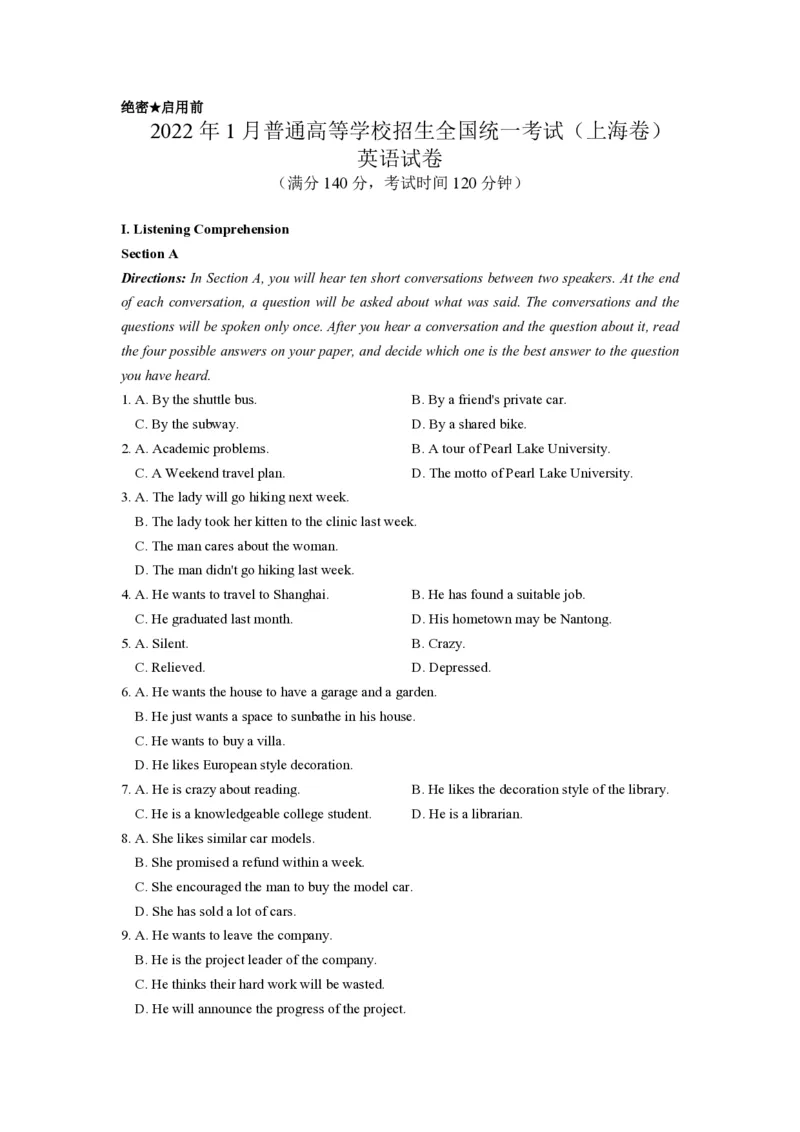
绝密★启用前
2022 年 1 月普通高等学校招生全国统一考试(上海卷)
英语试卷
(满分140分,考试时间120分钟)
I. Listening Comprehension
Section A
Directions: In Section A, you will hear ten short conversations between two speakers. At the end
of each conversation, a question will be asked about what was said. The conversations and the
questions will be spoken only once. After you hear a conversation and the question about it, read
the four possible answers on your paper, and decide which one is the best answer to the question
you have heard.
1. A. By the shuttle bus. B. By a friend's private car.
C. By the subway. D. By a shared bike.
2. A. Academic problems. B. A tour of Pearl Lake University.
C. A Weekend travel plan. D. The motto of Pearl Lake University.
3. A. The lady will go hiking next week.
B. The lady took her kitten to the clinic last week.
C. The man cares about the woman.
D. The man didn't go hiking last week.
4. A. He wants to travel to Shanghai. B. He has found a suitable job.
C. He graduated last month. D. His hometown may be Nantong.
5. A. Silent. B. Crazy.
C. Relieved. D. Depressed.
6. A. He wants the house to have a garage and a garden.
B. He just wants a space to sunbathe in his house.
C. He wants to buy a villa.
D. He likes European style decoration.
7. A. He is crazy about reading. B. He likes the decoration style of the library.
C. He is a knowledgeable college student. D. He is a librarian.
8. A. She likes similar car models.
B. She promised a refund within a week.
C. She encouraged the man to buy the model car.
D. She has sold a lot of cars.
9. A. He wants to leave the company.
B. He is the project leader of the company.
C. He thinks their hard work will be wasted.
D. He will announce the progress of the project.10. A. His child came home late and had no food.
B. He has spared some food for his child.
C. The whole family waited the child came back for dinner.
D. He was very angry with his child's behavior.
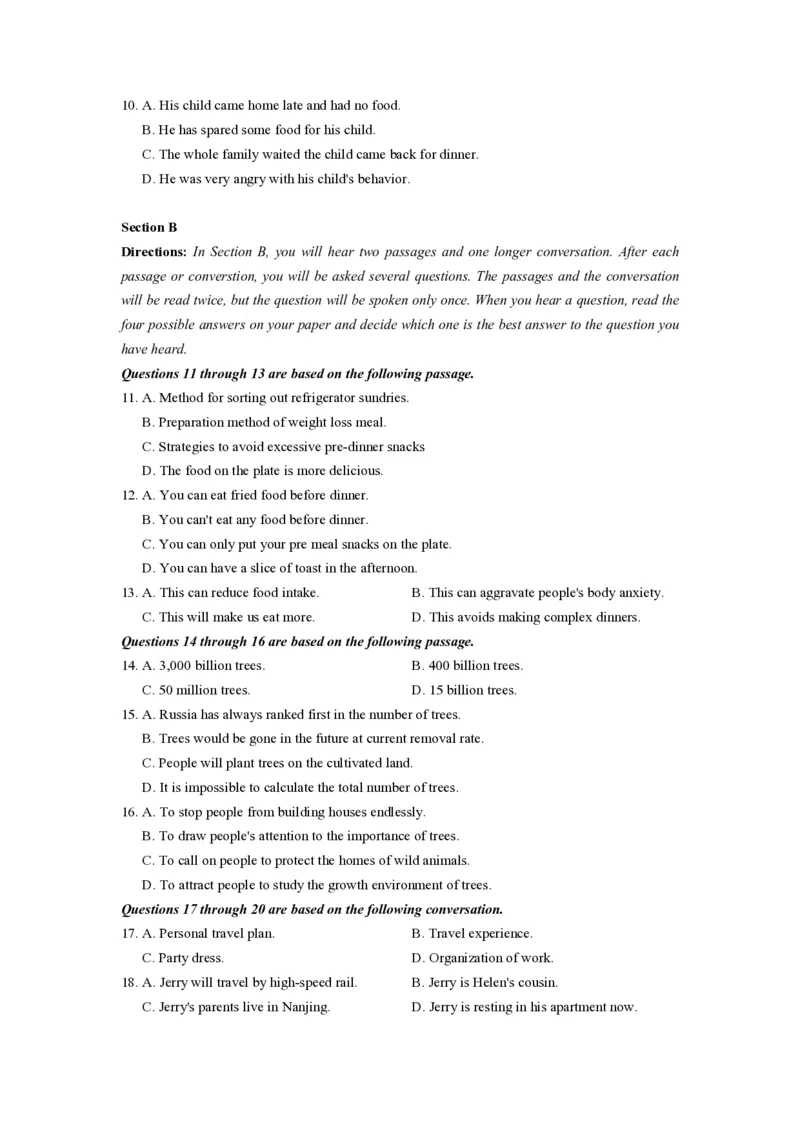
Section B
Directions: In Section B, you will hear two passages and one longer conversation. After each
passage or converstion, you will be asked several questions. The passages and the conversation
will be read twice, but the question will be spoken only once. When you hear a question, read the
four possible answers on your paper and decide which one is the best answer to the question you
have heard.
Questions 11 through 13 are based on the following passage.
11. A. Method for sorting out refrigerator sundries.
B. Preparation method of weight loss meal.
C. Strategies to avoid excessive pre-dinner snacks
D. The food on the plate is more delicious.
12. A. You can eat fried food before dinner.
B. You can't eat any food before dinner.
C. You can only put your pre meal snacks on the plate.
D. You can have a slice of toast in the afternoon.
13. A. This can reduce food intake. B. This can aggravate people's body anxiety.
C. This will make us eat more. D. This avoids making complex dinners.
Questions 14 through 16 are based on the following passage.
14. A. 3,000 billion trees. B. 400 billion trees.
C. 50 million trees. D. 15 billion trees.
15. A. Russia has always ranked first in the number of trees.
B. Trees would be gone in the future at current removal rate.
C. People will plant trees on the cultivated land.
D. It is impossible to calculate the total number of trees.
16. A. To stop people from building houses endlessly.
B. To draw people's attention to the importance of trees.
C. To call on people to protect the homes of wild animals.
D. To attract people to study the growth environment of trees.
Questions 17 through 20 are based on the following conversation.
17. A. Personal travel plan. B. Travel experience.
C. Party dress. D. Organization of work.
18. A. Jerry will travel by high-speed rail. B. Jerry is Helen's cousin.
C. Jerry's parents live in Nanjing. D. Jerry is resting in his apartment now.19. A. She knows the boss there. B. She booked the table a month earlier.
C. Her friend works in this restaurant. D. She has a noble status.
20. A. Going for a picnic in the forest park.
B. Resting in the apartment.
C. Going to the Domingo restaurant for dinner.
D. Going to Shanghai Museum. ,
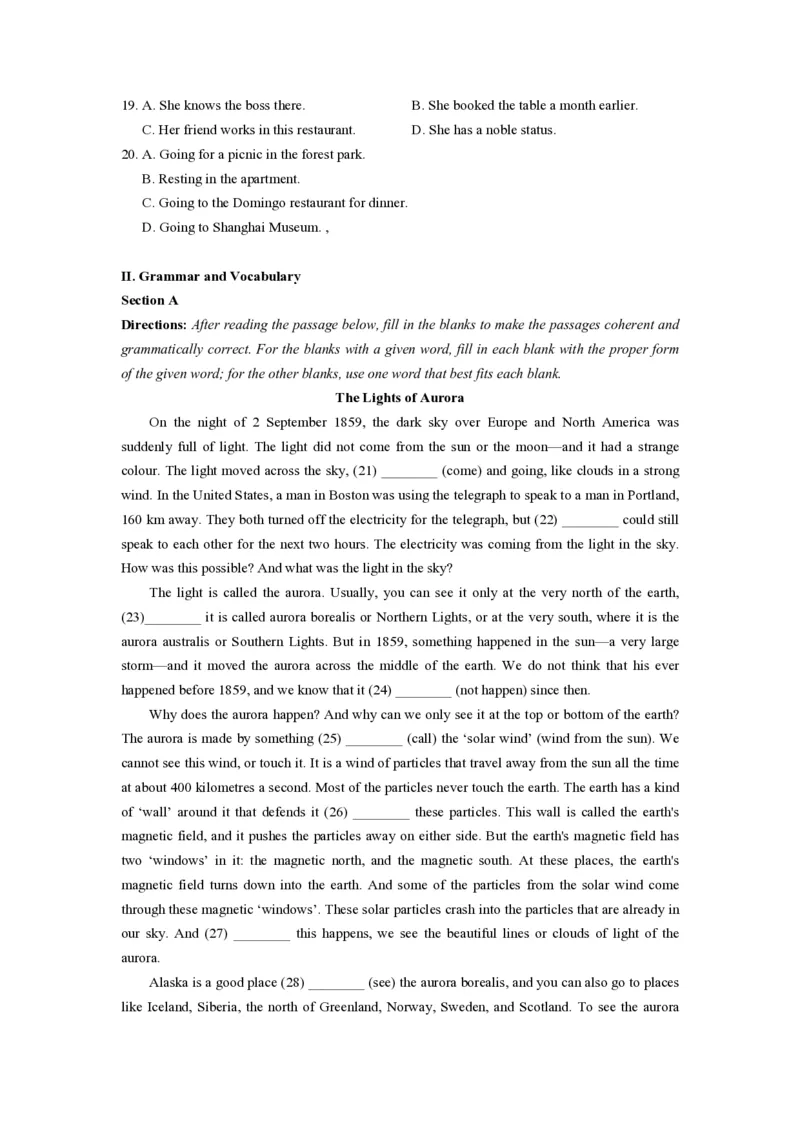
II. Grammar and Vocabulary
Section A
Directions: After reading the passage below, fill in the blanks to make the passages coherent and
grammatically correct. For the blanks with a given word, fill in each blank with the proper form
of the given word; for the other blanks, use one word that best fits each blank.
The Lights of Aurora
On the night of 2 September 1859, the dark sky over Europe and North America was
suddenly full of light. The light did not come from the sun or the moon—and it had a strange
colour. The light moved across the sky, (21) ________ (come) and going, like clouds in a strong
wind. In the United States, a man in Boston was using the telegraph to speak to a man in Portland,
160 km away. They both turned off the electricity for the telegraph, but (22) ________ could still
speak to each other for the next two hours. The electricity was coming from the light in the sky.
How was this possible? And what was the light in the sky?
The light is called the aurora. Usually, you can see it only at the very north of the earth,
(23)________ it is called aurora borealis or Northern Lights, or at the very south, where it is the
aurora australis or Southern Lights. But in 1859, something happened in the sun—a very large
storm—and it moved the aurora across the middle of the earth. We do not think that his ever
happened before 1859, and we know that it (24) ________ (not happen) since then.
Why does the aurora happen? And why can we only see it at the top or bottom of the earth?
The aurora is made by something (25) ________ (call) the ‘solar wind’ (wind from the sun). We
cannot see this wind, or touch it. It is a wind of particles that travel away from the sun all the time
at about 400 kilometres a second. Most of the particles never touch the earth. The earth has a kind
of ‘wall’ around it that defends it (26) ________ these particles. This wall is called the earth's
magnetic field, and it pushes the particles away on either side. But the earth's magnetic field has
two ‘windows’ in it: the magnetic north, and the magnetic south. At these places, the earth's
magnetic field turns down into the earth. And some of the particles from the solar wind come
through these magnetic ‘windows’. These solar particles crash into the particles that are already in
our sky. And (27) ________ this happens, we see the beautiful lines or clouds of light of the
aurora.
Alaska is a good place (28) ________ (see) the aurora borealis, and you can also go to places
like Iceland, Siberia, the north of Greenland, Norway, Sweden, and Scotland. To see the auroraaustralis, go to the south of Australia, Tasmania, or New Zealand.
People travel thousands of kilometres to see the aurora, and they can never be sure
(29)________ it will happen. But (30) ________ do see it say that they will never forget it.
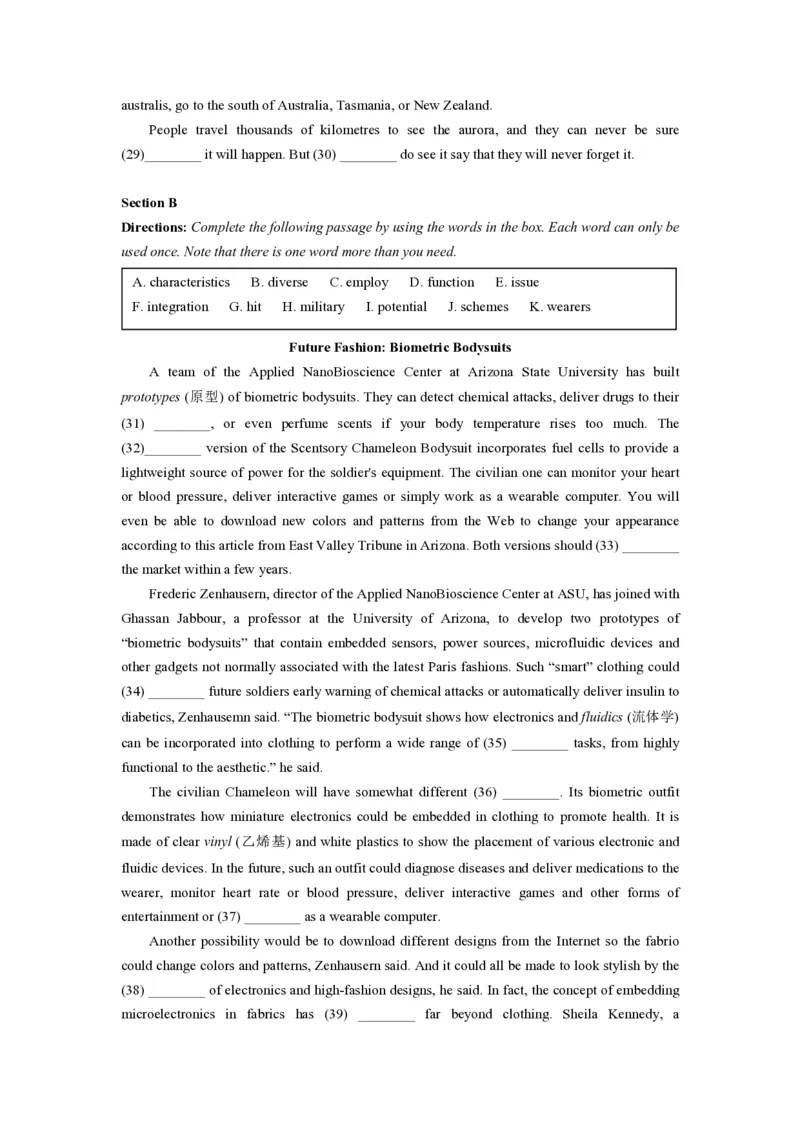
Section B
Directions: Complete the following passage by using the words in the box. Each word can only be
used once. Note that there is one word more than you need.
A. characteristics B. diverse C. employ D. function E. issue
F. integration G. hit H. military I. potential J. schemes K. wearers
Future Fashion: Biometric Bodysuits
A team of the Applied NanoBioscience Center at Arizona State University has built
prototypes (原型) of biometric bodysuits. They can detect chemical attacks, deliver drugs to their
(31) ________, or even perfume scents if your body temperature rises too much. The
(32)________ version of the Scentsory Chameleon Bodysuit incorporates fuel cells to provide a
lightweight source of power for the soldier's equipment. The civilian one can monitor your heart
or blood pressure, deliver interactive games or simply work as a wearable computer. You will
even be able to download new colors and patterns from the Web to change your appearance
according to this article from East Valley Tribune in Arizona. Both versions should (33) ________
the market within a few years.
Frederic Zenhausern, director of the Applied NanoBioscience Center at ASU, has joined with
Ghassan Jabbour, a professor at the University of Arizona, to develop two prototypes of
“biometric bodysuits” that contain embedded sensors, power sources, microfluidic devices and
other gadgets not normally associated with the latest Paris fashions. Such “smart” clothing could
(34) ________ future soldiers early warning of chemical attacks or automatically deliver insulin to
diabetics, Zenhausemn said. “The biometric bodysuit shows how electronics and fluidics (流体学)
can be incorporated into clothing to perform a wide range of (35) ________ tasks, from highly
functional to the aesthetic.” he said.
The civilian Chameleon will have somewhat different (36) ________. Its biometric outfit
demonstrates how miniature electronics could be embedded in clothing to promote health. It is
made of clear vinyl (乙烯基) and white plastics to show the placement of various electronic and
fluidic devices. In the future, such an outfit could diagnose diseases and deliver medications to the
wearer, monitor heart rate or blood pressure, deliver interactive games and other forms of
entertainment or (37) ________ as a wearable computer.
Another possibility would be to download different designs from the Internet so the fabrio
could change colors and patterns, Zenhausern said. And it could all be made to look stylish by the
(38) ________ of electronics and high-fashion designs, he said. In fact, the concept of embedding
microelectronics in fabrics has (39) ________ far beyond clothing. Sheila Kennedy, aBoston-based architect and visiting professor at the Harvard University Graduate School of
Design, sees possibilities to (40) ________ the technology in building design. As an example, she
said window shades containing organic light emitting diodes (二极管) could produce electricity
from sunlight that would help generate power.
III. Reading Comprehension
Section A
Directions: For each blank in the following passage there are four words or phrases marked A,
B, C and D. Fill in each blank with the word or phrase that best fits the context.
Artificially sweetened diet drinks make no difference to weight gain and should not be seen
as healthier than their sugar-laden counterparts, according to a team of experts. A review of
research evidence concludes there is nothing to support claims that sugar-free versions of popular
soft drinks can help (41) ________ obesity and related diseases such as Type 2 diabetes.
Industry-sponsored studies reporting “favourable” associations between diet drinks and weight
loss may be biased, it claims.
There have been concerns that diet drinks, known as artificially sweetened beverages (ASBs),
might lead people to consume more calories by (42) ________ sweet flavour taste buds. The new
study found that evidence (43) ________ the healthiness of ASBs was inconclusive with
randomised controlled trials (RCTs) producing mixed results. Senior investigator Professor
Christopher Millett said: “A common perception, which may be influenced by industry marketing,
is that because ‘diet' drinks have no sugar, they must be healthier and aid weight loss when used as
a(n) (44) ________ for full sugar versions.” However, we found no solid evidence to support this.
The researchers pointed out that research supported by food or beverage companies was more
likely to find no evidence of links between sugary drink (45) ________ and obesity than non-
industry sponsored research. Similarly, ASB industry-sponsored research was “more likely to
report favourable results and (46) ________ regarding ASB effects on weight control”.
In many cases, researchers had failed to disclose (47) ________ of interest relating to links
with the food industry, it was claimed. Co-author Dr Maria Carolina Borges said: “The lack of
solid evidence on the health effects of ASBs and the potential influence of bias from industry
funded studies should be taken seriously when discussing whether ASBs are (48) ________
alternatives to SSBs ( sugar-sweetened beverages). ”
Leading British nutritionist Professor Susan Jebb said despite the mixed evidence, there was
no reason to believe that replacing sugary drinks with artificially sweetened (49) ________ did
any harm. She said: “For people seeking to manage their weight, tap water is (50) ________ the
best drink to choose, for health and the environment, but for many people who are used to
drinking sugary drinks, this will be too hard a change to (51) ________ Artificially sweetened
drinks are a step in the (52 ) ________ direction to cut calories.” Dietician Professor Tom Sanders,
was also critical of the research, calling it “an opinion piece rather than a(n) (53) ________ reviewof the evidence”. He (54) ________: “The conclusion that reduced sugar or sugar-free drinks
should not be promoted or seen as part of a healthy diet seems unwarranted and likely to add to
public (55) ________.”
41. A. relieve B. oppose C. prevent D. bother
42. A. inserting B. stimulating C. enhancing D. securing
43. A. resulting from B. referring to C. depending on D. relating to
44. A. substitute B. proposal C. suspect D. implication
45. A. efficiency B. consumption C. distribution D. modernization
46. A. appointments B. instructions C. performances D. conclusions
47. A. threats B. matters C. conflicts D. appeals
48. A. adequate B. essential C. available D. deliberate
49. A. initiatives B. alternatives C. objectives D. representatives
50. A. without question B. beyond description
C. around the corner D. in consequence
51. A. settle B. route C. mend D. make
52. A. wrong B. right C. proper D. opposite
53. A. democratic B. automatic C. systematic D. dramatic
54. A. transferred B. ranged C. accessed D. added
55. A. fascination B. ambition C. confusion D. isolation
Section B
Directions: Read the following three passages. Each passage is followed by several questions or
unfinished statements. For each of them there are four choices marked A, B, C and D. Choose the
one that fits best according to the information given in the passage you have just read.
(A)
If a single word can describe our daily life during those first three years, it is “scrounge” (讨
要). Every waking moment we were concentrating on how the hell we would be able to save up
enough dough (面团;钱) to do whatever it was we had to do. Usually it was just break even. And
there's nothing romantic about it, either. Remember the famous stanza in Omar Khayyam? You
know, the book of verses underneath the bough, the loaf of bread, the jug of wine and so forth?
Substitute Scott on Trusts for that book of verses and see how this poetic vision stacks up against
my idyllic existence. Ah, paradise? No, bullshit. All I'd think about is how much that book was
(could we get it secondhand?) and where, if anywhere, we might be able to charge that bread and
wine. And then how we might ultimately scrounge up the dough to pay off our debts.
Life changes. Even the simplest decision must be scrutinized by the ever vigilant budget
committee of your mind.
“Hey, Oliver, let's go see Becket tonight.”“Listen, it's three bucks.”
“What do you mean?”
“I mean a buck fifty for you and a buck fifty for me.”
“Does that mean yes or no?”
“Neither. It just means three bucks.”
Our honeymoon was spent on a yacht and with twenty-one children. That is, I sailed a
thirty-six-foot Rhodes from seven in the morning till whenever my passengers had enough, and
Jenny was a children's counselor. It was a place called the Pequod Boat Club in Dennis Port (not
far from Hyannis), an establishment that included a large hotel, a marina and several dozen houses
for rent. In one of the tinier bungalows, I have nailed an imaginary plaque (匾牌): “Oliver and
Jenny slept here.” I think it's a tribute to us both that after a long day of being kind to our
customers, for we were largely dependent on their tips for our income, Jenny and I were
nonetheless kind to each other. I simply say “kind”, because I lack the vocabulary to describe what
loving and being loved by Jennifer Cavilleri is like. Sorry, I mean Jennifer Barrett.
Before leaving for the Cape, we found a cheap apartment in North Cambridge. I called it
North Cambridge, although the address was technically in the town of Somerville and the house
was, as Jenny described it, “in the state of disrepair”. It had originally been a two-family
structure,now converted into four apartments, overpriced even at its “cheap” rental. But what the
hell can graduate students do? It's a seller's market.
56. What can we learn from the conversation between Oliver and Jenny?
A. None of them wanted to see Becket.
B. They didn't have three bucks.
C. Jenny was wasting money.
D. Oliver was a thrifty man.
57. Why were Oliver and Jenny friendly to customers?
A. They were both counselors for children.
B. They needed to get tips from customers.
C. They didn't have enough room to live in.
D. That was the rule on the yacht.
58. By “in the state of disrepair”, the author implies that ________.
A. the apartment was very cheap
B. the apartment was very expensive
C. their accomodation is not decent
D. their accomodation is very decent
59. Which of the following might be the best title of the passage?
A. A couple's debt repayment process.
B. A couple's honeymoon trip.C. A couple's hard life.
D. A couple's life on a yacht.
(B)
Summer Camp Rules
Whether it's your child's first year at camp, or they are a seasoned camper and need a little
refresher, it's a good idea to go over summer camp rules and guidelines before leaving for camp.
Camp rules are in place to keep the camp community safe and camp operations running smoothly
throughout their stay.
1. Keep Your Personal Space Clean
Since your child will be in close quarters with many other campers, it's important that they
understand the necessity of keeping their sleeping and living areas organized.
Go over ways for your child to stay organized and tidy before they leave for camp. When
packing, make sure to provide a laundry bag to keep clean and dirty clothing separate. Utillize
under bed space or put clothes on your shelves or cubbies rather than living out of your suitcase or
camp trunk.
It also helps to not over pack. Follow packing list guidelines closely so your child can find
what they need without having to dig through piles of clothing that were not recommended. This
also helps you child know what they have in their luggage so they pull out the sweatshirt when it
gets cold, instead of thinking there wasn't one in their bag. Remind your child of their camp
account so they can purchase items from the camp store if necessary.
2. Valuables at Camp
As a best practice, we recommend leaving all valuables at home. Even if your child has a
bracelet or necklace that they never take off, there is still the chance that it could be lost while
swimming or participating in camp activities.
If you are thinking about bringing an expensive item of clothing, be prepared for it to get lost
or damaged. You may be better off buying a new, less expensive version. To be on the safe side,
don't let your child bring anything irreplaceable or emotionally valuable to camp.
3. Play Nice
Name calling, fighting, bullying, and arguing are strictly prohibited at summer camp. Camp
is a place to make friends, so aggressive behavior is not tolerated. Remind your child that they
don't have to be everybody's best friend, but they do have to be friendly to everyone.
Encourage your child to go into camp with the mindset of making a few new friends, and
chances are they will leave camp having made more than a few.
4. Have Fun and Try New Things
At the end of the day, summer camp is about getting out of your comfort zone, trying new
things, and having a blast. Before your child leaves for camp, congratulate them for being brave
enough to try sleepaway camp in the first place. Let them know that they’ve already won just bytrying, and the fun part is just about to begin. Remind them again that summer camp rules exist
only to improve the overall camp experience and to create a community of fun.
60. What is the purpose of clarifying the rules of summer camp?
A. Enrich children's summer camp operation.
B. Ensure the safety of children participating in summer camp.
C. Cultivate children's ability to survive in the wild.
D. Help children develop good cleaning habits.
61. Which of the following behaviors is advocated by the summer camp?
A. Take your favorite valuables.
B. Fight with camping friends.
C. Avoid participating in hazardous activities.
D. Keep personal camping supplies in order.
62. What is the passage mainly about?
A. Enjoy the unique fun brought by new things.
B. Make good friends wherever you are.
C. Follow the rules of summer camp.
D. Get enough sleep before camping.
(C)
Conservationists go to war over whether humans are the measure of nature's value. New
Conservationists argue such trade-offs are necessary in this human-dominated epoch. And they
support “re-wilding”, a concept originally proposed by Soule where people curtail economic
growth and withdraw from landscapes, which then return to nature.
New Conservationists believe the withdrawal could happen together with economic growth.
The California-based Breakthrough Institute believes in a future where most people live in cities
and rely less on natural resources for economic growth.
They would get food from industrial agriculture, including genetically modified foods,
desalination, intensified meat production and aquaculture, all of which have a smaller land
footprint. And they would get their energy from renewables and natural gas.
Driving these profound shifts would be greater efficiency of production, where more
products could be manufactured from fewer inputs. And some unsustainable commodities would
be replaced in the market by other, greener ones—natural gas for coal, for instance, explained
Michael Shellenberger, president of the Breakthrough Institute. Nature would, in essence, be
decoupled from the economy.
And then he added a caveat: “We are not suggesting decoupling as the paradigm to save the
world, or that it solves all the problems or eliminates all the trade-offs.”
Cynics (悲观者) may say all this sounds too utopian , but Breakthrough maintains the worldis already on this path toward decoupling. Nowhere is this more evident than in the United States,
according to Iddo Wernick, a research scholar at the Rockefeller University, who has examined
the nation's use of 100 main commodities.
Wernick and his colleagues looked at data carefully from the U.S. Geological Survey
National Minerals Information Center, which keeps a record of commodities used from 1900
through the present day. They found that the use of 36 commodities (sand, ire ore, cotton, etc.) in
the U.S. economy had peaked.
Another 53 commodities (nitrogen, timber, beef, etc.) are being used more efficiently per
dollar value of gross domestic product than in the pre-1970s era. Their use would peak soon,
Wernick said.
Only 11 commodities (industrial diamond, indium, chicken, etc.) are increasing in use
(Greenwire, Nov. 6), and most of these are employed by industries in small quantities to improve
systems processes. Chicken use is rising because people are eating less beef, a desirable
development since poultry cultivation has a smaller environmental footprint.
The numbers show the United States has not intensified resource consumption since the
1970s even while increasing its GDP and population, said Jesse Ausubel of the Rockefeller
University.
“It seems like the 20th-century expectation we had, we were always assuming the future
entailed greater consumption of resources,” Ausubel said. “But what we are seeing in the
developed countries is, of course, peaks.”
63. What does the underlined word “trade-offs” refer to in the first paragraph?
A. The balance between human development and natural ecology.
B. The profitability of import and export trade.
C. The consumption of natural resources by industrial development.
D. The difficult plight of economic growth.
64. Which of the following is true of the views of the new environmentalists?
A. They believe that mankind should live in forests with rich vegetation.
B. They believe that mankind will need more natural resources in the future.
C. They believe that mankind is the master of the whole universe.
D. They believe that mankind should limit economic growth.
65. What can we infer from the last paragraph of the passage?
A. Natural resources cannot support economic development.
B. More resource consumption will not occur in a certain period of time.
C. Excessive resource consumption will not affect the ecological environment.
D. All resource consumption in developed countries has reached a peak.
66. What is the passage mainly about?
A. Urbanization and re-wildness.B. Human existence and industrial development.
C. Socioeconomic development and resource consumption.
D. Commodity trading and raw material development.
Section C
Directions: Complete the following passage by using the sentences in the box. Each sentence can
only be used once. Note that there are two sentences more than you need.
A. However, this is not the case when libraries lend e-books.
B. This may not be a big issue now, for e-books are minor in publishing.
C. Also, publishers assume get more profits from libraries where readers pay them more.
D. Publishing contracts often don't specify whether and how much authors receive for e-books
sales or for e-lending.
E. Extension alone would do little if the current funds under the schemes were merely
re-distributed from books to e-books.
F. For this reason, authors and publishers have been talking the Government into extending the
Lending Rights Schemes to e-books.
Should Writers Be Paid for Their E-books Lent by Libraries?
When libraries lend books to the public, authors and publishers receive remuneration from
the Government under the Lending Rights schemes. (67) ________ Is this fair?
This year, the government has distributed almost a $22 million under these Public Lending
Rights and Educational Lending Rights Schemes. For each book in public library collections,
creators receive $2.11 and publishers receive $0.52.
The amount that each claimant receives is often not very significant, with the majority of
authors receiving between $100-500 annually. Still, a previous study has revealed that this
remuneration constitutes the second most important source of income for creators from their
creative work.
E-books, however, are not covered by these Lending Rights schemes. (68) ________
But e-book lending is increasing and, according to the Australian Library and Information
Association, e-books are likely to reach 20% of library holdings by 2020. Also, most, if not all,
self-published titles are done so in digital format only. Such self-published titles, if lent by
libraries, would not qualify for any remuneration.
(69) ________ Although the Book Industry Collaborative Council made such proposal
already in a report of 2013, nothing has happened of yet.
One of the main reasons why e-books are not covered is that e-book lending is quite different
from print book lending. In case of print books, authors and publishers are arguably losing on
customers and revenues when libraries loan their books for free.
Creators only receive $2.11 and publishers receive $0.52 for each book in public library
collections.At present, in the case of e-books, many publishers chose not to sell these books to libraries.
(70) ________
While publishers charge libraries high prices for e-books, writers complain that these
amounts do not reach them. Publishing contracts often don't specify whether and how much
authors receive for e-books sales or for e-lending.
IV. Summary Writing
71. Directions: Read the following passage. Summarize the main idea and the main point(s) of the
passage in no more than 60 words. Use your own words as far as possible.
Neuroscientists usually define a singular memory as an engram (记忆印记)—a physical
change in brain tissue associated with a particular recollection. Recently, brain scans revealed that
an engram isn't isolated to one region of the brain and instead manifests as a colorful splattering
across the neural tissue. “A memory looks more like a web in the brain than a single spot,” says
neuroscientist and National Geographic Explorer Steve Ramirez of Boston University. That's
because when a memory is created, it includes all the visual, auditory, and tactile inputs that make
an experience memorable, and brain cells are encoded from all of those regions.
Now, scientists are even able to track how memories move across the brain, like detectives
finding footprints in the snow. While at MIT in 2013, Ramirez and his research partner Xu Liu
had a breakthrough: They were able to target the cells that make up one engram in a mouse's brain
and then implant a false memory. In their work, mice reacted in fear to a particular stimulus even
when they had not been conditioned in advance. While mouse brains are less advanced than the
human equivalent, Ramirez says they can still help neuroscientists understand how our memories
work, too.
In their current work, Ramirez and his colleagues are investigating whether positive and
negative memories are stored in different groups of brain cells, and whether negative memories
can be “overwritten” by positive ones. To prep mice for the experiments, the team injects the
animals’ brains with a virus that contains fluorescent proteins and surgically implants optic fibers.
The mice are then given a diet that prevents the virus from fluorescing until the researchers are
ready to tag a positive or negative experience. Positive memories are created by putting male mice
in cages with female mice for an hour, and negative memories are created by putting the mice in
cages that deliver brief foot shocks. Once the mice have been conditioned to associate certain
triggers with each experience, they undergo a short surgical operation so the scientists can
stimulate the cells associated with the positive or negative engrams.
They are finding that activating positive memories while a mouse is in a cage it associates
with fear makes that mouse less fearful. Using a different technique, University of Toronto
neuroscientist Sheena Josselyn was able to completely eliminate fear memories in mice.
V. TranslationDirections: Translate the following sentences into English, using the words given in the brackets.
72.他已经几十年没见过如此壮美的日出了。(since)
73.小张昨天在田里播下种子, 期待来年的丰收。(sow)
74.鉴于不熟悉用手机打车的老人不在少数, 这家公司提供了一系列服务来满足他们的需求。
(a few)
75.正是因为贯彻了“顾客为本”的理念, 那家落寞已久的社区商场才得以重回大众视线。 (it)
VI. Guided Writing
Directions: Write an English composition in 120- - 150 words according to the instructions given
below in Chinese.
假设你是明启中学高三学生李明, 入冬以来,你校组织全校师生每周一至周五晨跑时间
为7:30—7:50, 休息5分钟后上第一节课。但有同学反映, 晨跑后身体不适, 因此学校委托
学生会征询大家对晨跑的意见。请你给学生会写一封邮件, 内容必须包括:
(1) 你认为该晨跑安排中存在的问题;
(2) 你的改进建议及理由。