






文档内容
六级通关模拟卷(第三套)
PartI Writing (30minutes)
Directions: For this part, you are allowed 30 minutes to write a short essay entitled My View on Postgraduate
Crazefollowingtheoutlinegivenbelow.Youshouldwriteatleast150wordsbutnomorethan200words.
1.目前考研正形成热潮
2.分析这股热潮产生的原因
3.我的看法
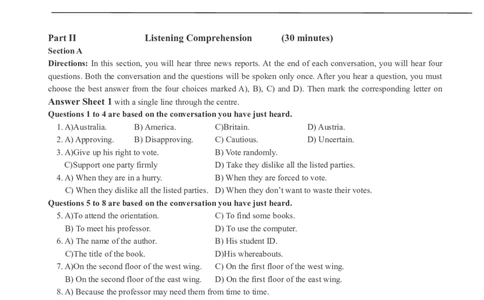
PartII ListeningComprehension (30minutes)
SectionA
Directions: In this section, you will hear three news reports.At the end of each conversation, you will hear four
questions. Both the conversation and the questions will be spoken only once.After you hear a question, you must
choose the best answer from the four choices marked A), B), C) and D). Then mark the corresponding letter on
AnswerSheet 1withasinglelinethroughthecentre.
Questions1to4arebasedontheconversationyouhavejustheard.
1.A)Australia. B)America. C)Britain. D)Austria.
2.A)Approving. B)Disapproving. C)Cautious. D)Uncertain.
3.A)Giveuphisrighttovote. B)Voterandomly.
C)Supportonepartyfirmly D)Taketheydislikeallthelistedparties.
4.A)Whentheyareinahurry. B)Whentheyareforcedtovote.
C)Whentheydislikeallthelistedparties. D)Whentheydon’twanttowastetheirvotes.
Questions5to8arebasedontheconversationyouhavejustheard.
5.A)Toattendtheorientation. C)Tofindsomebooks.
B)Tomeethisprofessor. D)Tousethecomputer.
6.A)Thenameoftheauthor. B)HisstudentID.
C)Thetitleofthebook. D)Hiswhereabouts.
7.A)Onthesecondfloorofthewestwing. C)Onthefirstfloorofthewestwing.
B)Onthesecondflooroftheeastwing. D)Onthefirstflooroftheeastwing.
8.A)Becausetheprofessormayneedthemfromtimetotime.
B)Becausetheyareverypreciousandvaluable.
C)Becausetheprofessorhopestheyareavailabletoallthestudents.
D)Becausetheyarealreadyreservedbysomestudents.
SectionB
Directions:In this section, you will hear two long conversations.At the end of each conversation, you will hear
four questions. Both the conversation and the questions will be spoken only once.After you hear a question, you
must choosethe bestanswer fromthe four choices markedA), B), C), andD).Then mark thecorresponding letter
onAnswerSheet 1withasinglelinethroughthecentre.
Questions9to11arebasedonthepassageyouhavejustheard.
19.A)Humans’socialstructureisthemostcomplicated.
B)Humansareabletocooperatewitheachother.
C)Predictionisthekeytohumans’survival.
D)Humansaresensitiveandmotivated.
10.A)Boilinghotwater. B)Slightlyhotwater.
C)Roomtemperaturewater. D)Icycoldwater.
11.A)Watching“warm”videos. B)Watchingcontrolvideos.
C)Watching“cold”videos. D)Alloftheabove.
Questions12to15arebasedonthepassageyouhavejustheard.
12.A)Tosolveeconomicproblems. B)Toincreasegenderequality.
C)Tofollowtheinternationaltrend. D)Toincreasethenumberofpopulation.
13.A)Onlymotherscantakethepaidparentalleave.
B)Noparentalleavecanbetakenafterthechildis8.
C)Onlyfamiliesoftwoworkingparentscanenjoythepaidleave.
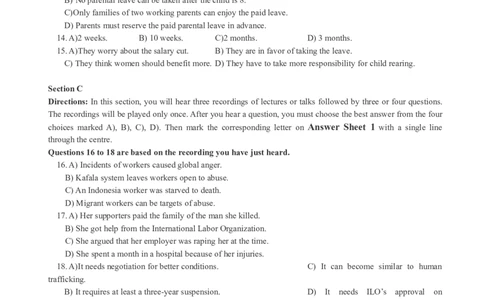
D)Parentsmustreservethepaidparentalleaveinadvance.
14.A)2weeks. B)10weeks. C)2months. D)3months.
15.A)Theyworryaboutthesalarycut. B)Theyareinfavoroftakingtheleave.
C)Theythinkwomenshouldbenefitmore. D)Theyhavetotakemoreresponsibilityforchildrearing.
SectionC
Directions: In this section, you will hear three recordings of lectures or talks followed by three or four questions.
Therecordingswillbeplayedonlyonce.Afteryouhearaquestion,youmustchoosethebestanswerfromthefour
choices marked A), B), C), D). Then mark the corresponding letter on Answer Sheet 1 with a single line
throughthecentre.
Questions16to18arebasedontherecordingyouhavejustheard.
16.A)Incidentsofworkerscausedglobalanger.
B)Kafalasystemleavesworkersopentoabuse.
C)AnIndonesiaworkerwasstarvedtodeath.
D)Migrantworkerscanbetargetsofabuse.
17.A)Hersupporterspaidthefamilyofthemanshekilled.
B)ShegothelpfromtheInternationalLaborOrganization.
C)Shearguedthatheremployerwasrapingheratthetime.
D)Shespentamonthinahospitalbecauseofherinjuries.
18.A)Itneedsnegotiationforbetterconditions. C) It can become similar to human
trafficking.
B)Itrequiresatleastathree-yearsuspension. D) It needs ILO’s approval on
Convention189.
Questions19to22arebasedontherecordingyouhavejustheard.
19.A)Hisbookshavebeensoldworldwide. B)Hecanspeakandwriteeightlanguages.
C)Hislifestyleiswell-knownintheworld.D)Hehasbeentomanycountriesbefore.
20.A)Itappearsinyourphysiology. C)Itisemphasizedbyphilosophers.
B)Itisinyourvaluesystem. D)Itcarriesitsownbeliefs.
21.A)Itisthecentreoftheworld. C)Ithasnoroomforlies.
B)Itisnoteasytoreach. D)Itisbrightlikethesun.
22.A)Trytogetwhatyou’vemissed C)Thinkofwaystobebetter.
B)Lovetheabundanceyouhave. D)Besatisfiedwithyourpast.
Questions23to25arebasedontherecordingyouhavejustheard.
223.A)Imitatingthewordsinmovies. B)Rememberingwordsinasong.
C)Listeningandrepeatingwords. D)Speakingthewordstoarhythm.
24.A)Thethreegroupsdidexactlythesame. C)Thesecondgroupperformedbetter.
B)Thefirstgroupdidthebestin4tests. D)Thethirdgroupcameoutontop.
25.A)Singingcouldleadtonewwaysoflearningaforeignlanguage.
B)Learnersshouldn’tusemusicallthetimetolearnaforeignlanguage.
C)Languagelearnersalreadyknowthevalueofusingsinging.
D)Adultslearnwordsbetterwhenrememberingtheminsongs.
PartⅢ Reading Comprehension (40minutes )
SectionA
Directions: In this section, there is a passage with ten blanks.You are required to select one word for each blank
from a list of choices given in a word bank following the passage. Read the passage through carefully before
making your choices. Each choice in the bank is identified by a letter. Please mark the corresponding letter for
each item on Answer Sheet 2 with a single line through the centre. You may not use any of the words in the
bankmorethanonce.
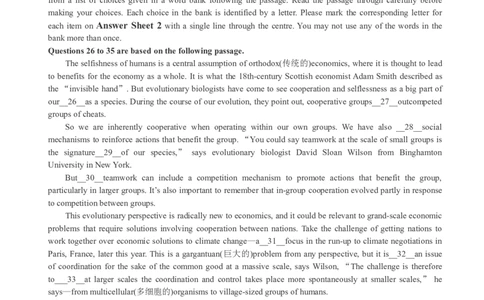
Questions26to35arebasedonthefollowingpassage.
Theselfishnessofhumansisacentralassumptionoforthodox(传统的)economics,whereitisthoughttolead
to benefits for the economy as a whole. It is what the 18th-century Scottish economistAdam Smith described as
the “invisible hand”. But evolutionary biologists have come to see cooperation and selflessness as a big part of
our__26__asa species.Duringthe courseof ourevolution,they pointout,cooperative groups__27__outcompeted
groupsofcheats.
So we are inherently cooperative when operating within our own groups. We have also __28__social
mechanisms to reinforce actions that benefit the group. “You could say teamwork at the scale of small groups is
the signature__29__of our species,” says evolutionary biologist David Sloan Wilson from Binghamton
UniversityinNewYork.
But__30__teamwork can include a competition mechanism to promote actions that benefit the group,
particularly in larger groups. It’s also important to remember that in-group cooperation evolved partly in response
tocompetitionbetweengroups.
Thisevolutionaryperspectiveisradicallynewtoeconomics,anditcouldberelevanttogrand-scaleeconomic
problems that require solutions involving cooperation between nations. Take the challenge of getting nations to
work together over economic solutions to climate change—a__31__focus in the run-up to climate negotiations in
Paris, France, later this year.This is a gargantuan(巨大的)problem from any perspective, but it is__32__an issue
of coordination for the sake of the common good at a massive scale, says Wilson, “The challenge is therefore
to___33__at larger scales the coordination and control takes place more spontaneously at smaller scales,” he
says—frommulticellular(多细胞的)organismstovillage-sizedgroupsofhumans.
“Morality evolved out of cooperation within and competition between groups, so when acting as a single
groupto tackle globalproblems wewill have to__34__therole of naturalselectionourselves,”Wilson says.This
might involve pursuing a wide variety of__35__,identifying those that work best, and then creating incentives to
cooperateonimplementation.“Insomewaysit’stheoppositeoftheinvisiblehand.”
3A)adaptation I)particular
B)assume J)promptly
C)compel K)remarkable
D)consistently L)rumor
E)developed M)strategies
F)effective N)success
G)essentially O)suspicion
H)implement
SectionB
Directions: In this section, you are going to read a passage with ten statements attached to it. Each statement
containsinformationgiveninoneoftheparagraphs.Identifytheparagraphfromwhichtheinformationisderived.
You may choose a paragraph more than once. Each paragraph is marked with a letter. Answer the questions by
markingthecorrespondingletteronAnswerSheet2.
Self-publishing
[A]To a writer, self-publishing is an incredibly powerful and alluring concept. On the simplest level, it’s an
intriguing solution to an age old problem: How do you get your words to a wide audience(ideally, while earning
some money along the way)? On a more artistic level, it is a unique extension of the creative process. Beyond
putting words on the page, the self-publisher actually controls every aspect of authoring—he or she creates the
physical book and actively brings it to an audience. It’s a uniquely harmonious and satisfying melding of art and
business.
Beginningthebook
[B]In most cases, the first step in self-publishing is developing an idea for your book. You can self-publish
almostanythingyouwant,butifyouwanttomakeaprofit,ithelpstoconsideryourbooknotjustasapieceofart
butalsoasasellableproduct.Whataudienceisinterestedinthesubjectandhowdoyougettheirattention?
[C] Everybodyhasanopiniononwhatsells, andwe won’tget intotoomuch here—it’s partofthe individual
creative process that self-publishers go through. The important point is that as a self-publisher, you have to
consider sales just as a large publisher would. Step one is arriving at an approach to the book that will make it
valuable to an audience.Among other things, that means seeing what similar books are out there, and seeing how
they’vesold(checkingAmazonrankingsisagoodplacetostart).
[D]Money isn’t everything of course. Few books are going to be blockbusters(一鸣惊人者),and many
self-publishersaren’tthatconcernedwithmakingmoneyatall.Butevensettingprofitaside,itisessentialthatyou
have a businessplan based onwhat you reasonably believe you can sell.To putit another way,there’s no pointin
printing10,000booksifbookslikeyourstypicallytakethreeyearstosell1,000copies.
Whatsortofbook?
[E]You certainly don’t need to know exactly how many pages your book is going to be before you even get
started writing. But if you have a target, and you know what type of book you’re creating , you can plan your
budget accordingly.The broad decision first: Do you want a hardback bookor a trade paperback book? Hardback
books are significantly more expensive to print, and because of the higher cover price, may sell less than a
paperback book. But, for some books—a mammoth(巨大的)textbook, say—hardback books are really the only
waytogo.
[F]After you’ve made this decision, you can decide how many pages you’ll want. Think about the scope of
whatyouhavetosayandlookatthepagecountinbookswithsimilarcontent.Butalsothinkaboutwhatyouwant
thebooktofeellike.Simplypickoutabookthatisaboutthesamesizeandformatofwhatyouhaveinmind.
[G]When you find a good model to shoot for, count the number of words per page. Multiply that by the
number of pages. Then subtract words for any “odd pages”—the first and last pages of each chapter(these aren’t
usuallyfilled),anyblanknumberedpagesandanypagesatthebeginningandendofthebook.Thiswillgiveyoua
4rough word count for the book. If you calculate how many words are on a page in your word processing
program(orpaperifyouuseatypewriterorifyouwritelonghand),youcangiveyourselfatargetpagecount.
[H]Why does this matter? For one thing , you need to think about the psychology of a book-buyer. If you’re
lookingtocreateagiftbookpaperback,youdon’twantamassive500-page volume,becauseitmayfeeltoomuch
like a reference encyclopedia(百科全书). Its intended audience has more of a casual interest, so it should have a
lighterfeel. Butif you’re puttingtogether a how-to guide,a 100-pagebookisn’tgoing to seemlikeagood dealto
your potential customer. They’ll pick the thicker book on the shelf next to yours, because it seems more
substantial.
[I]Price also plays a role here More pages cost more, and certain multiples of pages are cheaper than others.
Printing presses print a set number of pages in one pass—typically 32 pages, front and back. This means it’s
substantially cheaper to print a 320 page book than a 321 page book. This isn’t something you have to figure out
rightaway,butitshouldbeafactorwhenyouarelayingoutthefinishedbook.
Creatingcontent
[J]Once you nail down what kind of book you want to end up with, you can get busy writing. The obvious
way to go about this is to shut the door to the world, write whatever you want and worry about editing down the
line. Show your friends and family when you want to, but otherwise, do it however you like. You don’t have a
publishertoworryabout,soyoucanreallywritehoweveryouwantto.
[K]To many self-publishers, this doesn’t work very well—it’s too unstructured, and they get lost without
somebody to bounce ideas off. One solution is to hire a freelance(自由职业者)developmental editor. A
developmental editor serves the same basic function as the editor you would work with at a publishing
house—you can show them drafts and outlines, and they can make edits to improve the book. The difference of
courseis that whatyou sayis thelast word, rather thanthe other way around. Ideally,the main thing theybring is
expertiseinbookpublishing—adevelopmentaleditorshouldbesomebodywhoknowshowtobuildagoodbook.
[L]The priceof adevelopmentaleditorgoes in your totalbudget forthe book. Dependingonhow youwork,
itmaysaveyouenoughofyourowntimetomakeitaworthwhileexpense.
Selling
[M]When you finally reach your publish date, you have one basic job: Get people to buy your book. For
individual book-buyers, this is pretty simple.Theypay the cover price, you record the transaction and you ship or
give them the books. But individual book-buyers are the smallest piece of your customer base. Your major
customersincludeindependentbookstores,wholesalerswhofillordersfrommanybookstores(Theyonlybuywhat
they need or expect they will need.),distributors who buy books to actively resell them to bookstores, exclusive
distributors,whowillhandleeverythinginvolvedinthesellingofyourbook,inexchangefortheexclusiverightto
distribute,andonlinebooksellers.
[N]Two new factors enter the mix with these customers—discounts and returns. To ensure a profit,
booksellers always buybooks wellbelow thecover price,andmostreserve theoptionto return books theycannot
sell. If the books are undamaged, you must refund the buyers’ money. You’ll need a terms-and-conditions sheet
that outlines, in detail, how you’ll operate your business—what kind of discounts you offer, how you handle
returns, how you handle billing, etc. Your terms and conditions are up to you, but you’ll have to treat particular
typesofbuyersacertainwayinordertodobusiness.
[O]Selling is an ongoing process that can last for years. When you run through your first shipment, and
there’s still demand, you go to the printer foryour next shipment. If your bookreally catches on,you may beable
to land a good deal with a larger publisher who can push your sales to a higher level. Over the years, many
successfulauthorshaveusedthisroadtogetonapublisher’sradar.
[P]The sweet spot of writing is generally at the beginning of the process—when you’re sitting at a keyboard
putting your ideas into words. In contrast, the sweet spot to publishing generally comes after all the work is
done—when you’ve recouped(弥补)your initial costs, and every book sold is money in your pocket. This is a
self-publisher’sultimatereward.
536.Althoughsellingisanongoingprocess,theauthor’ssuccessdependsonthereaders’demand.
37.Hardbackbookscostmuchtoprint,butitisamustforthepublicationofcertainbooks.
38.Adevelopmentaleditorwillbeworthyofthemoneybecauseheisabletosavethetimeoftheself-publisher.
39.Self-publishingbecomesaninterestingideapartlybecauseitgetauthors’thoughtstoawideaudience.
40.Tosolvetheproblemoflackingfeedbacksfromothers,adevelopmentaleditormaybeemployed.
41.Self-publishershavetodecidewhatbookwillsellwellaccordingtotheirownopinions.
42.When planning the details of his discounts and returns, a self-publisher needs to work outdifferent ways to
treatparticulartypesofbuyers.
43.To give a target page count, you have to choose a book with the same size and format of what you have in
mind.
44.Ifaself-publisherwantshisbooktocostless,certainmultiplesofpagesshouldbeavailable.
45.Individual buyers, like the wholesalers and distributors, should be considered as major customers of
self-publishers.
SectionC
Directions: There are 2 passages in this section. Each passage is followed by some questions or unfinished
statements. For each of them there are four choices marked A), B), C) and D). You should decide on the best
choiceandmarkthecorrespondingletteronAnswerSheet 2withasinglelinethroughthecentre.
PassageOne
Questions46to50arebasedonthefollowingpassage.
It began with some marshmallows(棉花软糖). In the 1960s Walter Mischel, a psychologist then working at
StanfordUniversity,startedaseriesofexperimentsonyoungchildren.Achildwasleftalonefor15minuteswitha
marshmallow or similar treat, with the promise that, if it remained uneaten at the end of this period, a second
would be added. Some of the children, who were aged four or five at the time, yielded to temptation before time
wasup.Othersresisted,andheldoutforthereward.
Dr. Mischel then followed the children’s progress as they grew up. Those who had resisted, he found, did
better at school than those who had given in.As adults they got better jobs, were less likely to use drugs and got
into trouble with the law less frequently. Moreover, children’s family circumstances suggested that impulsive
behavior was as much learned as inherited. This suggested that it could be unlearned—improving the child in
question’schancesinlife.
Study after study has confirmed Dr. Mischel’s insight. However, recent observations, however, raise the
possibilitythatdevelopingself-controlisnotalwaysanunalloyed(纯粹的)good.
Work published two years ago by Gene Brody of the University of Georgia, who looked ata group of young
blackAmericans, showed that those who exhibited self-control as teenagers did indeed get the expected benefits.
But if such self-controllers came from deprived backgrounds, they developed higher blood pressure, were more
likely to be obese and had higher levels of stress hormones than their less-self-controlled peers. That correlation
didnotapplytopeoplewhostartedfartherupthesocialladder.
Dr. Brody and his colleagues have followed this study with one that comes to an equally astonishing
conclusion:forpeoplebornatthebottomofthesocialheap,self-controlspeedsuptheprocessofageing.
Dr.Brodyandhiscolleaguesfollowedalmost300blackAmericanteenagers ofdifferentbackgroundsasthey
agedfrom17to22.Forthefirstfewyearstheresearchersassessedtheirvolunteers’levelsofself-control,andalso
looked for signs of depression, aggression and drug use. They assessed, too, those volunteers’ socioeconomic
backgrounds. But the last examination, when participants were 22 years old, was different. Then, the researchers
took a blood sample, recorded the DNA-methylation(DNA 甲基化)patterns of cells in it, and worked out how
much these deviated from the pattern expected at that particular age. As the study shows, for people from
high-status backgrounds, higher self-control meant lower cellular ages. For those background was low-status, the
reversewastrue.
6Dr. Brody’s findings are both intriguing and worrying. The research into gene methylation suggests
changing methylation patterns are a common response to changing circumstances as well as changing age, as the
body’s physiology struggles to keep up. Fortunately, people can change their circumstances in rational ways: the
lesson of the marshmallows shows that. If Dr. Brody’s result is confirmed, the challenge it poses will be to work
outhowtoavoidtheadverseeffectsofself-control.
46.WhichofthefollowingistrueofDr.Mischel’sexperiment?
A)Itprobedintotheself-controlleveloflittlechildren.
B)Itshowedthatmostchildrencouldn’tresisttemptation.
C)Itexhibitedthatself-controlconnectswithlifeachievement.
D)Itfoundoutawaytohelpchildrendevelopself-control.
47.Dr.Brody’snewstudywithyoungblackAmericansrevealsthat_______.
A)developingself-controlisnotbeneficialatall
B)teenagerscanbenefitfromdevelopingself-control
C)theeffectofself-controlrelatestosocialbackground
D)self-controlcauseshighbloodpressureandobesity
48.WhatcanweinferaboutDNA-methylationfromthepassage?
A)Itcanreveallevelsofself-control. B)Itrelatestothephysiologicalage.
C)Itisoneoftheingredientsofblood. D)Itchangeswithsocialcircumstance.
49.WhatcanweknowaboutDr.Brody’sfindings?
A)Theyareoutoftheexpectationoftheresearchers.
B)Theyrevealaconnectionbetweengeneandage.
C)TheycontradictwiththeresultsofMischel’sstudy.
D)Theyraiseanewissueforresearchinthefuture.
50.Whichofthefollowingcanbeasuitabletitleforthepassage?
A)SocialBackgroundandSelf-control B)WhatBenefitsWillSelf-controlBring?
C)HowShouldWeDevelopSelf-control? D)ProbingtheEffectsofSelf-control
PassageTwo
Questions51to55arebasedonthefollowingpassage.
Marketplace or peer-to-peer(P2P)lending matches borrowers on low-cost online platforms. By skirting
banks, P2Plending allows borrower and lender alike to achieve better rates of interest. Essentially,P2Plending is
a way of capitalizing on the network effect of social media and the volumes of data generated therein to allow
cheaperaccesstocapital.
According to Liberum, P2P lending in the U.K. will grow at 98 percent year-on-year in 2015, with £3.5
billion presently lent out. Worldwide in 2015, it’s estimated that $77billion will be lent via P2P platforms— $60
billion China, $12 billion U.S.A. and $5 billion U.K. Morgan Stanley’s Huw Steenis says, “While marketplace
lending is still about 1 percent of unsecured consumer and SME lending in the U.S., we think it can reach
approximately 10 percent by 2020… We forecast the global market to grow to $150-$490 billion by 2020.” As
Liberum’sCormacLeechsays,“Wearewitnessingthebiggestchangestothebankingsectorfor400years.”
P2P lending offers huge opportunities, mainly at the expense of banks, whose biggest margins are
traditionallyinunsecuredlending.HereinisthelayeroffatP2Pplatformsareguzzling(大肆掠食的),pickingoff
thebanks’bestcustomers. P2Pplatformshavealsoprovedsuperioratharvesting andmanagingbigdata,andhave
lowercostbasesthanbanks.
A significant development is that institutional money is now alighting. The largest quoted institutional P2P
lender,P2PGlobalInvestmentPLC,floatedinLondonlastyear.Ithasraisednearly500mandaimstodouble that
this year.As a reward for lofting “transformational” amounts of cash on to various platforms, P2P Global has
been accumulating warrants and options on their equity, notably Ratesetter, Zopa, Direct Money and Lending
Works.
7In a twist to this development, NeilWoodford, Britain’s most famous fund manager,recently upped his stake
in P2P Global. Last August Woodford sold out of HSBC, fearing “fine inflation”. This seems a ringing
endorsementofthisdisruptivebutnascent(初期的)sector.
Perhaps most significantly, in May this year, Zopa, the P2P platform, announced its debut in secured(most
P2Plendingisunsecured)lendingbycollaboratingwithUber.UberdriversinU.K.willbeabletoborrowviaZopa
tobuytheircars,withloanssecuredagainstthecarsthemselves.
Of course, the sector presents risks. The credit dry-up when interest rates rise.AP2P platform may go bust.
But some investors, regulatory and technological upheaval(突变). And when the banks finally understand, how
willtheyreact?Whoknows?Sofar,noneofthemhave.
51.Liberum’sdataquotedinParagraphTwoindicatesthat_____.
A)P2Pplatformoffershugeopportunitiesforbanks
B)P2Plendingattractstheoldcustomersofbanks
C)P2Phasseizedmostshareofthefinancialmarket
D)P2Plendinghasbeenexperiencingfastbooming
52.WhatcanwelearnaboutP2PGlobalInvestmentPLC?
A)ItisthelargestinvestmentcompanyinLondon.
B)IthasbeenraisinghugefundsforP2Plending.
C)Ithascombinedwithafewfamouscompanies.
D)Ithasawell-knowneconomistasitsmanager.
53.ThecooperationbetweenZopaandUberhas______.
A)createdanewwayofP2Plending B)helpeddriverstobuytheirnewcars
C)raisedtheP2Plendinginterestrates D)posedrisksforotherP2Pcompanies
54.Whatistheauthor’sattitudetowardsthefutureofP2Plending?
A)Pessimistic. B)Optimistic. C)Wait-and-see. D)Indifferent.
55.What’sthepurposeoftheauthorinwritingthispassage?
A)Tointroducesomerecentchangesinlendingmarket.
B)ToanalyzetherisksofinvestingwithP2Pplatforms.
C)Tocallforbanks’attentiontothedevelopmentofP2P.
D)ToforecastthepossibledifficultiesP2Plendingmayface.
PartⅣ Translation (30 minutes)
Directions:Forthispart,youareallowed30minutestotranslateapassagefromChineseinto
English.YoushouldwriteyouransweronAnswerSheet 2.
今天,剪纸(paper-cutting)和古代一样是一项技术性很高的艺术形式,它需要创造力、技巧和经验。
无论是简单的还是复杂的形式,每一个设计必须形成一个连续的、完整的(integral)剪纸。仔细研究你会
发现中国人形成的哪种巧妙的剪法既链接了内部的各个部分,还保持了图形的完整性。总体来说,剪纸有
两种方法:一种是用剪子,另一种是用刀。由于窗户上的薄纸被玻璃替代,剪纸逐渐变得不那么流行。直
到近几年,这门古老的艺术才以令人难忘的新形式再次繁荣起来。
8