2020 年大连市初中毕业升学考试英语
第 I 卷选择题(共 72 分)
I. 单项填空(本题共12小题,每小题1分,共12分)
从每题所给的A、B、C和D四个选项中,选出可以填入空白处的最佳选项。
1. In this picture, people are celebrating China’s 70th birthday __________ Tian’anmen Square.
A. for B. with C. at D. from
2. Australians speak English, but in __________ own way.
A. its B. his C. her D. their
3. I live in Beijing now, but I ________ in Shanghai three years ago.
A. lived B. will live C. live D. have lived
4. Table tennis is ________ than baseball in China.
A. popular B. more popular C. most popular D. the most popular
5. AR and VR are just toys at the moment. But in the future, they __________ our homes and offices.
A. enter B. entered C. have entered D. will enter
6. I was late __________ I planned to get home early.
A. although B. since C. if D. because
7. Keep quiet! I __________ the online class.
A. have B. am having C. had D. have had
8. If the rivers __________, farmers can’t use the water for their crops.
A. polluted B. were polluted C. are polluting D. are polluted
9. It is easy __________ new words. Try to read the words when you see them, and try to use them.
A. remember B. to remember C. remembered D. remembering
10. My grandfather __________ newspapers for the latest news every morning at home.
A. throws away B. takes up C. looks through D. hears from
11. — Do you know ________?
— Next Sunday.
A. how we will hold the sports meeting B. where will hold the sports meeting
C. when we will hold the sports meeting D. why will we hold the sports meeting12. —I’m going to take a vacation tomorrow.
—Oh, good! ___________________
A. Have fun! B. Well done!
C. What a pity! D. Good luck!
II. 完形填空(本题共8小题,每小题2分,共16分)
阅读下面短文,从短文后各题所给的A、B、C、D四个选项中,选出可以填入空白处的最佳
选项。
Bringing water to Liberians
Destinee Whitaker was in the fourth grade when she first knew millions of people in Liberia(利比里亚)didn't
have clean water. “It made me feel ___13___ ,” the girl said. “Not everyone had what I had. Water, you know, is
something you ___14___ manage without.”
After Whitaker entered high school, she did some research on the problem carefully. She really wanted to
___15___ something. One day after school, she talked to her classmates about the problem. They decided to raise
money to buy water purification (水质净化)systems for people in need.
Together, Whitaker and her classmates thought about ___16___ to raise money. They organized(组织) a game
where students bought tickets to guess how many pieces of candy there were inside a jar(罐子).In only a few
weeks' time, they raised $ 800.
Whitaker then tried to ___17___ an organization that could deliver (递送) the water purification systems to
Liberia. She connected with Joseph Sackor. Sackor runs an organization that provides medical services for
Liberians.
“When I heard Whitaker's story,” Sackor said, “I was really surprised. I was moved that a girl of her age would
think about other people's ___18___ that way” Sackor said that in Liberia, many young children died because they
had to drink dirty water. Some students stay away from school because their parents cannot afford to buy them
bottled water. Whitaker's water purification systems will ___19___ make a difference in their lives.
And this is not the end of the story. Whitaker says she will ___20___ working with Sackor. She wants to find
more ways to help people in need.
13. A. interested B. surprised C. thirsty D. angry
14. A. mustn't B. can't C. shouldn't D. needn't
15. A. do B. buy C. say D. give
16. A. reasons B. tasks C. ways D. jobs17. A. find B. join C. follow D. check
18. A. suggestions B. country C. lives D. future
19. A. recently B. hardly C. suddenly D. immediately
20. A. start B. avoid C. keep D. enjoy
II. 阅读理解(一) (本题共17小题,每小题2分,共34分)
A.阅读下列短文,从每题所给的A、B、C和D四个选项中,选出最佳选项。
Passage 1
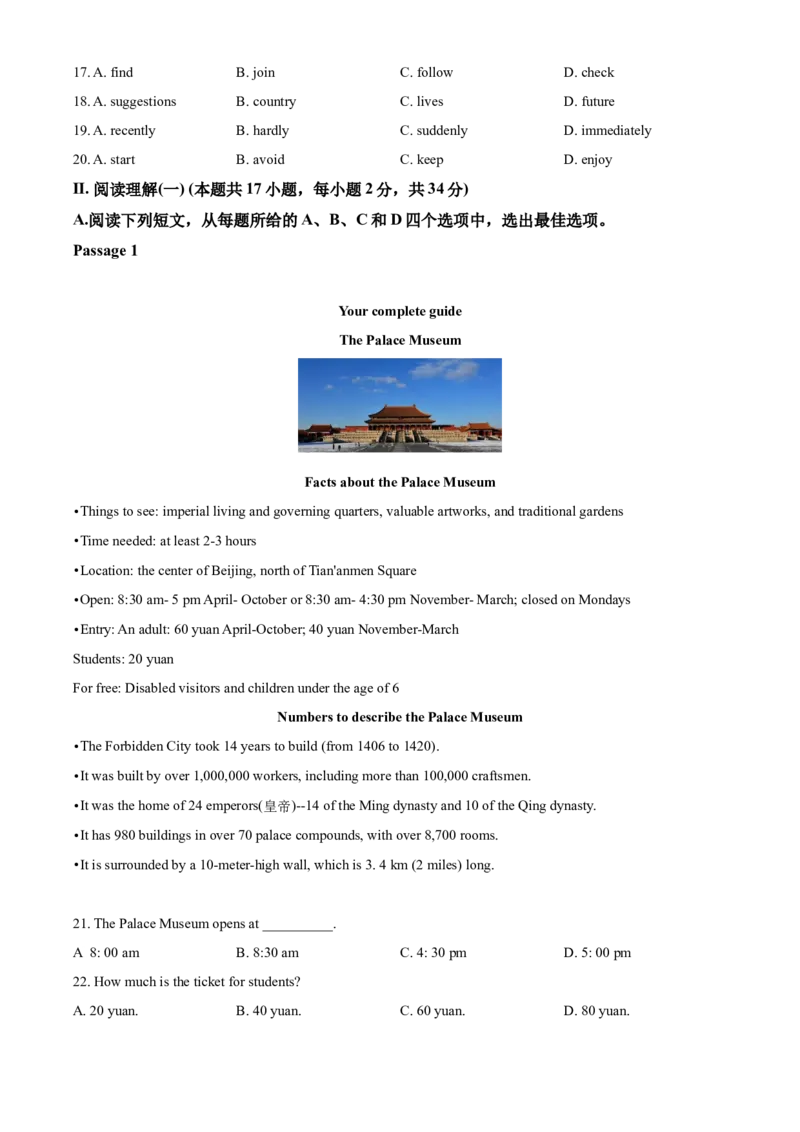
Your complete guide
The Palace Museum
Facts about the Palace Museum
•Things to see: imperial living and governing quarters, valuable artworks, and traditional gardens
•Time needed: at least 2-3 hours
•Location: the center of Beijing, north of Tian'anmen Square
•Open: 8:30 am- 5 pm April- October or 8:30 am- 4:30 pm November- March; closed on Mondays
•Entry: An adult: 60 yuan April-October; 40 yuan November-March
Students: 20 yuan
For free: Disabled visitors and children under the age of 6
Numbers to describe the Palace Museum
•The Forbidden City took 14 years to build (from 1406 to 1420).
•It was built by over 1,000,000 workers, including more than 100,000 craftsmen.
•It was the home of 24 emperors(皇帝)--14 of the Ming dynasty and 10 of the Qing dynasty.
•It has 980 buildings in over 70 palace compounds, with over 8,700 rooms.
•It is surrounded by a 10-meter-high wall, which is 3. 4 km (2 miles) long.
21. The Palace Museum opens at __________.
.
A 8: 00 am B. 8:30 am C. 4: 30 pm D. 5: 00 pm
22. How much is the ticket for students?
A. 20 yuan. B. 40 yuan. C. 60 yuan. D. 80 yuan.23. Which of the following is TRUE about the Palace Museum?
A. It has 70 buildings. B. It is closed on Mondays.
C. It was the home of 14 emperors. D. It takes at least a day to pay a visit.
24. According to the guide, the Forbidden City has a history of __________ years.
A. 400 B. 500 C. 600 D. 1,000
Passage 2
Can laughing every day help keep the heart attack (心脏病) away? Maybe so. Laughter, along with an active
sense of humor, may help protect people against the heart attack, according to a recent study from the University of
Maryland Medical Center in Baltimore.
“The old saying that ‘Laughter is the best medicine.’ seems to be true when it comes to protecting your heart,”
said Michael Miller at the University of Maryland Medical Center.
In the study, researchers compared the humor responses (反应) of 300 people. Half of them had suffered a
heart attack. The other 150 did not have heart disease. Researchers provided people from the first group with a
series of multiple-choice (多选的) questions to find out how much or how little they laughed in certain situations.
And the second group were given true or false questions to help researchers know more about anger.
Miller said the most important study finding was that “people with heart disease responded less humorously to
的
everyday life situations” They generally laughed less, even in positive (乐观 ) situations, and they showed more
anger. “We know that exercising, no smoking and eating foods low in fat will help cut down on the risk of heart
disease. Perhaps hearty laughter should be added to the list.” Miller said.
It may be possible to put laughter into our daily activities, just as we do with other heart-healthy activities,
such as walking up the stairs instead of taking the lift. According to Miller, every one of us is supposed to read
something humorous or watch a funny video, and try to find ways to take ourselves less seriously.
25. At the very beginning of this article, the topic is introduced by ________.
A. an example B. a question C. a problem D. an experiment(实验)
26. In the study, what did researchers want to know about the first group of people?A. Why they suffered a heart attack.
B. Whether they had heart disease or not.
C. What helped protect them against heart disease.
D. How much or how little they laughed in certain situations.
27. The result of the study shows that ________.
A. the first group of people generally laughed more B. the second group of people showed more anger
C. exercising can keep people away from getting sick D. laughing can help cut down on the risk of heart
disease
28. What can we learn from the last paragraph?
A. It is time to take ourselves less seriously. B. Laughter is as important as walking up the stairs.
C. Every one of us should do something to keep fit. D. Laughter is the best medicine to keep heart healthy.
Passage 3
When I arrived at my class on the early morning, I suddenly felt upset and uncomfortable. Today was the day
when our teacher would leave and move to another school. Mr. Smith was very easy to talk with and to have fun
with. He was cool, relaxed and was always friendly when you would see him. I couldn’t even imagine how things
were going to be without him.
“Thank you everyone for my time here. I will forever keep these memories and friendships I’ve made in the
past five years.” He took a deep breath and said, “As a moment for me leaving, please look under your seats.”
Confused(疑惑不解的), I slowly checked under my seat to see a yellow block of wood that read “Love” on it.
I quickly got it and began to study it. After seconds of watching the block, I realized that it was a Jenga block(积木
块).
Tears ran down my face and fell on the Jenga block. I heard my classmates sobbing(抽泣). That was to say,
everyone in my class had a Jenga block with the word “Love”. We hadn’t found a way to express(表达) our sadness
and also we couldn’t find a way to express our love to the respectable(令人尊敬的) man. “This is a reminder(提示
物) to always love others.” Mr. Smith said slowly.
Maybe that day wasn’t the worst day, and it was just a moment of my life and I was too young to understand
Mr. Smith. What Mr. Smith taught us is that whenever and wherever we are, we should love others. The Jenga
block acts as a reminder, encouraging me to give a hand to those in need of help. As time goes on, “Love” others
has been a habit.
29. Mr. Smith was going to __________.
A. change his job B. teach a new subject
C. give his last lesson D. work in another school30. Mr. Smith was a teacher who could make his students feel __________.
A. pleased B. excited C. bored D. nervous
31. Where did the students find Jenga blocks?
A. In their desks. B. Under their seats. C. On the blackboard. D. Inside their hearts.
32. What do we know about the Jenga block?
A. It is the symbol of love.
B. It shows students’ respect to Mr. Smith.
C. It means good memories and friendships.
D. It stands for Mr. Smith’s wish to his students.
33. What is the best title for the text?
A. Love is a habit B. Hard to say goodbye
.
C A teacher’s gift D. An unforgettable lesson
B. 阅读短文.根据短文内容,从短文后所给的选项中选出能填人空白处的最佳选项,选项中有
两项为多余选项。
Passage 4
Good grammar matters
Why is good grammar important? Well, good grammar can save lives! Just consider the difference between
“Let's eat. Grandma!” and “Let’s eat Grandma!” With the first one, you are inviting your grandma over for a lovely
meal. The second one sounds like you are excited about cannibalism(同类相食).
Jokes aside, some people think good grammar is unnecessary. They think that as long as they are being
understood, it should not matter whether there are a few grammatical mistakes or not.
___34___ I believe good grammar matters.
Thinking about your grammar when you are writing makes you easier to be understood. You may think a
grammatical mistake doesn’t matter. But think about it from the reader’s point of view(观点). Even a small mistake
can make your reader stop and read the message again. ___35___
___36___ Being able to speak and write correctly, over time, builds your confidence while using English. This
will encourage you to increase your vocabulary. With good grammar and a wide vocabulary, you will find it easier
to express your ideas and communicate with native speakers(讲母语的人) .
的
Good grammar can also make you appear more reliable(值得信赖 ). Just think about your attitudes(态度)
towards a newspaper that has many grammatical mistakes in its articles. You will doubt (怀疑) if the information in
the newspaper is reliable, won’t you?
The same is true on a personal level. If there are many careless mistakes, then it appears to readers that youdon’t care about your work. This makes them less likely(可能的) to trust you.
___37___
A. But I don’t think so.
B. That will make your writing bad.
C. So will you try to learn grammar well?
D. He or she will have to spend more time understanding it.
E. I hope you have now seen the importance of good grammar.
F. Good English grammar will help improve your English skills.
IV. 情景交际(本题共5小题,每小题2分,共10分)
根据对话内容,从对话后所给的选项中选出可以填入空白处的最佳选项,选项中有两项为多
余选项。
Shop worker: Good morning, what can 1 do for you?
John: I’d like to buy a T-shirt.
Shop worker: ___38___
John: Large, please.
Shop worker: Here you are.
John: Thank you. ___39___
Shop worker: Certainly.
John: Hmm, the size is OK. ___40___
Shop worker: What color do you like?
John: Blue.
Shop worker: How about this one?
John: ___41___ How much is it?
Shop worker: It’s $20.
John: Well, I’ll take it. ___42___
Shop worker: Thank you.
A. It looks great.
B. That’s too expensive.
C. What size do you want?
D. But I don’t like this color.
E. May I try it on?
F. Here is the money.
G. Everything is half price.第II卷非选择题(共68分)
V. 词语运用
A. 用括号中所给词的适当形式完成下列句子。(本题共6小题,每小题1分,共6分)
43. Smoking is bad for your _________. (healthy)
44. I have never been _________, and I don't like sports. (act)
45. What do you _________ do at a Chinese birthday party? (usual)
.
46. Lei Feng was always ready to help others without thinking of _________ (he)
47. I think the Giant’s Causeway is the most fantastic _________ wonder. (nature)
48. Before the _________ of printing, books were expensive, so few people had the chance to learn to read.
(introduce)
B. 用方框内所给词或短语的适当形式完成下面短文。每词或短语限用一次。(本题共10小题,
每小题2分,共20分)
properly look for call pick up type
“Which is the right bin(垃圾箱) for my garbage (垃圾).” This may be the most-asked question in Shanghai
since it started a new garbage-sorting(垃圾分类) program on July 1. When learning about the four ____49____ of
garbage-wet, dry, recyclable and harmful, many people might not be clear about how to ____50____ sort it.
To help people work it out, China’s tech companies are giving a hand. For example, if you want to throw away
a milk tea cup, you can just open a mini app(小程序) in WeChat or Alipay and ____51____ “milk tea cups”. The
app will give you the answer right away. Soon, you might do it in an easier way. Maybe you can just take a photo of
the garbage and then be told where it should go.
This kind of technology ____52____ image recognition(图像识别). It uses artificial intelligence(AI,人工智
能). Many companies around the world are making garbage-sorting robots that use this technology. For example,
AMP Robotics in the US has made a robot that can sort food and drink packages (包装) . By “seeing” pictures on
the packaging, the robot will ____53____ the rubbish and put it in the right place.
new million produce easy work
Why should we sort our garbage? The answer lies in the increasing amount of waste we are producing.Chinese cities produce over 200 ____54____ tons of waste each year, according to China Economic Net. Most of
this waste is buried(填埋) in landfills(垃圾填埋场), which may pollute water and soil. What’s more, we are
running out of space for new landfills.
In fact, more than half of our waste can be recycled. Recyclable garbage can be made into something
____55____, while wet garbage can be used to make gas, heat and fertilizer (肥料).So we need to sort our garbage.
Can’t garbage-processing companies do the sorting job for us? They can. But that requires a lot of
____56____ and costs lots of money. Things will become much ____57____ if each of us can sort our own
garbage. Also, the task of sorting encourage people ____58____ less waste.
VI. 阅读理解(二) (本题共6小题,每小题2分,共12分)
阅读下面短文,根据短文内容,回答下列问题。
Passage 5
Orphan elephants
An elephant calf
When an elephant calf is born, it stands quickly on its feet. It drinks milk from its mother for a few years. The
mother elephant teaches her calf how to use its trunk(象鼻). She teaches it many things. The mother elephant is
very important to an elephant calf.
Becoming an orphan
Elephants travel a lot. Sometimes they have to cross rivers. A calf can be washed down a river. Or it can fall
into a hole. When a calf is separated from its mother, it becomes an orphan. Sometimes a calf becomes an orphan
because its mother has been killed.
A park for orphans
In the wild, an elephant calf needs its mother. It can’t live without her. It can get sick. Some people called
keepers, take care of the orphan elephants in a park. The keepers take care of the elephants until they can take care
of themselves. Then, the keepers take the elephants back to the wild.
Caring for the orphans
The keepers need to teach an elephant calf how to feed. To make it more relaxed, they rest its trunk against a
huge blanket (毯子) , which feels a little like its mother. In the wild, an elephant calf will go under its mother to
find shelter (庇护处) from the sun. At the park, the keepers put an umbrella over them.
Dika--an orphan elephant
One day, the keepers found Dika. He was all alone. Some people had killed Dika’s family, and he had run
away. The keepers took Dika to the park. He was taken care of, but he cried for his mother. It was a long time
before Dika was happy again.Back to the wild
Dika was ten years old before he could live in the wild again. Many years later, he came back to the park. He
had some wire (电线) around his leg. He needed the keepers to help him. Orphan elephants don’t forget where they
were cared for.
59. Who is important to an elephant calf?
_________________________________________________________
60. What does the underlined word “orphan” probably mean in Chinese?
_________________________________________________________
61. What is the role of the keepers in the park?
_________________________________________________________
62. Why was Dika taken to the park?
_________________________________________________________
63. What did Dika do when he was in trouble?
_________________________________________________________
64. What can you learn from this passage?
_________________________________________________________
VI. 写作
A. 句子翻译。(本题共5小题,每小题2分,共10分)
65. 冰箱里没有蔬菜了,咱们去买一些吧。
_______________________, so let’s get some.
66. 你英语说得真好。你学英语多久了?
Your spoken English is so good. _______________________
67. 昨天当我给大明打电话的时候,他正在帮他的妈妈做家务。
When I telephoned Darning yesterday, _______________________.
68. 《汤姆·索亚历险记》这本书很好,我越读越想读。
The Adventures of Tom Sawyer is a great book. _______________________
69. 在困难的时刻,不要放弃。
_______________________
B. 书面表达。(共20分)
70. 人生的道路上我们总会因为遇到各种问题而感到烦恼,越是烦恼时越需要用积极、乐观的心态去
面对。假如你是初三学生李华,收到了笔友Paul的来信,在信中他提到了自己生活中的烦恼,并想知道你
的类似经历。请你用英语写一封回信,结合你自己的生活经历谈谈你对烦恼的认识,并给予他鼓励。
内容提示:(1) Talk about your problem.
(2) Give him encouragement.
要求:
(1)中心突出,语义连贯,层次清晰,书写规范;
(2)文中不得出现真实的姓名和校名;
(3)词数80词左右,信的开头、结尾已给出,不计入总词数内。
____________________________________________________________________________________________
____________________________________________________________________________________________
____________________________________________________________________________________________
____________________________________________________________________________________________
____________________________________________________________________________________________
________________________________________________________________________________________