第一部分: 教学设计
Functions Talk about personal traits Compare people
Structures Comparatives with –er, –ier, more and both
Target —Is that Sam?
language
—No, that’s Tom. He has shorter hair than Sam. He’s calmer than Sam.
Vocabulary more, than, taller, shorter, thinner, longer, calmer, wilder, quieter, funnier,
heavier, smarter, more athletic, more popular, twin, both, be good at
Learning Classifying, Listening for specific information
strategies
Period 1: Matching, Listening and Speaking (Page 31)
[来源:Zxxk.Com]
(Sam has longer hair than Tom.)
Objectives
■ To learn to talk about personal traits and compare people
■ To learn to use comparatives with –er, –ier, more and both
Procedures
■Warming up by learning adjective and its comparatives
Hello, class. Look at the title: I’m more outgoing than my sister. In the sentence outgoing
is an adjective, and more outgoing is its comparative.
An adjective is a describing word. When we compare two nouns we use a comparative
adjective. An example of this is the use of the endings: -er –est.
If you look at these sentences, we are using comparative adjectives to describe size: A pony
is small. A cat is smaller. A mouse is smallest.
1a Looking and matching
Look at the picture on page 31 in your book. What can you see in the picture? That’sright, the twins. Look at these two boys. They are Pedro and Paul. They are brothers.
Who is taller, Pedro or Paul? Yes, Pedro is taller. Now repeat after me: Pedro is taller. OK,
please look at the blackboard and read these sentences:
Tina is wilder than Tara. Tara is calmer than Tina.
Sam is wilder than Tom. Tom is calmer than Sam.
Sam has longer hair than Tom. Tom has shorter hair than Sam.
Pedro is heavier than Paul. Paul is thinner than Pedro.
Please pay more attention to structure of “ … er...than...”This structure is used in
comparisons. Now look at the words in the box in your book and match each word with
the opposite. Please draw lines between the words of the opposite meanings. Now let’s
check the answers.
all—short,long hair—short hair,thin—heavy, calm — wild
2b Listening and numbering
Look at the picture again. The people in the picture are all twins. Twins are children
born at the same time to the same parents. Sometimes they look exactly alike, but not
always. The twins in this picture do not look exactly alike. Please listen to these three
conversations and number the twins. You write the number 1 to 3 in the blanks beside
the twins. OK, now, let’s check the answers.
Sam and Tom: 1. Tara and Tina: 2. Pedro and Paul: 3
All right now, you are supposed to read the tapescript on page 87. While reading try to
find all the sentences with comparatives with –er, –ier, more and both. Try to also cut/
the sentence into thought groups, study all the predicates, circle all the linking words and
underline all the expressions. That’s grammar study, indeed.
Useful expressions from the conversation
have longer hair than …, be calmer than …, be taller than …, be also wilder, be heavier
than …, be shorter than …
Read the conversations again to rewrite them as you like.
1c Pairing and speaking
Now practice the conversation in the picture. And then make your own conversations
about the twins with your partner.
A: Is that Tom?
B: No, that’s Sam. Sam has longer hair than Tom.A: Yes, and he’s wilder than Tom.
A: Is that Pedro?
B: No, that’s Paul. Paul’s thinner than Pedro. And Pedro’s taller than Paul.
[来源:学§科§网Z§X§X§K]
A: Is that Tina?
B: No, it isn’t. It’s Tara. Tara is shouter than Tina, and she is calmer than Tina.
I’ll ask some pairs to say their conversations to the class.
Period 2: Listening and Speaking (Page 32)
(I’m funnier than Tara.)
Objectives
■ To learn to talk about personal traits and compare people
■ To learn to use comparatives with –er, –ier, more and both
Procedures
■Warming up by studying the grammar focus
-er,
Hello, class. Am I funny? Am I tall? Am I athletic? No, I am more
-ier
not.
outgoing funny
Now go to page 32 and read after me the sentences in the
athletic smart
grammar focus. serious quiet
Note how to make comparatives with –er, –ier and more.
2a Listening and writing
Next we will listen to an interview. Look at the picture on page 32 in your book. Tina
and Tara are talking to a reporter.
Now listen to the tape carefully and pay attention to what are they talking about.
They are talking about themselves, right? OK.
2b Listening and writingListen to the recording again. This time write words in the boxes of 2b using the words
from the list in activity 2a. Look at the example “funnier” in the box for Tina, which
means Tina isfunnier than Tara.
na and Tara different?
How are Ti
Tina is Tara is
funnier more serious
more outgoing quieter
more athletic smarter
Tina is funnier, more outgoing and more athletic than Tara. And Tara is more serious,
smarter and quieter than Tina.
2c Pairing and speaking
Just now we talked about the twins Tina and Tara. Next we are going on to talk about
Tom and Sam. How are Tom and Sam different? Look at the chart in activity 2c, and
work in pairs. Student A in each pair looks at the chart on page 32, and student B looks
at the chart on page 83. You mustn’t look at your partners’ page. Student A reads the
sample question to the class: “Is Tom smarter than Sam?” Student B looks at the answer
in his chart on page 89 and answers: “No, Sam is smarter than Tom.” Student B can ask
another question, for example, “Is Sam taller than Tom?”
Student A should answer: “Yes, Sam is taller than Tom.” Are you clear? OK, please go
ahead.
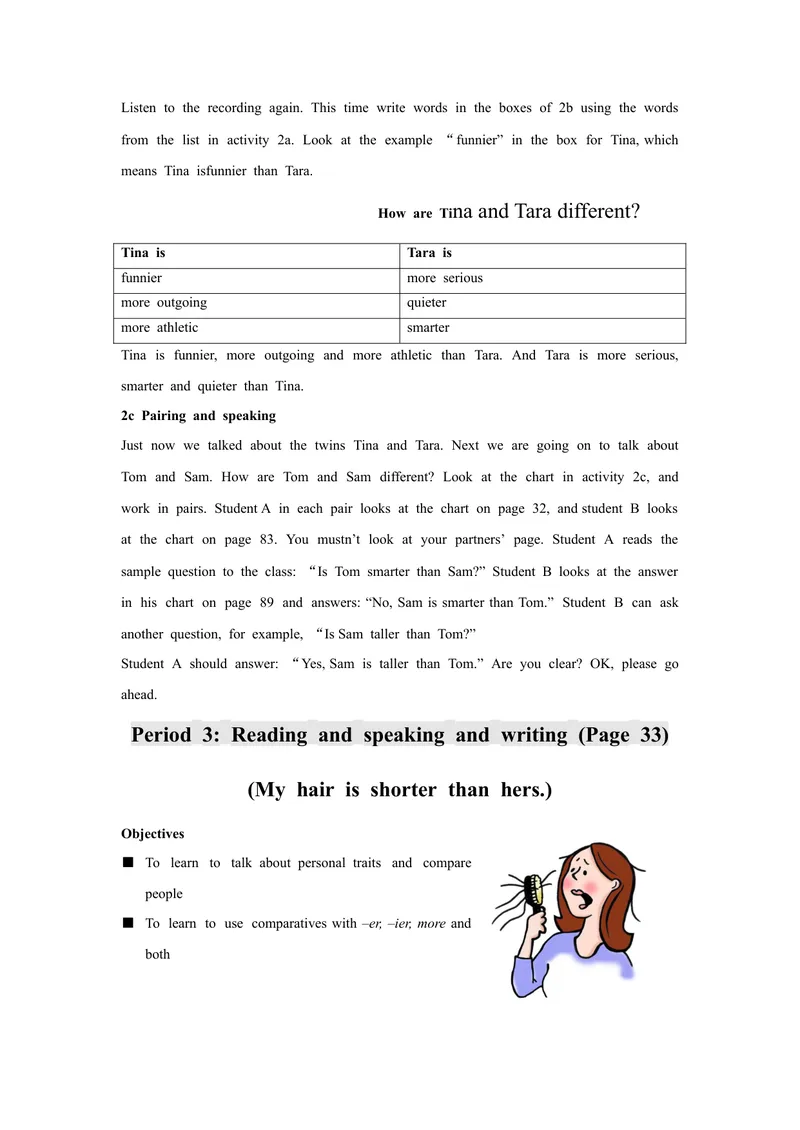
Period 3: Reading and speaking and writing (Page 33)
(My hair is shorter than hers.)
Objectives
■ To learn to talk about personal traits and compare
people
■ To learn to use comparatives with –er, –ier, more and
bothProcedures
■Warming up by reading aloud the text
Reading aloud to the recording helps you develop and improve English skills — reading, writing,
speaking, and listening. Listening to yourself makes you better understand vocabulary and
grammar.
Now go to page 33 to read aloud the text to the recording. While reading it aloud,
find all examples of comparatives with –er, –ier, more and both.
3a Reading and writing
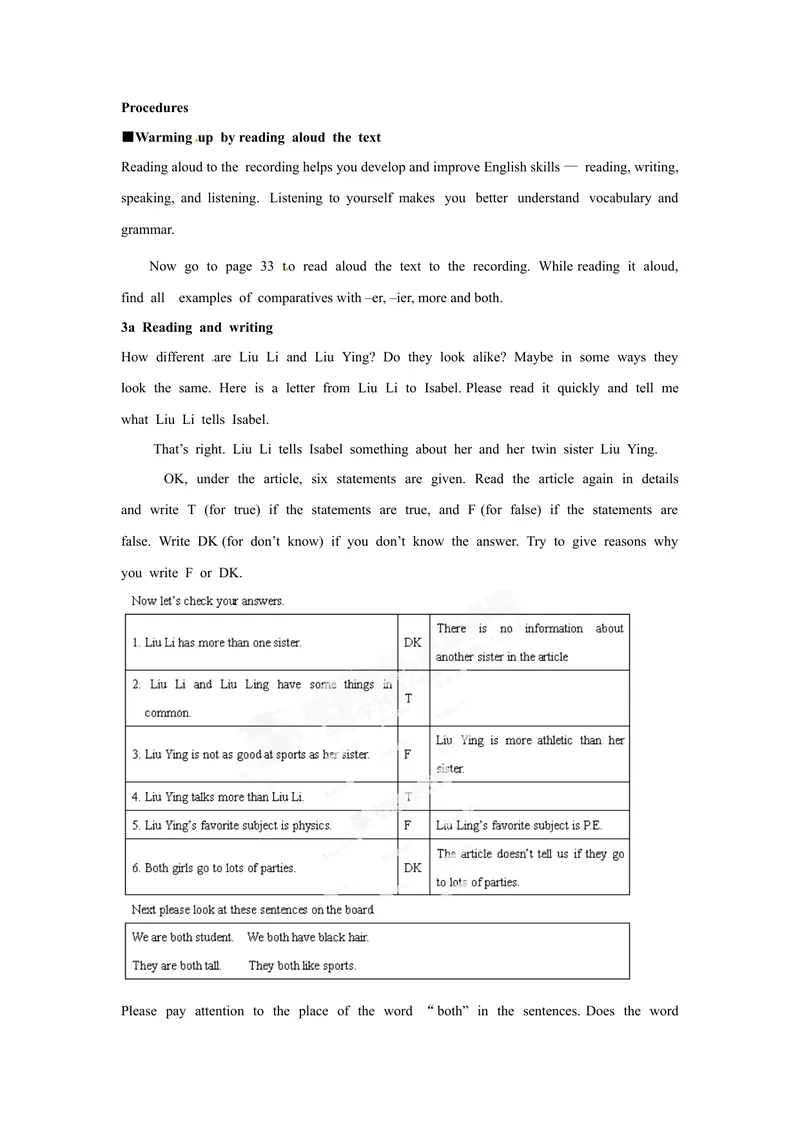
How different are Liu Li and Liu Ying? Do they look alike? Maybe in some ways they
look the same. Here is a letter from Liu Li to Isabel. Please read it quickly and tell me
what Liu Li tells Isabel.
That’s right. Liu Li tells Isabel something about her and her twin sister Liu Ying.
OK, under the article, six statements are given. Read the article again in details
and write T (for true) if the statements are true, and F (for false) if the statements are
false. Write DK (for don’t know) if you don’t know the answer. Try to give reasons why
you write F or DK.
Please pay attention to the place of the word “both” in the sentences. Does the word“both” come before or after the word “are”? Does the word “both” come before or
after the word “have” and the word “like”? Yes, as you see, the word “both” comes
after the verb be (are), and before other verbs (have, like). Now let’s read the article
loudly to the tape sentence by sentence. Try to imitate the pronunciation and intonation of
the native reader. Read the article for a second time.
While reading cut/ the sentence into thought groups, study all the predicates, circle all the
linking words and underline all the expressions. That’s grammar study, indeed.
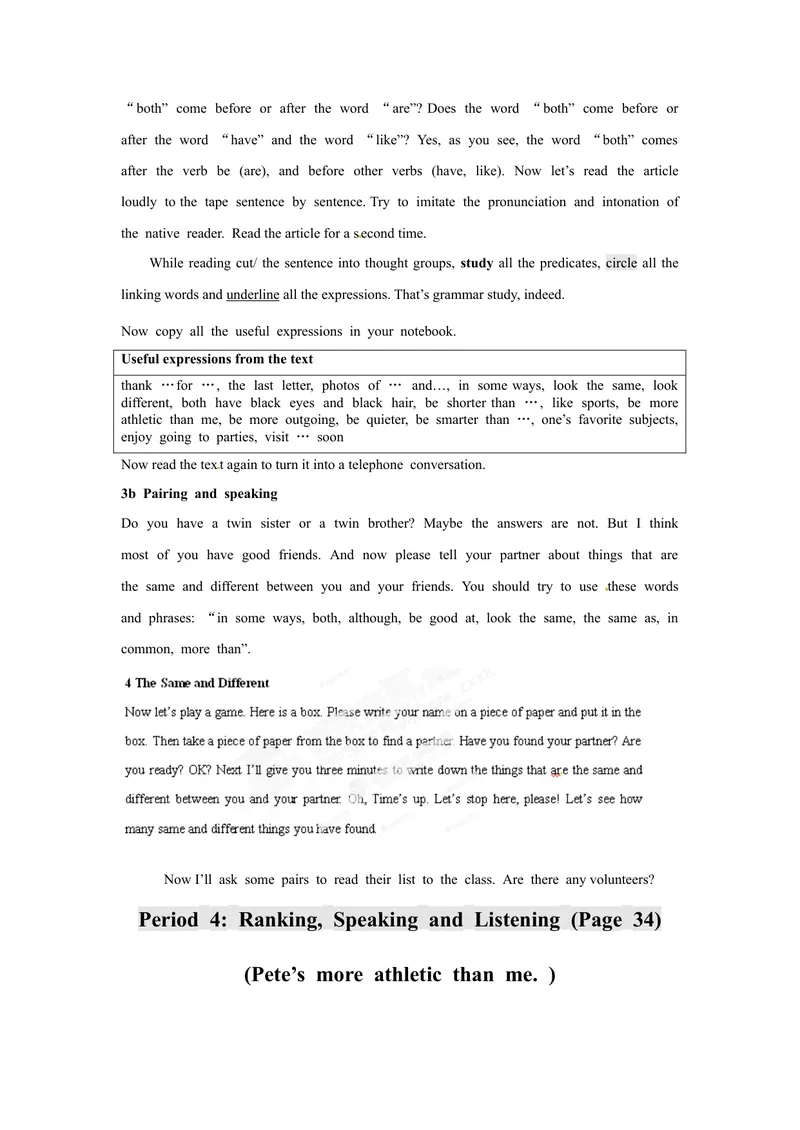
Now copy all the useful expressions in your notebook.
Useful expressions from the text
thank …for …, the last letter, photos of … and…, in some ways, look the same, look
different, both have black eyes and black hair, be shorter than …, like sports, be more
athletic than me, be more outgoing, be quieter, be smarter than …, one’s favorite subjects,
enjoy going to parties, visit … soon
Now read the text again to turn it into a telephone conversation.
3b Pairing and speaking
Do you have a twin sister or a twin brother? Maybe the answers are not. But I think
most of you have good friends. And now please tell your partner about things that are
the same and different between you and your friends. You should try to use these words
and phrases: “in some ways, both, although, be good at, look the same, the same as, in
common, more than”.
Now I’ll ask some pairs to read their list to the class. Are there any volunteers?
Period 4: Ranking, Speaking and Listening (Page 34)
(Pete’s more athletic than me. )Objectives
■ To learn to talk about personal traits and compare people
■ To learn to use adjective comparatives with –er, –ier, more and both
Procedures
■Warming up by looking and saying
Hello, class. Look at the photo. Could you tell the class the same and different between
these two boys? Now have a try. Make use of adjective comparatives you have learned so
far.
[来源:学科网]
1a Reading and ranking
Everyone has friends in his life. Some friends have some things in common with you,
while some friends are different from you. Here on page 34 are six descriptions. Read the
descriptions loudly. In your opinion, which one is the most important? Please rank the
things (1-6).
[来源:学科网ZXXK]
1b Grouping and speaking
Well, people have different ideas. Now please talk about what you think a good friend
four.
should be like in groups of
A: I think a good friend likes to do the same things as I do.
B: That’s not important for me. I think a good friend makes me happy.
C: Umm, I think a good friend is good at schoolwork.
D: Yes, and a good friend is popular, too.
A: I think a good friend has cooler clothes than I do.
B: That’s not important for me. I think a good friend should be better at sports than I
am.
C: Umm, I think a good friend must be funnier than I am.
D: Yes, and a good friend is taler, too.
2a Listening and writing
Just now you gave your opinions about what you think a good friend should be like to
your group. Next you will hear an interviewer talking to Holly and Maria. What are they
talking about? When I play the recording for the first time, you just listen carefully and
give me the answer. Have you got it? Yes, they are talking about their best friends. Now
look at the chart, listen to the tape again and write the things that Holly and Maria likes check your
about their best friends. You can write only words and phrases. Let’
answers.
likes about best the same as best different from best
friend friend friend
Holly likes to do the same … …
things, popular, is
good at sports
Maria good listener, … …
keep secrets
2b Listening and writing
Holly and Maria are both good at sports. Do you agree? OK, listen again. Listen
carefully and fill in the blanks. I’ll ask some students to read their answers later on.
Likes about best friend The same as best friend Different from best friend
likes to do the same are both pretty outgoing Pete’s funnier and wilder.
Holly things, popular, is good Holly is a little quieter.
at sports
good listener, look alike, both tall, Vera is quieter and
Maria both have long curly smarter. Maria is more
keep secrets
[来源:学+科+网Z+X+X+K] hair outgoing.
Now go to page 87 and read the tapescript. While reading remember to cut/ the sentence
into thought groups, study all the predicates, circle all the linking words and underline all
the expressions. That’s grammar study, indeed.
Useful expressions from the conversation
do the same things as …, be good at sports, like sports, be more athletic than …, be both
pretty outgoing, like … about …, be funnier than …, be a little quieter, a good listener,
keep secrets, be important to …, be a lot like …, look alike, have long, curly hair, be
much quieter than …, , be more outgoing
Now read the conversation again to turn it into an article.
2c Pairing and speaking
pairs using the information
Next we are going to make a conversation in
from activities 2a and 2b.
A: Holly’s best friend is funnier than she is.B: Well, Maria and her best friend are both tall.
A: Yes, and they both have long, curly hair. But Vera is much quieter and smarter than
Maria is.
B: Right. Holly and her best friend are both pretty outgoing.
A: My best friend is funnier than I am.
B: Well, my best friend Li Hong and I are both fat.
A: Yes, and you both have short, funny hair. But Li Hong is much noisier and smarter
than you are.
B: Right. Li Hong and I are both pretty easygoing.
Some of you will be asked to present their conversation to the class.
Period 5: Reading, Writing and Speaking (Page 35)
(Should friends be different or the same?)
Objectives
■ To learn to talk about personal traits and compare people
■ To learn to use comparatives with –er, –ier, more and both
Procedures
■ Warming up by reading the text aloud
Reading the text aloud to the recording is a favorite activity, both for the students and
teachers!
Now turn to page 35. Read the text aloud to the recording. OK, now please read the
article as the recorder goes. When you read, you should pay attention to the pronunciation
and intonation. Try to imitate the native reader.
3a Reading and underlining
According to 2a and 2b, we know some friends have opposite views and interests, while
some like the same things. Should friends be different or the same? I think everyone has
his own idea.
Let’s see what these three students think, and if you agree with them.
First, please look at the photos and read the article to find any words or sentences
you don’t understand. I’ll offer you help and you can also settle them by or among
yourselves.
Second, read the article again, cut/ the sentence into thought groups, study all thepredicates, circle all the linking words and underline all the expressions.
Write the useful expressions in your notebook.
Useful expressions from the text
have friends, be quieter than …, in my class, be smarter than …,be more athletic, be the
same, be different from …,be taller and more outgoing than …, both like sports, be more athletic
than …, beat …in tennis, really care, more outgoing than …, like doing the same things, in a
friendship
3b Reading and writing
OK, now please look at the chart in activity 2a on page 34 again. Write some sentences
about Holly, Maria, and their best friends. First, read the sample sentences. Then write
your own sentences. And I’ll ask two students to write sentences on the blackboard.
Holly’s best friend, Pete, likes to do the same things as she does. And they are both
pretty outgoing. Pete is funnier and wilder than Holly is. Maria and her best friend look
alike. They are both tall. They both have long, curly hair. But Maria’s friend is much
quieter and smarter than she is.
Now let’s check and make corrections on the board.
3c Thinking and writing
We have just written something about Holly, Maria and their friends. Now it’s time to
write something about you and your friend.
I like to have friends who It’s not necessary to be I don’t really care. My best
are not like me. I’m taller different. I like to have friend is Zhao Yannan She
than most of my friends in friends who are the same as is very pretty, and taller
my class. And my best I am. My best friend Niu than I am. But we both like
friend Yuan Li is shorter, Ying is as tall and as speaking English. I think
too. There are some things outgoing as I am. We both differences are not important
the same, though. I’m as like sports. We are both in a friendship.
good as Li Hua at English. athletic. She beats me in
She’s as happy as I am. tennis. And I beat her in
tennis. Also, I’m as quiet as
she is.
4 PAIRWORK Find someone for the job!
Read the job ad on page 35.
What are they looking for at the English Study Center? Yes, they are looking for a
weekend teacher.
And what do they expect of a weekend teacher? Yes, a weekend teacher needs to have
good grades, needs to be outgoing, needs to be good with children and also good at telling
jokes.It’s not easy, isn’t it?
Who wants to be a weekend teacher? Ok, Ruth and Rose do. Good! They are both
outgoing girls. Who do you think should get the job? Give your reasons using
comparatives.
A: So who do you think should get the job, Ruth or Rose?
B: Well, Ruth is smarter. I think she should get the job.
A: Yes, Ruth is smarter, but I think Rose is more outgoing. So Rose should get the job.
A: So who do you think should get the job, Ma Lin or Niu Jian?
B: Well, Ma Lin is more outgoing. I think she should get the job.
A: Yes, Ma Lin is more outgoing, but I think Niu Jian is more easygoing. So Niu Jian
should get the job.
Now work in pairs to talk about which classmate is better suited for the job.
SECTION CHECK
1 Filling and writing
Please open your book at page 36 and look at part 1.
Fill in the blanks with the words given. You may change the form of the word if
you can find the words in the preceding unit.
necessary. And
1. My friend likes sports, she’s very athletic.
2. Paul is never quiet! He can’t stop talking.
3. Lu Xiang is really smart. She is very good at math, physics and chemistry.
4. Mary is a funny girl. She always makes me laugh.
5. Jane isn’t very outgoing. She likes to stay at home and read.
to write on
Now please make sentences with these words. I’ll ask some students
board, and then we will check the answers together.
1. Dave is more athletic than his brother.
2. He is telling us a funny story.
3. My best friend is more outgoing than me.
4. Mary is smarter and quieter than most of the kids in her class.Two years ago, I was a primary school student. I am taller now. I am smarter than
before, too. I’m better at math and good at physics. I try to make more friends with my
classmates and be more helpful to them. So I’m more popular and more outgoing than I
was in the primary school. I will do my best to be a better student.