Unit 8 综合训练
第Ⅰ卷 听力部分
Ⅰ.听句子, 选择相对应的图片。 每个句子读两遍
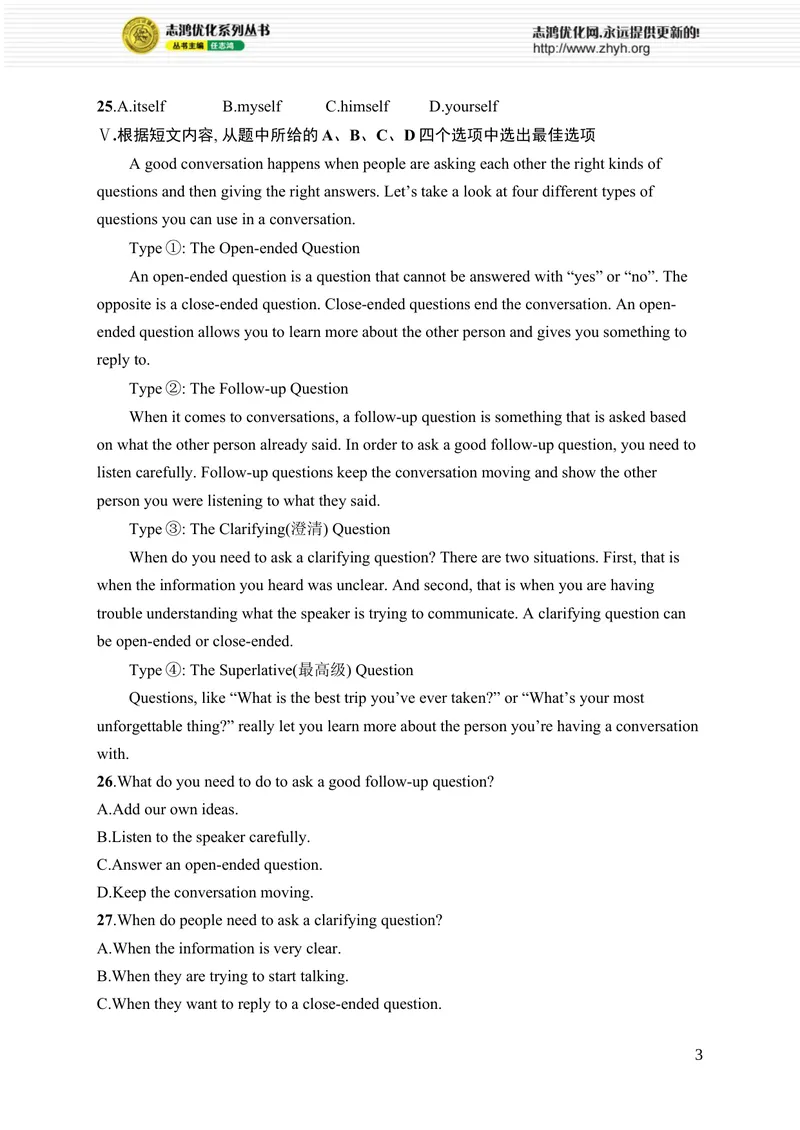
1.
2.
3.
4.
5.
Ⅱ.听句子, 选择最佳答语。 每个句子读两遍
6.A.No, thanks. B.You’re welcome. C.Don’t say so.
7.A.I have no communication. B.I like communication. C.By listening carefully.
8.A.The same to you. B.No problem. C.Wonderful.
9.A.A face-to-face talk. B.I understand. C.I’ll make it.
10.A.I like it. B.I agree. C.Sure.
Ⅲ.听短对话, 选择最佳答案。 每段对话读两遍
11.Mrs Li will be if students don’t obey the rules in class.
A.happy B.angry C.bored
12.How does Lucy communicate with her friends?
A.Through face-to-face talks.
B.Through emails.
1C.Through phone calls.
13.What are they talking about?
A.Their relationship. B.Friendship. C.Conversation skills.
14.Does John get along well with others in his new school?
A.Not really. B.Not bad. C.Very good.
15.Whom did Tom argue with?
A.His mother. B.His father. C.His brother.
第Ⅱ卷 笔试部分
Ⅳ.完形填空
As a student, I am quite afraid to answer questions in class. When the teacher asks a
question, I’m 1 6 about it. I always lower my head because I have no 1 7 in
standing up and expressing my thoughts in public. And I 1 8 that many students in my
class are just like me.
One day, Mr Liu gave us a foreign language lesson. He asked us some questions. 1 9
he encouraged us in many ways, no one answered. He wanted us to be 2 0 in class. “Let
me tell you a story first,” he said. “When I came to Beijing to study, the university often 2 1
some famous people to make speeches. Before the beginning of every speech, I saw a(n)
22 thing. The students around me always took cardboard and wrote their names in bold
with the most eye-catching colour, and then 2 3 the cardboard on the seat. So when the
speaker needed the answers 2 4 the students, he could see and call a listener’s name
directly.” “I couldn’t understand that. My classmates told me the speakers were all top
people. When your answer surprised them, it meant you were so excellent and successful.”
After listening to the teacher’s story, we all understand that success will not come to us
25 . We must dare to show ourselves all the time and try to get better.
16.A.wealthy B.noisy C.absent D.nervous
17.A.silence B.cost C.confidence D.chance
18.A.provide B.find C.produce D.cancel
19.A.When B.Since C.If D.Although
20.A.active B.foolish C.loud D.careful
21.A.offered B.pointed C.invented D.invited
22.A.awful B.possible C.interesting D.social
23.A.expected B.put C.beat D.required
24.A.at B.from C.by D.with
225.A.itself B.myself C.himself D.yourself
Ⅴ.根据短文内容, 从题中所给的A、B、C、D四个选项中选出最佳选项
A good conversation happens when people are asking each other the right kinds of
questions and then giving the right answers. Let’s take a look at four different types of
questions you can use in a conversation.
Type①: The Open-ended Question
An open-ended question is a question that cannot be answered with “yes” or “no”. The
opposite is a close-ended question. Close-ended questions end the conversation. An open-
ended question allows you to learn more about the other person and gives you something to
reply to.
Type②: The Follow-up Question
When it comes to conversations, a follow-up question is something that is asked based
on what the other person already said. In order to ask a good follow-up question, you need to
listen carefully. Follow-up questions keep the conversation moving and show the other
person you were listening to what they said.
Type③: The Clarifying(澄清) Question
When do you need to ask a clarifying question? There are two situations. First, that is
when the information you heard was unclear. And second, that is when you are having
trouble understanding what the speaker is trying to communicate. A clarifying question can
be open-ended or close-ended.
Type④: The Superlative(最高级) Question
Questions, like “What is the best trip you’ve ever taken?” or “What’s your most
unforgettable thing?” really let you learn more about the person you’re having a conversation
with.
26.What do you need to do to ask a good follow-up question?
A.Add our own ideas.
B.Listen to the speaker carefully.
C.Answer an open-ended question.
D.Keep the conversation moving.
27.When do people need to ask a clarifying question?
A.When the information is very clear.
B.When they are trying to start talking.
C.When they want to reply to a close-ended question.
3D.When they have trouble understanding the speaker.
28.Why does the writer use the sentence “What is the best trip you’ve ever taken?”
A.To find an answer. B.To give an example.
C.To create an interest. D.To start a conversation.
29.What is the writer trying to do in the passage?
A.Teach us some useful sentences. B.Introduce some school rules.
C.Guide us how to ask questions. D.Explain how to make friends.
30.What is the best title of the passage?
A.The Art of Asking Questions in Conversations
B.Four Types of Questions in Daily Communication
C.How to Keep a Conversation Going Smoothly
D.The Importance of Listening in Conversations
Ⅵ.书面表达
当今社会, 与人交往越来越成为一种不可或缺的能力。 校英语报正在以“How to Get
on Well with Others”为题, 举办英语作文比赛, 以下是部分论题, 请你从中选取一个写一
篇短文参赛。
How to Get on Well with Others
■What should you do to get along with the classmates around you?
■How to make your parents understand you better?
■How should you communicate with your neighbours who are doing things you don’t like?
...
注意:
1.文中不得出现真实姓名和校名;
2.80词左右。
4参考答案
【听力原文】
Ⅰ.1.Look! They’re using sign language to communicate.
2.If I can finish my homework early today, I’ll help my mum cook delicious food.
3.If the activity ends, I’ll pick you up at 9:00 a.m.
4.We’ll have a face-to-face meeting next Sunday.
5.He showed great interest in music when he was a small child.
Ⅱ.6.Thanks for your speech on communication.
7.How can you communicate better?
8.If you come to my farm, I’ll show you around.
9.What’s the best way to make up?
10.Can you become a better learner?
Ⅲ.11.M: Mrs Li, will you be angry if your students don’t obey the rules in class?
W: A little. But I will stop them in a friendly way.
12.M: Lucy, how do you communicate with your friends?
W: We often chat through face-to-face talks.
13.M: Mary, I often get nervous when I talk to someone.
W: If you have such a problem, you should learn some more conversation skills.
14.W: John, do you get along well with others in your new school?
M: Not really. I don’t know how to communicate with my new classmates.
15.W: Tom, you look unhappy. What’s up?
M: I argued with my father yesterday. I don’t know how to deal with it.
【答案】
Ⅰ.1—5 BBABA
Ⅱ.6—10 BCCAC
Ⅲ.11—15 BACAB
Ⅳ.16—20 DCBDA 21—25 DCBBA
Ⅴ.【主旨大意】本文作者就如何在对话中使用不同类型的问题给出了一些建议。
26.B 细节理解题。根据“In order to ask a good follow-up question, you need to listen
carefully.” 可知, 为了提出一个好的跟进问题, 你需要仔细倾听。故选B项。
27.D 细节理解题。根据“And second, that is when you are having trouble understanding
what the speaker is trying to communicate.” 可知, 当人们很难理解说话人想要表达的意思
时, 他们需要去问一个澄清性的问题。故选D项。
528.B 细节理解题。根据“Questions, like ...” 可知, 后面问句是作者对最高级问题的举
例说明。故选B项。
29.C 推理判断题。根据“Let’s take a look at four different types of questions you can use
in a conversation.” 可知, 作者就如何在对话中使用不同类型的问题给出了一些指导。故
选C项。
30.A 标题归纳题。本文主要介绍了在对话中提问的四种类型, 旨在指导读者如何在对
话中恰当地提问以促进交流。故选A项。
Ⅵ.
How to Get on Well with Others
When my neighbours do things I don’t like, I try to talk to them nicely. I’ll go to their
house and say “hi” first. Then, I tell them in a friendly way about the problem. For example,
if they make too much noise, I might say, “Hey, could you please be a bit quieter? It’s hard
for me to study.” I always use “please” and “thank you” to be polite. I think talking helps
solve problems better than getting angry. Being kind and patient is important when
communicating with neighbours.
6