暑假复习手册
针对初二菁英班
2019-秋季
学员姓名:(                              )
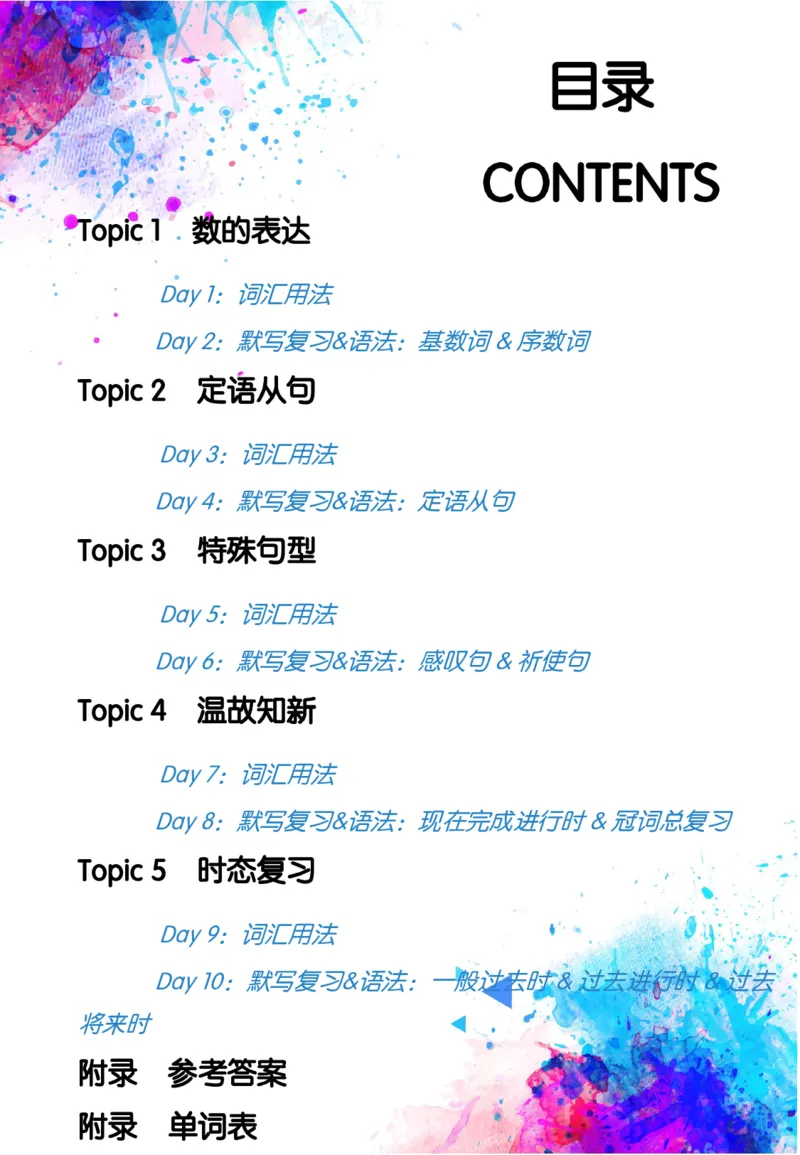
目录
CONTENTS
Topic 1    数的表达
         Day 1:词汇用法
             Day 2:默写复习&语法:基数词 & 序数词
Topic 2    定语从句
         Day 3:词汇用法
             Day 4:默写复习&语法:定语从句
Topic 3    特殊句型
         Day 5:词汇用法
             Day 6:默写复习&语法:感叹句 & 祈使句
Topic 4    温故知新
         Day 7:词汇用法
             Day 8:默写复习&语法:现在完成进行时 & 冠词总复习
Topic 5    时态复习
         Day 9:词汇用法
             Day 10:默写复习&语法:一般过去时 & 过去进行时 & 过去
将来时
附录    参考答案
附录    单词表
Topic 1 数的表达
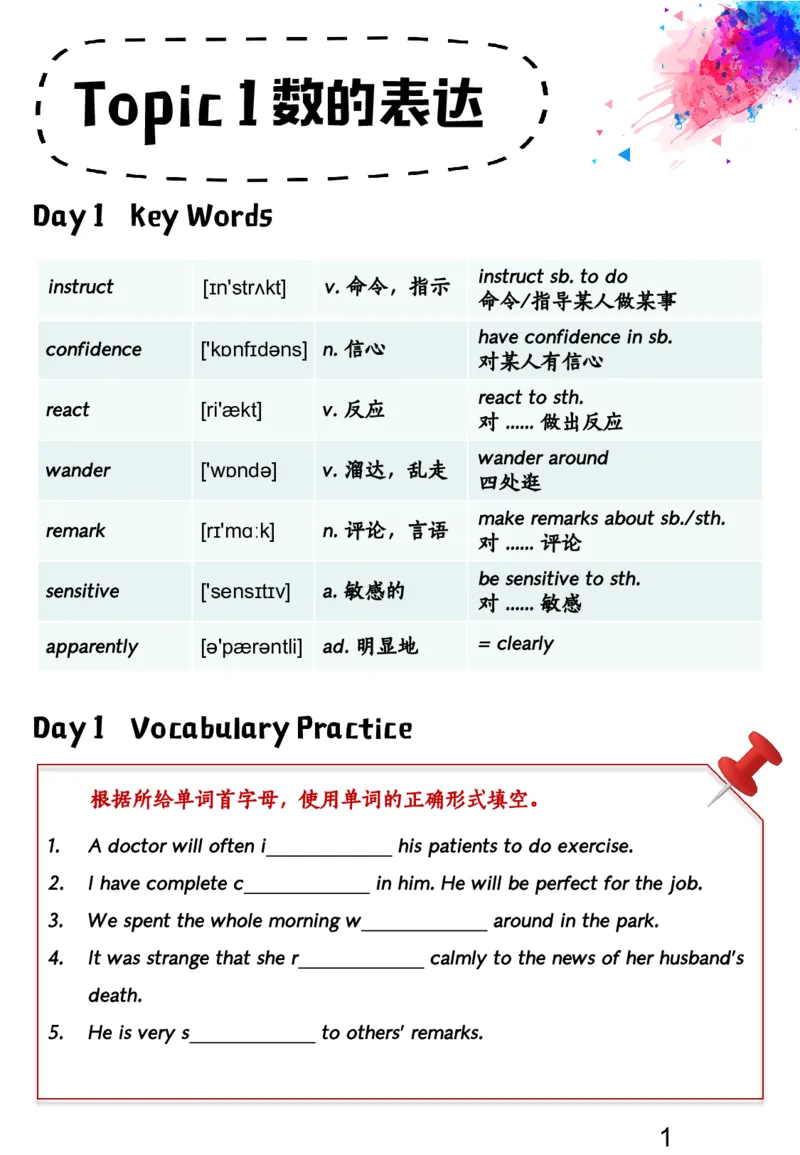
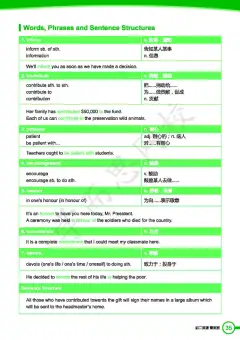
Day 1    Key Words
Day 1    Vocabulary Practice
根据所给单词首字母,使用单词的正确形式填空。
1.
A doctor will often i                     his patients to do exercise.
2.
I have complete c                     in him. He will be perfect for the job.
3.
We spent the whole morning w                     around in the park.
4.
It was strange that she r                     calmly to the news of her husband's
death.
5.
He is very s                     to others' remarks.
instruct
[ɪn'strʌkt]
v. 命令,指示
instruct sb. to do
命令/指导某人做某事
confidence
['kɒnfɪdəns] n. 信心
have confidence in sb.
对某人有信心
react
[ri'ækt]
v. 反应
react to sth.
对 ...... 做出反应
wander
['wɒndə]
v. 溜达,乱走
wander around
四处逛
remark
[rɪ'mɑːk]
n. 评论,言语
make remarks about sb./sth.
对 ...... 评论
sensitive
['sensɪtɪv]
a. 敏感的
be sensitive to sth.
对 ...... 敏感
apparently
[ə'pærəntli]
ad. 明显地
= clearly
1
【2019-秋季】针对初二菁英班
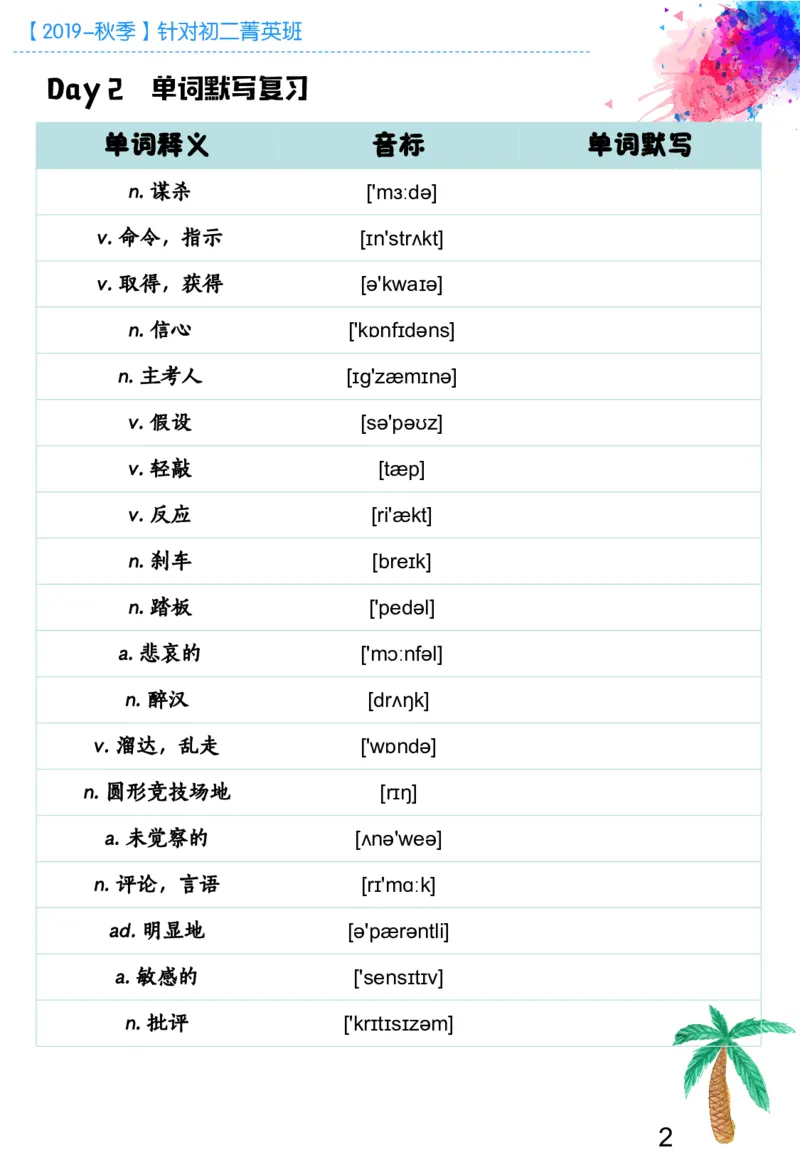
Day 2    单词默写复习
单词释义
音标
单词默写
n. 谋杀
['mɜːdə]
v. 命令,指示
[ɪn'strʌkt]
v. 取得,获得
[ə'kwaɪə]
n. 信心
['kɒnfɪdəns]
n. 主考人
[ɪg'zæmɪnə]
v. 假设
[sə'pəʊz]
v. 轻敲
[tæp]
v. 反应
[ri'ækt]
n. 刹车
[breɪk]
n. 踏板
['pedəl]
a. 悲哀的
['mɔːnfəl]
n. 醉汉
[drʌŋk]
v. 溜达,乱走
['wɒndə]
n. 圆形竞技场地
[rɪŋ]
a. 未觉察的
[ʌnə'weə]
n. 评论,言语
[rɪ'mɑːk]
ad. 明显地
[ə'pærəntli]
a. 敏感的
['sensɪtɪv]
n. 批评
['krɪtɪsɪzəm]
2
【2019-秋季】针对初二菁英班
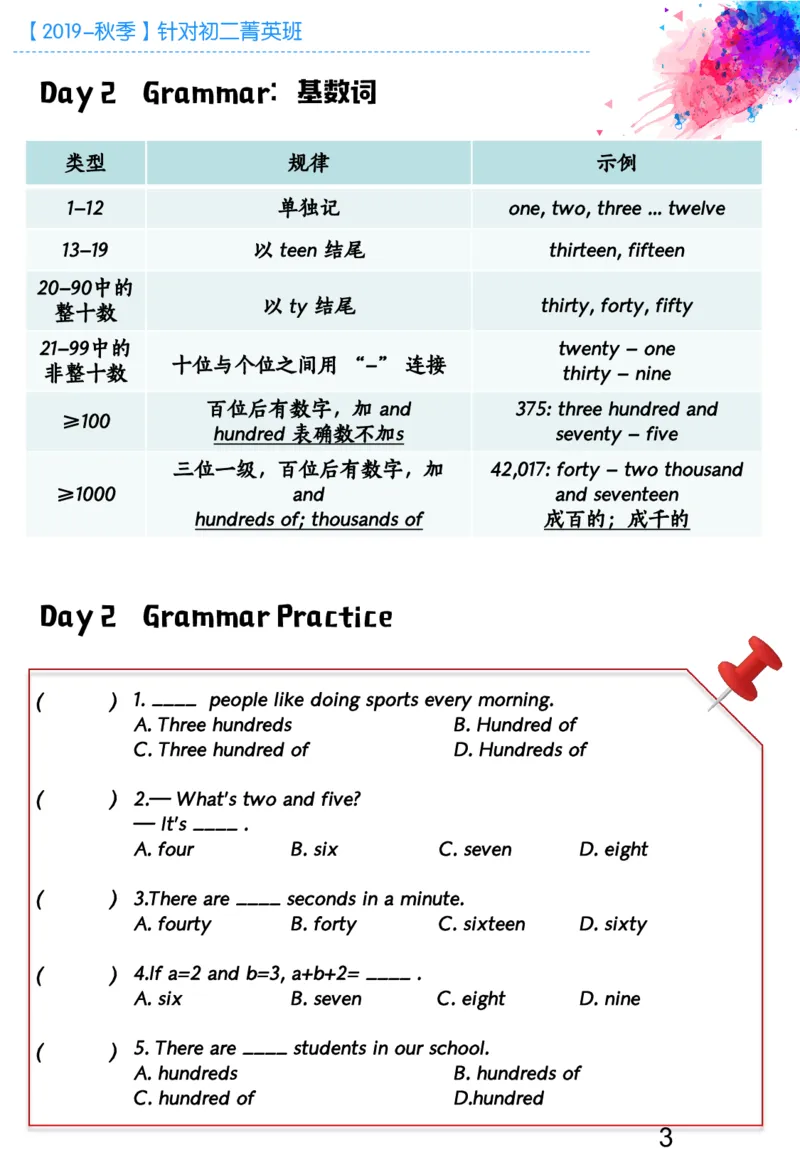
Day 2    Grammar:基数词
Day 2    Grammar Practice
1. ____  people like doing sports every morning.
A. Three hundreds
B. Hundred of
C. Three hundred of
D. Hundreds of
2.— What's two and five?
— It's ____ .
A. four
        B. six                C. seven
   D. eight
3.There are ____ seconds in a minute.
A. fourty
        B. forty             C. sixteen
   D. sixty
4.If a=2 and b=3, a+b+2= ____ .
A. six
        B. seven            C. eight
   D. nine
5. There are ____ students in our school.
A. hundreds
B. hundreds of
C. hundred of
D.hundred
(        )
类型
规律
示例
1-12
单独记
one, two, three ... twelve
13-19
以 teen 结尾
thirteen, fifteen
20-90中的
整十数
以 ty 结尾
thirty, forty, fifty
21-99中的
非整十数
十位与个位之间用 “-” 连接
twenty - one
thirty - nine
≥100
百位后有数字,加 and
hundred 表确数不加s
375: three hundred and
seventy - five
≥1000
三位一级,百位后有数字,加
and
hundreds of; thousands of
42,017: forty - two thousand
and seventeen
成百的;成千的
(        )
(        )
(        )
(        )
3
【2019-秋季】针对初二菁英班
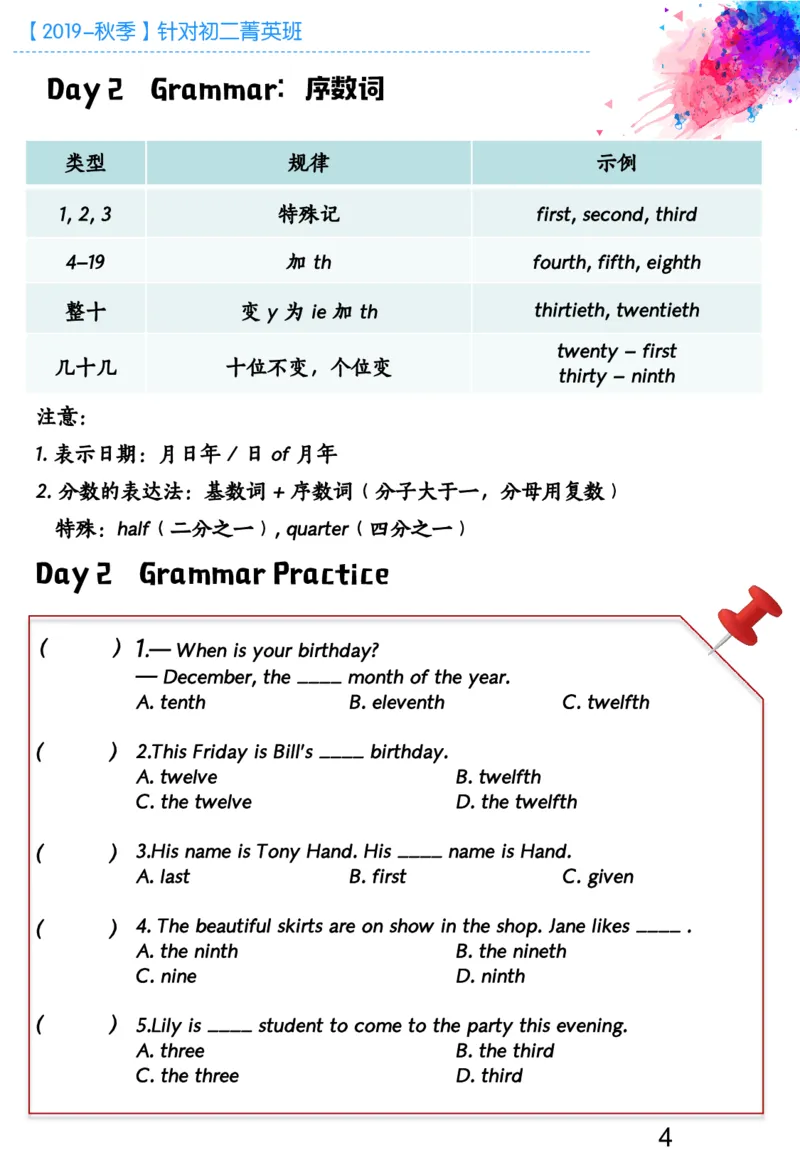
Day 2    Grammar:序数词
Day 2    Grammar Practice
1.— When is your birthday?
— December, the ____ month of the year.
A. tenth
B. eleventh
C. twelfth
2.This Friday is Bill's ____ birthday.
A. twelve
B. twelfth
C. the twelve
D. the twelfth
3.His name is Tony Hand. His ____ name is Hand.
A. last
B. first
C. given
4. The beautiful skirts are on show in the shop. Jane likes ____ .
A. the ninth
B. the nineth
C. nine
D. ninth
5.Lily is ____ student to come to the party this evening.
A. three
B. the third
C. the three
D. third
类型
规律
示例
1, 2, 3
特殊记
first, second, third
4-19
加 th
fourth, fifth, eighth
整十
变 y 为 ie 加 th
thirtieth, twentieth
几十几
十位不变,个位变
twenty - first
thirty - ninth
注意:
1. 表示日期:月日年 / 日 of 月年
2. 分数的表达法:基数词 + 序数词(分子大于一,分母用复数)
   特殊:half(二分之一), quarter(四分之一)

(        )
(        )
(        )
(        )
(        )
4
【2019-秋季】针对初二菁英班
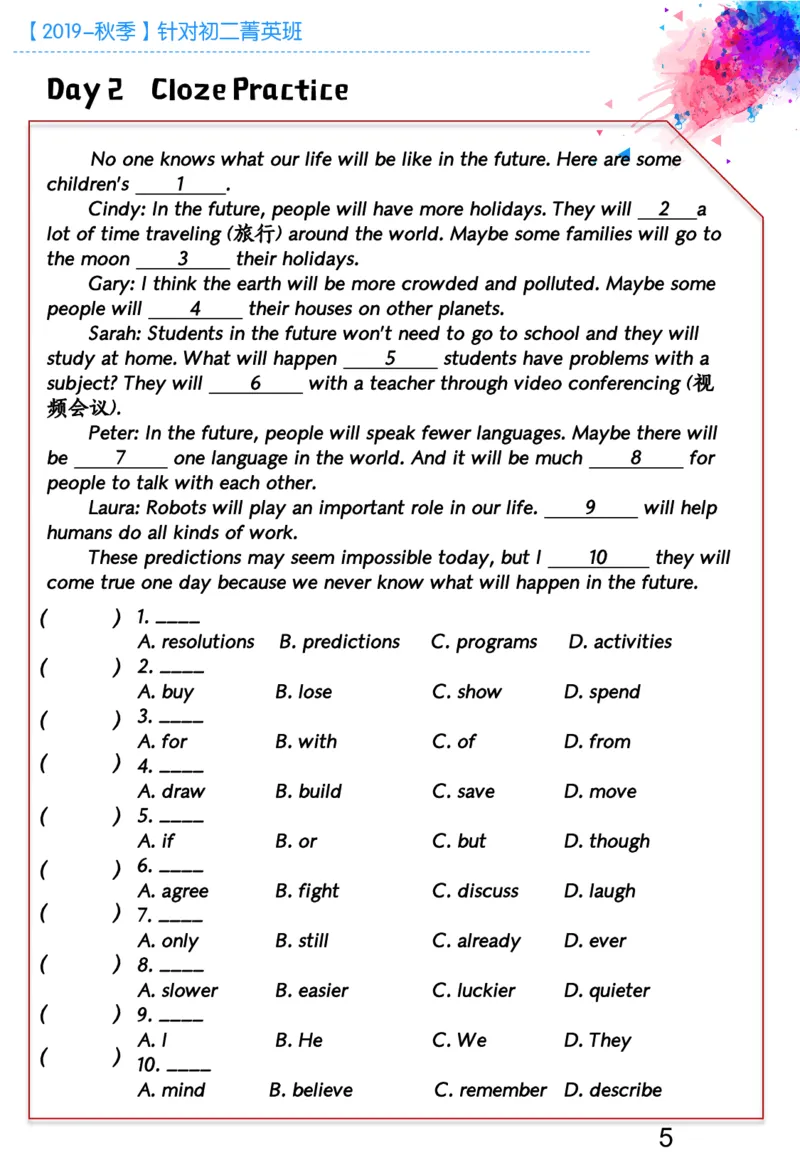
Day 2    Cloze Practice
       No one knows what our life will be like in the future. Here are some
children's   1  .
  Cindy: In the future, people will have more holidays. They will  2  a
lot of time traveling (旅行) around the world. Maybe some families will go to
the moon   3   their holidays.
  Gary: I think the earth will be more crowded and polluted. Maybe some
people will   4   their houses on other planets.
  Sarah: Students in the future won't need to go to school and they will
study at home. What will happen   5   students have problems with a
subject? They will   6   with a teacher through video conferencing (视
频会议).
  Peter: In the future, people will speak fewer languages. Maybe there will
be   7   one language in the world. And it will be much   8   for
people to talk with each other.
  Laura: Robots will play an important role in our life.   9   will help
humans do all kinds of work.
  These predictions may seem impossible today, but I   10   they will
come true one day because we never know what will happen in the future.
1. ____
A. resolutions    B. predictions     C. programs     D. activities
2. ____
A. buy
     B. lose
             C. show
D. spend
3. ____
A. for
     B. with             C. of
D. from
4. ____
A. draw
     B. build             C. save
D. move
5. ____
A. if
     B. or
             C. but
D. though
6. ____
A. agree
     B. fight             C. discuss
D. laugh
7. ____
A. only
     B. still
             C. already
D. ever
8. ____
A. slower
     B. easier             C. luckier
D. quieter
9. ____
A. I
     B. He
             C. We
D. They
10. ____
A. mind
    B. believe             C. remember
D. describe
(        )
(        )
(        )
(        )
(        )
(        )
(        )
(        )
(        )
(        )
5
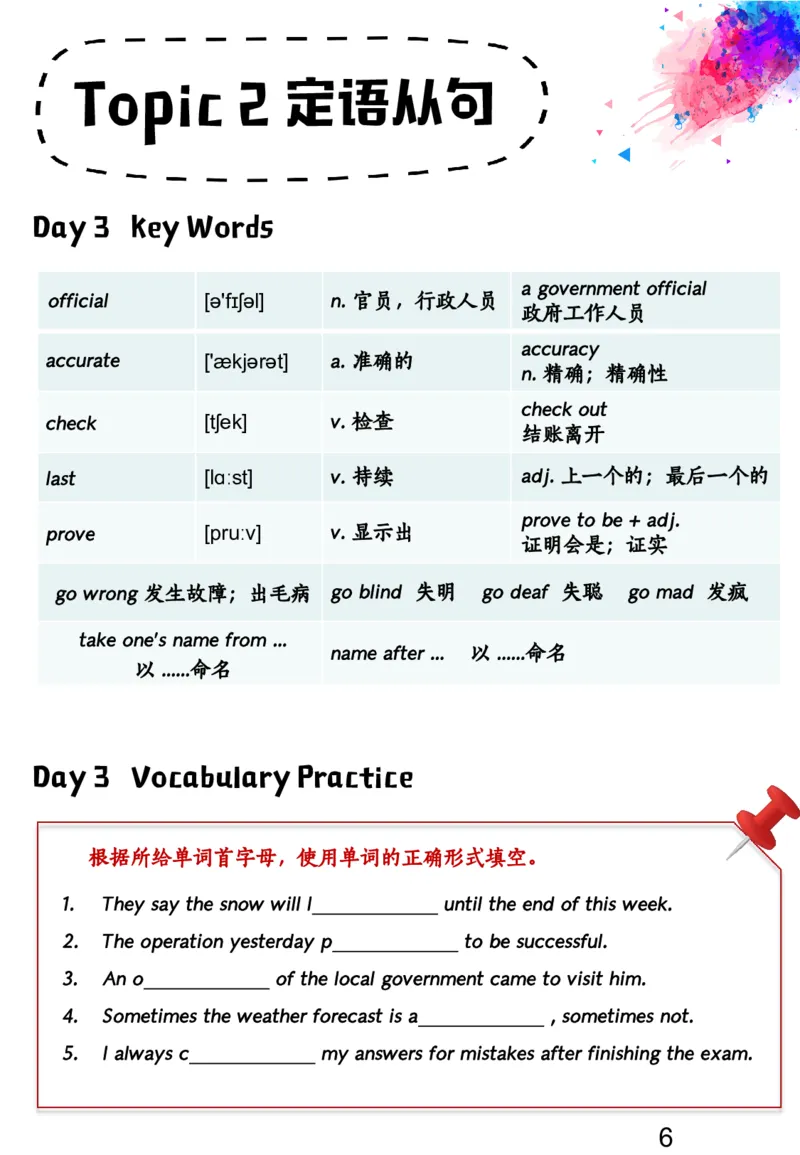
Topic 2 定语从句
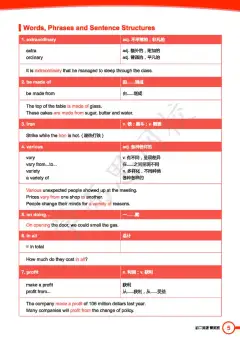
Day 3   Key Words
Day 3   Vocabulary Practice
根据所给单词首字母,使用单词的正确形式填空。
1.
They say the snow will l                     until the end of this week.
2.
The operation yesterday p                     to be successful.
3.
An o                     of the local government came to visit him.
4.
Sometimes the weather forecast is a                     , sometimes not.
5.
I always c                     my answers for mistakes after finishing the exam.
official
[ə'fɪʃəl]
n. 官员,行政人员
a government official
政府工作人员
accurate
['ækjərət]
a. 准确的
accuracy
n. 精确;精确性
check
[tʃek]
v. 检查
check out
结账离开
last
[lɑːst]
v. 持续
adj. 上一个的;最后一个的
prove
[pruːv]
v. 显示出
prove to be + adj.
证明会是;证实
go wrong 发生故障;出毛病
go blind  失明    go deaf  失聪    go mad  发疯
take one's name from ...
以 ......命名
name after ...    以 ......命名
6
【2019-秋季】针对初二菁英班
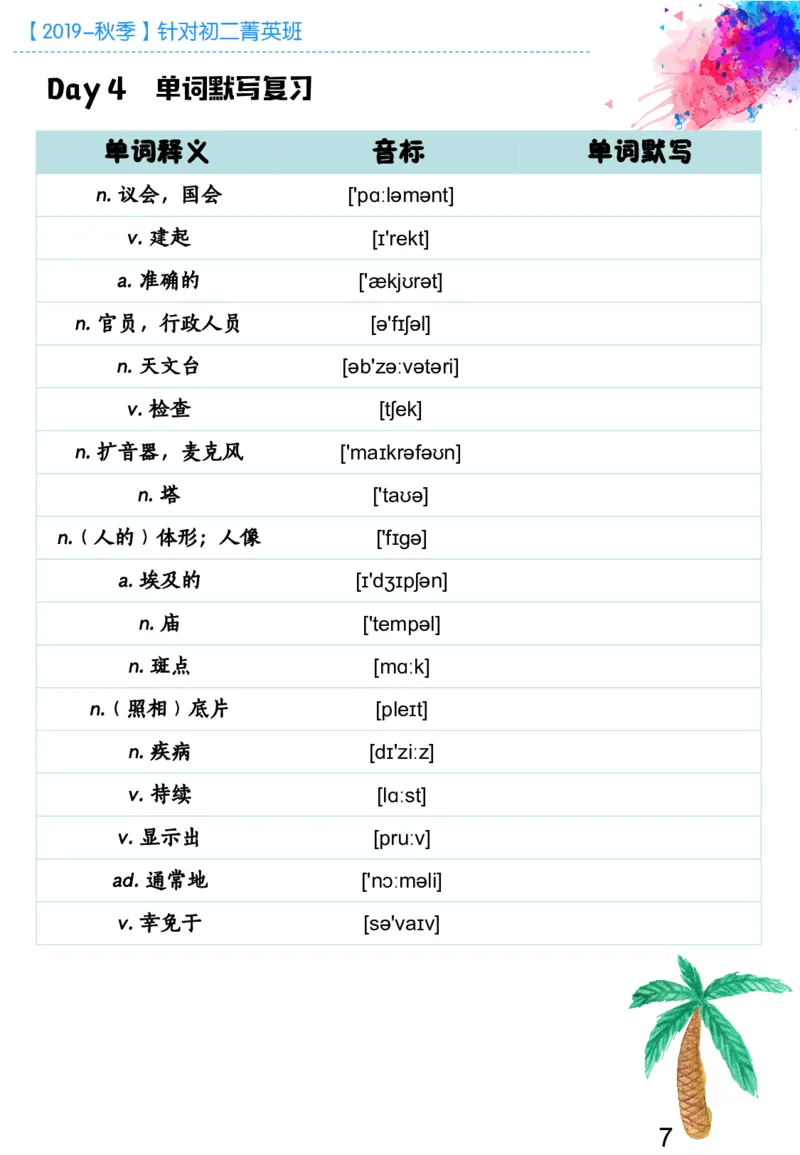
Day 4    单词默写复习
单词释义
音标
单词默写
n. 议会,国会
['pɑːləmənt]
v. 建起
[ɪ'rekt]
a. 准确的
['ækjʊrət]
n. 官员,行政人员
[ə'fɪʃəl]
n. 天文台
[əb'zəːvətəri]
v. 检查
[tʃek]
n. 扩音器,麦克风
['maɪkrəfəʊn]
n. 塔
['taʊə]
n.(人的)体形;人像
['fɪgə]
a. 埃及的
[ɪ'dʒɪpʃən]
n. 庙
['tempəl]
n. 斑点
[mɑːk]
n.(照相)底片
[pleɪt]
n. 疾病
[dɪ'ziːz]
v. 持续
[lɑːst]
v. 显示出
[pruːv]
ad. 通常地
['nɔːməli]
v. 幸免于
[sə'vaɪv]
7
【2019-秋季】针对初二菁英班
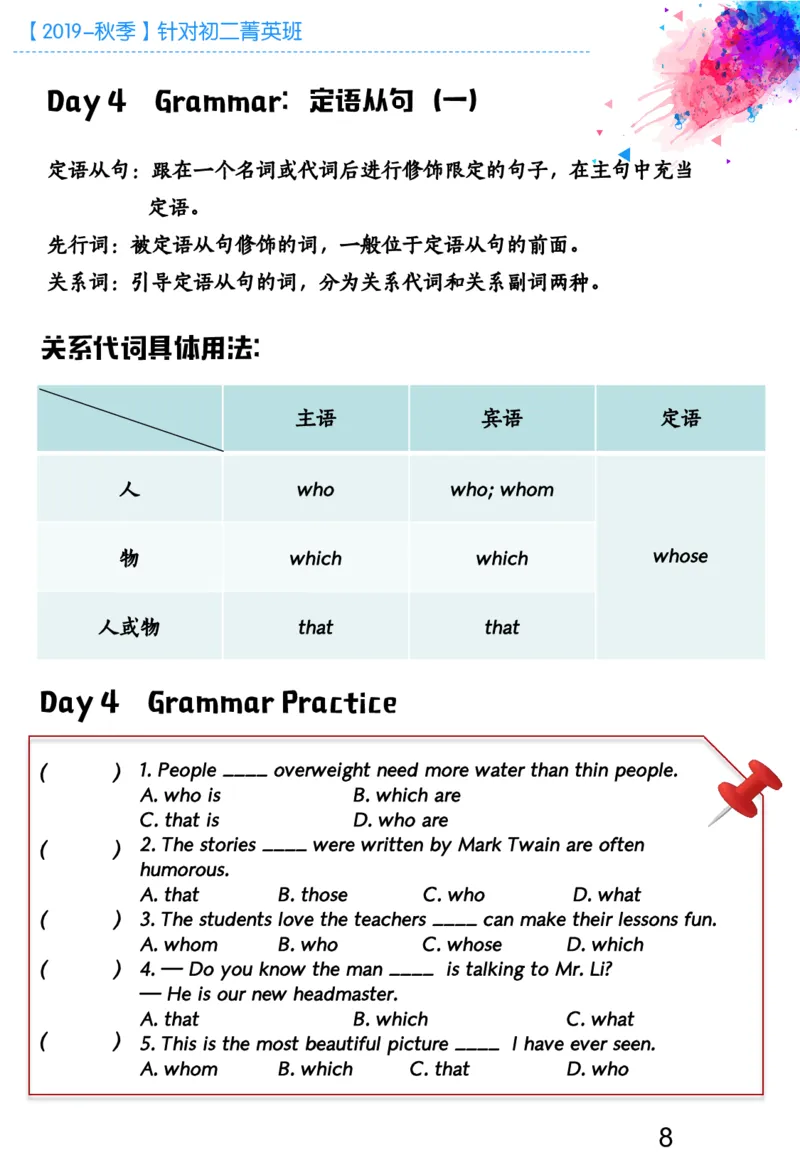
Day 4    Grammar:定语从句(一)
Day 4    Grammar Practice
关系代词具体用法:
定语从句:跟在一个名词或代词后进行修饰限定的句子,在主句中充当
                定语。
先行词:被定语从句修饰的词,一般位于定语从句的前面。
关系词:引导定语从句的词,分为关系代词和关系副词两种。
主语
宾语
定语
人
who
who; whom
whose
物
which
which
人或物
that
that
1. People ____ overweight need more water than thin people.
A. who is

B. which are
C. that is
D. who are
2. The stories ____ were written by Mark Twain are often
humorous.
A. that
     B. those            C. who
 D. what
3. The students love the teachers ____ can make their lessons fun.
A. whom
     B. who           C. whose
D. which
4. — Do you know the man ____  is talking to Mr. Li?
— He is our new headmaster.
A. that
B. which
C. what
5. This is the most beautiful picture ____  I have ever seen.
A. whom
     B. which         C. that
D. who
(        )
(        )
(        )
(        )
(        )
8
【2019-秋季】针对初二菁英班
Day 4    Grammar:定语从句(二)
Day 4    Grammar Practice
关系副词具体用法:
关系副词
从句中成分
例句
when
时间状语
We don't know the exact time when
the Engliah Corner will be held.
where
地点状语
Britain is one of the few countries
where people drive on the left.
why
原因状语
I didn't tell him the reason why I was
upset.
介词 + whom:He is the man with whom I worked.
介词 + which:此结构可以替代关系副词。
This is the room in which (where) I found the victim.
从方框中选择正确的单词填空,注意所填单词的正确形式。
that      when      where      why
1.
Do you know the name of the hotel                       is the best in the city?
2.
This is the small park                      you can play football with your friends
on Sundays.
3.
I still remember the time                      I first traveled by plane.
4.
Can you tell me the reason                      he is absent from school?
9
【2019-秋季】针对初二菁英班
Day 4    Reading Comprehension Practice
       Last year, I went to Australia to study and travel. I stayed in Sydney for
two weeks. I visited places of interest in the morning and took English lessons
in the afternoon. A friend and I stayed with a family from Sydney. The
homestay parents and brothers were very friendly to us. We talked about a
lot of things with each other in English.
  My spoken English improved (提高) greatly in Australia. I used to speak
very little English in China. But in Australia, I had to use it very often. I was
soon able to talk with my teachers and homestay family freely.
  To me, the best place in Australia is the Sydney Opera House. You can
look at it from different sides. I think it is one of the most wonderful
buildings in the world. I cannot sing very well, but when I was inside, I really
wanted to sing.
  Time flew when I was in Sydney. Soon came Christmas, then the New
Year. I had never spent the New Year without my family. But this year, I was
so far away from them. I felt a little homesick. I missed them so much, and I
knew they missed me so much, too. In the evening, I phoned my family.
When I heard their voices, I began to cry. My homestay mother held me in
her arms and comforted me.
1. I went to Australia last year ____ .
A. to make some foreign friends there
B. so that I could stay with an Australia family
C. to visit the Sydney Opera House
D. to improve my English and visit some places there
2.  The underlined word "homestay" means " ____ " in Chinese.
A. 在家居住     B. 安家             C. 寄宿家庭
D. 家庭
3.  What impressed (使......有印象) me most of my travel in
Australia is ____ .
A. the friendly people there       B. the places of interest
C. the Sydney Opera House      D. the beautiful songs everywhere
4. What does the sentence "Time flew when I was in Sydney."
mean?
A. Time passed very quickly in Sydney.
B. I stayed in Sydney for a long time.
C. Time in Sydney is shorter than that in my country.
D. I really had a good time in Sydney.
(        )
(        )
(        )
(        )
10
Topic 3 特殊句型
Day 5   Key Words
Day 5   Vocabulary Practice
根据所给单词首字母,使用单词的正确形式填空。
1.
Your computer won't arrive until Thursday. In the m                     , You can
use Jude's.
2.
Most parents are horrified when they discover their children have been
playing t                     from school.
3.
It puts me to s                     that I failed to hand in my homework on time.
4.
To be honest, your design is u                     , and I am sorry to tell you that
we can't accept it.
5.
Why did you s                     on that insect (昆虫)?
truant
['truːənt]
n. 逃学的孩子
play truant
逃学
unimaginative
[ʌnɪ'mædʒɪnətɪv] a. 缺乏想象力的
imagination
n. 想象力
shame
[ʃeɪm]
n. 惭愧,羞耻
put sb. to shame
使某人感到羞愧
meantime
['mi:ntaɪm]
n. 其间
in the meantime
在此期间
stamp
[stæmp]
v. 跺,踩
stamp on sth.
踩在 ...... 上面
11
【2019-秋季】针对初二菁英班
Day 6    单词默写复习
单词释义
音标
单词默写
n. 纪录保持者
['rekɔːd-'həʊldə]
n. 逃学的孩子
['truːənt]
a. 缺乏想象力的
[ʌnɪ'mædʒɪnətɪv]
n. 惭愧,羞耻
[ʃeɪm]
v. 搭便车旅行
['hɪtʃhaɪk]
n. 其间
['mi:ntaɪm]
n. 卡车
['lɒri]
n. 边界
['bɔːdə]
v. 逃避,逃离
[ɪ'veɪd]
a. 厚的
[θɪk]
n. 信号
['sɪgnəl]
v. 跺,踩
[stæmp]
n. 直升机
['helɪkɒptə]
n. 现场
[siːn]
n. 幸存者
[sə'vaɪvə]
12
【2019-秋季】针对初二菁英班
Day 6    Grammar:感叹句
Day 6    Grammar Practice
感叹句句型结构:
类型
句子结构
例句
what
what + a(n) + adj. + 可数名词单数 + 主谓
What a fine day it is
today!
what + adj. + 可数名词复数 + 主谓
What good students
they are!
what + adj. + 不可数名词 + 主谓
What cold weather it is!
how
how + adj. + 主谓(系动词)
How cold it is today!
how + adv. + 主谓(实意动词)
How fast they run!
how + adj. + a(n) + 可数名词单数 + 主谓
How clever a baby he is!
定义:用来表达说话者惊异、喜悦、气愤等强烈思想感情的句子。
省略:口语中,what/how 引导的感叹句可以省略主谓。
使用 What a 或 What an 或 How 完成下列感叹句。
1.
                     enjoyable journey it was! We really had a great time.
2.
                     great weather it is today!
3.
                     sweet the flowers smell in spring!
4.
— Mom, I bought us two tickets to the 2018 World Cup in Russia.
      — Really?                         pleasant surprise!
5.                         nervous the girl was! She could not fall asleep all night.
13
【2019-秋季】针对初二菁英班
Day 6    Grammar:祈使句
Day 6    Grammar Practice
定义:用来表示命令、请求、劝告、警告、禁止等的句子。
省略:祈使句中,主语常省略,谓语动词用动词原形。
 使用所给词的适当形式填空
1.
                     (wait) for me at the bus station across from the post office. I
can find you easily.
2.
Don't                       (leave) today's work for tomorrow.
3.
Daniel,                        (not) play with the mobile phone while you're walking
in the street.
4.                         (speak) more, and you'll improve your spoken English.
5.   We are free this afternoon. Let's                       (play) football.
14
类型
句子结构
例句
肯定
Do 型
Stand up.
Be 型
Be quiet.
Let 型
Let's go.
否定
Don't 型
Don't be late.
No 型
No photos.
Let 型
Let's not go.
Don't let him go.
【2019-秋季】针对初二菁英班
Day 6    Cloze Practice
       You want to run across the street to catch the bus which is leaving soon?
But   1   ! You'd better not. If a policeman sees you, you'll have to pay
a fine (罚款).
  New traffic laws say that   2   people cross the street when the
light is red, they can be fined as much as 50 yuan.
  Traffic accidents   3   more than 104,000 people in China last year.
Chinese cities have more cars than ever.   4   and pedestrians (行人)
must work together to make the streets safer.
  The law has new rules for drivers and pedestrians. Drivers have to   5
when they are close to crosswalks. If people are in a crosswalk, cars must stop
to let them pass. There are   6   for bus drivers, too. If bus drivers
smoke, drink or make phone calls while driving, policemen will fine them.
Buses that carry too many people are   7   against (违反) the law.
  Pedestrians will have to walk more   8   under the new law. They
must cross streets at crosswalks. Also, they shouldn't climb over the fences
(隔离栏) to cross streets.
  If you see a hit-and-nm, tell the police. They may give you a reward.
And don't be   9   to help people to the hospital if they are hurt in an
accident. Don't worry about money. The new law says that   10   must
take care of them even if they can't pay right away.
1. ____
A. hurry
     B. look             C. wait
D. listen
2. ____
A. if
     B. while             C. so
D. though
3. ____
A. did
     B. killed             C. died
D. ran
4. ____
A. Parents
     B. Drivers            C. Policemen D. Tourists
5. ____
A. get off
     B. keep going      C. speed up
D. slow down
6. ____
A. letters
     B. articles            C. rules
D. exercises
7. ____
A. also
     B. sometimes       C. never
D. often
8. ____
A. safely
     B. slowly             C. quickly
D. happily
9. ____
A. happy
     B. afraid              C. sad
D. great
10. ____
A. students     B. teachers           C. helpers
D. doctors
15
Topic 4 温故知新
Day 7   Key Words
Day 7   Vocabulary Practice
根据所给单词首字母,使用单词的正确形式填空。
1.
I'm s                     from toothache.
2.
Are you satisfied with your p                     salary?
3.
He always makes a f                     of himself at parties.
4.
He a                     that he was going to get married.
5.
C                     down and tell me what happened.
fool
[fuːl]
n. 傻瓜
make a fool of sb.
使某人出丑
announcer
[ə'naʊnsə]
n. 播音员
announce
v. 宣布,宣告
present
['prezənt]
a. 目前的
at present
现在
 calm
 [kɑːm]
v. 使镇定
calm down
冷静下来
 suffer
 ['sʌfə]
v. 受苦,受害
suffer from
受 ...... 的折磨
 urge
 [ɜːdʒ]
v. 力劝,怂恿
urge sb. to do sth.
力劝某人做某事
 satisfaction
 [sætɪs'fækʃən]
n. 满意,满足
be satisfied with
对 ...... 满意
16
【2019-秋季】针对初二菁英班
Day 6    单词默写复习
单词释义
音标
单词默写
n. 傻瓜
[fuːl]
n. 脾气
['tempə]
n. 播音员
[ə'naʊnsə]
n. 通心面
[mækə'rəʊni]
a. 主要的
['liːdɪŋ]
n. 胃口,食欲
['æpɪtaɪt]
a. 极好的
['splendɪd]
v. 拿出
[prə'djuːs]
v. 收庄稼
['gæðə]
v. 打(庄稼)
[θreʃ]
v. 加工
['prəʊses]
v. 力劝,怂恿
[ɜːdʒ]
a. 目前的
['prezənt]
n. 冠军
['tʃæmpɪən]
v. 以……为名
[ɪn'taɪtəl]
v. 使镇定
[kɑːm]
n. 神经
[nɜːv]
n. 集中,专心
[kɒnsən'treɪʃən]
v. 受苦,受害
['sʌfə]
n. 满意,满足
[sætɪs'fækʃən]
17
【2019-秋季】针对初二菁英班
Day 8    Grammar:现在完成进行时
Day 8    Grammar Practice
使用禁忌:
禁忌类型
例句
不与总数或次数连用
I have been having ice cream all morning. (√)
I have been having ice cream seven times. (×)
不与瞬间动词连用
(die, arrive, leave, fall, etc)
The plane has been circling over the airport
for an hour. (√)
The plane has been arriving. (×)
不与静态动词连用
(forget, remember, understand, etc)
I have been trying to understand his words
these days. (√)
I have been understanding his words these
days. (×)
定义:表示从某一时间开始,一直持续到现在,并可能要继续下去的工
作。
动词结构:have / has been doing
时间标志词:for... ;  since... ;  all... ;  over the past/last... ;  how long...
1. My father ____ for a new job over the last three months.
A. looks
B. looked
C. has been looking
D. had been looking
2. — How long ____ ?
— He has been skating for five hours.
A. had Sam been skating
B. has Sam been skating
C. did Sam skate
D. was Sam skating
3. Tom ____ in the library every night over the last three months.
A. works
B. worked
C. has been working
D. had been working
4. We have been ____ for her for five hours.
A. wait
     B. waiting       C. to wait
D. waited
5.  Mr. Black  ____ in China since ten years ago.
A. lived
B. lives
C. has been living
D. had lived
(        )
(        )
(        )
(        )
(        )
18
【2019-秋季】针对初二菁英班
Day 8    Grammar:冠词总复习
Day 8    Grammar Practice
类型
用法
例句
不定冠词
(a/an)
一个
an important person
又一
a second chance
每一
three times a week
一体
an actor and director
类型
使用定冠词的情况
定冠词
(the)
独 the moon
乐 play the piano
河 the Mississippi
旧 I see a dog. The
dog is big.
序 the first
建 the Great Wall
双 The woman there
is Kelly.
姓 the Simpsons
国 the United
Kingdom
方 in the east
形 the old
团 the UN
级 the best
山 the Himalayas
类型
使用零冠词的情况
零冠词
0 球类、棋类
4 四季
7 每星期七天
3 三餐
6 by 加交通工具
12 十二个月份
X 学科
 使用适当冠词(a 或 an 或 the 或 /)填空
1.
Look, he can play                       tennis so well.
2.
Dalian is                       beautiful city. It's in                       north of China.
3.    It is raining outside. You need to take                       umbrella with you when
      going out.
4.   There is                      “f”in the word“uniform”.
5.   Is India                       European country?
19
【2019-秋季】针对初二菁英班
Day 8    Reading Comprehension Practice
       Before you go to another country, it is a great help if you know the
language and some of the customs (风俗) of the country.
  When people meet each other for the first time in Britain, they say "How
do you do?" and shake hands. Usually they do not shake hands when they just
meet or say goodbye. But they shake hands when they haven't met for a long
time or when they will be away from each other for a long time.
  Last year a group of German students went to England for a holiday.
Their teacher told them that the English people hardly ever shake hands. So
when they met their English friends at the station, they kept their hands
behind their backs. The English students had learned that the Germans shake
hands as often as possible, so they put their hands in front and got ready to
shake hands with them. It made both of them laugh.
1.  English people usually shake hands when they ____ .
A. meet every time
B. meet for the first time
C. say goodbye to each other
D. say hello to each other
2.   Usually, English people don't shake hands ____ .
A. when they will be away for a long time
B. when they say "How do you do?"
C. when they just meet or say goodbye
D. when they haven't met for a long time
3.  Which of the following statement is right?
A. German people shake hands as often as possible.
B. English people like shaking hands very much.
C. German people hardly ever shake hands.
D. Both English people and Germans don't like shaking hands.
4. This story is about ____ .
A. shaking hands
B. languages
C. customs
D. languages and customs
(        )
(        )
(        )
(        )
20
Topic 5 时态复习
Day 9   Key Words
Day 9   Vocabulary Practice
根据所给单词首字母或句意,使用单词的正确形式填空。
1.
In China, chopsticks                      having meals. (use)
2.
She took c                     of the class when the head teacher was ill.
3.
Brian f                     me with a f                     mask just now.
4.
Babies are c                     about everything around him.
5.
We wished all passengers on b                     a pleasant journey.
plant
[plɑːnt]
v. 安放
plant
n. 植物
frightened
['fraɪtənd]
a. 感到害怕的
frightening  a. 令人害怕的
frighten      v. 吓唬
curious
['kjʊəriəs]
a. 好奇的
be curious about ...
对 ...... 好奇
take charge of
责管理,负责照顾
in charge of  负责,管理
on board
在(火车、轮船、飞机等)上
aboard
ad/prep. 在(火车、轮船、飞机等)上
used to do sth.
过去常做某事
be used to doing sth. 习惯了做某事
be used (to do / for doing sth.) 被用来做某事
21
【2019-秋季】针对初二菁英班
Day 10    单词默写复习
单词释义
音标
单词默写
n. 父(母)亲
['peərənt]
空中乘务员
['flaɪt-ə'tendənt]
a. 害怕,担惊
['fraɪtənd]
a. 好奇的
['kjʊəriəs]
n. 炸弹
[bɒm]
v. 安放
[plɑːnt]
负责管理,负责照顾
在(火车、轮船、飞机等)上
过去常做某事
22
【2019-秋季】针对初二菁英班
Day 10    Grammar:三种时态对比
Day 10    Grammar Practice
一般过去时/过去进行时/过去将来时:
1. As she ____ the newspaper, Granny ____ asleep.
A. read; was falling
B. was reading; fell
C. was reading; was falling
D. read; fell
2.  The wallet that I found ____ 100 in five-pound notes.
A. was contained
B. has contained
C. contained
D. containing
3.  He ____ when the UFO arrived.
A. was sleeping
B. were sleeping
C. has slept
D. is asleep
4.  Mary ____  at this time yesterday. She wasn't at the party.
A. reads
    B. read
         C. is reading
D. was reading
5.  He told me he  ____  call his brother the next day.
A. will
    B. would         C. shall
D. can
(        )
(        )
(        )
(        )
(        )
类型
一般过去时
过去进行时
过去将来时
定义
1. 过去某时间点发生
的动作。
2. 过去习惯发生的动
作。
1. 过去在某时间(段)
正在进行的动作。
2. 一个动作发生时,
另一个动作正在进行。
从过去的某一时间来看
将来要发生的动作。
结构
did
was/were doing
would do
was/were going to do
时间
标志
yesterday, last ..., ...
ago, in + 年份, 等
at 7 last night, from 7
to 9 last night, when ...
while ..., 等
the following ..., the
next ..., 等
例句
I didn't know you like
coffee.
I was doing my
homework at o'clock
yesterday evening.
I knew he would come.
23
【2019-秋季】针对初二菁英班
Day 10    Cloze Practice
       School was over. Usually Bill's mother would get him from school, but
today she was not here. Bill waited for 15 minutes,   1   he walked
home.
  When he got home, he knocked (敲) at the door   2   he didn't
take his keys. To his surprise, no one answered. Bill   3   his mother was
in the washing room so he waited quietly for his mother. After a few minutes
there was   4   no answer. Just when he was going to the nearby coffee
shop to get the key, he   5   the friendly voice of his neighbor, Mike.
  Bill told him that nobody was in and Mike's mother asked Bill to   6
in their house till his mother came back. Bill and Mike played   7   till
evening when Bill's mother came back.
  Bill   8   Mike and his family before he went back into his house,
Bill's mother told him that she had a   9   and went to a dentist.   10
this experience (经历), Bill knew that neighbors are people who help each
other.
1. ____
A. before
     B. after             C. when
D. then
2. ____
A. because     B. so
             C. and
D. without
3. ____
A. sounded     B. hoped             C. said
D. thought
4. ____
A. just
     B. still
             C. hardly
D. never
5. ____
A. listened     B. listened to       C. heard
D. heard from
6. ____
A. sing
     B. babysit            C. sleep
D. stay
7. ____
A. easily
     B. carefully          C. happily
D. quickly
8. ____
A. thanked     B. visited             C. called
D. loved
9. ____
A. headache     B. toothache        C. sore throat D. stomachache
10. ____
A. About
     B. As
              C. With
D. From
24
参考答案
Day 1    Vocabulary Practice
1.
instruct
2.
confidence
3.
wandering
4.
reacted
5.
sensitive
Day 2    Grammar Practice
1.【答案】D
【解析】句意:数百人喜欢每天早
晨做运动。当hundred前有数词时,
hundred用单数形式,后不用介词of;
当hundred表示模糊概数时,
hundred用复数形式,后用介词of。
故可以排除A、B、C三个选项,正
确答案为D。
2.【答案】C
【解析】句意:二加五等于多
少?——等于七。A. four 4;B. six
6;C. seven 7;D. eight8。根据句
意可知,答案为C。
3.【答案】D
【解析】本题考查基数词。本句句
意为:一分钟有六十秒。本题选D。
4.【答案】B
【解析】句意:如果a等于2,b等
于3,那么a加b加2等于7。根据数
学运算,根据句意及结构,故选B。
5.【答案】B
【解析】句意:我们学校有好几百
名学生。本题考查数词。 hundreds
of "成百上千的"。
Day 2    Grammar Practice
1.【答案】C
【解析】根据题意:——你的生日
是什么时候?——12月,一年的第
十二个月。the后接序数词,结合选
项,A. 第十;B. 第十一;C. 第十
二。故选C。
2.【答案】B
【解析】根据题意:这个周五是比
尔的第十二个生日。可知考查序数
词,空格前有名词所有格,所以不
能加the,故选B。
3.【答案】A
【解析】考查序数词。句意:他的
名字是托尼汉德。他的姓是汉德。
last上一个,最后的;first第一;
given给定的。英国人的名字,名在
前,姓在后。所以选A。
4.【答案】A
【解析】本题考查序数词的特殊用
法。the+序数词表示“第几
个……”。本题选A。本句句意为:
店里展出了几款漂亮的裙子,简喜
欢第九件。
5.【答案】B
【解析】考查数词。句意:莉莉是
晚上第三个到达晚会的学生。表示
“第三”用third,此处有特指,须
用the,故选B。
Day 2    Cloze Practice
1. 【答案】B
【解析】考查名词。A:决心;B:
预言;C:节目;D:活动。根据
No one knows what our life will be
like in the future.可知说的是对未来
的预言,故选B。
2. 【答案】D
【解析】考查动词,A:买;B:失
去;C:展示;D:花费。根据a lot
of time traveling (旅行),推出是花
费时间去旅行,故选D。
3. 【答案】A
【解析】考查介词,A:为了;B:
和……一起;C:……的;D:从。
根据their holidays,可知度假是去
月球的目的,for表目的,故选A。
4. 【答案】B
【解析】考查动词。A:画;B:建
造;C:节约;D:移动。根据their
houses on other planets,可知是在
别的星球上建造房子,故选B。
5. 【答案】A
【解析】考查连词。A:是否,如
果;B:或者;C:但是;D:虽然。
根据students have problems with a
subject,可知这是一种假设,如果
学生对一个科目有问题,将会发生
什么事呢?故选A。
6. 【答案】C
【解析】考查动词。A:同意;B:
打架;C:讨论;D:大笑,根据上
一句说到如果学生对一科目有问题,
将会发生什么事,推出他们将会和
老师通过视频讨论,故选C。
7. 【答案】A
【解析】考查副词。A:只有;B:
仍然;C:已经;D:曾经,根据
one language,结合选项,only修饰
one,只有一种语言,故选A。
8. 【答案】B
【解析】考查形容词。A:更慢;B:
更容易;C:更幸运;D:更安静,
根据上一句:Maybe there will be
7   one language in the world. 可
知只有一种语言,所以人们互相交
流就更容易了,故选B。
9. 【答案】D
【解析】考查代词。A:我;B:他;
C:我们;D:他们,根据Robots
will play an important role in our life.
推出此处是指机器人帮助人类,用
they代替机器人们,故选D。
10. 【答案】B
【解析】考查动词。A:介意;B:
相信;C:记住;D:描述,根据I
10     they will come true one day
because we never know what will
happen in the future.结合选项,推
出句意:我相信有一天它们会变成
现实,因为我们不知道将来会发生
什么,故选B。
Day 3   Vocabulary Practice
1.
last
2.
proved
3.
official
4.
accurate
5.
check
Day 4    Grammar Practice
1.【答案】D
【解析】观察句子的结构可知本句
是定语从句, 先行词people表示人且
作句子的主语, 所以应用关系代词
who引导;又由于people为复数含
义, 整个句子为一般现在时态, 故定
语从句中谓语动词用复数are, 故选
D。
2.【答案】A
【解析】考查关系代词。句意:
Mark Twain写的那些故事常常是非
常幽默的。that关系代词,先行词
可以是人或物;those 那些,不能
引导定语从句;who谁,引导定语
从句时,先行词是人;what什么,
不能引导定语从句。根据句意可知,
这里考查的是定语从句,先行词是
the stories,故选A。
3.【答案】B
【解析】考点:考查定语从句的用
法。 试题分析:句意:学生们喜欢
使他们的课变得有趣的老师。修饰
先行词teachers的定语从句中,缺
少主语,用关系代词who,故选B。
4.【答案】A
【解析】本题主要考查限制性定语
从句。本句先行词是 the man,先
行词在定语从句中作主语,以人作
主语选择关系代词 who 或 that。
which 为关系代词,在以物为主语25
参考答案
或宾语的情况下使用;what 不能引
导定语从句。故正确答案为A。
5. 【答案】C
【解析】考查定语从句。关系代词
that引导定语从句,同时代替先行
词picture,在从句中作宾语,因为
先行词由形容词的最高级修饰,不
能用which;先行词是物,不能用
who或whom。故选C。
Day 4    Grammar Practice
1.【答案】that
【解析】考查定语从句。句意:你
知道市里那家最好的宾馆叫什么吗?
先行词是hotel,关系代词that在从
句中作主语,故填that。
2.【答案】where
【解析】考查定语从句。句意:周
日你可以和你的朋友们来这个小公
园踢足球。先行词是small park,关
系副词where在从句中作地点状语,
故填where。
3.【答案】when
【解析】考查定语从句。句意:我
还记得我第一次坐飞机旅行的时候。
先行词是time,关系副词when在从
句中作时间状语,故填when。
4.【答案】why
【解析】考查定语从句。句意:你
能告诉我他为什么没来上学吗?先
行词是reason,关系副词why在从
句中作原因状语,故填why。
Day 4   Reading Comprehension
Practice
1.【答案】D
【解析】细节理解题。A. to make
some foreign friends there 为了在那
里结交一些外国朋友;B. so that I
could stay with an Australia family
这样我就可以和一个澳大利亚家庭
待在一起了;C. to visit the Sydney
Opera House 为了参观悉尼歌剧院;
D. to improve my English and visit
some places there 为了提高我的英
语水平并去游览那里的一些地方。
根据第一段第一句Last year, I went
to Australia to study and travel.(去
年,我去澳大利亚学习和旅行。)
和第三句I visited places of interest
in the morning and took English
lessons in the afternoon.(我早上参
观名胜古迹,下午上英语课。)可
知“我”去澳大利亚为了提高我的
英语水平,去并去游览那里的一些
地方。故选D。
2.【答案】C
【解析】单词“homestay”一词的
中文意思是什么。考查词义猜测题。
根据A friend and I stayed with a
family from Sydney.(我和一个朋
友住在悉尼的一个家庭里。)可知
此句The homestay parents and
brothers were very friendly to us.句
意是:寄宿家庭的父母和兄弟对我
们非常友好。故单词“homestay”
中文意思是“寄宿家庭”。故选C。
3.【答案】C
【解析】在澳大利亚的旅行中,给
我印象最深刻的是什么。细节理解
题。A. the friendly people there那
里友好的人们;B. the places of
interest名胜古迹;C. the Sydney
Opera House悉尼歌剧院;D. the
beautiful songs everywhere到处都是
美丽的歌曲。根据第三段第一句To
me, the best place in Australia is the
Sydney Opera House.(对我来说,
澳大利亚最好的地方是悉尼歌剧
院。)可知选C。
4.【答案】D
【解析】“Time flew when I was in
Sydney.(当我在悉尼时,时间过得
很快。)”这个句子是什么意思?
推理判断题。A. Time passed very
quickly in Sydney. 在悉尼,时间过
得很快;B. I stayed in Sydney for a
long time. 我在悉尼待了很长时间;
C. Time in Sydney is shorter than
that in my country. 悉尼的时间比我
的国家短;D. I really had a good
time in Sydney.我在悉尼过得很愉
快。根据上文叙述的作者在悉尼住
在一个很友好的寄宿家庭里,英语
水平有所提高,参观悉尼歌剧院很
高兴,可知作者在悉尼过得很愉快,
所以感觉时间过得快。故选D。
Day 5   Vocabulary Practice
1.
meantime
2.
truant
3.
shame
4.
unimaginative
5.
stamp
Day 6   Grammar Practice
1.
What an
2.
What
3.
How
4.
What a
5.       How
Day 6   Grammar Practice
1.
Wait
2.
leave
3.
don't
4.
Speak
5.
play
Day 6   Cloze Practice
1.【答案】C
【解析】考查动词。A匆忙;B看;
C等;D听。句意“你想跑过马路去
赶那辆即将离开的公共汽车吗?但 ,
你最好不要”。可知,应该是“等
等”。故选C。
2.【答案】A
【解析】考查连词。A如果;B
当……时候;C所以;D虽然。句意
“ 人们在红灯时横穿马路,就罚款
50元。”可知,用if引导的条件状
语从句,意思是“如果”。故选A。
3.【答案】B
【解析】考查动词。A did做;B
killed杀害;C died死亡;D ran跑。
根据Traffic accidents…more than
104,000 people in China last year.可
知去年在中国有104,000人死于交通
事故,故选B。
4.【答案】B
【解析】考查名词。A Parents父母;
B Drivers驾驶员;C Policemen警察;
D Tourists游客。根据and
pedestrians (行人) must work
together to make the streets safer。
结合选项,推出句意:司机和行人
必须一起努力维护交通安全,故选
B。
5.【答案】D
【解析】考查短语,A get off下车;
B keep going一直走;C speed up加
速;D slow down减速。根据when
they are close to crosswalks,可知
在靠近人行道时,司机必须减速,
故选D。
6.【答案】C
【解析】考查名词。A信;B文章;
C规则;D练习。句意“对公交车司
机也有着新的 。”。根据下一句If
bus drivers smoke, drink or make
phone calls while driving, policemen
will fine them.如果公共汽车司机在
开车时抽烟、喝酒或打电话,警察
会对他们罚款。可知,应该是“规
则”,故选C。
26
参考答案
7.【答案】A
【解析】考查副词。A also也;B
sometimes有时;C never从不;D
often经常。根据Buses that carry
too many people are…against (违反)
the law.可知公交车超载也会违反交
通规则,故选A。
8.【答案】A
【解析】考查副词。A safely安全地;
B slowly慢地;C quickly快速地;D
happily幸福地。根据Pedestrians
will have to walk more…under the
new law,结合选项,推出句意:
在新交通法规下,行人在路上行走
时更要注意安全,故选A。
9.【答案】B
【解析】考查形容词。A开心的;B
害怕的;C伤心的;D伟大的。句意
“不要 帮助受伤的人们去医院。”。
可知,应该是不要“害怕”。选B。
10.【答案】D
【解析】考查名词,A students学
生;B teachers老师;C helpers助理;
D doctors医生。根据材料最后一段
倒数第三句help people to the
hospital if they are hurt in an
accident,可知在即使不能马上付
钱,医生也要救人治病,故选D。
Day 7   Vocabulary Practice
1.
suffering
2.
present
3.
fool
4.
announced
5.
calm
Day 8  Grammar Practice
1.【答案】C
【解析】句意:在过去的三个月里,
我爸爸一直在找一份新工作。这里
考查现在完成进行时,所以选择C。
2. 【答案】B
【解析】句意:——山姆滑冰多长
时间了?——他滑了5小时了。用
How long提问当前正在进行的动作
的时间长度时,习惯上用完成进行
时,故选B。
3. 【答案】C
【解析】Tom每晚在图书馆工作已
经持续了三个月了。over the last
three months是从上三个月一直持
续到现在,并且以后还有可能继续,
所以用现在完成进行时,故选C。
4.【答案】B
【解析】句意:我们一直等她等了
5个小时。wait 等待,动词原形;
waiting动名词形式;to wait 动词不
定式;waited过去式。这句话使用
的句型have been doing sth.现在完
成进行时态,表示过去发生的事情,
持续到现在,现在还在进行。根据
句意选B。
5.【答案】C
【解析】考查动词时态。句意为:
Black先生从十年前就一直待在中国。
该动作为从过去时间到现在一直持
续,并还将继续持续下去,选择现
在完成进行时。故选C。
Day 8   Grammar Practice
1.
/
2.
a; the
3.
an
4.
an
5.
a
Day 8   Reading Comprehension
Practice
1.【答案】B
【解析】细节理解题。根据When
people meet each other for the first
time in Britain, they say "How do
you do?" and shake hands.可知在英
国人们第一次见面时,他们会说你
好吗,并握手,故选B。
2.【答案】C
【解析】细节理解题。根据Usually
they do not shake hands when they
just meet or say goodbye.可知通常
英国人只是在正好遇见或说再见时,
他们不会握手,故选C。
3.【答案】A
【解析】细节理解题。根据The
English students had learned that the
Germans shake hands as often as
possible.可知德国人经常握手,故
选A。
4.【答案】C
【解析】概括归纳题。根据Before
you go to another country, it is a
great help if you know the language
and some of the customs (风俗) of
the country.可知本文主要介绍的是
一些习俗,故选C。
Day 9   Volcabulary Practice
1.
are used for
2.
charge
3.
frightened; frightening
4.
curious
5.
board
Day 10  Grammar Practice
1.【答案】B
【解析】考查时态。句意:当她读
报时,奶奶睡着了。as引导的时间
状语从句表示过去发生的情况时,
若从句的谓语动词为延续性动词,
主句的谓语动词为非延续性动词;
那么主句的谓语动词应用一般过去
时,从句的谓语动词用过去进行时,
故选B。
2. 【答案】C
【解析】考查时态。句意为:我捡
到的钱包里有很多五镑纸币,一共
100镑。句子在描述过去的状态,
因此为C。
3. 【答案】A
【解析】考查过去进行时。句意:
不明飞行物来的时候,他正在睡觉。
由when引导的时间状语从句,从句
表示一个短暂性动作,用一般过去
时,主句表示一个持续性的动作,
应用过去进行时,表示过去某一时
刻或某段时间正在进行或发生的动
作。故选A。
4. 【答案】D
【解析】考查过去进行时。句意:
昨天这个时候Mary在读书,她没有
参加派对。由yesterday可知应用过
去的某种时态,结合句意可知是昨
天这个时候正在做的事,所以用过
去进行时。故选D。
5. 【答案】B
【解析】句意:他告诉我他明天将
会给他的哥哥打电话。will将,一
般将来时态;would将,过去将来
时态;shall用于主语是第一人称的
时候;can能。主句谓语动词told是
过去时态,因此宾语从句中也应用
过去时态,宾语从句表达的是将来
的事情,故用过去将来时态,选B。
27
参考答案
Day 10   Cloze Practice
1.【答案】D
【解析】考查连词。A. 表示之前;
B. 表示之后;C. 表示当……时;D.
表示然后;由Bill waited for 15
minutes和he walked home,可知此
处表示然后他走回了家,选D。
2.【答案】A
【解析】考查连词。A. 表示因为;
B. 表示所以;C. 表示并且;D. 表
示没有;分析语境可知he didn't
take his keys是he knocked (敲) at
the door的原因,选A。
3.【答案】D
【解析】考查动词。A. 表示听起来;
B. 表示希望;C. 表示说;D. 表示
认为,想;由Bill   3   his
mother was in the washing room so
he waited quietly for his mother.可
知,此处表示Bill认为他的妈妈在洗
衣房,选D。
4.【答案】B
【解析】考查副词。A. 表示只是;
B. 表示仍然;C. 表示几乎不;D.
表示从不;结合语境可知此处表示
几分钟后仍然没有回音,选B。
5.【答案】C
【解析】考查动词。A. 表示听;B.
表示听,指听的动作;C. 表示听到,
指听到的结果;D. 表示收到来信;
此处表示他听到邻居Mike友好的声
音,声音是听到。选C。
6.【答案】D
【解析】考查动词。A. 表示唱歌;
B. 表示照顾(小孩);C. 表示睡觉;
D. 表示待;由Mike's mother asked
Bill to   6   in their house till
his mother came back.可知此处表示
Bill和Mike一起玩待到晚上Bill的妈
妈回来,选D。
7.【答案】C
【解析】考查副词。A. 表示容易地;
B. 表示仔细地;C. 表示开心地;D.
表示快速地;结合语境可知此处表
示Bill和Mike玩得开心,选C。
8.【答案】A
【解析】解析考查动词。A. 表示感
谢;B. 表示拜访;C. 表示叫,打电
话;D. 表示爱;由上文的Mike's
mother asked Bill to   6   in
their house till his mother came back.
Mike的妈妈让Bill在他们家待到妈妈
回来,所以Bill感谢了Mike和他的家
人,选A。
9.【答案】B
【解析】考查名词。A. 表示头痛;
B. 表示牙痛;C. 表示嗓子痛;D.
表示胃痛;由went to a dentist可知
是牙痛,选B。
10.【答案】D
【解析】考查介词。A. 表示关于;
B. 表示作为;C. 表示和,有;D.
表示从;由上文Bill没有带钥匙,邻
居Mike的妈妈叫他待在他们家里可
知,此处表示从这个经历中Bill知道
了邻居就是相互帮助的人,选D。
28
单词表1
单词释义
音标
单词默写
n. 谋杀
['mɜːdə]
murder
v. 命令,指示
[ɪn'strʌkt]
instruct
v. 取得,获得
[ə'kwaɪə]
acquire
n. 信心
['kɒnfɪdəns]
confidence
n. 主考人
[ɪg'zæmɪnə]
examiner
v. 假设
[sə'pəʊz]
suppose
v. 轻敲
[tæp]
tap
v. 反应
[ri'ækt]
react
n. 刹车
[breɪk]
brake
n. 踏板
['pedəl]
pedal
a. 悲哀的
['mɔːnfəl]
mournful
n. 醉汉
[drʌŋk]
drunk
v. 溜达,乱走
['wɒndə]
wander
n. 圆形竞技场地
[rɪŋ]
ring
a. 未觉察的
[ʌnə'weə]
unaware
n. 评论,言语
[rɪ'mɑːk]
remark
ad. 明显地
[ə'pærəntli]
apparently
a. 敏感的
['sensɪtɪv]
sensitive
n. 批评
['krɪtɪsɪzəm]
criticism
29
单词表2
单词释义
音标
单词默写
n. 议会,国会
['pɑːləmənt]
parliament
v. 建起
[ɪ'rekt]
erect
a. 准确的
['ækjʊrət]
accurate
n. 官员,行政人员
[ə'fɪʃəl]
official
n. 天文台
[əb'zəːvətəri]
observatory
v. 检查
[tʃek]
check
n. 扩音器,麦克风
['maɪkrəfəʊn]
microphone
n. 塔
['taʊə]
tower
n.(人的)体形;人像
['fɪgə]
figure
a. 埃及的
[ɪ'dʒɪpʃən]
Egyptian
n. 庙
['tempəl]
temple
n. 斑点
[mɑːk]
mark
n.(照相)底片
[pleɪt]
plate
n. 疾病
[dɪ'ziːz]
disease
v. 持续
[lɑːst]
last
v. 显示出
[pruːv]
prove
ad. 通常地
['nɔːməli]
normal
v. 幸免于
[sə'vaɪv]
survive
30
单词表3
单词释义
音标
单词默写
n. 纪录保持者
['rekɔːd-'həʊldə]
record-holder
n. 逃学的孩子
['truːənt]
truant
a. 缺乏想象力的
[ʌnɪ'mædʒɪnətɪv]
unimaginative
n. 惭愧,羞耻
[ʃeɪm]
shame
v. 搭便车旅行
['hɪtʃhaɪk]
hitchhike
n. 其间
['mi:ntaɪm]
meantime
n. 卡车
['lɒri]
lorry
n. 边界
['bɔːdə]
border
v. 逃避,逃离
[ɪ'veɪd]
evade
a. 厚的
[θɪk]
thick
n. 信号
['sɪgnəl]
signal
v. 跺,踩
[stæmp]
stamp
n. 直升机
['helɪkɒptə]
helicopter
n. 现场
[siːn]
scene
n. 幸存者
[sə'vaɪvə]
survivor
31
单词表4
单词释义
音标
单词默写
n. 傻瓜
[fuːl]
fool
n. 脾气
['tempə]
 temper
n. 播音员
[ə'naʊnsə]
announcer
n. 通心面
[mækə'rəʊni]
macaroni
a. 主要的
['liːdɪŋ]
leading
n. 胃口,食欲
['æpɪtaɪt]
appetite
a. 极好的
['splendɪd]
splendid
v. 拿出
[prə'djuːs]
 produce
v. 收庄稼
['gæðə]
gather
v. 打(庄稼)
[θreʃ]
thresh
v. 加工
['prəʊses]
process
v. 力劝,怂恿
[ɜːdʒ]
 urge
a. 目前的
['prezənt]
present
n. 冠军
['tʃæmpɪən]
champion
v. 以……为名
[ɪn'taɪtəl]
 entitle
v. 使镇定
[kɑːm]
 calm
n. 神经
[nɜːv]
 nerve
n. 集中,专心
[kɒnsən'treɪʃən]
 concentration
v. 受苦,受害
['sʌfə]
 suffer
n. 满意,满足
[sætɪs'fækʃən]
satisfaction
32
单词表5
单词释义
音标
单词默写
parent
['peərənt]
n. 父(母)亲
flight attendant
['flaɪt-ə'tendənt]
空中乘务员
frightened
['fraɪtənd]
a. 害怕,担惊
curious
['kjʊəriəs]
a. 好奇的
bomb
[bɒm]
n. 炸弹
plant
[plɑːnt]
v. 安放
负责管理,负责照顾
take charge of
在(火车、轮船、飞机等)上
on board
过去常做某事
used to do sth.
33