预习手册
针对初一新概念一册精讲直播班
2020-春上
学员姓名:(          )
Lecture 1-6
学而思网校
Lecture 1
2
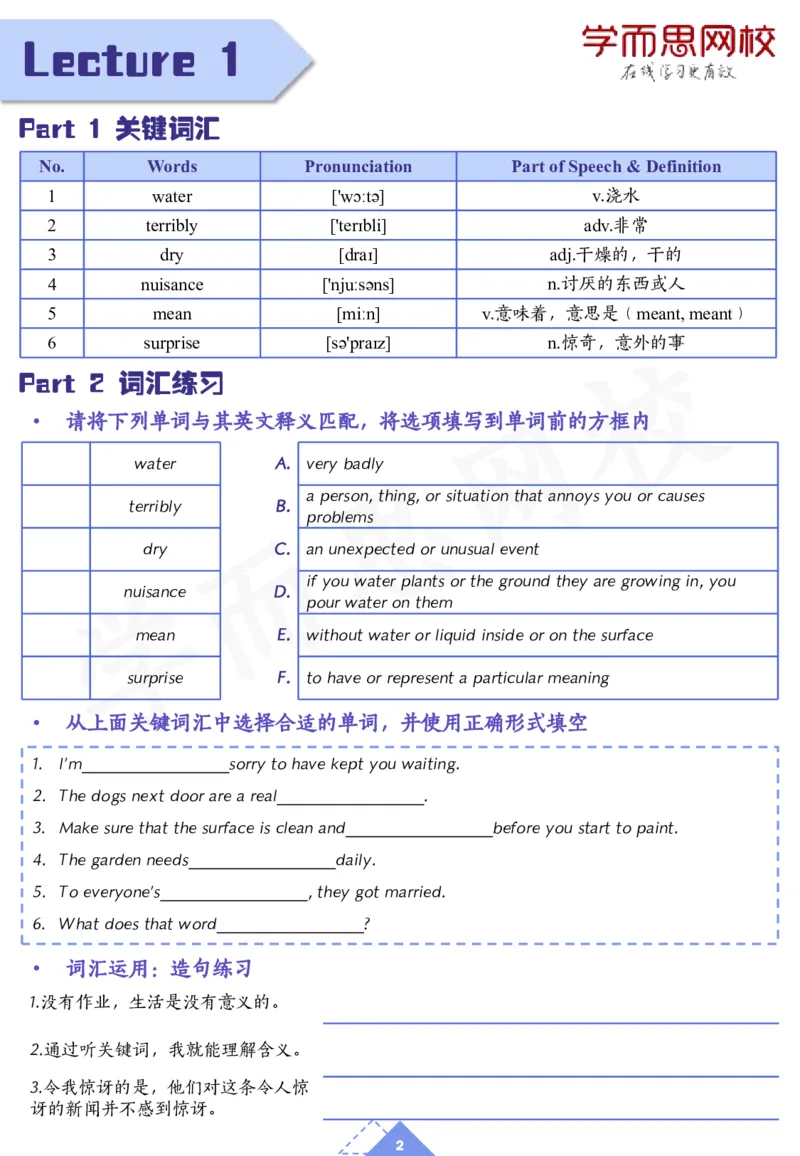
Part 1 关键词汇
No.
Words
Pronunciation
Part of Speech & Definition
1
water
['wɔːtə]
v.浇水
2
terribly
['terɪbli]
adv.非常
3
dry
[draɪ]
adj.干燥的,干的
4
nuisance
['njuːsəns]
n.讨厌的东西或人
5
mean
[miːn]
v.意味着,意思是(meant, meant)
6
surprise
[sə'praɪz]
n.惊奇,意外的事
Part 2 词汇练习
•
请将下列单词与其英文释义匹配,将选项填写到单词前的方框内
water
A.
very badly
terribly
B.
a person, thing, or situation that annoys you or causes
problems
dry
C.
an unexpected or unusual event
nuisance
D.
if you water plants or the ground they are growing in, you
pour water on them
mean
E.
without water or liquid inside or on the surface
surprise
F.
to have or represent a particular meaning
•
从上面关键词汇中选择合适的单词,并使用正确形式填空
1.
I'm                            sorry to have kept you waiting.
2. The dogs next door are a real                            .
3. Make sure that the surface is clean and                            before you start to paint.
4. The garden needs                            daily.
5. To everyone's                            , they got married.
6. What does that word                            ?
•
词汇运用:造句练习
1.没有作业,生活是没有意义的。
2.通过听关键词,我就能理解含义。
3.令我惊讶的是,他们对这条令人惊
讶的新闻并不感到惊讶。
学而思网校
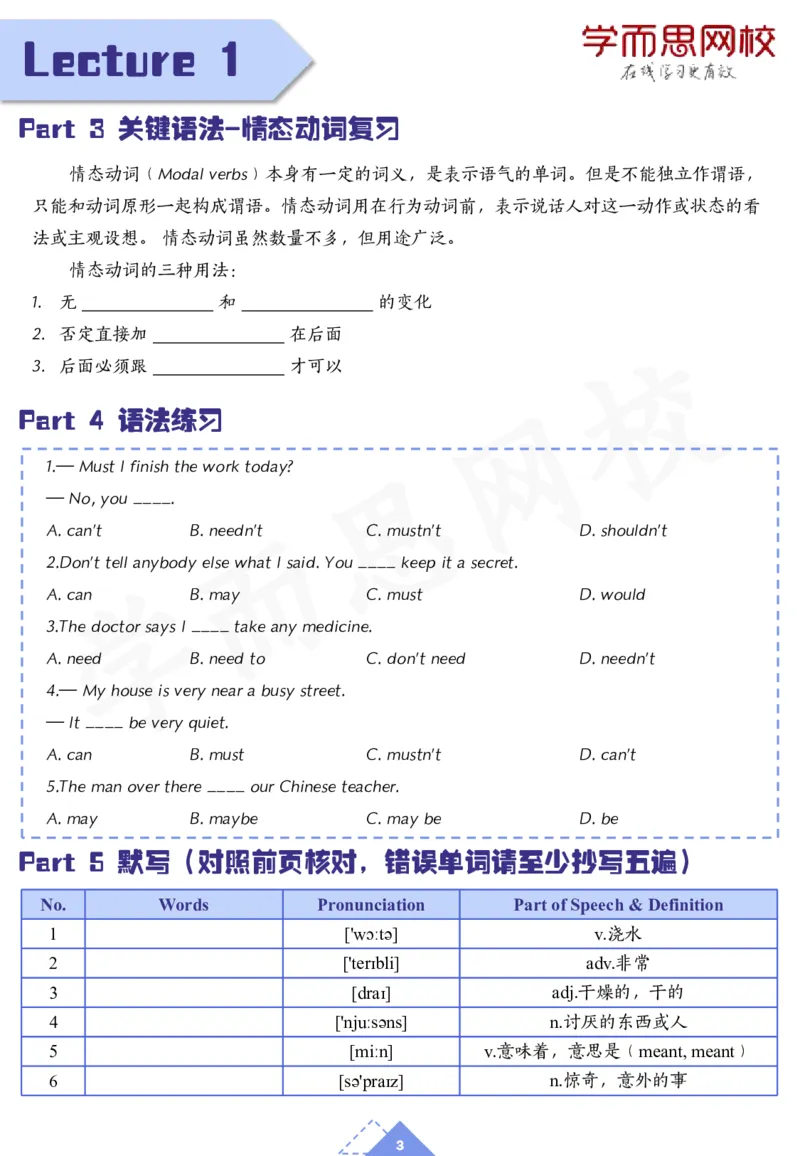
情态动词(Modal verbs)本身有一定的词义,是表示语气的单词。但是不能独立作谓语,
只能和动词原形一起构成谓语。情态动词用在行为动词前,表示说话人对这一动作或状态的看
法或主观设想。 情态动词虽然数量不多,但用途广泛。
情态动词的三种用法:
1.
无                           和                           的变化
2. 否定直接加                           在后面
3. 后面必须跟                           才可以
Lecture 1
3
Part 3 关键语法-情态动词复习
Part 4 语法练习
Part 5 默写(对照前页核对,错误单词请至少抄写五遍)
No.
Words
Pronunciation
Part of Speech & Definition
1
['wɔːtə]
v.浇水
2
['terɪbli]
adv.非常
3
[draɪ]
adj.干燥的,干的
4
['njuːsəns]
n.讨厌的东西或人
5
[miːn]
v.意味着,意思是(meant, meant)
6
[sə'praɪz]
n.惊奇,意外的事
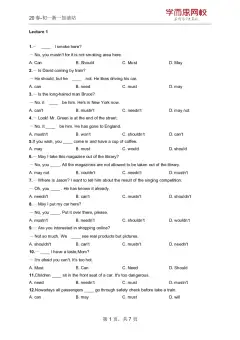
1.— Must I finish the work today?
— No, you ____.
A. can't
       B. needn't
C. mustn't
D. shouldn't
2.Don't tell anybody else what I said. You ____ keep it a secret.
A. can
       B. may
C. must
D. would
3.The doctor says I ____ take any medicine.
A. need
       B. need to
C. don't need
D. needn't
4.— My house is very near a busy street.
— It ____ be very quiet.
A. can
       B. must
C. mustn't
D. can't
5.The man over there ____ our Chinese teacher.
A. may
       B. maybe
C. may be
D. be
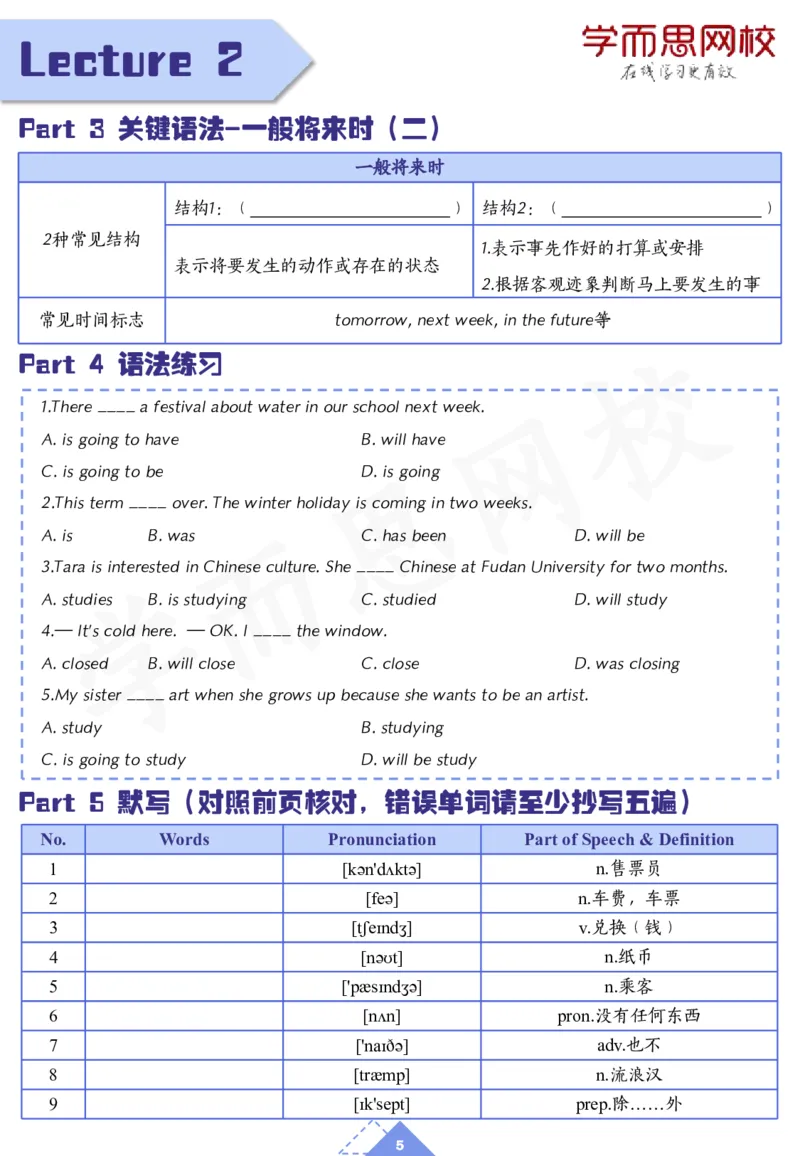
学而思网校
Lecture 2
4
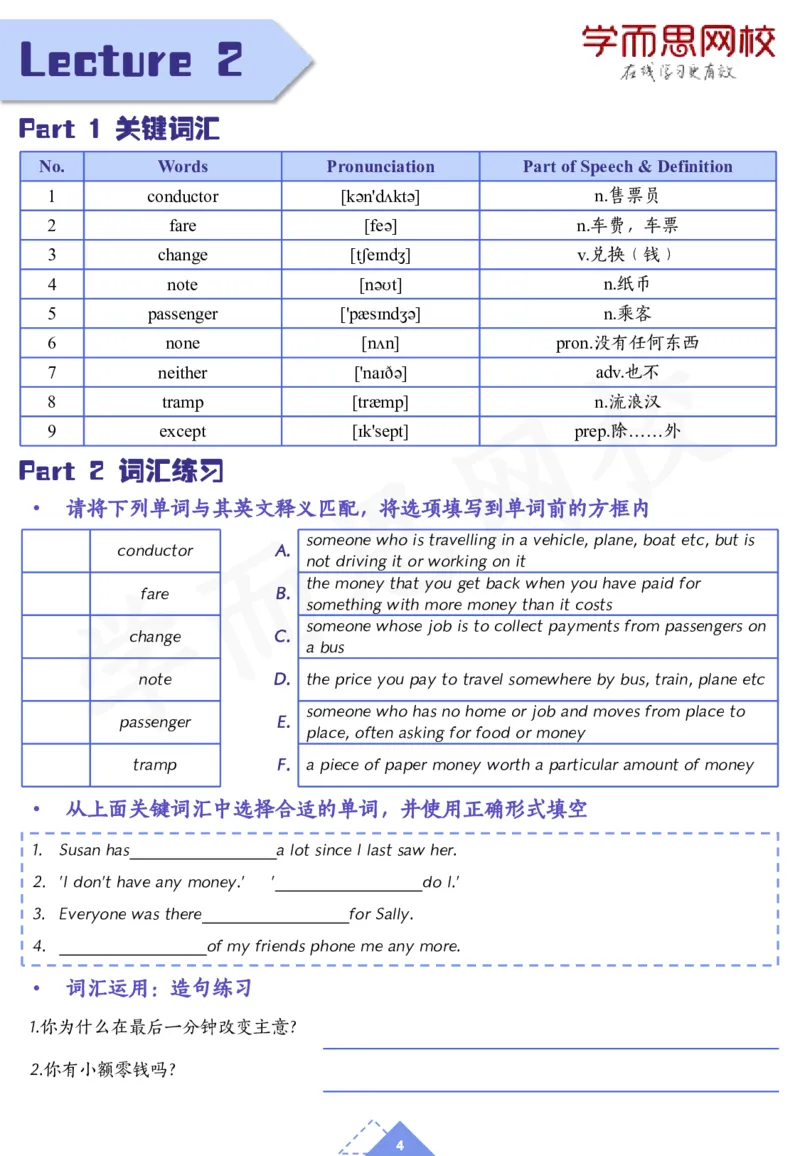
Part 1 关键词汇
No.
Words
Pronunciation
Part of Speech & Definition
1
conductor
[kən'dʌktə]
n.售票员
2
fare
[feə]
n.车费,车票
3
change
[tʃeɪndʒ]
v.兑换(钱)
4
note
[nəʊt]
n.纸币
5
passenger
['pæsɪndʒə]
n.乘客
6
none
[nʌn]
pron.没有任何东西
7
neither
['naɪðə]
adv.也不
8
tramp
[træmp]
n.流浪汉
9
except
[ɪk'sept]
prep.除……外
Part 2 词汇练习
•
请将下列单词与其英文释义匹配,将选项填写到单词前的方框内
conductor
A.
someone who is travelling in a vehicle, plane, boat etc, but is
not driving it or working on it
fare
B.
the money that you get back when you have paid for
something with more money than it costs
change
C.
someone whose job is to collect payments from passengers on
a bus
note
D.
the price you pay to travel somewhere by bus, train, plane etc
passenger
E.
someone who has no home or job and moves from place to
place, often asking for food or money
tramp
F.
a piece of paper money worth a particular amount of money
•
从上面关键词汇中选择合适的单词,并使用正确形式填空
1.
Susan has                            a lot since I last saw her.
2. 'I don't have any money.'     '                            do I.'
3. Everyone was there                            for Sally.
4.                            of my friends phone me any more.
•
词汇运用:造句练习
1.你为什么在最后一分钟改变主意?
2.你有小额零钱吗?
学而思网校
Lecture 2
5
Part 3 关键语法-一般将来时(二)
Part 4 语法练习
Part 5 默写(对照前页核对,错误单词请至少抄写五遍)
一般将来时
2种常见结构
结构1:(                                      )结构2:(                                      )
表示将要发生的动作或存在的状态
1.表示事先作好的打算或安排
2.根据客观迹象判断马上要发生的事
常见时间标志
tomorrow, next week, in the future等
No.
Words
Pronunciation
Part of Speech & Definition
1
[kən'dʌktə]
n.售票员
2
[feə]
n.车费,车票
3
[tʃeɪndʒ]
v.兑换(钱)
4
[nəʊt]
n.纸币
5
['pæsɪndʒə]
n.乘客
6
[nʌn]
pron.没有任何东西
7
['naɪðə]
adv.也不
8
[træmp]
n.流浪汉
9
[ɪk'sept]
prep.除……外
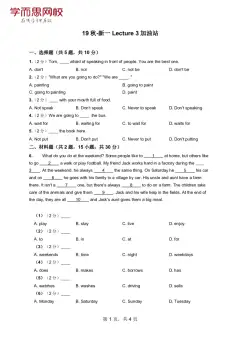
1.There ____ a festival about water in our school next week.
A. is going to have
B. will have
C. is going to be
D. is going
2.This term ____ over. The winter holiday is coming in two weeks.
A. is
B. was
C. has been
D. will be
3.Tara is interested in Chinese culture. She ____ Chinese at Fudan University for two months.
A. studies
B. is studying
C. studied
D. will study
4.— It's cold here.  — OK. I ____ the window.
A. closed
B. will close
C. close
D. was closing
5.My sister ____ art when she grows up because she wants to be an artist.
A. study
B. studying
C. is going to study
D. will be study
学而思网校
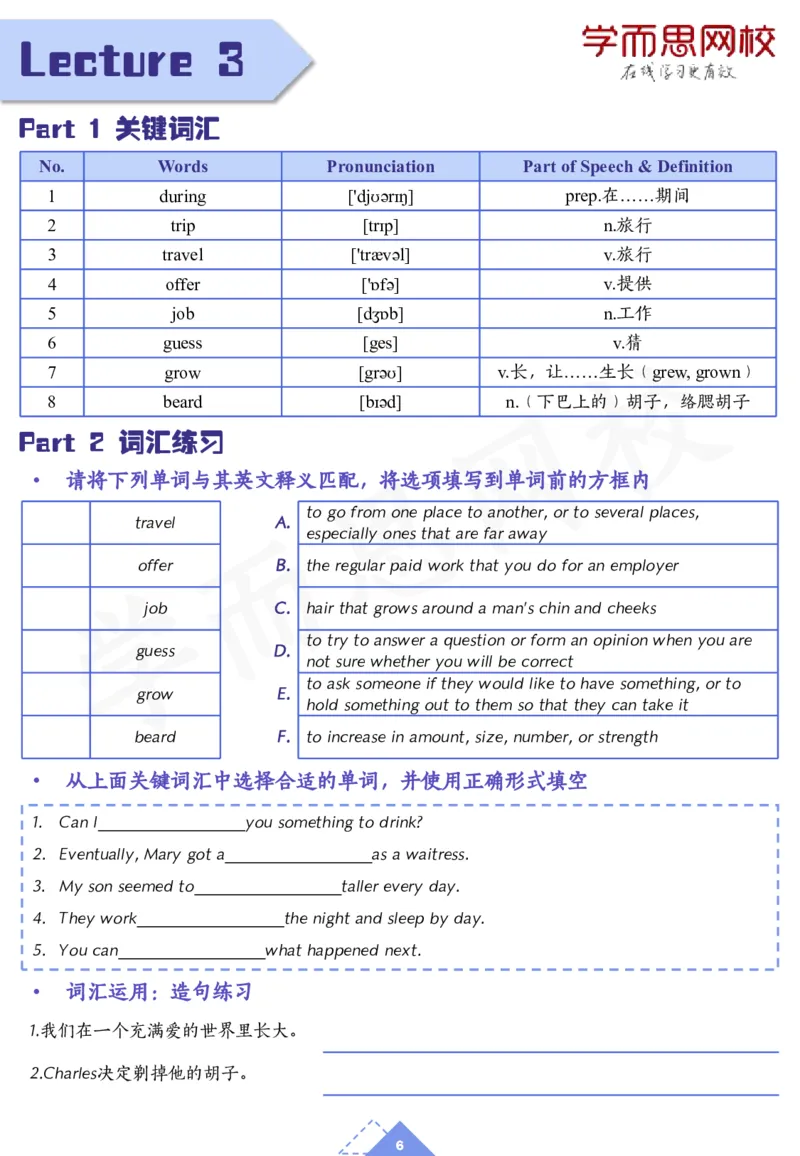
Lecture 3
6
Part 1 关键词汇
No.
Words
Pronunciation
Part of Speech & Definition
1
during
['djʊərɪŋ]
prep.在……期间
2
trip
[trɪp]
n.旅行
3
travel
['trævəl]
v.旅行
4
offer
['ɒfə]
v.提供
5
job
[dʒɒb]
n.工作
6
guess
[ges]
v.猜
7
grow
[grəʊ]
v.长,让……生长(grew, grown)
8
beard
[bɪəd]
n.(下巴上的)胡子,络腮胡子
Part 2 词汇练习
•
请将下列单词与其英文释义匹配,将选项填写到单词前的方框内
travel
A.
to go from one place to another, or to several places,
especially ones that are far away
offer
B.
the regular paid work that you do for an employer
job
C.
hair that grows around a man's chin and cheeks
guess
D.
to try to answer a question or form an opinion when you are
not sure whether you will be correct
grow
E.
to ask someone if they would like to have something, or to
hold something out to them so that they can take it
beard
F.
to increase in amount, size, number, or strength
•
从上面关键词汇中选择合适的单词,并使用正确形式填空
1.
Can I                            you something to drink?
2. Eventually, Mary got a                            as a waitress.
3. My son seemed to                            taller every day.
4. They work                            the night and sleep by day.
5. You can                            what happened next.
•
词汇运用:造句练习
1.我们在一个充满爱的世界里长大。
2.Charles决定剃掉他的胡子。
学而思网校
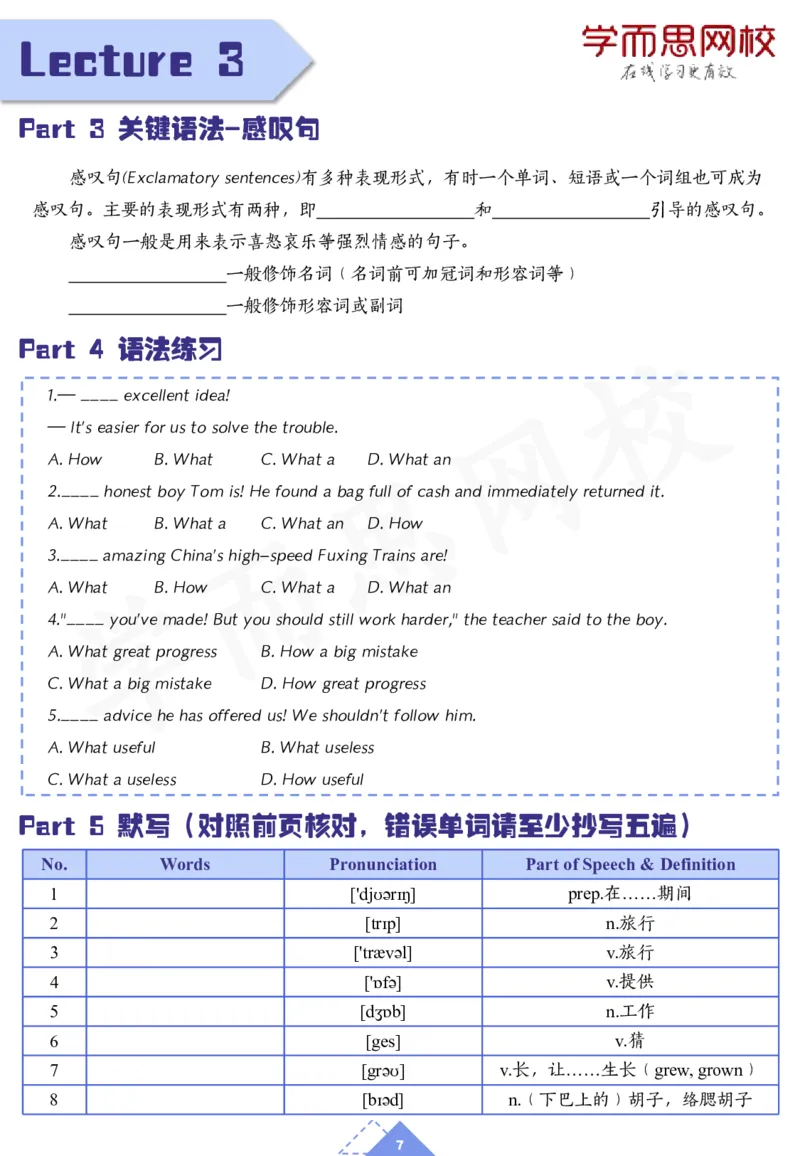
Lecture 3
7
Part 3 关键语法-感叹句
Part 4 语法练习
Part 5 默写(对照前页核对,错误单词请至少抄写五遍)
感叹句(Exclamatory sentences)有多种表现形式,有时一个单词、短语或一个词组也可成为
感叹句。主要的表现形式有两种,即                              和                              引导的感叹句。
感叹句一般是用来表示喜怒哀乐等强烈情感的句子。
                              一般修饰名词(名词前可加冠词和形容词等)
                              一般修饰形容词或副词
No.
Words
Pronunciation
Part of Speech & Definition
1
['djʊərɪŋ]
prep.在……期间
2
[trɪp]
n.旅行
3
['trævəl]
v.旅行
4
['ɒfə]
v.提供
5
[dʒɒb]
n.工作
6
[ges]
v.猜
7
[grəʊ]
v.长,让……生长(grew, grown)
8
[bɪəd]
n.(下巴上的)胡子,络腮胡子
1.— ____ excellent idea!
— It's easier for us to solve the trouble.
A. How
B. What
C. What a
D. What an
2.____ honest boy Tom is! He found a bag full of cash and immediately returned it.
A. What
B. What a
C. What an
D. How
3.____ amazing China's high-speed Fuxing Trains are!
A. What
B. How
C. What a
D. What an
4."____ you've made! But you should still work harder," the teacher said to the boy.
A. What great progress
B. How a big mistake
C. What a big mistake
D. How great progress
5.____ advice he has offered us! We shouldn't follow him.
A. What useful
B. What useless
C. What a useless
D. How useful
学而思网校
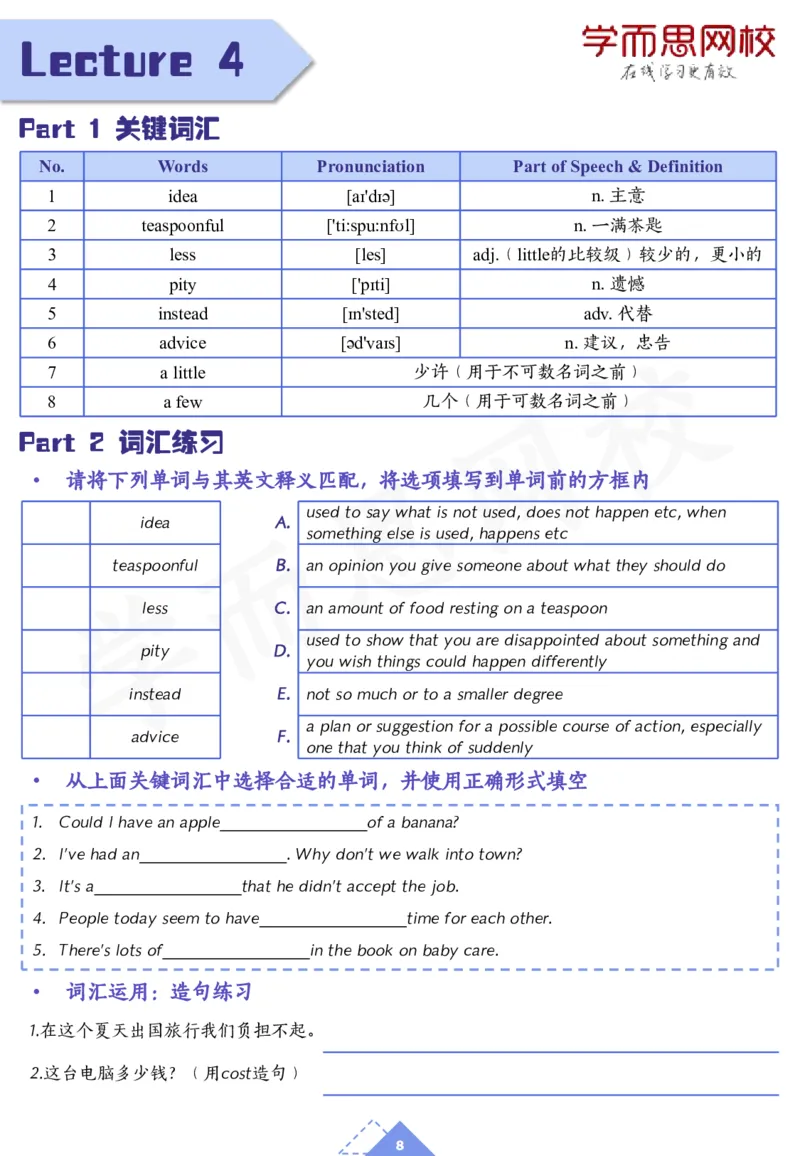
Lecture 4
8
Part 1 关键词汇
No.
Words
Pronunciation
Part of Speech & Definition
1
idea
[aɪ'dɪə]
n. 主意
2
teaspoonful
['ti:spu:nfʊl]
n. 一满茶匙
3
less
[les]
adj.(little的比较级)较少的,更小的
4
pity
['pɪti]
n. 遗憾
5
instead
[ɪn'sted]
adv. 代替
6
advice
[əd'vaɪs]
n. 建议,忠告
7
a little
少许(用于不可数名词之前)
8
a few
几个(用于可数名词之前)
Part 2 词汇练习
•
请将下列单词与其英文释义匹配,将选项填写到单词前的方框内
idea
A.
used to say what is not used, does not happen etc, when
something else is used, happens etc
teaspoonful
B.
an opinion you give someone about what they should do
less
C.
an amount of food resting on a teaspoon
pity
D.
used to show that you are disappointed about something and
you wish things could happen differently
instead
E.
not so much or to a smaller degree
advice
F.
a plan or suggestion for a possible course of action, especially
one that you think of suddenly
•
从上面关键词汇中选择合适的单词,并使用正确形式填空
1.
Could I have an apple                            of a banana?
2. I've had an                            . Why don't we walk into town?
3. It's a                            that he didn't accept the job.
4. People today seem to have                            time for each other.
5. There's lots of                            in the book on baby care.
•
词汇运用:造句练习
1.在这个夏天出国旅行我们负担不起。
2.这台电脑多少钱?(用cost造句)
学而思网校
大多数形容词与副词有三个等级,原级,比较级,最高级。
两者间比较,使用比较级。三者或以上比较,使用最高级。
形容词副词也可以使用原型构成原级比较。
Lecture 4
9
Part 3 关键语法-形容词副词比较级与最高级(二)
Part 4 语法练习
Part 5 默写(对照前页核对,错误单词请至少抄写五遍)
No.
Words
Pronunciation
Part of Speech & Definition
1
[aɪ'dɪə]
n. 主意
2
['ti:spu:nfʊl]
n. 一满茶匙
3
[les]
adj.(little的比较级)较少的,更小的
4
['pɪti]
n. 遗憾
5
[ɪn'sted]
adv. 代替
6
[əd'vaɪs]
n. 建议,忠告
7
少许(用于不可数名词之前)
8
几个(用于可数名词之前)
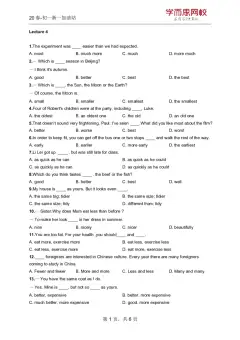
1.Jimmy and Timmy are both 10 years old, that is to say, Jimmy is ____ Timmy.
A. so old as
B. as old as
C. so older as
D. as older as
2.This classroom is three times as ____ as that one.
A. big
B. bigger
C. biggest
D. the biggest
3.Liu Mei is good at singing. She sings ____ the famous singer, Coco.
A. as good as
B. so good as
C. as well as
D. so well as
4.A: Which do you prefer, music or sports?      B: Both, I think. Music is ____ sports.
A. as popular as
B. not as popular as
C. more popular than
D. less popular than
5.The weather got colder and colder, but they still worked as ____ as possible.
A. harder
B. hardly
C. hard
D. hardest
学而思网校
Lecture 5
10
Part 1 关键词汇
No.
Words
Pronunciation
Part of Speech & Definition
1
story
['stɔ:ri]
n.故事
2
happen
['hæpən]
v.发生
3
thief
[θi:f]
n.贼
4
enter
['entə]
v.进入
5
dark
[dɑ:k]
adj.黑暗的
6
torch
[tɔ:tʃ]
n.手电筒
7
voice
[vɔɪs]
n.(说话的)声音
8
parrot
['pærət]
n.鹦鹉
Part 2 词汇练习
•
请将下列单词与其英文释义匹配,将选项填写到单词前的方框内
story
A.
there is little or no light
dark
B.
a small electric lamp that you carry in your hand
thief
C.
a description of imaginary people and events, which is written
or told in order to entertain.
enter
D.
to go or come into a place
torch
E.
someone who steals things from another person or place
voice
F.
the sounds that you make when you speak
•
从上面关键词汇中选择合适的单词,并使用正确形式填空
1.
Suddenly, the room went                            .
2. I could hear angry                            in the next room.
3. Something terrible has                            .
4. Don't                            my room without knocking.
5. A post office was broken into last night, and two                       got away with 120000 pounds.
•
词汇运用:造句练习
1.我碰巧在酒吧里遇见了我的老师。
2.当你离开房间的时候请关灯。
学而思网校
从属连词是连词的一种,用来引导状语从句。由从属连词所引导的句子叫从句,而含有从句
的句子叫作复合句。
用表示时间的连词连接一个句子作状语,这样的主从复合句叫做时间状语从句(adverbial
clause of time)。连接时间状语从句的连接词有when、before、after、while、as soon as、until、
since...... 等。
Lecture 5
11
Part 3 关键语法-时间从属连词
Part 4 语法练习
Part 5 默写(对照前页核对,错误单词请至少抄写五遍)
No.
Words
Pronunciation
Part of Speech & Definition
1
['stɔ:ri]
n.故事
2
['hæpən]
v.发生
3
[θi:f]
n.贼
4
['entə]
v.进入
5
[dɑ:k]
adj.黑暗的
6
[tɔ:tʃ]
n.手电筒
7
[vɔɪs]
n.(说话的)声音
8
['pærət]
n.鹦鹉
1.____ you cross the road, you must wait until the green light is on.
A. What
B. Why
C. When
D. Which
2.This is really a wonderful evening. It's years ____ I enjoyed myself so much.
A. when
B. that
C. before
D. since
3.Making friends is not easy. Sometimes it can take years ____ you become true friends with
someone.
A. before
B. after
C. because
D. unless
4.They didn't go to bed ____ the work was finished.
A. when
B. while
C. until
D. after
5.We will be able to play basketball and volleyball ____ it's clear and sunny outside.
A. because
B. but
C. as
D. when
学而思网校
Lecture 6
12
Part 1 关键词汇
No.
Words
Pronunciation
Part of Speech & Definition
1
coin
[kɔɪn]
n. 硬币
2
mouth
[maʊθ]
n. 嘴
3
swallow
['swɒləʊ]
v. 吞下
4
later
['leɪtə]
adv. 后来
5
toilet
['tɔɪlɪt]
n. 厕所,盥洗室
6
dining room
饭厅
Part 2 词汇练习
•
请将下列单词与其英文释义匹配,将选项填写到单词前的方框内
coin
A.
a room in a house or public building that contains a toilet
mouth
B.
to make food or drink go down your throat and towards your
stomach
swallow
C.
the part of your face which you put food into, or which you
use for speaking
later
D.
after the time you are talking about or after the present time
toilet
E.
a piece of metal, usually flat and round, that is used as money
•
从上面关键词汇中选择合适的单词,并使用正确形式填空
1.
He put some food into his                            .
2. He                            the last of his coffee and asked for the bill.
3. I'm going out for a bit - I'll see you                            .
4. Mummy, I need to go to the                            to wash hands!
•
词汇运用:造句练习
1.小心不要把那个盘子弄掉了。
2.我一会儿给你打电话!
3.我到处都找不到我的钥匙。
4.在这个公园里到处都是游客。
学而思网校
过去进行时表示过去在某一时间或某一段时间内正在发生或进行的动作或状态。其形式为
主语 + was /were + V-ing。常与表示过去的时间状语连用。
在英语时态中,“时“指动作发生的时间,”态“指动作的状态。
Lecture 6
13
Part 3 关键语法-过去进行时
Part 4 语法练习
Part 5 默写(对照前页核对,错误单词请至少抄写五遍)
now
past ←→ future
过去某时刻或时间段内正在发生的事情:
时态:(                                 )
No.
Words
Pronunciation
Part of Speech & Definition
1
[kɔɪn]
n. 硬币
2
[maʊθ]
n. 嘴
3
['swɒləʊ]
v. 吞下
4
['leɪtə]
adv. 后来
5
['tɔɪlɪt]
n. 厕所,盥洗室
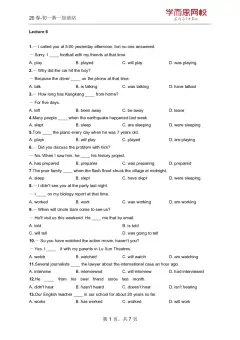
1.— Oh, dear! A power cut!
— Sorry, I didn't know you ____ the washing machine.
A. used
B. are using
C. to use
               D. were using
2.— Linda, I called you this morning, but nobody answered the phone.
— I'm sorry, I ____ football with my friends then.
A. play
B. played
C. am playing               D. was playing
3.— I called you at nine this morning, but there was no answer .
— Oh, sorry. I ____ with my mother in the supermarket.
A. shop
B. was shopping
C. shopped
               D. will shop
4.Sam ____ a newspaper when the bus stopped rapidly.
A. read
B. is reading
C. has read
               D. was reading
5.When I got home, mom ____  in the kitchen.
A. cooks
B. is cooking
C. cooked
              D. was cooking
学而思网校
答案解析
14
Lecture 1
Part 2
DAEBFC
1.terribly
2.nuisance
3.dry
4.watering
5.surprise
6.mean
1.The life isn't meaningful without
homework.
2.I can get the meaning by listening to the
key words.
3.To my surprise, they aren't surprised at
the surprising news.
Part 3
1.人称,数
2.not
3.动词原形
Part 4
1.【答案】B
【解析】本题考查情态动词need。
A项意为不能够;
B项意为不需要;
C项意为禁止,不许;
D项意为不该。
原文意思是:-这项工作我必须今天完成
吗?
             -不,你不需要。         故选B。
2.【答案】C
【解析】此题考查情态动词。此处用于
表达必须,故选C。
3.【答案】D
【解析】此题考查情态动词。any表明前
面必须是否定。need 的用法:need to do,
needn’t do,故选D。
4.【答案】D
【解析】此题考查情态动词。由前文
“房子临近一条热闹的街道”,可知房
子不可能(can't)是安静的,故选D。
5.【答案】C
【解析】此题考查情态动词。此句缺少
谓语动词,may和be不能单独做谓语,
maybe为副词做状语,may be可能是,故
选C。
Lecture 2
Part 2
CDBFAE
1.changed
2.Neither
3.except
4.None
1.Why did you change your mind at the
last minute?
2.Do you have any small change?
Part 3
1.will do
2.be going to do
Part 4
1.【答案】C
【解析】考查there be句型。句意:下周,
我们的学校会有一个关于水的节日。be
going to用于主观判断,即说话人主观上
计划或安排将要去做的事情。will则多用
于客观的情况,即客观上将要发生的事
情,而且be going to表示近期、眼下就要
发生的事情,will表示的将来时间,则较
远一些,因为是there be句型,故答案为
C。
2.【答案】D
【解析】考查一般将来时。由in two
weeks可知,句子时态为一般将来时,一
般将来时结构为:will+动词原形。故选D。
3.【答案】D
【解析】考查时态。由 “Tara is
interested in Chinese culture.”可知不是
过去,排除C。由for two months可知,
是持续一段时间,所以排除A、B。整句
话的意思是:Tara对中国文化很感兴趣,
她将在复旦大学学习两个月的汉语。故
选D。
4.【答案】B
【解析】考查一般将来时。句意:——
这里真冷。——好的,我这就把窗户关
上。关窗户动作尚未发生,应用一般将
来时;关窗的动作是听到对方说冷而产
生的意图,will用于临时意图,这里应用
will do的结构。故选B。
5.【答案】C
【解析】考查一般将来时。句意:我姐
姐长大后会学美术,因为她想成为一名
艺术家。be going to有某种迹象表明未来
会发生某事,D项应去掉be。故选C。
Lecture 3
Part 2
AEBDFC
1.offer
2.job
3.grow
4.during
5.guess
1.We grow up in the world full of love.
2.Charles decided to shave off his beard.
Part3
What, How, What, How
Part 4
1.【答案】D
【解析】感叹句。根据____excellent
idea! 可知这是一个感叹句,修饰的中心
词是一个可数名词idea,前面被形容词
excellent修饰,故用what,因excellent是
以元音音素开头的单词,故前面加冠词
an。故选D。
2.【答案】C
【解析】根据“____ honest boy Tom is!”
可知这是一个感叹句,修饰的中心词是
一个可数名词boy,前面被形容词honest
修饰,故用what;因honest是以元音音素
开头的单词,故前面加不定冠词an。故
选C。
3.【答案】B
【解析】根据amazing China's high-speed
Fuxing Trains are!可知
这里考查了感叹句,本句的中心词是
amazing,它是一个形容词,根据How+
形容词/副词+主语+谓语!故选:B。
4.【答案】A
【解析】根据you've made!可知这里考查
了感叹句,本句的中心词是progress,它
是一个不可数名词;great是一个形容词,
在这里修饰progress。根据感叹句结构
What+形容词+可数名词复数/不可数名
词+主语+谓语! 故选A。
5.【答案】B
【解析】句意:他给我们的建议太没用
了,我们不应该听他的。从We shouldn't
follow him.判断这里的建议应该是无用的,
用useless,再根据advice he has offered us!
可知这里考查了感叹句,本句的中心词
是advice,它是一个不可数名词,不可以
和a连用。useless在这里修饰advice。根
据What+形容词+可数名词复数/不可数
名词+主语+谓语!故选:B。
Lecture 4
Part 2
FCEDAB
1.instead
2.idea
3.pity
4.less
5.advice

1.We can't afford to go abroad this
summer.
2.How much does this computer cost?
Part 4
1.【答案】B
【解析】考查固定用法。通常用
as+adj./adv.+as...表示“和……一样”,
句型结构中只能用形容词和副词的原级
形式。
2.【答案】A
【解析】句意:这个教室是那个教室的
三倍大。数词+ times + as +形容词或副
词的原级+ as表示……几倍。故选A。
3.【答案】C
【解析】考查同级比较。句意:刘梅擅
长唱歌,她和著名歌手Coco唱的一样好。
固定短语as….as…意为“和……一样”,
中间的形容词、副词用原级形式。副词
well修饰动词sing。故选C。
学而思网校
答案解析
15
4.【答案】A
【解析】句意:两者都喜欢,我认为音
乐和体育一样受欢迎。根据句意及语境
是“和……一样”,所以要用 as...as 结
构,故选A。
5.【答案】C
【解析】考查hard的用法。句意:天气变
得越来越冷,但是他们仍然尽可能努力
地工作着。As…as possible中间要用形容
词或副词的原级,hard兼具形容词和副词
两个词性,表示“努力的;努力地”。
hardly 副词,表示“几乎不”,故选C。
Lecture 5
Part 2
CAEDBF
1.dark
2.voices
3.happened
4.enter
5.thieves
1.I happened to see my teacher in a bar.
2.Please turn off the light when you leave
the room.
Part 4
1.【答案】C
【解析】考查连词。句意:当你过马路
的时候,你一定要等绿灯亮了再走。
when引导时间状语从句,意为“当……
时候”,故选C。
2.【答案】D
【解析】本题考查时间状语从句。这真
是一个很美妙的夜晚,好几年我都没有
玩得那么痛快了。years 是一个时间段,
根据句意分析,空格处应用 since 表示
“自从……以来”,故正确答案为D。
3.【答案】A
【解析】本题主要考查时间状语从句。
A项,before “在…之前”。
B项,after “在…之后”。
C项,because “因为”。
D项,unless “除非”。
根据题意,交朋友很难,有时得花费好
几年才能找到真朋友。before 在这里表
明在交到朋友前的那段时间。
故正确答案为A。
4.【答案】C
【解析】本文主要考查时间状语从句。
A项,when 意为“当…时候,每当”,
一般用于引导时间状语从句,从句谓语
动词应为延续性动词。
B项,while 意为“当…时候,每当”,
一般用于引导时间状语从句,主从句动
作同时发生。从句谓语动词既可以是延
续性动词,也可以使非延续性动词。
C项,until 意为“直到…时候”,一般
与 not 连用引导时间状语从句,表示
“直到…才”,从句的动作先发生了,
主句动作才发生,从句动作是主句动作
发生的前提。
D项,after 意为“在…之后,在…后
面”,一般用于引导时间状语从句,表
示主从句动作先后发生,但两者之间没
有必然关系。
结合题意,他们没有去睡觉,直到(until)
工作完成了。此句应为 until 引导的时间
状语从句,表示只有“完成工作”发生
了,“睡觉”才发生。
故正确答案为C。
5.【答案】D
【解析】此题考查时间状语从句。句意:
当外面天气晴朗的时候我们可以打篮球。
故选D。
Lecture 6
Part 2
ECBDA
1.mouth
2.swallowed
3.later
4.toilet

1.Be careful not to drop the plate.
2.I will call you later.
3.I can't find my key anywhere.
4.There are visitors everywhere in this park.
Part 3
过去进行时
Part 4
1.【答案】D
【解析】考查过去进行时。句意:——
天哪!停电了。——抱歉,我不知道你
正在用洗衣机。根据句意可判断设空处
的动作在过去某个时间段内正在进行着,
且动作在一段时间内持续进行,所以用
过去进行时。故选D。
2.【答案】D
【解析】考查过去进行时。句意:——
琳达,今天早上我打电话给你,但没人
接听电话。——很抱歉,那个时候我正
和我的朋友们玩。由后半句中的时间状
语then可知道那是发生在过去的事情。根
据句意可知应用过去进行时,表示动作
在过去的某个时候正在进行。故选D。
3.【答案】B
【解析】考查过去进行时。句意:——
今天早上九点钟我打电话给你,但是没
有人接。——噢,对不起。我和妈妈在
超市购物。根据语境可知,这里表示的
是过去某一时刻或某段时间正在进行或
发生的动作,应用过去进行时。故选B。
4.【答案】D
【解析】考查过去进行时。句意:当公
共汽车迅速地停止时,萨姆正在读报纸。
根据公共汽车停止的动作是过去,可知
萨姆读报纸是在过去的那个时间点上发
生的,所以用过去进行时。故选D。
5.【答案】D
【解析】考查过去进行时。句意:当我
到家的时候,我妈妈正在厨房里做饭。
由when引导的时间状语从句使用过去时,
因此主句也应是过去时,故排除A、B。
根据句意,当时我的妈妈正在做饭,应
使用过去进行时。故选D。