ENGLISH
Learning
七年级下册
义务教育教科书·英语
教师用书
( 衔接三年级起点)
Teacher’s Guide
义
务
教
育
教
科
书
·
英
语
教
师
用
书
(
衔
接
三
年
级
起
点
)
七
年
级
下
册
定价:41.40 元( 含光盘)
微信公众号:电子课本大全
微信公众号:电子课本大全
微信公众号:电子课本大全
微信公众号:电子课本大全
微信公众号:电子课本大全
微信公众号:电子课本大全
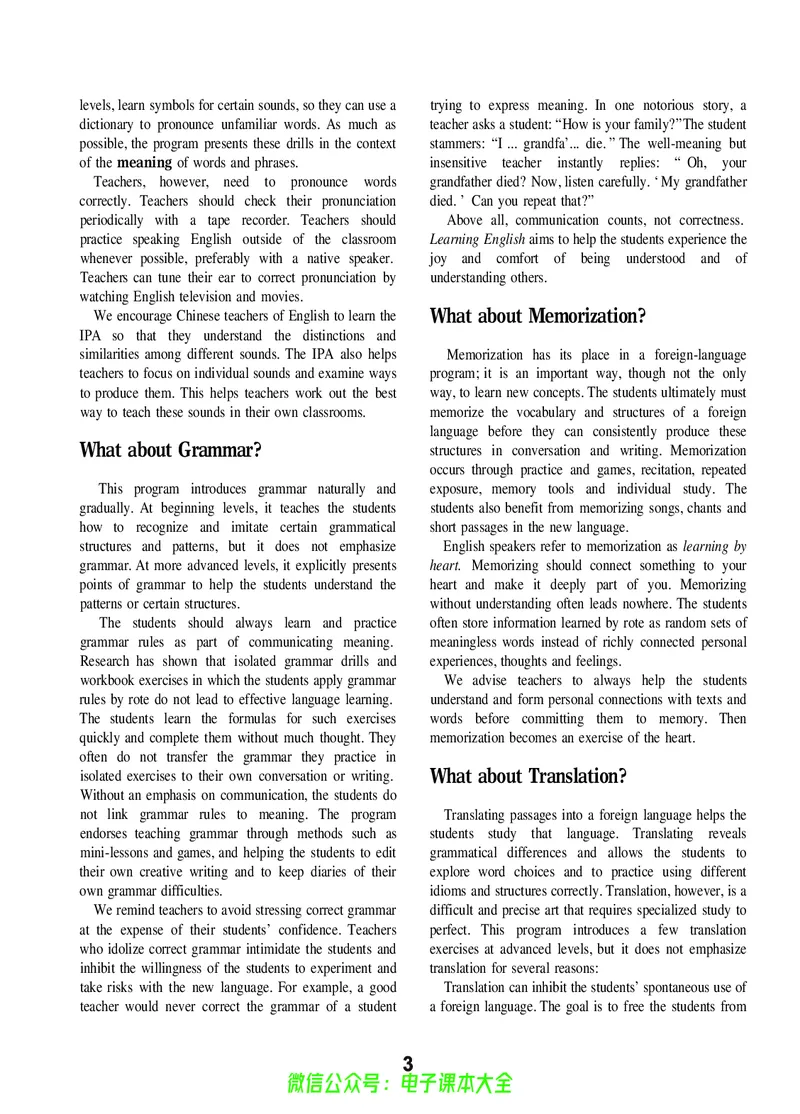
PhilosophyoftheLearningEnglish
Program
TheLearningEnglishprogramaimstohelpChinese
studentslearntospeakconversationalEnglishandtohelp
ChineseteachersimprovetheirownEnglishandEnglish
teachingskills.
The
program
stresses
communication
and
conversation.
It
focuses
on
talk牗listening
and
speaking牘.Itgivesthestudentsmanyopportunitiesto
talkinmanydifferentconversationalsituations牶student
tostudent牞
studenttogroup牞
studenttoteacher
and
studenttoclass.Thestudentsoftenroleplayandinvent
conversation.All
this
talk
develops
the
skill
to
communicaterealmeaning.Itpromotesflexiblelanguage
usesothatthestudentscanfunctioninavarietyof
situations.
Theprogramisholisticandintegrative.
At
beginninglevels牞itstresseslisteningandspeaking牞butit
alsointegratesreadingandwriting.Itcreatesabalance
amongalllanguageskills牞whichiskeytolanguage
instruction
and
crucial
to
language
development.
Languagedevelopmentoccursinstepwithchangesand
growthinconsciousness.Thefourlanguageskills
牗reading牞writing牞speakingandlistening牘naturally
reinforceeachotherinachildslanguagedevelopment.
ChildrenneedtolearnEnglishthewaytheylearnedtheir
ownlanguage牶throughlisteningtopeoplearoundthem
speakwordsandphrases.InEnglishclasses牞children
needmanyopportunitiesinawidevarietyofsituationsto
explore牞constructandconveymeaning牷toclarifyand
reflectontheirthoughts牞feelingsandexperiences牷and
alsotoplay牞experimentandusetheirimaginations.
Theprogrammodelstheprocessofchildrens
languagedevelopment.Childrenmasternewwordsas
partofdevelopingwaystomakemeaning.Ittakestime.
Differentstudentsdeveloplanguageindifferentwaysand
atdifferentrates牞andgoodteachersadapttheirclassroom
activitiestoaccommodateindividualstudentneeds.Not
everyonewillachievethesamefluencyattheendof
eachteachingunit.Forthisreason牞theprogramfirst
exposesthechildrentonewwordsandthenletsthem
encounterandusethesewordsagainandagainin
differentcontextsthroughouttheclassyear.
The
program
stresses
active
studentcentred
experiences.Itfrequentlyinvolvesthestudentsinpair
andsmallgroupactivitiesthatrequirethemtocreate
theirownconversationsinEnglish.Itincludesgames牞
songsandroleplayingwherethestudentsinventand
interactinEnglish.Itemphasizesengaging牞motivational
activitiesthatencouragethestudentstocommunicatein
Englishandtorespondpersonallyandcritically.The
morethestudentsactuallytalkinEnglish牞thefastertheir
languageskillsdevelop.
TheLearningEnglishprogramworksbestifteachers
encouragethestudentstotalkasmuchaspossible.
Teachers
should
guide
and
structure
activities牞
demonstrateandmodelconversation牞andcorrectthe
studentswherenecessary.Theprogram牞however牞does
notcentreonwhattheteacherdoesatthefrontofthe
classroombutonwhatthestudentsdowithinit.
The
program
stresses
meaningful
learning
situations.
Theprogramengagesthestudentsin
situationswheretheyneedEnglishtocopewithauthentic
Englishspeakingcontexts牶tomakearequest牞toexpress
afeeling牞toaccomplishsomething牞tofindoutessential
informationortocompleteatask.Thestudentsfeelmore
motivatedtolearnEnglishinrealsituations牞andthey
learnnaturallanguagepatternsratherthanartificial
classroomdialogues.
Theprogramstressesthinkingasanessentialpartof
communication.Tocommunicate牞apersonmusthave
somethingtotell.Ofteninthisprogram牞teacherssetup
classroom
experiences
that
allow
the
students
to
formulateapointofview牶tothinkaboutandsharetheir
ownpersonalexperiences牷tovalueothersideasand
experiences牷andtoimagineandcreatenewideasthrough
language.
Theprogramstresseslanguageimmersion.Each
lessonexposesthestudentstoalotofEnglish牞morethan
it
expects
the
students
to
master
or
understand
completely.Totheextentpossible牞teachersshouldstrive
tosurroundthestudentswithEnglish.Theclassroom
shouldcontainagoodrangeofEnglishlanguageposters牞
picture
dictionaries牞
newspapers牞
books牞
letters牞
postcards牞signsandmagazines.Thewallsof
the
classroomshoulddisplayvocabularypicturesandwords.
微信公众号:电子课本大全
Teachersshouldlabelitemsintheclassroomwithbig
cardsshowingtheEnglishwords.
Theprogramstressesrisktakinginasupportive
environment.Noonecanlearnalanguagewithout
makingmistakes.Ifthestudentsfearfailure牞theywillnot
trynewwordsandphrasesandtheywillnotprogress.
Thestudentsneedlotsofsupportandassistance
toexperimentwithnewlanguagestructures.
Theyneedpraiseforthecontentofwhatthey
say
rather
than
constant
correction
of
pronunciationandvocabulary.
Therefore牞good
languageteachersgivetheirstudentslotsofpraiseand
encouragement.Theyhelpthestudentsusenewwords
andphrasesbyprovidingmanymodels牞demonstrations
andclues.Goodteachersfrequentlyencouragethe
studentstoinventtheirownquestions牞responsesand
conversations牞andtheycongratulatethestudentsfor
takingrisks.
Theprogramstressesamotivationalclassroom
environment.Itprovidesmanyopportunitiesforplay牞
songs牞gamesandsurprisestomakeEnglishclassfun.
Theprogramaimstofosteradesiretolearnsothatthe
studentswillattendtothelessonandfeelinspiredto
practiceEnglishoutsideoftheclassroom.
OverallGoalsofthe
LearningEnglishProgram
Eachleveloftheprogramidentifiesspecificobjectives
formasteringvocabulary牞grammar牞conversation牞reading
andwriting.Teachers牞however牞needtotreatthese
objectivesaspartoflarger牞lifelonggoals牞notasisolated
targets.Theprogramaimstosupportthestudentsasthey
continuetolearnEnglishthroughouttheirschoolingand
throughouttherestoftheirlives.
Teachingwiththe
LearningEnglishProgram
Thisprogramstresses牶
● Interactive
conversation牞
not
just
lists
of
vocabularywordsandgrammaticalstructures.
● Flexiblelanguageusein
a
wide
range
of
situations牞notjustmemorizationandchanting.
● Understanding
and
expressing
overall
meaning牞
not
just
learning
isolated
parts
of
language.
● Authentic
realworld
situations
where牞
for
example牞childrenplaygames牞askforandgive
information牞andexpresslikesanddislikes.
● Everyday
language
among
native
English
speakers.Manyinformalexpressionsandcommon
idiomsareincludedinthecurriculum牞aswellas
formalstructuresdemonstratinggrammaticalpatterns.
Theprogramprovides牶
● AnaudiotapeofNorthAmericanEnglishspeakers.
The
students
become
used
to
hearing
and
understandingavarietyofinflectionsandtones牞not
justformalBritishaccents.
● Goodqualityliteraturethatletsthestudents
developunderstandingofwholeunitsofmeaning牞not
justisolatedwords牷thatmotivatesthestudents
interest牷andthatprovidesmoralinstructionfor
characterdevelopment.Thelessonsusetranslationof
wellknownChinesestoriesaswellastraditionaland
modernEnglishstories.
● Stepbystep
instructions
for
innovative
Englishteachingmethodsfortheteacherstouse
intheclassroom.
● Awidevarietyofstudentcentredactivities牞
includingdialogues牞roleplay牞games牞storywriting牞
smallgroupactivities牞TPR牗TotalPhysicalResponse牘
activitiesanddrills.
● WaystohelpChineseteachersimprovetheir
ownEnglishastheyprepareforlessons.The
teachersguideisverydetailedandcontainsmany
tipsforteachingEnglish.
WhataboutPhonetics牽
Pronunciationformsanimportantpartofanylanguage
program.Youngstudentsmimicwell.Theyoftenlearn
pronunciationbylisteningto牞andimitating牞goodrole
models.
Too
much
emphasis
on
correct
pronunciation牞
however牞canmakethestudentsafraidtospeakbecause
theyworry
too
much
about
pronunciation
errors.
Teachers
must
gently
guide
the
students
to
understandablepronunciation牞butneverletpronunciation
become
more
important
than
meaning
and
communication.
Thisprogramintroducespronunciationexerciseswhen
newvocabularyhassoundsthatChinesechildrenmay
finddifficulttoproduce.Thebeginninglevelcontainsa
fewphoneticdrills.Laterlevelsoffermorephonetic
drills牞suchasminimalpairs.Olderstudents牞atlater
微信公众号:电子课本大全
levels牞learnsymbolsforcertainsounds牞sotheycanusea
dictionarytopronounceunfamiliarwords.Asmuchas
possible牞theprogrampresentsthesedrillsinthecontext
ofthemeaningofwordsandphrases.
Teachers牞
however牞
need
to
pronounce
words
correctly.Teachersshouldchecktheirpronunciation
periodicallywithataperecorder.Teachersshould
practicespeakingEnglishoutsideoftheclassroom
wheneverpossible牞preferablywithanativespeaker.
Teacherscantunetheireartocorrectpronunciationby
watchingEnglishtelevisionandmovies.
WeencourageChineseteachersofEnglishtolearnthe
IPAso
that
they
understand
the
distinctions
and
similaritiesamongdifferentsounds.TheIPAalsohelps
teacherstofocusonindividualsoundsandexamineways
toproducethem.Thishelpsteachersworkoutthebest
waytoteachthesesoundsintheirownclassrooms.
WhataboutGrammar牽
Thisprogramintroducesgrammarnaturallyand
gradually.Atbeginninglevels牞itteachesthestudents
howto
recognize
and
imitate
certain
grammatical
structuresandpatterns牞butitdoesnotemphasize
grammar.Atmoreadvancedlevels牞itexplicitlypresents
pointsofgrammartohelpthestudentsunderstandthe
patternsorcertainstructures.
Thestudentsshouldalwayslearnand
practice
grammarrulesaspartofcommunicatingmeaning.
Researchhasshownthatisolatedgrammardrillsand
workbookexercisesinwhichthestudentsapplygrammar
rulesbyrotedonotleadtoeffectivelanguagelearning.
Thestudentslearntheformulasforsuchexercises
quicklyandcompletethemwithoutmuchthought.They
oftendonottransferthegrammartheypracticein
isolatedexercisestotheirownconversationorwriting.
Withoutanemphasisoncommunication牞thestudentsdo
notlinkgrammarrulestomeaning.Theprogram
endorsesteachinggrammarthroughmethodssuchas
minilessonsandgames牞andhelpingthestudentstoedit
theirowncreativewritingandtokeepdiariesoftheir
owngrammardifficulties.
Weremindteacherstoavoidstressingcorrectgrammar
attheexpenseoftheirstudentsconfidence.Teachers
whoidolizecorrectgrammarintimidatethestudentsand
inhibitthewillingnessofthestudentstoexperimentand
takeriskswiththenewlanguage.Forexample牞agood
teacherwouldnevercorrectthegrammarofastudent
tryingtoexpressmeaning.Inonenotoriousstory牞a
teacherasksastudent牶Howisyourfamily牽Thestudent
stammers牶I...grandfa...die.Thewellmeaningbut
insensitive
teacher
instantly
replies牶
Oh牞
your
grandfatherdied牽Now牞listencarefully.Mygrandfather
died.Canyourepeatthat牽
Aboveall牞communicationcounts牞notcorrectness.
LearningEnglishaimstohelpthestudentsexperiencethe
joy
and
comfort
of
being
understood
and
of
understandingothers.
WhataboutMemorization牽
Memorizationhasitsplaceinaforeignlanguage
program牷itisanimportantway牞thoughnottheonly
way牞tolearnnewconcepts.Thestudentsultimatelymust
memorizethevocabularyandstructuresofaforeign
languagebeforetheycanconsistentlyproducethese
structuresinconversationandwriting.Memorization
occursthroughpracticeandgames牞recitation牞repeated
exposure牞memorytoolsandindividualstudy.The
studentsalsobenefitfrommemorizingsongs牞chantsand
shortpassagesinthenewlanguage.
Englishspeakersrefertomemorizationaslearningby
heart.Memorizingshouldconnectsomethingtoyour
heartandmakeitdeeplypartofyou.Memorizing
withoutunderstandingoftenleadsnowhere.Thestudents
oftenstoreinformationlearnedbyroteasrandomsetsof
meaninglesswordsinsteadofrichlyconnectedpersonal
experiences牞thoughtsandfeelings.
Weadviseteacherstoalwayshelpthestudents
understandandformpersonalconnectionswithtextsand
words
before
committing
them
to
memory.Then
memorizationbecomesanexerciseoftheheart.
WhataboutTranslation牽
Translatingpassagesintoaforeignlanguagehelpsthe
students
study
that
language.
Translating
reveals
grammaticaldifferencesandallowsthestudentsto
explorewordchoicesandtopracticeusingdifferent
idiomsandstructurescorrectly.Translation牞however牞isa
difficultandpreciseartthatrequiresspecializedstudyto
perfect.Thisprogramintroducesafewtranslation
exercisesatadvancedlevels牞butitdoesnotemphasize
translationforseveralreasons牶
Translationcaninhibitthestudentsspontaneoususeof
aforeignlanguage.Thegoalistofreethestudentsfrom
微信公众号:电子课本大全
constantlytranslatingtheirnativelanguagesothatthey
canexperimentdirectlywithexpressionsandthought
constructedinthenewlanguage.
Toomuchtranslationmayalsomakethestudentsthink
thattheymustunderstandeverywordtheyread.Theydo
not.Theyneedtograspchunksofmeaning.Focusingtoo
muchonindividualwordsandphrasesinterfereswiththe
processofreading.
Toomuchtranslationalsorestrictsthestudentstotexts
writtenbyothers.Teachersshouldencouragethestudents
tocreatetheirowntextsinthenewlanguageinavariety
offorms牶letters牞shortdescriptions牞littlestories牞poems牞
essays牗atadvancedlevels牘andmanyothers.Insuch
exercises牞thestudentsshouldredraftandrevisetheirown
writingseveraltimesuntilitisclear牞vividandcorrect.
Thestudentsworkharderontheirowncreativewriting牞
drawnfromtheirownexperiences牞ratherthanon
translatingotherpeopleswork.
微信公众号:电子课本大全
《学英语》编写指导思想
本套教材旨在帮助中国学生学说英语,并帮
助中国英语教师提高自身的英语水平和教学能
力。本套教材强调交际和会话,重点在交谈(听
和说)。教材为学生提供了大量的在各种不同
交际情景中用英语进行交谈的机会:学生与学
生、学生与小组、学生与教师及学生与全班等。
学生能经常进行角色表演并自编对话。这些交
谈有利于培养学生交流真情实感的能力,促进灵
活的语言运用,使其在各种情景中都能自如地使
用英语。本套教材讲究系统性。在起始年级,既强调
听与说,又兼顾读与写,从而达到各项语言技能
之间的平衡。而这一点对于语言的教与学至关
重要。学生语言能力的提高是随着学生感知能
力的增强而同步发展的。语言的四项技能(听、
说、读、写)在儿童的成长过程中自然地相互促
进,相得益彰。儿童需要用习得母语的方法来学
习英语:通过听周围的人讲出的词语去学习。上
英语课时,孩子们需要大量机会,于各种不同的
情景之中,探索、建构、表达意义;去澄清、反思各
自的思想感情和经历;去发挥、试验、运用各自的
想像力。本套教材仿效儿童的语言发展过程。儿童
是通过掌握新的词语而获得建构意义的方法的,
这需要时间。语言习得的方式和速度,往往因人
而异。好的教师一般都力求使其课堂活动适合
不同学生的需要。一个单元学完,并非全班同学
人人都能达到相同的流利程度。因此,本套教材
先让孩子们接触新单词,然后,在整个学年里,让
他们在不同的情景之中,反反复复地碰到并运用
这些单词。
本套教材强调主动性的,以学生为中心的语
言活动,频繁地让学生参与一对一和小组活动,
并要求他们自编英语对话。教材提供了大量的
游戏、歌曲及角色表演等,供学生用英语交流。
教材强调学生的参与和能激发学生用英语作出
个人评论性反应的活动。学生实实在在地用英
语讲得越多,其语言能力提高也就越快。教师如
能激励学生最大限度地用英语交谈,便达到了教
材理想的教学指导效果。教师应指导、组织活
动、表演、示范对话,必要时应纠正学生的错误。
然而,本套教材重点不在于教师在教室前面干什
么,而在于学生在教室里做什么。
本套教材强调有意义的学习情景。教材把
学生置于特定的情景中,使其必须用英语应付真
实的讲英语的环境:提出要求、表达感情、做成一
件事、查到重要信息、完成一项任务等等。学生
处在真实的环境中,学英语的劲头也就越大,而
且学到的是自然的句型句式,而不是矫揉造作的
课堂对话。
本教材强调思维是交际的重要组成部分。
一个人要交流,必须有话可讲。本教材常常由教
师设计让学生形成自己观点的课堂教学:思考并
与他人交流彼此的经历;评价他人的思想和经
历;运用语言来想像并形成新的观点。
本套教材强调沉浸式训练。每一课均让学
生接触大量的英语,但并不都要求学生完全掌握
或理解。教师必须尽可能地使学生处于英语的
氛围中:教室内应张贴一系列的英语墙报、英文
图典、英文报纸、书籍、字母、明信片、标记、杂志
等,墙壁上应展示词汇图片和英语单词,教室内
的物品宜用大卡片标出相应的英语名称。
本套教材强调鼓励性环境下的“冒险”。没
有谁能够不犯错误而学会一门语言。如果学生
惧怕失败,他们也就不愿尝试使用新学的词语和
句型,自然也就无法取得进步。学生在尝试使用
新学的语言结构时,往往需要极大的支持和帮
助,他需要的是别人赞扬自己讲话的内容,而不
是不断地纠正他的发音和用词。因此,一个好的
教师总是极力表扬和鼓励学生,并通过提供大量
的示范、表演和提示来帮助学生使用新词新语。
他们频频鼓励学生创造各自的问答和对话,并对
学生所作的冒险表示祝贺。
微信公众号:电子课本大全
本套教材强调能激发学习积极性的课堂氛
围。教材提供了大量机会,让学生玩、唱歌、做游
戏,获得惊喜,从而使课堂充满乐趣。本套教材
目的在于培养学生学习的欲望,从而使学生课内
专心致志,课外积极进行英语实践。
《学英语》总目标
本套教材的每一单元均确定了要掌握的词
汇、语法、对话、读和写的具体目标。然而,教师
宜将这些具体目标当作更大的、终身式的目标的
一部分,而不是作为孤立的目标加以对待。本套
教材旨在帮助学生不仅在读书期间,而且于毕业
之后继续学好英语。
《学英语》教学法
本套教材教学侧重以下几点:
●交互式会话,而不仅仅是一连串的单词和
语法结构。
●各种情景下的灵活的语言运用,而不仅仅
是死记硬背或机械重复。
●理解和表达完整的意思,而不仅仅是孤立
的只言片语。
●真实可信的生活情景,使学生得以进行诸
如玩游戏、询问或提供信息、表达好恶等活动。
●英语为母语者所讲的日常话语。教材不
仅提供了体现出语法形式的规范结构,而且包括
了很多非正式的日常用语和普通习语。
本套教材提供:
●由北美人录制的录音带。学生会逐渐习
惯听并且能听懂(英语的)千变万化的语音语
调,而不仅仅是规范的英国口音。
●高质量的文学作品。这些作品能够引导
学生理解整体意思,而不是孤立的单词;激发学
生的兴趣;给学生的个性成长提供道德指导。课
文不仅仅是传统和现代的英语故事,而且选用一
些中国著名故事的英译。
●新颖的分步教学指导,供教师课堂使用。
●丰富多彩的以学生为中心的课堂活动,包
括对话、角色表演、游戏、写故事、小组活动、TPR
(TotalPhysicalResponse)(全身反应)活动和
操练。
●帮助中国英语教师于备课过程中提高自
身的英语水平的方法。《教师用书》写得十分详
细,提供了众多的教学指点。
语 音
发音乃是任何语言教材的重要组成部分。
学生善于模仿,他们常常能通过听标准的示范,
模仿并练习新的语音而学会发音。
然而,过分强调发音的准确性有可能令他们
因害怕发音错误而不敢开口。因此,应提倡听得
懂的发音。切忌让发音凌驾于意义表达和交际
之上。每逢遇到可能令中国学生感到发音有困难
的新词,本套教材总是自自然然地介绍一些发音
练习和教学诀窍。教材在起始阶段引入了若干
语音操练形式。在以后各级的教材中提供了更
多的诸如minimalpairs之类的语音练习。到以
后阶段,安排讲授一些语音符号,以便年龄稍大
点儿的学生能借助词典学会拼读不熟悉的单词。
所有这些练习均最大限度地置于所要拼读的词
语的意义的大环境之中。
教师自身语音正确与否极其重要。教师宜
使用录音机定期检查自己的发音,而且应于课堂
之外抓住一切机会练习说英语———最好是与以
英语为母语的人交谈。教师还可以通过看英语
电视和电影训练耳朵辨别正确与错误的发音的
能力。我们也鼓励中国英语教师学好国际音标,从
而能懂得不同语音之间的相同与不同之处。国
际音标还能帮助教师专注个别声音并探究这些
音的发音方式。这样,教师可以创造一些灵验的
方法用于课堂教学,帮助学生发好这些音。
语 法
语法是自然地、逐渐地引入本套教材里的。
在初级阶段,拟让学生知道怎样辨别并模仿一定
的语法结构和句式。在以后各级里,将明明白白
地把语法点提出来,以帮助学生理解怎样组织某
些结构。
微信公众号:电子课本大全
语法规则应总是在交际的总体意义的背景
下展示出来并加以练习的。研究表明,孤立的语
法训练和书面作业在语言学习过程中并不怎么
见效,因为这种情况之下,学生是在将语法条条
应用于各种孤立的语句中。完成这种作业,学生
很快就能掌握套路,做起来不动脑筋。学生往往
不会将他正在练习的语法规则与说与写联系起
来。本套教材提倡使用的语法教学法包括mini
lessons和语法游戏,教学生怎样修正自己的和同
学的作文,让学生就各自的语法难弱项记日记。
在此,谨提醒教师们注意,不要因偏重语法
正确而伤害了学生逐渐树立起来的使用英语的
信心。课堂上过分推崇语法的超正确性的教师,
势必令学生畏缩不前,最终使学生不愿意冒险尝
试使用这门新语言。例如,好的教师就绝不会在
学生正努力表达整体意思的时候,为纠正学生的
语法错误而打断他的。有这样一个故事,说的是
一位学生回答老师提的“你家人好吗?”这一问
题。该生正结结巴巴地说:“ I...grandfa...die
(我……爷爷……死)”,那位心地颇好可不怎么
通人情世故的老师马上回答说:“哦,你爷爷死
了?喂,仔细听着:‘Mygrandfatherdied.’好了,
请重复一遍。”
最重要的当属交际,而不是正确性。本套教
材主旨是帮助学生向别人表达意思,体验被人听
懂,得到人回应的快乐和舒畅。
熟 记
熟记乃是学新概念的一条重要途径。学好
一套外语教材,熟记虽不是惟一的办法,但其地
位不容否定。从终极的意义上讲,学生必须记住
一门外语的新词汇和语法结构,然后才能在对话
和写作时得以运用。熟记不仅通过个人学习,而
且通过练习、游戏、背诵、反复接触、记忆工具等
完成。学生还可通过记这门新语言的歌曲、唱诗
和短文而获益。
说英语的人称熟记为“用心学(learningby
heart)”。熟记乃是将某物与自己的心连接起
来,从而变成自己的东西。然而,死记硬背,或者
说不理解主要意义的熟记,常常是无用之功。这
样记住的东西只是作为一堆乱七八糟的、无意义
的词储藏起来,并没有与学生的经历和个人思想
感情之间形成丰富的联系。
本套教材建议教师经常帮助学生并建立与
正在学习的课文和单词与其本人之间的联系,理
解其意义,然后再用心去记。
翻 译
将短文从母语译成正在学习的外语,不失为
一项有益的练习。翻译活动使学生有机会去考究
语法差异,探索各种可能的遣词用句的方式,练习
正确使用不同的习语和结构。但是,翻译活动是
一项需要专门学习才能掌握的艰深的精确艺术。
本套教材到高级阶段,提供了一些翻译练
习。然而,编者谨提醒教师们注意,本套教材不
强调翻译,原因如下:
过分强调翻译势必妨碍学生自发地运用外
语。我们的目标最终是让学生免除掉不断翻译
其母语的过程,让学生们试着直接用英语建构思
想,直接用英语表达。过多的翻译还可能误导学
生认为理解每个词乃是阅读过程里至关重要的
部分。事实并非如此。重要的是让学生学会迅
速地抓住阅读内容的整体意义。将注意力过分
集中于像单词一类的个别意义单位,会极大影响
阅读速度。
过多的翻译往往还将学生禁锢于别人所创
作的文本之中。应尽量鼓励学生用英语这门新
语言以不同的形式创作各自的书面文本:信函、
简短描写、小故事、诗、文章(到高级时)等等。
此类练习,学生要多次打草稿,多次修改,直至清
楚、生动、正确。练习写出自己的作品,较之翻译
别人的东西,更容易激发学生的学习兴趣。
微信公众号:电子课本大全
YourEnglishClassroom
MakeYourClassroomWelcoming
Childrenneedtofeelsafe.Theyneedtotrustthatno
onewillmakethemfeelstupidorashamed.Theyneedto
feelliketheybelong.Theyliketofeelsurroundedby
friends.Theywanttobeactiveandtoparticipate.They
lovetolaughandplay.Theylovesurprises.Theywantto
feelspecial.Andmostofall牞childrenneedtofeelcared
for.
Whenyourclassroomenvironmentprovidesforthese
needs牞childrenwillbemotivatedtolearnandwillwork
hard.
Ifyoureallycareabouteachofyourstudents牞youwill
teachfromyourheart.Thatisthebestwaytocreatea
genuinelycaringcommunityinyourclassroom.Hereare
some
other
practical
suggestions
for
creating
a
stimulatinglearningenvironment牶
●
Keepabriskpacethroughouttheclass.Drillsand
questionandanswerperiodsshouldbeveryrapid.
● Allowlotsofopportunityforthestudentstotalkand
playinpairsandsmallgroups.
● Movethroughouttheclassroom.Dontalwaysstand
atthefrontoftheroom牎Forsomereviewsessions牞
standatthebackoftheclassroomorattheside.
Duringyourquestionandanswerdrills牞walkaround
theclassroom.Whenobservingthestudentspractice牞
besuretomovetodifferentareas.Thestudents
becomeextremelyattentivewhentheteacheris
standingnearby.Inclassroomswherespaceistight牞
whynotmovethedesksagainsteachsidewallto
makespaceforanaisledownthecentreofthe
classroom牽Thenyoucanmoveeasilythroughoutthe
classroomandhaveclosercontactwiththestudents.
● Varyactivitiesfrequently牶somedemonstration牞some
oralquestionandanswer牞somesmallgroupwork牞
somesongandgame牞somewriting.Thelessonsin
theLearningEnglishprogramarealreadydesignedto
dothis.
● Besensitivewhencorrectingthestudents.Focuson
praisingthemforwhattheydowell.Especially
rewardthestudentswithpraisewhentheytakerisks
andtrypronouncingwordsormakingsentencesthat
areunfamiliar.Remember牞learning
to
speak
a
languageinvolveslotsofcouragetotakerisksand
makingmany牞manymistakes.Mistakesareanatural
andveryfrequentpartoflanguagelearning.Helpthe
studentstounderstandthis.
● Whenofferingcorrection牞focusononeproblemata
time牗otherwiseyoucanoverwhelmthestudents牘.
Pickthemostimportanterrortocorrect.Donotjump
oneveryerrorthestudentsmakewhenspeakingor
thestudentswillbecomeselfconsciousandafraidto
speak.Makeyourcorrectionverymatteroffact牞and
donotdwellontheerror.Anddontforgettopraise
thestudentsfortrying牶Goodtry牎
● Ifastudentanswersaquestionincorrectlyinthe
class牞gettheclasstohelpthestudent.Ifyoucan牞
offercorrectionprivatelytothestudentbeforeorafter
class.Agoodopportunityiswhenthestudentsare
practicingtogetherinpairs.Alwaysbeverycareful
nottoembarrassastudentinfrontofothers.
● Displaythestudentsdrawings牞postersandwordson
thewalls.Thishelpsthestudentsfeelthatthe
classroomistheirs牞notjustyours.Italsoshowsthe
studentsthattheirownworkisveryimportant.
MakeYourClassroomaCulturalIsland
Manyforeignlanguageteacherstrytomaketheir
Englishclassroomsplacesthatsurroundthestudentswith
Englishculture.Thisgivesthestudentsacontextfor
Englishwordsandphrasesandaddsasenseofadventure
tolearningEnglish.
Trysomeoftheseideas牶
● Display
maps
and
magazine
pictures牞
English
languagepicturebooks牞travelbrochures牞English
magazinesandnewspapers牞advertisements牞objects
andphotographsshowingthecultureandlifestyleof
nativeEnglishspeakingpeople.Youcanhangitems
fromtheceiling牞postthemonthewallsorsetupa
tableatthebackoftheroomwherethestudentscan
examineculturalobjects.Manyteacherscollectthese
itemsthroughfriendswhotravelorbyrequestingfree
brochuresfromgovernmenttourismdepartments牞
travelagenciesorbusinessesinNorthAmerica.
● WriteEnglishproverbsonstripsofpaperandhang
themup.Findshortpoemstowriteinlargelettersand
微信公众号:电子课本大全
hangthemonthewalls.
● PlayEnglishpopsongsonthetaperecorderasthe
studentsarecomingintotheclassroomandasthey
areleaving.
● Encouragethestudentstohelpmakedisplays.Many
teachersappointafewofthestudentstostayafter
classtohelpmakedisplaysforeachunit.For
example牞onthebulletinboard牞pinupmagazine
picturesofpeople.Addanemptyspeechbubble
aboveeach
person.Ask
the
students
to
write
sentencesinthespeechbubbles.
● Collectbabyphotographsofthestudentsinthe
classroom.Thestudentscanwriteasentenceandput
itbesideanyoneofthephotographs.
● Putcartoonswithoutthepunchlinesonthewall.The
studentscanmakeuppunchlinesoftheirownto
add.
微信公众号:电子课本大全
英语课堂
营造美好的课堂氛围
孩子们往往需要有安全感、归属感,需要相信
不会有人使其出洋相或难堪。孩子们总喜欢周围
都是朋友,总想积极参与各种活动。他们喜欢笑,
喜欢做游戏和意外的惊喜。他们总想有种与众不
同的感觉。而最重要的是,他们需要关爱。
只要你的课堂氛围能满足这些需要,孩子们
就会有学习的动力,就会专心致志。
假如你真的关心每一位学生,那么你就会全
身心投入到教学中去的。这是营造课堂温暖的
氛围的最佳途径。下面再提供一些建议:
●课堂上自始至终保持轻快的节奏。练习
和回答速度要快。
●给学生提供大量的一对一、小组会话和游
戏的机会。
●绕教室四处走动。一定不要总站在教室
的前面!每逢学生复习,最好站到教室后面或边
上去;进行回答练习时,绕教室四处走动;观察学
生自己练习时,切忌总站在一个地方不动。有老
师站在身旁,学生就会特别用功。如果教室空间
太挤,最好将课桌靠两面墙壁,使中间空出一个
过道,便于教师四处走动,并能与学生保持较近
距离的接触。
●不断变换课堂活动:如演示、口头问答、分
小组练习、唱歌、玩游戏、笔头练习等等。本套教
材每一课,都是按这种思路设计的。
●纠正学生错误时,一定要小心。重点应放
在学生表现出的好的方面。尤其是学生大胆地
尝试拼读所不熟悉的内容或用不熟悉的东西造
句时,应充分地加以鼓励和表扬。记住,学好一
种语言难免要鼓起大量勇气去冒险,犯错误。出
错是语言学习的一个自然而经常的现象。帮助
学生们理解这一点。
●纠正错误时,一次纠正一个问题。挑最重
要的错误予以纠正。不要去纠正学生讲的过程
中所犯的每一个错误,否则,他们会感到难为情,
害怕去讲。以一种淡淡的方式纠正,而不要死抓
住该错误不放。而且别忘了用Goodtry!之类的
话表扬该生所作的努力。
●如果某学生课堂回答问题不正确,让班上
同学给予帮助。如可能,你本人在课前或课后私
下给予该生正确答案,最好是借用大家在进行一
对一练习的机会。千万注意不要在众人面前令
某个学生难堪。
●将学生所作的图画、张贴画、单词等张贴
在墙上。这样能使学生体会到教室是他们的而
不仅仅是你的,同时表明他们的创作非常重要。
让教室成为“文化小岛”
很多外语教师作出种种努力,使学生身处教
室便有种置身于英语文化之中的感觉。这种做
法给学生提供了英语词汇、语句的环境,并增添
了英语学习的勇气。不妨做以下尝试:
●展示表现英语国家的文化和生活方式的
东西,如地图、杂志图片、英语画册、导游册、英语
杂志、报纸、广告、照片、实物等。既可以挂出来,
也可以贴在墙壁上,或者在教室后面摆张桌子,
便于学生观看文化实物。很多老师是从一些出
过国的朋友那里收集到这类东西的,或者从北美
的政府旅游部门、旅行社和商务部门索取到免费
手册之类的。
●将英语谚语写成条幅挂出来。找些短诗,
用大体字书写下来,挂于墙上。
●学生进教室和离教室时,用录音机放些英
语流行歌曲。
●让学生帮忙布置教室。不少老师指定若
干学生放学后留下来,帮助布置每个单元的图片
展。例如,发动学生用图钉将杂志人物照片钉在
布告板(牌)上。在每个人物上方加上一个空的
语言框,请学生们往里面填些语句。
●教室里收集些学生们婴儿时的照片。学
生可以在任何一张照片边上写上一句话。
●将漫画贴于墙上,让学生自己想些俏皮话
写在上面。
微信公众号:电子课本大全
微信公众号:电子课本大全
微信公众号:电子课本大全
微信公众号:电子课本大全
微信公众号:电子课本大全
微信公众号:电子课本大全
微信公众号:电子课本大全
微信公众号:电子课本大全
微信公众号:电子课本大全
微信公众号:电子课本大全
微信公众号:电子课本大全
微信公众号:电子课本大全
微信公众号:电子课本大全
微信公众号:电子课本大全
微信公众号:电子课本大全
微信公众号:电子课本大全
微信公众号:电子课本大全
微信公众号:电子课本大全
微信公众号:电子课本大全
微信公众号:电子课本大全
微信公众号:电子课本大全
微信公众号:电子课本大全
微信公众号:电子课本大全
微信公众号:电子课本大全
微信公众号:电子课本大全
微信公众号:电子课本大全
微信公众号:电子课本大全
微信公众号:电子课本大全
微信公众号:电子课本大全
微信公众号:电子课本大全
微信公众号:电子课本大全
微信公众号:电子课本大全
微信公众号:电子课本大全
微信公众号:电子课本大全
微信公众号:电子课本大全
微信公众号:电子课本大全
微信公众号:电子课本大全
微信公众号:电子课本大全
微信公众号:电子课本大全
微信公众号:电子课本大全
微信公众号:电子课本大全
微信公众号:电子课本大全
微信公众号:电子课本大全
微信公众号:电子课本大全
微信公众号:电子课本大全
微信公众号:电子课本大全
微信公众号:电子课本大全
微信公众号:电子课本大全
微信公众号:电子课本大全
微信公众号:电子课本大全
微信公众号:电子课本大全
微信公众号:电子课本大全
微信公众号:电子课本大全
微信公众号:电子课本大全
微信公众号:电子课本大全
微信公众号:电子课本大全
微信公众号:电子课本大全
微信公众号:电子课本大全
微信公众号:电子课本大全
微信公众号:电子课本大全
微信公众号:电子课本大全
微信公众号:电子课本大全
微信公众号:电子课本大全
微信公众号:电子课本大全
TeachingTechniques
WaystoIntroduceVocabulary
Eachlessoninthisguidegivessuggestionsonhowto
introducenewEnglishwordsandconceptstothe
students.Weoftencombineseveralmethodsunderone
title牶amixofmethodsisthemosteffectivewaytohelp
thestudentslearnnewwordsandphrases.Thissection
describessomeofthekeymethods.Youshouldchoose
themethodsthatworkbestforyourclass.
ShowanObject
Arealobjectdemonstratesanewconceptpowerfully
becausethestudentscanseeandtouchit.Forexample牞
pointtoanobjectorpersonintheclassroomtoillustrate
anewword.Bringobjectstoclasswheneveryoucan.
ShowaPicture
Youcanmakesomebigvocabularycardsbyyourself
andusetheminclass.Yourlargevocabularycardseach
presentapicturetoillustratenewwords.Showother
pictures牞too.Usemagazinepictures牞picturesfromold
calendarsandoldgreetingcards牞personalphotographsor
photographsfromnewspapers.Ifthestudentsseemany
examplesofaword牞theywillunderstandtheconcept
better.
DrawaPicture
Youcandrawobjectsifyouhavenopicturetoshow.
Simplestickfiguresontheblackboardcanillustrate
conceptssuchashis牞her牞he牞sheandthey.Youcan
teachthestudentstorecognizesimpledrawingsto
representnounsthatarehardtoshow.Forexample牞draw
threeballoonstorepresentbirthdayparty牞drawabowl
withchopstickstorepresentfoodordrawalarge
buildingwithasignoverthegatetorepresentschool.
Youcanquicklydrawaseriesoffacesandexpressions
牗forexample牞happy牞sadandscared牘
toteach
differentfeelings.Youcandrawfacestoshowabstract
conceptssuchasIlike/Idontlike
.Youcan
drawpicturestoillustrateconceptssuchascryingor
singing.Youcandrawtodemonstrateactionsthe
studentsaretryingtolearn牞suchascolourorcircle牞or
howtomakelettersofthealphabet.
PerformanAction
Alwaysdemonstratewhenyoucan.Youcaneasily
demonstrateactionssuchaswalking牞standing牞sitting
andreaching.Useyourfacetodemonstratefeelings
牗suchasmad牞sadandtired牘.Useyourfingersto
demonstratenumbers.
Roleplay
Wheneverpossible牞extendyourdemonstrationinto
roleplaying.You
can
roleplay
by
yourself.
For
example牞toshowtheconceptImcold牞shiver牞frown牞
sayBrrrrr牞stampyourfeet牞holdyourarmstightand
sayOh牞Imcold.Ifeelcold牎Askastudenttoclose
thewindow牞sayingagainImsocold.Itscoldhere.
Cold.Verycold.Pretendtoputonasweater.When
thewindowisclosed牞pretendtowarmupandsayOh牞
thatsmuchbetter.Imnotcoldnow.
Youcanalsoroleplaywithastudent.Forexample牞to
showtheconceptofMayIhave
牽牞showthatyou
needsomethingandcantfindit.Approachavolunteer牞
pointtotheobject牞holdoutyourhandandusegestures
andfacialexpressionstoshowthatyouwanttoborrow
theobject.Asyouact牞sayMayIhave
牞please牽
MayI牽MayIhave
牞please牽Afteramomentof
pretendingtousetheobject牞returntheobjecttothe
studentasyousayThankyou牎andactoutbeing
pleased.
Youcanusepuppetsforroleplaying牞too.Witha
puppetoneachhand牞youcanroleplaytwosidesofa
conversation.Thestudentscanalsoplaypuppetswith
youorwitheachother.Youcanfindmoreinformation
onusingandmakingpuppetsinthePuppets牞Posters
andMoresectionatthebackofthisguide.
UsetheStudentBook
Thestudentbookpresentspicturesineachlesson.
Afteryouhaveintroducedthestudentstoanewword
throughpicturesordemonstration牞askthestudentsto
examinethepictureandwordinthestudentbook.The
studentscanpracticepointingtothewordwhenyoucall
itoutorwhenyouaskWheresthe
牽Theycan
practiceaskingeachotherWhatsthis牽whilepointing
topicturesinthestudentbook.Thestudentscanalso
微信公众号:电子课本大全
practicesayingthewordwhilereadingitafteryoumodel
thepronunciation.
WriteandRepeat
Afteryouhaveintroducedthestudentstoanewword
orstructurethroughpicturesordemonstration牞writethe
word牗s牘ontheblackboard.Pointtothewordandsay
Look.Thensaythewordslowly.SaySayit牞please.
SayAgain牞please.Repeatitatleastfourtimesasyou
pointtothewordandhavethestudentssayitslowlyafter
you.
Translate
Insomesituations牞useChinesetoexplainaconceptto
thestudents.Abstractconcepts牞suchasfriendor
favourite牞mayneedsometranslation.Storydiscussions
mayalsoneedsometranslation.
Compare
Toteachrelatedconceptssuchasantonyms牗for
example牞thinandfat牞longandshort牞oldand
young牞straightandcurly牞bigandlittle牘牞some
teacherspresentthetwowordstogethertoshowtheir
oppositemeanings.
UseExamples
Immediatelyafterthestudentshavelearnedanew
word牞showhowtouseitindifferentways.Youmay
findthatthebestexamplesmaketheconceptpersonalto
thestudents.Forexample牞toteachbirthday牞askthe
studentsabouttheirownbirthdaysandwhattheydoon
theirbirthdays.
Startwithstructuresthestudentshavealreadylearned.
Forexample牞ifyouteachanewaction牞suchastalk牞use
itinfamiliarsentencepatternsandquestions.Then
graduallyextendtheexamples.Useactionsandgestures
tomakethemeaningclear.Forexample牶
Heistalking.Lookathim牎Heistalking.
Ishetalking牽Isshetalking牽
Whatareyoudoing牽Areyoutalking牽No牞
yourenottalking.
Aretheytalking牽Look.Yes牞theyaretalking.
Iamtalkingnow.Iamtiredoftalking.Iwillstop
talking.
Wouldyouliketotalk牽Letstalk.Youtalknow.
Talktoyourpartner.Everyone牞talktoapartner.
Listen—everyone牞talk.Go牎Everyone牞talk.
Now—stop.Everyone牞stoptalking.Verygood.
SingaSong
Becausesongsuserhymeandrepetitionthatmakethe
newword牗s牘easytoremember牞thestudentsoftenlearn
newvocabularyandstructuresquicklythroughasong.
Forexample牞DotheHokeyPokeyteachesthestudents
thestructurePutyour
inandTakeyour
out
becausetheysingitmanytimes.Actionsongs牞suchas
DotheHokeyPokeyandThisIstheWayWeGoto
School牞areexcellentbecausethestudentsdoactions
whiletheyrepeatnewwordsandstructuresmanytimes.
TellaStory
Thestudentsoftenlearnnewvocabularyquickly
throughastory牞especiallyifthestoryrepeatsakeyword
orcentresonakeyword.Astorygivesmeaningtoanew
word.Astorypresentsnewphrasesforthestudentsto
hear.Thestudentsalsorememberandenjoystories.The
studentbookcontainsdialoguesthateachpresentsa
smallstory.
Youcanmakeupsimplestorydialogues牞too.Use
wordsandstructuresthestudentsalreadyknowandinsert
newvocabularywhereyoucan.Youcanusepuppets
牗oneoneachhand牘tohelptellyourstory.Oryoucan
drawsimplestickfiguresontheblackboardtorepresent
characters牞andpointtoeachfigurewhenheorsheis
sayingsomething.Forexample牞ifyouareintroducingthe
concepttiredtothestudents牞youmighttellalittlestory
likethis牞usingactionsandcharacters牶
Danny牶Iamverytiredtoday.Imsotired.
Jenny牶PoorDanny牎Whyareyoutired牽
Danny牶Idontknow.Imsotired.Imsotired.Icant
keepmyeyesopen.
Jenny牶Oh牞poorDanny.Ifyouaresotired牞whydont
yougotobedandgotosleep牽
Danny牶Icantgotobed牎Imustgotoschool.Imust
gotomyEnglishclass.牗Fallasleepandbegin
snoringloudly.牘
Jenny牶牗Whisper.牘Danny牎Danny牎Wakeup牎Thisis
Englishclass牎Theteacheristalkingtoyou.
Danny牶牗Wakewithastart.牘Oh—oh—oh牎Wheream
I牽Whathappened牽Oh—Imsotired.牗Gobackto
sleep.牘
ReadaStory
Choosesomestoriesforthestudentstoreadifyou
havetime.Storiesofferexcellentopportunitiestoelicit
languagefromthestudentsindiscussionsofcharacters
微信公众号:电子课本大全
andplot.Remember牞focusonthemainideasofthe
story.Thestudentsdontneedtoreadeveryword牷they
onlyneedtomakesenseofthemaineventsandthe
charactersinthestory.Alsorememberthatlisteningand
readingareonlypartofthelanguageexperience.
Astoryreadingexperiencehasthreeparts牶
PREPARETOREAD
● Drawthestudentsintothestorybylettingthemtalk
aboutexperiencesintheirownlivesrelatedtoits
theme.
●
Lookatthepicturesinthestorytoestablishits
context.Havethestudentsdiscusswhereandwhen
thestoryseemstotakeplace牞whoisinthestoryand
someoftheimportantobjectsinthestory.
● Leadthestudentsintoadiscussionaboutthestoryby
askingquestionsaboutthepictures.Forexample牞
Whoisthis牽Whereisshe牽Whatisshedoing牽
Whyisshedoingthis牽Whydoyouthink
shessmiling牽Whoelseisinthepicture牽
Whatdo
you
think
has
just
happened牽
Remember牞thepredictionsdonthavetoberight牎
● Encouragethestudentstopredictwhatthestoryis
about.
● Teachthestudentssomekeyvocabularywordsthat
theyneedtounderstandthemainideaofthestory.
Trytolimitthistoamaximumofthreetofivenew
words.
READ
● Readeachlineslowly.Youcanreadwhileholdingup
thestorybookandpointingtothepictures.
● Stop
to
check
the
students
comprehension
frequently牞torevisepredictionsandtomakenew
predictions.
●
Playtheaudiotapesothestudentscanhearnative
Englishspeakersreadthestory.
● Concentrateonthemainideas.Helpthestudents
avoidgettingboggeddowninthemeaningofevery
word.
●
Usequestionsandthepicturestoencouragethe
studentstomakemeaningofthestory.Havethe
studentslistenandlookforkeywordsthattheycan
recognize牞ascluestomeaning.
DISCUSS
● Afteryouhavereadthestoryasaclass牞makesure
everyonegraspsthemainideaofthestory.Donot
dwelloncomprehensionofindividualwords.
● Usequestionstocheckthestudentscomprehension.
Askquestionsaboutwhathappened牞whatthingsthe
charactersdid牞whatchoicesthecharactersmadeand
howthestoryended.
● Encouragethestudentstomaketheirown
observationsaboutthestory.Askthestudentsto
imaginehowtheywouldfeelorbehaveinthe
situationthestorydescribes.Askthestudentstotryto
figureoutwhycertaincharactersdidcertainthingsin
thestory.Askthestudentsfortheiropinionsaboutthe
charactersandtheiractions.Askthestudentswhether
theylikedtheending.
● Sometimes牞insteadofadiscussion牞teacherscanhave
thestudentsrespondtoastoryinoneofthefollowing
ways牶
— Drawapictureofsomethingthathappenedinthe
story.
— Writeasentenceunderthepicture.
— Makeaposteraboutthestory.
— Makeacollageofmagazinepicturesaboutthe
story.
— Changetheendingofthestory.Drawapictureto
showthenewending.
— Makeupadialoguewithanotherstudenttoshow
onepartofthestory.
— Makeupyourownstoryaboutamainelementof
thestory.
WaystoPracticeandReview
Vocabulary
Youneedtocontinuetopracticevocabularyand
structureswiththestudentsthattheyhavelearned.Dont
assumethatjustbecauseyouhavefinishedaunit牞the
studentshavemasteredthevocabulary.Inlaterunits牞
keepusingfamiliarstructurestopracticenewwords.Use
familiarwordstohelpintroducenewstructures.Hereare
someofthekeypracticeandreviewmethodsusedinthis
guide牶
UsetheActivityBook
Theactivitybookpresentspencilandpaperexercises
tohelpthestudentspracticethevocabularyandstructures
theylearninthelessons.Theseincludewordandpicture
matches牞puzzles牞drawingactivities牞fillintheblanks
andatestforeachunit.
微信公众号:电子课本大全
Ifthereistimeinclass牞havethestudentsdoactivity
bookexercisesinclass.Iftimeisshort牞youcanassign
theexercisesforhomework.Besuretoexplaintothe
studentswhattheymustdoineachexercisebeforethey
leaveclass.Someactivitybookexercisesrequirethe
studentstolistentotheaudiotape.Makesuretheseare
doneinclass.
Wheneverpossible牞usethecompletedexercisesto
createconversationamongyourstudents.
GiveDirections
Givethestudentsdirectionsandhavethemperformthe
actions.Forexample牶
Stand.Sit.
Lookattheclock.
Raiseyourrighthand.
Touchyourleftear.
Putyoureraseronyourbook.
Drawapictureof
.
Allofthesedirectionsmakethestudentsparticipate
anddemonstratetheirunderstandingofEnglishwords.
PracticeinPairsandSmallGroups
Wheneveryoucan牞givethestudentsafewminutesto
practiceanewstructuretheyhavelearnedwithapartner
orsmallgroup.Makesurethestudentscansayand
understandthestructurebeforeyouletthempractice牞and
thenhavethempracticethestructurewithsomelimited
substitution.
SingaSong
Songsstimulatethestudentsattention牞focustheir
listeningandquicklyreviewvocabulary.Asongiswell
suitedfortheopeningandclosingofmostclasses.You
canalsouseashortlivelysongtomotivatethestudents
inthemiddleofalesson.
Theaudiotapehasallthesongsintheprogram.Most
songshavepicturesandwordsinthestudentbook.Play
theaudiotape牞ifyouchoose牞andhavethestudentsfollow
wordsandpicturesintheirstudentbooks.
Thenteachthesonglinebylinetothestudents.You
singonelineorpartofalineandgetyourstudentsto
repeatafteryou.Usethepicturesinthestudentbookto
helpthestudentsrememberthewords.
Finally牞playtheaudiotapeagainandhaveyour
studentssingalonganddotheactions.
PlayaGame
TherearemanygamesintheLearningEnglish
programforvocabularypractice.RefertotheGames
sectioninthebackofthisguide牞whichcontainsspecific
directionsforplayinggames.
MakeUpaDialogue
Afterthestudentshavepracticednewvocabulary
wordsand
structures牞they
can
create
their
own
conversations.Whenyouaskthestudentstodothis牞
donttellthemexactlywhattheymustsay.Youmight牞
however牞listsomephrasesandwordsontheblackboard
togivethemideasofwhattosay.Also牞modeloneor
twodialoguestogivethemsomeideas.Remindthe
studentsthattheycanrepeatstructuresandwordsas
muchastheylikeinadialogue.
Encouragethestudentstoinventcharactersand
situationsfortheirdialogue.Thestudentscanusepuppets
orfacemasks.
Again牞youmightassistbyhelpingtheclasstolist
variouscharacters牗WHO牘andsituations牗WHAT牘on
theblackboard.Thestudentscanpickandmixtheseto
producetheirownimaginativescene.Forexample牶
WHO
● Frog牞butterfly牞fish.
● Cowboyorotherpeoplefromthepast.
● Goodqueen.
● Heroessuchasacourageousking.
● Moviestarsortelevisionactors.
● Monkey牞fox牞sheep牞lion.
● MickeyMouseorothercartooncharacters.
● Farmer.
● Doctor牞nurse牞teacher.
WHAT
● Savingsomeonefromadisaster.
● Hidingtogether.
● Mountainclimbing.
● Tryingtobuysomething.
● Stormatsea.
● Winningacontest.
● Playinginthepark.
● Goingonalongtrip.
● Justafterahardexamination.
Withinterestingsituations牞yourclasscanusesounds
andactionstomakeevensimplestructuresintodramatic
dialogues.Forexample牞heresawaythestudentscan
createdramaticsituationstopracticeHello牞myname
微信公众号:电子课本大全
is
.Howareyou牽Imfine.Whatsyourname牽
Mynameis
.Whatshis/hername牽Niceto
meetyou.
WHO
Mr.Wolf牞Mr.SheepandMissMonkey.
WHAT
MissMonkeyintroducesMr.WolftoMr.
Sheep牞butMr.SheepisveryafraidofMr.
Wolf.
WHO
Aboss牞aworkerandalittleboyorgirl.
WHAT
Theyareallstuckonanelevatorthathas
stopped.
WHO
Afather牞amother牞asonandthesonsfriend
whoisverystrange.
WHAT
Thesonisintroducinghisstrangefriendtohis
fatherandmother.
WHO
Twoaliensandahumanbeing.
WHAT
ThealienshavejustlandedonEarthandare
tryingtomakefriends.
UsePuzzlesandRiddles
Thestudentsmayguesswordsthroughriddleslike
this牶
Ihavefourlegs.Icanstandup牞butIcantsitdown.
WhatamI牽牗Adesk.牘
Drill
Heresakeyrule牶donotdrillthestudentsonwordsor
structuresunlesstheyunderstandwhattheymean.
Goodteachersuseacombinationofdrillstoavoid
monotonyandtokeepthestudentsthinking.Keepthe
drillsmovingbriskly.Switchtodifferenttypesofstudent
participation牶choralrepetition牞chainrepetition牞you
questioningsmallgroupsorthewholeclass牞orindividual
studentsquestioningyou.
●
NounDrill牶Youcanaskthestudentstopointto
objectsintheroomthatyouname牞oraskthestudents
tonameobjectsthatyoushowthembypointingor
holdinguppictures.
● QuestionandAnswer牶Askquestionsof
individualstudents牞groupsofstudents牗forexample牞
Thisrowanswer牘orthewholeclass.Donotaska
questionbeforeyouhaveshownthestudentshowto
respondtothequestion.Useavarietyofquestions牶
— YesNoQuestions牶Isthisachair牽牗Yes/
No.牘Doyoulikenoodles牽牗Yes/No.牘Are
youhot牽牗Yes/No.牘
— OrQuestions牶Isthisachairoradesk牽Do
youlikenoodlesorrice牽Areyouhotor
cold牽
— WhQuestions牶Whatsthis牽Whereis
牽
Whattimeisit牽Whatcolourisit牽
● ChainDrill牶Youcanstartachaindrillanywherein
theclassroom.Student1asksaquestionandStudent
2answersit.Student3asksthequestionofStudent4牞
insertinghe/she牞andStudent4answersthequestion.
Student5startsthechainoveragain.Forexample牶
Student1牶Whatsyourname牽
Student2牶MynameisDu.
Student3牶Whatshername牽
Student4牶HernameisDu.
Student5牶Whatsyourname牽
Afterafewstudents牞youcanmovethechaindrillto
anotherpartoftheclassroom.
●
RepetitionDrill牶Thisisverymechanical.The
studentsmaynotknowthemeaningofwhattheyare
saying牞
but
this
allows
them
to
practice
pronunciation.
Teacher牶Letsreadabook.
Student牶Letsreadabook.
Teacher牶Letsdrawapicture.
Student牶Letsdrawapicture.
●
DrillwithSubstitution牶Thisismoredifficult
thanstraightrepetition牞butitisstillmechanical.
Teacher牶Youwanttoread.
Student牶Letsreadabook.
Teacher牶Youwanttodraw.
Student牶Letsdrawapicture.
● DrillwithSingleWordPrompts牶Thisiseven
moredifficult.Thestudentsmustbeabletoconstruct
theirownsentence.
Teacher牶Book.
Student牶Letsreadabook.
Teacher牶Draw.
Student牶Letsdrawapicture.
● DrillwithPicturePrompts牶Thisismoredifficult
still.Thestudentsmustconstructtheirownsentence
withnoEnglishwordtopromptthem.
Teacher牶牗Holdupapictureofapark.牘
Student牶Lets
.
●
DrillwithFreeSubstitution牶Thisisthemost
difficult.Thestudentsmustunderstandthemeaning
inordertoparticipate.
Teacher牶Whatdoyouwanttodo牽Wheredoyouwant
togo牽
Student牶Iwanttogowalking.Letsgowalking.
Letsgoforawalk.Letsgotothepark.
微信公众号:电子课本大全
WaystoCheckforUnderstanding
Afterthestudentshavepracticedanewconcept牞you
needtocheckwhethertheyunderstand.
Asmuchaspossible牞avoidforcingveryshyor
reluctantstudentstospeakoutinclassallbythemselves.
Askforvolunteers.Forexample牞Whatsthis牽牗Pointto
anobject.牘Whocananswer牽Volunteer牽牗Raise
yourhandtoshowwhatyouwantthestudentstodo.牘Is
thereavolunteer牽
Obviously牞ifsomestudentsrefusetovolunteeran
answerevenafterseveralweeksofclasses牞youwillneed
toencouragethemmoreforcefully.Ifastudentfindsthis
impossible牞youmayneedtomeetprivatelywiththat
studentafterclasstocheckhisorherunderstanding.
Thisguideusessomeofthefollowingmethodsto
checkforunderstandinginclass牶
ObserveastheStudentsPractice
Wheneveryougivethestudentsclasstimetopractice
speakinginpairs牞makingupadialogueorworkingon
activitybookexercises牞youshouldwalkaroundthe
classroomandcarefullyobservetheirwork.Trytobe
unobtrusivewhenyouobserve.
●
MakingaChecklist牶Someteachersmakeupa
checklistofparticularskillstheywanttoobserve
throughoutseverallessons.Asyoumovearoundthe
class牞carrythechecklistonaclipboardtomakenotes
asyoulistentothestudents.Thestudentsnamesare
listedinacolumnononesideofthepage.Eachskill
iswrittenatthetopofthepageinaseparatecolumn.
Besideeachstudentsname牞youcanplaceamarkto
representthestudentsmasteryoftheskill.For
example牞write+or-toshowiftheskillis
satisfactoryornot.Orwrite1牞2or3toshow
beginning牞developingormasteryskilllevel.
●
MakingDescriptiveRecords牶Someteachers
writeshortnotesaboutparticularstudentsduring
practiceperiodsoraftereachlesson.Forexample牶
LiHong-Cannotpronounce/θ/correctly.
XiuJie-Confusemouth牞ears牞eyes牞nose.
YiYuming-Dropfinalconsonantsonmany
words.
Whenyouhavealargeclass牗morethan40
students牘牞youmayneedtofocusyourobservation
onthosestudentswhoappeartobehavingthemost
difficulty.Remembertomovetoallpartsofthe
classroom牞includingthebackrows牞whenyou
observe.
AsktheStudentstoPresent
Whenpairsorsmallgroupsofstudentshavepracticed
aquestionanswer
structure牞call
on
three
to
five
volunteergroupstodemonstrateinfrontoftheclass.
Also牞whenthestudentsmakeupadialogue牞you
mightwanttohavevolunteergroupspresentinfrontof
theclass.
Remember牞itisnotnecessarytoalwayshavesomeof
thestudentspresentaftertheyspendtimemakingup
dialogues.Ifyoudo牞thestudentsmaybegintobelieve
thattheperformanceisthemostimportantthing.The
mostbeneficialpartoftheexerciseisthelanguage
practicethestudentsgaininmakinguptheconversation.
Thestudentsneedtolearntohavefunandusetheir
imaginationsandEnglishintheprocessofmakingupthe
dialogues.
PlayaGameorSingaSong
Manyofthegamesandsongsdescribedinthis
programprovidegoodopportunitiesforyoutoobserve
thestudentsunderstandingofvocabularywordsand
commands.
ChecktheActivitiesinLetsDoIt牎
Youhavechoicesinhowtoevaluateactivities.Your
choicesdependonhowmuchtimeyouhaveinclassand
howwellthestudentsunderstandthelessons.
●
Thestudentsmaysharetheirworkinclass.The
studentsmaysharewithpartnersorinsmallgroups.
●
Thestudentsmayexchangetheiractivitieswitha
partner.Youcantelltheclassthecorrectanswers牞
andthestudentscangradeeachothersexercises.
● Youcancollectalltheactivitiesattheendoftheunit
andcheckthem.Youmightcollecttheactivitiesby
surprisenowandthen.Youcanchooseparticular
assignmentstogradeandrecordasmarks.Youcan
skimtheotherassignments牞checkingonlytoseeif
thestudentshavecompletedthemandwherethey
haveparticulardifficulties.
WaystoTeachPronunciation
Thisguidedoesnotofferdetailedmethodsforteaching
pronunciation.Here牞however牞areafewguidelines牶
Donotdrillchildrenonanywordorstructureunless
微信公众号:电子课本大全
theyknowwhatitmeans.Thisisageneralruleforany
kindofdrillorreview.
LearningEnglishdoesnotadvocateteachingchildren
theInternationalPhoneticAlphabet牗IPA牘atthevery
beginning.YoungstudentsarestrugglingtolearnEnglish
syntaxandthealphabetasawaytomakemeaning.IPA
representsanotherlayerofabstractsymbolstomemorize
andcanpresentobstaclestochildrentryingtodevelop
rapidandconfidentmeaningmakingskillsinEnglish.
IPA牞however牞isahelpfultoolforyou牞theteacher.It
canhelpyouidentifycertainsoundsthatChinesechildren
mightfindunfamiliarand牞therefore牞moredifficultto
pronounce.Onceyoucanpronouncethesesounds牞you
canhelpyourstudentswithothermethods.
Herearesomesuggestionstohelpthechildrenwith
pronunciationofindividualwordsandsounds牶
● Comparenewwordstheyarelearningwithsounds
theyalreadyknowinChinese.
● Describetheactionofthespeechorgansthatmake
thesound牗suchasthetongue牞teethandlips牞
palate牘.Showthestudents牞inanexaggeratedway牞
theplacementofthetongue牞teeth牞lipsandhavethem
practicethisexaggeratedway.Forexample牞placethe
tonguebetweentheteethtosaythanks.
●
Practice牗inveryshortdrills牘wordswithsimilar
vowelsounds牶boy牞toy牞soyorfour牞more牞your牞
store.
● Practice牗inveryshortdrills牘pairsofwordsthatare
identicalexceptforonesound牶bit/bet牞sit/set牞
bag/back牞rag/rack.
● Whenyouteachanunfamiliarsound牞teacha
contrastingsound.Forexamplewhenyouteach//
inthin牞contrastitwithtinanddin.
● Makealargeheadprofileoncardboardtoshowthe
teeth牞palate牞lipsandbottomofthemouth.Cutout
thecardboardtomakeaholewherethemouthcavity
is.Coveryourhandwitharedclothoramitten牞and
whenyouteachanewsound牞pokeyourhandinthe
mouthcavitytoshowtheactionofthetongue.
● Teachthestudentstonguetwisterstohelpdrill
particularlydifficultsounds.Theobjectistobeable
tosaythesentenceorphraseseveraltimes牞asfastas
possible牞withoutmixingupthewords.
Forexample牶
Thelips牞theteeth牞thetipofthetongue.
Aroundtheruggedrocktheraggedrascalran.
Shesellsseashellsbytheseashore.
LookhowhighhisHighnesshorseholdshis
haughtyhead.
Herearesomesuggestionstohelpthechildrenwith
intonationandstress牶
● Inbeginninglevels牞focusonlyonbasicrisingand
fallingintonationforasentence.Writearrowsonthe
blackboard牞useyourarmpointedupordownoruse
anyothercuethathelpsyourstudentsremember.
● Thestudentslearnbyhearingandimitatingmany牞
manyexamples.Youngchildrenmimicsoundvery
well.Providemanyexamples.Besureyourown
pronunciationisasclearandcorrectaspossible.Use
theaudiotapeofnativeEnglishspeakerswhenever
possibleforchildrentopracticeimitating.
● Risingintonationoccursinquestionswithayesno
answer.Thepitchrisesonthestressedwordinthe
sentenceandthenrisessharplyonthelastsyllable牶
Areyouhungry牽Doyoulikeicecream牽
● Fallingintonationoccursinstatementsandin
questionsthatarentansweredyes/no.Thepitchrises
onakeywordorstressedsyllableinthemiddleof
theutterance牞andthenfalls牶
Ilikeicecream.Hereismypencil.
● Backchainingisahelpfulmethodforthestudentsto
learnthenaturalflowofastructure.Breakastructure
intosmallpartsandthendrillthestudentsonthese
frombacktofront.Forexample牞inlearningthe
correctstressesandintonationofastructurelikeMay
Ihavethreebooks牞please牽牞writethewhole
structureontheblackboard.Drillthestudentslike
this牞usingyourhandtounderlinethewordsasthey
saythem牶
Please牽牗3times牘
Threebooks牞please牽牗3times牘
Havethreebooks牞please牽牗3times牘
MayIhavethreebooks牞please牽牗3times牘
微信公众号:电子课本大全
教 学 技 巧
词汇教学方法
本《教师用书》的每一课都提供了怎样向学
生教授新词和新概念的建议。编者常常将几种
方法结合起来,统一于一个标题之下:不同方法
的结合使用往往是帮助学生学会新词新语的最
有效的途径。本节旨在描述一些关键方法。教
师宜选择最适合本班的方法。
利用实物
一件实物,学生看得见,摸得着,因而往往能
有力地表明一个新的概念。例如,为说明某个新
词的意义,可以用手指向教室里的某个人或物。
只要可能,尽量将实物带到课堂上来。
利用图片
教师可以在班上利用亲手制做的词汇大卡
片,每一张词汇卡片均表明一个词。还可向学生
展示一些其他图片。宜利用杂志图片、旧挂历、
旧贺卡、个人照片、报纸上的照片等。对于每个
新词,学生见的实例越多,概念便掌握得越好。
画出来
如果找不到图片展示(给学生看),可以自
己动手画出来。在黑板上画几个简单的人物线
条画,即可表明诸如his,he,she和they之类的概
念。可教会学生怎样辨认表示一些难以表明的
名词的意义的简单图画。例如,画三个气球表示
birthdayparty,画一只碗外加筷子以代表food,
或者画幢大建筑物,其大门上方挂着一块牌子,
以表示school。你也可以快速地画一系列脸形
和表情(如happy,sad和scared),以表示不同的
感情;可以画些脸形,以表现诸如Ilike/Idont
like
之类的抽象概念;可画些画,表现如
crying或singing等概念;还可以画些画以表示学
生正在进行的活动,如colour或circle或怎样制
作字母等。
用形体动作表现
能用动作表现出来的就尽量用动作表现出
来。像行走、站立、坐和够着某物等诸类动作,是
很容易表演的;可用自己的面部表情,表现情感
(如愤怒,悲伤,疲倦等);可用手指表示数字。
角色扮演
只要可能,不妨扩大表现范围,进行角色扮
演。可以自己单独扮演。例如,要表示Im
cold.这一概念。可以(装做)发抖,皱眉头,发出
Brrrrr的声音,跺脚,双臂紧抱身体等,边做动
作边说:Oh,Imcold.Ifeelcold!让一个学生关
窗,再说一遍:Oh,Imsocold.Itscoldhere.
Cold.VeryCold.然后假装穿毛衣。关上窗子之
后,边假装感到暖和起来了,边说:Oh,thats
muchbetter.Imnotcoldnow.
教师还可以找个学生一起表演。例如,教师
为说明MayIhave
?这一概念,可表现出需
要某件东西,却找不到。接着走到某个自愿者身
边,指着某物,伸出双手,显出你想借用那东西的
表情。一边表演,一边说:MayIhave
,
please?MayI?MayIhave
,please?过一
会儿,假装用完了,将该物还给那位同学,一边
说:Thankyou!一边做出一副很高兴的样子。
教师也可以用手偶进行表演。可一手拿个
手偶,表演对话。学生既可同教师一起玩手偶,
也可与其他同学一起玩。本《教师用书》关于手
偶、张贴画章节,提供了大量的关于怎样制作、使
用手偶的方法。
利用《教科书》
《教科书》(学生课本)每课都配有一些图
片。通过图画和演示向学生介绍某个新词之后,
请学生们仔细看课本上的该画和该词。教师每
念一个词,问学生:Whereisthe
?可请学生
指到那个词。学生们边指着课本上的图画,可边
微信公众号:电子课本大全
互相提问:Whatsthis?学生也可跟着教师朗读
该词。
板书并重复
借助图片或演示向学生介绍完某个新词或
新结构之后,将该词写在黑板上,指着该词说
look,并且慢慢地念出该词。然后跟学生讲:Say
it,please.Again,please!指着该词,让学生跟着
慢慢念出来,至少重复四次。
翻译出来
有些情况下,可用汉语向学生解释某个概
念。像friend和favourite这类抽象概念,可能需
要翻译成汉语。讨论故事时也可能要借助翻译。
比较
在教授像反义词一类相互联系的概念(如
long与short,old与young,straight与curly,big
与little)时,有些老师往往将两个词同时教给学
生,以表现其相反的意义。
举例
学生一学到某个新词,就可教他们怎样以不
同的方式进行运用。你会发现例子举得好,往往
会使该概念变成学生自己的东西。例如,教
birthday这个词时,不妨问学生的生日是哪一天,
他们在生日那天做什么等。
先用学生已学过的结构(句式)举例(造
句)。如,教某个新的表示动作的词talk,可将该
词用于学生已熟悉的句型和问话中,然后再逐渐
扩展开来。用动作、姿势将意义说清楚。例如:
Heistalking.Lookathim!Heistalking.
Ishetalking?Isshetalking?
Whatareyoudoing?Areyoutalking?No,
youarenottalking.
Aretheytalking?Look.Yes,theyaretalking.
Iamtalkingnow.Iamtiredoftalking.Iwill
stoptalking.
Wouldyouliketotalk?Letstalk.Youtalk
now.
Talktoyourpartner.
Everyone,talktoa
partner.
Listen—everyone,talk.Go!Everyone,talk.
Now—stop.
Everyone,stoptalking.
Very
good.
唱歌
歌曲大量运用韵律和重复,歌词易于记忆,
而学生通过歌曲,往往能很快学会新词和新结
构。例如,“DotheHokeyPokey”目的就是教学
生:Putyour
in.Takeyour
out.因为学
生反复多次地唱,便于理解掌握。像“ Dothe
HokeyPokey”和“ ThisIstheWayWeWalkto
School”这类动作歌就很好,这些歌儿使学生反
复多次地边做动作边练习新词和新结构。
讲故事
听故事,尤其是重复较多或集中于某个关键
词的故事,往往能使学生很快将新词学到手。故
事赋予新词以意义;故事让学生听到新鲜的说
法。学生既记得住又喜爱故事。课本中有些对
话每篇都讲述个小故事。
你本人也可使用学生已知道的词汇和结构
编些短小的故事式对话。同时,如可能,不妨插
进些新词。既可用手偶(一手拿一个)帮你讲故
事,也可以在黑板上简单几笔,勾勒出主要角色。
轮到他或她说什么话时,就指向那个角色。例
如,如果你准备向学生讲tired这一概念,不妨以
角色对话的方式讲个像下面这样的故事:
Danny:Iamverytiredtoday.Imsotired.
Jenny:
PoorDanny!Whyareyoutired?
Danny:Idontknow.Imsotired.ImsotiredI
cantkeepmyeyesopen.
Jenny:
Oh,poorDanny.Ifyouaresotired,
whydontyougotobedandgoto
sleep?
Danny:Icantgotobed!Imustgotoschool.
ImustgotomyEnglishclass.(入睡,
接着开始打鼾)
Jenny:(悄悄地)Danny!Danny!Wakeup!
ThisisEnglishclass!TheTeacheris
talkingtoyou.
微信公众号:电子课本大全
Danny:(猛地惊醒过来)Oh—oh—oh!Where
amI?Whathappened?Oh—Imso
tired.(又倒头睡去)
读故事
时间允许的情况下,选择一些故事让学生
读。故事常常提供极好的机会让学生讨论人物
和情节,诱发学生的语言表达。记住:重点应放
在故事的中心意思上。学生不必每个词都读完;
只需大致了解故事的主要情节和人物。还请记
住:听和阅读不过是语言经历的一部分。阅读故
事包括三个部分:
阅读准备
●让学生谈谈各自与故事的主题相关的经
历,以将学生引入故事之中。
●看故事里的插图,以确实其背景。让学生
讨论故事可能发生在何时何地,故事的人物是
谁,故事中有哪些重要的东西。
●就插图进行提问,让学生就故事进行讨
论。可提这类问题:这是谁?她在哪儿?她在干
什么?她为什么要这么做?
●你认为她为什么笑?图中还有谁?你认
为刚发生了什么事?记住:这类预测不必非正确
不可!
●启发学生们推测本故事讲的是什么。
●将理解本故事的中心大意所需的关键词
教给学生。尽量将要教的新词限定在3至5个
以内。
阅读
●每行尽量读慢点。可以边拿着书指着插
图边读。
●频频停下来,检查学生的理解情况,修正
所作的预测,并作出新的推断。
●放录音,让学生听英美人是怎样朗读该故
事的。
●注意力放在中心意思上。帮助学生免于
陷进逐词理解的泥沼而走不出来。
●通过提问和插图,鼓励学生分析故事的意
义,让学生听出或找出他们所认识的关键词,以
作为故事意义的线索。
讨论
●全班跟着你读完故事之后,检查一下是不
是每个人都抓住了中心意思。不要纠缠于个别
词汇的理解。
●用提问的方式,检查学生的理解情况。可
提以下问题:故事是怎样发生的,故事中的人物
做了些什么,这些人物作出了什么选择,故事是
怎样结束的。
●激发学生就故事作出各自的评论。叫学
生设身处地地想一下,如果换了他们,会有什么
感受,会怎样做。让学生好好想想,故事中的人
物为什么要那样行事。叫学生谈谈各自对故事
中的人物和人物的行为的看法。问问学生是否
喜欢故事的结局。
●有些情况下,可以不进行讨论,而让学生
以下列的任何一种方式对故事作出反应:
画幅故事里发生的事件的图画。
图下写几句话。
就故事搞图画展。
就故事收集各种杂志图片,搞成一幅拼贴
画。改变故事的结局。画幅画表现新的结局。
与另一位同学一起编篇对话,以表现故事的
某个部分。
就故事的某个人或物编出各自的故事。
词汇练习和复习方法
教师需要不断地与学生一起练习他们已学
过的词汇和结构。千万别以为教完一个单元,学
生就都掌握了该单元的词汇。学后边的单元时,
反复不断地用学生所熟悉的结构练习新的单词;
将他们所熟悉的单词套用进新的结构中。下面
是本《教师用书》里的一些重要的练习和复习方
法。
利用《活动手册》
《活动手册》提供了笔头作业,帮助学生练
微信公众号:电子课本大全
习课文中所学的词汇和结构。这些作业既有词
画配对、智力游戏、绘画,又有填空以及每单元一
次的测验。如课内有时间,就让学生在课堂上做
《活动手册》上的作业。如时间不够,就作为家
庭作业布置下去。记住,在学生离教室之前,一
定对他们讲清楚每道题的要求。有些练习要求
学生听录音。这些事情一定要在课堂上做好。
只要有可能,尽量让学生就他们已完成的作
业相互之间进行对话。
给出指令
给学生一些指令,并让他们按指令去做。例
如:
Stand.Sit.
Lookattheclock.
Raiseyourrighthand.
Touchyourleftear.
Putyoureraseronyourbook.
Drawapictureof
.
这些指令能让学生参与活动,并表明他们对
英语词汇理解的程度。
一对一和小组练习
只要可能,尽量给学生几分钟时间,让他们
就刚学的新结构与同伴、同桌或分小组练习。一
定要先让学生们理解并能够说该结构(句式),
再让他们练习,然后要求他们就该结构进行有限
的替换练习。
唱歌
歌曲能集中学生的注意力和听力,并快速地
复习词汇。多数课在开始和结束时,宜唱首歌。
也可在一堂课的中间,唱支短小的劲歌,使学生
振奋起来。本套教材里的所有歌曲均已录入磁
带中。多数歌曲,都能在课本里找到图画和词
汇。如你觉得有必要,可播放磁带,让学生翻开
课本,看相应的词和画。然后,将歌曲一句一句
地教给学生。教师唱一句或一句的一部分,让学
生跟着你重复。利用课本上的图画来帮助学生
记住歌词。最后,再放磁带,让学生跟着唱并跟
着做动作。
做游戏
本套教材有很多供练习词汇的游戏。《教师
用书》的书末关于词汇复习的游戏那一节,提供
了怎样玩游戏的具体说明。
编对话
学生就新词新结构进行了一定的练习之后,
便可以自行对话。叫学生自行对话时,不要告诉
他们必须讲什么。不过,可以将一些短语和词汇
列在黑板上,以便给他们一些提示。还可以示范
一两个对话。别忘了告诉学生,任何结构和单
词,他们想在对话中重复多少次都可以。
鼓励学生在对话过程中创造人物和情景。
学生可使用手偶和面具。此外,你同样可以将不
同人物(Who,谁)和情景(What,什么)写在黑板
上,以启发全班同学。学生可以对这些人物和情
景进行取舍或混合,以编出他们自己想像的情
形。例如(注意将人物和情景分两栏列出,而且
不配对):
人物
青蛙,蝴蝶,鱼。
牛仔或昔日其他什么人。
贤明的女王。
像勇敢的国王一类的英雄。
电影明星或电视演员。
情景
救某人脱险。
一起躲藏着。
爬山。
想买点什么。
海上风暴。
猴子,狐狸,羊,狮子。
米老鼠或其他卡通人物。
农夫。
医生,护士,教师。
比赛争胜负。
在公园玩耍。
出门作长途旅行。
刚结束一门很难的考试。
只要情景设计得有趣,你班上的学生就可以
通过声音和动作,将一些很简单的结构变成一些
极富戏剧性的对话。例如:学生可用这种方式创
造戏剧性情景,以练习:Hello,mynameis
.
Howareyou?Imfine.Whatsyourname?My
nameis
.Whatshis/hername?Nicetomeet
you.人物:狼先生,羊先生和猴女士。
微信公众号:电子课本大全
情景:猴女士将狼先生介绍给羊先生,可羊
先生很害怕狼先生。
人物:老板,工人,小男孩或小女孩。
情景:他们全都困在停住不动的电梯里了。
人物:父亲,母亲,儿子和儿子的一个怪怪的
朋友。
情景:儿子将他那怪怪的朋友介绍给父母。
人物:两个外星人与一个地球人。
情景:两外星人刚在地球上着陆,正想法结
交朋友。
利用智力测验和谜语
学生可以通过这类谜语猜词:
Ihavefourlegs.IcanstandupbutIcantsit
down.WhatamI?(桌子)
操练
千万注意:一定要在学生弄懂了单词或结构
的意义之后,再行操练。好的教师一般采用几种
操练法,从而避免单词乏味并让学生不断动脑
筋。注意让操练进行得生动活泼。可运用不同
的方法调动学生的积极性:全班一齐重复,链式
重复,你本人向小组或全班提问,并请个别学生
向你提问。
●名词操练:可请学生指出你所提到的教室
里的实物,或者由你向学生展示图片,让学生说
出该实物的名称。
●问答:向个别学生、小组(如Thisrow
answer)或全班提问。一定要向学生讲明怎样
回答某问题之后,再提问。宜用不同问法:
“是/否问句”:
Isthisachair?(Yes/No.)
Doyoulikenoodles?(Yes/No.)
Areyouhot?(Yes/No.)
“选择问句”:
Isthisachairoradesk?
Doyoulikenoodlesorrice?
Areyouhotorcold?
“特殊问句”:
Whatsthis?
Whereis
?
Whattimeisit?
Whatcolourisit?
●链式操练法:可以从教室的任何一个地方
开始。甲提问,乙回答;丙向丁提问,加进He或
She,丁回答。第五个同学又从头开始。如:
甲: Whatsyourname?
乙:
MynameisDu.
丙:
Whatishername?
丁:
HernameisDu.
甲2:Whatsyourname?
这部分学生轮完之后,可将链条接到另一部
分学生那儿去。
●重复操练:这种练法很机械。学生不一定
知道自己在说什么,但可锻炼他们的发音。
教师:Letsreadabook.
学生:Letsreadabook.
教师:Letsdrawapicture.
学生:Letsdrawapicture.
●替换练习:此法比直接重复稍难一些,但
仍然是机械式的。
教师:Youwanttoread.
学生:Letsreadabook.
教师:Youwanttodraw.
学生:Letsdrawapicture.
●单词提示法:此法比较难。学生需要自己
造句。教师:Book.
学生:Letsreadabook.
教师:Draw.
学生:Letsdrawapicture.
●图片提示法:此法难度更大些。学生需在
没有英语词提示的情况下自行造句。
教师:(举起一张公园照片)
学生:Lets
.
●自由替换法:此法最难。学生要想参加练
习,需懂得其意义。
教师:Whatdoyouwanttodo?Wheredo
youwanttogo?
学生:I
want
to
go
walking.Lets
go
微信公众号:电子课本大全
walking.Letsgoforawalk.Lets
gotothepark.
怎样检查学生的理解情况
学生练习了某个新概念之后,教师得检查一
下,看他们是否理解其意。尽量不要迫使非常害
羞和不情愿的学生独自当全班的面回答,问谁愿
意回答。例如:Whatsthis?(指着某物)Who
cananswer?Volunteer?(举起手表明你要学生
怎么做)Isthereavolunteer?当然如果有些学
生上了几星期课之后,依然拒绝主动回答,你得
给予他们更有力的鼓励。如某学生觉得根本做
不到,你可能需要在课后与该生面谈,检查其理
解情况。本《教师用书》使用以下方法在课堂上检查
理解情况:
观察学生练习
无论何时,只要给学生时间,让他们一对一
或分小组练习对话,或做《活动手册》上的作业,
你都应在教室四处走动,仔细观察学生的练习情
况。在这个过程中,尽量做到不干扰学生。
●制作检查表:有些老师往往在连续几课的
教学中就学生特别需要掌握的技能制作检查表,
以了解情况。一般的做法是,将表夹在写字夹
里,手拿写字夹,在课堂上四处走动,边听学生练
习,边做笔记。表的一(左)边,列出全班学生的
名字;另一边的顶上,分栏列出各项技能,可在学
生名字的旁(右)边作记号,以表明该生掌握的
情况。例如,用+或-表示令人满意或不满意,
或用1,2,3表示技能掌握的程度。
●作描述性记录:有些老师往往在学生练习
过程中或课后,就某学生的情况作简单记录。例
如:李 红———/θ /音发得不准。
修 洁———mouth,ear,eyes,nose分不清。
易玉明———词末辅音吞音现象严重。
如果教的班太大(多于40名学生),宜将注
意力放在问题最多的那些学生身上。观察过程
中,记住:教室的各个地方都要走到,包括后面几
排。
让学生表演
学生们以一对一或小组练习的方式做完某
个问题练习之后,点三至五对或组(自愿者)上
台前表演。此外,学生练习对话时,有些情况下
也不妨请几个自愿者当着全班表演。记住,学生
花了时间自行对话之后,不一定每次都要请人上
台前表演。如你每次都这么做,学生慢慢可能会
认为其练习本身并非是最重要的。可真正最让
学生受益的恰恰是自行对话过程中所获得的语
言锻炼。学生需要寓学于乐,需要在自编对话的
过程中发挥其想像力运用英语。
做游戏或唱歌
本套教材中有很多游戏和歌曲,使你有机会
观察到学生掌握词汇和指令的情况。请参阅为
复习词汇而设的游戏那一节。
检查LetsDoIt!中的活动完成情况
检查学生活动完成情况可有多种选择。具
体办法可视情况而定:课堂上还剩多少时间;学
生课文掌握的程度如何等。
●可让学生在课堂上相互交流。学生可以
与同伴(桌)或在小组内交流作业。
●可让学生与同桌交流活动部分。将正确
答案告诉全班,学生就对方的作业相互打分。
●你也可以上完一个单元之后,将活动部分
收集上来检查。可不定期地突然抽查;可选取特
定的作业予以打分并予以记录;可“浏览”其他
部分,仅查看学生是否做了,以及他们的具体困
难在哪里。
语音教学方法
本书不提供详尽的语音教学方法。这里只
提出几点基本的指导意见:
不管任何词或句子,如果学生不明白其意
思,就不要让学生操练。这是一条总的原则。
微信公众号:电子课本大全
《学英语》教材不提倡一开始就教学生国际
音标。学生已经在费力地学习英语句法和拼音
来表达自己。而国际音标是另一套抽象记忆符
号,会给培养学生流利、自信地用英语表达自己
造成障碍。
然而,国际音标对于教师来说却不失为一种
有用的工具。它可以帮助教师辨别学生某些可
能因不太熟悉而难以发出的音。当教师能发这
些音时,便可以帮助学生学会其他学习语音的方
法。下面是帮助学生学会单词发音的一些建议:
●把生词的发音和学生所熟悉的汉语语音
相比较。
●说明发音器官(如舌、齿、唇、腭等)的动
作。可用一种夸张的方式向学生展示发音器官
的位置,并让他们以这种方式进行练习。如,把
舌尖置于上下齿之间说:Thanks.
●练习成组的元音发音相同的单词。如:
boy,toy,soy或four,more,your,store等。
●练习有一个音不同,其他音相同的成对单
词的发音。如:bit/bet,sit/set,bag/back,rag/
rack等。
●当你在教学生不熟悉的语音时,可采取对
比的方法。如教thin中//的发音时,把//和
tin和din相比较。
●在硬纸板上做一个大的人头侧面图像,展
示齿、腭、唇和喉咙。然后,把口腔部位从硬纸板
上剪下来。操作时,手上裹一块红布或戴上两指
手套。当你在教一个新学的语音时,把手从口腔
的部位伸出,表现舌的运动。
●教学生绕口令来练习较难的语音。其目
的是使学生能够尽快地说绕口令而不把其中的
单词说乱。如:
Thelips,theteeth,thetipofthetongue.
Aroundtheruggedrocktheraggedrascal
ran.
Shesellsseashellsbytheseashore.
LookhowhighhisHighnessshorseholdshis
haughtyhead.
下面是帮助学生练习语调和重音的一些建
议:
●在起始年级,重点是练习句子的基本的升
调和降调。可以在黑板上画出升、降调箭头,也
可用手势或其他方式帮助学生记忆。
●学生是通过大量的听和模仿范例学会语
音语调的。少年儿童模仿声音的能力很强。因
此要提供足够的范例。注意:教师自己的发音要
尽可能地清晰、正确。要尽可能地创造机会使学
生通过听说本族语的人的录音进行模仿。
●用yesno回答的问句要用升调。其方式
是在句子中的重读单词上提高音调,并在最后一
个音节上明显上升:
Areyouhungry?
Doyoulikeicecream?
●陈述句和不用yesno回答的问句用降调。
其方式是在核心词或重读音节上提高音调,然后
音调下降:
Ilikeicecream.
Hereismypencil.
●可以采用“回链”的方式帮助学生学习自
然的语流:把一个句子分成几个小部分,然后从
后向前进行操练。如,在学习MayIhavethree
books,please?这样一个句子的正确的重读和语
调时,先把整个句子写在黑板上,教师把手放在
单词下面,学生同时说:
Please?(3次)
Threebooks,please?(3次)
Havethreebooks,please?(3次)
MayIhavethreebooks,please?(3次)
微信公众号:电子课本大全
EvaluatingStudents
Usethesemethods牞oryourownmethods牞toevaluate
andrecordstudentprogressattheendofeachunit.
NoteParticularProblems
Writedownthenamesofstudentswhoseemvery
uncertainduringtheoralpartsofthelesson.
Writedownwordsthatyouthinkrequiremoredrillfor
thewholeclassincomprehensionorpronunciation.Refer
tothesenoteswhenmakinglessonplansinfutureunits.
GradetheTest
Scorethetestbygivingonepointforeachcorrect
answerandonepointifthestudenthasfollowedallthe
directionscorrectly牞includingplacinghisorhernameon
thecorrectline.
GradeOralComprehension
Based
on
your
observations
of
the
students
participationinthetestlessonandthroughouttheunit牞
awardpointsasfollows牶
●
1pointtostudentswhodemonstratelittleorno
comprehension.
● 2pointstostudentswhounderstandsomewordsand
canusesomenonverbalsignalstoexpressmeaning.
● 3pointstostudentswhocanunderstandandspeak
aboutsixtypercentofthematerial.Theymay牞
however牞
still
exhibit
uncertainty
or
poor
pronunciation.
● 4pointstostudentswhocanunderstandandspeak
abouteightypercentofthematerialwithreasonable
pronunciation.
● 5pointstostudentswhoparticipatewithconfidence牞
andcanspeakandunderstandninetypercentormore
ofthematerial.
GradetheActivities
Awardadditionalpoints牗2or3牘tostudentswhohave
completedalltheexercisesthatyouassignedduringthe
unit.
CalculatetheFinalGradeforUnit
Takehalfthescoreforthetest.Addittothetotal
scoresfororalcomprehensionandtheactivitybook.
微信公众号:电子课本大全
学生成绩评估
在每单元结束时,教师可以用以下方法或用
自己的方法来评估和记录学生的学习进展情况。
注意特殊问题
记下那些在做课堂口语练习时非常没有信
心的学生的名字。
记下教师认为需要学生在理解和发音方面
更多练习的单词。这些记录可以供教师在以后
各单元的备课中参考。
给测试评分
测试成绩按如下方式打分:每个正确答案均
给1分;如果学生正确地遵照指示去做,包括将
他们的名字写在正确的位置上,另给1分。
给口语理解评分
根据教师对学生在测试课和整个单元中学
生课堂参与的表现,按如下方式打分:
●1分:理解很困难或完全不能理解的学
生。
●2分:能够理解一些单词并能通过一些非
语言动作表达意思的学生(如点头或手指
事物)。
●3分:能够理解和表达三分之二内容的学
生,但是显得信心不足或发音不准确的学
生。
●4分:能够理解和用正确发音表达百分之
八十内容的学生。
●5分:信心十足,积极参与,并且能够表达
和理解百分之九十或更多内容的学生。
给活动评分
给那些能够完成该单元中教师所布置的作
业的学生,再加几分(2分或3分)。
计算总分
测试分数的一半加上口语理解和活动的分
数便是该单元的总分。
微信公众号:电子课本大全
Puppets牞PostersandMore
MakingandUsingPuppets
Puppetsareexcellentlanguagelearningtools.They
capturethestudentsattention.Theyencouragethe
studentstoexperimentandplaywithlanguage.Theycan
helpshystudentsfindthecouragetospeak.
Asateacher牞youcanusepuppetstodemonstrate
conversationstothestudents牞suchasdialoguesinthe
studentbook.Youcanusethemtoaskquestionsofthe
classorindividualstudents.Withapuppetoneachhand牞
you
can
hold
a
conversation
with
yourself
and
demonstratequestionanswerstructures牞suchasHowdo
youfeeltoday牽Ifeelhappy.
Thestudentsalsoenjoyusingpuppetstomakeup
dialogueswitheachother.Puppetcharacterscanhelpthe
studentsthinkofthingstosayinconversation.Puppets
alsohelpvaryclassroomactivity牶thestudentsoftenenjoy
drillingstructureswhentheyusepuppetstopracticewith
eachother.Shystudentsoftenfinditeasiertotalkwhen
theyspeakthroughpuppets.Youcanhelpshystudents
furtherbymakingasimplepuppetstagewithcardboard
anddesksatthefrontoftheclassroom.Thestudents
presentingpuppetdialoguescanhidetheirfacesbehind
thestage牞whichhelpssomeshystudentsspeakinfront
oftheclass.
Manyteacherssetasideonewholelessonforthe
studentstomakepuppetsoftheirownthattheycanuse
throughouttheyear.Thestudentslovetomakepuppets牶
itsfun牞highlycreativeandcreatesanaturalsettingfor
lotsofcommunication.Bringmaterialssuchasscissors牞
wool牞colouredfabric牞needlesandthread.Thestudents
couldeachbringoldbuttons牞socks牞pingpongballs牞
paperbagsorothermaterials.Beforetheclassmakes
puppets牞teachthestudentshowtonameandaskfor
itemstheywillneed.Thenduringthepuppetmaking牞
encouragethestudentstouseEnglish.
Youcanmakeapuppetoutofanythingyoucanfit
overyourhand牶asockorapaperbag牞forexample.Your
handbecomestheheadofthepuppetandyourfingersthe
mouth.Addeyes牞lips牞anoseandhair.Youcandraw
theseonwithmarkers牞orusebuttons牞fabric牞coloured
paper牞woolorothermaterials.
Decorateyourpuppetswithhats牞whiskers牞glasses牞
eyelashesandotherfeatures.Attachjewellry牞feathers牞
hairribbons—anythingcolourful.Useyourimagination
andhavefun牎
Thispuppethasapingpongballforaheadanda
squareoffabricforabody.Cutaholeinthepingpong
ballbigenoughforyourindexfingertopokethrough.
Drapeasquareoffabricoveryourfingerandpokeitinto
thehole.Useglueortapetosecurethefabrictotheedge
oftheholeintheball.Givethepingpongballafaceand
微信公众号:电子课本大全
somepersonality牎
MakingandUsingPosters
PosterswillmakeabigcontributiontoyourEnglish
languageclass.Youshouldtrytosurroundyourstudents
withEnglishsigns牞wordcardsanddisplays.
Pointtothesevisualaidsoftenwhenteaching
vocabulary.Encouragethestudentstolookatthemwhen
speakingtorememberwordsandstructures.Thisisan
effectivewaytodevelopfluentspeaking.
TeachingPosters
Makeaposterordisplayforeachgroupofwordsthe
studentslearn.EveryunitintheLearningEnglish
programhasathemethatfocusesonagroupofwords.
Forexample牞Unit1牞Book1牞focusesonschoolobjects.
AtthebeginningofUnit1牞Book1牞youshouldpost
picturesrelatedtothistheme牗suchasadesk牞chair牞
penandpencil牘onthewallsandbulletinboardsinyour
classroom.PutupsignswithlargeEnglishwordsbeside
eachpicture.Alsopostphrasesandquestionsthestudents
willlearnbesidethepictures.牗Forexample牞Whats
this牽Itsadesk.牘
Otherthemesinthisguideincludecolours牞clothes牞
foods牞partsofthebody牞family牞actions牗suchas
jumping牞singing牞laughing牘andfeelings牗suchas
mad牞sad牞tired牘.Makeaposterforeachofthese
themes.
PhotographPosters
Takephotographsofyourstudentsdoingactivitiesin
theclassroomandarrangethemonaposter.Labelthe
photographswithEnglishphrasessuchasHeis
standing.Theyareplaying.Putyourhandon
yourhead.
StudentPosters
Wheneverpossible牞havethestudentsmakesmall
postersofvocabularywords.Thestudentscandraw
picturesorcutoutpicturesfrommagazinesandwritethe
Englishwordsbesideeachone.
Thestudentscanalsocreatepicturestorespondtoa
storyordialoguetheyhaveread.Havethestudentstryto
inventasentencetowriteundertheirpictures.Display
thestudentspostersandartworkontheclassroomwall.
MakingandUsingPocketPanels
Apocketpanelisastripofheavypaperabouttwelve
centimetresdeepandfiftytoonehundredcentimetres
long.Leavingthetopedgeopen牞tapethestriptoawall
orstapleittoabulletinboard.Nowyouhaveapocket
thatwillholdwordcardsandpictures.
Pocketpanelsworkwelltoteachwordsubstitutionin
structures.Forexample牞toteachWhatisyour/his/
hername牽My/His/Hernameis
牞
make
separatewordcardsfor牶
Whatis
your
his
her
name牽
My
His
Her
nameis
.
Makethewordcardsabouttwentyfivecentimetres
longandtwelvecentimetreswide.Writeinbigletters.
PlacethecardswithWhatisandname牽inonepocket
panel.Placethecardwithnameis
.inanother
pocketpanel.Inserttheotherwordcards牗your牞his牞
her牞My牞His牞Her牘toshowthestudentshowthe
structureswork.
Usethesamemethodtoteachquestionanswer
structuressuchas牶
Howmany
doyouhave牽Ihave
.
Doyoulike
牽Yes牞Ilike
.
MakingandUsingFlannelBoards
Aflannelboardisacheapandveryusefultoolfor
teachingEnglish.Youneedastripofcheapflannel
牗aboutonemetredeepandtwometreslong牘.Some
teachersattachtheflanneltoawallorbulletinboard牷
someuseittocoverapieceofheavycardboardthatthey
thenuseindifferentpartsoftheclassroom.
Flannelstickstoflannel.Thismeansyoucanattach
picturesorwordcardstoaflannelboardiftheyhavea
smallpieceofflannelgluedtotheback.
Flannelboardscanhelpyouteachrelationshipsamong
objects.Forexample牞youcanstickpicturesonaflannel
boardtodemonstratetheconceptsofin牞on牞under牞
betweenandbeside.
微信公众号:电子课本大全
Youcanalsouseflannelboardstobuildpictures.For
example牞whenteachingthepartsofthebody牞gradually
makeapictureofacompletepersonasyouteachthe
wordsforarms牞legs牞hands牞feetandhead.You
canalsoaskthestudentstoworkwiththeflannelboard.
Forexample牞askastudenttoputaheadonthebody.
Askanotherstudenttoremoveanarmfromthebody.
Youcanmakefaceswithaflannelboard.For
example牞youcanstickablankflannelfaceontheflannel
boardandaskthestudentstochoosefromdifferentsets
ofeyes牞noses牞mouths牞ears牞hair牗differentcoloursand
styles牘tocreatecharacters.
微信公众号:电子课本大全
手偶、张贴画及其他
制作和利用手偶
手偶是很好的语言学习工具,能吸引学生的
注意力,能鼓励学生用语言来练习和玩耍,能帮
助害羞的学生有勇气开口。
作为一名教师,你可以用手偶为学生演示对
话。例如《教科书》中的那些对话,也可以用它向
全班或单个学生提问。每只手上拿一个手偶,你
自己就能组织会话,并能演示问答。如:Howdo
youfeeltoday?Ifeelhappy.
学生也喜欢用手偶来互相编对话。手偶人
物能帮助学生构思对话中所说的事情。手偶也
能使课堂练习变得丰富多彩。学生彼此用手偶
练习时,都乐意做句型操练。害羞的学生也会发
现对着手偶说话,开口说英语会变得轻松容易。
教师可以在教室前面用厚纸板和课桌做一个简
易的手偶舞台。表演手偶对话的学生可以把脸
藏在舞台后面,这样能够进一步帮助害羞的学生
面对全班同学开口说话。
许多教师留出一整堂课的时间让学生自己
制作可备一年用的手偶。学生喜欢制作手偶,因
为这项工作很好玩,富有创造性,能够为许多交
流创造出自然的场景。把诸如剪子、羊毛、彩布、
针线等材料带到课堂上,学生还可以每人带些旧
钮扣、短袜、乒乓球、纸袋或者其他材料。在学生
做手偶之前,教师应该教学生如何给手偶起名
字,如何要需要的物品。在制作手偶期间,鼓励
学生用英语交谈。
教师可用能放进手的任何东西来做手偶,如
用一只短袜或一个纸袋。教师可以用手做手偶
的头,用手指做手偶的嘴。再添上眼睛、嘴唇、鼻
子和头发。这些都可以用水彩笔画出,也可以用
钮扣、布料、彩纸、羊毛或其他材料制作。
可以用帽子、胡须、眼镜、眼睫毛和其他有特
点的东西来修饰手偶,还可以给它添加色彩鲜艳
的装饰品,诸如珠宝羽毛、发带等。运用你的想
像力获取乐趣吧!
微信公众号:电子课本大全
这个手偶是用乒乓球作头,用四方布作身体
的。在乒乓球上开一个大口,以便能让食指插进
去。用一块四方布盖住手指,然后把手指插进
去。用胶水或胶带把布固定在球的开口边缘。
再在乒乓球上制作手偶的面部以及其他拟人化
的东西。
制作和利用张贴画
张贴画会在你的英语教学中起到很大的作
用。你要尽量用英语的标志、词卡和展示牌装饰
教室,让学生们置身于英语环境中。
教英语词汇时,要经常性地指着这些直观教
具。鼓励学生口头说英语时要看着这些东西,以
帮助他们记忆单词和句型。这对提高学生流利
的口语能力是一个行之有效的办法。
教学张贴画
把学生学的每组词汇做成一幅张贴画或展
示牌。在《学英语》这套教材中,每个单元的教学
计划都有一个主题,集中归纳了学生要掌握的词
汇。例如,第1单元着重讲述了学校物品。在第
1单元开始的时候,应在墙上或教室后的宣传栏
上贴一些有关这一主题(例如desk,chair,pen和
pencil)的图片。在每幅图画的旁边用大号的英
语单词标注。也可以在图画的旁边贴上一些将
要学习的短语和问句(例如:Whatsthis?Itsa
desk.)。在这本参考书中,其他的主题包括颜色、衣
服、食物、身体部位、家庭、动作(如jumping,
singing,laughing)和感情(如happy,sad,tired)。
为每一个这样的主题制作一幅张贴画。
照片张贴画
拍下一些学生正在教室里活动的照片,把他
们布置到一个大展示牌上。用英语短句为每幅
照片作标注,例如:Heisstanding.Theyare
playing.Putyourhandonyourhead.
学生张贴画
只要有可能,尽量让学生们自己制作词汇小
张贴画,学生可以自己画,也可以从杂志上剪下
图画,然后在每幅图画的旁边写上英语单词。
学生们也可以创作一些与他们已经学过的
某个故事或对话相关的图画,让学生试着在图画
下面写上自己编的句子。在教室的墙上展示学
生的张贴画和艺术作品。
制作和利用词卡袋
词卡袋是由一块约12厘米宽,50厘米至
100厘米长的硬纸板制成。上端开口,用胶带把
它粘在墙上或钉在告示牌上,现在教师就有了一
个能插词卡和图片的词卡袋了。
词卡袋在教授句型单词替换中能发挥很好
的作用,例如教Whatsyour/his/hername?My/
His/Hernameis
时,制作下列单个词卡:
Whatis
your
his
her
name?
My
His
Her
nameis
.
制作的词卡大约25厘米长,12厘米宽,用大
号字母书写。把写有Whatis和name?的词卡
插入一个词卡袋中,把写在nameis
.的词卡
插入另一个词卡袋中,再插入其他的词卡(your,
his,her,My,His,Her),以便向学生展示这个结构
是怎样构成的。
用同样的方法也可教问答结构。例如:
Howmany
doyouhave?Ihave
.
Doyoulike
?Yes,Ilike
.
微信公众号:电子课本大全
制作和利用法兰绒板
法兰绒板是一种既便宜又实用的英语教学
用具。你需要一块便宜的法兰绒布(大约1米
宽,2米长)。一些教师把法兰绒布贴在墙上或
告示栏上,一些教师把它盖在一块厚纸板上,以
便能在教室不同的位置使用。
法兰绒与法兰绒相粘。如果在图片和词卡
的后面用胶水粘上一小块儿法兰绒,教师便能把
这些图片或词卡粘附在法兰绒板上。
法兰绒板能帮助教师教给学生物品之间的
关系。例如,教师可以把图画粘在法兰绒板上来
展示in,on,under,between和beside这些概念。
教师也可用法兰绒板来制作图画。例如,当
教给学生身体部位的名称时,随着教单词arms,
legs,hands,feet和head,就能逐步地在法兰绒板
上构造出一个人的完整图像。教师也可以让学
生用法兰绒板来做练习,例如,让一个学生把头
安在身体上,让另外一个学生把一只胳膊从身上
移开。教师可以用法兰绒板为人头像制作脸部。
例如,可以把用法兰绒制作的一个脸部轮廓粘在
法兰绒板上,让学生用不同类型的眼睛、鼻子、嘴
巴、耳朵、头发(不同颜色和风格)来创造各种各
样的人物脸型。
微信公众号:电子课本大全
Games
Childrenlovetoplaygames牞andthesegameshelp
themlearnEnglish牎
Thissectioncoversgamesthatthelessonsinthe
teachersguidecallforspecifically.Italsoincludes
supplementalgamesthatyoumayfindfunanduseful.
Someofthegamesfocusonreviewingvocabulary.
Othersfocusonaction.Useactiongamesoftenforyour
classopening.Thesegameshelpwarmupthestudents牞
focustheirattention牞encouragecarefullisteningand
stimulateimaginationandthinking.
ALPHABETSCRAMBLE
Acontesttoreviewlettersofthealphabetand
anyvocabulary.
Askthestudentstofindpartnersandtowritedownthe
alphabetinacolumnontheleftsideofapieceofpaper.
Askthemtoworkwiththeirpartnerstorememberas
manyEnglishwordsaspossible.Thestudentswritethe
wordsnexttotheletterthatbeginseachword.Theymay
writeuptothreewordsbesideeachletter.Youcangive
prioritytoparticularkindsofvocabulary牗forexample牞
foodwordsorbodyparts牘bygivingdoublepointsfor
thatvocabulary.
Givethestudentsfivetotenminutestowritedown
words.
Askthemtocalloutthewordstheywrote牞starting
withA.Havethestudentscounttheirpointsasyougo牷
prioritywordsgettwopoints牞otherwordsonepoint.
Theteamwiththemostpointswins.
AROUNDANDAROUND
Agametoreviewprepositions.
Inthisgame牞individualstudentstaketurnslisteningto
yourdirections牞answeringyourquestionsandmoving
aroundtheclassroom.Givedirectionssuchas牶
Teacher牶
牗Student1牘牞pleasewalkto
s牗Student
2s牘desk.Whereareyounow牽Youareat...
Student1牶At
sdesk.
Teacher牶Good牎牗ToStudent2.牘Pleasestand.牗To
Student1.牘Pleasesitat
sdesk.Whereareyou
sitting牽
Student1牶At
s牗Student2s牘desk.
Teacher牶Great牎牗ToStudent2.牘Pleasewalkto
s
牗Student3s牘desk.Whereareyougoing牽
Student2牶To
sdesk.
Teacher牶Right牎Stop牎Pleasewalktowards/around
s牗Student4s牘desk.Whereareyouwalking牽
Student2牶Towards/around
sdesk.
Teacher牶Stop牎Whereareyounow牽
Student2牶At
s牗Student5s牘desk.
Teacher牶Good牎牗ToStudent5.牘Pleasestand.牗To
Student2.牘Pleasesitat
s牗Student5s牘desk.
Variation牶Addothervocabularytothegame.For
example牞youcouldaskstudentstositin牞onorunder
anotherstudentsdesk.Youcouldalsoaskthestudentsto
jump牞walkorrunfromdesktodesk牞andyoucouldask
themtoperformtheseactionsquicklyorslowly牞loudly
orquietly.
BEFOREANDAFTER
Agametoreviewbefore牞afterandother
vocabulary.
Drawabigclock牗withoutanyhands牘inthecentreof
theblackboard.Facingtheclock牞writethewordbefore
ontheleftsideoftheblackboardandthewordafteron
theright.Askforvolunteerstocometotheblackboard牞
oneatatime.Askeachvolunteertodrawhandsonthe
clockanddoanactiontomatchyoursentence.Thensay
aphrasebasedonAt
牗time牘牞you
牗action牘.For
example牶
At7∶00inthemorning牞youbrushyourteeth.
At7牶15inthemorning牞yougotoschool.
At12牶00牞youeatlunch.
At2牶30牞youdrawapicture.
At4牶00牞yougooutside.Itiswinter.Itiscold牎
At6牶30intheevening牞youwashthedishes.
At8牶30intheevening牞youreadabook.
Thenaskeachvolunteertoansweryourquestionsby
standingunderthecorrectwordandmakingupan
answer.Askquestionsbasedon牶
Whatdoyoudobefore/afteryou
牽
Thestudentshavetothink牎Theymustgiveresponses
thatfittheactivityandtimeofdayinyourfirstsentence.
BINGO
Toreviewanyvocabulary.
Eachstudentneedsablankbingogamesheetanda
pencil.Youneedtwentyfourlargevocabularycards.
微信公众号:电子课本大全
Abingogamesheetisalargesquaredividedevenly
intofiverowsandfivecolumns牗tocreatetwentyfive
littlesquares牘.Blockoutthecentrespace牶itsafree
space.WriteBINGOacrossthetopofthecolumns牞
oneletteratthetopofeachcolumn.牗Youcanmakeone
bingogamesheetandduplicateit牞oryoucanshowthe
studentshowtomaketheirownsheetsinclass.牘
Writeanytwentyfourvocabularywordsonthe
blackboard.Askthestudentstocopythesewordsonto
theirbingogamesheets牞puttingadifferentwordinto
eachsquare.Important牶Eachstudentmustmixupthe
sequenceofthewordsasmuchaspossible.Ifevery
studenthasthesamesequenceofwords牞thegamewill
notwork.
Theobjectofthegameisforthestudentstofindand
markthewordsontheirbingogamesheetsthatmatch
thevocabularycardsyouholdup.Thefirststudenttoget
arowofmarkedwordsinanydirectionwinsthegame.
HoldupavocabularycardandsayUndertheB.The
studentschecktoseeiftheyhavethewordthatmatches
thecardinthecolumnundertheBontheirbingogame
sheets.Iftheydo牞theyputamarkeronthatsquare牗abit
ofcolouredpaper牞forexample牘.Iftheydonthavethe
wordintheBcolumn牞theyleaveitalone.
HoldupanothercardandsayUndertheI.The
studentschecktoseeiftheyhavethewordthatmatches
thecardinthecolumnundertheIontheirbingogame
sheets.Iftheydo牞theyputamarkeronthatsquare.If
not牞theyleavethewordalone.Dontforgetthecentre
spaceisafreespace.
Continueholdingupcardsandcallingoutdifferent
columns.Youneedtokeeptrackofwhichcardgoeswith
whichcolumn.Forexample牞youcouldwriteBINGO
ontheblackboardandstackeachcardunderthe
appropriateletterasyoucallit.
Whenastudent牞orstudents牞marksarowofwordsin
anydirectiononhisorherbingogamesheet牞heorshe
callsoutBingo牎Thenasthatstudentcallsbackeach
word牞checktomakesurethestudentmatchedthecorrect
wordsinthecorrectcolumns.
Continuethegameuntilyouhaveheldupalltwenty
fourcardsoruntilastudentcallsBingo牎Ifnoonegets
abingo牞mixupthetwentyfourcardsandcallthemout
againinadifferentorderuntilastudentcallsBingo牎
Askyourstudentstosavetheirgamesheets.Youcan
playagainwithdifferentvocabularyanothertime.
Variation1牶ThestudentstrytocompleteanXthrough
thecentrefreespaceontheirbingogamesheets.
Variation2牶Thestudentstrytocompleteasquare
aroundtheedgeoftheirbingogamesheets.
CANYOUFINDIT牽
Anactiongametoreviewanyvocabulary.
Thisgameisthemostfunifyouuserealobjects.For
example牞putapileofclothingatthefrontofthe
classroom.Askforavolunteer.Givethevolunteerafew
momentstostudytheclothing.Thenaskthevolunteerto
leavetheroom.Removeoneofthearticlesofclothing
fromthepileandgiveittoastudentintheclasstohide
inhisorherdesk.Thevolunteerreturnstotheclassand
guessesthemissingarticleofclothing.Theclass
confirmsordenieshisorherguessasfollows牶
Volunteer牶My
islost牎
Class牶Yes/No牎
Whenthevolunteercorrectlyguessesthemissing
articleofclothing牞heorsheroamstheclassroom牞asking
individualstudentsforhelpasfollows牶
Volunteer牶Canyoufindmy
牽
Student1牶No牞Icant.
Volunteer牶Is/Aremy
near牽
Student2牶Yes/No牞it/theyis/arenear/far.
Whenthevolunteerfindsthestudentwiththeitemof
clothing牞thestudentsaysHereitis牎
CHARADES
Toreviewanyvocabulary.
Forthisgame牞whichispronouncedshuhrayds牞you
needawatchorclockthatshowssecondsandalarge
container牞suchasaboxorhat.Inthecontainer牞put
vocabularycardsshowingwordsthestudentshave
learnedorslipsofpaperonwhichyouhavewritten
wordsorphrasesthestudentsknow.
Dividetheclassintotwoteams.Appointsomeoneasa
timekeeper.Team1choosesaplayerwhogoestothe
frontoftheroomandtakesavocabularycardorslipof
paperoutofthecontainer.Thatplayermusttrytoshow牞
throughactionONLY牞whatitsaysonthepaper.Team1
triestoguessthewordorphrase.Note牶Team2must
remainquiet牎
InCharades牞theplayermaynotsayanything牞point
toanythingordrawanything.Theplayermustuseonly
actiontoshowthewordorphrase.
Thetimekeeperkeepstrackofhowmanysecondsit
takestheteamtoguessthewordorphrase.Donotallow
morethantwominutes牗orsomeothertimelimit牘.When
theteamcorrectlyguessesthewordorphrase牞recordthis
微信公众号:电子课本大全
timeontheblackboard.
Next牞Team2sendsaplayertothefronttotakeaslip
ofpaperandactoutthewordorphrase.Repeatthe
activityasoftenasdesired.
Theteamwiththeleasttotalsecondsattheendofthe
gamewins.
CLAP
Toreviewnumbers.
Askthestudentstostand.Teachthemthispatternof
clappingina123rhythm牶
1-Clapyourhandsonyourthighs.
2-Clapyourhandstogether.
3-Clapyourhandsonyourthighs.
Askthestudentstoclapwithyouasyouallcount12
3togetheruntiltheclasshasmasteredit.
Countandclapthissequence牞uptothehighestnumber
youwanttoreview牶121牞122牞123牞124牞125牞1
26牞127牞128牞129牞1210牞1211牞1212牞12
13牞1214牞1215.
Repeatthisafewtimes.
COLOURPOINT
Toreviewcolours.
Putcolouredpaperontheblackboard牶red牞blue牞green
andyellow.Havereadypiecesofcolouredpaperforall
theothercolours.
Teachthestudentsthischant牶
Pointtored牞pointtoblue牞pointtogreenandyellow牞
too.
Nowwhatcolourdoyousee牽Pointtoitandthentell
me.
Askforavolunteer.Thestudentcomestothefront
andpointstoeachcolourontheblackboardastheclass
namesitinthechant.Onthelastlineofthechant牞hold
upasurprisecolour.Askthevolunteertopointtoitand
namethecolour.Repeatthiswithothervolunteers.
DIALAWORD
Atelephonegametoreviewanyvocabulary.
Ontheblackboard牞drawthetelephone.Tellthe
studentsthatwhentheymakeacalltheycanmake
words牞too.Ifthestudentsmakeacallwith218牞for
example牞theyspellcat."
Dividetheclassintopairs.Thestudentstaketurns
choosing
a
word
and
giving
their
partners
the
correspondingnumberstospellit.Eachpartnermust
guesstheword牞andspellit牞togetapoint.Thewordcan
beanylength.Ifastudentalsospellsotherwordswith
thenumbersfromhisorherpartner牞heorshegetsextra
points.
DRAWANDGUESS
Toreviewanyvocabulary.
ThisgameislikeCharades牞onlythestudentsdraw
picturestoillustratewordsorphrases.
Youneedawatchorclockthatshowssecondsanda
largecontainer牞suchasaboxorhat.Inthecontainer牞put
vocabularycardsshowingwordsthestudentshave
learnedorslipsofpaperonwhichyouhavewritten
wordsorphrasesthestudentsknow.Youcanmakethe
gameeasyordifficult.Forexample牶
Easywords牶chair牞desk牞ear牞scissors.
Difficultwords牶friend牞favourite牞eat牞colour.
Phrases牗difficult牘牶onebigapple牞singasong牞little
tree.
Dividetheclassintotwoteams.Appointsomeoneas
thetimekeeper.Team1choosesaplayerwhogoestothe
frontoftheroomandtakesavocabularycardorslipof
paperoutofthecontainer.Thatplayermusttrytoshow牞
throughdrawingONLY牞whatitsaysonthepaper.Team
1triestoguessthewordorphrase.Note牶Team2must
remainquiet牎
Inthisgame牞theplayermaynotsayanything牞pointto
anythingorwritewordsforanything.Theplayercan
onlydrawtoshowthewordorphrase.
Thetimekeeperkeepstrackofhowmanysecondsit
takestheteamtoguessthewordorphrase.Donotallow
morethantwominutes牗orsomeothertimelimit牘.When
theteamcorrectlyguessesthewordorphrase牞recordthis
timeontheblackboard.
NextTeam2sendsaplayertothefronttotakeaslip
ofpaperandactoutthewordorphrase.Repeatthe
activityasoftenasdesired.
Theteamwiththeleasttotalsecondsattheendofthe
gamewins.
DRAWME
Toreviewvocabularyforpersonaldescription.
Eachstudentwritesadescriptionforacharacter.Write
alistofcharacteristicsyouwantthestudentstocoveron
theblackboard.Thelistcouldincludequestionssuchas牶
Howoldisheorshe牽
Howtall牽
Isheorshefatorthin牽
Whatisheorshewearing牽Whatcolour牽
微信公众号:电子课本大全
Doesheorshehaveglasses牽
Whatcolourishisorherhair牽
Whatcolourarehisorhereyes牽
Isheorshemad牽Scared牽Happy牽Sad牽
Howmanylegs牗orotherpartsofthebody牘doesheor
shehave牽牗Onlyifyouaredrawingmonsters牎牘
Eachstudentdrawsapicturetomatchhisorher
writtendescription.Eachstudentthentradeshisorher
writtendescription牗butnotthepicture牎牘withapartner.
Eachstudentthentriestodrawhisorherpartners
characterfromthewrittendescription.Doesitmatch
whathisorherpartnerdrew牽
DRESSUP
Anactiongametoreviewclothesandother
vocabulary.
Putsomerealclothesatthefrontoftheclassroomina
pile.Theclothesshouldbeverybigsothatthestudents
canputthemonovertheirownclothes.Ifyoucan牞bring
morethanonearticleofeachtypeofclothingindifferent
colours.
Dividetheclassintotwoteamsandaskforaplayer
fromeachteam.Thendescribetheclotheseachplayer
shouldputon.Keepscore.
Youcanusethisgametoreviewpronouns牗he牞she牘.
Askforaboyandgirltocometothefront.Askthemto
listencarefullyandputontherightclotheswhenthe
sentenceyousayappliestothem.Forexample牶
Sheiswearinga
牗colour牘skirt.牗Thegirlputson
theskirt.牘
Heiswearinga
牗colour牘hat.牗Theboyputsonthe
hat.牘
Ifyoucantgetappropriateclothing牞usepicturesof
clothesthatyouprepareinadvance牞orthatyoudrawon
theblackboardwithasheetofcolouredpaperaboveeach
one.
Variation牶Usethisgametoreviewseasons.Put
clothingatthefrontoftheclassthatisappropriatefor
differentseasons.Whenyoucalloutaseason牞volunteers
racefortheappropriateclothingtoputon.Forexample牶
winter winterhat牞winterscarf牞mittens
spring umbrella牞rainboots牞rainjacket
summer shorts牞Tshirt牞sunglasses
fall
sweater牞jacket牞pants
Notethatthestudentsdonotneedtonameallthe
clothingtoplaythegame.Youmay牞however牞wantto
writetheseasonsontheblackboardwithcorresponding
weatheradjectives.牗Forexample牞winteriscoldand
snowy牞springiscloudyandrainy牞summerishotand
sunny牞falliscoolandwindy.牘
Ifyoucantgetclothesforthisgame牞youcanplayit
withpicturesofclothes.Dividetheclassintosmall
groupsandaskeachgrouptodrawapictureforeach
articleofclothing.Theythenputthesefaceupincentre
ofthegroup.Whenyoucalloutaseason牞thestudents
racetotakethecardsfortheappropriateclothing.
FAVOURITES
A
game
to
review
pronouns牞
possessive
pronounsandothervocabulary.
Drawquickpicturesofdifferentobjectsonthe
blackboard.Tapeasheetofcolouredpaperovereach
object牞orwriteanadjective牗slow/fast牞big/little牞loud/
quiet牘overeachobject.Askforvolunteers牞onebyone牞to
cometotheblackboardandremainstandingunderthe
objectsyoucallout.EachvolunteermustthensayIlike
my
牗adjective牘
牗object牘or牞ifsomeoneis
alreadystandingunderthatobject牞Welikeour
.Calloutanotherobject.Thesamevolunteermust
thencorrectlyformulateasentenceaboutthestudentor
studentsstandingunderthatobject牗He/Shelikeshis/
her
orTheyliketheir
.牘
Holdanadjectiveandobjectinyourownhands.When
youcalloutyourobject牞thevolunteermustsayYou
likeyour
.
FINDTHECARD
Toreviewanyvocabulary.
Placetentofifteenlargevocabularycardsatthefront
oftheclassroom.Turneachcardsothestudentscantsee
thepicture.
Askforavolunteer.SayWheresthe
牽牗Name
anyoneofthevocabularycards.牘Thestudentgoestothe
front牞picksacard牞holdsitupandsaysthewordonthe
cardloudly.
Ifthecardmatcheswhatyouaskedfor牞thestudent
maycalloutthenextword.ThestudentsaysWheres
the
牽andpicksavolunteertotrytofindthe
matchingcard.
Ifthecarddoesntmatch牞thestudentreturnstohisor
herdesk.
FINDTHELETTER
Toreviewlettersofthealphabet.
Havethestudentslookaroundtheclassroomtofind
objectsthatbeginwiththeletterAandthenfourtofive
微信公众号:电子课本大全
otherletters.
Calloutmoreletters牞butthistimeaskthestudentsto
lookthroughtheirstudentbookstofindwords.
Writethewordsontheblackboardasthestudentsfind
them.
Afterafewminutes牞stopthegame.Pointtoeachword
ontheblackboard牞asktheclasstosayitandthenname
itsfirstletter.
Continuetocalloutmoreletters.Thistime牞askthe
studentstofindwordsthatcontainoneofthelettersyou
callout.牗Pencil牞forexample牞containstheletterC.牘
Addthesewordstothelistontheblackboard.Aftera
fewminutes牞pointtoeachwordastheclassreadsit.
Chooseafewwordsandhavetheclassspellthemas
youpointtoeachletter.
GOFISH
Toreviewanyvocabulary.
Forbestresults牞eachplayershouldhave牞andbeable
toname牞ten
to
twenty
small
vocabulary
cards.
Important牶Eachplayermusthavethesamevocabulary
cards.
Dividetheclassintopairsorgroupsoffour.
Thegoalofthegameisforeachplayertomatchthe
cardsinpairs.Theplayerwhofinisheswiththemost
pairswins.
Eachplayerbringsonesetofvocabularycardstothe
group.Thestudentsinthegroupshufflealltheircards
togetherandthenputthemfacedowninabigpile牗so
theycantseethepictures牘.
Eachplayertakesfourcardsfromthetopofthepile牞
makingsurethattheotherplayersdonotseethecards.
Eachplayerchecksthecardsheorshechoseforcards
thatmatch.Anyplayerwhofindsapairimmediatelyputs
itdowninfrontofhimorher.Thatplayerthentakestwo
morecardsfromthetopofthepileandchecksagainfor
matchingcards.Whennoonehasanymorematching
cards牞thegamebegins.
TheplayerstaketurnsaskingeachotherDoyou
havea
牽牞tryingtomatchacardtheyalreadyhave.
Ingroupsoffour牞eachplayermustnameaspecific
memberofthegroupeachtime.Forexample牞Player1
mightsayRongji牞doyouhaveahotdog牽
IfRongjihasacardwithahotdogonit牞hemustgive
thecardtoPlayer1.Player1pairsitwithhishotdog
card牞putsthepairdownandgetsanotherturn.
IfRongjidoesnothaveacardwithahotdogonit牞he
saysGoFish牎Player1thentakesacardfromthetopof
thepile.Ifthecardmatchesonehealreadyhas牞Player1
makesapair牞putsitdownandgetsanotherturn.
IfPlayer1doesnotpickupamatchingcard牞theturn
passestoPlayer2.Player2repeatstheactivity.
Playuntilthepileisgoneandallplayershaverunout
ofturns.Theplayersthencountthenumberofpaired
cardstheyhave.Theplayerwiththemostpairswinsthe
game.
Makesuretheplayersgettheircardsbackattheend
ofthegame.
GUESSTHEQUESTION
Agametoreviewstandardquestions.
Askthestudentstotakeouttheirflashcardsthatsay
Who牽牞What牽牞When牽牞Where牽牞Why牽andHow牽
Dividetheclassintogroupsoffourtosixplayers.The
studentsineachgroupcombinetheircardsinastack.
Thestudentsthentaketurnspickingupacardandsaying
asentencethatanswersthequestiononthecard.牗For
Who牽牞aplayermightsayIamadoctor.牘Theother
playersthenguessthequestiononthecard牞startingwith
thefirstplayertotheright.Theplayerthatguessesthe
wordcorrectlygetsapoint.Thenthenextstudentpicks
upacardandmakesupasentence.
HAPPYFACE牞SADFACE
Toreviewvocabularythatgoestogether牞suchas
hungry/eat牞
thirsty/drink牞
she/girl牞
he/boy牞
breakfast/morning.
Askthestudentstoeachwritetwosentences.One
sentencematchesthevocabularycorrectly牷forexample牞
Inthemorning牞Ieatbreakfast.Theothersentence
makesanincorrectmatch牷forexample牞Heisagirl.
Givethestudentssometimetocompletetheirsentences.
Drawahappyfaceatoneendoftheblackboardanda
sadfaceattheotherend.
Explainthateachstudentwillcometothefrontofthe
classandreadoneofhisorhersentences.Thestudent
willthenstandunderoneofthefacesontheblackboard.
Standingunderthehappyfacemeansthesentence
matchedthevocabularycorrectly.Standingunderthesad
facemeanstheopposite.Thestudentcantrytotrickthe
classbystandingunderthewrongface.
TheclasssaysYesifthestudentstandsunderthe
correctfaceandNoifnot.
HIDEIT
Anactiongametoreviewwherequestionsand
微信公众号:电子课本大全
classroomobjects.
Explainthegameandthenaskavolunteertoleavethe
room.Tellthevolunteerwhatobjectyouwillusetoplay
thegame.
When
the
volunteer
is
gone牞hide
the
object
somewhereintheroom.
ThevolunteercomesbackandsaysWhereismy
牽andbeginslookingfortheobject.
Theclassclapsloudlywhenthestudentgetscloserto
theobject.Theclassclapssoftlywhenthestudentmoves
furtherawayfromthehiddenobject.Theclasschants
Whereishis/her
牽overandoverwhileclapping.
Whenthestudentfindstheobject牞heorsheholdsitup
andsaysThereitis.Thanks牎
ISEESOMETHING
Toreviewadjectives.
Sayinrhythm牶
Fillintheblankswithacolourorotheradjective.For
example牶
Iseesomethinggreen.OrIseesomethinglittle.
Thestudentstrytoguesswhatyousee.Toguess牞a
studentraiseshisorherhand牞asksIsitthis牽andpoints
tohisorherguess.YouanswerYesorNo.Thestudents
keeptryinguntiltheyguesscorrectly.
Thestudentwhoguessescorrectlynowhasaturn.She
orhesaysIseesomething
.Theotherstryto
guess.Important牶Thestudentsmustbehonestifsomeone
guessescorrectly牎Theymaynotchangetheirminds.
JOININGGAME
Anactiongametoreviewpartsofthebody.
Thestudentseachstandbesideapartner.Youcallout
anytwopartsofthebody.Asfastaspossible牞the
partnerstrytojointhosetwoparts.Forexample牞ifyou
sayFingerandelbow牞onestudentmustputhisfinger
ontheelbowofhisorherpartner.
Continuetocalloutbodyparts.Asthecombinations
getmoredifficult牞itisfuntoseewhocancompletethe
exercisefirstwithoutfallingover牎Herearesome
examples牶Footandknee牎Handandhead牎Elbow
andshoulder牎Kneeandear牎
LETTERS
Aspellinggametoreviewanyvocabulary.
Dividetheclassintogroupsoffour.Eachgrouphas
twoteamsoftwo牶Team1andTeam2.
Eachgroupneedspencils牞paperandvocabularycards
forthewordsyouwanttoreview.
Eachgroupputsthecardsfacedowninapileinthe
centreofthegroup.
Eachteamtakesacardfromthepileanddrawsblanks
onapieceofpaperforeachletterofthewordonthe
card.Forexample牞thewordcowhasthreeblanks牶
.Thewordsheephasfiveblanks牶
.
Theteamstaketurnsguessingthelettersthatgointhe
otherteamsblanks.Forexample牞Team1getsthecard
forcowanddrawsthreeblanksonthepaper.Team2
guessestheletterO.Team1writesOinthecorrect
牗second牘blank.Team2continuestoguessaslongasit
guessescorrectly.Foranincorrectguess牞Team1writes
theincorrectletterundertheblanksandtakesaturn
guessingthelettersinTeam2sword.
Theteamthatcompletesthemostwordswins.
LIVINGPICTURE
Agametoreviewactioninastory.
Inthisgame牞youoravolunteertellastory.Volunteers
intheclassplaypeopleinthestory.Theymustdothe
actionsyoudescribeandsaythewordsyoutellthemto
say.
Eachtimewerecommendthisgameintheteachers
guide牞wegiveyousentencestosay牞oraskyoutoread
fromthestudentbookorstorybook.Youcan牞however牞
makeupyourownstory牞oraskthestudentstomakeupa
story.
Beforeyoustartthegame牞youneedtoassignaroleto
eachstudentinthegame.Youcangivethestudentsnames牞
ortellthemtoplayobjects牞suchasaphone.Youalsoneed
toassembleanyobjectsyouwanttheplayerstouse.
Youcaninterruptthestoryatanytimeandaskthe
playerstosayappropriatewords.Forexample牞ifthe
storysaysaplayervisitsanotherplayer牞theyshould
exchangeagreeting.
Playthegamewithonegroupofvolunteersinfrontof
thewholeclass.
Variation牶Dividetheclassintosmallgroups牞each
withasetofplayers牞andplaythegamewithallthe
groupsatthesametime.
MEMORYCARD
Toreviewanyvocabulary.
Choosetentofifteenwordsyouwanttheclassto
微信公众号:电子课本大全
review.Askeachstudenttofindhisorhersmall
vocabularycardsforthesewords.
Askthestudentstofindpartners.Thepartnerscombine
theircardsandlaythemfacedownonadesk.Nocard
maytouchoroverlapanothercard.
Thestudentstaketurnsturningoveranytwocardsata
time.Theymustnameeachcardastheyturnitoverand
thencalloutSame牎ifthecardsmatchorDifferent牎if
theydont.Playersmustcalloutthenamesofthecards
correctlyandSame牎orDifferent牎correctly.
Ifthetwocardsmatchandtheplayersayseverything
correctly牞theplayerwinsthetwocardsandcollectsthem
inapile.Ifthecardsaredifferent牞oriftheplayermakes
mistakes牞theplayerreplacesthemonthetable牞face
down牞andhisorherpartnergetsaturn.
Theplayerwiththemostcardsattheendofthegame
wins.Thetrickofthegameistotrytorememberthe
locationofeachcard.
Makesurethestudentsgettheirowncardsbackatthe
endofthegame.
MEMORYNAME
Toreviewmy/his/herandlearneveryones
name.
Asktenvolunteerstostandatthefrontoftheroom
facingtheclass.Youstandatoneendoftherow.
ThefirstpersonsaysMynameis
牗Hong牞for
example牘.
The
second
person
says
My
name
is
牗Yangsheng牞forexample牘andHernameisHong.
ThethirdstudentsaysMynameis
牗Du牞for
example牘andHisnameisYangsheng牗pointstothe
secondstudent牘andHernameisHong牗pointstothe
firststudent牘.
Thegamecontinuesdowntherow.Youarethelast
personintherowandmustrememberallofthestudents
names牎
MOTHER牞MAYI牽
Anactiongametopracticeaskingpermission
andothervocabulary.
ThisisagameeveryNorthAmericanstudentknows.
Dividetheclassintogroupsofaboutsix.Eachgroup
appointsamotherorafather.Thisstudentstands
facingthegroupandtherestofthegroupstandsseveral
metresaway牞shouldertoshoulderinaline.The
motherorfatherthenrequestseachstudentintherest
ofthegroup牞onebyone牞toperformanaction.These
studentsmustsayMother/Father牞mayI牽beforetheydo
theaction.Theactionalwaysinvolvestakingaspecified
numberofstepsforwardinaspecifiedmanner.For
example牶
Mother/Father牶
牗nameofStudent1牘牞pleasetake
threebigsteps.
Student1牶Mother/Father牞mayI牽
Mother/Father牶Yes牞youmay.
Student1牶牗Takethreebigstepsforward.牘
Anystudentwhoperformstheactionwithoutsaying
Mother/Father牞mayI牽orwhoperformstheaction
incorrectly牞returnstothestartingline.Thestudentwho
reachesthemotherorfatherfirstwins.
Youcanusethisgametopracticesimpleorcomplex
sentences.Brainstormthesentencesyouwantyourclass
tousebeforeyouplaythegame.Forexample牶
Pleasetakenine牗oranynumber牘big/littlesteps.
Pleasetakefive牗oranynumber牘big/little牞fast/slow牞
loud/quietsteps.
Pleasetaketwo牗oranynumber牘big/little牗ora
combinationofadjectives牘stepsinanairplane牗or
othermodeoftransportation牘.
Pleaserun牗jump牞walk牞skip牘one牗oranynumber牘
big/little牗oracombinationofadjectives牘step.
Ifyouusemodesoftransportation牞helptheclassagree
onhowtoactthemout.
Variation1牶Youcanadaptthisgametoreviewany
actionyouwoulduseinSimonSays.Whenastudent
performsanactioncorrectly牗afterfirstaskingMother/
Father牞mayI牽牘牞heorshetakesastepforward.
Otherwise牞heorshereturnstothestartingline.
Variation2牶Playthegamewiththewholeclass.
Dividetheclassintoteams.Appointascorekeeper.
Requestactionsfromeachteam牞onebyone.牗Youcan
useactionstheycanperformonthespot.牘Eachteam
asksMother牞maywe牽andthenperformstheaction.
Thescorekeeperawardsapointeachtimeallthe
membersofateamdoeverythingcorrectly.
NAMEIT
Toreviewanyvocabulary.
Eachstudentneedsapieceofpaperandapencil.
Calloutacolourandacategoryofvocabulary牞suchas
foods牞animalsorclassroomobjects牷forexample牞Red牶
foods牎Thestudentsmustthenwritedownasmanyred
foodsastheycanthinkof牗forexample牞meat牞appleand
strawberry牘.
Thestudentsaddupthenumberofwordstheywrote
微信公众号:电子课本大全
downandthenwritedownthepoints牗onepointforeach
word牘.Whentheyhavefinished牞calloutanewcolour
andcategory.
Youmayalsocalloutlettersofthealphabetinsteadof
colours牷forexample牞E牶body牎Thestudentsmustwrite
downasmanypartsofthebodythatbeginwithEasthey
can牗forexample牞elbow牞earandeye牘.
Thestudentwiththemostpointsattheendofthe
gamewins.
Variation1牶Allowthestudentstoplayinsmall
groups.Withinagroup牞eachstudentwritesdownas
manywordsasheorshecanidentifytomatchtheletter
andthecategory.Thenthegroupcountshowmany
differentwordsitcollectivelygenerated.Thetotal
representsthegroupsscore.
Variation2牶Ingroupsoffourtoeight牞thestudents
playtheirowngameofNameItattheirownpace.
Preparefourslipsofpaperforeachgroupthateachshow
aletter牗orcolour牘andacategory.Oneplayerineach
groupreadsaloudtheslipofpaperandtheneachplayer
generateswordstomatchtheletterandcategory.The
groupdeclaresawinneraftereachcategory.
NEVERNEVER
Agametoreviewadverbsoffrequency.
Drawsevenboxesontheblackboard.Labeleachbox
withadayoftheweek牞startingwithSunday.Dividethe
classintotwoteamsandkeepscore.
Yousaysentencesthatusethewordsalways牞
sometimes牞usuallyandnever.Playersfromeach
teamtaketurnswritingcheckmarksorXsintheboxesto
matchwhatyousay.Forexample牶
Teacher牶Youalwayswearpants.
Student1牶牗Putacheckmarkineachbox.牘
Teacher牶Younevereatsandwiches.
Student2牶牗PutanXineachbox.牘
Forsometimesandusually牞thestudentshaveto
think牎Theymustuseacombinationofcheckmarksand
Xs牞butinanyorder.Forusually牞morethanhalfthe
daysshouldhavecheckmarks.Forsometimes牞less
thanhalfdaysshouldhavecheckmarks.
Variation牶Youcanmakethegameharderbyasking
thestudentstodrawpicturesorwritewordsthatmatch
thesentencesyousay.Forexample牞ifyousayYou
usuallywearshorts.Sometimesyouwearpants牞
thenthestudentsdraw牗orwritethewordfor牘shortsin
morethanhalfthedays牞andpantsintherestofthedays.
IfyousayItisneverrainy牞thestudentshoulddrawa
sun牗orwritetheword牘inallthedaysoftheweek.
NUMBERGAME
Toreviewnumbers.
Dividetheclassintotwoteams.Askonestudentfrom
eachteamtodrawalargecircleontheblackboard.
Callouttennumbersbetweenoneandfifteen.Tellthe
studentstowritethemanywhereintheircircles.They
thenreturntotheirseats.
Asktwootherstudentstocometotheblackboardto
keepscore.
Picktwocontestants牞onefromeachteam牞tocometo
theblackboard.Asyoucalloutmorenumbersbetween
oneandfifteen牞thecontestantserasethemiftheyare
there牞oraddthemtothecircleiftheyarenotthere.The
firststudenttowriteamissingnumberinthecircleearns
apointforhisorherteam.
Havethesecontestantspickthenextcontestantsand
repeatthegameuntileveryonehashadaturn.
Theteamwiththemostpointswins.
NUMBERME
Acard
game
to
review
heights牞ages
and
addresses.
Dividetheclassintosmallgroups.Eachgroupusesa
setofflashcardsforthenumbers1to100.Eachplayer
needsasheetofpaperwiththreequestionswrittenacross
thetop牶
Howoldareyou牽
Howtallareyou牽
Whatsyouraddress牽
Player1asksPlayer2牗theplayertohisorherright牘
allthreequestions牞oneatatimebutinanyorder.To
answereachquestion牞Player2picksupacardand
substitutesthenumberonthecardinthecorrect
answeringphrase.Giveextrapraisetostudentswhoact
theirage.Fortheaddress牞thestudentssaythe
number牞thentheordinalforthenumberfollowedby
road/street/avenue牞whicheverisappropriatefortheir
actualaddress.Soifaplayerdraws99牞heorshesays
MyaddressisNinetyninthStreet/Avenue.Aseach
playeranswerseachquestionwithanumbercard牞heor
sheputsthenumbercardunderthecorrectquestionon
hisorherpaper.
Whenallthestudentsinthegrouphavehadaturn牞
theycompareagesandheights.Eachmakesacorrect
sentenceaboutbeingolderoryounger牞tallerorshorter
thananotherstudentinthegroup.
微信公众号:电子课本大全
Variation牶Playonlywiththequestions牶Howoldare
you牽andHowtallareyou牽
OPPOSITES
Acardgametoreviewopposites.
ThisgameislikeMemoryCard牞exceptthestudents
makepairsfromopposites.
Askthestudentstoplaywithanyofthecardsbelow牞
dependingonwhatvocabularyyouhavecovered.Please
note牞therearetwocardsforsomewords牗oldand
slow牘.
fast牞slow
quick牞slow
easy牞hard
fat牞thin
loud牞quiet
big牞little
cold牞hot
happy牞sad
old牞young
short牞tall
old牞new
clean牞dirty
dry牞wet
Chinese牞Western
right牞wrong
good牞bad
strong牞weak
healthy牞sick
high牞low
heavy牞light
quickly牞slowly
loudly牞quietly
on牞off
early牞late
Variation1牶PlayOppositesasaclasswithyour
largevocabularycards.Postsomeofyourcardsatthe
frontoftheclass牞facingawayfromthestudents.The
studentstrytomakepairsofopposites.Whentheymake
apair牞theysaythewordsandremovethecardsfromthe
front.Dontworkwithallthecardsatonce牞butchange
themfromtimetotime.Dividetheclassintotwoteams
firstandkeepscore.Teamsgetapointformakingapair
correctly.
Variation2牶Puteachwordonaslipofpaperinabox.
Askeachstudenttodrawapaperfromtheboxandthen
findtheiroppositepartner.Eachstudentcallsouthisor
herwordandlooksforthestudentcallingoutthe
opposite.Wheneveryonehasfoundtheirpartner牞ask
eachpairofstudentstosaytheirwords.
PENPAL
Acreativewritingactivitytoreviewletter
writingformatandanyvocabulary.
Apenpalisafriendyoumakethroughwriting
letters.InCanada牞teachersoftenorganizepenpalsfrom
otherprovincesorothercountriesfortheirstudents.The
studentsgenerallynevermeettheirpenpals.
YoucansetuppenpalsinyourEnglishclass.Itsa
greatwaytoencouragepersonalexpressioninEnglish.
Youneedamailboxmadeoutofacardboardbox.It
needstobebigenoughtoholdaletterorpostcardfrom
eachofyourstudents.
Giveeachstudentintheroomanaddress.For
example牞nameeachrowinyourroomasastreet牞
avenue牞orroad.Thennumberoffthedesksineachrow.
Eachstudentthenhasanaddresslikethis牶Number
牞
牗ordinal牘Street/Road/Avenue.Youcanalsoassign
citiesandcountriestoeachrow.Postthenamesforthe
streets牞roads牞avenues牞countriesandcitiesatthefrontor
endofeachrow.Thisway牞anyonecanfindtheaddress
foranyoneelseintheclassroom.
Thestudentscan牞iftheywant牞makeupEnglishnames
forthemselves.Theycanchooseanamefromthestudent
bookorstorybook牞oryoucanhelpthemwithother
names.
Askthestudentseachtowritetheiraddresses牗and
names牘onaslipofpaper.Putallthepaperinaboxand
passitaroundtheroom.Eachstudenttakesapaperfrom
thebox牗butnevertheirown牎牘.Thestudenttheydraw
becomestheirpenpal.Tellthemtokeepthisaddress
sotheycanfinditagain.
Thestudentswritepostcardsandletterstotheirpen
palsandmailtheminthemailbox.Theycanwrite
aboutapretendtriptheyaretaking牞oraboutthemselves
andtheirfamily牞oranythingelse牎Tomaketheactivity
easier牞assignatopic牞andthenbrainstormphrasesand
vocabularywiththeclass.Youshouldalsoexplainletter
writingformattotheclassasfollows牶
● Writethedayatthetop.
● WriteDear
牞
● Writethebodyofthemessage牞withacapitalletterat
thebeginningofeachsentenceandaperiodatthe
end.
● WriteYourstruly牞
牗name牘atthebottom.
Thestudentsmailtheirlettersorpostcardsinthe
微信公众号:电子课本大全
mailbox.Askforvolunteerstodeliverthemail牞
duringthesameclass牞ifyouhavetime牞oratthestartof
thenextclass.Thestudentsthenreadthecorrespondence
fromtheirpenpalstopartners牞smallgroupsortothe
class.
QUESTIONTOSS
Anactiongametoreviewanyvocabulary.
Bringaballtoclass牞preferablyabig牞softone.Divide
theclassintotwoteams.Startanywhereinclass.
Youcalloutacategory.Forexample牞inthesports
unit牞calloutcategoriessuchas牶Clothes牎Favourite
sport牎Heavy牎
Aplayerthenthrowstheballtoanyplayeronthe
otherteamandasksaquestionthatusesthecategory.
The
player
who
catches
the
ball
must
answer
appropriately.Thenthatplayerthrowstheballtothe
otherteamandthegamecontinues.Forexample牶
Teacher牶Clothes牎
Player1牶牗Throwtheball牘Doyouhaveanyrunners牽
Player2牶牗Catchtheball牘Yes牞Ihavesomerunners/
No牞Idonthaveanyrunners.
Teacher牶Sports牎
Player2牶牗Throwtheball牘Whatsyourfavourite
sport牽
Player3牶牗Catchtheball牘Myfavouritesportis
.
Teacher牶Light牎
Student3牶牗Throwtheball牘Whatislight牽
Student4牶牗Catchtheball牘Apingpongball.
Youcankeepscore牗awardpointsforeachgood
questionandanswer牘orjustplayforfun.Thegamewill
movefasterifyoudonotchangethecategoryforeach
throw牞butallowaseriesofquestionsforeachcategory.
RACEANDDO
Toreviewanyvocabulary牞especiallyactionsand
directions.
Dividethestudentsintoteams.Onememberofeach
teamtakesaturnracingtofollowthedirectionyougive牞
suchasOpenthebook牎Closeyourmouth牎Toucha
window牎Pointtoaclock牎
Askthefirstpersonineachteamtocometothefront
oftheclass.Giveacommand牞suchasPleaseopenthe
door.Thecompetitorswalkquicklytothedoorandtry
tobethefirsttoopenit.Thewinnergetsapointforhis
orherteam.Recordthepointsontheblackboard.Give
eachteamapointwhenbothplayersdotheactionatthe
sametime.
Repeat
with
other
team
members
and
other
instructions.
Important牶Forsafetyreasons牞makeaNORUNNING
ruleforthisgame.Donotawardpointstoteamswhen
theirmembersrun.
Variation1牶Postlargevocabularycardsonthe
blackboardoronthewall.Calloutwords.Theplayers
fromeachteamracetotouchthecorrectcardfirst.
Variation2牶Dividetheclassintosmallgroups.Have
eachgrouptakeoutvocabularycardsandplacethemface
uponadesk.Eachgroupsitsaroundthedesk.Youcall
outwordsandthestudentsineachgroupracetotouch
thecorrectcardfirst.
SANTA
Aguessinggametopracticeadjectivesandother
vocabulary.
DrawaChristmastree牗withoutdecorations牘onthe
blackboard.Dividetheclassintotwoteams.Askfora
scorekeeperfromeachteam.Givethemeachadifferent
colourofchalk.Whenascorekeepersteamgetsapoint牞
heorshedrawsadecorationontheChristmastree.At
theendofthegame牞countupthedecorationsineach
colourtoseewhichteamwon.
Playthegamewithonevolunteerfromeachteamata
time.OnevolunteerplaysSanta牞theotherplaysachild.
Thechildnamesacategoryofobjectthatheorshe
wouldlikeforChristmas.Santamustthencomeup
withanobjectthatfitsthecategory.Theplayersusethe
dialoguebelow牞whichyoucanwriteontheblackboardat
first牶
Santa牶WhatwouldyoulikeforChristmas牽
Child牶Iwouldlikesomething
牗adjective牘.
Santa牶Heresa
牗adjective牘thing.牗Pretendtogive
agifttothechild.牘Itsa
牗object牘牎
Brainstormsomeadjectives牗andexamplesofobjects牘
thestudentscanusebeforeyoustartthegame.For
example牶
wet sink牞water牞milk
hot
stove牞tea牞soup
cold
snow牞ice牞refrigerator
big
bus牞house牞elephant
small
eraser牞pencil牞pen
anycolour
anyobjectintheroom
GiveextrapointstoSantaswhoactoutthesizeor
temperatureoftheirgift牞orwhoembellishtheirroleas
SantawithHo牎Ho牎Ho牎orMerryChristmas牎"
微信公众号:电子课本大全
SECRETWORD
Anactiongametoreviewanyvocabulary.
Choosethevocabularyyouwanttoreview.Playthe
audiotapeforanylessonorstorythatcontainsthe
vocabulary.Tellthestudentstosignalwhentheyhearthe
vocabulary.Tosignal牞youcouldaskthemtoputupa
hand牞tostand牞tomakeanoiseorperformanyother
action.Tomakethegamemorecomplicated牞review
morethanonewordorphraseatatime牞andgivethe
studentsdifferentsignalsforeach.
SHOWANDTELL
Acardgametoreviewshow牞tellandother
vocabulary.
EveryteacherinCanadaknowsShowandTell.It
helps
students牞
especially
young
students牞
practice
formulatingsentencesandspeakinginfrontofothers.
Thestudentstaketurnsbringingthingstoschooltoshow
theclassandtelltheclassabout.
Youcanadaptthisactivitytoyourclassasacard
game.Dividetheclassintosmallgroups.Askonestudent
ineachgrouptotakeouthisorherflashcardsfor
clothes牞classroomobjectsandotherobjects牞andplace
theminastackinthecentreofthegroup.Thestudents
taketurnsdrawingacardfromthestack.Theythensay
牗writethesesentencesontheblackboard牘牶
Ihave牗a/an牘
.
Iwanttoshowyoumy
.牗Showthegroupthe
card.牘
Iwanttotellyouaboutmy
.
Thestudentthenmakesupasentenceabouttheobject
onthecard.Forexample牶
Thisismyfavourite
.
My
is
牗adjective牘.
Variation牶Playthegamewiththewholeclass.Put
yourlargevocabularycardsinastackatthefrontofthe
classroom.Askforvolunteerstocometothefrontofthe
class牞onebyone牞anddrawacard.Eachstudentthen
saysthesentencesandmakesupasentenceaboutthe
objectonthecard.
SIMONSAYS
Anactiongame.
Youcanplaythisgamejustforfun牞oruseittoreview
directionsandpartsofthebody.
Thewholeclassplaysthegametogether.Tellthe
studentstoimitatewhatyoudo牞butonlyifyousay
Simonsaysfirst.IfyoudonotsaySimonsays牞they
shouldnotimitatewhatyoudo.Theymustlisten
carefully牷youwilltrytotrickthem牎
Performasimpleactionsuchaspointingtoyourelbow
orshakingyourhead.Asyouperformtheaction牞say
Simonsaysdothis.Thestudentsimitateyouraction.
ThenperformanotheractionandsaySimonsaysdo
this.Thestudentsagainimitateyouraction.
NowperformanotheractionandsayonlyDothis.
Thestudentsmustnotimitateyou.
Continuethegame牞mixingupSimonsaysdothis
andDothiswithmanydifferentactions.Changethe
commandsandtheactionsquicklytotrytotrickthe
students.
Ifyoutrickastudent牞heorshemustsitdown.The
studentswhoaresittingcanhelppointoutotherswhoget
tricked.
Thoseleftstandingwhenyoudecidetoendthegame
arethewinners.
Variation1牶Givespecificcommands.Forexample牞
Simonsayspointtoyourarm牎Simonsaysshake
yourleg牎Jumpupanddown牎
Variation2牶Allowindividualstudentstoleadthe
game.Thestudentswillprobablyfinditdifficultatfirst牞
sokeeptheturnsshort—nomorethanaminuteortwo.
Variation3牶Splittheclassintotwoorthreebiggroups
fortwoorthreesimultaneousgamesofSimonSays.
Appointaleaderforeachgroup.Simultaneousgames
helpdevelopconcentrationandlisteningskills.
SMILE牞FROWN
Agametoreviewand牞but牞pronounsand
possessivepronouns.
Dividetheclassintotwoteams.Askforthree
volunteersfromoneteam.Giveeachvolunteera
vocabularycardforanadjective牗colour牞sizeorother
adjective牘andanobject.Eachofthesestudentssmilesor
frownstoshowlikeordislikefortheobjectonthecard.
Callforavolunteerfromtheotherteam.This
volunteerrearrangesthesmilingandfrowningstudents牞if
necessary牞sothatfrowningstudentsstandtogetherand
smilingstudentsstandtogether.Thisvolunteerthen
constructsasentencethatdescribesthepreferencesofthe
smilingandfrowningstudents.Forexample牞ifthereisa
smilingboy牞thenasmilinggirlandthenafrowninggirl牞
thesentencegoeslikethis牶
Helikeshis
牗adjective牘
牗object牘andshelikes
her
牞butshedoesntlikeher
.
微信公众号:电子课本大全
Tomakethegamesimpler牞useyou/yourinsteadof
he/hisandshe/her.
Awardpointsforcorrectconstructions.
Variation牶Putthreepairsoflargevocabularycards
牗eachpairhasanadjectiveandanobject牘atthefrontof
theclassinarow.Team1sendsaplayertostandnextto
therowofcards.AplayerfromTeam2movestheTeam
1playerinfrontofeachpairofcards.TheTeam1player
smilesorfrownstoshowlikeordislikefortheobjects
describedbythecards.TheTeam2
playerthen
constructsasentencethatdescribestheotherplayers
preferences.Forexample牶
He/Shelikeshis/her
牗adjective牘
牗noun牘and
牞buthe/shedoesntlikehis/her
.
He/Shedoesntlikehis/her
牗adjective牘
牗noun牘
and
牞buthe/shelikeshis/her
.
He/Shelikeshis/her
andhis/her
andhis/her
.
He/Shedoesntlikehis/her
牗adjective牘
牗noun牘
andhis/her
andhis/her
.
Changethecardsandcontinueplaying.
Tomakethegamesimpler牞useyou/yourinsteadof
he/hisandshe/her.
SPELLIT
Toreviewspellingforanyvocabulary.
ThisislikeLetters牞butyouplayitasaclass.
Dividetheclassintotwoteams.Writeblanksforany
wordorphraseacrosstheblackboard牗leavespaces
betweenwordsinphrases牘.Theteamstaketurns
guessinglettersthatgointheblanks.You牞oravolunteer
fromtheclass牞writecorrectguessesinthecorrect
blanks.Ateammayguessthewordorphrasebeforeall
thelettersarefilledin牞butmustthencorrectlyspellthe
entirewordorphrasefromthebeginning.Thefirstteam
todothiswins.
SPELLINGBEE
Agametoreviewanyvocabulary.
Dividetheclassintotwoteamsandappointa
scorekeeper.Startwithaplayerfromeitherteam.Call
outaword.Theplayermustthenspellthewordout
loud.Iftheplayermisspellstheword牞aplayeronthe
otherteamgetsaturntotry.Theturnkeepspassingfrom
teamtoteamuntilsomeonespellsthewordcorrectly.
Thisteamthenwinsapoint.Whenaplayerspellsaword
correctlyandwinsapoint牞aplayerontheotherteam
takesaturntryingtospellanewwordyoucallout.For
example牶
Teacher牶Cat牎
TeamA牞Player1牶Cut.
Teacher牶No牎
TeamB牞Player1牶Cit.
Teacher牶No牎
TeamA牞Player2牶Cat牎
Teacher牶Yes牎Tomorrow牎
TeamB牞Player2牶Tomorrow.
Teacher牶Yes牎Noodles牎
TeamA牞Player3牶Noodles.
Teacher牶Yes牎
STOP牎GO牎
An
action
game
to
review
phrases
of
introduction.
TranslateStopandGofortheclass.
Tellthestudentstowalkquicklythroughoutthe
classroom牞lookingdownatthefloorwhenyousayGo牎
WhenyousayStop牎牞tellthemtostop牞lookupand
pairupwiththestudentstandingclosesttothem.
Thestudentsineachpairshakehandsandrepeatan
introductiondialogue.Forexample牶
Student1牶Hello.Mynameis
.Whatsyourname牽
Student2牶Mynameis
.Nicetomeetyou.
Student1牶Nicetomeetyou.
WhenyousayGo牎牞thestudentsimmediatelybegin
walkingquicklyagain牞lookingdown.
Ifyouhavetoomanystudentsinyourclasstoplay
thiscomfortably牞askthemtoplayitatthefrontofthe
class牞tenatatime.
THESTORYGAME
Agametoreviewanyvocabulary.
Inthisgame牞thestudentstaketurnsaddingasentence
toastory.Thestorycanbeaboutanything牎Encourage
thestudentstohavefunandbecreative牎
Appointasecretarybeforeyoubegin牗orbethe
secretaryyourself牘.Thesecretarywritesdownthestory
as
the
students
tell
it.
At
the
end
of
the
game牞heorshereadsthestoryfromthebeginning.
Ifyouhavesetvocabularyyouwanttoreview牞put
wordsorphrasesonslipsofpaperinabox.Eachstudent
drawsaslipofpaperfromtheboxbeforeheorshe
makesupasentencetoaddtothestory.
THINKAHEAD
Toreviewanyvocabulary.
微信公众号:电子课本大全
Tellthestudentstofindpartnersorformsmallgroups.
Eachpairorgroupneedsonesetofsmallvocabulary
cardsforwhateverwordsyouwanttoreview.Tellthe
studentstoplacethecardsfacedowninapile.
Player1picksupacardandputsitonhisorher
foreheadwiththepicturefacingtowardtheother
players.Player1triestoguessthepicturebyaskingthe
othersquestions.Forexample牞Isitgreen牽Isitbig牽
Isitathing牽Isitafeeling牽Isitfood牽
WhenPlayer1guessesthepicture牞theturnpassesto
thenextplayer.
THISTHAT
Acardgametoreviewdemonstrativepronouns
andothervocabulary.
Askthestudentstogetouttheirflashcardsforclothes
orotherobjects.Askthestudentstofindpartners.The
partnersarrangetheircardsinmatchingpairs牞face
down牞inarow.Eachstudentpicksuponecard牞orapair
ofcards牞andshowsitorthemtohisorherpartner.Then
thestudentstaketurnssaying牶
Student牶牗Pointtothecardsheorsheisholding.牘I
牗dont牘likethis/these
.牗Pointtothecard牗s牘of
hisorherpartner.牘I牗dont牘likethat/those
.
TICTACTOE
Anactiongametoreviewanyvocabulary.
Drawalargesimplegridontheblackboard.Thegrid
hasthreecolumnsandthreerows牞creatingninesquares
ofapproximatelyequalsize.
Dividetheclassintotwoteams.AskaplayeronTeam
1aquestion.Forexample牞Whatsthis牽Whatcolour
isthis牽Isthisa
ora
牽Whereisthe
牽
Youcanalsogivethewholeteamacommand.For
example牞
Touch
your
head.
Point
to
the
blackboard.Showmeaneraser.
Iftheplayerorteamanswersorperformscorrectly牞a
playerfromtheteammaywriteanXinanysquareon
thegrid.
Team2nowhasaturn.Iftheteamanswersor
performscorrectly牞itmaywriteanOinanysquareon
thegrid.
TheobjectforeachteamistoobtainarowofthreeXs
牗orthreeOs牘inanydirection牶horizontal牞verticalor
diagonal.Ofcourse牞teamsalsowanttoplacetheirXsor
Ostoblocktheotherteamfromcompletingarow.The
firstteamtoobtainarowwinsonepointandthegame
continues.
Variation1牶Prepareninelargecardsorpiecesof
heavypaper.WritealargeXononesideofeachcard
andalargeOontheotherside.Placethreechairsatthe
frontoftheroominarowfacingtheclass.Asknine
studentstocometothefrontoftheroomtobethegame
board牶threestudentssitinthechairs牞threestudentsstand
behindthechairsandthreestudentskneelinfrontofthe
chairs.Giveeachstudentacard.WhenTeam1chooses
anX牞itpointstoastudentonthegameboard.That
studentholdstheXcarduphigh.Continuethegame
withthestudentsholdingupXandOcardstoshowthe
teamschoices.
Variation2牶Thestudentscanplaythisgameinpairs
orsmallgroups.Theydrawthegridonapieceofpaper
andaskeachotherthereviewquestions.
TRAVEL
Toreviewvocabularyaboutcountries.
Postamapforeachcountryyouwanttoreview
牗China牞theU.K.牞theU.S.牞CanadaandAustralia牘
aroundtheroom牗orjustpostthewords牘.Dividethe
classintoasmanygroupsastherearecountries.Ask
eachgrouptostandunderacountryinaline.Startwith
anytwostudentsatthefrontofaline.Askthesestudents
aquestionaboutthecountrytheyarein.Thefirst
studenttoanswercorrectlytravels牞clockwise牞tothe
nextcountryandstandsbesidethestudentatthefrontof
theline.Thegamerepeats.
Anytravelingstudentwholosesaturngoestothe
backofthelineofthecountryheorsheisin.
Anystudentwhocompletesacircuitofallthe
countriesinoneturngoestothebackofthelineinhisor
heroriginalcountry.Youmightwanttohavealittleprize
readyforsuchstudents牎
Herearesomequestionsyoucanask牶
Whatcountryisthis牽
Doyouknowthecapitalcityof
牽
Is
north牗east牞west牞south牘of
牽
Whatdothey/wespeakin
牽
Doyouspeak
牽
Variation牶Youcanadaptthisgameforany
vocabulary.Justmakeitacontestaboutwhocananswer
themostquestions.
THETRIPGAME
Anactiongametoreviewcome牞goand
othervocabulary.
Inthisgame牞studentsjoinatriptosomewhere.
微信公众号:电子课本大全
Hereshowitgoes牶
Student1牶Iwanttogoonatripto
牗acityor
country牘牗PointtoStudent2.牘Youcome牞too.
Student2牶牗JoinStudent1.牘Letsgo牎
牗Students1and2walktoStudent3.牘
Student2牶牗ToStudent3.牘Youcome牞too.
Student3牶牗JoinStudents1and2.牘Letsgo牎
牗Repeatwithasmanystudentsasyouwant.牘
Variation1牶Makethegamemorecomplicated.Ask
everystudenttofindapartner.Onepartnersitsandone
partnerstands.Thepartnerstandingistheotherstudents
motherorfather.Beforeanystudentcanjointhe
trip牞heorshemustaskhisorherpartner牞Mother/
Father牞mayIgo牽IfhisorherpartnersaysYes牞you
maygo牞thestudentjoinsthetripandsaysLetsgo牎If
not牞thestudentremainsseatedandthetripstudentssay
Letsgo牎andasksomeoneelse.
Variation2牶Addmodesoftransportationtothegame.
Writethewordsformodesoftransportationonthe
blackboard牗car牞bus牞airplane牞cab牞bicycle牘.Whenthe
studentsarereadytosayLetsgo牎pointtooneofthe
words.ThestudentsthensayLetsgoby
牎and
traveltothenextstudentinthatmanner.
WHATDAYISIT牽
Agametoreviewdaysoftheweek牞monthsand
ordinalnumbers.
Writenumbers牗notordinals牘fromonetothirtyoneon
theblackboard.Putyourlargevocabularycardsfor
monthsoftheyearanddaysoftheweekatthefrontof
theclass.Dividetheclassintotwoteams.Askfora
volunteerfromeachteam.ThevolunteerfromTeam1
indicates牞inanyorder牞amonth牞adayoftheweekanda
number.ThisvolunteerthenasksWhatdayisit牽The
volunteerfromTeam2triestoanswerwiththecorrect
dayoftheweek牞thenthemonthandtheordinalnumber.
Twomorevolunteerscomeforward.
Keepscore.Giveapointforeachpartoftheanswer
thatiscorrectandanotherpointforputtingallpartsof
theanswerinthecorrectorder牗foramaximumoffour
points牘.
WHATHAPPENED牽
Agametoreviewpasttenseverbs.
Dividetheclassintotwoteams.Assembleyourlarge
vocabularycardsforlocations牗restaurant牞shop牞school牞
classroom牞gym牞library牞house牞apartment牘牞foodsand
colours.Explainthatthedifferentcardscorrespondwith
differentverbs牞asoutlinedbelow.Writetodayand
yesterdayontheblackboard.Thenholdupvocabulary
cardsandstandunderoneofthewordsonthe
blackboard.SayWhathappened牗ishappening牘牽The
studentsconstructcorrectsentences.
foodcards
Today/Yesterday牞weeat/ate
.
colourcards
Today/Yesterday牞wesee/saw
.
locationcards
Today/Yesterday牞wego/wenttothe
.
Variation牶Thestudentscanplaythisgameinsmall
groupsorpairswiththeirflashcards.Theyneedastack
ofcardsforlocations牞coloursandfoods.Theyalsoneed
theirflashcardsforthelettersyandtinaseparatestack.
Explainthatystandsforyesterdayandtstandsfor
today.Thestudentsthentaketurnsdrawingacard
fromeachstackandmakingappropriatesentences.
WHATTIMEISIT牽
Anactiongametoreviewtimesofday.
Thisgameislikeachaindrill.Startwithanystudent
intheclassroom.Afterastudentspecifiesatime牞thenext
studentscountfromoneoclockuptothetimespecified.
Astheycount牞theyshowthetimeswiththeirarmsasif
theirarmswerehandsonaclock.
Student1牶Whattimeisit牽
Student2牶牗Cansayanytime.牘Itsfouroclock.
牗Showfouroclockwithhisorherarms.牘
Student3牶Oneoclock.牗Showoneoclockwithhisor
herarms.牘
Student4牶Twooclock.
Student5牶Threeoclock.
Student6牶Fouroclock.Whattimeisit牽
Student7牶Its
牗anytime牘.
Youcanmakethegamemoredifficultbyallowingthe
studentstospecifyhalfhours牗theneachstudentcounts
byhalfhourswitharmactions牘orquarterhours牗then
eachstudentcountsbyquarterhourswitharmactions牘.
WHATSMISSING牽
Toreviewanyvocabulary.
Puttentotwentylargevocabularycardsupatthefront
oftheroom.Tellthestudentstolookatthecardsforone
minuteandthenclosetheireyes.Removeacard.
Askthestudentstoopentheireyesandtrytofigure
outwhichcardyouhaveremoved.Callonindividual
studentstoanswerwiththenameofthecarduntilone
answerscorrectly.
微信公众号:电子课本大全
Showthecardandreturnittothefront.Thestudent
whoansweredcorrectlythenhidesacardandleadsthe
guessing.
WHATSTHIS牽
Toreviewanyvocabulary.
Askthestudentstotakeouttheirsmallvocabulary
cardsforthevocabularyyouwanttoreview.
Askthemtofindpartners牞orformsmallgroups牞andto
eachputtheircardsfacedowninapileinfrontofthem.
Player1turnsoveracard牞holdsitupandasksthe
otherplayer牗orplayers牘Whatsthis牽Theotherplayer
牗s牘callsouttheword.Player1repeatsthiswithtwo
morecards.
Player2nowhasaturntoaskthreeWhatsthis牽
questions.Thepartnerorgroupanswers.Thegame
continuesafewminutes.
WHATSWRONG牽
Agametocorrectcommonerrors.
Writesentencesontheblackboardthatcontainerrors
牗andsomethatdontcontainerrors牘.Dividetheclass
intotwoteams.Theteamstaketurnstryingtocorrect
eachsentence.Theyerasetheincorrectwordsandwrite
inthecorrectwords.Ifateamcannotcorrectasentence牞
oranswersincorrectly牞theotherteamcantry.Keep
score.
Writesentencesthatpairconceptsincorrectly牞orthat
containerrorsaboutverbtenseorplurals.Forexample牶
Ieatbreakfastintheevening.
Iseeacatyesterday.
Ihavethreepencil.
Tomakethegameeasier牞useonlyonecategoryof
errorsandannounceitbeforeyoubegin.
THEWHENGAME
Amatchinggamefordatesandtimesofday.
PlaythisgamelikeGoFish.
Dividetheclassintosmallgroups.Eachgroupusesa
setofflashcardsforsixevents牞meals牗breakfast牞lunch牞
supper牘牞weatheradjectives牗sunny牞rainy牞windy牞
snowy牞cloudy牘牞themonthsandtimesofday牗morning牞
afternoon牞evening牘.
Theplayersmakeappropriatepairsofcards.They
havetothink牎Julyandsunnymakeagoodpair牞but
SpringFestivalandeveningdonot牎
Astheyaskforacard牞thestudentsusethisphrase牶
Doyouhaveacardfor
牽Astheymakeapair牞they
sayoneofthesephrases牶
Whenis
牗eventormeal牘牽In/At
牗monthor
timeofday牘.
Whenisit
牗weatheradjective牘牽In
牗month牘.
Beforethestudentsstartthegame牞brainstormalistof
waystomatchweatheradjectivesandeventswiththe
monthsoftheyear.Writeitontheblackboard.
WHEREINTHEWORLD牽
Toreviewvocabularyaboutcountriesofthe
world.
Dividetheclassintosmallgroups.Eachgroupshould
haveatleastasmanyplayersastherearecountriesinthe
game.
Askeachgrouptoassigneachplayeracountry牗they
canrepeatcountries牞butmusthaveatleastoneplayerper
country牘.Eachplayerthencutsasheetofpaperintofour
piecesandmakescardsforthatcountryasfollows牶
● Onecardwiththenameofthecountry.
● Onecardwiththelanguageofthecountry.
● Onecarddescribingthedirectionofthecountryfrom
China.牗Writethisontheblackboardtoavoid
confusion.StudentsmakingcardsforChinaleavethis
cardblank.牘
● Onecardwiththenameofthecapitalcityofthe
country牗orjustthewordscapitalcityof
牘.
Theplayersthenmixuptheircards牞facedown.Each
takesfourcards.
Theobjectofthegameistocollectallfourcardsfor
onecountry.Theplayersexaminethecardstheyhave
drawnand牞privately牞chooseacountry.Tocollectthe
cardsforthatcountry牞eachplayertriestotradecards牞
oneatatime牞withanyotherplayer.Totrade牞allplayers
callout牗atthesametime牎牘theword牗s牘onacardthey
wanttogiveaway.Astheycallout牞theylistentothe
otherplayersandtrytotradewithplayerscallingoutthe
word牗s牘theywant.Noplayerhastomakeatrade牞buta
smartplayerwilllistencarefullyandcollectcardsfora
countrythatnooneseemstowant.
Anyplayermaychangethecountryheorsheis
collectingforatanytime.
Whenaplayerhasallthecardsforacountry牞heor
shecallsoutIwin牎Thegamestopsandthatplayer
mustshowhisorhercards.
Tomakethegameharder牞addmorecardsforeach
country.Forexample牞addcardsforfamousfeaturesof
eachcountry.
Thisgamecangetquitenoisy牞whichispartofitsfun.
微信公众号:电子课本大全
Tokeepthenoisedown牞however牞askthestudentsto
tradecardsinwhispers.
WHISPER
An
action
game
to
review
actions
and
prepositions.
Askforavolunteer.Whisperanactionword牞ora
preposition牞tothestudent.Forexample牞wave牞stamp牞
clap牞in牞on牞under.
Ifyouwhisperon牞thestudentstandsorsitsonsome
classroomobject牞suchasachairoradesk.SayWhere
is
牽牗thestudentsname牘.Encouragetheclassto
answerHe/Sheisonthe
.
Ifyouwhisperanaction牞thestudentmustperformthe
action.SayWhatshe/shedoing牽Encouragetheclass
toanswerHe/Sheis
ing.
Repeatwiththeotherstudents.Eachstudentmustfind
adifferentwaytodemonstratethevocabulary.Encourage
thestudentstobecreative牎
WHOAMI牽
Acardgametoreviewwordsthatdescribe
people.
ThisisaversionofThinkAhead.
Askthestudentstogetouttheirtwelveflashcardsthat
sayWhoAmI牽Eachofthesecardsshowsaperson
andeachcardisdifferent牞insomeway牞fromallthe
othercards.
Studentsplayinpairs.Theymakeastackofonesetof
cardsandtheyspreadtheothersetofcardsbetween
them牞faceup.Theytaketurnsdrawingacardfromthe
stackand牞withoutlookingatit牞placingontheir
foreheadsfaceout.Thisway牞thestudentwhodrewthe
cardcannotseeit牞buthisorherpartnercan.Thestudent
whodrewthecardthenasksquestionstodetermine
whichpersonheorsheis.Thestudentlooksatthe
cardsspreadoutonthetabletoformulatequestionssuch
as牶
AmIawoman牽
DoIwearglasses牽
DoIhaveblackhair牽
DoIhavelonghair牽
WHYBECAUSE
AnactiongametoreviewthequestionWhy牽
ThisgameislikeCharades.
Writesomephrasesonslipsofpaperandputthemat
thefrontoftheclass.Dividetheclassintotwoteams.
Askfortwoplayersfromoneteamatatime.Oneplayer
actsoutaphraseandtheotherplayerguessesthephrase
untilheorshearrivesattherightanswer.Thenthetwo
playersrepeat
awhybecausedialogue
with
the
appropriatesubstitutions.Iftheydothiswithinatime
limitthatyouset牞theywinapoint.Ifnot牞theotherteam
takesaturn.
Theplayershavetothink牎Youcandirecttheplayers
attimeswithquestionsofyourown.Hereisanexample
ofthegameforthephraseeatingnoodles牶
Player1牶Youaredrinking.
Player2牶No牎
Player1牶Youareeating牎
Player2牶Yes牎
Teacher牶Whatishe/sheeating牽
Player1牶Rice牎
Player2牶No牎
Player1牶Noodles牎
Player2牶Yes牎
Player1牶Youareeatingnoodles.Why牽
Player2牶BecauseIamhungry.
Herearesomeotherphrasesanddialoguesyoucan
use牶
Phrase牶drinkingtea
Dialogue牶Youaredrinkingtea.Why牽/BecauseIm
thirsty.
Phrase牶washinghands
Dialogue牶Youarewashingyourhands.Why牽/
Becausemyhands牗they牘aredirty.
Phrase牶laughing
Dialogue牶Youarelaughing.Why牽/BecauseIm
happy.
Phrase牶crying
Dialogue牶Youarecrying.Why牽/BecauseImsad.
Phrase牶takingoffajacket
Dialogue牶Youaretakingoffyourjacket.Why牽/
BecauseImhot.
WORDCALL
Anactiongametoreviewanyvocabulary.
Thisgameworksforasfewastenstudentsandas
manyassixty.Itdependsonhowmanywordsyouwant
toreview.Ifyouusefewerwordsthanyouhave
students牞repeatthegamesoeveryonehasaturn.
Prepareasetofvocabularycardsforwordsyouwant
toreview.Makesureyouhaveapairofcardsforeach
word.Forexample牞havetwocardsforbook牞twofor
chairandsoon.Youcanuseslipsofpaperinsteadof
微信公众号:电子课本大全
cards.
Handthecardsout牞oneperstudent.Mixupthecards
sothestudentswiththesamewordarenotstanding
besideeachother.Ifonlyafewstudentsintheclasswill
playatatime牞spreadthemoutintheclassroom.
WhenyousayGo牎牞thestudentsallbeginsayingthe
wordontheirvocabularycardoverandoveragain.They
mustmovetofindtheotherstudentintheclassroomwho
issayingthesamewordoverandover.
WRITETHENUMBER
Toreviewnumbers.
Thestudentsformpairsortrios.Eachpersonneedsa
sheetofpaper.
Calloutanumber.Eachstudenttriestobethefirstto
writedownthecorrectdigitforthatnumber.
Writedownthecorrectdigitontheblackboardsothe
studentscanchecktheiranswers.
Whoeverhasthemostcorrectanswerswhenyou
decidetoendthegamewins.
微信公众号:电子课本大全
游
戏
孩子都喜欢做游戏,而这些游戏能帮助他
们学习英语!
这个部分涵盖了《教师用书》中每课具体要
求做的游戏,同时也包括了一些补充的游戏,教
师可能会觉得这些游戏既有趣又有益。其中一
些游戏着重复习词汇,其余的游戏着重动作。
在开始上课时,可经常做些动作游戏。这些游
戏有助于调动学生学习热情,吸引他们的注意
力,促使他们认真听讲,激发他们的想像力和思
考能力。
字母比赛
用来复习字母表中的字母和一些词汇。
让学生找各自的同伴,在一张纸的左侧写
下字母表。
让学生和他们的同伴一起尽可能多地回忆
英语单词。学生把单词写在与其词首字母相同
的字母旁边,每个字母旁能写出三个单词,教师
可以给出特殊种类的首选词汇,如有关食品或
身体各个部位的词,若学生能写出这样的词汇,
给双倍分数!
给学生5到10分钟的时间写下这些单词。
要求他们从A开始读所写的单词。这样做
时,让学生算出他们的各自得分,首选单词得2
分,其他的得1分。
得分最多的组为胜方。
环绕游戏
用来复习介词。
在本游戏中,教师发出指令并提出问题。
每个学生依次轮流听教师的指令,回答教师提
出的问题,围着教室绕来绕去。教师可发出如
下指令:教师:
(学生甲),pleasewalkto
s(学生乙)desk.Whereare
younow?Youareat...
学生甲:At
sdesk.
教师:
Good!(学生乙)Pleasestand.(学
生甲)Pleasesitat
sdesk.
Whereareyousitting?
学生甲:At
s(学生乙的)desk.
教师:
Great!(学生乙)Pleasewalkto
s(学生丙的)desk.Where
areyougoing?
学生乙:To
sdesk.
教师:
Right!Stop!Pleasewalktowards/
around
s(学生丁的)desk.
Whereareyouwalking?
学生乙:Towards/Around
sdesk.
教师:
Stop!Whereareyounow?
学生乙:At
s(学生戊的)desk.
教师:
Good!(学生戊)Pleasestand.(学
生乙)Pleasesitat
s(学生
戊)desk.
变化形式:在游戏中加入其他词汇。例如,教
师可以让学生坐在另一名学生的书桌里、书桌上
或者书桌下。教师也可以让学生们在课桌上跳来
跳去、走来走去或者跑来跑去,并且还可以让他们
快速地、慢速地、大声地、小声地做这些动作。
在前与在后
用来复习before,after和其他词汇。
教师在黑板的中心画一个大的钟表(不要指
针)。面向钟表,在黑板的左侧写上单词before,
在右侧写上单词after。找自告奋勇的学生到黑
板前面来,每次找一名学生。要求每名自告奋
勇者在钟表上画上指针,并按照教师的句子做
动作。然后,他们说出短语:At(时间),you
(动作).例如:
At7∶00inthemorning,youbrushyourteeth.
At7∶15inthemorning,yougotoschool.
At12∶00,youeatlunch.
At2∶30,youdrawapicture.
At4∶00,yougooutside.Itiswinter.Itiscold!
At6∶30intheevening,youwashthedishes.
At8∶30intheevening,youreadabook.
然后要求每名自告奋勇的学生站在正确的
单词下面作答,并且说出答案。教师可提问如
下问题:
Whatdoyoudobefore/afteryou
?
学生们必须思考!他们必须在教师第一个
句子中就活动内容及时间钟点作出反应。
微信公众号:电子课本大全
宾果游戏
用来复习词汇。
每个学生需要一张空白游戏纸和一枝铅笔,
教师需要24张大词汇卡片。游戏纸是一大张方
纸,均分为5个横栏和5个纵栏(形成了25个小
方格)。画出中心部分作为自由空间。在第一
排方格中写上BINGO,每个字母在竖行的第
一个方格中。(教师可以做一个宾果游戏纸,让
学生复制它,也可以在班上教他们如何制作他
们自己的游戏纸)
在黑板上写出任意24个词汇表单词,让学
生把这些单词写到自己的游戏纸上,每个方块
中写一个不同的单词。重要的是:每个学生必
须尽可能地打乱这些单词的顺序。如果每个学
生的单词顺序都一样,这个游戏就没法玩了。
本游戏的目的是使每个学生在他们的游戏
纸上找到,并标出和教师手中的词汇卡上的单
词相一致的单词。第一个找到并标出一排单词
的学生(不论朝哪个方向),为胜者。
当教师举起一张词汇卡并说UndertheB,
学生查看其游戏纸上B栏的下方是否有与卡片
相对应的单词。如果有,他们就用彩笔在方格
中做一个标记。如果在B栏中没有找到这样的
单词,就不要做任何标记。
当教师举起另一张卡片说UndertheI时,
学生查看其游戏纸I栏下方是否有与卡片相对
应的单词,如果有,他们就用彩笔做一个标记;
如果没有,就不做标记。不要忘记中心地带是
空白的。教师继续举着卡片喊出其他不同的栏目。
教师需要记录下来哪个栏目与哪张词卡相对应。
例如,可以在黑板上写下BINGO,当你喊出
一张卡片后,可把它放到相应的字母下面。
当一个或几个学生在游戏纸上标注出一排
单词(不论任何方向),他可以喊出Bingo!当该
学生读出他标出的单词时,检查一下以确信他
的游戏纸上的这些单词在相应的栏中。
继续做游戏直到举完了24张卡片,或者直
到有一个学生喊出了Bingo!如果没有人得到
宾果,就把24张卡片的顺序打乱,用不同的顺
序再次喊出它们,直到一个学生叫出Bingo!
要求学生保留游戏纸,以便下次你能用不
同的词汇再次做这个游戏。
变化形式1:在宾果游戏纸上,让学生通过
中心空白的地方设法完成一个X。
变化形式2:让学生设法在宾果游戏纸四周
边上完成一个方块。
你能找到它吗?
用来复习词汇的动作游戏。
如果教师用实物来做这个游戏将是最有趣
不过的了。例如,在教室前面放一堆衣服,教师
找一名自告奋勇的学生,让这名学生仔细看会
儿这些衣服,然后让他离开教室。教师取走那
堆衣服中的任意一件,将它递给班上的一名学
生,让他将这件衣服藏在其桌斗里。站在外面
的学生回到教室里猜被藏衣服的名称。全班同
学要做如下回答肯定或否定该生的猜测。
自告奋勇者:My
islost!
全班:
Yes/No!
如果这名学生猜对了被藏衣服的名称,他
边在教室中走动,边用如下句子向单个学生寻
求帮助:自告奋勇者:Canyoufindmy
?
学生甲:
No,Icant.
自告奋勇者:Is/Aremy
near?
学生乙:
Yes/No,it/theyis/arenear/
far.
当这名学生找到拿着衣服的学生时,拿着
衣服的学生要说:Hereitis!
猜字游戏
用来复习词汇。
这个游戏的名称,读音是Shuhrayds。教师
需要一块记时的秒表或时钟和一个容器,例如
一个盒子或一顶帽子。在容器中,放入学生已
学过的词汇的卡片或上面写着学生所认识的单
词和短语的纸条。
把全班分成两队,指定某个学生为计时员。
第一队推举一名选手到教室前面,从容器中抽
出一张词汇卡或纸条。这名选手只能
獉獉用动作表
明词汇卡或纸条上的单词意思。第一队的学生
要设法猜出那个词或短语。注意:第二队的学
生必须保持安静。
在游戏中,要求选手不能说话,也不能手指
某物或画出某物,选手只能用动作来表明单词
或短语的含义。
微信公众号:电子课本大全
计时员记录下来每队猜单词或短语所需的
时间。不能超过两分钟(也可用别的限定时
间)。当这个队成功地猜出了单词或短语后,在
黑板上写下此队所用的时间。
接下来,第二队派选手上前抽取纸条,用动
作表演单词和短语。如果学生感兴趣,可以反
复地做这个游戏。
在最短的时间内猜中的队为胜方。
拍数游戏
用来复习数字单词。
让学生起立,用1-2-3的节奏教拍数游
戏。
1-双手拍大腿。
2-双手齐拍。
3-双手拍大腿。
当教师和学生数数的时候,要求他们和教
师一起按1-2-3的节奏拍数,直到大家都掌握
为止。用下面的顺序拍和数数,直至教师想复习
的最大数字:1-2-1,1-2-2,1-2-3,1-2
-4,1-2-5,1-2-6,1-2-7,1-2-8,1-2
-9,1-2-10,1-2-11,1-2-12,1-2-13,
1-2-14,1-2-15。
教师也可以用此节拍数:twentyone,twen
tytwo,twentythree等等。当数到thirty时,双
手拍一下大腿。继续拍数出thirtyone,thirty
two等等直至100。比如说seventyone,seven
tytwo,seventythree等的数字也是如此。
反复几次。
指颜色
用来复习颜色名称。
把彩纸粘到黑板上:红的、蓝的、绿的和黄
的,也可准备其他几种颜色的彩纸来表示其他
颜色。教学生诵唱下列歌谣:
Pointtored,pointtoblue,pointtogreenand
yellow,too.
Nowwhatcolourdoyousee?Pointtoitand
thentellme.
让一个自告奋勇的学生走到黑板前,按照
全班在说唱中指出的颜色指黑板上相应的彩纸。
唱到歌曲的最后一行,教师举起一种出人意料
的颜色,让该学生指着它说出其颜色的名称。
让其他的学生重复做这个游戏。
拨单词游戏
用来复习任何词汇的电话游戏。
教师在黑板上画一个电话。告诉学生当他
们“打电话” 时,他们还可以拼写单词。例如,
如果学生用2-1-8“打电话”,他们便拼写出
单词cat。
将全班学生分为两人一组。学生轮流相互
选出一个单词并且给出对方相应的数码,让对
方拼出该单词。双方必须猜单词,拼出它,便可
得分。单词多长都可以。如果学生用同伴的数
字拼出不只一个单词,他便可以得到加分。
画画猜字
用来复习词汇。
该游戏类似上面的“Charades” 游戏,只不
过要学生通过画画来说明单词或短语的含义。
教师需要一块秒表或时钟来计时,另外还
需要一个容器,例如,一个盒子或一顶帽子。在
容器中放入学生已学过的词汇的卡片或写有单
词和短语的纸条,纸条上的单词和短语必须是
学生认识的。游戏的难易度教师可以自己掌握。
例如:容易的词:chair,desk,ear,scissors
难的词:friend,favourite,eat,colour
短语(难):onebigapple,singasong,little
tree
把全班学生分成两队,指定某个学生为计
时员。第一队推举一名选手到教室前面,从容
器中抽取一张词汇卡或纸条。这名选手只能
獉獉通
过画画设法说明纸条或词卡上单词的意思。第
一队的学生设法猜出是什么单词或短语。注意:
第二队必须保持安静!
在这个游戏中,选手不能说话,也不能手指
任何东西或者写下只言片语。选手只能通过画
画来说明单词或短语。
计时员记下每队猜词或短语所用的时间,
不能超过两分钟(或者用别的限定时间)。当这
个队成功地猜出了单词或短语后,在黑板上记
下所用的时间。
接下来,第二队派选手上前抽取纸条或词
卡,然后用画画表现出这个单词或短语。若学
生感兴趣,可以反复地做这个游戏。
在最短的时间内猜中的队为胜方。
画画我
用来复习描述人物的词汇。
微信公众号:电子课本大全
要求每名学生描述一个人物。教师在黑板
上列举出这个人物应包括哪些特征,可以把它
们写成问题的形式:
Howoldisheorshe?
Howtall?
Isheorshefatorthin?
Whatisheorshewearing?Whatcolour?
Doesheorshehaveglasses?
Whatcolourishisorherhair?
Whatcolourarehisorhereyes?
Isheorshemad?Scared?Happy?Sad?
Howmanylegs(或身体的其他部位)does
heorshehave?(此句仅用于你所画为怪物的情
况!)要求学生为其描述配上图画。然后,每名
学生和一个伙伴互相交换他们的文字描述(而
非图画!)。然后,学生们试着根据此文字描述
画出这个人物形象。画出的这张图和对方的一
样吗?
盛装游戏
用来复习衣服类词汇及其他词汇的动作游戏。
在教师的前面摆放一堆衣服。这些衣服要
大一些,以便学生能将这些衣服穿上去。如条
件允许,教师最好同时拿几件不同种类且同类
不同颜色的服饰。
将全班学生分成两组,并且每组找出一名
选手。然后教师描述每名选手应该穿的衣服。
计分。教师可以利用这个游戏复习代词(he,
she)。找一名男生和一名女生到教室前面。让
他们仔细听教师讲并且正确地根据句子着装。
例如:
Sheiswearinga
(颜色)skirt.(女生穿
上裙子)
Heiswearinga
(颜色)hat.(男生戴上
帽子)
如果教师找不到合适的衣物,可以利用课
前准备好的衣物图片,或者在黑板上画出图画
并在每个图上面贴上彩纸。
变化形式:利用这个游戏来复习季节。在
教室前面放上适合不同季节的服装。当教师说
出季节名称时,自告奋勇的学生们比赛谁最快
找到适合该季节的服装。例如:
winter
winterhat,winterscarf,mittens
spring
umbrella,rainboots,rainjacket
summer
shorts,Tshirt,sunglasses
fall
sweater,jacket,pants
注意,在游戏中,学生不必说出所有衣物的
英文名称。但教师可以在黑板上写出季节的名称
及相关季节的天气状况。(例如:冬天寒冷多雪,
春天多云多雨,夏天炎热晴朗,秋天凉爽多风)
如果教师找不到衣服实物,可以用衣物的
图片来做此游戏。将全班学生分为若干小组,
要求每组学生给每件衣物都画一幅图。然后,
将这些图正面朝上放在各组学生的中间。教师
喊出季节的名称,学生比赛去取适合该季节的
衣物。
最喜爱的东西
用来复习代词、物主代词和其他词汇的游戏。
在黑板上画一些不同物体的速描。在每件
物体上方用胶带粘上一个彩纸条或者写上一个
形容词(slow/fast,big/little,loud/quiet)。教师
大声说出物体名称,顺次叫自告奋勇的学生站
到黑板前该物体下面。这时,每名自告奋勇的
学生必须要说出:Ilikemy
(形容词)
(物体).或者,如果有其他学生已经站在某物体
下面,这名学生要说出:Welikeour
.教
师继续大声说出另一物体名称,这时,这名学生
必须正确地说出关于一名学生或几名学生站在
某物体下面的句子(He/Shelikeshis/her
.或Theyliketheir
.)。
教师手里拿一个“形容词” 和一个物体,大
声说出手中的物体名称,这时,自告奋勇者要说
出:Youlikeyour
.
找词卡
用来复习词汇。
把10到15张大词汇卡片放到教室前面,把
每张卡片翻过去使学生看不到卡片上的图画。
找一个自告奋勇的学生。教师说:Wheres
the
(说出其中一张词汇卡上的单词)?学
生走上前,挑出一张卡片,把它举起来,并大声
读出词汇卡上的单词。如果这名学生挑对了卡
片,他可以再说出下一个单词,然后说Wheres
the
?然后点一个自告奋勇的学生找出相应
的卡片。如果这位自告奋勇的学生没挑对正确的卡
片,就让他回到他的座位上去。
找字母
用来复习字母表中的字母。
让学生环顾教室的四周,找出名称以字母A
微信公众号:电子课本大全
打头的物体。然后再找出4个到5个名称以别
的字母打头的物体。
教师说出更多的字母,但这次让学生翻看
《教科书》来找这些单词。
当学生找到后,在黑板上写下这些单词。
几分钟后,停止这个游戏,指着黑板上的每
个单词,让全班学生朗读并且说出它的第一个
字母。继续说更多的字母。这次让学生找一些包
含有你说出的字母的单词(比如pencil,包含字
母c)。把这些单词添加到黑板上的单词表上。几
分钟以后,逐个指着单词让全班朗读。
选择一些单词,当你指着每个字母的时候,
让全班学生拼读。
钓鱼游戏
用来复习词汇。
为了取得最好的结果,每个选手应该拥有
并能读出10到20张小词汇卡片。注意,每个选
手手中的词汇卡片必须相同。
把班里学生分成二人或者四人一组。
该游戏的目标是让选手手中的卡片成对。
谁完成的配对数最多,谁就是胜方。
每个选手带一沓词汇卡片编入小组。小组
里的学生把他们的全部卡片都混在一起,把卡
片面朝下码成一大摞(令他们看不到图画)。
每个学生从这摞卡片上面取4张,确信别人
看不到自己手中的卡片。
每人检查一下手中的卡片,看有没有可以
配对的,只要发现配对的,就立即把这对卡片放
到自己面前,然后再从这摞卡片上拿两张。再
次检查有没有配对的。当大家手中都没有可以
配对的卡片时,游戏就开始了。
选手轮流问对方:Doyouhavea
?设
法使手中的牌配上对。在四人一组中,每个选
手每次必须叫出组中具体人的名字。比如说,
选手甲可能说Rongji,doyouhaveahotdog?
如果Rongji的卡片中有hotdog,他必须把
这张卡片给选手甲,选手甲就用它和他的hot
dog卡片配对,然后放下这对卡片,再去拿另外
一张。如果Rongji手中没有hotdog的卡片,他便
说:GoFish!选手甲便可以从那一摞卡片中取
一张。如果所取的这张卡片和其手中的某一张
相同,选手甲就配成了一对,将这对卡片放下,并
开始另一轮。
如果选手甲发现他拿到的这张卡片与他手
中的任何卡片不配对,那么就该轮到选手乙了,
选手乙继续重复这样的程序。
一直玩到这摞卡片被拿完为止。这时所有
选手不能再拿了。选手们各自清点他们手中配
对牌的数目。数目最多的选手赢得这场游戏。
确信选手们在游戏结束后都取回了自己的
卡片。
猜问题
用来复习标准问句。
让学生取出写有Who?、What?、When?、
Where?、Why?、How?的单词卡片。将全班学生
分为四至六人一组。每组学生将所有组员的词
卡放成一摞。然后每名学生轮流拿一张卡片,
并就卡片上的问题说出一个句子。(例如,如果
拿到的卡片上写有Who?,该组员可以说出句
子:Iamadoctor.)其他的组员们要根据句子猜
出卡片上写的问句,从组员右侧的另一名组员
开始猜起。正确地猜对词卡上的句子的组员得
1分。然后下一个学生拿一张卡片并说出句子
让其他组员猜。以此类推。
笑脸和哭脸
用来复习搭配成组的词汇,如hungry/eat,
thirsty/drink,she/girl,he/boy,breakfast/
morning。
要求学生每人写两个句子,一个句子词汇
搭配正确,如Inthemorning,Ieatbreakfast.另外
一个句子词汇搭配不正确,如Heisagirl.给学
生们一些时间来完成句子。
在黑板的一边画一张笑脸,另一边画一张
哭脸。讲明每个学生都要到讲台前来读他写的其
中一个句子。让他站在黑板上画的一张脸的下
面。他站在笑脸下面,意味着他的句子中词的搭
配是正确的,他站在哭脸下面,意味着搭配是错
的。但这名学生可以故意站错位置来迷惑全班
学生。如果这个学生站对了位置,全班就说Yes;
如果站错了,就说No。
藏东西
用来复习Where问题和教室用具名称的动作游
微信公众号:电子课本大全
戏。解释一下这个游戏,然后让一个自告奋勇
的学生离开教室,并告诉他你将用什么物品来
做这个游戏。这个学生离开后,把这件物品藏
在教室的某处。
这个学生回来后,问:Whereismy
?
然后开始找这个东西。
当该生接近了那个物品时,全班大声拍巴
掌。当他又远离了被藏物品时,全班轻声地拍
巴掌,边拍巴掌边一遍一遍地说唱:Whereis
his/her
?
当该生找到了被藏物品时,把它举起来,并
说:Thereitis.Thanks.
我看见了某物
用来复习形容词。
教师有节奏地说:
用一种表示颜色的词或其他形容词填空。
例如:Iseesomethinggreen或者Iseesomething
little。学生要设法猜出你看见了什么。要想猜测,
学生举起手,指着他猜测的东西问:Isitthis?
你回答Yes或No。学生们一直猜下去,直到猜
中为止。现在轮到猜中的学生来主持这个游戏了。
他说:Iseesomething
.其他人设法猜出他
看见了什么。注意:如果有人猜对了,学生们必
须诚实地承认,而且也不能中途改主意。
连接身体部位游戏
用来复习身体各部位名称的动作游戏。
学生一对一站立。当教师说出身体的两个
部位时,两个伙伴必须以最快的速度连接这两
个部位。例如,如果教师说Fingerandelbow,其
中一个学生就必须把他的手指放在自己的肘部
或者他伙伴的肘部。
继续说出身体的两个部位。当把两个部位
连接起来变得困难时,就会出现有意思的场面,
看看谁能首先完成这些动作而又不手忙脚乱。
这里有些例子:Footandknee!Handandhead!
Elbowandshoulder!Kneeandear!
字母游戏
用来复习词汇的拼写游戏。
把全班分成四人一组的若干小组,每组有
两人组成的两个队:甲队和乙队。
每组需要铅笔、纸和复习单词用的词汇卡
片。每组把卡片面朝下码成一摞,放在中间。
每队从这摞卡片上抓一张,并在一张白纸
上为卡片上的单词的每个字母画一个空格,例
如,单词cow有三个空格
,单词sheep有
五个空格
。
两个队轮流猜对方画的空格上应该是什么
字母。例如,甲队抓到的卡片上有单词cow,他
们便在一张纸上画出三个空格。乙队猜中字母
O,甲队便把O填入正确的(第二个)空格中,乙
队继续往下猜,直到猜对为止。如果猜错,甲队
便在空格的下面写上不正确的字母,然后就轮
到甲队猜乙队单词中的字母了。
猜对单词数目最多的队为胜方。
活画面
用来复习故事中的动作词汇。
在本游戏中,教师或者一名自告奋勇的学生
讲述一个故事。让自告奋勇的学生们扮演故事中
的人物。他们必须按照教师描述的动作做出动
作,教师让他们说单词时,他们要说出单词。
当《教师用书》中建议使用本游戏时,均给
教师提供了一些可供选用的句子,或者要求教
师读《教科书》或《故事书》中的句子。当然,教
师可以自编故事或让学生编故事。
在开始游戏前,教师需先安排给每位学生
在游戏中扮演的角色。教师可以给学生起名,
或让他们扮作某件物体,如电话等。教师还需
提前将游戏者所需的道具发给他们。
教师可以随时打断故事并要求游戏者说出
恰当的单词。例如,如果故事中说一名游戏者
去访问另一名游戏者,他们需互相问候对方。
教师和一组自告奋勇的学生在全班学生面
前做游戏。
变化形式:将全班学生分为若干小组,每组
学生均参加游戏。各组学生同时做此游戏。
记卡片
用来复习词汇。
挑选10个到15个教师想让学生复习的单
词,让每个学生找出自己有这些单词的小词汇
微信公众号:电子课本大全
卡片。让学生各找一个伙伴。两个伙伴把卡片混
在一起,把它们面朝下平铺在课桌上,卡片不能
互相接触,更不能叠加在一起。
学生轮流翻卡片,每次翻开两张。他们翻
开卡片时,必须读出卡片上的单词,如果两张卡
片相同,他们还要说Same!如果不同,说Dif
ferent!选手必须既要读对单词,又要说正确
Same!或Different!
如果两张卡片一样,而且选手说的也对,他
就赢得了这两张卡片。如果两张卡片不一样或
者选手说错了,就得把两张卡片再倒扣在桌子
上。这时,轮到他的对手来翻卡片。
最后手中卡片最多的选手为胜方。玩这个
游戏的技巧是设法记住每张卡片的位置。
做完游戏后,教师要确信学生都取回了自
己的卡片。
记名字
用来复习my/his/her和熟悉每个人的名字。
让10名自告奋勇的学生面对全班站在教室
的前面,教师站在这一排学生的一端。
第一个人说:Mynameis
(比如说红).
第二个人说:Mynameis
(比如说杨
生).HernameisHong.
第三个人说:Mynameis
(比如说杜).
HisnameisYangSheng(指着第二位学生).Her
nameisHong(指着第一位学生).
这个游戏一直进行到这一排的最后一个人,
即教师本人,教师必须记住所有学生的名字。
妈妈,我能这样做吗?
用来练习请求允许和其他词汇的动作游戏。
这是所有北美学生熟知的游戏。将全班分
成大约六个组。每组委任一名“妈妈”或“爸
爸”。这名学生面向组员,其他组员均站在离这
名学生几米远的地方,肩并肩地站成一排。然
后,“妈妈”或“爸爸”要求组里的其他学生依次
表演一个动作。这些学生在做动作前必须先说:
Mother/Father,mayI?这些动作常包括要求学
生向前迈出步子的具体数字和具体方式。例如:
妈妈/爸爸:
(学生甲的名字),please
takethreebigsteps.
学生甲: Mother/Father,mayI?
妈妈/爸爸:Yes,youmay.
学生甲: (向前迈出三大步)
只做动作没有说Mother/Father,mayI?的
学生或者做错动作的学生,将被罚重新回到起
始线上。最先到达“妈妈”或“爸爸”位置的学生
为优胜者。
教师可以用本游戏来练习简单的或复杂的
句子。做此游戏前,教师需和学生一起即席想
出一些在游戏中要用到的句子。例如:
Pleasetakenine(或任一数字)big/little
steps.
Pleasetakefive(或任一数字)big/little,
fast/slow,loud/quietsteps.
Pleasetaketwo(或任一数字)big/little
(或形容词组合)stepsinanairplane(或其他
交通方式).
Pleaserun(jump,walk,skip)one(或其
他数字)big/little(或形容词组合)step
(s).
如果教师运用表示交通方式的词汇,先和
全班就如何表演出这种交通方式达成一致。
变化形式1:教师可以改编此游戏,用来复
习任何能够用于“SimonSays”游戏的动作。如
果学生正确地做出动作(问了Mother/Father,
mayI?后),他可以向前走一步。反之,则必须
重新回到起始线上。
变化形式2:和全班一起做此游戏。将全班
分成若干小组。委派一名计分员。一个一个地
给各组发出动作指令。(教师可选用当场能表演
的动作)每组学生一起问:Mother,maywe?然
后表演出动作。每次小组组员均正确地根据指
令做出动作时,计分员给该组加1分。
说出名字
用来复习词汇。
每个学生需要一张纸和一枝铅笔。
教师说出颜色名称和词汇的类别,比如食
品、动物或者教室物品。例如,Red:foods!这
时学生必须写下他们所能想起来的红色的食品
(如:肉、苹果和草莓)。
学生把他们所写下的单词数目累加起来,
然后记下得分(每词1分),当他们完成以后,教
师开始说出新的颜色和单词类别。
教师还可以说出字母表中的字母来代替颜
色,例如,E:body!学生必须写下身体各部位
微信公众号:电子课本大全
中以E开头的单词(如elbow,ear和eye)。
最后得分最高的学生为胜方。
变化形式1:允许学生分成小组来做这个游
戏。在一个小组中,每个学生都写下他能回忆起
来的与字母类别配对的单词。然后,小组数一
下集体想出的不同的词汇有多少个,这个总数
即是小组的得分。
变化形式2:在4人到8人的小组中,学生
可以小范围地做此游戏。每组准备4张纸条。
每张纸条上面写一个字母(或一种颜色)和一个
单词类别。每组派一个代表大声读出纸条上的
内容,然后每个组员写出与字母和类别配对的
单词。在每个类别做完之后,由小组宣布一名
获胜者。
从不游戏
用来复习频度副词。
在黑板上画7个盒子,从周日开始,依次在
每个盒子上标上一个星期名称。将全班学生分
为两组,计分。
教师说出带有频度副词always,sometimes,
usually,never的句子。各组选手根据教师说出的
句子轮流在盒子上打对勾或画X。例如:
教师: Youalwayswearpants.
学生甲:(在每个盒子上画上对勾)
教师: Younevereatsandwiches.
学生乙:(在每个盒子上画X)
对于sometimes及usually,学生就要动脑筋
思考!他们既需要打勾,又要画X,顺序任意。
对于单词usually,一半以上的天数要打对勾。
对于单词sometimes,半数以下的天数要打对勾。
变化形式:教师可以要求学生根据句子画出图
画或写出单词,以加大游戏难度。例如:如果教师
说:Youusuallywearshorts.Sometimesyouwear
pants.那么,学生需在半数以上的天数上画上短裤
(或写上单词shorts),在其余的天数上画上裤子或
写上pants。如果教师说:Itisneverrainy.学生则应
在每一天画上太阳(或写下单词)。
数字游戏
用来复习数字单词。
把全班分成两队,每队派一名学生在黑板
上画一个大圆圈。
教师说出从1和15之间选出的10个数字。
告诉学生可在各自圆圈的任何地方写下这些数
字,然后回到座位上。
让另外两个学生到黑板上记分。
从每个队中选出一名参赛者站在黑板前,
告诉他们,当你开始说从1到15之间的数字时,
假若黑板上有这个数字,就擦掉它;如果没有,
就补上它。第一个在圆圈中写下数字的学生,
能为他的队挣1分。
让这些选手自己挑选下一个选手参赛,重
复这个游戏直到所有的人都能轮上。
得分最多的队为胜方。
我的数字
用来复习身高、年岁和地址的词卡游戏。
将全班分成若干小组。每组用一套数字1
~100的词卡。每名学生需准备一张纸,在纸的
上方横排写出如下三个问题:
Howoldareyou?
Howtallareyou?
Whatsyouraddress?
学生甲分别提问学生乙(学生甲右边的学
生)上述三个问题,一次只能问一个,但可以按
任何顺序来问。学生乙挑出一张词卡,用词卡
上的数字说出正确的句子做出回答。教师要给
表演出“年岁”的学生以特殊的表扬和鼓励。对
于地址,学生要先说出数字,然后再用序数词后
跟road/street/avenue,来表述他们的地址。因
此,如果一名学生抽出99,他便说:Myaddress
isNinetyninthStreet/Avenue.当每名学生用数
字卡片回答每个问题时,学生需将数字卡片放
在他的纸上所对应问题的下面。
当小组中每个学生都轮换一遍后,对比年
龄和身高。每名学生就其和同组的另一名学生
相比是年岁大还是年岁小,是高还是矮造句子。
变化形式:仅用Howoldareyou?和How
tallareyou?问句来做此游戏。
反义词
用来复习反义词的词卡游戏。
本游戏做法与“MemoryCard” 游戏类似,
所不同的是学生需用反义词来组对。
教师根据所学内容,要求学生选用任何以
下词汇的词卡做本游戏。注意,个别单词有两
张词卡(比如old,slow)。
fast,slow
quick,slow
微信公众号:电子课本大全
easy,hard
fat,thin
loud,quiet
big,little
cold,hot
happy,sad
old,young
short,tall
old,new
clean,dirty
dry,wet
Chinese,Western
right,wrong
good,bad
strong,weak
healthy,sick
high,low
heavy,light
quickly,slowly
loudly,quietly
on,off
early,late
变化形式1:用教师卡片让全班一起来做本
游戏。教师将一些词卡字面背朝着学生摆放在
教室前面。学生要尽力找反义词配对。当他们
找到一对时,说出单词并将这两张词卡拿走。
教师不要一次摆出所有词卡,而要不时地换一
换词卡。先将全班分为两组并且记分。各组每
正确地找到一组反义词,该组得1分。
变化形式2:将写有单词的纸条放入盒中。
要求每名学生从盒子中取出一张,然后寻找他
们的“反义词” 同伴。学生大声说出他的单词
并且寻找大声喊出其反义词的学生。当所有学
生都找到同伴时,要求每对学生说出单词。
笔友
用来复习信件写作格式和词汇的一项富于创造
力的写作活动。
“笔友”是通过写信而结交的朋友。在加拿
大,教师经常组织学生同其他省市或其他国家
的学生结交笔友。一般说来,笔友之间未曾见
过面。教师在英语课堂上可以组建“笔友”。这是
鼓励学生用英语来表达自己情感的一种极佳的
方式。教师需要制做一个纸“邮箱”。这个邮箱需
能盛下班上所有学生的信件或明信片。
给每名学生指定一个“地址”。例如,将班
内的一排指定为一条街道、大街或马路。然后给
每列的每桌编号。于是,每名学生便得到一个
地址:Number
,
(序数词)Street/Road/
Avenue。教师还可以给各排指定城市名和国名。
将给各排所定的街道、马路、大街、国家和城市名
称贴到此排的前面或后面,这样,大家都能找到
其他人的地址。
学生可以自愿给自己编英语名字。他们可
以选用《教科书》或《故事书》中的英文名字,或
者由教师来帮助他们取其他的名字。
要求每名学生在一张纸条上写下他们的地
址(和名字)。将这些纸条放进一个盒子里,在
班上传这个盒子。每名学生从盒子中拿出一张
纸条,(不要拿自己的那张!)学生拿到谁的纸条
谁便成为其“笔友”。让他们保存这个地址以便
能再次找到它。
学生给自己的笔友写明信片和信件并且将
他们放在邮箱中“邮”出去。他们可以写一次假
想的正在进行的旅行,或者写一写自己和家庭。
总之,写什么都可以!如果教师想使活动简单
些,给学生一个话题,然后同全班一起即席想出
一些短语和词汇。同时,教师需要向全班说明
信件的写作格式:
■在上方写上日期。
■写下:Dear
,
■写出主要内容。句首字母应大写,句末
有句号。
■在下端写下:Yourstruly,(名字)
学生将自己的信件或明信片放进邮箱中“邮
发”出去。教师可以请自告奋勇的学生在本节课
中或者在下节课的开始时“传递”信件。之后,
学生向自己的伙伴、小组或全班读出所收到的笔
友的来信。
掷猜问题
用来复习词汇的动作游戏。
教师将一个球带到班上,最好是又大又软
的球。将全班学生分为两组。教师可以从任意
一名学生处开始此游戏。
教师大声说出某一类别,例如,在讲运动项
目的那个单元,教师可以大声说出:Clothes!
Favouritesport!Heavy!
于是,其中一组的一名学生将球扔给另一
微信公众号:电子课本大全
组的一名学生并就这个类别提问一个问题。接
到球的学生必须恰当地作出回答,然后将球扔
回另一组继续此游戏。例如:
教师:
Clothes!
选手甲:(掷球):Doyouhaveanyrunners?
选手乙:(接球):Yes,Ihavesomerunners/
No,Idonthaveanyrunners.
教师:
Sports!
选手乙:(掷球)Whatsyourfavouritesport?
选手丙:(接球):Myfavouritesportis
.
教师:
Light!
选手丙:(掷球):Whatislight?
选手丁:(接球):Apingpongball.
教师可以记分(每个好的问句和答句均可
得分),也可只仅为娱乐做此游戏。如果教师不
是每次投球都更换类别,游戏的节奏要快一些,
但允许每个种类提问一些问题。
动作比赛
用来复习词汇,尤其是表示动作和指令词汇。
把学生分成几个队,每队派一名代表按照
你的指令比赛做动作。比如:Openthebook!
Closeyourmouth!Touchawindow!Pointtoa
clock!让每队的第一名学生到教室前面来。教师
发出一个指令,比如Pleaseopenthedoor,参赛
者快步走到门前争取第一个打开门。获胜者将
为他的队赢得1分,在黑板上记下得分。若两名
选手同时做完一个动作可给每队各加1分。
用其他指令让队中其他成员重复这个游戏。
注意:为了安全起见,做这个游戏时定一条
“不许跑”的规则。如果有的队员犯规,不能加分。
变化形式1:在黑板或墙上贴上大词汇卡
片,说出单词,每队的选手比赛看谁能首先摸到
正确的卡片。
变化形式2:把全班分成若干小组,让每个
小组拿出词汇卡片,面朝上放在课桌上,大家围
坐在课桌四周。教师说出单词,每个小组的学
生比赛看谁能第一个摸到正确的卡片。
圣诞老人
用来练习形容词以及其他词汇的猜词游戏。
在黑板上画一棵圣诞树(不加饰品)。将全班
学生分为两组,每组选出一名记分员。给每名记分
员各一枝不同颜色的粉笔。当一组得分时,记分员
在圣诞树上画上一个小饰品。游戏结束时,数一数
圣诞树上不同颜色饰物的数量来判断胜方。
做游戏时,每次每组各出一名自各奋勇的学
生,其中一名扮作圣诞老人,另一名扮作孩子。
“孩子”说出一种他想要的圣诞礼物的类型,然
后“圣诞老人”必须说出和这一种类相匹配的一
种物品。学生可使用如下对话,教师可将对话先
写在黑板上。
圣诞老人:WhatwouldyoulikeforChrist
mas?
孩子:
Iwouldlikesomething
(形
容词).
圣诞老人:Heresa
(形容词)thing.
(装作给“孩子”礼物)Itsa
(物品名称).
在游戏开始前先和学生一起想出一些游戏
中要用到的形容词(以及物品名称)。例如:
wet sink,water,milk
hot
stove,tea,soup
cold
snow,ice,refrigerator
big
bus,house,elephant
small
eraser,pencil,pen
anycolour
anyobjectintheroom
给那些表演出圣诞礼物的大小及温度的“圣
诞老人”额外加分。给那些表演圣诞老人时说出
Ho!Ho!Ho!或者MerryChristmas!使圣诞老人
更形象化的学生额外加分。
秘密词汇
用来复习词汇的动作游戏。
教师选出想要进行复习的词汇。播放任意
包含这些词汇的课文或故事的录音。要求学生
一听到这些词就发出信号。教师可以让学生举
手、起立、发生声音或表演任何动作来作为信号。
如果想要使本游戏更复杂些,可以一次复习多
个单词或短语,让学生针对不同的单词和短语
发出不同的信号。
展示讲述
用来复习单词show和tell及其他词汇的词卡游
戏。加拿大的老师都知道这个游戏。此游戏帮
助学生,特别是小学生练习造句及在他人面前
说话。学生轮流将一些东西带到学校,将它们
展示给全班学生并向全班讲出名称。
微信公众号:电子课本大全
教师可以将此活动更改为词卡游戏。将全
班学生分为若干小组。要求每组的一名学生将
其有关衣物名称、教室物品以及其他物品的词卡
取出,并将这些词卡摞在一起放在小组中央。
学生们轮流抽出一张词卡。然后他们说出如下
句子(教师将这些句子写在黑板上):
Ihave(a/an)
.
Iwanttoshowyoumy
.(向本组展示
卡片)
Iwanttotellyouaboutmy
.
然后,学生就词卡上的物品名称造句。例
如:
Thisismyfavourite
.
My
is
(形容词).
变化形式:全班学生一起做此游戏。教师将
教师卡片摞成一摞放在教室前面,让自告奋勇的学
生挨个到教室前面,每人抽一张卡片。然后,每名
学生说出句子并就卡片上的物品造句。
SIMON说话
这是一个动作游戏。
做这个游戏是为了活跃课堂气氛,或者用
它来复习表示指令或身体各部位的词汇。
全班一起来做这个游戏。告诉学生只有听
到你在说话开头时用Simonsays,他们才模仿你
的动作;如果你没有说Simonsays,他们就不要
模仿你的动作。他们必须仔细听,你要想法迷
惑他们!表演一个简单的动作,比如指着你的肘部
或者摇头。当你做这个动作时,说Simonsays
dothis,学生要模仿你的动作。然后表演另外一
个动作,说Simonsaysdothis,学生再模仿你的
另一个动作。
现在教师再表演一个动作。如果仅仅说Do
this.学生就不能模仿。
继续做这个游戏,伴随不同的动作交叉使
用Simonsaysdothis和Dothis,快速地变换指
令和动作,故意迷惑学生。
如果学生被迷惑做错了,他就必须坐下。坐
下的学生可以帮助指出另外那些也被迷惑的学
生。当你决定结束游戏时,那些没有做错动作
的学生是获胜者。
变化形式1:发出具体的命令。例如,Si
monsayspointtoyourarm!Simonsaysshake
yourleg!Jumpupanddown!
变化形式2:让单个学生引导做这个游戏。
起初,学生们可能觉得很难,所以缩短每一轮的
时间———不超过1至2分钟。
变化形式3:把全班分成二个或三个大组,一
起来做“SimonSays”游戏,每个组指定一名指挥
员,此游戏能使学生注意力集中并提高听力技能。
微笑、皱眉
用来复习and,but,代词和物主代词。
将全班分成两组。从一组中找3名自告奋勇
的学生。给每名自告奋勇的学生写有某个形容词
(表示颜色、尺寸或其他形容词)和一件物品的词
卡。每名学生要用微笑或皱眉来表达喜欢或不喜
欢其词卡上的物品。
从另一组中叫起一名自告奋勇的学生。如有
必要,这名学生可以将微笑的学生和皱眉的学生
重新排列,这样,微笑着的学生站在一起,皱眉头
的学生站在一起。然后,这名学生就通过造句来
描述微笑学生和皱眉学生的喜好。例如:如果有
一名微笑的男孩,一名微笑的女孩和一名皱眉的
女孩,所造句子可为:
Helikeshis
(形容词)
(物品名称)
andshelikesher
,butshedoesn'tlike
her
.
可以用you/your来替换he/his和she/her,
这样会使此游戏更简单些。
造句正确的得分。
变化形式:教师将3对词汇卡片(每对均包
括一个形容词和一件物品)排成一排放在教室前
面。甲组派一名选手站在这排词卡的旁边。乙
组的一名选手推动甲组选手分别站在每对词卡
前面。甲组这名选手微笑或皱眉来表达喜欢或
不喜欢各组词卡所形容的物品。然后乙组选手
就描述对方选手的喜好造句。例如:
He/Shelikeshis/her
(形容词)
(名
词)and
,buthe/shedoesntlikehis/
her
.
He/Shedoesntlikehis/her
(形容词)
(名词)and
,buthe/shelikes
his/her
.He/Shelikeshis/her
andhis/her
andhis/her
.
He/Shedoesntlikehis/her
(形容词)
(名词)andhis/her
andhis/her
.
替换词卡,继续游戏。
微信公众号:电子课本大全
可以用you/your来替换he/his和she/her,
这样会使此游戏更简单些。
拼读游戏
用来复习词汇的拼读。
本游戏做法类似于“Letters”游戏,只不过全
班要在一起做。
将全班分成两组。教师在黑板上画上空白线
表示任意单词或短语(短语中的词与词之间留出
距离)。两组学生轮流猜空白处应填入的字母。
猜对一个字母,教师或者班上一名自告奋勇的学
生写在相应的位置上。学生可以先猜单词或短
语,然后必须从头到尾正确地拼读出整个单词或
短语。最先拼读正确的一组为获胜者。
拼读游戏
用来复习任何词汇。
将全班学生分为两组,并选派一名记分员。
从任何一组的一名组员开始,教师说出一个单
词,然后这名学生必须拼写出这个单词,如果拼
写错误,另一组的学生便可试着拼出此单词,一
组试拼一次,直到正确地将单词拼读出来。那
么该组赢得一分。如果拼读正确该组即可得一
分,便轮到另一组拼读教师大声说出的另一个
新单词。例如:
教师:
Cat!
A组,选手甲:
Cut.
教师:
No!
B组,选手甲:
Cit.
教师:
No!
A组,选手乙:
Cat!
教师:
Yes!Tomorrow!
B组,选手乙:
Tomorrow.
教师:
Yes!Noodles!
A组,选手丙:
Noodles.
教师:
Yes!
停止!走步!
用来复习介绍某人时所用短语的动作游戏。
为学生翻译Stop和Go的意思。
告诉学生,当你说Go!的时候,他们要低
头看着地板在教室里快步行走。
当你说Stop!时,他们要停下来,抬起头
来,每人和站在最近的同学结成一对站立。
每对伙伴握手,用英语互相“介绍”。例如:
学生甲:Hello!Mynameis
.Whats
yourname?
学生乙:Mynameis
.Nicetomeet
you.
学生甲:Nicetomeetyou.
当你说Go!的时候,学生立即重新低头快
步走。如果班上有很多学生都愿意做这个游戏,让他
们在教室前面做这个游戏,每次10个人参加。
故事接力
用来复习任何词汇。
在本游戏中,学生轮流给故事加一句话。
什么样的故事都可以!鼓励学生从中获得乐趣
并激发其创造力。
在开始此游戏前先选派一名“文秘”(可由
教师担当)。在学生们讲述故事时,“文秘”记下
故事。游戏结束后,“文秘”从故事开始读出故
事。如果教师有固定的想要学生复习的词汇,
分别将这些单词和短语写在小纸条上,放进一
个盒子里。每名学生在接故事造句前,先从盒子
中抽出一张纸条。
猜画游戏
用来复习词汇。
告诉学生找伙伴或者结成小组。
每对学生或者每个小组需要准备一套你要
复习词汇的卡片。告诉学生把卡片面朝下叠成
一摞。选手甲抽取一张卡片把它放在自己的前额,
卡片上的图画对着其他的选手。他要通过提问
其他人问题来猜出是什么图画。例如,他问:Is
itgreen?Isitbig?Isitathing?Isitafeeling?Is
itfood?如果选手甲猜对了,就轮到下一个选手来
做这个游戏。
这个那个
用来复习指示代词以及其他词汇的词卡游戏。
要求学生取出他们的有关衣服或其他物品
名称的词汇卡片。让他们找各自的伙伴,一起
将他们二人的单词卡片配对,字面朝下排成一
排。每名学生取走一张或者一对卡片,并且将
这张或这对卡片出示给同伴看。之后,学生轮
流说出如下句子:
学生:(指着自己拿的卡片)I(dont)like
this/these
.(指着同伴的卡片)I
(dont)likethat/those
.
微信公众号:电子课本大全
排兵布阵
用来复习词汇的动作游戏。
在黑板上画一个简单的大表格。表格上有
3个横栏和3个纵栏,形成尺寸大致相等的9个
小方块。把全班学生分成两队,向第一队的一名选
手提问一个问题。例如:Whatsthis?Whatcol
ouristhis?Isthisa
ora
?Whereis
the
?你也可以向整个队发一个指令,例
如:Touchyourhead.Pointtotheblackboard.
Showmeaneraser.如果这名选手或整个队回答
或者表演正确的话,那么从队中走出一名选
手,在大表格中任意一个小方块中画一个×。
现在轮到第二队了。如果该队回答或表演
正确的话,可以在任意一个小方块中画一个O。
每个队的目标是在大表格的任意方向上:
不管是平行方向,垂直方向,还是对角方向获得
三个×(或三个O)。当然,每个队都想填入自
己的×或O,以阻止对方完成目标。第一个完成
的队赢得一分,然后继续做这个游戏。
变化形式1:准备9张大卡片或几张硬纸,在
每张卡片的一面写一个大×,在另一面写一个大
O。在教室前面放一排三把椅子,让九名学生到
教室前面来充当游戏板:三名学生坐在椅子上,
三名学生站在椅子后面,另外三名学生蹲在椅子
前面。给每个学生一张卡片。当第一队选择×
时,指着一个在前面的学生,该生就高举起写着
×的卡片。继续做这个游戏,让九名学生举出写
着×和O的卡片来表明每个队的选择。
变化形式2:学生可以一对一或结成小组来
做这个游戏。他们在一张纸上画一个格子,再
彼此提问那些要复习的问句。
旅行
用来复习关于国名的词汇。
教师把要复习的各个国家的地图贴在教室
周围(例如:China,theU.K.,theU.S.,Cana
da,Australia等)(或只贴单词)。复习几个国家
就将全班分成几个小组。要求每组学生均排成
一列站在一个“国家”下面。教师从其中任何一
列的前两名学生开始,就他们所“在”国家的有
关情况进行提问。首先回答问题正确的学生开
始“旅行”,按顺时针方向旅行至下一个国家并
且站在这个国家第一名学生的旁边。游戏如此
重复。那些在“旅行”中失利的学生站到他所在国
家学生的最后,重新排队等待。
完成各国一周旅行的学生重新回到他所在
的国家的最后排队等待。教师可以给这些学生
准备小小的奖品。
教师可以提问如下问题:
Whatcountryisthis?
Doyouknowthecapitalcityof
?
Is
north(east,west,south)of
?
Whatdothey/wespeakin
?
Doyouspeak
?
变化形式:教师可以改编此游戏用以复习
各种词汇,使之成为一个比赛,看谁回答问题最
多。
旅程
用来复习come,go和其他词汇的动作游戏。
在本游戏中,学生加入去某地的“旅程”。
按如下方式进行:
学生甲:Iwanttogoonatripto
(一个
城市或一个国家).(指着学生乙)
Youcome,too.
学生乙:(加入学生甲)Letsgo!
(学生甲和学生乙走向学生丙)
学生乙:(对学生丙)Youcome,too.
学生丙:(加入学生甲和学生乙)Letsgo!
(教师可找数名学生如此重复)
变化形式1:此游戏还可以更复杂一些。要
求每两名学生结伴,一个站着,一个坐着。站着
的学生扮作另一名学生的“母亲”或“父亲”。在
每位学生加入这次“旅程”前,他必须先问其伙
伴:Mother/Father,mayIgo?如果其伙伴说:
Yes,youmaygo.这名学生便可以加入旅程并且
说:Letsgo!否则,这个学生还要原处坐着,
“旅程”中的学生们便说:Letsgo!并且再找其
他学生。变化形式2:在游戏中加入表示交通方式的
名词。将这些词(car,bus,airplane,cab,bicycle)
写在黑板上。当学生们准备好说Letsgo!时,
教师指向黑板上的一个单词,然后学生说:Lets
goby
!并且用这种方式旅行到另一名同学
那里。
今天是几号?
用来复习星期名称、月份和序数词的游戏。
将1至31的数字(非序数词)写在黑板上。
微信公众号:电子课本大全
把关于月份名称和星期名称的教师卡片放在教
室前面。将全班分成两组,每组各找一名自告
奋勇的学生。甲组的这名自告奋勇的学生不按
顺序任意指出一个月份名称、一个星期名称和
一个数字,然后问:Whatdayisit?乙组中的自
告奋勇的学生需给出正确的星期名称、月份和序
数词来作答。再如此找两名自告奋勇的学生到
前面来继续本游戏。
计分:每说对一部分名称给1分,如果顺序
正确再给1分(满分为4分)。
发生过什么事儿?
用来复习动词过去式的游戏。
将全班分成两组。教师将表示处所(restau
rant,shop,school,classroom,gym,library,house,
apartment)、食品名称和颜色名称的单词卡片放
在一起。说明不同的词卡对应不同的动词,如
下所示。教师在黑板上写上today和yesterday,
然后举起一张词卡,站在其中一词的下面。教
师问:Whathappened(ishappening)?学生用正
确的句子作答。
foodcards
Today/Yesterday,weeat/ate
.
colourcards
Today/Yesterday,we
see/
saw
.
location
cards
Today/Yesterday,
we
go/
wenttothe
.
变化形式:可将学生分成若干小组或二人
一组,让他们用学生卡片做此游戏。他们需要
准备一摞表示处所名称、颜色名称和食品名称
的词卡。他们还需将y和t的字母卡片另外摞
放在一起,并说明y代表yesterday,t代表to
day。然后学生轮流从两摞词卡中各抽出一张,
造出恰当的句子。
现在是几点钟?
用来复习一天中时间钟点的动作游戏。
本游戏类似于链式操练,可以从教室里的
任何一名学生开始做此游戏。当这名学生指定
一个时间钟点后,其他的学生从一点钟开始数
到被指定钟点。学生一边数钟点一边将自己的
胳膊当作指针指示出时间。
学生甲:
Whattimeisit?
学生乙:(可说出任一时间钟点)Itsfour
oclock.(用其胳膊指为4点钟)
学生丙:
Oneoclock.(用其胳膊指成1
点钟)
学生丁:
Twooclock.
学生戊:
Threeoclock.
学生己:
Fouroclock.Whattimeisit?
学生庚:
Its
(任何时间).
教师可以允许学生以几时半为指定钟点(然
后每名学生按每半点钟的数并用胳膊指示出时
间)或者几时几刻为指定钟点(然后每名学生按
每刻钟的数并用胳膊指示出时间)以加大游戏的
难度。
哪个不见了?
用来复习词汇。
把10个到20个大词汇卡片竖放在教室前
面。告诉学生看1分钟的卡片后闭上眼睛,然后
教师移开一张卡片。
让学生睁开眼睛,设法指出教师移走了哪
张卡片。提问每个学生让其说出移走的卡片的
名称,直到猜对正确答案为止。
让学生重新看那张移走的卡片,并把它放
回原处。那名猜对正确答案的学生可以再移走
另一张卡片,让大家接着猜。
这是什么?
用来复习词汇。
让学生拿出教师打算让他们复习的小词汇
卡片。让他们各找伙伴,或者结成小组。每组把
卡片面朝下码成一摞放在面前。
选手甲翻开一张卡片,把它举起来问另一
位选手(或其他的选手们)Whatsthis?其他人
说出这个单词。选手甲再用其他的两张卡片重
复前面的问题。
轮到选手乙时,他要问三次Whatsthis?这
个问题。让他的伙伴或小组中的其他成员作出
回答。这个游戏可以持续做几分钟。
错在哪里?
用来更正常见错误的游戏。
教师在黑板上写出一些带有错误的句子(也
包括一些正确的句子)。将全班学生分为两组。
各组依次轮流更正每个句子。学生们擦掉错误
微信公众号:电子课本大全
的单词,并写上正确的。如果哪一组不能更正
句子或是改错了,另一组可以试着去改。记分。
尽量去写一些含有搭配不当,或者时态、单复数
有错误的句子。例如:
Ieatbreakfastintheevening.
Iseeacatyesterday.
Ihavethreepencil.
教师可以使用只含有一类错误的句子做游
戏,并在游戏开始前告诉学生错误类型,以使游
戏变得简单些。
什么时候?
将一天中日期和时间搭配组句的游戏。
本游戏类似“GoFish”。将全班分成若干小
组。每组使用一套包含有6个事件一日三餐
(breakfast,lunch,supper)、描写天气状况的形容
词(sunny,rainy,windy,snowy,cloudy)、月份名
称和时间(morning,afternoon,evening)的单词
卡片。参加游戏的选手将这些卡片恰当地组合在一
起。学生必须认真思考!July和sunny可以很好
地搭配,而SpringFestival和evening则不搭配!
当学生想获取卡片时,要使用这个短语:
Doyouhaveacardfor
?当他们配好一对
时,他们要说出如下任一句子:
Whenis
(一件事或一日三餐中一种)?
In/At
(月份名称或者时间).
Whenisit
(描写天气状况的形容词)?
In
(月份名称).
在游戏开始前,教师需和学生一起设计构
思一系列可以将天气形容词、事件和月份搭配组
合的方法。将这些组合写在黑板上。
世界的哪个国家?
用来复习关于世界上各国家名称的词汇。
将全班分成若干小组。每组参赛选手数至
少同本游戏用到的国名的数目相同。
要求每组给其每名参赛选手指定一个国家
名称(可以重复使用国名,但至少一个国家对应
一名选手)。然后,每名选手裁下一张纸,将纸
分成4份,按以下要求做4张和自己对应国家相
关的卡片。
■一张卡片写有国名。
■一张卡片写有该国使用的语言。
■一张卡片描述该国相对中国的地理方位。
(为避免混淆,教师需将此项内容写在黑
板上。代表中国的选手做一张空白卡片)
■一张卡片写有该国的首都(或只写出
capitalcityof
(国名)即可)。
然后选手们将所有卡片字面朝下混在一起。
每名选手各取4张卡片。
本游戏的目的是将代表一个国家的4张卡
片收集在一起。选手们仔细阅读自己抽到的卡
片,心里默定一个国家。为收集到有关这个国
家的卡片,选手需试着同其他选手互换卡片,一
次只能换一张。交换卡片时,选手们要(同时)
大声读出他们想放弃的卡片。讲的同时,要仔
细听其他选手讲话并努力换取自己想要的卡片。
谁都不会被迫去进行交易,但是聪明选手总是
认真听并且收集那些似乎其他选手都不愿意收
集的国家的卡片。
选手们可以随时更换他们想收集卡片的国
家。当选手得到有关同一国家的所有卡片时,
他要大声喊出:Iwin!游戏就此停止,这名选手
必须给全班展示自己的卡片。
如果想增加此游戏的难度,可以给每个国
家多写几张卡片。如第1册第8单元所述,增加
关于各个国家显著特征的卡片。
本游戏会使全班喧闹起来,这也是本游戏
有趣的一面。不过,如果想使课堂保持安静,可
以要求学生在交易卡片时悄悄说话。
耳语游戏
用来复习动词和介词的动作游戏。
找一名自告奋勇的学生,在其耳边轻声说
一个动词或一个介词。例如:wave,stamp,clap,
in,on,under。
如果悄声说的是on,这个学生就站在或坐
在教室里的某个东西上面,如一把椅子或桌子
上。然后教师说:Whereis
?(该学生的名
字),鼓励全班学生回答:He/Sheisonthe
.如果悄声说的是一个动词,该生必须表演
这个动作,然后教师说:Whatshe/shedoing?鼓
励全班学生回答:He/Sheis
ing.
让其他学生重复做这个游戏,每个学生都
必须用不同的方式来演示这个词汇,鼓励学生
做富有创造性的表演!
我是谁?
用来复习描述人物词汇的游戏。
微信公众号:电子课本大全
本游戏是“ThinkAhead” 游戏的变化形式。
要求学生拿出他们的写有WhoAmI?的12
张词汇卡片。每张词卡上都展示各自不同的人
物形象。学生两人一组做本游戏。他们将一套卡片
码起来,将另一套卡片字面朝上在两人中间摊
开。他们轮流从码起的卡片中取出一张卡片,
自己不能看,将它放在额头上方,字面朝着同
伴。这样,拿词卡的学生自己看不到单词,而其
伙伴可以。之后,这名学生要通过向对方提出
问题来判断词卡中的人物。这名学生可以看着
摊在桌子上的卡片,提出如下问题:
AmIawoman?
DoIwearglasses?
DoIhaveblackhair?
DoIhavelonghair?
因果关联
用来复习问句Why?的动作游戏。
此游戏做法类似于游戏“Charades”。
分别在纸条上写一些短语并将这些纸条放
在教室前面。将全班学生分为两人一组。每次
从一组学生中找两名学生。其中一名学生做出
动作,另一名学生猜出短语,直至猜出正确短
语。然后这两名学生用恰当的替换重复一组
“因果关联”对话。如果他们在教师规定的时间
内完成这些内容,则得一分。否则,将轮到另一
组学生。学生们必须思考!教师可以不时地提问问
题指导游戏者。如下列举了游戏中一个关于短
语eatingnoodles的例子:
选手甲:Youaredrinking.
选手乙:No!
选手甲:Youareeating!
选手乙:Yes!
教师:
Whatishe/sheeating?
选手甲:Rice!
选手乙:No!
选手甲:Noodles!
选手乙:Yes!
选手甲:Youareeatingnoodles.Why?
选手乙:BecauseIamhungry.
教师可利用如下短语及对话:
短语:drinkingtea
对话:Youaredrinkingtea.Why?/Because
Imthirsty.
短语:washinghands
对话:Youarewashingyourhands.Why?/
Becausemyhands(they)aredirty.
短语:laughing
对话:Youarelaughing.Why?/BecauseIm
happy.
短语:crying
对话:Youarecrying.Why?/BecauseIm
sad.
短语:takingoffajacket
对话:You
are
taking
off
your
jacket.
Why?/BecauseImhot.
呼相同词游戏
用来复习词汇的动作游戏。
这个游戏要求少则10名多则60名学生一
起来做。它取决于教师打算复习多少词汇。如
果教师所用的词汇数目比学生的人数还少,那
么反复做此游戏,使每个学生都有机会轮上。
教师准备一套打算复习的词汇卡片,确保
每个单词都有两张卡片。例如,有两张book的
卡片,两张chair的卡片等等。也可以用纸条代
替卡片。把卡片发给学生,每个学生人手一张。把
卡片的序列打乱,使得相同的单词不会落到彼
此紧挨着的学生手中。如果一次只有部分学生
做这个游戏,使他们分散站在教室的各处。
当教师说Go!的时候!所有学生都开始一
遍又一遍地说他们手中词汇卡上的单词。他们
必须在教室里来回走动,以便发现同他说一样
单词的同学。
写数字
用来复习数字。
学生一对一配对或三人一个小组,每个学
生都需要有一张纸。
说出数字单词,每个学生都要争取第一个
写下相应的阿拉伯数字。
在黑板上写下正确的阿拉伯数字,使学生
能检查各自的答案。
当你决定停止此游戏时,得正确答案最多
的学生为胜者。
微信公众号:电子课本大全
IPASymbols
IPAsymbolsshowyouhowtopronouncewords.HerearetheIPAsymbolsyouneedtoknow.
Consonants 辅 音
/p/ paint
/b/ build
/t/
teach
/d/
door
/k/
kite
//
get
/f/
future
/v/
very
/s/
student
/z/
zero
//
shall
//
measure
//
thing
//
that
/r/
ruler
/h/
have
/l/
lady
/m/
meaning
/n/
noise
//
along
/w/
wear
/j/
yes
/t/
chair
/d/join
Vowels 元 音
/i∶/ see
/I/ rich
/e/
bed
//hat
//
along
/∶/girl
//
sun
/∶/party
/?/
lot
/∶/store
//
put
/u∶/food
/aI/
try
/eI/date
/I/
noise
/a/how
//
no
/I/ear
/e/
hair
//poor
新旧英式英语音标对照
新旧英式英语音标对照表
旧式
i∶
i
e
∶
∶
∶
新式
~
I
~
~
~
∶
~
~
?
~
旧式
u
u∶
ai
ei
i
au
u
i
u
新式
~
aI
eI
I
a
I
e
【注】
●此表为新英式英语音标与旧英式英语音标元音音标变化对照表。
●新英式英语音标与旧英式英语音标辅音音标基本上没有变化。
●本套教材采用了DanielJones的CambridgeEnglishPronouncingDictionary第15版的国际音标
标音符号。
微信公众号:电子课本大全
RulesofReading 元音字母和元音字母组合读音规则表
a
Stressed
Syllable
Unstressed
Syllable
/eI/
name
eraser
cake
//
am
and
cat
/ɑ∶/
glass
banana
father
/?/
what
want
watch
/e/
many
any
//
breakfast
Canada
China
/I/
orange
cabbage
e
Stressed
Syllable
Unstressed
Syllable
/i∶/
she
he
we
/e/
pen
desk
yes
/I/
English
pretty
//
children
open
different
/I/
eleven
eraser
i
Stressed
Syllable
Unstressed
Syllable
/aI/
I
like
hi
/I/
sit
is
it
/i∶/
machine
policeman
/I/
English
difficult
o
Stressed
Syllable
Unstressed
Syllable
//
no
go
close
/?/
on
box
not
//
some
stomachMonday
/u∶/
do
to
whose
//
woman
//
today
ocolck
welcome
u
Stressed
Syllable
/ju∶/
unit
Tuesdayexcuse
//
us
up
uncle
/u∶/
blue
ruler
//
put
full
y
Stressed
Syllable
Unstressed
Syllable
/aI/
my
bye
fly
/I/
very
many
twenty
ai
/eI/
chain
waiter
waitress
ay/eI/
day
may
okay
ea
/i∶/
eat
meat
tea
/e/
bread
head
breakfast
ee/i∶/
meet
see
three
ei
/eI/
eight
eighteeneighty
oo
/u∶/
boot
food
zoo
//
book
look
good
ou/a/house
mouth
our
ow
/a/brown
down
now
//borrow
show
yellow
ar/∶/
hard
car
farm
er
/∶/
her
hers
certainly
//
finger
letter
later
ir
/∶/
girl
skirt
shirt
or/∶/
for
or
short
ur/∶/
hurt
purple
turn
air/e/chair
hair
pair
ing/I/
evening
feeling
sing
微信公众号:电子课本大全
口形及发音方法
/I/
/I/是短元音。发音时舌尖抵下齿,舌前部抬高,舌两侧抵上齿两
侧;口形扁平。例如:English,pretty,eleven等。
/i∶/
/i∶/是长元音。发音时舌尖抵下齿,前舌尽量抬高,舌位高于/I/;
口形扁平。例如:machine,policeman,meat等。
/e/
/e/是短元音。发音时舌尖低下齿,舌前部稍抬起,舌位比/i∶/
低;开口度比/i∶/大。例如:breakfast,many,bread等。
//
//是短元音。发音时舌尖抵下齿;舌前部稍抬高,舌位比/e/更
低;双唇平伸,成扁平形。例如:Canada,rabbit,fashion等。
//
//是短元音。发音时舌身平放,舌中部略隆起,双唇扁平。例
如:banana,around,driver等。
/∶/
/∶/是长元音。发音时舌中部比发//音时略高,双唇扁平。例
如:birthday,church,certainly等。
//
//是短元音。发音时舌尖和舌端两侧轻触下齿,舌后部靠前部
分稍抬起;唇形稍扁,开口度较大,与//相似。例如:uncle,
stomach,Monday等。
抵
微信公众号:电子课本大全
/?/
/?/是短元音。发音时口张大,舌身尽量降低并后缩,双唇稍稍
收圆。例如:watch,box,what等。
/∶/
/∶/是长元音。发音时舌后部抬得比/?/高,双唇收得更圆更小,
并向前突出。例如:horse,door,short等。
//
//是短元音。发音时舌后部抬起,舌身后缩,舌尖离开下齿。
双唇收圆,稍突出。例如:woman,full,book等。
/u∶/
/u∶/是长元音。发音时舌后部尽量抬起,舌位比//高。双唇收
圆并突出。口形比//稍小。例如:whose,ruler,blue等。
/∶/
/∶/是长元音。发音时口张大,舌身压低并后缩,后舌稍隆起,舌
尖不抵下齿。双唇稍收圆。例如:banana,farm,ask等。
/aI/
/aI/为双元音。先发/a/音,然后滑向/I/音。舌尖抵住下齿。发
此音的关键是要把/a/音发足,注意从开到合的滑动。例如:
like,white,shy等。
/eI/
/eI/为双元音。先发/e/音,然后滑向/I/音。双唇稍扁,口形从半
开到合。例如:play,complain,shape等。
微信公众号:电子课本大全
/I/
/I/是双元音。发音时双唇从圆到扁,口形从开到合。发好这个
音的关键是首先要把后元音/?/发足,然后滑向/I/音。例如:
boy,soil,point等。
/I/
/I/为双元音。从/I/音滑向//音。前面的/I/发得较清楚,后面
的//较弱。双唇始终半开。此音一定要发足。例如:clear,
here,dear等。
/e/
/e/为双元音。从/e/音滑向//音。发音时舌端抵下齿,前舌略
抬起,双唇半开,此音中的/e/有似于/e/音,//音较轻。例如:
fair,chair,repair等。
//
//是双元音。发音时,嘴唇从收圆到半开。发好这个音的关
键是首先要把//音发足,然后滑向//音。例如:poor,sure等。
/a/
/a/是双元音。由前元音/a/滑向后元音//。舌位由低到高,
口形由大到小。注意将音发足。例如:shout,cow,mouth等。
//
//是双元音。由中元音//滑向后元音//,舌位由半低到高,
口形由半开到小。注意将音发足。例如:go,cold,coat等。
微信公众号:电子课本大全
/p/
/b/
发音时双唇紧闭,憋住气,然后突然分开,气流冲出口腔,发出爆
破音。/p/是清辅音,声带不振动;/b/是浊辅音,声带振动。例
如:help,power,please;book,build,best。
/t/
/d/
发音时舌尖抵上齿龈,憋住气,然后突然分开,使气流冲出口腔,
发出爆破音。/t/是清辅音,声带不振动;/d/是浊辅音,声带振
动。例如:teacher,student,talk;glad,stand,down。
/k/
//
发音时舌后部隆起紧贴软颚,憋住气,然后突然分开,气流送出
口腔,形成爆破音。/k/是清辅音,声带不振动;//是浊辅音,声
带振动。例如:make,kind,capital;gate,leg,grandfather。
/f/
/v/
发音时下唇轻触上齿,气流由唇齿间通过,形成摩擦音。/f/是清
辅音,声带不振动;/v/是浊辅音,声带振动。例如:family,
favourite,telephone;very,every,village。
/s/
/z/
发音时舌端靠近齿龈,气流由舌端齿龈间送出,形成摩擦音。/s/
是清辅音,声带不振动;/z/是浊辅音,声带振动。例如:advice,
sorry,student;zero,zoo,his。
//
//
发音时舌端靠近齿龈后部,舌身抬起靠近上颚,双唇稍收圆并略
突出。气流通过时形成摩擦音。//是清辅音,声带不振动;//
是浊辅音,声带振动。例如:show,flash,sharp;measure,pleasure,
television。
//
//
发音时舌尖轻触上齿背,气流由舌齿间送出,形成摩擦音。//
是清辅音,声带不振动;//是浊辅音,声带振动。例如:thank,
month,south;this,those,leather。
微信公众号:电子课本大全
/h/
发音时气流送出口腔,在通过声门时发出轻微摩擦;口形随其后
的元音而变化。/h/是清辅音,声带不振动。例如:high,help,
hope等。
/r/
发音时舌尖卷起,靠近上齿龈后部。舌两侧稍收拢。双唇略突
出。气流通过舌尖和齿龈形成轻微摩擦。浊辅音,声带振动。
例如:right,green,remember等。
/m/
发音时软颚下垂,双唇紧闭,气流从鼻腔送出。例如:name,
home,message等。
/n/
发音时舌尖抵上齿龈,软颚下垂,气流从鼻腔送出。例如:new,
skin,neighbour等。
//
发音时软颚下垂,堵住口腔通道,气流从鼻腔送出。声带振动。
例如:morning,nothing,song等。
/l/
发音时舌尖及舌端紧贴上齿龈,当/l/位于元音前时,叫做清晰
音。舌前向硬颚抬起,气流从舌的旁边送出。当此音在辅音前
或为尾音时,叫做含糊音。将舌端抵住上齿龈,舌前下限,舌后
上抬,舌面形成凹形。浊辅音,声带振动。例如:lady,bottle,
laugh等。
/j/
发音时舌前部向硬颚尽量抬起,舌位较高,双唇伸展成扁平状。
/j/是浊辅音,声带振动。例如:yellow,yesterday,young等。
/w/
发音时舌后部向软颚抬起,舌位高。双唇收小并向前突出,声带
振动。发音短促,立刻滑向其后的元音。例如:weather,watch,
window等。
微信公众号:电子课本大全
SpellingandPronunciation 拼法和发音
元音字母和元音字母组合在重读和非重读音节中的读音
Spelling
StressedSyllable
UnstressedSyllable
a
/eI/
name
eraser
cake
//
am
and
cat
/ɑ∶/
glass
banana
father
/?/
what
want
watch
/e/
many
any
//
breakfast
Canada
China
/I/
orange
e
/i∶/
she
he
we
/e/
pen
desk
yes
/I/
English
pretty
//
children
open
/I/
eleven
eraser
i
/aI/
I
like
hi
/I/
sit
is
it
/i∶/
machine
policeman
/I/
English
family
o
//
no
go
close
/?/
on
box
not
//
some
stomach
Monday
/u∶/
do
to
whose
//
today
oclock
welcome
u
/ju∶/
unit
Tuesday
excuse
//
us
up
uncle
/u∶/
blue
ruler
//
put
full
y
/aI/
my
bye
fly
/I/
very
many
twenty
ai
/eI/
chain
waiter
waitress
al
/∶/
small
talk
all
au
/∶/
August
daughter
ay
/eI/
day
may
okay
ea
/i∶/
eat
meat
tea
/e/
bread
head
breakfast
ee
/i∶/
meet
see
three
ei
/eI/
eight
eighteen
eighty
ew
/ju∶/
new
few
review
微信公众号:电子课本大全
Spelling
StressedSyllable
UnstressedSyllable
oa
//
coat
soap
boat
oe
//
toe
/u∶/
shoe
oy
/I/
boy
toy
joy
oo
/u∶/
boot
food
zoo
//
book
look
good
ou
/a/
house
mouth
our
ow
/a/
brown
down
now
//
show
know
//
borrow
yellow
ar
/∶/
are
car
farm
er
/∶/
her
hers
certainly
//
finger
letter
later
ir
/∶/
girl
skirt
shirt
or
/∶/
for
or
short
//
forget
ur
/∶/
hurt
purple
turn
air
/e/
chair
hair
pair
ing
/I/
spring
sing
/I/
feeling
morning
evening
igh
/aI/
high
right
ere
/e/
there
where
/I/
here
ear
/e/
pear
wear
/∶/
heard
early
/I/
ear
hear
dear
oor
/∶/
door
floor
our
/a/
hour
our
/∶/
four
your
fourteen
ore
/∶/
more
before
store
微信公众号:电子课本大全
辅音字母和辅音字母组合的读音
b
/b/
bed
box
table
c
/k/
cake
cat
picture
/s/
city
pencil
nice
d
/d/
dog
bed
hand
f
/f/
fish
from
fifty
g
//
girl
dog
English
/d/
age
giraffe
orange
h
/h/
hair
have
hello
j
/d/
just
July
juice
k
/k/
key
like
milk
l
/l/
later
let
live
/l~/
old
full
people
m
/m/
my
number
name
n
/n/
need
nine
nurse
p
/p/
paper
play
map
r
/r/
read
red
friend
s
/s/
same
see
plus
/z/
eraser
excuse
his
t
/t/
tea
shirt
thirsty
v
/v/
very
love
vegetable
ts
/ts/
cats
students
w
/w/
we
want
with
x
/ks/
six
box
exercise
y
/j/
year
yellow
young
z
/z/
zebra
zoo
ch
/t/
catch
French
lunch
ck
/k/
black
chicken
sick
dr
/dr/
dress
drink
children
gh
/-/
high
light
daughter
/f/
laugh
kn
/n/
knee
know
knife
ng
/()/
feeling
evening
England
ph
/f/
phrase
elephant
telephone
qu
/k/
question
queen
request
sh
//
she
short
wash
th
//
three
thank
third
//
then
this
brother
tr
/tr/
tree
truck
trousers
wh
/w/
what
where
white
/h/
who
whose
dz
/dz/
friends
heads
微信公众号:电子课本大全
四种音标对照表
旧英式英语音标
新英式英语音标
美式英语音标(韦氏)
加拿大英语音标
OldBr.E.IPA
NewBr.E.IPA
Am.E.IPA
Ca.E.Phonetics
i∶
~
~
~
i
I
i
I
i
e
~
~
~
~
~
~
~
(r)
~
∶
∶
∶(∶r)
r
~
~
~
a∶
ɑ∶
ɑ∶(ɑ∶r)
r
?
?
∶
~
∶(r;∶r)
r
u
u
u∶
~
u∶(u∶r)
~
ai
aI
ai
ai
ei
eI
ei
ei
i
I
i
i
i(might,pipe)
au
a
au
au
u(house)
u
ou
o∶
i
I
ir(i∶r)
e
r(∶r)
u
ur(u∶r)
air
aur
【注】
● 本套教材采用了DanielJones的CambridgeEnglishPronouncingDictionary第15版的国际音标
标音符号。
● 加拿大英语发音介乎英国英语和美国英语之间,在标音符号上兼有英音与美音的特点。对
中国学习者来说,听懂加拿大英语较连贯的语段没有太大问题,但需指出的是,IPA中,
/aI/和/a/两个双元音在加拿大英语中明显体现出加拿大英语的特点,在绝对开音节中,
仍读作/aI/和/a/,否则分别读作/i/和/u/。例如:pipe读作/pip/,might读作/mit/,
house读作/hus/,mouth读作/mu/;why仍读作/waI/,my仍读作/maI/,how仍读作
/ha/,cow仍读作/ka/。
微信公众号:电子课本大全
Keys & Listening Materials (Student Book)
《英语》答案及听力材料
Keys
Unit 1
Lesson 1
①1. T 2. F 3. T
②1. Her school is planning a trip around China with
Li Ming’s school. 2. Ms. Martin. 3. It is a good
chance to learn about China. 4. She will tell him the
good news.
③ 1. trip 2. news 3. travel 4. lead 5. chance
6. note
Lesson 2
① 1. 6 500 kilometres. 2. No. 3. The history and
culture of China. 4. A trip plan. 5. About ten days.
② along, kilometres, special, culture
③ 1. will, leave 2. will arrive 3. will visit 4. will
take 5. will give 6. Will, come
Lesson 3
① 第1 幅图、第2 幅图、第3 幅图
② 1. It is about 12 kilometres long and over 600 years
old. 2. The Big Wild Goose Pagoda, the Drum Tower,
the Bell Tower and the Terra Cotta Warriors. 3. He
wants to sit on one of the horses. No, he can’t. 4. She
wants to take photos. No, she can’t.
③ 1. ring 2. move 3. hit 4. enjoy 5. ancient
Lesson 4
① 1. walks 2. first 3. a statue of a mother with a
baby 4. can’t
② 1. The Yellow River is about 5 400 kilometres
long. 2. The Mother River. 3. The Mother River
Statue is beside the Yellow River. 4. Cheese.
③ go for a walk, cross, go down, turn right, over, in
front of
Lesson 5
① 1. T 2. T 3. F
② main, Sands, same, safe
③ 1. rides 2. believe 3. another 4. is famous as
5. safe 6. on my way to 7. main
Lesson 6
① 第1 幅图、第4 幅图、第5 幅图
② 1. She loved the music and the colourful clothing.
2. They went to the Great Wall. 3. The 2008 Olympics.
4. The erhu.
Unit Review
Building Your Vocabulary
I. bridge, news, note, dish, diary, sand, bell
II. 1. excited 2. arrived 3. believe 4. instrument
5. dishes
III. trip, culture, ancient, instrument
Grammar in Use
I. 2. two hundred and six 3. six thousand and three
hundred
II. 1. may, May, may not 2. will, do, will help, will
go, will climb, Will, come
Listening and Speaking
I. 1. T 2. F 3. F 4. T
Unit 2
Lesson 7
① 1. F 2. T 3. F
② 1. His project is about some places of interest in
China. 2. He can’t find donuts on the Silk Road.
3. The Silk Road is about history and culture.
③ joke — something people say to make others
laugh, project — a task for school, history — things
that happened in the past, culture — the traditions and
beliefs of a group of people, anywhere — any place
④ trip, slept, projects, history, culture
Lesson 8
① 1. seventeen 2. Europe and Asia 3. coal and paper
② 1. Italy. 2. They travelled on boats, horses and
camels. 3. Their journey lasted about twenty years.
4. In 1275. 5. He brought some coal, paper, silk, tea
and other goods.
③ 1. goods 2. coal 3. journey 4. hoped
5. discovered
Lesson 9
① 1. 第3 幅图 2. 第1 幅图 3. 第1 幅图
② 1. army — a group of soldiers, ancient — very
very old, soft — not hard, describe — to explain
微信公众号:电子课本大全
something, ago — some time before
③ 2. IR 3. IR 4. R 5. IR
Lesson 10
① 1. China has a long history and rich culture.
2. He wants to learn to play the erhu. 3. A traditional
Chinese dance.
② 1. T 2. F 3. F
③ 1. realized 2. Western 3. dancer 4. player 5. take
part in
Lesson 11
① 1. T 2. T 3. T
② 1. dishes — special kinds of meals or food 2.
treasure — something very special 3. taste — to eat a
little bit of food 4. product — result from working
③ food, history, treasure, taste
Lesson 12
① 第2 幅图、第3 幅图
② experienced, long, rich, alive, hoped
Unit Review
Building Your Vocabulary
I. realize, experience, journey, discover, coal, describe,
still, hide
II. 1. Asia — a continent 2. journey — a long road
3. discover — to find for the first time 4. realize — to
understand something clearly 5. rich — to be full of
special and different things
Grammar in Use
1. Did, bring 2. have, did 3. saw, gave 4. did, get,
got 5. sent, read 6. heard
Listening and Speaking
I. Mum — chopsticks, Dad — tea, Friends —
postcards, Family — silk
Unit 3
Lesson 13
① Wang Mei’s subjects: Chinese, history, P.E.;
Jenny’s subjects: social studies, shop, French, art; the
same subjects: English, math
② 1. She is a little busy. 2. She has six classes every
day. 3. Her favourite subject is P.E. 4. Her favourite
subject is shop. 5. She made a bird house in shop last
week.
③ 1. am good at 2. finish 3. take part in 4. subjects
5. life
Lesson 14
① 3-1-5-2-4
② 1. There are 400 students in her school. 2. They do
a lot of projects in social studies. 3. She always draws
and paints in art class. 4. No, they usually play songs
as a class.
③ 1. wood 2. print 3. shop 4. silk 5. fair 6. guitar
Lesson 15
① 1. F 2. T 3. T 4. T 5. F
② 1. drop out of 2. give up 3. made a difference
4. in the future
③ 2. She sometimes helps out at home.
3. They never walk to school.
4. My father always reads the newspaper.
5. I often visit my grandparents.
Lesson 16
① 1. He is 12. 2. They lost everything in a big house
fire. 3. It happened on the first day of school.
4. Jason’s classmates helped him and his family.
5. They brought clothes and food from their homes.
The school also had a car wash and a cookie sale to
raise money.
② terrible — very very bad, everything — the
opposite of nothing, hear — listen, cookie —
something sweet to eat, raise — collect money
③ 1. news 2. fire 3. lost 4. raised 5. happened
Lesson 17
① 1. T 2. F 3. F 4. F 5. F
② 1. She hopes to win first prize. 2. She made a
video about silk worms. 3. It’s about donuts. 4. He
will make ten different kinds of donuts.
③ 1. am interested in 2. different kinds of 3. am
ready for 4. a piece of 5. did a great job
Lesson 18
① 1. F 2. T 3. F 4. T
② China: There are many students in a class. The
teachers move from classroom to classroom.
Canada: There are usually only 35 students in a class.
The students move from classroom to classroom for
their classes.
③ 1. friendly 2. wonderful 3. nervous 4. teach
5. relaxed
Unit Review
Building Your Vocabulary
微信公众号:电子课本大全
I. Cross: visitor, comfortable, video, quite, even,
nervous Down: difference, math, relaxed, term
II. is interested in, came up with, take part in, give up,
make a difference
Listening and Speaking
I. English, art, P.E.
III. CAEBD
Unit 4
Lesson 19
① 第1 幅图和第4 幅图。
② Monday — He is going to have dinner with Jim,
Tuesday — He has volleyball practice, Thursday —
He will volunteer at the Old Age Home, Friday — He
has math classes
③ 1. are going to have 2. is going to borrow 3. is
going 4. are going to make 5. am going to be
Lesson 20
① Li Lin — Swim Team, Zhang Lei — Chess Club,
Wang Tao — Acting Group
②
③ 1. swimming 2. join 3. skills 4. level 5. pool
Lesson 21
① 1-2-3-4
Lesson 22
① 第3 幅图
② 1. Because he has big plans. He can’t wait. It’s
going to be a good weekend.
2. Jenny usually just stay home, read a book, surf
the Internet, watch TV and help her mum with the
housework.
3. She will join Danny to make donuts this weekend.
③ stay still — don’t move, actually — in fact, hurry
— the wish to go some place quickly, somewhere —
to some place
Lesson 23
① She is going to buy some books at the bookstore.
She is going to read an English story to her grandma.
She is going to visit her grandparents. She is going to
have dumplings with her grandparents.
② 1. It’s just two bus stops away. 2. She always buy
her groceries at the morning market. The vegetables
are fresh and not too expensive. 3. Hanyu and her
grandparents are going to have dumplings tomorrow.
Lesson 24
① What did Danny do last weekend? — 第2 幅图,
What is Danny going to do next weekend? —第1 幅图
② 1. Danny’s mum taught him to make donuts.
2. Fresh home-made donuts are so delicious.
3. He is going to the mountain by bus.
4. The mountain is three hours away from Danny’s house.
5. Danny is going to bring some donuts for everyone.
③ 1. Everyone 2. bring 3. fresh 4. climb 5. take
Unit Review
Building Your Vocabulary
I. Monday, Tuesday, Wednesday, Thursday, Friday,
Saturday
II. basketball, volleyball, chess, paint, art, dance,
draw, music
Grammar in Use
I. Where are you going?
2. How will you go there?
3. Where are you going to visit?
II. 1. Tom is going to/will play volleyball with his
friends tomorrow.
2. They are going to/will climb a mountain next
weekend.
3. I am going to/will send an e-mail to my friend next
Sunday.
4. Ms. Zhang is going to/will teach me English next year.
Club
What is good about this club?
Club Meeting
Days
Chess
Club
• It helps you improve thinking
skills.
• It helps you make new
friends.
• It challenges you and makes
you think hard.
• It helps you learn and have
fun.
Tuesdays
and
Thursdays
Acting
Group
• It is fun and useful.
• It helps you meet lots of new
people and improve social
skills.
• Everyone can enjoy acting.
Mondays,
Wednesdays
and Fridays
Swim
Team
• It is a fun and good exercise.
• It helps you stay in shape
and have a good time.
• It has lessons for different
levels.
Monday to
Friday
(after school)
weekends
微信公众号:电子课本大全
5. Amy is going to/will fly a kite in the park tomorrow
morning.
Listening and Speaking
II. 1. Jack plays basketball on Sundays.
2. He goes to the library on Tuesdays, Fridays and
Saturdays. He will go to the library 5 times a month.
3. Jack is going to go shopping on the 7th.
4. Jack’s birthday is on May 25.
Unit 5
Lesson 25
① 1. F 2. T 3. T 4. F
② practice, talked, understand, speak, follow, had
③ 1. myself 2. Her 3. yourself 4. his 5. yourself
Lesson 26
① 1. Russia 2. a Canadian 3. twice 4. excited
5. next year
② 1. She won first place at the National English
Competition.
2. Ms. Bell talks with Alicia.
3. She won a trip to Canada.
4. She will stay in Canada for two weeks.
③ 3-6-5-1-8-7-9-2-4
Lesson 27
① 1. F 2. T 3. T 4. F 5. T
② 1. letter 2. fact 3. sentence 4. lazy 5. quick
③ 1. hear 2. meet 3. stay 4. be 5. find
Lesson 28
① Speak English every day! Read a lot and use a
dictionary! Listen to English music! Watch English
TV shows and movies!
② 1. She is in Grade 7. 2. She speaks Chinese
at home. 3. She often reads English storybooks,
magazines and newspapers. 4. She watches English
movies every Sunday evening. 5. We can find the
words on the Internet.
③ myself, you, me, I, you, yourself
Lesson 29
① 1. F 2. T 3. T 4. F 5. T
② knowledge — facts and ideas learned from study
and experience, article — a piece of writing in a
newspaper or magazine, opportunity — a good chance
for success, differences — things that are not the same,
challenge — something difficult or not easy to do
③ 1. future 2. communicate with 3. anywhere
4. never 5. asked for
Lesson 30
① 1. F 2. F 3. T 4. T 5. T
② 1. She is 1.6 metres tall. 2. She likes to play chess.
3. She is trying to use some new words. 4. She
teaches Jessica “Ni hao”. 5. She is looking forward to
Jessica’s reply.
③ 1. play chess 2. looking forward to 3. tried to
4. won first place
Unit Review
Building Your Vocabulary
I. Cross: connect, twice, flag, Canadian, mistake,
understand Down: prize, cartoon, knowledge, grade,
prove, proud
II. 1. can’t wait to 2. looking up 3. at the same time
4. am afraid to 5. laughed at
Grammar in Use
I. 1. myself 2. yourself 3. myself 4. yourself
II. 1. I can’t wait to see you. 2. You can stay with me.
3. I can sing along with the music.
Listening and Speaking
I. 1. Three hours. 2. No, they don’t. 3. Every Tuesday
and Thursday after school.
III. BDAC
Unit 6
Lesson 31
① 1.
② 4-3-2-1-5
③ What a snowy day! — 图2
What beautiful flowers they are! — 图1
What a hot, sunny day! — 图4
What cool weather it is! — 图3
④ 1. strange 2. dark 3. wake up 4. notice 5. wild
Lesson 32
① 2. skating — In winter, you can go skating on the
ice. 3. snowball fighting — We like to go out for a
snowball fight together. 4. making a snowman — We
can make a snowman together when it snows.
Name
Favourite Season
Steven
spring
Jenny
summer
Kim
autumn/fall
Danny
winter
微信公众号:电子课本大全
② 4-3-5-2-6-1
③ snowy, clear, scarves, hill, snowman
Lesson 33
① 1. Her favourite season is autumn.
2. She likes to wear sweaters and scarves.
3. On weekends, she and her family go to the farm
and pick apples.
4. Apples are in her big black bag.
② The weather is warm and windy.
It’s fun to go for walks in the park.
Kim can wear her favourite jacket.
③ pie — a kind of cake filled with fruit, bright —
filled with light, different — not the same, temperature
— a measure of how cold or how hot a place or thing is
Lesson 34
① 1. warm, bright 2. friends 3. near the lake
4. Sandwiches
②
③ 1. laughed 2. dark 3. wet 4. clouds 5. catch
Lesson 35
① 1. 16 2. Australia 3. summer 4. is 5. can’t
② reach — get to; arrive at, popular — be liked
by many people, degrees — a word to describe
temperature, sea — a big body of water
③ 1. lots of beaches 2. are different from
3. December to February 4. good exercise 5. a great
surfer
④ 1. I like summer best. 2. Many people here like to
go surfing. 3. The weather is Beijing and Chengdu is
not the same.
Lesson 36
① 第1 幅图
② 1. The temperature is not too hot or too cold. The
rain and sun make all the trees and grass green again.
Beautiful flowers are everywhere and everything
looks new and fresh.
2. Li Ming is going to the countryside with his
parents.
3. They are going to pick the strawberries and have a
picnic.
4. Li Ming’s house is near the park.
③ 1. like 2. hot, cold 3. everywhere, fresh, new
Unit Review
Building Your Vocabulary
I. strange, search, everywhere, wild, strawberry, dark,
goose, wet, degree, sea, wake
II. 1. winter 2. skate 3. flower 4. snowman
5. countryside
Grammar in Use
2. What a clear night it is! How clear the night is!
3. What a bright sun it is! How bright the sun is!
4. What beautiful flowers they are! How beautiful the
flowers are!
Steven’s Favourite Day
Time
Weather
Activities
After breakfast
The weather was warm.
The sun was bright.
He went on a trip to the countryside with his friends.
They played catch and made maple syrup.
They had a picnic near the lake.
After lunch
Then the sky became dark. There
were many clouds. It began to rain.
They fed the geese.
They ran to the car but it was too late. They were all wet!
5. What a warm day it is today! How warm it is today!
6. What fresh fruit it is! How fresh the fruit is!
Listening and Speaking
I. bright, picked, full, hill, flowers, clear, wet, laughed
Unit 7
Lesson 37
① 1. T 2. T 3. F 4. T
② 1. Ten.
2. You shouldn’t eat so many donuts. It’s not good for
your health. Do you know the saying: You are what
you eat?
3. Later that night, Danny had a dream. In the dream,
he became a big donut and everyone tried to eat him.
4. Because he doesn’t want to be a donut./Because he
agreed with his uncle./ Because he was scared in his
dream.
③ 1. is good for 2. as usual 3. have lunch 4. To tell
you the truth 5. woke up
微信公众号:电子课本大全
Lesson 38
① 1. Running 2. Walking 3. Exercise 4. Apples
5. Eggs
② Good for the Mind: watching TV/playing chess/
doing homework/talking with friends/studying/draw
pictures/singing/playing the erhu…
Good for the body: climbing mountains/dancing/
running/eating fish/eating fruit…
③ 1. healthy 2. truth 3. true 4. a lot of 5. vegetables
Lesson 39
①
② 1. All the students and teachers from Grades 7,
8 and 9 (took part in the sports events).
2. There were ten different events.
3. Because he didn’t win first place.
4. Good work, Danny. Winning is not everything.
Having fun is important.
③ 1. took, won 2. had 3. got, ran 4. were 5. see
Lesson 40
① 1-3-2-5-4
② 1. T 2. F 3. F 4. F 5. T
③ 1. used to 2. worry about 3. putting on weight
4. any more 5. go for a walk
Lesson 41
① 1. They ate good, natural food like fish and
vegetables.
2. Yes, they were (very healthy).
3. Yes. They always went fishing and hunting for food.
4. They rested and played together (after a hard day of
work).
② Canada, hunting, natural, fire, others
③ 2. There are many different vegetables in the salad.
3. There is a letter at his front door.
4. There are many clouds in the sky.
5. There are two interesting reports in today’s
newspaper.
6. There are many people on the beach.
Lesson 42
① 1. first 2. spend/spent 3. lead 4. habits 5. keep
② Yang Hao: I often play basketball with my friends
after school. (good habit)
Wang Mei: I always get up early. (good habit)
I brush my teeth three times a day. (good habit)
Steven: I always keep my room clean and organized.
(good habit)
I spend too much time on the computer. (bad habit)
③ 1. work for 2. work on 3. make my bed
4. improve myself 5. write down
Unit Review
Building Your Vocabulary
I. 1. spend 2. move 3. lucky 4. organized 5. team
II. natural, healthy; keep; bodies, minds; sports,
exercise; important
Grammar in Use
I. There is a cat in front of the door.
There is a picture above the couch./There is a bed
beside the couch.
There are some paper on the desk./There are two girls
beside the desk.
There are some books on the desk.
There is some water in the bottle.
II. 2. Are there some lovely girls in our classroom?
3. Was there many people at the Chess Club meeting?
Listening and Speaking
I. 1. habit 2. stay 3. health 4. be active 5. used to
6. take part in
III. 5-8-2-6-7-4-1-3
Unit 8
Lesson 43
① exam, over, month, tennis, football, sun
② 第1、4、5 幅图
③ 2. Jane will/is going to sing a folk song at the
school party tomorrow.
3. Tomorrow I will/am going to walk to school.
4. They will/are going to listen to the radio tomorrow.
Lesson 44
① 1. The letters “ARG” stand for Animal Rights
Group.
2. ARG takes care of pets without a home.
3. Because people move away and they can’t take
Name
Grade
Event Placings
Kim
7
won first place in four events
Tony
8
won first place in two events
and second place in three events
Jack
9
won first place in six events
Danny
7
won third place in running
微信公众号:电子课本大全
their pets with them. Or people are too old or sick and
they can’t take care of their pets. (Or, people are not
nice to their pets.)
4. His family left him alone in a field.
5. Because he loves animals.
② take care of, leave him alone, move away, take him
away
Lesson 45
① 1. He is going to play baseball for the Tigers.
2. “Tigers” is the name of Greg’s team.
3. Baseball is his favourite sport.
4. They practice in the morning and on weekends they
will play against other team.
5. His family and friends will come and watch him
play.
② ball, play, field, orange
③ 1. will/are going to 2. will/is going to 3. will/am
going to 4. will/are going to 5. will/are going to
④ play ball — do business or work together with
someone
drop the ball — make a mistake or do something
wrong
home run — do something very well, to be winner
play softball — ask easy questions
one base at a time — one step at a time
Lesson 46
① This morning — we played a baseball game
outside.
Next week — my friend and I are going to a national
park.
At noon today — we had a party!
In August — my family will go to the beach.
② plans, will, weeks, visit, go to, visit, will climb,
Friday, wishes, summer
③ 1. will go 2. leaves 3. goes 4. will/is going to
watch 5. will/are going to play 6. listen
Lesson 47
① Li Lin — 图4, Wang Mei — 图1 和3,
Yang Hao — 图2 和5
② plans, library, volunteer, storybooks, Germany,
parents, three, countryside, University
Lesson 48
① 1. F 2. F 3. F 4. T 5. T
② 1. Shanghai 2. doctor 3. Xi’an 4. go bike riding
③ 2. No, I am not. I am going to do my homework
after dinner./Yes, I am.
3. No, I won’t. I have to clean the house for the family
this evening./Yes, I will.
4. No, I am not. I am going to visit my aunt and uncle
this weekend./Yes, I am.
5. No, I won’t. I will fish at the river./Yes, I will.
6. No, I won’t. I will go to the village this summer./
Yes, I will.
Unit Review
Building Your Vocabulary
I. 1. nature 2. care 3. alone 4. leave 5. share
II. 1. get ready for 2. looking forward to 3. take part
in 4. play against 5. did well in
Grammar in Use
I . 2. He’s 43 years old.
3. She won’t stay in Shijiazhuang any longer.
4. We’re good friends.
5. He doesn’t drive a car.
II. 2. We will get up early tomorrow morning.
3. He will visit his grandmother this weekend.
4. I will go shopping this Sunday.
5. Our school will have a Sports Day.
Listening and Speaking
I. Age: 15 2. Beijing 3. her sister 4. two weeks
5. her uncle
III. 2-7-1-3-5-4-6
微信公众号:电子课本大全
Listening Materials
Unit 1
Lesson 1
① Listen and write true (T) or false (F).
(The text of the lesson)
Lesson 2
① Listen and tick the correct answers.
(The text of the lesson)
Lesson 3
① What can you see in Xi’an? Listen and tick the
correct pictures.
(The text of the lesson)
Lesson 4
① Listen and circle the correct words.
(The text of the lesson)
Lesson 5
① Listen and write true (T) or false (F).
(The text of the lesson)
Lesson 6
① What places did Jenny and her friends visit on
their trip? Listen and tick the correct pictures.
(The text of the lesson)
Unit Review
Listening and Speaking
I. Listen to the dialogues and write true (T) or false (F).
1. A: May I ask you a question?
B: Sure, Li Lin! What is it?
2. A: Can we take a picture in front of the statue?
B: Sorry, children. Look at the sign, “No photos!”
3. A: I want to ride a horse on the farm.
B: Is it safe?
A: Yes, I think so. I never fall off the horse.
4. A: How far is Beijing from Vancouver?
B: About 8 600 kilometres.
A: That’s far!
Unit 2
Lesson 7
① Listen to the dialogues and write true (T) or false (F).
1. A: Did you have a good rest after the trip?
B: Yes, I slept for two full days.
2. A: Are you ready for your project, Jenny?
B: Yes, I am. I will talk about Marco Polo.
3. A: Let’s go to the library and work on our projects.
B: Good idea.
Lesson 8
① Listen and tick the correct answers.
(The text of the lesson)
Lesson 9
① Listen to the dialogues and tick the correct pictures
to answer the questions.
1. A: Look! Is Danny riding a horse?
B: No, he is riding a camel.
Q: What animal is Danny riding?
2. A: Look at Wang Mei’s scarf. It’s soft and colourful.
B: It’s a silk scarf, I think.
Q: What is Wang Mei wearing?
3. A: I went on a trip to Xi’an last summer.
B: What did you see in Xi’an?
A: The Terra Cotta Warriors.
Q: What place of interest did the boy visit last
summer?
Lesson 10
① Listen and tick the correct answers.
(The text of the lesson)
Lesson 11
① Listen and write true (T) or false (F).
(The text of the lesson)
Lesson 12
① Which pictures dose Li Ming NOT mention?
Listen to the passage and tick.
Here are some photos from my trip! We went to
Xi’an. Look! We are in the Bell Tower. We also went
to Beijing. Here is a picture from the Great Wall. It
was so fun!
Unit Review
Listening and Speaking
I. Listen to the passage and match the people with the
gifts they got.
Ms. Martin is a teacher at Jenny’s school. She went
to China with her students. During the journey, she
realized many things. China is so rich in culture. It
was amazing to travel in China. She brought a lot of
gifts back to Canada. They were tea, silk, chopsticks
and a lot of postcards of the Terra Cotta Warriors in
Xi’an. She bought the tea for her dad. She gave the
silk to her mum. She gave every person in her family
chopsticks. And she gave postcards to all of her
friends.
微信公众号:电子课本大全
Unit 3
Lesson 13
① Listen and write down what subject they have.
(The text of the lesson)
Lesson 14
① Listen to the statements and number the pictures.
1. My favourite subject is shop. We make different
things in shop class.
2. I like art best. I’m good at drawing.
3. It’s time for P.E. Get ready to go to the playground.
4. I like English. I want to visit many foreign
countries.
5. Can you help me with this math problem? It’s too
hard.
Lesson 15
① Listen and write true (T) or false (F).
(The text of the lesson)
Lesson 17
① Listen and write true (T) or false (F).
(The text of the lesson)
Lesson 18
① Listen and write true (T) or false (F).
(The text of the lesson)
Unit Review
Listening and Speaking
I. Listen to the passage and complete the timetable.
My name is Linda. I’m a middle school student. Today
is Monday. It’s my favourite school day. My first class
is Chinese. It starts at 8:00 a.m. and finishes at 8:45
a.m. My second class is English. I have my homeroom
teacher for English. My next class is math. Math is
always hard for me, but my teacher helps me a lot. My
fourth class is my favourite — art! I like drawing and
painting. After lunch, my first class is history. It starts
at 2:30 p.m. and finishes at 3:15 p.m. My last class is
P.E. We always run and jump. It’s a fun class!
Unit 4
Lesson 19
① What is Jim going to do this week? Listen and tick
the pictures.
(The text of the lesson)
Lesson 20
① Listen to the statements and match the people with
the clubs they want to join.
I’m Li Lin. I need to stay in shape.
I’m Zhang Lei. I want to improve my thinking skills.
I’m Wang Tao. I like role play games and I enjoy
acting.
Lesson 21
① Listen to the statements and number the pictures.
Danny likes to play sports.
Jenny enjoys listening to music.
Kim likes to draw and paint.
Li Ming enjoys reading and writing.
Lesson 22
① What is Danny going to do this week? Listen and
tick the correct picture.
(The text of the lesson)
Lesson 23
① What is Zhao Hanyu going to do this weekend?
Listen and tick the correct statements.
(The text of the lesson)
Lesson 24
① Listen and match the pictures with the questions.
(The text of the lesson)
Unit 5
Lesson 25
① Listen and write true (T) or false (F).
(The text of the lesson)
Lesson 26
① Listen and circle the correct words.
(The text of the lesson)
Lesson 27
① Listen and write true (T) or false (F).
(The text of the lesson)
Lesson 28
① What tips does Teresa have for learning English?
Listen and tick the correct answers.
(The text of the lesson)
Lesson 30
① Listen and write true (T) or false (F).
(The text of the lesson)
Unit Review
Listening and Speaking
I. Listen to the passage and tick the correct answers.
Mr. Wilson is the head of a language school in
Canada. Today, he is welcoming his new foreign
students. “Hello everyone, my name is Sam Wilson.
微信公众号:电子课本大全
Welcome to our school. Before you begin your
classes, you need to know the following things: Every
morning from 8:30 to 11:30 and every afternoon
from 1:30 to 4:30, you will have English classes.
Lunch stars at 12:00. You can buy food at school or
bring your own lunch. In the evenings you don’t have
classes. But you should use that time to practice your
English. Every Tuesday and Thursday, there will be an
English corner after school. You are welcome to join.
It will be a good opportunity for you to practice your
English and make new friends. Have fun with your
studies and enjoy your time in Canada.”
Unit 6
Lesson 31
① What are the students’ favourite seasons? Listen
and fill in the table.
(The text of the lesson)
Lesson 32
① Listen to the passage and put the sentences in the
correct order.
It’s a snowy day today. I’m going to play outside with
my friends. I put on my scarf, hat, gloves and jacket.
Now I am ready to go out and play. My friends and I
roll in the snow and have a snowball fight. It’s so fun!
Then we make a big snowman. Later, we go skating
on the ice.
Lesson 33
① Listen and answer the questions.
(The text of the lesson)
Lesson 34
① Listen and circle the correct words.
(The text of the lesson)
Lesson 35
① Listen and circle the correct words.
(The text of the lesson)
Lesson 36
① What are Li Ming and his parents going to do?
Listen and tick the correct pictures.
(The text of the lesson)
Unit Review
Listening and Speaking
I. Listen to the passage and fill in the blanks.
It was a bright and sunny day yesterday. I went to the
countryside with my family. We visited a big farm. We
picked strawberries there. We got three bags full of
strawberries. Then we climbed a big hill. We looked
around at all the beautiful trees and flowers. Later, we
had a picnic near a small lake. The water was nice and
clear. I noticed many small fish. I put my feet in the
water, but then I fell down. I got all wet! It was funny.
I laughed at myself. What a fun day!
Unit 7
Lesson 37
① Listen and write true (T) or false (F).
(The text of the lesson)
Lesson38
① Listen to the statements and fill in the blanks. The
first letter is given.
1. Running helps us remember information.
2. Walking can improve our thinking skills.
3. Exercise can keep our brains young!
4. Apples help our brains stay strong.
5. Eggs and fish help our brains work faster.
Lesson39
① Listen and complete the table.
(The text of the lesson)
Lesson 40
① Listen to the statements and number the pictures.
1. Ben and Tim used to be very active together. They
played games outdoors.
2. But now Ben worries about Tim. Tim is not active
any more. He has some bad habits. He watches too
much TV. He is putting on weight.
3. Ben sends his friend a poem.
4. Tim reads the poem and he smiles. He writes a
poem back to Ben.
5. Ben and Tim decide to meet and take a walk.
Lesson 41
① How was life for the First Nations people a long
time ago? Listen and answer the questions.
(The text of the lesson)
Lesson42
① Listen to the statements and match the people with
the habits. Then draw (a happy face) for good habits
or (a bad face) for bad habits.
My name is Yang Hao. I often play basketball with
my friends after school.
I’m Wang Mei. I always get up early. And I brush my
微信公众号:电子课本大全
teeth three times a day.
Hi, I’m Steven. I always keep my room clean
and organized. But I spend too much time on the
computer.
Unit Review
Listening and Speaking
I. Listen to the definitions and tick the correct words
or phrases.
1. Something you do very often. You don’t even think
about it — you just do it.
2. To continue to be or do something.
3. About the strength of the body and the mind.
4. To move or get some exercise.
5. Something one did in the past, but doesn’t do it
anymore.
6. To join or be a member of a group or team.
Unit 8
Lesson 43
① What will the boy and his family do for the
summer? Listen to the passage and tick the correct
pictures.
Hooray! Summer is here! I love summer weather.
There are so many fun things to do outside. My family
and I don’t like to stay at home and watch TV. We like
to be active and enjoy the nice weather. We are lucky.
We live near a beautiful lake. We will go bike riding
around the lake. And I will play football with my
friends every day. My father likes playing basketball.
He will play basketball with his friends. My mother
enjoys running. She will go for a run every morning.
Every day will be fun.
Lesson 44
① Someone called ARG and asked ARG for help.
Listen and complete the phone call record with the
phrases in the box.
Person: Hi, my name is Peter. My neighbours are not
nice to their pet.
ARG: What did they do to the pet?
Person: Well… they don’t take care of their pet. They
often leave him alone outside. And they don’t give
him enough food or water.
ARG: Oh, I see. What kind of animal is it?
Person: It’s a dog. I want to bring him to my home,
but I can’t. I will move away next week.
ARG: OK. We will come and check tomorrow. We
may need to take him away and bring him to ARG.
Thank you for calling.
Lesson 45
① Listen to the chant and fill in the blanks.
Will you come to my ball game?
Will you come and watch me play?
I’m playing for the Tigers.
I’m going to practice every day.
Will you come to my baseball game?
Will you sing songs and buy a snack?
Look for my team on the baseball field.
Our uniforms are orange and black.
Lesson46
① Listen to the passage and fill in the blanks.
Betty has big plans this summer. She will visit her
aunt and cousins in Beijing. She will stay there for
two weeks. On the first day, they are going to visit the
Palace Museum. And later, they will go to Wangfujing
Street. The next day, they plan to visit the Great Wall.
They will climb the Wall and have a picnic near the
mountains. On Friday, they are going to the Beijing
Zoo. Betty wishes to see the pandas at the zoo. She
loves pandas! It’s going to be a great summer.
Lesson 47
① What are they going to do for the summer? Listen
to the dialogues and match the pictures.
1. Boy: Hi, Li Lin! What are you going to do this
summer?
Girl (Li Lin): I will visit my grandparents in the
countryside.
2. Girl: Do you have any plans for the summer, Wang
Mei?
Girl (Wang Mei): I’m going to volunteer at the library.
And I will read a lot of books.
3. Girl: Are you ready for your summer holiday, Yang
Hao?
Boy (Yang Hao): Yes. I will take swimming classes
in July and my parents and I are planning a trip to
Canada for August. I’m very excited.
Lesson 48
① Listen to the passage and tick the correct answers.
Bob lives in Shanghai. He is a doctor at a children’s
hospital. He is going to take a long holiday this
微信公众号:电子课本大全
summer. He planned to go to Hong Kong or Beijing,
but decided to go to Xi’an. Xi’an has a very long
history and it is very famous for the Terra Cotta
Warriors. Bob is going to leave Shanghai in July and
he will stay in Xi’an for a week. He will visit the
Terra Cotta Warriors and some other museums. He
also plans to go bike riding around the walled city in
Xi’an.
Unit Review
Listening and Speaking
I. Listen to the passage and complete the form.
Hey, I’m Jerry. I’m a fifteen-year-old boy from
Australia. Next Friday I’m going to Beijing for a
holiday. I’m going there with my sister. We are going
to stay there for two weeks. We will visit my uncle
there. He will take us around Beijing. We are going to
visit the Palace Museum and we will go bike riding
around city. On July 18, we will come back home.
微信公众号:电子课本大全
ClassroomEnglish
1.上课(Beginningaclass)
(1)Letsstartnow.
/Letsbeginourclass/
lesson.现在我们开始上课。
(2)Standup,please.请起立!
(3)Sitdown,please.请坐!
2.问候(Greeting)
(4)Hello,boysandgirls/children.同学们好。/
大家好。(5)Goodmorning,class/everyone/everybody/
children/boysandgirls.同学们,早上好。
(6)Goodafternoon,class/everyone/everybody/
children/boysandgirls.同学们,下午好。
(7)Howareyoutoday?你(们)今天感觉怎么样?
3.考勤(Checkingattendance)
(8)Whosondutytoday?/Whoshelpingthis
morning/today?今天(早上)谁值日?
(9)Iseveryone/everybodyhere/present?所有人
都到齐了吗?
(10)Isanyoneaway?/Isanybodyaway?有人缺
席吗?(11)Isanyoneabsent?/Isanybodyabsent?有人
缺席吗?(12)Whosabsent?/Whosaway?谁缺席了?
(13)Whereishe/she?他/她在哪里?
(14)Trytobeontime./Dontbelatenexttime.
尽量准时到。/下次别迟到了。
(15)Gobacktoyourseat,please.请回到你的座
位上去。(16)Whatdayisittoday?今天星期几?
(17)Whatsthedatetoday?今天几号?
(18)Whatstheweatherliketoday?今天天气怎么
样?(19)Whatsitlikeoutside?外面天气怎么样?
4.宣布(Announcing)
(20)Letsstartworking./Letsbegin/startanew
lesson./Letsbegin/startourlesson.我们开始上
(新)课。
(21)First,letsreview/dosomereview.首先,我
们来复习一下。
(22)Whatdidwelearninthelastlesson?上一课我
们学了什么?
(23)Whocantell/rememberwhatwedidinthe
lastlesson/yesterday?谁能告诉我/还记得上一课/昨
天我们学(做)了什么?
(24)Nowweregoingtodosomethingnew/
different./Nowletslearnsomethingnew.现在我们做
一些新的/不同的练习。/现在我们来学习一些新内
容。(25)Wehavesomenewwords/sentences.我们有
一些新单词/句子要学习。
5.提起注意(Directingattention)
(26)Ready?/Areyouready?准备好了吗?
(27)Didyougetthere?/Doyouunderstand?听懂
了吗?(28)Isthatclear?明白了吗?
(29)Anyvolunteers?谁自愿回答?/谁自告奋勇?
(30)Doyouknowwhattodo?知道要做什么吗?
(31)Bequiet,please./Quiet,please.请安静。
(32)Listen,please.请听。
(33)Listencarefully,please.请认真听。
(34)Listentothetaperecorder/therecording.听
录音。(35)Lookcarefully,please.请仔细看。
(36)Lookoverhere.看这里。
(37)Watchcarefully.仔细看。
(38)Areyourwatching?你(们)在看吗?
(39)Pleaselookattheblackboard/picture/map
爥请看黑板/图片/地图……
(40)Payattentiontoyourspelling/pronunciation
爥注意自己的拼写/发音。
6.课堂活动(Classroomactivities)
(41)Start!/Startnow.开始!/现在开始!
(42)Everybodytogether./Alltogether.所有人一
起。
微信公众号:电子课本大全
(43)Practiseinagroup./Practiseingroups./In
groups,please.分组练习。/请大家分组练习。
(44)Getintogroupsofthree/four爥每三/四个
人结成一组。
(45)Everybody,findapartner/friend.每人找一
个搭档。(46)Inpairs,please.请两人一组。
(47)Oneatatime./Letsdoitonebyone.一个
一个来。/让我们一个一个来做。
(48)Nowyou,please.
/Yourturn(Students
name).该你了。/轮到你了。
(49)Next,please.Nowyoudothesame,please.
下一位,请做同样的动作。
(50)Letsact./Letsactout/dothedialogue.我
们来表演对话。
(51)WhowantstobeA?谁想扮演角色A?
(52)Practisethedialogue,please.请练习对话。
(53)NowTomwillbeA,andtheotherhalfwillbe
B.现在汤姆扮演角色A,另一半学生扮演角色B。
(54)Pleasetake(play)thepartof爥请扮演……
(55)Whoseturnisit?轮到谁了?
(56)Itsyourturn.轮到你了。
(57)Waityourturn,please.请等候你的次序。
(58)Standinline./Lineup.站成一排。/来排
队。(59)Onebyone./Oneatatime,please.一个一
个来。(60)Intwos./Inpairs.两人一组。
(61)Dontspeakout.不要说出来。
(62)Turnaround.转身。
7.请求(Request)
(63)Couldyoupleasetryitagain?你(们)能再试
一下吗?(64)Couldyoupleasetrythenextone?请试试下
一个好吗?
(65)Willyoupleasehelpme?你愿意帮助我吗?
8.鼓励(Encouraging)
(66)Canyoutry?你(们)能试一下吗?
(67)Try,please.请尝试一下。
(68)Tryyourbest./Doyourbest.尽你最大的努
力!
(69)Thinkitoverandtryagain.认真思考一下,然
后再试试。
(70)Dontbeafraid/shy.不要害怕/害羞。
9.指令(Issuingacommand)
(71)Say/Readafterme,please.请跟我说/读。
(72)Followme,please.请跟我读(学……)。
(73)DowhatIdo.跟我做。
(74)Repeat,please.
/Repeatafterme.请重
复。/请跟我重复。
(75)Oncemore,please./Onemoretime,please.
再来一次。
(76)Comehere,please.请过来。
(77)Pleasecometothefront./Comeupandwrite
ontheblackboard/chalkboard.请到前面来。/到前面
来,写到黑板上。
(78)Comeandwriteitontheblackboard.过来写
到黑板上。
(79)Pleasegobacktoyourseat.请回座位。
(80)InEnglish,please.请使用英语。
(81)Putyourhandup,please./Raiseyourhand,
please.请举手。
(82)Putyourhandsdown,please./Handsdown,
please.请把手放下。
(83)Say/WriteitinChinese/English.用汉语/
英语说/写。
(84)Pleasetakeoutyourbooks.请把书拿出来。
(85)Pleaseopenyourbooksatpage爥/Findpage
爥/Turntopage爥请打开书,翻到……页。/把书翻
到……页。
(86)Pleaseanswerthequestion/questions.
/
Pleaseanswermyquestion(s).请回答这个(些)问
题。/请回答我的问题。
(87)Pleasereadthisletter/word/sentenceout
loud./Pleasereadoutthisletter/word/sentence.请
大声地读出这个字母/单词/句子。/请读出这个字母/
单词/句子。
(88)Pleasestopnow./Stopnow,please./Stop
here,please.请现在停下来。/请停到这里。
(89)Cleanupyourdesk/theclassroom,please.
请整理你的课桌/请打扫教室。
(90)Itscleanuptime./Tidyupyourdesk/the
微信公众号:电子课本大全
classroom.现在是大扫除时间。/请清理你的课桌/教
室。(91)Putyourthingsaway./Cleanoffyourdesk.
/Pickupthescraps.请把你的物品收拾起来。/收拾
好你的桌子。/收拾一下剩余的物品。
(92)Cleantheblackboard.请擦一下黑板。
(93)Pluginthetaperecorder,please.请插一下录
音机。(94)Putthetaperecorderaway.请把录音机收起
来。(95)Putthetapeinitsbox/cassette.把磁带放进
盒子里/磁带盒里。
(96)Listenandrepeat.先听,然后再重复。
(97)Lookandlisten.看并听。
(98)Repeatafterme.请跟我重复。
(99)Followthewords.请看着单词。
(100)Fast.
/Quickly!/Bequick,please.快
点。/请快一点。
(101)Hurry!/Hurryup,please.快!/请快一点。
(102)Slowdown,please.请慢一点。
(103)Slowly.慢慢来。
(104)Bringmesomechalk,please.请给我拿些粉
笔来。
10.禁止和警告(Prohibitionandwarning)
(105)Stoptalking./Stoptalkingnow,please.别
说话了。/现在请别说话了。
(106)Donttalk./Everybodyquiet,please.别说
话。/请大家安静。
(107)Dontbesilly.别傻了。
(108)Settledown.别激动。
11.评价(Evaluation)
(109)Good,thankyou.很好,谢谢你。
(110)Good!/Verygood./Goodjob./Good
work./Goodexample.好/很好/不错/做得好/好样
的。(111)Agoodanswer./Nicework.回答得很好/
做得好。(112)Excellent.
/Great!/Welldone.
/Very
good./Ilikethewayyou爥棒极了/太棒了/做得好/
非常好!/我喜欢你……的方式。
(113)Thatsinteresting!真有趣!
(114)Dontworryaboutit./Noproblem.别担
心。/没问题的。
(115)OK!/ThatsOK.好的。/没什么。
(116)Idontthinkso.我认为不是这样。
(117)Thatsnotquiteright,anyotheranswers?/
Thatsclose./Thatsalmostright.不是很确切,还有其
他的答案吗?/基本正确。
(118)Notquite,cananyonehelphim/her?/Try
again.不是很确切,有人能帮他/她一下吗?/再试一
下。(119)Agoodtry.很好的尝试。
12.布置作业(Settinghomework)
(120)Fortodayshomework爥今天的作业是
……(121)Practiseafterclass./Practiseathome.课
下/回家要练习。
(122)Sayitoutloud,beforeyouwriteitdown.先
大声把它说出来,再写出来。
(123)Copy/Print/Writeeachwordtwice.每个
单词写两遍。
(124)Remember(Memorize)thesewords/
sentences.记住这些单词/句子。
(125)Learnthesewords/thesesentences/thistext
byheart.记住这些单词/这些句子/这篇课文。
(126)Doyourhomework./Dothenextlesson./
Dothenewwork.做作业。/预习下一课。/做新功课。
13.下课(Dismissingtheclass)
(127)Handinyourworkbooks,please.请把作业
本交上来。
(128)Timeisup.时间到了。
(129)Thebellisringing.铃响了。
(130)Theresthebell.铃响了。
(131)Theregoesthebell.铃响了。
(132)Letsstophere.今天就到这里。
(133)Thatsallfortoday.今天就到此为止。
(134)Classisover.下课。
(135)Goodbye./Bye./Seeyounexttime.再
见!/拜拜!/下次见!
微信公众号:电子课本大全
�����������������
������� ����� �����一个�件��
�������������������关于
������ ��������������害怕的�担忧的
����� ��������������在��之后
�����之后
��������� ����������������下午�午后
�����
������������又�再
�����������
��������全部�所有的
���� ��������������也
��
��� �����
���������总是�一直
�
��
�����
��������是�用于�后�
��� ���� �������和
����� �������������生气的�愤怒的
���
�������
������动物
���
�� ��������������回答
��������������������任何一个�一些
� ����� �����苹果
�����������
���������是�用于���������
��及复数名词后�
��
���
����胳膊
��� ��������美术�艺术
���
���������问�询问
������������在�对�向
�������������阿姨�姑母�伯母�
舅母�婶母
����
�
������
����秋天�秋季
���� �����������婴儿
����
���� ������回来�回原处
��� ���� ������比较级为
�����
最高级为
�����坏的�严重的
�����������袋�包
�������������球
��������������� ����香蕉
���������� �����������������篮球
�� ��������是�在�存在
���� ���� ����熊
��������������������������美丽的�漂亮的
��� ���� ����床
������ ��������������������在��以前
�����
������� ���������� �������开始
������
��������� �������在��后面
���������������������在��旁边
���
���
�����
���������������在��
之间
������������������ ������ ���自行车
�������������大的
�������������自行车
���� ���������鸟
���������������������生日
����� ����������� ���黑色�的�
���������� ��������������黑板
��������������� ���蓝色�的�
���� ���������小船�船
��������������身体
���� ��������书
��� ���������盒子
�����������男孩
����� ���������面包
�����������������������早餐
����� ��������������������������拿来�
��带来
�������������� ����哥哥�弟弟
���
� ������ ������ ���棕色�的�
�����������公共汽车
���� ������������忙的�繁忙的
��� �����������除��以外�此外
��� ����������������������买
�� �����������在��旁边�经过
��� ����������再见
�������������蛋糕
���� ���������喊�打电话�称为或叫做
��� ���� ����能�能够
����������������糖果
微信公众号:电子课本大全
���
��������帽子
�����������小汽车
����
���������卡片�名片
�����������猫
���������� ����椅子
������� ������������鸡�鸡肉
����� �����������������������������������
��儿童�小孩
���������������中国�地名�
�����������������
����汉语�中国人
������ ������������电影院
��������������城市
����� ����������班级�课
�����
����������擦干净�把��弄干净
�����
�干净的
���
�� �����
� ������聪明的�机灵的
�� ��
����� ����时钟
�� �� �����
����关上
������������接近的�亲密的
�� ���� ������
����衣服
�� �����������������多云的
� �����������长外衣�夹克�大衣
� �� ������������冷的
� � ������������颜色
� ����������������� ���来
� ���������������������计算机
� �
��������烹调�煮
� � �����������很酷的�凉的
� ����
����
� ����表�堂�兄�弟��
��表�堂�姐�妹�
� � ��������牛�母牛�
���� �
������������蜡笔�彩色粉笔
������������哭
��� ���� ����爸爸�口语�
����� ����������跳舞
���舞蹈
�����������天�白天
���� ����������亲爱的�
���� ���������桌子
��������� ����������������困难的
������ ����������晚饭
������������������不干净的�肮脏的
� �������������� ���做�干
� �� � ��������� ���������医生
� ���������狗
� ���������门
� �� �����������向下
���� ���������������������画
��������������连衣裙
����� �����������������������喝
���
��������
�����司机
���� ��������鸭
����� ���� ����地球�陆地�泥�土
����������耳朵
����� ������������早期的�初期的�早的
��������
�������容易的
����������������������吃
��� �������鸡蛋
���������������������大象
������ �������������电子邮件
������� ������������英语
�
���������
�������晚上
�
��� ���
��������每个的
������� ���������
������锻炼�运动�
��练习
����������眼睛
�������������脸
������������������家庭
��� ��������电扇���的爱好者
�����������������远�的�
���� ���������农场
������ �����������农场主�农夫
���� ������������快速的�迅速的
�����������������父亲
��
����������
����������特别喜爱的
������������������������感觉
���� ���������电影
����
������ ������ ��� �� ����找到�发现
����������������身体�很好的
����
��������钓鱼�捕鱼
微信公众号:电子课本大全
����� ���������地面�地板
������ �����������花
��� ���������������������放�飞�飞行
���� ����� ����食物
���������������������������脚
�������� �������������足球
��������������为�给
������ ����������朋友
���� ������������自�从
���������������水果
���� ���������游戏�运动�比赛
��� ��������������������得到�拿到
�������������女孩
��
� ���
�������
����
���给
���������������������去�离开
���� ���� ������好的
����������������������再见
������������������������� ������
�
������
���� ����外�祖父
������� ��������������奶奶�姥姥
������������������������ ��������
����������� ����外�祖母
�����
� �������
������爷爷�姥爷
��� ����� ����草
����� �������������口语�好极了的�
非常愉快的
�����
������ ���������绿色�的�
�������� ����头发
���� ���������一半
���� ����� ����手
��
�����
�������高兴的
��
� ���
������������有
�� �����������他
���� ��������头
������� �������������健康的
���� ���� ���������� �������听见�听
���
� ����
�������重的
�������������� ���� ����喂�表示问候等�
���
����
����帮助
��������������她的�她
��������������在这儿
�� ����������嗨
����
���������������高地�的�
��� �����������他�宾格�
�� �����������他的
��������������������假日�节日
�������������家
��� ����� ����马
��
��������
�������医院
�������������热的
���� ����� ����小时
��� � ���� ����住宅�家庭
��� ����������怎样
��������������������饿的
�����������我
��������� ���� ����������冰淇淋
���� �����������主意�想法
������������有病的�不适的
�� ���������������在里面�在��里
������ ���� ������� ���������有趣的
� ���������� ������是�用于���������
及单数和不可数名词后�
������������它
�� ��� �������它的
���������� �����水果�汁
���
�����
����跳�蹦
���
��������小孩
����
����������种类
�������
������������厨房
���� ���������风筝
���� ��������������������知道
�������������湖
���� �����������晚�的��迟�的�
�����������������������左边�的�
�����������腿
�� �� ���� �����课
�����������让
������� ��������������图书馆
����� ���������灯�光
�������������喜欢
������像��一样
微信公众号:电子课本大全
������ ����������仔细听�倾听
������ ���
���������小的
�����稍许
������
������住
��������������长的
���� ��������看
���� �����������爱
����� ����������午餐
����������������
����
��制作
��� ��������男人�人
����������������许多的
��
���
����地图
����� ������� ���������������数学
�������������我�宾格�
���� ������������������遇见
���� ���������牛奶
������ �����������分钟
���� ��������想念�错过
�����������������猴子
�����
���������月份�月
����
����� ����月亮�月球
�� ����������������早晨�上午
����� ����������母亲
����� ���������嘴
� ������������先生�称谓�
� �������������夫人�称谓�
�����������女士�称谓�
���� ����������������多�很�非常
��� ������ ����������口语�妈妈
����� ��������� ����音乐�乐曲
�������������我的
���� ���������给��取名�命名�提名
���名字
��� ����������近�接近
��� �����������新的
����������������下一个的�其次的
���������������美好的
��������������夜晚
������������不
���
�������
�����面条�常用复数形式�
�������������鼻子
�������������不
��� ����������现在
�� �� ���������护士
�������������表示所属关系���的
�����
������ ������常常�经常
��
����
������旧的�老的
�� ��� �������在��之上�关于
�
�� ����
�� ���������打开�的�
� ����������或者�还是
� ������� ��
�����橘子
�� ������������我们的
��
���
��
�����大熊猫
� ��� ��
�� �������父亲或母亲
�常用复数形式�
� � �
�������停放�车�
� ����
��������晚会
� ��
������������体育课
�� �
������钢笔
�������
��������铅笔
��
�� ��
��
�����人�人们
���� ������������照片
���� ���
���������图片�照片
���
������猪
���� �
��������地点
���� �
���� ����飞机
���� �
���������植物
���种植
����
�������玩
���� ���
��
���� ���
����操场�运动场
������
����������请
������
����������警察
����� �
������������土豆�马铃薯
�
�� ��
���
�����学生
���
�������
���
���放�放置
��� � ����������雨�下雨
��
� ��
����� ��
� ��
�读
�
� �
���������红色�的�
���� �������稻米�米饭
����� �������������在�右边
微信公众号:电子课本大全
�����正确的�对的
����������� ����河流
���� ���������房间
������������ ����尺�直尺
���
���� �������� �����跑
���
���� ������难过的�悲伤的
���������������� ������讲
��������
�������学校
������������
����������书包
������� ������������科学
������ �����
� ����季节
�������������� ������看�看见
��������������她
����� ����� ����绵羊
���� ���� ����船
���������������男式�衬衫
������������鞋子�常用复数形式�
����
���� ����商店
����������������短的�矮的
����������������短裤
�����������������������唱歌
�����������������姐姐�妹妹
�����������������������坐
�
�����
�������女裙
����� ��������������������������睡着�
睡觉
��� �����������慢的
�����������������小的
��� ������������雪�下雪
���
���
����袜子�常用复数形式�
��������������������一些
��������� ���������
������有时
������������歌曲
�����������������表歉意的�遗憾的
�����对不起�抱歉
�表示委婉的拒绝等�
���� ���������汤
����
�����
��������
�����
���说
����� ����������运动
����������������春天
����� �����������������������站立
�������������星星
����
���������停止�阻止
�����������������故事
�����������������街道
������ ������������强壮的
����� �����������学习
������� ��������
�����科目�主题
����������������夏天
��� ��������太阳
�����������������阳光充足的
��������
��������������
������超级市场
� �������� �������毛衣�厚运动衫
� �� �� �������� ���� ���游泳
����������������桌子
��
�����
��������
���
���拿�拿走�带走
���
����
����说�讲
���������������高的
���� ����
������出租汽车
�����������茶
��������������� ����教师
����������������� ������告诉
����
����
�������谢谢
���������������那�那个
������ ������这�那�个�这�那�些
����� ���� �������他�她�它们的
���� �����������他�她�它们�宾格�
���� ���� ������然后�那时候
��������� ������在那儿
���������
�������这些
���������������他�她�它们
����
����������细的�薄的�瘦的
����
����
���������������������
想�思考�认为
���������������这�这个
���������
�������那些
����������������老虎
�������������时间
����� �������������累的
�������������朝���向��
微信公众号:电子课本大全
���������������������今天
������ ������
������厕所�盥洗室�浴室
������ ��������������番茄�西红柿
�������� ������������������明天
�������������也�太
�����������玩具
�����
������ ����火车
������ ����������� ���旅行
�������������树
����
��
�������������裤子
��� ���������试
����
���������转向
����轮到的�机会
�
�������������电视
�� ����� ���� ���� ����伞
���������������叔�伯�舅�姨父�姑父
����� ������ �������在��之下
�� ��� ������向上
�
��
�������我们�宾格�
�
� ������������用�使用
������ ���������� �����蔬菜
����������������非常�很
��
�������������拜访
���� ������������等�等候
����
����� �������散步�步行
�������������想
���� �����������温暖的
��
�
���������洗
�����
���������看
���手表
����������� ����浇水
���水
��� ��������方式�方法
�������������我们
�����������������������穿�戴
�����������������天气
����
���������周�星期
������� ������������欢迎
���
��受欢迎的
��������������咳�嘿�哟�好吧
��������������������什么
���� ���� ������������什么时候
��������� ������在何处�在哪里
�������������������白色�的�
��������������谁
���
�������������谁的
�������������为什么
������ ������������窗户
������������������有风的
�����������������冬天
���� �����������用�和��在一起
�����
�������������������� ���������
��妇女�女人
��������� ���������������极好的�令人
��惊奇的
����
����� ����词�单词
���� ����� �������工作
������ ������� ����工人
����� �����������使�担忧�担心
����� ������������������������写
����� ����������错的
������
������年
������ ����������������黄色�的�
��
���
������是
��
������ ����
��������������昨天
��� �����������你�你们
���������������年轻的
���������������你的�你们的
�����������动物园
微信公众号:电子课本大全