七年级下学期期末测试题
英语试卷
本试卷满分100 分,考试时间100 分钟。
听力理解(共30 分)
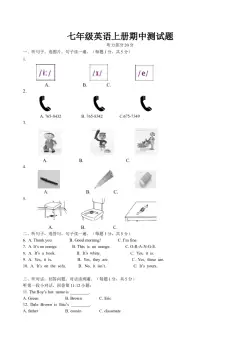
一、听录音,选出你所听到的单词。每个单词你将听两遍。(共5 分,每小题1 分)
1. A. right                   B. light
2. A. here
B. hair
3. A. shout
B. short
4. A. choose
B. chose
5. A. Kate
B. kite
二、听录音,选出与你所听到的内容相符的选项。(共5 分,每小题1 分)
6. A. You can come too.          B. Yes, I’d love to.
C. It’s going to be great.
7. A. It’s beautiful.              B. I love his music.
C. Well, I like both.
8. A. It took three weeks.         B. Three weeks ago.        C. For three weeks.
9. A. She was friendly.           B. She was in primary school.
C. She liked singing.
10. A. That’s right.              B. You’re welcome.
C. Certainly.
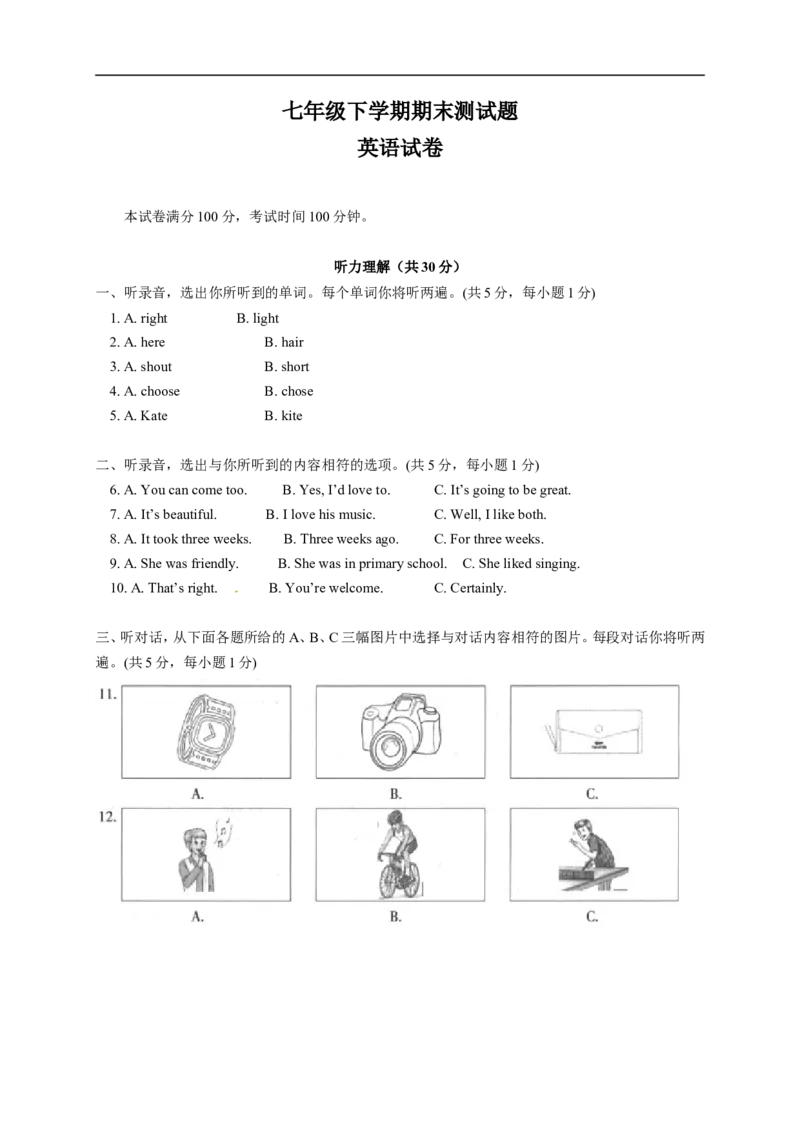
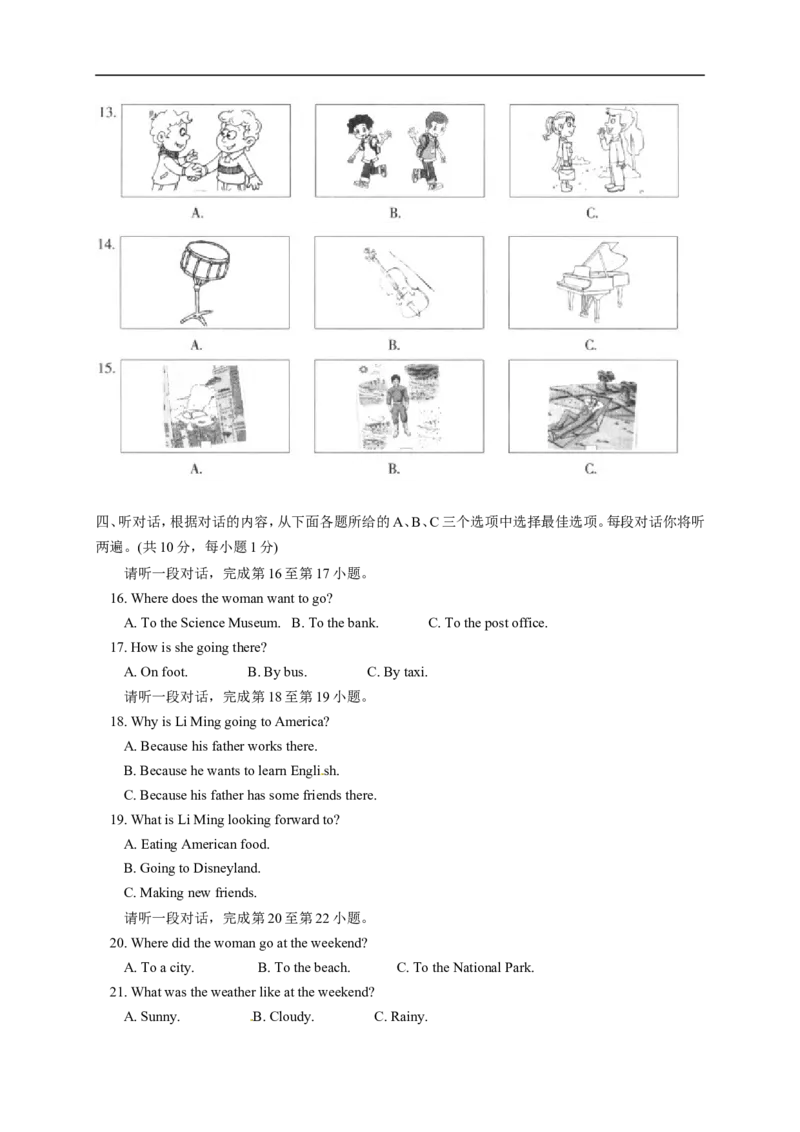
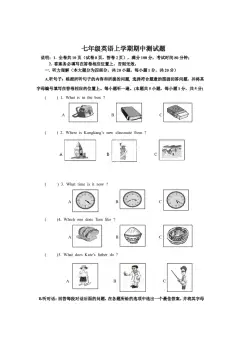
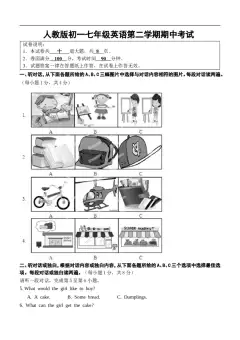
三、听对话,从下面各题所给的A、B、C 三幅图片中选择与对话内容相符的图片。每段对话你将听两
遍。(共5 分,每小题1 分)
四、听对话,根据对话的内容,从下面各题所给的A、B、C 三个选项中选择最佳选项。每段对话你将听
两遍。(共10 分,每小题1 分)
请听一段对话,完成第16 至第17 小题。
16. Where does the woman want to go?[来源:学科网ZXXK]
A. To the Science Museum.   B. To the bank.              C. To the post office.
17. How is she going there?
A. On foot.                 B. By bus.                 C. By taxi.
请听一段对话,完成第18 至第19 小题。
18. Why is Li Ming going to America?
A. Because his father works there.
B. Because he wants to learn Engli sh.
C. Because his father has some friends there.
19. What is Li Ming looking forward to?
A. Eating American food.
B. Going to Disneyland.
C. Making new friends.
请听一段对话,完成第20 至第22 小题。
20. Where did the woman go at the weekend?
A. To a city.                  B. To the beach.             C. To the National Park.
21. What was the weather like at the weekend?
A. Sunny.                    B. Cloudy.                 C. Rainy.
22. What did the man do on Sunday?
A. He took an exam.          B. He went over lessons.       C. He went swimming.
请听一段对话,完成第23 至第25 小题。
23. How many kilos of apples does the man want to buy?
A. One.                      B. Two.                  C. Six.
24. How much are the bananas?
A. Sixteen yuan a kilo.         B. Ten yuan a kilo.          C. Eight yuan a kilo.
25. What fruit can’t the man buy in the store?
A. Strawberries.               B. Oranges.               C. Pears.
五、听对话,根据所听到的对话内容和提示词语,将所缺的关键信息填写在相应位置上。对话你将听
两遍。(共5 分,每小题1 分)
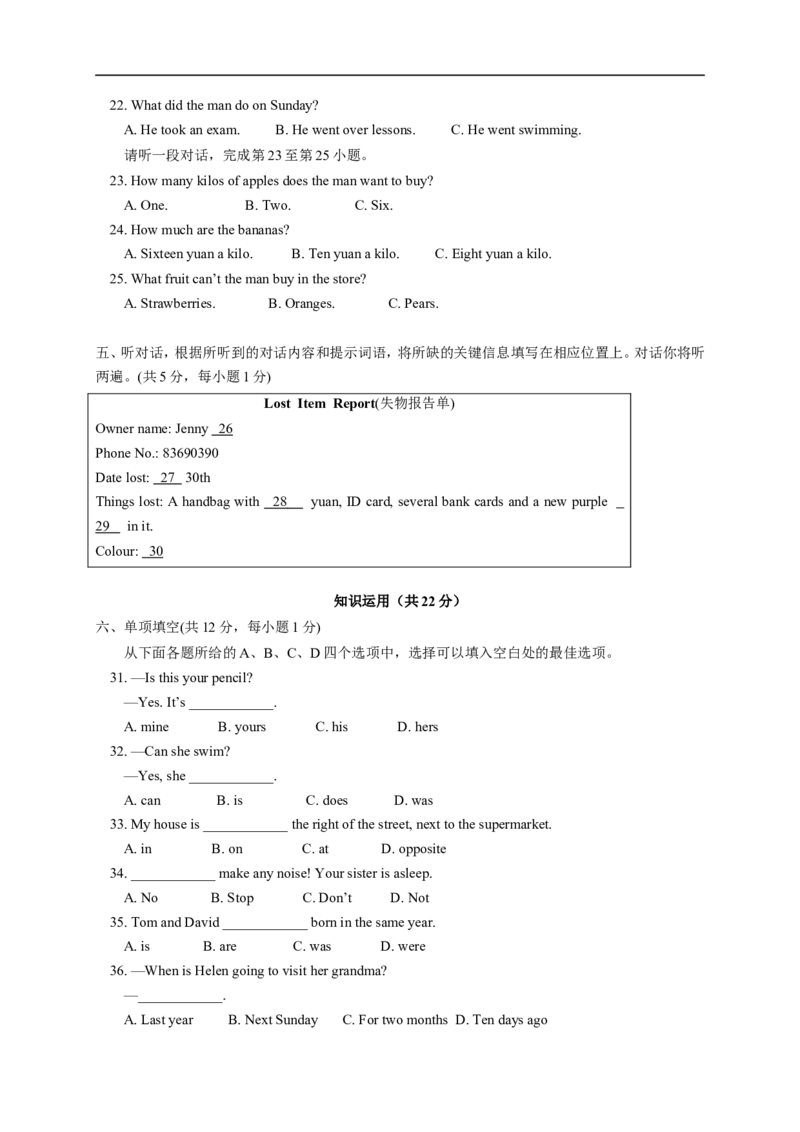
Lost Item Report(失物报告单)
Owner name: Jenny   26
Phone No.: 83690390
Date lost:   27   30th
Things lost: A handbag with   28


   yuan, ID card, several bank cards and a new purple
29    in it.
Colour:   30
知识运用(共22 分)
六、单项填空(共12 分,每小题1 分)
从下面各题所给的A、B、C、D 四个选项中,选择可以填入空白处的最佳选项。
31. —Is this your pencil?
—Yes. It’s ____________.
A. mine              B. yours              C. his              D. hers
32. —Can she swim?
—Yes, she ____________.
A. can                B. is                  C. does             D. was
33. My house is ____________ the right of the street, next to the supermarket.
A. in                 B. on                 C. at               D. opposite
34. ____________ make any noise! Your sister is asleep.
A. No               B. Stop              C. Don’t           D. Not
35. Tom and David ____________ born in the same year.
A. is               B. are                C. was              D. were
36. —When is Helen going to visit her grandma?
—____________.
A. Last year          B. Next Sunday       C. For two months  D. Ten days ago
37. There ____________ a computer on every desk in the future.
A. has              B. will be             C. will have        D. is
38. Lily ____________ some presents for her friends when she was in London last month.
A. buy              B. buys              C. is buying        D. bought
39. —____________ is that T-shirt?
—Sixty-eight yuan.
A. How much         B. How many         C. What size        D. What colour
40. David ____________ from London and he is British.
A. come              B. coming            C. came            D. comes
41. There isn’t ____________ in the box.[来源:学|科|网Z|X|X|K]
A. anything          B. something         C. everything       D. nothing
42. —Did he ____________ to work by bus yesterday?
—Yes, he did.
A. go               B. went               C. goes             D. going
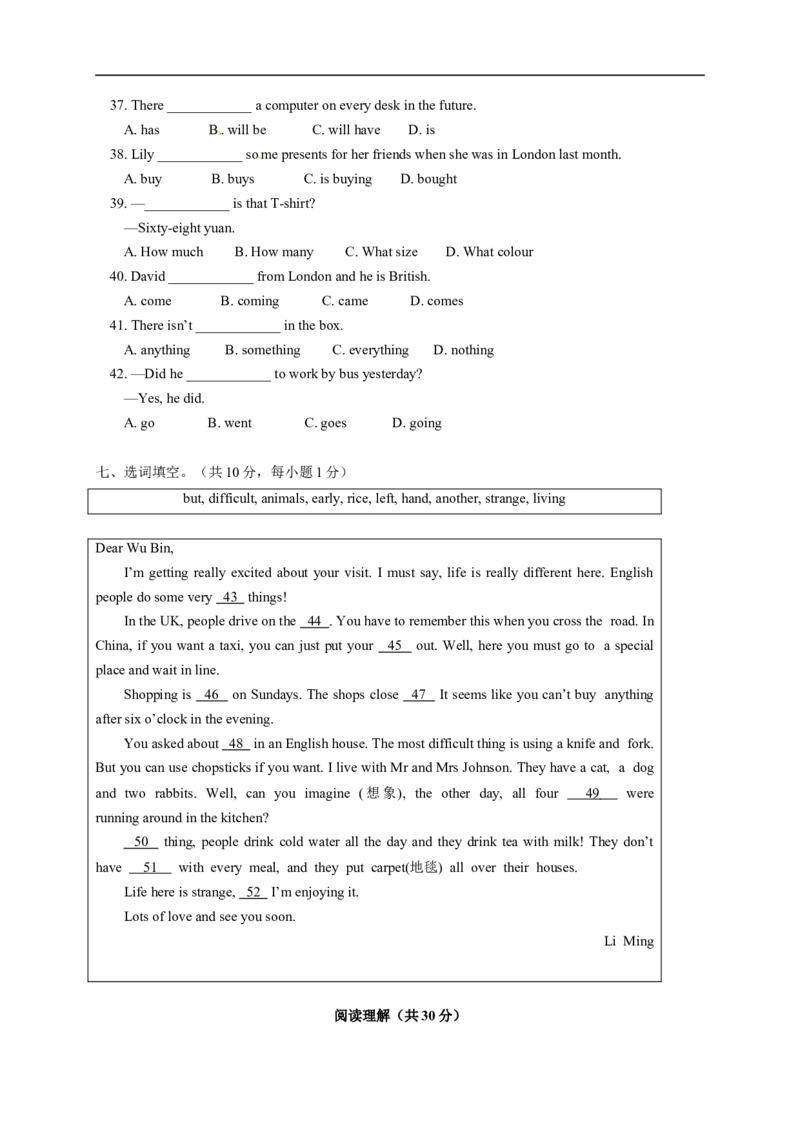
七、选词填空。(共10 分,每小题1 分)
but, difficult, animals, early, rice, left, hand, another, strange, living
Dear Wu Bin,
I’m getting really excited about your visit. I must say, life is really different here. English
people do some very   43   things!
In the UK, people drive on the   44  . You have to remember this when you cross the road. In
China, if you want a taxi, you can just put your   45   out. Well, here you must go to a special
place and wait in line.
Shopping is   46   on Sundays. The shops close   47   It seems like you can’t buy anything
after six o’clock in the evening.
You asked about   48   in an English house. The most difficult thing is using a knife and fork.
But you can use chopsticks if you want. I live with Mr and Mrs Johnson. They have a cat, a dog
and two rabbits. Well, can you imagine (想象), the other day, all four
  49

   were
running around in the kitchen?
  50   thing, people drink cold water all the day and they drink tea with milk! They don’t
have
  51

   with every meal, and they put carpet(地毯) all over their houses.
Life here is strange,   52   I’m enjoying it.
Lots of love and see you soon.
Li Ming
阅读理解(共30 分)
八、阅读下列短文,根据短文内容,从短文后各题所给的A、B、C、D 四个选项中,选择最佳选项。(共
20 分,每小题2 分)
A
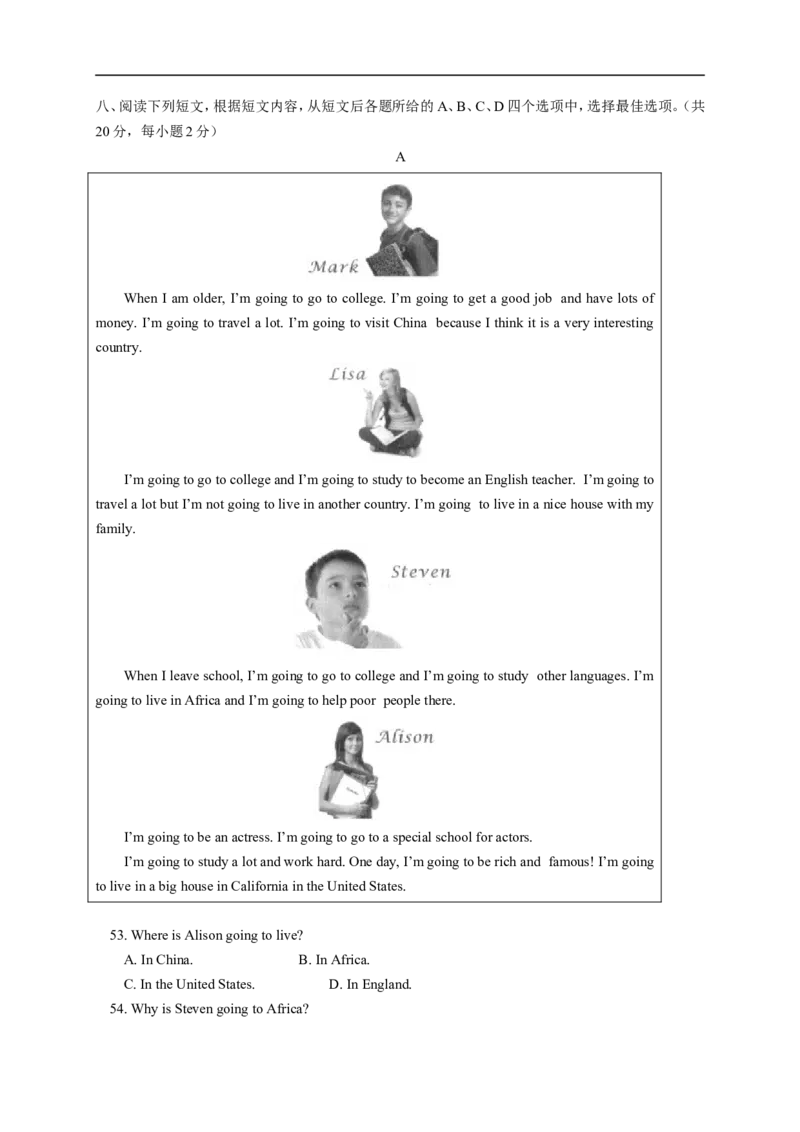
When I am older, I’m going to go to college. I’m going to get a good job and have lots of
money. I’m going to travel a lot. I’m going to visit China because I think it is a very interesting
country.
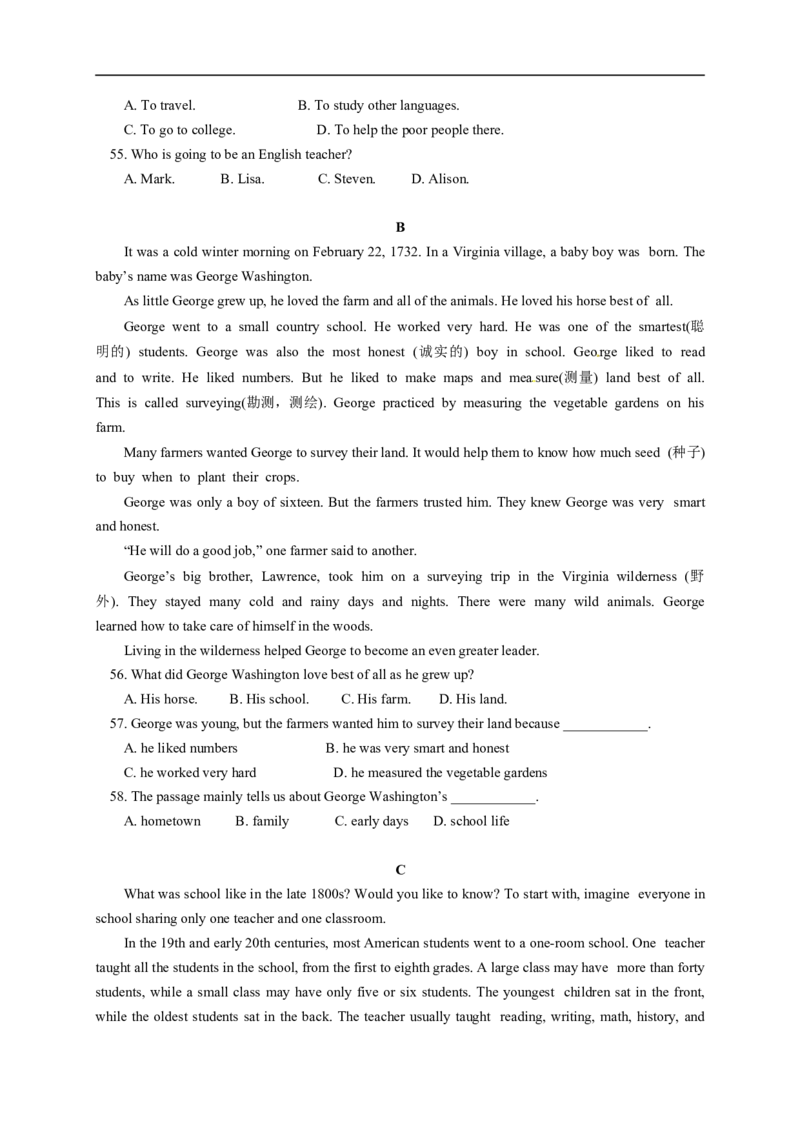
I’m going to go to college and I’m going to study to become an English teacher. I’m going to
travel a lot but I’m not going to live in another country. I’m going to live in a nice house with my
family.
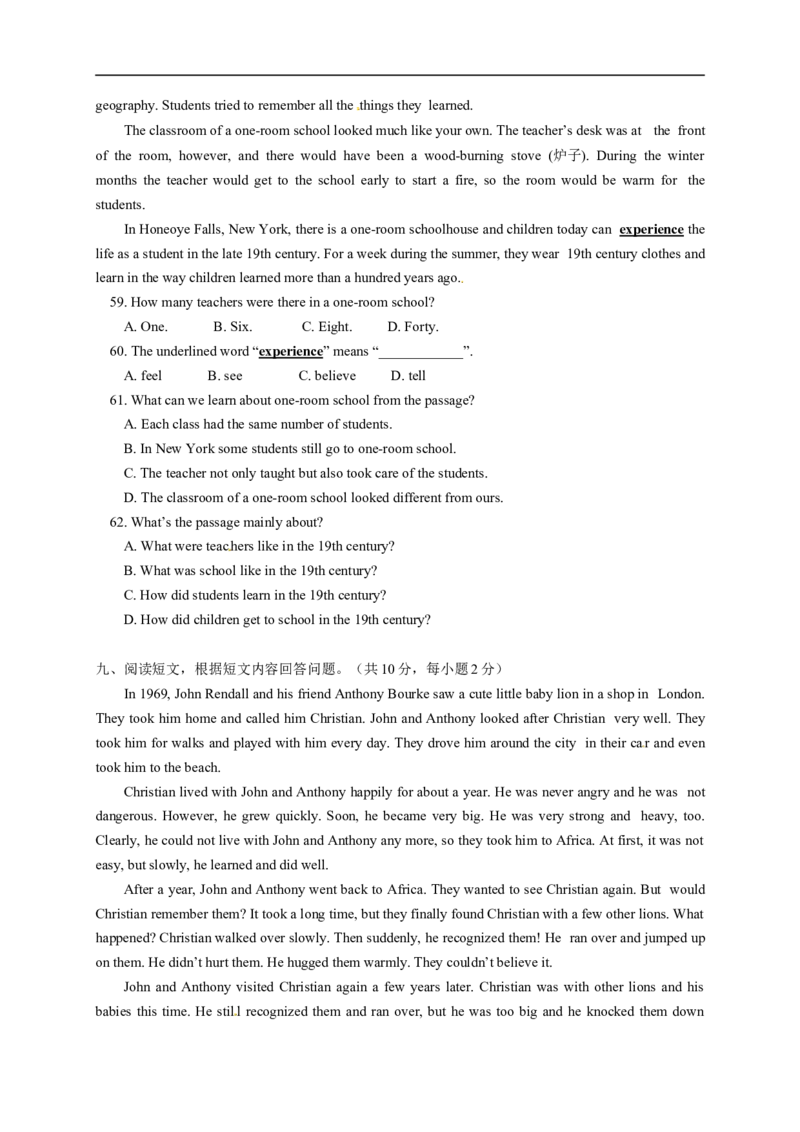
When I leave school, I’m going to go to college and I’m going to study other languages. I’m
going to live in Africa and I’m going to help poor people there.
I’m going to be an actress. I’m going to go to a special school for actors.
I’m going to study a lot and work hard. One day, I’m going to be rich and famous! I’m going
to live in a big house in California in the United States.
53. Where is Alison going to live?
A. In China.                              B. In Africa.
C. In the United States.                     D. In England.
54. Why is Steven going to Africa?
A. To travel.                             B. To study other languages.
C. To go to college.                       D. To help the poor people there.
55. Who is going to be an English teacher?
A. Mark.             B. Lisa.               C. Steven.          D. Alison.
B
It was a cold winter morning on February 22, 1732. In a Virginia village, a baby boy was born. The
baby’s name was George Washington.
As little George grew up, he loved the farm and all of the animals. He loved his horse best of all.
George went to a small country school. He worked very hard. He was one of the smartest(聪
明的) students. George was also the most honest (诚实的) boy in school. George liked to read
and to write. He liked numbers. But he liked to make maps and mea sure(测量) land best of all.
This is called surveying(勘测,测绘). George practiced by measuring the vegetable gardens on his
farm.
Many farmers wanted George to survey their land. It would help them to know how much seed (种子)
to buy when to plant their crops.
George was only a boy of sixteen. But the farmers trusted him. They knew George was very smart
and honest.
“He will do a good job,” one farmer said to another.
George’s big brother, Lawrence, took him on a surveying trip in the Virginia wilderness (野
外). They stayed many cold and rainy days and nights. There were many wild animals. George
learned how to take care of himself in the woods.
Living in the wilderness helped George to become an even greater leader.
56. What did George Washington love best of all as he grew up?
A. His horse.         B. His school.         C. His farm.        D. His land.
57. George was young, but the farmers wanted him to survey their land because ____________.
A. he liked numbers                         B. he was very smart and honest
C. he worked very hard                      D. he measured the vegetable gardens
58. The passage mainly tells us about George Washington’s ____________.
A. hometown          B. family             C. early days       D. school life
C
What was school like in the late 1800s? Would you like to know? To start with, imagine everyone in
school sharing only one teacher and one classroom.
In the 19th and early 20th centuries, most American students went to a one-room school. One teacher
taught all the students in the school, from the first to eighth grades. A large class may have more than forty
students, while a small class may have only five or six students. The youngest children sat in the front,
while the oldest students sat in the back. The teacher usually taught reading, writing, math, history, and
geography. Students tried to remember all the things they learned.
The classroom of a one-room school looked much like your own. The teacher’s desk was at  the front
of the room, however, and there would have been a wood-burning stove (炉子). During the winter
months the teacher would get to the school early to start a fire, so the room would be warm for the
students.
In Honeoye Falls, New York, there is a one-room schoolhouse and children today can experience the
life as a student in the late 19th century. For a week during the summer, they wear 19th century clothes and
learn in the way children learned more than a hundred years ago.
59. How many teachers were there in a one-room school?
A. One.             B. Six.              C. Eight.          D. Forty.
60. The underlined word “experience” means “____________”.
A. feel             B. see                C. believe          D. tell
61. What can we learn about one-room school from the passage?
A. Each class had the same number of students.
B. In New York some students still go to one-room school.
C. The teacher not only taught but also took care of the students.
D. The classroom of a one-room school looked different from ours.
62. What’s the passage mainly about?
A. What were teachers like in the 19th century?
B. What was school like in the 19th century?
C. How did students learn in the 19th century?
D. How did children get to school in the 19th century?
九、阅读短文,根据短文内容回答问题。(共10 分,每小题2 分)
In 1969, John Rendall and his friend Anthony Bourke saw a cute little baby lion in a shop in London.
They took him home and called him Christian. John and Anthony looked after Christian very well. They
took him for walks and played with him every day. They drove him around the city in their car and even
took him to the beach.
Christian lived with John and Anthony happily for about a year. He was never angry and he was not
dangerous. However, he grew quickly. Soon, he became very big. He was very strong and heavy, too.
Clearly, he could not live with John and Anthony any more, so they took him to Africa. At first, it was not
easy, but slowly, he learned and did well.
After a year, John and Anthony went back to Africa. They wanted to see Christian again. But would
Christian remember them? It took a long time, but they finally found Christian with a few other lions. What
happened? Christian walked over slowly. Then suddenly, he recognized them! He ran over and jumped up
on them. He didn’t hurt them. He hugged them warmly. They couldn’t believe it.
John and Anthony visited Christian again a few years later. Christian was with other lions and his
babies this time. He stil l recognized them and ran over, but he was too big and he knocked them down
easily. John and Anthony were sad to leave him, but they were also happy to see Christian live freely in
Africa.
63. What did John and Anthony do when they saw the baby lion?
64. How long did Christian live with John and Anthony?
65. Why did they take Christian to Africa?
66. Was it easy for Christian to live in Africa at first?
67. How many times(次数) did John and Anthony go to see Christian?
书面表达(共18 分)
十、完成句子(共8 分,每小题2 分)
根据中文意思完成句子。
68. 我擅长踢足球。
I ____________ playing football.
69. 莎士比亚不仅是一个作家也是一个演员。
Shakespeare was ____________ a writer ____________ an actor.
70. 注意!来了一辆车。
____________! Here comes a car.
71. 你上周乘坐火车去上海花了多长时间?
____________ go to Shanghai by train last week?
十一、文段表达(10 分)
根据中文大意和英文提示词语,写出意思连贯、符合逻辑、不少于50 词的短文。所给的英文提示
词语仅供选用。请不要写出你的校名和姓名。
72. 假如你叫李华,最近和美国朋友Jim 通过邮件谈论各自的校园生活,他想了解一些你上小学时
的事情。请你根据他的问题回复邮件。
提示词语:do one’s homework,help,play,happy
To
Jim
From
Li Hua
Subject My past life
Hi! Jim,
I’m
glad
to
hear
from
you.
____________________________________________________
______________________________________________________________________________
______________________________________________________________________________
______________________________________________________________________________
Yours,
Li Hua
【试题答案】
听力理解(共30 分)
一、听录音,选单词。(共5 分,每小题1 分)
1. A  2. B  3. A  4. A  5. B
二、听录音,选句子。(共5 分,每小题1 分)
6. B  7. C  8. C  9. A  10. C
三、听对话,选图。(共5 分,每小题1 分)
11. B  12. C  13. A  14. B  15. C
四、听对话或独白,选择答案。(共10 分,每小题1 分)[来源:学科网ZXXK]
16. A  17. B  18. C  19. C  20. C  21. A  22. B  23. B  24. B  25. A
五、听对话,记录关键信息。(共5 分,每小题1 分)
26. Alda  27. May  28. 200  29. watch  30. black
知识运用(共22 分)
六、单项填空(共12 分,每小题1 分)
31. A  32. A  33. B  34. C  35. D  36. B  37. B  38. D  39. A  40. D  41. A  42. A
七、选词填空(共10 分,每小题1 分)
43. strange  44. left  45. hand  46. difficult  47. early
48. living   49. animals  50. Another  51. rice    52. but
阅读理解(共30 分)
八、阅读短文,选择最佳选项。(共20 分,每小题2 分)
53. C  54. D  55. B  56. A  57. B  58. C  59. A  60. A  61. C  62. B
九、阅读短文,回答问题。(共10 分,每小题2 分)
63. They took him home.
64. For about a year.
65. Because he became very big and he was very strong and heavy.
66. No, it wasn’t.
67. Twice.
书面表达(共18 分)
十、完成句子(共8 分,每小题2 分)
68. am good at
69. not only; but also
70. Be careful
71. How long did it take you to
十一、文段表达(10 分)
72. One possible version:
Hi! Jim,
I’m glad to hear from you. I went to Yu Ying Primary School. It was small but beautiful. Wang Hui
and Liu Bo were my first friends. We often went to school together in the morning. After school, we did
our homework and helped each other with our lessons. At weekends, we played basketball or had some
other games. We really spent a lot of happy time together.
Yours,
Li Hua
文段表达评分标准:
第一档:(10~9 分)
完全符合题目要求,观点正确,要点齐全。句式多样,词汇丰富。语言准确,语意连贯,表达清楚,
具有逻辑性。
第二档:(8~6 分)
基本符合题目要求,观点正确,要点齐全。语法结构和词汇基本满足文章需要。语言基本通顺,语
意基本连贯,表达基本清楚。虽然有少量语言错误,但不影响整体理解。
第三档:(5~3 分)
部分内容符合题目要求,要点不齐全。语法结构和词汇错误较多,语言不通顺,表达不够清楚,影
响整体理解。
第四档:(2~0 分)
与题目有关内容不多,只是简单拼凑提示词语,所写内容难以理解。
听力录音材料:
1. right  2. hair  3. shout  4. choose  5. kite
6. Would you like to join us?
7. Do you like traditional music or pop music?
8. How long are you going to stay in Shanghai?
9. What was your first friend like?
10. Can you tell me the way to Wangfujing Dajie?
11. W: Whose camera is this?
M: It’s Tony’s.
12. W: Which club are you in, Daming?
M: I play table tennis, so I am in the Table Tennis Club.
13. W: What are they doing?
M: They are shaking hands.[来源:学科网ZXXK]
14. W: Listen. Who is playing the violin?
M: Maybe it’s Mr White. I’m not sure.
15. W: Will people do heavy jobs in the future?
M: No. Machines and robots will do heavy and difficult jobs and people will have a lot of time to
relax.
16. W: Excuse me. I need to go to the Science Museum. Can you tell me how to get there?
M: Sure. Walk down Park Road. Then turn left into Flower Street.
W: Flower Street?
M: Yeah. Go down the Flower Street and the Science Museum is on the left, next to the bank. It’s
opposite the post office.
W: Can I take a bus?
M: Yes. You can take a No. 10 bus there. The bus stop is over there.
W: OK. I’ll take a bus, Thanks very much.
M: You’re welcome.
17. W: What are you going to do this summer, Li Ming?
M: I’m going to visit America.
W: Wow! That’s a long way. Why America?
M: Because my father has got friends there.
W: Oh, that’s good.
W: Are you going to go to Disneyland?
M: I don’t want to go there.
W: So what are you looking forward to?
M: Lots of things. I’m looking forward to making new friends, and to speaking English.
W: And are you looking forward to American food, too?
M: Er no, not really.
18. M: Hi, Jenny, did you have a good weekend?
W: Yes, it was fantastic. We went to the National Park and went walking in the mountains.
M: Great. How was the weather?
W: Fine. There wasn’t a cloud in the sky. We could see for miles from the top. What about you, what
did you do?
M: On Saturday, I went to the beach with my family. We swam there. But on Sunday, I stayed at
home and went over lessons. You know, I am going to take an English exam.
W: It’s on Friday, isn’t it?
M: Yes. Five days to go.
W: Good luck!
19. W: Can I help you?
M: Yes. I’d like some apples, please. Some of the green ones. How much are they?
W: Sixteen yuan a kilo. How many kilos of apples would you like?
M: Two kilos.
W: OK. What else would you like?
M: And some bananas. How much are they?
W: Ten yuan a kilo. How many would you like?
M: Six. Have you got any strawberries?
W: Um... no, we haven’t. We had a few last week, but there aren’t many strawberries at the moment.
But we’ve got some nice oranges. And the pears are fresh too.
20. M: Good morning, madam. Can I help you?
W: Yes. I lost my handbag on the train from Shanghai to Beijing.
M: When did it happen?
W: Last Friday. May 30th.
M: Is there much money in the bag?
W: No, only two hundred yuan. There was also my ID card and several bank cards.
M: OK. What else?
W: I had a new purple watch in it.
M: What color is your handbag?
W: Black.[来源:学科网]
M: Madam, may I have your name?
W: Jenny Alda. Alda, A-L-D-A. And you can call me at 83690390.
M: OK. We’ll call you when we find it.
W: Thank you very much.
M: You’re welcome.