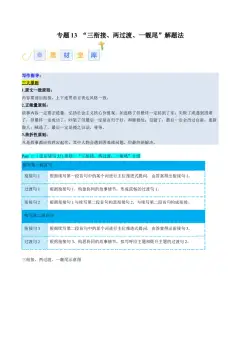
专题04 结构技巧321 原则:三衔接·两过渡·一靓尾
写作指导:
三大原则
1.原文一致原则:
内容要前后衔接,上下连贯语言表达风格一致。
2.正能量原则:
故事内容一定要正能量,弘扬社会主义核心价值观。如迷路了但最终一定回到了家;失败了或遇到困难
了,但最终一定成功了;吵架了但最后一定是言归于好,和睦相处;犯错了,最后一定会改过自新,重新
做人;贼逃了,最后一定是绳之以法,等等。
3.曲折性原则:
凡是故事都应有跌宕起伏,其中人物会遇到困难或问题,但最终能解决。
Part 1 (321 原则)“三衔接、两过渡、一靓尾”介绍
续写第一段首句
衔接句1
根据续写第一段首句中的某个词进行主位推进式提问,由答案得出衔接句1。
过渡句1
根据衔接句1,构建协同的故事情节,形成流畅的过渡句1。
衔接句2
根据衔接句1 与续写第二段首句构思衔接句2,与续写第二段首句构成衔接。
续写第二段首句
衔接句3
根据续写第二段首句中的某个词进行主位推进式提问,由答案得出衔接句3。
过渡句2
根据衔接句3,构思协同的故事情节,拟写呼应主题和提升主题的过渡句2。

核心要义解读:
“三衔接”是骨架:它确保了故事与题目所给句子紧密相连,绝不跑题。衔接句1 和衔接句3 是故事的起
点,衔接句2 是连接两段的桥梁。
“两过渡”是血肉:它们位于段落中部,是故事发展的主体。通过具体的动作、对话和细节描写,让故事
丰满、生动、有波澜。
“一靓尾”是灵魂:它是故事的落脚点,通过一句富有哲理的感悟,将普通故事提升到新的高度,留下余
味。
三衔接、两过渡、一靓尾示意图

Part 2 真题实战示例
示例1--运用“三衔接、两过渡、一靓尾”解答2025 年全国一卷
My wife and I wanted to share our new home with family and friends by hosting a small gathering in the
early summer. She had prepared lots of snacks, while my job was to have the backyard in order.
There was plenty of space for the kids to run and play. There was just one thing I hadn’t counted on: My
brother chose to bring his dog Toby, a 50-pound ball of fire. Though friendly, he could easily knock over my niece’s
small boys and my six-month-old granddaughter. So, when my brother showed up, I asked him to watch Toby and
keep him outside.
My plan was working out just fine. Toby was using up his energy by running back and forth in the backyard
and giving the kids plenty of room. Unexpectedly, after supper, the weather changed. It started to rain and everyone
went indoors.
It was an awkward moment. I didn’t want Toby to be running around in the house, and my brother wasn’t
happy with driving home with a wet dog. Eventually, my brother decided to leave rather than force the issue.
A few days passed, and I hadn’t heard anything from my brother. I texted him and expressed wishes for him
to come out again. His reply came as a surprise — a shock, actually: “Not a chance.” Clearly, he was unhappy over
the way we had parted. After all, I had left him little choice. Well, he’ll get over it, I reasoned.
Two months passed. My wife suggested I get in touch with my brother, but I resisted, thinking he should call
first. However, my conscience (良心) kept bothering me. I tried to put myself in my brother’s shoes. He was facing
health issues and his wife of thirty-five years had passed away a few months earlier. Toby was his constant
companion, the one who kept him going.
注意:
(1)续写词数应为150 个左右;
(2)请按如下格式在答题卡的相应位置作答。
I realized it was me who was at fault.
____________________________________________________________________________________________
____________________________________________________________________________________________
____________________________________________________________________________________________
____________________________________________________________________________________________
____________________________________________________________________________________________
_______________
With the biscuits my wife had made, I arrived at my brother’s door.
_________________________________________________________________________________
_________________________________________________________________________________
_________________________________________________________________________________
_________________________________________________________________________________
_________________________________________________________________________________
_______________________________________________________
第一步:明确续写的核心任务:
情感基调:从“我”的自责与反思,转向主动和解与行动。
情节发展:第一段应着重描写“我”的内心挣扎与和解决定;第二段应描写“我”登门拜访及与兄弟和解
的过程。
主题升华:应落脚于亲情、理解、陪伴的重要性,以及主动迈出第一步的勇气。
第二步用“三衔接、两过渡、一靓尾”方法论进行具体构思
第一段续写 (围绕 “I realized it was me who was at fault.”)
1. 衔接句 1
方法:对首句关键词 “at fault” 进行主位推进式提问:我具体错在哪里?我意识到了什么?
构思句:I had prioritized the cleanliness of my house over my brother's loneliness and the comfort he drew from
his only companion, Toby.
功能:情节与情感衔接。直接阐释“过错”的具体内容,将矛盾从“狗的问题”深化为“对兄弟情感需求
的忽视”,推动情节向内省发展。
2. 过渡句 1
方法:承接“衔接句1”中关于“兄弟孤独”的内容,构建协同情节,即“我”下一步的自然行动。
构思句:This realization washed over me, replacing my stubborn pride with a pressing need to apologize.
功能:逻辑/心理过渡。描写了“我”从“固执”到“急需道歉”的心理转变,为下文拿起电话或准备拜访
的行动做铺垫,使段落内部流畅。
3. 衔接句 2
方法:此句需作为桥梁,既要总结第一段“我”的决定,又要为第二段首句“带着饼干上门”的行动提供
逻辑铺垫。
构思句:Knowing that a simple "sorry" over the phone wouldn't suffice, I decided a sincere, face-to-face gesture
was necessary.
功能:段落与逻辑衔接。解释了为什么“我”不是发个信息而是亲自登门,完美地衔接了“内心决定”和
“登门行动”两个段落。
第二段续写 (围绕 “With the biscuits my wife had made, I arrived at my brother’s door.”)
4. 衔接句 3
方法:对第二段首句关键词 “arrived at my brother’s door” 进行主位推进式提问:我到门口后,做了什
么?看到了什么?心情如何?
构思句:My heart pounded as I rang the bell, clutching the box of biscuits like a peace offering.
功能:情节与情感衔接。延续了登门的动作,并通过“心跳加速”和“和平礼物”的比喻,生动地描绘了
紧张与期盼交织的心理,推动了“见面”这一核心情节。
5. 过渡句 2
方法:承接“衔接句3”的紧张情绪,构思协同情节,即兄弟的反应和“我”的应对,并开始将主题向“和
解与陪伴”提升。
构思句:When he opened the door, his eyes briefly showed surprise before softening at the sight of the biscuits —
a taste of family and care he had been missing.
功能:情节推进与主题提升。这个过渡句非常关键,它描绘了哥哥态度从“惊讶”到“软化”的转变,而
“家的味道”这一表述开始呼应“陪伴”这一深层主题,为最终的靓尾做足了铺垫。
6. 一靓尾
方法:依托“过渡句2”中哥哥态度软化的良好基础,完成最终的情感收束与主题升华。
构思句:"I've missed you," I said, my voice thick with emotion. He finally smiled, stepping aside, "Come in. Toby
will be happy to see you too."
功能:主题升华与情感收束。通过简洁有力的对话,直接表达了思念(情感收束),而哥哥的邀请和特意
提到Toby,则象征着隔阂的彻底消除与亲情的回归,完美升华了“爱与包容”的主题。
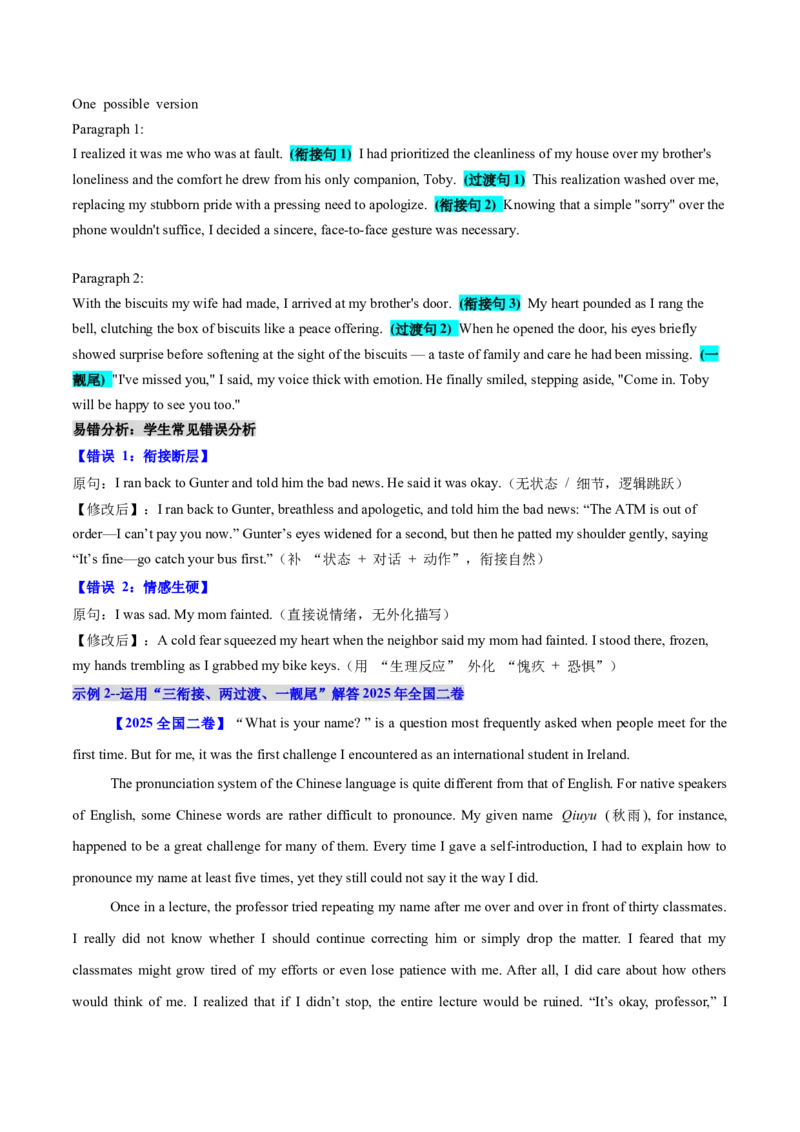
One possible version
Paragraph 1:
I realized it was me who was at fault. (衔接句1) I had prioritized the cleanliness of my house over my brother's
loneliness and the comfort he drew from his only companion, Toby. (过渡句1) This realization washed over me,
replacing my stubborn pride with a pressing need to apologize. (衔接句2) Knowing that a simple "sorry" over the
phone wouldn't suffice, I decided a sincere, face-to-face gesture was necessary.
Paragraph 2:
With the biscuits my wife had made, I arrived at my brother's door. (衔接句3) My heart pounded as I rang the
bell, clutching the box of biscuits like a peace offering. (过渡句2) When he opened the door, his eyes briefly
showed surprise before softening at the sight of the biscuits — a taste of family and care he had been missing. (一
靓尾) "I've missed you," I said, my voice thick with emotion. He finally smiled, stepping aside, "Come in. Toby
will be happy to see you too."
易错分析:学生常见错误分析
【错误 1:衔接断层】
原句:I ran back to Gunter and told him the bad news. He said it was okay.(无状态 / 细节,逻辑跳跃)
【修改后】:I ran back to Gunter, breathless and apologetic, and told him the bad news: “The ATM is out of
order—I can’t pay you now.” Gunter’s eyes widened for a second, but then he patted my shoulder gently, saying
“It’s fine—go catch your bus first.”(补 “状态 + 对话 + 动作”,衔接自然)
【错误 2:情感生硬】
原句:I was sad. My mom fainted.(直接说情绪,无外化描写)
【修改后】:A cold fear squeezed my heart when the neighbor said my mom had fainted. I stood there, frozen,
my hands trembling as I grabbed my bike keys.(用 “生理反应” 外化 “愧疚 + 恐惧”)
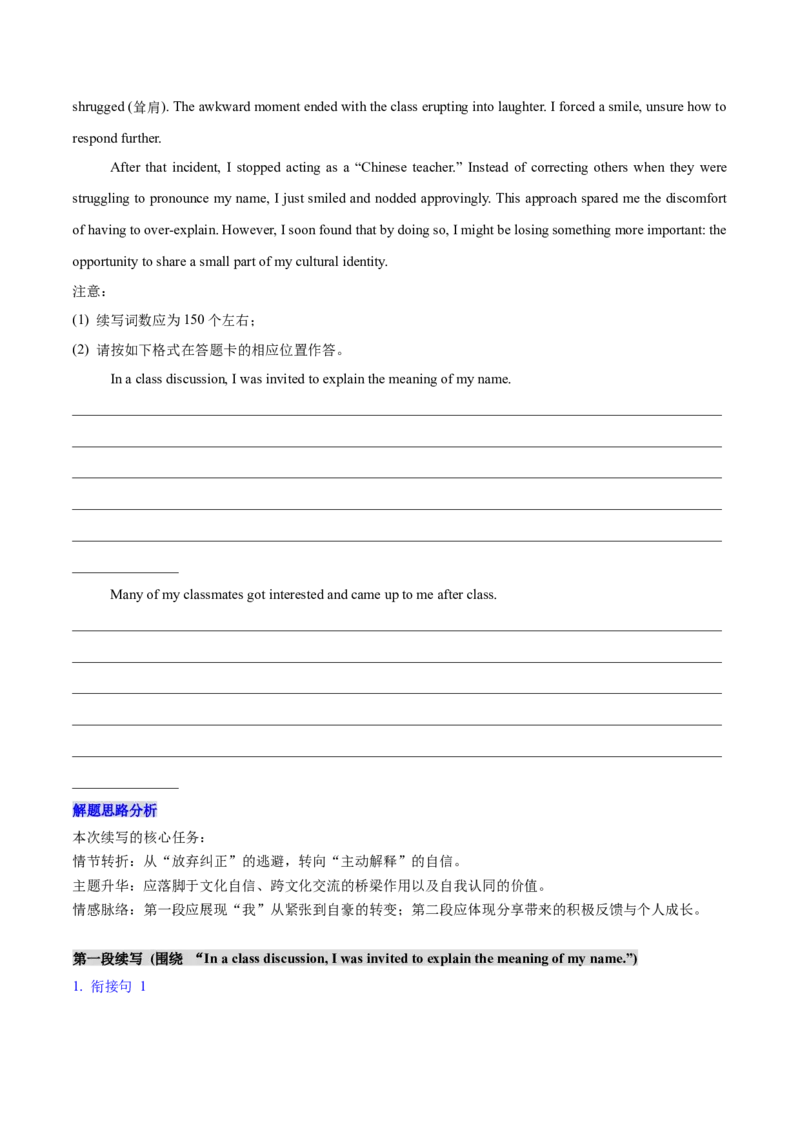
示例2--运用“三衔接、两过渡、一靓尾”解答2025 年全国二卷
【2025 全国二卷】“What is your name? ” is a question most frequently asked when people meet for the
first time. But for me, it was the first challenge I encountered as an international student in Ireland.
The pronunciation system of the Chinese language is quite different from that of English. For native speakers
of English, some Chinese words are rather difficult to pronounce. My given name Qiuyu (秋雨), for instance,
happened to be a great challenge for many of them. Every time I gave a self-introduction, I had to explain how to
pronounce my name at least five times, yet they still could not say it the way I did.
Once in a lecture, the professor tried repeating my name after me over and over in front of thirty classmates.
I really did not know whether I should continue correcting him or simply drop the matter. I feared that my
classmates might grow tired of my efforts or even lose patience with me. After all, I did care about how others
would think of me. I realized that if I didn’t stop, the entire lecture would be ruined. “It’s okay, professor,” I
shrugged (耸肩). The awkward moment ended with the class erupting into laughter. I forced a smile, unsure how to
respond further.
After that incident, I stopped acting as a “Chinese teacher.” Instead of correcting others when they were
struggling to pronounce my name, I just smiled and nodded approvingly. This approach spared me the discomfort
of having to over-explain. However, I soon found that by doing so, I might be losing something more important: the
opportunity to share a small part of my cultural identity.
注意:
(1) 续写词数应为150 个左右;
(2) 请按如下格式在答题卡的相应位置作答。
In a class discussion, I was invited to explain the meaning of my name.
____________________________________________________________________________________________
____________________________________________________________________________________________
____________________________________________________________________________________________
____________________________________________________________________________________________
____________________________________________________________________________________________
_______________
Many of my classmates got interested and came up to me after class.
____________________________________________________________________________________________
____________________________________________________________________________________________
____________________________________________________________________________________________
____________________________________________________________________________________________
____________________________________________________________________________________________
_______________
解题思路分析
本次续写的核心任务:
情节转折:从“放弃纠正”的逃避,转向“主动解释”的自信。
主题升华:应落脚于文化自信、跨文化交流的桥梁作用以及自我认同的价值。
情感脉络:第一段应展现“我”从紧张到自豪的转变;第二段应体现分享带来的积极反馈与个人成长。
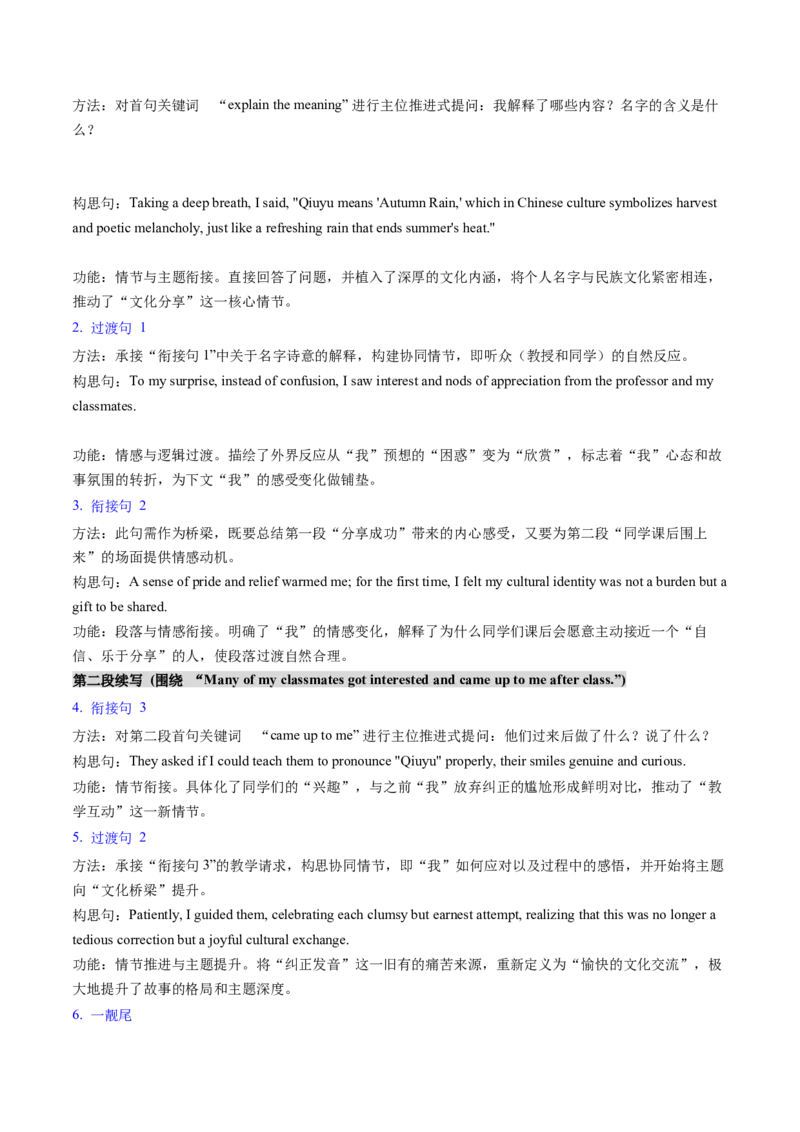
第一段续写 (围绕 “In a class discussion, I was invited to explain the meaning of my name.”)
1. 衔接句 1
方法:对首句关键词 “explain the meaning” 进行主位推进式提问:我解释了哪些内容?名字的含义是什
么?
构思句:Taking a deep breath, I said, "Qiuyu means 'Autumn Rain,' which in Chinese culture symbolizes harvest
and poetic melancholy, just like a refreshing rain that ends summer's heat."
功能:情节与主题衔接。直接回答了问题,并植入了深厚的文化内涵,将个人名字与民族文化紧密相连,
推动了“文化分享”这一核心情节。
2. 过渡句 1
方法:承接“衔接句1”中关于名字诗意的解释,构建协同情节,即听众(教授和同学)的自然反应。
构思句:To my surprise, instead of confusion, I saw interest and nods of appreciation from the professor and my
classmates.
功能:情感与逻辑过渡。描绘了外界反应从“我”预想的“困惑”变为“欣赏”,标志着“我”心态和故
事氛围的转折,为下文“我”的感受变化做铺垫。
3. 衔接句 2
方法:此句需作为桥梁,既要总结第一段“分享成功”带来的内心感受,又要为第二段“同学课后围上
来”的场面提供情感动机。
构思句:A sense of pride and relief warmed me; for the first time, I felt my cultural identity was not a burden but a
gift to be shared.
功能:段落与情感衔接。明确了“我”的情感变化,解释了为什么同学们课后会愿意主动接近一个“自
信、乐于分享”的人,使段落过渡自然合理。
第二段续写 (围绕 “Many of my classmates got interested and came up to me after class.”)
4. 衔接句 3
方法:对第二段首句关键词 “came up to me” 进行主位推进式提问:他们过来后做了什么?说了什么?
构思句:They asked if I could teach them to pronounce "Qiuyu" properly, their smiles genuine and curious.
功能:情节衔接。具体化了同学们的“兴趣”,与之前“我”放弃纠正的尴尬形成鲜明对比,推动了“教
学互动”这一新情节。
5. 过渡句 2
方法:承接“衔接句3”的教学请求,构思协同情节,即“我”如何应对以及过程中的感悟,并开始将主题
向“文化桥梁”提升。
构思句:Patiently, I guided them, celebrating each clumsy but earnest attempt, realizing that this was no longer a
tedious correction but a joyful cultural exchange.
功能:情节推进与主题提升。将“纠正发音”这一旧有的痛苦来源,重新定义为“愉快的文化交流”,极
大地提升了故事的格局和主题深度。
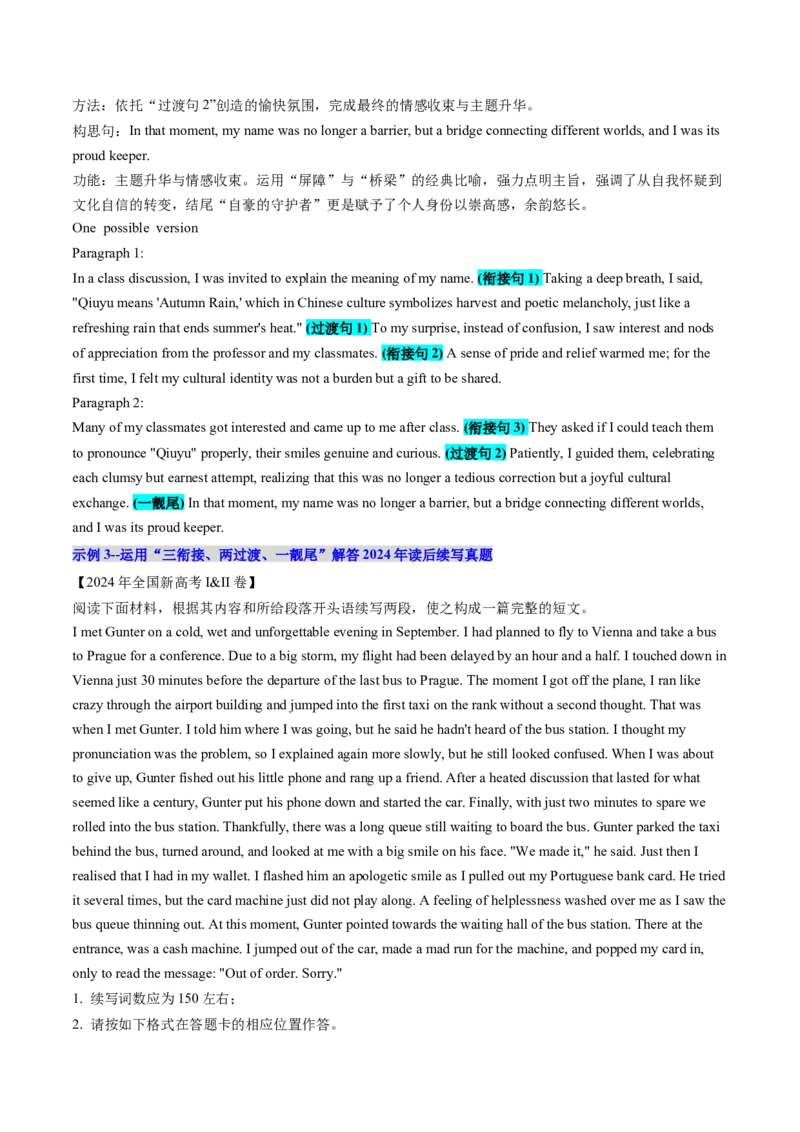
6. 一靓尾
方法:依托“过渡句2”创造的愉快氛围,完成最终的情感收束与主题升华。
构思句:In that moment, my name was no longer a barrier, but a bridge connecting different worlds, and I was its
proud keeper.
功能:主题升华与情感收束。运用“屏障”与“桥梁”的经典比喻,强力点明主旨,强调了从自我怀疑到
文化自信的转变,结尾“自豪的守护者”更是赋予了个人身份以崇高感,余韵悠长。
One possible version
Paragraph 1:
In a class discussion, I was invited to explain the meaning of my name. (衔接句1) Taking a deep breath, I said,
"Qiuyu means 'Autumn Rain,' which in Chinese culture symbolizes harvest and poetic melancholy, just like a
refreshing rain that ends summer's heat." (过渡句1) To my surprise, instead of confusion, I saw interest and nods
of appreciation from the professor and my classmates. (衔接句2) A sense of pride and relief warmed me; for the
first time, I felt my cultural identity was not a burden but a gift to be shared.
Paragraph 2:
Many of my classmates got interested and came up to me after class. (衔接句3) They asked if I could teach them
to pronounce "Qiuyu" properly, their smiles genuine and curious. (过渡句2) Patiently, I guided them, celebrating
each clumsy but earnest attempt, realizing that this was no longer a tedious correction but a joyful cultural
exchange. (一靓尾) In that moment, my name was no longer a barrier, but a bridge connecting different worlds,
and I was its proud keeper.
示例3--运用“三衔接、两过渡、一靓尾”解答2024 年读后续写真题
【2024 年全国新高考I&II 卷】
阅读下面材料,根据其内容和所给段落开头语续写两段,使之构成一篇完整的短文。
I met Gunter on a cold, wet and unforgettable evening in September. I had planned to fly to Vienna and take a bus
to Prague for a conference. Due to a big storm, my flight had been delayed by an hour and a half. I touched down in
Vienna just 30 minutes before the departure of the last bus to Prague. The moment I got off the plane, I ran like
crazy through the airport building and jumped into the first taxi on the rank without a second thought. That was
when I met Gunter. I told him where I was going, but he said he hadn't heard of the bus station. I thought my
pronunciation was the problem, so I explained again more slowly, but he still looked confused. When I was about
to give up, Gunter fished out his little phone and rang up a friend. After a heated discussion that lasted for what
seemed like a century, Gunter put his phone down and started the car. Finally, with just two minutes to spare we
rolled into the bus station. Thankfully, there was a long queue still waiting to board the bus. Gunter parked the taxi
behind the bus, turned around, and looked at me with a big smile on his face. "We made it," he said. Just then I
realised that I had in my wallet. I flashed him an apologetic smile as I pulled out my Portuguese bank card. He tried
it several times, but the card machine just did not play along. A feeling of helplessness washed over me as I saw the
bus queue thinning out. At this moment, Gunter pointed towards the waiting hall of the bus station. There at the
entrance, was a cash machine. I jumped out of the car, made a mad run for the machine, and popped my card in,
only to read the message: "Out of order. Sorry."
1. 续写词数应为150 左右;
2. 请按如下格式在答题卡的相应位置作答。
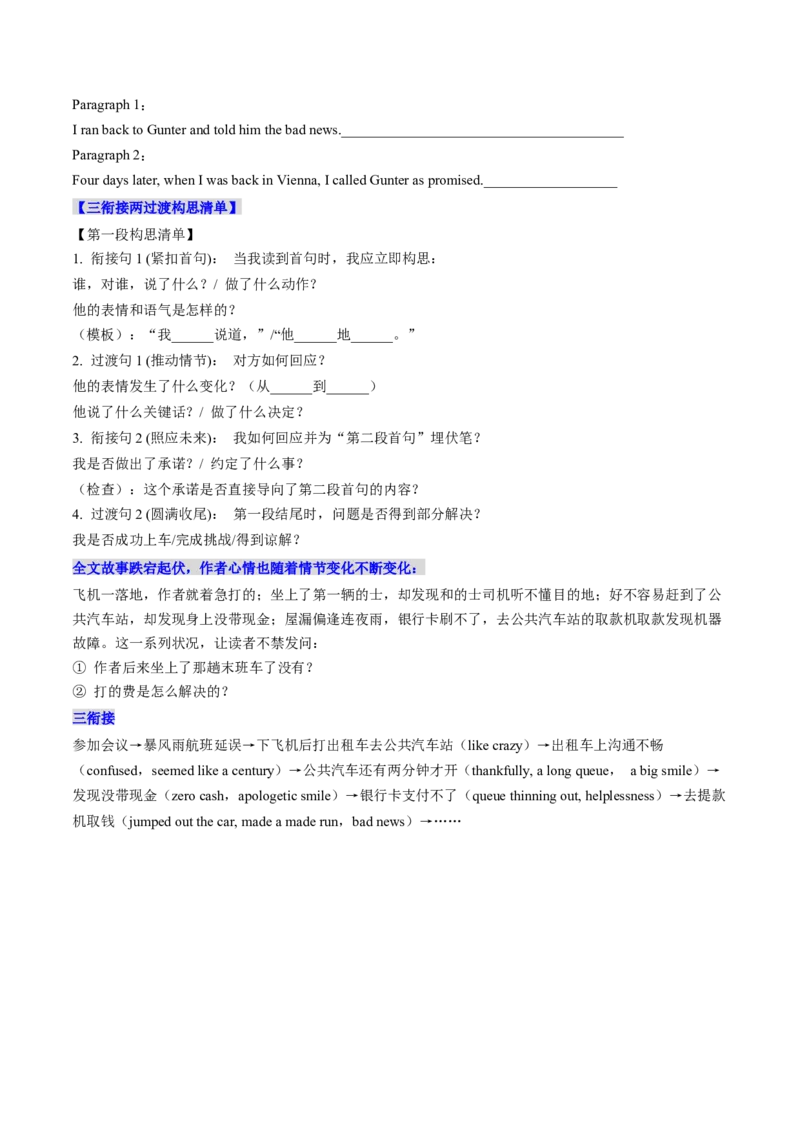
Paragraph 1:
I ran back to Gunter and told him the bad news.________________________________________
Paragraph 2:
Four days later, when I was back in Vienna, I called Gunter as promised.___________________
【三衔接两过渡构思清单】
【第一段构思清单】
1. 衔接句1 (紧扣首句): 当我读到首句时,我应立即构思:
谁,对谁,说了什么?/ 做了什么动作?
他的表情和语气是怎样的?
(模板):“我______说道,”/“他______地______。”
2. 过渡句1 (推动情节): 对方如何回应?
他的表情发生了什么变化?(从______到______)
他说了什么关键话?/ 做了什么决定?
3. 衔接句2 (照应未来): 我如何回应并为“第二段首句”埋伏笔?
我是否做出了承诺?/ 约定了什么事?
(检查):这个承诺是否直接导向了第二段首句的内容?
4. 过渡句2 (圆满收尾): 第一段结尾时,问题是否得到部分解决?
我是否成功上车/完成挑战/得到谅解?
全文故事跌宕起伏,作者心情也随着情节变化不断变化:
飞机一落地,作者就着急打的;坐上了第一辆的士,却发现和的士司机听不懂目的地;好不容易赶到了公
共汽车站,却发现身上没带现金;屋漏偏逢连夜雨,银行卡刷不了,去公共汽车站的取款机取款发现机器
故障。这一系列状况,让读者不禁发问:
① 作者后来坐上了那趟末班车了没有?
② 打的费是怎么解决的?
三衔接
参加会议→暴风雨航班延误→下飞机后打出租车去公共汽车站(like crazy)→出租车上沟通不畅
(confused,seemed like a century)→公共汽车还有两分钟才开(thankfully, a long queue, a big smile)→
发现没带现金(zero cash,apologetic smile)→银行卡支付不了(queue thinning out, helplessness)→去提款
机取钱(jumped out the car, made a made run,bad news)→……

三、续写构思
(一)续写第一段构思
根据续写段第一段首句“I ran back to Gunter and told him the bad news.”和续写段第二段首句提到的“Four
days later, when I was back in Vienna, I called Gunter as promised.”,运用逆向思维可以推断:我把坏消息告
诉了Gunter 后,也对Gunter 做出了承诺了。同时,利用主位推进法和G-N 策略,可以试问:
①【紧扣首句】【衔接句1】“我”说了什么? (直接根据“I ran back... and told him the bad news”进行扩
展)
构思方向:描述“我”气喘吁吁、满怀歉意的具体语言。
② 【推动情节】【过渡句1】他有何反应? (这是情节发展的关键)
构思方向:他的表情(由惊讶转为理解)、动作(摆手、指巴士)和语言(安慰、提出解决方案)。
③【衔接句2】【照应未来】“我”如何回应并承诺? (必须为第二段首句的“I called Gunter as promised”
埋下伏笔)
构思方向:“我”如何感激地接受,并明确做出“回去后一定联系并付钱”的承诺。
④【推动情节】【过渡句2】后来“我”有没有顺利坐上末班公共汽车?
(二)续写第二段构思:
根据续写段第二段段首句“Four days later, when I was back in Vienna, I called Gunter as promised.”,运用主
位推进法和G-N 策略,可以试问:
①【衔接句3】“我”打电话和说Gunter 了什么,Gunter 又回了什么?
②【过渡句2】“我”和Gunter 见面的情景是怎样的?“我”把打的的钱给Gunter 了的?他收了吗?
③【靓尾句】文章结尾升华,整件事情反映了什么?
(三)总结几种常见且高效的“靓尾”句式。
可在“Part 1”部分增加“一靓尾技法库”:
感悟升华式:This experience taught me that... is not about..., but about... (直接套用2025 年全国二卷范文结
尾,万能句式)
比喻收束式:That day, I felt like a... that had finally found its... (That day, I felt like a sapling that had finally
found its sunshine.)
首尾呼应式:Looking at..., I no longer felt the... that had haunted me at the beginning. (Looking at his smiling
face, I no longer felt the anxiety that had haunted me at the beginning.)
动作寓意式:As I [一个简单的动作], I knew everything was going to be okay. (As I reached out and held her
hand, I knew everything was going to be okay.)
三、参考范文
I ran back to Gunter and told him the bad news. His eyes widened for a moment, but then he simply nodded,
understanding the situation. “Don’t worry,” he said, “I trust you. Go catch your bus, and we can settle the fare
later.” I was taken aback by his kindness. I promised to call him as soon as I returned to Vienna to arrange
payment. With a grateful heart, I dashed towards the bus, which, fortunately, was still boarding. Thanks to Gunter, I
made it just in time.
Four days later, when I was back in Vienna, I called Gunter as promised. His voice was warm over the phone, and
he remembered me immediately. “Ah, the conference traveler!” he exclaimed. We met at a small café near the bus
station. I handed him the fare, adding a little extra for his trouble. He tried to refuse the extra money, but I insisted.
“It’s the least I can do,” I said. As we parted ways, I realized that this encounter wasn’t just about settling a debt; it
was a reminder of the unexpected kindness that can be found in strangers.
Writing 1
(重庆市第八中学校2025-2026 学年高三上学期10 月月考)For years, I struggled with self-doubt. It was my
constant companion, even in moments of success, after a kind word from a friend or a fleeting sense of
accomplishment. No achievement seemed enough to silence that inner voice saying, “You don’t belong.”
It started after my diagnosis. Autism (自闭症) wasn’t widely understood back then. My teachers didn’t get
me. My classmates didn’t know what to make of me. The bullying was constant. And through those years, I never
wanted to acknowledge that I was autistic. I tried to hide it. But hiding only made the self-doubt stronger.
Middle school was especially tough. I had back surgery, didn’t pass many exams and kept failing the SATs. It
felt like setback after setback. I remember thinking, “What’s the point?” But something deep inside me whispered,
“Keep going.” So I did. After three tries, I finally passed.
Still, the self-doubt lingered like a shadow in the night, always nearby, always whispering that I wasn’t
enough. The silence I carried was heavy.
To cope, I started writing.
At first, it was just a way to get the thoughts out of my head. I poured everything onto the page: anger,
sadness, confusion, hope. Somehow, writing words down gave shape to feelings I couldn’t express. My voice had
been quiet for so long, but now, on paper, it was starting to come through.
As I wrote, something shifted. I started sharing my story about autism, about the bullying, about the fight to
believe in myself.
With every word, the burden of self-doubt lightened just a bit.
The more I shared, the more I realized something profound: the very qualities I once tried to hide, like my
sensitivity, my unique perspective, my deep empathy, were actually strengths. I knew my story could help someone
else.
That was a turning point. I put my writings into a book and had it published.
注意:
1.续写词数应为150 左右;
2.请按如下格式在答题卡的相应位置作答。
People

of

different

identities

responded

in

ways

I

never

expected.
____________________________________________________________________________________________
____________________________________________________________________________________________
____________________________________________________________________________________________
___________________
Their words, like a beam of light, broke through my self-doubt’s darkness.
____________________________________________________________________________________________
____________________________________________________________________________________________
____________________________________________________________________________________________
____________
【答案】例文
People of different identities responded in ways I never expected. A teenage boy with autism emailed, saying
he’d long felt like an outsider afraid to share his thoughts until my story gave him the courage to join his school’s
writing club — a space he’d avoided for years. “It was your words that made me realize I’m not alone, and my
voice matters,” he wrote. A working woman, hiding her self-doubt for decades, shared that my story had pushed her
to pursue her long-held business dream, which she’s now actively planning. A parent also reached out, tearfully
saying my book helped her bridge the gap with her autistic child she’d struggled with for years.
Their words, like a beam of light, broke through my self-doubt’s darkness. For so long, I’d felt like I didn’t
belong in this world, like my struggles were mine alone. I used to think my voice was too small, too irrelevant. But
writing let those words travel across mountains and seas, landing in the hearts of people who needed them most,
guiding them out of their hardships. Watching these readers change, I suddenly realized — I was no longer the one
who “didn’t belong”. My words had become a bridge connecting us all, and I was truly making a difference in the
world. The fog of self-doubt lifted little by little. It turns out, when you help others, you’re also reshaping yourself.
In lifting others up, I finally grew into a more valuable, confident version of myself.
Writing 2
(河南省豫西北教研联盟2025-2026 学年高三上学期第一次质量检测英)阅读下面材料,根据其内容和所
给段落的开头语续写两段,使之构成一篇完整的短文。
Last month, my friend Ollie and I saw a poster in the park for Waste to Treasure Day. It said “We’re having a
recycled-sculpture contest here this weekend. The grand prize is a gift certificate to the skate shop!”
Ollie looked down at his trusty old skateboard. “I could probably do with an upgrade.”
“We could both use new boards,” I said. “Let’s team up and share the prize when we win!”
If we wanted a real shot at winning, we should probably plan what we were going to make before we got
there.
“How about a robot?” said Ollie.
“Possibly,” I said. “Or some kind of tree?”
“Maybe.” Ollie hopped back on his board. “I have to get to soccer practice. Can we decide tomorrow?”
I called to him as he skated away, “Don’t practice too hard. You’re going to need lots of energy for the
contest!”
That night, I lay awake trying to think of the perfect sculpture idea. When I finally fell asleep, I had a wild
dream. Ollie and I were working on a sculpture of a fire-breathing dragon. It was so fantastic that we ended up
winning first place. But just as the judge was handing us the prize, our dragon came to life and flew away.
After breakfast, when I told Ollie about the dream, he said, “Yeah! A dragon’s perfect!”
Since dragons are undeniably awesome, I agreed and spent the rest of the day researching. On contest day, I
was prepared with the perfect dragon picture to use as our guide.
When we got there, we saw piles of recycled stuff, including cardboard, containers and lids, used toys, and
trinkets (小玩意儿). Each workstation had tape, scissors, glue, paint, and markers.
“Welcome, artists, to our very first Waste to Treasure Day!” announced a woman wearing a plastic flamingo
(火烈鸟) hat. “Please use anything you find here, and feel free to work by yourself, with a partner, or in a group.
Judging and cake will be at three o’clock. Now, find an open workstation, and go create!”
注意:
(1)续写词数应为150 个左右;
(2)请按如下格式在答题卡的相应位置作答。
Ollie and I found a spot, and then we got off to a slow start.
____________________________________________________________________________________________
____________________________________________________________________________________________
____________________________________________________________________________________________
____________________________________________________________________________________________
____________________________________________________________________________________________
We laughed as we stuck random items, and soon, a unique creature took shape.
____________________________________________________________________________________________
____________________________________________________________________________________________
____________________________________________________________________________________________
____________________________________________________________________________________________
____________________________________________________________________________________________
Writing 3
(山东省齐鲁名校大联考2025-2026 学年高三上学期10 月月考)阅读下面材料,根据其内容和所给段落开
头语续写两段,使之构成一篇完整的短文。
Harry slammed (猛关) his bedroom door. He’d been begging Dad for a new tablet for weeks — one with a
fast camera to take photos for his art class. But Dad just shook his head every time.
“We need to save for your younger sister’s school trip to the science museum,” he’d said. Harry thought to
himself, “It’s not fair. All my friends have one for their projects.”
That evening, Dad found Harry sitting in the backyard, sad. He pulled up a chair and sat down, asking Harry,
“Remember that red bike in the storage room? That thing used to be my pride and joy.” Harry nodded, thinking of
the dusty thing covered by a strong cloth.
“I wanted a new bike more than anything when I was your age,” Dad said. “Your grandpa found that red one
at a junkyard — with a bent wheel. He said we couldn’t afford a new one. So I spent every weekend out here,
fixing that old one — straightening the wheel, patching (修补) the tires, even repainting it red with leftover paint
found in the storage room.” He laughed softly. “When I finally rode it, I felt prouder than if it had been brand-new.
I earned it.”
“Why are you telling me this? My tablet isn’t a bike,” Harry responded.
“Because wanting things is easy,” Dad said. “But working for them? That’s when you start caring about how
hard it is to get. That’s how you learn what they’re really worth. I know you want a tablet very much. But your
sister’s trip — she’s been talking about it since the second grade. Maybe there’s a way to do both.”
Harry’s throat suddenly felt tight. “What if ... what if I sold my old stuff? Toys, books — have a yard sale?”
Dad’s eyes lit up. “That’s a good plan. But you have to do the work — pricing, setting up, and selling. Whatever
you make, every cent goes towards your tablet.”
注意:
1. 续写词数应为150 个左右;
2. 请按如下格式在答题卡的相应位置作答。
    The next day, Harry dragged boxes full of old toys and books to the yard.
____________________________________________________________________________________________
____________________________________________________________________________________________
____________________________________________________________________________________________
____________________________________________________________________________________________
____________________________________________________________________________________________
_______________
    When the last customer left, Harry counted the day’s earnings.
____________________________________________________________________________________________
____________________________________________________________________________________________
____________________________________________________________________________________________
____________________________________________________________________________________________
____________________________________________________________________________________________
_______________
Writing 4
阅读下面材料,根据其内容和所给段落开头语续写两段,使之成为一篇完整的短文。
(江苏省高邮市2025-2026 学年高三上学期10 月调研)Sumi was a single mother, and her daughter Anna had
always been called “Number 23”. Every time the school released exam results, Anna would end up in 23rd place
among the 50 pupils. Always 23, regardless of topic or term. The nickname always filled Sumi with concern.
Sumi ran a service company that planned small events — outdoor trips for staff and their families, or
weekend parties. The discussion nearly always turned to their children, since most of her clients were parents. You
know how it went — one parent discussed their child’s piano honors, another talked proudly about Math Olympiads
or leadership responsibilities. Sumi would simply sit there, softly nodding, feeling uncomfortable. While others
were honoring these “great youngsters,” all she could think about was Anna and her Number 23.
At a family get-together, as lunch concluded, someone playfully asked the youngsters what they wanted to
be when they grew up. Bold, ambitious answers filled the room: “I want to be a pianist!” “I want to be a famous
actor!” “I want to be a politician!” “I’ll start a business and make tons of money!” Adults applauded each
declaration, celebrating these impressive dreams.
Anna, however, didn’t answer. She was quietly helping — bringing cups of soup, handing out cookies —
content in her own little world. The relative then asked, “Anna, what do you want to be?” Anna paused, then
smiled. “Uncle, I want to be a kindergarten teacher. I love tiny kids, dancing, singing, and playing.” The lively
room fell silent.
Sumi’s heart sank with embarrassment, fearing the quiet meant adults found Anna’s dream small or
unimpressive. Yet, Anna remained calm, her gentle smile unwavering (坚定的), as if she knew a profound truth
about her path’s value and joy, a truth the adults, caught in worldly expectations, hadn’t grasped.
注意:
(1)续写词数应为150 左右;
(2)请按如下格式在答题纸相应位置作答。
An elderly aunt broke into warm applause.
____________________________________________________________________________________________
____________________________________________________________________________________________
____________________________________________________________________________________________
____________________________________________________________________________________________
____________________________________________________________________________________________
Watching Anna’s pure smile, Sumi saw “Number 23” not as a shortcoming.
____________________________________________________________________________________________
____________________________________________________________________________________________
____________________________________________________________________________________________
____________________________________________________________________________________________
____________________________________________________________________________________________
Writing 5
(江西省景德镇市2025-2026 学年高三上学期10 月期中)阅读下面材料,根据其内容和所给段落开头语续
写两段,使之构成一篇完整的短文。
Susan looked forward to her birthday for weeks. She talked about it with her classmates every day,
wondering what gifts she might get — maybe a new storybook or a pretty hair clip, like the ones she had seen in the
shop window.
On the morning of her birthday, she walked to school with a big smile, her mind filled with thoughts of the
evening ahead. When she entered the classroom, her friends rushed over. Lily gave her a cute toy bear, Tom handed
her a colorful notebook, and Emma gave her a box of delicious chocolates. Susan held all the gifts in her arms,
feeling very happy. She thanked each friend and put the gifts in her schoolbag carefully, already imagining how
excited her parents would be when they saw them.
What Susan didn’t know was that her dad had lost his job a month ago. He hadn’t told her, afraid she would
worry. After school, Susan ran home quickly. She couldn’t wait to show her parents the gifts from her friends and,
secretly, to see what gifts they had prepared for her. When she opened the door, the house was quiet. She put her
schoolbag on the sofa and looked around. The living room was tidy, and there was a small birthday cake on the
table with a candle on top. Just then, she heard soft voices coming from the kitchen. Curious, she walked over
quietly and stood by the door.
Through the slightly open door, Susan heard her dad’s voice. “We need to save money these days since I’m
still looking for work,” he said gently. “I wish we could buy Susan a nice gift, but maybe a home-cooked meal is
better. She loves the food you make.” Her mom sighed softly, but her voice was warm. “You’re right. She is such a
good girl. Let’s make all her favorites. She will be happy with them.” Susan froze outside the door. Her eyes felt
hot. She never knew her dad was out of work, and she had been thinking about gifts the whole time.
注意:
(1)续写词数应为150 个左右;
(2)请按如下格式在答题卡的相应位置作答。
After a short while, Susan got her senses back and went to help.
____________________________________________________________________________________________
____________________________________________________________________________________________
____________________________________________________________________________________________
____________________________________________________________________________________________
______________________________________________________________________
Soon, the dinner was ready.
____________________________________________________________________________________________
____________________________________________________________________________________________
____________________________________________________________________________________________
____________________________________________________________________________________________
______________________________________________________________________