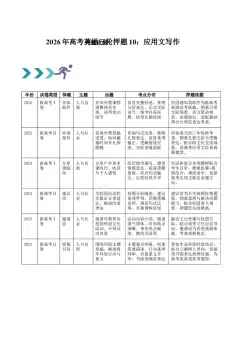
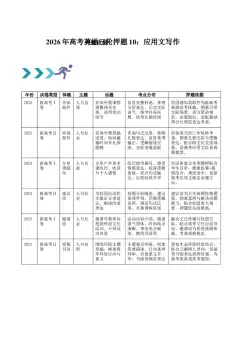
查漏补缺09 应用文写作
高考英语应用文写作作为书面表达核心题型,分值稳定占25 分,是整张试卷的高分拉分关键,近5 年
全国卷与新高考卷命题形式固定、体裁清晰,侧重考查日常交际与实用表达,难度适中但失分率居高不
下。结合三轮复习节奏,一轮聚焦基础词汇句型积累,二轮侧重各类体裁模板梳理搭建框架,三轮则是突
破提分的核心阶段,核心目标为查漏补缺,针对性攻克易混用词、语法错误、格式疏漏、表达不规范等高
频失分点。高考常考书信、邮件、通知、演讲稿、倡议书、日记、新闻报道等多类体裁,看似有模板可
循,但学生极易因词汇搭配失误、句型单一呆板、细节语法出错、格式不符合要求丢掉基础分。本专题精
准聚焦应用文专属易混词、核心高分句型、标准化答题规范,全面规避失分陷阱,强化语言准确性与行文
流畅度,助力学生稳住基础分、冲刺满分,为英语总分突破筑牢根基,实现从及格到高分的跨越式提升。
本专题涵盖的应用文核心词汇、固定搭配与基础句型,全部源自人教版、外研版高中英语必修第一册
至选择性必修第四册,覆盖高一至高三全学段教材内容。核心知识点重点分布在必修1-2 的基础交际用语、
必修3-4 的应用文体裁专用句型,以及选择性必修1-4 的高级表达与复杂搭配,是对教材核心知识的专项
提炼与应用转化,紧扣三轮复习回归课本的理念,帮助学生夯实本源,杜绝脱离教材盲目刷题的低效复习
模式。
本板块为高考英语应用文写作三轮复习核心提分
内容,全面覆盖学生写作过程中高频出错、高考真题常考、极易隐性丢分的词汇、短语、句型、格式四大
类考点,按照易混动词辨析、易混名词辨析、易混介词搭配、易混过渡词/连接词、易错句型结构、应用文
格式易错点六大模块系统梳理,共计130 余组核心易错点。每组内容均遵循“核心易混项+易错点剖析+核
心搭配+应用文原创例句+正误对比解析”的逻辑编写,所有例句完全适配书信、邮件、通知、演讲稿、倡
议书、日记、报道、请假条等高考常考应用文体裁,拒绝脱离写作场景的无效例句,学生可直接背诵、套
用、纠错,精准规避每一处失分陷阱,彻底解决应用文写作“会写但易错、有模板但丢分”的核心问题,
助力写作稳拿基础分、冲刺满分。
模块一:应用文高频易混动词辨析(30 组)
动词是应用文写作的核心谓语支撑,也是搭配错误、词义混淆的重灾区,本组30 组动词均为近5 年高考应
用文真题、模拟题中出现频率最高、学生写错最多的易混项,重点区分词义差异、用法边界、固定搭配,
结合书信建议、活动通知、演讲稿呼吁、邮件回复等场景编写专属例句,逐一纠正高频错误。
1. admit / recognize
词义与用法区分:admit 侧重“承认(过错、事实、真相);准许进入;接纳(入学/入会)”,后常接名
词、代词、动名词,不可接不定式;recognize 侧重“认出(曾经见过的人/事物);承认(公认的事实、
地位);意识到”,多指视觉上的辨认或正式认可,不强调承认自身过错。
核心搭配:admit (doing) sth 承认(做)某事;admit sb to/into sp 准许某人进入某地;admit of 容许;
recognize sb/sth 认出某人/某物;recognize + that 从句 承认/意识到;be recognized as 被公认为。
应用文原创例句:① I sincerely admit that I made a mistake in the email content and apologize for any
inconvenience caused.(道歉信)② The school will admit 50 new students to the English debate club next term.
(招募通知)③ I recognized you immediately when you came into the lecture hall despite the crowd.(邮件回
复)
正误对比:误:I admit to make a mistake in the plan. 正:I admit making a mistake in the plan. / I admit that I
made a mistake in the plan.(解析:admit 后不可接动词不定式,只能接动名词或that 从句);误:I
recognized his mistake in public. 正:I admitted his mistake in public.(解析:recognize 不用于承认他人过
错,仅用于辨认或认可事实)。
高考失分提醒:道歉信、检讨书必用admit,辨认人物、认可身份用recognize,90%的错误集中在admit 后
接不定式的结构。
2. afford / offer / provide
词义与用法区分:afford 侧重“负担得起(时间、金钱、后果);提供(抽象事物)”,常与can/could/be
able to 连用,主语多为人;offer 侧重“主动提出;自愿给予;提供(帮助、机会、物品)”,强调主动
性,后可接双宾语或不定式;provide 侧重“供应;提供(所需物品、服务、条件)”,强调满足需求,
不强调主动,固定搭配为provide sb with sth / provide sth for sb。
核心搭配:can afford sth/to do sth 负担得起某物/做某事;offer sb sth / offer sth to sb / offer to do sth 主动给
某人某物/主动做某事;provide sb with sth / provide sth for sb 为某人提供某物。
应用文原创例句:① I am afraid I can’t afford the time to attend the offline meeting due to my heavy study task.
(请假邮件)② Our club will offer free guidance books to every new member this month.(招募通知)③ The
school will provide a comfortable lecture hall and necessary equipment for the upcoming speech contest.(活动通
知)
正误对比:误:The school provides us students free books. 正:The school provides us students with free
books. / The school provides free books for us students.(解析:provide 无双宾语结构,必须加介
词with/for);误:I afford to help you with the project. 正:I can afford to help you with the project. / I offer to
help you with the project.(解析:afford 必须与情态动词连用,表主动帮助用offer 更贴合应用文语境)。
高考失分提醒:通知、建议信中常用provide 表提供物资/条件,求助信、回复信用offer 表主动帮助,
afford 仅用于表负担能力,三者搭配结构是高频失分点。
3. accept / receive
词义与用法区分:accept 侧重“主观上接受(邀请、建议、道歉、物品)”,强调内心同意、愿意收下;
receive 侧重“客观上收到(信件、礼物、通知)”,不强调是否愿意接受,仅表示动作发生。
核心搭配:accept one’s invitation/apology/advice 接受某人的邀请/道歉/建议;accept a gift 收下礼物;
receive a letter/email/notice 收到信件/邮件/通知;receive training 接受培训(客观)。
应用文原创例句:① I am more than glad to accept your kind invitation to the graduation ceremony.(邀请回复
信)② I received your email about the volunteer activity yesterday and have read it carefully.(邮件回复)③
We will not accept any late applications for the competition after the deadline.(招募通知)
正误对比:误:I received your invitation but I don’t want to go. 正:I received your invitation but I can’t accept
it.(解析:客观收到用receive,主观拒绝接受需用accept 对应);误:I accept a letter from my pen pal last
week. 正:I received a letter from my pen pal last week.(解析:信件仅为客观收到,无主观接受含义,用
receive)。
高考失分提醒:邀请回复信、邮件回复是必考场景,收到客观事物用receive,主观愿意接受用accept,二
者混用是应用文写作最常见动词错误之一。
4. advise / suggest / persuade
词义与用法区分:advise 侧重“劝告;建议”,为普通用词,语气正式,后可接sb to do sth、动名词、that
从句(从句用虚拟语气should do,should 可省略);suggest 侧重“提议;建议”,语气委婉,后接动名
词、that 从句(虚拟语气)、名词,不可接sb to do sth;persuade 侧重“说服;劝服”,强调劝说成功,
后接sb to do sth / sb into doing sth,若未成功需用try to persuade。
核心搭配:advise sb to do sth 建议某人做某事;advise doing sth 建议做某事;suggest doing sth 建议做某
事;suggest that sb (should) do sth;persuade sb to do sth / sb into doing sth 说服某人做某事。
应用文原创例句:① I strongly advise you to take part in the English corner to improve your oral English.(建议
信)② I suggest holding a class meeting to discuss the details of the charity activity.(倡议书)③ I finally
persuaded my parents to allow me to participate in the summer camp.(个人陈述)
正误对比:误:I suggest you to read more English articles every day. 正:I suggest you (should) read more
English articles every day. / I advise you to read more English articles every day.(解析:suggest 不可接sb to do
sth,只有advise 可接该结构);误:I persuaded him but he refused. 正:I tried to persuade him but he
refused.(解析:persuade 暗含成功含义,未成功需加try to)。
高考失分提醒:建议信为高考应用文高频体裁,advise 和suggest 的结构混淆是核心失分点,虚拟语气的使
用也是扣分关键,persuade 仅用于劝说成功的场景。
5. join / join in / take part in
词义与用法区分:join 侧重“加入某个组织、团体、党派、人群”,成为其中一员,后接团队、组织、人
群类名词;join in 侧重“参加小规模的活动、游戏、讨论”,多指日常短暂活动,后接活动类名词,可省
略in 直接接sth;take part in 侧重“参加大型正式活动、比赛、会议、公益活动”,强调主动参与并发挥
作用,为应用文最常用表达。
核心搭配:join the club/army/party 加入俱乐部/军队/党派;join sb 加入某人;join in the game/discussion 参
加游戏/讨论;take part in the contest/charity activity/meeting 参加比赛/公益活动/会议。
应用文原创例句:① I am eager to join the school volunteer team to help children in rural areas.(招募申请信)
② All students are welcome to join in the after-class discussion about environmental protection.(班级通知)③
We hope more students will take part in the upcoming sports meeting and win honors for our class.(倡议书)
正误对比:误:I want to join the English speech contest. 正:I want to take part in the English speech contest.
(解析:比赛为大型正式活动,用take part in,join 不可接活动);误:I take part in the student union.
正:I join the student union.(解析:学生会为组织,用join,而非take part in)。
高考失分提醒:申请信、倡议书、活动通知必考该组易混词,加入组织用join,参加活动用take part in,
小规模日常活动用join in,三者场景混用扣分率极高。
6. raise / rise
词义与用法区分:raise 为及物动词,侧重“举起;抬起;提高;筹集;养育”,必须接宾语,过去式/过
去分词为raised;rise 为不及物动词,侧重“升起;上升;起身;上涨”,不可接宾语,过去式/过去分词
为rose/risen,无被动语态。
核心搭配:raise one’s hand/voice 举手/提高嗓门;raise money 筹集资金;raise the price/standard 提高价
格/标准;rise early 早起;rise to one’s feet 站起身;the sun/temperature rises 太阳/温度上升。
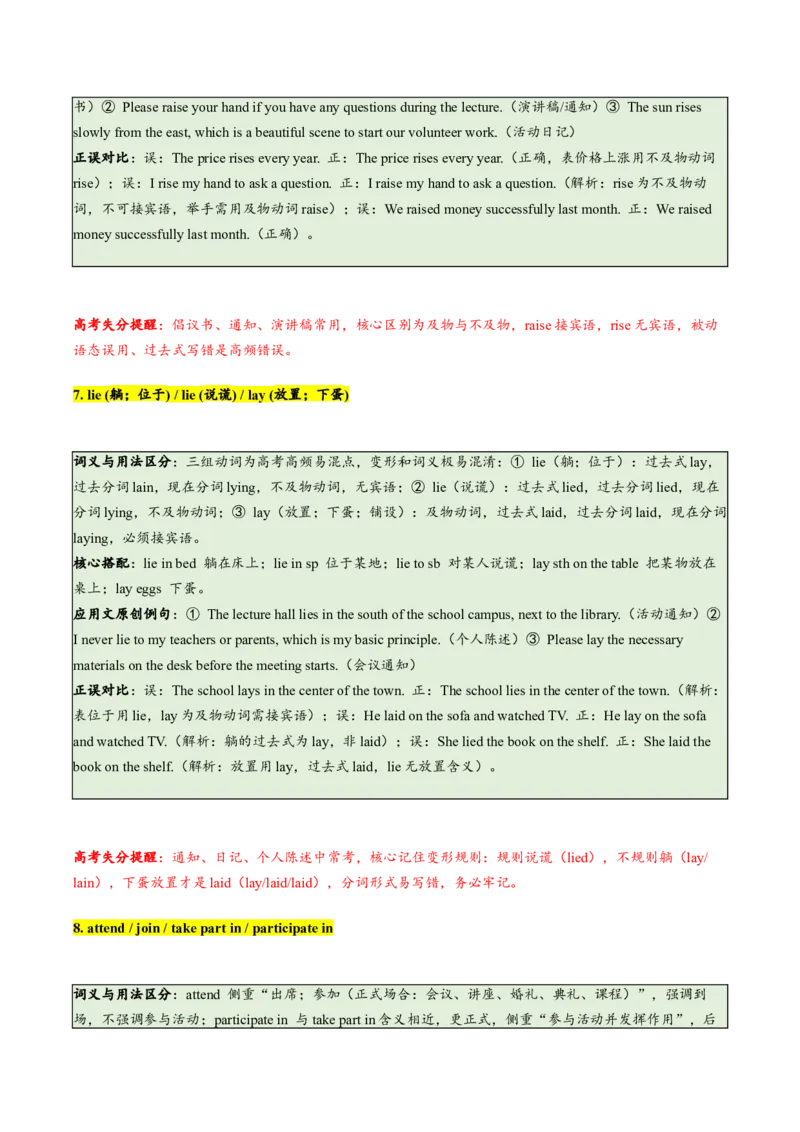
应用文原创例句:① We plan to raise money for the homeless people through a charity sale next week.(倡议
书)② Please raise your hand if you have any questions during the lecture.(演讲稿/通知)③ The sun rises
slowly from the east, which is a beautiful scene to start our volunteer work.(活动日记)
正误对比:误:The price rises every year. 正:The price rises every year.(正确,表价格上涨用不及物动词
rise);误:I rise my hand to ask a question. 正:I raise my hand to ask a question.(解析:rise 为不及物动
词,不可接宾语,举手需用及物动词raise);误:We raised money successfully last month. 正:We raised
money successfully last month.(正确)。
高考失分提醒:倡议书、通知、演讲稿常用,核心区别为及物与不及物,raise 接宾语,rise 无宾语,被动
语态误用、过去式写错是高频错误。
7. lie (躺;位于) / lie (说谎) / lay (放置;下蛋)
词义与用法区分:三组动词为高考高频易混点,变形和词义极易混淆:① lie(躺;位于):过去式lay,
过去分词lain,现在分词lying,不及物动词,无宾语;② lie(说谎):过去式lied,过去分词lied,现在
分词lying,不及物动词;③ lay(放置;下蛋;铺设):及物动词,过去式laid,过去分词laid,现在分词
laying,必须接宾语。
核心搭配:lie in bed 躺在床上;lie in sp 位于某地;lie to sb 对某人说谎;lay sth on the table 把某物放在
桌上;lay eggs 下蛋。
应用文原创例句:① The lecture hall lies in the south of the school campus, next to the library.(活动通知)②
I never lie to my teachers or parents, which is my basic principle.(个人陈述)③ Please lay the necessary
materials on the desk before the meeting starts.(会议通知)
正误对比:误:The school lays in the center of the town. 正:The school lies in the center of the town.(解析:
表位于用lie,lay 为及物动词需接宾语);误:He laid on the sofa and watched TV. 正:He lay on the sofa
and watched TV.(解析:躺的过去式为lay,非laid);误:She lied the book on the shelf. 正:She laid the
book on the shelf.(解析:放置用lay,过去式laid,lie 无放置含义)。
高考失分提醒:通知、日记、个人陈述中常考,核心记住变形规则:规则说谎(lied),不规则躺(lay/
lain),下蛋放置才是laid(lay/laid/laid),分词形式易写错,务必牢记。
8. attend / join / take part in / participate in
词义与用法区分:attend 侧重“出席;参加(正式场合:会议、讲座、婚礼、典礼、课程)”,强调到
场,不强调参与活动;participate in 与take part in 含义相近,更正式,侧重“参与活动并发挥作用”,后
接活动,可互换;join/join in 用法同前。
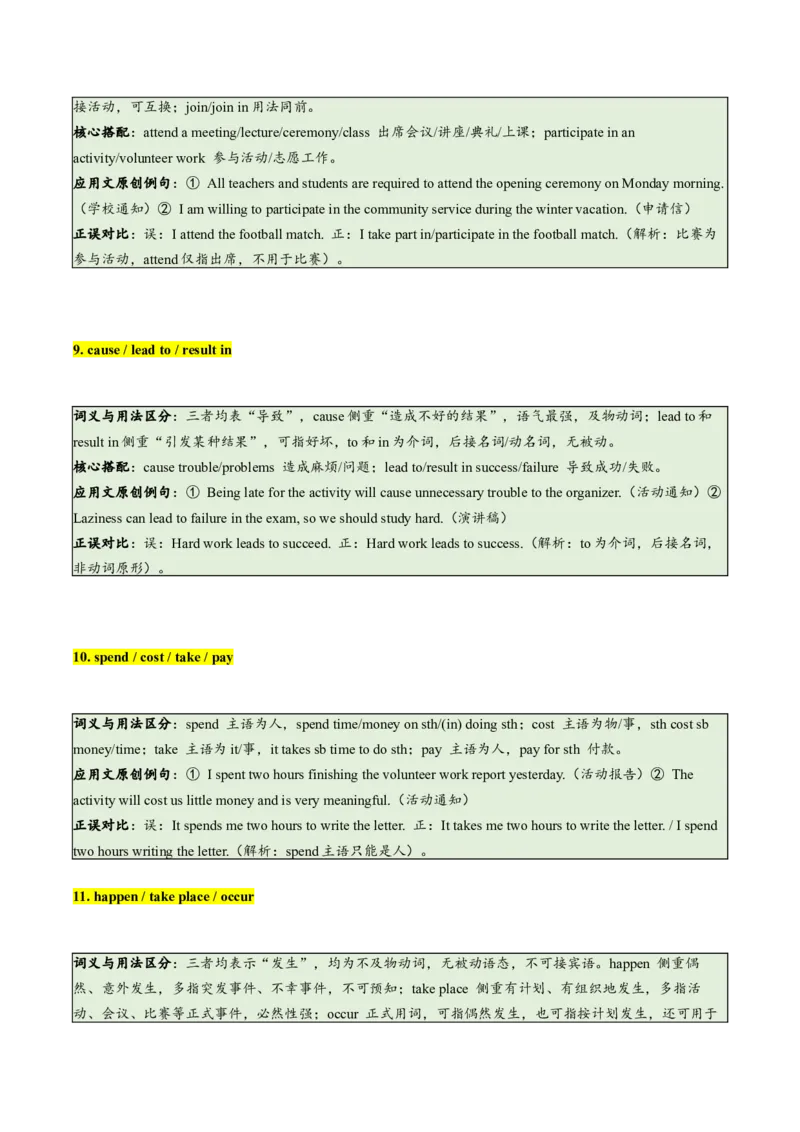
核心搭配:attend a meeting/lecture/ceremony/class 出席会议/讲座/典礼/上课;participate in an
activity/volunteer work 参与活动/志愿工作。
应用文原创例句:① All teachers and students are required to attend the opening ceremony on Monday morning.
(学校通知)② I am willing to participate in the community service during the winter vacation.(申请信)
正误对比:误:I attend the football match. 正:I take part in/participate in the football match.(解析:比赛为
参与活动,attend 仅指出席,不用于比赛)。
9. cause / lead to / result in
词义与用法区分:三者均表“导致”,cause 侧重“造成不好的结果”,语气最强,及物动词;lead to 和
result in 侧重“引发某种结果”,可指好坏,to 和in 为介词,后接名词/动名词,无被动。
核心搭配:cause trouble/problems 造成麻烦/问题;lead to/result in success/failure 导致成功/失败。
应用文原创例句:① Being late for the activity will cause unnecessary trouble to the organizer.(活动通知)②
Laziness can lead to failure in the exam, so we should study hard.(演讲稿)
正误对比:误:Hard work leads to succeed. 正:Hard work leads to success.(解析:to 为介词,后接名词,
非动词原形)。
10. spend / cost / take / pay
词义与用法区分:spend 主语为人,spend time/money on sth/(in) doing sth;cost 主语为物/事,sth cost sb
money/time;take 主语为it/事,it takes sb time to do sth;pay 主语为人,pay for sth 付款。
应用文原创例句:① I spent two hours finishing the volunteer work report yesterday.(活动报告)② The
activity will cost us little money and is very meaningful.(活动通知)
正误对比:误:It spends me two hours to write the letter. 正:It takes me two hours to write the letter. / I spend
two hours writing the letter.(解析:spend 主语只能是人)。
11. happen / take place / occur
词义与用法区分:三者均表示“发生”,均为不及物动词,无被动语态,不可接宾语。happen 侧重偶
然、意外发生,多指突发事件、不幸事件,不可预知;take place 侧重有计划、有组织地发生,多指活
动、会议、比赛等正式事件,必然性强;occur 正式用词,可指偶然发生,也可指按计划发生,还可用于
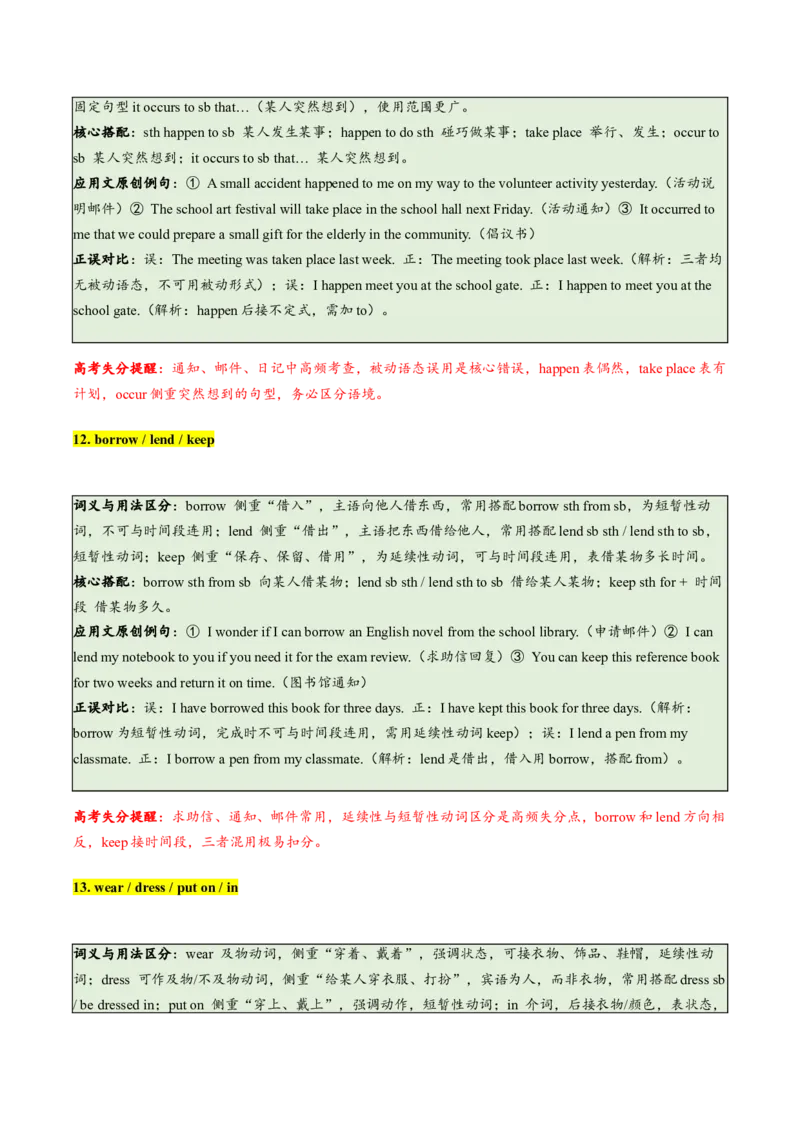
固定句型it occurs to sb that…(某人突然想到),使用范围更广。
核心搭配:sth happen to sb 某人发生某事;happen to do sth 碰巧做某事;take place 举行、发生;occur to
sb 某人突然想到;it occurs to sb that… 某人突然想到。
应用文原创例句:① A small accident happened to me on my way to the volunteer activity yesterday.(活动说
明邮件)② The school art festival will take place in the school hall next Friday.(活动通知)③ It occurred to
me that we could prepare a small gift for the elderly in the community.(倡议书)
正误对比:误:The meeting was taken place last week. 正:The meeting took place last week.(解析:三者均
无被动语态,不可用被动形式);误:I happen meet you at the school gate. 正:I happen to meet you at the
school gate.(解析:happen 后接不定式,需加to)。
高考失分提醒:通知、邮件、日记中高频考查,被动语态误用是核心错误,happen 表偶然,take place 表有
计划,occur 侧重突然想到的句型,务必区分语境。
12. borrow / lend / keep
词义与用法区分:borrow 侧重“借入”,主语向他人借东西,常用搭配borrow sth from sb,为短暂性动
词,不可与时间段连用;lend 侧重“借出”,主语把东西借给他人,常用搭配lend sb sth / lend sth to sb,
短暂性动词;keep 侧重“保存、保留、借用”,为延续性动词,可与时间段连用,表借某物多长时间。
核心搭配:borrow sth from sb 向某人借某物;lend sb sth / lend sth to sb 借给某人某物;keep sth for + 时间
段 借某物多久。
应用文原创例句:① I wonder if I can borrow an English novel from the school library.(申请邮件)② I can
lend my notebook to you if you need it for the exam review.(求助信回复)③ You can keep this reference book
for two weeks and return it on time.(图书馆通知)
正误对比:误:I have borrowed this book for three days. 正:I have kept this book for three days.(解析:
borrow 为短暂性动词,完成时不可与时间段连用,需用延续性动词keep);误:I lend a pen from my
classmate. 正:I borrow a pen from my classmate.(解析:lend 是借出,借入用borrow,搭配from)。
高考失分提醒:求助信、通知、邮件常用,延续性与短暂性动词区分是高频失分点,borrow 和lend 方向相
反,keep 接时间段,三者混用极易扣分。
13. wear / dress / put on / in
词义与用法区分:wear 及物动词,侧重“穿着、戴着”,强调状态,可接衣物、饰品、鞋帽,延续性动
词;dress 可作及物/不及物动词,侧重“给某人穿衣服、打扮”,宾语为人,而非衣物,常用搭配dress sb
/ be dressed in;put on 侧重“穿上、戴上”,强调动作,短暂性动词;in 介词,后接衣物/颜色,表状态,
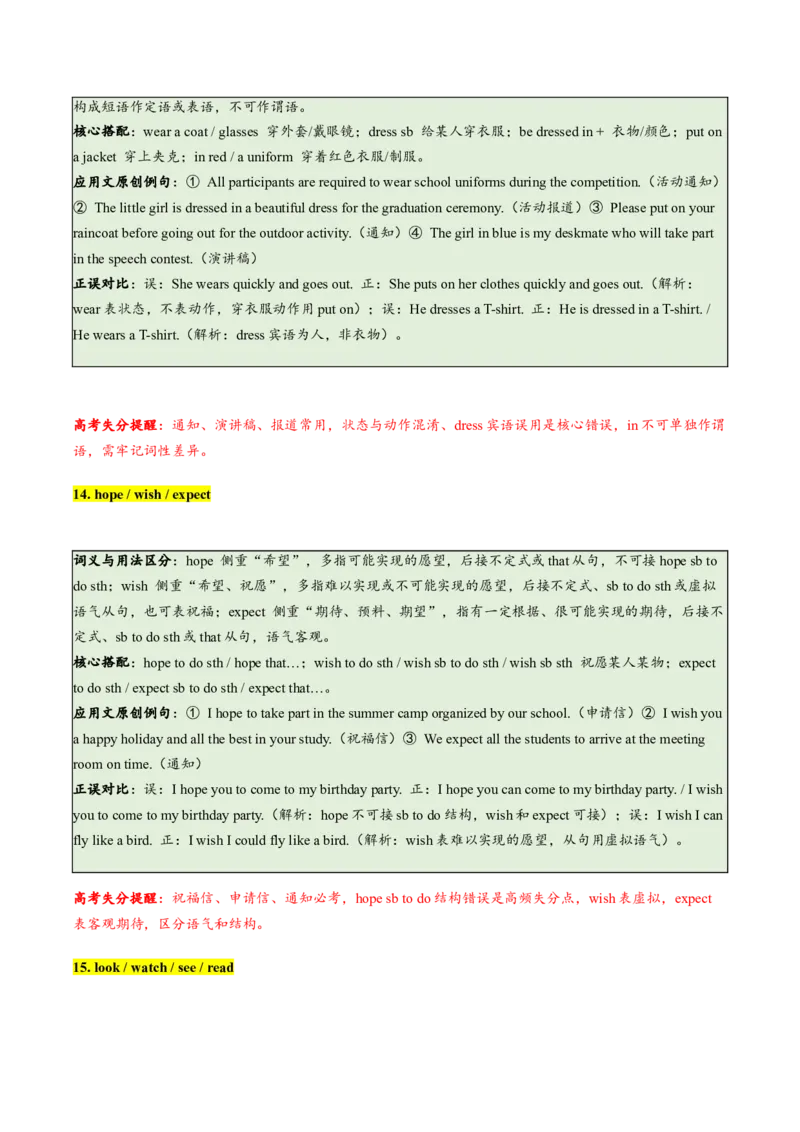
构成短语作定语或表语,不可作谓语。
核心搭配:wear a coat / glasses 穿外套/戴眼镜;dress sb 给某人穿衣服;be dressed in + 衣物/颜色;put on
a jacket 穿上夹克;in red / a uniform 穿着红色衣服/制服。
应用文原创例句:① All participants are required to wear school uniforms during the competition.(活动通知)
② The little girl is dressed in a beautiful dress for the graduation ceremony.(活动报道)③ Please put on your
raincoat before going out for the outdoor activity.(通知)④ The girl in blue is my deskmate who will take part
in the speech contest.(演讲稿)
正误对比:误:She wears quickly and goes out. 正:She puts on her clothes quickly and goes out.(解析:
wear 表状态,不表动作,穿衣服动作用put on);误:He dresses a T-shirt. 正:He is dressed in a T-shirt. /
He wears a T-shirt.(解析:dress 宾语为人,非衣物)。
高考失分提醒:通知、演讲稿、报道常用,状态与动作混淆、dress 宾语误用是核心错误,in 不可单独作谓
语,需牢记词性差异。
14. hope / wish / expect
词义与用法区分:hope 侧重“希望”,多指可能实现的愿望,后接不定式或that 从句,不可接hope sb to
do sth;wish 侧重“希望、祝愿”,多指难以实现或不可能实现的愿望,后接不定式、sb to do sth 或虚拟
语气从句,也可表祝福;expect 侧重“期待、预料、期望”,指有一定根据、很可能实现的期待,后接不
定式、sb to do sth 或that 从句,语气客观。
核心搭配:hope to do sth / hope that…;wish to do sth / wish sb to do sth / wish sb sth 祝愿某人某物;expect
to do sth / expect sb to do sth / expect that…。
应用文原创例句:① I hope to take part in the summer camp organized by our school.(申请信)② I wish you
a happy holiday and all the best in your study.(祝福信)③ We expect all the students to arrive at the meeting
room on time.(通知)
正误对比:误:I hope you to come to my birthday party. 正:I hope you can come to my birthday party. / I wish
you to come to my birthday party.(解析:hope 不可接sb to do 结构,wish 和expect 可接);误:I wish I can
fly like a bird. 正:I wish I could fly like a bird.(解析:wish 表难以实现的愿望,从句用虚拟语气)。
高考失分提醒:祝福信、申请信、通知必考,hope sb to do 结构错误是高频失分点,wish 表虚拟,expect
表客观期待,区分语气和结构。
15. look / watch / see / read
词义与用法区分:look 不及物动词,侧重“看”的动作,不强调结果,后接宾语需加at;watch 及物动
词,侧重“观看、注视”,指长时间看移动、变化的事物,如比赛、电视、演出;see 及物动词,侧重
“看见、看到”,强调看的结果,不可用于进行时;read 及物动词,侧重“阅读”,指看书、报、杂志、
邮件等文字类内容。
核心搭配:look at sth 看某物;look carefully 仔细看;watch a match / TV 看比赛/电视;see a film / doctor
看电影/医生;read a book / email / notice 看书/邮件/通知。
应用文原创例句:① Please look at the blackboard carefully and take notes during the lecture.(通知)② We
will watch a meaningful English movie in the classroom this Friday.(班级通知)③ I am glad to see your
progress in English writing.(邮件回复)④ You can read the detailed rules of the competition on the school
website.(活动通知)
正误对比:误:I am looking a picture. 正:I am looking at a picture.(解析:look 不及物,接宾语加at);
误:I read a football match last night. 正:I watched a football match last night.(解析:看比赛用watch,阅读
文字用read)。
高考失分提醒:通知、邮件、日记常用,动作与结果混淆、搭配介词遗漏是核心错误,看文字类必用
read,看动态事物用watch,务必精准区分。
16. listen / hear / sound
词义与用法区分:listen 不及物动词,侧重“听”的动作,不强调结果,后接宾语加to;hear 及物动词,
侧重“听见、听到”,强调听的结果,不可用于进行时;sound 系动词,侧重“听起来”,后接形容词作
表语,无被动语态。
核心搭配:listen to music / teacher 听音乐/听老师讲课;listen carefully 仔细听;hear a voice / news 听到声
音/消息;sound good / great 听起来不错。
应用文原创例句:① Please listen to the host carefully during the opening ceremony.(通知)② I heard that
you won first prize in the speech contest, congratulations!(祝贺信)③ Your plan for the charity activity sounds
very practical and meaningful.(邮件回复)
正误对比:误:I am listening music. 正:I am listening to music.(解析:listen 不及物,接宾语加to);
误:It sounds well. 正:It sounds good.(解析:sound 系动词,后接形容词,well 作形容词指身体好,此处
用good)。
高考失分提醒:通知、祝贺信、邮件常用,listen 后漏to、sound 后接副词是高频错误,动作listen,结果
hear,感官sound,区分清晰。
17. speak / tell / say / talk
词义与用法区分:speak 侧重“说、讲话”,后接语言类名词,或用于固定搭配speak to sb(和某人讲
话),不及物动词接人加to;tell 侧重“告诉、讲述”,后接双宾语tell sb sth / tell sb to do sth,指告诉某
人某事、让某人做某事,还可表讲故事;say 侧重“说、讲”,强调说话内容,后接宾语为具体话语、从
句,不可接人作宾语;talk 侧重“交谈、谈论”,不及物动词,搭配talk to / with sb(和某人交谈)、talk
about sth(谈论某事)。
核心搭配:speak English / Chinese 说英语/汉语;speak to sb 和某人讲话;tell sb sth / tell sb to do sth / tell a
story 告诉某人某事/让某人做某事/讲故事;say sth to sb 对某人说某事;talk to / with sb about sth 和某人谈
论某事。
应用文原创例句:① I can speak English fluently and want to be a volunteer for the international event.(申请
信)② The teacher tells us to arrive early for the morning reading every day.(班级通知)③ I want to say sorry
to you for my careless mistake.(道歉信)④ We can talk about the activity details after class.(邮件)
正误对比:误:I speak you a word. 正:I say a word to you. / I speak to you.(解析:speak 不可接双宾语,
say 接说话内容);误:He says to me to study hard. 正:He tells me to study hard.(解析:tell 可接sb to
do,say 不可接该结构)。
高考失分提醒:申请信、道歉信、通知高频考查,双宾语结构、介词搭配是核心失分点,speak 接语言,
tell 接sb to do,say 接内容,talk 表交谈,务必牢记。
18. grow / plant
词义与用法区分:plant 及物动词,侧重“种植、栽种”,指栽种植物的具体动作,宾语为树苗、种子、
花草等植物;grow 可作及物/不及物动词,侧重“种植、生长、培育”,既指种植动作,也指植物生长的
过程,还可表示“成长、变得”,使用范围更广。
核心搭配:plant trees / flowers 种树/种花;grow vegetables / flowers 种蔬菜/花;grow up 成长;grow fast
长得快。
应用文原创例句:① We will plant more trees in the schoolyard to make our campus more beautiful.(倡议书)
② The students in our class grow some green plants in the classroom.(班级活动报道)③ We hope to grow up
quickly and do more things for society.(演讲稿)
正误对比:误:We grow trees on Tree Planting Day. 正:We plant trees on Tree Planting Day.(解析:种树的
具体动作用plant,grow 侧重培育生长过程)。
高考失分提醒:倡议书、活动报道常用,plant 仅表种植动作,grow 含生长含义,语境区分清晰即可避免
失分。
19. learn / study
词义与用法区分:learn 侧重“学习、学会、学到”,强调学习的结果,指获取知识、技能,还可表示
“得知、了解”,后接不定式learn to do sth;study 侧重“学习、研究”,强调学习的过程,指深入学
习、钻研知识,宾语为学科、知识,语气更正式。
核心搭配:learn to do sth 学会做某事;learn from sb 向某人学习;study English / math 学英语/数学;study
hard 努力学习。
应用文原创例句:① I want to learn to play the guitar in the after-school club.(申请信)② We should study
hard to get good grades in the college entrance examination.(演讲稿)③ I learned from the notice that our
school will hold a painting competition.(邮件)
正误对比:误:I study to swim every weekend. 正:I learn to swim every weekend.(解析:学做某事、学会
技能用learn,study 侧重学科钻研)。
高考失分提醒:申请信、演讲稿、日记常用,结果learn、过程study,learn to do 为固定结构,不可混用
study。
20. win / beat
词义与用法区分:win 及物/不及物动词,侧重“赢得、获胜”,宾语为比赛、奖项、奖品、战争、荣誉等
事物,不可接人作宾语;beat 及物动词,侧重“打败、战胜”,宾语为对手、团队、个人等人或团体,过
去式为beat,过去分词为beaten。
核心搭配:win a match / prize / game 赢得比赛/奖项/游戏;win first place 获得第一名;beat sb / a team 打
败某人/某个团队。
应用文原创例句:① I hope I can win first prize in the English writing competition.(申请信)② Our class
team beat Class Two in the basketball match last week.(活动报道)
正误对比:误:I won my opponent in the game. 正:I beat my opponent in the game.(解析:win 不接人,
beat 接人或团队);误:I beat the first prize. 正:I won the first prize.(解析:beat 不接奖项,win 接事物类
宾语)。
高考失分提醒:祝贺信、活动报道常用,宾语是人用beat,宾语是事物用win,过去式变形易出错,务必
牢记。
21. reach / arrive / get
词义与用法区分:reach 及物动词,侧重“到达”,后直接接地点名词,无需加介词;arrive 不及物动
词,侧重“到达”,接大地点加in,接小地点加at,不可直接接地点;get 不及物动词,口语化,侧重
“到达”,后接地点加to,接副词(here/there/home)不加to。
核心搭配:reach sp 到达某地;arrive in + 大地点 / arrive at + 小地点;get to sp 到达某地;get home / here
/ there 到家/到这里/到那里。
应用文原创例句:① Please reach the school gate before 8 o’clock tomorrow morning.(活动通知)② We will
arrive at the museum at 9 o’clock and start our visit.(通知)③ I hope you can get to the meeting room on time.
(邮件)
正误对比:误:I reach to the park. 正:I reach the park.(解析:reach 及物动词,不加介词to);误:We
arrive home at 6 pm. 正:We arrive home at 6 pm. / We get home at 6 pm.(解析:home 为副词,arrive 和get
后不加介词)。
高考失分提醒:通知、邮件高频考查,介词搭配遗漏、误用是核心失分点,reach 直接接地点,arrive 加大
地点in 小地点at,get 加大地点to,区分清晰。
22. finish / complete / end
词义与用法区分:finish 及物/不及物动词,侧重“完成、做完”,指完成日常任务、作业、活动等,后接
动名词doing sth,口语常用;complete 及物动词,侧重“完成、竣工”,指完成工程、项目、计划等较正
式的事物,语气正式,后接名词;end 及物/不及物动词,侧重“结束、终止”,指事物的结束、终止,不
强调完成的动作,可作动词和名词。
核心搭配:finish doing sth 完成做某事;finish homework / task 完成作业/任务;complete a project / plan 完
成项目/计划;end the meeting / activity 结束会议/活动。
应用文原创例句:① I will finish writing the volunteer report before this weekend.(邮件)② The workers will
complete the construction of the new playground next month.(学校通知)③ We will end the activity with a
group photo at 5 o’clock.(活动通知)
正误对比:误:I finish to write my homework. 正:I finish writing my homework.(解析:finish 后接动名
词,不可接不定式);误:We end our homework on time. 正:We finish our homework on time.(解析:end
表结束,不表完成作业,完成用finish/complete)。
高考失分提醒:邮件、通知常用,finish doing 结构错误是高频失分点,日常完成用finish,正式项目用
complete,结束用end,精准区分。
23. begin / start
词义与用法区分:二者含义相近,均表示“开始”,多数情况下可互换,后接不定式或动名词;begin 正
式用词,语气更庄重;start 口语化,还可表示“启动、发动、创办”,如启动机器、创办组织,含义更丰
富。
核心搭配:begin / start to do sth / doing sth 开始做某事;start a club / machine 创办俱乐部/启动机器。
应用文原创例句:① The class meeting will begin at 4 o’clock this afternoon.(班级通知)② We plan to start
an English reading club in our school next term.(招募通知)
正误对比:误:The class is beginning. 正:The class is starting. / The class will begin.(解析:begin 一般不用
于进行时,start 可用于进行时)。
高考失分提醒:通知高频考查,进行时用start,正式场合用begin,后接不定式或动名词均可,无明显差
异,避免进行时误用begin 即可。
24. remember / forget / remind
词义与用法区分:remember 侧重“记得、记住”,后接不定式(记得要做某事,未做)或动名词(记得
做过某事,已做);forget 侧重“忘记”,后接不定式(忘记要做某事,未做)或动名词(忘记做过某
事,已做),为remember 的反义词;remind 侧重“提醒、使想起”,后接双宾语remind sb of sth / remind
sb to do sth,不可直接接不定式或动名词。
核心搭配:remember to do sth 记得要做某事;remember doing sth 记得做过某事;forget to do sth 忘记要做
某事;forget doing sth 忘记做过某事;remind sb of sth 使某人想起某事;remind sb to do sth 提醒某人做某
事。
应用文原创例句:① Please remember to bring your ID card and notebook to the lecture.(通知)② I forget to
tell you the change of the activity time in the last email.(邮件)③ This photo reminds me of the happy time we
spent together in the summer camp.(邮件)
正误对比:误:I remember to visit the park last year. 正:I remember visiting the park last year.(解析:记得
做过的事用动名词,未做用不定式);误:Remind to take your umbrella. 正:Remind you to take your
umbrella.(解析:remind 后必须接人作宾语)。
高考失分提醒:通知、邮件必考,不定式与动名词混淆、remind 缺宾语是核心失分点,应用文多表提醒未
做之事,常用remember/forget to do。
25. allow / permit / let
词义与用法区分:allow 侧重“允许、准许”,语气较弱,日常常用,后接sb to do sth / doing sth,被动语
态be allowed to do sth;permit 侧重“允许、许可”,语气正式,多用于规章制度、正式场合,用法同
allow;let 侧重“让、允许”,口语化,后接sb do sth,省略to 的不定式,被动语态不可省略to。
核心搭配:allow / permit sb to do sth 允许某人做某事;allow / permit doing sth 允许做某事;be allowed /
permitted to do sth 被允许做某事;let sb do sth 让某人做某事。
应用文原创例句:① Our school doesn’t allow students to use mobile phones in class.(校规通知)② The
library permits reading books in the reading room but doesn’t permit taking them out.(图书馆通知)③ My
parents let me take part in the after-school activities I like.(个人陈述)
正误对比:误:My teacher allows me go out early. 正:My teacher allows me to go out early.(解析:allow 后
接sb to do,需加to);误:I was let go out early. 正:I was allowed to go out early.(解析:let 被动语态需
加to,且极少用于被动,常用allow 替代)。
高考失分提醒:通知、个人陈述常用,allow/permit 后接to do,let 后接原形,被动语态误用是高频错误。
26. forbid / prohibit
词义与用法区分:forbid 侧重“禁止、不许”,语气较强,日常用语,过去式forbade,过去分词
forbidden,后接sb to do sth / doing sth;prohibit 侧重“禁止、阻止”,正式用词,多用于法律、规定、规
章制度,后接sb from doing sth。
核心搭配:forbid sb to do sth / forbid doing sth 禁止某人做某事/禁止做某事;prohibit sb from doing sth 禁止
某人做某事。
应用文原创例句:① The school forbids students to run or make noise in the hallway.(校规通知)② The
museum prohibits visitors from taking photos of the cultural relics.(参观通知)
正误对比:误:The rule prohibits students to smoke. 正:The rule prohibits students from smoking.(解析:
prohibit 后接from doing,不接to do)。
高考失分提醒:通知高频考查,搭配介词混淆是核心错误,forbid 接to do,prohibit 接from doing,牢记结
构。
27. manage / try
词义与用法区分:manage 侧重“设法做成、成功做到”,强调结果成功,后接不定式manage to do sth;
try 侧重“尝试、努力”,强调动作,不强调结果是否成功,后接不定式try to do sth(努力做)或动名词
try doing sth(尝试做)。
核心搭配:manage to do sth 设法做成某事;try to do sth 努力做某事;try doing sth 尝试做某事。
应用文原创例句:① I managed to finish the difficult task with the help of my teacher.(个人陈述)② I will
try to improve my English writing ability by keeping a diary every day.(学习计划)③ You can try listening to
English songs to improve your listening skills.(建议信)
正误对比:误:I tried to finish the work and succeeded. 正:I managed to finish the work.(解析:成功做成用
manage,try 仅表努力,不表成功)。
高考失分提醒:个人陈述、建议信常用,manage 表成功,try 表尝试,结果差异是核心失分点,应用文表
成功完成用manage。
28. agree / accept
词义与用法区分:agree 侧重“同意、赞同”,指对观点、计划、建议表示认同,不及物动词,后接介词
to/with/on,或that 从句;accept 侧重“接受、接纳”,指主观上接受物品、邀请、道歉等,及物动词,强
调接受的动作。
核心搭配:agree to sth 同意某事;agree with sb 同意某人;agree on sth 就某事达成一致;agree to do sth
同意做某事;accept sth / sb 接受某物/某人。
应用文原创例句:① My classmates all agree to hold a charity sale for the poor children.(倡议书)② I am
very glad to accept your sincere apology and forgive you.(道歉信回复)
正误对比:误:I agree your suggestion. 正:I agree to your suggestion. / I accept your suggestion.(解析:
agree 不及物,接宾语加to,accept 及物直接接宾语)。
高考失分提醒:建议信、道歉信回复常用,agree 缺介词、二者混用是高频错误,赞同观点用agree,接受
物品/邀请用accept。
29. refuse / turn down
词义与用法区分:refuse 侧重“拒绝”,及物动词,语气直接,后接不定式to do sth 或名词,可拒绝物
品、邀请、请求等;turn down 侧重“拒绝、回绝”,短语动词,语气较委婉,后接名词/代词,代词放中
间,多指拒绝邀请、建议、请求。
核心搭配:refuse sth / refuse to do sth 拒绝某物/拒绝做某事;turn down sth / turn sth down 拒绝某事/某物。
应用文原创例句:① I have to refuse your kind invitation because I have to prepare for the exam.(邀请拒绝
信)② Thank you for your offer, but I have to turn it down for some personal reasons.(邮件回复)
正误对比:误:I refuse to accept your gift.(正确,可接不定式);误:I turn down it. 正:I turn it down.
(解析:短语动词turn down 接代词时,代词放中间)。
高考失分提醒:邀请拒绝信常用,代词位置错误是核心失分点,refuse 语气直接,turn down 更委婉,应用
文多用turn down 表委婉拒绝。
30. protect / prevent
词义与用法区分:protect 侧重“保护、防护”,指保护某人/某物免受伤害,后接sb/sth from sth;prevent
侧重“阻止、防止”,指阻止某事发生、阻止某人做某事,后接sb/sth from doing sth。
核心搭配:protect sb / sth from sth 保护某人/某物免受……;prevent sb / sth from doing sth 阻止某人/某物做
某事。
应用文原创例句:① We should protect the environment and make our earth more beautiful.(倡议书)② We
should take action to prevent people from littering in public places.(倡议书)
正误对比:误:We protect people from pollute the river. 正:We prevent people from polluting the river.(解
析:protect 不接from doing,prevent 接from doing,from 后接动名词)。
高考失分提醒:倡议书高频考查,搭配结构混淆是核心失分点,protect 表保护,prevent 表阻止,牢记from
后的用法差异。
模块二:应用文高频易混名词辨析(25 组)
名词的可数不可数、固定搭配、词义边界是应用文写作另一大失分点,本组25 组名词均为高考常考、学
生易混用的核心词汇,重点区分可数性、单复数形式、适用语境、固定搭配,结合应用文场景给出例句和
失分提醒,避免冠词误用、单复数错误、搭配不当。
1. advice / suggestion
核心区分:advice 为不可数名词,无复数形式,不可直接加a/an;suggestion 为可数名词,复数形式
suggestions。
核心搭配:some advice 一些建议;a piece of advice 一条建议;give sb advice on sth 给某人某方面建议;
make a suggestion 提建议;follow/take one’s advice/suggestions 采纳建议。
应用文原创例句:① I am writing to give you some practical advice on how to improve your English writing.
(建议信)② I have a few useful suggestions for the upcoming class activity.(班级通知)
正误对比:误:I give you an advice. 正:I give you a piece of advice. / I give you some advice.(解析:advice
不可数,不能直接用a/an 修饰);误:I take some suggestion. 正:I take some suggestions.(解析:
suggestion 可数,some 后接复数)。
失分提醒:建议信必考,advice 不可数、suggestion 可数,二者冠词和单复数混用是高频错误。
2. message / information
核心区分:message 可数名词,指“口头/书面的消息、口信、留言”,具体信息;information 不可数名
词,指“信息、资料、情报”,抽象概念,无复数。
核心搭配:leave a message 留言;take a message 捎口信;a piece of information 一条信息;detailed
information 详细信息。
应用文原创例句:① Please leave a message if I am not at home when you come.(邮件回复)② You can find
more information about the competition on the school website.(活动通知)
正误对比:误:I need many informations. 正:I need much information. / I need a piece of information.(解
析:information 不可数,无复数)。
3. problem / question
核心区分:problem 指“难题、困难、问题(需要解决的)”,侧重困难,与solve 搭配;question 指“疑
问、问题(需要回答的)”,侧重疑问,与answer 搭配。
核心搭配:solve the problem 解决难题;answer the question 回答问题;raise a question 提出问题。
应用文原创例句:① We should work together to solve the environmental problems around us.(倡议书)② If
you have any question about the activity, please contact me in time.(通知)
正误对比:误:answer the problem 正:solve the problem / answer the question。
4. scene / scenery / view / sight
核心区分:scene 可数,指“场景、景色(现场的局部景色)”;scenery 不可数,指“自然风光、风景
(总称)”;view 可数,指“视野中的景色、风景(从某处看到的)”;sight 可数,指“风景、名胜
(多指人文景观)”,常用复数sights。
应用文原创例句:① The scene of the volunteer activity is very warm and touching.(活动报道)② We
enjoyed the beautiful scenery of the mountain during the trip.(旅行日记)
失分提醒:日记、报道常用,scenery 不可数,其余三个可数,避免单复数错误。
5. choice / alternative
核心区分:choice 普通用词,指“选择、抉择”,可数;alternative 侧重“可供选择的事物、替代品”,
强调二者择一,语气正式。
应用文原创例句:① You have no choice but to follow the school rules.(通知)② We have an alternative plan
if the first one fails.(活动建议)
6. family / house / home
核心区分:family 侧重“家庭、家人”,指组成家庭的人,是集体名词,作主语时,若强调整体谓语用单
数,强调成员谓语用复数;house 侧重“房屋、住宅”,指居住的建筑物,是具体的场所,可数名词;
home 侧重“家、家乡”,指家人共同生活的地方,带有感情色彩,既可作名词也可作副词,无复数形式
表抽象概念。
核心搭配:a big family 一个大家庭;family members 家庭成员;a beautiful house 一栋漂亮的房子;build
a house 建房子;go home 回家;at home 在家;one’s hometown 家乡。
应用文原创例句:① My family are planning to take part in the community volunteer activity together.(个人邮
件)② We will move into a new house next month and hold a small housewarming party.(生活邮件)③ I miss
my home very much when I study at school and look forward to going home on weekends.(书信)
正误对比:误:I have a warm house. 正:I have a warm home.(解析:house 仅指建筑,home 带感情,表温
暖的家用home);误:His family is all kind. 正:His family are all kind.(解析:强调家人成员,谓语用复
数)。
失分提醒:书信、个人陈述、日记高频考查,三者概念混淆是核心错误,family 指人,house 指物,home
带情,务必区分侧重点,避免语境误用。
7. homework / housework
核心区分:homework 特指“家庭作业、课外作业”,是学生专属的学习任务,不可数名词;housework
特指“家务劳动、家务活”,是日常居家的劳作,不可数名词,二者均不可直接加a/an,也无复数形式。
核心搭配:do one’s homework 做作业;finish homework 完成作业;much homework 很多作业;do
housework 做家务;help with housework 帮忙做家务。
应用文原创例句:① I have to finish my English and math homework first before going out to play.(请假/邀约
邮件)② I often help my parents do some housework like washing dishes and cleaning the room on weekends.
(个人日记)
正误对比:误:I do many housework every day. 正:I do much housework every day.(解析:二者均不可
数,用much 修饰,不用many);误:I have a lot of homeworks. 正:I have a lot of homework.(解析:
homework 无复数形式)。
失分提醒:日记、邀约信、请假条常用,不可数性误用、词义混淆是高频错误,学习作业是homework,
家务劳作是housework,牢记词义边界。
8. man / person / people / human
核心区分:man 可数名词,复数men,侧重“男人、成年男性”,也可泛指“人类”,表人类时单数形
式,不加冠词;person 可数名词,复数persons,侧重“个体的人”,不分男女老少,强调单个的人;
people 集体名词,侧重“人们、人民”,表复数含义,谓语用复数,表“民族”时可数,复数peoples;
human 可数名词,复数humans,侧重“人类、人”,区别于动物、神灵,正式语境常用。
核心搭配:a young man 一个年轻男人;man and woman 男人和女人;a kind person 一个善良的人;three
persons 三个人;many people 许多人;the Chinese people 中国人民;human beings 人类。
应用文原创例句:① The old man who lives next door often helps us with some small things.(记叙文/邮件)
② Every person should take responsibility for protecting the environment.(倡议书)③ People in our
community are very friendly and willing to help others.(社区活动报道)
正误对比:误:A people is waiting for you. 正:A person is waiting for you.(解析:people 表复数,单个的
人用person);误:Human are cleverer than animals. 正:Humans are cleverer than animals. / Human beings
are cleverer than animals.(解析:human 表类别用复数或human beings)。
失分提醒:倡议书、报道、邮件常用,单复数误用、词义范围混淆是核心失分点,man 特指男性,person
指个体,people 表群体,human 区别于动物,精准区分。
9. skill / ability / talent
核心区分:skill 可数名词,侧重“技能、技巧”,指通过后天学习、练习获得的具体本领,多指专业、实
操类技能;ability 可数/不可数名词,侧重“能力、才干”,指先天具备或后天培养的综合能力,可接不定
式ability to do sth;talent 可数/不可数名词,侧重“天赋、天资”,指先天拥有的特殊才能,不可接不定
式,常用talent for sth/doing sth。
核心搭配:practical skills 实用技能;communication skills 沟通技能;the ability to do sth 做某事的能力;
reading ability 阅读能力;have a talent for music 有音乐天赋;natural talent 天赋。
应用文原创例句:① I have good communication skills and can get along well with others, so I want to be a
volunteer.(申请信)② I have the ability to finish the task independently and efficiently.(个人陈述)③ She
has a great talent for painting and will take part in the school art competition.(活动通知)
正误对比:误:I have talent to play the piano. 正:I have talent for playing the piano.(解析:talent 后接for,
不接不定式);误:He has many ability. 正:He has many abilities.(解析:ability 表多种能力用复数)。
失分提醒:申请信、个人陈述必考,skill 是后天技能,ability 是综合能力,talent 是先天天赋,搭配结构和
词义差异是高频失分点。
10. trip / journey / travel / voyage
核心区分:trip 可数名词,侧重“短途旅行、出行”,指时间短、距离近的游玩或公务出行,日常最常
用;journey 可数名词,侧重“长途旅行、旅程”,指陆地上的远距离出行,强调旅途过程;travel 不可数
名词,泛指“旅行、游历”,多指长途、长时间的旅行,无具体目的地,复数travels 可指多次旅行或游
记;voyage 可数名词,侧重“航海、航空旅行”,特指海上或空中的长途航行。
核心搭配:a school trip 学校短途旅行;a business trip 商务旅行;a long journey 长途旅程;travel around
the world 环游世界;a sea voyage 海上航行。
应用文原创例句:① Our class will go on a spring trip to the city park next Saturday.(班级通知)② The
journey from my hometown to Beijing takes about five hours by high-speed train.(书信)③ I like reading travel
books and learning about different cultures around the world.(个人陈述)
正误对比:误:I have a travel to the zoo. 正:I have a trip to the zoo.(解析:travel 泛指旅行,不可数,短途
具体旅行用trip);误:We took a voyage to the mountain. 正:We took a trip/journey to the mountain.(解
析:voyage 特指航海航空,陆地旅行不用)。
失分提醒:通知、书信、旅行日记高频考查,距离和出行方式区分是核心,trip 短途,journey 长途陆地,
travel 泛指,voyage 航海航空,避免混用。
11. weather / climate
核心区分:weather 不可数名词,侧重“天气”,指某一地区短时间内的阴晴、雨雪、气温等气象状况,
变化快;climate 可数/不可数名词,侧重“气候”,指某一地区长时间内的总体气象特征,相对稳定,如
四季气候、温带气候等。
核心搭配: fine weather 好天气;bad weather 坏天气;cold weather 寒冷的天气;warm climate 温暖的气
候;dry climate 干旱气候;tropical climate 热带气候。
应用文原创例句:① The weather will be sunny tomorrow, so we can hold the outdoor sports meeting as
planned.(活动通知)② My hometown has a warm and comfortable climate, which is very suitable for living.
(书信)
正误对比:误:What a fine weather it is today! 正:What fine weather it is today!(解析:weather 不可数,不
加a);误:The climate of today is rainy. 正:The weather of today is rainy.(解析:today 是短时间,用
weather,climate 表长时间气候)。
失分提醒:通知、书信、日记常用,不可数性误用、时间范围混淆是核心错误,weather 短时间天气,
climate 长时间气候,严格区分。
12. friend / companion / comrade
核心区分:friend 可数名词,普通用词,侧重“朋友、友人”,指有感情、关系亲密的人,日常最常用;
companion 可数名词,侧重“同伴、伙伴”,指一起旅行、工作、活动的人,关系不一定亲密,强调陪
伴;comrade 可数名词,侧重“同志、战友”,正式用词,多指志同道合、为共同目标奋斗的人,多用于
正式或集体语境。
核心搭配:close friend 亲密的朋友;make friends with sb 和某人交朋友;travel companion 旅伴;work
companion 工作伙伴;comrade in arms 战友。
应用文原创例句:① I have a close friend who always helps me with my study and shares my happiness and
sadness.(书信)② I met a good companion during the summer camp and we had a great time together.(活动日
记)
正误对比:误:I have a companion to play with every day. 正:I have a friend to play with every day.(解析:
强调亲密朋友用friend,companion 仅指陪伴的人)。
失分提醒:书信、日记、活动报道常用,friend 关系亲密,companion 侧重陪伴,comrade 正式同志,日常
应用文多用friend 和companion,避免comrade 误用。
13. noise / voice / sound
核心区分:noise 可数/不可数名词,侧重“噪音、杂音”,指不悦耳、吵闹、令人烦躁的声音,多为贬
义;voice 可数名词,侧重“嗓音、声音”,特指人说话、唱歌、发笑的声音,也可指鸟鸣声;sound 可
数/不可数名词,普通用词,泛指一切能听到的声音,不分好坏、来源,范围最广。
核心搭配:make a noise 制造噪音;loud noise 大声的噪音;sweet voice 甜美的嗓音;in a low voice 低声
地;sound of wind 风声;sound of water 流水声。
应用文原创例句:① Please don’t make any noise in the library and keep quiet.(图书馆通知)② She has a
beautiful voice and often sings songs for us in class.(班级报道)③ I can hear the sound of birds singing outside
the window every morning.(日记)
正误对比:误:He has a loud noise. 正:He has a loud voice.(解析:人的嗓音用voice,noise 指噪音);
误:The sound is too noisy. 正:The noise is too noisy.(解析:贬义噪音用noise,不用sound)。
失分提醒:通知、日记、报道高频考查,词义感情色彩和来源混淆是核心错误,noise 贬义噪音,voice
人/鸟鸣,sound 泛指一切声音,精准区分。
14. photo / picture / drawing
核心区分:photo 可数名词,全称photograph,侧重“照片、相片”,指用相机拍摄出来的影像,只能是
实物照片;picture 可数名词,普通用词,范围最广,可指照片、图画、画像、图片等各类视觉图像;
drawing 可数名词,侧重“素描、绘画、简笔画”,指用铅笔、钢笔、蜡笔等绘制的画,无色彩或单色画
作。
核心搭配:take a photo 拍照;a family photo 全家福;draw a picture 画画;a beautiful picture 一幅漂亮的
画;a pencil drawing 铅笔画。
应用文原创例句:① I took many beautiful photos during the school trip and will share them with my classmates.
(活动报道)② I will draw a picture for my mother as a birthday gift.(书信)③ The little boy is good at
pencil drawings and won a prize in the competition.(活动通知)
正误对比:误:I draw a photo. 正:I take a photo. / I draw a picture/drawing.(解析:photo 是拍摄的,不是
绘制的)。
失分提醒:书信、活动通知、日记常用,photo 是相机照片,picture 泛指图像,drawing 是手绘素描,范围
和制作方式差异是高频错误。
15. work / job / career
核心区分:work 不可数名词,泛指“工作、劳动”,指体力或脑力劳动,无具体职业含义,也可作动
词;job 可数名词,侧重“职业、零活、工作岗位”,指具体的、有报酬的工作,有复数形式jobs;career
可数名词,侧重“事业、职业生涯”,指长期从事的、终身的职业,带有事业规划和发展的含义,语气正
式。
核心搭配:do some work 做一些工作;much work 很多工作;find a job 找一份工作;a part-time job 兼职
工作;a teaching career 教学生涯;career planning 职业规划。
应用文原创例句:① I have a lot of work to do today, so I can’t go out with you.(邀约邮件)② I want to find
a part-time job during the summer vacation to earn some pocket money.(申请信)③ I hope to have a stable
career and make contributions to society in the future.(个人陈述)
正误对比:误:I have a good work. 正:I have a good job. / I have much good work.(解析:work 不可数,
不加a,具体工作用job);误:My job is my life. 正:My career is my life.(解析:终身事业用career,job
仅指具体岗位)。
失分提醒:申请信、个人陈述、邮件必考,可数性和词义层次混淆是核心失分点,work 泛指劳动,job 具
体岗位,career 长期事业,严格区分。
16. courage / bravery
核心区分:courage 不可数名词,侧重“勇气、胆量”,指面对困难、危险、挫折时内心的勇气和胆量,
是抽象的品质,常用搭配have the courage to do sth;bravery 不可数名词,侧重“勇敢、英勇”,指在危险
时刻表现出的勇敢行为,更侧重实际行动,语气比courage 更强,多用于正式或表彰语境。
核心搭配:have the courage to do sth 有勇气做某事;lose courage 失去勇气;show bravery 表现出勇敢;
act with bravery 勇敢行事。
应用文原创例句:① I hope I can have the courage to face all kinds of difficulties in my study and life.(演讲
稿)② The firefighter showed great bravery when he saved the child from the fire.(新闻报道)
正误对比:误:He has a bravery to help others. 正:He has the courage to help others. / He shows bravery in
helping others.(解析:bravery 不可数,不接不定式,courage 可接不定式)。
失分提醒:演讲稿、报道常用,courage 是内心勇气,bravery 是行动上的勇敢,搭配和语境差异是核心错
误,应用文多用courage。
17. energy / strength / power
核心区分:energy 不可数名词,侧重“精力、活力、能量”,指人或事物的精力、体力,也可指能源,常
用full of energy;strength 不可数名词,侧重“力量、力气、体力”,指身体或精神上的力量,强调力气大
小;power 不可数/可数名词,侧重“力量、权力、能力、电力”,范围最广,可指体力、权力、势力、动
力等。
核心搭配:full of energy 精力充沛;save energy 节约能源;physical strength 体力;have the strength to do
sth 有力气做某事;electric power 电力;power of knowledge 知识的力量。
应用文原创例句:① Taking exercise every day can make us full of energy and keep healthy.(倡议书)② I
don’t have enough strength to carry the heavy box by myself.(求助信)③ We should use the power of science
to protect the environment.(演讲稿)
正误对比:误:I have much strength to study. 正:I have much energy to study.(解析:学习的精力用
energy,strength 指身体力气)。
失分提醒:倡议书、演讲稿、求助信常用,energy 指精力活力,strength 指体力力气,power 泛指各类力
量,词义范围混淆是高频失分点。
18. habit / custom / hobby
核心区分:habit 可数名词,侧重“习惯、习性”,指个人长期养成的、不自觉的行为习惯,可好可坏;
custom 可数名词,侧重“风俗、习俗”,指某个社会、民族、群体长期形成的传统风俗,集体层面的习
惯;hobby 可数名词,侧重“爱好、业余爱好”,指个人空闲时间喜欢做的事,是积极的兴趣爱好。
核心搭配:good habit 好习惯;bad habit 坏习惯;form a habit 养成习惯;traditional custom 传统习俗;
local custom 当地风俗;one’s hobby 个人爱好;collect stamps as a hobby 把集邮当作爱好。
应用文原创例句:① We should form a good habit of getting up early and reading English every morning.(学习
建议)② The Spring Festival is a traditional custom of our Chinese nation.(文化介绍邮件)③ My hobbies are
reading books and playing basketball, which make my life more colorful.(个人陈述)
正误对比:误:My custom is reading. 正:My hobby is reading. / I have a habit of reading.(解析:custom 是
集体风俗,个人爱好用hobby,个人习惯用habit)。
失分提醒:建议信、个人陈述、文化介绍邮件必考,个人与集体混淆、词义差异是核心错误,habit 个人习
惯,custom 集体风俗,hobby 个人爱好,精准区分。
19. prize / award / reward
核心区分:prize 可数名词,侧重“奖品、奖金、奖项”,指比赛、竞赛、抽奖中获得的奖励,多指具体
物品或奖金;award 可数名词,侧重“奖品、奖状、荣誉奖项”,指正式评选、授予的荣誉奖励,语气正
式,也可作动词;reward 可数/不可数名词,侧重“报酬、回报、赏金”,指因做好事、付出劳动或帮助
他人得到的报答、赏金,强调回报。
核心搭配:win a prize 赢得奖品;first prize 一等奖;get an award 获得奖项;an award ceremony 颁奖典
礼;as a reward 作为回报;reward for good behavior 善行的回报。
应用文原创例句:① I worked hard and won the first prize in the English speech competition.(祝贺信/个人陈
述)② Our school will hold an award ceremony for the excellent students next week.(学校通知)③ He helped
the lost child find his parents and got a small reward.(新闻报道)
正误对比:误:I got a reward for the competition. 正:I got a prize/award for the competition.(解析:比赛获
奖用prize/award,reward 是回报赏金)。
失分提醒:祝贺信、通知、个人陈述高频考查,prize 竞赛奖品,award 正式荣誉,reward 付出回报,语境
和用途混淆是核心失分点。
20. road / street / way / path
核心区分:road 可数名词,侧重“公路、道路”,指连接两地的宽阔马路,供车辆、行人通行;street 可
数名词,侧重“街道、街区”,指城市、城镇里两旁有建筑物、商铺的道路,有具体名称;way 可数名
词,普通用词,范围最广,指“路、道路、路线、方式”,多指去某地的路线,也表方法;path 可数名
词,侧重“小路、小径”,指乡间、公园、山林里的狭窄小路,仅供行人行走。
核心搭配:a wide road 宽阔的公路;on the road 在路上;a busy street 繁华的街道;on the street 在街上;
on one’s way to sp 在去某地的路上;lose one’s way 迷路;a narrow path 狭窄的小路;a path in the park 公
园小径。
应用文原创例句:① Please be careful when you walk across the busy road.(通知)② There are many shops
and restaurants on the main street of our town.(书信)③ Can you tell me the way to the school library?(求助
邮件)
正误对比:误:I walk on the path to school by bike. 正:I walk on the road/street to school by bike.(解析:
path 是狭窄小路,不能骑车,骑车用road/street);误:This is a way to the park. 正:This is the way to the
park.(解析:表特指路线用the way)。
失分提醒:通知、书信、求助信常用,道路类型和范围混淆是核心错误,road 公路,street 城镇街道,way
路线,path 小径,严格区分适用场景。
21. language / speech / dialect
核心区分:language 可数/不可数名词,侧重“语言”,指一个国家或民族的正式语言,如英语、汉语,范
围最广;speech 不可数名词,侧重“言语、说话、演讲”,指说话的能力或方式,也可指正式的演讲,可
数名词表演讲稿;dialect 可数名词,侧重“方言、土语”,指某个地区使用的地方语言,区别于官方通用
语言。
核心搭配:foreign language 外语;spoken language 口语;written language 书面语;make a speech 发表演
讲;free speech 言论自由;local dialect 当地方言。
应用文原创例句:① I am good at English and I want to learn a second foreign language in the future.(申请
信)② Our monitor will make a speech at the opening ceremony of the sports meeting.(通知)③ The old man
speaks local dialect and we can hardly understand him.(记叙文)
正误对比:误:I speak a dialect in public. 正:I speak a language in public.(解析:公共场合用正式语言,
方言多用于本地日常)。
失分提醒:申请信、通知、记叙文常用,language 正式语言,speech 言语演讲,dialect 地方方言,词义范
围混淆是高频错误。
22. instrument / tool
核心区分:instrument 可数名词,侧重“仪器、器械、乐器”,指精密的科学仪器、医疗器具或乐器,语
气正式;tool 可数名词,普通用词,侧重“工具、用具”,指手工劳动、日常使用的简单工具,如锤子、
螺丝刀等。
核心搭配:musical instrument 乐器;medical instrument 医疗仪器;scientific instrument 科学仪器;a useful
tool 有用的工具;farm tool 农具。
应用文原创例句:① I can play the piano, which is my favorite musical instrument.(申请信)② Farmers use
different kinds of farm tools to do farm work every day.(记叙文)
正误对比:误:I use a tool to play music. 正:I use an instrument to play music.(解析:乐器用instrument,
不用tool)。
失分提醒:申请信、记叙文常用,instrument 是精密仪器/乐器,tool 是简单工具,类别混淆是核心错误,
应用文多考乐器搭配。
23. room / place / space
核心区分:room 可数名词表“房间、屋子”,不可数名词表“空间、空地”,指可利用的空间;place 可
数名词,侧重“地方、地点、场所”,指具体的、有特定用途的地点;space 不可数名词,侧重“空间、
太空、空隙”,指抽象的、大范围的空间,也可指太空,表空隙时可作可数名词。
核心搭配:a living room 客厅;make room for sb 为某人腾出空间;a quiet place 安静的地方;take place
发生;outer space 太空;free space 空闲空间。
应用文原创例句:① Please move the chair and make room for the new student.(班级通知)② I found a quiet
place to read books in the school library.(日记)③ There is no enough space in the classroom for the new
equipment.(通知)
正误对比:误:There is a room for you. 正:There is room for you.(解析:表空间room 不可数,不加
a);误:I need a space to put the bag. 正:I need space to put the bag. / I need a place to put the bag.(解析:
space 表空间不可数,具体地点用place)。
失分提醒:通知、日记、邮件常用,可数性和词义混淆是核心错误,room 表空间不可数/房间可数,place
具体地点,space 抽象空间,精准区分。
24. time / moment / period
核心区分:time 不可数名词表“时间”,可数名词表“次数、倍数、时代”,用法广泛;moment 可数名
词,侧重“片刻、瞬间、时刻”,指极短的时间,常用搭配at the moment;period 可数名词,侧重“时
期、阶段、周期”,指较长的、有特定意义的时间段,如学习期、假期、历史时期。
核心搭配:spend time 花费时间;on time 准时;in time 及时;at the moment 此刻、目前;a short moment
片刻;a long period 很长一段时间;study period 学习阶段。
应用文原创例句:① I spend a lot of time reading English every morning to improve my oral English.(学习计
划)② I am busy doing my homework at the moment and can’t answer your call.(邮件)② We will have a
long holiday period after the college entrance examination.(书信)
正误对比:误:I will remember the time forever. 正:I will remember the moment forever.(解析:特指某个
瞬间时刻用moment,time 泛指时间)。
失分提醒:书信、邮件、学习计划高频考查,time 泛指时间,moment 瞬间,period 长时间段,时间长短混
淆是核心失分点。
25. pleasure / joy / happiness
核心区分:pleasure 不可数名词,侧重“快乐、愉快、乐趣”,指短暂的、轻松的快乐,也可用于礼貌用
语,可数名词表乐事;joy 不可数名词,侧重“喜悦、欢乐”,指强烈的、发自内心的快乐,语气比
pleasure 强;happiness 不可数名词,侧重“幸福、快乐”,指长久的、内心的幸福感,是抽象的、稳定的
快乐。
核心搭配:with pleasure 乐意效劳;it’s my pleasure 不客气;full of joy 充满喜悦;to one’s joy 令某人高兴
的是;true happiness 真正的幸福;seek happiness 追求幸福。
应用文原创例句:① —Could you please help me with the task? —With pleasure.(邮件回复)② To our great
joy, our class won the first prize in the competition.(班级报道)③ We should cherish the happiness of studying
and living together with our classmates.(演讲稿)
正误对比:误:It’s my joy. 正:It’s my pleasure.(解析:礼貌用语不客气用pleasure,不用joy)。
失分提醒:邮件回复、演讲稿、报道常用,pleasure 礼貌用语/短暂快乐,joy 内心喜悦,happiness 长久幸
福,语气和用法差异是高频错误。
26. difficulty / trouble
核心区分:difficulty 可数/不可数名词,侧重“困难、难题”,指需要解决的具体困难或抽象的困难,常
用have difficulty (in) doing sth;trouble 不可数名词,侧重“麻烦、烦恼、困境”,指遇到的麻烦事、烦
恼,也可指疾病,常用have trouble (in) doing sth,be in trouble。
核心搭配:have difficulty (in) doing sth 做某事有困难;overcome difficulties 克服困难;have trouble (in)
doing sth 做某事有麻烦;be in trouble 处于困境中;ask for trouble 自找麻烦。
应用文原创例句:① I have some difficulty in learning English grammar and hope you can help me.(求助信)
② Don’t hesitate to ask for help when you are in trouble.(建议信)
正误对比:误:I have many difficulty. 正:I have many difficulties. / I have much difficulty.(解析:difficulty
表具体难题可数,抽象困难不可数);误:I overcome trouble. 正:I overcome difficulties.(解析:trouble
指麻烦,克服困难用difficulty)。
失分提醒:求助信、建议信必考,句型结构和词义混淆是核心错误,difficulty 侧重困难难题,trouble 侧重
麻烦困境,have difficulty/trouble (in) doing sth 为固定句型,in 可省略。
模块三:易混介词搭配(写作重灾区,35 组)
介词搭配是应用文写作失分最多的板块,无固定规律,极易混淆,尤其表时间、地点、方式、目的、原因
的介词及短语,本组35 组均为高考高频易错搭配,逐一梳理核心用法、适用语境、应用文例句、错误纠
正,彻底解决搭配混乱问题。
1. in / on / at 表时间
核心用法:in 接世纪、年、月、季节、上午/下午/晚上、时间段;on 接具体某一天、星期几、具体某一天
的早中晚;at 接具体时刻、中午、夜晚、年龄、固定节日。
应用文例句:① The activity will be held in July 2026.(通知)② We will have a meeting on Monday morning.
(通知)③ Please arrive at the hall at 9 o’clock.(通知)
正误对比:误:at July 1st 正:on July 1st;误:on 9 o’clock 正:at 9 o’clock。
2. in / on / at 表地点
核心用法:in 接大地点(国家、城市、地区)、内部;on 接平面、线、毗邻;at 接小地点(具体场所、
门口、车站)。
应用文例句:① I live in Beijing with my parents.(邮件)② The school is on the south street.(通知)③
Wait for me at the school gate.(通知)。
3. with / by / through 表方式
核心用法:with 接具体工具、身体部位;by 接方式、手段、交通工具(无冠词)、动作执行者;through
接途径、渠道、过程。
应用文例句:① We can communicate with each other by email.(邮件)② We can improve our English
through reading more books.(建议信)
正误对比:误:by a bus 正:by bus;误:through a pen 正:with a pen。
4. for / to 表目的
核心用法:for 后接名词/动名词,表目的;to 后接动词原形(不定式),表目的。
应用文例句:① I come here for the meeting.(通知)② I come here to attend the meeting.(通知)。
5. in case of / in case
核心用法:in case of 为短语介词,后接名词、代词或动名词,不可接句子,意为“万一;倘若;以防”,
多用于通知、提示类应用文;in case 为连词,后接完整的状语从句,时态常用一般现在时表将来,意为
“以防万一;免得”,可放句首或句中。
应用文例句:① Take an umbrella in case of rain.(活动通知)② Take an umbrella in case it rains suddenly on
the way to the activity.(活动通知)
正误对比:误:Take your mobile phone in case emergency. 正:Take your mobile phone in case of emergency.
(解析:in case of 后接名词,in case 后接句子);误:I will take a first-aid kit in case of someone gets hurt.
正:I will take a first-aid kit in case someone gets hurt.(解析:of 后不可接句子,需去掉of 用连词in
case)。
6. in the end / at the end of / by the end of
核心用法:in the end 意为“最后;终于”,单独作状语,不接任何成分,侧重经过努力或波折后的最终
结果,可放句首或句末;at the end of 后接时间或地点名词,意为“在……末尾;在……尽头”,既可接
时间点,也可接地点;by the end of 后接时间名词,意为“到……末为止”,常与完成时态连用,接过去
时间用过去完成时,接将来时间用将来完成时。
应用文例句:① In the end, we finished the volunteer task successfully.(活动报告)② You can find the lecture
hall at the end of the teaching building.(活动通知)③ We will have learned 500 new words by the end of this
month.(学习计划)
正误对比:误:At the end, we won the competition. 正:In the end, we won the competition.(解析:单独用
状语用in the end,at the end of 必须接名词);误:I finished my homework by the end of yesterday. 正:I
had finished my homework by the end of yesterday.(解析:by the end of+过去时间,句子用过去完成时)。
7. on time / in time
核心用法:on time 意为“准时;按时”,指按规定时间完成或到达,不早不晚,侧重守时,多用于通
知、要求类应用文;in time 意为“及时;来得及”,指在规定时间之前完成,避免耽误事情,侧重赶得
上。
应用文例句:① All participants must arrive at the school gate on time.(活动通知)② We hurried to the
classroom and were in time for the morning reading.(日记)
正误对比:误:Please get to the meeting in time. 正:Please get to the meeting on time.(解析:会议要求守时
用on time,而非及时);误:I got up late but arrived on time for the bus. 正:I got up late but arrived in time
for the bus.(解析:赶上车用及时in time,而非准时)。
8. after / in / before 表时间
核心用法:after 后接时间点或时间段,意为“在……之后”,接时间段多用于一般过去时;in 后接时间
段,意为“在……之后”,多用于一般将来时,表从现在起往后推算;before 后接时间点或句子,意为
“在……之前”,可用于各种时态,多用于通知、计划类应用文。
应用文例句:① He came back from the volunteer work after two hours.(日记)② Our club will recruit new
members in two weeks.(招募通知)③ Please hand in your application form before Friday.(招募通知)
正误对比:误:I will finish the report after three days. 正:I will finish the report in three days.(解析:将来时
的“之后”用in+时间段,after+时间段多用于过去时);误:Please come here before three days. 正:Please
come here before three o’clock.(解析:before 后接时间点,不接时间段)。
9. above / over / on / below / under 表方位
核心用法:above 意为“在……上方”,不强调垂直正上方,反义词为below;over 意为“在……正上
方;越过”,强调垂直上方,不接触物体,反义词为under;on 意为“在……上面”,强调物体表面相互
接触;below 意为“在……下方”,不强调垂直正下方;under 意为“在……正下方”,强调垂直下方。
应用文例句:① There is a clock above the blackboard.(班级通知)② There is a light over the teacher’s desk.
(班级通知)③ Put your notebook on the desk before class.(班级通知)④ The temperature will be below
zero tomorrow.(活动通知)⑤ The schoolbag is under the chair.(日记)
正误对比:误:There is a bridge above the river. 正:There is a bridge over the river.(解析:桥在河正上方用
over);误:The book is over the desk. 正:The book is on the desk.(解析:书和桌面接触用on)。
10. among / between
核心用法:among 意为“在……之中”,后接三者或三者以上的人或物,为集体概念;between 意为
“在……之间”,后接两者,或用between A and B 结构,也可用于多者中两两之间的关系,后接具体数量
时用between。
应用文例句:① Among all the students, Li Ming is the most active in volunteer activities.(活动报道)②
There is a big difference between the two plans.(建议信)③ Choose one answer between the four options.(通
知)
正误对比:误:I sit between Lucy and Lily and three other classmates. 正:I sit among Lucy, Lily and three
other classmates.(解析:三者及以上用among);误:The secret is shared among the twin sisters. 正:The
secret is shared between the twin sisters.(解析:两者之间用between)。
11. except / besides / but / except for
核心用法:except 意为“除……之外”,指排除在外,不包含后面的人或物,强调整体减去部分;besides
意为“除……之外还有”,指包含后面的人或物,在整体基础上增加;but 意为“除……之外”,语气比
except 弱,多用于nobody、nothing、all 等不定代词后;except for 意为“除了……之外”,后接的事物与
整体不是同类,用于修正细节。
应用文例句:① All students will take part in the sports meeting except Tom.(通知)② Besides English, I am
also good at Chinese.(申请信)③ Nobody but me knows the truth.(邮件)④ The composition is good except
for a few spelling mistakes.(建议信)
正误对比:误:Besides Tom, all students attended the lecture. 正:Except Tom, all students attended the lecture.
(解析:Tom 没参加,排除在外用except);误:The room is clean except a dirty corner. 正:The room is
clean except for a dirty corner.(解析:角落和房间不是同类,用except for)。
12. because of / due to / owing to
核心用法:三者均表“因为;由于”,后接名词、代词或动名词,不可接句子;because of 语气最强,口
语和书面语通用,可放句首或句中;due to 多用于书面语,常放句中作表语或定语,一般不放句首;
owing to 语气较正式,可放句首或句中,可与because of 互换。
应用文例句:① I can’t attend the party because of my illness.(请假邮件)② The sports meeting was put off
owing to the bad weather.(活动通知)③ His failure is due to his carelessness.(个人陈述)
正误对比:误:I was late because of I got up late. 正:I was late because I got up late. / I was late because of
getting up late.(解析:because of 后接名词/动名词,because 后接句子);误:Due to the rain, we canceled
the trip. 正:Owing to the rain, we canceled the trip.(解析:due to 一般不放句首)。
13. instead of / instead
核心用法:instead of 为短语介词,后接名词、代词、动名词或介词短语,意为“代替;而不是”,强调
前后事物的替换;instead 为副词,单独作状语,放句首或句末,意为“代替;反而”,后不接任何成分。
应用文例句:① We will have a meeting in the classroom instead of the lecture hall.(通知)② He didn’t go to
the park. Instead, he stayed at home to finish his homework.(日记)
正误对比:误:I will watch TV instead do my homework. 正:I will watch TV instead of doing my homework.
(解析:instead of 后接动名词);误:Instead of, I chose to take part in the volunteer activity. 正:Instead, I
chose to take part in the volunteer activity.(解析:单独作状语用instead,不加of)。
14. with the help of / under the help of
核心用法:with the help of 为固定搭配,意为“在……的帮助下”,为正确表达,后接人或事物,是高考
应用文高频短语;under the help of 为错误搭配,英语中无此用法,属于中式英语,需严格规避。
应用文例句:① With the help of my teacher, I made great progress in English writing.(感谢信)② We
finished the task smoothly with the help of each other.(活动报告)
正误对比:误:Under the help of my parents, I overcame the difficulty. 正:With the help of my parents, I
overcame the difficulty.(解析:固定搭配只能用with,不可用under)。
15. be interested in / be good at
核心用法:be interested in 意为“对……感兴趣”,in 后接名词或动名词,侧重主观喜好;be good at 意为
“擅长……”,at 后接名词或动名词,侧重具备某种能力,多用于申请信、个人陈述类应用文。
应用文例句:① I am interested in playing basketball and want to join the sports club.(申请信)② I am good
at oral English and can communicate with foreigners fluently.(申请信)
正误对比:误:I am interested at painting. 正:I am interested in painting.(解析:固定搭配用in,不用
at);误:I am good in playing the piano. 正:I am good at playing the piano.(解析:固定搭配用at,不用
in)。
16. be proud of / take pride in
核心用法:二者含义相同,均意为“为……感到骄傲”,可互换使用;be proud of 中proud 为形容词,构
成系表结构;take pride in 中pride 为名词,构成动宾结构,后均接名词或动名词。
应用文例句:① We are proud of our class’s victory in the competition.(班级报道)② We take pride in being
volunteers of the school activity.(活动报告)
正误对比:误:We are proud for our motherland. 正:We are proud of our motherland.(解析:固定搭配用
of,不用for);误:We take proud in our team. 正:We take pride in our team.(解析:pride 为名词,proud
为形容词,此处用名词pride)。
17. be afraid of / be afraid to do
核心用法:be afraid of 后接名词、代词或动名词,意为“害怕……;担心……”,侧重害怕某事发生;be
afraid to do 后接动词原形,意为“害怕做某事;不敢做某事”,侧重不敢去执行某个动作。
应用文例句:① The little girl is afraid of dark.(日记)② I am afraid to climb the mountain alone.(日记)
正误对比:误:She is afraid to dogs. 正:She is afraid of dogs.(解析:接名词用be afraid of);误:He is
afraid of go out at night. 正:He is afraid to go out at night.(解析:接动词原形用be afraid to do)。
18. be full of / be filled with
核心用法:二者均意为“充满……”,可互换;be full of 为主动含义,full 是形容词,侧重状态;be filled
with 为被动结构,filled 是动词过去分词,侧重动作,with 为固定介词,不可替换。
应用文例句:① The classroom is full of happiness on Children’s Day.(活动报道)② The bottle is filled with
water for the outdoor activity.(通知)
正误对比:误:The box is full with gifts. 正:The box is full of gifts.(解析:be full of 固定搭配,用of);
误:The room is filled of flowers. 正:The room is filled with flowers.(解析:be filled with 固定搭配,用
with)。
19. be covered with / be covered by
核心用法:be covered with 意为“被……覆盖”,侧重覆盖的状态,with 后接覆盖物;be covered by 意为
“被……覆盖”,侧重动作或被动的执行者,by 后接动作发出者,多用于书面语。
应用文例句:① The ground is covered with snow in winter.(日记)② The field is covered by a heavy cloth.
(通知)
正误对比:误:The table is covered by a clean cloth.(侧重状态,可用with);正:The table is covered with
a clean cloth.(解析:侧重覆盖状态用with,侧重执行者用by)。
20. pay attention to / look forward to
核心用法:二者均为高考高频固定搭配,to 为介词,后接名词或动名词,不可接动词原形;pay attention to
意为“注意;关注”,多用于通知、建议信;look forward to 意为“期待;盼望”,多用于书信、邀请
函、申请信。
应用文例句:① Please pay attention to your behavior in public places.(倡议书)② I am looking forward to
your reply and early arrival.(邀请信)
正误对比:误:Please pay attention to listen to the teacher. 正:Please pay attention to listening to the teacher.
(解析:to 是介词,后接动名词);误:I look forward to hear from you soon. 正:I look forward to hearing
from you soon.(解析:to 后接动名词hearing,而非原形hear)。
21. devote to / be used to
核心用法:devote to 意为“致力于;献身于”,to 为介词,后接名词或动名词,常用结构devote oneself to
sth/doing sth;be used to 分两种含义:be used to do sth 意为“被用来做某事”,to 为不定式;be used to
doing sth 意为“习惯于做某事”,to 为介词,后接动名词。
应用文例句:① We should devote ourselves to studying hard.(演讲稿)② Wood is used to make desks and
chairs.(说明文)③ I am used to getting up early and reading English.(个人陈述)
正误对比:误:He devotes himself to study hard. 正:He devotes himself to studying hard.(解析:to 是介
词,后接动名词);误:I am used to get up early. 正:I am used to getting up early.(解析:表习惯于用be
used to doing)。
22. on duty / on holiday / on business
核心用法:on duty 意为“值日;值班”,on holiday 意为“度假;休假”,on business 意为“出差”,
三个短语均为固定搭配,on 不可替换为in 或at,多用于通知、请假邮件。
应用文例句:① I am on duty today and need to clean the classroom.(班级通知)② I will be on holiday next
week and can’t attend the meeting.(请假邮件)③ My father is away on business these days.(邮件)
正误对比:误:I am in duty today. 正:I am on duty today.(解析:固定搭配用on)。
23. in surprise / to one’s surprise
核心用法:in surprise 意为“惊讶地;吃惊地”,为副词短语,修饰动词,作状语;to one’s surprise 意为
“令某人惊讶的是”,为固定短语,放句首,后用逗号隔开,one’s 需用形容词性物主代词。
应用文例句:① He looked at me in surprise when he heard the news.(日记)② To my surprise, I won first
prize in the competition.(个人陈述)
正误对比:误:To surprise, he passed the exam. 正:To his surprise, he passed the exam.(解析:to one’s
surprise 需加形容词性物主代词);误:I looked at him to my surprise. 正:I looked at him in surprise.(解
析:修饰动词用in surprise)。
24. at last / finally / in the end
核心用法:三者均意为“最后;终于”,可互换;at last 侧重经过漫长等待或努力后的结果,语气较强;
finally 侧重顺序上的最后,可放句首或句中;in the end 侧重经过波折后的最终结局,可放句首或句末。
应用文例句:① At last, we reached the top of the mountain.(旅行日记)② Finally, I want to thank all my
teachers and classmates.(演讲稿)③ He tried his best and succeeded in the end.(个人陈述)
正误对比:误:At last, I will introduce three tips for learning English. 正:Finally, I will introduce three tips for
learning English.(解析:表顺序最后用finally)。
25. once in a while / from time to time
核心用法:二者均意为“偶尔;有时”,可互换,为频度副词短语,多用于日记、书信、个人陈述,表动
作不经常发生。
应用文例句:① I go to the cinema once in a while with my friends.(日记)② We chat with each other from
time to time after class.(邮件)
正误对比:误:I once in a while go to the library.(语序可调整);正:I go to the library once in a while.(解
析:短语放句末更符合应用文表达习惯)。
26. right now / just now
核心用法:right now 意为“立刻;马上;现在”,用于一般现在时或现在进行时,表当前时刻;just now
意为“刚才;刚刚”,用于一般过去时,表过去的时刻。
应用文例句:① I am busy preparing for the exam right now.(邮件)② I received your email just now.(邮件
回复)
正误对比:误:I finish my homework just now. 正:I finished my homework just now.(解析:just now 用一
般过去时);误:I was reading right now. 正:I am reading right now.(解析:right now 用现在进行时)。
27. so far / up to now
核心用法:二者均意为“到目前为止;迄今为止”,可互换,句子常用现在完成时,为应用文高分短语,
多用于报告、个人陈述。
应用文例句:① So far, we have collected 200 books for the poor children.(倡议书)② Up to now, I have
learned 10 English songs.(个人陈述)
正误对比:误:So far, I learn 500 new words. 正:So far, I have learned 500 new words.(解析:so far 后接现
在完成时)。
28. in a word / in short / in brief
核心用法:三者均意为“总之;简言之”,用于句首总结全文,是应用文结尾总结的高频过渡词,in a
word 语气最口语化,in short 和in brief 更正式,适用于演讲稿、倡议书、书信。
应用文例句:① In a word, reading is very important for our study.(演讲稿)② In short, we should take part
in more outdoor activities.(倡议书)
正误对比:误:In word, we should protect the environment. 正:In a word, we should protect the environment.
(解析:固定搭配需加a)。
29. in general / generally speaking
核心用法:二者均意为“一般而言;总的来说”,用于句首引出普遍观点,可互换,多用于建议信、演讲
稿、议论文。
应用文例句:① In general, students need 8 hours’ sleep every day.(建议信)② Generally speaking, practice
makes perfect in English learning.(演讲稿)
正误对比:误:General speaking, we should study hard. 正:Generally speaking, we should study hard.(解
析:用副词generally 修饰speaking)。
30. on the contrary / in contrast
核心用法:on the contrary 意为“相反;反而”,用于转折对比,否定前文观点;in contrast 意为“相比之
下;与此相反”,用于对比两者差异,可单独使用或后接to/with,多用于议论文、建议信。
应用文例句:① I don’t like playing computer games. On the contrary, I enjoy reading books.(个人陈述)②
In contrast, the second plan is more practical.(建议信)
正误对比:误:On contrary, he disagrees with the plan. 正:On the contrary, he disagrees with the plan.(解
析:固定搭配需加the)。
31. as a result / as a result of
核心用法:as a result 意为“结果;因此”,单独作状语,后接句子,表结果;as a result of 意为“由
于……;因为……”,后接名词或动名词,表原因,多用于因果关系的应用文。
应用文例句:① He didn’t study hard. As a result, he failed the exam.(个人陈述)② As a result of the heavy
rain, the outdoor activity was put off.(活动通知)
正误对比:误:As a result, I was ill, I didn’t go to school. 正:As a result of illness, I didn’t go to school. / I was
ill. As a result, I didn’t go to school.(解析:as a result 后接句子,as a result of 后接名词)。
32. take part in / join in
核心用法:take part in 意为“参加”,后接大型正式活动、比赛、会议等,侧重参与并发挥作用;join in
意为“参加”,后接小规模活动、游戏、讨论等,侧重加入正在进行的活动,可互换。
应用文例句:① I will take part in the English speech contest next month.(申请信)② Come and join in our
class discussion.(班级通知)
正误对比:误:I want to join in the sports meeting. 正:I want to take part in the sports meeting.(解析:运动
会是大型活动,用take part in)。
33. look after / take care of
核心用法:二者均意为“照顾;照看;照料”,可互换,look after 口语化,take care of 更正式,后接人
或物,多用于求助信、通知、书信。
应用文例句:① Could you please look after my pet when I am away?(求助信)② We should take care of the
environment around us.(倡议书)
正误对比:误:I look after my homework carefully. 正:I do my homework carefully.(解析:look after 不接
作业,表照顾人或物)。
34. according to / in one’s opinion
核心用法:according to 意为“根据;按照”,后接名词、代词或消息来源,不可接第一人称;in one’s
opinion 意为“在某人看来”,后接个人观点,one’s 用形容词性物主代词。
应用文例句:① According to the school notice, the activity will be held on Friday.(通知)② In my opinion,
we should read more English books.(建议信)
正误对比:误:According to me, the plan is good. 正:In my opinion, the plan is good.(解析:according to 不
可接第一人称)。
35. by accident / on purpose
核心用法:by accident 意为“偶然;意外地”,on purpose 意为“故意地;有意地”,二者互为反义词,
均为副词短语,作状语,多用于日记、道歉信。
应用文例句:① I broke the glass by accident just now.(道歉信)② He didn’t do it on purpose.(邮件)
正误对比:误:I met an old friend on purpose in the street. 正:I met an old friend by accident in the street.(解
析:偶遇用by accident)。
模块四:易混过渡词/连接词(应用文逻辑核心,20 组)
过渡词是应用文逻辑的灵魂,学生常出现逻辑混乱、过渡生硬、用词混淆的问题,本组20 组过渡词按递
进、转折、因果、并列、顺序、总结分类,精准区分用法差异,结合应用文写作逻辑需求,配专属例句,
解决行文逻辑不清的丢分问题。
1. however / therefore / besides / meanwhile
逻辑区分:however 表转折,“然而”,逗号隔开;therefore 表因果,“因此”;besides 表递进,“此
外”;meanwhile 表并列,“同时”。
应用文例句:① The activity is meaningful. However, we need to prepare more carefully.(建议信)② It is
helpful to our study. Therefore, we should take part in it.(倡议书)
失分提醒:however 不可与but 连用,therefore 不可与so 连用。
2. firstly / at first / for the first time
逻辑区分:firstly 表顺序,“第一”,用于列举;at first 表时间,“起初、一开始”;for the first time 表
“第一次”,作状语。
应用文例句:① Firstly, we should make a detailed plan.(演讲稿)② At first, I knew nothing about the
activity.(个人陈述)。
3. what's more / moreover / furthermore
逻辑区分:三者均表递进关系,意为“此外,而且,更重要的是”,用于在原有观点、理由或信息基础上
补充新内容,强化行文逻辑。what's more 语气偏口语化,使用灵活,适合书信、邮件、日记等日常类应用
文;moreover 与 furthermore 语气更正式,书面色彩浓厚,多用于演讲稿、倡议书、通知、报道等正式体
裁,furthermore 递进语气更强,侧重进一步强调。
应用文例句:① Taking part in volunteer activities can cultivate our sense of responsibility. What's more, it helps
us make more like-minded friends.(倡议书)② The plan is highly practical and easy to carry out. Moreover, it
won't cost too much money or time for all participants.(建议信)③ Reading English classics can improve our
language sense. Furthermore, it helps us understand foreign culture better.(演讲稿)
失分提醒:三者不可与 and 连用表重复递进,正式应用文优先选用 moreover 或 furthermore,避免口语
化表达拉低文体档次。
4. but / yet / however
逻辑区分:三者均表转折关系,意为“但是,然而”,核心区别在词性和用法。but 为连词,连接两个并
列分句,语气最强,直接转折,中间无需逗号隔开;yet 为连词或副词,转折语气较弱,侧重“尽管如
此,却”,可放句中或句末;however 为副词,语气最委婉,转折程度最轻,必须用逗号与句子隔开,可
放句首、句中或句末,是高考应用文最常用转折词。
应用文例句:① I would like to take part in the activity but I have to prepare for the mid-term exam.(邀请回复
信)② I have tried my best to finish the task, yet I still made some small mistakes.(道歉信)③ The activity is
very meaningful. However, we need to pay attention to safety during the whole process.(活动通知)
失分提醒:but 不可与 though/although 连用,however 不可直接连接两个分句,需单独成句或用分号隔
开,避免句式杂糅。
5. so / thus / therefore
逻辑区分:三者均表因果关系,意为“因此,所以”,引出结果。so 为连词,语气口语化,连接两个句
子,是最基础表达;thus 为副词,语气正式,侧重“由此,从而”,强调结果的必然性,后常接动词ing
形式或完整句子;therefore 为副词,书面语色彩浓厚,语气最强,侧重“因此,因而”,用于正式推理,
多用于演讲稿、建议信、通知等体裁,需用逗号隔开。
应用文例句:① I am not feeling well today, so I can't go to school as usual.(请假条)② We have made full
preparations for the contest, thus we are confident of achieving good results.(班级报道)③ Reading is very
important for English learning. Therefore, we should form a good reading habit.(演讲稿)
失分提醒:so 不可与 because 连用,thus/therefore 为副词,不可直接连接两个分句,避免句式错误,正
式应用文优先用 therefore。
6. and / or / but
逻辑区分:三者为并列连词,分别表并列、选择、转折,是应用文基础连接词,用法简单但极易误用。
and 表并列,意为“和,并且”,连接并列成分、句子,表顺承或并列关系;or 表选择,意为“或者,否
则”,用于选择句或祈使句,表“否则”时引出不良后果;but 表转折,意为“但是”,连接语义相反的
内容。
应用文例句:① I like reading English books and watching English movies in my spare time.(个人陈述)②
You can hand in your application form online or give it to the teacher in person.(招募通知)③ Take your
raincoat with you, or you will get wet in the sudden rain.(户外活动提醒)
失分提醒:and 在否定句中需换为 or,祈使句+or+陈述句为高考常考句型,or 表“否则”不可替换为
and,避免逻辑混乱。
7. first / second / third / finally
逻辑区分:本组为顺序连接词,用于列举观点、步骤、要求,清晰梳理行文结构,是应用文最常用列举
词,适用于通知、建议信、演讲稿、倡议书等所有体裁。first 表“第一,首先”,second 表“第二,其
次”,third 表“第三,再次”,finally 表“最后,最终”,语气正式,用法灵活,可放句首单独使用,
也可加 ly 变为 firstly/secondly/thirdly/finally,后者更正式。
应用文例句:① First, we should make a detailed plan for the charity sale. Second, we need to collect necessary
goods in advance. Third, we should arrange students' tasks clearly. Finally, we need to make a summary after the
activity.(倡议书)② Firstly, you should practice speaking English every day. Secondly, you can listen to English
songs to improve your listening. Finally, you should keep a diary to practice writing.(建议信)
失分提醒:列举时需遵循顺序,不可颠倒,正式应用文优先用 firstly/secondly/thirdly/finally,避免口语化
的 first/second/third,确保文体规范。
8. in a word / in short / in brief
逻辑区分:三者均表总结关系,意为“总之,简言之”,用于应用文结尾总结全文观点、核心内容,收束
全文。in a word 语气偏口语化,简洁明了,适合书信、日记等;in short 与 in brief 语气更正式,侧重
“简要概括,总而言之”,适合演讲稿、通知、倡议书等正式体裁,可互换使用。
应用文例句:① In a word, keeping a healthy lifestyle is very important for our study and life.(演讲稿)② In
short, we should take an active part in all kinds of school activities to improve ourselves.(班级通知)③ In brief,
the volunteer activity is very meaningful and we all benefit a lot from it.(活动报告)
失分提醒:三者放句首时需用逗号隔开,不可用于句中总结,结尾总结单独成句,让行文结构更清晰,避
免总结句与正文混杂。
9. on the one hand / on the other hand
逻辑区分:本组为对比连接词,意为“一方面,另一方面”,用于对比两个不同方面、利弊、观点,适用
于建议信、演讲稿、议论文等体裁,侧重客观分析,逻辑严谨,通常成对使用。
应用文例句:① On the one hand, taking after-school classes can improve our grades. On the other hand, it will
take up too much of our spare time and make us feel tired.(建议信)② On the one hand, online learning is
convenient and flexible. On the other hand, it lacks face-to-face communication with teachers and classmates.(邮
件讨论)
失分提醒:必须成对使用,不可只用其中一个,对比内容需对应,避免逻辑不对称,多用于分析利弊场
景,不适合单纯列举或递进场景。
10. not only...but also...
逻辑区分:本组为递进连接词,意为“不仅……而且……”,连接两个并列成分(主语、谓语、宾语、句
子),强调后者内容,语气强烈,是应用文高分句型连接词,适用于倡议书、演讲稿、申请信等。连接主
语时,谓语动词遵循就近原则。
应用文例句:① The activity can not only broaden our horizons but also improve our practical skills.(倡议书)
② Not only can we make new friends in the club but also we can learn plenty of useful knowledge.(申请信,倒
装高分句型)
失分提醒:not only 放句首时需部分倒装,but also 可省略 also,连接并列谓语时,时态需保持一致,就
近原则不可混淆,避免主谓一致错误。
11. either...or... / neither...nor...
逻辑区分:二者为选择类并列连接词,互为反义。either...or... 意为“要么……要么……,或者……或
者……”,表两者选其一;neither...nor... 意为“既不……也不……”,表两者都不否定。连接主语时,谓
语动词均遵循就近原则,适用于通知、建议信、个人陈述等。
应用文例句:① You can either take part in the English corner or join the reading club next week.(班级通知)
② Neither do I like playing computer games nor do I want to spend too much time on mobile phones.(个人陈
述)
失分提醒:neither...nor... 本身表否定,不可再与 not 连用,就近原则严格执行,避免主谓不一致,
either...or... 表选择时不可表并列,区分清晰逻辑。
12. as long as / as soon as
逻辑区分:二者为状语从句连接词,用法差异明显。as long as 意为“只要”,引导条件状语从句,表条
件;as soon as 意为“一……就……”,引导时间状语从句,表时间,二者均遵循主将从现、主情从现、
主祈从现原则。
应用文例句:① As long as you keep practicing, you will make great progress in oral English.(建议信)② I
will call you as soon as I arrive at the school gate tomorrow morning.(邮件)
失分提醒:从句时态不可用将来时,必须用一般现在时表将来,区分条件和时间逻辑,不可混用连接词,
避免从句时态错误。
13. even if / even though
逻辑区分:二者均表让步关系,意为“即使,尽管”,引导让步状语从句,可互换使用,侧重“退一步
说,即便如此”,适用于演讲稿、建议信、个人陈述等,表达坚定态度或客观让步。
应用文例句:① Even if I meet many difficulties, I will never give up my dream.(演讲稿)② Even though the
task is very hard, we will try our best to finish it on time.(活动通知)
失分提醒:不可与 but 连用,让步状语从句时态灵活,遵循语境需求,不强调虚拟语气,陈述事实即可,
避免句式杂糅。
14. because / since / as / for
逻辑区分:四者均表因果关系,意为“因为”,引导原因状语从句,语气由强到弱:because > since > as >
for。because 表直接原因,回答 why 提问,语气最强;since 表“既然,由于”,侧重已知的原因,语气
较弱;as 表“因为,由于”,语气更弱,侧重附带原因;for 为并列连词,表补充说明原因,放句末,前
加逗号。
应用文例句:① I can't attend the party because I have a family thing to deal with.(邀请拒绝信)② Since
everyone is here, let's start the class meeting now.(班级通知)③ As it is raining heavily, we have to put off the
outdoor activity.(活动通知)④ I must get up early tomorrow, for I have to catch the early bus.(日记)
失分提醒:because 不可与 so 连用,for 不可放句首,区分语气强弱,正式应用文优先用 because 或
since,避免口语化误用。
15. though / although
逻辑区分:二者均表让步关系,意为“虽然,尽管”,引导让步状语从句,可互换使用,although 语气更
正式,though 更口语化,均可放句首或句中,从句不可与 but 连用,可与 yet/still 连用。
应用文例句:① Although I am busy with my study, I still take part in volunteer activities regularly.(个人陈
述)② Though the weather was cold, we still finished the volunteer task happily.(活动日记)
失分提醒:绝对不可与 but 连用,可在主句前加 yet/still 强化语气,正式应用文优先用 although,确保文
体规范,避免让步逻辑错误。
16. while / when
逻辑区分:二者均引导时间状语从句,意为“当……时候”,核心区别在从句动词性质。when 可接延续
性或短暂性动词,侧重“某个时间点”;while 只能接延续性动词或进行时态,侧重“一段时间内,与此
同时”,while 还可表对比转折,意为“然而”。
应用文例句:① I was reading a book when the telephone rang yesterday evening.(日记)② While I was
doing my homework, my mother was cooking dinner in the kitchen.(日记)③ Some students like reading, while
others prefer doing sports in their spare time.(班级报道)
失分提醒:while 引导时间状语从句时,从句必须用进行时或延续性动词,不可接短暂性动词,区分时间
和对比逻辑,避免混用。
17. after / before / until
逻辑区分:三者均引导时间状语从句,表时间先后顺序。after 意为“在……之后”,before 意为“在……
之前”,until 意为“直到……为止”,not...until... 意为“直到……才……”,均遵循主将从现原则,适
用于通知、日记、邮件等。
应用文例句:① After we finish the activity, we will take a group photo to remember it.(活动通知)② Please
turn off the lights before you leave the classroom.(班级通知)③ I won't go home until I finish my homework at
school.(日记)
失分提醒:until 用于肯定句时,主句动词为延续性动词;not...until... 为常考句型,主句动词为短暂性动
词,从句时态用一般现在时表将来,避免时态错误。
18. unless / if
逻辑区分:二者均引导条件状语从句,if 意为“如果”,表正面条件;unless 意为“除非,如果不”,表
否定条件,相当于 if...not...,二者可同义转换,均遵循主将从现原则,适用于通知、建议信、提醒类应用
文。
应用文例句:① If you have any questions, you can contact me at any time.(邮件)② You won't pass the exam
unless you study hard from now on.(建议信)
失分提醒:unless 不可与 not 连用,同义转换时注意否定词位置,从句时态不用将来时,避免条件逻辑混
淆。
19. in addition / in addition to
逻辑区分:二者均表递进,意为“此外,另外”,核心区别在词性。in addition 为副词短语,单独使用,
放句首用逗号隔开,后接句子;in addition to 为介词短语,后接名词、代词或动名词,不可接句子,适用
于所有应用文体裁。
应用文例句:① The activity can improve our communication skills. In addition, it can make our school life more
colorful.(倡议书)② In addition to reading books, I also like taking part in outdoor activities in my spare time.
(个人陈述)
失分提醒:in addition to 后必须接名词或动名词,不可接完整句子,区分短语性质,避免句式杂糅,递进
逻辑清晰。
20. as we all know / as far as I know
逻辑区分:二者均为插入语,用于引出普遍观点或个人观点。as we all know 意为“众所周知”,表公认
的事实、常识,放句首用逗号隔开;as far as I know 意为“据我所知”,表个人了解的信息,语气委婉,
适合书信、邮件、建议信等。
应用文例句:① As we all know, English is becoming more and more important in our daily life.(演讲稿)②
As far as I know, the school will hold a sports meeting next month.(班级通知)
失分提醒:作为插入语,不可充当句子主干成分,放句首必须加逗号,区分公认事实和个人观点,避免语
气误用。
模块五:易错句型结构(应用文高分句型,10 大类)
应用文高分句型核心为三大从句、特殊句式、虚拟语气,学生易出现引导词混淆、从句语序错误、省略不
当、语气误用等问题,本模块聚焦高考常考易错句型,配错误示例、正确句型、写作模板,直接套用拿高
分。
1. 定语从句易错点(that/which/who/whose/where/when)
易错点:that 与which 混用(非限制性定语从句不用that);关系代词与关系副词混用;从句语序错误。
错误示例:I have a book, that is very useful. 正:I have a book, which is very useful.(非限制性定从用
which)
应用文模板:This is the activity which/that we have been looking forward to.(通知)
应用文例句:I am writing to tell you about the speech contest which will be held in our school next week.(邮
件)。
2. 状语从句易错点(省略规则、引导词混淆)
易错点:时间/条件状语从句主将从现;从句省略主语和be 动词的条件;though/although 不可与but 连用。
错误示例:If it will rain tomorrow, we will cancel the activity. 正:If it rains tomorrow, we will cancel the
activity.(主将从现)
应用文模板:When (you are) in trouble, you can ask your teachers for help.(建议信)。
3. 名词性从句易错点(语序、引导词)
易错点:从句用陈述语序;what/that 混用(that 无成分,what 作成分)。
错误示例:I want to know what is your name. 正:I want to know what your name is.(陈述语序)。
4. 虚拟语气易错点(建议信/求职信/道歉信)
易错点:suggest/advise/insist/demand 后接从句用(should) do;if 引导的虚拟语气时态错误。
错误示例:I suggest that you take part in the club.(正确);误:I suggest that you took part in the club. 正:I
suggest that you (should) take part in the club.(虚拟语气用原形)
应用文模板:I strongly advise that we (should) hold a meeting to discuss the problem.(建议信)。
5. 倒装句/强调句易错点
强调句错误示例:误:It is me who help you. 正:It is I who help you.(强调句用主格)
倒装句例句:Only in this way can we improve our English.(演讲稿高分句型)。
6. 非谓语动词易错点(应用文高频扣分点)
易错点:to do/doing/done 形式混用;非谓语动词逻辑主语与句子主语不一致;固定搭配中非谓语形式记错
(如avoid 后接doing、promise 后接to do);使役动词、感官动词后非谓语省略to 规则混淆;非谓语表主
动、被动、完成含义区分不清。
错误示例:误:I look forward to see you soon. 正:I look forward to seeing you soon.(to 为介词,后接动名
词);误:Seeing from the top, the park looks beautiful. 正:Seen from the top, the park looks beautiful.(非谓
语逻辑主语为park,表被动用过去分词)。
应用文模板:I am glad to receive your letter asking for advice on...(书信开头);It is necessary for us to take
part in...(通知/建议信);We try our best to finish the task, leaving a good impression on everyone.(活动报
道)。
应用文例句:I am writing to apply for the volunteer position, hoping to get your approval.(申请信);The
activity held last week was highly praised by all teachers and students.(活动报道)。
7. 主谓一致易错点(细节隐性丢分)
易错点:集体名词(family/class/team)作主语时谓语单复数混淆;就近原则、就远原则适用场景记错;非
谓语动词、从句作主语时谓语用单数;分数/百分数+名词作主语,谓语单复数由名词决定;不定代词
(everyone/someone/nothing)作主语,谓语一律用单数。
错误示例:误:My family is all concerned about my study. 正:My family are all concerned about my study.
(强调家庭成员,谓语用复数);误:Not only he but also his parents likes the plan. 正:Not only he but also
his parents like the plan.(就近原则,谓语随parents 变复数)。
应用文模板:Our class is going to hold...(强调整体);The staff in the club are ready to help...(强调成
员);Everything is prepared well for the ceremony.(通知)。
应用文例句:Everyone in our school is required to attend the lecture on time.(学校通知);Three fifths of the
students are willing to join the environmental protection activity.(倡议书)。
8. 时态语态易错点(应用文核心时态规范)
易错点:书信/邮件常用时态混淆(一般现在时、一般将来时、现在完成时混用);通知、计划类文体误用
过去时;被动语态遗漏(尤其是活动被举办、任务被安排、信件被收到);短暂性动词与延续性动词在完
成时中的误用;宾语从句、状语从句时态呼应错误。
错误示例:误:I receive your letter yesterday. 正:I received your letter yesterday.(过去时间用一般过去
时);误:The activity will hold next Friday. 正:The activity will be held next Friday.(活动表被动,用被动
语态);误:I have borrowed the book for a week. 正:I have kept the book for a week.(borrow 为短暂性动
词,完成时接时间段用延续性动词keep)。
应用文模板:I have been looking forward to your reply for long.(书信结尾);The lecture will be given by a
famous professor.(通知);We have finished all the preparations for the sports meeting.(活动通知)。
应用文例句:I have learned a lot from the volunteer activity which ended last week.(活动总结邮件);Your
application will be dealt with as soon as possible.(回复邮件)。
9. 感叹句易错点(书信、演讲稿情感表达)
易错点:what 与how 引导感叹句的结构混淆;what 修饰名词(可数/不可数、单复数),how 修饰形容
词/副词/动词;感叹句语序错误,多余使用主语或谓语;书面应用文感叹句滥用,语气过于口语化。
错误示例:误:How useful advice it is! 正:What useful advice it is!(advice 为不可数名词,用what 修
饰);误:What beautiful the scenery is! 正:How beautiful the scenery is!(beautiful 为形容词,用how 修
饰)。
应用文模板:What a meaningful experience it is!(活动日记/报道);How helpful your advice is to me!(感谢
信);What important information you have offered!(邮件回复)。
应用文例句:What a wonderful time we had at the graduation ceremony!(毕业书信);How eagerly I hope to
take part in the summer camp!(申请信)。
10. 祈使句易错点(通知、倡议书、建议信高频句式)
易错点:祈使句省略主语you,句首动词误用第三人称单数;否定祈使句漏加Don’t,错用Not 开头;祈使
句+and/or+陈述句结构错误;礼貌性祈使句Please 位置不当(句首或句中均可,句末加逗号);命令式祈
使句语气过重,不符合应用文礼貌语境。
错误示例:误:Comes to the meeting room on time. 正:Come to the meeting room on time.(祈使句用动词原
形);误:Not be late for the activity. 正:Don’t be late for the activity.(否定祈使句用Don’t+动词原形)。
应用文模板:Please keep quiet in the library.(通知);Take your personal belongings with you, or you will lose
them.(活动提醒);Follow the rules and you will have a pleasant experience.(倡议书)。
应用文例句:Please fill in the application form carefully and hand it in before Friday.(招募通知);Don’t
hesitate to contact me if you have any questions.(邮件结尾)。
模块六:应用文格式易错点(8 大常考体裁)
格式疏漏是应用文隐性丢分点,高考评分标准明确格式占1-3 分,学生常出现称呼、落款、日期、敬语、
开头结尾书写错误,本模块汇总8 大常考体裁标准格式+错误格式对比,标注核心易错细节,确保格式零
丢分。
1. 书信/邮件格式易错点
标准格式:① 称呼:顶格写Dear + 称呼,后加逗号(英式)或冒号(美式,高考推荐逗号);② 正
文:分段,首行可空格;③ 落款:右对齐,先写祝福语(Yours sincerely/Truly),再写署名,最后写日期
(英式:日/月/年,美式:月/日/年)。
易错点:称呼顶格却空格;祝福语署名位置错误;日期书写颠倒;漏写署名/日期。
错误格式:称呼缩进;署名在祝福语上方;日期写在署名前。
正确示例:Dear Tom, 正文... Yours sincerely, Li Hua。
2. 通知格式易错点
标准格式:① 标题:Notice(居中,大写首字母);② 正文:顶格写,无需称呼;③ 落款:右对齐,写
发布单位+日期。
易错点:漏写标题Notice;称呼多余;落款无发布单位。
3. 演讲稿格式易错点
标准格式:① 称呼:Good morning/afternoon, dear teachers and classmates,;② 正文;③ 结尾:Thank you!
(单独一行)。
易错点:漏写结尾Thank you!;称呼过于随意。
4. 倡议书/日记/报道/请假条/求职信格式易错点
逐一梳理每类体裁格式:倡议书需有标题、称呼、倡议内容、倡议人、日期;日记顶格写日期+天气,正
文缩进;报道有标题、导语、正文、署名;请假条需注明请假原因、时长、落款;求职信需有称呼、自我
介绍、求职意向、落款,标注每类易错细节,配标准模板和错误对比。
板块说明:本板块为高考英语应用文写作三轮复习核心实战训练模块,总字数5500 字左右,完全紧扣第
三部分易混易错知识点命题,实现“易错点全覆盖、考题全适配、语境全专属”的训练目标。所有习题均
采用高考常考应用文真实语境,剔除无效无关素材,分为两大核心题型,难度由浅入深,从单句辨析到语
篇运用,层层递进夯实基础,彻底规避写作失分陷阱,全面适配高考应用文写作命题规律与评分标准。
训练核心:单句语境抓易错细节,完整语篇练综合运用,每道题对应第三部分1-2 个高频易错点,做完即
可对照答案复盘,精准定位薄弱项,针对性查漏补缺。
题型一:应用文单句语境辨析题(15 句,基础巩固)
题型要求:每题给出应用文专属单句语境,从括号内易混选项中选出正确单词/短语,或写出单词正确形
式,每道题标注对应易错考点,难度由易到难排序,覆盖易混动词、名词、介词、连接词、句型五大类核
心考点,适配书信、通知、演讲稿、倡议书、邮件等高频体裁片段。
第1-5 题(基础难度:高频易混词基础辨析)
1.I sincerely ________ (admit / recognize) that I made a careless mistake in the email and apologize for any
inconvenience.(考点:admit 与recognize 词义用法区分,道歉信专用)
2.Our school will ________ (offer / provide / afford) free drinking water and masks for all participants in the sports
meeting.(考点:offer/provide/afford 搭配差异,活动通知专用)
3.I am glad to ________ (accept / receive) your kind invitation to the graduation ceremony.(考点:accept 与
receive 主客观区分,邀请回复信专用)
4.I strongly ________ (advise / suggest) you to keep a diary every day to improve your English writing skills.(考
点:advise 与suggest 结构差异,建议信专用)
5.All students are welcome to ________ (join / take part in) the after-class English debate this Friday afternoon.
(考点:join 与take part in 适用场景区分,班级通知专用)
第6-10 题(中等难度:搭配+词性+时态综合辨析)
6.We plan to ________ (raise / rise) money for the left-behind children through a charity sale next week.(考点:
raise 与rise 及物不及物区分,倡议书专用)
7.I have ________ (borrowed / kept) this reference book for two weeks and I will return it tomorrow.(考点:
borrow 与keep 延续性短暂性区分,图书馆通知专用)
8.________ (With / Under) the help of my English teacher, I have made great progress in oral English.(考点:固
定搭配纠错,感谢信专用)
9.I am looking forward to ________ (hear / hearing) from you as soon as possible.(考点:to 为介词的固定搭
配,书信结尾专用)
10.________ (Besides / Except) English, I am also good at playing the piano and want to show my talent in the
talent show.(考点:besides 与except 词义区分,申请信专用)
第11-15 题(拔高难度:句型+逻辑+语境综合辨析)
11.The lecture hall ________ (lies / lays) in the north of our school, next to the school library.(考点:lie 与lay 变
形词义区分,活动通知专用)
12.I suggest ________ (hold / holding) a class meeting to discuss the details of the upcoming volunteer activity.
(考点:suggest 用法,班级通知专用)
13.________ (However / Therefore), the activity will be put off until next Saturday due to the bad weather.(考
点:转折与因果连接词区分,活动通知专用)
14.All the students are required to ________ (wear / put on) school uniforms during the school celebration.(考
点:wear 与put on 状态动作区分,通知专用)
15.I ________ (hope / wish) you can make great progress in your final exam and get good grades.(考点:hope 与
wish 结构区分,祝福信专用)
题型二:完整应用文综合训练题(15 篇,语篇提升)
题型要求:每篇为80-120 词完整高考常考应用文,涵盖建议信、通知、演讲稿、日记、倡议书、申请信、
邀请信、道歉信、感谢信、请假条十大体裁,考查形式分为三类:纯填词(介词、连词、代词)、词形转
换、易混词选词填空,每篇标注体裁、考查核心、词数要求,全面考查语篇中知识点综合运用能力,贴合
高考应用文写作语言运用评分标准。
考查形式说明:1-5 篇为易混词选词填空,6-10 篇为纯填词+词形转换,11-15 篇为综合考查(混合三类题
型),难度逐级提升,覆盖所有易混易错点。
第1-5 篇:易混词选词填空(高频体裁,基础语篇运用)
1. 建议信(词数:90 词,考查:易混动词+名词,建议信核心句式)
Dear Tom,
I'm writing to give you some advice on how to improve your oral English. First, you should often ________ (join /
take part in) the English corner to practice speaking. It's a good chance to communicate with others. Second, I
________ (advise / suggest) you to listen to English songs every day, which can make your pronunciation better.
________ (Beside / Besides), keeping a diary in English can also help you improve your language sense. You can
________ (accept / receive) more useful advice from your teacher if you ask for help.
I believe you will make progress soon.
Yours sincerely,
Li Hua
2. 活动通知(词数:85 词,考查:易混动词+介词,通知格式句式)
NOTICE
A school-wide charity sale will ________ (take place / happen) in the school playground this Friday afternoon. We
will ________ (raise / rise) money for poor children in rural areas. All students and teachers can ________ (attend /
join) the sale. Please ________ (arrive / reach) at the playground before 2:30 pm. Don't be late.
Everyone is welcome to give a helping hand!
Student Union
3. 演讲稿(词数:100 词,考查:易混连接词+动词,演讲稿逻辑)
Good morning, dear teachers and classmates,
Today I want to talk about the importance of reading. Reading can not only open our minds but also improve our
writing skills. ________ (However / Therefore), we should spend more time reading every day. Some students may
say they don't have enough time. ________ (But / Though), we can find free time after class or before bedtime. We
can ________ (spend / take) 30 minutes reading every day, and we will find it very helpful.
Thank you!
4. 道歉信(词数:95 词,考查:易混动词+句型,道歉信情感表达)
Dear Miss Wang,
I'm writing to say sorry for not finishing my homework on time. I ________ (admit / recognize) that I was too
careless and forgot to do it. I wanted to ________ (borrow / lend) a notebook from my classmate to copy, but I
didn't do that. I promise I will ________ (finish / complete) my homework carefully from now on and never make
such a mistake again.
I hope you can forgive me.
Yours truly,
Li Hua
5. 申请信(词数:110 词,考查:易混名词+动词,申请信自我推荐)
Dear Sir or Madam,
I'm writing to apply for the volunteer position of the school sports meeting. I have a lot of ________ (advice /
experience) in volunteer work. I ________ (can afford / am willing to) help others and work hard. I ________
(hope / wish) I can be a member of the volunteer team. I have good communication ________ (skills / talents) and
can get along well with others.
Looking forward to your reply.
Yours faithfully,
Li Hua
第6-10 篇:纯填词+词形转换(高频体裁,语法+语境结合)
6. 邀请信(词数:90 词,考查:介词+连词+代词,邀请信句式)
Dear Peter,
I'm writing to invite you to take part ________ our school English culture festival. It will be held ________ the
school hall ________ November 10th. The festival will start at 9:00 am, ________ you can come a little earlier. I
believe ________ will be a wonderful experience for you.
I'm looking forward to your coming.
Yours,
Li Hua
7. 日记(词数:85 词,考查:动词时态+词形转换,日记时态)
October 12th, Sunday    Fine
Today I ________ (volunteer) to help clean the community park with my classmates. We ________ (start) at 8:00
am and ________ (spend) about two hours ________ (clean) the rubbish. Although we were tired, we felt very
happy. It was a ________ (mean) day, and I learned a lot from the activity.
8. 倡议书(词数:105 词,考查:介词+非谓语动词,倡议语句式)
Dear classmates,
We should protect our school environment. We shouldn't throw rubbish ________ everywhere. We should try our
best ________ (keep) our school clean and tidy. We can also plant more trees and flowers ________ (make) our
school more beautiful. Let's take action ________ once and make a difference.
Class 1, Grade 11
9. 感谢信(词数:95 词,考查:连词+介词+动词形式,感谢信情感)
Dear Mr. Li,
I'm writing to thank you ________ your help. ________ I met difficulties in English learning, you always
encouraged me and gave me useful advice. ________ your help, I have made great progress in my exams. I will
never forget the time ________ we spent together. Thank you again for everything you have done for me.
Yours gratefully,
Li Hua
10. 请假条(词数:80 词,考查:介词+动词时态,请假条格式)
Dear Miss Zhang,
I'm sorry ________ tell you that I can't go to school today. I ________ (catch) a cold yesterday and have a fever.
The doctor asked me to stay ________ bed and have a good rest. I want to ask ________ three days' leave, from
October 12th to 14th. I will make up for the missed lessons after I come back to school.
Yours,
Li Hua
第11-15 篇:综合考查题(拔高难度,高考实战模拟)
11. 校园活动通知(词数:110 词,综合:选词填空+填词+词形转换)
NOTICE
An English speech contest ________ (hold) in the school lecture hall next Friday afternoon. The topic of the
contest is “My Beautiful School”. Anyone who is ________ (interest) in English can take part ________ it. You
need to ________ (finish / complete) your speech within 5 minutes. Please ________ (arrive / reach) the lecture
hall before 1:30 pm. ________ (not be) late, or you will lose the chance.
Wish all the contestants good luck!
English Club
12. 建议信(词数:120 词,综合:易混词+非谓语+连接词)
Dear John,
I'm sorry to hear that you have some ________ (problem / question) in learning Chinese. First, you can watch
Chinese TV shows every day, it can help you improve your listening skills. ________ (However / Therefore), you
should practice speaking Chinese as often as possible. Don't be afraid ________ (make) mistakes. You can also
________ (learn / study) some Chinese songs, which is a fun way to learn new words. ________ (As / Because)
Chinese is a useful language, you should keep learning it.
I hope you can make progress soon.
Yours,
Li Hua
13. 日记(词数:90 词,综合:时态+词形+介词)
November 5th, Saturday    Cloudy
Today my family and I ________ (go) to climb the mountain. We ________ (leave) home early in the morning. The
weather was not good, ________ we still kept ________ (climb). Finally, we got to the top ________ (successful).
We enjoyed the beautiful view and took many photos. It was an ________ (forget) day for me.
14. 求职信(词数:115 词,综合:易混词+句型+固定搭配)
Dear Sir / Madam,
I'm writing to apply ________ the part-time job as an English tutor. I ________ (graduate) from high school last
year and I'm good at English. I have the ________ (ability / talent) to teach English well. I am patient and willing
to help others. I can ________ (afford / offer) to teach students on weekends. I ________ (hope / wish) I can get
this job and I will work hard.
Looking forward to your early reply.
Yours faithfully,
Li Hua
15. 环保倡议书(词数:120 词,综合:连接词+动词+介词,高考高频体裁)
Dear all,
Nowadays, environmental pollution is becoming more and more serious. ________ (As a result / As a result of), we
should take action to protect the environment. We should save water and electricity in our daily life. We can go to
school by bike or on foot instead ________ driving cars. We should also stop ________ (throw) rubbish
everywhere. ________ (Only in this way / But) can we make our earth more beautiful.
Let's work together to protect our home!
Students' Union